What is wrong with thorium nuclear reactors? Well, a lot, really
Thorium: Why We Don’t Want It http://nowarnow.wordpress.com/2012/08/03/thorium-why-we-dont-want-it/ By No War Now / 3 August, 2012
“….. Thorium is just another nuclear industry way of persevering their jobs in an energy production method that does not make sense for our planet. Thorium requires mining rare earth elements. Thorium requires the changing of laws to process monazite, currently categorized as “‘prescribed substance’ and the sole domain of the government” per the Atomic Energy Act (Canada and China work in thorium, http://nextbigfuture.com/2012/08/canada-and-china-work-on-thorium-candu.html).
Thorium continues the predatory practice of extracting public money to support its development and operations. Of course, you won’t learn this from the schills and trolls who want to convince you that thorium is the answer to our energy needs and ought be part of our “clean energy” package. Mining is not, and has never been, a clean energy production practice. Especially when it involves uranium. Continue reading
In Africa – uranium mining down: solar energy up
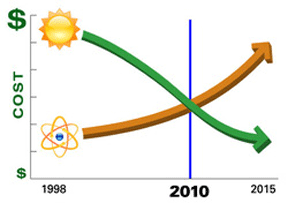 Areva suspends Trekkopje uranium mine project, Paul Langley’s Nuclear history Blog, 24 Aug 12 Areva has decided to suspend the Trekkopje uranium mine project. …. Rumours already started in October Areva planned to abandon the Trekkopje uranium mine project as part of a massive restructuring program that is to be set up in reaction to a drop in demand caused by the German nuclear phase-out and the Fukushima disaster….
Solar Project Aims to Becomes Largest in West Africa By Steve Leone, Associate Editor, RenewableEnergyWorld.com October 25, 2011 DALLAS, Texas — An American-based investment group has secured a power purchase agreement with the Namibian government to build a 500-megawatt photovoltaic power plant near the capital of Windhoek.
If built, the plant would represent the largest solar installation in West Africa, and could eventually include wind generation and grow up to 1 gigawatt. The group, led by Washington-based project developer SSI Energy Solutions (SSIES), is the parent company of Africa Energy Corp., which was set up for the Namibia project. Partners in the project include former SunEdison CEO Jigar Shah, Tom Amis and Nik Patesh of clean-energy law firm Cooley LLP, Eric Henderson of the Beacon Group and Adam Stern and Gary Kleiman of The Gemstone Group……. The project is far bigger than any solar project currently online in the southern hemisphere. South Africa, which borders Namibia, has garned the most interest in the region for large-scale developments…. http://nuclearhistory.wordpress.com/2012/08/23/areva-suspends-trekkopje-uranium-mine-project/
Court ruling on uranium company’s insurance policies
Court rules in uranium mine cleanup dispute http://www.vcstar.com/news/2012/aug/23/court-rules-in-uranium-mine-cleanup-dispute/#ixzz24VeeQu7N
– vcstar.com The Associated Press VCStar.com August 23, 2012 SANTA FE, N.M. (AP) – The state Supreme Court has ruled a uranium company’s insurance policies may cover costs of cleaning up contamination at a former mine in northwestern New Mexico.
The ruling on Thursday sends the dispute back to a district court to
determine what insurers must pay for, if any, involving a cleanup by
United Nuclear Corp. at the Northeast Church Rock mine near Gallup.
The site is adjacent to the Navajo Nation.
The court decision hinged on an insurance provision excluding coverage
for pollution damages unless the discharges were “sudden and
accidental.” The court concluded the term “sudden” meant unexpected
rather than happening over a short period of time. An insurance
company had contended its policies provided no liability coverage
because environmental damage at the mine happened over many years.
Why molten salt nuclear reactors and thorium nuclear reactors are duds
 Thorium: Not ‘green’, not ‘viable’, and not likely Oliver Tickell, April / May 2012. 1. Introduction ”With uranium-based nuclear power continuing its decades-long economic
Poisonous legacy of rare earths mining in China
Rare-earth mining in China comes at a heavy cost for local villages Guardian UK Pollution is poisoning the farms and villages of the region that processes the precious minerals , 7 August 2012 From the air it looks like a huge lake, fed by many tributaries, but on the ground it turns out to be a murky expanse of water, in which no fish or algae can survive. The shore is coated with a black crust, so thick you can walk on it. Into this huge, 10 sq km tailings pond nearby factories discharge water loaded with chemicals used to process the 17 most sought after minerals in the world, collectively known as rare earths.
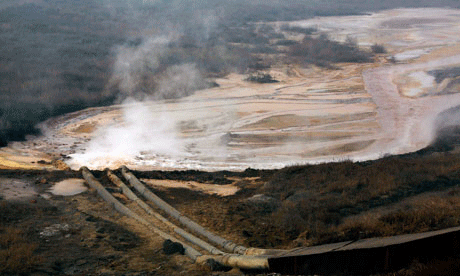
The town of Baotou, in Inner Mongolia, is the largest Chinese source of these strategic elements, essential to advanced technology, from smartphones to GPS receivers, but also to wind farms and, above all, electric cars. The minerals are mined at Bayan Obo, 120km farther north, then brought to Baotou for processing.
The concentration of rare earths in the ore is very low, so they must be separated and purified, using hydro-metallurgical techniques and acid baths. China accounts for 97% of global output of these precious substances, with two-thirds produced in Baotou.
The foul waters of the tailings pond contain all sorts of toxic chemicals, but also radioactive elements such as thorium which, if ingested, cause cancers of the pancreas and lungs, and leukaemia. “Before the factories were built, there were just fields here as far as the eye can see. In the place of this radioactive sludge, there were watermelons, aubergines and tomatoes,” says Li Guirong with a sigh.
It was in 1958 – when he was 10 – that a state-owned concern, the Baotou Iron and Steel company (Baogang), started producing rare-earth minerals. The lake appeared at that time. “To begin with we didn’t notice the pollution it was causing. How could we have known?” As secretary general of the local branch of the Communist party, he is one of the few residents who dares to speak out.
Towards the end of the 1980s, Li explains, crops in nearby villages started to fail: “Plants grew badly. They would flower all right, but sometimes there was no fruit or they were small or smelt awful.” Ten years later the villagers had to accept that vegetables simply would not grow any longer. In the village of Xinguang Sancun – much as in all those near the Baotou factories – farmers let some fields run wild and stopped planting anything but wheat and corn.
A study by the municipal environmental protection agency showed that rare-earth minerals were the source of their problems. The minerals themselves caused pollution, but also the dozens of new factories that had sprung up around the processing facilities and a fossil-fuel power station feeding Baotou’s new industrial fabric. Residents of what was now known as the “rare-earth capital of the world” were inhaling solvent vapour, particularly sulphuric acid, as well as coal dust, clearly visible in the air between houses.
Now the soil and groundwater are saturated with toxic substances. Five years ago Li had to get rid of his sick pigs, the last survivors of a collection of cows, horses, chickens and goats, killed off by the toxins.
The farmers have moved away. Most of the small brick houses in Xinguang Sancun, huddling close to one another, are going to rack and ruin. In just 10 years the population has dropped from 2,000 to 300 people…… http://www.guardian.co.uk/environment/2012/aug/07/china-rare-earth-village-pollution
Tanzania uranium project held up till Australian company Mantra pays taxes
Tanzania: Uranium Project Licence Shelved Till Tax Bill Paid, Beyond Nuclear 12 Aug 12, Dodoma – A SPECIAL mining licence to allow Russian firm, Uranium One start mining at Mkuju River in the Selous Game Reserve buffer zone, will not be issued until Australian Mantra Resources pay over 180 million US dollars (approx. 292.12bn/-) in taxes, the Parliament was told.
Call to protect Selous Game Reserve from uranium mining
The radioactive wastes pose a serious threat to Selous Game Reserve which is home to the world’s largest elephant population and other wildlife. No proven methods exist to keep the radioactive and toxic slush and liquids from seeping into surface waters, aquifers or spreading with the dry season wind into the Reserve.
The environmental groups urge the World Heritage Committee to reconsider its decision on the Selous Game Reserve Boundary Change and call upon the Government of Tanzania to refrain from licensing a uranium mine in Selous Game Reserve or on lands cut out from it.
World Heritage Comittee Decision on Selous Game Reserve Boundary Changes uranium-network.org, Freiburg, Germany Gunter Wippel , Elephants, Rhinos and the environment under threat from 60 million tons of radioactive waste as World Heritage Committee agrees boundary change that will allow uranium mining at the Tanzania Selous Game Reserve – a World Heritage site. Freiburg, Germany, July 30, 2012
A foreign uranium mining conglomerate will be allowed to exploit the precious Selous Game Reserve in Tanzania after the World Heritage Committee (WHC) decided, at its July 2012 session in Russia, to accept what was described as a “minor boundary change” of the site. The change had been requested by the Government of Tanzania, in order to make way for the development of a major uranium mine, Mkuju River Uranium Project, owned by Russian ARMZ and Canadian Uranium One.
The decision to allow the boundary change would allow the Mkuju River uranium project, situated in the South of the Selous Game Reserve at its transition to the Selous Niassa Wildlife Corridor, to go forward. The Tanzanian Government lobbied heavily for the boundary change, after declaring its intent to ” win the battle” against the UNESCO WHC.
Dozens of environmental groups around the world, many of them members of the German-based Uranium Network, decried the WHC decision which could lead to the creation of 60 million tons of radioactive and poisonous waste by the mine during its 10-year lifespan (139 million tons if a projected extension of the mine should be implemented) Continue reading
Uranium price not getting any better
 Uranium Spot Prices Slip Below $50 Uranium Investing News, August 8, 2012, By Melissa Pistilli – The uranium spot price slipped further last week, dropping below the $50 mark for the first time in nearly a year as sellers gave in to lower bids.
This week, TradeTech is reporting a spot price of $49.50 per pound, down 25 cents from the previous week. …. The consulting firm said transaction activity in the spot market remains “exceptionally weak,” with transaction volume at less than 500,000 pounds of U308 over the past two months. Even with ConverDyn’s Metropolis Works conversion facility looking at a possible 15-month shutdown for safety upgrades, “the market is at a standstill.”…
Mystery still shrouds uranium tailings storage
It is presently unknown what type of containment system —if any — would offer any degree of protection to groundwater or for how long at Coles Hill.
Mystery still shrouds uranium tailings storage, Star Tribune, Karen B. Maute August 1, 2012 Virginia Uranium Inc.’ website states: “Much of the tailings will be mixed with a cement-like substance and put back into the mine shafts and drifts, and the rest will be stored in heavily-monitored and regulated below-grade storage facilities.” Continue reading
Navajo Nation determined to get uranium cleanup
The Navajo Nation Diné Natural Resources Protection Act of 2005 prohibits uranium mining within Navajo Indian Country.
Uranium Cleanup is Priority for Navajos NEW MINING IS SECONDARY OFFICIALS SIGN AGREEMENT , Cibola Beacon, July 31, 2012 By Donald Jaramillo Beacon Managing Editor CIBOLA COUNTY – The Navajo Nation and many of its members have stated it loud and clear, no new uranium mining until cleanup is complete on Navajo lands.
An agreement was signed on July 19 between the Navajo Nation and Hydro Resources, Inc. (HRI), a subsidiary of Uranium Resources, Inc. (URI). Continue reading
a SILEX facility could make it much easier for a rogue state to clandestinely enrich weapons grade uranium to create nuclear bombs
SILEX could become America’s proliferation Fukushima,
Controversial nuclear technology alarms watchdogs http://www.smartplanet.com/blog/intelligent-energy/controversial-nuclear-technology-alarms-watchdogs/18138 By David Worthington | July 30, 2012 A controversial nuclear technology is raising alarms bells among critics who claim it may be better suited for making nuclear weapons than lowering the cost of nuclear power and could lead to a nonproliferation “Fukushima” for the United States. Continue reading
Cameco uranium company – profit loss with low sales and prices
Cameco profit hit by lower sales, prices Mining Peter Koven Jul 27, 2012 Second quarter profit dropped sharply at Cameco Corp. as the uranium giant’s sales volumes declined and it faced lower realized prices and higher costs.
Adjusted net income came in at $34-million, or 9 cents a share, down from 18 cents a year ago. The numbers fell short of analyst expectations.
Uranium sales volumes in the quarter were 5.3 million pounds, well down from 5.8 million pounds in the second quarter of 2011. Saskatoon-based Cameco’s realized price also dropped 8% year-over-year to US$42.08 a pound because of lower U.S.-dollar prices under
fixed-price contracts. Uranium production dropped 7%….
Flat uranium market with more uncertainty about the industry’s future
 Uranium, Two Pounds For A Benny International Business Times, July 24, 2012 By Andrew Nelson It was yet another dull week on the spot uranium market last week, marked by slim volumes and another minor price decline. As of Friday, a US$100 bill sporting the inscrutable face of Benjamin Franklin, will now buy you two pounds of uranium.
Industry analyst TradeTech reported just 3 transactions last week, with only 250,000 pounds changing hands. Also affecting trading was news that Honeywell will not restart production at its Metropolis Works conversion facility, operated by ConverDyn. The company said the plant could remain closed for as long as 12-15 months in order to
undertake safety upgrades ordered by the US Nuclear Regulatory Commission…….
Whether the news is relevant or not to the daily grind of the uranium spot trading, it certainly did a good job of introducing even more uncertainty into what remains a very tentative market. The end result of low volumes, at least one motivated sell and new uncertainly was a US$0.25 decline in TradeTech’s Weekly U3O8 Spot Price Indicator to US$50.00.
There was no activity and only a little demand in the term market. None of it was new and all of it is coming from non-US utilities. TradeTech’s mid-term and long-term indicators remained unchanged at US$54.00 and US$61.00 respectively….
http://au.ibtimes.com/articles/366001/20120724/uranium-two-pounds-for-a-benny.htm#.UBGVnGGe5dM
Keep Virginia’s ban on uranium, says Norfolk Council
Norfolk council backs uranium mining moratorium By Steven G. Vegh The Virginian-Pilot July 25, 2012 NORFOLK The City Council called unanimously on Tuesday for a continuation of the state’s moratorium on uranium mining to safeguard rivers and reservoirs that provide Norfolk’s drinking water.
“This is a vote for us to stand up for the system and against anything that may somehow taint the quality of the water,” Mayor Paul Fraim said after the vote at the council’s regular meeting.
Fraim said the action intentionally echoed a similar resolution approved by Virginia Beach last month against mining and milling uranium ore…. Fraim said the city’s water system serves 700,000 people a day, including naval bases. “We’re very protective of that system,” he said, and cautious about anything that might interfere with the water quality.
USA rejects South Korea’s push to enrich uranium
Samore says no need for S. Korea to enrich uranium By Lee Chi-dong WASHINGTON, July 23 (Yonhap) — Gary Samore, President Barack Obama’s top aide for nonproliferation, said Monday that the U.S. sees no need for South Korea to enrich uranium, a stance against Seoul’s goals. Continue reading
1 This Month

of the week – Shut Down Drone Warfare!


Tell the Ukrainian Government to Drop Prosecution of Peace Activist Yurii Sheliazhenko

Petition to revoke the licensing of the Near Surface Nuclear Disposal Facility (NSDF) at Chalk River. https://www.ourcommons.ca/petitions/en/Petition/Details?Petition=e-7247
To see nuclear-related stories in greater depth and intensity – go to https://nuclearinformation.wordpress.com
-
Archives
- April 2026 (114)
- March 2026 (251)
- February 2026 (268)
- January 2026 (308)
- December 2025 (358)
- November 2025 (359)
- October 2025 (376)
- September 2025 (257)
- August 2025 (319)
- July 2025 (230)
- June 2025 (348)
- May 2025 (261)
-
Categories
- 1
- 1 NUCLEAR ISSUES
- business and costs
- climate change
- culture and arts
- ENERGY
- environment
- health
- history
- indigenous issues
- Legal
- marketing of nuclear
- media
- opposition to nuclear
- PERSONAL STORIES
- politics
- politics international
- Religion and ethics
- safety
- secrets,lies and civil liberties
- spinbuster
- technology
- Uranium
- wastes
- weapons and war
- Women
- 2 WORLD
- ACTION
- AFRICA
- Atrocities
- AUSTRALIA
- Christina's notes
- Christina's themes
- culture and arts
- Events
- Fuk 2022
- Fuk 2023
- Fukushima 2017
- Fukushima 2018
- fukushima 2019
- Fukushima 2020
- Fukushima 2021
- general
- global warming
- Humour (God we need it)
- Nuclear
- RARE EARTHS
- Reference
- resources – print
- Resources -audiovicual
- Weekly Newsletter
- World
- World Nuclear
- YouTube
-
RSS
Entries RSS
Comments RSS
 nuclear-news