Uranium fever collides with industry’s dark past in Navajo country
Mining.com, Bloomberg News | January 14, 2025
A few miles south of the Grand Canyon, thousands of tons of uranium ore, reddish-gray, blue and radioactive, are piled up high in a clearing in the forest.
They’ve been there for months, stranded by a standoff between the mining company that dug them deep out of the ground, Energy Fuels Inc., and the leader of the Navajo Nation, Buu Nygren.
Back in the summer, Energy Fuels had triggered an uproar when it loaded some of the ore onto a truck, slapped a “radioactive” sign over the taillights and drove it through the heart of Navajo territory.
Radioactive is an alarming word anywhere, but here in Navajo country, surrounded by hundreds of abandoned uranium mines that powered America’s nuclear arms race with the USSR and spewed toxic waste into the land, it causes terror. Those fears have only grown the past couple years as nuclear power came back in vogue and sparked a uranium rush in mining camps all across the Southwest.
So when the news made it to Nygren that morning, he was furious. No one had sought his consent for the shipment. He quickly ordered dozens of police officers to throw on their sirens, fan out and intercept the truck.
The dragnet turned up nothing in the end — the truck snuck through — but the hard-line response delivered a warning, amplified over social media and ratified days later by the governor of Arizona, to the miners: Stay out of Navajo country.
Cut off from the lone processing mill in the US — all the main routes cut through Navajo territory — executives at Energy Fuels stockpiled it by the entrance of the mine. When the heaps of crushed rock grew too sprawling, they pulled the miners out of the tunnels and turned the drilling machines off…………………………………………………………………………………………………………………………………………………………………
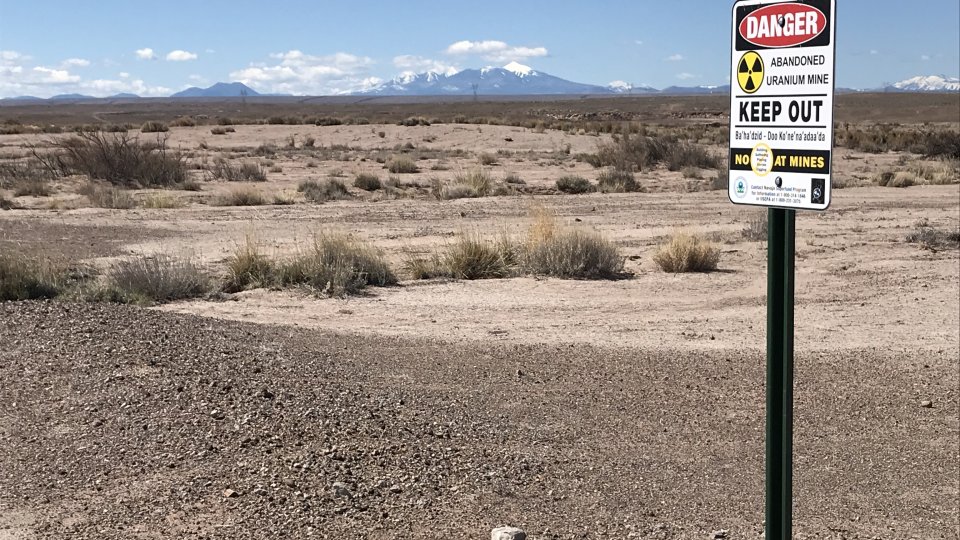
Animosity towards mining companies runs high on Navajo land. It’s visible everywhere. On huge roadside billboards and small office signs, in fading pinks and yellows and jet blacks, too. They read “Radioactive Pollution Kills” and “Haul No” and, along the main entrance to Cameron, a hard-scrabble village on the territory’s western edge, “No Uranium Mining.”
A few miles down the road, big mounds of sand streaked gray and blue rise, one after the other, high above the vast desert landscape. They are the tailings from some of the uranium mines that were abandoned in the territory last century.
To Ray Yellowfeather, a 50-year-old construction worker, the tailings were always the “blue hills,” just one big playground for him and his childhood friends.
“We would climb up the blue hills and slide back down,” Yellowfeather says. “Nobody told us they were dangerous.”
Years later, they would be cordoned off by the Environmental Protection Agency as it began work to clean up the mines. By then, though, the damage was done. Like many around here, Yellowfeather says he’s lost several family members to stomach cancer. The last of them was his mother in 2022.
Yellowfeather admits he doesn’t know exactly what caused their cancer but, he says, “I have to think it has to do with the piles of radioactive waste all around us.” It’s in the construction material in many of the homes and buildings and in the aquifers, too. To this day, drinking water is shipped into some of the hardest-hit areas.
The US government has recognized the harm its nuclear arms projects have done to communities in the Southwest. In 1990, Congress passed a law to compensate victims who contracted cancer and other diseases. It paid out some $2.5 billion over the ensuing three decades. The EPA, meanwhile, has been in charge of the clean-up of the abandoned mines. Two decades after the program began, though, only a small percentage have been worked on at all.
This is giving mining companies an opportunity to curry favor in tribal communities by offering to take over and expedite the clean-up of some mines.
…………………………………………………………………………..the EPA released a detailed study on Pinyon Plain. In it, the agency found that operations at the mine could contaminate the water supply of the Havasupai, a tribe tucked in such a remote corner of the Grand Canyon that it receives mail by mule. The report emboldened Havasupai leaders to step up their opposition to the mine, adding to Chalmers’s growing list of problems.
For the Navajo, the risks that come from the hauling of uranium through its territory are far smaller — so negligible as to be almost non-existent, according to Chalmers. Nygren is unmoved. The Navajo have heard such reassurances many times before, he says, only to pay dearly in the end.
Nygren grew up near a cluster of old mines right along the territory’s Arizona-Utah border, which makes the whole Energy Fuels affair “incredibly personal,” he says. His voice grows louder now and his tone more emphatic, indignant. To him, the Energy Fuels incursion feels no different than all the abuses committed over the course of decades by the US government and the mining companies that supplied it with a steady stream of uranium.
“We played a big role in the national security of the United States and we played a big part in the Cold War, providing energy for nuclear weapons. We’ve done our part. And now it’s time for the US to do its part by cleaning up these mines and respecting our laws.” https://www.mining.com/web/uranium-fever-collides-with-industrys-dark-past-in-navajo-country/
Poisoning the well – The toxic legacy of Cold War uranium mining in western New Mexico
Studies have shown that chronic exposure to uranium through drinking water can cause kidney damage and cardiovascular disease. When inhaled, uranium can lead to lung cancer and pulmonary fibrosis, a scarring of the lung tissue. Studies of uranium miners associate cumulative exposure to radon with higher rates of death by lung cancer.
Proving that one’s illness originated as a result of living near a mine or mill, as opposed to actually working in it, is nearly impossible, given that symptoms can take years to manifest — a lack of clear causation that is ultimately advantageous to polluters.
Near the western New Mexico town of Grants, the toxic legacy of Cold War uranium mining and milling has shattered lives, destroyed homes and created a contamination threat to the last clean source of groundwater for an entire region
SEARCHLIGHT NEW MEXICO, by Alicia Inez Guzmán, March 13, 2025 [ excellent pictures and maps]
Driving along a stretch of New Mexico Highway 605, just north of the tiny Village of Milan, it’s easy to imagine that this area has always been no-man’s-land. Little appears in the distance except for a smattering of homes and trees peppered by expanses of bone-dry scrub brush. But a hard second look reveals something else — vestiges of a mass departure. Sidewalks lead to nowhere, a dog house sits in the middle of a field next to a mound of cinder blocks, phone lines crisscross empty stretches of land and deserted propane tanks and mailboxes sit perched in front of nothing. Around the bend on one unpaved side road, a neighborhood watch sign stands sentinel where a neighborhood no longer exists…………………………………………………………………………………………………………………
This home site was once part of a cluster of five rural subdivisions interspersed with rich farm and ranchland. The Homestake Mining Company — famously known for gold mining in the Black Hills of South Dakota — took up residence here in 1958, to mill uranium. From that year until 1990, millions of tons of ore were prised from nearby mines and processed at Homestake, where the ore was ground into fine particles and leached with a solution that coaxed out pure uranium oxide, often called “yellowcake.” That uranium was then shipped off to help make America’s Cold War fleet of nuclear weapons or to power nuclear reactors. The leftover slurry was piped into two unlined earthen pits, the largest the size of 50 football fields and filled with over 21 million tons of uranium mill tailings.
Over time, the uranium tailings decayed into radon gas; meanwhile, radioactive contaminants seeped into four of the region’s aquifers. Residents compiled a list of neighbors who died of cancer — they called it the Death Map. In 2014, the U.S. Environmental Protection Agency (EPA) predicted that the probability of developing cancer was notably higher for residents who lived closest to the mill, especially if they drank the water.
In the intervening decades, Homestake attempted to hold its remaining contamination at bay rather than offer a long-term solution. That changed in 2020, when the company declared that a full cleanup of the groundwater was not feasible and instead embarked on a mass buyout and demolition of homes inside the rural subdivisions and beyond, Boomer and Billiman’s included. Homestake’s goal, ultimately, is to hand over 6,100 acres of land — almost twice the size of nearby Milan — to the U.S. Department of Energy (DOE) as part of a special federal program that takes over shuttered nuclear outfits when industry walks away. The deadline is 2035. And if this site is anything like the majority of the DOE’s other sites, the land will be rendered inaccessible to the public, with the company’s guarantee that toxins will stay inside the massive contamination zone boundary for a thousand years.
“Talk about the myth of containment,” says Christine Lowery, a commissioner in Cibola County. “The myth of reclamation as well,” she adds. For Lowery, a member of the Pueblo of Laguna who lives in Paguate, one of its six villages — itself blighted by the Jackpile-Paguate Uranium Mine, one of the world’s largest open pit uranium mines — the subtext is clear. “What they should be saying is, ‘We’ve contaminated everything we can, and there’s no way we can fix it.’”
In fact, the conditions necessary for contaminants to infiltrate a fifth aquifer in a single generation — not a thousand years — could already be in the making. The aquifer in question is the San Andres-Glorieta, so ancient that its limestone was forged from the same material as seashells before the era of the dinosaurs. It’s also the last clean source of groundwater for Milan, the county seat of Grants, many private well owners and the Pueblo of Laguna, as well as the Pueblo of Acoma, one of the longest continually inhabited communities in the United States.
According to regulators, the San Andres-Glorieta still meets standards for groundwater that is safe to use and drink. According to Homestake’s own reports, however, at least three uranium plumes are converging toward what Ann Maest, an aqueous geochemist with Buka Environmental, a Colorado-based firm, calls “a bull’s-eye of radioactive contamination.” The potential target? A geological formation called a subcrop. Here, approximately 100 feet below the surface of the earth and three miles southwest of the Homestake site, this subcrop directly connects the San Andres-Glorieta with an overlying aquifer long known to transport contamination from two uranium mills including Homestake. In 2022, the company commissioned an independent firm to study the geological feature. But according to a memo sent to state and federal regulators and written by Maest the following year, the findings were “light on interpretation” and evaded answering the most important question of all: Have those contaminants reached the San Andres-Glorieta?………………………
Gauging the extent of groundwater plumes is notoriously difficult. Topography and geology shape how groundwater moves, and sampling can underestimate the full range of a plume, leaving gaps in the data, whether that’s inadvertent or intentional. A 2022 ProPublica investigation found that regulators had been lax in their oversight of the Homestake mill, its toxic footprint and the uranium industry as a whole. Over time, a dizzying array of state and federal agencies have each overseen a different aspect of the site’s reclamation; in the past, those agencies haven’t even agreed on what that reclamation should look like.
Now, as uranium mining undergoes a national revival under initiatives that favor carbon-free nuclear energy, waste from the previous Cold War era of mining and milling endures. Homestake’s remediation — which has gone on for 49 years — exemplifies this legacy. During that time, company reports say, its collection wells have pumped out billions of gallons of contaminated water. Nearly one million pounds of uranium have been removed from the groundwater, too. Bingham says this represents 85 percent of the total uranium that was released into the environment. That’s in addition to the removal of tens of thousands of pounds of selenium and over a million pounds of molybdenum.
The company has attempted to keep pollutants that have seeped into groundwater from migrating farther away from the source. But this so-called hydraulic barrier has only addressed the symptoms of the contamination, not the cause: the tailings piles, which the company declined to relocate into a lined repository nearby. That means that some groundwater contamination continues to spread beyond Homestake’s site. The hydraulic barrier has another drawback — it has used “a massive amount of freshwater from the San Andres-Glorieta aquifer to operate,” says Laura Watchempino, a member of the Multicultural Alliance for a Safe Environment (MASE), a grassroots network of uranium-impacted communities working collectively to address the legacy of mining and milling on the health and environment of future generations. Watchempino is a former lawyer who also worked as a water quality specialist for the Pueblo of Acoma………………………………………………………………………………..
………………………………………………………………….Carver estimates that he is one of around 30 holdouts left in the five subdivisions; four of the families live in his own, Murray Acres. But few others have spent so much time fighting to hold the company accountable. “I’m 85 and it all started when I was 40,” he says.
In 1983, he was one of the plaintiffs in a lawsuit filed against the company, which argued, among other claims, that contamination of the well water had “completely destroyed the market value of the plaintiffs’ properties.” As part of the settlement, the company made small cash payments to residents and hooked them up to the municipal water system, which drew from the last clean source of water in the region, the San Andres-Glorieta. That year, the mill was designated a Superfund site, and in 1987 the company entered into a consent order with the EPA to analyze radon levels in residents’ homes, the product of uranium decaying from the tailings piles.
The mill closed in 1990, less than a decade after the uranium industry went bust. Records from the county assessor’s office show that Homestake quietly began buying a handful of homes in adjacent neighborhoods as early as 1996. (In 2001, Homestake Mining merged with the Canadian juggernaut, Barrick Gold, one of the world’s largest gold mining companies.)
“Every time someone dies or decides to move away, Homestake-Barrick Gold buys the property at a greatly reduced cost, which they can do because their ineffective groundwater remediation has devalued property many of us worked lifetimes to build,” Candace Head-Dylla, a former resident, said in a 2017 letter to the NRC.
In 2020, the company argued that it was no longer technically practical to clean up the groundwater to match its pre-mill days, Bingham wrote. So began the tangled regulatory process of applying for a less-stringent cleanup standard through the NR……………………………………
Searchlight asked the DOE for comment, but the agency declined. According to Samah Shaiq, a former DOE spokesperson, the agency is not yet responsible for the site.
The NRC denied Homestake’s application for the lower standard — the basis of the buyout — but the company remains steadfast in its desire to walk away. As part of those plans, Homestake has already scooped up approximately 455 of the estimated 523 properties that sit inside its proposed boundary, an expanse that’s nearly as large as the most contaminated area of the Rocky Flats Plant, another of the more than 100 sites under the DOE’s perpetual care, where thousands of plutonium bomb cores for the nation’s nuclear arsenal were fabricated between 1952 and 1989.
Much of Milan, along with huge swaths of land west and north, including some five miles of Highway 605, sit within this massive pie-shaped chunk, a proposed boundary that is based on the company’s groundwater modeling data. Inside are public water and electric lines, groundwater wells, septic systems and other, smaller roads, the fate of which have yet to be determined. Milan Elementary School sits only a mile away from the boundary’s southernmost rim.
When Searchlight asked how fast those plumes are migrating, drawing on a Homestake-produced simulation that’s meant to predict how contaminants move in groundwater aquifers at the site, the EPA declined to comment, because the simulation was still in draft form.
Regulators, meanwhile, are plodding through the process of determining what final act of remediation they should require before allowing Homestake to hand off the site to the DOE. But prospects for that remedy depend on whether and when the company will receive a lower cleanup threshold. If a lower standard is settled on, that remedy, whatever it may be, will fall radically short of truly protecting groundwater, advocates believe. Adding to the uncertainty is a recent announcement that the Trump administration intends to cut personnel at the EPA by up to 65 percent.
The future of the site seems all but predetermined: a wasteland in the truest sense, and a national sacrifice zone. The buyout, a prologue to this future, has fractured residents’ lives in the present. Homestake subjected sellers to nondisclosure agreements — “standard business practice,” in Bingham’s words — but to some in the community, a mechanism for silencing dissent……………………………………………………………………………………………………………………………………………
“We’ve been poisoned to the gills”
The Grants Mining District stretches from the Pueblo of Laguna to Gallup, across almost 100 miles of western New Mexico’s red bluffs. Uranium here and throughout the world is ancient even by cosmic standards………………………………………………………
…………………………..in time, more than 150 mines would be developed across this district and the greater San Mateo Creek Basin, and, today, there are a total of 261 former uranium mines statewide, making New Mexico the fourth-largest producer of uranium globally, behind East Germany, the Athabasca Basin and the Democratic Republic of the Congo, which supplied much of the uranium for the Manhattan Project.
But with the uranium boom came a wave of devastation across the greater Southwest, including in Indigenous communities like the Pueblo of Laguna, as well as the Navajo Nation, where there are more than 500 abandoned uranium mines. Workers often lived near mines and mills and would bring yellowcake home on their clothes, exposing their families to harmful radioactive dust; water sources, meanwhile, have shown “elevated levels of radiation,” according to the EPA.
In the Church Rock Chapter of the Navajo Nation, a tailings dam breached on an early July morning in 1979, sending contaminated water into the Rio Puerco. Today, it constitutes the largest release of nuclear materials in the U.S. worse even than the meltdown at Three Mile Island.
Church Rock was among the eight mills that processed uranium ore in New Mexico. Others include Homestake and, in its immediate vicinity, Bluewater and two mills at Ambrosia Lake. Workers flocked here from across the state and nation during the booming 1960s and 1970s, with Homestake alone employing 1,500 people at its peak.
After graduating from high school and intermittently through his college years, Carver worked stints at all four of those mills before opening his own business, Carver Oil. At Homestake, he worked at a site where yellowcake was processed and packaged into barrels to go to Oak Ridge, Tennessee, where it would be enriched for use in nuclear weapons. He also worked in the tailings piles.
Carver now receives benefits for spots on his lungs from the Radiation Exposure Compensation Act (RECA), a program he qualified for because of his time working in the mills. Whether his illness was compounded by living near the mill tailings and by breathing excess radon, or by drinking the water — at least until the company connected residents to a clean source — is unknown. Studies have shown that chronic exposure to uranium through drinking water can cause kidney damage and cardiovascular disease. When inhaled, uranium can lead to lung cancer and pulmonary fibrosis, a scarring of the lung tissue. Studies of uranium miners associate cumulative exposure to radon with higher rates of death by lung cancer.
Maggie Billiman, who’s from the Sawmill Chapter of the Navajo Nation, has advocated for RECA to cover people in New Mexico and parts of Arizona who lived downwind of atmospheric nuclear tests or who worked in mines after 1971, the current cutoff date. Last fall, she traveled with other Indigenous activists to Washington, D.C., as part of her efforts to expand RECA after struggling with various undiagnosed illnesses for years; several painful cysts that have yet to be biopsied were recently found on her liver and pancreas. Many doctor visits later, she’s still pursuing a clear diagnosis and treatment plan.
But whether or how one gets sick can depend on biological sex, age when exposed and the pathway a certain type of radioactive particle takes to enter the body. Proving that one’s illness originated as a result of living near a mine or mill, as opposed to actually working in it, is nearly impossible, given that symptoms can take years to manifest — a lack of clear causation that is ultimately advantageous to polluters.
Groundwater contamination from uranium mining was detected as early as 1961. Even before that, the federal government was aware that New Mexico’s waterways were already showing signs of radioactive contamination from the burgeoning uranium extraction industry. It would take another 15 years for Homestake to begin a convoluted, if limited, remediation effort: A series of collection wells would pull contaminated water out and treat it, then pump that water, along with clean water sourced from the San Andres-Glorieta, back into the subsurface.
………………………………………………………………………………………………………………………….. It’s hard to visualize such an underground fortification — on maps, it looks like a cashew-shaped moat that wraps around the west and south sides of the large tailings pile — or the timescale needed for its maintenance. In 1982, Homestake said it would “require operation for a considerable amount of time.” In response, NMED declared that Homestake had to commit to operating the system until it “can be demonstrated that contaminants in the groundwater will not exceed New Mexico Water Quality Control Commission standards off Homestake’s property in the foreseeable future.”
Advocates believe that means forever. If barrier maintenance is stopped, experts contend that highly contaminated groundwater will migrate southward and downward and eventually make its way to the subcrop, an entry point into the San Andres-Glorieta, municipal supply wells for Milan and Grants and eventually the Río San José. “This signals a bleak future for the stream system and for future generations,” Laura Watchempino warns.
Bluewater’s plume is coming from the northwest; Homestake’s plumes from the northeast. Models show that all are converging, like a Venn diagram, in a location where groundwater flows toward the subcrop. On one side, the hydraulic barrier is warding off some of that pollution, but when it stops operation completely, those contaminants will very likely infiltrate the San Andres-Glorieta, according to NMED.
In the past, it’s been difficult to discern what contaminants belong to what polluter, especially when they mingle, as is the case here. But in 2019, the USGS published the findings of a study that “fingerprinted” such mine and mill contaminants to show their point of origin……………………….
…………………………………….. “We’ve been poisoned to the gills,” says Christine Lowery, the Cibola county commissioner. “The question is: How do we recover and live with contamination?”
Alicia Inez Guzmán
Raised in the northern New Mexican village of Truchas, Alicia Inez Guzmán has written about histories of place, identity and land use in New Mexico. She brings this knowledge to her current role at Searchlight, where she focuses on nuclear issues and the impacts of the nuclear industry. The former senior editor of New Mexico Magazine, Alicia holds a Ph.D. in Visual and Cultural Studies from the University of Rochester in New York. More by Alicia Inez Guzmán https://searchlightnm.org/new-mexico-cold-war-uranium-mining-toxic-legacy-threat-homes-underground-aquifers/?utm_source=Searchlight+New+Mexico&utm_campaign=d2d0fd81fc-3%2F13%2F2025+%E2%80%93+Poisoning+the+well&utm_medium=email&utm_term=0_8e05fb0467-d2d0fd81fc-395610620&mc_cid=d2d0fd81fc&mc_eid=a70296a261
Fukushima Remembered At URENCO’s Uranium Enrichment Plant Today in Cheshire
Campaigners gathered today at the UK’s uranium enrichment plant to
remember Fukushima and hand over a letter of concern about uranium
enrichment. Today marks the 14th anniversary of the Fukushima catastrophe.
On March 11, 2011, a record 9.0-magnitude quake struck off the coast of
Japan’s Tohoku region, triggering a tsunami with waves that reached a
maximum height of 40.5 meters and causing a triple nuclear meltdown at the
Fukushima No.1 nuclear plant.
Radiation Free Lakeland 11th March 2025, https://mariannewildart.wordpress.com/2025/03/11/fukushima-remembered-at-urencos-uranium-enrichment-plant-today-in-cheshire/
Fearing toxic waste, Greenland ended uranium mining. Now, they could be forced to restart – or pay $11bn

Fearing toxic waste, Greenland ended uranium mining. Now, they could be
forced to restart – or pay $11bn. The island is being sued by a mining
company over its decision, and faces paying nine times its annual budget in
damages if it loses.
From the iceberg-filled bay, the mountains above the
town of Narsaq, in south-west Greenland, appear unremarkable. In the
September warmth, clumps of grass cling to the smooth, grey peaks shaped
over centuries by an enormous ice cap that lurks behind the fjords on the
horizon. Brightly coloured homes are scattered around the shoreline below,
home to a community of just over 1,300 people.
Were it not for a mining
outhouse on the edge of town, there would be little indication of the
potential riches in the rock. The range is home to one of the largest
undeveloped deposits of rare-earth minerals and uranium in the world: the
Kvanefjeld site, or Kuannersuit in Greenlandic. It contains high
concentrations of metals such as terbium and neodymium, which are used to
manufacture permanent magnets in wind turbines and electric cars. Every
major power in the world is scrambling to get access to these minerals for
carbon-free energy and transport.
A proposed open-pit mine would be worth
about $7.5bn (£6bn) if it went ahead, according to the site operator,
generating income for the island’s economy. But when the mining company
acquired the site in 2007, the impact of potentially radioactive waste
contaminating drinking water and nearby sheep farms alarmed local people.
They feared that the “tailings” – a slurry of ground-up waste from
mining – would be laced with radioactive waste and could contaminate
waterways or spread as dust in the air.
Guardian 5th March 2025, https://www.theguardian.com/environment/2025/mar/05/greenland-mining-energy-transition-minerals-environmental-laws-uranium-rare-earth-toxic-waste-investor-state-dispute-settlement-isds-aoe
As tensions rise, Canada to lean on U.S. for uranium enrichment

Matthew McClearn, February 24, 2025, Globe and Mail
Even as U.S. President Donald Trump talks of waging a campaign of “economic force” to persuade Canada to join a political union with the United States, Ontario Power Generation is preparing to construct an American reactor at its Darlington Nuclear Generating Station. The reactor’s uranium fuel would be enriched at a facility in New Mexico, a new vulnerability U.S. administrations could exploit.
Canada’s 17 operating reactors are of thehomegrown Candu design, which consume natural uranium. Canada possesses uranium in abundance and has long made its own fuel. But nearly all the reactors promoted for construction now require enriched uranium, which Canada can’t produce.
Proposals by Canadian utilities to build new reactors attracted American vendors, including GE-Hitachi Nuclear Energy (which is designing the BWRX-300, planned for deployment at Darlington and in Saskatchewan), Westinghouse Electric Co. and ARC Clean Technology. Until the past few months, the risks of the U.S. government weaponizing nuclear fuel against allies for political purposes seemed distant. Now it’s just one more aspect of Canada-U.S. relations that Mr. Trump has disrupted.
“Developing a dependence on another country for our nuclear fuel has always been a concern and recent events have proven those concerns are justified,” Bob Walker, national director of the Canadian Nuclear Workers’Council, an umbrella organization of unions within Canada’s nuclear industry, said in a written response to questions.
We haven’t done our due diligence in terms of having other partners,” said Akira Tokuhiro, a professor in Ontario Tech University’s nuclear engineering department.
“Canada needs to really invest and make a concerted effort to find and establish the nuclear supply chain without the United States.”………………………………………………………………………………………
Nuclear fuel supply agreements are typically confidential, so it’s unclear what provisions GE-Hitachi and OPG have made to deal with supply disruptions. (Orano’s presence, though, seems to offer OPG a non-American enrichment supplier.) Neither company granted an interview for this article.
“The arrangements are probably as robust as they could be under normal circumstances, but the circumstances are no longer normal,” Mr. Walker said.
“This is a very fluid situation,” OPG spokesperson Neal Kelly wrote in a statement. “We are proactively evaluating potential impacts and will act as the situation arises.”
Tariffs could make nuclear fuel far more costly. One mitigating factor, however, is that fuel represents a relatively small portion of nuclear plant operating costs – typically under 20 per cent. That’s a striking contrast with power plants that burn oil or natural gas.
George Christidis, acting chief executive of the Canadian Nuclear Association, said that if Washington imposed a 25-per-cent tariff on Canadian uranium, that would harm the U.S. enough to force re-evaluation.
“There’s such an interconnection within our industry, on the uranium side right into the American economy and energy system, that in the end, it really would be something that may cause them a lot of distress.”
The U.S. government could also deny Canada access to enriched fuel, for example as part of a broader campaign to undermine Canadian sovereignty, or to reserve it exclusively for American utilities.
“A presidential executive order could force the U.S. Nuclear Regulatory Commission to disallow shipments to Canada,” Mr. Walker wrote.
“We don’t know how likely it is but there is a risk it could happen.”
Halting nuclear fuel shipments likely wouldn’t have the immediate impact of, say, ceasing deliveries to Canada on natural gas pipelines. Unlike gas-fired power plants, which require a steady stream of fuel, reactors are only refuelled periodically, affording time to adjust. And the high energy density of nuclear fuel facilitates stockpiling.
Mr. Christidis discounted the idea that the U.S. would disrupt Canada’s ability to acquire low-enriched uranium.
“I think quite strongly that there will be a path forward between the two countries to work together.”
Ms. Hanebach said Canada’s uranium supply would provide leverage in negotiating relationships with new enrichment partners. But the list is short.
“If the U.S. decided to pull enrichment capacity, it would be Russia, then it’s China,” she said. “And then there’s some in France, Netherlands, U.K. and Germany. That’s it.”
Experts told The Globe and Mail that there’s no aspect of the Candu’s fuel cycle that relies on American inputs, making it more resilient to disruption.
AtkinsRéalis Group Inc., which has exclusive licensing rights to Candu technology, regards that as a trump card against U.S. competitors – as it made clear in a survey it published in January. “Candu uses unenriched uranium,” noted the preamble to one question, while another said: “Westinghouse uses enriched uranium imported from countries like Russia.” Informed by such statements, 84 per cent of respondents said they preferred Candus over Westinghouse reactors.
“Candu emerges as the clear favourite,” AtkinsRéalis enthused.
But there’s a problem: The Candu is widely regarded as obsolete. The last one built in Canada was Darlington Unit 4, completed in 1993. Since then a number of new designs have been drawn up, but none were licensed or built. AtkinsRéalis now has a team of 250 employees designing a modernized version dubbed the Monark.
If Canada follows through on plans to build a fleet of light water reactors in Ontario, Saskatchewan and possibly elsewhere, it could elect to build its own enrichment capacity. Energy analyst Juzel Lloyd suggested doing precisely this, in a recent commentary for the Macdonald-Laurier Institute.
“Recent global events demand that the Canadian government re-evaluate its position on uranium enrichment,” she wrote.
“By initiating enrichment services, Canada can diversify the global nuclear supply chain, reduce reliance on Russian fuel and ensure the energy security of both established and emerging nuclear-powered states.”
The conventional wisdom, though, is that enrichment is so technically challenging and costly that only nuclear weapons states can justify it. (Japan is the noteworthy exception.) Prof. Tokuhiro said acquiring enrichment capacity would cost at least $100-billion and take at least 20 years.
“It’s more money than the Canadian government is willing to commit,” he said.
Ms. Hanebach observed that many legislative and regulatory changes would be required. Canada is a party to the Treaty on the Non-Proliferation of Nuclear Weapons, for example. “We would need to work with the International Atomic Energy Agency on that, and then implement that in domestic legislation,” she said. Canada doesn’t have a regulatory framework for enrichment, either.
Internationally, enrichment capability is tightly controlled by the Nuclear Suppliers Group to prevent weapons proliferation. Canada’s a member but is not permitted to enrich uranium.
Steve Aplin, of the Canadian Nuclear Workers’ Council, said Canada had sought U.S. support in 2006 before the Group to construct an enrichment facility here in Canada, but the U.S. refused outright.
“It was all very preliminary,” Mr. Aplin wrote. “The Americans refused because they want to control how many ‘enrichers’ there are in the world.”
Furthermore, he said that had the U.S. acquiesced, Russia, which is also a member, would not.
“Russia, like America, likes the fact they possess enrichment capacity and others don’t.” subscription:https://www.theglobeandmail.com/business/article-with-us-tensions-rising-canada-lacks-its-own-uranium-enrichment/
Radioactive Roulette: Uranium Mining Threatens Vital Southern African Aquifer
Andrew Maramwidze , 16 Jan 25, https://namibianminingnews.com/radioactive-roulette-uranium-mining-threatens-vital-southern-african-aquifer/?fbclid=IwY2xjawIeBAdleHRuA2FlbQIxMQABHSb3NRHlM9u5GURoopgphOqCBJptJNaq2Brc8FAAJr2DXIXC9rPY_nk-uA_aem_TR9RB_c4htmreaRa1XUdXA
The idyllic image of the Stampriet Transboundary Aquifer System, a vast freshwater reserve stretching across Namibia, South Africa, and Botswana, is under threat. The Namibian government has issued a flurry of uranium exploration permits, igniting fears that this precious resource could be irrevocably contaminated by the very industry it is meant to sustain.
This aquifer, roughly the size of Austria, provides a lifeline for over 50,000 people across the region. However, the allure of uranium, a key component in nuclear power generation, has enticed mining companies to stake their claims. While the Namibian government insists on safeguarding the aquifer, the potential for contamination looms large.
Uranium mining, by its very nature, carries significant environmental risks. The process often involves injecting sulfuric acid into the ground to dissolve uranium-rich rock, a method that can leach radioactive fluids into the surrounding environment. The long-term consequences of such contamination are dire, potentially leading to severe health issues for local populations, including cancer, kidney damage, and respiratory problems.
The experience of other mining regions, such as the boreal zone in Canada, provides a sobering cautionary tale. Acid mine drainage and mine effluents have contaminated numerous water sources, highlighting the difficulty of mitigating the environmental impact of large-scale mining operations. Furthermore, the long-term rehabilitation of mine sites often proves challenging, with determining individual mine’s responsibility for environmental damage proving to be a complex and protracted process.
The Namibian government, while acknowledging the potential risks, has awarded 35 uranium exploration permits, covering a vast expanse of territory. This raises serious concerns about the adequacy of environmental impact assessments and the long-term sustainability of the aquifer.
The potential impact on the aquifer extends beyond Namibia’s borders. The Stampriet Transboundary Aquifer System is a shared resource, and its contamination would have far-reaching consequences for South Africa and Botswana.
The need for cooperation between the three nations is paramount. A comprehensive, independent scientific assessment of the potential risks is crucial, along with the development of robust environmental safeguards and a clear plan for long-term monitoring and mitigation.
While the allure of mineral wealth is undeniable, it is imperative to prioritize the long-term health and well-being of the people who depend on this vital water source. The potential consequences of uranium mining in this sensitive region are simply too grave to ignore.
The question remains: Is the short-term economic gain worth the long-term environmental and human cost? The answer, for the sake of future generations, must be a resounding no.
Republican urges Trump to overrule court and open Grand Canyon to uranium mining

Shondiin Silversmith, Arizona Mirror, Raw Story 12th Feb 2025
A top Arizona Republican is hoping the Trump administration will do what a federal court wouldn’t: overturn a national monument protecting lands around the Grand Canyon so that mining companies can extract uranium and other valuable minerals from the land.
Arizona Senate President Warren Petersen sent a letter to the U.S. Department of the Interior on Feb. 7 requesting a meeting with Secretary of the Interior Doug Burgum to discuss ending the “government overreach” of the national monument and ban on uranium mining in the area.
At issue is the Baaj Nwaavjo I’tah Kukveni – Ancestral Footprints of the Grand Canyon National Monument, which President Joe Bidencreated in 2023. Petersen and Ben Toma, who was at the time the speaker of the state House of Representatives, sued to have the designation revoked…………………………………
The Grand Canyon is the ancestral homeland of multiple tribal nations across the Southwest, and tribes still rely on the canyon for natural and cultural resources that are significant and sacred to their communities.
The monument protects thousands of historical and scientific objects, sacred sites, vital water sources and the ancestral homelands of many Indigenous communities. ……… https://www.rawstory.com/after-court-loss-gop-targets-grand-canyon-monument-through-trump/
Uranium fever collides with industry’s dark past in Navajo country
by Jacob Lorinc, Phys Org, 20Jan 25
A few miles south of the Grand Canyon, thousands of tons of uranium ore, reddish-gray, blue and radioactive, are piled up high in a clearing in the forest.
They’ve been there for months, stranded by a standoff between the mining company that dug them deep out of the ground, Energy Fuels Inc., and the leader of the Navajo Nation, Buu Nygren.
Back in the summer, Energy Fuels had triggered an uproar when it loaded some of the ore onto a truck, slapped a “radioactive” sign over the taillights and drove it through the heart of Navajo territory. Radioactive is an alarming word anywhere, but here in Navajo country, surrounded by hundreds of abandoned uranium mines that powered America’s nuclear arms race with the USSR and spewed toxic waste into the land, it causes terror.
Those fears have only grown in the past couple of years as nuclear power came back in vogue and sparked a uranium rush in mining camps all across the Southwest. So when the news made it to Nygren that morning, he was furious. No one had sought his consent for the shipment. He quickly ordered dozens of police officers to throw on their sirens, fan out and intercept the truck.
The dragnet turned up nothing in the end—the truck snuck through—but the hard-line response delivered a warning, amplified over social media and ratified days later by the governor of Arizona, to the miners: Stay out of Navajo country.
Cut off from the lone processing mill in the U.S.—all the main routes cut through Navajo territory—executives at Energy Fuels stockpiled it by the entrance of the mine. When the heaps of crushed rock grew too sprawling, they pulled the miners out of the tunnels and turned the drilling machines off.
The standoff represents the ugly side of the world’s sudden re-embrace of nuclear power. Yes, there’s the promise of a steady stream of clean energy to fuel the AI boom, fight climate change and, in the wake of Vladimir Putin’s invasion of Ukraine, replace Russian oil and gas.
But there’s also the fear—both around the nuclear reactor sites popping up across the world and in the communities surrounding mining operations in Australia, Kyrgyzstan and Navajo Nation, where the locals are still documenting cancer cases decades after the last of the Cold War-era outfits shut down.
It’s like the backlash erupting over all sorts of other mining projects crucial to the transition away from fossil fuels—lithium, nickel, copper, cobalt, zinc—just with the added threat of radioactivity.”Generations and generations of my people have been hurt,” Nygren, 38, said in an interview. “Go find uranium somewhere else.”
Truth is there isn’t all that much uranium at the Energy Fuels mine, known as Pinyon Plain, or any of the other half-dozen mines that opened in the Southwest the past couple years.
In most cases, crews are simply combing through the untouched veins of mines that were closed when the 2011 Fukushima disaster scared global leaders away from nuclear power and crashed the uranium market. Pooled all together, they only hold a fraction of the hundreds of millions of pounds of ore buried in any of the top mines in Canada, Kazakhstan and Namibia.
So the rush of mining activity here serves as a testament to the magnitude of the uranium fever sweeping the globe right now. At just over $70 per pound, the price is up some 200% over the past five years—even after it gave back a chunk of its gains in 2024.
……………………………………………………….At Pinyon Plain, they’re used to setbacks. Prospectors discovered the deposit in the 1970s but by the time all the mining permits were secured a decade later, the global uranium market had collapsed. Just like in 2011, the initial trigger was a nuclear disaster, the Chernobyl meltdown. And then, a few years later, the Berlin Wall fell and the nuclear arms race was over.
Plans were hatched over the years to open the mine as uranium prices bumped higher, but the enthusiasm would die as soon as the rally faded. It took the 2022 price surge to get Chalmers, who’s been scouting out Pinyon Plain ever since he first joined Energy Fuels back in the 1980s, to finally ram it through.
Now, after a single shipment to the mill in Utah, he’s stuck again. As he sees it, routes 89 and 160 are federal highways and, as a result, subject to federal shipping laws. The company doesn’t need the Navajos’ authorization, he says. To Nygren, every single inch of Navajo territory is subject to tribal law……………………..
Animosity towards mining companies runs high on Navajo land. It’s visible everywhere. On huge roadside billboards and small office signs, in fading pinks and yellows and jet blacks, too. They read “Radioactive Pollution Kills” and “Haul No” and, along the main entrance to Cameron, a hard-scrabble village on the territory’s western edge, “No Uranium Mining.”
A few miles down the road, big mounds of sand streaked gray and blue rise, one after the other, high above the vast desert landscape. They are the tailings from some of the uranium mines that were abandoned in the territory last century.
To Ray Yellowfeather, a 50-year-old construction worker, the tailings were always the “blue hills,” just one big playground for him and his childhood friends.
“We would climb up the blue hills and slide back down,” Yellowfeather says. “Nobody told us they were dangerous.”
Years later, they would be cordoned off by the Environmental Protection Agency as it began work to clean up the mines. By then, though, the damage was done. Like many around here, Yellowfeather says he’s lost several family members to stomach cancer. The last of them was his mother in 2022
Yellowfeather admits he doesn’t know exactly what caused their cancer but, he says, “I have to think it has to do with the piles of radioactive waste all around us.” It’s in the construction material in many of the homes and buildings and in the aquifers, too. To this day, drinking water is shipped into some of the hardest-hit areas.
The U.S. government has recognized the harm its nuclear arms projects have done to communities in the Southwest. In 1990, Congress passed a law to compensate victims who contracted cancer and other diseases. It paid out some $2.5 billion over the ensuing three decades.
The EPA, meanwhile, has been in charge of the clean-up of the abandoned mines. Two decades after the program began, though, only a small percentage have been worked on at all.
This is giving mining companies an opportunity to curry favor in tribal communities by offering to take over and expedite the clean-up of some mines. Chalmers has made it a key point in negotiations with Nygren.
…………. the EPA released a detailed study on Pinyon Plain. In it, the agency found that operations at the mine could contaminate the water supply of the Havasupai, a tribe tucked in such a remote corner of the Grand Canyon that it receives mail by mule. The report emboldened Havasupai leaders to step up their opposition to the mine, adding to Chalmers’s growing list of problems.”…….. https://phys.org/news/2025-01-uranium-fever-collides-industry-dark.amp?fbclid=IwY2xjawIUwvtleHRuA2FlbQIxMQABHey6Nv6MJqijcV5suiJOZjDx46rSSzwyrFBVrtbA0McaSeoPu-rhCeR0zQ_aem_N06qMIWp_xVHiPlfOH7DG
Concerns about Agnew Lake Uranium Mine Unheard at Nuclear Commission Meeting.

| Northwatch, 29 Jan 25 |
Saskatoon – Canada’s federal nuclear regulator is holding a public meeting in Saskatoon today about uranium mines, including closed and decommissioned uranium mines in northeastern Ontario. In their overview presentation this morning Canadian Nuclear Safety Commission (CNSC) staff omitted any discussion of the closed mines in Elliot Lake or the Agnew Lake mine, which were issues of high concern to intervenors including the Township of Nairn and Hyman and the northeastern Ontario environmental group Northwatch.
The Township of Nairn and Hyman retained a technical expert and provide a written intervention outlining their community’s growing concerns regarding the environmental and public health risks associated with the Agnew Lake Tailings Management Area (TMA). The Township noted that the 2023 Annual Report prepared by the Ministry of Mines exposes critical deficiencies in the Agnew Lake TMA’s environmental monitoring and contamination levels. Groundwater, surface water, and soil samples collected during the monitoring period indicate widespread exceedances of contaminants and heavy metals.
“Nothing could be more important to Nairn & Hyman than our drinking water and natural resources. The Agnew Lake Tailings Management Area (ALTMA) needs to be adequately managed to safeguard our immediate neighbours, waterways, and the surrounding environment”, commented Mayor Amy Mazey.
“We have profound concerns for the lack of site-specific details contained in this report. For instance, the report fails to acknowledge contaminant exceedances in the surface water, ground water and sediment adjacent to the site that include uranium, radium, arsenic and cyanide. We are hopeful that the CNSC will take these concerns seriously and act appropriately by expertly managing ALTMA.”
Northwatch outlined similar concerns in their written intervention, including general comments on the CNSC regulatory report, which it found to be lacking detail and sufficient supporting information and rationale for conclusions, and noted that most concerns Northwatch and its technical experts had identified during previous reviews did not appear to have been resolved, and many concerns have continued or perhaps worsened during the current reporting period, particularly at the Agnew Lake site. Northwatch also commented on negative trends in the decommissioned mines in the Elliot Lake area, including rising concentrations of radium in water discharge and sediments and poor performance in meeting water quality benchmarks.
The Township of Nairn and Hyman and Northwatch both expressed strong concerns about a proposal to transfer large low-level radioactive wastes from just outside North Bay to deposit on the tailings management area at the Agnew Lake Mine.
During a 2015 inspection, CNSC staff found sections of the tailings were exposed where the tailings management area cover had degraded. The response proposed by the Ministry of Mines, who is licensed to manage the Agnew Lake Mine, was to transfer 20,000 m3 of niobium bearing material classified as naturally occurring radioactive material (NORM) from the former Beaucage Mine near North Bay and place it on the Agnew Lake tailings. Northwatch objected in its 2018 written intervention on the grounds of there having been insufficient review of the potential for negative effects of adding the niobium wastes to the Agnew Lake tailings. At a public meeting in Nairn Centre on September 11th of this year, repairs to the tailings cover had still not been done and no information on the potential cumulative effects of adding the niobium waste to the uranium tailings was presented by staff from the Canadian Nuclear Safety Commission or the Ontario Ministry of Mines.
Neither the Township of Nairn and Hyman or Northwatch were permitted to present at the Commission meeting underway today in Saskatoon. CNSC staff presented the regulatory report in the morning session but included no mention of the closed mines in northeastern Ontario or the several significant concerns raised by the Township of Nairn and Hyman or Northwatch in their written interventions.
The public meeting is being streamed live at https://cnsc.isilive.ca/ and will continue throughout the day. The Commission has the option of asking questions of CNSC staff about the written interventions during the afternoon session.
The Township of Nairn and Hyman and the Township of Baldwin will be holding a Joint Public Meeting on February 18 at 7:00 p.m. in the community centre in Nairn Centre to provide updates to residents on the review undertaken by the Township of Nairn and Hyman and various meeting outcomes, including today’s public meeting of the CNSC.
How Canada supplied uranium for the Manhattan Project
Peter C. van Wyck · CBC, Jan 10, 2025
In the past couple of years, the public imagination has been taken up with all things nuclear — the bomb, energy and waste. The film Oppenheimer recasts the story of the bomb as a Promethean and largely American narrative, while the series Fallout depicts a post-nuclear world. Russia has repeatedly emphasized its readiness for nuclear conflict. Nuclear energy has been regaining popularity as a hedge against climate change.
And yet, the story of Canada’s nuclear legacy — and our connection to the bombs that the U.S. military dropped on the Japanese cities of Hiroshima and Nagasaki, killing tens of thousands in an instant — is rarely told.
The documentary Atomic Reaction examines the impact of the radioactive materials mined in a Dene community in the Northwest Territories in the 1930s and ’40s. That radioactive ore was transported thousands of kilometres south, via Canada’s “Atomic Highway,” to be refined in Port Hope, Ont. And the uranium was used in the Manhattan Project, which developed those atomic bombs.
A mineral with immense power
This Canadian story began in 1930. Gilbert LaBine, a co-founder of Eldorado Gold Mines, discovered a rich deposit of radioactive pitchblende ore — containing radium, uranium and polonium — as well as silver, on the eastern shores of Great Bear Lake in the Northwest Territories. The site, on the traditional lands of the Sahtúgot’įnę Dene, came to be known as Port Radium. In a stroke, the country had entered the atomic age. ………………………………….
Port Hope: ‘The town that radiates friendliness’
In 1932, Eldorado constructed a radium-processing plant in Port Hope, the only such refinery in North America. Eldorado secured an abandoned waterfront factory and hired Marcel Pochon, a former student of radioactivity pioneers Marie and Pierre Curie, to mass-produce radium.
By 1936, the first grams of radium salts had been produced. (More than six tonnes of pitchblende are needed to produce a gram of radium.) However, by the late 1930s, Eldorado’s radium business was in decline. Competition with Belgium’s mine in the Congo was fierce, and global radium prices had fallen. In 1940, the Port Radium mine closed.
But soon, Eldorado’s and Port Hope’s fortunes radically changed. Uranium, previously considered waste from the processing of radium, became a strategic commodity. In 1942, LaBine’s Eldorado signed contracts with the U.S. military to supply uranium to the fledgling Manhattan Project, and the mine at Port Radium quietly reopened. In 1943, the company changed its name to Eldorado Mining and Refining, and in early 1944 the Canadian government took over the company and made it a Crown corporation.
The Port Hope refinery processed both Canadian and Congolese ores for the Manhattan Project. Eldorado continued to refine military-grade uranium for the Americans until 1965. The facility currently converts nuclear-grade uranium trioxide into uranium hexafluoride or uranium dioxide, used in nuclear reactors around the world. In the 1970s, a billboard leading into town even read, “Beautiful old Port Hope. The town that radiates friendliness.” Today, the plant is owned by Cameco, one of the world’s largest publicly traded uranium companies.
A lasting legacy and a massive cleanup
In Délı̨nę, a Dene community near Port Radium, a dark shadow remains after so many residents worked in the mine without being told they were involved in the Manhattan Project. And later, Dene miners started dying of lung cancer, earning the community of Délı̨nę the grim nickname the “Village of Widows.”
In 2005, a national report examining the health and environmental effects of the mine concluded there was no scientific link between cancer rates in Délı̨nę and mining activities in the area. But another study by the Canadian Nuclear Safety Commission the following year found increased rates of lung cancer in mine workers. People in the community still feel fear and anxiety about Port Radium’s impact on their health.
But the story of Eldorado and Port Hope also includes radioactive and chemical contamination.
Today, the municipalities of Port Hope and neighbouring Clarington are the sites of the largest volume of historic low-level radioactive waste in Canada — a result of spillage, leakage and widespread disposal of contaminated fill and other materials.
Major radioactive contamination in the area first came to light in the late 1960s, but little was done.
It wasn’t until 1975 that the public started to become aware of the problem, when St. Mary’s elementary school was abruptly closed. Eldorado had detected gamma radiation in the school’s parking lot and dangerously high levels of radon gas in the school; the building had unknowingly been built on contaminated fill from Eldorado’s operations some 15 years earlier.
The school closure set in motion a flurry of activity. It came to light that radioactive and chemical waste — estimated at roughly two million cubic metres — had been dumped directly into the harbour beside the plant and in ravines around town and used in the construction of homes, basements, driveways, businesses, roads, schools and other public buildings. Properties were surveyed for radiation levels; several hundred of them were remediated; and some 100,000 tonnes of contaminated soil and materials were relocated to a site at Chalk River, operated by Atomic Energy of Canada Ltd. (AECL). Still, the scope and severity of the contamination was not fully understood.
In 2001, the Port Hope Area Initiative (PHAI) began — a government plan to ensure the safe long-term management of historic low-level radioactive waste.
In 2012, the minister of natural resources announced an investment of $1.28 billion over 10 years for the PHAI. A radiological survey of approximately 4,800 public and private properties began, along with project design, an environmental assessment and community engagement.
Today, many sites await cleanup, and waste is still produced and stored at the Port Hope facility. https://www.cbc.ca/documentaries/how-canada-supplied-uranium-for-the-manhattan-project-1.7402051
Saudi Arabia plans to enrich and sell uranium as Iran commences nuclear talks with E3

Jan 13, 2025,
https://www.iranintl.com/en/202501135824
audi Arabia plans to monetize all its mineral resources, including uranium, by enriching and selling it, while Iran begins nuclear talks with the E3 in Geneva.
Speaking at a conference in Dhahran, Saudi energy minister Prince Abdulaziz bin Salman said on Monday, “We will enrich it and we will sell it and we will do a ‘yellowcake,'” referring to the powdered concentrate used to prepare uranium fuel for nuclear reactors.
According to Iranian media, Iran’s two-day discussions with the E3 (Britain, France, and Germany), along with a European Union representative, will focus on negotiations for a nuclear deal and regional issues.
The talks follow November meetings amid tensions following the UN nuclear watchdog’s Board of Governors’ resolution censuring Iran, demanding that Tehran resolve outstanding issues with the IAEA over its advancing nuclear program.
US to study proliferation risk of HALEU nuclear fuel, after warning by scientists

By Timothy Gardner January 10, 2025
WASHINGTON, Jan 8 (Reuters) – The U.S. agency in charge of nuclear security is commissioning a study on the proliferation risks of a more-enriched uranium fuel that nuclear power developers want to fuel new high-tech reactors, the head of the agency said this week.
Jill Hruby, administrator of the National Nuclear Security Administration, said in a statement published in the journal Science that it is important to address proliferation concerns of so-called high assay, low-enriched uranium fuel, or HALEU.
“NNSA recognizes that reactor type, fuel enrichment level, fuel quantity, and fuel form are important factors in evaluating proliferation risks and believes that risk-informed and adaptive approaches to the proliferation challenges inherent in nuclear energy are warranted,” Hruby said.
Planned new nuclear plants, known as small modular reactors, or advanced reactors, must set high standards for safety and security, “especially considering Russia’s takeover of Ukraine’s largest nuclear power plant,” she said.
Russia in 2022 took the Zaporizhzhia plant, the largest nuclear plant in Europe, by force after it invaded Ukraine.
Hruby’s statement was in response to an article published last year in which scientists said HALEU poses a security risk because it can be used without further enrichment as fissile material in a crude nuclear weapon.
HALEU is uranium fuel enriched up to 20% instead of the 5% level of uranium fuel used in today’s commercial reactors.
Several companies are hoping to develop a wave of reactors that would use HALEU, including the Bill Gates-backed TerraPower, which wants to build a $4 billion plant in Wyoming by 2030. Nuclear has gotten attention from technology companies seeking new ways to power data centers and as U.S. power demand is growing for the first time in decades. None of the plants have yet to be built.
TerraPower did not immediately respond to a request for comment.
In October, the U.S. Energy Department rolled out initial contracts to four companies hoping to produce HALEU domestically. Currently, commercial amounts of HALEU are only produced in Russia. The U.S. contracts will last up to 10 years and each awardee received a minimum of $2 million, with up to $2.7 billion available subject to congressional appropriations.
Hruby said NNSA has regularly collected data and evaluated HALEU risks, and is finalizing plans to commission a National Academies report. The reports are largely classified, she said. But the information will be used to inform programs, develop actions, and make recommendations to stakeholders.
Edwin Lyman, a physicist at the Union of Concerned Scientists and an author of last year’s report, said he appreciated that Hruby is asking for the independent review of HALEU by the National Academies. “We are hopeful that this effort will lead to tighter security controls on HALEU to prevent its misuse by proliferators and terrorists.”
The authors had written that if HALEU enrichment is limited to 10% to 12%, the supply chain would be far safer with only modest costs.
Nuclear company Orano seeks arbitration over Niger mining licence
World Nuclear News 20th Dec 2024, https://www.world-nuclear-news.org/articles/orano-seeks-arbitration-over-niger-mining-licence
The French company has opened international arbitration proceedings against the State of Niger following the withdrawal of its mining licence for the Imouraren project in June.
“This move comes after several months of unsuccessful attempts at mediation and conciliation,” the company said.
The Imouraren project is about 80km south of Arlit and about 160km north of Agadez and, with mineral reserves of over 200,000 tU, is one of the largest known uranium reserves in the world. Operating company Imouraren SA – owned 66.65% by Orano Expansion and 33.35% by Niger state interests – was awarded an operating permit to mine the deposit in 2009, but development work was suspended in 2015 due to market conditions at the time.
Earlier this year, the company announced it had restarted preparatory work for the project, but within days the Nigerien authorities withdrew the Orano subsidiary’s operating permit.
“The announcement of the withdrawal of the licence took place when Orano presented the State of Niger with a concrete, technical proposal, which would have allowed the IMOURAREN deposit to be exploited as quickly as possible, and after works had resumed since June 2024,” Orano said today. It has engaged law firm Clay Arbitration as its representative.
In July, the Nigerien authorities also withdrew Canadian company GoviEx Uranium’s mining rights for the Madouela uranium project. Earlier this month, the company and its fully owned subsidiary GoviEx Niger Holdings Ltd started proceedings against Niger under the Convention on the Settlement of Investment Disputes Between States and Nationals of Other States, on the basis the state had breached its legal obligations in withdrawing the permit.
How a uranium mine became a pawn in the row between Niger and France
Paul Melly, BBC 8th Dec 2024
In the latest sign of a dramatic deterioration in relations, Niger’s military rulers appear increasingly determined to drive France out of any significant sector in their economy – and particularly uranium mining.
This week the French state nuclear company Orano announced that the junta – which deposed France’s ally, President Mohamed Bazoum, in a coup in July 2023 – had taken operational control of its local mining firm, Somaïr.
The company’s efforts to resume exports have for months been blocked by the regime and it is being pushed into financial crisis.
And the impact could be felt more widely – although Niger accounts for less than 5% of the uranium produced globally, in 2022 it accounted for a quarter of the supply to nuclear power plants across Europe.
So the timing could hardly be more awkward, as Western countries struggle to meet the challenge of climate change and cut their carbon emissions from electricity generation.
For French President Emmanuel Macron, already wrestling with political crisis at home, the potential departure of Orano from Niger is certainly awkward in image terms…………………………………………………………………………………………………………
In this poisonous atmosphere of hostility and mistrust, Orano was an obvious and convenient target for junta retaliation.
The French company’s predominant role in the uranium sector had for years fuelled resentment among many Nigériens, amidst claims that the French company was buying their uranium on the cheap, despite periodic renegotiations of the export deal. Although the mining operations only started years after independence, they were seen as emblematic of France’s ongoing post-colonial influence.
……………….Niger’s junta feels no need to make concessions to Orano because it is now buoyed by a sharp rise in oil exports, thanks to a new Chinese-built pipeline.
With that financial cushion, the regime appears prepared to bear the cost of paralysing and probably dismantling the traditional uranium partnership with France – now its main international opponent.
https://www.bbc.co.uk/news/articles/czjd70mzge2o
Relationship Between Urinary Uranium and Cardiac Geometry and Left Ventricular Function: The Strong Heart Study
Uranium is a potentially cardiotoxic, nonessential element commonly found
in drinking water throughout the United States. The purpose of this study
was to evaluate if urinary uranium concentrations were associated with
measures of cardiac geometry and function among American Indian young
adults from the Strong Heart Family Study.
Urinary uranium levels were
adversely associated with measures of cardiac geometry and LV function
among American Indian adults, including increases in pulse pressure and LV
hypertrophy.
These findings support the need to determine the potential
long-term subclinical and clinical cardiovascular effects of chronic
uranium exposure, and the need for future strategies to reduce exposure.
JACC Journals 3rd Dec 2024 https://www.jacc.org/doi/10.1016/j.jacadv.2024.101408
1 This Month

of the week – Shut Down Drone Warfare!


Tell the Ukrainian Government to Drop Prosecution of Peace Activist Yurii Sheliazhenko

Petition to revoke the licensing of the Near Surface Nuclear Disposal Facility (NSDF) at Chalk River. https://www.ourcommons.ca/petitions/en/Petition/Details?Petition=e-7247
To see nuclear-related stories in greater depth and intensity – go to https://nuclearinformation.wordpress.com
-
Archives
- March 2026 (251)
- February 2026 (268)
- January 2026 (308)
- December 2025 (358)
- November 2025 (359)
- October 2025 (376)
- September 2025 (257)
- August 2025 (319)
- July 2025 (230)
- June 2025 (348)
- May 2025 (261)
- April 2025 (305)
-
Categories
- 1
- 1 NUCLEAR ISSUES
- business and costs
- climate change
- culture and arts
- ENERGY
- environment
- health
- history
- indigenous issues
- Legal
- marketing of nuclear
- media
- opposition to nuclear
- PERSONAL STORIES
- politics
- politics international
- Religion and ethics
- safety
- secrets,lies and civil liberties
- spinbuster
- technology
- Uranium
- wastes
- weapons and war
- Women
- 2 WORLD
- ACTION
- AFRICA
- Atrocities
- AUSTRALIA
- Christina's notes
- Christina's themes
- culture and arts
- Events
- Fuk 2022
- Fuk 2023
- Fukushima 2017
- Fukushima 2018
- fukushima 2019
- Fukushima 2020
- Fukushima 2021
- general
- global warming
- Humour (God we need it)
- Nuclear
- RARE EARTHS
- Reference
- resources – print
- Resources -audiovicual
- Weekly Newsletter
- World
- World Nuclear
- YouTube
-
RSS
Entries RSS
Comments RSS
 nuclear-news