United Nations verifies that Iran has changed all enriched uranium into safer form

 UN: Iran Turns Nuclear Material Into More Harmless Forms http://www.huffingtonpost.com/2014/07/20/iran-nuclear_n_5604070.html By GEORGE JAHN 07/20/2014 VIENNA (AP) — The United Nations says Iran has turned all enriched uranium closest to the level needed to make nuclear arms into more harmless forms.
Tehran had committed to the move under an agreement with six powers last November that essentially froze its atomic programs while the two sides negotiate a comprehensive deal. They extended those talks Saturday to Nov. 24.
Iran had more than 200 kilograms (over 250 pounds) of 20 percent enriched uranium when the agreement was reached and began reducing it shortly after. The U.N.’s International Atomic Energy Agency said Sunday in a report obtained by The Associated Press that all has now been converted or diluted.
At 20 percent, enriched uranium can be converted quickly to arm a nuclear weapon. Iran denies wanting such arms.
Living on a radioactive uranium dump
 What does uranium do?
When uranium is ingested it is deposited in the kidneys, lungs, brain and bone marrow. The alpha particles – which contain massive doses of energy – sit in these parts and damage the tissue around them. Because it is an endocrine disrupter, it increases the risk of fertility problems and reproductive cancer. Large doses are fatal, but the constant exposure to low levels has intergenerational effects that are still not fully understood
 One man’s home is another man’s uranium dump, Mail & Guardian, Africa 18 JUL 2014 SIPHO KINGS With nowhere else to live, many seek refuge in the radiation wastelands in Gauteng, unaware of the deadly dangers the abandoned mining areas present……..Faded photographs in the town museum show people sunbathing and swimming in the lake in the 1980s. There were bars, a jetty and a miniature putting course. Now only the foundations remain after it was closed because of the increasing concentration of uranium in Robinson Lake.
In the past it was a place for the residents of Randfontein – 50km west of Johannesburg – to relax on the weekend and forget their jobs in the mining industry. But in the late 1990s the underground mines started closing because the falling price of gold and uranium made them unprofitable. The mines were abandoned and the water levels inside started rising. Acid mine drainage began seeping into the dam, increasing the level of uranium to levels 220 times higher than the safe limit. The resort closed.
Deep into winter a chill breeze blows across the lake, creating ripples in the clear water. The surface is a stark blue reflection of the sky, with the bottom tainted red from the heavy metals in the water. No alga grow here, no fish swim, no underwater life ripples the surface.
The periphery of the lake is a wide ring of cracked yellow earth. The soil beyond is brown. There are 20m-high blue gum trees. There are yellow signs with “Radiation area – Supervised area” wired to the fence around the area and nailed to the trees.
Gold seam
The Witwatersrand gold seam runs for about 100km, from Randfontein in the west of Johannesburg to Springs in the east. A century of mining drove a mining boom, thanks to this being the world’s largest concentration of the precious metal.
Mine shafts up to 3km deep were sunk. The waste was dumped above ground in over 400 mine dumps or tailings dams that now dot the province. These contain a mixture of heavy metals, and an estimated 600 000 tonnes of uranium.
The Cancer Association of South Africa (Cansa) says this is the only place in the world where large numbers of people live next to dumps full of uranium. Continue reading
Economics, Time, and Terrorism make a thorium nuclear industry unlikely to happen
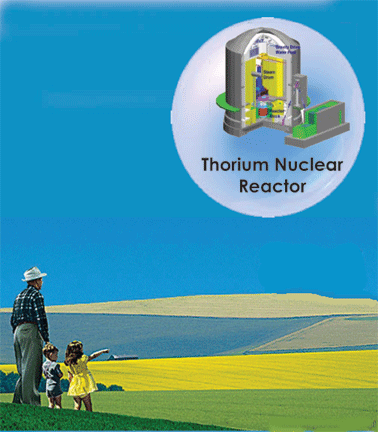 Writing in Oil Price, Andrew Topf 18 June 2014 discusses the very real impediments to starting a thorium nuclear reactor industry
“One large hole that can be punched in the argument for thorium involves the economics of thorium reactors. Experts say compared to uranium, the thorium fuel cycle is more costly and would require extensive taxpayer subsidies.
Another issue is time. With a viable thorium reactor at least a decade away if not more, the cost of renewable alternatives like solar and wind may come down to a point where thorium reactors won’t be economical. Critics also point out that the nuclear industry has invested too much in uranium reactors – along with government buy-in and a set of regulations around them – to be supplanted by thorium.
As for the “green nuclear” argument, thorium’s detractors say that isn’t necessarily the case. While thorium reactors produce less waste, they also produce other radioactive by-products that will need safe disposal, including U-232, which has a half-life of 160,000 years.
“It will create a whole new volume of radioactive waste from previously radio-inert thorium, on top of the waste from uranium reactors. Looked at in these terms, it’s a way of multiplying the volume of radioactive waste humanity can create several times over,” said Oliver Tickell, author of Kyoto2, speaking to The Guardian.”
They’e touting thorium nuclear energy, but it’s a weapons proliferation risk
Thorium: Proliferation warnings on nuclear ‘wonder-fuel’ Phys Org, Thorium is being touted as an ideal fuel for a new generation of nuclear power plants, but in a piece in this week’s Nature, researchers suggest it may not be as benign as portrayed.
The element thorium, which many regard as a potential nuclear “wonder-fuel”, could be a greater proliferation threat than previously thought, scientists have warned.
Writing in a Comment piece in the new issue of the journal, Nature, nuclear energy specialists from four British universities suggest that, although thorium has been promoted as a superior fuel for future nuclear energy generation, it should not be regarded as inherently proliferation resistant. The piece highlights ways in which small quantities of uranium-233, a material useable in nuclear weapons, could be produced covertly from thorium, by chemically separating another isotope, protactinium-233, during its formation.
The chemical processes that are needed for protactinium separation could possibly be undertaken using standard lab equipment, potentially allowing it to happen in secret, and beyond the oversight of organisations such as the International Atomic Energy Agency (IAEA), the paper says.
The authors note that, from previous experiments to separate protactinium-233, it is feasible that just 1.6 tonnes of thorium metal would be enough to produce 8kg of uranium-233 which is the minimum amount required for a nuclear weapon. Using the process identified in their paper, they add that this could be done “in less than a year.”
……….”Small-scale chemical reprocessing of irradiated thorium can create an isotope of uranium – uranium-233 – that could be used in nuclear weapons. If nothing else, this raises a serious proliferation concern…….. Continue reading
Looks like Thorium Nuclear Energy has no future in USA
 G. Bothun · University of Oregon Researcj gaste ( apro nuke forum) 27 June 14
1) Currently the timescale to go from permit to actual turning ON line any nuclear power plant is about 15 years (I think currently there are only 2 recently (2012) approved plans coming on line in Georgia and that will take likely another 8–10 years) – meaning that this really isn’t a “bridge fuel” (especially compared to fracked natural gas – which is being rapidly depleted)
2) The whole US nuclear infrastructure is based on handling Uranium. Thorium has much more stringent handling requirements and I just don’t think the US will ramp up an infrastructure to deal with this. Its probably not even wise to do so as those investments are better made in renewable energy and/or carbon capture and storage projects (like the one in Michigan)
The health toll of India’s uranium mining
India’s uranium mines expose villages to radiation, DW 25 June 14 India plans to source a quarter of its energy from nuclear power by 2050. But this ambitious goal could come at a cost. Radioactive waste from uranium mines in the country’s east is contaminating nearby communities…….Local activist Kavita Birulee says the villagers here are terrified of the radioactive waste. In Jadugoda, rates of cancer, miscarriages and birth defects are climbing…….
Health-related deformities
Just 40 years ago, Jadugoda was a quiet and lush green locality with no dust or radiation pollution. The people here lived a quiet rural life. But things changed when the Indian government started mining operations here in 1967.
Radioactive waste generated by three nearby government-owned mines has caused serious health-related problems in Jadugoda. The mines belong to Uranium Corporation of India Limited – or UCIL. They employ 5,000 people and are an important source of income for villagers in this relatively remote area. But the waste has put 50,000 people, mostly from tribal communities, at risk.
A recent study of about 9,000 people in villages near the mines has documented cases of congenital deformities, infertility, cancer, respiratory problems and miscarriages.
Nuclear scientist Sanghmitra Gadekar, who was responsible for conducting the survey on radioactive pollution in villages near the mines, says there was a higher incidence of miscarriages and still births.
“Also, laborers were given only one uniform a week. They had to keep on wearing it and then take it home. There, the wives or daughters wash it in a contaminated pond, exposing them to radiation. It’s a vicious circle of radioactive pollution in Jadugoda,” he said…….
Grim future
The mines are on the doorstep of the area’s largest city, Jamshedpur. If radiation pollution isn’t controlled, more people will be affected in the future. Local officials, however, are proud of their role in India’s nuclear defense industry.
Anti-nuclear pollution activist Xavier Dias has been trying to alert locals about the dangers presented by the mines.
“When you are talking about Jamshedpur, you are talking about a thousand ancillary industries, a huge population,” he said. “These are dust particles that fly around. They enter the water, the fauna, flora, the food system. And they are killers, but they are slow killers. They kill over generations.” http://www.dw.de/indias-uranium-mines-expose-villages-to-radiation/a-17730703
New design nuclear reactors will not need much uranium
New nuclear reactors ‘to need much less uranium’ The world’s nuclear watchdog has been told that new generation nuclear reactors will need much less uranium than those currently in service. SBS, Kerry Skyring and Zara Zaher World News Radio 25 JUN 2014
The comments came at a symposium on uranium and the nuclear fuel cycle which the IAEA is holding in Vienna. http://www.sbs.com.au/news/article/2014/06/25/new-nuclear-reactors-need-much-less-uranium
USA and France co-operating on the militarisation of Africa: Niger uranium
Uranium games in Niger and the US-Franco competition Andrew Korybko for RT June 11, 2014 The West has actively been making multidimensional inroads into Africa over the past decade, largely of a malignant nature. The US and its NATO allies are interested in market potential, energy prospects, and military engagement…….
Altogether, the US and France are closely cooperating in the NATO militarization of Africa during the “Second Scramble”. Despite being somewhat different in their approaches, they represent “two hands from the same magician” working behind the scenes to advance the Western interest there. Concurrently, as can be seen by the NSA spying directed against European “allies”, Washington does not place full trust in those that it cooperates with. Therefore, it is fully in line with America’s established track record of deceit to hedge itself towards a position of guiding influence over its partners, specifically France. In the event that Paris’ ambitions for power get the best of it and it once more “goes rogue” from Atlantic command, the US will play the Nigerien uranium card to enact maximum pressure on the country and force it back into the unipolar fold. http://rt.com/op-edge/165092-west-africa-uranium-games/
South Dakota’s community livelihood at risk from uranium polluted water
 Uranium mine would affect more than West River http://www.argusleader.com/story/opinion/readers/2014/06/07/letter-uranium-mine-affect-west-river/10109709/ Kim C. Kraft Are you aware of the potential problem of uranium mining in western South Dakota to the rest of the state? Presently, there are more than 200 abandoned uranium mines leaching radioactive debris into our rivers. Radioactive residue from these mines can be detected as far as Vermillion. So it is not just a West River problem.
Now we have Powertech/Azarga, a China-based investment company, wanting to take vast amounts of water from two major aquifers of the Southern Black Hills for in situ mine leaching of uranium. Not only will they take the water from our ranchers, who desperately need it during the drought, but contaminating it for any future use by the ranchers and surrounding communities. With the Western states becoming dryer from prolonged drought, we cannot afford to waste clean water for the benefit of foreign countries. Our state government is allowing this. Our governor and Legislature have removed oversight and control over water usage in the Southern Black Hills, thus allowing the mining companies to use up precious clean water, pollute it and then leave with no responsibility to clean the mess up. They are putting our livelihoods on the line. Remember this for the November elections.
Uranium companies in a turmoil as analysts forecast prices staying low
 Uranium stocks tumble after RBC takes axe to price forecasts,Financial Post Peter Koven | June 5, 2014 Uranium miners have offered a very consistent message to investors over the past couple of years: The short-term outlook is bad, but don’t worry, a lot more uranium is going to be needed down the road.
RBC Capital Markets Analysts agree. Only they think it will be a much longer road than most.
Analysts Fraser Phillips and Patrick Morton on Thursday sent shudders through the industry as they took an axe to their uranium price forecasts. They cut their 2014 spot price forecast to US$31.50 a pound, down from US$45. And it got worse from there. The 2015 target was cut to US$40 (from US$60), and targets for the 2016 to 2018 period fell to just US$40-US$45 from US$75-US$80. Not surprisingly, shares of every significant uranium company (including Cameco Corp., Paladin Energy Ltd. and Denison Mines Corp.) tumbled on Thursday.
The analysts believe the uranium market is going to be in surplus until 2021, which is far longer than most insiders expect. They blame continuing oversupply in the market.
“Active annual supply exceeds demand by a significant margin, and on top of that, significant excess inventories have been and continue to be accumulated post the Fukushima disaster, particularly in Japan,” they said in a note. It is no secret the uranium market is under pressure. The sector is still reeling from the Fukushima disaster in 2011, and approvals for Japanese reactor restarts are taking longer than expected. The spot uranium price recently fell below US$30 a pound for the first time since 2005…….
The RBC analysts pointed out that mine production has continued to grow during the past two years despite low prices, and that the Japanese restart process has stalled. They believe only four Japanese reactors will restart this year, and just 28 (out of 50) will be online by 2018…….http://business.financialpost.com/2014/06/05/rbc-annihilates-uranium-price-outlook/
South Dakota – take heed from Colorado’s bad experience with uranium mining
 Colorado has ‘experience’ with uranium mines http://www.argusleader.com/story/opinion/readers/2014/06/03/letter-colorado-experience-uranium-mines/9942453/
uranium mines and prospects, Colorado has 387. While South Dakota has yet to experience an operating in-situ leach uranium mine (Powertech/Azarga is attempting to permit the first one 15 miles northwest of Edgemont), Colorado has experienced experimental in-situ leach uranium mining, which left elevated levels of gross alpha radiation, beta radiation, nitrate, ammonia and selenium in the underground aquifer. The contamination got worse after the mine was declared “restored.”Colorado has had enough. Colorado House legislators recently passed new regulations on uranium processing. The bill sets minimum standards for groundwater cleanups before a company can be let off the hook. It also requires uranium and thorium mines to get a radioactive materials license from the state health department if they use a new process that involves injecting water into the mine’s rock formations.
Colorado state Representative Jared Wright, R-Fruita, said new mining technologies often pollute, despite promises to be safe and clean. “This bill is about protecting our citizens, those we are all here today to serve,” Wright said.
Let’s hope our legislators take heed and protect our water in 2015’s legislative session.
Wave of public resistance to uranium mining in Slovakia
Slovakia tightens regulation on uranium mining, Global Post, BRATISLAVA, June 3 (Xinhua) — As of June 15, uranium mining in Slovakia will be possible only if the inhabitants of the affected municipalities allow it in a referendum, according to an amendment to the Geological Act approved by Parliament on Tuesday…….Wave of resistance against uranium mining in Jahodna has emerged in Slovakia in last two years, with more than 100,000 people signing a petition to that effect. According to the new legislation, any company interested in mining will have to ask the six affected municipalities to hold a referendum…..http://www.globalpost.com/dispatch/news/xinhua-news-agency/140603/slovakia-tightens-regulation-uranium-mining
Doom and gloom now permanent for the uranium industry
We are heading for a uranium crisis , Investor Intel, June 2, 2014 by Robin Bromby“……Welcome to the “perma-gloom” with spot uranium now at $28.25/lb. But it really does portend a very troubling situation. We could be on the brink of a real uranium crisis, one that could have serious ramifications down the road. This is because, on top of all the doubts about nuclear post-Fukushima and the slowness of Japan to get reactors back on line, uranium is caught up in the general malaise affecting the mining industry ……….the uranium price has fallen by 30% over the past year. If it keeps falling, and it well might, more and more companies will either go into hibernation mode or quit the sector all together ……..

A surer sign that all is not well can be evidenced from an ominous trend — exploration companies quitting the sector. Others are making cuts: Cameco closed its Cheyenne office, while BHP Billiton has deferred its expansion at the world’s biggest uranium deposit, Olympic Dam in South Australia. Australia’s Paladin Energy (ASX:PDN) has put one of its mines, Kayelekera in Malawi, on care and maintenance.
Back in 2007-8, after spot uranium hit $137/lb, this was the place to be. Suddenly every mining explorer was keen to be in the uranium hunt. At one stage, more than 260 companies listed on the Australian Securities claimed to have uranium projects (many of them in what the Canadian miners call “moose pasture”).
Now, it seems, those small number remaining can’t wait to get out. FYI Resources (ASX:FYI), which got into uranium after quitting the eye care business (it’s previous name was Freedom Eye) in 2009, is now concentrating on potash in Thailand. Uranex (ASX:UNX) is staying in Tanzania, but has put its uranium on the back-burner in order to pursue graphite.
But possibly the most startling change was reported today. Junior United Uranium (ASX:UUL) which has six projects in Western Australia [and A$3.41 million in the bank as at March 31] is getting out of uranium and into — wait for it — property development.You can’t exactly blame the directors. The shares are trading at a discount to the company assets (the market capitalisation being just A$2 million), all its projects are early-stage ones that will require considerable sums to explore and may not turn out to be viable, no one is investing in the sector, the uranium price is depressed as is the resource sector generally.
Just two weeks ago another uranium explorer working in Western Australia, Prime Minerals (ASX:PIM), signalled it was changing direction. It is merging with Cocoon Data Holdings which has data security software. The news lifted Prime’s stock from A0.9c to A2.2c.
Back in 2007, announcing you were getting into uranium could see your stock price double. Now announcing you’re switching focus away from uranium does the trick. This is not a good trend. http://investor
US tax-payer is propping up the uranium industry
THE GOVERNMENT IS PROPPING UP THE URANIUM INDUSTRY AND WE’RE PAYING FOR IT http://www.esquire.com/blogs/politics/white-mesa-uranium-mill-lawsuit-053014 The Department of Energy is promoting uranium mining at places like the White Mesa Mill and is tasked with the pricey cleanup. By Leslie Macmillan on May 30, 2014
The Grand Canyon Trust, an environmental group, has sued the operator of America’s last conventional uranium processing mill, saying its vast piles of spent ore and radioactive waste emit dangerous levels of radon and other toxins that violate the Clean Air Act.
The group and other critics of the White Mesa Mill near Blanding, Utah say it is a poorly disguised nuclear waste dump that would have gone out of business long ago were it not propped up by a lucrative federal contracts.
 The uranium market has declined in the wake of the Fukushima meltdown. To stay alive in a depressed market, Energy Fuels Resources, the mill’s operator, recycles mine tailings and radioactive waste — known as “alternate feed” — from Superfund sites around the country. The mill extracts any remnants of uranium from the waste then sells the concentrated, purified uranium, called yellowcake, to its customers, some of which are government-owned utilities obligated to buy White Mesa yellowcake at prices far higher than the $35 a pound it is currently fetching on the spot market. The leftover waste, a toxic stew of industrial chemicals, is stored in open pits called impoundments.
Energy Fuels spokesperson Curtis Moore said the issues raised in the lawsuit “are either inaccurate or have already been addressed through the proper regulatory channels.”
Taylor McKinnon of the Grand Canyon Trust says he hopes the lawsuit will “rip the mill from the rat’s nest of bureaucrats who have been protecting the status quo.”
The mill, he and other critics contend that uranium mining, milling and cleanup has become a virtual cottage industry — one orchestrated largely by the federal government.
During the Cold War period of 1940s through the 1980s, uranium was mined extensively in the Colorado Plateau to supply critical materials for the nation’s nuclear weapons program. The U.S. Department of Energy manages the nation’s surplus uranium and much of the cleanup of old processing mills.
Travis Stills, an energy and conservation law attorney, argues that the DOE’s mandate to “provide a domestic supply of uranium” is outdated and wreaks havoc on environmental and human health. He also says it’s unnecessary. The DOE already owns a uranium stockpile worth $7 to $8 billion.
The DOE doesn’t want to sell off the stockpile, Stills argues, because that would drive uranium prices down. Instead, the government artificially inflates prices to keep the industry going, he says.
Energy Fuels also operates several mines at the Grand Canyon, despite the federal ban on uranium mining there, because it possesses old mining claims that were “grandfathered in.” The company said in December it planned to shutter its Pinenut Mine there as well as the White Mesa Mill in 2014 and potentially reopen them in 2015. It reversed that decision last month and announced it would continue mining, but stockpile the ore pending better market conditions.
Cleaning up uranium is not cheap. The DOE is spending a billion dollars to dispose of tailings at an enormous site near Moab — a cost “born by the taxpayer,” the Trust’s lawsuit points out. On the Navajo reservation alone, there are 500 abandoned uranium mines. The EPA estimates the cleanup cost would be in the hundreds of millions. An $18 million bond has been posted for cleaning up White Mesa Mill when it stops processing uranium — not nearly enough, Stills argues. He says the federal government — and the taxpayer — will be left holding the bag for that cleanup too.
Indeed, the DOE is slated to inherit White Mesa Mill for cleanup. Stills says that the department’s mission, to at once promote uranium mining and oversee its cleanup, is contradictory but that it keeps the agency employed. “It’s bureaucratic make-work,” he says. “As long as they keep making a mess, they’ll need to keep cleaning it up.”
Largest environmental settlement ever to clean up South Dakota uranium mine

 Settlement gives $179 million to clean up abandoned uranium mine in Harding County, Rapid City Journal, 1 June 14, Used in the early years of America’s thirst for nuclear fuel, the Riley Pass uranium mine in Harding County was one of hundreds of sites mined to provide fuel for nuclear weapons and reactors.
Companies strip-mined the site, which sprawls across 250 acres of bluffs and other land in the North Cave Hills, about five miles east of the town of Ludlow about 130 miles northwest of Rapid City. In those days, there were no regulations forcing companies to clean up old mines.
“Back in the Cold War era, there was almost sort of a gold rush going on up there for uranium,” said Dan Seifert, a project coordinator for the Riley Pass mine with Custer National Forest.
But for the past 50 years, the mining site has been abandoned, and waste products known as spoils have sat exposed to the wind and rain. That allowed toxic metals and elements like arsenic, uranium, radium and thorium vulnerable to be carried away by the weather.
Now, a tangled series of court proceedings has resulted in a $179 million plan to clean up the majority of the mine site. That money is part of a settlement, announced last month by the U.S. Department of Justice and approved by a judge last week, required Anadarko Petroleum Corp. to pay a $5.15 billion settlement of fraud claims from a 2006 acquisition of Kerr-McGee. Continue reading
1 This Month

of the week – Shut Down Drone Warfare!


Tell the Ukrainian Government to Drop Prosecution of Peace Activist Yurii Sheliazhenko

Petition to revoke the licensing of the Near Surface Nuclear Disposal Facility (NSDF) at Chalk River. https://www.ourcommons.ca/petitions/en/Petition/Details?Petition=e-7247
To see nuclear-related stories in greater depth and intensity – go to https://nuclearinformation.wordpress.com
-
Archives
- April 2026 (68)
- March 2026 (251)
- February 2026 (268)
- January 2026 (308)
- December 2025 (358)
- November 2025 (359)
- October 2025 (376)
- September 2025 (257)
- August 2025 (319)
- July 2025 (230)
- June 2025 (348)
- May 2025 (261)
-
Categories
- 1
- 1 NUCLEAR ISSUES
- business and costs
- climate change
- culture and arts
- ENERGY
- environment
- health
- history
- indigenous issues
- Legal
- marketing of nuclear
- media
- opposition to nuclear
- PERSONAL STORIES
- politics
- politics international
- Religion and ethics
- safety
- secrets,lies and civil liberties
- spinbuster
- technology
- Uranium
- wastes
- weapons and war
- Women
- 2 WORLD
- ACTION
- AFRICA
- Atrocities
- AUSTRALIA
- Christina's notes
- Christina's themes
- culture and arts
- Events
- Fuk 2022
- Fuk 2023
- Fukushima 2017
- Fukushima 2018
- fukushima 2019
- Fukushima 2020
- Fukushima 2021
- general
- global warming
- Humour (God we need it)
- Nuclear
- RARE EARTHS
- Reference
- resources – print
- Resources -audiovicual
- Weekly Newsletter
- World
- World Nuclear
- YouTube
-
RSS
Entries RSS
Comments RSS
 nuclear-news