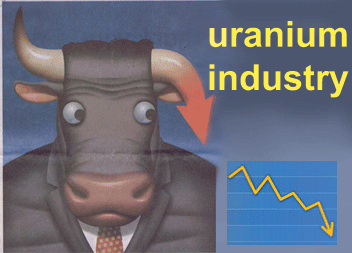
Uranium company Cameco continues to get miserable results
 Uranium Producer Cameco Looks Depleted Full-Year Results Lowest Since 2006, WSJ, By SPENCER JAKAB Feb. 8, 2015 Customers shutting down in droves? Environmentalists creating headaches? Low cost competitors flooding the market? Nuke ‘em. ……
he nearly two-thirds decline in Cameco’s U.S.-listed share price since February 2011 is about more than a delayed earnings bonanza. Furthermore, fluctuations in uranium’s thinly traded spot market should be viewed cautiously.
Not only do utilities in Japan and elsewhere have substantial inventory on hand but other sources of uranium supply hang over the market. These include low-cost mines in Kazakhstan that now supply around 40% of the market as well as nuclear fuel derived from nonmine sources such as the waste “tailings” of previously processed uranium.
Assuming analysts’ 2018 scenario plays out in terms of output and prices, Cameco now fetches just under 10 times that year’s consensus forecast earnings according to FactSet—hardly a bargain in today’s depressed mining landscape. The cloud hanging over Cameco may not dissipate soon.http://www.wsj.com/articles/uranium-producer-cameco-looks-depleted-ahead-of-the-tape-1423421905
Navajo community – a case study on deadly effects of uranium mining
The studies have found considerably increased rates of death by lung cancer and other lung or related diseases
“Navajo is a non-smoking population. That’s why the Navajo underground miners were such an important sub-unit of the cohort,” Shuey said. “The Navajo cohort debunks the whole notion that the uranium miners’ lung cancer relates to smoking.”
 Radon’s Deadly Connection With Uranium Mining As Seen From Navajo Nation, Indian Country, Konnie LeMay 2/2/15 Where you live may increasingly become as important as how you live in determining your health as we continue to recognize how environmental factors affect our lives and may hasten our deaths.
“No longer can we just kind of sit back and say those are all just lifestyle (influences) … just stop eating frybread and throw some vegetables in there,” said Chris Shuey, director of the Uranium Impact Assessment Program for theSouthwest Research and Information Center.
For more than three decades, Shuey has tracked the environmental influences on long-term health for the Navajo people linked to the region’s past uranium mining. He foresees growing acknowledgment of how human-caused environmental changes and naturally occurring threats may affect our health. Continue reading
Iranium President Rouhani optimistic about a nuclear deal with the West
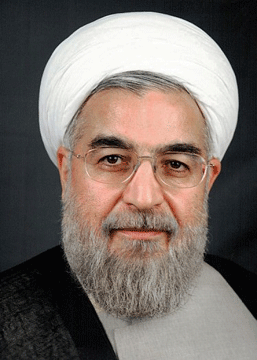 Iranian president says nuclear deal with the west is getting closer, Guardian, Julian Borger and Saeed Kamali Dehghan, 4 Feb 15 Mehr news agency quotes Hassan Rouhani saying sides have ‘narrowed the gaps’ as second report emerges of uranium enrichment deal with US. President Hassan Rouhani has said that a nuclear deal with the west is getting closer, as a report emerged of a possible compromise between American and Iranian negotiators over uranium enrichment.
After meeting the heads of the country’s parliament and judiciary, Rouhani was quoted by the Mehr news agency as saying: “We have narrowed the gaps,” adding that although “some issues and differences remain … The west has realised that it should recognise the rights of the Iranian people.”
Even Ali Larijani, the parliamentary speaker and a noted hardliner on nuclear talks, declared himself “not pessimistic” about the trajectory of the negotiations.
Nuclear talks between Iran and six major powers are due to resume later this month in Geneva ahead of a March deadline for arriving at a basic framework agreement. A comprehensive permanent settlement would be reached by the end of June………
The possible compromise under consideration, according to the AP, would see most of the 10,000 centrifuges in operation left in place but reconfigured so that they would be less productive. One way of doing that would be to spin the centrifuges more slowly. Other measures would be agreed upon to reassure the west that Iran could not make a warhead quickly, such as reducing its stockpile of uranium hexafluoride gas – the form in which uranium can be enriched by centrifuge………http://www.theguardian.com/world/2015/feb/03/iranian-president-nuclear-deal-west
Lowest production in 16 years – uranium in Australia
 Lowest Australian uranium production for 16 years, World Nuclear Association 23 Jan 15 Due to the shutdown of ERA’s Ranger plant to June, and despite the rich Four-Mile deposit coming on line, Australia’s uranium production in 2014 at 5897 tonnes U3O8 (5000 tU) was the lowest since 1998. Two thirds of it was from Olympic Dam, where uranium is a by-product of copper. Production from Four Mile is recovered at the Beverley plant, replacing output from that mine at about double the level. http://us1.campaign-archive1.com/?u=140c559a3b34d23ff7c6b48b9&id=e08ac096b6&e=ae5ca458a0
Research into problem of uranium mining & processing causing contamination of groundwater
22-Jan-2015 Source Newsroom: SLAC National Accelerator Laboratory Newswise — Researchers at the Department of Energy’s SLAC National Accelerator Laboratory are trying to find out why uranium persists in groundwater at former uranium ore processing sites despite remediation of contaminated surface materials two decades ago. They think buried organic material may be at fault, storing toxic uranium at levels that continue to pose risks to human health and the environment, and hope their study will pave the way for better long-term site management and protection of the public and environment.
The contaminated sites, on floodplains in the upper Colorado River basin, operated from the 1940s to the 1970s to produce “yellowcake,” a precursor of uranium fuel used in nuclear power plants and weapons. In the 1990s, site surfaces were cleaned up, and remaining uranium in the ground was expected to flush out over time due to natural groundwater flow across the sites.
Uranium selling at price way below its costs of production, by Australian miner Paladin Energy
 Paladin Energy Ltd revenues soar 79% but shares sink Motley Fool By Mike King – January 19, 2015 Uranium miner Paladin Energy Ltd (ASX: PDN) has announced sales of US$69.9 million in the December quarter, a rise of 79% over the previous quarter.
But despite the news, shares are down 2.8% at 35 cents at lunchtime.
So why are investors selling out of a stock reporting such strong growth?
The problem is that Paladin sold 1.9 million pounds of uranium in the quarter, at an average price of US$36.58 per pound. That last figure is the issue – that price is well below what it costs Paladin to produce the uranium, and there are no signs that the price is…[members only] http://www.fool.com.au/2015/01/19/paladin-energy-ltd-revenues-soar-79-but-shares-sink/
Small rally in uranium price didn’t last long
Uranium Rally Running Low on Juice After shooting higher, prices have come back down amid questions about how much more of the radioactive metal China needs to buy. BARRON’S Uranium bulls have long pointed to China’s nuclear-industry expansion as a catalyst for a recovery in the market. In mainland China, there are 22 nuclear reactors currently operating, 26 being built and more about to start construction, according to the World Nuclear Association.
However, Australian investment bank Macquarie thinks there are now “serious question marks” about how much uranium the world’s No. 2 economy will need. “China is clearly the most positive story globally when it comes to nuclear-power-capacity expansion,” according to Macquarie analysts. “The concern, however, is that China has already procured a substantial amount of uranium well in excess of what it has consumed and that this advance purchasing might limit its need to enter the market to source material over the next few years,” they add in a note.
Uranium prices have mostly languished since the 2011 Fukushima disaster………with uranium prices rising 37% from August through November as Japan moved closer to restarting its idled reactors. Consultants Ernst & Young said they thought the market had bottomed. Analysts at Australian brokerage Bell Potter agreed.
BUT THAT RECOVERY HAS STALLED…….While the revival of Japan’s nuclear sector is positive for prices, China’s potential demand is more important……..But Macquarie’s analysts say China’s growing store of uranium may be bigger than anyone previously thought. Their latest analysis suggests China increased its stockpiles by 17% last year and now has enough uranium to meet domestic demand for about seven years at forecast 2020 consumption rates. China doesn’t provide data on its uranium inventories…. JPMorgan expects uranium prices to average $30.70 a pound this year, down from last year’s $31.70…….http://online.barrons.com/articles/uranium-rally-running-low-on-juice-1421462807
Sound reasons for co-operation and a nuclear deal with Iran

 7 reasons not to worry about Iran’s enrichment capacity, ALMONITOR 5 Nov 14 Iran and the five permanent members of the UN Security Council plus Germany are aiming to end the standoff over Iran’s nuclear program by Nov. 24. Iranian and US officials have confirmed that progress was made in the extremely complicated nuclear talks in mid-October in Vienna. …………The following are seven reasons not to be too overly concerned about Iran’s breakout capability:
- Under the current International Atomic Energy Agency (IAEA) rules and regulations, the maximum level of transparency for nuclear activities would be secured by the implementation of its three arrangements: the Safeguard Agreement, Subsidiary Arrangement Code 3.1 and the Additional Protocol. The world powers negotiating with Iran have a clear understanding that Iran is ready to commit to all three arrangements in a final comprehensive agreement.
- Iran would be cooperative in capping its level of enrichment at 5% for the duration of the final agreement to assure non-diversion toward weaponization. The fissile uranium in nuclear weapons contains enrichment to 85% or more.
- To ensure that Iran’s enrichment activities do not lead to a bomb, Tehran would be willing to synchronize the number of centrifuges or their productivity to its practical needs and convert the product to oxide for a number of years. Iran’s major practical need is to provide fuel for the Bushehr plant in 2021, when its fuel-supply contract with Russia terminates. Practically, out of the current 22,000 centrifuges, Iran would need around 9,000 to 10,000 to provide enough fuel annually for the four fuel elements (out of a total 54 fuel elements) for Bushehr that Russia is contractually required to supply.
- Regarding the heavy water facility at Arak, Iran would be cooperative in placing greater monitoring measures and modifying the reactor to reduce the annual enriched plutonium production capacity of 8-10 kilograms (18-22 pounds) to less than 0.8 kilograms (1.7 pounds). Furthermore, the 0.8kg of material will be 78% fissile, which is too low for the production of nuclear weapons, and the timeline for redesigning and building the reactor will require another five to six years.
- Secularizing the supreme leader’s fatwa banning the production and stockpiling of nuclear and all other weapons of mass destruction would be a strong objective guarantee. Once the fatwa is secularized and operationalized, violation would be a criminal matter for the courts to pursue and punishable by law. Iran’s history makes it hard to dismiss the fatwa. After all, despite an estimated 100,000 deaths from Iraqi use of chemical weapons against Iran, it was a fatwa issued by the late Ayatollah Ruhollah Khomeini that kept Tehran from retaliating during the Iran-Iraq war.
- Iran has paid a high price for its nuclear program, having endured a barrage of draconian multilateral and unilateral sanctions to date. The sanctions imposed against Iran are far beyond those imposed on North Korea, which does possess nuclear weapons. The fact is that Iran has already paid the price for making a bomb, but neither wants nor has one, a clear indicator of its steadfastness on nonproliferation and the peaceful use of nuclear technology.
- If anyone were going to have made the decision to build nuclear weapons, it would have been former President Mahmoud Ahmadinejad. Yet, during his eight years in the presidency, the IAEA found no evidence of an Iranian nuclear program geared toward weaponization, and his administration sought to normalize bilateral relations with the United States more than all his predecessors.
I am confident that Iran, the United States and the world powers genuinely seek to reach a deal and that there is no reason to extend the deadline beyond late November. The best strategy is to pursue a broad engagement with Iran to ensure that the decision to pursue a nuclear breakout will never come about. Iran and the United States are already tacitly and indirectly cooperating in the fight against the Islamic State (IS). A nuclear agreement would be a great boost to mutual trust and provide greater options for dealing not only with IS and the Syrian regime but also Afghanistan and Iraq — where both Washington and Tehran support the new governments in Kabul and Baghdad. Rather than focusing onenrichment capacity, Washington should weigh its capacity for relations with Iran. http://www.al-monitor.com/pulse/originals/2014/11/iran-nuclear-enrichment-uranium-iaea-fatwa-sanctions.html?utm_source=Al-Monitor+Newsletter+%5BEnglish%5D&utm_campaign=a39e197e64-November_5_2014&utm_medium=email&utm_term=0_28264b27a0-a39e197e64-93115393##ixzz3IKFLTdR3
German power companies discreetly trying to sell their holdings in URENCO
 Ticking nuclear time bomb up for grabs URANTRANSPORT.De 3 Nov 14 As discretely as possible, the German power companies EON and RWE are trying to sell their holdings in URENCO, the tri-national company that produces weapons-grade uranium. The prominent German newspaper, Sueddeutsche Zeitung, reported that not only respectable potential buyers are lining up to bid and that intelligence services are on alert.
The German URENCO plant is located at Gronau, a small town only a stone’s throw away from the border with the Netherlands. And not far into that country is another URENCO plant at Almelo.
The newspaper incorrectly describes Gronau as “the last bastion of the nuclear industry in Germany”, which it is not. There is also a nuclear fuel plant at Lingen and centrifuge research and development in Jülich, run jointly by a Urenco/Areva subsidiary.
With a world market share of 31% the German-Dutch-British URENCO, which also operates plants in the UK and the USA, is one of the major suppliers of nuclear fuel. Almost unnoticed by the general public, URENCO keeps Germany a major player in nuclear power, which officially is planned to end in the country in 2023.
As the newspaper points out, “URENCO possesses highly sensitive knowledge: the key to the atom bomb“. The one-third-each owners, which apart from the two power companies include the British and Dutch governments, want to sell the firm to investors.Ten billion euros is one figure being mentioned. Bids to be accepted until the end of December.
It’s a scary scenario: “Up for sale is the simplest path to the atom bomb,” suggests Michael Sailer of the Eco-Institute in Darmstadt, an advisor on nuclear matters to the German government.
Finance circles say the list of potential buyers includes firms and hedge funds around the world, in Canada, Japan, Britain, Hong Kong, India and the Middle East. There’s even talk of questionable billionaires and states.
Experts say in Gronau alone enough highly enriched uranium to make a bomb could be produced in a few weeks.
If the state owners give up their controlling majority, it will get ever harder to protect the technology against unpermitted access, notes Sailer. “I find it irresposnible to leave a technology with such destructive power to the market.“
The Sueddeutsche Zeitung says secret documents from the Netherlands make clear how far plans to sell up are advanced in London and The Hague.
German parliamentarians have been told by the government that intelligence services have been brought in to study potential buyers. The same is said to be happening in Britain and The Netherlands.
“Every transfer of knowledge of uranium enrichment technology also increases the knowledge of atomic weapon technology,“ warns Sylvia Kotting-Uhl of the German Greens, and calls on the German government to veto the sale.
“We demand the immediate closure of the Gronau uranium enrichment plant,“ writes a group of activists in Muenster, which is close to Gronau, as well as centrifuge research and development in Jülich, run jointly by a Urenco/Areva subsidiary, ETC.
The Aktionsbündnis Münsterland gegen Atomanlagen (SOFA) will host an international uranium transportation conference from 28-30. November in Münster.
www.sofa-ms.de, www.urantransport.de, www.kein-castor-nach-ahaus.de
13 USA election candidates who want to seize public lands for uranium mining etc
there are currently 13 candidates up for election in November who want to sell or seize public lands for drilling, mining, or logging and seven senators not up for reelection, including four Arizonans: Sen. McCain, Sen. Jeff Flake, U.S. Rep. Trent Franks, and State Rep. Andy Tobin.

 Federal Court: One Million Acres Near Grand Canyon Protected From Mining, Think Progress, BY ARI PHILLIPS OCTOBER 10, 2014 In early October, an Arizona federal judge upheld the Obama Administration’s 2012 withdrawal of over one million acres of federal lands surrounding Grand Canyon National Park from uranium mining. Originally imposed by then-Secretary of the Interior Ken Salazar, the mining industry challenged the ban arguing that the 700-page Environmental Impact Statement was inadequate, failed to address “scientific controversies”, and was unconstitutional.
and several sacred Native American sites. According to the government’s study, removing the ban would mean that 26 new uranium mines and 700 uranium exploration projects could be developed.
According Roger Clark, air quality and clean energy director at the Grand Canyon Trust, the ruling affirms conclusions by five federal agencies, including scientists from the U.S. Geological Survey — that uranium mining poses unacceptable risks to Grand Canyon’s water, wildlife, and people.
“Uranium mines threaten hundreds of the Grand Canyon seeps and springs that provide precious water to thousands of desert-dwelling species,” wroteClark. “Every new mine sacrifices cultural sites and fragments wildlife habitat, polluting the park with dirt roads, dust, heavy machinery, noise, off-road drilling rigs, power lines, and relentless truck traffic.”………
When Salazar first banned this block of 633,547 acres of public lands and 360,002 acres of National Forest land from mining in 2012, a number of politicians objected, including U.S. Senators Orrin Hatch (R-UT), John McCain (R-AZ), John Barrasso (R-WY), and Mike Lee (R-UT). Sen. Hatch said mining the land “poses no environmental threat” and that the announcement was another sign that the Obama Administration “is one of the most anti-American energy presidencies in history.”
Fast-forward two years later and there are currently 13 candidates up for election in November who want to sell or seize public lands for drilling, mining, or logging and seven senators not up for reelection, including four Arizonans: Sen. McCain, Sen. Jeff Flake, U.S. Rep. Trent Franks, and State Rep. Andy Tobin.
The uranium mining companies have 60 days to appeal Judge Campbell’s decision to the Ninth Circuit Court of Appeals and are likely to do so, according to the Center For Biological Diversity. http://thinkprogress.org/climate/2014/10/10/3577414/arizona-grand-canyon-uranium-mining-withdrawal/
Judge rules against uanium miners and for the Grand canyon environment
Ban on uranium mining at Grand Canyon upheld by Arizona court . http://www.theguardian.com/environment/2014/oct/02/ban-uranium-mining-grand-canyon-arizona-court Ruling protects national treasure against the possibility of opening it to 26 new mines and 700 exploration projects Leslie Macmillan theguardian.com, Friday 3 October 2014 In January 2012, then-US interior secretary Ken Salazar issued the ban that prohibits new mining claims and mine development on existing claims without valid permits. A subsequent mining industry lawsuit asserted that the interior department’s 700-page study of environmental impacts was inadequate and the ban was unconstitutional.
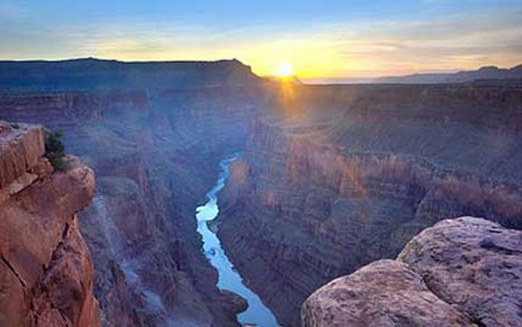
A coalition of groups including native American tribes and the Sierra Club intervened in that lawsuit, and on Tuesday the court ruled in their favour.
Judge David G Campbell of the US district court for Arizona summarised his ruling dismissing all uranium mining industry claims by stating that the secretary of the interior had the authority to “err on the side of caution in protecting a national treasure – Grand Canyon national park.”
Critics of uranium mining say that it would threaten the aquifers and streams that feed the Colorado river and Grand Canyon by releasing toxic waste.
Martha Hahn, chief of science and resource management for the Grand Canyon, says that mines would leach contaminants into watersheds, seeps and springs in the canyon, mar the landscape and impact wildlife. The seeps that make rocks slick might not look life-sustaining, but one might “feed a critter that feeds another critter, so you see the effect pretty exponentially,” said Hahn.
- According to the government’s study, removing the ban would mean that 26 new uranium mines and 700 uranium exploration projects could be developed.The Grand Canyon attracts about 4m tourists a year. Uranium mining companies have 60 days to appeal the decision
OECD and IAEA warn of uranium industry’s uncertain future
OECD/IAEA Red Book The latest edition of the ‘Red Book’ − ‘Uranium 2014: Resources, Production and Demand’ − has been released by the OECD Nuclear Energy Agency and the International Atomic Energy Agency.8………
“Uranium miners have been hit harder by the Fukushima Daiichi accident than any other segment of the nuclear fuel cycle,” the Red Book states, and Fukushima “has eroded public confidence in nuclear power in some countries and prospects for growth in nuclear generating capacity are in turn being reduced and subject to even greater uncertainty than usual.”
 Uranium’s dead cat bounce as miners play chicken Dr Jim Green − Nuclear Monitor 2 Oct 2014 “…..the price increase has been driven by supply-side concerns and speculation instead of increased demand or even speculation regarding increased demand. UBS commodities analyst Daniel Morgan said in early September: “There’s been a few supply-side issues which has been enough for a very modest price rise. What the market really needs is a demand-side driver to get the price going and in my view we don’t have one at the moment.”2
Macquarie Group’s Stefan Ljubisavljevic predicts a uranium supply surplus for the next five years unless some unprofitable mines close.1 Raymond James analyst David Sadowski said in May that many utilities around the world “are sitting on near-record piles” of uranium.11 For example China has stockpiled about eight years’ supply (at its current rate of consumption) while it may take Japanese utilities a decade or more before they exhaust existing stockpiles.12
The long term price, where most uranium business is conducted, was still languishing at US$44 / lb in late August, a six-year low.3
A number of mines have been put into care-and-maintenance over the past year, including Paladin Energy’s Kayelekera mine in Malawi, and the Honeymoon mine in South Australia, owned by a Rosatom subsidiary. Many other planned mining projects have been cancelled or deferred or scaled down, and some uranium mining companies are being downgraded. Recent examples include:
Investors advised to steer clear of uranium stocks

Buy fertilizer stocks, don’t buy uranium and precious metals: RBC FINANCIAL POST, Peter Koven | October 1, 2014 |It has been a turbulent fall season for mining equities and commodity prices. As investors try to predict what will happen next, analysts at RBC Capital Markets are advising clients to go overweight on fertilizer equities and underweight on uranium and precious metals equities in the fourth quarter…….
The negative call on uranium is no surprise, as investors have been down on this sector ever since Japan’s Fukushima disaster in 2011. The analysts expect weak uranium demand and soft pricing will continue…….http://business.financialpost.com/2014/10/01/buy-fertilizers-dont-buy-uranium-and-precious-metals-rbc/
First Nations Quebec-Labrador (AFNQL) reaffirm their opposition to uranium mining on their land
 Quebec and Labrador First Nations draw the line against uranium By: Henry Lazenby 27 Sep 2014 TORONTO (miningweekly.com) – At a workshop on uranium development hosted by the Assembly of First Nations Quebec-Labrador (AFNQL) on Friday, First Nations from across the region reaffirmed their opposition to uranium development on their territories and throughout Quebec.
In March 2013, the AFNQL passed a resolution inviting its members to voice their opposition to uranium development and to declare a blanket rejection of the uranium exploration and exploitation on all First Nation territories. This followed a resolution adopted by the Grand Council of the Crees in August 2012 declaring a permanent moratorium on uranium development in Cree territory.
“The exploration and exploitation of uranium constitute major and irreversible threats to our population, our territories and the resources they contain. As First Nations, we have a sacred duty to protect our territories and ensure the sustainable development of our natural resources,” Timiskaming First Nation Chief Terence McBride said.
“Our experience here today has clearly demonstrated that the First Nations of Quebec and Labrador are united in our opposition to uranium development in our territories. We strongly encourage all the First Nations and citizens in Quebec to clearly and publicly express their opposition to uranium development,” Cree Nation Grand Chief Matthew Coon Come added.
In March 2013, Quebec’s Minister of the Environment announced a moratorium on uranium exploration or mining permits until the Bureau d’audiences publiques sur l’environnement (BAPE) had completed hearings on the uranium industry in Quebec and provided recommendations to the Minister. The BAPE’S mandate began in May.
This week, the BAPE completed the second phase of its inquiry, during which it heard from various ministries, experts and industry representatives on a number of topics relating to uranium and its associated risks. The third phase of the BAPE hearings were scheduled to start in November, at which time members of the public would have the opportunity to make oral and written submissions to the BAPE.
Anyone wishing to make submissions must file a notice of intention, available on the BAPE website, by October 16.
Poor outlook again for uranium market, with renewed glut
Uranium Rally Threatened by Surplus as Mine Strike Eases Bloomberg, By Ben Sharples September 23, 2014 The rally in uranium spurred by speculation of further sanctions against Russia is poised to unravel as a supply surplus builds with the end of a labor strike at the world’s biggest mine in Canada……
Market Glut
Cantor estimates a uranium market surplus of 13.2 million pounds in 2014 while Raymond James Ltd., a financial adviser, on Aug. 27 forecast an overhang of about 10 million…….
Paladin Energy Ltd. said it would close its Kayelekera operation in Malawi until uranium climbs above $70 a pound, while Russia’s Atomredmetzoloto shut the Honeymoon mine in Australia last year…….http://www.businessweek.com/news/2014-09-23/uranium-rally-threatened-by-surplus-as-mine-strike-eases
1 This Month

of the week – Shut Down Drone Warfare!


Tell the Ukrainian Government to Drop Prosecution of Peace Activist Yurii Sheliazhenko

Petition to revoke the licensing of the Near Surface Nuclear Disposal Facility (NSDF) at Chalk River. https://www.ourcommons.ca/petitions/en/Petition/Details?Petition=e-7247
To see nuclear-related stories in greater depth and intensity – go to https://nuclearinformation.wordpress.com
-
Archives
- April 2026 (68)
- March 2026 (251)
- February 2026 (268)
- January 2026 (308)
- December 2025 (358)
- November 2025 (359)
- October 2025 (376)
- September 2025 (257)
- August 2025 (319)
- July 2025 (230)
- June 2025 (348)
- May 2025 (261)
-
Categories
- 1
- 1 NUCLEAR ISSUES
- business and costs
- climate change
- culture and arts
- ENERGY
- environment
- health
- history
- indigenous issues
- Legal
- marketing of nuclear
- media
- opposition to nuclear
- PERSONAL STORIES
- politics
- politics international
- Religion and ethics
- safety
- secrets,lies and civil liberties
- spinbuster
- technology
- Uranium
- wastes
- weapons and war
- Women
- 2 WORLD
- ACTION
- AFRICA
- Atrocities
- AUSTRALIA
- Christina's notes
- Christina's themes
- culture and arts
- Events
- Fuk 2022
- Fuk 2023
- Fukushima 2017
- Fukushima 2018
- fukushima 2019
- Fukushima 2020
- Fukushima 2021
- general
- global warming
- Humour (God we need it)
- Nuclear
- RARE EARTHS
- Reference
- resources – print
- Resources -audiovicual
- Weekly Newsletter
- World
- World Nuclear
- YouTube
-
RSS
Entries RSS
Comments RSS
 nuclear-news