Indigenous protest against uranium mill in South East Utah
Marcus Atkinson, of Australia, is touring the U.S. promoting a film opposing uranium mining in his country and heard about the White Mesa protest.
“We would like to use this case in our next film to raise international awareness that uranium is too dangerous and is not the answer to our energy needs,” he said.
 Ute protesters march to Utah uranium mill, Ute Mountain Utes concerned about health impacts from White Mesa mill, The Journal, By Jim Mimiaga Journal Staff Writer May 13, 2017 White Mesa, Utah – About 80 protesters opposed to the White Mesa uranium mill in southeast Utah marched three miles along U.S. Highway 191 to the mill’s entrance Saturday.
The protest was organized by members of Ute Mountain Ute tribe, which has a small reservation community three miles from the mill. The mill, which is owned by Energy Fuels, of Toronto, is the only conventional uranium mill operating in the country.
Protesters carried anti-nuclear signs, including “No Uranium, Protect Sacred Lands,” “Water is Life,” and “No Toxic Waste.”
They are concerned about the mill’s potential health impacts on air and water quality, and they object to containment cells at the mill that accept radioactive waste from around the country.
“The dust blowing from uranium ore piles is a concern. Our water comes from wells that are not far from those waste cells. Those things are a big worry for the community,” said Antonio Cly, 22, of the Ute Mountain tribe. He is studying the mill as a student at the University of Utah.
Thelma Whiskers, a Ute elder and founder of the White Mesa Concerned Community group, said her family has been fighting the mill all their lives, and the march was a way to raise awareness of the issues to pass on to the younger generation. Continue reading
Uranium company Cameco in trouble: the industry is just not viable
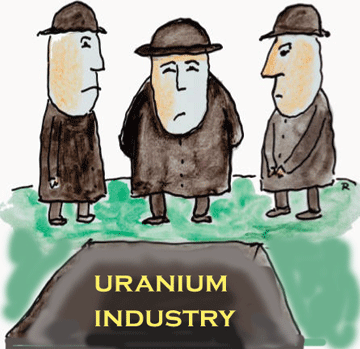 Unviable economics of nuclear power catches up with Cameco, Independent Australia, Jim Green 9 May 2017 Multinational uranium producer Cameco is battling a uranium downturn, the tax office, disinterested customers and Traditional Owners, Dr Jim Green reports.
ECONOMICS is killing the nuclear power industry.
Westinghouse, a giant of the industry, recently filed for bankruptcy protection and its parent company Toshiba may also go bankrupt — both companies brought undone by $15 billion cost overruns building four reactors.
In France, nuclear utilities EDF and Areva would have gone bankrupt if not for repeated multi-billion-dollar government bailouts — their most immediate problem is cost overruns of $18 billion building just two reactors.
The question arises: will them nuclear power crisis create similar carnage in the uranium industry? Might it bring down a uranium industry giant like Cameco, which provides about 17% of the world’s production from mines in Canada, the U.S. and Kazakhstan?
The short answer is that Cameco will likely survive, but the company has been downsizing continuously for the past five years:
- In 2014, Cameco cut its growth plans and uranium exploration expenses, warning that the “stagnant, oversupplied short-term market” was not going to improve any time soon.
- In 2014, Cameco put its Millennium uranium project in northern Saskatchewan on hold ‒ where it remains today ‒ and asked the Canadian Nuclear Safety Commission to cease the mine approval process.
- In April 2016, Cameco announced that it was suspending uranium production at Rabbit Lake in Canada, reducing production at McArthur River/Key Lake in Canada, and slowing production at its two U.S. uranium mines, both in-situ leach mines — Crow Butte in Nebraska and Smith Ranch-Highland in Wyoming. About 500 jobs were lost at Rabbit Lake, 85 at the U.S. mines, and corporate headquarters was downsized.
Another 120 workers are to be sacked by May 2017 at three Canadian uranium mines ‒ McArthur River, Key Lake and Cigar Lake ‒ and production at McArthur River, already reduced, will be suspended for six weeks in mid-2017.
Cameco’s revenue dropped US$238 million (AU$321 million) in 2016 and the company posted a US$46 million (AU$62 million) loss for the year. The loss was largely the result of US$267 million (AU$360 million) in impairment charges, including US$91 million (AU$123 million) related to the Rabbit Lake mine and a write-off of the full US$176 million (AU$237 million) value of the Kintyre uranium project in Western Australia.
President Tim Gitzel said:
“I think it’s fair to say that no one, including me, by the way, expected the market would go this low and for this long … market conditions in 2016 were as tough as I have seen them in 30 years.”
Cameco’s “tier-1” mines ‒ McArthur River and Cigar Lake in Canada and the Inkai ISL mine in Kazakhstan ‒ have been largely unaffected by the cutbacks except for the slowdown at McArthur River. But the tier-1 mines aren’t safe, Cameco plans to reduce production by 7% in 2017, the two mines in the U.S. might be sold (if a buyer can be found), and new mines are off the table.
TEPCO cancels billion-dollar contract
Cameco faces a new problem with notorious Japanese company TEPCO ‒ owner of the Fukushima reactors ‒ announcing on January 24 that it had issued a contract termination notice, sparking a 15% drop in Cameco’s share price over the next two days. The termination affects about 9.3 million pounds (4.22 kilos) of uranium oxide due to be delivered until 2028, worth approximately US$959 million (AU$1294 million).
TEPCO argues that a “force majeure” event occurred because it has been unable to operate its nuclear plants in Japan ‒ four reactors at Fukushima Daini and seven reactors at Kashiwazaki Kariwa ‒ for some years due to government regulations relating to reactor restarts in the aftermath of the March 2011 Fukushima disaster.
Cameco plans to fight the contract termination and will pursue “all its legal rights and remedies”.
Gitzel said:
‘They’ve taken delivery under this contract in 2014, 2015 and 2016, so we’re a bit perplexed as to why now all of a sudden they think there’s a case of, as they say, “force majeure”.’
TEPCO has received and paid for 2.2 million pounds of uranium oxide from Cameco since 2014
Japan is “swimming – some would say drowning – in uranium”, the senior editor of Platts Nuclear Publications said in early 2016. According to Forbes writer James Conca, Japan’s existing uranium inventory will suffice to fuel the country’s power reactors “for the next decade”.
Nick Carter from Ux Consulting said he believes TEPCO is the first Japanese utility to terminate a long-term contract, while many others have tried to renegotiate contracts to reduce volumes or prices or delay shipments. Gitzel acknowledged that “there is concern over the risk of contagion from the TEPCO announcement” ‒ more customers might try to cancel contracts if TEPCO succeeds.
Tax dispute
A long-running tax dispute is starting to heat up with the October 2016 commencement of a court case brought against Cameco by the Canada Revenue Agency (CRA). The dispute has been slowly winding its way through appeals and legal motions since 2009 when Cameco first challenged the CRA’s findings. The court case is likely to conclude in the coming months but the court’s decision may not be finalised until late-2017 or 2018.
Cameco is accused of setting up a subsidiary in Switzerland and selling it uranium at a low price to avoid tax. Thus Cameco was paying the Swiss tax rate of about 10% compared to almost 30% in Canada. Cameco set up the subsidiary in 1999 and established a 17-year deal selling uranium at approximately US$10 (AU$13.50) a pound — far less than the average price over the 17-years period. Another subsidiary was established in Barbados — possibly to repatriate offshore profits.
If Cameco loses the case in the Tax Court of Canada, it could be liable for back taxes of US$1.6 billion (AU$2.2 billion). Last year, the company spent approximately US$89 million (AU$120 million) legal costs related to the tax dispute.
Canadians for Tax Fairness have been arguing the case for legislative change to stop profit-shifting schemes, and for Cameco to pay up. Last year, the NGO teamed up with Saskatchewan Citizens for Tax Fairness and the international corporate watchdog, SumOfUs, to deliver a petition with 35,000 signatures to the Canadian Prime Minister’s office and to Cameco’s executive offices.
Don Kossick from Canadians for Tax Fairness noted that the US$1.6 billion (AU$2.2 billion) could easily cover the budgetary deficit in Saskatchewan that has resulted in major cuts to health, education and human services……..https://independentaustralia.net/business/business-display/unviable-economics-of-nuclear-power-catches-up-with-cameco,10275
AREVA abandons Nunavut uranium project, due to indigenous opposition and low market prices
 Areva pulls out of Baker Lake, Nunavut uranium mine remains mothballed, NUNATSIAQ ONLINE, Nunavut May 05, 2017 JANE GEORGE Areva Resources Canada, the proponent of the Kiggavik uranium project, has decided to close shop in Baker Lake and put its office building up for sale.
“After over 10 years exploring in the territory, studying the possibility of developing the Kiggavik Project and making numerous friends in the Kivalliq region, it’s time to say good bye,” the company said in an advertisement in the Nunatsiaq News print newspaper of May 5…..
The decision to sell the building comes after Areva opted to place its uranium mining project on hold.
That followed a 2015 recommendation from the Nunavut Impact Review Board that the project, 80 kilometres east of Baker Lake, should not proceed.
Then, in July 2016, the four federal ministers with authority over the project said they accepted the NIRB’s recommendation.
Kiggavik will remain in care and maintenance for an “indefinite period,” McCallum said May 4.
Meanwhile, its permits will be maintained and the property will be secured and visited once a year, he said.
The uranium mine to be located at two sites, Kiggavik and Sissons, would have comprised four open pits and an underground operation.
Areva said the project, with an estimated lifespan of about 12 years, would have been operating by some time in the 2020s or 2030s.
But opponents, such as the Nunavummiut Makitagunarningit group, said uranium mining posed a serious risk to the Kivalliq region’s caribou herds and that the environmental risks associated with the operation would outweigh its economic benefits.
While the mine would have cost $2 billion to build, McCallum said Areva had spent $80 million on developing the project, with $30 million going to northern contractors since 2006—numbers he recently shared in a meeting with the mayor of Baker Lake and the Kivalliq Inuit Association……The price of uranium currently stands at about $22 per pound—down nearly by half since 2013 and much lower than its high of more than $136 per pound in 2007. http://www.nunatsiaqonline.ca/stories/article/65674areva_pulls_out_of_baker_lake_as_nunavut_uranium_mine_mothballed/#.WQzPWFlWLhM.twitter
The Sahara’s little known nuclear wasteland
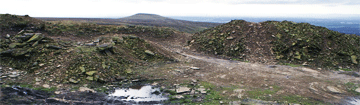 In the Sahara, a Little-Known Nuclear Wasteland, “There’s nothing nuclear in what I do. It’s just rocks we dilute into powder.”, Catapult, Hannah Rae Armstrong Apr 12, 2017 Activist Azara Jalawi lives with her mother, a nomad; her daughter Amina, who watches Mexican soap operas and dates a local human trafficker; her son Doudou, nicknamed “Slim Shady,” and a lean girl, probably a slave, in the town of Arlit, Niger, a mining hub of about forty thousand set deep within the Tuareg Sahara, a slow-baking proto-Chernobyl, a little-known nuclear wasteland.
Around Arlit, prehistoric volcanoes and petrified forests rise from the sand. Beneath it lie the skulls of giant crocodiles who preyed on dinosaurs a hundred million years ago. Within the rocky plateaus are havens like the oasis at Timia, where orange, grapefruit, and pomegranate groves ripen and flower in the desert. For forty years, the French nuclear-energy giant Areva has mined uranium here, and milled it into yellowcake, the solid concentrate that is the first step towards enriching uranium for nuclear fuel or weapons. Three miles outside the town, fifty million tons of radioactive tailings—a waste byproduct containing heavy metals and radon—sit in heaps that resemble unremarkable hills. In strong winds and sandstorms, radioactive particles scatter across the desert. “Radon daughters,” odorless radioactive dust, blanket the town. Public health and the environment exhibit strange symptoms of decay—mysterious illnesses are multiplying; grasses and animals are stunted. The people of Arlit are told that desertification and AIDS are to blame. ………..
Living atop an open-pit uranium mine has made the people ill, in ways they do not understand. Breathing radioactive dust, drinking contaminated well water, and sleeping between walls stitched from radioactive scrap metal and mud, the people tell stories to fill the gaps in their knowledge. ………
At her brother Doudou’s high school, funded by the mining company, students are told not to do drugs or set things on fire. Teachers tell Doudou nothing about the contaminated well water he consumes daily. At lunch on my first day in Arlit, I ask nervously about the source of the water in a chilled glass bottle on the table. “Don’t worry, it’s the well water,” they assure me. “We drink it all the time.” I learn later that well water readings reveal contamination one hundred times beyond the World Health Organization’s threshold for potable water.
………. a dim awareness of the contamination risks was just beginning. Almoustapha Alhacen, a yellowcake miller and environmental activist, recognizes himself on the cover of a 2012 book I’ve brought with me: “Being Nuclear: Africans and the Global Uranium Trade.” He is the man wearing a gas mask and gloves. “The problem with Areva is it never informed people that radioactivity exists and that it is dangerous,” he says. An NGO called the Commission for Independent Research and Information on Radioactivity (CRIIRAD), created by a French EU deputy after the 1986 Chernobyl catastrophe, equipped him with a device and trained him to take readings. Once, he recalls, he saw a pregnant woman eating mud next to the road that leads from the mine to the town. This road is often tamped down with clay from the mines, and the tires that cross it regularly give it a fresh, invisible wash of radon. Almoustapha took a reading there and found radioactivity twenty-four times higher than the safe level. At markets selling scrap metal used for building houses, and at the community taps where people draw water, he took readings that were off the charts.
“Arlit was built around uranium. And humanity needs uranium,” Almoustapha says, speaking quickly and with rage. “But what happens next for us, when the uranium runs out, Areva leaves, and we are left with 50 million tons of radioactive waste?” As an activist, he ponders the future and the environment with seriousness. But these become abstract concerns before the fact of his job, which he needs right now. In a white turban and sunglasses, with sequined leather jewelry adorning his chest, he protests: “There’s nothing nuclear in what I do. It’s just rocks we dilute into powder, powder we dilute into liquid. It’s just mechanics, like for any car.” …….
If any state benefits from the distraction counter-terrorism provides from these underlying issues, it is France. Insecurity shields the mines from environmental scrutiny. Threats justify deepening militarization, an ongoing erosion of Nigerien sovereignty and independence. And the French mines still face no real obstacle to radiating the radiant desert. In fact, they’re expanding. A new mine—Africa’s largest—is being built near Arlit, at a site called Imouraren. There, a “security belt” encircles 100,000 acres, marking the land off limits to nomads.
https://catapult.co/stories/in-the-sahara-a-little-known-nuclear-wasteland#
Navajo Nation still affected by legacy of uranium mining – contaminated water

 Uranium leaves legacy of contamination for Navajo Nation http://www.heraldextra.com/news/state-and-regional/uranium-leaves-legacy-of-contamination-for-navajo-nation/article_8c4df54f-426c-5647-8779-15049d913308.html Apr 2, 2017 SHIPROCK, N.M. (AP) — For more than a decade, about 20 gallons of uranium-contaminated groundwater have been pumped per minute into a disposal pond from beneath a tailings site on the eastern edge of the Navajo Nation.
Hazards of uranium mining have been known for centuries
 Native American uranium miners and the Trump budget, Bulletin of the Atomic Scientists Robert Alvarez, 30 Mar 17, Bulletin of the Atomic Scientists “…….The hazards of uranium mining have been known for centuries. As early as 1556, dust in the Ore Mountain (Erzgebirge) mines bordering Germany and what is now the Czech Republic was reported to have “corrosive qualities… it eats away the lungs and implants consumption in the body…” By 1879, researchers found that 75 percent of the miners in the Ore Mountains had died from lung cancer. By 1932, the Ore Mountain miners were receiving compensation for their cancers from the German government. Uranium mining was convincingly linked to lung cancer by dozens of epidemiological and animal studies by the late 1930s.
In 1942, Wilhelm C. Hueper, the founding director of the environmental cancer section of the National Cancer Institute, brought the European studies to light in the United States—concluding that radon gas was responsible for half of the deaths of European miners after 10 to 20 years of exposure. By this time, uranium had become a key element for the making of the first atomic weapons. Hueper’s superiors blocked him from further publication and discussion in this area; they told him that dissemination of such information was “not in the public interest.”
In fact, withholding information about workplace hazards was deeply embedded in the bureaucratic culture of the early nuclear weapons program. In 1994, the Energy Department made a previously secret document, written in the late 1940s, public. It crystallized the long-held rationale for keeping nuclear workers in the dark: “We can see the possibility of a shattering effect on the morale of the employees if they become aware that there was substantial reason to question the standards of safety under which they are working. In the hands of labor unions, the results of this study would add substance to demands for extra-hazardous pay.”
Kee Begay worked in the mines for 29 years and was dying of lung cancer when I first met him. “The mines were poor and not fit for human beings,” he told me. Begay also lost a son to cancer. “He was one of many children that used to play on the uranium piles during those years. We had a lot of uranium piles near our homes—just about 50 or 100 feet away or so. Can you imagine? Kids go out and play on those piles.”
In 1957, the US Public Health Service reported that the average radiation lung dose to Indian miners was 21 times higher than was allowed in the Atomic Energy Commission’s nuclear weapons plants. In 1962, the Public Health Service revealed that radon exposure in the mines was statistically linked to lung cancer among US miners—at a rate comparable to what Heuper had warned about 20 years earlier.
Lung disease associated with radon exposure was “totally avoidable,” former chief health scientist for the AEC Merrill Eisenbud said in 1979. “The Atomic Energy Commission … is uniquely responsible for the death of many men who developed lung cancer as a result of the failure of the mine operators, who must also bear the blame, because they too had the information, and the Government should not have had to club them into ventilating their mines………..”http://thebulletin.org/native-american-uranium-miners-and-trump-budget10657?platform=hootsuite
Uranium companies having ‘worst time ever’

 Not just Toshiba – the global nuclear industry is in crisis everywhere, Ecologist, Jim Green 3rd February 2017 “………..”It has never been a worse time for uranium miners”, said Alexander Molyneux from Paladin Energy in October 2016.
“No major commodity had a worse 2016 than uranium”, Bloomberg said in January 2017. “In fact, the element used to make nuclear fuel has had a pretty dismal decade.”
Uranium mining ramped up 5-10 years ago in anticipation of the nuclear renaissance that never materialised. Hence a glut, hence the low price. The price has fallen for seven of the past nine years. The spot price fell 41% in 2016, sinking to a 12-year low (US$18 / lb U3O8 in November).
The spot price averaged about $26 last year, and is expected to average just $23 in 2017 according to the median forecast of analyst estimates compiled by Bloomberg in December 2016. “I don’t think there’s a mine profitable at current spot prices”, Leigh Curyer from Canadian uranium miner NexGen Energy told Bloomberg.
The long-term contract price fell from $44 in January 2016 to $30 in December. It would need to double to encourage the development of new mines. KPMG noted in December that “uranium producers are expected to reduce production and cut costs through 2017 and 2018, with high cost mines likely to scale back or close. New projects are expected to remain on hold.” RBC expects the sector will be oversupplied until around 2024.
The uranium enrichment industry is in much the same place as uranium mining. The spot uranium enrichment price has fallen consistently since the 2011 Fukushima disaster, and it fell by a third between early 2015 and late 2016 to reach an all-time low.
And since cheap, abundant enrichment capacity can substitute for newly mined uranium (either by extracting more uranium-235 during uranium enrichment, or re-enriching tails), this has and will continue to keep uranium prices down. http://www.theecologist.org/News/news_analysis/2988607/not_just_toshiba_the_global_nuclear_industry_is_in_crisis_everywhere.html
Uranium market outlook: not all that good
Profit Margins : Once again, without positive earnings, it’s tough to calculate a meaningful profit margin for Uranium Resources. We have to ding it here again.
 Return on Equity : The nuclear power stock falls short in terms of return on equity. Its early-stage investors have lost 54.65% in the last year. The equity situation isn’t great for other energy stocks, but it’s not this bad.
Is Uranium Resources a Nuclear Power Play?, I nvestment U by Samuel Taube, Investment U Research Team Wednesday, January 25, 2017 Nuclear power has seen better days. In recent decades, pressure from environmentalist groups, the high cost compared to fossil fuels and the perceived risk to public safety has beaten the industry down.
Then along came President Trump, reverser of trends. Our new president is big on nuclear development – both the military and energy varieties. . And that means that beaten-down nuclear stocks like Uranium Resources (Nasdaq: URRE) could heat up again soon.
As you can see, Uranium Resources stock has been declining for much of the year. Other nuclear power stocks showed similarly drab performances before the election.
Now President Trump has spurred a revival in this industry. And Investment U readers are wondering whether or not it’s too late for a recovery. After such a long bear market, is Uranium Resources a good buy?
To find out, we ran Uranium Resources stock through the Investment U Fundamental Factor Test. (As a reminder, our checklist looks at six key metrics to diagnose the financial health of a stock.)
 Earnings-per-Share (EPS) Growth: Uranium Resources has a great earnings-per-share growth rate of 77.38%. That’s well above the average of 13.21% in the energy space. However, we should note that the nuclear power stock can post such impressive earnings growth because its earnings are still below zero.
Price-to-Earnings (P/E): And since Uranium Resources has negative earnings, we can’t calculate its P/E ratio. We’re giving it the red X in this metric by default.
Debt-to-Equity : The stock outperforms most other energy companies in terms of debt-to-equity ratio. Uranium Resources has a frugal 17.72% debt burden. That’s much less than the industry average of 41.87%.
Free Cash Flow per Share Growth : Uranium Resources really blows other energy companies out of the water in terms of cash flow. It has grown free cash flow per share by 96.27% in the last year. Its competitors saw it shrink by -28.82% in that time.
Profit Margins : Once again, without positive earnings, it’s tough to calculate a meaningful profit margin for Uranium Resources. We have to ding it here again.
Return on Equity : The nuclear power stock falls short in terms of return on equity. Its early-stage investors have lost 54.65% in the last year. The equity situation isn’t great for other energy stocks, but it’s not this bad. ……http://www.investmentu.com/article/detail/53391/stockgrader-uranium-resources-nuclear-power#.WIpYkNJ97Gh
Environmental Protection Agency caters to uranium industry, not to protection of groundwater
 US delays cleanup rule at uranium mines amid GOP criticism
Federal GOP legislators from Wyoming have said a rule was an unnecessary burden for the uranium industry NBC5 Jan 5, 2017 CHEYENNE, Wyo. —
Federal officials withdrew a requirement for companies to clean up groundwater at uranium mines across the U.S. and will reconsider a rule that congressional Republicans criticized as too harsh on industry.
The plan that the U.S. Environmental Protection Agency put on hold Wednesday involves in-situ mining, in which water containing chemicals is used to dissolve uranium out of underground sandstone deposits. Water laden with uranium, a toxic element used for nuclear power and weapons, is then pumped to the surface. No digging or tunneling takes place.
The metal occurs in the rock naturally but the process contaminates groundwater with uranium in concentrations much higher than natural levels. Mining companies take several measures to prevent tainted water from seeping out of the immediate mining area…….
Along with setting new cleanup standards, the rule would have required companies to monitor their former in-situ mines potentially for decades. The requirement was set for implementation but now will be opened up for a six-month public comment period.
EPA officials didn’t immediately respond to a request for comment Thursday.
Environmentalists and others say uranium-mining companies have yet to show they can fully clean up groundwater at a former in-situ mine. Clean groundwater should not be taken for granted, they say, especially in the arid and increasingly populated U.S. West.

“We are, of course, disappointed that this final rule didn’t make it to a final stage,” said Shannon Anderson with the Powder River Basin Resource Council. “It was designed to address a very real and pressing problem regarding water protection at uranium mines.”
The EPA rule is scheduled for further consideration in President-elect Donald Trump’s administration.
In-situ uranium mining surged on record prices that preceded the 2011 Japanese tsunami and Fukushima nuclear disaster. Prices lately have sunk to decade lows, prompting layoffs. http://www.mynbc5.com/article/woman-who-lost-her-leg-receives-very-generous-gift/8570346
Donald Trump’s aim for more nuclear weapons sends uranium stocks upward
Donald Trump Is the Stock Market’s Most Interesting Man, Bloomberg, by Joseph Ciolli and
-
Uranium ETF surges right after post as underlying shares soar
-
Icahn pick moves stocks the investor has previously rebuked
Donald Trump’s still the most interesting man in the world for U.S. stock investors.
A Twitter post from the President-elect signaling support for beefing up America’s nuclear arsenal sent shares in uranium miners surging……..
Trump’s call for expanded nuclear capability erased a loss of 2 percent in an exchange-traded fund tracking a basket of uranium miners. Uranium Energy Corp. climbed as much as 14 percent intraday to lead gains in the fund, while Mega Uranium Ltd. and Laramide Resources Ltd. are on pace to gain more than 3.7 percent…….
Goldman Sachs Group Inc. shares have surged 32 percent, touching the highest since 2007 this week, to lead financial shares higher on speculation Trump will roll back industry regulations. Goldman alumni dot the billionaire’s inner circle, with his picks for Treasury secretary, economic adviser and chief strategist all having ties to the investment bank………https://www.bloomberg.com/news/articles/2016-12-22/trump-stock-market-s-most-interesting-man-as-tweet-roils-nuclear
Mounting evidence of long term harm of depleted uranium weapons
There is increasing worldwide support for a Depleted Uranium ban….There is a
growing consensus among civil society groups, scientists and
some military organisations that the health risks from DU have been seriously underestimated.
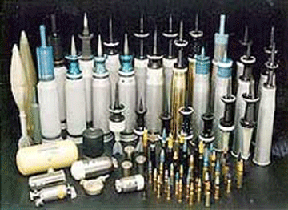
Latest documents advocating the ban of depleted uranium. By Jerry Mazza, Online Journal, 23 July 2010, US Armed Forces Radiobiology Institute Between 2000 and 2003, Dr Alexandra Miller of AFFRI was at the forefront of US Government sponsored research into DU�s chemical toxicity and radioactivity. Through a series of peer-reviewed papers, Dr Miller and her colleagues demonstrated for the first time that internalised DU oxides could result in �a significant enhancement of urinary mutagenicity,� that they can transform human cells into cells capable of producing cancerous tumours,
……and that DU was capable of inducing DNA damage in the absence of significant radioactive decay, i.e. through its chemical toxicity alone. In one study, 76% of mice implanted with DU pellets developed leukaemia.
International response�There is increasing worldwide support for a DU ban. In 2007 Belgium became the first country in the world to ban all conventional weapons containing uranium with �other states set to follow their example. Meanwhile the Italian government agreed to a 170m Euro compensation package for personnel exposed to uranium weapons in the Balkans.
Later that year the UN General Assembly passed a resolution highlighting serious health concerns over DU and in May 2008, 94% of MEPs in the European Parliament strengthened four previous calls for a moratorium by calling for a DU ban treaty in a wide-ranging resolution. In December 2008 141 states in the UN General Assembly ordered the World Health Organisation, International Atomic Energy Agency and United Nations Environment Programme to update their positions on the long-term health and environmental threat that uranium weapons pose.
With more than 100 member organisations worldwide, ICBUW represents the best opportunity yet to achieve a global ban on the use of uranium in all conventional weapon systems. Even though the use of weapons containing uranium should already be illegal under International Humanitarian, Human Rights and Environmental Laws, an explicit treaty, as has been seen with chemical and biological weapons, landmines and cluster bombs, has proved the best solution for confirming their illegality. Such a treaty would not only outlaw the use of uranium weapons, but would include the prohibition of their production, the destruction of stockpiles, the decontamination of battlefields and rules on compensation for victims.
ICBUW has prepared a draft treaty, which contains a general and comprehensive prohibition of the development, production, transport, storage, possession, transfer and use of uranium ammunition.
There is a growing consensus among civil society groups, scientists and
some military organisations that the health risks from DU have been seriously underestimated. Establishment scientific bodies have been slow to react to the wealth of new research into DU and policy makers have been content to ignore the claims of researchers and activists. Deliberate obfuscation by the mining, nuclear and arms industries has further hampered efforts to recognise the problem and achieve a ban. The past failure of the UN Convention on Certain Conventional �Weapons to deal with landmines and cluster bombs suggests that an independent treaty process is the best route to limiting the further use and proliferation of uranium weapons.As enshrined in the Geneva Conventions, the methods and means of warfare are not unlimited. We must not allow the short term military advantage claimed for uranium weapons to override our responsibility for the long-term welfare of people and planet.
Australian uranium companies facing oblivion
Writing on the wall for Paladin Energy Ltd, y Mike King – December 1, 2016 Uranium miner Paladin Energy Ltd (ASX: PDN) faces the prospect of being unable to repay US$212 million due in April 2017 and being forced into liquidation.
The troubled company has seen its share price slump more than 65% this year alone. The planned sale of 24% of its Langer Heinrich Mine (LHM) to CNNC Overseas Uranium Holdings (COUH) for US$175 million appears unlikely to complete before the end of 2016. Now Paladin has been forced to consider other ‘contingencies’ to repay the 2017 convertible bonds.
Not only that but Paladin also needs to raise working capital as it struggles to generate positive cash flow with uranium prices trading under US$20 per pound – the lowest prices in more than 12 years. As Paladin admits, that’s a level that no producer in the world can sustainably break even, and most producers are experiencing negative cash flows.
That’s a long way away from Paladin’s all-in cash expenditure of extracting uranium of US$38.75 per pound (lb). Even the company’s C1 cash costs of US$25.88/lb are well above the spot price of uranium. Paladin is forecasting all-in costs of around US$30/lb for the 2017 financial year, but it’s clear that even at that level, the company is going backwards.
Energy Resources of Australia Limited (ASX: ERA), majority owned by Rio Tinto Limited(ASX: RIO) faces a similar prospect to Paladin and is likely to shut up shop in 2021, once it has finished processing stockpiles at its Ranger uranium mine.
The problem for uranium miners around the world is that since the Fukushima nuclear incident in 2011, uranium prices have steadily fallen from above US$60/lb to its current price under US$20/lb……
Paladin faces the prospect of sinking into administration unless it can find a white knight willing to take a minority stake in its mine – or make an outright bid for the whole company.
That appears highly unlikely. http://www.fool.com.au/2016/12/01/writing-on-the-wall-for-paladin-energy-ltd/
Cancer and birth defects in India’s uranium mining area
 Koodankulam struggle: Western nations are learning from their mistakes, India is not, The Weekend Leader, By Nityanand Jayaraman & Sundar Rajan, 30 Nov “…..In Jadugoda, Jharkhand, where India’s uranium is mined by the Uranium Corporation of India Ltd, the effects of radiation among the local adivasi population are horrendous.
Indian Doctors for Peace and Development, a national chapter of the Nobel-winning International Physicians for Prevention of Nuclear War, recently published a health study on Jadugoda. The study found that:
• Primary sterility is more common in people residing near uranium mining operations.
• More children with congenital deformities are being born to mothers living near uranium mining operations.
• Congenital defects as a cause of death of children are higher among mothers living near uranium mines.
• Cancer as a cause of death is more common in villages surrounding uranium operations.
• Life expectancy of people living near uranium mining operations is lower than Jharkhand’s state average and lower than in villages far removed from the mines.
• All these indicators of poor health and increased vulnerability are despite the fact that the affected villages have a better economic and literacy status than reference villages….. http://www.theweekendleader.com/Causes/833/Nuking-myths.html
Desperate times for the uranium industry, and no hope in sight
Desperate uranium miners switch to survival mode despite nuclear rebound, Reuters, 7 OCT 16 LONDON “……..BULGING INVENTORIES Mining executives partly blame the slump on their customers’ wait-and-see attitude, as utilities believe that the uranium market’s over-capacity will persist for years and see no need to rebuild their dwindling stockpiles.
Demand for uranium is determined by the number of nuclear plants in operation worldwide, but supply and demand are disjointed by huge stocks and uranium’s long production cycle……..
In the five years before Fukushima, utilities worldwide bought about 200 million pounds of uranium per year, he said. Although Japan’s consumption averaged only around 25 million pounds per year, when it closed its reactors demand was cut far further, falling by half. European and U.S. utilities saw that the market was over-supplied and reduced inventories, buying less.
Mining firm Energy Fuels estimates global uranium stocks held by utilities, miners and governments are now at around 1 billion pounds. That is down from a peak around 2.5 billion pounds in 1990, but still many years’ worth of consumption.
Despite the plunge in uranium prices after the 2008 financial crisis and again after Fukushima, uranium production has doubled from 80-90 million pounds in the mid-1990s to about 160 million pounds last year, according to Energy Fuels data……
DESPERATE TIMES
With so much new supply, and demand sliding, prices have fallen to a level where most uranium miners operate at a loss.
“At today’s spot prices, the primary uranium mining industry is not sustainable,” US uranium producer Energy Fuels COO Mark Chalmers told the World Nuclear Association’s London conference last month.
He added that many legacy long-term supply contracts will expire in 2017-18, which will force many mines to close or throttle back even further than they already have.
Miners like Canada’s Cameco, France’s Areva and the uranium arms of global mining companies have closed or mothballed several mines and deferred new projects in order to cut back supply.
Paladin – the world’s second-largest independent pure-play uranium miner after Cameco and the seventh or eighth-largest globally – has production capacity of 8 million pounds of yellowcake uranium but produced just 4.9 million pounds last year at its Langer Heinrich mine in Namibia.
Molyneux said the firm will produce about 4 million pounds this year and will cut output further to about 3.5 million pounds next year if prices do not recover.
Paladin suspended production at its 2.3 million pounds per year capacity Kayelekera mine in northern Malawi in 2014 but maintains equipment so it can resume when prices recover.
Meanwhile it is trying to further reduce its debt, which already fell from $1.2 billion five years ago to $362 million.
Paladin has agreed to sell 24 pct of Langer Heinrich to the China National Nuclear Company and plans to use the expected proceeds of 175 million dollars to further reduce debt.
Bigger peer Cameco in April suspended production at its Rabbit Lake, Canada mine while also curtailing output across its U.S. operations, saying market conditions could not support the operating and capital costs needed to sustain production.
Cameco marketing head Tim Gabruch told the WNA conference that “desperate times call for desperate measures”.
Supply adjustments and producer discipline had not yet been sufficient to counter the loss of demand, he said.”As difficult as those decisions have been, we recognize that those actions may not be enough.”(Reporting by Geert De Clercq; editing by Peter Graff) http://www.reuters.com/article/us-uranium-nuclearpower-idUSKCN1230EF
1 This Month

of the week – Shut Down Drone Warfare!


Tell the Ukrainian Government to Drop Prosecution of Peace Activist Yurii Sheliazhenko

Petition to revoke the licensing of the Near Surface Nuclear Disposal Facility (NSDF) at Chalk River. https://www.ourcommons.ca/petitions/en/Petition/Details?Petition=e-7247
To see nuclear-related stories in greater depth and intensity – go to https://nuclearinformation.wordpress.com
-
Archives
- April 2026 (44)
- March 2026 (251)
- February 2026 (268)
- January 2026 (308)
- December 2025 (358)
- November 2025 (359)
- October 2025 (376)
- September 2025 (257)
- August 2025 (319)
- July 2025 (230)
- June 2025 (348)
- May 2025 (261)
-
Categories
- 1
- 1 NUCLEAR ISSUES
- business and costs
- climate change
- culture and arts
- ENERGY
- environment
- health
- history
- indigenous issues
- Legal
- marketing of nuclear
- media
- opposition to nuclear
- PERSONAL STORIES
- politics
- politics international
- Religion and ethics
- safety
- secrets,lies and civil liberties
- spinbuster
- technology
- Uranium
- wastes
- weapons and war
- Women
- 2 WORLD
- ACTION
- AFRICA
- Atrocities
- AUSTRALIA
- Christina's notes
- Christina's themes
- culture and arts
- Events
- Fuk 2022
- Fuk 2023
- Fukushima 2017
- Fukushima 2018
- fukushima 2019
- Fukushima 2020
- Fukushima 2021
- general
- global warming
- Humour (God we need it)
- Nuclear
- RARE EARTHS
- Reference
- resources – print
- Resources -audiovicual
- Weekly Newsletter
- World
- World Nuclear
- YouTube
-
RSS
Entries RSS
Comments RSS
 nuclear-news
