Elon Musk’s satellites litter the heavens as astonishing video shows how 5,000 Starlink aircraft are whizzing around the Earth and will soon outnumber the stars.
- Elon Musk’s 5,000 Starlink satellites are on track to surpass the number of visible stars in the sky, around 9,000
- A fascinating video showed the staggering number floating around in space
- Scientists fear for the future of astronomy as Musk’s space junk litters our sky

Unbalanced science. All about technology. But what about nature? What about light pollution? What about the moths, and all the other creatures that depend on the night darkness?
By MARTHA WILLIAMS FOR DAILYMAIL.COM 30 September 2023
Elon Musk‘s satellites are littering the heavens and an astonishing video has revealed how 5,000 of his Starlink aircraft are whizzing around the Earth.
Staggering footage posted by X user @flightclubio on September 18 shows thousands of little orange dots, representing the satellites, orbiting the planet and illustrating the vast scale of his investment.
But though Starlink has been hailed for providing internet in war-torn Ukraine, astronomers fear that the devices may soon obstruct our view of the cosmos – with around 9,000 stars visible from our planet.
New research showed that low-frequency radio waves – like the ones produced by Musk’s machines – are leaking into the sky which makes it difficult for scientists to make astronomical observations.
Scientists are also concerned that Musk’s ‘space junk’ could cause an extreme collision event. The ‘Kessler syndrome’ – proposed by NASA scientist Donald Kessler in 1978 – said that if there is too much space junk in the earth’s orbit then the objects could collide and make MORE space junk. This would result in Earth’s orbit becoming unstable.
SpaceX launched Starlink satellites in May 2019 and have already sent over 5,000 of the mass-produced objects into space.
The company announced reaching over 2 million subscribers in September 2023 and plan to deploy 12,000 satellites – a goal which could be raised to 42,000.
The SpaceX Starlink is a low orbit satellite that provides internet with unlimited data and quick broadband speeds.
The satellites offer fixed-location or portable internet options to users for a hefty price.
Internet provider T-mobile provide broadband for $50 monthly with no installation fee – while Starlink charges up to $2,500 for installation and can cost users up to $250 a month.
Viewers expressed their fear in the comments of the astonishing video that was uploaded to Musk’s social media website X (formerly known as Twitter).
One user said: ‘The size and scale of the Starlink project concerns astronomers, who fear that the bright, orbiting objects will interfere with observations of the universe, as well as spaceflight safety experts who now see Starlink as the number one source of collision hazard in Earth’s orbit.’
Researchers at Max Planck Institute used a telescope in the Netherlands to observe 68 devices made by Starlink, finding 47 were emitting ‘unintended electromagnetic radiation’ emanating from onboard electronics.
The team feared that the amount of emissions could be enough to be mistaken as radio waves from celestial objects.
The SpaceX CEO filed paperwork with the International Telecommunications Union for the operation of 30,000 more small devices in October 2019.
In its filings, SpaceX said the additional 30,000 satellites would operate in low Earth orbit at altitudes ranging from 1,076 feet to 1,922 feet. …………….. https://www.dailymail.co.uk/news/article-12575221/Elon-Musks-starlink-satellites-spacex-soon-outnumber-stars.html
Star-crossed States: No result from the UN Working Group on Reducing Space Threats
The long-standing goal of preventing an arms race in outer space could be slipping away
OPEN CANADA, BY: PAUL MEYER / 24 SEPTEMBER, 2023
It has become a challenge these days to keep up with the exponential growth in the number of satellites orbiting this planet. Current estimates of active satellites are upwards of 6000 with tens of thousands more launches planned by the end of the decade. The private sector is driving this growth with Elon Musk’s Starlink telecommunication constellation constituting almost half of the satellites operating in low earth orbit (the closest and most congested orbital slot).
The world is increasingly dependent on satellites to provide a vast spectrum of services essential for global security and well-being, and it is all the more regrettable therefore that this surge of activity in outer space is coinciding with what appears to be a nadir in the level of cooperation amongst leading space powers. Although objectively it would be in the interests of all spacefaring states, and the entire international community reliant on space-enabled services, to cooperate to ensure the continued safe and secure utilisation of outer space, the current situation is fraught with tension and mistrust. For over 40 years the UN has sought to prevent an arms race in outer space, but besides the repeated declarations that this remains a common goal there is little evidence of meaningful efforts to ensure it.
It was back in 1981 that the “Prevention of an Arms Race in Outer Space” (aka PAROS) item was added to the agenda of the UN General Assembly and the negotiating forum of the Conference on Disarmament in Geneva. While member states agreed to put this topic on the UN’s agenda, ever since they have held contending views as to how best to make progress on outer space security. The 1967 Outer Space Treaty (with 112 states parties) provided some common ground in calling for the peaceful uses of outer space and prohibiting the stationing in orbit of weapons of mass destruction, but was silent on other types of weaponry. Although the treaty required its parties to exercise “due regard” for the space operations of other states and to avoid “harmful interference” with such operations these terms have lacked a common understanding as to their import.
The Cold War era development of space weapons including anti-satellite weapons (ASATs) demonstrated that the legal regime established by the Outer Space Treaty was insufficient to ensure that the peace was kept in outer space and almost all states agreed that “further measures” would be required to strengthen it. This broad consensus that the Outer Space Treaty needed to be reinforced with complementary agreements however, quickly broke down over the specific content and form such additional measures should take.
One camp led by China and Russia, although including many other states such as Brazil, India, Mexico and Indonesia, favours legally binding agreements to supplement the Outer Space Treaty. They argue that only legal agreements will have the authority and staying power to ensure compliance with their provisions. Political measures at best might supplement a legally binding instrument, but could never substitute for one.
The other camp led by the United States, supported by many of its allies, argue that at this stage it is best to develop politically binding measures, such as so-called Transparency and Confidence Building Measures .
dherents of this approach argue that the negotiation of a legally binding agreement would take too long and would flounder over issues of definition and verification. In their view, settling on a set of practical measures would be a quicker and more effective means of agreeing “rules of the road” for state-conducted space operations.
This argument over the best diplomatic path to take to prevent armed conflict in space has gone on for decades without a resolution. As a result, in recent years the relations among leading space powers have deteriorated significantly with mutual accusations of “weaponizing” outer space and the development of “counter-space capabilities” in the arsenals of states. ……………………………………………………………… more https://opencanada.org/star-crossed-states-no-result-from-the-un-working-group-on-reducing-space-threats/
Pentagon’s new plan to counter China includes swarms of smart satellites

Deputy Secretary Kathleen Hicks: DoD wants to “leverage platforms that are small, smart, cheap, and many”
Space News, Sandra Erwin, September 6, 2023
ARLINGTON, Va. — Under a new strategy to counter China’s military buildup, the Pentagon is advocating the use of low-cost autonomous platforms that can be mass produced and deployed at sea, on land, in the air and in space.
“This is about driving culture change just as much as technology change — so we can gain military advantage faster,” Deputy Defense Secretary Kathleen Hicks, said Sept. 6 at the DefenseNews annual conference.
Hicks discussed DoD’s plan to field thousands of autonomous systems across all domains within the next 18 to 24 months. China’s advantage is “mass,” said Hicks. DoD will continue to invest in its traditional platforms but will counter with “mass of our own,” or large numbers of autonomous systems.
DoD would field fleets of tiny drones and swarms of satellites that would be inexpensive to replace.
“Imagine constellations of autonomous, attritable systems on orbit, flung into space scores at a time, numbering so many that it becomes impossible to eliminate or degrade them all,” she said.
The strategy is to “leverage platforms that are small, smart, cheap, and many,” Hicks said. …………………………………………………….
The U.S. military’s Space Development Agency is building a government-owned proliferated constellation. DoD is also a major customer of Starlink, SpaceX’s massive internet in space. ……………….. https://spacenews.com/pentagons-new-plan-to-counter-china-includes-swarms-of-smart-satellites/?utm_medium=email
Space agency NASA and bro billionaires conspire to trash the moon

Two days before the Lockheed Martin news broke, NASA had announced a literally lunatic plan to trash the Moon with nuclear waste. It’s as if our species has learned nothing at all after ruining our own planet to the point of extinction as a livable organism.
We are arming the heavens
NASA joins the lunatic fringe, By Linda Pentz Gunter, https://beyondnuclearinternational.org/2023/08/27/nasa-joins-the-lunatic-fringe/
Russia just crash-landed on the moon. India’s lunar rover is trundling across its surface. Are their intentions purely benign? Just about science? Or something more?
There are no such doubts lingering over US lunar plans, however. The mistakes made on Planet Earth will now be repeated on the moon.

In his fascinating and frightening 2012 book — A Short History of Nuclear Folly — that I somehow maddeningly missed on publication, Rudolph Herzog writes:
“There are places where radioactive substances have no business being. One of them is space.”
Herzog, son of the famous film director Werner, and whose book, written in German, was translated into English in 2013, details a whole panoply of terrifying nuclear accidents and near-misses, including disasters that could have befallen us in and from space.
But no lessons have been learned and no such warnings heeded.
Consequently, we now learn that NASA and the US Defense Department have awarded nuclear weapons company, Lockheed Martin, a contract to build a nuclear powered rocket to speed humans on their way to Mars.
“Higher thrust propulsion” is what Lockheed Martin is seeking to develop, but is travel speed to Mars really the only motivation? Of course not. The Pentagon admits it is also keen to develop nuclear reactor technology that will power satellites with more “fuel-efficient fuel sources” so that they can maneuver in space in such a way as to “make them more difficult for adversaries to target” reported the Washington Post.
As Herzog recounts in his book, we have been here before, and the outcome could have been catastrophic. In his chapter, Flying Reactors, he recounts how in the 1960s, the then Soviet Union developed miniature nuclear reactors to power their RORSAT military surveillance satellites. At the end of their life they were simply blasted into deeper space where their radioactive load would decay far from human exposure risk. Or, at least, that is what was supposed to happen.
Needless to say, eventually one of the Soviet reactor-powered satellites failed to follow orders and instead began plummeting toward Earth. The Soviets warned the US it could crash in North America on January 24, 1978.
Panicked headlines ensued as the media began to speculate on worst case scenario crash landing locations. As Herzog relates, “Time magazine calculated that if the satellite had orbited the Earth one more time it could have crashed in New York City in rush hour.”
Instead, luck prevailed, although not for northwestern Canada where it eventually reached Earth in the middle of the Arctic winter, prompting a challenging and month-long search party to find it and clean up the “mess”.
Despite this, the Soviets continued right on and lost several more of these Cosmos satellites, although none, apparently, crashed on land.
Two days before the Lockheed Martin news broke, NASA had announced a literally lunatic plan to trash the Moon with nuclear waste. It’s as if our species has learned nothing at all after ruining our own planet to the point of extinction as a livable organism.
A total of $150 million in contracts are to be awarded by NASA to “build landing pads, roads and habitats on the lunar surface, use nuclear power for energy, and even lay a high-voltage power line,” reported the Washington Post.
Yes, the USA is going to pave the moon and put up a parking lot.
The endgame is to allow human beings to live on the moon for extended periods of time. And to contaminate it with nuclear waste while they’re about it. And to dig it up and pave it over and, most absurdly, to “Iive off the land” as one NASA administrator put it.
That means implementing an extractive industry to mine the moon for construction materials such as metals, as well as to find water. And, presumably, to dispose of all the waste on other parts of the moon not targeted for human living spaces.

A major recipient of NASA’s lunatic largesse was, needless to say, one of the bro billionaires who are already heavily invested in the futile and expensive space odyssey that will eventually allow human habitation on the moon and Mars (presumably for a handful of other bro billionaires and their cronies.) So Amazon and Washington Post owner, Jeff Bezos, is first in line for a $43.7 million handout to support these goals.
Solar arrays for the moon are also in the offing, but this does little to nullify the awful prospect of the moon turning into Thneed-Ville (see Dr. Seuss’s seminal book on industrial destruction, The Lorax).
As these latest NASA announcements reveal, without actually spelling it out, the agenda here goes well beyond the thrill of human space exploration. We are arming the heavens and that, as Herzog points out, can only go badly.

The madness of nuclear power and nuclear weapons in space has been well documented in War in Heaven: The Arms Race in Outer Space by Helen Caldicott and Craig Eisendrath and The Wrong Stuff: The Space Program’s Nuclear Threat to Our Planet, by Karl Grossman.We also examine the more sinister agenda behind all this in the Beyond Nuclear Handbook — The U.S. Space Force and the dangers of nuclear power and nuclear war in space.
But there is also another question: What gives the United States the right to decide, unilaterally, that it will colonize the moon and Mars? When did the US annex these celestial territories? Human beings have for centuries waxed lyrical and poetic about the moon as it shines down on us with its magical and ethereal glow. But do any of us own it? Surely it belongs in the commons and we, as a collective species, should decide whether or not it can be plundered and desecrated by one country alone, or, preferably, not at all?
Ironically, after all the sci-fi fantasies about evil Martians invading Planet Earth, it turns out that it is we humans who are about to invade Mars and the moon, bringing our heedless and destructive ways with us. And all this, while we leave a spectacularly beautiful planet behind us to decay and degenerate as a result of our selfish greed.
Ukraine Providing an Important Testing Ground For Space-Based Weapons

Covert Action Magazine, By Jeremy Kuzmarov, August 23, 2023
Weapons Straight Out of a Science Fiction Novel Have Not Been Able to Turn the Tide on the Battlefield
In his 1988 book War Stars: The Superweapon in the American Imagination, H. Bruce Franklin traces a deep-rooted cultural belief in the magic of futuristic weapon systems that would enable the U.S. to defeat any foreign adversary.
Franklin dates the infatuation to the era of the revolutionary war with the development of the combat submarine by Robert H. Fulton to pulverize the British Navy.
He in turn shows a direct line through World War I and World War II and the development of air power and the atomic bomb, through the Vietnam War where sophisticated U.S. war machines could not defeat the guerrilla warfare tactics of the Vietcong.
Franklin could easily include a new chapter on Ukraine, whose summer counteroffensive has fizzled despite the country’s function as a testing ground for new American weapon systems.
These include space-based satellites and sensors that have been used by the Ukrainians to track Russian troop movements and assist in navigation, mapping and electronic warfare, and positioning systems that guide precision weapons and drones.
A webinar in mid-July hosted by the War Industry Resistance Network placed the U.S. strategy in Ukraine in the context of a broader attempt by the U.S. to militarize space and use it to destroy its leading geopolitical rivals—Russia and China.
The first speaker, Dave Webb, a retired engineering and peace studies professor from England, emphasized that the 1991 Operation Desert Storm set the groundwork for Ukraine as the first space war in which the U.S. showed off new satellite and precision guided missiles that wound up devastating Iraq.
In 1997, the U.S. Space Command outlined its goal of obtaining full-spectrum military dominance over land, sea, air and space by the year 2020—which achieved partial fulfillment with the Trump administration’s creation in 2019 of a new Space Force as a branch of the U.S. military.
By 2024, the budget of the Space Force reached $30.3 billion, a 15% increase over 2023 and a doubling of the budget from 2020.
Congress has in a not so veiled way tried to legitimate these budget increases by holding hearings raising alarm about the threat of Unidentified Flying Objects (UFO’s).
One in late July featured a former intelligence officer, David Grusch, who claimed that he faced retaliation at the Pentagon for his confidential disclosure that “non-human beings” had been retrieved from spacecraft.[1]
On August 11, the 75th Intelligence, Surveillance and Reconnaissance Squadron (ISRS) was activated at Peterson Space Force Base in Colorado. It has been tasked with identifying and destroying or disrupting adversary satellites and ground-based lasers aimed at preventing the U.S. from using its own satellites during a conflict.
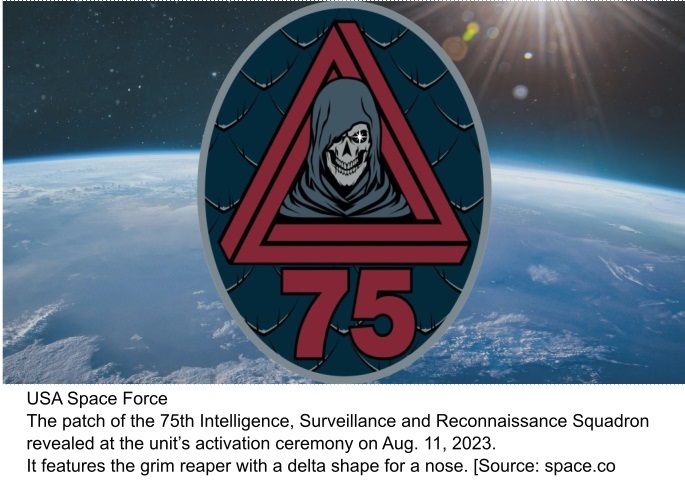
Space.com reported that the U.S. Space Force has conducted multiple training exercises to practice “live fire” satellite jamming [of Russian and Chinese space based satellites] and “simulated on-orbit combat training” as part of a growing commitment to space-based war.
The Space Force’s operations have been made possible by a $1.5 billion space surveillance radar center built by Lockheed Martin in an atoll in the Marshall Islands, which became operational in March 2020. The center now tracks more than 26,000 objects in space, some the size of a marble.
Additional surveillance centers have recently been built in Texas, Australia and Great Britain while Boeing is building a secret military space plane, the X-37B, which can carry out orbital space flight missions.
Webb ended his talk by noting that the spirit of a 1967 Outer Space Treaty that was designed to prevent the militarization of Outer Space is not being followed.
Space exploration is giving way to space exploitation and growing competition with Russia, which has developed its own space-based weapon systems in response to what the U.S. is doing.
The second speaker at the webinar, Bruce Gagnon, coordinator of the Global Network Against Weapons & Nuclear Power in Space, pointed out that, for the last quarter century, Russia has presented its demand for a new cooperative space treaty before the United Nations but has been blocked by the U.S., Israel and a few of their allies.
The Russians have stated unequivocally, as have the Chinese, that they do not want to devote their countries’ resources to a destructive and fruitless arms race in space, though the U.S. believes it can be master in space and has been taken over totally by the military-industrial complex.
When the creation of the new Space Force came up for a vote in 2019, the Democratic-controlled House of Representatives supported it, though it had wanted to call it Space Corps.
………………………………………….Gagnon’s concern about the militarization of Outer Space began when he read a book by Linda Hunt called Secret Agenda, which detailed the CIA’s recruitment of Nazi scientists under Operation Paperclip who helped found the U.S. space program.
Chief among them was Wernher von Braun, who had helped develop the V-2 rocket in Germany using slave labor.
Gagnon said he finds it chilling that the U.S. Space Force carries out yearly war-game exercises where they simulate fighting using space-based weapons right out of science fiction novels. Among these is the “Rod from God,” a weapon in which tungsten steel rods are fired from orbiting satellites, smacking the Earth from the sky as if sent by God.
Right now, Gagnon says, we are living through a Cuban Missile Crisis in reverse as the U.S. has pointed nuclear weapons directly at Russia from a U.S. military base in Deveselu, Romania, and another in Redzikowo, Poland off the Baltic Sea.
The U.S. goal is to break up Russia as it did Yugoslavia in the 1990s because Russia is the world’s largest resource base and threatens the ability of the U.S. to extract resources from the Arctic unencumbered.
Along with World War III, the current U.S. space strategy is threatening to unleash a major environmental catastrophe as space-based satellites and weapons are leaving debris that cannot be cleaned up.
According to Gagnon, exhaust from escalating numbers of rocket launches is diminishing the ozone layer, and the growing space debris could even cause the Earth to go dark as collisions become more likely………………….. more https://covertactionmagazine.com/2023/08/23/ukraine-providing-an-important-testing-ground-for-space-based-weapons/
Threat from the skies: India steps up the fight against a major space danger.

By B R Srikanth, a veteran Bengaluru-based journalist reporting on space and defense, 21 Aug 23, https://www.rt.com/india/581397-india-space-debris-cleaning-mission/
New Delhi’s ambitious space plans include tackling the problem of floating debris, countless pieces of which orbit the Earth
A spectacular display of celestial fireworks? The momentous arrival of aliens? Or was it a work-in-progress sci-fi flick?
These questions weighed heavily on many minds as Melbourne’s night sky lit up for almost a minute on the night of August 7. The flame raced across the sky before breaking into blazing fragments. A sonic boom shook the ground for a couple of seconds, setting off a panic among residents. A day later, the Australian Space Agency confirmed it was space junk, likely “remnants” of a giant Russian rocket which had hoisted a new navigational satellite into orbit.
A few weeks earlier, a six-foot high cylindrical object, perhaps the fuel tank of an Indian rocket, had washed ashore at Green Head Beach, 250 km north of Perth, Australia. The artificial lighting, the loud explosion, and the large fuel tank found there reignited one question: How to vacuum-clean the graveyard in the deep, dark heavens to safeguard assets worth billions of dollars?
Such assets include satellites circling the Earth at 300 km to 36,000 km, in support of telecommunications, broadcasting, meteorology, civil aviation, telemedicine, distance education, and even espionage (by military satellites launched without fanfare).
Space junk
Outer space contains hundreds of dead satellites, millions of fragments of old satellites and rockets, and even paint flakes; each is hurtling through space at an incredible speed of 10 km a second, with a lethal punch of a 550-pound object. NASA estimates there are around 23,000 pieces of debris larger than a softball, half a million pieces the size of a marble or up to a centimeter, 100 million pieces one millimeter and larger.
Example of space junk include a glove lost by Edward Higgins White during America’s first spacewalk, Michael Collins’ camera lost near Gemini 10, a thermal blanket lost during STS-88, the first space shuttle mission, garbage bags jettisoned by cosmonauts during Mir’s 15-year life, a wrench, and a toothbrush.
Indian-American astronaut Sunita Williams lost her camera during her spacewalk from the space shuttle in 2007, and astronaut Heidemarie Stefanyshyn-Piper lost a briefcase-sized tool bag during her spacewalk the following year.
And if you think the Hollywood film ‘Gravity’, where a spacecraft is hit by a cloud of space debris (killing George Clooney’s character, and nearly marooning Sandra Bullock) was fiction, then consider that in 1996, a French satellite was hit and damaged by a French rocket that had exploded a decade earlier. Or that on February 10, 2009, a defunct Russian spacecraft collided with and destroyed a USA Iridium commercial spacecraft. The collision over northern Siberia added 2,300 pieces of large trackable debris and a bigger quantity of smaller trash to the existing space junk.
China did not help matters when in 2007 it used a missile to destroy an old weather satellite, creating 3,500 pieces of large debris. In 2016, a tiny piece of debris punched a hole in the solar panel of the European Space Agency (ESA) observation satellite, Copernicus Sentinel 1A. Even the Hubble Telescope’s solar array shows hundreds of tiny holes caused by dust-sized debris.
The risk of trash colliding with satellites could spiral higher in the future, K R Sridhara Murthy, Honorary Director and former vice president of Paris-based International Institute of Space Law (IISL), and a former senior scientist of the Indian Space Research Organisation (ISRO), told RT.
This is because a large number of private companies – SpaceX, OneWeb, Amazon Kuiper, Guo Wang (China), Samsung (Korea), and Astrome Tech (India) plan to add a whopping 75,000 satellites within a decade to provide global communication networks (superfast internet services), and Automatic Identification Systems (AIS) to track ships (including those of pirates) among other benefits.
Though smaller than conventional satellites, they will crowd the low earth orbit (LEO), about 400 km from the ground, and multiply the number already in this sphere. “More companies are joining the race to position their satellites in orbit because the economics of satellite launch are changing drastically owing to reduction in the cost of putting a satellite into orbit and the deployment of reusable rockets,” Murthy added.
Need for self-discipline
Nations have not been unmindful of the hazards of space junk. The USA and the former USSR tracked objects measuring four inches or more from the Cold War era using a string of radars. NASA and the US Defense Department’s Space Surveillance Network (SSN) have cataloged more than 27,000 pieces of debris, and track each piece’s trajectory.
Not surprisingly, nations with ambitions in space, including India, are setting up facilities to track the burgeoning amount of trash.
The importance of tracking can be gauged when even the voyage of a rocket into space is delayed by a couple of minutes to prevent debris from causing a disastrous impact on missions, Dr. Mylswami Annadurai, the “Moon man of India” and former director of ISRO’s Prof. U R Rao Satellite Centre in Bengaluru, told RT. He said that ISRO delayed the launch of its rockets three times to avoid a piece of space junk: a one-minute delay in the blast-offs in 2011 and 2016 and a three-minute hold in 2014
All space agencies realize the need for self-discipline in outer space and try not to disturb the operations of other satellites when decommissioning an old and defunct one. “For example, we (ISRO) brought down Megha-Tropiques (a satellite designed jointly and launched by ISRO and CNES of France in 2011 to study tropical atmosphere in the context of climate change) last year with the help of fuel available onboard without causing damage to any other satellite,” Rao said.
Last month, Indian space scientists reduced the altitude of the last stage of the Polar Satellite Launch Vehicle (PSLV) rocket as part of its initiative to avoid creating more space junk. “Left alone at a 536 km circular orbit, the PSLV4 stage would orbit the Earth for over 25 years. As the number of satellites in LEO (low earth orbit) is growing and the space around this orbit is of particular interest, the orbit of the spent PSLV4 was reduced to 300 km,” said the ISRO’s spokesperson.
“Everybody wants to clear outer Space of debris, but how to do it is a billion-dollar question,” K Sivan, former Chairman of ISRO, explained to RT. “We are part of the Inter-Agency Space Debris Coordination Committee (IADC). This international governmental forum coordinates global efforts to reduce debris by sharing research and identifying debris mitigation options.”
When Sivan was at the helm, ISRO established a radar at the Deep Space Network Station on the outskirts of Bengaluru as part of a project, called ‘Nethra’, to track junk in outer space and to share the data with other space agencies. Earlier, ISRO established the Multi-Object Tracking Radar at Satish Dhawan Space Centre, Sriharikota, the country’s spaceport just off the eastern coast in Odisha, to track the trajectory of 10 pieces of space junk and share the data with IADC.
According to Sivan’s predecessor, Gopalan Madhavan Nair, options include preventing new debris, designing satellites to withstand the impact of minor pieces, and improving procedures such as using orbits with less trash.
“Earlier, we used to allow the last stage of our PSLV rocket, along with some fuel, to drift away after launching the satellite, but now we make sure that the fuel (propellant) is exhausted to prevent an explosion of the last stage, or it is used to push the last stage closer to the Earth. Eventually, the last stage will drift further down and burn on re-entering the Earth’s atmosphere,” he said, alluding to the recent manoeuver.
Clearing efforts
In 2018, the United Nations Institute for Disarmament Research (UNDIR) proposed three A-SAT (anti-satellite) test guidelines for preventing junk in outer space. No consensus, however, has been reached among space-faring nations on the policies.
To mitigate the hazards of vast amounts of junk in outer space, the Japanese Space Agency, JAXA, has launched a project to develop a sprawling net akin to the one used by fishermen, to trap and drag down the trash. Many private companies are working on similar methods to cart away the garbage through operations that could fetch them millions of dollars.
ESA has teamed up with a consortium led by Swedish start-up, ClearSpace, to remove all ESA-owned, defunct satellites in the LEO. Their mission, ClearSpace1, will be launched in 2025 to capture a 100-kg upper-stage left orbit after the second flight of ESA’s Vega launcher in 2013. During follow-up missions, ESA will attempt multi-object captures.
Other space agencies and private enterprises could follow suit, each with unique techniques to reduce the trash in outer space by 2050. Space scientists, however, feel new satellite observation methods, too, ought to be developed to forecast the trajectory of orbiting satellites and debris to avoid collisions.
Military interest in nuclear-powered space travel, but solar-powered is just as good, -and safer.

2 Government, Industry Explore Nuclear, Solar Space Engines
COLORADO SPRINGS, Colorado — More commercial and military activity is taking place in space, and the Defense Department and industry are investing in emerging propulsion technologies to move systems in orbit faster, farther and more efficiently.
……………………………………..In 2021, the Defense Advanced Research Projects Agency selected Lockheed Martin as one of three prime contractors — along with General Atomics and Blue Origin — for Phase 1 of its Demonstration Rocket for Agile Cislunar Operations, or DRACO, program to showcase the potential of a nuclear thermal propulsion system in space, a DARPA release said.
This January, NASA announced it had partnered with DARPA on the DRACO program, describing a nuclear thermal rocket engine as “an enabling capability for NASA crewed missions to Mars.” The goal is to demonstrate the system in orbit in fiscal year 2027, with the Space Force providing the launch vehicle for the DRACO mission, a DARPA statement said.
The program is about to enter Phase 2, which “will primarily involve building and testing on the non-nuclear components of the engine” such as valves, pumps, the nozzle and “a representative core without the nuclear materials in it,” DARPA’s program manager for DRACO Tabitha Dodson said during a panel discussion at the Space Foundation’s Space Symposium in April. Dodson said then a Phase 2 decision is “quite close.” However, at press time in mid-July, no contracts have been awarded.
…………………………………“There are no facilities on Earth that we could use for our DRACO reactor’s power test … so we’ve always baselined doing our power test for the reactor in space,” Dodson said. Once in space, DARPA will “very gradually” ramp up the system to “full power thrust,” she said…………………………………………………………………………………………………………………………………………
Despite DARPA’s commitment to safety, nuclear propulsion systems face an uphill battle getting deployed on spacecraft at scale, said Joel Sercel, founder and CEO of TransAstra, a space technology company.
………………………………………………………………………………..In May, the Space Force awarded TransAstra a Phase One Small Business Innovation Research contract to explore new applications for the company’s propellant-agnostic Omnivore thruster.
The Omnivore thruster uses solar reflectors to focus sunlight onto a solar absorber, which then superheats the system’s propellant to generate thrust “typically six times faster and eight times cheaper than electric systems,” a company release said.
Additionally, TransAstra calculated an Omnivore thruster “using liquid hydrogen propellant … will perform similarly to nuclear rockets, but without nuclear materials, costs or risk.”
Sercel said Omnivore has “80 percent of the performance of nuclear at 1 percent of the cost.” The system is essentially nuclear powered, “but the nuclear reactor in question is the fusion reactor at the center of the solar system called the Sun,” he added.
“The nice thing about nuclear reactors is that you have a small, compact reactor versus large deployable solar reflectors, but the basic performance of solar thermal rockets and nuclear rockets is about the same,” he said. And with Omnivore “you don’t have all these safety concerns and radioactive material and reactor control issues and so on. So, we think it’s a much more practical approach.”
Omnivore could have multiple mission applications for the Defense Department, Sercel said. Using liquid hydrogen propellant, the thruster “can deliver hundreds of kilograms” of spacecraft to geosynchronous orbit “on small launch vehicles, and the Space Force seems to be very excited about this,” he said. The system could also deliver spacecraft weighing more than 100 kilograms to cislunar space, he said.
Additionally, TransAstra has an Omnivore variant that uses water as the propellant, the solar absorber superheating the water vapor and releasing the gas through a nozzle to generate thrust.
The water-based variant can be placed on the company’s Worker Bee small orbital transfer vehicles, about 25 of which can fit on a single Falcon 9 rocket, Sercel said.
“Each [Worker Bee] could deliver up to six small [satellites] to their orbital destinations. So, we can deliver a full constellation of 100 small or micro [satellites] to all different inclinations, and you would get global coverage in one launch.”…………………………………………………………more https://www.nationaldefensemagazine.org/articles/2023/7/31/government-industry-explore-nuclear-solar-space-engines
NASA is planning to use nuclear power for the first human trip to Mars
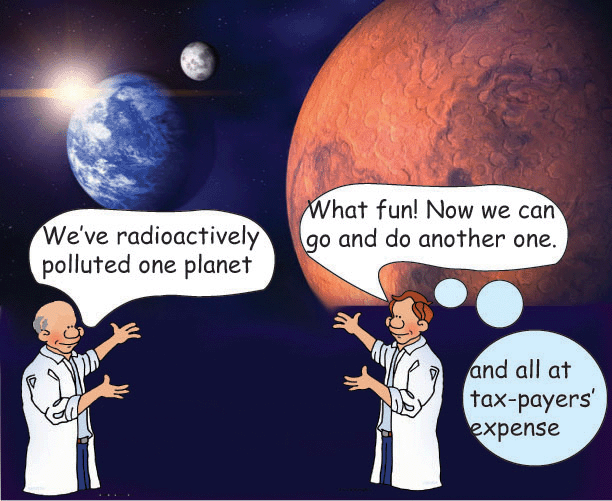
earth.com By Chrissy Sexton 30 July 23
The space race has been revived, but this time, the goal post has been shifted much further – to Mars. As recent technological advancements promise to open new horizons of exploration, NASA plans to cut the travel time to Mars with a nuclear-powered spacecraft.
A trip to Mars currently takes approximately seven months, covering a staggering 300-million-mile journey. NASA, in collaboration with the US Defense Advanced Research Projects Agency (DARPA), now proposes an ambitious plan that hinges on the promise of nuclear thermal propulsion technology to reduce this duration significantly.
DRACO spacecraft is nuclear-powered
NASA aims to launch a nuclear-powered spacecraft, known as DRACO (Demonstration Rocket for Agile Cislunar Operations), into Earth’s orbit either by late 2025 or early 2026. The spacecraft, under construction by Lockheed Martin, a leading aerospace and defense company, will serve as a testbed for this groundbreaking technology.
NASA administrator Bill Nelson said that this technology “would allow humans to travel in deep space at record speed.” However, it remains unclear by how much the nuclear thermal propulsion technology can decrease the travel time.
…………………………………………………………………. The history of NASA’s interest in nuclear propulsion dates back over six decades. The concept was first explored in the 1960s when Wernher von Braun, a pioneer of rocket technology, advocated for a Mars mission utilizing a nuclear propulsion system. Unfortunately, budgetary constraints and shifting priorities resulted in the abandonment of this vision in 1972
But with the dawn of the new space age, NASA’s pursuit of the Red Planet has been rekindled. In collaboration with the US government, the space agency aims to expedite progress with the DRACO nuclear thermal rocket program.
“The ability to accomplish leap-ahead advances in space technology through the DRACO nuclear thermal rocket program will be essential for more efficiently and quickly transporting material to the Moon and eventually, people to Mars,” commented Dr Stefanie Tompkins, director at DARPA………………………………………………………………………………………………
More about Mars…………………….
Size
Mars is about half the size of Earth but has the same amount of dry land. It is much colder than Earth, with temperatures ranging from -195 degrees F in winter at the poles to 70 degrees F in summer near the equator. Mars has the largest dust storms in the solar system, capable of covering the entire planet and lasting for months.
Atmosphere
The planet’s atmosphere is very thin, composed mainly of carbon dioxide (95%), with traces of nitrogen and argon. It lacks a magnetic field, which on Earth serves to protect us from harmful solar radiation. As a result, the surface of Mars is exposed to higher levels of radiation, which can be a challenge for human exploration and potential colonization.
………………………….... Potential for life on Mars
The possibility of liquid water in the past, and thus the potential for life, has made Mars a prime target for future human exploration. The planned missions to Mars, such as NASA’s Artemis program and SpaceX’s Starship project, aim not only to land humans on Mars but also to establish a sustainable colony, marking a significant leap in our exploration of the cosmos. https://www.earth.com/news/could-a-nuclear-powered-spacecraft-shorten-the-trip-to-mars/
Funny How The UFO Narrative Coincides With The Race To Weaponize Space

does it really sound like a coincidence that we’re seeing all these news stories about UFOs and aliens at the same time we’re seeing news stories about a race between the US and China and Russia to dominate space militarily?
Caitlin’s Newsletter CAITLIN JOHNSTONE, JUL 28, 2023
If Wednesday’s House Oversight subcommittee hearing on UFOs had happened ten years ago instead of today, it would have shaken the world. Imagine someone from 2013 hearing congressional testimonies about “routine” military pilot encounters with giant flying tic tacs, floating orbs, 300-foot red squares, and cubes in clear spheres zipping around in ways that surpass all known earthly technology by leaps and bounds, or about secret government possession of otherworldly aircraft they’re trying to reverse engineer and the dead bodies of their non-human pilots, or about the possibility that these creatures are not merely extraterrestrial but extra-dimensional. Their jaws would have hit the floor.
Now in 2023 we’ve been getting incrementally drip-fed bits and pieces of these stories for six years, so the scene on Capitol Hill on Wednesday didn’t have the impact it would’ve had in 2013. It’s making headlines and getting attention, but not as much as Sinead O’Connor’s death or people’s thoughts on Barbie and Oppenheimer. The response from the general public could be described as a collective nervous laugh and a shrug.
……………………………………………………. the new UFO narrative wasn’t just cooked up at the last minute to distract from current headlines, it’s been unfolding for six years, and people aren’t even paying that much attention to it. The empire doesn’t tend to orchestrate spectacular events as a “distraction” anyway; the adjustment of public attention tends to take the much more mundane form of agenda setting in the media, where some stories receive more attention than others based on what’s convenient for the oligarchs who own the press.
……………………………………. for me what really stinks about all this UFO stuff is the timing. Here we are in the early stages of a new cold war which features a race to militarize space, and we’re hearing congressional testimony about mysterious vehicles posing a threat to US airspace which have the ability to go up and down between earth and space very quickly. That smells off.
I mean, does it really sound like a coincidence that we’re seeing all these news stories about UFOs and aliens at the same time we’re seeing news stories about a race between the US and China and Russia to dominate space militarily?
A Foreign Policy article from last year blares the headline “China and Russia Are Catching Up to U.S. in Space Capabilities, Pentagon Warns” with the subheading “The militarization of space is picking up pace.” These warnings are echoed in articles by Defense One and Time. An article on the United Nations website from last year carries the title “‘We Have Not Passed the Point of No Return’, Disarmament Committee Told, Weighing Chance Outer Space Could Become Next Battlefield.” A 2021 report from the war machine-funded Center for Strategic and International Studies titled “Defense Against the Dark Arts in Space: Protecting Space Systems from Counterspace Weapons” warns of the urgent need to build more space weapons to counter US enemies. A Global Times article from last year carries the title “Chinese experts urge avoidance of space weaponization amid commercial space capability deployment in Ukraine.”
………………………………….it just seems mighty suspicious to me how we’re being slowly paced into this UFO narrative (or UAP narrative for those hip to the current jargon) right when there’s a mad rush to get weapons into space. I can’t actually think of any other point in history when the timing of something like this would have looked more suspicious.
So for me the most disturbing parts of the UFO hearing were the parts that could wind up facilitating the agenda to militarize space, like when this phenomenon was framed as a “national security” threat or when it was mentioned that they can transition from earth to space very rapidly.
When asked by congressman Glenn Grothman “do you believe UAPs pose a threat to our national security?”, former Navy commander David Fravor answered with an unequivocal yes. A few minutes later Fravor described these vehicles as being able to “come down from space, hang out for three hours and go back up.”
When asked by congressman Andy Ogles whether UFOs could be “collecting reconnaissance information” on the US military, all three witnesses — Grusch, Fravor, and former Navy pilot Ryan Graves — answered in the affirmative. Asked by Ogles if UFOs could be “probing our capabilities,” all three again said yes. Asked if UFOs could be “testing for vulnerabilities” in US military capabilities, all three again said yes. Asked if UFOs pose an existential threat to the national security of the United States, all three said they potentially do. Asked if there was any indication that UFOs are interested in US nuclear technology, all three said yes.
Ogles concluded his questioning by saying, “There clearly is a threat to the national security of the United States of America. As members of Congress, we have a responsibility to maintain oversight and be aware of these activities so that, if appropriate, we take action.”
When asked by congressman Eric Burlison if “there has been activity by alien or non-human technology, and/or beings, that has caused harm to humans,” Grusch said he couldn’t get into specifics in a public setting (a common theme throughout the hearing), but said that “what I personally witnessed, myself and my wife, was very disturbing.”
Grusch would complicate this cryptic statement a few minutes later by saying that he’s never seen a UFO. How this statement doesn’t contradict his previous statement about having witnessed harmful behavior from non-human technology and/or beings was not made clear.
So you’ve got US policymakers being told that there are vehicles using technology not of this world routinely violating US airspace and posing an existential threat to US national security, and that these craft can go from earth to space and back at will, and that they need to help make sure their nation can address this threat.
What conclusions do you come to when presented with that kind of information? If you’re a lawmaker in charge of facilitating the operation of a highly militaristic empire, you’re probably not going to conclude that it’s time to hold hands and sing Kumbaya. You’re probably eventually going to start thinking in terms of military technology.
One of the most important unanswered questions in all this UFO hullabaloo is, why now? Why are we seeing all this movement on “disclosure” after generations of zero movement? If these things are in fact real and the government has in fact been keeping them secret, why would the adamant policy of dismissal and locked doors suddenly be reversed, allowing “whistleblowers” to come forward and give testimony before congress? If they had motive to keep it a secret this entire time, why would that motive no longer be there?
…………………………………So why now? Why the drastic and sudden shift from UFOs and aliens being laughable tinfoil hat nonsense to the subject of serious congressional inquiries and widespread mainstream media coverage?
Well, the timing of the race to militarize space might provide an answer to the “why now?” question. Is it a coincidence that this new UFO narrative began its rollout in 2017, around the same time as the rollout of the Space Force? Are we being manipulated at mass scale about aliens and UFOs to help grease the wheels for the movement of war machinery into space? How likely is it that by pure coincidence this extraplanetary narrative timed out the way it did just as the US empire makes a last-ditch grab at unipolar planetary domination?
I don’t know. I do know that if I’m assigning degrees of probability, “Extraterrestrial or extradimensional beings are here and take a special interest in us and sometimes crash their vehicles and our government recovered them but kept them a secret but suddenly decided not to be so secretive about them anymore” ranks significantly lower than “Our rulers are lying and manipulating to advance their own interests again.”
I am 100 percent wide open to the possibility of extraterrestrials and otherworldly vehicles zipping around our atmosphere. What I am not open to is the claim that the most depraved institutions on earth have suddenly opened their mind to telling us the truth about these things, either out of the goodness of their hearts or because they were “pressured” by UFO disclosure activists.
I don’t know what the hell is going on with this UFO thing, but I do know the drivers of the US empire have an extensive history of manipulating and deceiving at mass scale to advance imperial agendas. And I do know that at this crucial juncture in history where the empire is clinging to planetary domination with the tips of its fingernails, there are a lot of imperial agendas afoot. https://www.caitlinjohnst.one/p/funny-how-the-ufo-narrative-coincides?utm_source=post-email-title&publication_id=82124&post_id=135494785&isFreemail=true&utm_medium=email
NASA solving climate crisis by facilitating escape to Mars?
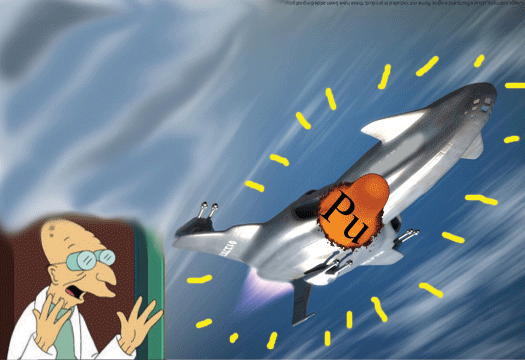
NASA will test launch nuclear-powered spacecraft for the first time to try
and get to Mars faster. Nasa has revealed that it plans to use
nuclear-powered spacecrafts to help humanity land on Mars. Whilst it sounds
like the stuff of science fiction, the space agency has been perfecting the
technology for over 60 years and the first rockets could soon be blasting
off. In fact, the insane tech could be tested within the next couple of
years.
Unilad 27th July 2023
https://www.unilad.com/technology/nasa/nasa-nuclear-powered-rockets-mars-574302-20230727
SpaceX Starlink satellites had to make 25,000 collision-avoidance maneuvers in just 6 months — and it will only get worse
Space.com ,By Tereza Pultarova 7 Jul 23
Since the launch of the first Starlink spacecraft in 2019, the SpaceX satellites have been forced to move over 50,000 times to prevent collisions.
Staggering growth in Starlink collision-avoidance maneuvers in the past six months is sparking concerns over the long-term sustainability of satellite operations as thousands of new spacecraft are poised to launch into orbit in the coming years.
SpaceX‘s Starlink broadband satellites were forced to swerve more than 25,000 times between Dec. 1, 2022, and May 31, 2023 to avoid potentially dangerous approaches to other spacecraft and orbital debris, according to a report filed by SpaceX with the U.S. Federal Communications Commission (FCC) on June 30. That’s about double the number of avoidance maneuvers reported by SpaceX in the previous six-month period that ran from June to November 2022. Since the launch of the first Starlink spacecraft in 2019, the SpaceX satellites have been forced to move over 50,000 times to prevent collisions.
The steep increase in the number of maneuvers worries experts because it follows an exponential curve, leading to concerns that safety of operations in the orbital environment might soon get out of hand.
“Right now, the number of maneuvers is growing exponentially,” Hugh Lewis, a professor of astronautics at the University of Southampton in the U.K. and a leading expert on the impact of megaconstellations on orbital safety, told Space.com. “It’s been doubling every six months, and the problem with exponential trends is that they get to very large numbers very quickly.”
1 million maneuvers by 2028
Data compiled by Lewis shows that, in the first half of 2021, Starlink satellites conducted 2,219 collision-avoidance maneuvers. The number grew to 3,333 in the following six-month period ending in December 2021 and then doubled to 6,873 between December 2021 and June 2022. In the second half of 2022, SpaceX had to alter the paths of its satellites 13,612 times to avoid potential collisions. In the latest report to the FCC, the company declared 25,299 collision-avoidance maneuvers over the past six months, with every satellite having been made to move an average of 6 times. ……………………………………………………………………….
Currently there are about 10,500 satellites orbiting our planet, 8,100 of which are operational, according to the European Space Agency. Things only started to get so congested fairly recently…………………………………………………
Lewis expects that, unless regulators cap the number of satellites in orbit, collisions will soon become a regular part of the space business. Such collisions would lead to rapid growth in the amount of space debris fragments that are completely out of control, which would lead to more and more collisions. ……….. https://www.space.com/starlink-satellite-conjunction-increase-threatens-space-sustainability?utm_source=flipboard&utm_content=QuickFlipper%2Fmagazine%2F%5BExplorology%5D—
Chinese astronauts install radiation-exposure experiment outside Tiangong space station
By Andrew Jones, 21 June 23, https://www.space.com/astronauts-install-radiation-experiment-china-tiangong-space-station
China plans to conduct radiation experiments on plant seeds, microorganisms and small animals.
China is running a biological radiation exposure experiment outside its space station.
The country’s Shenzhou 16 astronauts — Jing Haipeng, Zhu Yangzhu and Gui Haichao — installed the experiment outside the Tiangong space station‘s Mengtian science module on June 10, China’s National Space Science Center (NSSC) announced in a statement.
The experiment was deployed using Mentian’s dedicated payload airlock and attached to an external payload adapter using the space station’s small robotic arm.
The experiment payload contains 13 sample box units loaded with biomaterials. These are designed to study the impact of cosmic radiation and microgravity on organisms, the origin and evolution of life and the development of space radiation mutagenic resources.
The equipment can be used for in-orbit experiments on biological samples, including plant seeds, microorganisms and small animals, according to NSSC. The temperature inside each sample container unit can be adjusted to suit the organisms it is hosting.
On-orbit medical research involving space radiation biological exposure is of great significance to supporting China’s human spaceflight program. That program is ambitious, with plans to launch long-term crewed missions in Earth orbit and send people to the surface of the moon, the Chinese-language outlet Science and Technology Daily reported.
The experiment payload was developed jointly by the NSSC and Dalian Maritime University. It is intended to operate for five years and is planned to be used for several scientific projects.
The Shenzhou 16 crew arrived at Tiangong on May 30 and will remain aboard the space station until November.
India needs ‘space-based’ weapons – top generals

The space arms race is already ongoing, according to the chiefs of the Air Force and the Defense Staff.’
https://www.rt.com/news/575556-india-space-based-weapons/ 30 Apr 23
India must boost its defensive and offensive capabilities in the space domain, as the “future lies in having space-based platforms,” Air Chief Marshal Vivek Ram Chaudhari told a national security and geopolitics forum on Saturday.
“
In the future, instead of having purely land-based offensive systems, we should also have space-based offensive systems,” Chaudhari said, according to The Economic Times.
The competition and rivalry between the global powers in space “will have its effects across all other domains of warfare,” he said, predicting that his Air Force will soon turn into an Air Space Force, and “will be called upon to take part in space situational awareness, space denial exercises or space control exercises.”
“The race to weaponize space has already started and the day is not far when our next war would spread across all domains of land, sea, air, cyber and space,” the air force chief warned back in March. On Saturday he stated that the race has actually been ongoing ever since Nazi Germany first launched its V-2 rocket almost 80 years ago.
India’s Chief of Defense Staff, General Anil Chauhan, also recently stated that the “military applications of space is the dominant discourse from which we cannot remain divorced.”
“The aim for all of us should be developing dual-use platforms with special focus on incorporating cutting-edge technology,” he told the Indian DefSpace Symposium on April 11.
It remains unclear what kind of futuristic space weapons the military seeks to obtain, but Chaudhari said India should capitalize on the success of its 2019 anti-satellite missile test. The so-called Mission Shakti destroyed a satellite some 300km away in low-Earth orbit and was hailed at the time as an “unprecedented achievement” by Prime Minister Narendra Modi.
ndia has become the fourth “space superpower” after the US, Russia, and China, to openly demonstrate its ASAT missile capability. The space club members have regularly accused each other of weaponizing space, voicing suspicions over secretive military launches and dual-purpose tests, but have never admitted to possessing any orbital weapons systems.
The wrong stuff – Musk and the 4/20 rocket drill

on nearly all the times Musk has tried to land Starship its blown up or crashed.
But its Musk’s money, he can do whatever he likes with it surely? Actually, no Starship now forms a critical part of NASA’s lunar landing project. These tests are mostly taxpayer funded.
So on the 20th of April (4/20, so at least we know what he was smoking), chief twit Elon Musk launched his ego rocket to cheering crowds, which was deemed a success. …despite blowing itself to bits and scattering debris over a wetlands habitat. I’m sorry, but that’s not what can even be considered a success. But it just goes to show the double standards the media applies to Musk and other tech bro’s. And how lazy most journalists are.
The wrong stuff – Musk and the 4/20 rocket drill — daryanenergyblog
……………………………………. its considered bad luck to cheer during a rocket launch (as it was not unusual for people to cheer in these early days only for the rocket to shortly there after blow up). Musk and his fanboys seem intend on re-learning what we all ready know.
Indeed, there’s very little that we learnt from this test flight that couldn’t have been learned from ground testing, simulations, some quick calculations….or applying some basic common sense. For example, the main problem was how Musk’s rocket was less the world’s big’s rocket, but the the world’s biggest drill bit. It chewed up its own launch pad and effectively destroyed it, spraying chucks of concrete out to a distance of several hundred metres, damaging equipment on site (likely including the rocket itself as several engines failed immediately upon launch) and scatter debris into a protected wetland area.
This was entirely predictable and indeed several commentators did predict it (but obviously Musk the college drop out knows way more about rocketry than these guys with their fancy degrees). This is why most other launch complexes have a flame pit and maintain a large separation between the pad and anything that might not react well to flaming chucks of debris (like a tank full of propellants).
There were also some control and stability issues, as the aerodynamic surfaces at the front of the craft require control inputs from the engines at the back just to fly in a straight line (think of an arrow, where you put the fins on the front instead of on the back). Obviously, this means the engines have to work harder to steer. Plus you lose enough of the steerable engines (or you hit gimbal lock) and the rocket becomes uncontrollable (which towards the end of the flight, is basically what happened).
And since we are talking about it, I still can’t understand why he’s using Methane as a fuel. This gives a specific impulse of only 360s, while Lox/LH2 will give you at least 450s (i.e. 20% more bangs for each gram of fuel). And NASA has the RS-25 engines used by the SLS (based on the space shuttle engines, so a proven technology), which are also reusable and can be throttled. The only reason not to use them seems to be not invented here syndrome. Either way, it would make far more sense to adapt Starship to be brought up to orbit in sections by the SLS (or just go with a more sensible space craft design), or adapt SLS to lift it up in one go (e.g. cluster several core SLS stages together, similar to the soviet Energia system).
And least we forget, Starship is supposed to be a man rated rocket (which for NASA means getting the probability of loss down to 1 in 500…good luck with that one!). There has to be serious doubts about it meeting that now. Aside from the issued I discussed previously related to its stainless steel construction, it also has to undertake a very risky manoeuvre in order to separate both halves. The rocket does a 180 degree spin arse over end, sling shooting the upper stage away from the lower stage (keeping in mind the control issues I mentioned earlier, will be much worse due to the fact the rocket is now nose heavy, as most of the fuel in the lower stage is gone). And its possible the rocket broke its back trying to do this.
Its also unclear how Starship is supposed to separate and land safely in the event of a booster failure during the early launch phase (had more of those engines been lost earlier on, this type of failure would have occurred shortly after lift off). By contrast the Orion capsule on the SLS (or indeed Soyuz or the Dragon capsule) has an escape tower, which will boost the capsule and its crew away from a failing rocket. No such escape options appear to exist for Starship. Indeed on nearly all the times Musk has tried to land Starship its blown up or crashed.
But its Musk’s money, he can do whatever he likes with it surely? Actually, no Starship now forms a critical part of NASA’s lunar landing project. These tests are mostly taxpayer funded. Quite apart from the costs of delaying the entire lunar project, the costs of the impending FAA investigation and the time of the US wildlife service who are going to have to devote to cleaning up the mess in the wetlands.
And this is hardly the first time Musk has promised way more than he can deliver. As I mentioned before, Falcon was supposed to be fully reusable, but is only partially reusable (and even then, more in theory than practice), at a significantly higher cost. Hyperloop is still a pipe dream, and the loop is a glorified Disney ride. Meanwhile twitter is an increasingly unreliable hellscape which has lost half its value since he took it over, and self driving cars? Will be available in 2013, 2015, 2017, 2020, 2024.
I mean imagine if NASA behaved the same way as Musk. Or let’s suppose some Mexican billionaire started blowing up rockets just across the border in Mexico showering debris into the US. Would they be treated the same way by the US government or the media? No, they’d be pretty quick to shut them down. But being a billionaire is basically an excuse to get away with anything in America, even if its criminal, immoral or insane. https://daryanenergyblog.wordpress.com/2023/04/30/the-wrong-stuff-musk-and-4-20-rocket-drill/
Stop SpaceX from crashing rockets in the Pacific.
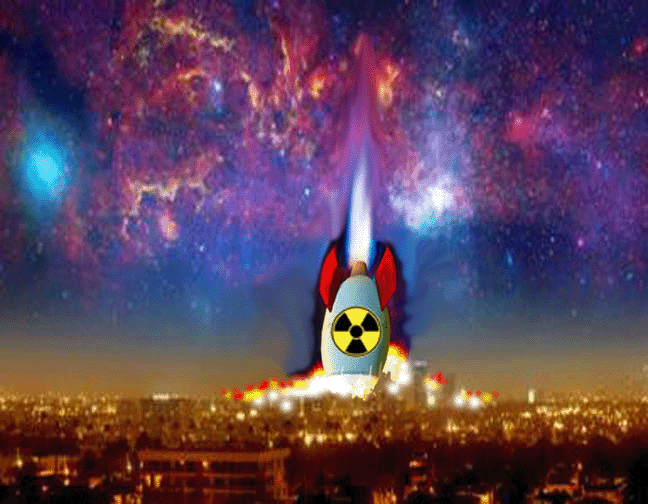
Hawaii should not be a collateral sacrifice zone for a private space company working for the pentagon
Hawaii needs to have input on SpaceX ocean-landing plan, STAR ADVERTISER. By Lynda Williams, APRIL 27, 2023
The world watched aghast as SpaceX blew up its own spaceship on April 20, four minutes after launch due to engine failure. Even though the mission was not completed, Elon Musk, CEO of SpaceX, claimed it was a success because the real goal was for the rocket to clear the launch pad at the spaceport in Boca Chica, Texas.
What most folks don’t know or realize is that Starship was always going to blow up when it crashlanded in the Pacific Ocean, just 62 nautical miles north of Kauai and a few hundred miles east of the Papahanaumokuakea Marine National Monument.
In the next test launch, which Musk boasted will happen in the next few months, the world’s largest spaceship will descend toward Earth in free fall and blow up upon impact with a force of a ton of TNT as fuel ignites in a great explosion. On a second and third launch test, Starship will break up in the atmosphere and tumble down and crash-land in a debris field several hundred miles southwest of the island chain.
SpaceX obtained a Federal Aviation Administration (FAA) commercial space launch license (experimental permit), rubber-stamped by the National Oceanic and Atmospheric Agency (NOAA) without any consultation of Hawaii’s people because, according to an email I received from the FAA: “No in-person public outreach was conducted in Hawaii as the Starship vehicle was planned to land outside of range for impacts to the residents of Hawaii.”
First of all, that is assuming everything goes exactly according to the plan, which we have all just witnessed doesn’t always happen. If the Starship goes off course by even a few degrees, the consequences could be catastrophic to Hawaii.
Secondly, I think most folks in Hawaii would agree that 62 miles north of Kauai is considered Hawaii culturally if not legally, and that is way too close for what is essentially a rocket bomb to crash-land.
SpaceX was not required to do a full environmental impact study (EIS), but a much-weaker environmental assessment (EA) that only requires the analysis of “nominal operations” or bestcase scenarios. Why was that allowed when the worst-case scenarios are so catastrophic?
In the EA, rather than doing a detailed analysis of the potential impact to marine mammals protected by the Endangered Species Act, NOAA wrote a “Biological Opinion” that argued “less than one” animal would be harmed by a 100 ton steel rocket exploding with the energy of a small nuclear bomb.
It came to that conclusion because it analyzed only one “nominal” scenario in which the rocket hits the water exactly horizontal to the surface with the fuel tanks orientated on top, which is impossible to control or predict. If the explosion is above water, NOAA argues, only a fraction of the energy will be transmitted into the ocean and travel deep enough to harm any of the 30 endangered species of whales, sharks, turtles, monk seals, dolphins and rays in Hawaii.
The EA has many unsubstantiated claims, such as no animals would be near the surface of the water during the crash — even though most are mammals that surface to breathe air.
It ignored the fact that Humpback whales migrate through the target “action area.” It assumed that most of the debris will be large enough to sink to the bottom of the ocean without encountering and injuring animals — but if any does drift into the Papahanaumokuakea Marine National Monument, then the Coast Guard would be sent to clean it up.
This alone is reason to contest the EA and demand an EIS since NOAA and the Office of Hawaiian Affairs co-manage Papahanaumokuakea and OHA should have been consulted, but was not.
The FAA and NOAA analyses are flawed, and both are failing in their duty to protect the people of Hawaii from extreme corporate and federal government abuse.
Hawaii must not become collateral damage and a colonized sacrifice zone for the government’s privatization of the space program and a billionaire’s personal ambition and corporate profits.
At minimum, the FAA must suspend the SpaceX license, conduct a full EIS and include the residents of Hawaii in the review process. The best plan is to ban SpaceX from trashing people and planet in Musk’s ego trip to Mars.
ISLAND VOICES
1 This Month

5 March -Online – Reversing nuclearization:
From nuclear weapons in Belarus and NATO host countries to a European-Nuclear-Weapon Free Zone
11am-12:30pm Eastern Time USA / 5pm-6:30pm CET

of the week – Advocating for a
nuclear free beach – https://www.samuellawrencefoundation.org/
The Samuel Lawrence Foundation advocates for a Nuclear Waste Free Beach at San Onofre, join us and take action!

10 March A LIVE WEBINAR THE REAL EFFECTS OF NUCLEAR POWER
What the Industry Isn’t Telling Us
1:00 PM Mountain, 2 pm Central, 3 pm Eastern. Live on the Keepers of the Water Facebook page


18 March Webinar @ 1 PM EST: An Assessment of SMR Projects: The Case of Canada
register for the zoom:
https://us02web.zoom.us/webinar/register/WN_o8BIIOUvQ2ONJR1nta65DQ#/registration

of the week – STOP SMALL MODULAR REACTORS IN CANADA
To see nuclear-related stories in greater depth and intensity – go to https://nuclearinformation.wordpress.com
-
Archives
- March 2026 (38)
- February 2026 (268)
- January 2026 (308)
- December 2025 (358)
- November 2025 (359)
- October 2025 (376)
- September 2025 (258)
- August 2025 (319)
- July 2025 (230)
- June 2025 (348)
- May 2025 (261)
- April 2025 (305)
-
Categories
- 1
- 1 NUCLEAR ISSUES
- business and costs
- climate change
- culture and arts
- ENERGY
- environment
- health
- history
- indigenous issues
- Legal
- marketing of nuclear
- media
- opposition to nuclear
- PERSONAL STORIES
- politics
- politics international
- Religion and ethics
- safety
- secrets,lies and civil liberties
- spinbuster
- technology
- Uranium
- wastes
- weapons and war
- Women
- 2 WORLD
- ACTION
- AFRICA
- Atrocities
- AUSTRALIA
- Christina's notes
- Christina's themes
- culture and arts
- Events
- Fuk 2022
- Fuk 2023
- Fukushima 2017
- Fukushima 2018
- fukushima 2019
- Fukushima 2020
- Fukushima 2021
- general
- global warming
- Humour (God we need it)
- Nuclear
- RARE EARTHS
- Reference
- resources – print
- Resources -audiovicual
- Weekly Newsletter
- World
- World Nuclear
- YouTube
-
RSS
Entries RSS
Comments RSS
 nuclear-news