Musk’s SpaceX is building spy satellite network for US intelligence agency, sources say
By Joey Roulette and Marisa Taylor, March 17, 2024
WASHINGTON, March 16 (Reuters) – SpaceX is building a network of hundreds of spy satellites under a classified contract with a U.S. intelligence agency, five sources familiar with the program said, demonstrating deepening ties between billionaire entrepreneur Elon Musk’s space company and national security agencies.
The network is being built by SpaceX’s Starshield business unit under a $1.8 billion contract signed in 2021 with the National Reconnaissance Office (NRO), an intelligence agency that manages spy satellites, the sources said.
The contract signals growing trust by the intelligence establishment of a company whose owner has clashed with the Biden administration and sparked controversy, opens new tab over the use of Starlink satellite connectivity in the Ukraine war, the sources said.
The Wall Street Journal reported, opens new tab in February the existence of a $1.8 billion classified Starshield contract with an unknown intelligence agency without detailing the purposes of the program.
Reuters reporting discloses for the first time that the SpaceX contract is for a powerful new spy system with hundreds of satellites bearing Earth-imaging capabilities that can operate as a swarm in low orbits, and that the spy agency that Musk’s company is working with is the NRO.
Reuters was unable to determine when the new network of satellites would come online and could not establish what other companies are part of the program with their own contracts.
SpaceX, the world’s largest satellite operator, did not respond to several requests for comment about the contract, its role in it and details on satellite launches. The Pentagon referred a request for comment to the NRO and SpaceX.
In a statement the NRO acknowledged its mission to develop a sophisticated satellite system and its partnerships with other government agencies, companies, research institutions and nations, but declined to comment on Reuters’ findings about the extent of SpaceX’s involvement in the effort…………………………………………..
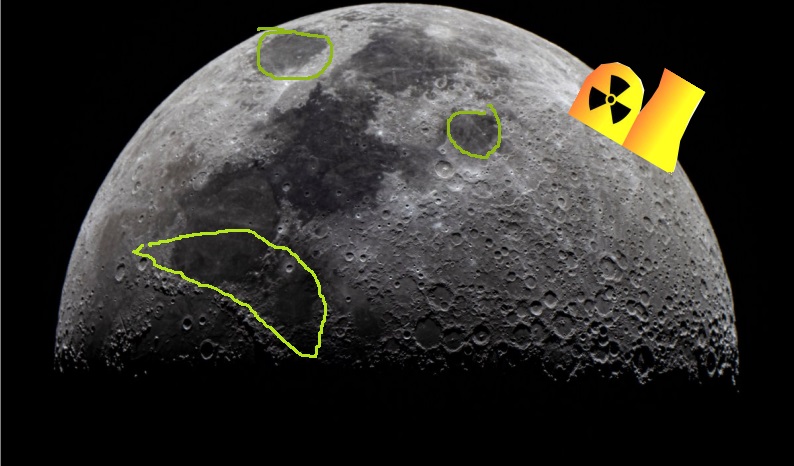
Russia and China announce plan to build shared nuclear reactor on the moon by 2035, ‘without humans’
Live Science, By Harry Baker, 8 Mar 24
The proposed nuclear reactor, which could be transported and assembled without human assistance, would provide energy to a lunar base that Russia and China have agreed to build together.
Russia’s space agency Roscosmos has announced plans to work with China to build an automated nuclear reactor on the moon by 2035. The proposed reactor will help power a proposed lunar base that the two countries will jointly operate.
Back in 2021, Roscosmos and the China National Space Administration (CNSA) revealed that they intended to build a shared base on the moon, named the International Lunar Research Station (ILRS), which they claimed at the time would be “open to all interested countries and international partners.”
However, NASA astronauts are unlikely to be allowed to visit this base due to historically frosty relations with CNSA and a more recent split with Roscosmos, which will leave the International Space Station by 2025 in response to sanctions from the U.S. over Russia’s invasion of Ukraine in February 2022.
On Tuesday (March 5), Roscosmos announced that it will eventually attempt to build a nuclear reactor alongside CNSA, which would theoretically be able to power the ILRS.
“Today we are seriously considering a project — somewhere at the turn of 2033-2035 — to deliver and install a power unit on the lunar surface together with our Chinese colleagues,” Roscosmos director general Yury Borisov told state-owned Russian news site TASS.
Borisov added that the challenging construction job would likely be carried out autonomously “without the presence of humans” and that the necessary technological solutions to pull it off are “almost ready.”
Roscosmos is also looking to use massive nuclear-powered rockets to transfer cargo to the moon to build this base, but the agency has not yet figured out how to build these spacecraft safely, Reuters reported……………………………………..
Roscosmos and CNSA, neither of which have put humans on the moon’s surface, have contrasting track records when it comes to recent lunar exploration.
Last year, Russia’s first moon mission in 47 years ended in disaster when the Luna-25 lander crashed into the lunar surface, leaving behind a 33-foot (10 meter) wide crater.
However, China has had a presence on the moon since 2013, when the Chang’e 3 mission put a lander and rover on the lunar surface. The subsequent Chang’e 4 and Chang’e 5 missions, which occurred in 2019 and 2020 respectively, also successfully landed spacecraft on the moon. The most recent mission also successfully returned lunar samples to Earth — a feat that CNSA will attempt to repeat later this year.
Last week, CNSA also announced that it will start launching giant reusable rockets over the next two years as part of the agency’s plan to put boots on the moon by 2030.
However, NASA is still on track to return humans to the lunar surface before then, despite the first crewed Artemis mission being delayed until 2026. https://www.livescience.com/space/space-exploration/russia-and-china-announce-plan-to-build-shared-nuclear-reactor-on-the-moon-by-2035-without-humans
Russia says it is considering putting a nuclear power plant on the moon with China
Reuters, March 6, 2024, https://www.reuters.com/technology/space/russia-china-are-considering-putting-nuclear-power-unit-moon-ria-2024-03-05/
MOSCOW, March 5 (Reuters) – Russia and China are considering putting a nuclear power plant on the moon from 2033-35, Yuri Borisov, the head of Russia’s space agency Roscosmos said on Tuesday, something he said could one day allow lunar settlements to be built.
Borisov, a former deputy defence minister, said that Russia and China had been jointly working on a lunar programme and that Moscow was able to contribute with its expertise on “nuclear space energy”.
“Today we are seriously considering a project – somewhere at the turn of 2033-2035 – to deliver and install a power unit on the lunar surface together with our Chinese colleagues,” Borisov said.
Solar panels would not be able to provide enough electricity to power future lunar settlements, he said, while nuclear power could.
“This is a very serious challenge…it should be done in automatic mode, without the presence of humans,” he said of the possible plan.
Borisov spoke also of Russian plans to build a nuclear-powered cargo spaceship. He said all the technical questions concerning the project had been solved apart from finding a solution on how to cool the nuclear reactor.
“We are indeed working on a space tugboat. This huge, cyclopean structure that would be able, thanks to a nuclear reactor and a high-power turbines…to transport large cargoes from one orbit to another, collect space debris and engage in many other applications,” Borisov said.
Russian officials have spoken before of ambitious plans to one day mine on the Moon, but the Russian space programme has suffered a series of setbacks in recent years.
Its first moon mission in 47 years failed last year after Russia’s Luna-25 spacecraft spun out of control and crashed.
Moscow has said it will launch further lunar missions and then explore the possibility of a joint Russian-China crewed mission and even a lunar base.
China outlines position on use of space resources
Space News Andrew Jones, March 6, 2024
HELSINKI — China holds a seemingly positive stance towards the use of space resources, according to a recent submission made by a Chinese delegation to the United Nations.
The delegation appears to state that China considers space resource utilization as permissible, but must be conducted in accordance with the Outer Space Treaty (OST) of 1967.
China’s submission treats the use of space resources as legal, but also calls for adherence to the existing frameworks of international space law, with the OST as the cornerstone.
The document was submitted to the Working Group on Legal Aspects of Space Resource Activities of the Legal Subcommittee of the Committee on the Peaceful Uses of Outer Space (COPUOS).
COPUOS is a body of the United Nations tasked with governing the exploration and use of space for the benefit of all humanity, overseeing matters related to space science and technology and their applications. The Working Group plays a critical role in addressing the legal challenges posed by the utilization of space resources, helping to shape the international legal framework that will govern these activities.
The submission could be seen as a beneficial development, helping to set the stage for a dialogue on the legal frameworks for governing the use of space resources.
“This engagement by China on the international discussion on space resources is a positive development,” Christopher Johnson, director of legal affairs and space law for the Secure World Foundation, told SpaceNews. “It tells us that China is taking international fora like COPUOS seriously, and seems to be engaging in good faith with the fora and with the process.
“Additionally, it’s welcome to have a clear statement of Chinese positions on these issues, and this informs other States in their approach and preparations to the international discussions going on at the UN.”
Johnson interprets the Chinese stance as seemingly largely aligned with the broader international consensus on the use of space resources. That is, the right to possess and use space resources is not only desirable by space agencies and national governments, but is also permissible under the current international law.
Discussion and consideration of the use and legality utilizing space resources has grown in recent years due to advancements in the space sector, the rise of commercial companies and renewed interest in the moon.
This has made international law and diplomacy related to the subject matters of key focus, with the distance between the respective stances of the U.S. and China likely to be pivotal. ……………….
There are a number of issues for the international community to settle going forward, some of which are noted in the Chinese submission. These include how space resources can be utilized in a sustainable fashion and in a way that fosters scientific investigations, while also ensuring peaceful relations in space between states and other actors in space.
Another key matter is the question of how states supervise their national activities, making sure private companies comply with the law. Additionally, all such activities will also need to preclude any national territorial annexation of the moon or other celestial bodies, as prohibited by Article II of the OST. ……………………………………………………………….. more https://spacenews.com/china-outlines-position-on-use-of-space-resources/
Satellites burning up in our atmosphere may not be as harmless as first thought

Business Insider, Marianne Guenot , Mar 2, 2024
- Spacecraft burning up in the atmosphere are leaving behind metal particles.
- Scientists are racing to understand if that affects the climate.
- One risk is that these particles may spark rainbow-colored clouds that damage the ozone layer.
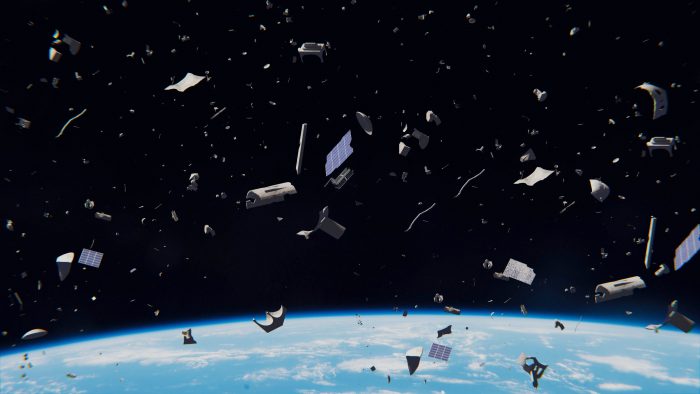
Satellites and spacecraft burning up in our atmosphere are leaving metal particles in the stratosphere — and scientists are worried it could harm our planet.
About 10% of the particles floating around the stratosphere now come from the aerospace industry, and we don’t know if this could impact the climate.
One risk is that these new particles could seed polar stratospheric clouds, which are spectacular rainbow-colored clouds that can damage the ozone layer, experts told Business Insider.
“This is a good demonstration of how important it is to have the basic research on the stratosphere,” Daniel Murphy, a research scientist at the National Oceanic and Atmospheric Administration Chemical Science Lab, who led a survey of the particles, told BI.
“There is a whole phenomenon here that we didn’t expect out and we don’t fully understand the implications,” he said.
Stratospheric particles can shape the ozone layer
…..This crucial layer of the atmosphere, mostly contained in the stratosphere, protects us from ultraviolet radiation from the sun. It was frequently splashed across the headlines about 40 years ago when scientists raised the alarm about gaping holes growing over the poles made by chlorofluorocarbons (CFCs) rising up uncontrolled to the atmosphere…………………………………………………
Metal from satellites and spacecraft is vaporizing into the atmosphere
Murphy and his colleagues recently conducted a survey of the state of stratospheric particles over Alaska using a sensitive detector aboard NASA’s WB-57 high-altitude research plane.
The findings, published in the peer-reviewed journal PNAS in October 2023, revealed that about 10% of the stratospheric sulfuric acid particles they picked up could not be explained by natural causes………………………………………………………………………………………………………………………….
We’re realizing how little we know

With launch costs going down, the number of satellites orbiting the planet is only expected to grow to over 50,000 by 2030, up from about 8,000 now. Many of these satellites are expected to have a short lifetime.
“If you multiply those numbers out, a satellite will be reentering the atmosphere on average about once an hour,” said Murphy.
Within the next few decades, Murphy and his co-authors estimate aerospace debris could make up 50% of the particles in the stratosphere, which makes the need to understand what they do even more pressing.
Spacecraft decommissioning is only part of the equation, said Chipperfield.
“There’s an increasing number of rocket launches for small satellites and tourism, which burn kerosene or other fuels that emissions in the atmosphere. Then some satellites and orbit have fuel like iodine that can come back to the atmosphere. And then the demise,” he said………………………………………………………………………………. more https://www.businessinsider.com/satellites-burn-atmosphere-particles-stratosphere-climate-ozone-2024-2
—
Get These Rich People Off the Moon.

Other than allowing billionaires and private companies to benefit from taxpayer-funded pipe dreams and advertising, the value of going to the moon for all mankind is not at all clear.
The US military has also expressed an interest in renting Starships for their Space Force cargo and troops — delivering war to poor countries anywhere in the world within one hour.
Despite the mess it makes on Earth, NewSpace investments are growing in popularity among everyman-for-himself superrich techies
BY PETER HOWSON,on behalf of Koohan Paik-Mander
Texas start-up Intuitive Machines has achieved the first moon landing by a private firm. It’s dumping rich people’s detritus on the lunar surface — a grim sign of how the superrich plan to plant their flag beyond our own planet.
Amid tears of joy at their Houston control room, the Texas start-up Intuitive Machines successfully landed on the moon. Their uncrewed lander, known as Odysseus, hitched a ride on a SpaceX rocket last week, touching down near the moon’s south pole on Thursday. After many failed attempts by various private outfits, Intuitive Machines is the first private company to plant a free-market flag on the moon
In January, a different US private venture crashed back to Earth. Astrobotic’s Peregrine lander had been supposed to dispose of at least seventy dead rich people (and one rich dog) on the lunar surface.
Spending billions of dollars dumping odd things in space has become a tradition among the lunar classes. Elon Musk famously sent a Tesla Roadster as the dummy payload for the 2018 Falcon Heavy test flight. Driven by a mannequin in a spacesuit dubbed “Starman,” the car is now an enduring satellite of the sun. You can track him, if you like.
The Japanese isotonic drinks company Pocari Sweat has been trying to leave a can of pop on the moon since 2014. It finally crashed with Astrobotic’s failed $100 million lander. The Japanese still plan to send a hydrogen-powered Toyota “Lunar Cruiser” up there, despite a few explosive setbacks.
Toxic Effects
Other than allowing billionaires and private companies to benefit from taxpayer-funded pipe dreams and advertising, the value of going to the moon for all mankind is not at all clear. British astronaut Tim Peake suggests the microgravity up there might one day enable exotic treatments for all sorts of diseases, albeit expensive treatments for those who can afford them. Aside from body parts, fizzy pop, and “art,” the squillion-dollar landers are packed full of instruments designed for exploring the unknown, before anyone else gets their mitts on it.
So called “NewSpace” companies are on the prowl for profitable rare earth metals, helium-3, and water. Just like the spice of Arrakis, helium-3 is being pitched as “the most precious resource in the universe.” At least it might be if someone invents a use for it. Getting large quantities of water to space is pricey. A stable reservoir will keep plebs alive while they mine for spice. And both hydrogen and oxygen can make the rocket fuel needed to search for shiny things further afield.
It all sounds very exciting. But realizing these fantasies has costs for the rest of us. According to Atrium, a big insurer for rocket-makers, early space-faring outfits should typically expect 30 percent of their launches to end in catastrophic failure. When two separate SpaceX Starship launches in Texas went south last year, toxic particulates rained down on people’s homes. Debris broke windows and caused fires that burned across Boca Chica Park, home to endangered birds and ocelot cats.
“We never gave our consent,” said one indigenous Carrizo-Comecrudo representative at a SpaceX protest in South Texas. “Yet they [SpaceX] are moving forward. It’s colonial genocide of native people and native lands.” Bekah Hinojosa of the Texas environmental group Another Gulf Is Possible claims environmental deregulation, tax breaks, and subsidies have been used by the Texas state government to lure SpaceX in. Meanwhile local indigenous communities who rely on Boca Chica’s fish to feed their families feel their customary land is being sacrificed.
For the Navajo people, the costly blunders are no bad thing. The Navajo hold the moon to be sacred, and consider fly-tipping and mining there an act of profound desecration. According to the Navajo Nation’s president Dr Buu Nygren, “The sacredness of the Moon is deeply embedded in the spirituality and heritage of many Indigenous cultures, including our own.”
Wars on Our Home Planet
Yet, despite the mess they’re making, SpaceX plans on going bigger and bigger.
SpaceX will soon be moving its monster Starship boosters from Boca Chica to the much larger Kennedy Space Center in Florida. Like the Falcon 9, SpaceX’s Starship is designed as a workhorse for frequent, repeated flights. Instead of only a couple of launches per year, Kennedy will start to resemble an airport. The same powerful and destructive super heavy-lift rockets that devastated Boca Chica will be lifting off on a near daily basis from the Florida coast.
The US military has also expressed an interest in renting Starships for their Space Force cargo and troops — delivering war to poor countries anywhere in the world within one hour.
NewSpace is scaling up US geopolitical influence behind a facade of free-market competition. In Indonesia, SpaceX has edged out Beijing to become the country’s satellite launch partner of choice. The partnership was achieved through the personal relationship Musk nurtured with outgoing Indonesian president Joko Widodo. The deal marks a rare instance of a US company making inroads in Indonesia, whose telecommunications sector is dominated by Chinese outfits offering low costs and easy financing. Some see the SpaceX deal as just a sweetener for Musk to build a new Tesla factory somewhere in Indonesia. The electric vehicle-maker has so far signed contracts worth billions for Indonesia’s nickel and other essential materials for the company’s car batteries.
As well as ripping up Indonesia’s pristine forests for luxury car bits, plans to furnish Musk with a new spaceport on the island of Biak, Papua, is fermenting anger among indigenous Warbon peoples. Clearances for the spaceport are reigniting ethnic tensions and military violence. Somewhere between 40 and 150 Papuans protesting the spaceport have been killed by the Indonesian military since the plans were originally unveiled.
Real People Are Gross
Despite the mess it makes on Earth, NewSpace investments are growing in popularity among everyman-for-himself superrich techies.
For them, dealing with today’s real social and environmental problems tends to involve paying icky taxes and/or remunerating their workers fairly. Meanwhile, finding solutions for potential future problems is far more profitable. For billionaires, “longtermism” packages up this predicament beautifully.
Factoring future populations into decision-making models is just a nice, sustainable thing to do. Longtermism on the other hand, is too much of a good thing. It’s an extreme utilitarian, accelerationist ideology asking us to drastically increase rates of economic growth and technological advancement to ensure humanities’ long-term survivability as a multiplanetary species.
Meanwhile, taxes and government interventions are framed as an impediment to growth and innovation. For these longtermists, someone potentially not being born on Mars in the far distant future is in many ways far worse than someone actually dying of a preventable disease or poverty today. Mars guy is super smart and loaded. Unlike the stinky real person, Mars guy is likely to live a long happy life free of dysentery. He’s white because rich people tend to be that way.
If this all sounds a bit fascist, that’s because it is. According to Oxford philosopher Nick Bostrom, widely considered the founding father of longtermism, “blacks are more stupid than whites,” as he once said on an extropian community message board. “I like that sentence and think it is true.” Bostrom then used an offensive slur beginning with “N.” “It seems that there is a negative correlation in some places between intellectual achievement and fertility,” he argued. “If such selection were to operate over a long period of time, we might evolve into a less brainy but more fertile species.” He later apologized for coming across as “racist.”
Thanks in part to Musk, the cost of space travel has dropped considerably. A seat on a Falcon 9 rocket and an eight-day stay on the International Space Station (ISS) now only costs $82 million. Musk predicts his one-way tickets to Mars will cost somewhere between $500,000 to $1 million, a price at which he thinks “it’s highly likely that there will be a self-sustaining Martian colony.” For the poors, Musk has an indentured labor package where workers take out a loan to pay for their tickets, paying them off later by mining for spice or something.
Life on Earth will end one day (we have somewhere between one and five billion years). But the universe will also end. What then? We could just keep on running through the vacuum of a dying universe. Or, instead of living as slaves obsessing over spice and birth quotas for some odious space baron, we could take a leaf from the Navajo’s book, taking the moon for sacred, and mountains, lakes, and rivers, too. If we treat our planet right, we might just live longer and better.
I’ll admit: I wrote two versions of this article, depending on the fate of the Intuitive Machines lander. In 1969, President Richard Nixon did something similar, just in case everyone died onboard Apollo 11. But when it comes to NewSpace, there’s no need for tears or alternative endings.
Private space missions will only ever serve the billionaires, not us.If we make no effort to change direction, we will end up where we are heading.”
Nuclear space-based ASAT weapons – A brief international legal perspective

Charlie JP Bennett, 27 Feb 24, https://www.ejiltalk.org/nuclear-space-based-asat-weapons-a-brief-international-legal-perspective/
On 14th February 2024, US and UK media reported the emergence of serious national security concerns by senior American officials and lawmakers that the Russian state was pursuing the deployment of a nuclear-based weapon designed to eliminate (enemy) satellites. It was added that such a weapon had not yet been deployed, but had reached some stage of development.
The exact severity of the development remains hotly contested (also here) and presently unknown, but was described as a ‘destabilising foreign military capability’ to the US and its allies. There is speculation that it may be a political ploy to further pressure the US house to authorise further aid to Ukraine in its conflict against Russia. There has also been speculation regarding a critically-important ambiguity in the information released – is it a nuclear weapon, or merely a nuclear-powered weapon? The latter is far less destructive.
Yet, the White House NSC strategic communications coordinator, John Kerby, stated on February 15th, without any hesitation whatsoever, that the weapon, if deployed, would be ‘space based, and a violation of the Outer Space Treaty’. Assuming this is true, and though not definitive evidence, the fact that no other weapons are prohibited by the Outer Space Treaty except for nuclear weapons/WMDs (see below) means that we have to consider the nuclear weapon scenario. The scenario for a weapon to be so definitively contrary to the treaty, and not nuclear, is small. Even if true in part, it would mark a frightening turning point in the decades-long consensus regarding nuclear-based weapons in space; and yet another compounding issue for an international legal order stretched to its limits.
How such weapons may work
It seems highly likely that the intent of such a space-based nuclear explosion would be to knock out satellites through the emission of a powerful Electromagnetic Pulse (EMP) as a consequence of the explosion: rendering all electronics caught in the (potentially enormous) area – and thus also any satellites – damaged or outright inoperable. These effects can linger for years, forming an artificial radiation belt around earth.
One of the last nuclear tests in outer space, the American ‘starfish prime’, produced an EMP so (unexpectedly) powerful that it damaged all electronics within a ~900 mile / ~1450 kilometre radius – including on the ground in Hawaii. That explosion had a large yield of approximately 1.4 megatons. Its resulting electromagnetic effects carried by the planet’s magnetic field, flattening them into a radioactive belt, almost immediately rendered three satellites in Low Earth Orbit (LEO) inoperable, and ultimately destroyed eight in the months that followed due to lingering radiation in orbit. Not many in absolute terms – but roughly a third of those deployed in 1962; at time of writing, there are approximately 8,300. This was not even a weapon designed to produce as large an EMP as possible, or to target specific orbits – both things a new weapon might do. There is little doubt that deployment of such an EMP through a nuclear medium would be a highly destructive weapon.
Some observers have pointed out that use of such a weapon would damage Russia’s (or any nuclear-ASAT deploying nation’s) own interests; its own space-based infrastructure – with the implication being that they would thus never actually use it. Given the events of the past several years, however, can we really rely on the assumption that a state will not – even severely – damage itself to prevent another state from achieving/acquiring/joining something? No. Absolutely not.
Tearing up the nuclear-space consensus
It is pertinent to distinguish between the use/deployment of a nuclear weapon in space, and the mere placing of such a weapon into outer space. Both are prohibited through different instruments.
Use of such a weapon in space is, flatly, prohibited. The most obvious legal violation would be against the “1963 Treaty Banning Nuclear Weapon Tests in the Atmosphere, in Outer Space and Under Water” (otherwise known as the ‘Partial test-ban treaty’), to which Russia is (and for now remains) a founding party. It is a short treaty with one operable article, created immediately after the Cuban Missile Crisis of 1962. It simply states the following:
Article 1
1. Each of the Parties to this Treaty undertakes to prohibit, to prevent, and not to carry out any nuclear weapon test explosion, or any other nuclear explosion, at any place under its jurisdiction or control:
a. in the atmosphere; beyond its limits, including outer space […]
The provision includes no further qualification. For now Russia remains a party to this treaty, though has pulled out of similar cold-war era treaties in recent years given the restrictions they place on military operations.
Further, the mere placement of such a weapon into space is clearly prohibited by international space law. The Outer Space Treaty is sometimes known as the ‘Space Constitution’, and is the most fundamental treaty governing outer space activities. All major space powers, including the US, Russia, China, Japan, and leading European states, are party to it. It plainly states:
Article IV
States Parties to the Treaty undertake not to place in orbit around the earth any objects carrying nuclear weapons or any other kinds of weapons of mass destruction, install such weapons on celestial bodies, or station such weapons in outer space in any other manner.
[…]
These provisions are rather simple as international legal provisions go. They reflect an agreement between the Soviet Union and the US established after repeated nuclear crises in the 1960s that the use of nuclear weapons must be limited as far as possible – including in outer space.
Desecration of the space environment
In addition to the above, there is also (as is so common when talking about space-based issues) the issue of the debris it will cause. Dead, inoperable satellites-turned-debris cannot manoeuvre to avoid orbital collisions with debris. They will remain in orbit, as debris, for potentially indefinitely depending on their altitude. While there is no binding international law or custom (yet) that prohibits the production of space debris, it could certainly be argued that the desecration of the space environment in this manner violates the Outer Space Treaty, Article IX of which prohibits the ‘contamination’ of the space environment and its celestial bodies.
We also know from the long-lasting consequences of Starfish Prime that, depending on the size and calibration of the weapon, entire regions of Low Earth Orbit could be rendered (near-)uninhabitable zones for satellites – or indeed any electronic systems – for potentially several years. This is strikingly similar, in terms of severity and also duration, with a Kessler Syndrome/Cascade; the worst case scenario following the continuous build-up of conventional space debris multiple decades from now. Entire regions of LEO could be rendered inoperable for satellites post-deployment of such a weapon, without considering the more immediate damage it would cause.
The Legality of the Threat or Use of Nuclear Weapons Advisory Opinion, though inconclusive in its final determination of the legality of a nuclear weapon’s use, does make clear that the long-term, and widespread nature of nuclear effects may well be in violation of international humanitarian law. The Court did not apply its reasoning to the realm of space specifically. However, it is worth noting that the effects of rendering regions of space uninhabitable is notably far more widespread than the effects of a typical nuclear weapon detonated on the ground (actually a little above) – whereas the latter may affect an area of hundreds of square kilometres, the former may affect an area of hundreds of thousands of cubic kilometres. Whether this changes the proportionality equation (preserved by the Court in relation to an extreme circumstance of self-defence) is perhaps worth further thought.
Further consequences
There has not been a known nuclear deployment in space since the 60s. Since then, the Partial Nuclear Test Ban and Outer Space Treaties have held firm, albeit with a couple of allegations of relatively minor primarily procedural breaches by various parties, from which no consequence followed. The mere deployment of such weapons may therefore tear up over 55 years of legal and geopolitical consensus, and throw astropolitics into a new era of threat – one where, as is increasingly common in many areas, international rules give way to military and strategic interests.
It is far from clear whether or not the US or its allies have capabilities to stop such a weapon from being deployed should it reach space. In theory, conventional ASAT weapons (also heavily restricted) might be able to take them out before deployment, but this would of course amount to direct military engagement at a time where military intervention could have explosive consequences. Thus, once there, such a weapon would hang in orbit like a Sword of Damocles ready to swing – potentially crippling parts of civil (or even military) infrastructure at least for a time if used – and causing significant military, economic and societal damage. Given that a nation could send a nuclear weapon into space atop a ballistic missile if it wanted to, the insecurity and fear of having a nuclear weapon orbiting above a country at any point might even be its primary destructive power. They could also be extremely difficult to detect/verify as there – unlike a ballistic launch.
Concluding remarks
If Russia, or any nation, were to do this, there is no doubt that the placement, or detonation, of nuclear-based weapons in outer space would amount to a flagrant violation of several enduring international treaties. A great deal remains unknown, and seemingly contradictory. It is nonetheless important (also for international lawyers) to prepare for all scenarios – including purportedly stupid, self-harming ones. Russia has already harmed its (and all of our) space environment via conventional ASAT testing.
This further raises the question about whether Russia may withdraw from further nuclear-restricting treaties to do this, as has been hypothesised. It already has with several. The departure of one of the most prominent space-faring nations from the Outer Space Treaty would be legally monumental at a critical juncture in the development of international space law. It would further reflect yet more dismantling of the most basic rules of the ‘rules-based international order’.
Finally, this threat – the ambiguity of its imminence and its true existence aside – highlights the importance of the defence of space-based infrastructure upon which so much of the modern world – and modern military – relies. The vulnerability of these systems is now plain for all to see, and may perhaps induce concrete action to mitigate their risks. The threat of an outer-space arms race remains firmly on the table as a result of these developments, to the detriment of global safety, and especially to outer-space activities.
Shock Horror! Serious risk TO INVESTORS of nuclear war in space!

Are investors prepared for *checks notes* nuclear war in space? Space boom, meet actual boom
F.com Sinead O’Sullivan FEBRUARY 24 2024 Sinéad O’Sullivan is a former Senior Researcher at Harvard Business School’s Institute for Strategy and Competitiveness.
Imagine if a country launched a 1.4-megaton nuclear warhead into space and detonated it 400 kilometres above the Pacific Ocean, generating such a huge burst of electromagnetic energy that it resulted in an artificial aurora while disrupting electrical systems over land masses up to 1,500km away and destroying several satellites…………………………………..
This actually happened in 1962. And the actor, naturally, was the United States of America. In the early 1960’s, the United States conducted a series of nuclear tests in space, which were primarily aimed at studying the effects and potential military applications of deploying nuclear weapons in space. The explosion test, called Starfish Prime, was a high-altitude nuclear test conducted as a joint effort of the Atomic Energy Commission and the Defense Atomic Support Agency.
One of the test’s consequences was to catalyse Russian enthusiasm for some ground rules: the Outer Space Treaty was adopted by the United Nations General Assembly a few years later, in 1967……
Today, most people — including investors who have bet billions of dollars on SpaceX’s Starlink constellation — have probably not heard of Starfish Prime, and don’t worry much about the impact of mega-radiation war in space………………….
Regardless, what we do know is that any nuclear weapon in space would — along with a great number of other consequences — pose a huge risk to the $300bn of private capital invested into the space sector in the last decade………………..
It is unideal that there are currently no globally binding rules that protect investor interests and assets in space. Consider the $180bn valuation of SpaceX, which is largely credited to its Starlink satellite communications constellation. This constellation could disappear in the space of minutes with the use of a single nuclear anti-satellite weapon in space — Russian or otherwise. It is possible many investors have not considered that a single adversarial event could destroy value so quickly. …………………………………..
The Outer Space Treaty says that nations cannot militarise space, place weapons in space, or take ownership of any celestial space bodies. This makes it an established investor’s friend, not foe — especially if that investor is American.
It is overseen by the United Nations Committee on the Peaceful Uses of Outer Space (UN COPUOUS), but this body cannot legally mandate any nation to follow it. After all, in the jurisdiction of space, adherence is done via the complex mechanisms of diplomacy, something capital markets grossly lack……………….. https://www.ft.com/content/5a9c4477-6db9-4ea5-8ba2-7065f2370b02
U.S. Militarizes Space While Accusing Russia of Doing So
Since the creation of the U.S. Space Force in 2019, Washington has seen the militarization of space as a true strategic priority. At the time, then-American President Donald Trump had made it clear that the country’s objective was to achieve “American dominance in space.” Since then, several activities to increase American military space capabilities have been undertaken – many of them in partnership with other NATO countries and international allies.
In 2022, NATO began drafting a “space doctrine” based on “interoperability”. The following year, the alliance published a document exposing its main interests in space and pursuing American guidelines for the militarization of the orbit.
Lucas Leiroz, Strategic Culture Foundation, Tue, 20 Feb 2024, https://www.sott.net/article/489189-US-militarizes-space-while-accusing-Russia-of-doing-so
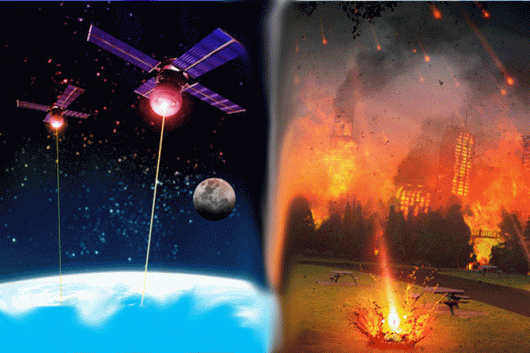
Recently, the U.S. began spreading rumors about alleged Russian space-based nuclear weapons. According to American intelligence, Moscow is developing a powerful anti-satellite weapon to be deployed in space, thus violating international norms that prohibit the militarization of Earth’s orbit.
In 2022, NATO began drafting a “space doctrine” based on “interoperability”. The following year, the alliance published a document exposing its main interests in space and pursuing American guidelines for the militarization of the orbit. According to analysts, the “interoperability” of NATO’s space activities simply means the creation of mechanisms for U.S. allies to help pay the high costs of military space development – while, on the other hand, only the Pentagon maintains real control of the activities and benefits from “space control”.
Mike Turner, head of the House Intelligence Committee, formally asked for the declassification of documents concerning the investigation on the “space-nukes”, stating that a deliberation on the case in the National Congress is necessary. According to Turner, American parliamentarians need to discuss this serious “threat” to U.S. national security, having therefore the requirement to fully release data obtained by intelligence on the subject.
Subsequently, the White House stated that there was no imminent threat to the country’s national security according to the information obtained so far. Spokespersons confirmed they are monitoring the possible existence of a Russian nuclear space program, but denied the existence of any evidence of a high-risk threat at the moment. As a result, once again American officials made contradictory statements, discrediting the image of U.S. authorities.
Moscow denied the accusations and stated that the rumors were intended to strengthen the anti-Russian establishment, pressuring parliamentarians to recognize the existence of a “threat” and thus approve the billion-dollar military aid package to Ukraine. Considering the domestic political stalemate in the U.S., with pro-war sectors failing to convince their opponents to continue aid to Kiev, it is very likely that the intention behind the spread of anti-Russian rumors is to actually increase fear among policymakers about a possible “danger”.
Obviously, as a major military power, the Russian Federation has its own anti-satellite systems and is able to employ them, if necessary, in a possible large-scale conflict scenario. However, the current tensions between Moscow and Washington, despite high, do not bring any need to use military force against American satellites, and there is therefore no “imminent threat” to the U.S. in the Russian arsenal.
In parallel, Moscow remains firmly committed to complying with international space law standards. The deployment of weapons of mass destruction in Earth’s orbit is banned by the treaties that regulate space activities. Therefore, even though it has weapons strong enough to inflict damage on enemy countries’ satellites, Russia is not willing to allocate nuclear weapons or weapons of mass destruction in outer space, as this would violate current regulations on the matter.
In fact, Russian actions regarding the outer space make it clear that Moscow intends to cooperate to prevent the militarization of Earth’s orbit. Russia, although it has the military capacity to do so, does not invest in “space-based” weapons, focusing its space activities on the peaceful and scientific sphere. This, however, is not the case with the U.S., which openly promotes the militarization of space, with constant efforts to turn Earth’s orbit into a true battlefield.
Since the creation of the U.S. Space Force in 2019, Washington has seen the militarization of space as a true strategic priority. At the time, then-American President Donald Trump had made it clear that the country’s objective was to achieve “American dominance in space.” Since then, several activities to increase American military space capabilities have been undertaken – many of them in partnership with other NATO countries and international allies.
“The U.S. Space Command planning document stated that the U.S. will ‘control and dominate space and deny other nations if necessary access to space (…) At the Space Command HQ in Colorado just above their doorway they have a sign that reads ‘Master of Space (…) Even with all its resources the U.S. can’t afford to pay for its ‘Master of Space’ plan by itself (…) [In order to maintain its dominance], the U.S. sets up a story line that it ‘must protect space’ from the dark forces in Russia, China, Iran, and North Korea (…) Interoperability’ ensures that all NATO members purchase new expensive space technologies mostly from U.S. aerospace corporations like Lockheed Martin, Raytheon, and others. In addition, ‘interoperability’ means that all space information, surveillance, and targeting is run through the U.S.-dominated system. In other words, NATO allies help pay for these costly space warfare systems but the Pentagon controls the ‘tip of the spear’,” Professor Bruce Gagnon, director of the Global Network Against Weapons and Nuclear Power in Space, once said commenting on the topic.
All these factors lead us to believe that there really was an attempt on the part of the U.S. to create a smokescreen for its own space militarization activities. By pointing out the existence of a “Russian danger”, Washington legitimizes its own “reactive” policies, thus encouraging increased investment in space weapons in NATO. In the same sense, this smokescreen helps to pressure parliamentarians to revise their stance on supporting Ukraine. With the popularity of the anti-Russian war gradually decreasing, the creation of a non-existent threat could serve as a legitimizing factor for the conflict.
In addition to all this, it is curious how contradictory U.S. narratives about Russia fluctuate. Previously, the American media accused the Russians of fighting using shovels due to the lack of weapons. Now, on the other hand, they accuse Russia of deploying nuclear weapons from space. These lies only worsen the mainstream media’s own image among Western public opinion, leading to absolute discredit.
Touring South Korea to support opposition to US space warfare plans
Organizing notes, Bruce Gagnon, 19 Feb 24
https://space4peace.blogspot.com/2024/02/touring-south-korea-to-support.html
I’ve just landed in South Korea (ROK) where I will be on a speaking tour around the country for the next 10 days.
I was invited to come and talk about Washington’s push to entrap South Korea into the Pentagon’s space technology strategy aimed at North Korea, China and Russia.
Already at the US Osan AFB in South Korea the Space Force has set up operations with the ROK client state.
The US has pushed the right-wing Seoul government to massively expand their spending on military space tech. With the current US national debt now at $35 trillion, Washington can’t afford to pay for its expensive and ambitious plans to ‘control and dominate’ space. Thus the #1 job of the Pentagon and State Department is to get the allies to help pay for the space warfare infrastructure.
Currently the ROK government is building space R & D centers, satellite production facilities, new airfields likely to test hypersonic missiles and expanding ‘missile defense’ deployment sites.
One key goal the US has is to use ROK satellite production and launch facilities to hoist mini-satellites into Lower Earth Orbit (LEO) to help fill up the already crowded orbits before China and Russia can get there. Eyes and ears in LEO give a nation a decisive advantage in full scale war making.
Late last year the US hosted a big space industry conference in the capital city of Seoul in order to cement this expanding space warfare relationship. Dangling the promise of ‘lots of high-tech jobs’ the US has drawn the ROK into the trap.
The problem for the ROK (like all of Washington’s allies participating in this space warfare operation) is that they will have little to no input into how and when this Star Wars program will be used. Even though ROK will help pay for it (and host many of the bases) the Pentagon will remain in charge of the ‘tip of the spear’. Once becoming a colony of the US war machine, a nation loses their right to be full partners.
One sad thing about all of this is how Jeju Island (just off the southern tip of the Korean peninsula) is becoming further militarized via this new space tech operation.
Late last year the US hosted a big space industry conference in the capital city of Seoul in order to cement this expanding space warfare relationship. Dangling the promise of ‘lots of high-tech jobs’ the US has drawn the ROK into the trap.
The problem for the ROK (like all of Washington’s allies participating in this space warfare operation) is that they will have little to no input into how and when this Star Wars program will be used. Even though ROK will help pay for it (and host many of the bases) the Pentagon will remain in charge of the ‘tip of the spear’. Once becoming a colony of the US war machine, a nation loses their right to be full partners.
One sad thing about all of this is how Jeju Island (just off the southern tip of the Korean peninsula) is becoming further militarized via this new space tech operation.
Is there really a nuclear weapon in space?
CASSANDRA STEER, The Interpreter, 18 Feb 24
Calm down, Congressman.
Alarm was raised in the media this week about a “national security threat” to the United States from Russia, ostensibly a nuclear space-based weapon. The news came after the Republican chair of the US House of Representatives intelligence committee, Mike Turner, unusually went public with an allegation based on classified intelligence that had not yet been properly discussed across the National Security briefing channels.
The fact that a cryptic, public allegation was made about a threat in space, combined with repetitions of one unnamed source referring to a potential nuclear capability, has led to some sensationalised news articles, and a lot of misleading conclusions, that Russia has a nuclear space weapon. Lack of clarity can lead to misunderstanding, misinterpretations, and possible missteps, which are in fact the biggest threats to space security.
This news is useful in terms of raising awareness of the high stakes in space security. But as became clear when White House National Security Communications Adviser John Kirby spoke earlier today, this potential capability does “not pose an urgent threat to the United States”– i.e.: it doesn’t yet exist.
We do know all the great powers, many middle powers and even smaller nations are developing counter-space capabilities, most of which are non-kinetic, and the most effective of which have temporary, but highly impactful effects. But this is not “Star Wars”, there are no space-based nuclear weapons.
Space is critical to national, regional and international security, because of how integral space-based services are to civil life and military operations. Satellites have been key military sources of intelligence, surveillance and reconnaissance (ISR) since the 1960s, and continue to be so today. Space-based communications, internet and navigation (such as GPS) are part of our daily lives without most of us thinking about where they come from, and they are a major source of military communications, operational navigation on land, at sea and in the air, as well as guidance for precision weapons.
Because of these high dependencies, space has itself become a strategic domain. In recent decades, increasingly sophisticated counter-space capabilities have been developed globally to interfere with these systems. The most effective way to compromise an adversary’s eyes and ears is to interfere with their space systems, whether by jamming a signal, listening in on a signal, spoofing a false positioning signal, or undertaking a cyberattack on a satellite operation. These are all temporary, reversible means of targeting a satellite or the signals and data it sends to Earth. There is a reason these means are preferred over kinetic, destructive means.
Nuclear weapons (and weapons of mass destruction) are the only type of weapon prohibited in the 1967 Outer Space Treaty, in article IV. The Soviets and the United States, together with many other countries, were able to agree on this treaty at the height of the Cold War, because they realised that strategic restraint was the only way to ensure they would both continue to have access to this new critical domain. In other words, after their own nuclear and Electro-Magnetic Pulse tests in the 1960s, they realised there was no way to contain the effects of such weapons, and their own capabilities would be impacted. A lose-lose scenario.
Perhaps the strongest lessons came from the US nuclear test known as Starfish Prime, which took out US, UK and other national satellite capabilities, reaching from the east coast of the United States to Australia. US and Soviet decision-makers realised they needed to secure their own access to space by prohibiting such weapons, and other countries pushed to ensure these superpowers would not take nuclear war to space, denying access to space for others………………………………………………………………………………. more https://www.lowyinstitute.org/the-interpreter/there-really-nuclear-weapon-space
‘Everyone needs to calm down’: experts assess Russian nuclear space threat
Attacks in Earth’s orbit as likely to damage Russian interests as western ones, says leading academic
Nicola Davis , 15 Feb 24, Guardian,
Rumours that Russia is planning to deploy nuclear weapons in space have been dampened down by experts who say that while such technology is possible, there is no need to push the panic button.
The furore kicked off on Wednesday when the head of the US House of Representatives’ intelligence committee, Mike Turner, called for the Biden administration to declassify information on what he called a “serious national security threat”.
While Turner gave no further details, it was later reported by news outlets, citing unnamed sources, to involve Russia’s potential deployment of a nuclear anti-satellite weapon in space. The Kremlin dismissed the claim as a “malicious fabrication”.
Dr Bleddyn Bowen, an associate professor at the University of Leicester who specialises in outer space international relations and warfare, said the the lack of detail was no reason to panic. “It’s so vague and cryptic, it could be a number of different things. [But] no matter what they are, none of them are a big deal, to be honest. Everyone needs to calm down about this.”
Russia is bound by several legal restrictions regarding the use or presence of nuclear weapons in space. Article 4 of the Outer Space treaty (1967) bans nuclear weapons from being put into orbit, installed on celestial bodies or otherwise stationed in outer space, while the New Start treaty aims to reduce the number of deployable nuclear arms. The Partial Nuclear Test Ban treaty (1963) bans nuclear explosions in space.
Even if Russia ignores these agreements, there are other considerations. Bowen said the rumoured threat may relate to nuclear-tipped anti-satellite weapons but that such a threat was nothing new.
“These are the first and the most crude kind of anti-satellite weapons ever built: the Americans had them in 1959.” He said any state with nuclear weapons already had the technology to use them in space, broadly speaking.
Another possibility, Bowen said, was that the threat related to space-based nuclear weapons that could be used to knock out satellites. Again, the idea is not entirely new: Russia has previously explored the stationing of nuclear weapons in space, albeit to attack ground targets……………………………………………………………………………………
Space-based nuclear weapons are vulnerable to attack from other nations, while the damage from such weapons would be indiscriminate.
“When you detonate a nuclear weapon in space you generate the fireball … but what you [also] generate is the electromagnetic pulse which fries the electrical circuits of anything that’s unshielded within a few thousand kilometres’ radius,” he said. The pulse may also knock out power grids on Earth if the bomb is detonated above or near populated areas.
“After that, you have the radiation that the bomb would generate,” Bowen said. Over time it would fry the electrical circuits of satellites in the wider part of Earth’s orbit.
The loss of satellite services could affect myriad systems on Earth, from telecoms to satellite navigation services. “That can have knock-on effects to the economy, to critical infrastructure, to the financial system, which relies on these satellites.”
In other words, while nuclear bombs could take out a desired satellites, they could also damage Russia’s technology and interests.
“You’ve got to be in a very desperate situation to want to do something like that,” he said. “So I am not losing any sleep over this.”
Russia also has other technology to hand. In 2021 Russia tested a direct-ascent anti-satellite missile, successfully knocking out one of its own defunct satellites.
But James Green, a professor of public international law at the University of the West of England, said he was also dubious that that system would be deployed. “I think Russia likes to project its space power [to appear] greater than it probably is,” he said.
https://www.theguardian.com/world/2024/feb/15/experts-russian-nuclear-space-threat
What are Russia’s Top 5 Anti-Satellite Systems?
Sputnik, 15 Feb 24
Russia has effective means to thwart adversary satellites, including arms based on new physical principles. What are they?
Moscow trashed the groundless rumors of its alleged efforts to deploy a nuclear anti-satellite system in space on February 15.
A day earlier, mainstream US media claimed that Washington had informed Congress and its European allies about Russia’s work on a new, space-based nuclear weapon designed to undermine the US satellite network.
A new bugaboo about Russia’s supposed plans to destroy American satellites with nuclear arms is aimed at ramming a $60 billion funding package for Ukraine through US Congress, military analyst and editor-in-chief of the National Defense magazine Igor Korotchenko told Sputnik on Thursday. Even though the package in question was earlier passed in the US Senate as part of a $95 billion bill, the chances of the House approving the legislation is considered slim.
According to Korotchenko, Russia has cheaper and more effective means of anti-satellite warfare than those that Washington accuses it of developing.
This is a question of approaches. The fact is that the deployment of nuclear weapons in space is ineffective in terms of its use, especially given that Russia has much simpler and cheaper means to disable, in the event of hostilities, a significant part of the US satellite constellation,” the expert underscored.
Sputnik has taken a look at the systems that could do the job.
The Nudol System
On November 15, 2021, Moscow conducted a direct-ascent hit-to-kill anti-satellite (ASAT) test using the A-235 Nudol anti-satellite system. The test shot down an old Soviet reconnaissance satellite launched back in 1982.
The A-235 Nudol is an improved modification of the A-135 Amur strategic missile defense system. The missile can hit a target at a distance of up to 1,500 kilometers (versus 850 kilometers for the A-135), while its interception speed is increased to Mach 10 (versus Mach 3.5 for the A-135).
In contrast to its predecessor, the A-235 may use kinetic force, not nuclear or high-explosive fragmentation, to destroy the target.
The development of the A-235 Nudol started in 1985-1986 and was carried out in compliance with international ballistic missile agreements existing at the time. The weapon was designed to become the first Soviet mobile missile defense system capable of intercepting intercontinental-range missiles, spacecraft and satellites operating at high orbits.
Immediately after the Cold War, the development of the A-235 was suspended and restarted in 2011 by Almaz-Antey, nine years after the Bush administration unilaterally terminated the Antiballistic Missile Treaty (ABM) in 2002.
The system has been tested several times since 2014; however, in November 2021 the missile was fired at a specific moving space target and eventually destroyed it, causing a fuss in the Pentagon.
Nanosatellites: Nivelir, Burevestnik and Numismat
The development of Russia’s secretive project Nivelir (“Leveler”) has reportedly been carried out by the Central Scientific Research Institute of Chemistry and Mechanics Named after D.I. Mendeleyev since 2011.
The endeavor supposedly envisaged building small satellites designed to inspect other satellites in space. The first three satellite-inspectors were reportedly attached to three communications satellites launched between 2013 and 2015.
According to other sources, Russia has been experimenting with satellite inspectors since 2017. The satellites maneuvered in orbit, moving away from each other and then getting closer. In 2019, the Cosmos-2535 and Cosmos-2536 devices were launched. Their goal was to study the impact of “artificial and natural factors of outer space” on Russia’s space devices and to develop “technology for their protection.”…………………………………..
The Kontakt System
The USSR started to develop the 30P6 Kontakt (“Contact”) system in 1983. The 79М6 munition – a three-stage rocket – was supposed to be mounted on the MiG-31D fighter-interceptor.
Launched from an airplane at an altitude of 15 kilometers the munition was designed to fire a fragmentation warhead into space. It was assumed that the Kontakt system would be a stealth and inexpensive means of destroying enemy satellites……………………………………………………….
The Tirada Electronic Warfare System
According to the Russian Ministry of Defense, the Tirada-2S radio-electronic communication suppression system is capable of electronically jamming satellite communications with complete disabling. In this case, satellites can be deactivated directly from the Earth’s surface.
There is little information about the system’s specifications in the public domain. …………………………………………………………………………………..
The Peresvet Laser System
On March 1, 2018, Russian President Vladimir Putin first mentioned Russia’s laser weapon for air defense and anti-satellite warfare, the Peresvet, during his address to the Federal Assembly………………………………………….
The aforementioned systems are just a few of those potentially developed by the Russian military-industrial complex, indicating that Russia is capable of using its decades-long scientific and technological potential to ensure the nation’s security in the event of a large-scale conflict. https://sputnikglobe.com/20240215/what-are-russias-top-5-anti-satellite-systems-1116802215.html
SpaceX deorbiting 100 older Starlink satellites to ‘keep space safe and sustainable’

By Brett Tingley, Space,com , 14 Feb 24
There are still well over 5,000 operational Starlink satellites in low Earth orbit.
SpaceX will deorbit some of its older Starlink internet satellites in order to reduce the number of potentially dangerous spacecraft in low Earth orbit.
The company just announced that 100 Version 1 Starlink satellites will be deorbited over the next weeks and months in the name of space sustainability. SpaceX posted a statement to X (formerly Twitter) on Monday (Feb. 12) announcing the plan, noting that the move is “the right thing to do to keep space safe and sustainable.”
The statement, titled “Commitment to Space Sustainability,” points out that SpaceX‘s Starlink team found a “common issue in this small population of satellites that could increase the probability of failure in the future,” potentially rendering them unable to be maneuvered out of the way of other spacecraft. The deorbiting operation should take around six months…………………………………………………………..
All Starlink satellites are designed to fall into Earth’s atmosphere on their own in under five years from the time they are deployed due to the effects of atmospheric drag. They are also engineered to be “fully demisable by design,” SpaceX’s statement adds, meaning they burn up entirely as they deorbit, rendering the risk of debris falling to Earth to “effectively zero.”
While 100 satellites sounds like a significant amount, SpaceX currently has 5,438 Starlink craft in orbit, according to astrophysicist and satellite tracker Jonathan McDowell. The company already has regulatory approval to launch 12,000 Starlink satellites, and wants to eventually expand its fleet to 40,000 or so.
And more are going up every month; SpaceX plans to launch 144 missions this year, most of them likely devoted to placing Starlink satellites in orbit. (About 60% of the company’s launches in 2023 were dedicated Starlink missions.) The satellites offer high-speed broadband connectivity to users worldwide, including in war-torn or disaster-stricken areas. https://www.space.com/spacex-starlink-satellites-deorbit-space-sustainability
The ‘disturbing’ intel roiling the Hill is about Russian nukes in space
The U.S. has for more than a year been concerned about Russia’s potentially creating and deploying an antisatellite nuclear weapon, one of the people familiar with the intelligence said.
Politico, By ERIN BANCO, ALEXANDER WARD and LEE HUDSON, 02/14/2024
A vague warning by the chair of the House Intelligence Committee about a “serious national security threat” Wednesday is related to Russia’s attempts to develop an antisatellite nuclear weapon for use in space, according to two people familiar with the matter.
While the people did not provide further details on the intel, one of them noted the U.S. has for more than a year been concerned about Russia’s potentially creating and deploying an antisatellite nuclear weapon — a weapon the U.S. and other countries would be unable to adequately defend against.
In his statement Wednesday morning, Rep. Mike Turner (R-Ohio) said his committee had made available the information about the national security threat and called on the administration to declassify the intelligence so officials and lawmakers could discuss the matter with allies.
It is not clear what prompted Turner to issue the statement now, as the intelligence has been available to leaders of the House intelligence committee and their top aides in a secure room on Capitol Hill for more than a week, one of the people said. The Senate intelligence committee has also had access to the information.
House intelligence committee members on Tuesday voted to open the intelligence up for viewing for all members. All Senate members now have access as well.
It’s possible Turner was attempting to raise alarms about Russia’s advancements in space as a way of underscoring the need for lawmakers to approve additional aid to Ukraine. The Senate passed the supplemental bill including $60 billion in aid for Kyiv. It is currently under review by the House.
One House intelligence committee member said the intelligence was “disturbing.” Another said “it’s a serious issue but not an immediate crisis.” Both members and the others familiar with the intelligence were granted anonymity to speak about classified materials. ………………………………………………………..
U.S. officials have raised the alarm in recent years about missiles launched from Earth’s surface that can destroy satellites in orbit. In 2021, Russia conducted an anti-satellite missile test on one of its own satellites, breaking it up into more than 1,500 pieces of debris — which can pose a serious threat to other objects in orbit.
ABC previously reported on the particulars about the most recent intelligence relating specifically to the antisatellite nuclear weapon.
There are a number of other issues that the administration has viewed as concerning in regard to Russia’s activities in space, including certain developments with its satellites and its jamming of U.S. satellites. https://www.politico.com/news/2024/02/14/house-intel-national-security-threat-russia-space-power-00141473
1 This Month

of the week – Shut Down Drone Warfare!


Tell the Ukrainian Government to Drop Prosecution of Peace Activist Yurii Sheliazhenko

Petition to revoke the licensing of the Near Surface Nuclear Disposal Facility (NSDF) at Chalk River. https://www.ourcommons.ca/petitions/en/Petition/Details?Petition=e-7247
To see nuclear-related stories in greater depth and intensity – go to https://nuclearinformation.wordpress.com
-
Archives
- March 2026 (237)
- February 2026 (268)
- January 2026 (308)
- December 2025 (358)
- November 2025 (359)
- October 2025 (376)
- September 2025 (257)
- August 2025 (319)
- July 2025 (230)
- June 2025 (348)
- May 2025 (261)
- April 2025 (305)
-
Categories
- 1
- 1 NUCLEAR ISSUES
- business and costs
- climate change
- culture and arts
- ENERGY
- environment
- health
- history
- indigenous issues
- Legal
- marketing of nuclear
- media
- opposition to nuclear
- PERSONAL STORIES
- politics
- politics international
- Religion and ethics
- safety
- secrets,lies and civil liberties
- spinbuster
- technology
- Uranium
- wastes
- weapons and war
- Women
- 2 WORLD
- ACTION
- AFRICA
- Atrocities
- AUSTRALIA
- Christina's notes
- Christina's themes
- culture and arts
- Events
- Fuk 2022
- Fuk 2023
- Fukushima 2017
- Fukushima 2018
- fukushima 2019
- Fukushima 2020
- Fukushima 2021
- general
- global warming
- Humour (God we need it)
- Nuclear
- RARE EARTHS
- Reference
- resources – print
- Resources -audiovicual
- Weekly Newsletter
- World
- World Nuclear
- YouTube
-
RSS
Entries RSS
Comments RSS
 nuclear-news