Mars and travel to Mars – will kill astronauts with ionising radiation
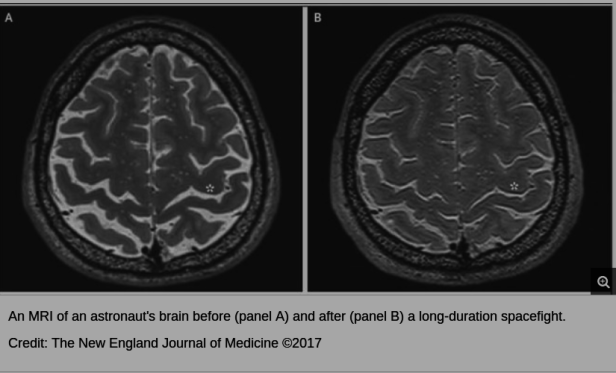
EUROPEAN SPACE AGENCY: RADIATION WILL MAKE MARS MISSION DEADLY, https://futurism.com/the-byte/space-radiation-mars-mission-deadly JUNE 5TH 19__DAN ROBITZSKI__
Slow Down
Elon Musk once said he’d likely move to Mars in his lifetime. But before we settle the Red Planet, the European Space Agency (ESA) urges extreme caution.
That’s because it lacks the natural barriers that protect us Earthlings from cosmic radiation, which would put astronauts at risk of deadly health conditions. But they’re working on it — the ESA says it has partneredwith particle accelerators to recreate cosmic radiation in a controlled setting and build shields that can protect future explorers.
Harsh Conditions
“The real problem is the large uncertainty surrounding the risks,” said ESA physicist Marco Durante in the press release. “We don’t understand space radiation very well and the long-lasting effects are unknown.”
Shields Up
The ESA found that a six-month stay on Mars would expose astronauts to “60% of the total radiation dose limit recommended for their entire career.”
As it stands today, we can’t go to Mars due to radiation,” said Durante. “It would be impossible to meet acceptable dose limits.”
READ MORE: Radiation Makes Human Missions to Mars Too Dangerous: ESA [ExtremeTech]
Ionising radiation in space will kill astronauts headed for Mars
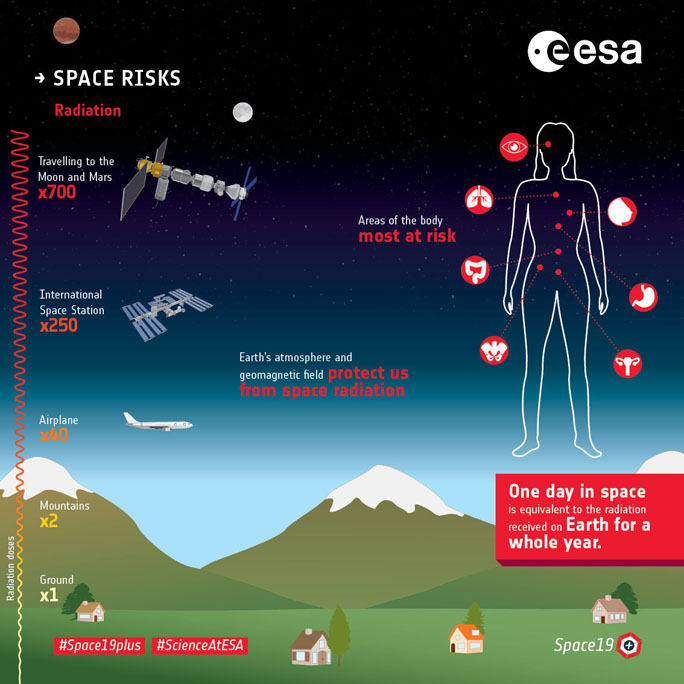 The radiation showstopper for Mars exploration https://phys.org/news/2019-06-showstopper-mars-exploration.html, by European Space Agency 3 June 19, An astronaut on a mission to Mars could receive radiation doses up to 700 times higher than on our planet—a major showstopper for the safe exploration of our solar system. A team of European experts is working with ESA to protect the health of future crews on their way to the Moon and beyond.
Earth’s magnetic fieldand atmosphere protect us from the constant bombardment of galactic cosmic rays—energetic particles that travel at close to the speed of light and penetrate the human body.
Cosmic radiation could increase cancer risks during long duration missions. Damage to the human body extends to the brain, heart and the central nervous system and sets the stage for degenerative diseases. A higher percentage of early-onset cataracts have been reported in astronauts.
“One day in space is equivalent to the radiation received on Earth for a whole year,” explains physicist Marco Durante, who studies cosmic radiation on Earth.
Marco points out that most of the changes in the astronauts’ gene expression are believed to be a result of radiation exposure, according to the recent NASA’s Twins study. This research showed DNA damage in astronaut Scott Kelly compared to his identical twin and fellow astronaut Mark Kelly, who remained on Earth.
A second source of space radiation comes from unpredictable solar particle events that deliver high doses of radiation in a short period of time, leading to “radiation sickness” unless protective measures are taken.
Europe’s radiation fight club
“The real problem is the large uncertainty surrounding the risks. We don’t understand space radiation very well and the long-lasting effects are unknown,” explains Marco who is also part of an ESA team formed to investigate radiation.
Since 2015, this forum of experts provides advice from areas such as space science, biology, epidemiology, medicine and physics to improve protection from space radiation.
“Space radiation research is an area that crosses the entire life and physical sciences area with important applications on Earth. Research in this area will remain of high priority for ESA,” says Jennifer Ngo-Anh, ESA’s team leader human research, biology and physical sciences.
While astronauts are not considered radiation workers in all countries, they are exposed to 200 times more radiation on the International Space Station than an airline pilot or a radiology nurse.
Radiation is in the Space Station’s spotlight every day. A console at NASA’s mission control in Houston, Texas, is constantly showing space weather information.
f a burst of space radiation is detected, teams on Earth can abort a spacewalk, instruct astronauts to move to more shielded areas and even change the altitude of the station to minimize impact.
One of the main recommendations of the topical team is to develop a risk model with the radiation dose limits for crews traveling beyond the International Space Station.
ESA’s flight surgeon and radiologist Ulrich Straube believes that the model should “provide information on the risks that could cause cancer and non-cancer health issues for astronauts going to the Moon and Mars in agreement with all space agencies.”
Recent data from ExoMars Trace Gas Orbiter showed that on a six-month journey to the Red Planet an astronaut could be exposed to at least 60% of the total radiation dose limit recommended for their entire career.
“As it stands today, we can’t go to Mars due to radiation. It would be impossible to meet acceptable dose limits,” reminds Marco.
Measure to protect
ESA has teamed up with five particle accelerators in Europe that can recreate cosmic radiation by “shooting” atomic particles to speeds approaching the speed of light. Researchers have been bombarding biological cells and materials with radiation to understand how to best protect astronauts.
“The research is paying off. Lithium is standing out as a promising material for shielding in planetary missions,” says Marco.
ESA has been measuring the radiation dose on the International Space Station for seven years with passive radiation detectors in the DOSIS 3-D experiment. ESA astronauts Andreas Mogensen and Thomas Pesquet wore a new mobile dosimeter during their missions that gave them a real-time snapshot of their exposure.
The same European team behind this research will provide radiation detectors to monitor the skin and organ doses of the two phantoms traveling to the Moon onboard NASA’s Orion spacecraft.
$125 million to NASA to develop nuclear rockets
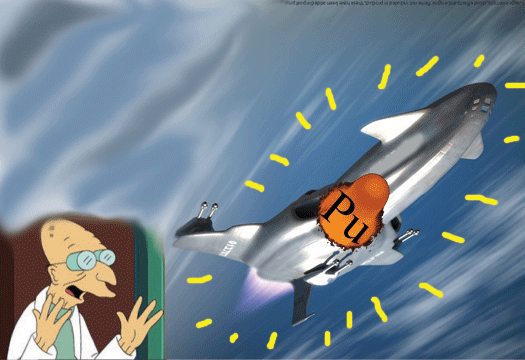 NASA JUST GOT $125 MILLION TO DEVELOP NUCLEAR ROCKETS, https://futurism.com/the-byte/nasa-develop-nuclear-rockets DAN ROBITZSKI_ 29 May 19, For the first time since the 1970s, NASA is developing nuclear propulsion systems for its spacecraft.NASA didn’t request any money for a nuclear propulsion program, but it will get $125 million for the research as part of the space agency’s $22.3 billion budget that Congress approved last week, Space.comreports. If the program succeeds, nuclear propulsion could significantly cut down on travel time during missions to Mars and beyond.
Test Launch
Republican leadership sees nuclear propulsion as an important step along the way to deep space missions and the 2024 Moon landing with which Congress has tasked NASA, per Space.com. Alabama Representative Robert Aderholt described nuclear propulsion as “critical” for the 2024 launch in a budget meeting last week.
“As we continue to push farther into our solar system, we’ll need innovative new propulsion systems to get us there, including nuclear power,” Vice President Mike Pence told the National Space Council in March.
Sorting It Out
But before NASA can embrace nuclear-powered technology, there’s the matter of navigating regulations that govern the use of nuclear energy.
For the time being, the space agency hasn’t announced any plans to use nuclear propulsion for any of its planned missions, according to Space.com, but that may change as the technology develops.
Funds being cut from US Air Force nuclear, space programs
 US Air Force nuclear, space programs take hit in border wall reprogramming, Defense News, WASHINGTON — In the wake of the Pentagon reprogramming $1.5 billion in fiscal 2019 funds to support President Donald Trump’s border wall with Mexico, only the U.S. Air Force appears to be losing money appropriated for equipment updates.
Russia considering making spaceplane powered by a nuclear reactor
 ‘Reshaping space market’: Russia mulls building rocket plane with nuclear engine Rt.com : 6 Mar, 2019 Russian space agency Roscosmos is considering building a spaceplane powered by a nuclear reactor, according to a memo obtained by a Russian news agency. The move could “reshape” the market for space launches, the document says.
A rocket plane is an aircraft powered by rocket engines. Conventional jets proved better for atmosphere-only flight, but this type of vehicle found its niche application as a reusable spacecraft – most notably as the Space Shuttle program.
Several rocket planes are still operational today, like the SpaceShipTwo, which is meant for suborbital tourist flights. Roscosmos believes such an aircraft may be viable for space missions if equipped with a nuclear power plant, says a memo reviewed by RIA Novosti.
The memo says Russia’s experience with creating the Buran spaceplane and similar space systems would come in handy for designing such a craft in the future.
Nuclear power is tricky to use in space, let alone harnessing it to provide propulsion. The USSR experimented with placing small nuclear reactors on its satellites for endurance, but the incident with the Kosmos 954 sat, which malfunctioned and fell in Canada in 1977, showed that potential problems probably outweigh the benefits. Improvements in solar panels made them the to-go power source in space applications while chemical and compressed gas thrusters are used for propulsion.
The picture may be different for long-range space missions, in which a reliable power source, capable of providing propulsion for months rather than minutes would be a huge advantage. Russia is currently working on a project dubbed TEM, a nuclear-powered rocket powered by a megawatt-class nuclear reactor…….. https://www.rt.com/russia/453132-rocket-plane-nuclear-power/
Space travel? The human body is not compatible with ionising radiation
From Radiation to Isolation: 5 Big Risks for Mars Astronauts (Videos)
Even astronauts who live on the International Space Station, which sits inside Earth’s protective magnetic field, are exposed to 10 times the radiation they would if they were back on Earth, NASA officials said in a statement and series of videos from the agency’s Human Research Program.
Anyone who traveled through deep space would be at much greater risk from radiation exposure. Outside of Earth’s protective shield, radiation can increase cancer risk and damage a person’s central nervous system (which would cause altered cognitive function, reduced motor function and behavioral changes), NASA’s Human Research Program said. Other dangers of being exposed to such high radiation include nausea, vomiting, anorexia, fatigue, cataracts, cardiac disease and circulatory disease. …….https://www.space.com/42918-big-space-risks-mars-astronauts-videos.html
Space travel enthusiasts show their ignorance of ecology and the dangers of Plutonium 238
I do not have time at the moment to really think about this one, – But – a couple of lovely sentences just leaped out at me:
Plutonium-238 is very special for the fact that it’s a material that poses virtually no danger to anyone unless you do something insane
we have to put our illogical fears aside
That’s from this absolute hymn to Plutonium 238 – Forbes 13 Dec 18 – NASA Doesn’t Have Enough Nuclear Fuel For Its Deep Space Missions
1 This Month



Shut down the radiation-damaged Heysham nuclear reactors now
To see nuclear-related stories in greater depth and intensity – go to https://nuclearinformation.wordpress.com

Say No to NASA’s Reckless Nuclear Reactor on the Moon
Say No to NASA’s Reckless Nuclear Reactor on the Moon
-
Archives
- October 2026 (268)
- September 2026 (339)
- August 2026 (330)
- July 2026 (355)
- June 2026 (287)
- May 2026 (306)
- April 2026 (356)
- March 2026 (251)
- February 2026 (267)
- January 2026 (308)
- December 2025 (358)
- November 2025 (359)
-
Categories
- 1
- 1 NUCLEAR ISSUES
- business and costs
- climate change
- culture and arts
- ENERGY
- environment
- health
- history
- indigenous issues
- Legal
- marketing of nuclear
- media
- opposition to nuclear
- PERSONAL STORIES
- politics
- politics international
- Religion and ethics
- safety
- secrets,lies and civil liberties
- spinbuster
- technology
- Uranium
- wastes
- weapons and war
- Women
- 2 WORLD
- ACTION
- AFRICA
- Atrocities
- AUSTRALIA
- Christina's notes
- Christina's themes
- culture and arts
- Events
- Fuk 2022
- Fuk 2023
- Fukushima 2017
- Fukushima 2018
- fukushima 2019
- Fukushima 2020
- Fukushima 2021
- general
- global warming
- Humour (God we need it)
- Nuclear
- RARE EARTHS
- Reference
- resources – print
- Resources -audiovicual
- Weekly Newsletter
- World
- World Nuclear
- YouTube
-
RSS
Entries RSS
Comments RSS

