Conibio, which partners with federal conservation programs, expects to see the loss of more endangered turtles because of launches from Starbase. “It’s like launching bombs on their habitat,”
A Mexican conservation group says Elon Musk’s rocket launches from South Texas are killing turtles, damaging homes, and littering Tamaulipas beaches with debris.
Three miles south of Starbase, Texas, where SpaceX launches rockets into orbit, the beaches of Tamaulipas begin at the mouth of the Rio Grande. Further south along the water’s edge, generations of families from northern Mexico have spent Sundays on the shores of Playa Bagdad’s recreational area, renting small wooden palapas for shade. Local fishermen live off the seafood they catch nearby in the Gulf of Mexico. They sell their fried fish, spicy shrimp kabobs, and raw oysters to visitors who sunbathe and swim on the beach.
Many Tamaulipecos have grown up with fond memories of Playa Bagdad, and Jesús Elías Ibarra Rodríguez is one of them. Rodríguez is a Matamoros-based veterinarian and the founder and president of Conibio Global A.C., a nonprofit conservation organization based in the state of Tamaulipas.
For several years, residents of Brownsville and other border towns have protested losing access to public beaches and the harm to the environment and communities caused by many SpaceX rocket explosions. In August, several Texas border organizations demanded that the Federal Aviation Administration halt more rocket launches until a complete environmental impact statement is conducted.
A protest movement is also building in neighboring Mexico, Rodríguez said, as the number of launches and tests has increased. “We’ve been here years before SpaceX, working to conserve these precious ecosystems,” he said. “But everything is changing now. The beach is changing. Even people’s homes, old houses going back generations, are getting damaged from the launch vibrations.”
In 2019, SpaceX launched its first rocket prototype from Starbase, called Starhopper. Rodríguez said that during early tests, most noise and debris were contained north of the U.S.-Mexico border. But in recent years, SpaceX “began building rockets of great size, considered the largest rockets ever constructed on the planet.” It was around this time that communities in Tamaulipas began to feel the greater effects from the vibrations of engine tests and rocket launches.
A 2024 study from Brigham Young University found that the rocket launches at Starbase produced sound levels similar to “a rock concert or chainsaw” up to six miles away. The data also showed the blasts were powerful enough to cause structural damage to nearby homes and buildings.
Concerns increased in Mexico as residents in Tamaulipas began to find industrial debris on the beach, some labeled with the names of manufacturers of materials used in the space industry. “They started letting debris fall into Mexican territory,” said Rodríguez. “That was what really worried us, alarmed us, and upset us.” Rodríguez says that his organization has documented debris from SpaceX rocket launches along a 40-kilometer stretch of Tamaulipas beach.
Mexico’s president, Claudia Sheinbaum, said in June that the federal government was looking into a possible lawsuit against SpaceX based on damage sustained in the region from rocket launches. That same month, El País reported that Elon Musk had reached out to the Mexican government in the days after Sheinbaum’s comment for help in recovering any debris found in Tamaulipas that might still belong to the company.
Rodríguez says that Sheinbaum has assigned a local task force that is now present during launches along with Conibio staff and will soon make available a special team of divers to prepare reports on any major debris that is still under Mexican waters.
Rodríguez says that Conibio, which partners with federal conservation programs, expects to see the loss of more endangered turtles because of launches from Starbase. “It’s like launching bombs on their habitat,” said Rodríguez. “You have the sound and vibration of the explosions, and you have tons of millions of little pieces of plastic that are bait for them. And we worry about sea life in general consuming all that.”
Conibio reports that some 900 endangered turtles have died this year because they were trapped in their underground nests by compacted sand from Starbase launch and test vibrations, including from an accidental explosion of a rocket in June that occurred on the ground while it was still attached to its launch arm………………………………………………………………………………………………………………………………………..
While some community members in South Texas have rallied behind the Starbase project in hopes of jobs and economic benefits, that tradeoff does not exist for people in Tamaulipas.
As the space community awaits the upcoming deadline for a Golden Dome architecture, perhaps the biggest story on Golden Dome is how the program is resonating through the industry.
Last month, a new report by the Aerospace Corporation’s Center for Space Policy and Strategy identified Golden Dome (and its prominence within the Trump administration’s fiscal year 2026 defense budget request) as a significant turning point for American space policy, Pentagon spending priorities and the role of the Space Force.
The report said that “the introduction of Golden Dome is arguably the most important development affecting the defense space budget since the inception of the Space Force.”
As SpaceNews’ Sandra Erwin wrote:
For the relatively young Space Force, established in 2019, Golden Dome represents a significant expansion of resources and responsibilities. Sam Wilson, budget analyst at the Center for Space Policy & Strategy and author of the report, views the initiative as creating “a major opportunity for the Space Force as it brings extra resources for some of Space Force’s priorities such as missile warning satellites that the service already was planning to develop.”
“This is an opportunity to get those funded at higher levels,” Wilson told SpaceNews.
The article describes how Golden Dome’s prominence – and the level of attention paid to it – is elevating space issues within broader defense planning. It’s also a program that could benefit new and old space firms alike while calling broader public attention to the military’s role in and influence over space.
Investors feel the same. A note from Capital Alpha Partners this week highlighted that “Golden Dome gave something new for U.S. contractors to talk about and position for,” but so far details are scarce. At last month’s industry summit in Huntsville, Alabama, defense firms got little more than high-level overviews.
While in the Air Force during the Vietnam War, I read the infamous Pentagon Papers that revealed how our government lied to the public, the Congress and the media to create the support for the war. We witnessed a similar story repeated in 2003 with “shock and awe” in Iraq and supposed weapons of mass destruction.
I’ve been coordinating the Global Network since its founding in 1992 while then living in Florida. In 1997, we obtained a copy of the Space Command’s internal document “Vision for 2020” that declared the U.S. would “control space, dominate space and deny other nations access to space.” Since that time the Pentagon and the aerospace industry have done everything possible to create a new arms race in space that they long ago stated would be “the largest industrial project in human history.”
For more than 30 years, China and Russia have gone to the United Nations proposing a new space treaty called PAROS (Prevention of an Arms Race in Space). At the general assembly, in a vote on the nonbinding resolution, it overwhelmingly passes despite the U.S. and Israel voting “No.” The treaty proposal is then sent to Geneva’s Conference on Disarmament for negotiation. There the U.S. and Israel block the treaty.
The official position of the U.S. (through Democrat and Republican administrations) has been “There are no weapons in space, we don’t need a new treaty.” The Global Network’s position has always been “Close the door to the barn before the horse gets out.” But the U.S. has always intended to be the dominant power in space. That is how wars are created.
China and Russia have steadily responded, telling the U.S. that they will not allow Washington to be the “Master of Space” — a slogan over the doorway at the Space Command HQ in Colorado.
NASA has long predicted that war in space will create the Kessler Syndrome — a cascading field of space debris as satellites are destroyed. The outcome would be that much of the Earth would go dark as so many things in our high-tech civilization are linked to space satellites.
While in the Air Force during the Vietnam War, I read the infamous Pentagon Papers that revealed how our government lied to the public, the Congress and the media to create the support for the war. We witnessed a similar story repeated in 2003 with “shock and awe” in Iraq and supposed weapons of mass destruction.
I’ve been coordinating the Global Network since its founding in 1992 while then living in Florida. In 1997, we obtained a copy of the Space Command’s internal document “Vision for 2020” that declared the U.S. would “control space, dominate space and deny other nations access to space.” Since that time the Pentagon and the aerospace industry have done everything possible to create a new arms race in space that they long ago stated would be “the largest industrial project in human history.”
For more than 30 years, China and Russia have gone to the United Nations proposing a new space treaty called PAROS (Prevention of an Arms Race in Space). At the general assembly, in a vote on the nonbinding resolution, it overwhelmingly passes despite the U.S. and Israel voting “No.” The treaty proposal is then sent to Geneva’s Conference on Disarmament for negotiation. There the U.S. and Israel block the treaty.
The official position of the U.S. (through Democrat and Republican administrations) has been “There are no weapons in space, we don’t need a new treaty.” The Global Network’s position has always been “Close the door to the barn before the horse gets out.” But the U.S. has always intended to be the dominant power in space. That is how wars are created.
Advertisement
China and Russia have steadily responded, telling the U.S. that they will not allow Washington to be the “Master of Space” — a slogan over the doorway at the Space Command HQ in Colorado.
NASA has long predicted that war in space will create the Kessler Syndrome — a cascading field of space debris as satellites are destroyed. The outcome would be that much of the Earth would go dark as so many things in our high-tech civilization are linked to space satellites.
The Pentagon has a plan, though. Its strategy is to fund a slew of launch providers around the world to, in a short time during a war in space, put into orbit new military mini-satellites to replace those that were destroyed. One such potential launch provider is bluShift Aerospace in Brunswick.
The CEO of bluShift, in answering a question from me, admitted that his corporation was being funded by NASA and the U.S. Space Force to launch mini-satellites in a time of crisis in order to keep China and Russia from filling up the already overly congested Lower Earth Orbit (LEO).
The only way to peace and security in space is via a new treaty to ban all weapons in space. We delay such a move at our own peril.
You have until Thursday August 21 to respond if you do
The Register, Richard Speed, Fri 15 Aug 2025
NASA’s plans to put a nuclear reactor on the Moon have moved on – the agency has now put out a Request For Information (RFI) to gauge industry interest in the project.
An RFI is not an invitation to bid for the work. Interested parties need to register their interest by 21 August, and only later, there’s a chance that they could be used to “finalize a potential opportunity later this year.” It comes after a directive from NASA Acting Administrator Sean Duffy that called for the US to be the first to put a nuclear reactor on the Moon.
Things will need to move fast if the agency is to meet the goal of being ready to launch by the first quarter of fiscal year 2030.
Dubbed the Fission Surface Power System, the reactor must have a mass of less than 15 metric tons, have a minimum power output of 100 kWe, and utilize a closed Brayton cycle power conversion system.
NASA is no stranger to nuclear power. It had rovers and spacecraft powered by the technology and has looked into Brayton cycle power conversion for nuclear electric propulsion on Mars missions [PDF].
The Apollo missions used Radioisotope Thermoelectric Generators (RTGs) to power experiments to be left on the lunar surface. These contained plutonium-238, and one returned to Earth on Apollo 13, remaining on the lunar module. The container for the plutonium is now at the bottom of the Pacific Ocean, and no release of radiation has been detected.
One hundred kilowatts of power is, however, an order of magnitude greater than the nuclear power sources launched by NASA to date. It would be enough to power the International Space Station (ISS), which currently charges its batteries using electricity generated by solar arrays attached to the outpost………………………https://www.theregister.com/2025/08/15/nuclear_moon/
The U.S. Army will begin recruiting soldiers for its first dedicated enlisted specialty in space operations. This is part of a broader push by the service to build organic expertise as satellites become increasingly critical to modern ground warfare….
…The initiative comes as military leaders increasingly view space capabilities as essential to ground operations, driven in part by lessons from the conflict in Ukraine, where electronic jamming, cyber threats and satellite-denied environments have become routine challenges for forces.
HUNTSVILLE, Ala. — The U.S. Army will begin recruiting soldiers for its first dedicated enlisted specialty in space operations. This is part of a broader push by the service to build organic expertise as satellites become increasingly critical to modern ground warfare.
Army officials at the Space & Missile Defense Symposium this week said the 40 Delta (40D) Space Operations Specialist military occupational specialty is moving from planning to implementation, with full operations expected by October 2026.
Lt. Gen. Sean Gainey, head of the Army’s Space and Missile Defense Command, said the service is just weeks away from the official launch of the new specialty. The goal is to “build long-term, institutional knowledge and to retain noncommissioned officers (NCOs) with space expertise,” Gainey said.
The 40D program was approved in December and will begin accepting applications early next year, with selection boards starting in May, according to Command Sergeant Major John Foley, the Army’s senior enlisted leader for space operations. Selected soldiers will receive specialized training in Colorado Springs to become space operations specialists.
The initiative comes as military leaders increasingly view space capabilities as essential to ground operations, driven in part by lessons from the conflict in Ukraine, where electronic jamming, cyber threats and satellite-denied environments have become routine challenges for forces.
Organizational structure
Beyond the new enlisted specialty, the Army is developing what it calls a “space branch” – a professional category similar to existing branches like Infantry, Armor and Artillery. Foley said the space branch would initially encompass about 1,000 enlisted soldiers and officers and would allow space professionals to advocate for programs and resources. The branch is not officially in place yet but should be coming soon, he added.
These organizational changes build on the evolution of the 1st Space Brigade and expansion of “multidomain” task forces, which Gainey identified as significant developments in Army space capabilities. These units have integrated space operations with ground maneuver formations through exercises and collaboration with special operations and cyber elements, giving soldiers hands-on experience in spectrum awareness and techniques to deceive and disrupt adversaries’ satellite use.
The Army’s own labs also have produced weapons like BADGR, a portable system that combines surveillance sensors and jamming devices for electronic attack missions. Brig. Gen. Don Brooks, deputy commander for operations at the Army Space and Missile Defense Command, said five BADGR prototypes have been delivered to Army units based on feedback from ground forces requesting specialized equipment for “electronic attack.”
A joint endeavor, not a turf war
The Army’s push to develop internal space expertise has drawn criticism from some observers who view it as creating a “mini Space Force” that could duplicate the newer service’s mission. Army leaders have pushed back against such characterizations, emphasizing their goal is to cultivate organic space competencies rather than compete with the Space Force.
Army officials argue that having soldiers on the ground who understand space-based assets and can immediately translate satellite data, communication support and threat warnings into real-time action is essential for modern warfare. They contend that waiting for external support, even from an expert service like the Space Force, is often impractical when ground units need instant solutions integrated into their tactical operations.
The Army continues to rely on the Space Force for satellite launches, advanced systems and global networks, but maintains that a land component with skilled space professionals can make the entire joint force more capable and resilient.
Gen. Stephen Whiting, head of U.S. Space Command, offered support for the Army’s approach during remarks at the symposium. “I’m gratified to see that all of our military services are understanding the criticality of space,” Whiting said. “The Army recognizes that for maneuver elements to be successful, that there needs to be soldiers who understand space.”
Whiting emphasized that the Space Force maintains its “global space mission to provide space capabilities to the entire force and also to protect and defend capabilities in the domain,” while acknowledging that “all of our services have real institutional strengths.” Rather than viewing the Army’s efforts as competitive, Whiting said, “I don’t see it as being an overlapping and competitive set of responsibilities … but I do see them being complimentary.”
“Thank God men cannot fly, and lay waste the sky as well as the earth,” – Henry David Thoreau
The moon is in trouble. And so are we.
Bruce Gagnon:
NASA is not really looking for the ‘origins of life,’ as it tells school children today. Instead, it is laying the groundwork for a new gold rush that will drain our national treasury and enrich the big corporations that now control our government. It is beyond time for the American people to wake up to the shell game underway.[1]
Americans haven’t awoken, despite the environmental damage these projects already inflict and the peril to Earth’s future and that of other planets. That damage will dramatically escalate with the U.S. Space Force and Artemis Accords.
The moon is key to the U.S. and other countries for commercial mining, military bases to control access to Earth and space, and for launching military and commercial conquest of space. On April 6, President Trump issued an executive order directing the Secretary of State to “take all appropriate actions to encourage international support for the public and private recovery and use of resources in outer space”.
“Americans should have the right to engage in commercial exploration, recovery, and use of resources in outer space, consistent with applicable law. Outer space is a legally and physically unique domain of human activity, and the United States does not view it as a global commons.” [2]
The Artemis Accords are being drafted to establish legal justification for commercial space resource extraction, exploitation, and ownership [3] (reminiscent of the Bush administration memos by Yoo, Bybee, and Bradbury on torture). They would be an international pact for “like-minded nations”, foregoing the United Nations treaty process.
Vice President Mike Pence:
“The United States has always been a nation of restless pioneers, from those Americans who crossed the western frontier to settle in California to those who first stepped onto the Moon. We are ever striving to explore uncharted lands, reach new horizons, and venture into the unknown.
Today, we are renewing the legacy of those courageous space pioneers and all they represent. As part of our re-engagement in human space exploration, the Trump administration’s policy is to return to the moon by 2024, ensuring that the next man and the first woman on the moon will both be American astronauts. From there, we plan to put men and women on Mars.
To accomplish this next big leap, we will develop the technologies to live on the moon for months and even years. We will learn how to make use of resources that the moon has to offer. That includes mining oxygen from the lunar surface and rocks to fuel reusable landers, extracting water from the permanently shadowed craters of the south pole, and developing a new generation of nuclear-powered spacecraft that will help us fly further and faster than ever before. [4]
Former Nazi Major General Walter Dornberger, head of Hitler’s V1 and V2 program, told Congress in 1958 that America’s top space priority ought to be to “conquer, occupy, keep, and utilize space between the Earth and the Moon.”[5] The Apollo missions were the first phase — on-site assessments to gather samples, run experiments, and test human interaction with the lunar environment.
Since 1959, lunar missions and crashes by the U.S., China, Russia, Japan, India, Israel, and European Union have left over 413,000 pounds of debris and toxic substances on the formerly pristine lunar surface,[6] including 96 bags of bacteria-laden human excrement dumped by the Apollo missions.[7] Apollo also left a nuclear generator on the moon.[8]
Governments have intentionally hit the moon 22 times as part of experiments and conducted 17 other post-mission crashes. The U.S. did the majority — 16 post-mission crashes and 14 intentional strikes, including the 2009 LCROSS hit, equivalent to 1.5 tons of TNT, to blast 350 tons of rock and dust and create a six-mile-high cloud for data gathering and public relations. That mission cost $49 million, and NASA’s Ames Research celebrated with an all-night party.[9] In the 1950s, the U.S. even planned to drop an atomic bomb on the moon — Project A119 – but cancelled it as too risky.[10]
Why should the moon be protected? There are many reasons.
The moon
stabilizes Earth’s rotation
has a major role in maintaining the Earth’s magnetic field
regulates the climate
creates the tides
affects plant cycles and likely affects all biology and human cycles in profound ways
regulates the procreation of some creatures, including coral [11]
The light of the moon is essential for life, and the moon may well be a stabilizing force for every living being on the planet,
The moon is also a sovereign body with its own rights, and it belongs to no one. It is revered by Earth–based indigenous peoples and has been considered a living, sentient being by people worldwide throughout human history. The moon and earth’s self-protective systems demonstrate far more intelligence, wisdom, and life than “civilized” society understands.[12]
None of this matters to NASA, the U.S. government, other countries, and related businesses. Laser-focused on their mission objectives, with virtually no checks or public oversight, they wield the ultimate in “big toys.” The United States alone budgets millions of tax dollars every year to develop space technology for future outposts and has spent billions on the Artemis Program. For their space program, the overarching priorities are American supremacy, empire, and profit — the unflinching mandate of manifest destiny projected into space.
The United States is by far the biggest threat to space and the moon.
When you don’t initiate the boys, they burn down the village. — African saying
The 1979 United Nations Moon Treaty prohibits military bases and national appropriation of territory but only minimally protects the moon environmentally. It enshrines depredation “on the basis of equality” — “The Moon and its natural resources are the common heritage of mankind.” [13] Former astronaut Harrison Schmidt, who formed his own company to mine the moon, complained the treaty would “complicate private commercial efforts.”[14] He was not alone. The U.S. did not sign, and only 18 nations have ratified it.
“…the United States does not consider the Moon Agreement to be an effective or necessary instrument to guide nation states regarding the promotion of commercial participation in the long-term exploration, scientific discovery, and use of the Moon, Mars, or other celestial bodies. Accordingly, the Secretary of State shall object to any attempt by any other state or international organization to treat the Moon Agreement as reflecting or otherwise expressing customary international law.” [15]
Companies such as Bechtel and Bigelow Aerospace [16] are securing contracts from the FAA and other agencies to own land on the moon and mine the moon. Helium-3, used for nuclear fusion, may be worth $3 billion per metric ton, and there are millions of tons of helium-3 in the moon’s upper layer. This is one cause of the new gold rush to the moon.[17] Lunar water deposits are being assessed to see if they can provide drinking water for military and commercial bases there. Moon tourism is being pursued internationally.[18] A Japanese startup even wants to put billboards on the moon.[19]
There are direct and immediate impacts to Earth from these space programs. They accelerate climate change and will eventually torch the climate if allowed to continue. Each fossil-fuel-burning rocket launch not only uses toxic chemicals and causes toxic fallout. They also put particulate matter and exhaust into the atmosphere, and destroy part of the ozone layer.[20]
For example, before leaving Earth’s atmosphere, each shuttle spewed thousands of pounds of metals and other chemicals into the air, including lithium, nickel, mercury [21], bismuth, manganese, aluminum, iron, and zinc. “People think of a shuttle launch as a short-term, finite event, but each launch expels a huge amount of debris into the atmosphere with the potential for long-term effects on the surrounding ecosystem. The plume contains hydrogen chloride, a strong acid. After launches, the pH of the [nearby] lagoons may plummet for a short time, rendering the water nearly as caustic as battery acid.” — John Bowden, environmental chemist at Hollings Marine Laboratory in Charleston, S.C., 2014 [22]
The Earth and its atmosphere have never experienced the sheer volume of launches planned. Dramatically worsening this are the thousands of rockets to put Wi-Fi and 5G satellites into earth orbit that began last year by Elon Musk/SpaceX and others.[23]
This is sheer insanity.
Congress continues to divert more taxpayer dollars into these extremely costly space projects — the next moon visit could cost trillions. This resource extraction from taxpayers robs cities, counties, and states of critical financial resources to solve real problems right here, especially now, while ignoring the planetary environmental cost.
Where are the environmentalists, the biologists, the ocean scientists, and consumer advocates?
We must break out of the NASA trance. Everything that is done to the moon has repercussions to Earth. “National security” is protecting Earth and the moon.
Human history with empires and invaders that subjugate and plunder is being repeated again, with an addiction to “command and control” permeating these space programs. These values and policies are opposed to life, peace, and a future. The Global Network Against Weapons & Nuclear Power in Space just sponsored a webinar on these plans “War in Space — Weaponising the final frontier”.[24]
The film “Independence Day” got it wrong, and Pogo got it right – the enemy is human. Tell children the truth: astronauts are not heroes.
Humans must repair Earth and themselves first with all available creativity and resources, and the COVID19 shutdown has worsened everything. If humans are incapable of fixing the dire messes they’ve created on Earth, incapable of stopping wars, incapable of living cooperatively with their neighbors, then they cannot go off planet or contaminate anything else.
The future is at stake. The moon must be defended. Shut NASA and these space ventures down.
Nina Beety is an investigative writer and public speaker on governmental policy, the environment, and wireless radiation hazards. She has written two reports for officials on Smart Meter problems which are on her website www.smartmeterharm.org. She lives in California.
Notes
[1] 2006. Bruce Gagnon is co-founder of Global Network Against Weapons & Nuclear Power in Space.
In the years of the Cold War, the US and the Soviet Union tussled to prove their superiority by rushing to become the first nation to put a man on the moon.
While America might have claimed that particular prize in 1969, a new and even more dramatic space race is only just beginning.
But with Russia and China targeting 2036 as their completion date, the three superpowers are now locked in a head-to-head race to get there first.
This comes as the US makes a rapid and unexpected shift towards prioritising human exploration in space.
Despite slashing scientific missions and giving NASA the smallest budget since 1961, the agency has allocated more than $7 billion for lunar exploration.
Mr Duffy will give NASA 30 days to appoint an official to oversee the operation and 60 days to issue a request seeking proposals from commercial companies for the project.
Nuclear power is seen as key for establishing a lunar presence because it is plunged into complete, freezing darkness for two weeks every month.
At the South Pole, where NASA is planning to establish its operations, the sun never rises high above the horizon and some craters are shrouded in permanent darkness.
That makes it practically impossible for spacecraft or bases to survive on the moon using solar power and batteries alone.
However, this sudden swing back to lunar exploration may be a product of increasing competition from other superpowers.
Tellingly, Mr Duffy warned that ‘the first country to do so could potentially declare a keep-out zone which would significantly inhibit the United States from establishing a planned Artemis presence if not there first.’
This is almost certainly a reference to Russia and China’s recent plans to build a nuclear reactor on the moon, announced in May.
That reactor would be used to power the International Lunar Research Station (ILRS), which should be completed by 2036 according to the latest plans.
Roscosmos, the Russian space agency, wrote in a statement at the time: ‘The station will conduct fundamental space research and test technology for long-term uncrewed operations of the ILRS, with the prospect of a human being’s presence on the Moon.’
The groundwork will be laid by China’s upcoming Chang’e-8 mission, which will be the nation’s first attempted human moon landing.
This means that the moon, and especially the south pole, is now becoming the target of a new international space race.
Dr Mark Hilborne, a security studies expert from King’s College London, told Daily Mail: ‘The Moon is a place where nations will have competing interests. There will be parts of the moon that are more valuable than others and, therefore, could be particular points of competition.
‘The Moon is valuable as a low-gravity staging base where future space developments can be built. Lunar materials, mined in situ, would be valuable in building elements that would further lunar exploration.
‘If these could be built on the Moon, rather than sent from Earth, the cost would be far cheaper.’
The big concern for the US, and presumably Russia and China, is that whatever country starts building on the moon first could effectively claim it as its own territory
Countries’ dealings in space are governed by a set of rules called the Outer Space Treaty, which was first signed in 1967.
Signatories to the treaty agree that space is ‘not subject to national appropriation by claim of sovereignty, by means of use or occupation, or by any other means.’
This explicitly means that nations are not legally able to make territorial claims on celestial bodies like the moon.
However, in practice, America has recently doubled down on a far more assertive version of the law by signing a series of rules called the Artemis Accords in 2020.
Critically, the Artemis Accords also gives states the power to implement ‘safety zones’ – exclusive areas which members of other states will not be able to enter or use without permission from the owner.
While the US insists that these boundaries will end ‘when the relevant operation ceases’, for a permanent colony, this would function almost exactly like the borders of a sovereign territory.
These rules essentially create a principle that whoever gets to a part of the moon first gets to keep it for their own use.
Dr Jill Stuart, an expert on space law from the London School of Economics, told Daily Mail: ‘Countries could use a part of the lunar surface for a scientific base – without claiming long-term ownership of it – but must communicate to other users where that base is and be transparent about its purpose.
‘Although this seems like a potentially “fair” way to allow for future activity on the moon, it also creates a “first mover advantage” in that those who can set up bases first have the right to claim a safety zone around it.’
While these safety zones might be essential for a nuclear reactor, experts say this may lead to an increasingly risky space race.
Dr Fabio Tronchetti, a space law expert from Northumbria University, told Daily Mail: ‘It is evident that we are heading towards a space rush.
‘The United States is attempting to act quickly and get to the Moon first, at least before China and Russia, so as to be able to unilaterally claim the right to set out the rules of the game.’
This has the serious potential to spark conflict between the nations since China and Russia, having not signed the Artemis Accords, have no legal requirement to respect the US ‘keep-out zones’.
Dr Tronchetti says that international law ‘does not recognise the possibility’ of the US’s claims, adding that the US is attempting to ‘force its [China’s] hand to set out rules favourable to its own interests’.
How this conflict might play out on the lunar surface remains to be seen, but in the future, we might see the conflicts here on Earth extend out into space.
There are already many complications in this proposal, which has not been officially released yet. The Trump administration proposed a budget that would devastate NASA’s multiple science programs, and while it asked for more funding for human spaceflight in the short term, it would cancel the Space Launch System and Orion Spacecraft, making NASA exclusively reliant on private companies to get to the Moon. As yet, we don’t have one of those that won’t stop exploding.
US space agency Nasa will fast-track plans to build a nuclear reactor on the Moon by 2030, according to US media. It is part of US ambitions to build a permanent base for humans to live on the lunar surface. According to Politico, the acting head of Nasa referred to similar plans by China and Russia and said those two countries “could potentially declare a keep-out zone” on the Moon. But questions remain about how realistic the goal and timeframe are, given recent and steep Nasa budget cuts, and some scientists are concerned that the plans are driven by geopolitical goals.
Boeing lands $2.8 billion deal to build next-gen nuclear communications satellites
The ESS satellites are central to U.S. nuclear command, control and communications.
Space News, 3 Aug 25,
WASHINGTON — Boeing won a $2.8 billion contract to develop a new generation of secure military satellites (Evolved Strategic Satellite Communications spacecraft) that will serve as the backbone of the United States’ nuclear command, control and communications network, the U.S. Space Force announced July 3.
The award marks a major milestone in the Pentagon’s effort to modernize its most hardened space-based communication infrastructure. The contract is part of the Evolved Strategic Satellite Communications program, or ESS, which will ultimately replace the current constellation built by Lockheed Martin under the Advanced Extremely High Frequency (AEHF) program.
Boeing edged out Northrop Grumman after a nearly five-year competition that began in 2020, when both aerospace giants were selected to develop prototype systems. The Space Force selected Boeing as the prime contractor for the next phase of the ESS program, which includes development and production of two satellites, with options for two more. If all options are exercised, the contract could reach $3.75 billion.
The first satellite delivery is slated for 2031.
Critical infrastructure for nuclear command
The ESS satellites are designed to provide jam-resistant, always-on communications for the U.S. military’s nuclear command, control, and communications (NC3) architecture. These satellites must function under the most extreme conditions — including in the wake of a nuclear strike — ensuring the President and senior military leaders can communicate securely with deployed forces anywhere in the world.
“The strategic communication mission requires protection, power and always-available capability, even through adversary attempts to interrupt our connectivity,” said Cordell DeLaPeña, the Space Force’s program executive officer overseeing the ESS effort.
Broader $12 billion program
While Boeing’s $2.8 billion development contract is the most visible component, it is only part of a broader $12 billion ESS program that also includes ground systems, cryptographic infrastructure, and user terminals. The terminals, which allow individual military branches to access the ESS network, are acquired separately.
Boeing said its satellite design draws on technology developed for its Wideband Global SATCOM (WGS) satellites and commercial spacecraft it built for SES’s O3b mPOWER broadband constellation.
“This win validates all the investments and innovations we’ve made in our satellite technology,” said Michelle Parker, vice president of Boeing Space Mission Systems.
The ESS satellites will operate in geostationary orbit — 22,000 miles above Earth — where they can provide persistent coverage to specific regions. The full constellation is expected to support global coverage, including the Arctic, an area of growing strategic interest.
The ESS constellation is being built to replace the AEHF network, which was designed and launched over the last two decades to provide similar survivable communications capabilities. Military leaders say growing threats from advanced anti-satellite weapons and electronic warfare systems demand more modern, flexible platforms.
The Space Force is using a cost-reimbursement contracting model for the initial satellite development, a structure more suited to high-risk, high-complexity projects. Under this arrangement, the government pays for allowable costs plus a negotiated profit margin — an approach often used when requirements are not yet fully known and involve extensive non-recurring engineering.
However, future satellites under the ESS program may be procured using fixed-price contracts, which shift more cost risk to the contractor and are generally used once designs mature and production stabilizes.
In January 2025, Donald Trump signed an executive order directing the US armed forces to construct a missile defense system – the ‘Golden Dome’ – a proposed multi-layer defense system, comparable to the Iron Dome system in Israel. It aims to place and maintain space weapons orbit, for the first time in history.
The proposed system will be exorbitant. According to US Congress sources it could cost several trillion dollars. This would require the US to cut every one of its remaining social programs. Such a military system would inflict ever more damage to the environment both on and around our planet.
Trump wants such a system, so that the US can launch a nuclear attack on another nuclear armed country and the US be confident that it has sufficient defenses to reduce the impact of any retaliatory missiles launched against US to levels deemed acceptable to US military planners. As the US advances its war drive, it is developing its military alliances with other countries and locking them into its war preparations.
Military coordination is being stepped up with increased ‘interoperability’ of hardware. In these alliances, such as NATO, it is always the US that is ‘in charge of the tip of the spear’.
Bruce Gagnon, in discussion with Dae-Han Song, explains why the proposed Golden Dome should be opposed. Bruce Gagnon has been organizing to stop the new arms race in space (Star Wars) since 1982. He began by coordinating the Florida Coalition for Peace and Justice from 1983-1998. During those years, in 1992, he co-founded the Global Network Against Weapons & Nuclear Power in space that he now coordinates. Bruce began his organizing career working for the United Farm Workers Union. He is a Vietnam war era veteran. He lives in Brunswick, Maine.
Website of The Global Network Against Weapons & Nuclear Power in Space: https://space4peace.org/ The petition against the Golden Dome is here: https://space4peace.org/global-networ… Dae-Han Song is a part of the International Strategy Center and the Korea Policy Institute. He is a member of the international No Cold War collective.
What goes up must come down, and earlier this week yet another of SpaceX’s Starships, the biggest and most powerful type of rocket ever built, came back down to Earth in spectacular fashion. In the sky above the Indian Ocean, it exploded.
This was the ninth test flight for the rocket, and the third catastrophic failure in a row, just this year.
Is this what we should expect from the very ship some are counting on to take humans further than we’ve ever been in the solar system? Or does this failure point to deeper concerns within the broader program?
A decade of development
The Starship program from Elon Musk’s space technology company, SpaceX, has been in development for more than a decade now and has undergone many iterations in its overall design and goals.
The Starship concept is based upon the SpaceX Raptor engines to be used in a multistage system. In a multistage rocket system, there are often two or three separate blocks with their own engine and fuel reserves. These are particularly important for leaving Earth’s orbit and travelling to the Moon, Mars and beyond.
With Starship, the key factor is the ability to land and reuse vast amounts of the rocket stages again and again. The company’s Falcon 9 vehicles, which used this model, were fantastically successful.
Initial tests of Starship began in 2018 with two low-altitude flights showing early success. Subsequent flights have faced numerous challenges with now four complete failures, two partial failures and three successes overall.
Just two days ago, during the latest failed attempt, I watched alongside more than 200 other space industry experts at the Australian Space Summit in Sydney. Broadcast live on a giant screen, the launch generated an excited buzz – which soon turned to reserved murmurs.
Of course, designing and launching rockets is hard, and failures are to be expected. However, a third catastrophic failure within six months demands a pause for reflection.
On this particular test flight, as Starship positioned itself for atmospheric re-entry, one of its 13 engines failed to ignite. Shortly after, a booster appeared to explode, leading to a complete loss of control. The rocket ultimately broke apart over the Indian Ocean, which tonnes of debris will now call home.
Polluting Earth in pursuit of space
We don’t know the exact financial cost of each test flight. But Musk has previously said it is about US$50–100 million.
The exact environmental cost of the Starship program – and its repeated failures – is even harder to quantify.
For example, a failed test flight in 2023 left the town of Port Isabel, Texas, which is located beside the launch site, shaking and covered in a thick cloud of dirt. Debris from the exploded rocket smashed cars. Residents told the New York Times they were terrified. They also had to clean up the mess from the flight.
Then, in September 2024, SpaceX was fined by the US Environmental Protection Agency and the Texas Commission on Environmental Quality for 14 separate incidents since 2022 where the launch facilities discharged polluted water into Texas waterways. Musk denied these claims.
That same month, the US Federal Aviation Administration (FAA) proposed a fine of US$633,009 in civil penalties should be issued to SpaceX. This was on the grounds of using an unapproved launch control room and other violations during 2023. Musk denied these claims too and threatened to countersue the FAA for “regulatory overreach”.
It’s unclear if this suit was ever filed.
Two other failed launches in January and March this year also rained rocket debris over the Caribbean, and disrupted hundreds of commercial flights, including 80 which needed to be diverted and more than 400 requiring delayed takeoff to ensure they were entering safe air space.
Success of different space programs
Until last year, the FAA allowed SpaceX to try up to five Starship launches a year. This month, the figure was increased to 25.
A lot can go wrong during a launch of a vehicle to space. And there is a long way to go until we can properly judge whether Starship successfully meets its mission goals.
We can, however, look at past programs to understand typical success rates seen across different rocketry programs.
The Saturn V rocket, the workhorse of the Apollo era, had a total of 13 launches, with only one partial failure. It underwent three full ground tests before flight.
SpaceX’s own Falcon 9 rocket, has had more than 478 successful launches, only two in flight failures, one partial failure and one pre-flight destruction.
The Antares rocket, by Orbital Sciences Corporation (later Orbital ATK and Northrop Grumman) launched a total of 18 times, with one failure.
The Soyuz rocket, originally a Soviet expendable carrier rocket designed in the 1960s, launched a total of 32 times, with two failures.
No sign of caution
Of course, we can’t fairly compare all other rockets with the Starship. Its goals are certainly novel as a reusable heavy-class rocket.
But this latest failure does raise some questions. Will the Starship program ever see success – and if so when? And what are the limits of our tolerance as a society to the pollution of Earth in the pursuit of the goal to space?
For a rocketry program that’s moving so fast, developing novel and complex technology, and experiencing several repeated failures, many people might expect caution from now on. Musk, however, has other plans.
Shortly after the most recent Starship failure, he announced on X (formerly Twitter), that the next test flights would occur at a faster pace: one every three to four weeks.
After spectacular back-to-back upper stage failures in January and March, SpaceX launched another Super Heavy-Starship rocket Tuesday on the program’s ninth test flight, but ran into fresh problems that resulted in the loss of both stages before they could carry out controlled descents to splashdown.
The Super Heavy first stage, following a deliberately steeper, more stressful descent trajectory toward splashdown near the Texas Gulf Coast, suffered a catastrophic failure at the moment its engines reignited for what would have been a relatively gentle splashdown.
But a few minutes later, a door on the side of the rocket failed to open, preventing the planned release of simulated Starlink satellites in a test of the rocket’s Pez-like deployment system.
SpaceX confirmed the stage had been lost, but given the extreme nature of the testing, the loss was not an out-of-the-blue surprise. The Starship upper stage, meanwhile, managed to make it into its planned suborbital trajectory after an apparently flawless performance from its six engines.
With that test deferred to a future flight, SpaceX engineers hoped to reignite a single Raptor engine to test its start-up capability in space. But an apparent propellant leak put the spacecraft into a slow spin that ruled out the restart and a controlled reentry and splashdown.
The Starship has to enter at the right angle and in a precise orientation to survive reentry heating and aerodynamic “loads.” Entering in a spin doomed the Starship to a catastrophic breakup…………………………………………………………………………………………………………………………………………………………………………………………..As a result of the high-stress tests, SpaceX targeted a splashdown in the Gulf instead of attempting a launch pad capture where critical infrastructure could be damaged in a landing mishap.
As it turned out, that was a good decision.
Launch attempt follows two Starship breakups
Tuesday’s launch came on the heels of back-to-back Starship upper stage breakups during the two previous test flights that generated spectacular showers of flaming debris along the flight paths……………………………………………………………………………………………………………..
SpaceX made changes after two catastrophic explosions
The last two Starships, launched Jan. 16 and March 6, both ended with unrelated catastrophic explosions as they neared their planned sub-orbital trajectories.
During the January flight, a propellant leak in an unpressurized “attic” above the Raptor engines led to sustained fires that eventually triggered shutdown of all but one of the spacecraft’s engines. Telemetry was lost eight minutes and 20 seconds after launch and moments later, the vehicle broke apart………………………………………………………………………………………………..https://www.cbsnews.com/news/spacex-super-heavy-starship-launch-ninth-test-flight/
Bruce Gagnon is coordinator of the Global Network Against Weapons & Nuclear Power in Space. He offers his own reflections on organizing and the state of America’s declining empire….
Today the Military Industrial Complex is marching towards world dominance through space technology on behalf of global corporate interests. To understand how and why the space program will be used to fight all future wars on Earth from space, it’s important to understand how the public has been misled about the origins and true purpose of the space program.
Trump calls for a renewal of Ronald Reagan’s 1980’s vision of SDI (Strategic Defense Initiative), popularly called Star Wars. The program is a massive boondoggle in the works. Early estimates are that Trump’s ‘Golden Dome’ would cost from $500 billion to trillions of dollars. The recipients of this largess would be weapons corporations like Lockheed Martin, Raytheon and Space X.
Major cutbacks in social and environmental programs will be required to help fund this insanity.
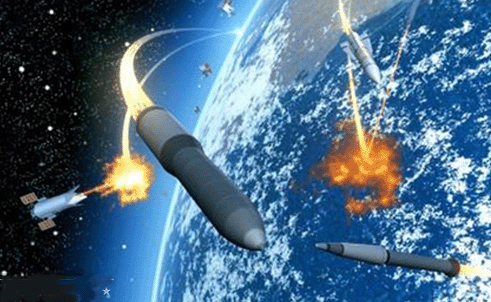
Golden Dome would spur a new space weapons arms race that will destabilize our planet and beyond.
This documentary Arsenal of Hypocrisy features Global Network Coordinator Bruce Gagnon, Noam Chomsky and Apollo 14 astronaut Edgar Mitchell talking about the dangers of moving the arms race into space.
The one-hour production includes archival footage of Nazi rocket tech brought to U.S. after WW2, Pentagon documents, and clearly outlines the U.S. plan to “control and dominate” space and the Earth below.
The video spells out the dangers of the Bush-era “Nuclear Systems Initiative” that will expand the use of nuclear power in space by building Project Prometheus — the nuclear rocket.
Mitchell, the 6th man to walk on the Moon, warns that a war in space would create massive bits of space junk that would create a mine field surrounding the Earth making it virtually impossible to launch anything into the heavens. Mitchell calls space a fragile environment that must be protected.
Noam Chomsky talks about how the U.S. intends to use space technology to control the Earth and reminds the viewer that the U.S. has refused for many years to negotiate a global ban on weapons in space at the United Nations. He also speaks about the role of the media in suppressing this important issue.
The video also contains archival sound of President Dwight Eisenhower in 1961 warning the American people about the power of the military industrial complex.
Arsenal of Hypocrisy was produced in 2003 by filmmaker Randy Atkins from Gainesville, Florida. It is still highly relevant today.
The video was featured at the New York International Independent Film and Video Festival 2004.
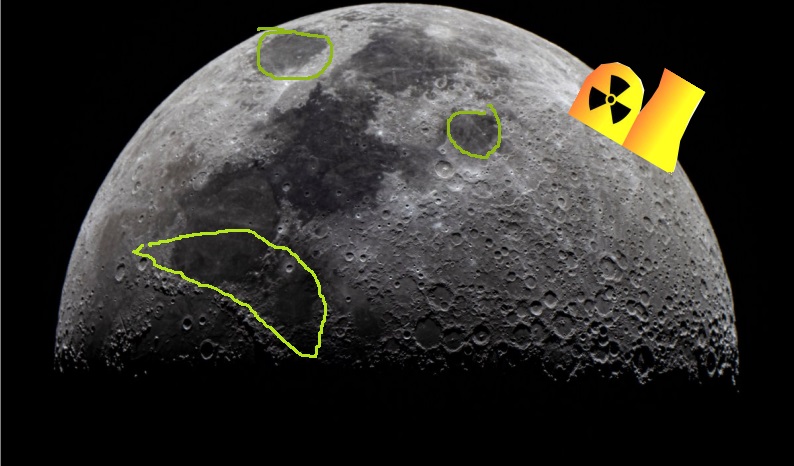
China and Russia plan to build a nuclear reactor on the moon by 2035 to power a permanent lunar base. The International Lunar Research Station (ILRS) will rely on the power plant for its scientific research. The IRLS involves over a dozen international partners and is seen as a rival program to NASA’s Artemis Program.






 nuclear-news