Enthusiastic space travel publicity avoids mentioning radiation danger
We need to talk about radiation in space, Cosmos By Jamie Seidel/1 July 2022,
Escape from it all: go above and beyond in your quest for relaxation. Space hotels promise to capitalise on the ultimate dream. But there’s an elephant in orbit, and nobody’s talking about it.
“We’ve seen a lot of great concept designs for orbital hotels lately,” says Dr Iwan Cornelius. “But none of them seem worried about radiation.”
Cornelius is the managing director of Amentum Scientific, an Australian predictive scientific modelling company that quantifies the risks of radiation exposure for the aviation, transport, mining and space industries.
“I’m guessing being sick in space is not good,” the former radiation worker quips. “It’s a long way to your local GP – and the emergency department.”
Radiation exposure has bothered NASA since the earliest days of its space programs. It’s why the International Space Station (ISS) has a tiny bunker surrounded by water and equipment where astronauts can hunker down.
Space tourism is closer to reality than you think – but a few important things remain to be ironed out.
Escape from it all: go above and beyond in your quest for relaxation. Space hotels promise to capitalise on the ultimate dream. But there’s an elephant in orbit, and nobody’s talking about it.
“We’ve seen a lot of great concept designs for orbital hotels lately,” says Dr Iwan Cornelius. “But none of them seem worried about radiation.”
Cornelius is the managing director of Amentum Scientific, an Australian predictive scientific modelling company that quantifies the risks of radiation exposure for the aviation, transport, mining and space industries.
“I’m guessing being sick in space is not good,” the former radiation worker quips. “It’s a long way to your local GP – and the emergency department.”
Radiation exposure has bothered NASA since the earliest days of its space programs. It’s why the International Space Station (ISS) has a tiny bunker surrounded by water and equipment where astronauts can hunker down.
“One thing you’ll notice with all these concept diagrams for space hotels is there’s not a lot of information about a radiation refuge.”
…………… “If we’re talking about a packed hotel in space, where will they go?” Cornelius asks. “How long will it take to get there? Does everyone get access to a shelter – including staff? I don’t know if this is being thought through”.
And solar events aren’t the only space radiation source…………………………….
Lost in space: Astronauts struggle to regain bone density
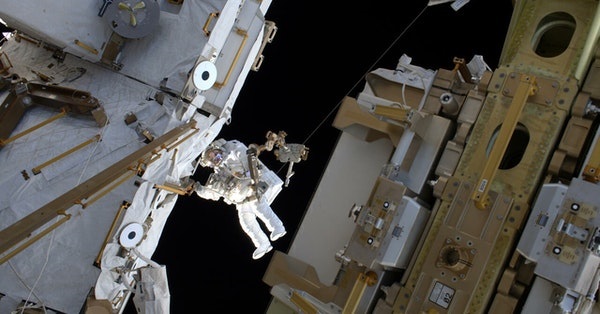
France 24 30/06/2022 Paris (AFP) – Astronauts lose decades’ worth of bone mass in space that many do not recover even after a year back on Earth, researchers said Thursday, warning that it could be a “big concern” for future missions to Mars.
Previous research has shown astronauts lose between one to two percent of bone density for every month spent in space, as the lack of gravity takes the pressure off their legs when it comes to standing and walking.
To find out how astronauts recover once their feet are back on the ground, a new study scanned the wrists and ankles of 17 astronauts before, during and after a stay on the International Space Station.
The bone density lost by astronauts was equivalent to how much they would shed in several decades if they were back on Earth, said study co-author Steven Boyd of Canada’s University of Calgary and director of the McCaig Institute for Bone and Joint Health.
The researchers found that the shinbone density of nine of the astronauts had not fully recovered after a year on Earth — and were still lacking around a decade’s worth of bone mass.
The astronauts who went on the longest missions, which ranged from four to seven months on the ISS, were the slowest to recover.
“The longer you spend in space, the more bone you lose,” Boyd told AFP.
Boyd said it is a “big concern” for planned for future missions to Mars, which could see astronauts spend years in space……………………..
Guillemette Gauquelin-Koch, the head of medicine research at France’s CNES space agency, said that the weightlessness experienced in space is “most drastic physical inactivity there is”.
“Even with two hours of sport a day, it is like you are bedridden for the other 22 hours,” said the doctor, who was not part of the study.
“It will not be easy for the crew to set foot on Martian soil when they arrive — it’s very disabling.”…………………………………. https://www.france24.com/en/live-news/20220630-lost-in-space-astronauts-struggle-to-regain-bone-density—
The impossibility of humans colonising space
Ukraine Is The Most Aggressively Trolled War Of All Time: Notes From The Edge Of The Narrative Matrix, Caitlin’s Newsletter, Caitlin Johnstone 30n June 22
”……………………………………………………………………………..One thing we learned from Covid is that being stuck inside sucks. Space colonization would be like being in permanent lockdown with no windows, no Uber Eats, no birdsong or rain on the roof and no chance of ever going home. Even if it somehow became possible, it’s a dumb idea and I hate it.
And there’s no reason to believe it will ever become possible. Science is nowhere near finished learning about all the countless ways the human organism is inseparably intertwined with Earth. The belief that we can solve our problems with space colonization is unscientific. We’re just going to have to change how we function as a species.

The biggest obstacle remains the fact that science has no idea how to sustain human life in a way that is separate from earth’s ecosystem. We don’t even have any evidence that it’s possible. We’re no closer to being able to do it than we were a thousand years ago; today’s space stations are not independent of Earth’s ecosystem in even the tiniest way. They’re still 100 percent dependent on terrestrial supplies, which is an unsustainable model if you’re talking about actual colonization.
The idea of space colonization appeals to the capitalist mentality because it means we can keep expanding our population and keep expanding the economy and keep harvesting and consuming resources in the way we have been. But there’s literally zero scientific evidence that it’s feasible.
A future of space colonization is a fairy tale we tell ourselves so that we won’t have to change. So we can keep up our egocentric way of functioning without adapting and transcending our self-destructive patterns. We’re like a slacker who refuses to get off their parents’ couch and get their shit together who babbles made-up nonsense about NFT get-rich-quick schemes when asked about their plans for the future.
Collective extinction is easier to imagine than collective ego death. https://caitlinjohnstone.substack.com/p/ukraine-is-the-most-aggressively?utm_source=substack&utm_medium=email
Elon Musk’s satellites for the war in Ukraine
From CNGNN Italy, 29 May 22, Elon Musk, the richest man in the world whose wealth nearly doubled in the two pandemic years, offered $ 44 billion to buy Twitter, which he says would become “the platform for free speech across the country world“. Elon Musk owns SpaceX, an aerospace company based in California.
SpaceX makes rockets and satellites to build Starlink, a broadband Internet system that once is completed will cover the entire world. SpaceX has so far put 2,500 satellites into orbit with rockets carrying 50 satellites at a time and plans to place 42,000 Starlink satellites in low orbit occupying 80% of this space.
Starlink was presented as a commercial satellite system but has fundamental military applications. In fact, satellites in low orbit transmit signals at a much higher speed than those in geosynchronous orbit around the equator. The US Army and Air Force fund and test Starlink to use its military capabilities. For example, last March, the US Air Force reported that conventional and nuclear dual-capacity F-35A fighters had carried out data transmission using Start link satellites at speed 30 times faster than traditional connections.SpaceX’s Starlink satellites are already being used by the Ukrainian military to guide drones, artillery shells, and missiles into Russian positions. This is confirmed by General Dickinson, head of the US Space Command, who declared to the Senate that “Elon Musk’s Starlink demonstrates in Ukraine what the mega-constellations of satellites can do“. Elon Musk’s SpaceX is part of the group of ten largest commercial satellite operators collaborating with US Space Command at the Vandenberg military space base in California.
”Commercial” nuclear power in space? – it’s all about weapons and war.
US military wants to demonstrate new nuclear power systems in space by 2027,By Elizabeth Howell , Space.com , 29 May 22,
That’s just one year after DARPA plans to test out its own nuclear power prototypes.Add the Defense Innovation Unit to a growing list of U.S. government organizations furthering their work in nuclear power in pace.
The organization, which seeks to get the military ready to use emergent commercial products, announced two prototype contracts on May 17 “to demonstrate the next generation of nuclear propulsion and power capability for spacecraft.” The ultimate aim is an orbital flight demonstration in 2027, DIU officials said in a statement(opens in new tab).
The contracts went to two companies, Ultra Safe Nuclear and Avalanche Energy, to demonstrate nuclear propulsion and power capabilities for small spacecraft that would operate in cislunar (Earth-moon) space. (The values of the contracts were not disclosed in the release.)
It’s part of the U.S. military’s pressing focus on cislunar activities to keep an eye on commercial and government activities that will ramp up there in the coming decades, including the international NASA-led Artemis program that seeks to put people on the moon in the 2020s………………………… https://www.space.com/nuclear-power-propulsion-space-defense-innovation-unit-contracts
US military wants nuclear rocket ideas for missions near the moon
The space agency is collaborating on the DRACO project “using non-reimbursable engagement with industry participants
Space.com, By Elizabeth Howell published 1 day ago
The U.S. military hopes to see a flight demonstration in 2026. The U.S. military is ready to take the next step in developing a nuclear rocket to help monitor Earth-moon space, an area it has deemed a high strategic priority.
The Defense Advanced Research Projects Agency (DARPA) announced May 4 that it’s seeking proposals for the second and third phases of a project to design, develop and assemble a nuclear thermal rocket engine for an expected flight demonstration in Earth orbit by 2026.
“These propulsive capabilities will enable the United States to enhance its interests in space and to expand possibilities for NASA’s long-duration human spaceflight missions,” DARPA officials said in a statement.
The proposals will support DARPA’s Demonstration Rocket for Agile Cislunar Operations (DRACO) program, which aims to develop a nuclear thermal propulsion (NTP) system for use in Earth-moon space. DRACO is part of the U.S. military’s larger push to keep an eye on cislunar (Earth-moon) space as government and commercial activities increase in this sector in the coming decade…………
Phase 1 for Draco included awards in April 2021 for General Atomics, Blue Origin and Lockheed Martin. The phase was scheduled to last 18 months across two independent tracks.
Track A, for General Atomics, included the preliminary design of a nuclear thermal propulsion reactor, along with a propulsion subsystem. Track B, pursued by Blue Origin and Lockheed Martin independently, aimed to create an “operational system spacecraft concept” to meet future mission objectives, including a demonstration system.
In September 2020, DARPA also awarded a $14 million task order for DRACO to Gryphon Technologies, a company in Washington, D.C. that provides engineering and technical solutions to national security organizations…………
The space agency is collaborating on the DRACO project “using non-reimbursable engagement with industry participants where technology investments have common interest to both organizations,” NASA officials wrote in the $26 billion budget request for fiscal year 2023, which was released in March. ………. https://www.space.com/darpa-nuclear-rocket-earth-moon-space
NASA Is Sending Artificial Female Bodies to the Moon to Study Radiation Risks.

Gizmodo, Passant Rabie, May 3, 22, Helga and Zohar are headed for a trip around the Moon on an important mission, measuring radiation risks for female astronauts for the first time.
The inanimate pair are manikins modelled after the body of an adult woman. For the Artemis 1 mission, in which an uncrewed Orion capsule will travel to the Moon and back, one of the manikins will be outfitted with a newly developed radiation protection vest. Helga and Zohar, as they’re called, won’t be alone, as they’ll be joined by a third manikin that will collect data about flight accelerations and vibrations. Artemis 1 is scheduled to blast off later this year.
The Artemis program aims to return humans to the Moon for the first time in over 50 years, but this time the space agency has vowed to land the first woman on the dusty lunar surface.
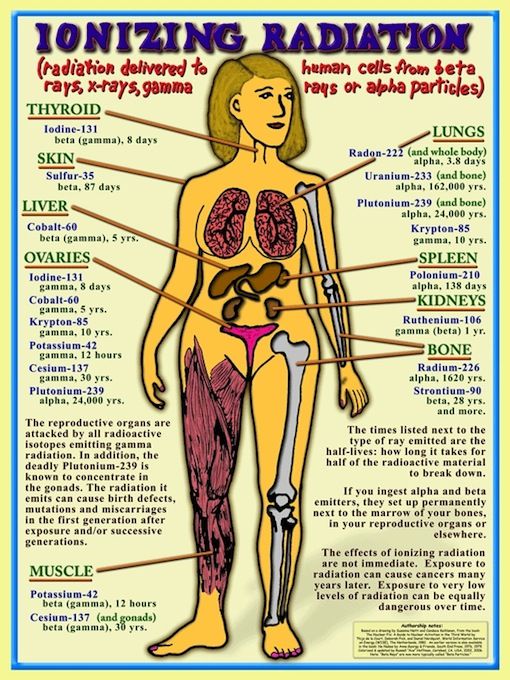
Women appear to be at a greater risk of suffering from the harmful effects of space radiation, so they have different radiation boundary levels than their male colleagues. Studies of radiation exposure for men and women indicate a higher chance of women developing cancer, while other research has found that space radiation is likely to affect female reproductive health…………………………………. https://www.gizmodo.com.au/2022/05/nasa-is-sending-artificial-female-bodies-to-the-moon-to-study-radiation-risks/
Photovoltaics vs. nuclear power on Mars

Photovoltaics vs. nuclear power on Mars https://www.pv-magazine-australia.com/2022/04/29/photovoltaics-vs-nuclear-power-on-mars/
Solar might be more efficient than nuclear energy to supply power for a six-person extended mission to Mars that will involve a 480-day stay on the planet’s surface before returning to Earth, according to new US research.
APRIL 29, 2022 EMILIANO BELLINI Researchers at the University of California, Berkeley, have compared how PV or nuclear energy could power a crewed outpost for an extended period on Mars and have determined that solar offers the best performance.
“Photovoltaic energy generation coupled to certain energy storage configurations in molecular hydrogen outperforms nuclear fusion reactors over 50% of the planet’s surface, mainly within those regions around the equatorial band, which is in fairly sharp contrast to what has been proposed over and over again in the literature, which is that it will be nuclear power,” said UC Berkeley researcher Aaron Berliner, noting that two energy sources were compared for the power supply of a six-person extended mission to Mars involving a 480-day stay on the planet’s surface before returning to Earth.
The US team considered four different scenarios: nuclear power generation with the miniaturised nuclear fission Kilopower system, PV power generation with battery energy storage, PV power generation with compressed hydrogen energy storage produced via electrolysis, and hydrogen generation with compressed hydrogen energy storage (PEC).
In our calculations, we assumed a capacity factor of 75% to account for the solar flux deviation throughout the Martian year and sized energy storage systems to enable 1 full day of operations from reserve power,” the group explained. “We then calculated the carry-along mass requirements for each of the power generation systems considered.”
The scientists found that, of the three PV-based power generation options, only the photovoltaics-plus-electrolyser system outcompetes the nuclear system based on carry-along mass. They also said that the optimal absorber bandgaps for the PV systems depend heavily on the location on the surface of Mars, the total depth of the air column above a given location, gradients in dust and ice concentrations, and orbital geometry effects that cause different effective air column thicknesses for locations near the poles.
In our calculations, we assumed a capacity factor of 75% to account for the solar flux deviation throughout the Martian year and sized energy storage systems to enable 1 full day of operations from reserve power,” the group explained. “We then calculated the carry-along mass requirements for each of the power generation systems considered.”
The scientists found that, of the three PV-based power generation options, only the photovoltaics-plus-electrolyser system outcompetes the nuclear system based on carry-along mass. They also said that the optimal absorber bandgaps for the PV systems depend heavily on the location on the surface of Mars, the total depth of the air column above a given location, gradients in dust and ice concentrations, and orbital geometry effects that cause different effective air column thicknesses for locations near the poles.
Solar beats nuclear at many potential settlement sites on Mars
Thanks to today’s light, flexible solar panels, photovoltaics may be more practical for long stays,
Science Daily April 27, 2022, Source:University of California – BerkeleySummary:While most missions to the moon and other planets rely upon solar power, scientists have assumed that any extended surface mission involving humans would require a more reliable source of energy: nuclear power. Improvements in photovoltaics are upending this calculus. A new study concludes that a solar power system would weigh less than a nuclear system, and would be sufficient to power a colony at sites over nearly half the surface.
The high efficiency, light weight and flexibility of the latest solar cell technology means photovoltaics could provide all the power needed for an extended mission to Mars, or even a permanent settlement there, according to a new analysis by scientists at the University of California, Berkeley……………………………… https://www.sciencedaily.com/releases/2022/04/220427100529.htm
US Planned A Nuclear Explosion On Moon; Information Revealed From Intelligence Documents
https://www.businessworld.in/article/US-Planned-A-Nuclear-Explosion-On-Moon-Information-Revealed-From-Intelligence-Documents/25-04-2022-426503/ Some intelligence documents have revealed that the US wanted to conduct a nuclear explosion on the moon. The purpose of this US mission was to make a tunnel on the moon and dig in its core. Huge expenditure was also spent on this campaign
There has been a big disclosure about America’s Moon Mission. Some intelligence documents have revealed that America’s plan was to conduct a nuclear explosion on the moon. Under the Advanced Aerospace Threat Identification Program (AATIP), the US spent a lot on this mission, but did not get the expected success.
The US was working on such a plan, which is very difficult to believe. Its mission included visibility cloaks, antigravity devices, traversable wormholes, and tunneling to the Moon by detonating nuclear weapons. However, now AATIP is inactive and currently this program is not working.
In the 1600-page document, there have been many revelations about the research being done by AATIP. Documents show that the AATIP was a secret organisation and information about it came to light when its former director Luis Elizondo resigned from the Pentagon in 2017. At that time it was claimed that about USD 22 million had been spent on this Moon mission.
This agency, which plans Nuke Explosion on the Moon, was funded by the US Department of Defense and has also been at the center of discussion about UFOs many times. According to the documents, America wanted to dig in the core of the moon.
The reason for this was the discovery of a metal as strong as steel, but 100,000 times lighter than that. It could be used to build spacecrafts. Scientists associated with the mission had plans to build a tunnel through the lunar crust and mantle with thermonuclear explosives to reach the Moon’s core. However, this plan could not be fully implemented.
UK preparing for ‘exo-atmospheric nuclear attack’ as greatest threat in space war, government report warns
UK preparing for ‘exo-atmospheric nuclear attack’ as greatest threat in space war, government report warns
Such an event would be a ‘permanent kill’ scenario worse than any electronic weapons or orbital anti-satellite weapons, a new report states, Adam Smith Independent 2 Feb 22,
The government says space will be a key future battlefield with the most dangerous threat being a “exo-atmospheric nuclear attack”.
In a report from the Ministry of Defence, the government body described such an event as a “permanent kill” scenario; this would be vastly more dangerous than either electronic warfare, laser dazzling, cyber attacks, or orbital ASATs (anti-satellite weapons)………… (registered readers only) https://www.independent.co.uk/space/atmospheric-nuclear-attack-space-war-government-b2005990.html
Rockets Destroy Ozone and Cause Climate Change – Aerospace Programs’ Deadly Impacts to the Earth.
 | |||

Rockets Destroy Ozone and Cause Climate Change – Aerospace Programs’ Deadly Impacts to the Earth https://www.globalresearch.ca/rockets-destroy-ozone-and-cause-climate-change-aerospace-programs-deadly-impacts-to-the-earth/5767944By Nina BeetyGlobal Research, January 24, 2022 Since its beginnings, the space industry has used PR, Hollywood, and a parade of stars to carve itself into the public psyche, including targeting children. Aerospace costs have been largely ignored or hidden, but these costs are serious and accelerating.
The ozone layer in the sky continues to deteriorate despite international action such as the ban on CFCs. The Antarctic ozone hole is becoming permanent year-round, and the soothing green and blue on NASA’s maps actually signifies low ozone levels.1 The aerospace industry is a major factor in this problem. Dallas etal. (2020): [O]zone depletion is one of the largest environmental concerns surrounding rocket launches from Earth.”2 Why?
1. Rockets’ radical emissions cause immediate, almost total ozone destruction for hundreds of square miles and which lasts days.3
2. Rockets’ exhaust and pollutants introduced into the stratosphere persist there and react with and destroy ozone over the long term.4
3. The sun creates the ozone layer by changing oxygen into ozone in the stratosphere. But rockets put pollutants such as exhaust, water vapor, black carbon, and fuel components such as alumina into the stratosphere, blocking the sun’s rays. This reduces the sun’s creation of ozone, reducing ozone layer repair and replenishment. The long-lived rocket byproducts persist in the stratosphere for 3-5 years,5 and accumulate with every rocket launch, decreasing ozone regeneration with each launch.6
4. The shockwave of de-orbitting debris, satellites, and rockets creates nitric oxide which destroys ozone.7
There is no environmental oversight. Researchers including Martin Ross, Darin Toohey, and James Vedda have repeatedly warned the industry,8 but the industry and governments are escalating space funding and programs instead.
Prior to 2021, 2000 satellites were in orbit around the Earth. Then in 2021, 2800 satellites were launched — more than doubling the total in just one year.9 However, the FCC has approved 17,270 low-earth-orbit (LEO) satellites. 65,912 more LEO applications are pending. Governments and private companies plan an additional 30,947+. Rwanda has applied to the ITU for a staggering 327,320 satellites (Firstenberg, 2022). These numbers don’t include systems fewer than five satellites, geostationary, or medium earth orbit (MEO) satellites, or rockets into space.
These programs will acceleratingly destroy the ozone layer which is essential to protect the Earth and life.10 NASA discovered in 2007 that UV-C and UV-B were already reaching the Earth and failed to act.11 UV radiation is having lethal effects on species now.
LEO satellites are very short-lived, lasting 5-7 years; the U.S. military plans 3-year duration satellites. These LEOs need frequent replacement via rocket launch.
Aleksandr Dunayev of the Russian Space Agency said in 1991: “About 300 launches of the [space] shuttle each year would be a catastrophe, and the ozone layer would be completely destroyed.”12
Science author Arthur Firstenberg says: “In 2021, there were 146 orbital rocket launches to put 1,800 satellites into space. At that rate, to maintain and continually replace 100,000 low-earth-orbit satellites, which have a lifespan of five years, would require more than 1,600 rocket launches per year, or more than four every day, forever into the future.”13 That’s over five times the amount to totally destroy the ozone layer.
The long-lived rocket pollution in the stratosphere also traps Earth’s natural and human-made heat under a rapidly thickening blanket, preventing the heat from venting into space. This will increasingly raise Earth’s temperature.14 This has nothing to do with carbon or methane. However, the increased heat will release methane stored in permafrost and formerly ice-covered regions, and this methane will poison Earth.
These satellite systems are largely intended for 4G/5G global Wi-Fi, military warfighting, and the Internet of Things. They exponentially increase RF-EMF radiation levels in the atmosphere and on Earth. This radiation damages health and causes environmental damage. It damages neurology, DNA, cell membranes, the brain, cognition, learning, memory, immunity, reproduction and fertility, blood, and mitochondria, dysregulates hormones, the blood-brain barrier, and sleep cycles, and causes cancer, stroke, heart attacks, and oxidative stress.15
It disrupts wildlife’s ability to navigate and orient by Earth’s natural EMF fields. Bees, insects, and birds are particularly vulnerable.16 The U.S. Department of Interior warned in 2014 about the devastating impacts to birds from this radiation.17 In 2020, a 5G military/SpaceX “live fire” drill killed up to millions of birds in the Southwest.18 Western governments and the FCC ignore the substantial research showing devastating impacts.
What a disaster.

Another problem: dead spacecraft and debris are rapidly accumulating in the sky, creating collision hazards for other rockets, satellites, and the space stations.19 Every collision creates more debris, leading to more collisions. Unstoppable chain-reaction collisions – Kessler Syndrome — are inevitable. It is increasingly difficult to navigate through these debris fields.
High rates of satellite failure leave dead, unmaneuverable satellites in orbit. The new large constellations will dramatically worsen this problem.20
All of this debris, computers, electronic and chemical waste, radioactive elements, weapons, dead satellites, rocket parts, and dust come down. Aerospace officials and agencies, including the FCC,21 talk nonsense about “disposal” via “safe” de-orbitting and vaporization, as if the waste simply disappears.
The reality is that de-orbitting and vaporization create new problems — exploding burning debris, aerosolizing toxins, metals, paints, fuels, and other chemicals. They fall into the lower atmosphere to pollute the soil, ocean, waters, and air we breathe. “Vaporized” means it explodes into tiny particles and dust.
With these large constellations of short lifespan, increasing failures, and launch rocket debris, a barrage of debris and fall-out and increasing atmospheric dust are just beginning.
All of this debris burns at very hot temperatures as it re-enters the atmosphere, with big and little chunks landing everywhere.22 Exponential increases in fall-out increases the risk for fires, injuries, deaths, and property damage. A large chunk of space debris fell into a Michigan family’s yard and just missed hitting anyone.23 Hot debris fell in Chile last year causing fires.24 A Russian satellite that was supposed to stay in orbit for ten thousand years fell out of orbit this month and possibly landed in the Pacific Ocean.25
In 2020, the FCC proposed an “acceptable” casualty rate of 1 in 10,000 from falling satellites and rockets.26 The FCC also discussed liability and indemnity. However, any liability depends on debris being attributable to a company or government. Otherwise, injured parties would likely have limited or no recourse.
Direct land, air, and ocean pollution from dumping, rocket liftoffs, launch pad runoff and accidents, is another terrible problem.27
No one is discussing this.
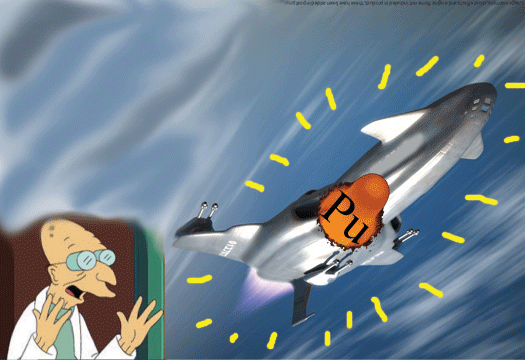
The US also wants to put nuclear power into space 28 — reactors in the sky — and awarded a major contract to a team that includes GE, the company which engineered the flawed Fukushima reactors.29 Rockets can explode at launch, malfunction after launch, or fail to reach orbit. This last happened with SNAP 9-A in 1964. As a result, 2.1 pounds of plutonium-238 “vaporized in the atmosphere and spread worldwide… Dr. John Goffman …concluded that the dispersed deadly plutonium-238 was a leading cause of the increase in cancers around the world today.”30 There have been other space nuclear accidents. Officials don’t seem to care.
The militarization of the atmosphere, space, and the moon risk World War III — another problem. 5G in space will control weapons systems on Earth and in the ocean, 31 including military sonar already responsible for killing hundreds of thousands of dolphins, whales, and other marine animals.32

The militarization of the atmosphere, space, and the moon risk World War III — another problem. 5G in space will control weapons systems on Earth and in the ocean, 31 including military sonar already responsible for killing hundreds of thousands of dolphins, whales, and other marine animals.32
Elon Musk/SpaceX in partnership with the US government has endangered Chinese astronauts by getting too close to their space station.33 Musk is the same man who advocates nuking Mars and saying the U.S. can coup whatever country it wants for rare earth minerals such as lithium.34 The military and its contractors are not guided by responsible, calm leaders. The worst is already happening.

Add to that accelerating plans to exploit, extract, militarize, and privatize the sovereign moon which stabilizes Earth’s rotation and climates, creates the tides, and is essential to all life, as I detailed in my previous article.35 Who’s protecting the moon and the Earth?
Military conquest, profiteering through extraction, mining, tourism, and exploitation are the main goals driving the expenditure of public monies and private investment, not pretty space pictures or neutral, scientific “exploration”. The plutonium ecocide of Saturn by the space industry via the Cassini probe should have been a wakeup call to pull the plug on NASA and the aerospace industry before more planets are destroyed including the Earth.
Subsidizing this industry has caused a brain drain into its high-paying jobs, neglecting and hampering work on Earth’s urgent problems. And the aerospace industry has siphoned off billions in public funds that could fund solutions, while causing expensive environmental problems to be dealt with “later”. The $10 billion dollar Webb telescope is one recent example. Decisionmakers are dashing headlong toward the mirage of a new Gold Rush.
It’s time to strip back the curtain and reveal the protected astronauts, aerospace moguls, and rocket scientists. They are not heroes. They are destroying the Earth. The joy rides of William Shatner and Jeff Bezos were sickening.
Those who want to stop climate change and protect the ozone layer must halt the space programs including space tourism and military programs.
Those who would protect the environment must stop these programs and do it now.
This is common sense. This is about Earth protection. This is about growing up.
Stop the rockets. Defund the space programs. Protect the Earth now.
The US and China Could Soon Be In Race For Nuclear-Powered Satellites.
The US and China Could Soon Be In Race For Nuclear-Powered Satellites, Defense One, 16 Jan 22,
An idea from the 1960s has found new backers., If future U.S. satellites are to dodge incoming Russian or Chinese fire, they’ll need better ways to move around than today’s fuel-intensive thrusters. That’s why the Pentagon is looking into nuclear-powered propulsion.
While leaders at the Space Force and the Pentagon Research and Development office remain publicly quiet about the idea of putting nuclear-powered spacecraft in orbit, the Mitchell Institute for Aerospace studies released a new report that argues for more focused work on it.
It isn’t a new concept. NASA and the Atomic Energy Commission were working toward a flight test for their nuclear rocket until the Vietnam War sapped the program’s funding. It was cancelled in 1973, and safety concerns have since scuttled further efforts………….
If future U.S. satellites are to dodge incoming Russian or Chinese fire, they’ll need better ways to move around than today’s fuel-intensive thrusters. That’s why the Pentagon is looking into nuclear-powered propulsion.
While leaders at the Space Force and the Pentagon Research and Development office remain publicly quiet about the idea of putting nuclear-powered spacecraft in orbit, the Mitchell Institute for Aerospace studies released a new report that argues for more focused work on it.
It isn’t a new concept. NASA and the Atomic Energy Commission were working toward a flight test for their nuclear rocket until the Vietnam War sapped the program’s funding. It was cancelled in 1973, and safety concerns have since scuttled further efforts……….
But one DARPA official, at least, suggests looking at the idea afresh. A 2020 policy change from the Trump White House has clearing the way for new research into nuclear propulsion, Micheal Leahy, the director of the tactical technology office at DARPA, told a virtual audience on Friday. Leahy’s office runs the DARPA Demonstration Rocket for Agile Cislunar Operations, or DRACO, program. Last April, DARPA awarded General Atomics a contract for a preliminary design of a reactor and propulsion subsystem, and gave Lockheed Martin and Blue Origin a contract for a spacecraft design.
But the bigger factor is thatChina is working along similar lines with planes to field its own nuclear-powered satellites by 2040. The lessons from the current gap in hypersonic missile technology should provide a cautionary tale, Leahy said.
“We had the lead in hypersonics, only to watch it go away. Right?… Now I’m in a tail chase,” he said. https://www.defenseone.com/technology/2022/01/us-and-china-could-soon-be-race-nuclear-powered-satellites/360792/
The environmental impact of emissions from space launches: a comprehensive review
The environmental impact of emissions from space launches: A comprehensive review https://www.sciencedirect.com/science/article/abs/pii/S0959652620302560Author links open overlay panelJ.A.DallasabS.RavalbcJ.P.Alvarez GaitandS.SaydamabA.G.Dempsterae
a Australian Centre for Space Engineering Research, UNSW, Sydney, Australia
bSchool of Minerals and Energy Resources Engineering, UNSW, Sydney, Australia
cAustralian Centre for Sustainable Mining Practices, UNSW, Sydney, Australia
d School of Civil and Environmental Engineering, UNSW, Sydney, AustraliaeSchool of Electrical Engineering and Telecommunications, UNSW, Sydney, Australia
28 January 2020.
Highlights
•The environmental impact of space launches is becoming increasingly significant.•
Stratospheric ozone depletion is a key environmental concern for space launches.•
Environmental trade-offs exist between propellant types.•
Further study is required into the cumulative impact of launches.
Abstract
With the increasing accessibility of commercial space flight, the environmental impacts of space launches will become increasingly significant in the coming years. Here, for the first time, a review is presented of the environmental impacts of space launches, specifically of emissions from commonly used solid and liquid rocket propellants. While there are a number of environmental impacts resulting from the launch of space vehicles, the depletion of stratospheric ozone is the most studied and most immediately concerning. Solid rocket motors are the subject of most of the environmental studies on rocket launches, while the now more commonly used liquid rocket propellants are underrepresented in the literature. The limited studies of emissions from rocket engines using liquid propellent reveal that while they do result in stratospheric ozone loss, solid rocket motors are responsible for orders of magnitude greater loss. The comparison of commonly used propellants highlights the environmental trade-offs that must be made when selecting a launch system. This review highlights the need for further study of the cumulative impacts that frequent space launches have on all areas of the environment, including global climate, ecosystem toxicity, and human toxicity, and with consideration given to all commonly used propellants, to ensure that the impacts are well characterised and well understood before the number of launches greatly increases.
You thought Rolls Royce’s Small Nuclear Reactors would be for electricity on Earth?

Rolls-Royce team moves into Space Park Leicester to work on nuclear powered space travel, BusinessLive, 13 Jan 22,
Rolls-Royce already signed contract with UK Space Agency to study future nuclear power options for space exploration.
Rolls-Royce has moved a team onto Space Park Leicester to push forward its work on nuclear power for space travel.
The engineering giant has taken space in the new £100 million facility which was launched as a breeding ground for out-of-this-world tech by bringing together industry and academia.
Rolls-Royce is reported to be the only UK company focussing on the line of work and staff with a pedigree in nuclear power will collaborate with new space park head Professor Richard Ambrosi, Professor of Space Instrumentation and Space Nuclear Power Systems at University of Leicester and other experts in space science.
Last January, Rolls-Royce signed a contract with the UK Space Agency to study future nuclear power options for space exploration………………… https://www.business-live.co.uk/technology/rolls-royce-team-moves-space-22728938
1 This Month

22 June – Virtual Event –Climate Change: New Data, New Debate

Monday, June 22, 2026 2:30 p.m. – 3:15 p.m. CT
YouTube. Register here

Protect Sazan Island from the Trump family! https://secure.avaaz.org/campaign/en/protect_sazan_island_from_the_trump_family_loc/?bqFCVab&v=174511&cl=22707147157&_checksum=5e9dde668860e8231c33699735e16a1fbf22ab2cb01da50c999fe8732b9775ef&utm_source=email&utm_medium=blast_email&utm_campaign=174511
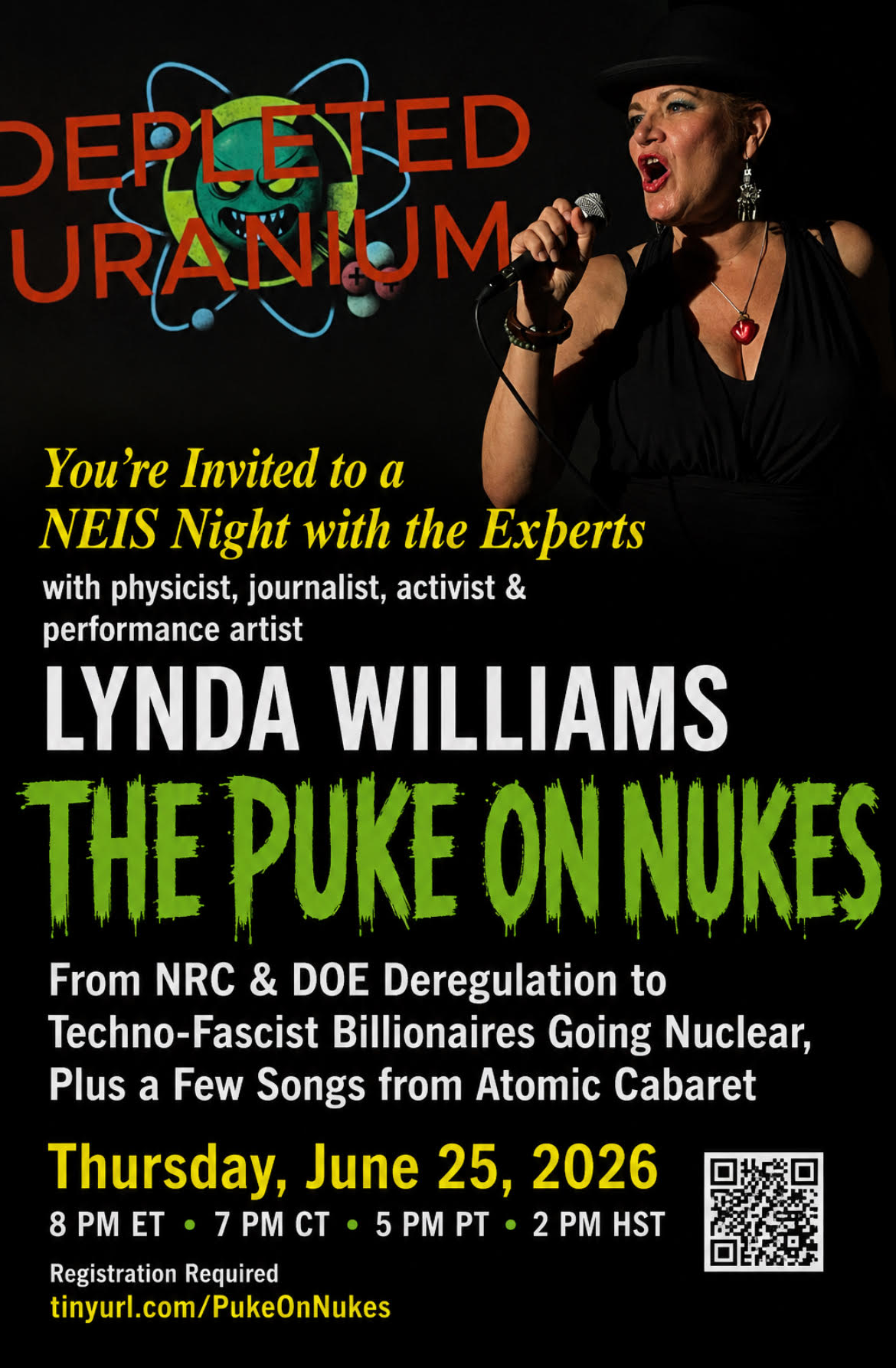
25 June- THE PUKE ON NUKES
Thursday, June 25, 2026
7pm Central Time (8pm ET, 6pm MT, 5pm PT) UTC – 5
From NRC & DOE Deregulation to Techno-Fascist Billionaires Going Nuclear, Plus a Few Songs from Atomic Cabaret REGISTER
26 June – Radiation Trainwreck at the NRC / Join the Protect Better Campaign – https://us02web.zoom.us/meeting/register/4ZlZ5_qLSHGiLSCg8FF6Bg#/registration


Cuba Is Not a Failed State – It Is a Besieged State
PETITION: “Global Appeal to Endorse Palestinian Right of Return of Refugees”
To see nuclear-related stories in greater depth and intensity – go to https://nuclearinformation.wordpress.com
-
Archives
- June 2026 (211)
- May 2026 (306)
- April 2026 (356)
- March 2026 (251)
- February 2026 (268)
- January 2026 (308)
- December 2025 (358)
- November 2025 (359)
- October 2025 (376)
- September 2025 (257)
- August 2025 (319)
- July 2025 (230)
-
Categories
- 1
- 1 NUCLEAR ISSUES
- business and costs
- climate change
- culture and arts
- ENERGY
- environment
- health
- history
- indigenous issues
- Legal
- marketing of nuclear
- media
- opposition to nuclear
- PERSONAL STORIES
- politics
- politics international
- Religion and ethics
- safety
- secrets,lies and civil liberties
- spinbuster
- technology
- Uranium
- wastes
- weapons and war
- Women
- 2 WORLD
- ACTION
- AFRICA
- Atrocities
- AUSTRALIA
- Christina's notes
- Christina's themes
- culture and arts
- Events
- Fuk 2022
- Fuk 2023
- Fukushima 2017
- Fukushima 2018
- fukushima 2019
- Fukushima 2020
- Fukushima 2021
- general
- global warming
- Humour (God we need it)
- Nuclear
- RARE EARTHS
- Reference
- resources – print
- Resources -audiovicual
- Weekly Newsletter
- World
- World Nuclear
- YouTube
-
RSS
Entries RSS
Comments RSS
 nuclear-news