Getting bigger but not safer or cheaper – the myth of Rolls Royce and its very big non-modular reactor

Rolls Royce are now starting a ‘Generic Design Assessment’ (GDA) process with the ONR which will take around 5 years. After then they will be asking the UK Government for a blank cheque for the project.
https://100percentrenewableuk.org/getting-bigger-but-not-safer-or-cheaper-the-myth-of-rolls-royce-and-its-very-big-non-modular-reactor By David Toke, 30 Mar 22, Rolls Royce’s so-called small modular reactor (SMR) is getting bigger, but is likely to have fewer special safety features compared to EDF’s increasingly pricey design for Hinkley C.
In 2017 Rolls Royce said that its small modular reactor would be between 220 and 440 MW, but the latest design is bigger, at 470 MW. It is strange to call this small. Reactors in service at the moment (the so-called AGR reactors) were around the 600 MW size for each unit and, strange as it might seem, most of the first generation of so-called ‘Magnox’ nuclear reactors built in the UK were actually smaller than 470 MW. They were not called ‘small’. So why is Rolls Royce calling this a SMR? There’s no reason for this other than public relations.
Rolls Royce claim that the parts will be mainly built in factories. Well, of course they will, that’s always the case with nuclear power plant. The difference with building a relatively smaller plant of course is that you get less of the economies of scale in doing this. That is why nuclear power plant have got bigger.

So the fact that the Rolls Royce unit will be about a third the size of the EPR is likely to make them cost more. But there is one way that Rolls Royce will be able to economise compared to the European Pressurised Reactor (EPR) being built at Hinkley C, and that is because I have seen no sign that Rolls Royce will include some special safety features that have been included in the EPR.
The best known of these safety features are a) a ‘double containment’ feature that is designed to stop material from the inside getting out (as well as another external shell to shield from aircraft) and b) a ‘core catcher’ to stop a melting core eating its way into the ground and potentially contaminating water courses. I am assuming Rolls Royce will not be including either of these features, although it will have to satisfy the Office for Nuclear Regulation (ONR) that it has other ways of stopping radioactive releases from accidents.
Rolls Royce are now starting a ‘Generic Design Assessment’ (GDA) process with the ONR which will take around 5 years. After then they will be asking the UK Government for a blank cheque for a project.
Of course there is another factor and that is that EDF have some experience (admittedly not very successful of late) of building nuclear power plant. Rolls Royce do not have experience of building large nuclear power plant (which is what they are really hoping to do). Producing small (and, it must be said extremely expensive) genuinely small reactors for nuclear submarines is not the same thing at all! So Rolls Royce are likely not to have the skills to build large nuclear power plant. That is a bad sign!
The so-called SMRs proferred by Rolls Royce will just be the latest in a long line of very expensive, very lately delivered nuclear power stations in the UK. It is unlikely to be any cheaper than the reactor that EDF is building at Hinkley C (becoming more expensive as time goes on). But it will have fewer safety features.
Robert (Bob) Hoggar comments: Small Mod Reactors scattered about Britain will also have lots of nuclear waste scattered about Britain which will need careful looking after and that is guaranteed to be an additional rusk to the nation.
Ottawa’s Nuclear Funding Delays Climate Action, Ignores Indigenous Objections, Opponents Warn
Ottawa’s Nuclear Funding Delays Climate Action, Ignores Indigenous Objections, Opponents Warn The Energy Mix March 20, 2022
The federal government is delaying climate action by subsidizing small, modular nuclear reactor (SMR) development, over the objections of the remote, Indigenous communities the technology is supposed to serve as an alternative to diesel generators, opponents warned last week.
“There is no guarantee SMRs will ever produce energy in a safe and reliable manner in Canada,” the groups said in a release, after Innovation Minister François-Philippe Champagne announced a C$27.2-million grant for Westinghouse Electric’s $57-million bid to move its e-Vinci reactor toward licencing. They said systems of the type Westinghouse is developing “are not the energy answer for remote communities”, since they “do not compete when compared with other alternatives.”
In a study conducted in 2020, “the cost of electricity from SMRs was found to be much higher than the cost of wind or solar, or even of the diesel supply currently used in the majority of these communities,” the release added.
“Canadians want affordable energy that does not pollute the environment,” said Susan O’Donnell, spokesperson for the Coalition for Responsible Energy Development in New Brunswick. “Why would we invest in unproven technologies that, if they ever work, will cost two to five times more than building proven renewables?”
“The nuclear industry is promoting a nuclear fantasy to attract political support while purging past failures—like cost overruns and project delays—from public debate,” said Kerrie Blaise, northern services legal counsel at the Canadian Environmental Law Association. “Before Canada invests any public dollars in this yet-to-be-developed technology, they must fully evaluate the costs of nuclear spending and liabilities associated with the construction, oversight, and waste of this novel technology.”
“Studies have shown that electricity from small modular reactors will be more expensive than electricity from large nuclear power plants, which are themselves not competitive in today’s electricity markets,” said M. V. Ramana, a professor at the University of British Columbia School of Public Policy and Global Affairs, one of the co-authors of the 2020 study. “There is no viable market for small modular reactors, and even building factories to manufacture these reactors would not be a sound financial investment……………….
Last week’s government release added that SMR development will “help communities that rely on heavy-polluting diesel fuel to transition to a cleaner source of energy.” But the opposing groups say many of those remote settings are Indigenous communities, and SMR development isn’t the help they’re looking for. A December, 2018 resolution by the Assembly of First Nation Chiefs asked the industry to stop pursuing SMR development and the government to stop funding it, and “other Indigenous communities, including the Chiefs of Ontario, have passed resolutions opposing funding and deployment of SMRs”. https://www.theenergymix.com/2022/03/20/ottawas-nuclear-funding-delays-climate-action-ignores-indigenous-objections-opponents-warn%ef%bf%bc/
British public in the dark about what ”Modular” nuclear reactors really means (hint -they’re like Lego pieces)
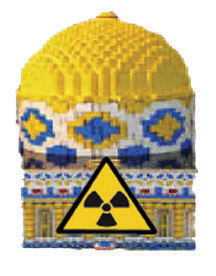
What does “modular” mean here? I haven’t the faintest. Isn’t it to
do with university courses? I’ve been quizzing friends and so far only
two even took a stab: one thought it might mean being able to have them
together, or not, or something. The other thought it might mean
“portable”. My guess is that the British population shares my
ignorance, but thinks you don’t say “small reactors” without
inserting “modular”. Obviously, we’ll have to ramp these modularities
up. On multiple occasions. Onwards, then, to my next small, modular item.
Times 23rd March 2022
https://www.thetimes.co.uk/article/this-craze-for-modular-must-be-a-fission-thing-s35qx0ktq
Nuclear lobby touting small nuclear reactors to Alaska

House bill would streamline approval of small nuclear reactors in Alaska, Alaska Public Media, By, Dan Bross, KUAC – Fairbanks, March 21, 2022 A bill moving through the Alaska Legislature would streamline the state’s approval process for small nuclear reactors, which have been touted as cleaner, more cost-effective sources of energy for Alaska.
There are no microreactors operating anywhere in the United States. But a few pilot projects are planned, including one at Eielson Air Force Base. The federal Nuclear Regulatory Commission must approve any new reactor, but House Bill 299 from Gov. Mike Dunleavy would exempt microreactors from some decades-old state requirements.
At a state House committee hearing, Alaska Department of Environmental Conservation environmental health director Christina Carpenter said the bill would exempt microreactors from multi-agency study and legislative siting approval requirements……………
Alaska Community Action on Toxics executive director Pam Miller describes nuclear power as destructive throughout its lifecycle.
“While these nuclear microreactors are being touted as a solution for the climate crisis and energy needs in rural Alaska, I believe that it’s a false solution and that these reactors are actually quite dangerous,” she said. “From the mining of uranium, which usually takes place on Indigenous lands, through the enrichment process. And then there is the untenable problem of radioactive waste disposal, and that has not been solved.”
Miller said she is also concerned about the security of microreactors in Alaska, especially if deployed in remote locations.
Under the bill, microreactors proposed for areas without local government would still need to get siting approval from the legislature. https://www.alaskapublic.org/2022/03/21/house-bill-would-streamline-approval-of-small-nuclear-reactors-in-alaska/
Indigenous, scientific, environmental and citizen groups strongly oppose Ottawa’s push for small nuclear reactors
Ottawa pours more money into next-gen nuclear tech; critics to push back
against ‘dangerous distraction’. Innovation, Science and Industry
Minister François-Philippe Champagne announced a $27.2-million investment
Thursday in the development of next-generation nuclear technology he said
will make energy more accessible to remote communities.
However, numerous Indigenous, scientific, environmental and citizen groups have called the
technology a “dirty, dangerous distraction” from real climate action.
The money will go to the development of Westinghouse Electric Canada
Inc.’s eVinci micro-reactor, a small modular reactor (SMR) the company
says will “bring carbon-free, transportable, safe and scalable energy
anywhere Canada requires reliable, clean energy.”
National Observer 17th March 2022
Small modular nuclear reactors – no good for Canada’s indigenous communities, no good for climate action
The Government of Canada is further delaying climate action with an
announcement of $27 million in funding today to develop a Small Modular
Nuclear Reactor (SMR).
There is no guarantee SMRs will ever produce energy
in a safe and reliable manner in Canada. During his remarks for the
announcement, François-Philippe Champagne, Minister of Innovation, Science
and Economic Development Canada, as well as Westinghouse representatives,
said that the technology to be developed, the e-Vinci reactor by the
Westinghouse Electric Company, will be suitable for remote Indigenous
communities currently using diesel energy.
However, research has demonstrated that small modular nuclear reactors such as the type
Westinghouse is proposing are not the energy answer for remote communities.
The researchers–Froese, Kunz & Ramana (2020)–concluded that the
economics of SMRs do not compete when compared with other alternatives. The
cost of electricity from SMRs was found to be much higher than the cost of
wind or solar, or even of the diesel supply currently used in the majority
of these communities.
Canadian Coalition for Nuclear Responsibility 17th March 2022
Another burst of tax-payer funding for Bill Gate’s gee-whiz Natrium reactor project
TerraPower receives $8.5M grant to explore recovering uranium from used nuclear fuel, Oil City News
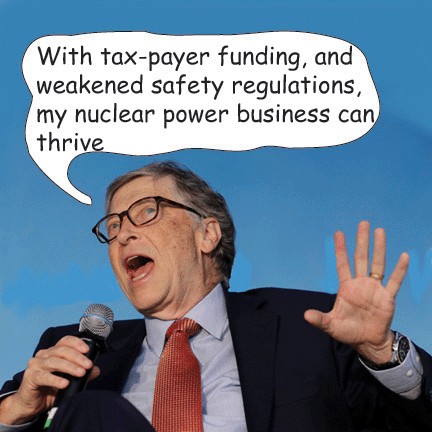
CASPER, Wyo. — TerraPower, the Bill Gates–founded company working toward building a new nuclear reactor in Kemmerer, Wyoming, said in a press release Monday that it has been awarded an $8.5 million grant from the U.S Department of Energy’s Advanced Research Project Agency – Energy (ARPA-E).
The grant funding is part of ARPA-E’s Optimizing Nuclear Waste and Advanced Reactor Disposal Systems (ONWARDS) program that aims to increase the use of nuclear power as a source of clean energy while limiting the amount of nuclear waste created by advanced reactors……
TerraPower and GE technology is going into the new Natrium nuclear reactor, which is expected to be built in Wyoming as part of the U.S. Department of Energy’s Advance Reactor Demonstration program.
“TerraPower is further demonstrating, through the Molten Chloride Reactor Experiment (MCRE), a uranium chloride salt–fueled concept with the DOE, Southern Company and other partners, and advancing medical research and innovation through its TerraPower Isotopes® subsidiary,” the press release states.
TerraPower President and CEO Chris Levesque added in the press release that “TerraPower continues to advance nuclear energy’s promise for our country and the world………… https://oilcity.news/wyoming/energy/2022/03/14/terrapower-receives-8-5m-grant-to-explore-recovering-uranium-from-used-nuclear-fuel/
Rolls Royce wants to hurry up the introduction of small nuclear reactors, but UK govt is focussed on a big one for Wylfa

Rolls-Royce calls for accelerated SMR rollout as Boris considers bigger plans for Wylfa
14 MAR, 2022 BY CATHERINE KENNEDY ROLLS-ROYCE IS APPEALING TO THE UK GOVERNMENT TO SPEED UP THE ROLLOUT OF SMALL MODULAR REACTORS (SMRS), WHILE PRIME MINISTER BORIS JOHNSON IS REPORTEDLY KEEN TO REVIVE PLANS FOR THE WYLFA NEWYDD NUCLEAR POWER PLANT IN RESPONSE TO THE UK ENERGY CRISIS.
There is a pressing need to improve the UK’s energy security, with prices soaring due to the Russian invasion of Ukraine, and alternative solutions are being explored to plug the gap.
Rolls-Royce submitted SMR designs for Wylfa and Trawsfynydd for assessment last week. However extensive safety checks are needed and these are not expected to come online until the 2030s. As such, government sources told the Telegraph that Rolls-Royce is frustrated with the lack of progress.
Meanwhile according to The Times, government sources have also said Johnson is determined to press ahead with plans for a large scale nuclear plant at Wylfa, with the government in talks with US nuclear reactor manufacturer Westinghouse and the engineering firm Bechtel about a proposal to develop the site. The government has so far set aside £120M to support the project………..
‘Serious problems’ with NuScale’s proposed small nuclear reactors
Report claims ‘serious problems’ with proposed NuScale SMR, Power Engineering, By Kevin Clark -2.18.2022. Too late, too expensive, too risky and too uncertain” is how a new report by the Institute for Energy Economics and Financial Analysis (IEEFA) described NuScale’s proposed small modular reactor (SMR) project.
The analysis, released by the institute February 17, primarily focuses on the SMR project the Oregon-based company is building for Utah Associated Municipal Power Systems (UAMPS) at a U.S. Department of Energy (DOE) site in Idaho. However, the institute noted it was outlining cost risks, construction timelines, and competitive alternatives for all buyers in the SMR market.
In 2020, NuScale received U.S. Nuclear Regulatory Commission (NRC) approval on its SMR design, the first design approval for a small commercial nuclear reactor. SMRs have a smaller footprint, capacity and anticipated cost than traditional high-capacity nuclear power plants.
NuScale is among several companies developing SMRs, with the intent of reigniting the country’s nuclear power sector. The company touts its reactors as “smarter, cleaner, safer and cost competitive.”
The SMRs are light-water reactors, which represent most of the reactors now in operation. But modular reactors are designed to use less water than traditional ones and have a passive safety system enabling them to shut down automatically, should something go wrong.
The federal government has invested in the development of SMRs, and the NuScale site is no exception. In October 2020, UAMPS received a nearly $1.4 billion, 10-year award from the DOE to help fund the project.
However, in its report, IEEFA said there are “uncertain implications for the units’ cost, performance and reliability,” and that NuScale makes overly optimistic claims in each of these categories.
NuScale said its plant has a construction period of “less than 36 months from the first safety concrete through mechanical completion,” according to reports on the company’s website. But the institute said based on recent nuclear industry experience, plants with new reactor designs have taken more than twice as long to build as the owners projected at construction start, resulting in “delays of four years or longer before the start of commercial operations.”
IEEFA also noted NuScale’s project design has changed repeatedly throughout the development process. In July 2021 UAMPS said it would be downsizing the project from 12 to six modules, with 462 MW of power. NuScale recently projected the project’s first module, once expected to deliver in 2016, would come online in 2029, with all six modules online by 2030.
The institute also doubted NuScale’s ability to keep construction costs in check, thereby meeting a target power price of less than $60/MWh, set in mid-2021.
The nonprofit noted costs for all recent nuclear projects have vastly exceeded original estimates. It cited cost overruns at the embattled Plant Vogtle in Georgia, the project “most like NuScale in terms of modular development” where costs “now are 140% higher than the original forecast.”
“This first-of-a-kind reactor poses serious financial risks for members of [UAMPS], currently the lead buyer, and other municipalities and utilities that sign up for a share of the project’s power,” IEEFA researchers wrote.
The report also cited the new wind, solar and energy storage that have been added to the grid in the last decade, along with significant additional renewable capacity and storage expected to come online by 2030. IEEFA added new techniques for operating these renewable and storage resources, along with energy efficiency, load management and broad efforts to better integrate the western grid would undermine NuScale’s affordability and reliability claims.
“This new capacity is going to put significant downward pressure on prices, undercutting the need for expensive round-the-clock power,” the institute said……..
VOYGR is the official name of NuScale’s small modular reactor………..
In December 2021 the company and Spring Valley Acquisition Corp., a publicly traded special purpose acquisition company, reached a merger agreement with an estimated enterprise value of $1.9 billion.
Upon completion of the transaction, Fluor projects to control around 60% of the combined company, based on the PIPE investment commitments and the current equity and in-the-money equity equivalents of NuScale Power and Spring Valley.
Existing NuScale shareholders, including majority owner Fluor, will retain their equity in NuScale and roll it into the combined company. Fluor will also continue to provide NuScale with engineering services, project management, administrative and supply chain support. Additional investors in NuScale include Doosan Heavy Industries and Construction, Samsung C&T Corp., JGC Holdings Corp., IHI Corp., Enercon Services, Inc., GS Energy, Sarens and Sargent & Lundy.
In April 2021, Japanese project firm JGC Holdings Corp. announced it was investing $40 million in NuScale Power. https://www.power-eng.com/nuclear/report-claims-serious-problems-with-proposed-nuscale-smr/
Update on the status of Britain’s Rolls Royce Small Nuclear Reactor project

Safe Energy E-Journal No. 93 February 2022, Rolls Royce’s Small Modular Reactors On 9th November the Government announced that it would back the Rolls-Royce Small Modular Reactor with £210m in funding. Matched by private sector funding of over £250 million, this investment will be used to further develop the SMR design and start the Generic Design Assessment (GDA) process. (1)
This was followed in December by an announcement the Qatar Investment Authority will pour £85m into its Small Modular Reactor (SMR) programme, which now has total funding of £490m – enough for RR to start scouting sites for factories to supply parts to build SMRs. (2) France’s wealthy Perrodo family, is also investing in the project. (3) RR hopes to see the first reactors supplying electricity within the next decade.
Rolls-Royce is now seeking bids for a site for a factory to make parts for its small nuclear power plants. It has begun competition between English and Welsh regions. The industry consortium led by Rolls-Royce has sent letters to several regional development agencies in England and the Government of Wales to ask them to sell a site. (4) The main factory will build some of the key components of the reactors which will then be assembled at sites around the UK. The letter from Rolls-Royce promised “high value, sustainable jobs which will produce products that will be exported globally for many decades to come”. It also made clear they were looking for possible “financial and non-financial support” from the host. (5)
The consortium led by Rolls Royce, is planning to build 16 SMRs around the country by 2050, the first of which could be plugged into the grid by 2031. (6) Trawsfynydd and Wylfa are two sites expected to be in line for an SMR. (7) Moorside has also been mentioned and Tees Valley mayor Ben Houchen wants Hartlepool to be on the list. (8) North Ayrshire Conservative councillor Tom Marshall has called for an SMR to be built at Hunterston. (9)
Jamie Stone, the Liberal-Democrat MP for Caithness, Sutherland and Easter Ross wants Caithness to be considered as a possible site. Davie Alexander, the vice-chairman of the Dounreay Stakeholder Group and chairman of the Thurso and Wick Trades Union Council, would also like to see the county included as a possible location. (10) Stone is meeting with Rolls-Royce to discuss the matter. RollsRoyce welcomed the opportunity. (11)
Councillor Feargal Dalton, chair of the Scottish Forum of the NFLA urged Jaime Stone to think again. Given the good news on renewables, Councillor Dalton was shocked to hear that Stone has invited Rolls Royce for talks on locating a new reactor for Caithness.
“There is clearly no need, and almost no public support, for new nuclear in Scotland, and we need to tackle climate change now. The Rolls Royce technology is unproven, and civil nuclear projects continue to be notorious for being delivered years late or at an eye-wateringly inflated cost and there is no guarantee that the project will not eventually be cancelled because it took too long or cost too much.” (12)
In November Rolls Royce submitted its 470 MWe SMR design for entry to the UK’s Generic Design Assessment (GDA) process. (13) But this won’t formally begin until the government has assessed the company’s capability and capacity to successfully enter the GDA process. This could take up to 4 months. The GDA process, once it begins, will take 4 or 5 years. (14)
The Government claims that SMRs have the potential to be less expensive to build than traditional nuclear power plants because of their smaller size, and because the modular nature of the components offers the potential for parts to be produced in dedicated factories and shipped by road to site – reducing construction time and cost. But the reason why existing reactors are large is precisely to derive economies of scale: why smaller reactors should be more economic is problematic. Nuclear proponents allege that assembly-line technology will be used in reactor construction but this has yet to be shown in practice anywhere in the world
Some say that SMRs are little more than wishful thinking. For example, Professor MV Ramana ‒ Simons Chair in Disarmament, Global and Human Security at the School of Public Policy and Global Affairs at the University of British Columbia – states:
“SMR proponents argue that they can make up for the lost economies of scale by savings through mass manufacture in factories and resultant learning. But, to achieve such savings, these reactors have to be manufactured by the thousands, even under very optimistic assumptions about rates of learning.” (15)
The Rolls Royce SMR design is not exactly small at 470 MWe. It is proposing to build 16 reactors at an expected cost around £1.8bn – £2.2bn and producing power at £40-60/MWh over 60 yrs. (16)
As well as the Government funding, Rolls-Royce has been backed by a consortium of private investors. The creation of the Rolls-Royce Small Modular Reactor (SMR) business was announced following a £195m cash injection from BNF Resources, and Exelon Generation to fund the plans over the next three years. (17)
References; …………… https://www.no2nuclearpower.org.uk/wp/wp-content/uploads/2022/02/SafeEnergy_No93.pdf
Mini-reactor for Highlands -too “high cost and high risk” says Scottish MP Maree Todd
Caithness, Sutherland and Ross MSP Maree Todd has declared that she cannot support the idea of a mini-reactor being built in her constituency,pointing to the “high cost and high risk” associated with nuclear energy.
Engineering giant Rolls-Royce hopes to build up to 10 small modular reactor(SMR) power stations by 2035 and there have been calls for one to be established in Caithness, which has been described as “one of the most nuclear-sympathetic parts of the UK”.
However, Ms Todd said her party, the
SNP, has been clear in its opposition to nuclear development and she argued
that Scotland must look to “safe, sustainable and cost-effective” renewable
sources for its future energy supply.
Ms Todd said: “As an MSP representing a vast and rural Highland constituency, a constituency with the highest fuel poverty rates in the country, I cannot in all conscience
support a nuclear fission solution as a cost-effective, safe energy source
for our community and I believe the vast majority of the public back my
position. We must focus on reliable energy sources that offer value for
money and align with our net-zero ambitions.
John O Groat Journal 16th Feb 2022
Ahead of regulatory approval the US Dept of Energy wants Govt to grant $4 billion for Small Nuclear Reactors development

Bloomberg Business Week, 7 Feb 22, –………………………… Congress has ordered the Nuclear Regulatory Commission to replace a rules framework that dates to the 1950s. The new guidelines aren’t expected until at least 2025……… To prove the safety of designs, for instance, the commission demands data from similar plants, but none of the smaller installations have been built in the U.S., so there’s no performance history.
……….. the U.S. Department of Energy has gotten ahead of the NRC. The department is asking Congress for as much as $4 billion over seven years for advanced reactor development.
Beneficiaries include TerraPower, a startup founded by Bill Gates that’s working on a project in Wyoming; X-energy, which is planning a high-temperature, gas-cooled reactor in Washington state; and Kairos Power, which aims to build a 35-megawatt salt-cooled test reactor in Tennessee and applied for a construction license last September.
…………… these plants face staunch opposition. Environmental groups say that small reactors—some have a capacity of only 1.5MW, about 0.1% the size of a traditional plant—still produce enough radioactive material to present a contamination risk. And building more plants, even small ones, will add to the pile of toxic waste that no one can figure out what do with. “To the extent that there will be efforts to weaken the regulatory envelope, we will aggressively push back,” says Geoff Fettus, an attorney with the Natural Resources Defense Council.
Globally, more than 70 small modular reactors, with a total capacity of about 12 gigawatts, have been proposed or are under development in at least five countries, according to the International Atomic Energy Agency. The only one that’s been built is a floating reactor in the Russian town of Pevek, on the Arctic Sea, where it’s used to power mining operations. Gregory Jaczko, who served as NRC chair from 2009 to 2012, says the lack of movement on such plants around the world suggests we would be wrong to count on them as a way out of the climate crisis. “They’re just not ready,” he says. “And by the time they could be ready, they’re not going to be useful.”
Bill to help build small nuclear reactors in Indiana passes Senate,
Bill to help build small nuclear reactors in Indiana passes Senate, WFYI Indianapolis,
REBECCA THIELE 2 Feb 22,
A bill that would make it easier for smaller, more advanced nuclear power plants to be built in Indiana passed in the state Senate on Tuesday…….
But opponents of SB 271 said small modular nuclear reactors are a risky investment for the state. None of the planned modular nuclear reactors have been built yet and many have gone over their proposed budgets — some by billions of dollars.
Sen. Shelli Yoder (D-Bloomington) said the fact that ratepayers would have to foot the bill for these projects is concerning.
“This is a question of who is going to pay and for quite some time and before any project has ever come to fruition,” she said.
The Union of Concerned Scientists has also questioned the safety of the plants. It said the nuclear industry has sometimes used the plant’s smaller size to justify cutting back on safety equipment and staff as well as shrink the area that would be told to evacuate in a disaster.
The bill now moves on to the House for consideration. https://www.wfyi.org/news/articles/bill-to-help-build-small-nuclear-reactors-in-indiana-passes-senate
Japan needs a realistic debate instead of new push for fast nuclear reactors
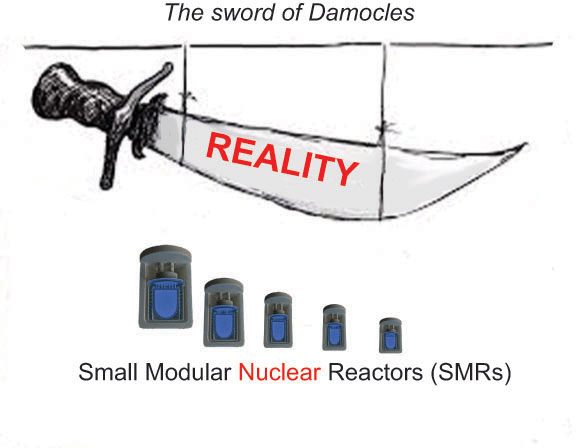
Realistic debate needed instead of new push for fast nuclear reactors https://www.asahi.com/ajw/articles/14534098
January 28, 2022 Japan has agreed to work with a U.S. company in technological cooperation to develop a sodium-cooled fast reactor.
People involved in the project stress that the new technology will contribute to the goal of a carbon-free society. But the government should not eschew reality-based debate on the future of existing nuclear power reactors.
The Japan Atomic Energy Agency, Mitsubishi Heavy Industries Ltd. and other Japanese entities will cooperate with TerraPower LLC’s project to build a fast reactor in the U.S. state of Wyoming.
Fast reactors are more resource efficient as they can burn types of nuclear fuel that cannot be used at conventional reactors.
TerraPower’s reactor will use liquid sodium as a cooling agent such as the Monju prototype fast-breeder reactor, which Japan decided to decommission after a series of accidents.
Japan can provide meaningful support to develop a new type of reactor and maintain related technology by offering what it has learned from its experiences including failures.
Japan has been promoting the concept of recycling separated plutonium back into fuel for nuclear power generation. Fast reactor technology to burn plutonium is at the core of this strategy.
But this program has suffered setbacks, including the decision to scrap Monju and a lack of progress in the government’s plan to burn so-called MOX (mixed oxide) fuel, which is usually plutonium blended with natural uranium, in conventional nuclear reactors.
The government also considered participating in France’s Advanced Sodium Technical Reactor for Industrial Demonstration (ASTRID) project to build a prototype sodium-cooled nuclear reactor.
But the idea was dropped after the French government decided to scale down the project.
The nuclear fuel recycling program, which has gone awry, should be abandoned. The participation in the TerraPower project should not allow the government to delay the decision on the program.
The technological cooperation with the United States has been touted as a way to “contribute to the achievement of carbon neutrality.”
However, it is unclear whether this will help Japan achieve its goal of net zero emissions of greenhouse gases by 2050.
TerraPower plans to start operating the new reactor in 2028. But this technology cannot be used immediately in Japan, which has been developing fast reactor technology for a different type of fuel.
The government’s road map for the development of fast reactor technology, determined in 2018, offers no clear time frame for practice use. It only said full-scale operation is expected “sometime in the late 21st century.”
The government has cited the development of next-generation reactor technology, such as small modular reactors and fast reactors, as an important factor for its clean energy and “zero carbon” policy efforts.
But it has failed to offer a clear vision for the future of existing nuclear reactors despite its massive reservoir of experience and expertise.
The government’s new Basic Energy Plan, unveiled last year, says nuclear power should account for 20 to 22 percent of the nation’s total electricity output in fiscal 2030. But the document did not refer to any specific measure to hit the target.
Neither Prime Minister Fumio Kishida nor members of his Cabinet have been eager to discuss this issue, apparently because of a reluctance to engage in debate on sticky issues concerning nuclear power.
Fast-breeder reactors, which can theoretically produce more fuel than they use, were once advertised as a source of “dream energy” for a resource-poor Japan.
Following the Monju debacle, the government started stressing that nuclear fuel recycling and fast reactor technology can help reduce high-level radioactive waste. Now, policymakers are singing the “carbon neutrality” theme.
The government should stop trying to obscure problems with its nuclear power policy by promoting a new technology without clear prospects for practical use under a new slogan.
Instead, it should launch a reality-based debate on existing nuclear reactors in line with its pledge to reduce the nation’s dependence on nuclear energy as much as possible.
NB Power and New Brunswick government gamble on untested, non existent ”small” nuclear reactors (SMRs)

While the world is turning overwhelmingly toward renewable sources of
energy, currently about four times cheaper than new nuclear plants and with
an established track record, NB Power and the New Brunswick government
insist on gambling on two new unproven nuclear plants, misleadingly termed
“small modular nuclear reactors” (SMNRs or SMRs).
SMRs do not exist at all in Canada except on paper or as computerized plans. There is no
guarantee these new untested reactors will ever succeed in producing
electricity in Canada in a safe and affordable manner.
But public utilities across the country are being pressured to generate power without emitting
greenhouse gases during operation. Instead of investing big bucks in
negawatts (energy efficiency) or renewables, four provinces are promoting
new nuclear plants – SMRs – as their best strategy for combatting
climate change. Since these plants are not likely to materialize for more
than a decade, if ever, the nuclear strategy is another way of “kicking
the can down the road.”
NB Media Co-op 27th Jan 2022
1 This Month
10 March A LIVE WEBINAR THE REAL EFFECTS OF NUCLEAR POWER
What the Industry Isn’t Telling Us
1:00 PM Mountain, 2 pm Central, 3 pm Eastern. Live on the Keepers of the Water Facebook page



18 March Webinar @ 1 PM EST: An Assessment of SMR Projects: The Case of Canada
register for the zoom:
https://us02web.zoom.us/webinar/register/WN_o8BIIOUvQ2ONJR1nta65DQ#/registration


of the week – STOP SMALL MODULAR REACTORS IN CANADA
To see nuclear-related stories in greater depth and intensity – go to https://nuclearinformation.wordpress.com
-
Archives
- March 2026 (109)
- February 2026 (268)
- January 2026 (308)
- December 2025 (358)
- November 2025 (359)
- October 2025 (376)
- September 2025 (258)
- August 2025 (319)
- July 2025 (230)
- June 2025 (348)
- May 2025 (261)
- April 2025 (305)
-
Categories
- 1
- 1 NUCLEAR ISSUES
- business and costs
- climate change
- culture and arts
- ENERGY
- environment
- health
- history
- indigenous issues
- Legal
- marketing of nuclear
- media
- opposition to nuclear
- PERSONAL STORIES
- politics
- politics international
- Religion and ethics
- safety
- secrets,lies and civil liberties
- spinbuster
- technology
- Uranium
- wastes
- weapons and war
- Women
- 2 WORLD
- ACTION
- AFRICA
- Atrocities
- AUSTRALIA
- Christina's notes
- Christina's themes
- culture and arts
- Events
- Fuk 2022
- Fuk 2023
- Fukushima 2017
- Fukushima 2018
- fukushima 2019
- Fukushima 2020
- Fukushima 2021
- general
- global warming
- Humour (God we need it)
- Nuclear
- RARE EARTHS
- Reference
- resources – print
- Resources -audiovicual
- Weekly Newsletter
- World
- World Nuclear
- YouTube
-
RSS
Entries RSS
Comments RSS
 nuclear-news