Lesson from Fukushima: Collusion in the nuclear domain
Nuclear power became an unstoppable force, immune to scrutiny by civil society. Its regulation was entrusted to the same government bureaucracy responsible for its promotion.”
Canada has not heeded these warnings. ……. The CNSC, mandated to protect the public and the environment, lobbied government to abolish full impact assessments for most “small modular nuclear reactors” (SMN
By Gordon Edwards & Susan O’Donnell | Opinion | March 13th 2023 https://www.nationalobserver.com/2023/03/13/opinion/lesson-fukushima-collusion-nuclear-domain
—
This month marks the 12th anniversary of the Fukushima disaster, when three nuclear reactors in Japan suffered catastrophic meltdowns.
A tsunami knocked out the reactors’ cooling systems. The plant was shut down, but radioactivity sent temperatures soaring past the melting point of steel.
Radioactive gases mingled with superheated steam and explosive hydrogen gas, which detonated, spreading radioactive contamination over a vast area; 120,000 people were evacuated and 30,000 are still unable to go home.
Radioactively contaminated water from the stricken reactors has accumulated in 1,000 gigantic steel tanks, and despite objections from China, Korea and local fishers, Japan plans to dump it into the Pacific Ocean soon.
What caused this catastrophe? Most people blame the tsunami. The commission of investigation in Japan concluded otherwise. In its report to the National Diet, the commission found the root cause was a lack of good governance.
The accident “was the result of collusion between the government, the regulators and TEPCO [the nuclear company], and the lack of governance by said parties. They effectively betrayed the nation’s right to be safe from nuclear accidents. Therefore, we conclude that the accident was clearly ‘man-made.’ We believe that the root causes were the organizational and regulatory systems that supported faulty rationales for decisions and actions…”
The commission chairman wrote: “What must be admitted — very painfully — is that this was a disaster ‘made in Japan.’ Its fundamental causes are to be found in the ingrained conventions of Japanese culture: our reflexive obedience; our reluctance to question authority; our devotion to ‘sticking with the program’; our groupism; and our insularity… Nuclear power became an unstoppable force, immune to scrutiny by civil society. Its regulation was entrusted to the same government bureaucracy responsible for its promotion.”
Canada has not heeded these warnings. After Justin Trudeau was elected in 2015, his government did away with environmental assessments for any new reactors below a certain size, thus eliminating scrutiny by civil society. This leaves all decision-making in the hands of the Canadian Nuclear Safety Commission (CNSC) — an agency previously identified by an expert review panel as a captured regulator.
The CNSC, mandated to protect the public and the environment, lobbied government to abolish full impact assessments for most “small modular nuclear reactors” (SMNRs).
Back in 2011, in the midst of the media frenzy about the triple meltdown, Canadians were testifying at federal environmental assessment hearings for up to four large nuclear reactors to be built by Ontario Power Generation (OPG) at Darlington, about 50 kilometres east of Toronto’s edge. The Fukushima disaster was cited repeatedly as a warning.
The panel approved OPG’s plan, but the Ontario government was thunderstruck by the price tag, reputed to be over $14 billion per unit, and cancelled the project.
Now OPG wants to build a smaller reactor at the Darlington site. Since a full impact assessment has been ruled out, CNSC is using the report from 12 years ago as the basis for public interventions. The reactor now proposed (the BWRX-300) has no similarity to any of the reactors that were under consideration then or to any operating today in Canada. Ironically, it is a “miniaturized” version of those that melted down at Fukushima.
CNSC is legally linked to the minister of Natural Resources, who is also tasked with promoting the nuclear industry at home and abroad. The International Atomic Energy Agency (IAEA) warns that regulators must be independent of any agency promoting the industry.
One day after Canada’s Infrastructure Bank gave OPG a $970-million “low-interest loan” to develop the BWRX-300 at Darlington, the minister boasted to a Washington audience that it would soon become Canada’s first commercial SMNR.
CNSC president Rumina Velshi lauded the speed at which the licensing is proceeding, saying that Canada would be the first western country to approve an SMNR built for the grid.
CNSC is at least two years from approving the reactor. Nevertheless, OPG held a ground-breaking ceremony at Darlington in December. The licence to construct seems a foregone conclusion. When asked, CNSC freely admitted that from the day of its inception, it has never refused to grant a licence for any major nuclear facility.
Government, regulator and industry are already on board. Collusion? Or just co-operation?
Gordon Edwards is president and co-founder of the Canadian Coalition for Nuclear Responsibility, a not-for-profit corporation established in 1975. He is a retired professor of mathematics and science at Vanier College in Montreal.
Susan O’Donnell is an adjunct professor at St. Thomas University and a member of the Coalition for Responsible Energy Development in New Brunswick.
Rolls-Royce Small Modular Reactor project running out of cash

3 March 2023 https://www.neimagazine.com/news/newsrolls-royce-smr-faces-financial-problems-10648145
UK-based Rolls-Royce SMR says its £500m ($600m) small modular reactor (SMR) programme will run out of cash by the end of 2024, Reuters has reported. Alastair Evans, Government & Corporate Affairs Director at Rolls-Royce SMR noted: “We aren’t asking the government to make an order (for the nuclear units) today but we need to start negotiations on a deployment plan by the middle of this year. We are facing a cliff edge, by December 2024 the money will have run out.” This would put at risk UK government plans to use SMRs to boost energy security and achieve climate targets.
The 470 MWe Rolls-Royce SMR design is based on a small pressurised water reactor. The design was accepted for Generic Design Assessment review in March 2022 and Rolls-Royce SMR expects to receive UK regulatory approval by mid-2024. A Rolls-Royce-led UK SMR consortium aims to build 16 SMRs. The consortium – which includes Assystem, Atkins, BAM Nuttall, Jacobs, Laing O’Rourke, National Nuclear Laboratory, the Nuclear Advanced Manufacturing Research Centre and TWI – expects to complete its first unit in the early 2030s and build up to 10 by 2035.
Rolls-Royce’s SMR development business received a commitment of £210m from the UK government in 2021 but talks on how the projects would be funded are yet to start. Rolls-Royce’s new CEO Tufan Erginbilgic said recently that there was a sense of urgency in its engagement with government. “We built a capable team (and) without any project, sustaining that team will be a big challenge,” he told reporters after the group published full-year results. He noted that it was vital to move quickly, given that rival companies were developing similar technology.
“It is important that we engage therefore with the UK government urgently, and for a project that we can deploy as soon as possible,” he said. Rolls Royce and shareholders in the SMR business – advisory firm BNF Resources Ltd, US Energy company Constellation and Qatar Investment Authority have invested a total of around £280m.
This and the government money have been used to build the business, which employs some 600 staff across Derby, Warrington and Manchester. The funds have enabled it to start the regulatory process to approve the reactor design and identify sites for plants and factories. In November 2022, Rolls-Royce identified four sites with the potential to deploy multiple SMR units: Trawsfynydd (requiring agreement with Nuclear Decommissioning Authority (NDA) – and the Welsh Government); Sellafield (NDA land availability to be confirmed); Wylfa-South (requiring agreement with Horizon Nuclear Power); and Oldbury-North (also requiring agreement with Horizon Nuclear Power).
Rolls-Royce hopes to build the reactors in UK factories. In July 2022, the company announced six potential locations for the factory, shortlisted from more than 100 submissions from local enterprise partnerships and development agencies. They were: Sunderland in Tyne and Wear, Richmond in North Yorkshire, Deeside in Wales, Ferrybridge in Yorkshire, Stallingborough in Lincolnshire and Carlisle in Cumbria. David White, newly appointed Chief Operating Officer of Rolls-Royce SMR, said another two locations – Shotton in Deeside (Wales) and Teesworks in Redcar (North East) – had been added to the list.
The Dream of NuScale Small Nuclear Reactors Hangs in the Balance

Wired, 27 Feb 23
A cluster of reactors that are just 9 feet in diameter is supposed to start a nuclear energy resurgence. Mounting costs may doom the project.
JORDAN GARCIA, A deputy utilities manager in Los Alamos, New Mexico, is facing an energy crunch that is typical in the American West. For decades, the county-run utility relied on a cheap and steady mix of coal and hydroelectric power. But the region’s dams are aging and drought-parched, and its coal plants are slated to retire.
The county is aiming to fully decarbonize its grid by 2040, and the city has been tapping more solar lately, but batteries are arriving slowly, and Garcia worries about heat waves that strain the grid after the sun goes down. Wind power? He’d take more of it. But there aren’t enough wires stretching from the state’s windy eastern plains to the mesa-top community. “For us it’s pretty dire,” he says.
For the past few years, Garcia has been counting on a unique nuclear experiment to come to the rescue. In 2017, Los Alamos signed up to join a group of other local utilities as an anchor customer of the first small modular reactors, or SMRs, in the US, created by a company called NuScale. The design, which calls for reactors only 9 feet in diameter, had never been built before, but the initial cluster planned in Idaho Falls, Idaho, was promised to be much cheaper than a full-scale reactor and to offer affordable carbon-free energy 24/7.
To Garcia, this felt like a homecoming. Los Alamos, a town with the motto “Where discoveries are made,” is the birthplace of the atom bomb, and experimental reactors ran not far from downtown for much of the 20th century. But it had never actually used nuclear power to keep the lights on.
This month, Los Alamos and other local utilities across the West were facing a weighty decision: whether to pull the plug on their nuclear dream. NuScale had informed members of the group, Utah Associated Municipal Power Systems, or UAMPS, that the estimated costs of building the six 77-MW reactors had risen by more than 50 percent to $9.3 billion. For Garcia, that translated into a jump in the cost of energy from $58 to $89 per megawatt-hour.
…………… Without extra subsidies from the new Inflation Reduction Act—on top of $1.4 billion already committed to the project by the US Department of Energy—the price to energy users in places like Los Alamos would have doubled.
…………. The project’s power output is only 20 percent subscribed, and UAMPS says it will need to reach 80 percent for planning and construction to proceed next year.

Many a “nuclear renaissance” has fizzled.
…………….. Only two [large nuclear] reactors are being built in the US: a pair of 1100-MW units at the Vogtle plant in Georgia, now seven years delayed and $20 billion over their $14 billion budget.
NuScale hopes its smaller reactors can avoid that fate……… Last month, the company was the first of dozens of companies working on SMRs to have a design approved by US regulators. That makes NuScale first in the race to leap from a “paper napkin” reactor, as critics sometimes deride SMRs, to a real one, though the Idaho project involves a revised design that will need its own approval.
The project has hit roadblocks before. It began with 36 utilities signed on, but that number has fluctuated and dropped to 27 last year. In 2020, several municipal utilities dropped out in response to a construction delay and cost increases. Some later rejoined the project after the US Department of Energy upped its commitment to offset some of the costs.
Critics say those price revisions are a sign SMRs are heading down the same path as projects like Vogtle. For nearly a century, the nuclear power industry’s mantra was that building bigger plants would drive down costs. While existing plants aged and new construction withered, SMR companies began promoting a different philosophy, says David Schlissel, an analyst at the Institute for Energy Economics and Fiscal Analysis, claiming that constructing many small reactors would teach builders how to make them more cheaply.
But the evidence for progress is flimsy, says Schlissel, who notes that his 50-year career has spanned many a “nuclear renaissance” that fizzled. When that philosophy was applied in France, where dozens of reactors were built in the 1980s, costs still increased. Claims that “modularity” will help make construction construction more efficient are also suspect, he adds. The new Vogtle reactors involved nearly 1,500 “modular” components that were largely constructed offsite.
Schlissel also believes that NuScale’s current estimates are rosy because they rely on the approval of its newer design that uses less steel, one of the materials driving the cost increases. But regulators may not back that approach, he says. Towns should get out while they can, he advises, before costs climb higher still, and seek out alternatives like geothermal and battery storage. “Let the buyer beware,” he says.
……………….. officials in Morgan, Utah, a small town in the Wasatch Mountains north of Salt Lake City, decided to make a quick exit from the project…….
This year, the city realized it had new alternatives to the rising costs of nuclear power. While the Inflation Reduction Act is expected to help offset the costs of the Idaho plant, it also includes funds to help rural communities start their own energy projects. Bailey wants the city to become more self-reliant, installing its own solar panels and batteries that reserve power overnight.
In this round, Morgan was the only defector, though another Utah city, Parowan, reduced its commitment from 3 MW to 2 MW—just enough to cover the loss of its coal power. But the new agreement with utilities, negotiated during a two-day meeting with UAMPS members this winter, sets the project under a ticking clock. It includes requirements that the price hold steady at $89 per megawatt-hour, and—most worrying to utilities that want the project to succeed—that the project be at least 80 percent subscribed by next year. If it doesn’t hit that threshold, towns will get a refund on most of their expenses so far.
At this point, the utilities have sunk relatively little of their own money into the project, but that will change in 2024 as the project begins to seek site-specific building approvals followed by actual construction. To get the project fully subscribed, the group is talking with utilities elsewhere in the Northwest, where NuScale is competing with other SMR startups, including the Bill Gates–backed TerraPower, which recently signed a feasibility agreement with PacifiCorp, a private utility. Webb of UAMPS says he is optimistic about where the negotiations are headed.
…………………….. For now, the Los Alamos county council voted to formalize a long-planned increase of their share of the NuScale plant’s power, from 1.8 MW to 8.6 MW. Garcia hopes it will help encourage other utilities to take a chance on sparking a nuclear renaissance. https://www.wired.com/story/the-dream-of-mini-nuclear-plants-hangs-in-the-balance/—
UK: big talk about small nuclear reactors, but not much is happening, really.
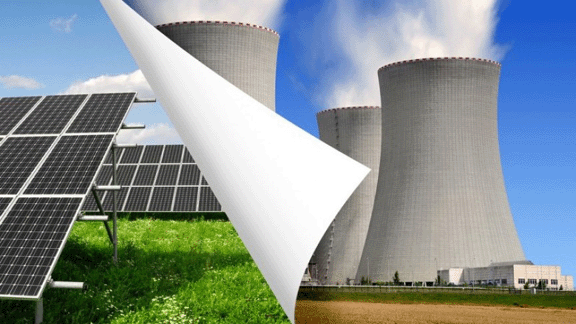
Over 3000GW of renewables are already in place globally, compared to only 394 GW of nuclear, with wind and solar now romping further ahead around the world. By 2050, the BNEF says the global power system will be dominated by wind and solar (75% of production), with nuclear at just 9%, down from 10% now. If it makes it to 24% nuclear by then, the UK will be a bit of an outlier.
“……………………………….Graham Stuart, now a Minister of State at the new Department for Energy Security and Net Zero…..- ‘what I can say is that we are absolutely committed to nuclear as a significant share of our electricity because we need that baseload and are committed to driving it forward.’
So that’s a positive ‘go’ signal, although funding is still a major problem, and, despite much talk, progress on the proposed ‘24 GW of nuclear by 2050’ programme seems to have slipped behind.
As NuClear News 141 reported, at the end of November last year, the Government was said to be about to announce proposals to set up a new body called Great British Nuclear (GBN), which would develop a network of small modular reactors (SMRs), as well as promote new large reactors. Grant Shapps, the Business Secretary, was due to make the announcement on 29th November. But it was delayed because of a row with the Treasury over funding.
And by January, The Times was reporting that a deal on SMR funding was unlikely to materialise for at least another 12 months. A senior government source said the Treasury would not sign off on any orders or significant funding for SMR work until the technology had approval from the Nuclear Regulators Generic Design Assessment, which was not expected, until 2024.
In addition to the proposed Rolls Royce SMRs, four of which are planned initially, several other SMRs are also now in the race for UK deployment, some from overseas. They include GE Hitachi’s 300MW boiling water reactor, and Holtec’s 160MWe pressurised water reactor, developed in collaboration with Mitsubishi and Hyundai. The USA’s NuScale, the most advanced project so far, has also expressed interest in UK sites for its mini PWR.
Potential UK sites for new SMRs include Trawsfynydd in Wales and Heysham and Oldbury in England, but, given the funding issues, it will evidently be a while before anything happens on SMRs, or indeed, in terms of new larger projects, after Sizewell C. Though some help with funding may yet be on hand. According to the Telegraph, nuclear projects may soon to be classed as ‘green’ or ’sustainable’ investments, clearing a way for more institutional investors and environment-focused funds to back them. The Telegraph says there are also hopes that use can be made of the Government’s green gilts green savings bonds.
Is nuclear really green? Not many greens think so, and given the risks, costs and delays associated with it, nuclear is often not popular with investors. There have been some delays with the only currently live new projects in the UK, the Hinkley Point C EPR being built by EdF, although nothing so far on the decade-long delays with the ongoing EPR projects in France and Finland. EDF now say the Hinkley EPR should start up in 2027. However, to be on the safe side, the deadline for starting up its major CfD payment (after which, under the contract rules, it would not be eligible for CfD payments) has been extended to 2036 from 2033.
…………………….. EDF has recently admitted that Hinkley Point C final cost is likely to be £31-32bn, up from the £18 bn estimated initially. Sizewell ought to benefit from construction lessons learned from Hinkley, but, although RAB pushes the financial risks onto consumers, there are still many investment uncertainties about the project.
Finance may be a key issue for EDF in the UK, but it is if anything even more of an issue for it in France, where it is facing major problems, with a huge repair bill and loss of income as plants are shut for safety checks and power has to be imported. As a result, with energy security being a key issue these days, nuclear no longer looks reliable. ………………………
With a handful of other nuclear projects being considered around the world, including some SMRs, and Russia and China also pressing ahead with larger plants, the UK isn’t the only country with ambitions for nuclear expansion. However, globally, the likely scale of nuclear expansion is relatively small in total, compared with the vast scale and rapid pace of renewables expansion.
Over 3000GW of renewables are already in place globally, compared to only 394 GW of nuclear, with wind and solar now romping further ahead around the world. By 2050, the BNEF says the global power system will be dominated by wind and solar (75% of production), with nuclear at just 9%, down from 10% now. If it makes it to 24% nuclear by then, the UK will be a bit of an outlier. https://renewextraweekly.blogspot.com/2023/02/uk-nuclear-news.html
Rolls Royce’s financial problems, as it plans to make small nuclear reactors for the British government.

Rolls is complex: it can’t seem to decide whether it has three, four, or
five divisions. It has its fingers in too many pies.
Among its many projects: it makes engines for luxury yachts. It provides back-up power to
solar farms in the Atacama desert. It has built an enormous new jet engine
called the UltraFan at a cost of hundreds of millions of pounds, without
knowing which model of plane might actually use it (Rolls insists the tech
developed for Ultra Fan is already finding its way into existing engines).
Oh, and it has an arm that wants to build small modular nuclear reactors
(SMRs) for the British government — tech derived from the reactors it
makes for the Royal Navy.
So much for the diagnosis, but what can
Erginbilgic do to heal the patient? This week he is expected to announce
restructuring — though not job cuts, yet — and a strategic review. This
may stop short of selling off divisions, but could see Rolls seek out more
partners.
Times 19th Feb 2023
Small modular nuclear reactors: a good deal for Southwest Virginia?

FEBRUARY 16, 2023 By Rees Shearer, https://www.virginiamercury.com/2023/02/16/small-modular-nuclear-reactors-a-good-deal-for-southwest-virginia/
In announcing his 2022 Virginia Energy Plan, Gov. Glenn Youngkin said, “A growing Virginia must have reliable, affordable and clean energy for Virginia’s families and businesses.” The governor’s plan to promote and subsidize small modular nuclear reactors (SMRs) in Southwest Virginia fails all three of the governor’s own criteria:
- SMRs can’t be reliable, when they cannot reliably be built and brought on line in a predictable and timely fashion.
- SMRs can’t be affordable, because nuclear power is close to the costliest of all forms of electric power generation.
- SMRs can’t be clean, since they produce extremely toxic high- and low-level nuclear waste, which has no safe storage or disposal solution.
Appalachia has long served as a sacrifice zone for rapacious energy ambitions of other regions. Southwest Virginians have had reason to hope that would change as opportunities for low-cost solar development emerged in recent years. Instead, politicians like Youngkin are making too-good-to-be-true promises about SMRs, sidelining opportunities to promote solar, which can produce power in a matter of weeks, not decades.
Imposing SMRs on Southwest Virginia is disturbing. My father worked for the Atomic Energy Commission in the 1950s. The promise the nuclear industry and the government touted then, “electricity, too cheap to meter,” has never been realized. Tennessee Valley Authority and other utilities abandoned nuclear plants under construction, leaving costly monuments to that folly and sticking electricity customers with the bill.
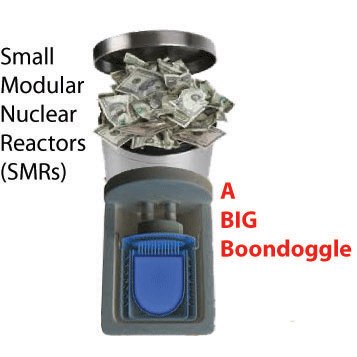
It’s not at all clear that SMR technology will succeed, or when. Levelized cost charts of electric power generation rate nuclear as among the very most expensive means to generate electric power at utility scale. If nuclear waste management, insurance and decommissioning costs are included, actual costs are far higher. (Some of these costs are already socialized for nuclear power, such as insurance in the Price-Anderson Act.)
The first commercial SMR is not expected to be completed until 2029, but already its developers have raised the target price of its power by 53%. This is not a surprise; nuclear power construction history documents an extremely strong correlation between new designs and cost increases and project delays. Indeed, the Lazard analysis shows that nuclear is the ONLY grid-wide generation source to increase in price between 2009 and 2021. The increase was 36%!

Nuclear waste and reprocessing are also serious concerns. Make no mistake, un-reprocessed nuclear waste, for all practicable purposes, is forever. The fact that we have become accustomed to risk does not, by any means, reduce risk. Nor will SMRs generate less waste than their larger forbears. Indeed, a recent Stanford University study concluded that “small modular reactors may produce a disproportionately larger amount of nuclear waste than bigger nuclear plants.”
Safeguarding this waste is already costing taxpayers and utility customers tens of billions of dollars. Since the United States has failed to designate a central storage facility, nuclear power plants are forced to continue to store the waste in pools on site.

Yet nuclear waste recycling, known as reprocessing, is no panacea. In November, the governor spoke in Bristol in support of recycling nuclear waste from SMRs: “I think the big steps out of the box are the technical capability to deploy in the next 10 years and on top of that to press forward to recycling opportunities for fuel.” He may have had in mind BWX Technologies of Lynchburg, which is beginning reprocessing of uranium at its Nuclear Fuel Services plant in Erwin, Tennessee, for nuclear weapons.

Transportation of SMR nuclear wastes along Virginia mountain roads or railroads across the border to Erwin presents further risk of accident and contamination. Longstanding concerns about transportation and security of nuclear wastes have never been adequately addressed.
Given these questions about cost, practicality and safety, the governor’s choice of SMRs as the cornerstone for future energy development in the coalfields of Southwest Virginia risks leaving residents here with nothing. This is especially worrisome as it pulls state support from proven, cheaper and more readily deployable solar and energy storage applications.
It also redirects government resources away from homegrown economic projects, like the New Economy Program, based on cleaning up and repurposing unrestored mine lands for a burgeoning utility solar energy industry, employing local residents and adding productive purpose to restored land and benefiting the tax base.
Counties across eastern and Piedmont Virginia are benefiting from a property tax bonanza flowing from utility-scale solar development. Coalfield counties are being told to ignore a sure solar bet and place their few economic development chips on a risky, unproven, costly, pie-in-the-sky energy prospect.
Why should SWVA be forced to endure the burden of risky and more costly electric energy, subsidized by the state to benefit powerful corporations, which seek to exploit our region and its people? Why indeed, while the rest of Virginia benefits economically from low-cost, safe solar energy?
This same shell game occurred when state mining regulation allowed mountaintops to be blown away and thousands of acres of forestland despoiled. Once again, government officials are choosing to make decisions that benefit the interests of corporations outside the region instead of the people who actually live here.
Coalition for Responsible Energy Development in New Brunswick (CRED-NB) informs Senate with analysis of “advanced” small nuclear reactors
On Feb. 14, our Coalition made our case against SMRs to the MLAs on the Climate Change and Environmental Stewardship committee of the Legislative Assembly of New Brunswick. Our presentation used the best scientific analysis to critique the “advanced” SMRs for development in New Brunswick. CRED-NB core member Susan O’Donnell presented on behalf of the Coalition. Our written presentation in English is HERE (and HERE in French). The video of the session is on YouTube, HERE. Check out the video to learn more about the SMR plans and what our elected representatives have to say about them.
There were 13 presentations over two days. Other presentations to watch for are, on Feb. 14: J.P. Sapinski, M.V. Ramana. On Feb. 15: Gordon Edwards, Chief Hugh Akagi + Chief Ron Tremblay + Kim Reeder, and Louise Comeau + Moe Quershi. Each has a one-hour time slot, with 20 minutes by presenters followed by 40 minutes of Q&A with the MLAs on the committee. The full schedule of presentations is HERE. The link to the video archive is HERE (scroll through or search to find the webcast archive from Feb. 14 and 15).
*on Thursday, the House of Commons Standing Committee on Science and Research released the report from the SMR study:
The link to the national report is here:
tiny pdf button top right of this page:
https://www.ourcommons.ca/DocumentViewer/en/44-1/SRSR/report-3/
The report recommends that the federal government pay half the development costs of SMRs
*Today the front page of the business section of New Brunswick’s Telegraph Journal has this story, attached:
Moltex wants $250 million in public funds (half its development costs)
Scotland’s Minister Matheson reassures the Nuclear Free Local Authorities (NFLA) that no small nuclear power station will be permitted near Grangemouth refinery.
The Scottish Nuclear Free Local Authorities have been reassured by a recent
reply from Scottish Government Net Zero Minister Michael Matheson that
Small Modular Reactors are not under consideration at the Grangemouth
refinery complex.
Following media speculation that INEOS was contemplating
co-locating an SMR next to its colossal refinery to power operations, the
Convenor of the Scottish NFLA, Councillor Paul Leinster, wrote to the
minister expressing grave concerns that the combination of a nuclear power
station next to the chemical refinery represents ‘a disaster
waiting-to-happen’.
Covering an area of 1,700 acres and with 2,000 staff,
INEOS’s own website describes Grangemouth as a ‘world-scale
petrochemicals plant’ which produces about 7 million tonnes of fuels, much
of which is used in Scotland, and 1.4 million tonnes of other products per
year. These products are synthetic ethanol, ethylene, propylene,
polyethylene and polypropylene used in the food packaging, construction,
automotive and pharmaceutical industries.
In his letter, Cllr Leinster
described an accident involving an SMR and the INEOS refinery as ‘a
monumental calumny for Scotland against which any Hollywood disaster movie
would pale by comparison’. To the NFLA, ‘it would be madness to partner a
nuclear power plant with Scotland’s biggest explosive chemical factory’.
In his response, dated 12 January, Michael Matheson was quick to reassure the
NFLA that Scottish Ministers ‘remain committed’ to their ‘long-standing
government policy to withhold support for any new nuclear power stations to
be built in Scotland’ and that officials have been advised by INEOS that
‘Small Modular Reactors do not currently form part of their net zero road
map for Grangemouth’.
NFLA 17th Feb 2023
Rolls Royce’s “small” nuclear reactor will occupy 5.3 acres.
The UK/Ireland Nuclear Free Local Authorities have today received a reply
from Rolls-Royce as to just how big their proposed ‘Small’ Modular
Reactor will be.
During last year’s World Cup, the NFLA’s then Chair,
Councillor David Blackburn, wrote to Tom Samson, Chief Executive Officer at
Rolls-Royce, to point out the general state of confusion amongst nuclear
activists, pro- and anti-, alike, with media reports claiming that an SMR
would occupy a surface area amounting to between ‘one and a half and ten
football pitches’ and asking for clarification.
Now Dan Gould, Head of Communications at Rolls-Royce SMR, has provided a final score – 5.3 acres –
an area ‘incorporating the entirety of the SMR unit’.
NFLA 16th Feb 2023
Some, but not all, First Nations support small nuclear reactors in New Brunswick

Moltex CEO says company has full support of all 15 First Nations in N.B. to develop SMRs
Jennifer Sweet · CBC News Feb 15, 2023
Companies trying to develop small modular nuclear reactors in New Brunswick are getting some support from an unlikely source.
An energy crisis is looming large, and SMRs have better potential than renewables in the short term, said Chief Terry Richardson of Pabineau First Nation, near Bathurst.
Richardson said he sees nuclear power as consistent with his cultural values.
“As First Nations, we are stewards of the land. Well, when we look at nuclear technology, it’s not a carbon emitter. So it’s not going to cause a problem. It’s going to actually solve the problem of carbon.
“If we don’t do something, we all know what’s happening with climate change.”
Pabineau has signed memoranda of understanding to work with two companies that have SMR projects under way at Point Lepreau — Moltex and ARC, said Richardson.
He describes the MOUs as “non-contractual, binding documents” that state a willingness to work together on development.
Details of exactly how his community and potentially other First Nations in the province may take part in SMR projects have yet to be negotiated, said Richardson.
“There’s going to be an opportunity to be involved on the equity side and that’s where we have to sit down and talk and discuss it and see where we’re going to go.”
After the initial development at Lepreau, ARC is talking about installing more SMRs in Belledune, Richardson noted, which could mean job opportunities in northern New Brunswick.
He also likes that Moltex is looking at reusing spent fuel rods, which it says would reduce the amount of toxic nuclear waste that already exists.
Study looks at SMR waste
A Canadian peer-reviewed study that came out last summer found the volume of waste from SMRs would be between double and 30 fold that from a typical reactor and that its chemical complexity would make it more difficult to manage.
Richardson said he is satisfied that plans are in place to deal with nuclear waste and added that maybe in the future there will be a way to recycle it…..
Moltex CEO Rory O’Sullivan told the legislative committee Wednesday that his company has the support of all 15 First Nations in the province to develop SMRs.
However, some other Indigenous leaders addressed the committee who have concerns about the SMR plans and the public investment in development.
Chief Hugh Akagi represents the Peskotomuhkati Nation at Skutik, which doesn’t have official recognition as a First Nation in Canada. https://www.cbc.ca/news/canada/new-brunswick/first-nations-small-modular-nuclear-reactors-1.6749808
GE Hitachi group announce contract for grid-scale small nuclear reactor, requiring large taxpayer subsidy .

GE Hitachi and 3 partners announce first commercial contract for grid-scale SMR in North America.Utility Dive 30 Jan 23
Dive Brief:
- An energy and construction partnership announced Friday an agreement to build what it says will be the first grid-scale small modular reactor in North America. Terms were not disclosed.
- GE Hitachi Nuclear Energy, Ontario Power Generation, SNC-Lavalin and Aecon Group signed a contract to deploy a BWRX-300 small modular reactor at OPG’s Darlington New Nuclear Project site in Clarington, Ontario.
…………………………………….. Critics say SMRs, which are advanced nuclear reactors with a power capacity of up to 300 MW(e), according to the International Atomic Energy Agency, are financially feasible only because of large taxpayer subsidies. Detractors also say solar and wind power, which do not produce waste, can be deployed more quickly than SMRs. https://www.utilitydive.com/news/SMRs-reactor-GE-Hitachi-Ontario-Public-Power-Aecon-Group-nuclear/641483/
As SMR developer X-energy moves to go public, merger partner Ares cautions investors about risks
Utility Dive Stephen Singer, Editor, Jan. 27, 2023
Dive Brief:
- The partner in a merger with a small modular nuclear reactor developer going public has cautioned investors that changing markets and a “limited operating history” may ultimately be unfavorable to the business.
Ares Acquisition Corp., a special purpose acquisition company, warned in an S-4 filing with the U.S. Securities and Exchange Commission Wednesday of “limited operating experience for reactors of this type, configuration and scale” that could lead to higher than expected construction costs, maintenance requirements, operating expenses or changes in the timing of delivery. X Energy Reactor Co. announced the merger in December.- The market for SMRs generating electric power and high-temperature heat is not yet established and “may not achieve the growth potential we expect or may grow more slowly than expected,” Ares said. It’s backed by private equity firm Ares Management Corp.
Dive Insight:
The S-4 filing, which provides a preliminary proxy statement and spells out details of the renamed X-Energy business and market risks, provides boilerplate cautions to investors who require transparency and discussion of as many potential risks as possible. It highlights challenges in a still-emerging industry. The U.S. Nuclear Regulatory Commission on Jan. 19 certified NuScale Power’s SMR design, the first of its type to win federal approval………………………………
Ares said the market for SMRs, and particularly for SMRs using advanced nuclear technologies such as those employed in the Xe-100 — an 80 MWe reactor that can be scaled into a ‘four-pack’ 320 MWe power plant — has not yet been established. SMRs using advanced nuclear technologies have not been proven at scale, it said……………………..
Ares also warned that it may not attract customers for its SMR technology — a “relatively new and unproven technology” — as quickly as it expects, “or at all,” and acquiring customers may be more expensive than it currently anticipates.
In addition, Ares said the time and funding needed to bring X-energy’s nuclear fuel, TRISO-X, to market at scale may “greatly exceed” expectations………………….
Critics of SMRs have raised issues nearly identical to what Ares cited, calling out the reactors over the projected cost and time needed for siting and other approvals.
“Small modular reactors may be viable one day, but they are not today, will not be tomorrow and may never make as much economic sense as renewable sources of electricity,” the Institute for Energy Economics and Financial Analysis says. “We should stick to carbon-free energy sources that make financial and environmental sense.”………. more https://www.utilitydive.com/news/ares-acquisition-x-energy-smr-sec-investor-warning/641337/
Rolls Royce wants to make sure that the tax-payer cops the cost of their small nuclear reactor folly

Rolls-Royce calls on government for more clarity on nuclear. https://www.energylivenews.com/2023/01/26/rolls-royce-calls-on-government-for-more-clarity-on-nuclear/
Executives of the engineering giant have cited Britishvolt as an example of a company which committed to a factory without having orders.
Dimitris Mavrokefalidis
Rolls-Royce has urged the government to provide more clear vision of its target to roll out 24GW of nuclear power generation by 2050.
During a session at the House of Commons Welsh Affairs Committee, asked when Rolls-Royce will start the process of building its first Small Modular Reactor factory, Alastair Evans, Director of Corporate and Government Affairs at Rolls-Royce SMR, said: “If you look at the Britishvolt example, that is an example of a company that committed to a factory without orders. We don’t have clarity on orders in the UK.
“So, as soon as we have that clarity that the UK Government wants to deploy Rolls-Royce SMRs, we will be able to get the first factory moving, but our shareholders need that clarity. Britishvolt is a very good example of where you try and run a business and build a factory and get things moving without that certainty, orders and customers.”
A few days ago, company representatives visited the first four sites which have the potential to host 15GW of new nuclear power capacity.
Mr Evans confirmed that once Rolls-Royce receives the green light from the government, then the whole process around the development of its first SMR facility will accelerate.
He said: “That was the purpose of doing our planning processes, getting the selection of our heavy pressure vessel sites – we’ve got 600 people in the Rolls-Royce SMR business today. So we are set up to deliver at pace. We are 600 UK-based workers looking at manufacturing, assembly, lead skills, and module concept. We are ready to go.”
Former DEA Nuclear Security Official Says Wyoming Reactor Not Safe

the sodium reactor planned for Kemmerer has a high degree of potential for explosive accidents and proliferation of nuclear weapons material.
Sodium reacts with water and air, which Tallen said poses a huge risk for accidents.
Cowboy State Daily, By Kevin Killough, State Energy Reporter
Kevin@CowboyStateDaily.com January 25, 2023January 25, 2023
When TerraPower and PacifiCorp announced in November 2021 that they had selected Kemmerer as the location of its Natrium reactor demonstration project, many welcomed the opportunity as a path to a diverse energy economy for Wyoming.
In the next few months, TerraPower plans to break ground on a sodium testing project for the larger demonstration project. If the reactor design is proven, it would provide lots of carbon-free energy and provide a viable replacement for retiring coal plants in the state, TerraPower said.
Wapiti resident Bill Tallen had a 20-year career with the Department of Energy that was focused on the threat posed by terrorists who sought ways to create improvised nuclear devices.
Tallen argues that the sodium reactor planned for Kemmerer has a high degree of potential for explosive accidents and proliferation of nuclear weapons material. Henry Sokoloski, executive director of the Nonproliferation Policy Education Center (NPEC), which is based in Washington D.C., has a lot of the same concerns.
Jeff Navin, director of external affairs with TerraPower, says these concerns have been considered and addressed as much as reasonably possible in the project’s design and development.
Not Opposed To Nuclear
Tallen said he’s not ideologically opposed to nuclear power. He said he rubbed elbows with that crowd years ago, but it’s not where he stands today.
“The distrust of nuclear power is one of the major ideological tenets of left-wing, anti-establishment politics,” Tallen said. “I had to say to them, I can’t agree with you on many of your basic assumptions. I’m just saying that this particular [Natrium] technology pursued the way it is right now – I don’t think it’s a good idea.”
Reaction Risk
The Natrium reactor being built in Kemmerer uses sodium instead of water as a heat sink for the reactor core. That heat will then be transferred to water, which will produce steam to turn turbines.
Sodium reacts with water and air, which Tallen said poses a huge risk for accidents.
“There’s never been a sodium reactor that has actually met its promises. They’ve all had leaks and fires and explosions and toxic releases,” Tallen said. “Granted, in America we haven’t had big problems, but the past is not always prologue. The risk is still there.” ……………………
Plutonium And Proliferation
Sokolski with NPEC said these reactors produce plutonium during the fission process.
“The plutonium produced in these machines isn’t just weapons usable. It isn’t even weapons grade. It’s super weapons grade,” Sokolski said.
The Natrium reactors run on high-assay low-enriched uranium, known commonly as HALEU. It’s currently produced only in Russia, and due to the invasion of Ukraine, supplies of the material are scarce. This has led to a delay in the Kemmerer project.
Tallen said that as these reactors grow and more HALEU is produced, it’s just inviting a nation like Iran to find sources of the material, which can be enriched to weapons-grade with the right facilities.
“These are parties that do in fact have, or can construct, enrichment capabilities and will not be concerned by U.S. export restrictions,” Tallen said. ……………………….. https://cowboystatedaily.com/2023/01/25/former-dea-nuclear-security-official-says-wyoming-reactor-not-safe/
Canadian MP Charlie Angus Questions the Claims of SMRs (Small Modular Reactors)
Proponents of SMRs are on a major spin campaign. None of them have been approved for licensing. The Toronto Star calls them a “boutique boondoggle”. The IPCC raises serious questions about the dangers of nuclear proliferation. Chris Keefer is their big proponent. Here is the exchange at the Natural Resources Committee.
“Proponents of SMRs are on a major spin campaign. None of them have
been approved for licensing. The Toronto Star calls them a “boutique
boondoggle”. The IPCC raises serious questions about the dangers of
nuclear proliferation.”
1 This Month
10 March A LIVE WEBINAR THE REAL EFFECTS OF NUCLEAR POWER
What the Industry Isn’t Telling Us
1:00 PM Mountain, 2 pm Central, 3 pm Eastern. Live on the Keepers of the Water Facebook page



18 March Webinar @ 1 PM EST: An Assessment of SMR Projects: The Case of Canada
register for the zoom:
https://us02web.zoom.us/webinar/register/WN_o8BIIOUvQ2ONJR1nta65DQ#/registration


of the week – STOP SMALL MODULAR REACTORS IN CANADA
To see nuclear-related stories in greater depth and intensity – go to https://nuclearinformation.wordpress.com
-
Archives
- March 2026 (109)
- February 2026 (268)
- January 2026 (308)
- December 2025 (358)
- November 2025 (359)
- October 2025 (376)
- September 2025 (258)
- August 2025 (319)
- July 2025 (230)
- June 2025 (348)
- May 2025 (261)
- April 2025 (305)
-
Categories
- 1
- 1 NUCLEAR ISSUES
- business and costs
- climate change
- culture and arts
- ENERGY
- environment
- health
- history
- indigenous issues
- Legal
- marketing of nuclear
- media
- opposition to nuclear
- PERSONAL STORIES
- politics
- politics international
- Religion and ethics
- safety
- secrets,lies and civil liberties
- spinbuster
- technology
- Uranium
- wastes
- weapons and war
- Women
- 2 WORLD
- ACTION
- AFRICA
- Atrocities
- AUSTRALIA
- Christina's notes
- Christina's themes
- culture and arts
- Events
- Fuk 2022
- Fuk 2023
- Fukushima 2017
- Fukushima 2018
- fukushima 2019
- Fukushima 2020
- Fukushima 2021
- general
- global warming
- Humour (God we need it)
- Nuclear
- RARE EARTHS
- Reference
- resources – print
- Resources -audiovicual
- Weekly Newsletter
- World
- World Nuclear
- YouTube
-
RSS
Entries RSS
Comments RSS
 nuclear-news