University of New Hampshire researchers recently concluded there’s at least 30 percent more dangerous radiation in our solar system than previously thought, which could pose a significant risk to both humans and satellites who venture there.
In their study, published Feb. 22 in the journal Space Weather, the researchers found that astronauts could experience radiation sickness or possibly more serious long-term health effects, including cancer and damage to the heart, brain, and central nervous system, said Nathan Schwadron, a space plasma physics professor at UNH and lead author of the study.
“Both concerns are very serious, but what we’re seeing in deep space is that over time, radiation seems to be getting worse,” Schwadron said.
Why is it getting worse? The sun’s activity has been low, the lowest it’s ever been during the Space Age, which began in 1957 with the launching of Sputnik, the world’s first satellite.
That’s bad because an active sun intensifies the sun’s magnetic field, which shields our solar system from cosmic rays, the university said in a statement.
“When we started sending human beings to the moon in the late 50s, the solar activity cycles were fairly strong, so the number of cosmic rays were lower,” Schwadron said. “But now the cosmic rays number is going up.”
Scientists expect the solar activity levels to vary, but they don’t know why the current activity is so weak, he said.
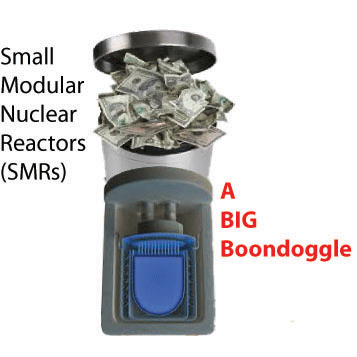
Interest in Small Modular Nuclear Reactors Is Growing. So Are Fears They Aren’t Viable
SMRs are the future of nuclear. Will they always be the future? Greentech Media JASON DEIGNMARCH 14, 2018
The slow-moving small modular reactor (SMR) market saw some positive activity in recent weeks, even as one expert predicted the technology would never achieve commercialization.
Earlier this month, the World Nuclear Association reported that Ukraine had signed a memorandum of understanding with SMR developer Holtec International, aiming to turn the Eastern European nation into a manufacturing hub for Holtec’s SMR-160 reactors.
The Association said Holtec is planning a Ukrainian manufacturing plant to allow for partial localization of its 160-megawatt SMRs, so Ukraine’s nuclear operator Energoatom can use the design to replace two aging Russian VVER-440 reactors at its Rivne nuclear power plant.
The news came a week after the government of Canada announced a road-mapping exercise to explore the potential of SMRs in the country.
“The road map will be an important step in positioning Canada to advance next-generation technologies and become a global leader in the emerging SMR market,” said Natural Resources Canada, a federal institution.
This was welcome news for a technology that has been slow to achieve commercialization — and which some believe might never take off.
In the December 2017 edition of the National University of Singapore’s Energy Studies Institute Bulletin, for example, Canadian academic Professor M.V. Ramana provided a detailed argument for why SMRs could never be a viable technology. Nuclear plants in general require high levels of capital, he noted, and high construction costs mean the electricity they provide ends up being more expensive than coal, gas and, more recently, wind and solar.
SMRs may be able to overcome the first problem, said Ramana, who is a professor at the University of British Columbia’s School of Public Policy and Global Affairs.
But SMRs could end up with even higher energy costs because the smaller reactors can’t take advantage of economies of scale unless they’re manufactured “by the thousands, even under very optimistic assumptions about rates of learning.”
Experience indicates such rates of learning may be rare in the nuclear industry. In France and the U.S., according to Ramana, reactor construction costs have historically risen rather than falling.
Also, mass production would need the industry to settle on a single SMR design. As of 2016 there were 48 listed by the International Atomic Energy Agency.
Finally, said Ramana, for all the interest in SMRs, no country has yet got behind the technology enough for it to be commercialized. This likely indicates demand for the reactors is not as solid as proponents imagine.
“SMRs seem appealing to many countries at first sight,” Ramana told GTM. “But once they get into the actual nitty gritty of planning an SMR project, they realize that there are numerous problems.
One of the cliches of nuclear power research is that a commercial fusion reactor is only ever a few decades away – and always will be. So claims that the technology is on the “brink of being realised” by scientists at the Massachusetts Institute of Technology and a private company should be viewed sceptically.
The MIT-led team say they have the “science, speed and scale” for a viable fusion reactor and believe it could be up and running within 15 years, just in time to combat climate change. [?] The MIT scientists are all serious people and perhaps they are within spitting distance of one of science’s holy grails. But no one should hold their breath.
Fusion technology promises an inexhaustible supply of clean, safe power. If it all sounds too good to be true, that’s because it is. For decades scientists struggled to recreate a working sun in their laboratories – little surprise perhaps as they were attempting to fuse atomic nuclei in a superheated soup. Commercial fusion remains a dream. Yet in recent years the impossible became merely improbable and then, it felt almost overnight, technically feasible. For the last decade there has been a flurry of interest –and not a little incredulity –about claims, often made by companies backed by billionaires and run by bold physicists, that market-ready fusion reactors were just around the corner.
There are reasons to want to believe that fusion will one day be powering our lives. The main fuel is a heavy isotope of hydrogen called deuterium which can be extracted from water and therefore is in limitless supply – unlike the uraniumused in nuclear fission reactors. But fusion’s science is tricky and the breakthroughs rare. So far there has been no nuclear fusion reaction that has been triggered, continued and self-sustained. Neither has the plasma soup that exists at temperatures found in the stars been magnetically contained. Nor has any research group sparked a fusion reaction that has released more energy than it consumed, one of the main attractions of the technology. Perhaps the most successful fusion reactor has been the JET experiment, so far Europe’s largest fusion device, which ended up in the UK after the SAS stormed a hijacked German airliner in 1977 and Bonn backed the then prime minister Jim Callaghan’s request to host it. JET hasn’t even managed to break even, energy-wise. Its best ever result, in 1997, remains the gold standard for fusion power – but it achieved just 16 MW of output for 25 MW of input.
Hopes for fusion now rest with the International Thermonuclear Experimental Reactor (Iter), a multi-national $20bn effort in France to show that the science can be made to work. Within a decade Iter aims to control a hydrogen bomb-sized atomic reaction for a few minutes. It is a vast undertaking. At its heart is a doughnut-shaped device known as a tokamak that weighs as much as three Eiffel towers. Iter’s size raises a question of how large a “carbon footprint” the site will leave. Like JET, Iter uses a fusion fuel which is a 50-50 mixture of deuterium and a rare hydrogen isotope known as tritium. To make Iter self-sustaining it will have to prove that tritium can be “bred”, a not inconsiderable feat. Iter will also test how “clean” a technology fusion really is. About 80% of a fusion reaction’s energy is released as subatomic particles known as neutrons, which will smash into the exposed reactor components and leave tonnes of radioactive waste. Just how much will be crucial in assessing whether fusion is a dirty process or not.
Iter’s worth is that it is a facility in the real world, where fusion’s promise can be tested. If it turns out to be better than expected then private investment is going to be needed to commercialise a fusion reactor. If it falls short then there must be a realistic rethink of fusion’s potential. After all, the money that has been poured into it could have been spent on cheap solar technology which would allow humanity to be powered by a fusion reactor that’s 150m kilometres away, called the sun.
MIT Receives Millions to Build Fusion Power Plant Within 15 Years https://gizmodo.com/mit-receives-millions-to-build-fusion-power-plant-withi-1823644634?IR=T Ryan F. Mandelbaum 10 Mar 18 Nuclear fusion is like a way-more-efficient version of solar power—except instead of harnessing energy from the rays of a distant sun, scientists create miniature suns in power plants here on Earth. It would be vastly more efficient, and more importantly, much cleaner, than current methods of energy production. The main issue is that actually realizing fusion power has been really difficult.
But MIT has announced yesterday that it is working with a new private company called Commonwealth Fusion Systems (CFS) to make nuclear fusion finally happen. CFS recently attracted a $50 million investment from the Italian energy company Eni, which it will use to fund the development.
The goal? “The 15-year timeline is to get a device that puts 200 megawatts on the grid,” CFS CEO and MIT grad Robert Mumgaard told Gizmodo. “That’s a small city.”
Nuclear fusion is the process by which two hydrogen atoms are fused together into helium. This process results in the release of lots of energy. Scientists have been chasing fusion for a long time, perhaps since the 1950s. But there have been technological roadblocks, mainly making a device that outputs more energy than it takes to run. Another fusion device under construction in Europe called ITER, for example, should be ready by 2035 but is far over budget. The US Senate has attempted to pull out of the project, reports Nature.
MIT’s “tokamak” fusion reactor seems to promise much cheaper fusion power. It relies on a non-traditional, higher-temperature superconductor called ytterbium-barium-copper-oxide, a kind of cuprate, to allow electricity to flow efficiently without resistance. These produce strong magnetic fields and high pressures in plasma that confine the fusion reactions inside of the device. The sun confines its own reactions with its immense gravity.
The MIT group has been researching the device for a few years. This infusion of capital should allow them to build magnets four times stronger in the next three years. The planned device, called Sparc, will be a 65th of ITER’s size but release a fifth the power, according to an email sent by MIT’s press office.
Of course, there are challenges. Martin Greenwald, deputy director of MIT’s Plasma Science and Fusion Center, told Gizmodo that they have yet to actually develop these magnets and integrate them into such a machine. They will also need to learn how to build and operate the device, and bring it to a position that it can actually enter the market.
It’s important to note that fusion is way different from fission, the process that powers current nuclear power plants. Fusion can’t cause an explosive runaway chain reaction without some sort of fissile material, and rather than using uranium like fission does, it’s water and lithium in, helium out. This also cuts down on nuclear weapons risks. “There’s no reason to have fissile materials around fusion plants,” said Greenwald. “If you do, you’re up to no good.”
Some, like the folks at the Bulletin of the Atomic Scientists, still worry that the excess neutrons produced in fusion could lead to radioactive waste or contaminants, as well as high costs.
Nature points out that there are plenty others are in the fusion-with-high-temperature-superconductors game, too. Princeton has its own tokamak, and there’s a British company called Tokamak Energy using a similar device to produce fusion energy. But all of the cash towards the MIT effort is significant.
“If MIT can do what they are saying—and I have no reason to think that they can’t — this is a major step forward,” Stephen Dean, head of Fusion Power Associates, in Maryland, told Nature. Perhaps all fusion power needed to become reality was, well, a lot of money. Mumgaard said that CFS’ collaboration with MIT will “provide the speed to take what’s happening in the lab and bring it to the market.”
Reforging its core business to return to competitiveness after record losses of €4.83 billion in 2014, French nuclear firm AREVA has split its five operational business units and rebranded them—again. All its assets related to the design and manufacture of nuclear reactors and equipment, fuel design and supply, and services to existing reactors now fall under Framatome, which until January 4 was known as New NP. Operations related to the nuclear fuel cycle will be undertaken by Orano, which until January 23 was known as NewCo.
Creation of the AREVA group itself was an overhaul effort. The company was formed in 2001 with the merger of Framatome, Cogema, a nuclear business of German giant Siemens, and French propulsion and research reactor arm Technicatome. Framatome—short for Franco-Américaine de Constructions Atomiques—was created in 1958 by Schneider, Merlin Gerin, and Westinghouse Electric to exploit the emerging pressurized water reactor (PWR) market.
. By 1975, the company had become the sole manufacturer of nuclear power plants in France, equipping French state-owned utility EDF with 58 PWRs, and gradually taking on more projects overseas, building reactors like South Africa’s Koeberg, South Korea’s Ulchin, and China’s Daya Bay and Ling-Ao. In 1989, Framatome and Siemens created a joint company called Nuclear Power International to develop the EPR, a third-generation reactor that complied with both French and German nuclear regulations. The companies eventually merged in 2001, retiring the Framatome name and giving birth to AREVA.
One of the company’s most prominent contract wins came in 2003 from Finnish utility Teollisuuden Voima Oy (TVO) for construction of the world’s first EPR, Olkiluoto 3, in southern Finland. In 2007, AREVA also signed a contract with EDF for an EPR in Flamanville, France, and separately with Taishan Nuclear Power Co., a joint venture 70% held by China Guangdong Nuclear Power Holding Corp. and 30% by EDF. Two years later, Siemens withdrew its capital in Areva NP—AREVA’s specialized nuclear steam supply system arm—citing a “lack of exercising entrepreneurial influence within the joint venture” as the reason behind the move, and transferred its 34% stake to the AREVA group.
But plagued by delays and cost overruns at Olkiluoto 3 (Figure 3) and Flamanville 3, as well as at a research reactor construction project, and financially hemorrhaging from renewable energy contracts, AREVA’s finances began to fall into disarray, reaching record losses in 2014. In 2015, EDF moved to snap up between 51% and 75% of the troubled nuclear giant’s reactor business, encouraged by the French government’s attempts to address a rivalry between the two majority state-owned companies.
In November 2016, AREVA and EDF signed a contract conferring to EDF exclusive control of a new entity—New NP—that oversaw AREVA’s reactor design and equipment manufacturing, fuel design and assemblies manufacturing, and reactor services. Closure of the sale was completed in December 2017, and EDF became the majority owner (holding 75.5% of shares) of New NP, while Mitsubishi Heavy Industries took on 19.5%, and Paris-based international engineering firm Assystem held 5%.
Then in January 2018, the companies rebranded New NP, reviving the Framatome name in a move to harken to its celebrated legacy. Staffed by 14,000 employees worldwide, Framatome today has an “existing global fleet of some 440 reactors representing output of around 390 GWe in 31 countries, and with new nuclear capacity on its way, the nuclear market presents opportunities in the areas of components, fuel, retrofits and services,” the company noted in January.
The name’s luster has this year already been burnished by two significant developments for the company. On January 25, the French Nuclear Safety Authority (Autorité de Sûreté Nucléaire [ASN]) gave Framatome and EDF the green light to resume manufacture of forgings for the French nuclear fleet at its 2006-purchased Le Creusot site (Figure 4), which was taken offline following the French regulator’s 2015 discovery of an anomaly in the composition in certain zones of the Flamanville EPR pressure vessel head and bottom head. In 2016, a quality audit identified “irregularities” in paperwork on nearly 400 plant components produced at the forge since 1965. Preventative measures ordered by ASN stemming from that debacle in December 2016 shut down more than half of France’s reactor fleet, sending contract prices across Europe soaring.
Also, on January 25, Framatome finalized and launched Enfission, a 50-50 joint venture with Lightbridge Corp., to commercialize the U.S. fuel technology developer’s metallic fuel. Lightbridge says that the “seed-and-blanket” design can safely operate at increased power density compared to standard uranium oxide fuel. For Framatome, which provides next-generation fuel assembly designs to more than 100 of about 260 light water reactors around the world, the partnership will strengthen its position in the global fuel market.
As part of restructuring efforts in June 2016, meanwhile, AREVA also created a separate company focused on the nuclear cycle, which it called, simply, “New Company” (NewCo). On January 23, that company was renamed “Orano.” The name is derived from Ouranos, a Greek god who personifies the heavens and was father of the Titans, and who in Roman mythology became “Uranus.” In 1789, German chemist and mineralogist Martin Heinrich Klaproth named his newly discovered rare metallic element “uranium” for the planet Uranus, which had also been recently found.
For Orano, the name is important because it “symbolizes a new start,” said CEO Philippe Knoche in January. “We have big ambitions for Orano, namely for it to become the leader in the production and recycling of nuclear materials, waste management, and dismantling within the next ten years.” Knoche also said, however, that the company’s name is written in lower case because the prospect of rebuilding a profitable operation will be done “with humility.” For now, the company’s operations will bank on reprocessing and nuclear growth in Asia rather than investing in new mines, owing to low prices of uranium, which have slipped 80% over the last decade as the nuclear sector sees a general slowdown.
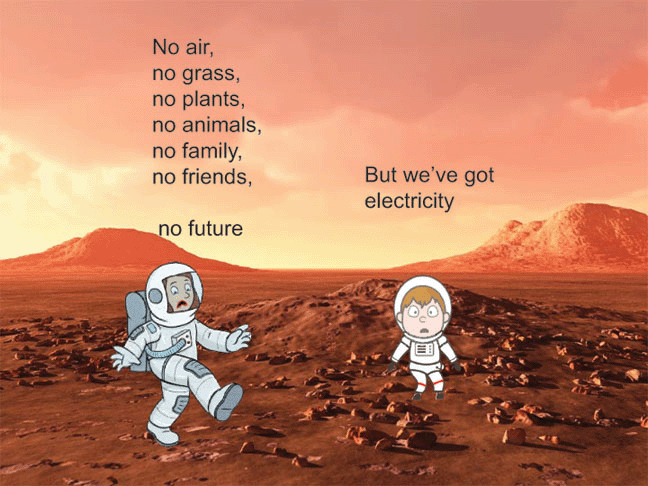
Kilowatt nuclear reactor could play role in powering manned missions on Mars, Las Vegas Now Patrick Walker Feb 26, 2018 “…….As humans prepare to venture out farther into the final frontier, the name of the game is nuclear fission.
“We had to show NASA that we could do this affordably within a schedule that’s reasonable for them, and that’s the whole basis of this project,” Dr. Poston said.
Dr. Poston is the chief designer of a kilowatt nuclear reactor……..
Some members of the Board of Public Utilities voiced doubt about a possible investment in a small-scale nuclear power project Wednesday during a meeting with the Department of Public Utilities.
The meeting was a preview of a joint public meeting the board will have about the project with the County Council at 6 p.m. March 6 at the county Municipal Building.
The board was expecting answers about what the risk would be to the county if the project went sour.
The project is proposed and designed by Nuscale and consists of 12 50-megawatt light water, nuclear reactor modules. The units would be installed in Idaho.
The Board of Public Utilities is expected make a decision about whether to invest $500,000 in the project in late March.
BPU member Stephen McLin wanted to know why they haven’t given them more definite answers, since the initial Jan. 25 meeting explaining the project.
“These cost commitments that we’re about ready to make… I think that the board members, I can’t really speak for them, but I think we had it in our mind that we were going to be voting on about $500,000 commitment for the next six months or so, and that was going to keep us in a kind of holding pattern until other costs could be fleshed out,” McLin said. “I’m really starting to question the wisdom of making even that investment based on tonight’s performance, these questions have not even been summarized. Why not?”
Deputy Manager Steve Cummins replied they were aiming for the Board of Public Utilities March 6 meeting.
“We are working very diligently, everybody is, for the March 6 meeting. As I mentioned during our introduction, one of the biggest concerns we heard was about cost, exposure and things like that to the county. So, we put a lot of time in the last couple of weeks on the resolution I talked about that’s going to be now made into a contract. Actually, we’re pretty happy about that. We see it as a huge step in the right direction,” Cummins said.
McLin then asked what happens to the county’s financial risk while it waits for the project to be approved by the Nuclear Regulatory Commission. He said he would like to see those numbers at the March 6 meeting.
“The track record is very ugly… 12- to 15-year timelines from the license submission to approval,” Mclin said. “In my mind, I’m calling it the second step for the county. What kind of commitment are we making as we submit that application. I think that’s what got a lot of people concerned. It would be helpful to see a lot of these costs and options laid out. To see them in black and white would be very helpful.”
Board of Public Utilities member Kathleen Taylor feared cost overruns on the project would drive up the costs of the construction, which would then affect the rate they pay for the power from the plant, which is expected to be between $45 and $65 per kilowatt hour.
“I want to see cost overruns and what caused them,” Taylor said. We need to see it in black and white. That’s the stopper. If they can’t build this plant in three our four years or whatever it’s going to take, then we’re off into Never Never Land. I’d like to see it in black and white.
Utilities Manager Tim Glasco said he would provide her slides NuScale provided, but said it would be up to her to decide “if they’re all wet or if they’re any validity to the claims of what they did different” in other projects.
Supporters of nuclear power hope that small nuclear reactors, unlike large plants, will be able to compete economically with other sources of electricity. But according to M.V. Ramana, a Professor at the University of British Columbia, this is likely to be a vain hope. In fact, according to Ramana, in the absence of a mass market, they may be even more expensive than large plants.
In October 2017, just after Puerto Rico was battered by Hurricane Maria, US Secretary of Energy Rick Perry asked the audience at a conference on clean energy in Washington, D.C.: “Wouldn’t it make abundant good sense if we had small modular reactors that literally you could put in the back of a C-17, transport to an area like Puerto Rico, push it out the back end, crank it up and plug it in? … It could serve hundreds of thousands”.
As exemplified by Secretary Perry’s remarks, small modular reactors (SMRs) have been suggested as a way to supply electricity for communities that inhabit islands or in other remote locations.
In the past decade, wind and solar energy have become significantly cheaper than nuclear power
More generally, many nuclear advocates have suggested that SMRs can deal with all the problems confronting nuclear power, including unfavorable economics, risk of severe accidents, disposing of radioactive waste and the linkage with weapons proliferation. Of these, the key problem responsible for the present status of nuclear energy has been its inability to compete economically with other sources of electricity. As a result, the share of global electricity generated by nuclear power has dropped from 17.5% in 1996 to 10.5% in 2016 and is expected to continue falling.
Still expensive
The inability of nuclear power to compete economically results from two related problems. The first problem is that building a nuclear reactor requires high levels of capital, well beyond the financial capacity of a typical electricity utility, or a small country. This is less difficult for state- owned entities in large countries like China and India, but it does limit how much nuclear power even they can install.
The second problem is that, largely because of high construction costs, nuclear energy is expensive. Electricity from fossil fuels, such as coal and natural gas, has been cheaper historically ‒ especially when costs of natural gas have been low, and no price is imposed on carbon. But, in the past decade, wind and solar energy, which do not emit carbon dioxide either, have become significantly cheaper than nuclear power. As a result, installed renewables have grown tremendously, in drastic contrast to nuclear energy.
How are SMRs supposed to change this picture? As the name suggests, SMRs produce smaller amounts of electricity compared to currently common nuclear power reactors. A smaller reactor is expected to cost less to build. This allows, in principle, smaller private utilities and countries with smaller GDPs to invest in nuclear power. While this may help deal with the first problem, it actually worsens the second problem because small reactors lose out on economies of scale. Larger reactors are cheaper on a per megawatt basis because their material and work requirements do not scale linearly with generation capacity.
“The problem I have with SMRs is not the technology, it’s not the deployment ‒ it’s that there’s no customers”
SMR proponents argue that they can make up for the lost economies of scale by savings through mass manufacture in factories and resultant learning. But, to achieve such savings, these reactors have to be manufactured by the thousands, even under very optimistic assumptions about rates of learning. Rates of learning in nuclear power plant manufacturing have been extremely low; indeed, in both the United States and France, the two countries with the highest number of nuclear plants, costs rose with construction experience.
Ahead of the market
For high learning rates to be achieved, there must be a standardized reactor built in large quantities. Currently dozens of SMR designs are at various stages of development; it is very unlikely that one, or even a few designs, will be chosen by different countries and private entities, discarding the vast majority of designs that are currently being invested in. All of these unlikely occurrences must materialize if small reactors are to become competitive with large nuclear power plants, which are themselves not competitive.
There is a further hurdle to be overcome before these large numbers of SMRs can be built. For a company to invest in a factory to manufacture reactors, it would have to be confident that there is a market for them. This has not been the case and hence no company has invested large sums of its own money to commercialize SMRs.
An example is the Westinghouse Electric Company, which worked on two SMR designs, and tried to get funding from the US Department of Energy (DOE). When it failed in that effort, Westinghouse stopped working on SMRs and decided to focus its efforts on marketing the AP1000 reactor and the decommissioning business. Explaining this decision, Danny Roderick, then president and CEO of Westinghouse, announced: “The problem I have with SMRs is not the technology, it’s not the deployment ‒ it’s that there’s no customers. … The worst thing to do is get ahead of the market”.
Delayed commercialization
Given this state of affairs, it should not be surprising that no SMR has been commercialized. Timelines have been routinely set back. In 2001, for example, a DOE report on prevalent SMR designs concluded that “the most technically mature small modular reactor (SMR) designs and concepts have the potential to be economical and could be made available for deployment before the end of the decade provided that certain technical and licensing issues are addressed”. Nothing of that sort happened; there is no SMR design available for deployment in the United States so far.
There are simply not enough remote communities, with adequate purchasing capacity, to be able to make it financially viable to manufacture SMRs by the thousands
Similar delays have been experienced in other countries too. In Russia, the first SMR that is expected to be deployed is the KLT-40S, which is based on the design of reactors used in the small fleet of nuclear-powered icebreakers that Russia has operated for decades. This programme, too, has been delayed by more than a decade and the estimated costs have ballooned.
South Korea even licensed an SMR for construction in 2012 but no utility has been interested in constructing one, most likely because of the realization that the reactor is too expensive on a per-unit generating-capacity basis. Even the World Nuclear Association stated: “KAERI planned to build a 90 MWe demonstration plant to operate from 2017, but this is not practical or economic in South Korea” (my emphasis).
Likewise, China is building one twin-reactor high- temperature demonstration SMR and some SMR feasibility studies are underway, but plans for 18 additional SMRs have been “dropped” according to the World Nuclear Association, in part because the estimated cost of generating electricity is significantly higher than the generation cost at standard-sized light-water reactors.
No real market demand
On the demand side, many developing countries claim to be interested in SMRs but few seem to be willing to invest in the construction of one. Although many agreements and memoranda of understanding have been signed, there are still no plans for actual construction. Good examples are the cases of Jordan, Ghana and Indonesia, all of which have been touted as promising markets for SMRs, but none of which are buying one.
Neither nuclear reactor companies, nor any governments that back nuclear power, are willing to spend the hundreds of millions, if not a few billions, of dollars to set up SMRs just so that these small and remote communities will have nuclear electricity
Another potential market that is often proffered as a reason for developing SMRs is small and remote communities. There again, the problem is one of numbers. There are simply not enough remote communities, with adequate purchasing capacity, to be able to make it financially viable to manufacture SMRs by the thousands so as to make them competitive with large reactors, let alone other sources of power. Neither nuclear reactor companies, nor any governments that back nuclear power, are willing to spend the hundreds of millions, if not a few billions, of dollars to set up SMRs just so that these small and remote communities will have nuclear electricity.
Meanwhile, other sources of electricity supply, in particular combinations of renewables and storage technologies such as batteries, are fast becoming cheaper. It is likely that they will become cheap enough to produce reliable and affordable electricity, even for these remote and small communities ‒ never mind larger, grid- connected areas ‒ well before SMRs are deployable, let alone economically competitive.
Editor’s note:
Prof. M. V. Ramana is Simons Chair in Disarmament, Global and Human Security at the Liu Institute for Global Issues, as part of the School of Public Policy and Global Affairs at the University of British Columbia, Vancouver. This article was first published in National University of Singapore Energy Studies Institute Bulletin, Vol.10, Issue 6, Dec. 2017, and is republished here with permission.
Humans can reach Mars but unknown radiation may turn out lethal, Russian scientist warns http://tass.com/science/991224, February 22, 18
Alongside safety matters there is the fund-raising problem that will have to be addressed as well. MOSCOW, February 22. /TASS/. The current level of science and engineering as it is, humans can reach Mars in principle, but no means exist at the moment of protecting them from radiation there, the chief of the space plasma physics section at the Russian Academy of Sciences’ Space Research Institute, Anatoly Petrukovich, told TASS.
“As far as the technical possibility of flying to Mars is concerned, it does exist. For instance, we may launch Proton rockets [with space vehicle components] several times, then assemble them in orbit the way the railway engine and cars are coupled on the ground and then push the spacecraft towards Mars somehow. The odds are it will reach its destination and may even deliver some crew there. The question is what the chances of getting back will be, bearing in mind the level of radiation,” Petrukovich said.
The effects of unknown types of radiation on biological species are not very well studied at the moment, but it is already clear they may cause heavy damage to the human body.
Alongside safety matters there is the fund-raising problem that will have to be addressed.
“A flight to Mars may require investment identical to what the world spends on space research these days. Possibly, there should be some international project,” Petrukovich said.
Both Russia and the United States are considering a variety of options related to future Martian missions.
NASA revives its Cold War-era idea of using atomic rockets to create ‘drastically smaller’ craft that will get to Mars by the 2030s
NASA plans to use the same technology it discontinued using in the 1970s
NASA partnered with BWXT Nuclear Energy to develop nuclear propulsion tech
A nuclear system can cut the voyage time to Mars from six months to just four
Nuclear Thermal Propulsion project could significantly change space travel
“……..NASA says it will use technology it discontinued in the 1970s to create ‘drastically smaller’ craft capable of greater speeds than their non-nuclear rivals.
This system could cut the voyage time to Mars from six months to four and safely deliver human explorers by reducing their exposure to cosmic radiation.
NASA first hinted at the potential for nuclear thermal propulsion technologies last year, saying that they are more promising than ever.
It partnered with BWXT Nuclear Energy, based in Lynchburg, Virginia, in an $18.8 million (£13.3m) contract to refine those concepts.
The resulting Nuclear Thermal Propulsion (NTP) project could significantly change space travel, according to its creators.
This is mostly due to its ability to push a large amount of propellant out of the back of a rocket at very high speeds, resulting in a highly efficient, high-thrust engine.
‘As we push out into the solar system, nuclear propulsion may offer the only truly viable technology option to extend human reach to the surface of Mars and to worlds beyond,’ said Sonny Mitchell, nuclear thermal propulsion project manager at NASA’s Marshall Space Flight Centre, in Huntsville, Alabama.
We’re excited to be working on technologies that could open up deep space for human exploration.’
…….. getting to Mars entails a 55 million-kilometre (34 million-mile) flight, more than 100 times the distance between Earth and the Moon.
The NTP project is under the umbrella of NASA’s Game Changing Development Program, which advances space technologies that may lead to entirely new approaches for the Agency’s future space missions and provide solutions to significant national needs.
Given its experience delivering nuclear fuels for the US Navy, BWXT will help with the design and testing of promising, low-enriched uranium-based nuclear thermal engine concept and ‘Cermet’ – ceramic metallic – fuel element technolgy.
During BWXT-NASA contract, which is set to run through to September 30, 2019, BWXT will manufacture and test prototype fuel elements and also help NASA address and resolve nuclear licensing and regulatory requirements.
The project will test full-length fuel rods using a unique Marshall test facility.
………. the complexities of the technology and testing could lead to high development costs, which could be a major barrier, however, using NASA technology developed decades ago could help speed up progress, says Claudio Bruno,
Russia also has plans to reach the red planet using nuclear technologies.
Russia’s Rosatorm Corporation plans this year to test a nuclear engine for a spacecraft that can travel to Mars.
China also plans to use nuclear-powered shuttles as part of its space explortation endeavours through to 2045.
NASA also faces competition in reaching Mars from the likes of Elon Musk and his company SpaceX, which just launched its Falcon Heavy rocket, which is designed to carry humans to space.
However, SpaceX is planning on using a liquid oxygen and methane fueled engine.
…….NASA is also developing technologies that could power human settlements on Mars.
A year in review: the trends in nuclear construction, Global Construction, By DAN BRIGHTMORE. Feb 12, 2018“……Small Modular Reactors (SMRs) and other kinds of so-called ‘advanced reactors’ continue to be positioned as a solution to the problems confronting nuclear power and the still costly renewal requirements of monolithic reactors. SMRs are nuclear power reactors with an electrical output below 300MWe and distinguishable from large reactors by modular design, with prefabrication in offsite factories and the potential for multiple reactors to be deployed at the same site to create bigger power plants. Proponents claim they will be faster, cheaper and less risky to build while safer to operate than large nuclear plants.
NuScale has claimed that “once approved, global demand for SMR plants will create thousands of jobs during manufacturing, construction and operation” and “re-establish US global leadership in nuclear technology, paving the way for NRC approval and subsequent deployment of other advanced nuclear technologies”. It predicts “about 5,575GWe of global electricity will come from SMRs by 2035, equivalent to over 1,000 NuScale Power Modules”.
However, Danny Roderick, former president and CEO of (now bankrupt nuclear services market leader) Westinghouse, once countered: “The problem I have with SMRs is not the technology, it’s not the deployment – it’s that there’s no customers… The worst thing to do is get ahead of the market.” Currently there are no operational NPPs in the world that can be considered fully-fledged SMRs. Several countries and companies are at different stages in the development of SMR technologies. NuScale is the frontrunner to deliver a SMR in Idaho with the initial operational date of 2024. Meanwhile, mPower (another previous beneficiary of Department of Energy funding to the tune of $80m per year) has been struggling to advance a similar project mooted in Tennessee which was terminated in March last year. Elsewhere, South Korea’s System-Integrated Modular Advanced Reactor (SMART) is the first land based SMR to receive regulatory approval anywhere in the world. However, SMR’s are often found to be too expensive on a per-unit generating-capacity basis which has led to this project being shelved. The words of incoming South Korean premier President Moon echo the sentiments of many world leaders now exploring other forms of energy creation: “We will scrap the nuclear-centred policies and move toward a nuclear-free era. We will eliminate all plans to build new nuclear plants.”…. http://www.constructionglobal.com/infrastructure/year-review-trends-nuclear-construction
World Nuclear News 15th Feb 2018, Holtec International and GE Hitachi Nuclear Energy (GEH) are to collaborate
on accelerating the commercialisation of Holtec’s SMR-160 small modular
reactor (SMR). Their cooperation will initially include nuclear fuel
development and control rod drive mechanisms. Under a memorandum of
understanding, GEH, Global Nuclear Fuel (GNF), Holtec and SMR Inventec LLC
(SMR LLC) have agreed to enter into a “procompetitive collaboration” to
progress the SMR-160. GNF, a GE-led joint venture with Hitachi and Toshiba,
is primarily known as a supplier of boiling water reactor fuel. SMR LLC is
a wholly-owned subsidiary of Holtec established in 2011 to manage the
development of the SMR-160. http://www.world-nuclear-news.org/NN-Holtec-and-GEH-team-up-on-advancing-SMR-160-1502184.html
The “Versatile Fast Neutron Source”: A Misguided Nuclear Reactor Project, UCS,
ED LYMAN, SENIOR SCIENTIST | FEBRUARY 15, 2018The Union of Concerned Scientists (UCS) supports a moderate level of Department of Energy (DOE) research funding to make nuclear power safer and more secure—for example the agency’s program to develop accident tolerant fuels for nuclear reactors. Conversely, UCS does not support programs that not only would cost a lot of money, but also could make nuclear power more dangerous and less secure. That’s why the organization is troubled by a bill that was passed by the House of Representatives on February 13.
The bill in question, H.R. 4378, authorizes the secretary of energy to spend nearly $2 billion over the next seven years to build what’s called a “versatile reactor-based fast neutron source.” As its name indicates, the primary purpose of this facility would be to provide a source of high-energy neutrons to help researchers develop fuels and materials for a class of advanced nuclear reactors called fast reactors.
What is it?
What may not be clear from the name is that this facility itself would be an experimental fast reactor, likely fueled with weapon-usable plutonium.
Compared to conventional light-water reactors, fast reactors are less safe, more expensive, and more difficult to operate and repair. But the biggest problem with this technology is that it typically requires the use of such weapon-usable fuels as plutonium, increasing the risk of nuclear terrorism. Regardless, the House passed the bill with scant consideration of the risks and benefits of building it. Hopefully, the Senate will conduct a due diligence review before taking up a companion bill. Caveat emptor.
Based on what little public information there is available about the plans for this facility, it would be a fast reactor of at least 300 thermal megawatts (or about 120 MW of electricity if it is also used for power generation). This power level is the minimum necessary to achieve the desired rate of neutron production. This would make the reactor about five times larger than the last experimental fast reactor operated in the United States, the EBR-II, which shut down in 1994. One proposed design, called FASTER, would have a peak power density three times higher than the EBR-II, making it much more challenging to remove heat from the core. This design would require about 2.6 metric tons of metallic fuel containing about 500 kilograms of plutonium per year. One third of the reactor fuel would be replaced every 100 days. (The DOE also is apparently considering a different fast reactor design that would use high-assay, low-enriched uranium fuel, but this material is in short supply and a new production source would have to be established. In any case, the DOE has not yet determined if it is feasible to use low-enriched uranium.)
Cost?
The amount of funding authorized by H.R. 4378 for designing and constructing this fast reactor is less than 60 percent of its estimated cost of $3.36 billion, and the aggressive timeline mandated by the bill, which calls for full operation by the end of 2025, is significantly shorter than the optimistic 11- to 13-year schedule anticipated by its designers. By low-balling the initial authorization and construction time, H.R. 4378’s sponsors may have been trying to make it more palatable, but they are also undermining their project.
It’s also important to keep in mind that the estimated cost of $3.36 billion is just a fraction of the project’s total cost. ……….
Finally, what agency will oversee the safety and security of this risky project? The DOE. By designating this reactor as a neutron source, and building it at a DOE site, it will be exempt from licensing and oversight by the Nuclear Regulatory Commission. While NRC licensing is far from perfect, it would be far superior to DOE self-regulation.
To summarize, H.R. 4378 authorizes constructing a fast reactor without assessing the need or evaluating its costs and benefits. It compels the DOE to build an experimental fast reactor, using an experimental fuel, at a scale and power density that has never been demonstrated, on a rushed schedule, with insufficient funding.
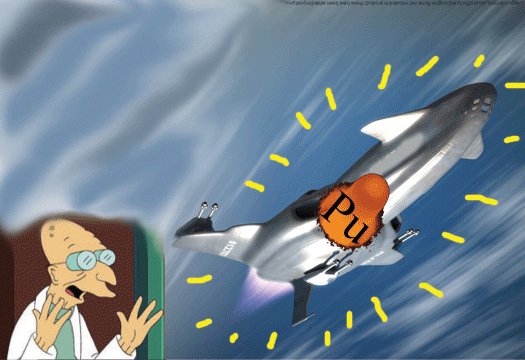
NASA Is Bringing Back Nuclear-Powered Rockets to Get to Mars Fortune, By BLOOMBERG , 15 Feb 18, In the race to land humans on Mars, NASA is blowing the cobwebs off a technology it shelved in the 1970s — nuclear-powered rockets.
Last year, NASA partnered with BWXT Nuclear Energy Inc. for an $18.8 million contract to design a reactor and develop fuel for use in a nuclear-thermal propulsion engine for deep-space travel. While that small start is a long way from the the heady days of the Space Race of the Cold War, it marks the U.S. return to an idea that is also being pursued by Russia and China.
Unlike conventional rockets that burn fuel to create thrust, the atomic system uses the reactor to heat a propellant like liquid hydrogen, which then expands through a nozzle to power the craft……..
While the system would be a niche market in the global nuclear industry, it could be highly lucrative for the company that cracks the technology, especially for nations like the U.S., where the atomic energy sector has been in the doldrums for decades. …….
Russia’s Rosatom Corp. has said it plans this year to test a prototype nuclear engine for a spacecraft that can go to Mars. Russia so far has led research in the field and has deployed more than 30 fission reactors in space, according to the World Nuclear Association. China aims to use atomic-powered shuttles as part of its space exploration plans through 2045, according to state Xinhua News Agency.
NASA faces competition in the race to Mars from industrialists like Elon Musk, who have also vowed to get people to the red planet. Space Exploration Technologies Corp., founded by Musk, is developing a liquid oxygen and methane fueled engine. Jeff Bezos’ Blue Origin is testing an engine that uses liquid oxygen and liquefied natural gas.
NASA also has its eye on atomic technology to power human colonies once they get to Mars. The agency and the Department of Energy are developing a space-ready nuclear fission reactor, known as Kilopower, that could provide up to 10 kilowatts of power and be deployed on other planets and moons. NASA has employed radioisotope thermoelectric generators — batteries that run off the heat from radioactive materials — on previous space missions, including the Mars Curiosity rover.
……… Nuclear propulsion may be the favored option for deep space travel, but the intricacies of the technology and the testing mean that development costs could be a major barrier, said Claudio Bruno, a professor at the University of Connecticut. Using technology developed by NASA decades ago could help speed up the process, he said.Getting to Mars is no small task — it requires a 55 million-kilometer (34 million-mile) space flight, more than 100 times the distance from Earth to the Moon. NASA probably won’t send humans to orbit the planet until at least the early 2030s.
Ground testing would require a costly system that captures and scrubs exhaust to remove tiny radioactive materials, according to Purdue University’s Heister.
“Space exploration is a captivating passion that many folks have – they are not necessarily motivated by profit,” said Heister. “In our business, we joke that the best way to become a millionaire in the space propulsion industry is to start out as a billionaire.” http://fortune.com/2018/02/15/nasa-nuclear-rockets-mars/
GE Hitachi, Holtec Announce Cooperation to Accelerate Commercialization of SMR-160 Small Modular Reactor, Power Magazine
02/14/2018 GE Hitachi Nuclear Energy (GEH), Global Nuclear Fuel (GNF), Holtec International and SMR Inventec, LLC (SMR, LLC), today announced a collaboration to advance the SMR‐160, a single loop, 160 MWe pressurized light water reactor based on existing light water technologies.In a Memorandum of Understanding, the companies have agreed to enter into a procompetitive collaboration to progress the SMR-160 which SMR, LLC intends to develop, design, license, commercialize, deploy and service globally. The cooperation will initially include nuclear fuel development supported by GNF and control rod drive mechanisms designed by GEH, and may later extend to other areas.
“We are excited to leverage the experience and capabilities of world class nuclear companies like GEH and GNF as we bring our game changing SMR-160 technology to global markets,” said Holtec President and CEO Dr. Kris Singh. “SMR-160 has prioritized safety in its design, to produce a right-sized, passively safe and cost-effective solution for carbon-free energy. This collaboration will ensure the SMR-160 supply chain, to deliver and fabricate critical SMR-160 technologies and components, including at our new Advanced Manufacturing Division in Camden, New Jersey.”……http://www.powermag.com/press-releases/ge-hitachi-holtec-announce-cooperation-to-accelerate-commercialization-of-smr-160-small-modular-reactor/










 nuclear-news