Reuters 3rd May 2018 , French uranium mining and nuclear fuel group Orano, formerly called Areva,
said it had signed a fuel reprocessing deal with Ukraine. Orano and the
Ukrainian utility EnergoAtom signed a contract for assessing the
feasibility of reprocessing services of spent fuel assemblies of Ukrainian
VVER-1000 nuclear reactors in Orano la Hague facility Orano said the
contract, signed in the presence of Oleksander Shavlakov, First
Vice-President of EnergoAtom and Pascal Aubret, Senior Executive Vice
President of Orano’s Recycling Business Unit, marks a new step towards
the treatment of Ukrainian used fuels VVER 1000 at the Orano la Hague site. https://af.reuters.com/article/commoditiesNews/idAFFWN1SA18N
Lincoln University 4th May 2018 , Researchers have secured £1.1 million in grant funding to develop
artificial intelligence systems to enable self-learning robots to be
deployed in place of humans to hazardous nuclear sites.
It is estimated that up to £200 billion will be spent on the clean-up and decommissioning
of nuclear waste over the next 100 years.
Now, a team of computer scientists from the University of Lincoln will create machine learning
algorithms to increase capabilities in several crucial areas of nuclear
robotics, including waste handling, cell decommissioning and site
monitoring with mobile robots.
Machine learning is an application of artificial intelligence (AI) which enables systems to collect data and use
it to inform automated decision-making and make improvements based on
experience without being explicitly programmed.
The Lincoln team will create algorithms for vision-guided robot grasping, manipulation and
cutting, mobile robot navigation, and outdoor mapping and navigation. The
aim is to build systems which can use machine learning to adapt to the
unique conditions of nuclear sites, including locations contaminated by
radiation.
The Lincoln project is part of the National Centre for Nuclear
Robotics (NCNR), a multi-disciplinary EPSRC RAI (Robotics and Artificial
Intelligence) Hub led by the University of Birmingham, and also involves
Queen Mary University of London, the University of West England, University
of Bristol, University of Edinburgh, and Lancaster University.
We Now Have A Working Nuclear Reactor for Other Planets — But No Plan For Its Waste,
Futurism, Claudia Geib, 23 May 18 If the power goes out in your home, you can usually settle in with some candles, a flashlight, and a good book. You wait it out, because the lights will probably be back on soon.
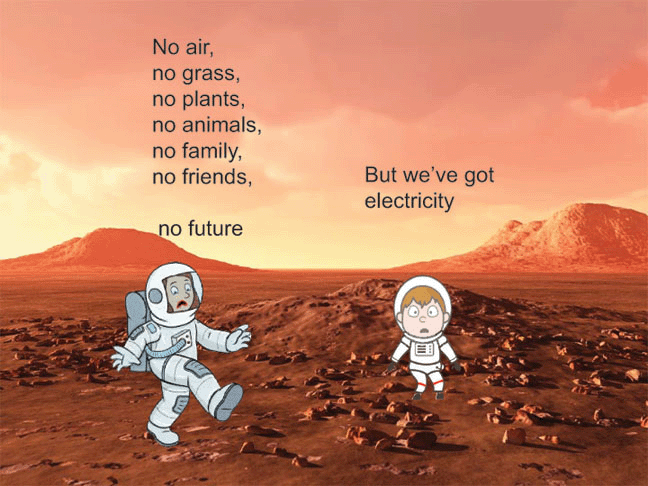
But if you’re on Mars, your electricity isn’t just keeping the lights on — it’s literally keeping you alive. In that case, a power outage becomes a much bigger problem.
NASA scientists think they’ve found a way to avoid that possibility altogether: creating a nuclear reactor. This nuclear reactor, known as Kilopower, is about the size of a refrigerator and can be safely launched into space alongside any celestial voyagers; astronauts can start it up either while they’re still in space, or after landing on an extraterrestrial body.
The Kilopower prototype just aced a series of major tests in Nevada that simulated an actual mission, including failures that could have compromised its safety (but didn’t).
………. Nuclear reactors are not an unusual feature in space; the Voyager 1 and 2 spacecraft, now whizzing through deep space after departing our solar system, have been running on nuclear energy since they launched in the 1970s. The same is true for the Mars rover Curiosity since it landed on the Red Planet in 2012.
But we’d need a lot more reactors to colonize planets. And that could pose a problem of what to do with the waste.
If the power goes out in your home, you can usually settle in with some candles, a flashlight, and a good book. You wait it out, because the lights will probably be back on soon.
But if you’re on Mars, your electricity isn’t just keeping the lights on — it’s literally keeping you alive. In that case, a power outage becomes a much bigger problem.
NASA scientists think they’ve found a way to avoid that possibility altogether: creating a nuclear reactor. This nuclear reactor, known as Kilopower, is about the size of a refrigerator and can be safely launched into space alongside any celestial voyagers; astronauts can start it up either while they’re still in space, or after landing on an extraterrestrial body.
The Kilopower prototype just aced a series of major tests in Nevada that simulated an actual mission, including failures that could have compromised its safety (but didn’t)
But we’d need a lot more reactors to colonize planets. And that could pose a problem of what to do with the waste. According to Popular Mechanics, Kilopower reactors create electricity through active nuclear fission — in which atoms are cleaved apart to release energy. You need solid uranium-235 to do it, which is housed in a reactor core about the size of a roll of paper towels. Eventually, that uranium-235 is going to be “spent,” just like fuel rods in Earth-based reactors, and put nearby humans at risk.
When that happens, the uranium core will have to be stored somewhere safe; spent reactor fuel is still dangerously radioactive, and releases lots of heat. On Earth, most spent fuel rods stored in pools of water that keep the rods cool, preventing them from catching fire and blocking radiating radioactivity. But on another planet, we’d need any available water to, you know, keep humans alive.
…….Right now, all we can do is speculate — as far as we know, NASA doesn’t have any publicly available plan for what to do with spent nuclear fuel on extraterrestrial missions. That could be because the Kilopower prototype just proved itself actually feasible. But not knowing what to do with the waste from it seems like an unusual oversight, since NASA is planning to go back to the Moon, and then to Mars, by the early 2030s.
NASA demos little nuclear power plant to help find little green men, Kilopower experiment looks good for 10 kilowatts on the Moon, Mars or beyond By Simon Sharwood, APAC Editor3 May 2018 NASA has announced successful tests of a small fission reactor capable of producing about 10 kilowatts of power, and hopes the technology will prove suitable for use on the Moon or Mars.
Amsterdam, Netherlands – The “Akademik Lomonosov”, the world’s first floating nuclear power plant, has this morning left St. Petersburg and will be towed through Estonian, Danish, Swedish and Norwegian waters towards Murmansk, warned Greenpeace.
The floating nuclear power plant was initially supposed to be loaded with nuclear fuel and tested on site in the centre of St. Petersburg. However, due to pressure from the Baltic states and a successful petition organised by Greenpeace Russia, Rosatom, the state-controlled nuclear giant that owns and operates the floating nuclear power plant, decided on 21 July 2017 to move loading and testing to Murmansk.
“To test a nuclear reactor in a densely populated area like the centre of St. Petersburg is irresponsible to say the least. However, moving the testing of this ‘nuclear Titanic’ away from the public eye will not make it less so: Nuclear reactors bobbing around the Arctic Ocean will pose a shockingly obvious threat to a fragile environment which is already under enormous pressure from climate change,” said Jan Haverkamp, nuclear expert for Greenpeace Central and Eastern Europe.
Having reached Murmansk, a city of 300,000, the “Akademik Lomonosov” — first in a series of floating nuclear plants planned — will be fuelled, tested and, in 2019, towed 5,000 km through the Northern Sea Route and put to use near Pevek, in the Chukotka Region.
According to Russian media, Rosatom is currently planning a production line, which will be capable of mass producing floating nuclear reactors. Backed by its owner, the Russian State, the company has already been in talks with potential buyers in Africa, Latin America and South East Asia.
“This hazardous venture is not just a threat to the Arctic, but, potentially, to other densely populated or vulnerable natural regions too,” said Jan Haverkamp.
There are indications that 15 countries, including China, Algeria, Indonesia, Malaysia and Argentina, have shown an interest in hiring floating nuclear plants. Among other purposes, the floating nuclear plant is intended to provide power for oil and gas exploration.
“The floating nuclear power plants will typically be put to use near coastlines and shallow water. Contrary to claims regarding safety, the flat-bottomed hull and the floating nuclear power plant’s lack of self-propulsion makes it particularly vulnerable to tsunamis and cyclones,” said Jan Haverkamp.
Akademik Lomonosov, the world’s first floating nuclear power plant, left the Baltic Shipyard in St Petersburg on Saturday morning.
It is expected to reach the Swedish coast next week, before making its way through the narrow Öresund straits, across the Kattegat and into the North Sea.
“We are following this closely through our cooperation with other countries and through our own national agencies,” Johan Friberg, Director of the Swedish Radiation Safety Agency told Sweden’s state broadcaster SVT.
Russia’s development of a floating nuclear power plant has generated alarm among its Nordic neighbours, with Norway’s foreign minister Børge Brende last June warning that the plan to transport it fully fuelled raised “serious questions”.
Karolina Skog, Sweden’s environment minister, argued last June that floating nuclear power stations created “a new type of risk”.
“It is important that Russia makes every effort to fulfil the criteria of international agreements, which should be seen as applying to floating nuclear power stations as well,” she said.
After a meeting in Moscow that July, Russia’s state nuclear corporation Rosatom relented on its plans to drag the reactor through the Baltic fuelled, saying that the plant would instead be fuelled in Murmansk after it had arrived in the Russian Arctic.
“We will carry out the transportation through the Baltic and the Scandinavian region without nuclear fuel on board,” Alexey Likhachev told the Independent Barents Observer.
Jan Haverkamp, nuclear expert for Greenpeace Central and Eastern Europe, has attacked the plant as a ‘nuclear Titanic’, and “threat to the Arctic”
“Nuclear reactors bobbing around the Arctic Ocean will pose a shockingly obvious threat to a fragile environment which is already under enormous pressure from climate change,” he said in a press release.
After the plant is fuelled and tested, it will be pulled across to Pevek on the Eastern Siberian Sea, where it will be used to power oil rigs.
World Nuclear News 27th April 2018 ,A statement of intent to strengthen cooperation on fast neutron
sodium-cooled reactors has been signed between the US Department of Energy
(DOE) and the French Alternative Energies and Atomic Energy Commission
(CEA). The partners have also a statement of intent to begin cooperation in
the field of artificial intelligence. The documents were signed yesterday
in Washington, DC, by US Energy Secretary Rick Perry and CEA’s new Chairman
François Jacq. http://www.world-nuclear-news.org/NP-France-USA-to-enhance-cooperation-on-fast-reactors-2704184.html
Interstellar for Real: Meet the Nuclear-Powered Spaceships of the Future Sputnik news, 22 Apr 18,Spaceships using conventional hydrogen-oxygen fuel will be able to take people to the moon, Mars or Venus. But human exploration of other planets in our solar system, and beyond it, will require the creation of ships harnessing the power of nuclear fission and nuclear fusion, including via the concept of nuclear pulse propulsion.
………Icarus envisions sending multiple probes across multiple solar systems within 15 light years of Earth to carry out detailed studies of stars and planets. Like Daedalus, the project requires helium-3 for fuel, which can be found in ample quantities on Neptune or Jupiter, but which is scarce on Earth. Based on the current pace of technological development, such foreign-planet mining, and hence such a mission, may not be possible until the year 2,300.Ultimately, Anton Pervushin believes that so long as the nuclear test ban treaty remains in force, nuclear pulse propulsion will inevitably remain a theoretical concept. Furthermore, as Pichugina explained, in addition to legal issues, a number of technical questions remain unresolved. These include how to apply fuel to the combustion chamber, how to amortize acceleration, how to protect crews from cosmic radiation, and in general determining the most efficient types of spacecraft.
Still, as Pervushin noted, if humanity wants to escape the bonds of our solar system and send large spacecraft to those close by, nuclear pulse propulsion remains the only realistic option.Postscriptum: Nuclear Fission for Electrical Propulsion
In addition to the ambitious proposals for interstellar nuclear fission and nuclear fusion propulsion, Soviet scientists worked intently from the 1960s to the 1980s on nuclear fission electric power propulsion systems, which transform nuclear thermal energy into electrical energy, which is then used to power conventional electrical propulsion systems.
The Soviet space program pioneered and worked to improve the technology with the Kosmos series of satellites, which, while generally successful, had their reputation somewhat marred following the emergency descent of Kosmos 954 in 1978, which spread radioactive debris over northern Canada.
Two main types of radiation in space are extremely harmful to humans: protons spewed out by the sun and cosmic rays. These high-energy particles and the secondary radiation they create penetrate deep into cells, promoting chronic and sometimes deadly diseases such as cancer.
Cancer is a major risk of radiation exposure, but there are more immediate and surprising symptoms. Deep-space radiation might promote cataracts and impair eyesight
Animal-based experiments also suggest radiation could damage the nervous system, including the brain, which might impair astronauts’ focus and memory.
But the cosmos teems with invisible, high-energy radiation – particles travelling near light-speed that can pummel human travellers and the surfaces of worlds like tiny bullets.
NASA recently signed on to test a new polymer-based radiation-blocking vest for astronauts, called AstroRad, on its next mission around the moon.
Musk, meanwhile, has said his new Big Falcon Rocket will use water to block radiation, though only during emergencies.
“Ambient radiation damage is not significant for our transit times,” Musk said during an Oct. 2017 chat on Reddit. “Just need a solar storm shelter, which is a small part of the ship.”
But just how bad is the problem of radiation in space?
The graphic below [on original] – created using data provided by NASA, the EPA, FDA, NRC, scientific journals, and other sources – compares various exposure levels in scenarios both familiar and far-flung.
Hover over a category box to see how it compares.
Musk has “aspirational” hopes to launch a round-trip mission to the red planet with humans in 2024, but the trip could total a year, and astronauts may spend about 500 days on Mars’ surface.
The whole journey would expose astronauts to about 1,000 millisieverts – depending on how many solar storms belch high-energy particles toward Mars, and whether the first entity to reach the planet actually lands on it.
This means the first Martian explorers could get roughly eight times the amount of radiation per year of a radiation worker’s annual exposure limit. In total, the space travellers would get about one-third of the way toward hitting a NASA astronaut’s maximum lifetime exposure limit (2,500-3,250 mSv).
Where the radiation comes from – and why cancer isn’t the only danger
Two main types of radiation in space are extremely harmful to humans: protons spewed out by the sun and cosmic rays. These high-energy particles and the secondary radiation they create penetrate deep into cells, promoting chronic and sometimes deadly diseases such as cancer.
Earth’s magnetic field and atmosphere protect us by deflecting and absorbing most of this energy.
“The background radiation rates on the ground are 100 times to 1,000 times smaller than they would be above the atmosphere in free space,” Edward Semones, a radiation health officer at NASA’s Johnson Space Center, previously told Business Insider.
Cancer is a major risk of radiation exposure, but there are more immediate and surprising symptoms. Deep-space radiation might promote cataracts and impair eyesight. Even high-flyingcommercial-airline workers face that risk because of the thinner atmosphere.
Animal-based experiments also suggest radiation could damage the nervous system, including the brain, which might impair astronauts’ focus and memory.
“You’re somehow losing cognitive ability,” Semones said, adding that, over the years, this “may impact conducting the mission.”
Ultimately, colonists may try to terraform Mars – a deliberate and unprecedented act of climate change.
Frozen carbon dioxide at the Martian poles could be turned into greenhouse gases in order to create a radiation-absorbing atmosphere that would insulate the surface. Plants could then convert the thin air into oxygen and, over hundreds of years, temperatures may warm enough to melt hidden water and make it again flow on Mars’ surface. One day, that could even permit spacesuit-free excursions.
Jim Green, the former head of NASA’s planetary science division, has proposed building anartificial magnetic shield for Mars to protect a hypothetical nascent atmosphere from the sun’s proton radiation, which might otherwise blow the air into space.
“This may sound ‘fanciful’ but new research is starting to emerge revealing that a miniature magnetosphere can be used to protect humans and spacecraft,” Green and other researchers wrote in a brief study of the concept in 2017. “If this can be achieved in a lifetime, the colonization of Mars would not be far away.”
Nasa is to make a major announcement about its project to put nuclear power in space.
The agency has been working on “Kilopower” – a project to use a nuclear reactor to generate clean energy on the Moon, Mars and beyond – for some time. And now it will hold a press conference to reveal the latest results from its plans to unveil a new space exploration power system, it has said.
The conference will see the agency discuss the results of its latest experiments, it said in a release. It has been conducted from November 2017 through until March 2018, at the Nevada National Security Site or NNSS.
That site, deep in the Nevada desert, has long served as a testing ground for nuclear experiments. In the 1950s, for instance, it was used to detonate nuclear bombs that could be felt across the state and into Las Vegas.
Nasa hopes that Kilopower can use some of that same nuclear technology to provide energy for space explorers as they make their way through the solar system. They will need energy for a wide variety of tasks, from generating the light, water and oxygen they need to conducting experiments and sending information back to Earth.
“That’s why NASA is conducting experiments on Kilopower, a new power source that could provide safe, efficient and plentiful energy for future robotic and human space exploration missions,” Nasa wrote in a statement in January.
“This pioneering space fission power system could provide up to 10 kilowatts of electrical power — enough to run two average households — continuously for at least ten years. Four Kilopower units would provide enough power to establish an outpost.”
Using nuclear fission will allow astronauts to be able to generate energy wherever they are. If people on Mars, for instance, the amount of energy coming from the sun varies wildly; on Moon, the night lasts for 14 days.
“We want a power source that can handle extreme environments,” says Lee Mason, NASA’s principal technologist for power and energy storage. “Kilopower opens up the full surface of Mars, including the northern latitudes where water may reside. On the Moon, Kilopower could be deployed to help search for resources in permanently shadowed craters
Decades-old plant has cost almost $10bn and hardly ever operated KAZUNARI HANAWA, Nikkei staff writer
TOKYO — Japan is set to start decommissioning its troubled Monju fast-breeder reactor after decades of accidents, cost overruns and scandals. It is the beginning of the end of a controversial project that exposed the shortcomings of the country’s nuclear policy and the government’s failure to fully explain the risks and the costs.
In July, the Japan Atomic Energy Agency will begin decommissioning what was hailed as a “dream” reactor that was expected to produce more nuclear fuel than it consumed. The government has so far spent more than 1 trillion yen ($9.44 billion) on the plant, which has barely ever operated.
The plan approved by the Nuclear Regulation Authority on March 28 to decommission the reactor, located in central Japan’s Fukui Prefecture, calls for the extraction of spent nuclear fuel to be completed by the end of the fiscal year through March 2023. Full decommissioning is expected to take about 30 years.
Total costs to shut down the reactor are currently estimated at 375 billion yen, but that could climb, as the full technical requirements and the selection of the nuclear waste sites are not well understood.
Japan does not have the technological ability to manage the decommissioning process on its own, and must enlist the help of France, which has more experience with fast-breeder reactors. Among the technical challenges is handling the plant’s sodium coolant, which is highly reactive and explodes on contact with air.
Many of the problems with Japan’s nuclear policy were brought to light by the Fukushima Daiichi nuclear disaster caused by the tsunami and earthquake of March 2011. Such problems have included the high costs of plants, the selection of nuclear disposal sites, and the threat of shutdowns due to lawsuits. Japan’s nuclear policy has largely been gridlocked since the disaster.
But the Monju project had many problems before the Fukushima catastrophe.
Planning for the project began in the 1960s. Its fast-breeder technology was considered a dream technology for resource-poor Japan, which had been traumatized by the oil crisis of the 1970s. The reactor was supposed to generate more plutonium fuel than it consumed.
The reactor finally started operating in 1994, but was forced to shut down the following year due to a sodium leak. It has been inoperative for most of the time since. The decision to decommission it was made in December 2016 following a series of safety scandals, including the revelation that many safety checks had been omitted.
Recent experience suggests the government’s estimated cost of 375 billion yen to decommission Monju could be on the low side. In 2016, the estimate for decommissioning the Fukushima Daiichi plant ballooned to 8 trillion yen from an initial 2 trillion yen in 2013, largely due to inadequate understanding of the decommissioning process.
While “the JAEA will try to keep costs down,” said Hajime Ito, executive director with the agency, the process of extracting sodium, the biggest hurdle, has yet to be determined. Future technical requirements will also involve significant costs.
The Monju reactor is not the only example of failure in Japan’s nuclear fuel cycle policy — the cycle of how nuclear fuel is handled and processed, including disposing nuclear waste and reprocessing used fuel.
Central to this policy is a nuclear fuel reprocessing plant in the village of Rokkasho in northern Aomori Prefecture that was supposed to extract plutonium and uranium by reprocessing spent nuclear fuel to be reused at nuclear plants.
More than 2 trillion yen has been spent on the plant so far. Construction was begun in 1993, but completion has been repeatedly postponed due to safety concerns. On Wednesday, the NRA decided to resume safety checks on the plant, but if it chooses to decommission it, the cost would be an estimated 1.5 trillion yen.
Had Japan taken into consideration the costs of decommissioning plants and disposing of spent nuclear fuel, it probably would not have been able to push ahead with its nuclear policy in the first place, said a former senior official of the Ministry of Economy, Trade and Industry, who was involved in formulating the country’s basic energy plan.
Beyond Nuclear 31st March 2018, President Trump has announced that he wants the National Aeronautics and Space Administration (NASA) to “lead an innovative space exploration program to send American astronauts back to the moon, and eventually
Mars.” But the risks such ventures would entail have scarcely been touched upon.
For those of us who watched Ron Howard’s nail-biter of a
motion picture, Apollo 13, and for others who remember the real-life drama
as it unfolded in April 1970, collective breaths were held that the
three-man crew would return safely to Earth. They did.
What hardly anyone remembers now — and certainly few knew at the time — was that the
greater catastrophe averted was not just the potential loss of three lives,
tragic though that would have been. There was a lethal cargo on board that,
if the craft had crashed or broken up, might have cost the lives of
thousands and affected generations to come. It is a piece of history so
rarely told that NASA has continued to take the same risk over and over
again, as well as before Apollo 13. And that risk is to send rockets into
space carrying the deadliest substance ever created by humans: plutonium. https://beyondnuclearinternational.org/2018/03/31/the-real-houston-problem/
As the nuclear option looks less and less sensible, it becomes harder to explain Whitehall’s enthusiasm. Might it be to do with the military? Guardian, Andy Stirling and Phil Johnstone, 29 Mar 18,
The depth of this Whitehall bias creates a challenging environment for reasoned debate over British energy policy. To many, it seems scarcely believable that UK plans are so massively out of sync with current trends. The sheer weight of UK nuclear incumbency has successfully marginalised the entirely reasonable understanding that – like many technologies before it – nuclear power is simply going obsolete.
With direct reasons for the UK’s eccentric national position still unstated, we should pay attention to body language. Here, clues may be found in the work of the National Audit Office (NAO). Its 2017 report of 2017 points out serious flaws in the economic case for new nuclear – highlighting “unquantified”, “strategic” reasons why the UK still prioritises new nuclear despite the setbacks and increasingly attractive alternatives. Yet the NAO remains uncharacteristically unclear as to what these reasons might be.
An earlier NAO report may shed more light. Their 2008 costing of military nuclear activities states: “One assumption of the future deterrent programme is that the United Kingdom submarine industry will be sustainable and that the costs of supporting it will not fall directly on the future deterrent programme.” If the costs of keeping the national nuclear submarine industry in business must fall elsewhere, what could that other budget be?
So why does the UK debate on these issues remain so muted? It is now beyond serious dispute that nuclear power has been overtaken by the extraordinary pace of progress in renewables. But – for those so minded – the military case for nuclear power remains. In a democracy, it might be expected that these arguments at least be tested in public. So, the real irrationality is that an entire policy arena should so comprehensively fail to debate such crucial issues. In the end, all technologies become obsolete. If we are not honest about UK civil nuclear policy, the danger is that British democracy may go the same way.
Mars mission: how increasing levels of space radiation may halt human visitors, The Conversation, Gareth Dorrian, Post Doctoral Research Associate in Space Science, Nottingham Trent University, Ian Whittaker, Lecturer, Nottingham Trent University,
From surviving take off to having to rely on oxygen tanks to breathe in orbit, space travel is incredibly risky. But a huge hazard that we sometimes overlook is high energy radiation from sources both inside and outside the solar system.
A new study, published in the journal Space Weather, has shown that radiation received from outside our solar system has been increasing steadily for the last few years, returning to levels not seen since the first half of the 20th century – making space travel more dangerous today than it was during the Apollo era.
This type of radiation, known as “galactic cosmic rays”, consists of the nucleus of an atom travelling very close to the speed of light. These rays, many of which come from our own Milky Way galaxy, are some of the most energetic particles in the known universe and are found throughout the solar system.
Humans have a limited tolerance to radiation of all kinds. Particle radiation can damage DNA in human cells, cause mutations and stimulate cancer. In extreme circumstances, an acute dose of radiation can cause sickness, burns and organ failure. Anyone who works near sources of radiation has a maximum annual limit on the dose they can safely receive.
Solar cycle
In space, astronauts are partially shielded from galactic cosmic rays by the magnetic field of the sun, which deflects some of these incoming charged particles. However, the sun’s magnetic field varies in strength over time, with the 11-year solar activity cycle. At solar minimum (when the sun is least active), the solar magnetic field is weaker, allowing more galactic cosmic rays into the solar system – posing a greater radiation hazard to astronauts. At solar maximum, the opposite is true………..
New data
Since the last solar minimum in 2009, however, the sun appears to have returned to a quieter state once again. In fact, it has not been this quiet since the end of the 19th century. This change appears to be having a strong influence on the level of incoming galactic cosmic rays once again. Since the most recent solar minimum, the new study shows this specific radiation level is on the rise once more – it is currently some 30% higher than it was on average during the latter, quieter, part of the 20th century.
Scientists are currently debating whether these radiation levels will continue to rise. Our lack of knowledge about the underlying science of long-term variation in solar cycles is making it difficult to know for sure. Several studies predict that we are entering a new period of extended solar minimum conditions. But others suggest that current conditions are just part of the normal, long-term variation in solar cycles, and nothing out of the ordinary.
Either way, this evidently has major implications for future manned space missions. Although it is not the only factor to take into account. As well as charged particle radiation from the galaxy, the sun also produces this type of radiation in the form of solar energetic particles, which are produced more often, though not exclusively, at solar maximum………. https://theconversation.com/mars-mission-how-increasing-levels-of-space-radiation-may-halt-human-visitors-94052
NASA to allow nuclear power systems for next Discovery mission, Space News by Jeff Foust — WASHINGTON — Citing progress in producing plutonium-238, NASA will allow scientists proposing missions for an upcoming planetary science competition to use nuclear power sources.
In a statement issued March 17, Jim Green, director of NASA’s planetary science division, said the agency was reversing an earlier decision prohibiting the use of radioisotope power systems for spacecraft proposed for the next mission in the agency’s Discovery program.
A “long-range planning information” announcement about plans for the competition, issued Dec. 12, said that the use of such power systems would not be allowed, although missions could use radioisotope heater units, which use a very small amount of plutonium to keep spacecraft elements warm.
NASA made that decision based on projected use of existing stocks of plutonium-238 for upcoming missions, such as the Mars 2020 rover. Dragonfly, one of the two finalists for the next New Frontiers medium-class planetary science mission, also plans to use a radioisotope power system, as well as potential future missions the moon that require nuclear power to operate through the two-week lunar night.
“We have some liens against the radioisotope power,” Green said at a Feb. 21 meeting of NASA’s Planetary Science Advisory Group, citing those upcoming missions. The agency, he said, needed to balance mission demands against existing stocks of plutonium and efforts currently ramping up to produce new supplies of the isotope, which should reach a goal of 1.5 kilograms a year by around 2022. “The last thing we want to do is to select a mission and then not be ready to fly it.”
At the time of the meeting last month, though, Green said the agency was reviewing the prohibition against using nuclear power for the Discovery competition at the request of the scientific community, but didn’t offer a schedule for completing that review……. http://spacenews.com/nasa-to-allow-nuclear-power-systems-for-next-discovery-mission/












 nuclear-news