Logan has 10 months to consider modular nuclear reactor program, HJ News.com, By Sean Dolan staff writer, 31 May 18, “……..Right now, Logan is the largest city participating in a plan to build a small modular nuclear reactor just north of Idaho Falls.
The project is still in the development phases, and Logan has several opportunities to pull out of the project, including a coming deadline in March 2019. At that point, UAMPS Chief Legal Officer Mason Baker said, UAMPS will gauge how many cities are participating and decide whether it makes good business sense to keep going. Baker said UAMPS hopes Logan will sign power contracts before the March deadline.
……“There’s all kinds of risks,” said Logan Light and Power Director Mark Montgomery. “There’s first-of-its-kind risk, there’s construction risk, there’s design risk, there’s a regulatory risk and probably other risks that I’m forgetting.”
Logan is set to participate in the nuclear reactor at 30 megawatts, which exceeds any of the city’s existing power contracts. Logan Finance Director Rich Anderson said there is always risk involved in the power business, but he is concerned with the financial risk involved in this level of participation…..Since 2016, Logan has paid UAMPS $206,000 for administration and general costs and has another $250,000 budgeted for this year. City Attorney Kymber Housley said there’s a risk that Logan could pay UAMPS hundreds of thousands of dollars for a project that might never happen.
“One of the big risks is it gets caught up in litigation,” Housley said in a Wednesday interview. “I don’t even think it’s a question of if; it’s more of a question of how many lawsuits will be brought trying to stop a nuclear plant.”
NASA looks to send a small nuclear reactor to the moon and MarsSanDiego Union-Tribune, 23 May 18 ………. some aren’t exactly over the moon with the prospect of nuclear power in space.
Among other incidents, the group points to a Russian nuclear-powered satellite that crashed into the Indian Ocean in 1982 and chunks of another that fell into a remote area of the Northwest Territories of Canada in 1978.
Gagnon also worries about launch accidents, contamination and whether projects like Kilopower may “serve as a Trojan horse” that could lead to using nuclear to power weapon systems in space.
“It’s not the kind of thing we can play games with,” Gagnon said. “One thing we know is technology is not invincible — the Titantic, the Challenger, Fukushima, there are a whole host of examples in the modern age. And when you start mixing nuclear power into the equation, it’s a very dangerous thing.”
Can we protect the brain from cosmic radiation? Medical News Today ,By Maria CohutAs we prepare to enter a new era of space travel, we must find ways of averting health risks posed by the cosmic environment. Deep space radiation, in particular, is known to impair cognitive function………. One main threat comes from cosmic radiation, which can harm the central nervous system, altering cognitive function and leading to symptoms similar to those found in Alzheimer’s disease.
……. ‘Cosmic radiation may affect brain long-term’Previous research conducted by Rosi and team found that, after mice were exposed to a level of radiation roughly equivalent to what human astronauts might encounter during an outer space mission, their capacity to differentiate between familiar and unfamiliar objects was impaired.
Usually, when mice are faced with two objects — one that is new and unknown to them and one that they formerly explored — they will spend more time familiarizing themselves with the new object.
However, the animals that had been exposed to radiation tended to spend an equal amount of time exploring both objects, which suggested to the researchers that the mice had forgotten they had already been exposed to one of the two.
Other symptoms that the mice presented included problems with social interactions and a sense of elevated anxiety. Rosi and team note that this was likely because of the effect the strong radiation had on the microglia, or nerve cells found in the brain and spinal chord that are part of the central nervous system’s immune mechanism.
When microglia are activated, they can cause symptoms — such as impaired memory recall — that are consistent with those of neurodegenerative disorders.
This is partly due to the fact that they are driven to destroy synapses, or the connections formed between brain cells that allow them to convey information.
“We are starting to have evidence that exposure to deep space radiation might affect brain function over the long-term, but as far as I know, no one had explored any possible countermeasures that might protect astronauts’ brains against this level of radiation exposure.” Susanna Rosi………https://www.medicalnewstoday.com/articles/321898.php
Small Nuclear Passes a Milestone – But Does it Have a Future? U.S. regulators for the first time have approved a design for a ‘small modular reactor,’ but it remains to be seen whether going small can save nuclear power. S. News, By Alan Neuhauser, Staff Writer May 22, 2018 “… the nuclear power industry is betting its future on going small.
Even as cheap natural gas and falling prices for solar, wind and battery storage have all but killed the prospects for expensive new nuclear power projects in much of the developed world – and especially the U.S. – a handful of companies is plunging ahead in an effort to design a small modular reactor promised to offer flexible, carbon-free electricity at a competitive price.
Earlier this month, NuScale Power, based in Oregon, passed a significant milestone, earning Phase 1 approval from U.S. regulators for the design of its nearly $3 billion small modular reactor – an early but crucial step in the development of small nuclear technology.
…….. An operational small modular reactor, however, remains a decade or longer away from becoming concrete-and-steel reality. And in that time, the question remains whether the market for costly new nuclear plants – already a challenge, and all but dead in the U.S. – will become even more challenging in the intervening years as renewable and battery prices continue to fall and U.S. gas production booms.
One major consulting firm, which declined to comment on the record, stated bluntly, “There are doubts in terms of the economic viability of these projects.”
Some environmental groups have also shared that assessment: “Unless a number of optimistic assumptions are realized, SMRs are not likely to be a viable solution to the economic and safety problems faced by nuclear power,” the Union of Concerned Scientists, which is generally skeptical of nuclear power,wrote in 2013.
……. NuScale Chief Commercial Officer Tom Mundy has predicted that the first small modular reactors would cost about $100 per MW-hour and drop to about $90 or lower – roughly the same cost that the U.S. Energy Information Administration has estimated for large-scale advanced nuclear projects, including tax credits. Renewables such as new solar or onshore wind, by contrast, cost about $47 and $37, respectively, while advanced natural gas plants cost about $48…….. some organizations remain skeptical of nuclear’s role in addressing climate change, arguing that the technology – even for small modular reactors – remains too vulnerable to accident or deliberate attack and that solar or wind plus battery storage offer a safer option.
The Union of Concerned Scientists, for example,allows that while smaller reactors are less dangerous than larger ones, such a view can be “misleading, because small reactors generate less power than large ones, and therefore more of them are required to meet the same energy needs. Multiple SMRs may actually present a higher risk than a single large reactor, especially if plant owners try to cut costs by reducing support staff or safety equipment per reactor.” ……https://www.usnews.com/news/national-news/articles/2018-05-22/small-nuclear-passes-a-milestone-but-does-it-have-a-future
COLUMBIA — It’s a familiar story in South Carolina: Nuclear contractors fail to produce a reliable schedule, start construction with just a fraction of design finished, and let pipes and other material corrode in storage under the watch of government agencies.
The abandonment of two nuclear reactors at the V.C. Summer Nuclear Station generated headlines and riled state lawmakers since last summer, but 90 miles south, a similar scenario played out at the Savannah River Site near Aiken.
The federal government has likely squandered more than $7 billion as they watched a project fall decades behind schedule and its final cost increase by 12 times the initial estimates. And, like V.C. Summer, the plug is being pulled. The parallels don’t end there: The debacles also shared two of the same contractors.
The Savannah River project has not faced the same anger and scrutiny as the abandonment of the two nuclear reactors in Fairfield County — likely because the inflated cost of the complex project is being distributed to federal taxpayers across the country instead of 1.6 million electric customers in South Carolina.
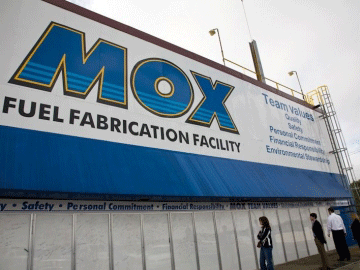
For more than a decade, the U.S. Department of Energy and its private contractors have tried to build the plant to turn Cold War-era nuclear weapons into fuel that could be used in nuclear power plants. It’s known as MOX, short for mixed oxide fuel fabrication.
The project became a federal priority around the turn of the century, and was intended to be a cornerstone of the United States’ effort to reduce its aging stockpiles of nuclear weapons.
But for more than four years, it has been on the federal chopping block. In federal studies and congressional testimony reviewed by The Post and Courier, government officials laid out a long list of problems with the contractors and the project in general. Two presidential administrations have tried to put an end to the costly undertaking.
Each time, however, South Carolina’s powerful congressional delegation revived the project, siding with the contractors who disputed the findings of independent consultants and federal agencies.
Now, it may be too late. Congress gave U.S. Energy Secretary Rick Perry the power in March to put an end to the 11-year construction effort, and the federal agency is already taking action.
Earlier this month, President Donald Trump’s administration released an alternative proposal to deal with the 34 metric tons of weapons-grade plutonium that was set to be processed at the site. They estimated it will cost less than half of what it would take to finish the MOX facility and turn the plutonium into commercial fuel.
The new plan calls for mixing the plutonium with another material, not revealed by the federal government, and storing it below the New Mexico desert. Buried with it could be the second major nuclear project to be cancelled in South Carolina in less than a year.
……..the companies have sunk billions into the facility that has risen out of the surrounding pines. But many of the circumstances that drove federal officials to approve the project, including the deal with Russia, have changed.So, too, have the projections for the final cost of the facility. It now stands at roughly $17 billion.
A ‘horror story’ for taxpayers?
U.S. Rep. Jim Cooper took direct aim as he opened a congressional oversight hearing in the fall of 2015.
“I am worried that, as we enter the month of October and head toward Halloween, that really the subject of this hearing is a horror story for the American taxpayer,” said Cooper, a Democrat from Tennessee.
By that time, the contractors’ forecasted price tag for the facility had jumped by more than six times the estimates from 2002. The Department of Energy estimated the cost to be even higher, and President Barack Obama’s administration was pushing to end construction altogether.
“Immature design is one of the biggest problems we face,” said MacWilliams, who led a special team that reviewed the project’s management.
MacWilliams also reported that around a quarter of the rebar, pipes, electrical wiring and other material that was initially installed had to later be torn back out and replaced — slowing construction and increasing the cost of labor.
Like V.C. Summer, federal officials reported materials being ruined because parts were ordered years before they were ever needed. The contractors reportedly didn’t have a “resource loaded” schedule that tied together supplies and construction work. Fifty percent of the piping that was manufactured as of 2016 was unusable due to corrosion and design changes, a report by the U.S. Army Corps of Engineers found. “This pattern of early procurement is systemic,” the report said.
“I think it’s clear that although there is blame to go around on all sides the contractors from the very beginning misled the Department and for that matter the U.S. government,” MacWilliams told The Post and Courier last week.
……..Existing facilities at Savannah River are already capable of diluting the plutonium, but the federal government also wants to install new equipment to speed up the work that’s expected to continue for the next three decades. The full price tag for the process, according to a new Department of Energy analysis, could equal another $19.9 billion.
By comparison, federal officials say it would take another $48 billion to complete the construction of the MOX facility, as well as finish the work of turning the plutonium into fuel.
The French stress test for nuclear power, Ft.com 18 May 18
Years late and billions over budget the first European Pressurised Reactor is set to become operational. Its success is critical for France Andrew Ward in London and David Keohane in Paris MAY 17, 2018 “….. fuel loading at Taishan — one of the last steps before it starts producing electricity — carries wider significance beyond China. Taishan, operated by China General Nuclear Power Corp, the state-owned energy company, is on course to become, within months, the first plant in the world to operate a European Pressurised Reactor — the Franco-German technology plagued by delays and cost overruns since it was designed in the 1990s. “The Taishan 1 fuel loading is a very important milestone,” says Xavier Ursat, head of new nuclear projects for EDF, the French state-backed utility which owns 30 per cent of the project. “It will bring a new image to the EPR.”
Few technologies are in greater need of a makeover. When work started on the first EPR as a joint venture of Areva of France and Siemens of Germany at Olkiluoto, Finland, 13 years ago, it was supposed to herald a new era of growth for atomic power. Instead, as construction timetables slipped and German support melted away, the EPR has become a symbol of the nuclear industry’s struggle to remain competitive. EDF, the main surviving corporate champion behind the EPR, is hoping that completion of Taishan will mark a turning point in efforts to convince sceptical investors, policymakers and potential buyers that the reactor can still be a success. At stake is the future of the wider French nuclear sector, which is relying on the EPR for long-term growth, at a time when the country’s dependence on atomic power is being questioned by President Emmanuel Macron ’s administration.
Taishan is the furthest advanced of four EPR projects around the world and, at a mere five years late, the least delayed. Olkiluoto is due to come into service next year, a decade late and nearly three times over budget at €8.5bn. It is a similar story at EDF’s flagship Flamanville plant in France, which is seven years late and €7bn over budget. A further project involving two EPRs at Hinkley Point, south-west England, is not due for completion until the end of 2025, eight years after EDF once predicted it would be finished. These setbacks have plunged France’s nuclear industry into financial turmoil. Areva, battered by its losses at Olkiluoto, was last year folded into EDF in a state-brokered deal that amounted to a bailout of the sector. A €4bn capital raising by EDF last year improved its balance sheet but the company still had €33bn of net debt at the end of 2017, only a little less than its current market capitalisation.
No country has more invested in nuclear power than France, which generates 70 per cent of its electricity from the splitting of atoms. The EPR was designed to renew the country’s nuclear fleet as many of its existing 58 reactors approach the end of their operational lives, while also generating valuable export orders. But construction delays have been seized on by those — including some inside the Macron government — who want a decisive shift in French energy policy away from nuclear and towards renewable power. A policy “road map” is due by the end of the year setting out how fast France should pursue a government target to cut nuclear’s share of domestic electricity production to 50 per cent. Similar debates are under way in many countries where nuclear power is generated, as critics argue that its high costs, safety risks and radioactive waste can no longer be justified when the costs of wind and solar power are falling rapidly. ……….
While the EPR was designed to be almost bomb and meltdown-proof, construction flaws have painted a less robust picture. France’s nuclear regulator, the Autorité de Sûreté Nucléaire, ruled last year that anomalies in the steel used at Flamanville meant the reactor’s lid, or vessel head, would need replacing — at significant expense — after just six years of operation. Separate defects have since emerged in the welding of steel pipes at the French plant. EDF is due to reveal within weeks whether it can still meet its latest timetable to be fully operational by November 2019. While the start-up of Taishan will be a welcome fillip, Flamanville remains the bigger test for EDF because of its 100 per cent ownership and because approval from the ASN — seen as a gold standard in nuclear regulation — bestows credibility on the technology internationally. ………
Setbacks at Flamanville have cast a shadow over the early stages of construction at Hinkley Point, where two EPRs are being built with an aim to meet 7 per cent of UK electricity demand. EDF insists that experience accumulated at Flamanville and Taishan will make Hinkley a smoother process. Avoiding delays in the UK will be crucial if EDF is to persuade international buyers — and its own shareholders, not least the French government — that the EPR’s teething problems are over. ………https://www.ft.com/content/7c68a702-57cb-11e8-bdb7-f6677d2e1ce8
Floating nuclear power plant reaches the Arctic, Greenpeace demands strict safety controls by Greenpeace International Vienna, Austria – As Russia’s state-run corporation Rosatom prepares to celebrate the arrival of its first purpose-built floating nuclear power plant in the Arctic city of Murmansk, campaigners are warning of threats to people and nature and calling for a full environmental impact assessment and independent nuclear oversight.
The controversial Akademik Lomonosov barge, dubbed ‘nuclear Titanic’ by some, arrived in Murmansk today where it will be loaded with nuclear fuel and tested. The Rosatom welcoming party is scheduled to take place on 19 May.
“It is now that one of the riskiest parts of the project begins,” said Jan Haverkamp, nuclear expert with Greenpeace Central and Eastern Europe.
“The barge will be fuelled and tested near a city of 300,000 people, then towed with two reactors full of irradiated fuel along the Northern Sea Route. Its installation in the harsh environment of the Russian Arctic will pose a constant threat to people of the North and the pristine Arctic nature,” he added.
Greenpeace CEE together with Russian environmental organisations Ecodefense andRussian Socio-Ecological Union (Friends of the Earth Russia) has sent a letter to Rosatom and relevant authorities demanding full and unrestricted regulatory oversight by the Russian nuclear regulator Rostechnadzor, with peer-review by nuclear regulators from other Arctic countries, as well as a transboundary Arctic Environmental Impact Assessment (EIA).[1]
“The incident-ridden history of Russian nuclear icebreakers and submarines shows the need for strict, independent oversight with international peer review. This must start now, before the reactors are loaded, and span the plant’s entire risky operation – including transport, decommissioning and waste management,” said Haverkamp.
Initial plans to load and test the floating nuclear plant in the centre of St. Petersburg were abandoned after pressure from Nordic and Baltic countries and a public petition organised by Greenpeace Russia. While being towed to Murmansk, the barge was escorted and peacefully protested in Danish waters by the Greenpeace Ship Beluga II.
In 2019, the Akademik Lomonosov will be towed 5,000 km through the Northern Sea Route and put to use near Pevek, in Russia’s Chukotka Region.
According to Russian media, 15 countries, including China, Algeria, Indonesia, Malaysia, Argentina and Sudan, have shown interest in hiring floating nuclear plants that – among other purposes – are intended to provide power for fossil fuel exploration.
Notes:
[1] The letter was sent today to the acting Minister of Natural Resources and Environment of the Russian Federation, the CEO of Rosatom, the chairperson of the Russian nuclear regulator Rostechnadzor and the international cooperation body for the Arctic, the Arctic Council.
Recent press releases with more information available here and here.
Review of nuclear fuel reprocessing plant resumes https://www3.nhk.or.jp/nhkworld/en/news/20180517_32/Japan’s nuclear regulator has resumed its review of an under-construction nuclear fuel reprocessing plant, following a suspension of 8 months because of a maintenance problem discovered last summer.
The Nuclear Regulation Authority on Thursday resumed its review of the plant in Rokkasho Village in Aomori Prefecture. The resumption came after the plant’s operator, Japan Nuclear Fuel Limited, gave notice that it has worked out a plan to introduce new safety measures.
Last August, rainwater was found to have flowed into a building for emergency power generators at the plant. The rainwater leak was blamed on a failure by the company to conduct mandatory inspections of the area over a period of several years.
During Thursday’s review session, Japan Nuclear Fuel explained how it will improve its maintenance programs at the plant.
In response, officials from the Regulation Authority said the company should conduct a more rigorous assessment of its past maintenance work.
In future review sessions, the regulator is planning to ask about the company’s contingency plans for emergencies such as the fallout of volcanic ash from a nearby volcano, or a plane crash.
The company is aiming to complete the construction of the plant in 3 years.
Energy Department Makes the Right Decision to Kill MOX Program https://www.ucsusa.org/press/2018/energy-department-makes-right-decision-kill-mox-program#.Wv35qjSFPGh Statement by Edwin Lyman, Union of Concerned Scientists WASHINGTON (May 14, 2018)—Late last week, the Department of Energy (DOE) submitted a report to Congress documenting that an alternative method to dispose of U.S. excess weapons plutonium would be less than half the cost of the current plan to use it as mixed oxide (MOX) fuel for nuclear reactors. By certifying that finding, Secretary of Energy Rick Perry will have the legal authority next month to stop construction of the MOX facility at the Savannah River Site in South Carolina. The Union of Concerned Scientists (UCS), which obtained the report and publicly released it, has long called for canceling the MOX program because it would make it easier for terrorists to gain access to fissile material that could be used to make a nuclear weapon.
Instead of finishing the half-built MOX facility, the Trump administration—like the Obama administration before it—proposes to dilute 34 tons of plutonium from retired U.S. nuclear weapons with an inert substance and dispose of it at the deep underground Waste Isolation Pilot Plant in New Mexico. According to the DOE report, this “dilute and dispose” process would cost at most $19.9 billion, 40 percent of $49.4 billion cost of continuing the MOX program.
Below is a statement by Edwin Lyman, a UCS senior scientist.
“Energy Secretary Perry made the right decision to terminate the misguided MOX program. Ironically, while the program was intended to reduce the risks posed by the large US stockpile of plutonium from dismantled nuclear weapons, it would make this material more vulnerable to theft. The alternative approach—dilute and dispose—will be far safer and more secure than MOX.
“While the MOX program has gone well over-budget, we now know that the dilute and dispose process will be far cheaper. According to DOE’s comprehensive report the cost of diluting and disposing of 34 metric tons of U.S. excess plutonium will be less than half the remaining cost of the MOX program. This finding allows the DOE to waive the wasteful congressional requirement that it must continue to build the MOX plant. As a bonus, the agency can begin the dilute and dispose process much sooner.
“The dilute and dispose approach will not only be cost-effective, it also will provide sustainable employment at the Savannah River Site for decades to come. The DOE report estimates that the project will require more than 400 full-time employees through its completion date in the late 2040s. Secretary Perry’s decision to kill MOX is a victory for US taxpayers, national security, and South Carolina workers.”
2 gallons of radioactive nuclear waste done. 56M gallons to go, BY ANNETTE CARY acary@tricityherald.comRICHLAND, WA 17 May 18
Researchers in Richland have done what the $17 billion vitrification plant at Hanford is intended to do — turn radioactive waste into a solid glass form.
Over about 24 hours last month researchers ran a laboratory-sized plant, dripping a radioactive waste mixture into a miniature melter inside the Pacific Northwest National Laboratory’s Radiochemical Processing Laboratory.
When they were done, they had 20 pounds of glass encasing actual Hanford waste.
……….The vitrification plant — or Waste Treatment Plant — at the Hanford nuclear reservation has been under construction since 2002, with a court-ordered deadline of 2023 to start treating some of the 56 million gallons of radioactive waste in underground tanks.
Much of the waste, which is left from the past production of plutonium for the nation’s nuclear weapons program, is planned to be vitrified, or turned into a solid glass form for disposal.
In the past about a cup of waste at a time has been vitrified — but not in a way that really mimics the system to be used at the plant.
Scientists have not been able to determine in earlier tests how the plant’s process would control the chemistry of the mixture, which determines how well waste is contained within the mixture as vitrification progresses from liquid waste to molten glass.
“This is the first time low-activity Hanford tank waste has been vitrified in a continuous process, very similar to the treatment process that will be used at Hanford, rather than as a single batch,” said Albert Kruger, a Hanford Department of Energy glass scientist.
Results of the demonstration will be used to help DOE and its tank farm contractor, Washington River Protection Solutions, make plans for operating the vitrification plant. They commissioned the tests from PNNL, an expert in the vitrification field.
…… At Hanford, DOE’s plan is to separate some low-activity radioactive waste from the site’s underground tanks, leaving high-level radioactive waste for later treatment at the vitrification plant……… Low activity radioactive waste is primarily liquid, but solids and radioactive cesium in the liquids are designated as high level radioactive waste and must be removed if the waste is treated as low activity waste…….http://www.tri-cityherald.com/news/local/hanford/article211071854.html
Small Modular Nuclear Reactors Will Soon Face a Moment of Reckoning, NuScale is bringing small nuclear alive. But will the concept survive? GreenTech Media , JASON DEIGNMAY 14, 2018
Last month’s first-ever small modular reactor design approval could usher in a new era for nuclear power, provided the technology can live up to the hype.
The U.S. Nuclear Regulatory Commission (NRC) phase 1 review approval of a small nuclear reactor (SMR) design from Portland, Oregon-based NuScale Power means the technology now has a realistic chance of being up and running within a decade.
In a press release, NuScale said its first operational products, for Utah Associated Municipal Power Systems (UAMPS), could be hooked up to the grid “by the mid-2020s,” while Bloomberg reported that the company was aiming for commercial operations in 2026.
The reactor developer next has to get NRC design certification application approval and customer UAMPS needs a combined construction and operating license, NuScale’s director of communications, Mariam Nabizad, told GTM. …….
When it goes live, the UAMPS plant could be the definitive test of whether nuclear has a future in many Western economies. In Europe and the U.S. the industry is on the wane, mounting a rearguard PR campaign to claw back fans and betting heavily on SMRs to regain credibility.
That means the UAMPS project, which is set to have a dozen 50-megawatt NuScale SMR modules, will have to buck recent nuclear new-build trends by coming in on time and on budget.
And, critically, it will have to be competitive with other generation sources being built eight years from now. Nabizad said that the estimated overnight cost for the UAMPS project was $2.9 billion, and its target levelized cost of energy was $65 per megawatt-hour.
For comparison, the International Renewable Energy Agency predicts that by 2020, more than half a decade ahead of the UAMPS project going live, onshore wind will be hitting an LCOE of $50 per megawatt-hour and solar will be at $60 per megawatt-hour.
……… with wind- or solar-tied storage plummeting in cost, it is unclear to what extent intermittency will be an issue for intermittent renewables eight years from now. All these factors could fuel concerns that SMRs may never be a viable technology. ……. even if NuScale and its brethren can reignite interest in nuclear across the U.S. and Europe, it may still face a threat from within its own industry.
Trump Abandons Nuclear Energy Project, Failed ‘Test’ Cost 38 Times More Than Russian Success, Western Journal , By Michael Bastasch , May 14, 2018
The Trump administration will abandon a nuclear energy project that was supposed to satisfy de-nuclearization treaty obligations with Russia and will instead bury diluted nuclear weapons underground.
Energy experts have long pointed to bureaucratic inefficiencies holding back nuclear energy projects, but the now-abandoned Mixed Oxide, or MOX, project illustrates just how expensive building these facilities has become.
Energy Secretary Rick Perry wrote to Congress in early May, detailing the administration’s plan to abandon the project. Perry wants to blend weapons-grade plutonium with inert substances and then bury them underground in New Mexico, according to a copy of the letter obtained by Reuters.
The federal government has already spent about $7.6 billion on the MOX project at South Carolina’s Savannah River Site, but Perry said completing the facility meant to convert nuclear weapons into fuel would cost another $48 billion.
In total, MOX is projected to cost nearly $56 billion and is still decades away from completion. Federal officials initially expected MOX to cost less than $5 billion and begin operations this year……
Trump administration axes project to generate power from plutonium, Timothy Gardner, WASHINGTON (Reuters) 13 May 18 – The Trump administration plans to kill a project it says would have cost tens of billions of dollars to convert plutonium from Cold War-era nuclear bombs and burn it to generate electricity, according to a document it sent to Congress last week.
The Department of Energy submitted a document on May 10 to Senate and House of Representative committees saying that the Mixed Oxide (MOX) project at the Savannah River Site in South Carolina would cost about $48 billion more than $7.6 billion already spent on it. The United States has never built a MOX plant.
Instead of completing MOX, the administration, like the Obama administration before it, wants to blend the 34 tonnes of deadly plutonium – enough to make about 8,000 nuclear weapons – with an inert substance and bury it underground in a New Mexico’s Waste Isolation Pilot Plant (WIPP). Burying the plutonium would cost about $19.9 billion, according to the document, a copy of which was seen by Reuters.
“We are currently processing plutonium in South Carolina for shipment (to WIPP) … and intend to continue to do so,” Energy Secretary Rick Perry said in a letter sent to committee leaders.
Legislation passed in February allows the Energy Department to advance burying the plutonium if it showed that the cost would be less than half of completing MOX……..
Edwin Lyman, a physicist at science advisory group the Union of Concerned Scientists concerned about plutonium getting into the wrong hands, said Perry had made a sensible decision. “MOX was a slow-motion train wreck, and throwing good money after bad simply wasn’t an option.”
The Monju fast-breeder reactor experiment yielded few sufficient results despite an investment of at least ¥1.13 trillion ($10.3 billion) worth of taxpayers money since 1994, state auditors confirmed on Friday.
The trouble-plagued prototype, which only ran for 250 days, was designed to play a key role in Japan’s quest to set up a nuclear fuel recycling program, but the project only achieved 16 percent of the intended results, the Board of Audit said.
The government finally decided to scrap Monju in December 2016 at an estimated additional cost of ¥375 billion. But the audit board noted that the 30-year decommissioning plan could cost even more.
The reactor, which started operations in 1994, was designed to produce more plutonium than it consumes while generating electricity, experienced several problems over its more than two-decade run, including a sodium coolant leak and attempted cover-up, and equipment inspection failures.
“Flawed maintenance led to the decommissioning,” the auditors concluded in their report.
But the report also spotlights the absence of a systematic evaluation system for the project. During the entire experiment, the auditors expressed their opinions on Monju’s research and development costs only once — in 2011.
Monju was only up and running for 250 days in total after repeatedly failing to complete test items, according to the report.
As for the decommissioning costs, the report said they might expand because the current estimate does not include personnel costs and taxes. It also noted that the cost of removing the radioactive sodium coolant could change.
Recycling nuclear waste is not the win-win it seems like it should be, Las Vegas Sun, Editorial, Sunday, May 6, 2018 The idea of turning Yucca Mountain into a nuclear waste reprocessing facility, which some Nevadans are proposing, sounds wonderful….
But the hard facts behind reprocessing show that doing it at Yucca Mountain is almost as scary as storing waste there. …. Here are a few key reasons why:
It’s expensive. Reprocessing does yield new fuel, but it costs up to 10 times more than producing conventional fuel — uranium that is mined and enriched. That being the case, the market price of reprocessed fuel is far higher than enriched uranium, so it’s not a cost-effective option for nuclear plant operators.
• It doesn’t solve the transportation problem. Radioactive materials would still be shipped into Nevada, and some of the transportation routes for the waste cut through the heart of the Las Vegas Valley. This isn’t just a NIMBY issue, either, considering that the routes also pass through 43 other states.
• It’s water-intensive. According to one estimate, it would require 50,000 acre-feet of water annually, or the equivalent of enough for 100,000 homes for a year. Considering that the water in the Yucca Mountain area is already over-appropriated, that’s more than would be available and far more than would be environmentally sound.
• It’s dirty. Reprocessing involves using acid to extract plutonium and recover unused uranium from irradiated uranium fuel, which results in liquid wastes teeming with radioactive and chemical poisons. The Hanford Nuclear Reservation in Washington, one of the few places in the U.S. where reprocessing for nuclear weapons production has occurred, is an environmental disaster area where $50 billion in cleanup work has been done and more than $100 billion more is needed to deal with millions of gallons of liquid waste stored in underground tanks.
So while the basic idea behind reprocessing may sound like sort of a nuclear version of recycling aluminium cans or plastic bottles, it’s actually not environmentally friendly and is prohibitively costly.
…… it’s a dangerous idea, not only from a health and environmental standpoint but from a political one, as well.Yucca Mountain proponents in other states would love to see a crack in Nevada’s longstanding official opposition to the repository. If they sense that the reprocessing concept has caused Nevadans to warm to the idea of bringing the nation’s waste to the state, you can bet they’ll exploit it.
That’s especially true given President Donald Trump’s support of the project, for which he placed $120 million in funding to restart the licensing process in his budget. Congress rebuffed him by not including the funding in this year’s omnibus spending bill, but there’s been no indication that Trump will stop pressing.
It’s important for Nevadans to remain galvanized in their opposition to Yucca Mountain. Regardless of whether the site is used for storage or reprocessing, bringing the nation’s 77,000 tons of highly radioactive nuclear waste to a site just 90 miles northwest of Las Vegas would be a disaster waiting to happen. https://lasvegassun.com/news/2018/may/06/recycling-nuclear-waste-is-not-the-win-win-it-seem/











 nuclear-news