Nano diamond batteries from nuclear waste? Impractical and not likely to ever happen
Arkenlight “surprised” by NDB’s grand nuclear diamond battery claims, New Atlas By Loz Blain, September 30, 2020 Totally safe, self-charging batteries that generate power for thousands of years … It’s an exciting thought, and when we wrote about California’s NDB in August, the story generated all kinds of feedback. A lot of people felt some of NDB’s claims were outrageously false, contravening the laws of physics and vastly overstating the capabilities of a device that was already well understood.
IWe ended up having a very informative chat with Morgan Boardman, an Industrial Fellow and Strategic Advisory Consultant with the Aspire Diamond Group at the South West Nuclear Hub of the University of Bristol.
He is also – and this is much less of a tongue twister – the CEO of a new company called Arkenlight, which has been created to commercialize the Bristol team’s diamond battery technologies, among other radioisotope-driven power sources.
In short, Boardman broadly agreed with the position that these “betabatteries” produce power far too slowly to replace the cells in your iPhone or Tesla; yes, you could build a betabattery for a phone or a vehicle, but only if you’re prepared to have the battery be several times the size of the device it’s powering.
What’s more, he pointed out that the University of Bristol took out patents covering all devices that embed radioisotopes in diamond structures, and that Arkenlight now holds those patents. So if NDB is talking about using the same kind of nuclear diamond technology – which it sure sounds like it is – it could have some licensing issues ahead of it.
So it seems it’s time to pump the brakes on some of NDB’s more exciting claims ……….. https://newatlas.com/energy/arkenlight-nuclear-diamond-batteries/
On the moon ”normal” humans (i.e males) will get 200 Times the Radiation Experienced on Earth, (what about females?)

Christina Macpherson’s websites & blogs
It is amazing that in all this propaganda for putting a woman on the moon, – no mention is ever made, of the fact that women are much more susceptible to the effects of ionising radiation, meaning that their risk of developing cancer and other illnesses is greater than it is for men. Apparently the space enthusiasts are still buying into that traditional view that the ”normal” human being is male.

The 12 human beings who have walked on the moon were all bombarded by radiation roughly 200 times what we experience here on Earth, reports Adam Mann for Science. That’s two to three times what astronauts experience aboard the International Space Station, explains Marcia Dunn for the Associated Press (AP), suggesting that any long term human presence on the moon will require shelters with thick walls capable of blocking the radiation.
Despite the fact that the measurements, which come courtesy of China’s Chang’e-4 lunar lander, are quite high compared to what we experience on Earth, the data is quite useful for protecting future moonwalkers. According to Science, the levels of radiation at the lunar surface wouldn’t be expected to increase the risk of NASA astronauts developing cancer by more than 3 percent—a risk threshold the agency is legally required to keep its astronauts’ activities safely below.
Despite the fact that the measurements, which come courtesy of China’s Chang’e-4 lunar lander, are quite high compared to what we experience on Earth, the data is quite useful for protecting future moonwalkers. According to Science, the levels of radiation at the lunar surface wouldn’t be expected to increase the risk of NASA astronauts developing cancer by more than 3 percent—a risk threshold the agency is legally required to keep its astronauts’ activities safely below……
Some forms of radiation, which is electromagnetic energy emitted in forms like heat, visible light, X-rays and radio waves, can mess with the cells inside the human body by breaking up the atoms and molecules they’re made of. On Earth, most people are familiar with ultraviolet radiation’s harmful effects on our skin, but in space, astronauts are also subjected to galactic cosmic rays, accelerated solar particles, neutrons and gamma rays, according to the research published this week in the journal Science Advances. This material can damage our DNA and lead to increased incidences of cancer or contribute to other health problems such as cataracts and degenerative diseases of the central nervous system or other organ systems.
Humanity measured the radiation astronauts on the Apollo missions experienced on their journeys to the moon, but those measurements were cumulative for each astronaut’s entire journey, per Science. To figure out the daily dose of radiation exclusively on the surface of the moon, the robotic Chang’e-4 lander used a stack of ten silicon solid-state detectors.
The renewed interest in collecting such measurements is partly because NASA has plans to send more people to the moon. The Artemis moon mission, scheduled for 2024, will feature the first woman ever to walk on the moon as well as a week-long expedition to the lunar surface and a minimum of two moonwalks, reports Katie Hunt for CNN.
Berger tells the AP that these new findings suggest the shelters needed to protect Artemis’ astronauts during such a long stay on the moon should have walls made of moon dirt that are some two and a half feet thick. Science notes that the shelter would also need an even more heavily shielded inner sanctum to protect astronauts in the event of a solar storm. Adequate shielding for this inner chamber would be roughly 30 feet of water, and would also need to be reachable within 30 minutes—the current limit of satellites’ abilities to provide astronauts with advanced warning of such hazards.
The findings aren’t exactly suprising: they are in line with calculations made using existing measurements. But they’re a crucial step towards putting people on the surface of the moon for extended periods of time. According to Science, the results confirm that with proper shielding astronauts could spend as long as six months on the moon. https://www.smithsonianmag.com/smart-news/moonwalking-humans-get-blasted-200-times-radiation-experienced-earth-180975926/
Lunar base woud have to be underground, due to the danger of high radiation on the moon
 After measuring radiation on the moon for the first time, scientists say a lunar base should be built underground to protect astronauts, Business Insider, AYLIN WOODWARD, SEP 30, 2020,
- NASA recently unveiled the plan for its Artemis program, a series of missions that would return astronauts to the moon.
- A new study found how much radiation astronauts are exposed to on the lunar surface: a daily dose about 200 times as great as on Earth.
- NASA wants to build a base on the moon, but the new data suggests it’d be safest to bury such a base under 2.5 feet of moon dirt to protect astronauts from radiation.
But a new study found that any astronauts who go there would face levels of radiation nearly three times as high as what the astronauts on the space station deal with. Long-term exposure to enough of this cosmic radiation poses significant health risks, including cataracts, cancer, and diseases of the central nervous system.
The new research, published last week in the journal Science, calculated for the first time what a moonwalker’s daily dose of radiation would be.
“If you think about people staying on the moon for extended periods of time — say, on a scientific research station for a year or two — then these levels start getting problematic,” Robert Wimmer-Schweingruber, an author of the new study, told Business Insider.
The solution, he said, would be to build any lunar base beneath the moon’s surface.
The first study to calculate radiation on the moon
Apollo astronauts carried radiation-measuring instruments on their missions in the 1960s and ’70s, but those dosimeters could tell scientists only the total amount of radiation the astronauts were exposed to throughout their time in space, from blasting off to landing, not just on the moon.
Astronauts on the moon, meanwhile, face a daily radiation level five to 10 times as high as transatlantic fliers, since the moon doesn’t have the shield that Earth does.
One more Utah city withdraws from NuScam small nuclear reactor project
Kaysville withdraws from nuclear power project. Post Register, By NATHAN BROWN nbrown@postregister.com
- Sep 28, 2020 One more Utah city has withdrawn from a project to build 12 small nuclear reactors west of Idaho Falls.
The Kaysville City Council voted unanimously a week-and-a-half ago to withdraw from the Carbon Free Power Project, although the resolution left the door open for the city to hold a special meeting to rejoin the project if anything changes……….
Lehi and Logan have also withdrawn from the Carbon Free Power Project over the past month-and-a-half, citing potential risks to local taxpayers if costs go up. There are still more than 30 cities and power systems, including Idaho Falls, that are part of it, and the members have until Oct. 31 to recommit to the project’s next phase by approving the new budget. Utah Associated Municipal Power Systems is waiting for the U.S. Department of Energy to give final approval to a promised $1.4 billion to support the project. ……. https://www.postregister.com/news/government/kaysville-withdraws-from-nuclear-power-project/article_fbb6f15e-e8c6-5207-b6e9-bbf632538c85.html
Dr Helen Caldicott busts the media spin on ‘small nuclear reactors’
HELEN CALDICOTT: Small modular reactors — the next big thing?
 https://independentaustralia.net/environment/environment-display/helen-caldicott-small-modular-reactors–the-next-big-thing,14342#disqus_thread By Helen Caldicott | 27 September 2020 Politicians debating nuclear power as an energy source, know little of the facts that make small modular reactors a bad idea, writes Dr Caldicott. AUSTRALIAN politicians are contemplating developing nuclear power for this country. In their ignorance, they are mooting “small modular reactors” (SMRs) about which they clearly know little.
The so-called “nuclear renaissance” died following the Fukushima catastrophe when one-sixth of the world’s nuclear reactors closed. However, global nuclear corporations – Toshiba, NuScale, Babcock & Wilcox, GE Hitachi, General Atomics and the Tennessee Valley Authority – did not accept defeat.
Their new strategy has been to develop small modular nuclear reactors without the dangers inherent in large reactors — safety, cost, proliferation risks and radioactive waste. But these claims are fallacious for the reasons outlined below.
Basically, there are three types of SMRs which generate less than 300 megawatts of electricity compared with current day 1000 megawatt reactors.
Light water reactors designs
These will be smaller versions of present-day pressurized water reactors using water as the moderator and coolant, but with the same attendant problems as Fukushima and Three Mile Island. Built underground, they will be difficult to access in the event of an accident or malfunction.
Mass-produced (turnkey production) large numbers must be sold yearly to make a profit. This is an unlikely prospect because major markets – China and India – will not buy U.S. reactors when they can make their own.
If safety problems arise – as in General Motors cars – they all must be shut down which will interfere substantially with electricity supply.
SMRs will be expensive because the cost per unit capacity increases with a decrease in reactor size. Billions of dollars of government subsidies will be required because Wall Street is allergic to nuclear power. To alleviate costs, it is suggested that safety rules be relaxed, including reducing security requirements and a reduction in the 10-mile emergency planning zone to 1,000 feet.
Non-light water designs
These are high-temperature gas-cooled reactors (HTGR) or pebble bed reactors. Five billion tiny fuel kernels consisting of high-enriched uranium or plutonium will be encased in tennis-ball-sized graphite spheres which must be made without cracks or imperfections — or they could lead to an accident. A total of 450,000 such spheres will slowly and continuously be released from a fuel silo – passing through the reactor core – and then be re-circulated ten times. These reactors will be cooled by helium gas operating at very high temperatures (900 degrees Celsius).
A reactor complex consisting of four HTGR modules will be located underground, to be run by just two operators in a central control room. Claims are that HTGRs will be so safe that a containment building will be unnecessary and operators can even leave the site – “walk away safe” reactors.
However, should temperatures unexpectedly exceed 1,600 degrees Celsius, the carbon coating will release dangerous radioactive isotopes into the helium gas and at 2,000 degrees Celsius the carbon would ignite creating a fierce graphite Chernobyl-type fire.
If a crack develops in the piping or building, radioactive helium would escape and air would rush in, also igniting the graphite.
Although HTGRs produce small amounts of low-level waste they create larger volumes of high-level waste than conventional reactors.
Despite these obvious safety problems and despite the fact that South Africa has abandoned plans for HTGRs, the U.S. Department of Energy has unwisely chosen the HTGR as the “Next Generation Nuclear Plant”.
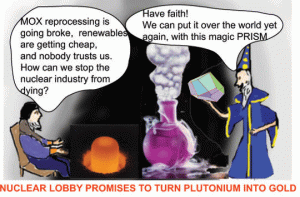 Liquid metal fast reactors (PRISM)
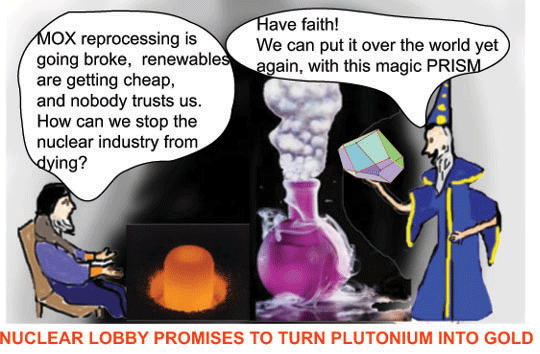
It is claimed by proponents that fast reactors will be safe, economically competitive, proliferation-resistant and sustainable.
They will be fueled by plutonium or highly enriched uranium and cooled by either liquid sodium or a lead-bismuth molten coolant. Liquid sodium burns or explodes when exposed to air or water and lead-bismuth is extremely corrosive producing very volatile radioactive elements when irradiated.
Should a crack occur in the reactor complex, liquid sodium would escape, burning or exploding. Without coolant, the plutonium fuel could reach critical mass, triggering a massive nuclear explosion scattering plutonium to the four winds. One-millionth of a gram of plutonium induces cancer and it lasts for 500,000 years. Extraordinarily, claims are made that fast reactors will be so safe they will require no emergency sirens and emergency planning zones can be decreased from ten miles to 1,300 feet.
There are two types of fast reactors: a simple plutonium fueled reactor and a “breeder” in which the plutonium reactor core is surrounded by a blanket of uranium 238 which captures neutrons and converts to plutonium.
The plutonium fuel, obtained from spent reactor fuel will be fissioned and converted to shorter-lived isotopes — caesium and strontium which last 600 years instead of 500,000. Called “transmutation”, the industry claims that this is an excellent way to get rid of plutonium waste. But this is fallacious because only ten per cent fissions, leaving 90 per cent of the plutonium for bomb-making etc.
Three small plutonium fast reactors will be grouped together to form a module and three of these modules will be buried underground. All nine reactors will then be connected to a fully automated central control room operated by only three operators. Potentially then, one operator could simultaneously face a catastrophic situation triggered by the loss of off-site power to one unit at full power, in another shut down for refuelling and in one in start-up mode. There are to be no emergency core cooling systems.
Fast reactors require a massive infrastructure including a reprocessing plant to dissolve radioactive waste fuel rods in nitric acid, chemically removing the plutonium and a fuel fabrication facility to create new fuel rods. A total of 10,160 kilos of plutonium is required to operate a fuel cycle at a fast reactor and just 2.5 kilos is fuel for a nuclear weapon.
Thus fast reactors and breeders will provide extraordinary long-term medical dangers and the perfect situation for nuclear weapons proliferation. Despite this, the industry is clearly trying to market them to many countries including, it seems, Australia.
You can follow Dr Caldicott on Twitter @DrHCaldicott. Click here for Dr Caldicott’s complete curriculum vitae.
Russia’s nuclear-powered ice-breakers lead towards military domination of the Arctic

Russia’s Nuclear-Powered Icebreaker Is a Step Toward Military Domination
The country is fast becoming an icebreaking superpower. BY KYLE MIZOKAMI, SEP 24, 2020 Russia’s newest icebreaker, the  nuclear-powered Arktika, is headed to its new homeport in St. Petersburg, Russia. The ship, painted in the colors of the Russian state flag, will operate north of the Arctic Circle in anticipation of a year-round shipping route across the icy far north. Arktika is part of Moscow’s emerging policy of exploiting a warming arctic region—and protecting its stake in the region from competitors.
- Russia’s first new nuclear-powered icebreaker in decades, Arktika, is joining the country’s large fleet of icebreaking ships.
- Arktika is capable of smashing through ice that’s nearly 10 feet thick.<
- Millions of Russians live above the Arctic Circle, and warming ocean temperatures could create ice-free shortcuts between Asia and Europe.Russia’s newest icebreaker, the nuclear-powered Arktika, is headed to its new homeport in St. Petersburg, Russia. The ship, painted in the colors of the Russian state flag, will operate north of the Arctic Circle in anticipation of a year-round shipping route across the icy far north. Arktika is part of Moscow’s emerging policy of exploiting a warming arctic region—and protecting its stake in the region from competitors.
<Arktika is the first of a new class of nuclear-powered icebreakers. Construction began at the Baltic Shipyards in St. Petersburg in 2012 with a scheduled launch in 2017, but delays pushed the completion back to 2020. This past February, a short circuit damaged one of the ship’s three 300-ton electric motors, disabling one of the three propellers. Russian authorities ordered the ship to continue, however, and the ship is currently moving on just two propellers.
In 2019, Russian President Vladimir Putin announced the country would ultimately have a fleet of 13 icebreakers, the majority of them nuclear-powered. …………..
Iceabreakers like Arktika could also allow Russia to militarily dominate the Northern Sea Route, smashing a route for Russian warships and transports full of Russian Marines. Warming temperatures will mean other countries, such as Canada and the U.S., will likely move to unlock natural resources previously trapped under sheets of sea ice, and Russia will be in a position to threaten oil, gas, and mineral exploration and exploitation…………. https://www.popularmechanics.com/military/navy-ships/a34128219/russia-nuclear-powered-icebreaker-arktika/
Canada to splurge $billions on non-existent small nuclear reactors, ineffective and no use against climate change
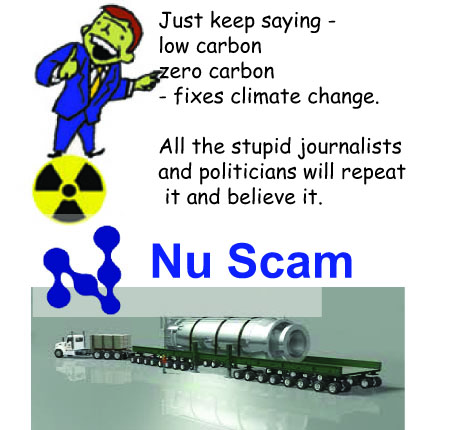 GIBBONS: Nuclear power no solution to climate change https://torontosun.com/opinion/columnists/gibbons-nuclear-power-no-solution-to-climate-change, Author of the article:, Jack Gibbons, Sep 25, 2020 At a time when action on climate change has never been more urgent, the federal Liberals want to throw billions of dollars at non-existent technology that will not make a difference for decades, if ever.
But that’s pretty much the way things have always been when it comes to federal spending on nuclear power: As long as the word “nuclear” is attached, we put common sense aside and fund projects that lead to one dead end after another.
More than $400 million for Advanced CANDU reactors that never got built? You bet. Another $600 million on the infamous Maple medical isotope reactor design, which proved unsafe to operate? No problem.
Now the industry’s latest pitch is Small Modular Reactors (SMRs) and off we go on another wild goose chase with Minister of Natural Resources Seamus O’Regan once again promising billions for technology that is nowhere in sight, let alone use.
Meanwhile, costs for wind and solar have plunged to the point where these energy sources are now outcompeting even natural gas.
Nuclear, for its part, is fading fast. Due to its high costs and safety concerns, nuclear’s share of the world electricity market has cratered in the past two decades. More places are now retiring aging reactors than building them.
The nuclear industry loves to claim they are a critical climate change solution — except on a cost per tonne basis.
Nuclear is like buying a Mercedes to go to the corner store.
Ontario pays as little as two cents a kilowatt hour (kWh) for energy efficient improvements that could displace the need for nuclear while reducing greenhouse gas pollution.
Alberta is now paying around five cents per kWh for solar and four cents for wind.
Ontario Power Generation says it will need to be paid 16.5 cents per kWh for nuclear by 2025.
A whole lot has changed since the bad old days of Ontario’s Green Energy Act.
Yes, the sun doesn’t always shine or the wind blow. Which is why it is fortunate that in Ontario we live beside a giant battery.
Quebec has an enormous water-power reservoir system that Hydro Quebec is keen to integrate with renewable sources for its out-of-province customers.
When we have surplus solar and wind, Quebec stores water. When not, it produces hydro power for export.
We have the connections necessary to make this system work and can expand them at a cost that looks like spare change next to what it costs to rebuild a nuclear reactor or get an SMR prototype built.
The nuclear industry is grasping at straws. Its technology is obsolete, its promises unfulfilled and its costs ever rising.
Betting on nuclear as a climate solution is just sticking our heads in the sand because SMR technology is decades away, extremely expensive, and comes with a nasty pile of security and waste headaches. Yes. Virginia, SMRs still produce lots of highly radioactive waste and we still have no place to put the stuff.
That our government would be this gullible is distressing, especially given the havoc already being wreaked by a changing climate.
We have simple, affordable, reliable and truly clean answers to our climate problem at our fingertips.
Yet our government sits and waits for the nuclear industry to call with some good news. And the phone never rings.
— Jack Gibbons is chairman of the Ontario Clean Air Alliance
Radiation exposure on the moon is nearly three times that on the International Space Station
 Radiation exposure on the moon is nearly three times that on the ISS, 25 September 2020
By Layal Liverpool Astronauts on the moon would face nearly three times more radiation exposure than those aboard the International Space Station, which could make long-term missions riskier than thought.
“Once you’ve survived being on the moon and come back to Earth, radiation damage is what stays with you for the rest of your life and that’s why this is a critical measurement,” says Robert Wimmer-Schweingruber at the University of Kiel in Germany.
Wimmer-Schweingruber and his team analysed several weeks of data acquired by China’s Chang’e … (subscribers only) https://www.newscientist.com/article/2255545-radiation-exposure-on-the-moon-is-nearly-three-times-that-on-the-iss/#ixzz6Z61souv7
Small modular nuclear reactors for Canada? – useless, expensive, untested, and a wasteful distraction
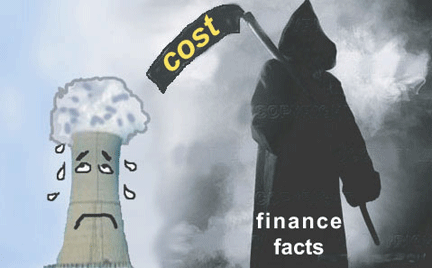 NB Media Co-op 22nd Sept 2020,Premier Blaine Higgs has endorsed so-called “small modular nuclear reactors” or SMRs. SMRs represent an untested technology but what we know on the basis of technical characteristics and historical precedent is that they will be expensive and any electricity they generate will not be economical. The nuclear industry is pushing small reactors because large reactors are simply not economical. Constructing nuclear plants is just too expensive—as Ontario’s government found out after its call in 2008 for bids to build two more reactors at the Darlington site.
https://nbmediacoop.org/2020/09/22/no-business-case-for-new-nuclear-reactors-in-new-brunswick/
Sierra Club Canada (accessed) 23rd Sept 2020, No plan that gets us to net zero in a reasonable time frame includes new nuclear reactors. Nuclear is far too slow and expensive to deal with the climate emergency. Just like fossil fuel energy, nuclear produces wastes that pose unacceptable health hazards and economic costs.Japanese government dangles financial carrot to persuade reluctant communities to take nuclear wastess
 But there is no prospect for the establishment of such a recycling system which would allow for disposing only of the
 waste from reprocessing and recycling.
Eventually, Japan, like most other countries with nuclear power plants, will be forced to map out plans for “direct disposal,” or disposing of spent fuel from nuclear reactors in underground repositories.
Hokkaido Governor Suzuki has taken a dim view of the financial incentive offered to encourage local governments to apply for the first stage of the selection process, criticizing the proposed subsidies as “a wad of cash used as a powerful carrot.”
|
EDITORIAL: Much at stake in picking a final nuclear waste disposal site, http://www.asahi.com/ajw/articles/13749856 21 Sept 20, Two local communities in Hokkaido are considering pitching themselves as candidates for the site for final disposal of highly radioactive waste from nuclear power plants.Last month, the mayor of Suttsu in the northernmost main island said the municipal government is thinking to apply for the first stage of the three-stage process of selecting the site for the nation’s final repository for nuclear waste. During this period, past records about natural disasters and geological conditions for the candidate area are examined. Town authorities are holding meetings with local residents to explain its intentions. In Kamoenai, a village also in Hokkaido, the local chamber of commerce and industry submitted a petition to the local assembly to consider an application for the process. The issue was discussed at an assembly committee. However, the assembly decided to postpone making a decision after further discussion. Both communities are located close to the Tomari nuclear power plant operated by Hokkaido Electric Power Co. and struggling with common rural problems such as a dwindling population and industrial and economic stagnation. The law decrees that when the first stage of the selection process starts, the municipality that is picked will receive up to 2 billion yen ($19.1 million) in state subsidies for two years. But the Ministry of Economy, Trade and Industry and the Nuclear Waste Management Organization of Japan (NUMO), which are in charge of the selection process, have promised it will not move to the second stage if the prefectural governor or local mayor voices an objection. Hokkaido Governor Naomichi Suzuki has already expressed his opposition. A huge amount of spent nuclear fuel has been produced by nuclear plants in Japan, and it needs to be stored and disposed of somewhere in this country. This policy challenge requires a solid consensus among a broad range of people, including residents of cities who have been beneficiaries of electricity generated at nuclear plants. The two Hokkaido municipalities’ moves to consider applying for the first stage of the selection process should be taken as an opportunity for national debate on the issue. The first step should be to establish a system for local communities to discuss the issue thoroughly from a broad perspective. It is crucial to prevent bitter, acrimonious divisions in local communities between supporters and opponents. The central government and other parties involved need to provide whatever information is needed from a fair and neutral position to help create an environment for healthy, in-depth debate. There is also a crucial need to fix the problems with the current plan to build a final repository for radioactive waste. Under the plan, which is based on the assumption that a nuclear fuel recycling system will eventually be established, the repository will be used to store waste to be left after spent nuclear fuel is reprocessed to recover and recycle plutonium and uranium. But there is no prospect for the establishment of such a recycling system which would allow for disposing only of the waste from reprocessing and recycling. Eventually, Japan, like most other countries with nuclear power plants, will be forced to map out plans for “direct disposal,” or disposing of spent fuel from nuclear reactors in underground repositories. The central government has not changed its policy of maintaining nuclear power generation as a major power source. If nuclear reactors keep operating, they will continue producing spent fuel. The government will find it difficult to win local support for the planned repository unless it makes clear what kind of and how much radioactive material will be stored at the site. Many local governments are facing a fiscal crunch partly because of the impact of the COVID-19 pandemic. Hokkaido Governor Suzuki has taken a dim view of the financial incentive offered to encourage local governments to apply for the first stage of the selection process, criticizing the proposed subsidies as “a wad of cash used as a powerful carrot.” It takes tens of thousands of years for the radioactivity of spent nuclear fuel to decline to sufficiently safe levels. Trying to stem local opposition by dangling temporary subsidies could create a serious problem for the future in the communities. It is vital to ensure that the repository plan will secure a long-term policy commitment to the development of the local communities and ensure benefits for the entire areas. September 22, 2020 |
|
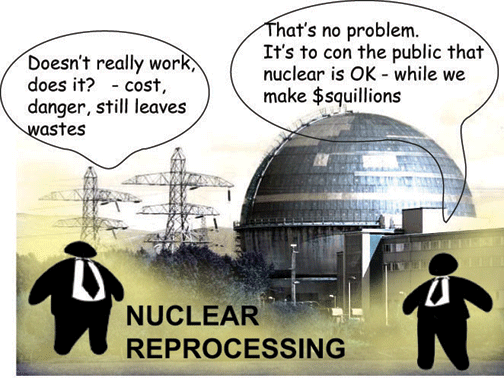
USA.Federal Bill to promote nuclear waste borehole system, and the dubious plan for reprocessing
|
Bill would create new federal research program for nuclear waste disposal
Deep boreholes, fuel reprocessing are on the to-do list of things to investigate, By TERI SFORZA | tsforza@scng.com | Orange County Register September 21, 2020 ”………… A federal bill that would pump a half-billion dollars into America’s long-stalled effort to find a permanent home for nuclear waste, would nudge reprocessing of spent fuel back on the table and prod officials toward big-picture solutions. The Spent Nuclear Fuel Solutions Research and Development Act, by Rep. Mike Levin, D-San Juan Capistrano, would create, among many other things, “an advanced fuel cycle research, development, demonstration, and commercial application program” at the U.S. Department of Energy. The program would be charged with investigating improvements to the fuel cycle, advanced reactor concepts “while minimizing environmental and public health and safety impacts,” and much-needed storage options, from dry casks to deep geological boreholes. Boreholes have long been considered the single best method to isolate nuclear waste for the long haul, but efforts have been plagued by opposition from communities unwilling to be home to the nation’s nuclear waste. ……..
Recycling wasteReprocessing, however, has had a fraught history in the United States. The technology to chemically separate and recover fissionable plutonium from used nuclear fuel was developed after World War II and was an integral part of the nuclear plan in America, according to a Congressional Research Service report. But reprocessing fuel produces material that can easily be used in nuclear bombs, while regular spent fuel does not. After India started showing off its nuclear muscle in the 1970s, America got spooked. President Gerald Ford suspended commercial reprocessing and recycling of plutonium in 1976, concerned that it could fall into the wrong hands. A year later, President Jimmy Carter issued an executive order that etched the policy into stone.
President Ronald Reagan reversed Carter’s order, but the work never really ramped back up. Congress soon passed the Nuclear Waste Policy Act — committing the federal government to accept and store spent commercial nuclear fuel in exchange for payments from the nuclear plant operators — so there wasn’t much more impetus for reprocessing. …….
reprocessing has strong critics. The Union of Concerned Scientists calls it dangerous, dirty, and expensive.
“While some supporters of a U.S. reprocessing program believe it would help solve the nuclear waste problem, reprocessing would not reduce the need for storage and disposal of radioactive waste. Worse, reprocessing would make it easier for terrorists to acquire nuclear weapons materials, and for nations to develop nuclear weapons programs,” the watchdog group says in its primer on the topic. The Blue Ribbon Commission on America’s Nuclear Future rejected calls for reprocessing in 2012, saying “all spent fuel reprocessing or recycle options generate waste streams that require a permanent disposal solution.” “Nuclear waste reprocessing does not benefit the environment — it only benefits the nuclear industry, and then not by much,” said Bart Ziegler, president of the Samuel Lawrence Foundation. “It’s a very financially costly process and lends to more waste effluent.”
David Victor, a UC San Diego professor and chair of a volunteer committee advising on San Onofre’s tear-down, said he sees the bill trying to create a big tent of supporters. Reprocessing wouldn’t make much sense in the U.S. unless there was a huge new demand for nuclear fuel, he said by email…… https://www.ocregister.com/2020/09/21/bill-would-create-new-federal-research-program-for-nuclear-waste-disposal/
|
|
Utah lawmakers seek details on planned nuclear plant in Idaho
Cities and districts invested in the plant have until Oct. 31 — one of several so-called off-ramps — to bow out of the project.
During the committee hearing, Sen. Ron Winterton, R-Roosevelt, shared his concerns over the cities’ financial commitments.
“I want to feel warm and fuzzy” he said, but questioned the technology and potential risks…….
Under both the Obama and the Trump administrations, the NuScale project has received strong financial support, Squires said. The federal energy agency gave NuScale a competitive award of $226 million in 2013 to develop the technology. Two years later, the federal agency gave NuScale $16.7 million for licensing preparation. …….
Critics like the Utah Taxpayers Association, however, say the investment by Utah cities is too risky and they should not be acting as seed investors.
“We are not opposed to nuclear power, we are opposed to the financial risk,” said the association’s vice president, Rusty Cannon. ……….. https://www.deseret.com/utah/2020/9/19/21438026/news-nuclear-plant-in-idaho-lawmakers-seek-details-on-planned-nuscale-uamps
NuScam’s ”small” nuclear reactor design approved – but cost, safety, public acceptance hurdles loom against them

First U.S. Small Nuclear Reactor Design Is Approved, Concerns about costs and safety remain, however, Scientific American  By Dave Levitan on September 9, 2020
- The U.S. Nuclear Regulatory Commission (NRC) has approved the design of a new kind of reactor, known as a small modular reactor (SMR). The design, from the Portland, Ore.–based company NuScale Power, is intended to speed construction, lower cost and improve safety over traditional nuclear reactors…………
- some experts have expressed concerns over the potential expense and remaining safety issues that the industry would have to address before any such reactors are actually built. ………
- The NRC’s design and related final safety evaluation report (FSER) do not mean that the firm can begin constructing reactors. But utility companies can now apply to the NRC to build and operate NuScale’s design. With almost no new nuclear construction completed in the U.S. over the past three decades, SMRs could help reinvigorate a flagging industry.
NuScale’s SMR, developed with the help of almost $300 million from the U.S. Department of Energy, has a generating capacity of 50 megawatts—substantially smaller than standard nuclear reactors, which can range to well more than 1,000 megawatts (MW). A utility could combine up to 12 SMRs at a single site, producing 600 MW of electricity—enough to power a midsize city. The NRC says it expects an application for a 60-MW version of NuScale’s SMR in 2022……….
In a July 2020 report, NRC nuclear engineer Shanlai Lu discussed a complicated issue known as boron dilution, which could possibly cause “fuel failure and prompt criticality condition”—meaning that even if a reactor is shut down, fission reactions could restart and begin a dangerous power increase. And in another report, the NRC’s Advisory Committee on Reactor Safeguards also noted that “several potentially risk-significant items” are not yet completed, though it did still recommend that the NRC issue the FSER. The agency’s response to the latter report stated that those items will be further assessed when site-specific licensing applications—the step needed to actually begin building and operating a reactor—are submitted. ……..
Lyman says that in general, the NRC’s design certification process should reduce uncertainty for utilities aiming to build nuclear plants because they can reference a completed safety review. But he thinks the NuScale approval undermines that advantage. Whether the gaps in safety will result in further delays to NuScale’s time line remains to be seen. The NRC will undertake another review when the company’s 60-MW design is submitted. https://www.scientificamerican.com/article/first-u-s-small-nuclear-reactor-design-is-approved/
Bill Gates and nuclear bigwigs-a conglomerate of propaganda for Small Nuclear Reactors

|
GE Hitachi, TerraPower Team on Nuclear-Storage Hybrid SMR, Power, Sep 3, 2020, by Sonal Patel GE Hitachi Nuclear Energy (GEH) and Bill Gates’ nuclear innovation startup TerraPower are ready to demonstrate a “cost-competitive” advanced nuclear reactor system that will integrate a 345-MWe sodium fast reactor (SFR) with a molten salt energy storage system under a unique energy system architecture. The advanced nuclear technology developed under a joint development agreement is called “Natrium.” It blends the “best of” TerraPower’s Traveling Wave Reactor (TWR) and GEH’s PRISM technology, but it boosts them with “additional innovations and improvements” to ramp up the SFR’s performance and economics and render it competitive in the U.S. and other countries, the companies told POWER on Sept. 2. Because Natrium leverages “the breadth and depth of the team’s expertise and resources”—which takes into account work on multiple reactor designs and efforts across the nuclear lifecycle—the technology has sped “beyond the research and development phase” and is ready for demonstration. “The demonstration plant is designed to be delivered in the next seven years,” TerraPower told POWER on Wednesday. “That means the Natrium technology will be available in the late 2020s,” which would make it one of the world’s first commercial advanced nuclear technologies, it said. …. https://www.powermag.com/ge-hitachi-terrapower-team-on-nuclear-storage-hybrid-smr/ |
|
Fluor could improve its finances by abandoning NuScam, as some cities pull out of ”small” nuclear reactor scheme
 Fluor could improve earnings by reducing underperforming assets, including NuScale
But two cities, Logan and Lehi, Utah have walked away from the project, and a third is now considering dropping its support because of risks and a lack of backers, according to officials.
Allen Johnson, the power department director for Bountiful, Utah, said chances are greater than 50-50 it will withdraw.
“You’ve got to have enough people to support it and some of the players I thought would be interested are not,” he said.
The defections are bad news for U.S. efforts to develop modular nuclear energy …
Combined, cities have so far committed to buying just under 200 megawatts of the plant’s planned 720 megawatts of power.
The U.S. Department of Energy has pumped more the $280 million into the project since 2013, and is expected to commit another $1.4 billion over the next nine years. The department did not respond to requests for comment…….
The consortium earlier this year pushed back the project’s commercial operation date to 2030 from 2026, Webb said, to provide more time for public input and opportunities for cities to reconsider their participation at various phases.
CITIES RETHINK COSTS
NuScale, based in Portland, Oregon, is majority owned by construction and engineering firm Fluor Corp.
The project would include 12 60-megawatt modules at the Energy Department’s Idaho National Laboratory.
The Nuclear Regulatory Commission last week approved NuScale’s design, the first such green light for a modular reactor.
Small modular reactors are meant to be cheaper and quicker to build than traditional reactors because they can be manufactured in factories. But critics say economies of scale are lost with the smaller plants.
The NuScale project’s projected cost of $6.1 billion has risen from $3.6 billion in 2017, Mark Montgomery, head of the municipal utility in Logan told officials there last month ahead of their vote to abandon the project.
Lehi withdrew from the project due to a lack of interest from other entities and increased costs, according to the Aug. 25 resolution approved by its city council.
“These cities should not be acting as venture capital investors,” said Rusty Cannon, vice president of the Utah Taxpayers Association, which has been pushing cities to leave.
Previous cost estimates did not account for financing and decommissioning, as well as higher labor, construction and materials costs over ten years, UAMPS spokesman Webb said, explaining the change.
NuScale said the project delay had been requested by UAMPS. It did not comment specifically on the city defections.
A Wednesday report written by M.V. Ramana a professor of disarmament and human security at the University of British Columbia said Fluor had cut its own investment in the project and excluded NuScale expenses from its financial forecasts because it was expecting additional funding from third party investors.
Financial analyst Jamie Cook of Credit Suisse said last year that Fluor could improve earnings by reducing underperforming assets, including NuScale. ………https://whtc.com/news/articles/2020/sep/02/some-us-cities-turn-against-first-planned-small-scale-nuclear-plant/1054578/
1 This Month



26 September – International Day for the Total Elimination of Nuclear Weapons


PLEASE OPPOSE HR 8255 AND S.3639 – bills would accelerate satellite deployment, with no environmental review or safeguards – https://ncstd5li.quorum.us/campaign/169331/
To see nuclear-related stories in greater depth and intensity – go to https://nuclearinformation.wordpress.com
-
Archives
- September 2026 (257)
- August 2026 (330)
- July 2026 (355)
- June 2026 (287)
- May 2026 (306)
- April 2026 (356)
- March 2026 (251)
- February 2026 (267)
- January 2026 (308)
- December 2025 (358)
- November 2025 (359)
- October 2025 (375)
-
Categories
- 1
- 1 NUCLEAR ISSUES
- business and costs
- climate change
- culture and arts
- ENERGY
- environment
- health
- history
- indigenous issues
- Legal
- marketing of nuclear
- media
- opposition to nuclear
- PERSONAL STORIES
- politics
- politics international
- Religion and ethics
- safety
- secrets,lies and civil liberties
- spinbuster
- technology
- Uranium
- wastes
- weapons and war
- Women
- 2 WORLD
- ACTION
- AFRICA
- Atrocities
- AUSTRALIA
- Christina's notes
- Christina's themes
- culture and arts
- Events
- Fuk 2022
- Fuk 2023
- Fukushima 2017
- Fukushima 2018
- fukushima 2019
- Fukushima 2020
- Fukushima 2021
- general
- global warming
- Humour (God we need it)
- Nuclear
- RARE EARTHS
- Reference
- resources – print
- Resources -audiovicual
- Weekly Newsletter
- World
- World Nuclear
- YouTube
-
RSS
Entries RSS
Comments RSS

