Funds being cut from US Air Force nuclear, space programs
 US Air Force nuclear, space programs take hit in border wall reprogramming, Defense News, WASHINGTON — In the wake of the Pentagon reprogramming $1.5 billion in fiscal 2019 funds to support President Donald Trump’s border wall with Mexico, only the U.S. Air Force appears to be losing money appropriated for equipment updates.
The false hope of “Small Modular Nuclear Reactors” being pushed in Wales

of Everlasting Nuclear Destruction. It is also the Welsh word for fox.
talked about as a possible location for a new, small modular reactor (SMR).
Trawsfynydd reactors are decommissioning now, but very slowly. On
Wikipedia, the page proclaims that the decommissioning is expected to take
“almost 100 years.”
beyond Trawsfynydd. Being described as “small” and “modular” tends
to mask the reality that it is expensive, of little use for climate change,
and likely still far in the future.
false hope, of course, because the likelihood of SMRs coming to fruition is
slim and would provide only a handful of jobs.
https://beyondnuclearinternational.org/2019/05/12/the-fox-we-need-to-guard-this-henhouse/
The vulnerability of nuclear weapons systems to cyber threats

|
Apocalypse now? Cyber threats and nuclear weapons systems, European Leadership Network Julia Berghofer |Policy Fellow and Project Manager for the YGLN, 10 May 19, It is accepted that all states are vulnerable to cyber threats. Yet, a majority of states have yet to develop coherent cyber strategies or implement sufficient preventive measures. Despite the increase in severe cyber incidents directed at national power plants, companies and nuclear-related military equipment, the threat of cyber interference in national nuclear weapons systems is not being properly tackled. With multinational nuclear supply chains and nuclear command and control systems at risk of being compromised, this must be urgently addressed. The more complex, the more vulnerable Governments and legislators are struggling to keep pace with the rapid development of cyber capabilities. As military systems become more technically complex it would be easy to assume that they are more secure. The opposite is true. Increased automation and connectivity increases vulnerabilities to cyber attacks. Measures such as air-gapping a system (ie. de-connecting it from the internet) can fall short. A recent US Government Accountability Office (GAO) report assessed the cyber security of US weapons systems and found “mission critical cyber vulnerabilities in nearly all weapons systems […] under development.“ While the report does not make reference to any specific system type, one can reasonably assume that nuclear weapons systems are vulnerable to cyber attacks.
Cyber attacks can take many forms. Activities range from cyber espionage, data theft, infiltration of nuclear command, control and communications (NC3), denial of service/distributed denial of service (DoS/DDoS) attacks, false alarms (jamming and spoofing), sabotage and physical damage. When directed against nuclear weapons systems, in the worst possible case this may escalate to a deliberate or inadvertent exchange of nuclear weapons. Another area of concern is the supply chain, comprised of any hardware and software components belonging to the nuclear weapons system, including NC3, platforms, delivery systems and warheads. The supply chain usually includes a string of companies and providers located in different countries with varying cyber security standards, which means there is room for manipulation and sabotage. Take, for instance, a computer chip produced in country A. If a vulnerability were inserted at the production stage it could then be remotely activated at a later point when the chip is integrated into the military system of country B. If the attacker happened to be an “insider“ with unlimited access to a military site, compromising military equipment could be easier. This could be done for instance through an infected USB drive when security standards in a military facility happen to be low, leaving the victim of the attack unaware of the manipulation up until it is too late. Limited awareness of cyber risks to nuclear systems There is a lack of awareness within the expert community and among decision-makers and a reluctance by states to implement measures such as common cyber security standards and the sharing of information on vulnerabilities. Among the nuclear weapons states, only in the United States have high-ranking officials, such as Gen. Robert Kehler (ret.) and Air Force Gen. John Hyten (STRATCOM), in two Senate Armed Service Committee hearings in 2013 and 2017 expressed their concerns about a potential cyber attack affecting the U.S. nuclear deterrent. One reason why decision-makers and governments are unwilling to take these steps could be that it seems too unrealistic or improbable a threat, merely belonging to the worlds of science fiction and doomsday scenarios. But there is no reason to assume that the warnings of the GAO, the U.S. 2017 Task Force on Cyber Deterrence or the Nuclear Threat Initiative (NTI) are exaggerated. Certainly, there has not yet been a major cyber attack on a state-run nuclear weapons programme – at least none we have publicly heard of. But there are a string of examples of cyber interference in nuclear installations or parts of the What should decision-makers and policy-makers do? Governments need to grapple with how to handle rapidly developing cyber capabilities. A critical first step is develop a better understanding of the threat…….. https://www.europeanleadershipnetwork.org/commentary/understanding-and-addressing-cyber-threats-to-nuclear-weapons-systems/
|
|


The problematic arrival of Artificial Intelligence for NuclearWeapons

From the A bomb to the AI bomb, nuclear weapons’ problematic evolution, more https://www.france24.com/en/20190510-nuclear-weapons-artificial-intelligence-ai-missiles-bombs-technology-military, France 24 LIVE, Sébastian SEIBTm 10 May 19
From autonomous nuclear submarines to algorithms detecting a threat, to robot-guided high-speed missiles, artificial intelligence could revolutionise nuclear weapons – risking some profound ethical conundrums – a recent report reveals.
At 2:26 A.M. on June 3, 1980, Zbigniew Brezezinski, US President Jimmy Carter’s famously hawkish national security adviser, received a terrifying phone call: 220 Soviet nuclear missiles were heading for the US. A few minutes later, another phone call offered new information: in reality, 2,220 missiles were flying towards the US.
Eventually, as Brezezinski was about to warn Carter of the impending doom, military officials realised that it was a gargantuan false alarm caused by a malfunctioning automated warning system. Thus, the Cold War nearly became an apocalypse because of a computer component not working properly.
This was long before artificial intelligence (AI) rose to prominence. But the Americans and Soviets had already begun to introduce algorithms into their control rooms in order to make their nuclear deterrence more effective. However, several incidents – most notably that of June 3, 1980 – show the disadvantages of using AI.
Novelty implies new vulnerabilities’
Almost forty years on from that near debacle, AI seems to have disappeared from the nuclear debate, even though such algorithms have become ubiquitous at every level of society. But a report by the Stockholm International Peace Research Institute (SIPRI) published on May 6 underlines the importance of this aspect.
The nuclear arms race still poses a considerable threat, seeing as Donald Trump’s America has promised to modernise its arsenal, North Korea seems uninterested in abandoning its nuclear programme, and relations are tense between neighbouring nuclear powers and historical antagonists India and Pakistan.
However, technological breakthroughs in AI show “enormous potential in nuclear power, as in the areas of conventional and cyber weapons”, said Vincent Boulanin, the researcher at SIPRI responsible for the report, in an interview with FRANCE 24. In particular, machine learning is “excellent for data analysis”, Boulanin continued. Such work could play an essential role in intelligence gathering and the detection of cyber attacks.
Russia resurrects Soviet AI system
“In truth, we know very little about the use of AI in nuclear weapons systems at present,” Boulanin admitted. Russia is the only world power to have brought up the issue recently, with President Vladimir Putin announcing in March 2018 the construction of a fully automated nuclear submarine called Poseidon. Furthermore, in 2011 Moscow resurrected and updated the Perimetr system, which uses artificial intelligence to be able (under certain conditions) to detect an atomic bomb by another state. But experts consider these announcements to be lacking in concrete details.
In part, such scepticism stems from the fact that “the adoption of new technologies in the nuclear field tends to be rather slow because novelty implies the possibility of new vulnerabilities”, Boulanin pointed out. Those in control of nuclear weapons programmes prefer to work on outdated computers instead of state-of-the-art technologies that are at risk of being hacked.
Nevertheless, Bounanin continued, it’s only a matter of time before the nuclear powers adopt AI in their weapons systems, considering the enticing prospects of such technology. Its main advantage is that algorithms are an awful lot faster than humans at processing information.
AI could also make guidance systems for missiles more accurate and more flexible, according to Boulanin. “This would be especially useful for high velocity systems that human can’t manoeuvre,” he said. Indeed, several countries are working on prototypes of hypersonic aircraft and missiles able to fly five times faster than the speed of sound. It would be impossible for humans to intervene on the trajectory of such missiles, while AI could correct the aim if necessary.
The dark side of AI in nuclear weapons
There is, however, a very dark side to AI. By nature, it implies the delegation of decision-making from humans to machines – which would carry serious “moral and ethical” implications, noted Page Stoutland, vice-president of the American NGO Nuclear Threat Initiative, which collaborated in the SIPRI report.
On this basis, “the guiding principle of respect for human dignity dictates that machines should generally not be making life-or-death decisions”, argued Frank Sauer, a nuclear weapons specialist at the University of Munich, in the SIRI study. “Countries need to take a clear stance on this” so that they don’t have robotic hands on the red button.
That’s while algorithms are created by humans and, as such, can reinforce the prejudices of their creators. In the US, AI used by the police to prevent reoffending has been shown to be “racist” by several studies. “It is therefore impossible to exclude a risk of inadvertent escalation or at least of instability if the algorithm misinterprets and misrepresents the reality of the situation,” pointed out Jean-Marc Rickli, a researcher at the Geneva Centre for Security Policy, in the SIRI report.
Risk of accidental use
Artificial intelligence also risks upsetting the delicate balance between the nuclear powers, warned Michael Horowitz, a defence specialist at the University of Pennsylvania, in the SIRI study: “An insecure nuclear-armed state would therefore be more likely to automate nuclear early-warning systems, use unmanned nuclear delivery platforms or, due to fear of rapidly losing a conventional war, adopt nuclear launch postures that are more likely to lead to accidental nuclear use or deliberate escalation.” That means that the US – which boasts the world’s largest nuclear stockpile – will be more cautious in adopting AI than a minor nuclear power such as Pakistan.
In short, artificial intelligence is a double-edged sword when applied to nuclear weapons. In certain respects, it could help to make the world safer. But it needs to be adopted “in a responsible way, and people needs to take time to identify the risks associated with AI, as well as pre-emptively solving its problems”, Boulanin concluded.
One sobering comparison might be with the financial services industry. Bankers used the same arguments – the promises of speed and reliability – to introduce AI to the sector as those used by its advocates in the nuclear weapons field. Yet the use of AI in trading rooms has led to some very unpleasant stock market crashes. And of course, nuclear weapons will give AI much more to play with than mere money.
Another nail in the coffin of the ‘integral fast nuclear reactors’ championed by nuclear lobby shills
Jim Green.Nuclear Fuel Cycle Watch South Australia https://www.facebook.com/groups/1021186047913052/– 9 May 19
 Another nail in the coffin of the ‘integral fast reactors’
  championed by Ben Heard, Barry Brook et al.
A decision on the fate of UK’s Plutonium stockpile remains years away. http://corecumbria.co.uk/briefings/a-decision-on-the-fate-of-uks-plutonium-stockpile-remains-years-away/?fbclid=IwAR2yPVluaq70YaoxikF_paOTbJ9BwleBhtGQb6kF0vI2sT4Ae-0M7HIItrE, 6th May 2019 The much delayed update from the Nuclear Decommissioning Authority (NDA) on its plans for dealing with Sellafield’s burgeoning plutonium stockpile was quietly published at the end March 2019 under the title ‘Progress on plutonium consolidation, storage and disposition’. The lack of fanfare for its publication may be attributable to the absence of any major breakthrough in progress since the NDA’s 2014 Position Paper and the subsequent warning given to a Sellafield Stakeholder Group in 2016. Continue reading
NuScale’s 12 Small Modular Nuclear Power units will cost $3 billion
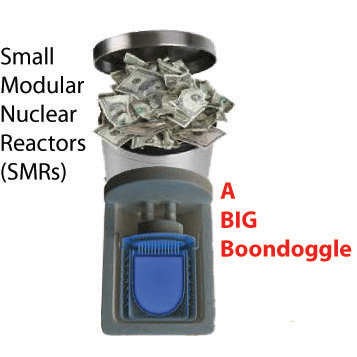 NuScale Gains Potential Financial Backing for Worldwide SMR Deployment, Power , 05/01/2019 | Sonal Patel NuScale Power, the front-runner in the race to commercialize small modular reactors (SMRs), has bagged another major backer that could broaden its nuclear supply chain base and expand its financial standing.
On April 29, NuScale signed a memorandum of understanding (MOU) with Doosan Heavy Industries and Construction (DHIC), a South Korean–based engineering, procurement, and construction contractor with a wide global network, that supports deployment of NuScale’s Power Module worldwide. “The relationship includes DHIC, a member of the Doosan Group, and potential Korean financial investors, which, commensurate to final due diligence, plan to make a cash equity investment in NuScale,” NuScale said on Monday. …..
That project, which is to be built at a 890-square-mile site at the Department of Energy’s (DOE’s) Idaho National Laboratory near Idaho Falls, will feature a plant comprising a dozen 60-MWe modules. NuScale anticipates the first module could be operational by 2026 and full plant would be operational by 2027.
However, NuScale’s design certification application, which it submitted to the the Nuclear Regulatory Commission (NRC) in December 2016 covers 50-MWe modules. The company increased the module’s capacity to 60-MWe in June 2018, citing optimization through advanced testing and modeling tools. The breakthrough would boost the power capacity of the 12-module UAMPs facility from 600 MWe to 720 MWe, it said. ….
According to NuScale, the first 12-module facility, even at 684 MWe (net), could cost up to $3 billion to build. ……https://www.powermag.com/nuscale-gains-potential-financial-backing-for-worldwide-smr-deployment/
Pentagon’s strange and dangerous plan for small nuclear reactors at the battle scene

|
A New Kind of Nuclear War; The Pentagon pushes for fission for fighting, POGO,BY MARK THOMPSON 19 Apr19 “…… the Pentagon wants to build flyable and truckable nuclear-power plants to generate the power U.S. troops need to wage war deep in hostile territory.The concept of micro-nuclear power plants on the battlefield is both inspired and insane. The idea of landing portable nuclear reactors inside a war zone is as outlandish—economically and environmentally—as it sounds.
Yet the Pentagon’s nuclear push didn’t “go critical”—achieve a self-sustaining atomic reaction—on its own. “It is the culmination of a patient, decade-long effort by nuclear lobbyists to interest Defense and its congressional overseers in a costly product—small nuclear reactors—that few in the private sector seem to want,” Edwin Lyman, a senior scientist at the Union of Concerned Scientists, wrote in the Bulletin of the Atomic Scientists in February. “The Pentagon is precisely the savior small nuclear reactor vendors need: deep-pocketed and unbeholden to return-seeking investors.” Beyond that, the Pentagon’s nuclear advocates argue that battlefield nuclear reactors would improve the environment and help jump-start the nuclear-reactor business, creating thousands of well-paying jobs in the process. That meshes with the U.S. nuclear industry’s push to peddle more civilian reactors abroad, including a meeting with President Trump in February. “He really wanted to hear from us on what our views are on how we win the global nuclear energy technology race,” said J. Clay Sell, head of Maryland-based X-energy, an advanced nuclear-reactor company seeking business in Jordan. …. it should come as no surprise that the nuclear industry is pulling out all the stops as it sees climate-change concerns giving it a second lease on life, even as renewable energy (wind, solar, hydroelectric) is now producing more power in the United States. The NEI spends about $2 million annually seeking favors from the federal government. Conveniently, the Trump Administration is seeking to bail out the nuclear industry. The nuclear industry’s push isn’t only in Washington, DC. It’s gaining traction with state legislatures as well, most notably in Pennsylvania, home to Three Mile Island, the site of the most serious nuclear-power plant accident in U.S. history. In the last three years, Exelon, which operates Three Mile Island, has ramped up its lobbying efforts in Pennsylvania, in hopes of boosting taxpayer subsidies. The Pentagon has had a long-standing romance with nuclear power, dating back to Hiroshima and Nagasaki……. the Pentagon is trying to build support for the plan by noting that mini-nukes have heart-warming peaceful uses, too. “A small mobile nuclear reactor would enable a more rapid response during Humanitarian Assistance and Disaster Relief (HADR) operations,” it said earlier this year in a “request for information” seeking outside help to develop portable atomic reactors for war zones……. The Pentagon wants a reactor capable of generating between 1 and 10 megawatts (enough for a base housing at least 1,000 troops for three years without refueling. Weighing no more than 40 tons, it must be “sized for transportability by truck, ship, and C-17 aircraft.” And to avoid the problems posed by water-cooled reactors, it needs to be cooled by “ambient air,” just like the original VW Beetle and its distinctive putt-putt engine…….. The unit will be “semiautonomous—Not requiring manned control by operators to ensure safe operation,” the Pentagon says. Starting it up should take less than three days, and shutting it down should take no more than a week. Their basic design is as simple as nuclear power gets: as the reactor fuel decays, it generates heat that is then turned into electricity. The Pentagon plans on funding up to three designs before tapping a winner from among them. Other nations—Canada, China, and the United Kingdom—are also exploring such small reactors……. Lyman of the Union of Concerned Scientists says the “lobbying push” to build micro-nukes for the U.S. military comes from the U.S. Nuclear Industry Council. The Washington-based trade group says it is “composed of over 80 companies” and “represents the ‘Who’s Who’ of the nuclear energy supply chain community, including key utility movers, technology developers, fuel cycle companies, construction engineers, manufacturers and service providers.” But nuclear insiders also are playing a critical role. Among the authors of that key Defense Science Board report were some atomic heavyweights, including co-chairman Michael Anastasio, the only person to ever run two of the nation’s nuclear labs (he is the former head of Los Alamos in New Mexico, and Lawrence Livermore in California), and William Madia, who served as director of the Oak Ridge National Laboratory in Tennessee, and Pacific Northwest National Laboratory in Washington state. …… There are proliferation risks associated with deploying nuclear reactors amid wars. The 2016 Defense Science Board report suggested that portable nuclear reactors be fueled only with low-enriched uranium that couldn’t be turned into nuclear weapons, although it conceded they would represent “a lucrative target to become a dirty bomb if breached.” The Pentagon’s January 2019 solicitation said that “technology, engineering, and operations must demonstrate minimization of added proliferation risk.” Of course, the U.S. government has been through this before, dating back to President Eisenhower’s “Atoms for Peace” initiative. That led to the first nuclear reactors in Iran and Pakistan. Harnessing nuclear power on the battlefield would require changes in U.S. military training, nuclear regulation and licensing, as well as convincing foreign governments to let them on their soil. …….. Training soldiers to deploy and operate portable nuclear power plants would be challenging, although the Army said in the report, “this requirement is not anticipated to be as demanding as that of a nuclear weapon.” Any Army port-a-nuke “must prevent the reactor from going critical when it should not, such as during movement/transport.” While such a reactor “is not expected to survive a direct kinetic attack,” the Army said it would be designed “for the protection of personnel who may be adversely affected by the system or threats to the system.” Outsiders are dubious. “Even a reactor as small as 1 megawatt-electric would contain a large quantity of highly radioactive, long-lived isotopes such as cesium-137—a potential dirty bomb far bigger than the medical radiation sources that have caused much concern among security experts,” the Union of Concerned Scientists’ Lyman warned in the Bulletin of the Atomic Scientists. “At best a release of radioactivity would be a costly disruption, and at worst it would cause immediate harm to personnel, render the base unusable for years, and alienate the host country.” Any radiation leakage would be far more vexing than the cleanup after dumping about 20 million gallons of Agent Orange and other herbicides on Vietnam from 1961 to 1971. “While design simplification and damage-resistant fuel choices help, detailed planning for cleanup and removal of battle-damaged reactors or reactor components will be expensive and pose some technical challenges to resolve,” the Army report said, likely requiring changes to “existing treaties, international agreements, and policies.” At the end of the day, of course, the big bugaboo is what to do with all that spent, but still dangerous, nuclear fuel. But not to worry: the Army has figured that out, too. “Nuclear fuel is a DOE [Department of Energy] responsibility,” the Army notes. “Issues such as recycling of nuclear fuel or long-term disposal are not DOD’s business.” Perfect. Of course, the Energy Department hasn’t figured out what to do with the 80,000 metric tonsof spent nuclear-reactor fuel created by U.S. commercial reactors over the past half-century. Bottom line: thinking about sending portable nuclear reactors off to war is kind of like invading a country with no plan for how to get out. https://www.pogo.org/analysis/2019/04/a-new-kind-of-nuclear-war/ |
|
Artificial Intelligence Could Solve Nuclear Fusion’s Biggest Problem
|
https://oilprice.com/Energy/Energy-General/Artificial-Intelligence-Could-Solve-Nuclear-Fusions-Biggest-Problem.html
By Irina Slav – Apr 18, 2019, The predictive powers of artificial intelligence could help scientists bring nuclear fusion closer to actually working, researchers from Princeton and Harvard working with the Department of Energy hope.The team, working at the DoE’s Princeton Plasma Physics Laboratory, says they have applied deep learning techniques to computers in order to be able to forecast sudden outages in the reactors used for nuclear fusion that can halt the energy-generating reaction. Nuclear fusion, unlike fission, which is what takes place in traditional reactors, involves smashing particles together and turning them into plasma to generate energy. This takes place in what is called a magnetic fusion machine, or a tokamak. The tokamak produces magnetic fields that keep the superhot plasma inside and keep it moving—and hot—but controlling it for ever-longer periods of time and making it move faster to produce more energy has been a challenge. Many believe we will never be able to make nuclear fusion happen, but researchers are not giving up. Computer technology is a natural ally to scientists in this quest for infinite clean power, but the presence of data to feed into the computers has proved crucial. The Princeton and Harvard scientists used data from two fusion reactors: the Department of Energy’s DIII-D National Fusion Facility in California, operated by General Atomics, and the Joint European Torus tokamak in the UK. What the team learns about predicting outages will be applied to the largest tokamak that is currently in construction in the ITER project in Europe. It may just help solve fusion’s biggest problem: why the particle smashing sometimes stops. If this problem is solved, the world could see a working nuclear reactor in less than 20 years, although many scientists and observers rem |
|
|
Nuclear Transparency Watch warns on the unwisdom of UK government subsidising Small Modular Nuclear Reactors (SMRs)
Small Modular Reactors – of SMRs and ANTs, by Jan Haverkamp http://www.nuclear-transparency-watch.eu/activities/small-modular-reactors-of-smrs-and-ants-by-jan-haverkamp.html
15 April 2019 The debate on Small Modular Reactors continues to warm up. The IAEA recently updated its webpages on the issue. SMRs are currently promoted by parts of the nuclear industry as an answer to the decrease of interest in normal gigawatt (GW)-scale reactors because of economic and technical realities.
Dr. David Lowry thinks it is time for a warning: “This article focuses on the UK, but similar arguments as I brought forward in Bratislava would apply to any other European government confronted with requests for support of this new sector.”
Fluor lays off nuclear workers – those involved in the Advanced Mixed Waste Treatment Project
Fluor Idaho to layoff up to 190 workers, By RYAN SUPPE rsuppe@postregister.com, Apr 9, 2019
Many obstacles to small modular nuclear reactors, but U.S. Nuclear Regulatory Commission recommends them, anyway
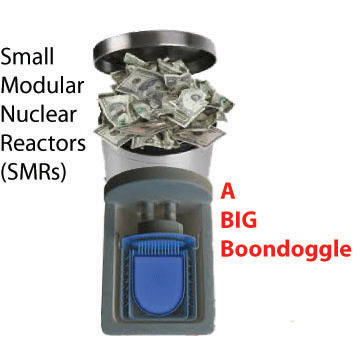 NRC recommends issuing early site permit for Clinch River Nuclear Site, OAK RIDGE TODAY, APRIL 8, 2019BY The U.S. Nuclear Regulatory Commission has issued a final environmental impact statement, and the staff has recommended, based upon the environmental review, issuing an early site permit for the Clinch River Nuclear Site in west Oak Ridge, where two or more small modular nuclear reactors could be built.The final environmental impact statement, or EIS, was issued by the NRC on April 3. A notice of the EIS and the staff’s recommendation were published in the Federal Register on Monday, April 8.
The 935-acre Clinch River Nuclear Site is located in Roane County along the Clinch River……….
An early site permit is the NRC’s approval of a site for one or more nuclear power facilities. It does not authorize the actual construction and operation of a new nuclear power plant. That requires a construction permit and an operating license, or a combined license. ………
The Clinch River Nuclear Site could be used to demonstrate small modular reactors with a maximum total electrical output of 800 megawatts………
Now that the final EIS has been published, there will be a mandatory hearing with the NRC after a final safety evaluation report is issued. The NRC expects that report to be published in June. The five-member commission will make a decision after the hearing about whether to issue the early site permit.
A contested hearing could be held by the Atomic Safety and Licensing Board panel if a member of the public or an organization successfully files a petition that raises safety or environmental concerns about granting the site a permit, the NRC said.
The NRC said an authorization for the construction or operation of new nuclear units at the Clinch River site is not being sought at this time.
The potential timing of any reactors being built at the site is not clear. Among other things, TVA doesn’t control the reactor certification process.
“There are currently no certified small modular reactor designs available, but TVA will continue working to ensure we are ready to fully evaluate them when they are available,” Hopson said.
Financial considerations would have to be evaluated, and the TVA board of directors would have the final decision “based on what they believe will be in the best interest of the people of the Tennessee Valley,” Hopson said.
Since a design hasn’t been certified for a small modular reactor, TVA used what is known as a “plant parameter envelope” as a surrogate for a nuclear power plant and its facilities when applying for the early site permit. The “plant parameter envelope” estimated the potential environmental impacts of building and operating two or more small modular reactors at the site. TVA used information from four small modular reactor vendors to develop the “plant parameter envelope.”
A reader has asked why TVA might consider adding new generating capacity at the Clinch River site even as it plans to retire coal-fired units like the Bull Run Fossil Plant in Claxton, citing flat or declining demand………https://oakridgetoday.com/2019/04/08/nrc-recommends-issuing-early-site-permit-clinch-river-nuclear-site/
Another new nuclear gimmick going way over budget – the “Virtual Test Reactor”
 US nuclear research programme potentially 40% over budget https://www.power-technology.com/news/us-department-
 energy-nuclear-research/, By Jack Unwin, 5 Apr 19,
The US Department of Energy estimates the nuclear versatile test reactor (VTR) research programme could cost between £3.9bn and $6bn, potentially 40% more than the original $3.5bn estimate given by Idaho National Laboratory head Kemal Pasamehmetoglu. The new estimate comes via a freedom of information request placed by the non-governmental organisation (NGO) Union of Concerned Scientists (UCS).
The VTR was originally announced by Energy Secretary Rick Perry in February 2018 as part of the Trump administration’s policy to revitalise the US nuclear industry. The facility is expected to be built by 2025 and would be the first nuclear test reactor built by the Department of Energy (DOE) for decades.
It would be the first of a number of fast reactors, which breed their own fuel and increase the amount of energy produced from uranium compared with light water reactors.
Research for the VTR will be led by Idaho National Laboratory, with General Electric (GE) and Hitachi forming a partnership called GE Hitachi Nuclear to provide support for design and safety of the plant.
UCS also estimate that the VTR would cost between $550-$850m per year for the next seven years compared to the $740m in the 2019 budget for the DOE’s entire nuclear technology development, $65m of which was allocated to VTR.
UCS senior scientist Ed Lyman said: “UCS received documents from a Freedom of Information Act request that contained the DOE’s current “rough order-of-magnitude” cost estimate for the Versatile Test Reactor project of US $3.9-6.0 billion.
“These values assume different cost escalation factors over a roughly seven-year period. I estimate the corresponding unescalated cost to be as much as $5 billion. The reactor isn’t really “over budget” yet, because there was no official cost estimate prior to this.
“UCS has many concerns about this project. First, we don’t generally support the development of fast reactors because of their proliferation and nuclear terrorism risks, so we question the rationale for building this facility. Second, we believe this reactor will not be a reliable test reactor because the design is experimental. Third, there are much cheaper options that the DOE has not adequately explored to provide a source of fast neutrons to reactor developers.
“Given the likelihood that any DOE first-of-a-kind nuclear construction project will experience major delays and cost overruns, the project may well end up costing $10 billion or more. That money could be far better spent on working to improve the safety and security of light-water reactors.”
The DOE has also been approached for comment.
UK and EU agree to continue nuclear fusion project in Britain, despite Brexit
UK and EU agree contract that buys more time for Jet nuclear fusion lab, Chemistry World, An agreement between the UK and European commission will guarantee the future of the Joint European Torus (Jet) nuclear fusion facility in Oxfordshire, regardless of the UK’s Brexit plans.
Both parties have signed an extension to Jet’s contract that secures an additional €100 million (£86 million) of EU funding over the next two years and ensures the continuation of research until the end of 2020. The future of Jet has been uncertain for some time following the result of the UK referendum, especially as, when it leaves the EU, the UK is due to pull out of Euratom – the organisation that coordinates nuclear research around Europe, including work at Jet.
The contract will enable the facility to push ahead with planned fusion tests in 2020, and offers job security for its staff of more than 500. It also contains the option to extend operations until 2024, a measure which may be necessary in the run-up to the new international experimental fusion reactor Iter in southern France, which is planned to open in 2025. 1 APRIL 2019….. https://www.chemistryworld.com/news/uk-and-eu-agree-contract-that-buys-more-time-for-jet-nuclear-fusion-lab-/3010319.article
France’s Orano (formerly bankrupt Areva) to send MOX fuel to Japan
ACROnique of Fukushima 31st March 2019 According to the Asahi , Orano is preparing to send MOx fuel to Japan from
2020. It is intended for the Takahama power plant , operated by Kansai Electric in Fukui province. The previous shipment dates from 2017. There are 32 nuclear assemblies that should sail to Japan. The amount of plutonium contained in these fuels is one tonne.
KEPCo will have yet to repatriate 10 tons of plutonium in the form of MOx fuel to clear its stock.
And Japan must also drastically reduce its stock in order to hope to start its reprocessing plant in Rokkashô mura, which is already 24 years behind schedule . However, only four reactors currently operate with MOx in Japan: Takahama 3 and 4, Genkai-3 and Ikata-3 ( see the state of the Japanese nuclear fleet ).
https://fukushima.eu.org/nouvel-envoi-de-mox-vers-le-japon-en-preparation/
15 USA senators re-introduce bill to promote new nuclear reactors
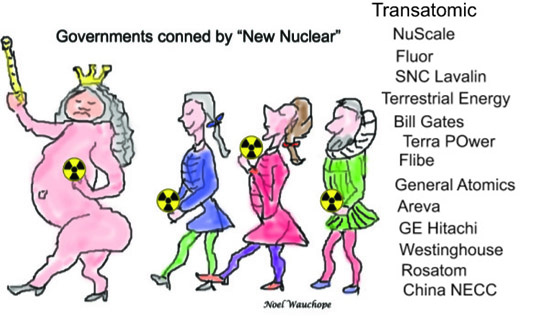
Senate re-introduces bill to help advanced nuclear technology, Legislation was praise by Bill Gates, who has funded an advanced nuclear company. Ars Technica, MEGAN GEUSS – 4/1/2019,
Last week, a bipartisan group of 15 US senators re-introduced a bill to instate the Nuclear Energy Leadership Act (NELA), which would offer incentives and set federal goals for advanced nuclear energy. A smaller group of senators originally introduced the bill in September of last year, but the Congressional session ended before the Senate voted on it.
Specifically, the bill authorizes the federal government to enter into 40-year power purchase agreements (PPAs) with nuclear power companies, as opposed to the 10-year agreements that were previously authorized. Securing a 40-year PPA would essentially guarantee to an advanced nuclear startup that it could sell its power for 40 years, which reduces the uncertainty that might come with building a complex and complicated power source.
……. In addition to supporting a 40-year PPA to improve the economics of advanced nuclear reactor research from the private market, the bill directs the Department of Energy’s Office of Nuclear Energy to develop a 10-year strategic plan to support advanced nuclear reactor research. The DOE must also “construct a fast neutron-capable research facility” if the bill passes, which Senate materials say “is necessary to test important reactor components, demonstrate their safe and reliable operation, and ultimately license advanced reactor concepts.”
The bill also directs the federal government to make available some “high-assay low-enriched uranium” for research and testing in advanced reactors. Traditional light-water reactors use low-enriched uranium in which the active U-235 isotope constitutes 3 to 5 percent of the nuclear fuel, according to the World Nuclear Association. High-assay low-enriched uranium, on the other hand, pushes enrichment levels to about 7 percent of the fuel and, in some cases, can go as high as 20 percent.
Finally, the bill directs the DOE to create “a university nuclear leadership program” to train the next generation of nuclear engineers.
On Thursday, Microsoft mogul Bill Gates tweeted his support for the bill. Gates is currently the chairman for an advanced nuclear reactor company called Terrapower, which is developing a traveling wave reactor that uses depleted uranium as fuel (depleted uranium is a by-product of uranium enrichment). Terrapower suffered a political setback earlier this year, as US rules against sharing nuclear technology with China forced the company to abandon its plans for conducting preliminary trials of its technology in that country.
Gates praised this new bill, writing “I can’t overstate how important this is.”
…….. NuScale Power, a company that has made significant progress toward building a small modular reactor in Idaho, also praised the bill. In a statement to a market research company called The Morning Consult, chief strategy officer of NuScale Power Chris Colbert said that “the bill would ‘absolutely’ make it easier and more certain to reach deployment.” https://arstechnica.com/science/2019/03/senate-re-introduces-bill-to-help-advanced-nuclear-technology/
1 This Month
29 Jan. Thursday 7-8 p.m. Webinar – World’s Largest Nuclear Station in Port Hope, ON?
To see nuclear-related stories in greater depth and intensity – go to https://nuclearinformation.wordpress.com/



31st January – Challenging the War Machine – a DECLASSIFIED UK SUMMIT


Website of the Week
Now until to February 10, 2026 Radioactive waste storage in France: the debate is finally open! How to participate?
-
Archives
- January 2026 (283)
- December 2025 (358)
- November 2025 (359)
- October 2025 (376)
- September 2025 (258)
- August 2025 (319)
- July 2025 (230)
- June 2025 (348)
- May 2025 (261)
- April 2025 (305)
- March 2025 (319)
- February 2025 (234)
-
Categories
- 1
- 1 NUCLEAR ISSUES
- business and costs
- climate change
- culture and arts
- ENERGY
- environment
- health
- history
- indigenous issues
- Legal
- marketing of nuclear
- media
- opposition to nuclear
- PERSONAL STORIES
- politics
- politics international
- Religion and ethics
- safety
- secrets,lies and civil liberties
- spinbuster
- technology
- Uranium
- wastes
- weapons and war
- Women
- 2 WORLD
- ACTION
- AFRICA
- Atrocities
- AUSTRALIA
- Christina's notes
- Christina's themes
- culture and arts
- Events
- Fuk 2022
- Fuk 2023
- Fukushima 2017
- Fukushima 2018
- fukushima 2019
- Fukushima 2020
- Fukushima 2021
- general
- global warming
- Humour (God we need it)
- Nuclear
- RARE EARTHS
- Reference
- resources – print
- Resources -audiovicual
- Weekly Newsletter
- World
- World Nuclear
- YouTube
-
RSS
Entries RSS
Comments RSS
 nuclear-news