To resuscitate the nuclear industry, USA Dept of Energy promotes yet another gimmick The Versatile Test Reactor

Energy Department wants to build nuclear test “fast” reactor, BOISE, Idaho (AP) — A new nuclear test reactor is needed as part of an effort to revamp the nation’s fading nuclear power industry by developing safer fuel and power plants, the U.S. Department of Energy said Monday.
The federal agency said it will prepare an environmental impact statement as part of the process to build the test reactor in Idaho or Tennessee by the end of 2025. Public comments on the environmental review are being taken through Sept. 4.
The Energy Department had a fast reactor, the Experimental Breeder Reactor II, operating in eastern Idaho until it was shut down in 1994 as the nation turned away from nuclear power.
Edwin Lyman, senior scientist and acting director of the Nuclear Safety Project at the Union of Concerned Scientists, a nonprofit, said fast reactors such as the proposed Versatile Test Reactor are less safe than current reactors.
Most nuclear reactors in use now are “light-water” reactors fueled by uranium and cooled with water. Lyman said the test reactor will be cooled with harder to control liquid sodium and likely fueled by plutonium, increasing potential nuclear terrorism risks because plutonium can be used to make nuclear weapons.
“There is nothing good about these reactors,” he said. “I think there is a love of plutonium in the (Energy) Department that is irrational.”…….
Reducing spent nuclear fuel, federal officials say, is also an objective of the new test reactor. The U.S. has no permanent repository for about 77,000 tons (70,000 metric tons) of radioactive spent fuel, stored mainly at the commercial nuclear power plants where they were used to produce electricity.
But Lyman said fast reactors would produce waste even more hazardous and difficult to dispose…….
The Energy Department is considering building the test reactor at the Idaho National Laboratory in eastern Idaho or the Oak Ridge National Laboratory in eastern Tennessee. …….. https://apnews.com/64194c2125ad4dc6add67d412e9024c5
Major problem for astronauts – radiation damages mood and memory?

|
Long-Term Radiation Exposure From Space Travel Harms Memory, Mood, D-brief,
Researchers also know that short, powerful doses of radiation are deadly. But less is known about long-term, low-dose radiation — the kind that settlers on Mars or the moon would face. Now, a team of scientists led by Charles Limoli at the University of California, Irvine, has taken a step toward a better understanding of those long-term risks. The researchers exposed mice to chronic, low-dose radiation for six months. The results are troubling for the future of spaceflight. The radiation left the mice suffering from both memory and mood problems that the scientists say would likely show up in human subjects as well. The results were published Monday in the journal eNeuro. Radiation on the BrainIn the study, the mice showed “severe impairments in learning and memory,” according to the research paper. The mice were also generally more stressed out by their environments. That isn’t a good sign for space settlers, who will need their wits to face unforeseen struggles. Other studies have also already shown the potential ill effects of the long-term isolation and stress. In the past, scientists hit lab mice with radiation levels some 100,000 times higher than they’d actually experience on Mars’ surface. But the researchers say their test is the first that has used these lower, more realistic doses of radiation over long periods to study space travel. Their efforts were made possible by a new facility. The radiation included both neutrons – heavy particles from atomic nuclei – and pure energy in the form of gamma rays and other scattered photons…… Researchers found both physical and chemical changes in the brains they examined, in addition to the behavioral changes they observed in the living mice…….. more tests need to be done, and the radiation, while more realistic than past experiments, still doesn’t exactly mimic the space environment. But if their results hold up, they’re not a good sign for the future of human space settlement, at least not without a lot of bulky and expensive radiation shielding. http://blogs.discovermagazine.com/d-brief/2019/08/05/long-term-radiation-exposure-from-space-travel-harms-memory-mood/#.XUionm8zbIU |
|
NuScale’s Small Modular Nuclear power is too risky

NuScale nuclear power is too risky, [artist’s model above] https://www.sltrib.com/opinion/letters/2019/08/04/letter-nuscale-nuclear/ By Robert Goodman | The Public Forum, 4 Aug 19, NuScale’s nuclear power project is too much of a financial and environmental risk when there are cleaner energy alternatives.
Not only will NuScale’s virtually untested nuclear technology be an estimated 40% more costly than renewable energy portfolios, the project in Idaho Falls, Idaho, will also likely go exceedingly over budget.
Many recent nuclear projects nationwide have resulted in extreme cost overruns and project cancellations, the burden of which has often fallen on ratepayers. For instance, ratepayers in South Carolina will end up owing more than $6,000, to be paid in monthly installments for the next four decades for a failed nuclear power plant. And just this year, the Department of Energy gave $3.7 billion in taxpayer money to the ailing Southern Co.’s nuclear power project near Waynesboro, Ga.
Yes, UAMPS has promised a rate cap in order to protect ratepayers. But if the new, first-of-a-kind project goes over budget, will that rate cap stay? Will NuScale Power, an Oregon-based LLC, step up and pay the extra expense?
City officials in UAMPS districts should look beyond NuScale Power’s promotional presentations and consider economically competitive, safer and more sustainable energy portfolios through a more transparent, independent and robust procurement process.
Jolly propaganda about plutonium fuelling spacecraft
 I do love the way that they trivialise the danger and massive tax-payer expense involved in the production and use of plutonium, for Mars travel etc.
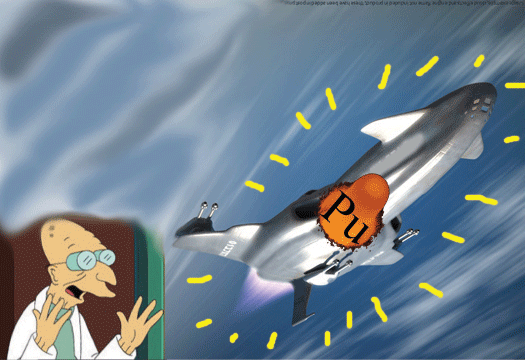 NASA’s Mars 2020 rover is fueling up for the Red Planet. NASA’s next spacecraft on Mars is getting a nuclear battery to do science on the Red Planet.
The Mars 2020 rover will soon be fueled using a multi-mission radioisotope thermoelectric generator, which is essentially a battery to keep it warm and productive on its mission in search of signs of habitability on Mars.
Mars 2020 isn’t alone in using nuclear power, as a host of other NASA spacecraft — 27 in all — have also used nuclear power. Some examples include the Voyager missions in interstellar space, the New Horizons mission that went past Pluto, and Curiosity — Mars 2020’s predecessor rover on the Red Planet.
Production of plutonium-238 — a radioactive isotope of plutonium that will fuel the Mars 2020 rover — was stopped for awhile in the U.S. in the late 1980s, then restarted in 2011 in a joint effort between NASA and the Department of Energy. The isotope is the main source of energy for spacecraft that cannot rely on solar power, usually because the craft is too far from the sun, or on a world where the sunlight is too weak to generate enough power.
A 2017 report from the Government Accountability Office said that there was enough plutonium-238 in stockpiles at that time for space missions planned through the 2020s. There were, however, long-term issues with plutonium-238 production, including reactor availability, technical matters with chemical processing, and workforce hiring and training. In 2018, citing progress with stockpile management, NASA said plutonium would be available for its next Discovery-class mission, which will announce Step 1 selections in 2020 and the final selections in 2021…….. https://www.space.com/mars-2020-rover-nuclear-battery-fueled-up.html
A damning new report on the unlikely future for Small Modular Nuclear Reactors (SMRs)
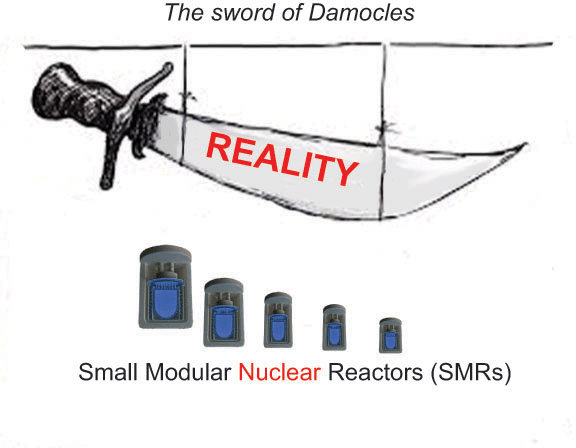 NFLA support joint report with the Nuclear Consulting Group which looks at the prospects of Small Modular Nuclear Reactors in the UK and globally and concludes they will not be built to any significant scale http://www.nuclearpolicy.info/news/nfla-joint-ncg-report-on-smrs/ 25 Jul 19
The Nuclear Free Local Authorities (NFLA) welcomes cooperating with the Nuclear Consulting Group (NCG) in its development of one of the most detailed analyses of the technologies being developed to create small modular nuclear reactors (SMRs) in the UK and around the world. This report concludes there remains fundamental barriers to any significant development of this new nuclear technology, and its prospects for creating some kind of ‘nuclear renaissance’ are unlikely to be realised.
The report has been developed by Professor Stephen Thomas of Greenwich University, Dr Paul Dorfman of University College London and NCG Founder, Professor M V Ramana of British Columbia University, and the NFLA Secretary. (1) The global nuclear industry has put forward SMRs as a panacea to the problems of high cost and the difficulty of financing large nuclear reactors; a ready-made alternative that can fill the gap.
However, as the NCG / NFLA report outlines in detail, there are huge obstacles to overcome. Some of these are technical issues, others are around building up an effective supply chain, while the financing of such schemes will only be possible with significant and large subsidy from the public purse.
The report starts with considering the failures in delivering larger nuclear reactors, and then takes in turn each type of SMR technology that has been put forward by companies involved in the nuclear industry.
The report outlines in some detail UK Government policy on SMRs. It notes that after some considerable early promotion of the technology, interest has markedly cooled, despite another fairly limited amount of money being offered to develop the technology, announced earlier this week. (2) The report notes the extraordinary set of conditions set out by Rolls Royce to be met by the UK Government if it is to invest significant amounts of money in its own SMR design, which the authors argue could and should not be committed to at a time when serious doubts remain about the economic viability of the technology.
At a global level, the report concludes that, as with the much-heralded ‘nuclear renaissance’ of recent times, SMRs will not be built in any significant scale. The authors note that the two main rationales for SMRs – promised lower overall project costs and lowering the risk of cost overruns by shifting to an assembly line approach – are more than offset by the loss of scale economies that the nuclear industry has pursued for the past five decades. Indeed, many of the features of the SMRs being developed are the same ones that underpinned the latest, failed generation of large reactors. Reactor cost estimates will remain with a large degree of uncertainty until a comprehensive review by national nuclear regulators is completed, the design features are finalised and demonstration plants are built. Whether the economies claimed from the use of production line techniques can be achieved will only be known if reactors are built in very large numbers, and at significant cost.
Spending so much time and effort pursuing such an uncertain technology, at a time when the ‘climate emergency’ has now reached the political and public lexicon in requiring urgent attention, does not appear to be an effective use of taxpayer resources. Abundant evidence shows that renewable energy supply, storage, distribution and management technologies are being developed ever cheaper and swifter at a time when real urgency is required across society and government to mitigate the worst effects of climate change. SMRs are no answer to creating low-carbon economies by 2030 or close to that date. Governments should consider this report carefully and not be diverted by an unproven technology inherent with many difficult issues still to overcome.
In the overall view of the report authors, the prospects for SMRs in the UK and Worldwide are limited and not worth the huge levels of effort or finance being proposed for them.
NFLA Steering Committee Chair Councillor David Blackburn said:
“This excellent independent analysis on the prospects for small modular nuclear reactors needs to be read by the new Business Secretary Andrea Leadsom and senior civil servants in the UK Government who have been providing support to the development of small modular nuclear reactors. It is clear from this joint report between the NCG and the NFLA that this technology is not the panacea to kick start new nuclear reactors, far from it. As Councils around the country declare ‘climate emergencies’ it is clear from this report that scarce available resource should not be spent developing this technology but rather diverted into renewable energy, smart energy, energy efficiency and energy storage projects instead. As large new nuclear like at Moorside and Wylfa has failed to be realised, it is time now to move away from small nuclear reactors as an expensive sideshow to the critical needs of mitigating carbon.”
Report co-author Professor Steve Thomas added:
“Nuclear proponents are saying that SMRs will be the next big thing – but the reality is they are as expensive as large reactors, produce the same waste, carry the same radiation risks, and are a long way from any real deployment.”
Ends – for more information please contact Sean Morris, NFLA Secretary, on 00 44 (0)161 234 3244.
Notes for editors:
(1) NCG / NFLA report – Prospects for Small Modular Reactors in the UK and Worldwide, July 2019
http://www.nuclearpolicy.info/wp/wp-content/uploads/2019/07/Prospects-for-SMRs-report-2.pdf
(2) Energy Live News, Government mulls investing £18 million to develop UK’s first mini nuclear reactor, 23rd July 2019 https://www.energylivenews.com/2019/07/23/government-mulls-investing-18m-to-develop-uks-first-mini-nuclear-reactor/
UK government commits to ordering mini nuclear reactors from Rolls Royce
 Rolls-Royce gets government commitment for mini nuclear reactors UK aero-engine maker seeks to spearhead development of export-led industry https://www.ft.com/content/32ee2100-ad43-11e9-8030-530adfa879c2 Sylvia Pfeifer in London, 24 July 19,
Although the initial commitment is just £18m, it will allow the consortium to mature the design of the reactors. The move, which is subject to a final sign-off, would still require significant levels of additional investment before the reactors can become a commercial reality. The UK aero-engine maker has long argued that its technology in this sphere should be regarded as a “national endeavour” to develop nuclear skills that can be used to create an export-led industry.
A consortium spokesperson said on Tuesday that the £18m investment would be used to “mature the design, address the considerable manufacturing technology requirements and to progress the regulatory licensing process”. He added: “We believe with early co-investment by the government, this power station design is a compelling commercial opportunity.”
Rolls-Royce and its team, which includes Laing O’Rourke and Arup, was one of several consortiums that bid in an initial government-sponsored competition launched in 2015 to find the most viable technology for a new generation of small nuclear modular reactors (SMRs). Most of these will not be commercial until the 2030s
Supporters argue that they can deliver nuclear power at lower cost and reduced risk. They will draw on modular manufacturing techniques that will reduce construction risk, which has plagued larger-scale projects. However, when a nuclear sector deal was finally unveiled last June, the government allocated funding only for more advanced modular reactors.
MRs, which typically use water-cooled reactors similar to existing nuclear power stations, were omitted from funding even though they were closer to becoming commercial. Rolls-Royce threatened last summer that it would shut down the project if there was no meaningful support from the government.
Ministers have in recent months scrambled to recast Britain’s energy policy after the collapse of plans to build several large reactors and on Monday evening published proposals to finance new nuclear plants by having taxpayers pay upfront through their energy bills. The government added that, as part of its plans to fund advanced nuclear technologies, it would make an “initial award” of up to £18m under the industrial strategy challenge fund to the Rolls-Royce-led consortium in the autumn. The consortium has said any government funding will be matched in part by contributions from the companies as well as by raising funds from third-party organisations.
Hinkley Pt nuclear station’s cooling system will mean massacres of fish

 Times 20th July 2019 Nuclear power plant will suck fish to their deaths, The Times, Ben Webster,, Oceans Correspondent, July 20 2019 It has been described as a giant plughole under the sea, sucking in 130,000 litres of water a second along with vast numbers of fish. The twin inlet tunnels stretching two miles out into the Severn estuary are so big that a Times 20th July 2019 Nuclear power plant will suck fish to their deaths, The Times, Ben Webster,, Oceans Correspondent, July 20 2019 It has been described as a giant plughole under the sea, sucking in 130,000 litres of water a second along with vast numbers of fish. The twin inlet tunnels stretching two miles out into the Severn estuary are so big that adouble-decker bus could drive through them. The system will cool a new
nuclear power station being built at Hinkley Point in Somerset but conservation groups say it will kill up to 250,000 fish a day and must be altered or scrapped. They say that EDF, the French state-owned energy group, has grossly underestimated the system’s impact on marine life in the estuary, a special conservation area. A 5mm mesh will be installed to
prevent larger fish being swallowed but the groups, including the Blue Marine Foundation, Wildfowl & Wetlands Trust and Somerset Wildlife Trust, say many fish will be fatally injured when pressed against it. Small fish, eels and the fry of many species, such as salmon, whiting and cod, will be sucked through the mesh and into the cooling system. The groups say it
could damage the population of twaite shad in the UK, a small herring-like fish that used to spawn in the estuary by the millions but has dwindled to tens of thousands. EDF says the system will kill about 650,000 fish a year.
It has asked to vary its original permits and planning permission for the power station to allow it to remove an “acoustic fish deterrent” from the cooling system. It argues that, even without it, the impact of the system on fish populations will still be “negligible”. EDF says fish will be adequately protected by other measures, one which will slow the water entering the system and another which will return to the sea the fish sucked in. Conservation groups argue that scientific analysis they obtained
of the cooling system shows far greater harm to marine life. This analysis is partly based on measurements of fish swallowed by the cooling system of Hinkley Point B, a nearby nuclear power station which consumes a quarter of the sea water that will be extracted to cool Hinkley C. They want the
government to reject EDF’s application and, if the company cannot mitigate the damage, force it to use other ways to cool the station, such as cooling towers or ponds. James Robinson, of the Wildfowl & Wetlands Trust, said:
“The authorities must decide if it’s worth building a giant plughole to suck millions of sea animals to their deaths, in one of our most important protected marine areas, in order to produce electricity.” Charles Clover, director of Blue Marine Foundation, said the groups would also challenge plans by EDF for a similar system at its proposed new nuclear power station at Sizewell in Suffolk. https://www.thetimes.co.uk/article/e0c7e83e-aa68-11e9-89e4-5e7e89de8df9 |
|
|
Small Modular Nuclear Reactors – at least 10 years away – Canadian Nuclear Association
 Mini-nuclear power plants at least 10 years out: Canadian Nuclear Association, The Post Millennial Jason Unrau, 21July 19, Mini-nuclear power plants at least 10 years out: Canadian Nuclear Association, The Post Millennial Jason Unrau, 21July 19,
|
|
|
New type of nuclear fusion plan, but the reality is as far away as ever

Skunk Works’ Exotic Fusion Reactor Program Moves Forward With Larger, More Powerful DesignThis will be the company’s fifth major design iteration as it pushes ahead toward building a potentially revolutionary practical prototype. The Drive, BY JOSEPH TREVITHICK, JULY 19, 2019, Lockheed Martin’s Skunk Works is building a new, more capable test reactor as it continues to move ahead with its ambitious Compact Fusion Reactor program, or CFR. Despite slower than expected progress, the company remains confident the project can produce practical results, which would completely transform how power gets generated for both military and civilian purposes……
Since then, teams in various countries have built functional fusion reactors, but they remain large, inefficient, and expensive. Last year, China touted progress on its Experimental Advanced Superconducting Tokamak (EAST), but without highlighting that this reactor is situated inside a two-story building within the Dongpu Science Island, a large research campus on a lakeshore peninsula in China’s Anhui Province. An international consortium also hopes to have the International Thermonuclear Experimental Reactor (ITER) up and running in France in 2021, but this reactor will weigh approximately 23,000 tons.
Unfortunately, despite the progress that Skunk Works has made, many questions remain about whether its new reactor concept will be able to succeed whether other designs have failed. Lockheed Martin has initially suggested it might have a viable prototype ready this year or the next.
By 2017, that schedule had gotten pushed back to sometime in the mid-2020s. In his interview with Aviation Week, Babione did not offer any more of a specific timeline for when a practical reactor, which the company refers to as TX, might be ready……. https://www.thedrive.com/the-war-zone/29074/skunk-works-exotic-fusion-reactor-program-moves-forward-with-larger-more-powerful-design?fbclid=IwAR3KPPiShDzNPTS-Zz3XHjhC8QjyBE3S0Ymlc2sgdg0BL7NrJAmt-KLusZg
Utah communities sign on, rather cautiously, to buy NuScale’s Small Modular Nuclear Reactors

 communities in Utah and elsewhere have agreed to purchase nuclear power from a small modular reactor planned at the Idaho National Laboratory, triggering a next phase in its development.
America’s original moon plan was to explode a nuclear bomb on the moon

Landing on the Moon was option B.
Option A was to detonate a nuke on it.
In the late 1950s, Washington set in place a secret operation to examine the feasibility of detonating a thermonuclear device on the surface of our closest celestial neighbour.
It was codenamed Project A119.
Had it gone ahead, the expression “shooting for the Moon” would have gained a whole new meaning.
A spectacular scheme born of desperationWhat might now seem unimaginable only makes sense in the context of the Cold War, historian Vince Houghton says……..
The West was given a shock with the launch of Sputnik and very quickly the US Government flew into action and said we need to do something very spectacular,” Dr Houghton says.
“We need to do something so big that the whole world will know that this was just an anomaly, that Sputnik was just a blip, that the United States was still the big kid on the block.”
And with that, Project A119 was born.
One hell of a mushroom
The idea behind the project was ambitious, but simple — to create an explosion and lunar mushroom cloud so awe-inspiring and unavoidable that no matter where you lived on planet Earth, it would be impossible to ignore the extent of America’s military and technological might.
Appointed to lead the project was a physicist named Leonard Reiffel, who later went on to become the deputy director of the Apollo Program at NASA.
Dr Houghton says when delivering the initial findings in June 1959, cost was among the major reasons why the project was scuttled.
But he says there were also concerns about damaging the lunar landscape.
“There were some scientists who said: ‘You know, we might want to walk up there some day. Maybe we don’t want to blow the hell out of it before we do,'” he says.
“But, again, Sputnik was so terrifying that a lot of people were willing to take that chance.
“A lot of people were willing to say: ‘You know what? The Moon’s big enough that we can nuke it and land on it at the same time, so let’s give this a shot.'”
The big bang that fizzed
Dr Reiffel’s secret report into the feasibility of a lunar detonation was eventually declassified in 2000.
It carried a rather innocuous title: A Study of Lunar Research Flights.
It suggested that detonating a nuclear device on the Moon was technically feasible, but it gave no substantive detail as to how it might be done.
The project never proceeded to operational phase.
Interviewed by The Guardian shortly after the report’s declassification, Dr Reiffel expressed his personal relief.
“I am horrified that such a gesture to sway public opinion was ever considered,” he said.
“Had the project been made public there would have been an outcry.
“I made it clear at the time there would be a huge cost to science of destroying a pristine lunar environment, but the US Air Force were mainly concerned about how the nuclear explosion would play on Earth.”
Dr Houghton says it’s important to view Project A119 in its historical context.
He details the operation in a new book called Nuking the Moon, which examines a whole slate of radical intelligence projects that were set in motion during WWII and the Cold War, but which were never carried out……… https://www.abc.net.au/news/2019-07-17/moon-us-plans-cold-war-russia-sputnik/11220340
Future space travellers will be, in reality, radiation guinea pigs
 Space radiation hasn’t contributed to astronaut mortality — yet, study shows
An analysis of all living and dead astronauts and cosmonauts shows that radiation hasn’t contributed meaningfully to their mortality rates. Astronomy, By Korey Haynes , July 5, 2019 “ ………… they found no trend in the deaths suggesting any common cause, meaning radiation didn’t play a major role in the health outcomes of the astronauts and cosmonauts they studied.
Of course, this doesn’t mean humans are in the clear.
“We would expect that at some level of dose there should be adverse health effects,” Reynolds says. “We keep getting the answer ‘no.’ This doesn’t mean radiation isn’t harmful or greater doses wouldn’t be. But so far the doses have been low enough that we don’t see anything.”
That’s probably because the vast majority of space farers so far have spent most or all of their time in Earth orbit, where Earth’s magnetic fields still protect them from the majority of harmful space radiation. Only those 24 astronauts who ventured to the Moon went beyond Earth’s radiation protection, and they stayed for just a few days.
Reynolds says that it’s difficult to draw meaningful results from that tiny sub-sample of people.
By contrast, a Mars mission might last multiple years, and would take place almost entirely beyond Earth’s shielding.
Other researchers are looking at alternative ways of testing the dangers of radiation exposure. But it’s possible that the next round of human space explorers will be guinea pigs, much like the first generation, and only time will tell how radiation has affected them.http://www.astronomy.com/news/2019/07/space-radiation-hasnt-contributed-to-astronaut-mortality–yet-study-shows
A heightened solar cycle, by chance, reduced the exposure of Apollo astronauts to space radiation
The term “radiation” is used to describe energy that is emitted in the form of electromagnetic waves and/or particles. Humans can perceive some forms of electromagnetic radiation: visible light can be seen and infrared radiation (heat) can be felt.
Meanwhile, other varieties of radiation such as radio waves, X-rays and gamma rays are not visible and require special equipment to be observed. Worryingly, when high energy (ionising) radiation encounters matter, it can cause changes at the atomic level, including in our bodies.
There are a several sources of ionising radiation in space. The sun continuously pours out electromagnetic radiation across all wavelengths – especially as visible, infrared and ultraviolet radiation. Occasionally, enormous explosions on the solar surface known as solar flares release massive amounts of X-rays and gamma rays into space, as well as energetic electrons and protons (which make up the atomic nucleus along with neutrons). These events can pose a hazard to astronauts and their equipment even at distances as far from the sun as Earth, the moon and Mars.
Potentially dangerous radiation in space also originates from outside our solar system. Galactic cosmic rays are high energy, electrically charged atomic fragments that travel at nearly the speed of light and arrive from all directions in space.
On Earth, we are protected from most of this ionising radiation. The Earth’s strong magnetic field forms the magnetosphere, a protective bubble that diverts most dangerous radiation away, while the Earth’s thick atmosphere absorbs the rest.
But above the atmosphere, the magnetosphere traps energetic subatomic particles in two radiation regions. These “Van Allen belts” comprise an inner and outer torus of electrically charged particles.
Lucky escape
So how did NASA solve the problem of crossing the Van Allen belts? The short answer is they didn’t. To get to the moon, a spacecraft needs to be travelling quickly to climb far enough away from the Earth such that it can be captured by the moon’s gravity. The trans-lunar orbit that the Apollo spacecraft followed from the Earth to the moon took them through the inner and outer belts in just a few hours.
Although the aluminium skin of the Apollo spacecraft needed to be thin to be lightweight, it would have offered some protection. Models of the radiation belts developed in the run-up to the Apollo flights indicated that the passage through the radiation belts would not pose a significant threat to astronaut health. And, sure enough, documents from the period show that monitoring badges worn by the crews and analysed after the missions indicated that the astronauts typically received doses roughly less than that received during a standard CT scan of your chest.
But that is not the end of the story. To get to the moon and safely back home, the Apollo astronauts not only had to cross the Van Allen belts, but also the quarter of a million miles between the Earth and the moon – a flight that typically took around three days each way.
They also needed to operate safely while in orbit around the moon and on the lunar surface. During the Apollo missions, the spacecraft were outside the Earth’s protective magnetosphere for most of their flight. As such, they and their crews were vulnerable to unpredictable solar flares and events and the steady flux of galactic cosmic rays.
The crewed Apollo flights actually coincided with the height of a solar cycle, the periodic waxing and waning of activity that occurs every 11 years. Given that solar flares and solar energetic particle events are more common during times of heightened solar activity, this might seem like a cavalier approach to astronaut safety.
There is no doubt that the political imperative in the 1960s to put US astronauts on the moon “in this decade” was the primary driving factor in the mission timing, but there are counterintuitive benefits to spaceflight during solar activity maxima. The increased strength of the sun’s magnetic field that permeates the solar system acts like an umbrella – shielding the Earth, moon and planets from galactic cosmic rays and therefore lessening the impact on astronaut radiation doses. https://theconversation.com/space-radiation-the-apollo-crews-were-extremely-lucky-120339
Bill Gates now glum about the prospects for his nuclear power company TerraPower

Bill Gates faces “daunting” nuclear energy future, Amy Harder AXIOX 15 July 19 ,The optimism usually radiating from billionaire Bill Gates when it comes to climate change is starting to fade on one of his biggest technology bets: nuclear power.
Driving the news: The Microsoft co-founder has focused much of his time lately on climate change and energy innovation. In an exclusive interview with Axios, Gates said that setbacks he is facing with TerraPower, a nuclear technology firm he co-founded in 2006, has got him questioning the future of that entire energy source.
……It’s declining in most places around the world, including the U.S., due to aging reactors, cheaper energy alternatives and public unease about radioactive risk ……
- The industry’s future is riding on largely unproven technologies like that of TerraPower because they’re smaller and deemed safer than today’s huge reactors.
“Without this next generation of nuclear, nuclear will go to zero,” Gates said during an interview in Washington last month. Germany is shutting 22 nuclear plants, France — a leader in clean-burning nuclear power — has plans to shut down some of its reactors and a similar trend is underway in the U.S. due to economic conditions, said Gates, before adding with a sigh: “So yes, it is daunting.”
Flashback: Gates announced in December that TerraPower was scrapping plans to build a demonstration reactor in China, largely due to the Trump administration deciding that fall to crack down on technological agreements between the two nations.
“There are times like when TerraPower gets told not to work in China, you’re thinking, ‘Boy, is this thing going to come together or not?’ ” Gates said in what are his first public comments on the matter since it happened. “That was a real blow.”
Where it stands: Gates is now trying to build TerraPower’s demonstration reactor in the U.S., calling on the Energy Department and Congress to more aggressively support advanced nuclear power through more funding and new legislation. Such a plant could cost anywhere between $3-$6 billion, say experts and Gates’ energy advisers.
- Bellevue, WA-based TerraPower is opening a new 65,000-square foot facility in the same region later this year to expand its research and testing, which is currently done in a lab 1/6th that size.
- Gates, whose net worth is roughly $100 billion, hasn’t disclosed how much money he has put toward the company, but experts think it’s at least $500 million.
“If at the end of the day we don’t find a country that wants to build an advanced nuclear power plant, then TerraPower will fail. I’m going to keep funding it for a period of years. And working with the U.S. is our strategy right now.”
— Bill Gates ………‘TerraPower’s traveling wave may prove to be an example of a very ambitious attempt to solve a very challenging problem that has turned out to be too expensive and too difficult,” said Chris Gadomski, head of nuclear research at Bloomberg New Energy Finance. ………
Russia’s grandiose nuclear ambitions – expressed in its floating nuclear plant for the Arctic
Russian floating nuclear plant prepares for towing into Arctic seas, Plant to support 50,000-person Chukotka region with power for oil and gas industries Katie Toth · CBC News Jul 10, 2019 Russia’s controversial nuclear barge is ready to travel through the Arctic seas — and observers across the globe are watching.
Greenpeace has called it a “floating Chornobyl.”
But the Akademik Lomonosov, which will dock in the Eastern Siberian town of Pevek, also provides a small glimpse into Russia’s northern ambitions and the role of nuclear power in achieving them.
Russia’s atomic energy agency, the Rosatom State Atomiс Energy Corporation (ROSATOM), has said in news releases that the future floating nuclear power plant will be a key piece of infrastructure as it develops its Arctic shipping route.
Meanwhile, the agency has started work on a fleet of nuclear-powered icebreakers to keep that route open. Its latest three ships can cut through three metres of ice, and each can produce 350 megawatts of power.
It’s a lot more difficult to counter a catastrophe there than anywhere else on the globe.– Jan Haverkamp, Greenpeace
Rebecca Pincus, an assistant professor with the U.S. Naval War College, says Russia’s vision for itself as a global superpower in the 21st century hinges on the far North.
Russia’s grand strategy for the century is centred on developing Arctic resources,” Pincus said. “That economic engine [is] … integral to Russia relaunching its place in the world.”
According to statements by ROSATOM, the plant will supply the 50,000-person Chukotka region with power and it will support “key industries” in this oil-and-gas rich region.
‘It’s a classical Russian solution’
The choice to build a floating nuclear power station is “a fabulous little encapsulation of all the challenges Russia faces in developing its Arctic zone,” Pincus said. “Floating a nuclear power plant to a tiny little city in the Russian Arctic is colossally challenging, colossally expensive … it’s a classical Russian solution.”
………. Jan Haverkamp, a nuclear energy expert with Greenpeace, says his organization is right to be worried. The Lomonosov will be docking in one of the most remote places in the world.
The Lomonosov, prior to a paint job. Greenpeace is concerned about the plant and its isolated location, saying that it would be difficult to counter a catastophe in the remote region. (ROSATOM)
“It’s a lot more difficult to counter a catastrophe there than anywhere else on the globe,” he said.
Haverkamp is also concerned about the power being used to extract fossil fuels.
“Climate change is a given.… Opening up new fossil projects at the moment, when the world needs to be fossil-free in 2050, does not seem to make very much sense.”
Meanwhile, ROSATOM says this barge is only a small piece of a new future for floating nuclear power. It’s building a second generation of the floating nuclear units, and it’s in talks with several countries looking to buy nuclear barges of their own.
Emails to ROSATOM’s media contact were not returned before publication.
The barge will start getting towed to Pevek in August. https://www.cbc.ca/news/canada/north/russia-floating-nuclear-plant-1.5206448
1 This Month
29 Jan. Thursday 7-8 p.m. Webinar – World’s Largest Nuclear Station in Port Hope, ON?
To see nuclear-related stories in greater depth and intensity – go to https://nuclearinformation.wordpress.com/



31st January – Challenging the War Machine – a DECLASSIFIED UK SUMMIT


Website of the Week
Now until to February 10, 2026 Radioactive waste storage in France: the debate is finally open! How to participate?
-
Archives
- January 2026 (283)
- December 2025 (358)
- November 2025 (359)
- October 2025 (376)
- September 2025 (258)
- August 2025 (319)
- July 2025 (230)
- June 2025 (348)
- May 2025 (261)
- April 2025 (305)
- March 2025 (319)
- February 2025 (234)
-
Categories
- 1
- 1 NUCLEAR ISSUES
- business and costs
- climate change
- culture and arts
- ENERGY
- environment
- health
- history
- indigenous issues
- Legal
- marketing of nuclear
- media
- opposition to nuclear
- PERSONAL STORIES
- politics
- politics international
- Religion and ethics
- safety
- secrets,lies and civil liberties
- spinbuster
- technology
- Uranium
- wastes
- weapons and war
- Women
- 2 WORLD
- ACTION
- AFRICA
- Atrocities
- AUSTRALIA
- Christina's notes
- Christina's themes
- culture and arts
- Events
- Fuk 2022
- Fuk 2023
- Fukushima 2017
- Fukushima 2018
- fukushima 2019
- Fukushima 2020
- Fukushima 2021
- general
- global warming
- Humour (God we need it)
- Nuclear
- RARE EARTHS
- Reference
- resources – print
- Resources -audiovicual
- Weekly Newsletter
- World
- World Nuclear
- YouTube
-
RSS
Entries RSS
Comments RSS
 nuclear-news