 White House Overhauls Launch Approval Process for Nuclear Spacecraft, AIP, 23 Aug 19, The White House has announced a new launch authorization process for spacecraft that use nuclear-powered systems, instituting a tiered framework that delegates decision-making for less risky missions and provides explicit guidance on acceptable risk levels……
The memo categorizes missions into three tiers based on the amount and type of nuclear material they contain as well as the estimated probability that a launch accident would result in a certain level of exposure to any member of the public. Unlike the prior policy, it also lays out criteria specific to fission reactor systems and non-federal missions.
The least risky missions fall in Tier 1, where the director of the sponsoring agency can approve the launch. In Tier 2, an interagency review process is triggered, though the sponsoring agency director maintains authority over the launch decision. The memo directs NASA to establish a standing Interagency Nuclear Safety Review Board to perform this function, which formerly was handled by an ad hoc committee empaneled on a mission-by-mission basis.
Spacecraft that use fission reactors automatically fall in at least Tier 2, and the memo requires NASA to identify additional safety guidelines for “safe non-terrestrial operation of nuclear fission reactors, including orbital and planetary surface activities.”
Tier 3 missions require presidential authorization, which for non-defense missions is delegated to the OSTP director, who may opt to forward the decision to the president. Due to nuclear nonproliferation considerations, missions that use highly enriched uranium automatically fall in Tier 3.
The memo also establishes a set of safety guidelines that apply to spacecraft across all tiers. It specifies that the probability a launch accident would result in any individual receiving a total effective dose between 0.025 rem and five rem should be no greater than 1 in 100. The probability for exposures between five rem and 25 rem should not exceed 1 in 10,000, and above 25 rem the probability should not exceed 1 in 100,000. For comparison, the average effective doseindividuals receive from natural background radiation in the U.S. is about 0.3 rem per year, and the Nuclear Regulatory Commission’s dose limit for radiation workers is five rem per year…….
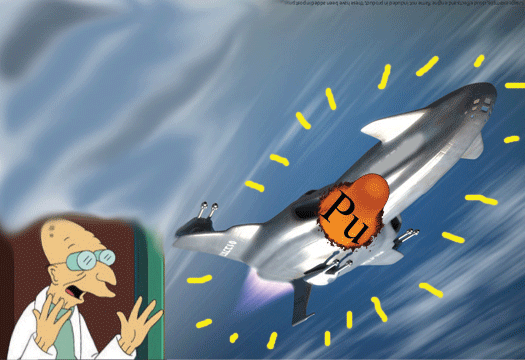
According to a 2015 study, the U.S. has launched 47 nuclear power systems and hundreds of heater units on 31 missions since 1961. The most recent scientific missions to employ an RPS were New Horizons, a Pluto fly-by mission launched in 2006, and the Mars Curiosity Rover, launched in 2011. The follow-on Mars 2020 Rover and the recently selected Dragonfly rotorcraft mission to Saturn’s moon Titan are currently the only two approved NASA spacecraft in development that will use an RPS.
The relatively infrequent use of nuclear systems on spacecraft is in part attributed to the complexity and cost of the safety review process, which generally has limited them to flagship-class missions. Low availability of plutonium for civilian uses has also constrained the mission cadence…….
NASA has recently emphasized the potential value of fission reactors for human deep space exploration missions. At the National Space Council meeting this week, NASA Administrator Jim Bridenstine said nuclear thermal propulsion technologies could significantly reduce transit time to Mars. He also pointed to other potential applications, such as using fission to power a space-based laser that could deflect asteroids and deorbit space debris.
NASA is also exploring how nuclear reactors could meet the power demands of planetary bases. One such concept, called Kilopower, could provide up to 10 kilowatts per reactor using highly enriched uranium. Bridenstine visited members of the Kilopower team this week at NASA’s Glenn Research Center.
The concept is not without critics. Rep. Bill Foster (D-IL), a former Fermilab physicist who advocates using alternatives to highly enriched uranium, pressedBridenstine on the subject at a hearing this year.
“A future where every space-faring nation has a big inventory of weapons-grade material to service the reactors that they are using all over the Moon and all over Mars is not a very safe space environment,” Foster said. “There will be some small performance compromises in going with low enriched non-weapons grade material, but I really urge you to look hard at keeping alive the prospect of having an international collaboration to develop workable non weapons grade-based materials that the whole world will use.” …….https://www.aip.org/fyi/2019/white-house-overhauls-launch-approval-process-nuclear-spacecraft
August 24, 2019
Posted by Christina Macpherson |
space travel, USA |
Leave a comment
The astronomer royal and risk specialist on cyber-attacks, pandemics, Brexit and life on Mars, Martin Rees is a cosmologist and astrophysicist who has been the astronomer royal since 1995. He is also a co-founder of the Centre for the Study of Existential Risk, Cambridge. His most recent book, On the Future: Prospects for Humanity, is published by Princeton.
Martin Rees……. science is not just a venture for academics – most of our life depends on how it’s applied.
…….. One consequence of modern technology is that the world is more interconnected. It’s possible for small groups or even individuals to produce an effect that cascades very widely, even globally.
Ian Tucker..…
The climate crisis is another area where international agreements have had limited impact. There is a strong grassroots movement led by Greta Thunberg and others, yet we have populist presidents in the US and Brazil who are climate-change deniers and reneging on agreements…
Martin Rees Politicians don’t prioritise things when the benefits are diffuse and in the far future. They will only take action if the voters are behind them. That’s why it’s very important to sustain these campaigns.
We want to make sure that these issues of climate stay on the agenda. For instance, the 2015 papal encyclical on climate change. The pope has a billion followers from Latin America, Africa, East Asia and this helped towards consensus at the Paris conference……
The need for sending people into space has evaporated. If you were building the Hubble telescope now, you wouldn’t send people to refurbish it, you would send robots. I hope human space flight will continue, but as a high-risk adventure bankrolled by private companies. If I were American, I wouldn’t support taxpayers’ money going on Nasa’s manned programme. …..
it is a delusion to think we can solve Earth’s problems by relocating to Mars. I completely disagree with Musk and with my late colleague Stephen Hawking on that, because dealing with climate change on Earth is a doddle compared with terraforming Mars. ….https://www.theguardian.com/science/2019/aug/18/martin-rees-astronomer-royal-interview-brexit
August 20, 2019
Posted by Christina Macpherson |
2 WORLD, space travel |
Leave a comment
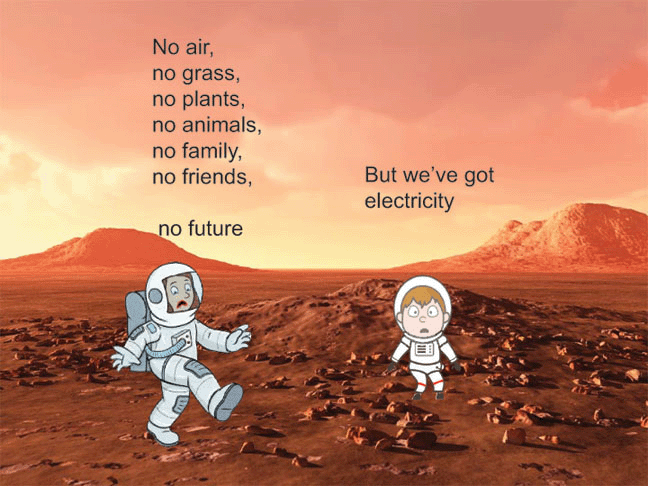
US plans to send nuclear reactors to space, Rt.com 19 Aug, 2019 Despite the nuclear industry stumbling in the domestic United States, the country is looking to put nuclear reactors on Mars and the Moon.
While the nuclear energy industry is struggling to stay afloat in the United States, bogged down by public and political mistrust, crushing nuclear waste-maintenance costs, and a market flooded by cheap natural gas, the country has grand plans for nuclear power outside of its domestic borders. Way outside.
In just a few short years from now, the United States will be shipping nuclear reactors to the moon and Mars. According to team members from the Kilopower project, a collaborative venture from NASA and the United States Department of Energy, nuclear energy is just a few years from heading into the space age.
“The Kilopower project is a near-term technology effort to develop preliminary concepts and technologies that could be used for an affordable fission nuclear power system to enable long-duration stays on planetary surfaces,” says NASA’s “Space Technology Mission Directorate.” In layman’s terms, the focus of the Kilopower project is to use an experimental fission reactor to power crewed outposts on the moon and Mars, allowing researchers and scientists to stay and work for much longer durations of time than is currently possible. …..
[ NASA says] The potential of this demonstration would be to “pave the way for future Kilopower systems that power human outposts on the Moon and Mars, enabling mission operations in harsh environments and missions that rely on In-situ Resource Utilization to produce local propellants and other materials.”
While this is not the first time that nuclear energy is being used to power pursuits into the final frontier, the Kilopower project is a much more ambitious and powerful project than any of its predecessors. According to Space.com, “nuclear energy has been powering spacecraft for decades. NASA’s Voyager 1 and Voyager 2 probes, New Horizons spacecraft, and Curiosity Mars rover, along with many other robotic explorers, employ radioisotope thermoelectric generators (RTGs), which convert the heat thrown off by the radioactive decay of plutonium-238 into electricity.” ….. https://www.rt.com/business/466790-us-space-nuclear-reactors/
August 20, 2019
Posted by Christina Macpherson |
space travel, USA |
Leave a comment
 7 reasons why Small Modular Nuclear Reactrs are a bad idea for Australia, more https://independentaustralia.net/environment/environment-display/seven-reasons-why-small-modular-nuclear-reactors-are-a-bad-idea-for-australia,13010
Small Nuclear Reactors are in the news internationally, and, rather more quietly, also in Australia.
International news reports that, in a failed missile test in Russia, a small nuclear reactor blew up, killing five nuclear scientists, and releasing a radiation spike.
In Australian news, with considerably less media coverage, Parliament announced an Inquiry into nuclear energy for Australia, with an emphasis on Small Modular Reactors (SMRs). Submissions are due by September 16.
A bit of background. The U.S. government and the U.S. nuclear industry are very keen to develop and export small modular nuclear reactors for two main reasons, both explained in the Proceedings of the National Academy of Sciences, 2018 Firstly, with the decline of large nuclear reactors, there is a need to maintain the technology and the expertise, trained staff, necessary to support the nuclear weapons industry. Secondly, the only hope for commercial viability of small nuclear reactors is in exporting them – the domestic market is too small. So – Australia is seen as a desirable market.
The USA motivation for exporting these so far non-existent prefabricated reactors is clear. The motivation of their Australian promoters is not so clear.
These are the main reasons why it would be a bad idea for Australia to import small modular nuclear reactors.
- COST.Researchers from Carnegie Mellon University’s Department of Engineering and Public Policy concluded that the SMR industry would not be viable unless the industry received “several hundred billion dollars of direct and indirect subsidies” over the next several decades. For a company to invest in a factory to manufacture reactors, they’d need to be sure of a real market for them – Australia would have to commit to a strong investment up front.
The diseconomics of scale make SMRs more expensive than large reactors. A 250 MW SMR will generate 25 percent as much power as a 1,000 MW reactor, but it will require more than 25 percent of the material inputs and staffing, and a number of other costs including waste management and decommissioning will be proportionally higher.
A study by WSP / Parsons Brinckerhoff, commissioned by the 2015/16 South Australian Nuclear Fuel Cycle Royal Commission, estimated costs of A$180‒184/MWh (US$127‒130) for large pressurised water reactors and boiling water reactors, compared to A$198‒225 (US$140‒159) for SMRs.
To have any hope of being economically viable, SMRs would have to be mass produced and deployed, and here is a “Catch-22″ problem The economics of mass production of SMRs cannot be proven until hundreds of units are in operation. But that can’t happen unless there are hundreds of orders, and there will be few takers unless the price can be brought down. Huge government subsidy is therefore required
- Safety problems. Small nuclear reactors still have the same kinds of safety needsas large ones have. The heat generated by the reactor core must be removed both under normal and accident conditions, to keep the fuel from overheating, becoming damaged, and releasing radioactivity. The passive natural circulation coolingcould be effective under many conditions, but not under all accident conditions. For instance, for the NuScale design a large earthquake could send concrete debris into the pool, obstructing circulation of water or air. Where there are a number of units, accidents affecting more than one small unit may cause complications that could overwhelm the capacity to cope with multiple failures.
Because SMRs have weaker containment systems than current reactors, there would be greater damage if a hydrogen explosion occurred. A secondary containment structure would prevent large-scale releases of radioactivity in case of a severe accident. But that would make individual SMR units unaffordable. The result? Companies like NuScale now move to projects called “Medium” nuclear reactors – with 12 units under a single containment structure. Not really small anymore.
Underground siting is touted as a safety solution, to avoid aircraft attacks and earthquakes. But that increases the risks from flooding. In the event of an accident emergency crews could have greater difficulty accessing underground reactors.
Security
Proponents of SMRs argue that they can be deployed safely both as a fleet of units close to cities, or as individual units in remote locations. In all cases, they’d have to operate under a global regulatory framework, which is going to mean expensive security arrangements and a level of security staffing. ‘Economies of scale’ don’t necessarily work, when it comes to staffing small reactors. SMRs will, anyway, need a larger number of workers to generate a kilowatt of electricity than large reactors need. In the case of security staffing, this becomes important both in a densely populated area, and in an isolated one.
- Weapons Proliferation.
The latest news on the Russian explosion is a dramatic illustration of the connection between SMRs and weapons development.
But not such a surprise. SMRs have always had this connection, beginning in the nuclear weapons industry, in powering U.S. nuclear submarines. They were used in UK to produce plutonium for nuclear weapons. Today, the U.S. Department of Energy plans to use SMRs as part of “dual use” facilities, civilian and military. SMRs contain radioactive materials, produce radioactive wastes – could be taken, used part of the production of a “dirty bomb” The Pentagon’s Project Dilithium’s small reactors may run on Highly Enriched Uranium (HEU) , nuclear weapons fuel – increasing these risks.
It is now openly recognised that the nuclear weapons industry needs the technology development and the skilled staff that are provided by the “peaceful” nuclear industry. The connection is real, but it’s blurred. The nuclear industry needs the “respectability” that is conferred by new nuclear, with its claims of “safe, clean, climate-solving” energy.
- Wastes.
SMRs are designed to produce less radioactive trash than current reactors. But they still produce long-lasting nuclear wastes, and in fact, for SMRs this is an even more complex problem. Australia already has the problem of spent nuclear fuel waste, accumulating in one place – from the nuclear reactor at Lucas Heights. With SMRs adopted, the waste would be located in many sites, with each location having the problem of transport to a disposal facility. Final decommissioning of all these reactors would compound this problem. In the case of underground reactors, there’d be further difficulties with waste retrieval, and site rehabilitation.
6. Location.
I have touched on this, in the paragraphs on safety, security, and waste problems. The nuclear enthusiasts are excited about the prospects for small reactors in remote places. After all, aren’t some isolated communities already having success with small, distributed solar and wind energy? It all sounds great. But it isn’t.
With Australia’s great distances, it would be difficult to monitor and ensure the security of such a potentially dangerous system, of many small reactors scattered about on this continent. Nuclear is an industry that is already struggling to attract qualified staff, with a large percentage of skilled workers nearing retirement. The logistics of operating these reactors, meeting regulatory and inspection requirements, maintaining security staff would make the whole thing not just prohibitively expensive, but completely impractical.
- Delay.
For Australia, this has to be the most salient point of all. Economist John Quiggin has pointed out that Australia’s nuclear fans are enthusing about small modular nuclear reactors, but with no clarity on which, of the many types now designed, would be right for Australia. NuScale’s model, funded by the U.S. government, is the only one at present with commercial prospects, so Quiggin has examined its history of delays. But Quiggin found that NuScale is not actually going to build the factory: it is going to assemble the reactor parts, these having been made by another firm, – and which firm is not clear. Quiggin concludes:
Australia’s proposed nuclear strategy rests on a non-existent plant to be manufactured by a company that apparently knows nothing about it.
As there’s no market for small nuclear reactors, companies have not invested much money to commercialise them. Westinghouse Electric Company tried for years to get government funding for its SMR plan, then gave up, and switched to other projects. Danny Roderick, then president and CEO of Westinghouse, announced:
The problem I have with SMRs is not the technology, it’s not the deployment ‒ it’s that there’s no customers. … The worst thing to do is get ahead of the market.
Russia’s programme has been delayed by more than a decade and the estimated costs have ballooned.
South Korea decided on SMRs, but then pulled out, presumably for economic reasons.
China is building one demonstration SMR, but has dropped plans to build 18 more, due to diseconomics of the scheme.
There’s a lot of chatter in the international media, about all the countries that are interested, or even have signed memoranda of understanding about buying SMRs, but still with no plans for actual purchase or construction.
Is Australia going to be the guinea pig for NuScale’s Small and Medium Reactor scheme? If so,when? The hurdles to overcome would be mind-boggling. The start would have to be the repeal of Australia’s laws – the Environment Protection and Biodiversity Conservation (EPBC) Act 1999 Section 140A and Australian Radiation Protection and Nuclear Safety Act 1998. Then comes the overcoming of States’ laws, much political argy-bargy, working out regulatory frameworks, import and transport of nuclear materials, – finding locations for siting reactors, – Aboriginal issues-community consent, waste locations. And what would it all cost?
And, in the meantime, energy efficiency developments, renewable energy progress, storage systems – will keep happening, getting cheaper, and making nuclear power obsolete.
August 17, 2019
Posted by Christina Macpherson |
AUSTRALIA, Small Modular Nuclear Reactors |
Leave a comment

Space Radiation Will Damage Mars Astronauts’ Brains, Space.com By Mike Wall 9 Aug 19, Space radiation will take a toll on astronauts’ brains during the long journey to Mars, a new study suggests.
Mice exposed for six months to the radiation levels prevalent in interplanetary space exhibited serious memory and learning impairments, and they became more anxious and fearful as well, the study reports.
The trip to Mars takes six to nine months one way with current propulsion technology. So, these results should ring a cautionary bell for NASA and other organizations that aim to send people to the Red Planet, study team members said.
These chronic low-dose-rate, low-dose-exposure scenarios are going to increase the risk of developing, perhaps, mission-critical performance deficits,” Limoli told Space.com. “What exactly those are, we’ll never know until we get out there.”
Researchers investigating the effects of deep-space radiation have historically given lab animals acute doses — high levels over a relatively short period of time. But Limoli and his colleagues — led by Munjal Acharya and Janet Baulch of UCI’s Department of Radiation Oncology and Peter Klein of Stanford University’s Department of Neurosurgery — took a different tack.
Using a neutron-irradiation facility, they exposed 40 mice to 1 milligray of radiation per day (1 mGy/day) for six months, about the same dose and duration that astronauts would experience on a trip to or from Mars. (Astronauts in low Earth orbit are exposed to lower doses, because they’re protected by our planet’s magnetosphere.)
“This is the first study that’s looked at space-relevant dose rates,” Limoli said. “And this is the first study to analyze the consequences of the low dose rate over the course of time on functional endpoints in the brain.”
The researchers analyzed the behavior of these mice over the course of the study, measuring the animals’ ability to learn and remember information, their willingness to interact with new mice introduced into their enclosure, and other variables. And at the end of the six months, the scientists euthanized the mice and studied their brains, looking for physiological changes.
All of these measurements and observations were compared with those gathered from a control group of 40 mice, which did not receive the 1 mGy/day dose.
The results were striking. Radiation-exposed mice exhibited more stress behaviors and a decreased ability to learn and remember. The physiological work bolstered these behavioral findings, identifying impaired cellular signaling in two key areas of the brain: the hippocampus, which is associated with learning and memory, and the prefrontal cortex, the site of many complex cognitive functions. …….https://www.space.com/space-radiation-damage-mars-astronauts-brains.html
August 10, 2019
Posted by Christina Macpherson |
deaths by radiation, radiation, space travel |
Leave a comment

Nuclear fuel carrier “Serebryanka” remains inside closed-off waters near missile explosion site, Barents Observer, By Thomas Nilsen. August 09, 2019 “………Barents Observer report
The Barents Observer has recently published an overview (pdf) listing the increasing number of reactors in the Russian Arctic. The paper is part of Barents Observer’s analytical popular science studies on developments in the Euro-Arctic Region.
According to the list there are 39 nuclear-powered vessels or installations in the Russian Arctic today with a total of 62 reactors. This includes 31 submarines, one surface warship, five icebreakers, two onshore and one floating nuclear power plants.
Looking 15 years ahead, the number of ships, including submarines, and installations powered by reactors is estimated to increase to 74 with a total of 94 reactors, maybe as many as 114. Additional to new icebreakers and submarines already under construction, Russia is brushing dust of older Soviet ideas of utilizing nuclear-power for different kind of Arctic shelf industrial developments, like oil- and gas exploration, mining and research. “By 2035, the Russian Arctic will be the most nuclearized waters on the planet,” the paper reads.
Also, existing icebreakers and submarines get life-time prolongation. The average age of the Northern Fleet’s nuclear-powered submarines has never been older than today. Several of the submarines built in the 1980s will continue to sail the Barents Sea and under the Arctic ice-cap until the late 2020s. https://thebarentsobserver.com/en/security/2019/08/severodvinsk-authorities-confirm-mysterious-brief-radiation-spike-after-missile
August 10, 2019
Posted by Christina Macpherson |
ARCTIC, Russia, technology |
Leave a comment







 nuclear-news