Small Modular Nuclear Reactors costs jump by $billions. Logan city abandons NuScam project

|
Logan withdraws from nuclear power project seen as cutting-edge but risky, KSL.com
By Graham Dudley, KSL.com – Aug. 20, 2020 LOGAN — A hesitant Logan City Council agreed to follow staff recommendations Tuesday and voted to leave a nuclear power project that has been characterized by ballooning costs and funding uncertainties.The Carbon Free Power Project aims to begin producing nuclear power from state-of-the-art small modular reactors But the projected cost of the power plant jumped from about $3.6 billion in 2017 to more than $6.1 billion in 2020. Logan has already committed more than $400,000 to the project and would have paid over $650,000 more in the next three years to see it through its next phase, at which point the city would again have had the option to modify or withdraw from the agreement. The project involves the Utah Associated Municipal Power Systems, or UAMPS, a political subdivision of the state of Utah which supplies energy to communities in six Western states and of which Logan is a member. The reactors are being built by Oregon-based NuScale, and the Texas-based Fluor Corporation is involved in project construction Logan council members reviewed the city’s involvement in the Carbon Free Power Project during their Aug. 4 and Aug. 18 meetings, ultimately voting 4-1 to leave the agreement…….. https://www.ksl.com/article/50008552/logan-withdraws-from-nuclear-power-project-seen-as-cutting-edge-but-risky |
|
Japan’s Rokkasho nuclear reprocessing plant delayed, for the 25th time!
 Nuclear fuel reprocessing plant completion delayed, NHK News, 21 Aug 20 The operator of a nuclear fuel reprocessing plant in northeastern Japan says it will postpone the scheduled completion of the facility by one year. The plant is the centerpiece of the Japanese government’s nuclear fuel recycling policy.This is the 25th time that Japan Nuclear Fuel Limited has delayed the scheduled completion of the plant. The operator says it now aims to complete construction in the first half of fiscal 2022, which is 25 years behind schedule. Nuclear fuel reprocessing plant completion delayed, NHK News, 21 Aug 20 The operator of a nuclear fuel reprocessing plant in northeastern Japan says it will postpone the scheduled completion of the facility by one year. The plant is the centerpiece of the Japanese government’s nuclear fuel recycling policy.This is the 25th time that Japan Nuclear Fuel Limited has delayed the scheduled completion of the plant. The operator says it now aims to complete construction in the first half of fiscal 2022, which is 25 years behind schedule.
The facility in the village of Rokkasho in Aomori Prefecture, northeastern Japan, is designed to extract plutonium from spent nuclear fuel generated by power plants, for recycling. Masuda Naohiro, the president of Japan Nuclear Fuel Limited, reported the decision to Aomori Governor Mimura Shingo on Friday. Masuda explained that considerable time would be necessary to prepare to ensure safety against tornados, as well as for the assessment of that work……….. The scheduled plant completion has been postponed many times due to various problems and other reasons. Some experts have pointed out technical issues concerning on-site management and maintenance, given the considerable delay in the schedule. The outlook for the use of the extracted plutonium is also unclear. https://www3.nhk.or.jp/nhkworld/en/news/20200821_25/ |
|
City of Logan cuts its losses, withdraws from risky NuScam “small” nuclear reactor project
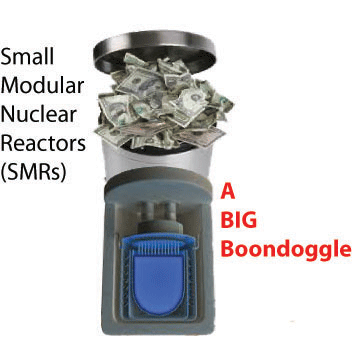 Logan withdraws from risky nuclear power project, Cache Valley
  Daily Charlie Schill August 19, 2020 LOGAN – Members of the Logan City Council voted Tuesday to end the city’s partnership in an increasingly expensive nuclear power project.
As a member of the Utah Associated Municipal Power Systems (UAMPS), Logan City owned a partial interest in a first-of-its-kind nuclear plant proposed to be constructed at the Idaho National Laboratory.
Faced with Sept. 15 deadline to ante up more funding for the risky project, both Mark Montgomery, the city’s light and power director, and Logan Finance Director Richard Anderson recommended that Logan withdraw from the Carbon Free Power Project…….
Montgomery told city council members that Logan had invested about $400,000 in the Small Modular Reactor (SMR) project since 2017. If the city had opted to continue its participation in the project into its initial licensing phase through 2023, the price tag would have been another $654,000.
In early August, the Utah Taxpayers Association urged all Utah cities to reconsider their participation in the SMR project due to its potential for out–of-control costs………
In the original CFPP proposal, the U.S. Department of Energy was to foot the bill for the development of the project’s first module. After pledging up to $1.4 billion for those expenses, federal officials have since backed out of that agreement, leaving UAMPS holding the bag for the project’s first-of-its-kind risks.
Montgomery added that estimated cost of the project have also escalated since 2017, jumping from $3.6 billion to $6.1 billion as of July of this year……… https://www.cachevalleydaily.com/news/archive/2020/08/19/logan-withdraws-from-risky-nuclear-power-project/#.X0BMOOgzbIU
NuScam’s not so small nuclear reactors need $1.4 billion subsidy, and might not be so safe
Smaller, cheaper [?] reactor aims to revive nuclear industry, but design problems raise safety concerns, Science, By Adrian Cho, Aug. 18, 2020 Engineers at NuScale Power believe they can revive the moribund U.S. nuclear industry by thinking small. Spun out of Oregon State University in 2007, the company is striving to win approval from the U.S. Nuclear Regulatory Commission (NRC) for the design of a new factory-built, modular fission reactor meant to be smaller, safer, and cheaper than the gigawatt behemoths operating today. But even as that 4-year process culminates, reviewers have unearthed design problems, including one that critics say undermines NuScale’s claim that in an emergency, its small modular reactor (SMR) would shut itself down without operator intervention.The issues are typical of the snags new reactor designs run into on the road to approval, says Michael Corradini, a nuclear engineer at the University of Wisconsin, Madison. “I don’t think these things are show-stoppers.” However, M. V. Ramana, a physicist who studies public policy at the University of British Columbia, Vancouver, and has been critical of NuScale, says the problems show the company has oversold the claim that its SMRs are “walk-away safe.” “They have given you the standard by which to evaluate them and they’re failing,” Ramana says.
Passive safety?
Normally, convection circulates water—laced with boron to tune the nuclear reaction—through the core of NuScale’s reactor (left). If the reactor overheats, it shuts down and valves release steam into the containment vessel, where it conducts heat to a surrounding pool and condenses (center). The water flows back into the core, keeping it safely submerged (right). But the condensed water can be low in boron, and reviewers worried it could cause the reactor to spring back to life………..
NuScale’s likely first customer, Utah Associated Municipal Power Systems (UAMPS), has delayed plans to build a NuScale plant, which would include a dozen of the reactors, at the Department of Energy’s (DOE’s) Idaho National Laboratory. The $6.1 billion plant would now be completed by 2030, 3 years later than previously planned, says UAMPS spokesperson LaVarr Webb. ……… The delay will give UAMPS more time to develop its application for an NRC license to build and operate the plant, Webb says. The deal depends on DOE contributing $1.4 billion to the cost of the plant, he adds.
……… A NuScale reactor—which would be less than 25 meters high, hold about one-eighth as much fuel as a large power reactor, and generate less than one-tenth as much electric power—would rely on natural convection to circulate the water
……….. In March, however, a panel of independent experts found a potential flaw in that scheme. To help control the chain reaction, the reactor’s cooling water contains boron, which, unlike water, absorbs neutrons. But the steam leaves the boron behind, so the element will be missing from the water condensing in the reactor and containment vessel, the NRC’s Advisory Committee on Reactor Safeguards (ACRS) noted. When the boron-poor water re-enters the core, it could conceivably revive the chain reaction and possibly melt the core, ACRS concluded in a report on its 5–6 March meeting.https://www.sciencemag.org/news/2020/08/smaller-cheaper-reactor-aims-revive-nuclear-industry-design-problems-raise-safety
Artificial Intelligence brings a new worry into nuclear weaponry

Artificial intelligence and nuclear weapons: Bringer of hope or harbinger of doom? https://www.europeanleadershipnetwork.org/commentary/bringer-of-hope-or-harbinger-of-doom-artificial-intelligence-and-nuclear-weapons/ Jennifer Spindel |Assistant Professor of Political Science, University of New Hampshire, 17 Aug, 20
In 2017, Russian President Vladimir Putin said whichever country leads in the development of artificial intelligence will be “the ruler of the world.” Artificial intelligence is not unlike electricity: it is a general-purpose enabling technology with multiple applications. Russia hopes to develop an artificial intelligence capable of operations that approximate human brain function. China is working to become the world leader in AI by 2030, and the United States declared in 2019 that it would maintain its world leadership on artificial intelligence. Will the world’s major powers seek to use AI with their nuclear weapons and command and control systems? Pairing nuclear weapons – arguably the previous ruler of the world – with this new technology could give states an even greater edge over potential competitors. But the marriage between nuclear weapons and artificial intelligence carries significant risks, risks that currently outweigh potential benefits. At best, using AI with nuclear weapons systems could increase time efficiencies. At worst, it could undermine the foundations of nuclear deterrence by changing leaders’ incentives to use nuclear weapons.
Opportunities in data analysis and time efficiencies
Artificial intelligence could be a boon for drudgery type tasks such as data analysis. AI could monitor and interpret geospatial or sensor data, and flag changes or anomalies for human review. Applied to the nuclear realm, this use of AI could be used to track reactors, inventories, and nuclear materials movement, among other things. Human experts would thus be free to spend more of their time investigating change, rather than looking at data of the status quo.
Incorporating artificial intelligence into early warning systems could create time efficiencies in nuclear crises. Similar to the boon for data analysis, AI could improve the speed and quality of information processing, giving decision-makers more time to react. Time is the commodity in a nuclear crisis, since nuclear-armed missiles can often reach their target in as little as eight minutes. Widening the window of decision could be key in deescalating a nuclear crisis.
Challenges posed by risks, accidents, and nuclear deterrence
Incorporating artificial intelligence into nuclear systems presents a number of risks. AI systems need data, and lots of it, to learn and to update their world model. Google’s AI brain simulator required 10 million images to teach itself to recognize cats. Data on scenarios involving nuclear weapons are, thankfully, not as bountiful as internet cat videos. However, much of the empirical record on nuclear weapons would teach an AI the wrong lesson. Consider the number of almost-launches and near-accidents that occurred during the Cold War; both U.S. and Soviet early warning systems mistakenly reported nuclear launches. Although simulated data could be used to train an AI, the stakes of getting it wrong in the nuclear realm are much higher than in other domains. It’s also hard to teach an AI to feel the doubts and suspicions that human operators relied on to detect false alarms and to change their minds.
Accidents are also amplified in the nuclear realm. There are already examples of accidents involving automated conventional weapons systems: in March 2003, U.S. Patriot missile batteries shot down a British fighter plane and a U.S. fighter jet while operating in “automated mode,” killing the crews of both planes. Accidents are likely to increase as AI systems become more complex and harder for humans to understand or explain. Accidents like these, which carry high costs, decrease overall trust in automated and AI systems, and will increase fears about what will happen if nuclear weapons systems being to rely on AI.
Beyond accidents and risks, using AI in nuclear weapons systems poses challenges to the foundations of nuclear deterrence. Data collection and analysis conducted by AI systems could enable precision strikes to destroy key command, control, and communication assets for nuclear forces. This would be a significant shift from Cold War nuclear strategy, which avoided this type of counterforce targeting. If states’ can target each other’s nuclear weapons and command infrastructure, then second-strike capabilities will be at risk, ultimately jeopardizing mutually assured destruction. For example, AI could identify a nuclear submarine on patrol in the ocean, or could interfere with nuclear command and control, thus jeopardizing one, or more, legs of the nuclear triad. This creates pressure for leaders to use their nuclear weapons now, rather than risk losing them (or control over them) in the future.
Even if states somehow agree not to use AI for counterforce purposes, the possibility that it could one day be used that way is destabilizing. States need a way to credibly signal how they will – and won’t – use artificial intelligence in their nuclear systems.
The future of AI and nuclear stability
The opportunities and risks posed by the development of artificial intelligence is less about the technology and more about how we decide to make use of it. As the Stockholm International Peace Research Institute noted, “geopolitical tensions, lack of communication and inadequate signalling of intentions” all might matter more than AI technology during a crisis or conflict. Steps to manage and understand the risks and benefits posed by artificial intelligence should include confidence-building measures (CBMs) and stakeholder dialogue.
CBMs are crucial because they reduce mistrust and misunderstanding, and can help actors signal both their resolve and their restraint. As with conventional weapons, transparency about when and how a state plans to use artificial intelligence systems is one type of CBM. Lines of communication, which are particularly useful in crisis environments, are another type that should be explored.
Continued dialogue with stakeholders including governments, corporations, and civil society will be key to developing and spreading norms about the uses of artificial intelligence. Existing workshops and dialogues about the militarization of artificial intelligence, and artificial intelligence and international security show that such dialogues are possible and productive. The international community can consider building on existing cooperative efforts concerning cyberspace, such as the U.N.’s work on norms and behaviour in cyberspace, the Cybersecurity Tech Accords, and Microsoft, Hewlett, and Mastercard’s CyberPeace Institute. This dialogue will help us understand the scope of potential change and should give us incentives to move slowly and to push for greater transparency to reduce misperception and misunderstanding.
Alberta premier’s small nukes pipe dream makes no economic sense.
Look Over There! Jason Kenney’s Phoney Nuclear Power  Distraction Why the Alberta premier’s small nukes pipe dream makes no economic sense., David Climenhaga 14 Aug 20, | TheTyee.ca
When Alberta Premier Jason Kenney says small nuclear reactors “could be a game changer in providing safe, zero-emitting, baseload power in many areas of the province,” as he did this week in a tweet, he’s pulling your leg…….
No electrical utility is ever going to buy one unless they are forced to by government policy or regulation — the kind of thing Alberta’s United Conservative Party purports to oppose……..
Small nuclear reactors are not as cheap to build as the premier’s fairy tale suggests.
Bringing an acceptable small nuclear reactor design all the way from the drawing board to approval by a national nuclear regulatory authority will cost hundreds of millions of dollars.
While dozens of speculative companies are printing colourful brochures with pretty pictures of little nukes being trucked to their destinations, very few are serious ventures with any possibility of building an actual reactor. The United Nations International Atomic Energy Agency says diplomatically there are about 50 concepts “at different stages of development.” Those that are serious, like NuScale Power in the United States, have huge amounts of government money behind them.
The only small nuclear reactor plant known to be operating in the world now is the Akademik Lomonosov, Russia’s floating power barge with two 35-megawatt reactors aboard. From an original estimate of US$140 million in 2006, its cost had ballooned to US$740 million when the vessel was launched last year.
The kind of small reactors Kenney is talking about won’t be cheap by any yardstick.
Small reactors are less economical to run than big reactors…….
This is why nobody wanted to buy the scaled-down CANDU-3 reactor, development of which was paid for by Canadian taxpayers in the 1980s. At 300 megawatts, they were just too small for commercial viability. A working CANDU-3 has never been built.
The cost of small reactors would have to come down significantly to change this. And remember, the research and development requirements of small reactors are just as high as for big ones. With nobody manufacturing modules, there are no existing economies of scale. In other words, dreamy brochures about the future of small reactors are just that — dreams.
By the way, in 2011 the Harper government privatized the best commercial assets of Crown-owned Atomic Energy of Canada Ltd. to… wait for it… SNC-Lavalin Group Inc. Think about that every time you hear Conservatives in Ottawa screeching about the goings on at SNC-Lavalin!
Small reactor designs mostly require enriched uranium, and Canada doesn’t produce any……
Small reactors might be safer than big ones, but we don’t really know.
Kenney and Savage talk about small reactors as if it were a fact they’re safer than big reactors. Maybe they are. But we don’t really know that because nobody but the Russians actually seems to have built one, and in most cases they haven’t even been designed.
Remember, the Russians’ small reactors are both on a barge. For what it’s worth, critics have called it “Floating Chernobyl.”
Small reactors won’t be safe without public regulation……..
Then there’s the matter of waste disposal.
Nuclear plants don’t produce a lot of waste by volume, but what there is sure has the potential to cause problems for a very long time. Thousands of years and more. So safe storage is an issue with small nukes, just like it is with big ones.
Where are we going to store the waste from all these wonderful small nuclear reactors Kenney is talking about?
How many jobs is it likely to create here in Western Canada? Well, Saskatchewan’s Ministry of Environment recently posted a job for a director of small modular reactors. That person will supervise four people. That’s probably about it for jobs for the foreseeable future.
If Alberta ever ends up with the same number of people working on this, we’ll be lucky https://thetyee.ca/Analysis/2020/08/13/Kenney-Nuclear-Power-Plant-Distraction/
Even with $1.4 billion government subsidy, NuScam’s nuclear station is still a dodgy prospect

The NuScale SMR plant is designed to be built with up to a dozen 60-MW reactor modules.
UAMPS is seeking other utilities throughout the West to purchase hundreds of megawatts of the $6 billion project’s output, but no utility has agreed to such a purchase.
Utah Taxpayer Association Vice President Rusty Cannon said UAMPS members currently committed to the project should withdraw from it because of the risks.
“The development of untried new designs is no place for small utilities with no nuclear construction experience to risk their customers’ money,” former NRC Commissioner Peter Bradford said during the briefing.
the first module is now expected to be operational in June 2029. Previously NuScale had targeted commercial operation of at least one reactor module in 2027.
|
Municipal power group awaits $1.4 billion from DOE for Idaho nuclear plant, https://www.spglobal.com/platts/en/market-insights/latest-news/electric-power/081320-municipal-power-group-awaits-14-billion-from-doe-for-idaho-nuclear-plant Author, Michael McAuliffe , Editor Keiron Greenhalgh 14 Aug 20, HIGHLIGHTS Utah Associated Municipal Power Systems (UAMPS) members face September decision on project Startup of first unit delayed to 2029 from 2027 Odds of members agreeing to go forward 50/50: muni Washington — A Utah municipal power association is expecting an influx of $1.4 billion in federal funds for the small modular reactor plant it is looking to build in Idaho, but association members are still deciding whether to go forward with the 720-MW project and the completion date has recently slipped, officials said. Continue reading |
NuScam’s (sort of) small nuclear reactors rejected by Utah Taxpayers Association
Critics of planned nuclear power project urge Utah cities to pull out before it’s too late, Utah Taxpayers Association warns it believes proposal is too costly, not transparent DeseretNews, By Amy Joi O’Donoghue@Amyjoi16 Aug 4, 2020 SALT LAKE CITY — The Utah Taxpayers Association and a former member of the U.S. Nuclear Regulatory Commission are urging cities that have signed on to a planned nuclear power plant in Idaho to get out while they can before costs become too great.
NuScale’s Small Modular Reactor is planned for construction at the Idaho National Laboratory near Idaho Falls and would provide 720 megawatts of power, or enough energy for 720,000 homes.
The Carbon Free Power Project is promoted as the next generation design for nuclear power, featuring 12 distinct modules, with the first scheduled to come online in 2029 with the 11 others following the next year.
The project is a collaborative effort involving the U.S. Department of Energy, NuScale and the Utah Associated Municipal Power Systems, a political subdivision of the state of Utah. ……
there are several off-ramps in those phases for cities to exit, one of which is coming up Sept. 14. That deadline prompted the taxpayers association to urge cities to get out now before they get trapped into paying millions for a technology it says is unproven.
“Small modular reactor power is just not cost competitive,” said Rusty Cannon, vice president of the taxpayer group, adding participating cities and districts should hold a public vote to withdraw from the project……..
Peter Bradford, a former member of the U.S. Nuclear Regulatory Commission, said enthusiasm over new developments in nuclear technology that turned out to be flawed have cost ratepayers and taxpayers in multiple states billions of dollars.
He said that of 31 projects pending before the commission in 2009, only two remain — with the rest canceled or indefinitely postponed.
“The stranded costs of nuclear plants paid off by customers in the 1990s exceeded $50 billion nationwide,” he said. “Each period of abject failure is followed by an array of new proposals.”…….
The project is backed heavily by the U.S. Department of Energy, which gave NuScale a competitive award of $226 million in 2013 to develop the technology. Two years later, the federal agency gave NuScale $16.7 million for licensing preparation……..
Cannon and Bradford also criticized the municipal power association for not being transparent enough because its briefing meetings are exempt from the Utah open meetings law and are closed……… https://www.deseret.com/utah/2020/8/4/21354171/critics-nuclear-power-project-urge-utah-cities-pull-out-nuscale-small-modular-reactor-idaho
It’s not the energy salvation for the world – nuclear fusion
 Nuclear Fusion Will Not Save Us, https://www.gizmodo.com.au/2020/08/nuclear-fusion-will-not-save-us/ Yessenia Funes, August 6, 2020 Last week, construction kicked off on the world’s largest experimental nuclear fusion reactor. It marked the start of a new era in the energy sector: The fossil fuel industry has historically dominated this arena, but renewable energy is quickly taking over. Now, nuclear scientists are hoping that the International Thermonuclear Experimental Reactor, or ITER, the experimental power plant under construction in southern France, can play a role alongside already-established technologies like solar and wind.
All the nuclear power plants that exist today rely on nuclear fission. ITER, however, will rely on nuclear fusion. The two are dramatically different, and scientists have struggled to recreate nuclear fusion — the process that makes stars shine — in a lab setting. ITER is the world’s first true attempt at this on a large scale.
“The difference between nuclear fission and nuclear fusion is the reason why we’ve developed a nuclear fission reactor in a matter of years, and still after more than six decades, we still don’t have a nuclear fusion reactor,” said Eugenio Schuster, a mechanical engineering and mechanics professor at Lehigh University who is working on ITER.
Around the world, 450 nuclear reactors were operating last year, all using nuclear fission, which involves splitting heavy atoms of elements such as uranium and plutonium. The process produces tons of highly radioactive waste, the ingredients to create nuclear weapons, potential instability that could lead to a destructive nuclear meltdown, and other concerning issues.
This process also requires uranium. In the U.S., the mining of this resource has contaminated the waters of the Navajo Nation and left countless individuals sick. President Donald Trump wants to see more uranium mining, and he doesn’t care where. The Grand Canyon? It can be mined. Bears Ears National Monument? That, too. Nuclear fission has proven destructive to both human health and the environment. There’s a reason many environmental advocates are highly opposed.
“We have a horrible legacy of uranium contamination in our communities,” said Carol Davis, the executive director of Diné C.A.R.E., an environmental organisation that supports the Navajo people. “Water was contaminated with uranium, and it’s never been cleaned, and people are using that and drinking that.”
Davis and other advocates worry nuclear power is just another false promise that creates radioactive waste while taking time and money away from developing renewable energy technologies. The United States alone has 90,000 metric tons of nuclear waste with nowhere to go. Nuclear fusion doesn’t create the same level of long-lived radioactive waste as the more popular process of nuclear fission, but it isn’t waste-free, either.
The process begins with the breaking down of lighter atoms into a state of matter called plasma. It requires more than 150 million degrees Celsius of heat to get going, though. When you’re comparing it to fission, of course, fusion is better. It can’t cause the nuclear meltdowns that we’ve seen at other sites. It doesn’t need any uranium; all it needs is lithium and water. If greenhouse gas emissions are the concern, fusion doesn’t have any evidence of contributing there. But the process does still produce some waste, and advocates are worried that their communities will be forced to deal with that waste for the greater good.
“This whole notion of endless power with little to no waste, it just sounds too good to be true. We really need to examine what are the true costs and who are the people who will be impacted,” said Leona Morgan, a Diné activist and coordinator of the Nuclear Issues Study Group, a New Mexico-based volunteer organisation against nuclear power. “It seems like we should really learn from what we have already experienced with the loss of human rights and loss of water resources from contamination.”
If scientists want communities to fully embrace nuclear energy, they need to figure out what the hell to do with this toxic trash. In the U.S., decision-makers have historically dumped this stuff near tribal or low-income rural communities. History is bound to repeat itself if leaders don’t take proper action to prevent these injustices.
“The reason we’re investing in fusion is because the promise is big,” Schuster said. “We’re going to have the benefits of renewables in terms of greenhouse gas emissions, but at the same time, we’re going to reduce the area we need to produce the same amount of energy while eliminating the risk of nuclear accidents and the generation of long-lived radioactive waste.”
That’s the thing, though. Intense attention on the climate crisis allows other ecological crises to happen alongside it. No one wants to see the world burn from rising temperatures, but disenfranchised communities don’t want to keep being sacrificed for the sake of human progress, either. Lithium extraction primarily happens in Argentina and Chile, where Indigenous advocates worry about the amount of water the mining requires, as well as the potential for contamination of their lands. Water is going to become even more valuable as we see droughts dry out lakes, rivers, and streams. Fusion simply doesn’t come without a cost.
“This whole notion of endless power with little to no waste, it just sounds too good to be true.”
Proponents of ITER note that the amount of lithium and water needed is minimal, especially compared to the extractive industries that exist today. The plant is expected to need only 550 pounds of fuel a year, half from the isotopes they need from water and half from the isotopes they need from lithium. Schuster notes that most of the water needed for this process would be returned to its source. That’s because researchers need only a specific molecule from the water. These materials won’t be the main issue with nuclear fusion, said Egemen Kolemen, an assistant professor of mechanical and aerospace engineering at Princeton University who is also working on the plant.
“The real issue is going to be the nuclear safety issues,” Kolemen said. “Even though it doesn’t have this runaway type of [reaction], there is still going to be some sort of nuclear reactions… that are going to have low levels, but still some, nuclear waste of sorts.”
The construction of ITER certainly does mark a new chapter in the world’s energy sector. It marks a moment of technological breakthrough and scientific accomplishment, but it won’t save us by itself. No new energy source can. At the heart of the climate crisis is human behaviour. If we’re to survive it — and, more importantly, solve it — we need to take a long, hard look in the mirror. Reducing emissions will require more than finding the perfect clean energy source; it will need a massive shift in human behaviour, lowering our emissions through energy efficiency and less consumption.
Then again, emissions aren’t everything. If we’re lowering our carbon footprint without protecting the health of vulnerable communities, what good is it after all? A nuclear future needs a justice and equity lens if it’s to actually be successful. Otherwise, it’ll be another damaging industry. The world already has enough of those. The construction of ITER certainly does mark a new chapter in the world’s energy sector. It marks a moment of technological breakthrough and scientific accomplishment, but it won’t save us by itself. No new energy source can. At the heart of the climate crisis is human behaviour. If we’re to survive it — and, more importantly, solve it — we need to take a long, hard look in the mirror. Reducing emissions will require more than finding the perfect clean energy source; it will need a massive shift in human behaviour, lowering our emissions through energy efficiency and less consumption.
Then again, emissions aren’t everything. If we’re lowering our carbon footprint without protecting the health of vulnerable communities, what good is it after all? A nuclear future needs a justice and equity lens if it’s to actually be successful. Otherwise, it’ll be another damaging industry. The world already has enough of those.
Utah Taxpayers – NuScam nuclear power project costly and public kept in the dark
 New Information Disclosed in Meeting Closed to Public Points to Major Budget Commitments, Delay Risks in UAMPS Power Project https://utahtaxpayers.org/new-information-disclosed-in-meeting-closed-to-public-points-to-major-budget-commitments-delay-risks-in-uamps-nuclear-power-project/
by Tax Watchdog | Aug 4, 2020 “We Need Public Hearings and We Need Public Votes”: UTA Calls for Full Transparency and Accountability Ahead of September 14th Deadline; Parallels Seen to Ohio, Illinois and South Carolina Nuclear Controversies Where Public Was Kept in the Dark.
SALT LAKE CITY – August 4, 2020 – Utah Associated Municipal Power Systems (UAMPS) and NuScale Power held an “online town hall meeting” on July 21st, but there was just one problem: due to a quirk in Utah’s open meeting laws, the town was not invited. Not only did UAMPS/NuScale fail to be transparent in terms of the meeting about their controversial small modular nuclear reactor plans, but they also failed to disclose new and troubling information that emerged during the behind-closed-doors virtual session, according to the nonprofit Utah Taxpayers Association (UTA). UTA and Peter Bradford, a former U.S. Nuclear Regulatory Commission (NRC) member, warned that potentially higher costs, project delays, and other risks could be costly for UAMPS members and ratepayers.
A total of 34 municipalities in Utah, Idaho, New Mexico and California (see full list below) are participating in the UAMPS small modular nuclear project. Ratepayers will be locked into more than $100 million in commitments by a September 14th deadline and billions of dollars of risks later on if UAMPS members do not opt out of the project. The need for openness is particularly important while the nuclear industry is currently facing major credibility problems with scandals in Ohio, Illinois, and South Carolina.
On July 21st, UAMPS and NuScale held a so-called “online town hall meeting,” which was not made open to the media under a special Utah exemption for UAMPS for open meeting requirements. A video copy of the UAMPS/NuScale event was acquired after the fact. (The timecodes shown below refer to various points in the video.)
Rusty Cannon, Vice President, Utah Taxpayers Association, said: “The UAMPS project will lock in 27 municipalities in Utah and several in surrounding states for a share of billions of dollars in costs and unclear risk in the pursuit of a cluster of small modular reactors (SMRs) touted by Oregon-based NuScale Power, which repeatedly has delayed timelines and increased costs associated with its SMRs.”
Cannon added: “This risky project with massive cost escalations is being conducted largely out of the public eye. Most recently the public was barred from a late July online ‘town hall meeting,’ the content of which has since come to light and which raises serious concerns about what has not been disclosed to the general public. The Utah Taxpayers Association urges elected officials involved with UAMPS to disclose all relevant information to the public so decisions can be made in the open and city officials can be held accountable. We are urging city councils in Utah that are subscribed to the project to vote in a public meeting before the September deadline to withdraw from the project.”
Also speaking at today’s news event was Peter Bradford, a former member of the U.S. Nuclear Regulatory Commission who served as chair of both the New York Public Service Commission and the Maine Public Utilities Commission. He has been an expert witness in many cases involving nuclear power economics, and he has taught Nuclear Power and Public Policy at the Vermont Law School as well as Energy Policy and Environmental Protection at the Yale School of the Environment.
Peter Bradford said: “There is the very real possibility of large rate increases to the customers in these communities due to inadequate safeguards in this project. It is difficult to understand the case for taking on this risk given the certainty of cheaper clean energy alternatives as clearly shown by recent purchases of firm combinations of renewables, energy efficiency plus storage elsewhere in the West. The cost of lack of transparency plus unwise and secretive deals has resulted in the nuclear energy industry becomingembroiled in multiple debacles. UAMPS members and ratepayers should take heed and avoid making the same mistakes.”
Just what is UAMPS and NuScale failing to disclose to the public?
- RAPIDLY ESCALATING CONSTRUCTION COSTS. NuScale’s website currently explains to the public: “The estimated construction cost for the first NuScale 684 MWe (net) plant is about $3 billion.” However, during the July 2020 “town hall,” UAMPS contractor Bob Squires (MPR Associates) calls the project a “roughly $5 billion nuclear power plant development project with first of a kind technology.” (3:47:24) Even worse: NuScale’s 2020 Amended Budget & Plan of Finance projects a total cost of approximately $6.1 billion.
- MAJOR MISSED DEADLINES. In 2008, NuScale explained: “With timely application for a combined construction and operating license (COL), a NuScale plant could be producing electricity by 2015-16.” In 2019, UAMPS publicly announced that the NuScale nuclear power plant would begin construction in 2023, “with the first 60 MW module becoming operational in 2026 [and] [o]ther modules would come on-line soon thereafter.” However, during the non-public July “town hall,” Glenn Neises, nuclear director, Burns & McDonnell, announced for the first time that completion is now projected for June 2030, and the first module is not expected to become operational until June 2029. (3:22:25) And things could get even worse. Warning of possible new delays, Neises said: “I’d also like to stress that this is the current schedule and expect it to change as we see changes in funding, engineering moves forward, and as licensing advances.” (3:22:25)
-
- LOW-BALLED ENERGY PRICE. Doug Hunter, UAMPS CEO, said an undisclosed Economic Competitiveness Test (ECT) determined the UAMPS project power that could be generated would cost $55/MWh in 2018 dollars. (24:30) The UAMPS/NuScale estimate contrasts sharply with other independent utility projections (PacifiCorp’s estimate of $95/MWh and Idaho Power’s estimate of $125/MWh). Doug Hunter confirms this in answering a question as to why large investor-owned utilities are not pursuing this project: “Right now they’re still relying on existing capacity, most of them, to fill in energy with renewables because that happens to be the lowest IRP.” (2:28:20)
- DEPENDENCE ON UNPREDICTABLE FEDERAL SUBSIDIES. Mason Baker, UAMPS chief legal officer, admitted during the “town hall” that project organizers are now banking on a “massive increase” in the federal government’s contribution to UAMPS, a jump from $60 million to $1.4 billion. (48:30) UAMPS now acknowledges taxpayer subsidies are necessary to achieve the $55 per MW/h price point. (53:50) In effect, U.S. taxpayers are being asked to subsidize roughly 25 percent of the UAMPS SMR project to artificially hold down energy costs. However, taxpayer subsidies of this sort are both objectionable on their merits, entirely unpredictable as to passage, and subject to being withdrawn at any time.
- The Utah Taxpayers Association also noted that no town or city of more than 100,000 has opted into the UAMPS SMR project, which has not been successful in securing investments in it by investor-owned utilities. It is not apparent that any UAMPS member so far opting into the SMR project has been able to afford to do its own independent financial evaluation of the project, and, instead, may be over relying on assurances from the promoter, NuScale. Committing a municipal government to a long-term contract of this magnitude could result in massive sunk costs and higher rates and taxes on citizens.
- The following are the UAMPS members currently subscribed to the SMR project: Utah (Beaver City, Blanding, Bountiful, Brigham City, Enterprise, Ephraim City, Fairview City, Fillmore City, Heber City Light & Power, Holden Town, Hurricane City, Hyrum City, Kanosh Town, Kaysville City, Lehi, Logan City, Monroe City, Morgan City, Mt. Pleasant City, Murray City, Oak City, Paragonah Town, Parowan, Payson City, Santa Clara City, South Utah Valley Electric Service District, Spring City, Washington City, and Weber Basin Conservancy District); Idaho (Idaho Falls Power and Salmon River Electric Cooperative, Inc.); California (Lassen Municipal Utility District and Plumas-Sierra Rural Electric Cooperative); and New Mexico (Los Alamos County). The total size of the subscriptions is 160.4 megawatts, with 133.4 megawatts going to the state of Utah.
The Utah Taxpayers Association is a non-profit 501(c)(4) organization that works to limit state and local taxes, making Utah an attractive place to live and do business. www.utahtaxpayers.org
Important note: The Utah Taxpayers Association has no position on nuclear energy. The Association’s interest in this matter is limited to the extent to which public business of interest to ratepayers/taxpayers is conducted in an open and transparent manner in order to ensure maximum accountability to the public.
USA’s Nuclear Regulatory Commission plans to weaken safety standards for smaller nuclear reactors
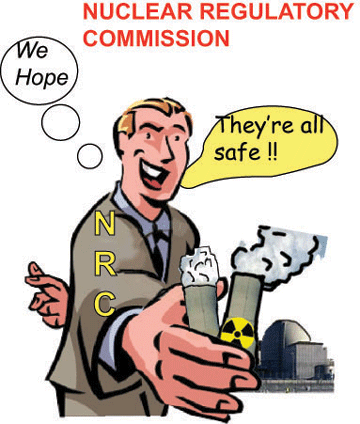 Smaller Nuclear Plants May Come With Less Stringent Safety Rules, npr, August 1, 2020
The NRC is considering whether to shrink emergency planning and evacuation zones around these newer reactors — from a 10-mile radius to, in some cases, the boundary of the plant site.
Nuclear energy critics say that would be a mistake.
“When you’re talking about a reactor that’s never been built or operated, you have to take with a big grain of salt the claims that it’s actually safer or more secure,” says Edwin Lyman at Union of Concerned Scientists.
He says the industry also wants to use weaker reactor containment shells, and in some cases they don’t want to have to keep an operator at the site.
Lyman thinks companies should build plants under current rules first. “You have to work out the kinks of these new plants,” he says. “And then over time you might be able to adjust your requirements accordingly. But you don’t do that at the get-go.”
A National Nuclear Security Administration (NNSA) official recently echoed some of Lyman’s concerns in comments sent to the NRC. The NNSA is a semi-autonomous agency within the Department of Energy.
Deputy Under Secretary Jay Tilden called the proposed rule a major departure from “the successful 42-year-old practice of using a 10-mile plume exposure emergency planning zone.” That existing regulation, he wrote, provides “the last layer of a defense-in-depth for low-probability, high-consequence accidents.” ………
As Dept of Energy officials enthuse over nuclear in space, they show their disdain for health and safety in pandemic
Here we see 9 DOE officials all close to each other – bugger social distancing. Typical nuclear enthusiasts, 7 men confident, think they’re invincible? next to them , the two token women, wearing masks – they have some grasp of the need for safety and public health measures in the pandemic.

US Ramps Up Planning for Space Nuclear Technology AIP, NASA and the Department of Energy are expanding their collaboration as part of a broader White House push to develop nuclear power systems for space applications. The initiative comes as NASA faces key decisions on what fuel sources and technology development paths to pursue.
Now, NASA, DOE, and the White House want nuclear power to play a much larger role in space exploration as plans take shape for a sustained human presence on the Moon and subsequent crewed journeys to Mars……….
The American Nuclear Society hosted a debate on the topic at its annual meeting in June. While the society has generally supported the use of space nuclear power and propulsion in the past, it has decided to develop a position statement by spring 2021 on whether to favor the use of LEU.
Among the participants was Rep. Bill Foster (D-IL), a former Fermilab physicist, who argued that proceeding with HEU ( Highly Enriched Uranium)would set a dangerous precedent. “If all of the spacefaring nations start using HEU reactors in space, then this would involve utilization of a significant amount of weapons grade material,” he remarked…….
Alan Kuperman, a policy scholar affiliated with the Nuclear Proliferation Prevention Project, pointed to U.S. efforts since the 1970s to minimize the use of HEU in civilian applications, arguing they are “based on the logic of no exceptions.”
“If we say, ‘well, we’re going to have exceptions,’ then other countries are going to say, ‘well, we want exceptions too,’ and then the whole thing falls apart,” he remarked……..https://www.aip.org/fyi/2020/us-ramps-planning-space-nuclear-technology
Problems in USA’s rush to put a nuclear reactor on the moon
 America Wants to Put a Nuclear Power Plant on the Moon
What happens to all that highly enriched uranium in space? Popular Mechanics, BY CAROLINE DELBERT, JUL 30, 2020
- The U.S. Department of Energy (DoE) is looking for technology partners to help power the moon.
- This could begin a project that later includes powering a Mars surface mission.
- The Union for Concerned Scientists doesn’t want highly enriched uranium in space.
Scientists at the U.S. Department of Energy’s (DoE) Idaho National Laboratory have a new design for a nuclear power plant they say could allow humans to more easily live on the moon. As part of a form plan, the scientists say they want to have the fission reactor, safe launch, and landing system ready by 2027
What are the challenges of generating nuclear energy on the moon?
Design Development Today reports that the Union of Concerned Scientists expressed, well, concerns:
“Edwin Lyman, director of Nuclear Power Safety at the Union of Concerned Scientists, a nonprofit, said his organization is concerned the parameters of the design and timeline make the most likely reactors those that use highly enriched uranium, which can be made into weapons. Nations have generally been attempting to reduce the amount of enriched uranium being produced for that reason.”
While the Idaho National Laboratory and the DoE broadly are pushing for “advanced” reactor technology in terms of issues like modularity and safety, the “parameters of the design and timeline” they refer to—in this case advocating for a small, reliable, space-friendly design in just 6 years—almost definitely rules out the modular reactors being developed and certified now.
To fully test and regulate these reactors—and design the special edition to send to the moon in this timeframe—is probably impossible. To rush any nuclear approval is a terrible idea, not just for safety, but also for a public that’s already shy about nuclear energy.
Technology like thorium fuel is still far from ready for the market….
USA Department of Energy enthuses about Highly Enriched Uranium in space. Not everyone agrees
As I’ve mentioned before on this site, the oh so confident macho nuclear enthusiasts don’t need to do precautions, even though USA is in the thick of the pandemic. Only the 2 token women have the brains to wear masks.
US Ramps Up Planning for Space Nuclear Technology AIP, 31 July 20, NASA and the Department of Energy are expanding their collaboration as part of a broader White House push to develop nuclear power systems for space applications. The initiative comes as NASA faces key decisions on what fuel sources and technology development paths to pursue.
Now, NASA, DOE, and the White House want nuclear power to play a much larger role in space exploration as plans take shape for a sustained human presence on the Moon and subsequent crewed journeys to Mars……….
The American Nuclear Society hosted a debate on the topic at its annual meeting in June. While the society has generally supported the use of space nuclear power and propulsion in the past, it has decided to develop a position statement by spring 2021 on whether to favor the use of LEU.
Among the participants was Rep. Bill Foster (D-IL), a former Fermilab physicist, who argued that proceeding with HEU ( Highly Enriched Uranium) would set a dangerous precedent. “If all of the spacefaring nations start using HEU reactors in space, then this would involve utilization of a significant amount of weapons grade material,” he remarked…….
Alan Kuperman, a policy scholar affiliated with the Nuclear Proliferation Prevention Project, pointed to U.S. efforts since the 1970s to minimize the use of HEU in civilian applications, arguing they are “based on the logic of no exceptions.”
“If we say, ‘well, we’re going to have exceptions,’ then other countries are going to say, ‘well, we want exceptions too,’ and then the whole thing falls apart,” he remarked……..https://www.aip.org/fyi/2020/us-ramps-planning-space-nuclear-technology
Examining NuScam’s deceptive claims about Small Nuclear Reactors
Derek Abbott shared a link. Nuclear Fuel Cycle Watch Australia, 30 July 20
1 This Month
29 Jan. Thursday 7-8 p.m. Webinar – World’s Largest Nuclear Station in Port Hope, ON?
To see nuclear-related stories in greater depth and intensity – go to https://nuclearinformation.wordpress.com/



31st January – Challenging the War Machine – a DECLASSIFIED UK SUMMIT


Website of the Week
Now until to February 10, 2026 Radioactive waste storage in France: the debate is finally open! How to participate?
-
Archives
- January 2026 (283)
- December 2025 (358)
- November 2025 (359)
- October 2025 (376)
- September 2025 (258)
- August 2025 (319)
- July 2025 (230)
- June 2025 (348)
- May 2025 (261)
- April 2025 (305)
- March 2025 (319)
- February 2025 (234)
-
Categories
- 1
- 1 NUCLEAR ISSUES
- business and costs
- climate change
- culture and arts
- ENERGY
- environment
- health
- history
- indigenous issues
- Legal
- marketing of nuclear
- media
- opposition to nuclear
- PERSONAL STORIES
- politics
- politics international
- Religion and ethics
- safety
- secrets,lies and civil liberties
- spinbuster
- technology
- Uranium
- wastes
- weapons and war
- Women
- 2 WORLD
- ACTION
- AFRICA
- Atrocities
- AUSTRALIA
- Christina's notes
- Christina's themes
- culture and arts
- Events
- Fuk 2022
- Fuk 2023
- Fukushima 2017
- Fukushima 2018
- fukushima 2019
- Fukushima 2020
- Fukushima 2021
- general
- global warming
- Humour (God we need it)
- Nuclear
- RARE EARTHS
- Reference
- resources – print
- Resources -audiovicual
- Weekly Newsletter
- World
- World Nuclear
- YouTube
-
RSS
Entries RSS
Comments RSS
 nuclear-news