.S. govt funds small nuclear reactors, with $billions more tax-payer money to follow
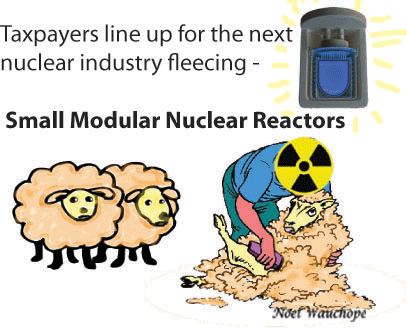 DOE Awards $160M to TerraPower and X-Energy to Build Advanced Nuclear Plants by 2027, Greentech Media, 14 Oct 20 The U.S. Department of Energy has awarded $160 million to X-energy and TerraPower with the potential for billions more in federal funding, as the companies strive to build a working model of their smaller scale, more flexible advanced nuclear reactor designs by 2027. TerraPower is partnered with the GE Hitachi Nuclear Energy, a nuclear industry joint venture formed in 2007.
DOE’s Advanced Reactor Demonstration Program will provide $80 million to each award winner, DOE Secretary Dan Brouillette said Tuesday. DOE intends to invest about $3.2 billion over the next seven years into advanced nuclear, subject to future congressional appropriations, he said………
Smaller reactors are critical to rejuvenate an industry that’s struggling to finance and build the massive, gigawatt-plus power plants that make up the world’s existing nuclear fleet. In the U.S., several of these have been canceled, and Southern Company’s Plant Vogtle expansion is behind schedule and over budget.
Meanwhile, existing reactors in Pennsylvania and Illinois are facing the threat of closure due to challenging energy market economics, and California’s sole remaining nuclear reactor is set to close by mid-decade…………
TerraPower’s initial plans for what it calls a traveling wave reactor drew investment from Gates and Sun Microsystems billionaire Vinod Khosla with its promise of using depleted uranium rather than enriched uranium-235. But that project was abandoned last year after the Trump administration imposed limits on U.S.-China technology transfer forced it to cancel its partnership with China National Nuclear Corp. ……..
X-energy’s advanced pebble-bed reactor…… has yet to be proven in commercial form. A 15 MW demonstration reactor in Germany operated for two decades, but a second, larger-scale version was shut down after only four years of operation. China has built a 10 MW demonstration reactor, and a 250 MW unit began construction in 2012, but plans to start operations in 2019 have been pushed back, with no new completion date announced. ……
Small modular nuclear reactors create intensely radioactive wastes
 A bridge to nowhere New Brunswick must reject small modular reactors, Beyond Nuclear International, By Gordon Edwards and Susan O’Donnell, 12 Oct, 20 ”……… In New Brunswick, the proposed new reactors (so-called “small modular nuclear reactors” or SMNRs) will create irradiated fuel even more intensely radioactive per kilogram than waste currently stored at NB Power’s Point Lepreau Nuclear Generating Station. The non-fuel radioactive wastes will remain the responsibility of the government of New Brunswick, likely requiring the siting of a permanent radioactive waste repository somewhere in the province.
Interestingly, promoters of both new nuclear projects in New Brunswick – the ARC-100 reactor and the Moltex “Stable Salt Reactor” – claim their reactors will “burn up” these radioactive waste fuel bundles. They have even suggested that their prototype reactors offer a “solution” to Lepreau’s existing nuclear fuel waste problem. This is untrue. Radioactive left-over used fuel from the new reactors will still require safe storage for hundreds of thousands of years.
……… Until now, every effort to recycle and “burn up” used reactor fuel – in France, the UK, Russia and the US – has resulted in countless incidents of radioactive contamination of the local environment. In addition, none of these projects eliminated the need for permanent storage of the left-over long-lived radioactive byproducts, many of which cannot be “burned up.”…….
The nuclear waste problem is not going away. The recent letter from more than 100 groups across Canada, and the recent cancellation of the proposed nuclear waste dump in Ontario have shown that significant opposition to new nuclear energy generation exists. Because producing nuclear energy always means producing nuclear waste as well……. https://beyondnuclearinternational.org/2020/10/12/a-bridge-to-nowhere/,
Inadequate Emergency Planning Zones for small modular nuclear reactors
No emergency planning zones for SMRs? NRC commissioner warns against “flimsy” rule that could extend to current reactor fleet, Beyond Nuclear International By Jeff Baran, 12 Oct 20, In a 3-1 vote by NRC Commissioners on December 17, 2019, Proposed Rule: Emergency Preparedness for Small Modular Reactors and Other New Technologies (SECY-18-0103) was accepted. The Rule would eliminate the need for Emergency Planning Zones and dedicated offsite emergency planning for Small Modular Reactors. The lone dissenting vote came from NRC Commissioner Jeff Baran. These are his comments.
For the last 40 years, NRC has required emergency planning zones, or EPZs, (Emergency Planning Zones) around nuclear power plants “to assure that prompt and effective actions can be taken to protect the public in the event of an accident.” Every one of the 96* operating large light-water reactors in the country has a plume exposure pathway EPZ that extends about 10 miles around the site with dedicated offsite radiological emergency plans and protective actions in place to avoid or reduce radiation dose to the public during an accident. An ingestion exposure pathway EPZ with a radius of 50 miles around each of these sites is designed to avoid or reduce dose from consuming food and water contaminated by a radiological release.
The EPZs and dedicated radiological emergency plans are meant to provide multiple layers of protection – or defense-in-depth – against potential radiological exposure. Other NRC requirements are focused on preventing or mitigating a radioactive release. The emergency planning regulations are there to provide another layer of defense in case a release occurs despite those safety requirements.
In other words, EPZs and radiological emergency planning are designed to address low-probability, high-consequence events. The Federal Emergency Management Agency (FEMA) assesses the adequacy of the offsite emergency plans, and NRC regulations require licensees to hold offsite emergency preparedness drills at each plant at least once every 2 years to practice implementing the plan .
Under this proposed rule, emergency planning for small modular reactors (SMRs) and non-light-water reactors would be flimsy by comparison. Instead of a 10-mile plume exposure pathway EPZ, these reactors would have EPZs that encompass only areas where the projected dose from “credible” accidents could exceed 1 rem. An EPZ extending only to the site boundary is explicitly permitted under this methodology.
In the case of a site-boundary EPZ, NRC would not require dedicated offsite radiological emergency planning and FEMA would have no role in evaluating the adequacy of a site’s emergency plans. In addition, the proposed rule would eliminate the requirement for an ingestion exposure pathway EPZ and no longer require a specific drill frequency for emergency planning exercises. Overall, this proposed rule represents a radical departure from more than 40 years of radiological emergency planning…………
We need to take FEMA’s warnings seriously. FEMA has a key role in determining whether the emergency planning for a nuclear power plant site is adequate. Under NRC’s regulations, a nuclear power plant license cannot be issued unless NRC makes a finding that the major features of the emergency plan meet the regulatory requirements. And NRC is supposed to base its finding on FEMA’s determinations as to whether the offsite emergency plans are adequate and whether there is reasonable assurance that they can be implemented.
No new SMR or non-light-water reactor designs have yet been approved by NRC, and only one SMR design has been submitted for the staff’s review. These new designs could potentially be safer than current large light-water-reactor designs. But that does not eliminate the need for EPZs and dedicated offsite emergency planning to provide defense-in-depth in case something goes wrong…….
In addition to the issues identified by FEMA, there are several other significant problems with the proposed rule.
First, the logic of the proposed EPZ sizing methodology could be applied to the existing fleet of large light-water reactors to weaken the current level of protection. As the Advisory Committee on Reactor Safeguards noted:
No technical basis is stated in the rule or the guidance for restricting the use of the new rule to SMRs and [other new technologies] with a limit on thermal power. The rule could apply to any reactor technology regardless of size. During our meetings, the staff acknowledged this point.
In fact, the proposed rule explicitly seeks comment on whether to apply this kind of approach to large light-water reactors. This opens the door to smaller EPZs and reduced emergency planning for the existing fleet of power reactors. If the proposed rule’s formulaic approach is adopted, a precedent will be established for applying a purely risk-based methodology to EPZ sizing.
Second, the proposed rule does not account for the possibility of accidents affecting more than one SMR module. Even though some SMR designs contemplate several reactors at one site, the EPZ sizing methodology addresses each reactor in isolation. This ignores a key lesson of the Fukushima accident – that severe natural disasters can simultaneously threaten multiple reactors at a site. Under the draft proposed rule, a SMR is defined as a power reactor that produces less than 1,000 megawatts-thermal. The combined heat energy produced by just two SMRs of this size could be larger than that of some existing large light-water reactors in the U.S. But, under the proposed rule, each module could individually qualify for a site boundary EPZ without consideration of the other.
Third, unlike the existing regulations for large light-water reactors, the proposed rule “would not define the required frequency of drills and exercises” for emergency preparedness. As a result, SMR and non-light-water reactor licensees would not be required to conduct a full offsite emergency preparedness drill every 2 years. The NRC staff provides no basis for this weaker standard.
Finally, the proposed rule would eliminate the ingestion pathway EPZ for SMRs and non- light-water reactors . . . No FEMA evaluation of this change is provided. Nor is there any discussion of the effectiveness of ad hoc responses to previous radiological releases. Moreover, if the staff’s unbounded rationale were adopted, it could ultimately lead to ingestion pathway EPZs being dropped for the existing fleet of large light-water reactors.
For these reasons, I do not support finalizing the proposed rule in its current form. NRC needs a rule that provides regulatory certainty for potential applicants and recognizes that SMRs and non-light-water reactors will be different than traditional, large light-water reactors. It makes sense to have a graded approach that accounts for potential safety improvements in new designs. But the rule should not be purely risk-based, relying entirely on the results of a dose formula. Instead, NRC should issue a rule to establish the following emergency planning requirements for three categories of nuclear power plants………….https://beyondnuclearinternational.org/2020/10/12/no-emergency-planning-zones-for-smrs/
Big doubts about the economics of small nuclear reactors for the UK
 FT 11th Oct 2020, The big challenge facing small nuclear reactors. When Britain unveiled its
first commercial nuclear reactor back in 1956, Calder Hall in Cumbria had
the ability to generate 50 megawatts of electricity. Fast-forward four
decades to the last reactor the UK completed, at Sizewell in Suffolk. Still
functioning, it has a capacity of 1,200MW. Spot the theme? Yup, ever bigger
reactors.
Size has steadily increased because of simple nuclear economics.
Sizewell B may be able to generate 24 times as much power as a 50MW
reactor. But it doesn’t need 24 times the material inputs and staffing to
generate that extra power. Which all makes it seem faintly
counter-intuitive that Britain is considering downsizing and spending money
on a fleet of so-called small modular reactors.
The government is considering plans to put up to £2bn into developing the technology. A
number of companies, including Britain’s Rolls-Royce and GE Hitachi, are
pitching to sell their products. The aim is to fund prototypes with a view
to kick-starting a new SMR industry.
This would build perhaps dozens of
mini-reactors to [supposedly] help the UK meet its net zero emissions target while also
keeping the lights on, as well as exporting this technically advanced kit.
Large nuclear hasn’t exactly a spotless record when it comes to cost
containment. So why make it harder by forgoing those scale advantages?
Research by a team led by Tony Roulstone at Cambridge university looked at
the relative costs of building a “first of a series” SMR against a
comparable large reactor. It concluded that if you used the same project
techniques as for conventional plants, the SMR would cost (once the
interest costs incurred in construction were taken into account) roughly 70
per cent more per kilowatt (kW) to build than the larger one.
Squeezing that cost back down requires a wholly different approach to construction.
Instead of building everything in the open on a massive building site, as
with large reactors, it means making as much as possible in factories
before shipment to site. The same Cambridge team estimated that with ever
more prefabrication and standardisation of parts, you could ultimately
squeeze the cost down roughly to parity with the larger reactor.
A glance at the history of overruns and delays that plagued the Advanced Gas-cooled
Reactor project in the 1960s should suffice as a reminder. For SMRs to
avoid a similar miserable fate, the government must pick a single
commercial technology which can bring in sufficient private sector
investment and attract export orders. This cannot be some “made in
Britain” industrial exercise. If that’s what’s in prospect, then,
honestly, big is probably best.
https://www.ft.com/content/99307126-bb21-48e3-87aa-301749dec870
3 Canadian provinces sucked in by propaganda from 3 Small Nuclear Reactor companies

|
The two big-name companies that won’t be designing Ontario’s next nuclear reactor The province has passed over two major players on its shortlist for a small-modular-reactor design. Will that mean a more competitive process? TVO By John Michael McGrath – Oct 09, 2020 The Ontario government — along with the governments of New Brunswick, Saskatchewan, and (probably) Alberta — wants to develop a new generation of nuclear reactors in Canada. This week, the provincially owned Ontario Power Generation announced it was taking the latest step toward that goal and would be working with three different companies to refine their engineering and design work so that eventually one can be selected for completion.
The three lucky companies are Terrestrial Energy (covered previously on TVO.org), GE Hitachi (with generations of nuclear experience in the United States), and X-energy. At least as notable, however, are two major omissions: NuScale and SNC-Lavalin, which makes the CANDU reactors that Ontario has relied on for decades……….. The problem for NuScale is that its design is meant to be packaged in clusters of up to 12, which is fine if you need 12 — but, right now, Ontario is looking to find one reactor that it could build reasonably quickly, to prove the design works and can be built economically, and then to reproduce it in other provinces, such as Saskatchewan……… In June of this year, however, SNC-Lavalin announced it was submitting a reactor design to the Canadian regulator in the 300-megawatt range — putting it on the larger end of the spectrum for something that’s still supposed to be “small” but is still smaller than traditional CANDU designs. Terrestrial Energy, by comparison, is offering a 195-megawatt design. Canada’s nuclear industry tried to market a 300-megawatt CANDU reactor in the 1980s (the CANDU 3) but never found a buyer. ……… handing the prize to SNC-Lavalin out of nostalgia for the CANDU design would have been a poor guarantee of value for electricity customers. https://www.tvo.org/article/the-two-big-name-companies-that-wont-be-designing-ontarios-next-nuclear-reactor |
|
Design not even finished! But UK govt to subsidise Small Nuclear Reactors (SMRs)
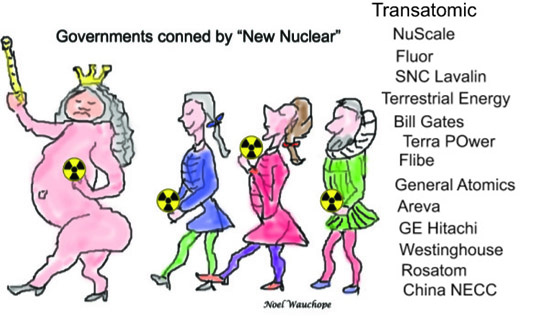
The plan is for 16 of them – at ? £2bn each?
FT 7th Oct 2020, Downing St considers £2bn support for mini nuclear reactors
Consortium wants to build up to 16 generators . Downing Street is supporting plans to spend up to £2bn of taxpayers’ money on a
new generation of mini nuclear reactors. Consortium wants to build up to 16 generators to help UK meet carbon emissions targets. The first SMR is expected to cost £2.2bn and be online by 2029.
Government and industry figures confirmed that a pledge of £1.5bn-£2bn is being discussed which could even see taxpayers acquire an equity stake in the programme.
However, discussions are still ongoing and any final decision will be subject to the Treasury’s current multiyear spending review, which is due later this year. The government could also commission the first mini power station, giving confidence to suppliers and investors. The consortium, which also includes the National Nuclear Laboratory, will seek additional funding of at least £2bn, including from private investors and the capital markets.
Support for SMR technology is expected to form part of Boris Johnson’s “10-point plan for a green industrial revolution” which he will set out later in the autumn. …….. Under the plans being considered by Number 10, the small
modular reactors would be manufactured on production lines in central plants and then transported to sites for assembly. Each mini power station would operate for up to 60 years, providing 440MW of electricity per year — enough to power a city the size of Leeds.
The government’s support “should deliver sufficient cash to get the consortium through building
factories and well on the way to construction of power stations prior to finding more money from other sources,” said one person with knowledge of the situation.
The consortium is expected to finalise the SMR design by April next year, when it hopes to launch the four-year licensing process.
During that time it hopes to begin recruiting employees for the business, and identifying the sites for powers stations and the factories to build the components and modules for the SMRs. The business department hasalready pledged £18m towards the consortium’s early-stage plans.
https://www.ft.com/content/d7016b80-e0c4-4444-a059-2daf32b9a4ab
Nuclear no option for hydrogen production: German government
Energy ministry state secretary Feicht says, however, that the rule of nuclear will be discussed at an EU level, Recharge 6 October 2020 By Bernd Radowitz
“Nuclear isn’t an option for our energy system, be it the production of electricity for our electricity demand, [or] for the production of hydrogen,” Andreas Feicht, secretary of state in Germany’s economics and energy ministry, said at a virtual conference on hydrogen organized by his ministry……..
Green’ or ‘carbon-free’ hydrogen?
Germany by the end of 2022 will phase out its last atomic power stations, and in its €9bn ($10.6bn) national hydrogen strategy has laid down that it strives to ramp up a ‘green hydrogen’ economy mostly based on renewables such as offshore wind, with a temporary and limited role for ‘blue hydrogen’ produced from natural gas linked to carbon capture and storage (CCS)…………..
the Dutch government is planning to launch a consultation on building new nuclear power plants after a study commissioned by its economics and climate ministry claimed atomic energy is as cheap as wind or solar power – and supposedly the safest way to produce electricity in the country.
The study was conducted by a nuclear energy consultancy with links to the nuclear industry, though. At the same time, a flurry of studies advises against a nuclear renaissance.
‘Nuclear and renewables don’t mix’
The University of Sussex Business School and the ISM International School of Mangement this week published an analysis of 123 countries over 25 years in Nature Energy that concludes that nuclear and renewables don’t mix, and only the latter can deliver truly low carbon energy.
The researchers found that unlike with renewables, countries around the world with larger scale nuclear attachments do not tend to show significantly lower carbon emissions – and in poorer countries nuclear programmes actually tend to associate with relatively higher emissions.
The researchers found that unlike with renewables, countries around the world with larger scale nuclear attachments do not tend to show significantly lower carbon emissions – and in poorer countries nuclear programmes actually tend to associate with relatively higher emissions.
Champagne of power fuels
Michael Bloss, a Green Party member of the European Parliament, at the same hydrogen conference stressed that only “green hydrogen is clean hydrogen.”
Blue hydrogen as considered as a temporary option by the German government is no real option due to high amounts of methane leakage during its production, which he argued is “much more detrimental for the climate than CO2.”
Despite €3.7bn in EU investments into CCS since 2009 (according to the European Court of Auditors), the technology remained at the “beginning of its development” and is still “not ready to be applied,” Bloss said.
Renewable energies such as offshore wind, meanwhile, are the most cost-competitive energy source and should be used for hydrogen production, he added, without going into the nuclear versus renewables controversy.
Bloss, however, stressed that it has been said that “hydrogen is the Champagne among power fuels,” which must be used only in difficult-to-decarbonise sectors where it cannot be replaced by other applications, such as steel, cement or chemicals.https://www.rechargenews.com/wind/nuclear-no-option-for-hydrogen-production-german-government/2-1-887905
Nano diamond batteries from nuclear waste? Impractical and not likely to ever happen
Arkenlight “surprised” by NDB’s grand nuclear diamond battery claims, New Atlas By Loz Blain, September 30, 2020 Totally safe, self-charging batteries that generate power for thousands of years … It’s an exciting thought, and when we wrote about California’s NDB in August, the story generated all kinds of feedback. A lot of people felt some of NDB’s claims were outrageously false, contravening the laws of physics and vastly overstating the capabilities of a device that was already well understood.
IWe ended up having a very informative chat with Morgan Boardman, an Industrial Fellow and Strategic Advisory Consultant with the Aspire Diamond Group at the South West Nuclear Hub of the University of Bristol.
He is also – and this is much less of a tongue twister – the CEO of a new company called Arkenlight, which has been created to commercialize the Bristol team’s diamond battery technologies, among other radioisotope-driven power sources.
In short, Boardman broadly agreed with the position that these “betabatteries” produce power far too slowly to replace the cells in your iPhone or Tesla; yes, you could build a betabattery for a phone or a vehicle, but only if you’re prepared to have the battery be several times the size of the device it’s powering.
What’s more, he pointed out that the University of Bristol took out patents covering all devices that embed radioisotopes in diamond structures, and that Arkenlight now holds those patents. So if NDB is talking about using the same kind of nuclear diamond technology – which it sure sounds like it is – it could have some licensing issues ahead of it.
So it seems it’s time to pump the brakes on some of NDB’s more exciting claims ……….. https://newatlas.com/energy/arkenlight-nuclear-diamond-batteries/
On the moon ”normal” humans (i.e males) will get 200 Times the Radiation Experienced on Earth, (what about females?)

Christina Macpherson’s websites & blogs
It is amazing that in all this propaganda for putting a woman on the moon, – no mention is ever made, of the fact that women are much more susceptible to the effects of ionising radiation, meaning that their risk of developing cancer and other illnesses is greater than it is for men. Apparently the space enthusiasts are still buying into that traditional view that the ”normal” human being is male.

The 12 human beings who have walked on the moon were all bombarded by radiation roughly 200 times what we experience here on Earth, reports Adam Mann for Science. That’s two to three times what astronauts experience aboard the International Space Station, explains Marcia Dunn for the Associated Press (AP), suggesting that any long term human presence on the moon will require shelters with thick walls capable of blocking the radiation.
Despite the fact that the measurements, which come courtesy of China’s Chang’e-4 lunar lander, are quite high compared to what we experience on Earth, the data is quite useful for protecting future moonwalkers. According to Science, the levels of radiation at the lunar surface wouldn’t be expected to increase the risk of NASA astronauts developing cancer by more than 3 percent—a risk threshold the agency is legally required to keep its astronauts’ activities safely below.
Despite the fact that the measurements, which come courtesy of China’s Chang’e-4 lunar lander, are quite high compared to what we experience on Earth, the data is quite useful for protecting future moonwalkers. According to Science, the levels of radiation at the lunar surface wouldn’t be expected to increase the risk of NASA astronauts developing cancer by more than 3 percent—a risk threshold the agency is legally required to keep its astronauts’ activities safely below……
Some forms of radiation, which is electromagnetic energy emitted in forms like heat, visible light, X-rays and radio waves, can mess with the cells inside the human body by breaking up the atoms and molecules they’re made of. On Earth, most people are familiar with ultraviolet radiation’s harmful effects on our skin, but in space, astronauts are also subjected to galactic cosmic rays, accelerated solar particles, neutrons and gamma rays, according to the research published this week in the journal Science Advances. This material can damage our DNA and lead to increased incidences of cancer or contribute to other health problems such as cataracts and degenerative diseases of the central nervous system or other organ systems.
Humanity measured the radiation astronauts on the Apollo missions experienced on their journeys to the moon, but those measurements were cumulative for each astronaut’s entire journey, per Science. To figure out the daily dose of radiation exclusively on the surface of the moon, the robotic Chang’e-4 lander used a stack of ten silicon solid-state detectors.
The renewed interest in collecting such measurements is partly because NASA has plans to send more people to the moon. The Artemis moon mission, scheduled for 2024, will feature the first woman ever to walk on the moon as well as a week-long expedition to the lunar surface and a minimum of two moonwalks, reports Katie Hunt for CNN.
Berger tells the AP that these new findings suggest the shelters needed to protect Artemis’ astronauts during such a long stay on the moon should have walls made of moon dirt that are some two and a half feet thick. Science notes that the shelter would also need an even more heavily shielded inner sanctum to protect astronauts in the event of a solar storm. Adequate shielding for this inner chamber would be roughly 30 feet of water, and would also need to be reachable within 30 minutes—the current limit of satellites’ abilities to provide astronauts with advanced warning of such hazards.
The findings aren’t exactly suprising: they are in line with calculations made using existing measurements. But they’re a crucial step towards putting people on the surface of the moon for extended periods of time. According to Science, the results confirm that with proper shielding astronauts could spend as long as six months on the moon. https://www.smithsonianmag.com/smart-news/moonwalking-humans-get-blasted-200-times-radiation-experienced-earth-180975926/
Lunar base woud have to be underground, due to the danger of high radiation on the moon
 After measuring radiation on the moon for the first time, scientists say a lunar base should be built underground to protect astronauts, Business Insider, AYLIN WOODWARD, SEP 30, 2020,
- NASA recently unveiled the plan for its Artemis program, a series of missions that would return astronauts to the moon.
- A new study found how much radiation astronauts are exposed to on the lunar surface: a daily dose about 200 times as great as on Earth.
- NASA wants to build a base on the moon, but the new data suggests it’d be safest to bury such a base under 2.5 feet of moon dirt to protect astronauts from radiation.
But a new study found that any astronauts who go there would face levels of radiation nearly three times as high as what the astronauts on the space station deal with. Long-term exposure to enough of this cosmic radiation poses significant health risks, including cataracts, cancer, and diseases of the central nervous system.
The new research, published last week in the journal Science, calculated for the first time what a moonwalker’s daily dose of radiation would be.
“If you think about people staying on the moon for extended periods of time — say, on a scientific research station for a year or two — then these levels start getting problematic,” Robert Wimmer-Schweingruber, an author of the new study, told Business Insider.
The solution, he said, would be to build any lunar base beneath the moon’s surface.
The first study to calculate radiation on the moon
Apollo astronauts carried radiation-measuring instruments on their missions in the 1960s and ’70s, but those dosimeters could tell scientists only the total amount of radiation the astronauts were exposed to throughout their time in space, from blasting off to landing, not just on the moon.
Astronauts on the moon, meanwhile, face a daily radiation level five to 10 times as high as transatlantic fliers, since the moon doesn’t have the shield that Earth does.
One more Utah city withdraws from NuScam small nuclear reactor project
Kaysville withdraws from nuclear power project. Post Register, By NATHAN BROWN nbrown@postregister.com
- Sep 28, 2020 One more Utah city has withdrawn from a project to build 12 small nuclear reactors west of Idaho Falls.
The Kaysville City Council voted unanimously a week-and-a-half ago to withdraw from the Carbon Free Power Project, although the resolution left the door open for the city to hold a special meeting to rejoin the project if anything changes……….
Lehi and Logan have also withdrawn from the Carbon Free Power Project over the past month-and-a-half, citing potential risks to local taxpayers if costs go up. There are still more than 30 cities and power systems, including Idaho Falls, that are part of it, and the members have until Oct. 31 to recommit to the project’s next phase by approving the new budget. Utah Associated Municipal Power Systems is waiting for the U.S. Department of Energy to give final approval to a promised $1.4 billion to support the project. ……. https://www.postregister.com/news/government/kaysville-withdraws-from-nuclear-power-project/article_fbb6f15e-e8c6-5207-b6e9-bbf632538c85.html
Dr Helen Caldicott busts the media spin on ‘small nuclear reactors’
HELEN CALDICOTT: Small modular reactors — the next big thing?
https://independentaustralia.net/environment/environment-display/helen-caldicott-small-modular-reactors–the-next-big-thing,14342#disqus_thread By Helen Caldicott | 27 September 2020 Politicians debating nuclear power as an energy source, know little of the facts that make small modular reactors a bad idea, writes Dr Caldicott. AUSTRALIAN politicians are contemplating developing nuclear power for this country. In their ignorance, they are mooting “small modular reactors” (SMRs) about which they clearly know little.
The so-called “nuclear renaissance” died following the Fukushima catastrophe when one-sixth of the world’s nuclear reactors closed. However, global nuclear corporations – Toshiba, NuScale, Babcock & Wilcox, GE Hitachi, General Atomics and the Tennessee Valley Authority – did not accept defeat.
Their new strategy has been to develop small modular nuclear reactors without the dangers inherent in large reactors — safety, cost, proliferation risks and radioactive waste. But these claims are fallacious for the reasons outlined below.
Basically, there are three types of SMRs which generate less than 300 megawatts of electricity compared with current day 1000 megawatt reactors.
Light water reactors designs
These will be smaller versions of present-day pressurized water reactors using water as the moderator and coolant, but with the same attendant problems as Fukushima and Three Mile Island. Built underground, they will be difficult to access in the event of an accident or malfunction.
Mass-produced (turnkey production) large numbers must be sold yearly to make a profit. This is an unlikely prospect because major markets – China and India – will not buy U.S. reactors when they can make their own.
If safety problems arise – as in General Motors cars – they all must be shut down which will interfere substantially with electricity supply.
SMRs will be expensive because the cost per unit capacity increases with a decrease in reactor size. Billions of dollars of government subsidies will be required because Wall Street is allergic to nuclear power. To alleviate costs, it is suggested that safety rules be relaxed, including reducing security requirements and a reduction in the 10-mile emergency planning zone to 1,000 feet.
Non-light water designs
These are high-temperature gas-cooled reactors (HTGR) or pebble bed reactors. Five billion tiny fuel kernels consisting of high-enriched uranium or plutonium will be encased in tennis-ball-sized graphite spheres which must be made without cracks or imperfections — or they could lead to an accident. A total of 450,000 such spheres will slowly and continuously be released from a fuel silo – passing through the reactor core – and then be re-circulated ten times. These reactors will be cooled by helium gas operating at very high temperatures (900 degrees Celsius).
A reactor complex consisting of four HTGR modules will be located underground, to be run by just two operators in a central control room. Claims are that HTGRs will be so safe that a containment building will be unnecessary and operators can even leave the site – “walk away safe” reactors.
However, should temperatures unexpectedly exceed 1,600 degrees Celsius, the carbon coating will release dangerous radioactive isotopes into the helium gas and at 2,000 degrees Celsius the carbon would ignite creating a fierce graphite Chernobyl-type fire.
If a crack develops in the piping or building, radioactive helium would escape and air would rush in, also igniting the graphite.
Although HTGRs produce small amounts of low-level waste they create larger volumes of high-level waste than conventional reactors.
Despite these obvious safety problems and despite the fact that South Africa has abandoned plans for HTGRs, the U.S. Department of Energy has unwisely chosen the HTGR as the “Next Generation Nuclear Plant”.
 Liquid metal fast reactors (PRISM)
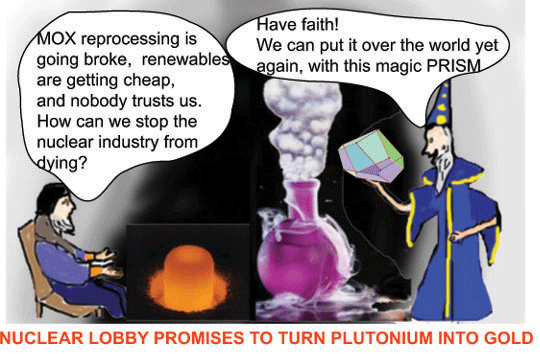
It is claimed by proponents that fast reactors will be safe, economically competitive, proliferation-resistant and sustainable.
They will be fueled by plutonium or highly enriched uranium and cooled by either liquid sodium or a lead-bismuth molten coolant. Liquid sodium burns or explodes when exposed to air or water and lead-bismuth is extremely corrosive producing very volatile radioactive elements when irradiated.
Should a crack occur in the reactor complex, liquid sodium would escape, burning or exploding. Without coolant, the plutonium fuel could reach critical mass, triggering a massive nuclear explosion scattering plutonium to the four winds. One-millionth of a gram of plutonium induces cancer and it lasts for 500,000 years. Extraordinarily, claims are made that fast reactors will be so safe they will require no emergency sirens and emergency planning zones can be decreased from ten miles to 1,300 feet.
There are two types of fast reactors: a simple plutonium fueled reactor and a “breeder” in which the plutonium reactor core is surrounded by a blanket of uranium 238 which captures neutrons and converts to plutonium.
The plutonium fuel, obtained from spent reactor fuel will be fissioned and converted to shorter-lived isotopes — caesium and strontium which last 600 years instead of 500,000. Called “transmutation”, the industry claims that this is an excellent way to get rid of plutonium waste. But this is fallacious because only ten per cent fissions, leaving 90 per cent of the plutonium for bomb-making etc.
Three small plutonium fast reactors will be grouped together to form a module and three of these modules will be buried underground. All nine reactors will then be connected to a fully automated central control room operated by only three operators. Potentially then, one operator could simultaneously face a catastrophic situation triggered by the loss of off-site power to one unit at full power, in another shut down for refuelling and in one in start-up mode. There are to be no emergency core cooling systems.
Fast reactors require a massive infrastructure including a reprocessing plant to dissolve radioactive waste fuel rods in nitric acid, chemically removing the plutonium and a fuel fabrication facility to create new fuel rods. A total of 10,160 kilos of plutonium is required to operate a fuel cycle at a fast reactor and just 2.5 kilos is fuel for a nuclear weapon.
Thus fast reactors and breeders will provide extraordinary long-term medical dangers and the perfect situation for nuclear weapons proliferation. Despite this, the industry is clearly trying to market them to many countries including, it seems, Australia.
You can follow Dr Caldicott on Twitter @DrHCaldicott. Click here for Dr Caldicott’s complete curriculum vitae.
Russia’s nuclear-powered ice-breakers lead towards military domination of the Arctic
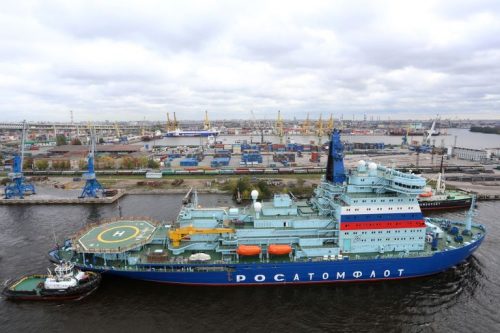
Russia’s Nuclear-Powered Icebreaker Is a Step Toward Military Domination
The country is fast becoming an icebreaking superpower. BY KYLE MIZOKAMI, SEP 24, 2020 Russia’s newest icebreaker, the  nuclear-powered Arktika, is headed to its new homeport in St. Petersburg, Russia. The ship, painted in the colors of the Russian state flag, will operate north of the Arctic Circle in anticipation of a year-round shipping route across the icy far north. Arktika is part of Moscow’s emerging policy of exploiting a warming arctic region—and protecting its stake in the region from competitors.
- Russia’s first new nuclear-powered icebreaker in decades, Arktika, is joining the country’s large fleet of icebreaking ships.
- Arktika is capable of smashing through ice that’s nearly 10 feet thick.<
- Millions of Russians live above the Arctic Circle, and warming ocean temperatures could create ice-free shortcuts between Asia and Europe.Russia’s newest icebreaker, the nuclear-powered Arktika, is headed to its new homeport in St. Petersburg, Russia. The ship, painted in the colors of the Russian state flag, will operate north of the Arctic Circle in anticipation of a year-round shipping route across the icy far north. Arktika is part of Moscow’s emerging policy of exploiting a warming arctic region—and protecting its stake in the region from competitors.
<Arktika is the first of a new class of nuclear-powered icebreakers. Construction began at the Baltic Shipyards in St. Petersburg in 2012 with a scheduled launch in 2017, but delays pushed the completion back to 2020. This past February, a short circuit damaged one of the ship’s three 300-ton electric motors, disabling one of the three propellers. Russian authorities ordered the ship to continue, however, and the ship is currently moving on just two propellers.
In 2019, Russian President Vladimir Putin announced the country would ultimately have a fleet of 13 icebreakers, the majority of them nuclear-powered. …………..
Iceabreakers like Arktika could also allow Russia to militarily dominate the Northern Sea Route, smashing a route for Russian warships and transports full of Russian Marines. Warming temperatures will mean other countries, such as Canada and the U.S., will likely move to unlock natural resources previously trapped under sheets of sea ice, and Russia will be in a position to threaten oil, gas, and mineral exploration and exploitation…………. https://www.popularmechanics.com/military/navy-ships/a34128219/russia-nuclear-powered-icebreaker-arktika/
Canada to splurge $billions on non-existent small nuclear reactors, ineffective and no use against climate change
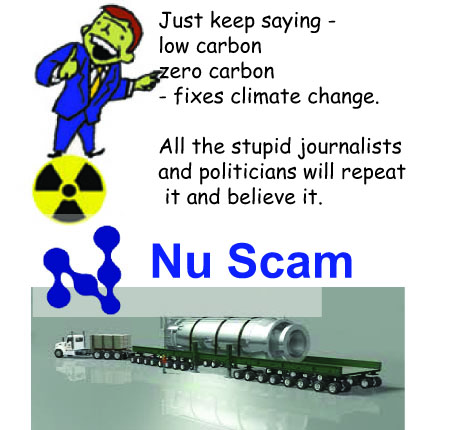 GIBBONS: Nuclear power no solution to climate change https://torontosun.com/opinion/columnists/gibbons-nuclear-power-no-solution-to-climate-change, Author of the article:, Jack Gibbons, Sep 25, 2020 At a time when action on climate change has never been more urgent, the federal Liberals want to throw billions of dollars at non-existent technology that will not make a difference for decades, if ever.
But that’s pretty much the way things have always been when it comes to federal spending on nuclear power: As long as the word “nuclear” is attached, we put common sense aside and fund projects that lead to one dead end after another.
More than $400 million for Advanced CANDU reactors that never got built? You bet. Another $600 million on the infamous Maple medical isotope reactor design, which proved unsafe to operate? No problem.
Now the industry’s latest pitch is Small Modular Reactors (SMRs) and off we go on another wild goose chase with Minister of Natural Resources Seamus O’Regan once again promising billions for technology that is nowhere in sight, let alone use.
Meanwhile, costs for wind and solar have plunged to the point where these energy sources are now outcompeting even natural gas.
Nuclear, for its part, is fading fast. Due to its high costs and safety concerns, nuclear’s share of the world electricity market has cratered in the past two decades. More places are now retiring aging reactors than building them.
The nuclear industry loves to claim they are a critical climate change solution — except on a cost per tonne basis.
Nuclear is like buying a Mercedes to go to the corner store.
Ontario pays as little as two cents a kilowatt hour (kWh) for energy efficient improvements that could displace the need for nuclear while reducing greenhouse gas pollution.
Alberta is now paying around five cents per kWh for solar and four cents for wind.
Ontario Power Generation says it will need to be paid 16.5 cents per kWh for nuclear by 2025.
A whole lot has changed since the bad old days of Ontario’s Green Energy Act.
Yes, the sun doesn’t always shine or the wind blow. Which is why it is fortunate that in Ontario we live beside a giant battery.
Quebec has an enormous water-power reservoir system that Hydro Quebec is keen to integrate with renewable sources for its out-of-province customers.
When we have surplus solar and wind, Quebec stores water. When not, it produces hydro power for export.
We have the connections necessary to make this system work and can expand them at a cost that looks like spare change next to what it costs to rebuild a nuclear reactor or get an SMR prototype built.
The nuclear industry is grasping at straws. Its technology is obsolete, its promises unfulfilled and its costs ever rising.
Betting on nuclear as a climate solution is just sticking our heads in the sand because SMR technology is decades away, extremely expensive, and comes with a nasty pile of security and waste headaches. Yes. Virginia, SMRs still produce lots of highly radioactive waste and we still have no place to put the stuff.
That our government would be this gullible is distressing, especially given the havoc already being wreaked by a changing climate.
We have simple, affordable, reliable and truly clean answers to our climate problem at our fingertips.
Yet our government sits and waits for the nuclear industry to call with some good news. And the phone never rings.
— Jack Gibbons is chairman of the Ontario Clean Air Alliance
Radiation exposure on the moon is nearly three times that on the International Space Station
 Radiation exposure on the moon is nearly three times that on the ISS, 25 September 2020
By Layal Liverpool Astronauts on the moon would face nearly three times more radiation exposure than those aboard the International Space Station, which could make long-term missions riskier than thought.
“Once you’ve survived being on the moon and come back to Earth, radiation damage is what stays with you for the rest of your life and that’s why this is a critical measurement,” says Robert Wimmer-Schweingruber at the University of Kiel in Germany.
Wimmer-Schweingruber and his team analysed several weeks of data acquired by China’s Chang’e … (subscribers only) https://www.newscientist.com/article/2255545-radiation-exposure-on-the-moon-is-nearly-three-times-that-on-the-iss/#ixzz6Z61souv7
1 This Month
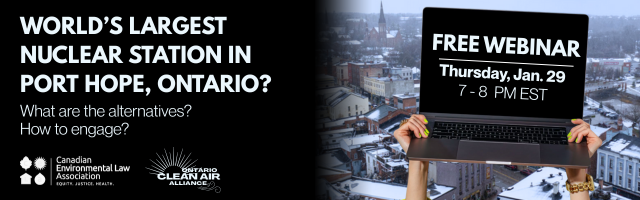
29 Jan. Thursday 7-8 p.m. Webinar – World’s Largest Nuclear Station in Port Hope, ON?
To see nuclear-related stories in greater depth and intensity – go to https://nuclearinformation.wordpress.com/


31st January – Challenging the War Machine – a DECLASSIFIED UK SUMMIT

Website of the Week
Now until to February 10, 2026 Radioactive waste storage in France: the debate is finally open! How to participate?
-
Archives
- January 2026 (283)
- December 2025 (358)
- November 2025 (359)
- October 2025 (376)
- September 2025 (258)
- August 2025 (319)
- July 2025 (230)
- June 2025 (348)
- May 2025 (261)
- April 2025 (305)
- March 2025 (319)
- February 2025 (234)
-
Categories
- 1
- 1 NUCLEAR ISSUES
- business and costs
- climate change
- culture and arts
- ENERGY
- environment
- health
- history
- indigenous issues
- Legal
- marketing of nuclear
- media
- opposition to nuclear
- PERSONAL STORIES
- politics
- politics international
- Religion and ethics
- safety
- secrets,lies and civil liberties
- spinbuster
- technology
- Uranium
- wastes
- weapons and war
- Women
- 2 WORLD
- ACTION
- AFRICA
- Atrocities
- AUSTRALIA
- Christina's notes
- Christina's themes
- culture and arts
- Events
- Fuk 2022
- Fuk 2023
- Fukushima 2017
- Fukushima 2018
- fukushima 2019
- Fukushima 2020
- Fukushima 2021
- general
- global warming
- Humour (God we need it)
- Nuclear
- RARE EARTHS
- Reference
- resources – print
- Resources -audiovicual
- Weekly Newsletter
- World
- World Nuclear
- YouTube
-
RSS
Entries RSS
Comments RSS
 nuclear-news