Two more cities opt out of Utah’s dubious small nuclear reactor project
|
The $6 billion project has built in “off-ramps” for members of the Utah Associated Municipal Power Systems to bow out of participation at this stage, with a deadline for this exit set for Saturday. The 720-megawatt NuScale Power project is planned for construction at the U.S. Department of Energy’s Idaho National Laboratory, about 180 miles north of Salt Lake City. Earlier this month, the federal agency announced it will provide nearly $1.4 billion for the project to pay for one-time costs for a plant that is being billed as a first-of-its-kind, next-generation nuclear power technology. The infusion of money would be subject to yearly appropriations by Congress, but project backers say it has had bipartisan support under both the Trump and Obama administrations. The power association is made up of 47 members in Utah and throughout the Intermountain West that are independent utilities. Bountiful and Beaver are the latest to leave the Carbon Free Power Project, citing concerns over rising costs,…. Concerns over costs and utilities acting as “seed investors” have been raised by the Utah Taxpayers Association, which warns project delays and mounting costs may make members vulnerable. The project passed one regulatory hurdle in a design certification process before the U.S. Nuclear Regulatory Commission and is moving onto the next phase of licensing…… If successful, the Carbon Free Power Project would be the first globally to deploy the modular technology. Construction of the 12-modular unit is expected to start in 2025, with the first unit coming online in 2029. https://www.deseret.com/utah/2020/10/28/21536595/news-nuclear-power-project-utah-cities-bountiful-bow-out-of-planned-nuscale-plant-idaho-uamps |
|
The very real risks of radiation accidents on Earth, from nuclear reactors in space
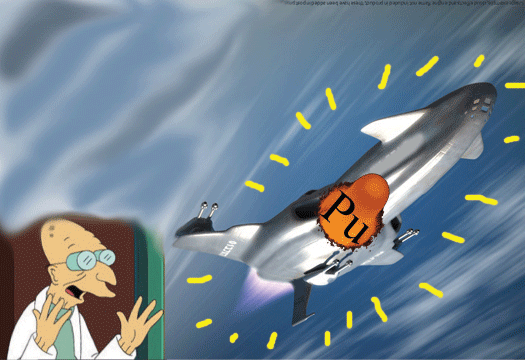 Ensuring Safety on Earth from Nuclear Sources in Space, Mirage News, 28 Oct 20, In early 1978, the world steeled itself as gravity pulled an uncontrolled satellite powered by a small reactor fueled with 45 kg of highly enriched uranium towards Earth. Since COSMOS 954’s impact point could not be predicted accurately, emergency responders had to assume that an inhabited area could be contaminated, and they feverishly prepared equipment and response procedures. This was the world’s first experience with the uncontrolled re-entry of a space object with radioactive materials. Ensuring Safety on Earth from Nuclear Sources in Space, Mirage News, 28 Oct 20, In early 1978, the world steeled itself as gravity pulled an uncontrolled satellite powered by a small reactor fueled with 45 kg of highly enriched uranium towards Earth. Since COSMOS 954’s impact point could not be predicted accurately, emergency responders had to assume that an inhabited area could be contaminated, and they feverishly prepared equipment and response procedures. This was the world’s first experience with the uncontrolled re-entry of a space object with radioactive materials.The radioactive materials launched into Earth orbit, or traveling in spacecraft, can potentially harm people or the environment in case of an accident and for which strict emergency response planning and effective information sharing at the international level are required. This was the topic of an IAEA webinar held last week for emergency response experts.
In the majority of nuclear and radiological emergencies there will be enough information to know the location of a potential release of radioactivity, but with space activities the exact location of impact cannot always be predicted. “The IAEA has developed arrangements to share information about any pending nuclear-powered satellite re-entry. Using the data, countries can quickly respond to protect the public and the environment from the radioactivity that might spread as a result of an accident,” said Frederic Stephani, Incident and Emergency Assessment Officer in the IAEA, during the webinar. COSMOS 954 eventually crashed in the Northwest Territories in Canada on 24 January 1978, scattering radioactive debris over a 600 km footprint and spreading radioactivity over 100 000 km2. The clean-up operation, called “Operation Morning Light,” jointly coordinated by Canada and the US, recovered 80 radioactive items…… accidents can occur during the launch, operation and end-of-service mission phases of space nuclear power source applications. These accidents could expose the nuclear power source to extreme physical conditions leading to a radioactive release into the Earth’s atmosphere. …. https://www.miragenews.com/ensuring-safety-on-earth-from-nuclear-sources-in-space/ |
|
Finland, stuck with increasingly costly Olkiluouti nuclear nightmare, plans and even worse expense, with small nucler reactors!
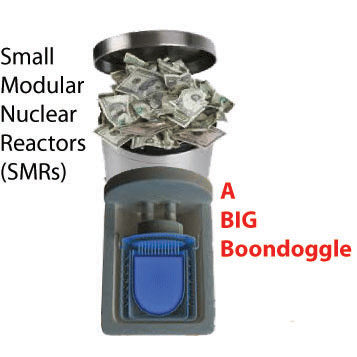 Taz 26th Oct 2020, The European pressurized water reactor Olkiluoto 3 has long since developed into a Finnish BER – at least twelve years too late, three times as expensive as planned. And it’s far from being online. The same goes for the
new Hanhikivi project: years behind before construction began .
But the Finnish nuclear lobby is already planning another nuclear energy adventure: the construction of so-called Small Modular Reactors (SMR). Paul Dorfman of the UK UCL Energy Institute and co-author of an SMR study by the Nuclear
Consulting Group estimates that small reactors would provide increasingly expensive energy due to the cost of materials and personnel : the massive investments that would be required to create a supply chain so that replacing the economies of scale of large reactors with the advantage of series production would make the investment risk for SMR even higher than for standard reactors.
Trump’s USA is pushing NuScale’s small nuclear reactors for South Africa

The US nuclear company with an eye on South Africa just got a R23 billion boost, courtesy of Donald Trump, https://www.businessinsider.co.za/nuscale-nuclear-which-has-plans-for-sa-gets-a-big-us-subsidy-to-test-its-design-2020-10 Phillip de Wet , Business Insider SA Oct 22, 2020,
- American nuclear energy company NuScale has been citing Cape Town as an example of an ideal customer for its still-theoretical generators.
- It has now received in-principle financial support from the American government to build a nuclear power station in South Africa.
 NuScale’s pathfinder project for its new technology, in Idaho, just got a promise of an infusion of US government cash worth some R23 billion.
- While South Africa abandoned plans to create next-generation PBMR systems, the administration of Donald Trump has pushed small-scale nuclear development.
NuScale, a company with roots in US-funded research, this week received assurances that the American government will provide up to $1.4 billion (around R23 billion) in subsidies for a 12-module reactor it hopes to start building in Idaho by 2025.
The project is a commercial one, with municipal buyers lined up for the electricity, but the cash from the US department of energy is intended to bring the cost of that electricity down to $55 per MWh on a levelised cost of energy (LCOE) basis, making the project at least vaguely competitive with other forms of power generation.
Without the subsidies, the supposedly once-off cost of building a first-of-its kind power station would make the NuScale project commercially unviable, its planned customers say.
Just how once-off such costs are, and how much money the US government ends up actually spending on the project, will be closely watched in South Africa
Last week the US International Development Finance Corporation (DFC) announced it had signed a letter of intent to support NuScale “to develop 2,500 MW of nuclear energy in South Africa”.
NuScale has cited Cape Town as a purely theoretical customer for a 12-module version of its nuclear energy system, saying that such an installation could desalinate enough water to keep the entire city going.
But the 2,500MW number cited by the DFC suggests its South African ambitions are substantial. That is the full generating capability the South African government now envisages adding to the national grid from nuclear stations – but the government plan calls for a mixture of the conventional pressurised water reactors (PWRs) such as Russia’s Rosatom sells, and the type of small modular reactors (SMRs) NuScale is developing.
By seeking development finance for the full 2,500MW, NuScale appears to be signalling a plan to bid for the whole thing, rather than seeking to build only part of a new set of nuclear generators in SA alongside companies from China or elsewhere.
That matches the aggressive posture of the US government under the administration of Donald Trump. The DFC letter of intent is the first time the organisation has supported any nuclear project; a ban on its involvement in nuclear energy was lifted on the recommendation of a working group formed by the White House.
The state funding for the NuScale project in the US, meanwhile, comes after consistent and determined efforts under Trump’s presidency to “revitalise” nuclear energy in America, both in production and through research and development on next-generation systems.
South Africa, though determined to buy new nuclear power stations, has not had a similar political appetite to invest in research. In 2010 it mothballed work on the pebble bed modular reactor, a project launched in the late 1990s to create a safe, small, modular reactor system for both domestic use and sale abroad.
Russia once thought it had a done deal to build new nuclear reactors in South Africa. Half a decade later, thanks to its sheer political weight, China seems to be a serious contender for the job. Both France and South Korea have, at various points, been in the running too.
But as of this week, an American company with no track record of actually building commerical nuclear reactors yet is lining up the kind of money from the US government that could make its plans for South Africa viable – replacing a dream of home-grown next-generation nuclear with an imported version.
As of this year there are still vague plans to revive the project, in one form or another, but even if those were to succeed, the pace of development would have to be improbably fast for it to have any place in South Africa’s current round of explorations.
Another city leaves small nuclear reactor project – unanimous vote by Murray City Council, Utah
 Murray City votes to withdraw from nuclear power project, Salt Lake Tribune, By Taylor Stevens– 23 Oct 20, The Murray City Council voted unanimously this week to back out of a first-of-its-kind nuclear power project that has the support of a number of Utah municipalities.
It’s the fourth Utah city to exit the small modular nuclear reactor pursuit over the last few months amid pressure from opponents who have raised concerns about environmental and financial risks of the proposed 12-module plant, which would be located at Idaho National Laboratory in Idaho Falls and produce a total 720 megawatts of electricity.
During the city’s Tuesday council meeting, Murray Power Manager Blaine Haacke outlined several advantages of the project, including the potential that it could fill the energy gap that will be left when the Hunter Power Plant in Castle Dale goes offline in the coming years.
He told the council that he expects UAMPS will carry the project forward without Murray. But he said the association’s members will meet during the first week of November to make a final decision, after they find out how many cities have exited.
Very dubious claims made by proponents of NuScam’s small nuclear reactor plans
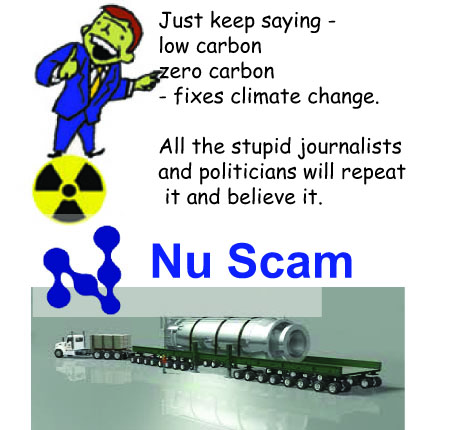 Small Nuclear Reactors Would Provide [a dubious claim] Carbon-Free Energy, but Would They Be Safe? Inside Climate News, Jonathan Moens, -21 Oct 20 Regulators have approved designs for 12 small reactors to be built in Idaho, but opponents say the project is dangerous and too late to fight climate change. “……… Last month, U.S. officials approved NuScale Power’s designs for 12 small nuclear reactors to be built in Boise, Idaho. The reactors could make use of the water, transmission lines and general infrastructure of former coal-powered plants in the West to produce clean energy, said Jose Reyes, co-founder of the company.
NuScale said the energy produced by its reactors would generate enough electricity to power about 50,000 homes across six Western states. The Utah Associated Municipal Power Systems, an energy cooperative, would be the first to build the reactors on a federal site at the Idaho National Laboratory.
The NuScale Power initiative has met with opposition from local environmental groups, who say that nuclear power is a dangerous and unsustainable energy source.
In addition, the highly radioactive waste from nuclear reactors must be securely stored indefinitely to prevent accidents, and contains plutonium and uranium that can be reprocessed into nuclear weapons. “We see this project as a way to create a whole new generation of high level radioactive waste,” said Scott Williams, executive director of Healthy Environment Alliance of Utah, a nuclear watchdog. ……
The designs underwent a public health and safety review by the Nuclear Regulatory Commission. But some scientists think they still aren’t safe enough. In a public statement, Edwin Lyman, director of nuclear power safety with the Union of Concerned Scientists, cited a report by a senior engineer at the Nuclear Regulatory Commission expressing concern that the cooling process might inadvertently cause “catastrophic” core damage to the reactors.
Other scientists worry that NuScale may be getting ahead of itself by not having a planning protocol for a radioactive emergency that affects areas around the site.
“In the event of an accident, the people around there will not have rehearsed how to do an evacuation,” said M.V. Ramana, a professor in the School of Public Policy and Global Affairs at the University of British Columbia. …….
Too Late in a Climate Crisis?
The municipal power systems cooperative still needs to obtain a license to build and begin operating the reactors. To do so, the project will undergo an additional site-specific review to consider the potential ecological, geographic and residential impact the technology may have on the area, said George Griffith, lead technician at the Idaho National Laboratory.
The delay means that while NuScale will be ready to manufacture modular reactors by around 2024, it will take an additional five to six years for them to be operational at the Idaho site, said Reyes.
Some experts, however, question whether 2029 is too late for the technology to be relevant in a time of climate crisis…….
Ramana, of the University of British Columbia, said, “While the overall capital cost [for small modular reactors] might be smaller, they also generate smaller amounts of electricity.” He outlined his concerns in a report released in September urging the Utah energy cooperative to “end their pursuit of small modular reactors.”
Ramana made clear that while devastating incidents associated with nuclear power plants might seem unlikely, we need to remain cautious.
“The lesson we should learn from all the many nuclear and other accidents that have happened with hazardous technologies, is a little bit of humility,” he said. https://insideclimatenews.org/news/20102020/small-nuclear-reactors-carbon-free-energy
Japan now has enough plutonium to make about 6,000 atomic bombs
Japan Sticks to Nuclear Fuel Recycling Plan Despite Plutonium Stockpile
Japan now has 45.5 tons of separated plutonium, enough to make about 6,000 atomic bombs. https://thediplomat.com/2020/10/japan-sticks-to-nuclear-fuel-recycling-plan-despite-plutonium-stockpile/
Chief Cabinet Secretary Kato Katsunobu, at a meeting with the governor of Aomori prefecture, home to Japan’s pending nuclear fuel reprocessing plant, reaffirmed that new Prime Minister Suga Yoshihide’s government will pursue the country’s nuclear energy policy.
“The government will firmly promote our nuclear energy policy and fuel cycle programs,” Kato said. He said Japan will make effort to reduce volume and toxicity of high-level nuclear waste, and extract plutonium from spent fuel from a resource conservation point of view.
critics say continuation of spent fuel reprocessing only adds to Japan’s already large plutonium stockpile. Japan also lacks a final repository for high-level nuclear waste.
Wednesday’s meeting came after the Nuclear Regulation Authority granted a safety approval this past summer for the Rokkasho fuel reprocessing plant, operated by Japan Nuclear Fuel Ltd., located in northern Japan, for a planned launch in 2022. The authority also gave a preliminary permit for the Rokkasho MOX fuel production plant, also planned for completion in 2022.
Japan now has 45.5 tons of separated plutonium — 8.9 tons at home, and 36.6 tons in Britain and France, where spent fuel from Japanese nuclear plants has been reprocessed and stored because Japan lacks a plant to produce MOX fuel containing plutonium at home. The amount is enough to make about 6,000 atomic bombs.
Despite security concerns raised by Washington and others, the stockpile is hardly decreasing due to difficulties in achieving a full nuclear fuel recycling program and slow restarts of reactors amid setbacks from the 2011 Fukushima disaster.
Japan reprocesses spent fuel, instead of disposing it as waste, to extract plutonium and uranium to make MOX fuel for reuse, while the U.S. discontinued the costly and challenging program. Allowed under international safeguard rules, Japan is the only non-nuclear weapons state that separates plutonium for peaceful purposes, though the same technology can make atomic bombs.
Nuclear industry stagnates, renewables thrive- small nuclear reactors will be a terrible mistake for Canada
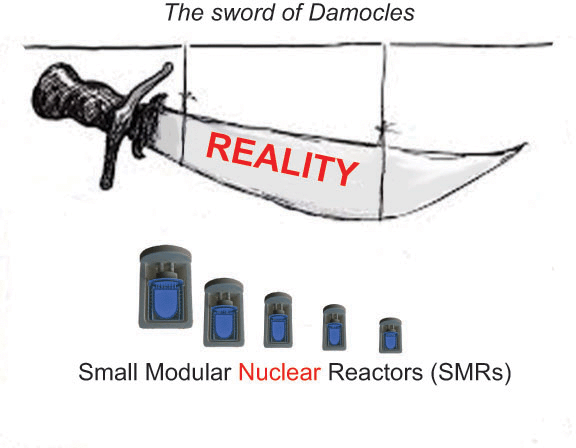 WORLD NUCLEAR INDUSTRY LOSES GROUND TO CHEAP RENEWABLES AS CANADA CONSIDERS SMALL MODULAR REACTORS, The Energy Mix SEPTEMBER 27, 2020 MITCHELL BEER @MITCHELLBEER WORLD NUCLEAR INDUSTRY LOSES GROUND TO CHEAP RENEWABLES AS CANADA CONSIDERS SMALL MODULAR REACTORS, The Energy Mix SEPTEMBER 27, 2020 MITCHELL BEER @MITCHELLBEER
The world nuclear industry “continues to be in stasis,” with power plants shutting down at a faster rate in western Europe and the United States, the number of operating reactor units at a 30-year low, and the few new construction projects running into “catastrophic cost overruns and schedule slippages,” according to the latest edition of the annual World Nuclear Industry Status Report (WNISR), released last week. “Some 408 nuclear reactors were in operation in 31 countries as of July 2020, a decline of nine units from mid-2019 and 30 fewer than the 2002 peak of 438,” Reuters writes, citing the report. “The slow pace of new projects coming onstream also increased the overall age of the global fleet to around 31 years.” “Overall, in terms of the cost of power, new nuclear is clearly losing to wind and photovoltaics,” with the two renewable technologies now receiving about 10 times the investment, write Jungmin Kang, former chair of South Korea’s Nuclear Safety and Security Commission, South Korea, and Princeton University Professor Emeritus Frank von Hippel, in their foreword to the 361-page report. That meant new nuclear projects “were struggling to secure finance amid competition from renewables, with reported investment decisions for the construction of new nuclear plants at around US$31 billion in 2019,” Reuters says. One of the problems facing nuclear plants is that their high capital cost “requires that they operate almost continually to bring down the capital charge per kilowatt-hour,” Kang and von Hippel explain. “They must therefore compete directly with renewables most of the time or store their output to be used during cloudy, windless periods.” But “storage does not relieve the competition with wind and solar” since, “as renewables expand and storage costs come down, they too will have increasing incentives to store their excess output.” The report focuses in on COVID-19 as the first pandemic to have a significant, direct impact on the global nuclear industry, with large numbers of infections reported by the few operators that released precise figures. The WNISR says the pandemic has led to degraded safety and security and critical staffing issues at operating nuclear plants that also faced a tough economic hit when crashing electricity demand drove down power prices. In 2019, Russia had a hand in 15 of the 52 new nuclear construction projects around the world, and electricity generation from nuclear facilities grew 3.7%, with half of that total attributable to a 19% increase in China. But 33 of the 52 projects were behind schedule, and eight had been delayed by 10 years or more, “including two units that had construction starts 35 years ago and one unit that goes back 44 years,” WNISR notes. Of the 13 reactors scheduled for start-up last year, “only six made it,” including three in Russia, two in China, and one in South Korea—and no new nuclear facilities went online in the first half of 2020. Meanwhile, non-hydro renewables installed 184 gigawatts of new capacity in 2019, and “comparisons between nuclear and solar options show a large and widening gap,” the report states. “For example, a contract for 1.2 GW of solar power at US$24.20 per megawatt-hour, signed in 2017 and connected to the grid in 2019, is five to eight times cheaper than the international cost estimate for nuclear of US$118 to $192 per MWh.” [And that’s before the cost overruns that seems to be inevitable with most nuclear projects—Ed.] While “the biggest social argument for nuclear power plants is that their carbon emissions are low,” Kang and von Hippel write, that line of thought leads more toward refurbishing existing reactors—an area where the industry is also struggling. “In some major countries such as the United States, even 30-year-old plants whose capital costs have been paid off cannot compete economically with new renewable power plants, whose capital costs have been declining. The operating costs of nuclear plants are high in part because one to two hundred workers and guards are required onsite per reactor at all times in case of accident or terrorist attack.” And earlier this month, an incident in South Korea raised concerns about the reliability of nuclear generation in an era when climate change will make severe weather events more common and severe. The Kori nuclear plant was supplying 7% of the country’s electricity until it went into an automatic shutdown “because of typhoon impacts on their power transmission lines,” the two reviewers state. “Experts are concerned that, under different circumstances, the sudden shutdowns could destabilize South Korea’s grid and cause large-scale blackouts.” Paris-based consultant and lead WNISR author Mycle Schneider said the long-term headwinds facing nuclear development are even more daunting than the annual snapshot. Don’t just look at the photograph. Look at the movie,” he told The Energy Mix in an interview last week. “It takes an average of roughly 10 years to build a nuclear power plant from official construction start to grid connection,” even when a project isn’t delayed—which raises a particularly tough series of questions in the midst of a global climate emergency. “If I’m spending a dollar or a Euro or a yuan, I have to spend it in a way that allows me to reducogical renaissance through small modular reactors (SMRs). But “the industry is actually selling PowerPoint reactors, not detailed engineering, and it’s not the first time. They’ve been doing this for decades,” Schneider said. “Nobody, not even industry, pretends they can produce anything before 2030. That’s the earliest,” when 2050 is the latest possible deadline to decarbonize the entire global economy. Which means that, when it comes to SMRs, “it’s already very simple—it’s much too late, and we don’t know if it’ll work or what it’ll cost.”……….. “If I’m spending a dollar or a Euro or a yuan, I have to spend it in a way that allows me to reduce GHG emissions the most per dollar invested, the fastest.” Schneider said. But “if you look at nuclear power, it’s not only the most expensive, but it’s by far the slowest.” With even French nuclear giant EDF bidding against its own legacy technology to supply lower-cost solar projects, “do we really have to discuss what the future is or where this goes?” Schneider asked. “It’s obvious.” More recently, the nuclear industry has been promising a technological renaissance through small modular reactors (SMRs). But “the industry is actually selling PowerPoint reactors, not detailed engineering, and it’s not the first time. They’ve been doing this for decades,” Schneider said. “Nobody, not even industry, pretends they can produce anything before 2030. That’s the earliest,” when 2050 is the latest possible deadline to decarbonize the entire global economy. Which means that, when it comes to SMRs, “it’s already very simple—it’s much too late, and we don’t know if it’ll work or what it’ll cost.”……….. “Betting on nuclear as a climate solution is just sticking our heads in the sand because SMR technology is decades away, extremely expensive, and comes with a nasty pile of security and waste headaches,” Gibbons writes. “That our government would be this gullible is distressing, especially given the havoc already being wreaked by a changing climate.” Against concerns about intermittency of solar and wind, “it is fortunate that in Ontario we live beside a giant battery,” he adds. OCAA has long been an advocate for cross-border hydropower imports from Quebec to Ontario, and in the Sun, Gibbons notes that “Quebec has an enormous water power reservoir system that Hydro-Québec is keen to integrate with renewable sources for its out-of-province customers. When we have surplus solar and wind, Quebec stores water. When not, it produces hydropower for export.” The two provinces already “have the connections necessary to make this system work and can expand them, at a cost that looks like spare change next to what it costs to rebuild a nuclear reactor or get an SMR prototype built,” he adds. https://theenergymix.com/2020/09/27/world-nuclear-industry-loses-ground-to-cheap-renewables-as-canada-considers-small-modular-reactors/ |
|
Small Nuclear Reactors on the moon- desperate hope for the failing nuclear industry

While our species’ insatiable scientific curiosity has undoubtedly led to some beneficial inventions, it has also drawn us inexorably towards our own downfall. Our zeal to create the atomic bomb ignored logic, ethics, consequences and the fundamentals of human rights.
The bomb brought us so-called civil nuclear power reactors, the ugly and irresponsible spawn of a weapon that leaves us perched perpetually on the precipice of extinction. But there is nothing “civil” about nuclear power.
At the dawn of the nuclear energy age, not a thought was given to the legacy of deadly radioactive waste it would produce. That can was kicked summarily down the road. Now we are far down that road and no solution has been arrived at, while we ignore the one obvious one: stop making more of it!
So now comes the news that the US wants to put nuclear power reactors on the Moon.
In the news stories that followed the announcement, replete with the usual excitement about space exploration (never mind the cost and bellicose implications) there was not one single mention of the radioactive waste these reactors would produce.
The problem, like the waste itself, will simply be kicked into some invisible crater on the dark side of the Moon.
NASA, the US Department of Energy and assorted nuclear labs are pushing the small modular reactor for nuclear projects on the 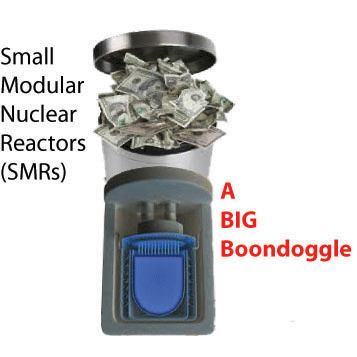 Moon and Mars. Desperate to stay relevant and to continue gobbling up taxpayer dollars, this is music to the failing nuclear industry’s ears. Financially disastrous and technically unresolved on Earth, the SMR, say these “experts”, is ideally suited to the needs of humans living for extensive periods in space.
Since each of these mini-reactors will likely have an uninterrupted output of only 10 kilowatts, it will take multiple reactors on the Moon or Mars to fulfill the necessary functions for their human inhabitants.
Needless to say, so far there is no certified design, no test reactor, no actual reactor, and no fool-proof way to send such a reactor to the Moon. (Rockets have an unfortunate habit of sometimes blowing up on — or shortly after — launch.) Nevertheless, the year 2026 is the ambitious target date for all systems go. In keeping with the theme, “pie in the sky” springs to mind.
While no reactor design has been identified, it will most likely need to use highly enriched uranium (HEU) which puts the reactor firmly in violation of non-proliferation standards. As Dr. Edwin Lyman of the Union of Concerned Scientists told PBS Newshour, “This may drive or start an international space race to build and deploy new types of reactors requiring highly enriched uranium.”
Given the utility of HEU for nuclear weapons use, and the probes currently being sent to the Moon and Mars by “unfriendly” countries such as China and the United Arab Emirates, it does not take much of an imagination to envisage the temptation for theft by force. Will the US deploy guards around its lunar reactors.? Will we see terrorism on the Moon, even war?
What is this really all about? Profit? Prestige? Proliferation? The Idaho National Laboratory, which is eager to develop the lunar SMR prototype, sees this as an opportunity to emphasize “the United States’ global leadership in nuclear innovation,” the lab’s John Wagner told Newshour.
This echoes the mantra parroted by almost every federal institution and corporation seeking to justify some new and exorbitant nuclear expense: we cannot let China and Russia take over; the US must retain — or regain — pre-eminence in the nuclear sector and in space. And so on.
It’s not being cute to call this lunacy. With the ever-expanding crises on Earth, caused by the ravaging effects of climate change as well as the current pandemic, spending exorbitant sums to stick reactors on the Moon or Mars is more than madness; it is morally irresponsible. It abandons most of us on Earth to our fate, while, just maybe, possibly, someday, a handful of people will head off to the Red Planet. Never to return.
Yet undeterred by immorality and expense, and apparently without the slightest concern for the radioactive dirt pile these reactors will produce, NASA and the Department of Energy are eagerly soliciting proposals.
And what will these lunar reactors do? They will enable “capability for a sustained lunar presence, particularly for surviving a lunar night,” NASA’s Anthony Calomino told Space News. “The surface of the moon provides us an opportunity to fabricate, test and flight qualify a space fission system,” he said.
The Moon is seen as our launchpad to Mars. Now, it seems, it will also become our latest nuclear dustbin. If there is a meltdown, or a cascade of accidents among the cluster of small identical reactors there, all of which could suffer the same failure at the same time, it will become our next nuclear wasteland.
I am happy to say “goodnight moon.” But I don’t wan’t to say “goodbye.”
Hypocrisy prize to U.S. International Development Finance Corporation (DFC), for pretending that NuScam’s Small Nuclear Reactors are ”foreign aid”

|
DFC Convenes U.S., African Leaders for Investment Conference, U.S. International Development Finance Corporation (DFC), October 16, 2020 Announces new efforts aimed at bolstering agency’s reach across continent. WASHINGTON – Today, U.S. International Development Finance Corporation (DFC) and the Atlantic Council hosted the virtual Investing in Africa’s Future conference to bring together African heads of state, senior U.S. government officials, African development finance institutions and others to announce new efforts to promote and strengthen U.S. trade and investment in Africa, in support of the Administration’s Prosper Africa Initiative…….. DFC made the following announcements during the summit: …………
LOI for Nuclear in South Africa: In July 2020, DFC updated and modernized its nuclear energy policy—ending its prohibition on supporting nuclear power in order to help meet the energy needs in the developing world. DFC signed a Letter of Intent to support NuScale, a U.S. nuclear energy technology firm, to develop 2,500 MW of nuclear energy in South Africa. If successful, NuScale would be the first U.S. nuclear energy IPP on the continent and would help support energy resilience and security in one of Africa’s leading economies and a key partner on the continent for the United States Government……….. https://www.dfc.gov/media/press-releases/dfc-convenes-us-african-leaders-investment-conference
|
|
Canada’s government caught up in the Small Nuclear Reactor Ponzi Scheme
 Why is the federal government funding new nuclear power reactors? rabble.ca Susan O’Donnell, October 15, 2020
Today, the government made its first SMR funding announcement: $20 million from ISED’s Strategic Innovation Fund for the company Terrestrial Energy to develop its prototype SMR in Ontario.
Anyone interested in evidence-based policy is wondering: Why are they doing this? There is no evidence that nuclear power will achieve carbon reduction targets, while there is considerable research indicating the contrary.
In fact, in today’s funding announcement, federal Natural Resources Minister Seamus O’Regan confirmed that the new reactor will take more than a decade to develop and will contribute nothing to Canada’s 2030 target for reducing greenhouse gas (GHG) emissions.
The same week as the throne speech, the release of the 2020 World Nuclear Industry Status Report (WNISR) confirmed, as did its previous reports, that developing new nuclear energy is too slow and uneconomical to address the climate crisis compared to deploying renewable energy technologies.
Last week, research based on data from 123 countries over a 25-year period made a similar finding. December 2019 research from Stanford professor Mark Z. Jacobson refutes claims that nuclear energy is zero-carbon. A November 2019 article in the American business magazine Forbes argues that building new nuclear reactors instead of investing in more climate-effective energy resources actually makes climate change worse.
SMRs, the nuclear reactors promoted by the federal government, are in particular over-hyped as a climate crisis solution. SMRs have been proposed as a solution for remote communities and mining sites currently relying on diesel fuel but new research has found the potential market is too small to be viable.
SMRs exist only as computer models and nobody knows for sure if they will work. Last month, the Canadian energy watchdog The Energy Mix interviewed WNISR lead author Mycle Schneider, who called SMRs “PowerPoint reactors, not detailed engineering.”
Given all the research evidence pointing away from funding nuclear energy in a climate action plan, why is the federal government proposing to do it?
In a webinar presentation earlier this year, the president of the Canadian Coalition for Nuclear Responsibility Gordon Edwards put it bluntly: “The nuclear industry is desperate.”
Edwards believes the federal government’s push for new reactor development is coming from the nuclear industry. “If they can, the nuclear industry will convince governments to pour public money into this for whatever reason, by misrepresenting its advantages and minimizing or even ignoring its disadvantages.”……….
Nuclear reactor promoters are “barely keeping themselves alive,” said Edwards, and have realized for quite a while that “they are in trouble.”
The federal government created the nuclear industry in Canada and has funded it since the late 1940s. For more than 70 years Canada has been spending vast sums of public money to keep it going. Atomic Energy of Canada Limited (AECL), a Crown corporation with a mandate to promote and support nuclear science and technology and manage nuclear waste in Canada, received $826 million from the federal government in 2017-2018. Most of the public funds are turned over to a private-sector entity, Canadian Nuclear Laboratories, whose majority partner is SNC Lavalin.
One description of the nuclear industry in Canada is that it can be understood as a kind of Ponzi scheme. In its current corporate plan, AECL listed a cost liability of almost $6.4 billion for decommissioning and waste management provision and $988 million for contaminated sites in 2017-18.
The industry needs new nuclear reactors as a replacement revenue stream. New reactors require capital investment but no banks or private investors are willing to invest due to the poor return on investment. Public funding is the only option to keep the industry alive and pay off its liabilities, and more public money is always required or the entire scheme will collapse. ……..
a revolving door shuttles senior government personnel involved in nuclear energy files to the CNA lobby. In one recent example, the former parliamentary secretary to the minister of natural resources who was responsible for nuclear policy is now a consultant for the CNA.
Former senior AECL executives and government nuclear energy staff are now establishing and managing various start-up nuclear companies actively seeking public funding from the federal government. And according to the throne speech, the money is available…….
The Canadian government’s plans to invest in nuclear energy contrast with the European Union’s proposed Green New Deal released in June this year that specifically excludes investment in nuclear energy because of its harmful environmental impacts. The decision followed sustainable finance guidelines also adopted this year and developed in a process that included environmental and other civil society groups as well as energy industry representatives……….https://rabble.ca/blogs/bloggers/views-expressed/2020/10/why-federal-government-funding-new-nuclear-power-reactors#.X4t38dAXWFc.twitter
South Africa the first sucker to get American experimental nuclear reactor + $billions in bribes?
 US firm ‘aims to build a nuclear power plant’ in South Africa, https://www.thesouthafrican.com/news/us-firm-aims-to-build-a-nuclear-power-plant-in-south-africa/What pandemic? An American investment group is looking to pump billions into South Africa, with one eye on a new nuclear power plant for Mzansi.by Tom Head 2020-10-18 US firm ‘aims to build a nuclear power plant’ in South Africa, https://www.thesouthafrican.com/news/us-firm-aims-to-build-a-nuclear-power-plant-in-south-africa/What pandemic? An American investment group is looking to pump billions into South Africa, with one eye on a new nuclear power plant for Mzansi.by Tom Head 2020-10-18
The future of South Africa’s energy supply could be shaped by a cash injection from the United States of America. The government, in their ongoing discussions with NEDLAC and foreign investors, has entertained the idea of letting an international development firm finance and build a new nuclear power plant in Mzansi.
AN AMERICAN NUCLEAR POWER PLANT IN SOUTH AFRICA?As Bloomberg has confirmed, The US International Development Finance Corp (DFC) has signed a letter of intent to support plans laid out by NuScale, an American technology group that are ready to kick on with this project. Amongst the billions of dollars they’ve pledged to South Africa, a ‘secure, reliable energy supply through the construction of new nuclear plants’ is their major priority. A CONTINENTAL FIRST FOR SOUTH AFRICA?
The DFC released a statement last week, confirming that they would be pioneering in their ambitious blueprint. Should a new nuclear plant get the green light, this would be the first IPP funded by the USA throughout the whole of Africa. The future of South Africa’s energy supply could be shaped by a cash injection from the United States of America. The government, in their ongoing discussions with NEDLAC and foreign investors, has entertained the idea of letting an international development firm finance and build a new nuclear power plant in Mzansi. further R4.5 billion would be spent on public transport development over the next 12 months. |
Washington State touted for ”new generation” nuclear power – (some time in the distant future)
 Feds: Washington nuclear operator to develop new plants, Lexington Herald Leader, BY NICHOLAS K. GERANIOS ASSOCIATED PRESS, OCTOBER 15, 2020SPOKANE, WASH. Feds: Washington nuclear operator to develop new plants, Lexington Herald Leader, BY NICHOLAS K. GERANIOS ASSOCIATED PRESS, OCTOBER 15, 2020SPOKANE, WASH.
The federal government has chosen the operator of a nuclear power plant near Richland to help develop the next generation of nuclear energy facilities, raising the possibility of a new reactor in central Washington state. The U.S. Department of Energy this week announced that Energy Northwest, which operates the only nuclear power plant in the Northwest, will be part of a team developing the next generation of nuclear energy plants. The announcement prompted Republican U.S. Rep. Dan Newhouse, who represents the area in Congress, to applaud the recipients of Advanced Reactor Demonstration Program funds. “The selection of these projects is an absolute game-changer for our state and makes it official: Tri-Cities, Washington is a global leader in nuclear energy innovation,” Newhouse said. However, a spokesman for Energy Northwest warned that the decision on where to build new commercial nuclear power plants is years away. `There are no plans currently to site anything,″ Jason Herbert said, while adding that land owned by Energy Northwest in the Tri-Cities area includes “potential sites″ for a new reactor. Energy Northwest operates the Columbia Generating Station, which was completed in 1984 and is the last remaining nuclear power plant in the Northwest. The Department of Energy this week announced that Energy Northwest would partner with X-energy and TerraPower-GE Hitachi in developing new reactor technology. The Advanced Reactor Demonstration Program is designed to help private industry demonstrate advanced nuclear reactors in the United States, using $230 million appropriated by Congress. If built in Washington, Energy Northwest would expect to own and operate the new nuclear plant, the company said. The Tri-Cities region, which includes Richland, has a long history in the nuclear industry, dating back to its selection by the Manhattan Project in World War II as a site to help develop the atomic bomb. https://www.kentucky.com/news/business/article246476415.html |
|
USA marketing NuScam small nuclear reactors to Africa
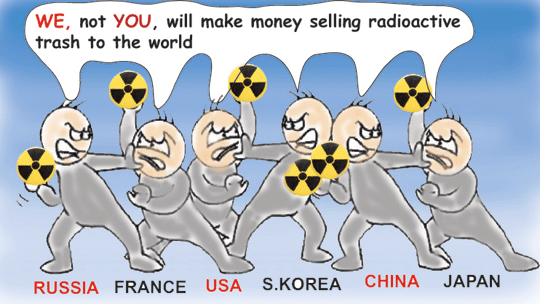 US to support new nuclear power project in South Africa https://businesstech.co.za/news/energy/441510/us-to-support-new-nuclear-power-project-in-south-africa/, Bloomberg17 October 2020 The United States International Development Finance Corp. pledged to support NuScale Power LLC, a US nuclear energy technology firm, to develop 2,500 megawatts of power in South Africa.
South Africa’s government drafted an economic recovery plan in conjunction with business and labour groups several months ago in a bargaining forum known as the National Economic Development and Labour Council, in the wake of the coronavirus pandemic.A version of the strategy that was discussed by the cabinet this week, and seen by Bloomberg, includes suggestions to secure reliable energy supply through the construction of new nuclear plants.
The draft envisages R23 billion ($1.4 billion) being allocated to galvanize private investment in infrastructure and R4.5 billion being spent on public transport over the next 12 months, but provides scant detail on where the money will come from.
The DFC, which ended its prohibition on supporting nuclear power in July, signed a letter of intent to support NuScale’s bid for South Africa’s independent power producer program, the development bank said in an emailed statement on Friday.
“If successful, NuScale would be the first US nuclear energy IPP on the continent and would help support energy resilience and security in one of Africa’s leading economies,” the DFC said.
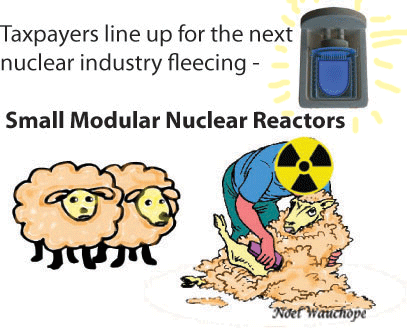
USA starts off $3.2 billion subsidy program with $80 million each for “next generation” nuclear reactors
|
US DOE awards TerraPower, X-energy $80 million each for advanced nuclear reactors, S and P Global , Joniel Cha William Freebairn , EditorDerek Sands 14 Oct 20, Washington — The US Department of Energy has awarded two companies proposing next-generation nuclear reactors $80 million each in an initial award as part of a $3.2 billion program to build two advanced reactors that can be operational within seven years, Energy Secretary Dan Brouillette said Oct. 13.
One award went to a group including TerraPower, a company co-founded by billionaire Bill Gates, working with a General Electric and Hitachi joint venture, while the other is X-energy, a start-up that is advancing a reactor design originally developed in Germany. The awards are part of DOE’s Advanced Nuclear Reactor Demonstration Program, and future funding is dependent on appropriations, Brouillette said. Regarding advanced reactors, which generally use a different coolant than all operating commercial reactors in the US, “We want to make them more affordable to build, and we want to make them more affordable to operate,” Brouillette said. Brouillette said “it is likely” the advanced reactors will be built in Washington state, where he said a site is available. The key criteria to select applicants included that the reactor design represent a truly advanced technology dissimilar from existing reactors, Brouillette said. A second key factor was DOE’s assessment that the management team of the winning groups be able to supply the required 50-50 match in resources and deliver the projects within seven years, he said. TerraPower partnered with GE Hitachi, engineering and construction company Bechtel, and utilities Energy Northwest, Duke Energy and Pacificorp for its Natrium sodium fast reactor. The system will be supported by a new fuel fabrication facility to supply fuel for the unit, DOE said in a statement Oct. 13. That Natrium reactor and storage system is a 345-MW net reactor system coupled with a molten-salt-based energy storage system that will provide greater operating flexibility for owners, the companies have said. The Natrium system is designed to cost under $1 billion excluding financing costs. …… Congress appropriated $230 million to start a new demonstration program for advanced reactors in the fiscal 2020 budget. DOE said in May it would award $80 million each to two projects that could be operational in the next five to seven years. Additional funding was to be made available to up to five additional projects with anticipated deployment later than the near-term time frame. The other funding awards will be made in December, DOE said in the statement. https://www.spglobal.com/platts/en/market-insights/latest-news/electric-power/101320-us-doe-awards-terrapower-x-energy-80-million-each-for-advanced-nuclear-reactors X-energy is developing an 80-MW high temperature gas-cooled reactor, the Xe-100, which has begun a vendor design review with the Canadian Nuclear Safety Commission. It is working with Canadian engineering company Hatch on potential Canadian projects to deploy the Xe-100. The X-energy proposal includes four Xe-100 reactors and completion of a commercial-scale fuel fabrication facility. |
|
1 This Month
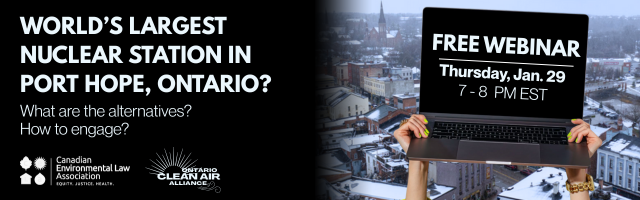
29 Jan. Thursday 7-8 p.m. Webinar – World’s Largest Nuclear Station in Port Hope, ON?
To see nuclear-related stories in greater depth and intensity – go to https://nuclearinformation.wordpress.com/


31st January – Challenging the War Machine – a DECLASSIFIED UK SUMMIT

Website of the Week
Now until to February 10, 2026 Radioactive waste storage in France: the debate is finally open! How to participate?
-
Archives
- January 2026 (283)
- December 2025 (358)
- November 2025 (359)
- October 2025 (376)
- September 2025 (258)
- August 2025 (319)
- July 2025 (230)
- June 2025 (348)
- May 2025 (261)
- April 2025 (305)
- March 2025 (319)
- February 2025 (234)
-
Categories
- 1
- 1 NUCLEAR ISSUES
- business and costs
- climate change
- culture and arts
- ENERGY
- environment
- health
- history
- indigenous issues
- Legal
- marketing of nuclear
- media
- opposition to nuclear
- PERSONAL STORIES
- politics
- politics international
- Religion and ethics
- safety
- secrets,lies and civil liberties
- spinbuster
- technology
- Uranium
- wastes
- weapons and war
- Women
- 2 WORLD
- ACTION
- AFRICA
- Atrocities
- AUSTRALIA
- Christina's notes
- Christina's themes
- culture and arts
- Events
- Fuk 2022
- Fuk 2023
- Fukushima 2017
- Fukushima 2018
- fukushima 2019
- Fukushima 2020
- Fukushima 2021
- general
- global warming
- Humour (God we need it)
- Nuclear
- RARE EARTHS
- Reference
- resources – print
- Resources -audiovicual
- Weekly Newsletter
- World
- World Nuclear
- YouTube
-
RSS
Entries RSS
Comments RSS
 nuclear-news