UK’s ‘small nuclear reactors’ – the real agenda is the funding of nuclear weapons
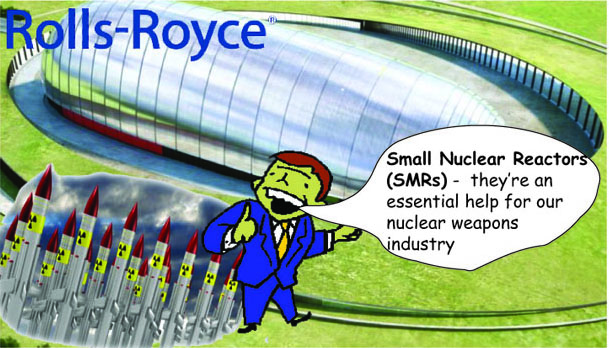
A secret military agenda. UK defence policy is driving energy policy – with the public kept in the dark, Beyond Nuclear
By David Thorpe, 8 Nov 20,The UK government has for 15 years persistently backed the need for new nuclear power. Given its many problems, most informed observers can’t understand why. The answer lies in its commitment to being a nuclear military force. Here’s how, and why, anyone opposing nuclear power also needs to oppose its military use.
“All of Britain’s household energy needs supplied by offshore wind by 2030,” proclaimed Prime Minister Boris Johnson at a recent online Conservative Party conference. This means 40 per cent of total UK electricity. Johnson did not say how, but it is likely, if it happens, to be by capacity auctions, as it has been in the recent past.
But this may have been a deliberate distraction: there were two further announcements on energy – both about nuclear power.
16 so-called “small nuclear reactors”
Downing Street told the Financial Times, which it faithfully reported, that it was “considering” £2 billion of taxpayers’ money to support “small nuclear reactors” – up to 16 of them “to help UK meet carbon emissions targets”.
It claimed the first SMR is expected to cost £2.2 billion and be online by 2029.
The government could also commission the first mini power station, giving confidence to suppliers and investors. Any final decision will be subject to the Treasury’s multiyear spending review, due later this year.
The consortium that would build it includes Rolls Royce and the National Nuclear Laboratory.
Support for this SMR technology is expected to form part of Boris Johnson’s “10-point plan for a green industrial revolution” and new Energy White Paper, which are scheduled for release later in the autumn.
Johnson will probably also frame it as his response to the English citizens assembly recommendations– a version of the one demanded by Extinction Rebellion in 2019 – which reported its conclusions last month.
While the new energy plan will also include carbon capture and storage, and using hydrogen as vehicle fuel, it’s the small modular reactors that are eye-popping.
They would be manufactured on production lines in central plants and transported to sites for assembly. Each would operate for up to 60 years, “providing 440MW of electricity per year — enough to power a city the size of Leeds”, Downing Street said, and the Financial Times copied.
The SMR design is alleged to be ready by April next year. The business and energy department has already pledged £18 million (US $23.48 million) towards the consortium’s early-stage plans.
They are not small
The first thing to know about these beasts is that they are not small. 440MW? The plant at Wylfa (Anglesey, north Wales) was 460MW (it’s closed now). 440MW is bigger than all the Magnox type reactors except Wylfa and comparable to an Advanced Gas-cooled Reactor.
Where will they be built? In the town of Derby – the home of Rolls Royce – where, as nuclear consultant Dr. David Lowry points out, the government is already using the budget of the Housing and Communities Department to finance the construction of a new advanced manufacturing centre site.
When asked why this site was not being financed by the business and energy department (BEIS), as you’d expect, a spokesperson responded that it was part of “levelling up regeneration money”.
Or perhaps BEIS did not want its budget used in such a way. Throwing money at such a “risky prospect” betrays “an irrationally cavalier attitude” according to Andrew Stirling, Professor of Science & Technology Policy at the University of Sussex Business School, because an “implausibly short time” is being allowed to produce an untested reactor design.
Only if military needs are driving this decision is it explicable, Stirling says. “Even in a worst case scenario, where this massive Rolls Royce production line and supply chain investment is badly delayed (or even a complete failure) with respect to civil reactor production, what will nonetheless have been gained is a tooled-up facility and a national skills infrastructure for producing perhaps two further generations of submarine propulsion reactors, right into the second half of the century.
“And the costs of this will have been borne not by the defence budget, but by consumers and citizens.”
Yes, military needs
UK defence policy is fully committed to military nuclear. The roots of civil nuclear power lay in the Cold War push to develop nuclear weapons. Thus has it ever been since the British public was told nuclear electricity would be “too cheap to meter”.
The legacy of empire and thrust for continued perceived world status are at the core of a post-Brexit mentality. It’s inconceivable to the English political elite that this status could exist without Great Britain being in the nuclear nations club, brandishing the totem of a nuclear deterrent.
“The civil-military link is undisputable and should be openly discussed,” agrees Dr Paul Dorfman at the Energy Institute, University College London.
Andrew Stirling talks of the “tragic relative popularity of (increasingly obsolescent) nuclear weapons”. The coincidental fact that civil nuclear installations are also crumbling provides a serendipitous opportunity for some.
The stores of plutonium in the UK are already overflowing and the military has its own dedicated uranium enrichment logistics.
Any nation’s defence budget in this day and age cannot afford a new generation of nuclear weapons. So it needs to pass the costs onto the energy sector.
“Clearly, the military need to maintain both reactor construction and operation skills and access to fissile materials will remain. I can well see the temptation for Defence Ministers to try to transfer this cost to civilian budgets,” observes Tom Burke, Chairman of think tank E3G.
The threat of nuclear proliferation
The threat of nuclear proliferation is therefore linked to the spread of civil nuclear power worldwide, says Dr David Toke, Reader in Energy Politics, Department of Politics and International Relations at the University of Aberdeen. David Lowry agrees: “India, Pakistan and above all Israel are obvious examples, each of which certainly has built nuclear weapons.”
It’s impossible to separate the tasks of challenging civil nuclear power without also challenging military nuclear interests, Stirling strongly believes. “The massive expense of increasingly ineffective military nuclear systems extend beyond the declared huge budgets. They are also propped up by large hidden subsidies from consumer and taxpayer payments for costly nuclear power.
“Huge hidden military interests will likely continue to keep the civil nuclear monster growing new arms. Until critics reach out and engage the entire thing, we’ll never prevail in either struggle.”
How new plants would be paid for still remains a question. Nuclear power is prohibitively expensive………..https://wordpress.com/read/feeds/72759838/posts/3011373103
Explaining the diseconomics problems for the NuScale small nuclear reactors plan in Utah

First major modular nuclear project having difficulty retaining backers, The complicated finances of the first major test of small modular nuclear reactors. https://arstechnica.com/science/2020/11/first-major-modular-nuclear-project-having-difficulty-retaining-backers/ JOHN TIMMER – 11/8/2020,
Earlier this year, the US took a major step that could potentially change the economics of nuclear power: it approved a design for a small, modular nuclear reactor from a company called NuScale. These small reactors are intended to overcome the economic problems that have ground the construction of large nuclear plants to a near halt. While each only produces a fraction of the power possible with a large plant, the modular design allows for mass production and a design that requires less external safety support.
But safety approval is just an early step in the process of building a plant. And the leading proposal for the first NuScale plant is running into the same problem as traditional designs: finances.
The proposal, called the Carbon Free Power Project, would be a cluster of a dozen NuScale reactors based at Idaho National Lab but run by Utah Associated Municipal Power Systems, or UAMPS. With all 12 operating, the plant would produce 720MW of power. But UAMPS is selling it as a way to offer the flexibility needed to complement variable renewable power. Typically, a nuclear plant is either producing or not, but the modular design allows the Carbon Free Power Project to shut individual reactors off if demand is low.
According to one report, the US Department of Energy had originally planned to purchase the first reactor for research use, then turn it over to UAMPS. But now, the goal is apparently for the DOE to provide an annual supplement of about $130 million a year for a decade. However, that would be dependent upon annual renewals of the funding by Congress during that decade, which is yet another risk. Separately, to reach a target price for the power that is expected to be competitive with natural gas, the project has been made larger and its completion delayed by three years.
That shouldn’t be unexpected, as utilities are notoriously conservative—justifiably so, considering how much their customers rely on electricity. So any new electrical technology is likely to face some struggles as its customers learn to use it effectively and understand how to extract the most value out of it. Typically, the government steps in to provide some support during this awkward phase, as it has done for wind and solar, and plans to do for NuScale.
Small and large new nuclear reactors in Britain’s so-called ‘green industrial revolution’
Mail on Sunday 7th Nov 2020, Boris Johnson is poised to launch major plans for a ‘green industrial revolution’ backing a new wave of nuclear power plants to boost the economy and slash Britain’s carbon emissions. The proposals are expected to include the green light to build a nuclear plant at Sizewell C in Suffolk and thenext stage in a programme that would lead to a production line of rapidlyn and more cheaply produced small modular reactors within a decade, The Mail on Sunday understands.
The Government is considering a ‘Made in Britain’ solution that may include a taxpayer-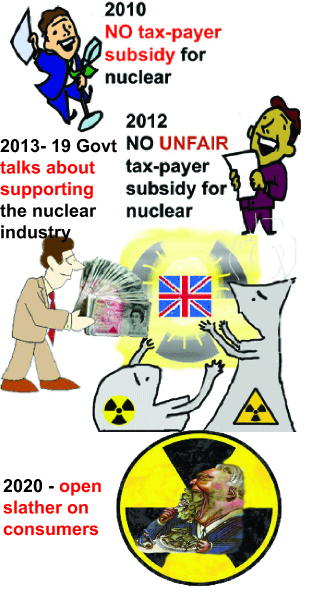 backed injection from an infrastructure growth fund – a plan that would need rubber stamping by the Treasury. Funding could also include backing from British pension funds. It would allow the Government to help subsidise the small modular reactor programme (SMR) with as much as £2billion and a stake in Sizewell C of up to 10 per cent of its £20billion build costs.
Sizewell C is backed by French state-backed EDF Energy, which could become a minority shareholder. Government financing would also help slash the cost of electricity produced by the plant. Britain has eight nuclear power plants, generating about a fifth of the country’s electricity. Seven are due to close by 2030.
The SMR consortium is led by Rolls-Royce and includes construction and engineering companies Assystem, Atkins, BAM Nuttall,
Jacobs and Laing O’Rourke. It hopes to build ten to 15 reactors in the UK, largely on former nuclear sites. Plans are already being discussed for the possibility of joint sites in locations including Moorside in Cumbria – where Japanese multinational Toshiba recently pulled out of developing its own reactor – that could contain a large EDF-backed reactor and a smaller modular reactor, creating a ‘clean energy hub’.
EDF has insisted synergies with Hinkley will mean the cost of energy from a second plant at Sizewell C would be slashed. It is understood site preparations could begin immediately and that planning consent for the project itself could be given
as soon as 2022, meaning the plant could be online by 2032.
https://www.thisismoney.co.uk/money/markets/article-8924115/Lift-GREEN-Industrial-Revolution.html
Nuclear Technology Germany Association says Small Nuclear Reactors (SMRs) will always be more expensive than large ones.
 German nuclear industry cautious about usefulness of small reactors for energy transition, Nuclear phase-out Technology, Clean Energy Wire, Süddeutsche Zeitung , 6 Nov 20 Small Modular Reactors (SMR) are increasingly hailed as an effective way for using nuclear power to curb the climate crisis without the major risks associated with conventional nuclear plants, but Germany’s nuclear industry is sceptical whether the small reactors really can help boost international climate action, Christian J. Meier writes for the Süddeutsche Zeitung German nuclear industry cautious about usefulness of small reactors for energy transition, Nuclear phase-out Technology, Clean Energy Wire, Süddeutsche Zeitung , 6 Nov 20 Small Modular Reactors (SMR) are increasingly hailed as an effective way for using nuclear power to curb the climate crisis without the major risks associated with conventional nuclear plants, but Germany’s nuclear industry is sceptical whether the small reactors really can help boost international climate action, Christian J. Meier writes for the Süddeutsche Zeitung
……… Nicolas Wendler of industry association Nuclear Technology Germany (KernD) says SMRs are always going to be more expensive than bigger reactors due to lower power output at constant fixed costs, as safety measures and staffing requirements do not vary greatly compared to conventional reactors. In terms of levelised energy costs, SMRs will always be more expensive than big plants.” In order for SMRs to be profitable, these should run at maximum utilisation most of the time, Wendler argues, concluding that the potential on the German market would not be much greater than what is needed to adjust oscillating renewable power production…. https://www.cleanenergywire.org/news/german-nuclear-industry-cautious-about-usefulness-small-reactors-energy-transition
|
Several U.S. utilities back out of deal to build Small Nuclear Reactors

|
Several U.S. utilities back out of deal to build novel nuclear power plant, Science, By Adrian Cho, Nov. 4, 2020 Plans to build an innovative new nuclear power plant—and thus revitalize the struggling U.S. nuclear industry—have taken a hit as in recent weeks: Eight of the 36 public utilities that had signed on to help build the plant have backed out of the deal. The withdrawals come just months after the Utah Associated Municipal Power Systems (UAMPS), which intends to buy the plant containing 12 small modular reactors from NuScale Power, announced that completion of the project would be delayed by 3 years to 2030. It also estimates the cost would climb from $4.2 billion to $6.1 billion………. critics of the project say the developments underscore that the plant, which is designed by NuScale Power and would be built at the Department of Energy’s (DOE’s) Idaho National Laboratory, will be untenably expensive. M. V. Ramana, a physicist who works on public policy at the University of British Columbia, Vancouver, says he’s not surprised that so many utilities have opted out of the project. The question, he says, is why so many are sticking with it. “They ought to be seeing the writing on the wall and getting out by the dozens,” he says. ……… if the NuScale plant doesn’t run constantly at full output, it will be less efficient and even more expensive to operate, in terms of cost per megawatt hour (MWh) of energy, Ramana argues. Peter Bradford, a former member of the Nuclear Regulatory Commission (NRC) and former chair of the state utility commissions in Maine and New York, says renewables coupled with short-term storage in batteries would likely be a cheaper means to even out the supply……. in the 1980s, Washington Public Power Supply System agreed to build several nuclear reactors in Washington that ran far overbudget and were never completed, leading to the biggest default on municipal bonds in U.S. history. Public utilities are particularly vulnerable to such risks, Bradford says, as other than ratepayers they have few sources of revenue that could be used to cover cost overruns. “Not only are there no deep pockets, there are no pockets,” he says. On 28 October, Heber Light & Power in Utah withdrew from the project, just 1 day after utilities in the Utah communities of Bountiful and Beaver pulled out. Still, even critics doubt the UAMPS deal will fall apart immediately. In August, the NuScale design passed a key milestone in the NRC review process, receiving its safety evaluation report, and observers expect final “design certification” to come next year. In the meantime, UAMPS is moving to complete an application to construct and operate the plant, Webb says. That application should be submitted in 2023, construction of the plant should start in 2025, he says. Before construction can start, however, UAMPS still has to line up customers to buy the full 720-megawatt output of the plant, Webb says. So far, UAMPS members involved in the project have agreed to take only a relatively small fraction of that output. So UAMPS may have to convince plenty of other folks that it’s a good deal. https://www.sciencemag.org/news/2020/11/several-us-utilities-back-out-deal-build-novel-nuclear-power-plant |
|
Japanese nuclear regulator’s website hit by possible cyberattack
Japanese nuclear regulator’s website hit by possible cyberattack, Japan Times, https://www.japantimes.co.jp/news/2020/11/04/national/nuclear-regulator-website-cyberattack, KYODO, Nov 4, 2020
The Nuclear Regulation Authority said Tuesday its official website became inaccessible possibly due to cyberattacks.
The incident comes a week after the regulatory body’s intranet had an unauthorized access from outside.
According to the NRA, the government’s cybersecurity institute notified it of the website disruption on Tuesday afternoon. There was no abnormality when the NRA updated the website Monday evening, it said.
The website remained inaccessible for hours, but the problem was resolved by around 8:30 p.m., the NRA said.
In August, a fake website resembling that of the NRA was discovered by an official of the regulator.
Some problems that will handicap the development of Small Nuclear Reactors
 The I&C challenges for small modular reactors, Nuclear Engineering International 4 November 2020 Dr Li Li examines the instrumentation and control requirements and challenges for a new generation of small modular reactors.
REACTOR DEVELOPERS ARE DEVELOPING A wide variety of small modular reactor (SMRs)….. Many use Generation III+ pressurised water reactor (PWR) technology similar to that used in current gigawatt-scale reactors, while others are based on advanced Generation IV technologies ranging from high temperature gas-cooled reactors to molten-salt reactors.
Each design will have its own requirements for instrumentation and control (I&C) systems for the operation, monitoring and control of the reactor, turbine island and balance of plant. Even among PWRs, the design principles and I&C architectures are very different and cannot be easily replicated from one design to another.
To understand the challenges, let’s look at three competing designs: the UK SMR being developed by a consortium of companies including Rolls-Royce, Jacobs, Assystem and Atkins with support from research institutions including Nuclear AMRC; the NuScale Power Module backed by Fluor Corporation with funding from the US Department of Energy; and the Westinghouse SMR, which adapts technologies from the established AP1000 design………..
The issue of cyber security will be critical for the certification of digital I&C systems. According to the Industrial Control Systems Cyber Emergency Response Team, part of the US Department of Homeland Security, cyber-attacks and security infringement targeting control systems have increased significantly in recent years. With more digital smart devices used in nuclear power plant of any size, it must be a priority to protect the vulnerability of smart devices and digital I&C system from cyber attack and malicious sniffing from hostile individuals or organisations…….
in most cases, new codes and standards will need to be developed for advanced reactors.
The development of new codes and standards is a very lengthy process. It will take resources and time to publish a new standard for the nuclear industry, and we might not see one ready before new SMR developers file their design certification application……….
Many SMR designs, including the three considered above, have the potential to be used for co-generation of process heat, district heating or desalination. This will introduce additional complexity for regulators to approve the power plant I&C design, if the co-generation processes are located at same site for economic reasons. This brings new challenges because extra safety measures must be considered. For example, additional safety features of the control system and evacuation plan must be approved by an adequate jurisdictional authority for the orderly shutdown of both the nuclear plant and industrial processes in the event of an accident.
Author information: Dr Li Li, Head of the digital I&C group at the UK’s Nuclear Advanced Manufacturing Research Centre (Nuclear AMRC) https://www.neimagazine.com/features/featurethe-ic-challenges-for-small-modular-reactors-8345341/
Bill Gates and ORANO (formerly the bankrupt AREVA) aim to start nuclear shipping, despite its history of failures.
UK-Based Startup Proposes a Renaissance for Nuclear-Powered Shipping, The Maritime Executive 11-02-2020, A UK-based startup with backing from some of the biggest names in nuclear energy has applied to the U.S. Department of Energy for cost-sharing support for the development of a new generation of nuclear power for commercial ship propulsion.Nuclear-powered civilian shipping had a small heyday during the Cold War, when the United States, the Soviet Union and Japan invested in demonstration vessels that could operate for years without refueling. In the U.S., the Eisenhower administration conceived of a nuclear-powered “peace ship” that would carry passengers and cargo in small quantities to serve as a demonstration of the potential for civilian nuclear energy projects. The result, the NS Savannah, entered service in 1962 and operated until 1972, when the Maritime Administration decommissioned her over cost concerns.
Japan’s entrant, the freighter Mutsu, entered service in 1974. She suffered a minor reactor shield fault on her maiden voyage, which led to a wave of negative publicity, and her operators had to negotiate with port communities in order to find her a new berth. She was not fully repaired until 1982 and did not set sail again until 1991. She was decomissioned one year later, and her reactor core was removed so that she could be converted into a conventionally-powered oceanographic research vessel.
The Soviet-built icebreaking LASH vessel Sevmorput is the only remaining nuclear-powered merchant cargo ship in civilian use. Operated by Atomflot, the agency charged with running Russia’s nuclear-powered icebreaker fleet, Sevmorput carries containerized cargo and project cargo along Russia’s Northern Sea Route (NSR). Shortly after she entered service in 1988, four Russian ports in the Siberian Far East refused to allow her to enter over fears that her nuclear reactor posed a public safety hazard. Similar concerns have been raised by foreign port operators, and she has generally been deployed on domestic intra-Russian routes only; however, this year she was dispatched to resupply Russia’s Antarctic research station. (As of Monday, she was broadcasting restricted maneuverability 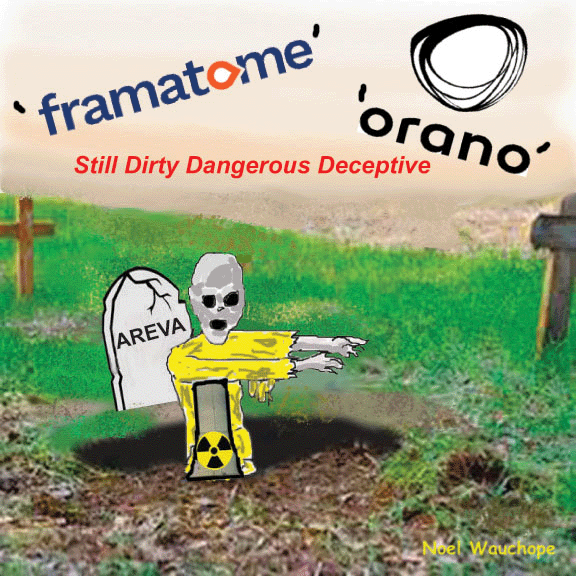 and moving north at a slow bell off the port of Luanda, Angola.)
Despite the past difficulties encountered by nuclear vessel operators, nuclear innovation company TerraPower – chaired by Microsoft founder and serial entrepreneur Bill Gates – has decided to partner with utility firm Southern Company and nuclear tech company Orano USA to back a new reactor designed to power commercial ships. The reactor’s developer, UK-based Core Power, sees molten salt reactor (MSR) nuclear “batteries” as a sustainable alternative for decarbonizing the world’s merchant fleet in the decades ahead. ….. https://www.maritime-executive.com/article/uk-based-startup-proposes-a-renaissance-for-nuclear-powered-shipping
Nukes in space

Bill Gates has another go at getting taxpayer funding, for another nuclear venture (ships this time)
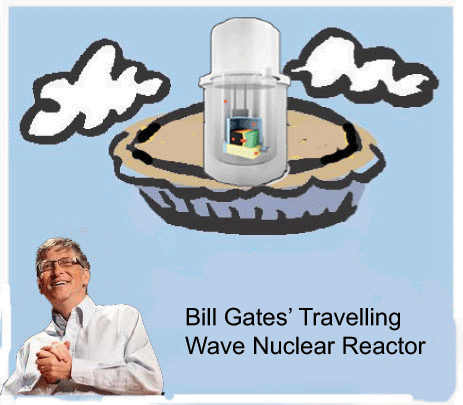 Bill Gates joins nuclear-powered shipping push, Splash Sam ChambersNovember 2, 2020 Bill Gates, one of the richest men in the world, has turned his attention to getting ships powered by nuclear energy.
The Microsoft co-founder, who turned 65 last week, is also chairman of TerraPower, a nuclear tech company that today announced a new venture with Mikal Bøe’s CORE POWER, French nuclear materials handling specialist Orano and American utilities firm Southern Company. The four companies plan to develop molten salt reactor (MSR) atomic technology in the United States………
The four companies have submitted an application to the US Department of Energy to take part in cost-share risk reduction awards under the Advanced Reactor Demonstration Programme to build a prototype MSR, as a proof-of-concept for a medium-scale commercial-grade reactor.
……. we seek to build scale-appropriate technology and broad acceptance of modern and durable liquid-fuelled atomic power to shape the future of how we deal with climate change,” Bøe commented today…….
Thorium is a weakly radioactive metallic chemical element found most commonly in India and is a substance that Gates’ TerraPower has been studying closely of late.
Admitting the technology would not be cheap to install on ships, Bøe has proposed a leasing model for his batteries, similar to those deployed for aircraft engines………. https://splash247.com/bill-gates-joins-nuclear-powered-shipping-push/
While Canadian authorities fall for “New Small Nuclear” spin, U.S. consortium rips off Canada’s nuclear waste disaster
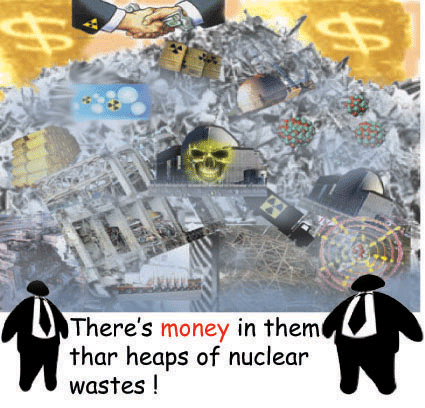
 U.S. corporations profiting from major Canadian nuclear liability, https://rabble.ca/blogs/bloggers/views-
 expressed/2020/10/us-corporations-profiting-major-canadian-nuclear-liability Ole Hendrickson, October 30, 2020
The nearly 70-year history of the federal crown corporation Atomic Energy of Canada Limited (AECL) has left a $16 billion toxic legacy of shuttered reactors, polluted lakes and groundwater, contaminated soils, and hundreds of thousands of cubic metres of radioactive waste.
AECL’s 2018 annual report estimates its undiscounted waste and decommissioning liability at $15.9 billion as of March 31, 2018. Table 5.7 in Canada’s 2019 public accounts estimates AECL’s environmental liabilities at $1.05 billion and “asset retirement obligations” at $6.6 billion.
This $7.7 billion estimate of AECL’s total nuclear liability is heavily discounted. The accounting firm Deloitte does not recommend discounting for environmental liabilities and asset retirement obligations unless the amount of the liability and the amount and timing of cash payments are “reliably determinable.” As explained in a detailed report, neither is true for AECL’s liability.
Prime Minister Stephen Harper thought that the private sector might do a better job of addressing this massive liability than AECL itself. Just before losing power to the Liberals in the 2015 election, his government contracted an American-controlled consortium (creatively called the “Canadian National Energy Alliance”) to manage federal nuclear facilities and reduce the waste liability quickly and cheaply.
According to the main estimates, AECL’s expenditures grew from $326 million in 2014-15 (before the consortium assumed control) to $491 million in 2015-16, $784 million in 2016-17, $827 million in 2017-18 and $829 million in 2018-19. The 2020-21 main estimates for AECL are $1.2 billion.
AECL hands most of this money over to the consortium, whose current members are Texas-based Fluor and Jacobs, and SNC-Lavalin. AECL retains ownership of the waste. A 2017 special examination report of the Auditor General of Canada to AECL’s board of directors says that “approximately $866 million for contractual expenses was paid or payable by the Corporation in the 2016-17 fiscal year.”
Is this “Government-owned, contractor-operated” (GoCo) arrangement providing value for money?
The GoCo contract was supposed to have been reviewed after an initial six-year period. However, AECL — whose president is an American with past ties to consortium members — extended it to a full 10-year period in April 2020, 18 months before its September 2021 renewal date.
The centrepiece of the consortium’s approach — a million-cubic–metre radioactive waste mound on a hillside draining into the Ottawa River – was revealed in May 2016, shortly after the ink dried on the contract. Neither the public, nor Algonquin peoples on whose unceded territory this facility would be built, were consulted.

Technical problems and public opposition have put the “near surface disposal facility” — to be built at AECL’s Chalk River laboratories — years behind schedule. AECL waste management experts who left when the consortium took over have been highly critical, pointing out that an above-ground mound would not contain and isolate the types of radioactive waste that the consortium planned to put in it.
Chalk River, the focal point of Canadian nuclear research since the late 1940s, is where most of AECL’s radioactive waste legacy is found. But AECL also built reactors at four other sites in Manitoba, Ontario and Quebec. All have been shut down for decades — radioactive hulks, yet to be fully decommissioned.
AECL and its American-led consortium have announced quick and cheap plans for Manitoba and Ontario reactors: fill them up with blast furnace slag and concrete, and abandon them in place. Critics say these proposals are seriously flawed, noting that the International Atomic Energy Agency (IAEA) says that “entombment” should only be considered in the event of a serious reactor accident.
Critics say that these sub-standard schemes would pollute major Canadian waterways and could expose workers and future generations to dangerous radiation levels.
The consortium is trying to salvage its Chalk River mound proposal with a promise to reduce the amount of radiation in the wastes it would house. Less radiation would leak into the Ottawa River.
However, management practices during Chalk River’s early years were poor, accidents were frequent and records were lost in a fire. Trying to separate out lower-activity from higher-activity wastes would involve considerable expense and high worker radiation exposures. And if strict limits on the mound’s radioactivity were adhered to, much of the federal waste liability would likely remain unaddressed.
Management of Canada’s radioactive waste by for-profit corporations, combined with a lack of government oversight, creates risks of delays, excessive radiation exposures to workers and the public, and squandering of tax dollars. Critics of AECL’s GoCo contract are asking the federal government to establish a publicly acceptable strategy for addressing its nuclear liability.
In a mission to Canada in late 2019, IAEA reviewers found virtually “no evidence … of a governmental policy or strategy related to radioactive waste management.” The government agreed to their recommendation that this gap be filled, assigning the task to Natural Resources Canada.
But Natural Resources Minister Seamus O’Regan seems preoccupied with promotion of a new generation of mass-produced, “modular” nuclear reactors. Two consortium members — Fluor and SNC-Lavalin — are heavily invested in their own reactor designs. There are plans to build three new demonstration reactors at Chalk River, and talk of building as many as eight. One proposal has already reached the environmental assessment stage.
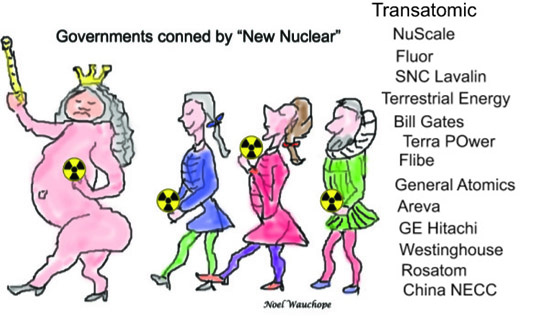
If the Liberal government caves into industry pressure to fund the building of these new reactors — instead of dealing responsibly with its existing waste liability — AECL’s $16 billion radioactive burden on Canadian taxpayers — and risks to workers and the public — will just keep growing.
Ole Hendrickson is a retired forest ecologist and a founding member of the Ottawa River Institute, a non-profit charitable organization based in the Ottawa Valley.
Financial red flags warn against Utah’s NuScale small nuclear reactor project
|
Is nuclear power Utah’s future? Red flags suggest holding off https://www-deseret-com.cdn.ampproject.org/c/s/www.deseret.com/platform/amp/opinion/2020/10/27/21535010/guest-opinion-nuclear-power-plant-idaho-utah-uamps-nuscale-red-flags?fbclid=IwAR13pzEW_7Bl0BQVlj8jN5UUIcoX9Mi_BZbgQq-22TBtjnJLSeSov8rZER, By M.V. Ramana, – on October 27, 2020 UAMPS has promised electricity at $55 per megawatt hour (MWh), down from the $65 it promised two years ago. One might imagine that the lower price is due to declining costs, but according to UAMPS, the project’s estimated costs have gone up, not down. In its 2018 Budget & Plan of Finance, UAMPS approved a construction cost of approximately $4.2 billion. This year, the UAMPS Amended Budget & Plan of Finance mentions a figure of approximately $6.1 billion. If the construction costs are going up, then why did the cost of electricity come down from $65/MWh to $55/MWh? The question arises because UAMPS and NuScale have not been transparent with the methodology used to develop figures like $55/MWh. The lack of transparency means the public does not know what assumptions are being made, let alone whether those assumptions are realistic. We do know that Pacificorp and Idaho Power have concluded that electricity from NuScale reactors would cost $94-$121/MWh. The UAMPS project also bears other red flags, and seems headed for failure. Less than 25% subscriptions. Based on public testimony, the UAMPS project has subscribers for less than 25% of the total power, leaving 75% of the output unclaimed. Communities continue to withdraw, citing the increasing costs, uncertain technology and the lack of subscribers. Several of the communities that withdrew were among the project’s largest subscribers. Project delays continue. NuScale initially claimed it could deliver the first working nuclear reactor in 2015. Now, the first UAMPS reactors aren’t scheduled to come online until 2029-2030, roughly 15 years later than originally expected — provided there are no further delays. NuScale’s experience is consistent with an independent study that showed that 175 of the 180 nuclear power projects examined took on average 64% longer than projected (and had final costs that exceeded the initial budget by an average of 117%). Unpredictable taxpayer subsidies. UAMPS and NuScale expect taxpayers to cover 25% of the project’s costs over the next nine years. Contrary to NuScale/UAMPS’ assurances about the recent U.S. Department of Energy $1.4 billion “funding vehicle,” there is no way to guarantee these funds. As the on-again, off-again Yucca Mountain project illustrates, federal funding for nuclear projects can be fickle and subject to withdrawal at any time. In the long history of failed U.S. nuclear projects, the public is almost never given an honest, transparent assessment of the likelihood of expensive overruns, lengthy scheduling delays and possible project collapse. The problems already apparent in the UAMPS project fit squarely into this history of failure. Some UAMPS members — Logan, Lehi, Kaysville and Murray, among them — seem to have realized that the risk of such failure is high enough and have pulled out of the project, cutting their losses. By the end of this week, roughly 30 Utah cities and towns will have a similar decision to make. They can either decide to continue the gamble and be tied to a contract that could leave them with millions of dollars of public debt. Or they could follow the lead of Logan, Lehi, Kaysville and Murray and vote to withdraw from this financially risky nuclear project. The sad irony is that even in the highly unlikely event of NuScale delivering on its promises, the $55/MWh figure is well above the current cost of procuring electricity for UAMPS itself, which has averaged around $29/MWh in the last two years. The $55/MWh would also far exceed the cost of renewables, which are continuing to decline in prices. Thus, a long term contract for $55/MWh is a recipe for excessive electricity costs for decades. I do think that UAMPS can achieve one of the stated goals of NuScale project promoters, namely invest in low-carbon sources of energy. But the way to do that is to pursue currently available solar, wind, energy storage (batteries) and energy efficiency. That is cheaper, safer, cleaner and more reliable than going deeper into the NuScale dead-end. Professor M.V. Ramana is the Simons Chair in Disarmament, Global and Human Security and Director of the Liu Institute for Global Issues at the School of Public Policy and Global Affairs at the University of British Columbia in Vancouver, Canada. Dr. Ramana is a member of the International Panel on Fissile Materials, the International Nuclear Risk Assessment Group and the team that produces the annual World Nuclear Industry Status Report. |
|
Another city bites the dust in regard to Utah’s NuScam small nuclear reactors plan

Seven Utah cities have now bailed out of an Idaho nuclear power project, Salt Lake Tribune, By Taylor Stevens-30 Oct 20,
Three more Utah cities voted this week not to move forward with a first-of-its kind nuclear power project that proponents have pitched as the future of clean energy but that opponents have lined up against over concerns about financial risk.
Beaver, Bountiful and Heber are the latest municipalities to exit the small modular nuclear reactor pursuit, following in the footsteps of Murray, Kaysville, Lehi and Logan, which also backed out in recent weeks. ………
The Heber Light and Power Board, which voted 5-1 to get out of the project, and the Bountiful City Council, which unanimously made the decision to back out, both did so this week largely over concerns about the subscription rate of the nuclear energy pursuit.
“There’s enough things wrong with this project that it made it really scary,” said Bart Miller, Heber Light and Power’s chief financial officer. “We’re just a bunch of little utilities in the state of Utah trying to do a $6 billion nuclear power plant.”………
Bountiful City Councilman Richard Higginson said the leaders there had similar concerns, and felt too many of the development and construction costs were falling to a small number of municipalities…….
Costs have been one of the main concerns for several of the cities that have backed out over the last few weeks, as the project’s projected price tag has ballooned significantly, from $4.5 billion a few years ago to around $6 billion now. Opponents have also raised concerns about time and cost overruns, safety considerations and an uncertain regulatory environment.
The Utah Taxpayers Association has been among the critics of the project, arguing that municipal power companies should not act as a “seed investor” for the new technology, a responsibility it’s argued should lie with the private sector.
Environmental groups, such as the Healthy Environment Alliance of Utah, have also raised concerns about the radioactive waste that would be generated by the project.
Cities participating in the Carbon Free Power Project through the Utah Associated Municipal Power Systems — a consortium of municipally owned power systems in Utah and several other Western states that has partnered with NuScale Power to study and create the nuclear technology — have until Saturday to decide whether to stay in the project or back out. https://www.sltrib.com/news/politics/2020/10/29/seven-utah-cities-have/
Big questions on the costs and safety of NuScale’s little nuclear reactors
NuScale Faces Questions on Nuclear Reactor Safety and Financing Its First Project
The first small modular reactor to receive federal approval must still grapple with design changes and safety concerns if it’s to be built by 2030. GreentechMedia
But its reactor design faces significant safety questions that were not resolved by a Nuclear Energy Commission (NRC) review completed in August. Those include potential problems with the system that automatically shuts down its reactors in case of emergency, casting doubt on key safety claims from the Portland, Oregon-based company, critics say.
The nature of NRC’s review will leave the resolution of these key safety issues to be completed later this decade.
This could prove problematic for NuScale’s first project, the 12-reactor Carbon Free Power Project (CFPP) in Idaho Falls, Idaho. Over the past two years, the project has seen expected costs double from $3 billion to $6.1 billion and its completion date moved from 2026 to 2030, putting pressure on parent company Fluor Corp. to keep further cost increases in check and secure financial backers for the project.
NuScale won’t complete key safety reviews for its reactor design until later this decade. These design changes and safety reviews will be the responsibility of the Utah Associated Municipal Power Systems (UAMPS), the first customer for 213 megawatts of the 720 MW the CFPP will produce, under a combined construction and operating license process. This could open up the CFPP to technical and legal challenges after significant investments in the project have already been made, critics warn.
UAMPS, a division of the Utah state government serving wholesale electric services to communities across the Intermountain West, has seen three cities vote to depart the 33-city consortium planning to agree to buy power from the CFPP in the past few months and is facing an October 31 deadline to commit to its role in the project.
And while the Department of Energy has issued a $1.36 billion, 10-year cost-share pledge to UAMPS, that funding will require future congressional appropriations in order to become reality. …..
Other U.S.-based SMR developers include Bill Gates-backed TerraPower and X-Energy, which have recently received financial support from DOE with the goal of building their first working units in the next seven years. Others include Hyperion Power Generation and Terrestrial Energy. ……
Safety questions on emergency shutdown
One of the most pressing unresolved safety issues deals with NuScale’s system to prevent overheating or meltdown during emergencies, according to the Advisory Committee on Reactor Safeguards (ACRS), which reviews reactor designs for the NRC.
NuScale’s reactor must submerge its fuel in water carrying boron, an element that absorbs neutrons and slows the fission chain reactions that generate heat and radioactivity. That water can be boiled away during emergencies, meaning that redundant safety systems are required that are capable of replacing it.
NuScale has said its system can reintroduce boronated water into the reactor without pumps that might lose power during an emergency, by venting steam into a surrounding containment vessel and condensing it back into water to inject into the core. But a March ACRS review noted that boron could be left behind as water turns into steam, yielding condensed water without enough boron to slow the chain reactions that could lead to overheating or core meltdown.
NuScale submitted design modifications to add boron to that reintroduced water supply. But in an April meeting, ACRS member Jose March-Leuba noted that the new design requires a series of 10 valves to operate without fail to solve the problem it’s geared to address, which he characterized as “10 single failure points.”
The ACRS told the NRC in a June letter that it “cannot reach a final conclusion on the safety of the NuScale design until the issue of the potential for a reactivity insertion accident” — a sudden increase in fission that cannot be halted — “is resolved to our satisfaction.” ………
Edwin Lyman, director of nuclear power safety at the Union of Concerned Scientists, said that the ACRS finding casts doubt on “one of the major selling points for this reactor, which is that it can passively shut down without any operator actions.”
NuScale has relied on its passive safety claims to argue that it should be exempt from other nuclear reactor safety requirements, such as maintaining emergency evacuation and planning zones within a 10-mile radius of the site and employing a security force to prevent sabotage attempts. Integrating these safety requirements into its projects may push NuScale’s power costs beyond the $55 per megawatt-hour it has targeted, he said.
“Nuclear safety is not just design. It’s the whole set of measures,” Lyman said.
Uncertain path to approval, unclear financing future
NuScale’s recent safety approval from the NRC is not as comprehensive a stamp of federal approval as the company had planned to obtain by now.
In March testimony before the U.S. House of Representatives, NuScale CEO John Hopkins said that parent company Fluor Corp. and investors have spent about $500 million to prepare a “design certification application,” which was submitted in 2016 and expected to be complete by September.
But NuScale’s recent approval from the NRC is not for a design certification application, Lyman said. Rather, it’s a “standard design approval,” which comes with less stringent rules for NRC review and allows future design changes. But it opens up NuScale’s design to future legal challenges that a design certification approval would not, he said.
NuScale also plans to increase the size of its reactor units from 50 MW to 60 MW units, which will require a separate design approval review, Lyman said. Meanwhile, NuScale’s original design certification, “when it’s approved, may never actually be used.” ……
these uncertainties have complicated the picture for UAMPS, which has pushed back its deadline for finalizing its licensing agreement with NuScale from September until October 31. UAMPS could be facing more than $100 million in commitments under its yet-to-be-finalized agreement. ….
Broader challenges for small modular reactors
In a September report, M.V. Ramana, a professor of disarmament and human security at the University of British Columbia, highlighted other risks facing NuScale. Those include further delays in licensing and certification, as well as the potential that design changes and increased safety requirements will raise the cost of power from NuScale’s reactors, which is already higher than the prices being set by new wind and solar energy today. Adding batteries or other forms of energy storage to renewables may prove a less costly solution to providing reliable zero-carbon electricity than NuScale can, he wrote.
Ramana also questioned the financial stability of NuScale’s parent company, engineering and construction giant Fluor, which has seen its share price drop about 80 percent over the past two years amid mounting financial losses and federal investigations into its accounting practices.
Fluor has invested $643 million into NuScale alongside $314 million in DOE funding, Hopkins told Congress in March. But it will need to bring more financial backers on board in the decade to come.
As for the DOE cost-share agreement, Lyman said it’s dependent on future congressional budget approvals that may not emerge. “The bottom line is, without a large subsidy, it would not be economical for them to buy this power.” ……… https://www.greentechmedia.com/articles/read/nuscale-faces-questions-over-nuclear-reactor-safety-path-to-financing-first-project
Space exploration – to lead to dangerous nuclear-armed totalitarian societies

Professor warns space exploration will give rise to totalitarian societies equipped with nuclear weapons – but some say his forecast is too pessimistic
- Daniel Deudney is a political science professor at Johns Hopkins University
- He recently published a book titled ‘Dark Skies’ that talks about space expansion
- The text warns that space settlements could become totalitarian societies
- Populations and resources will need to be controlled for survival
- Deudney notes that nuclear weapons will become the gold standard in space
- He fears that the cosmic battles will eventually make their way to Earth
By STACY LIBERATORE FOR DAILYMAIL.COM, 28 October 2020 Space agencies across the world are working tirelessly to design the best ships and technologies for the chance to claim a stake of the final frontier for their country.
Although it may seem like an act of national pride, a professor from Johns Hopkins University warns that space expansion may lead to the extinction of humanity, suggesting it should not be attempted at all.
Daniel Deudney recently published a book titled ‘Dark Skies’ that examines space expansionism through geopolitics revealing cosmic habitats could spark totalitarian empires.
The political science professor also notes that if these settlements stretch across the solar system, nuclear weapons will become the gold standard in war, along with using asteroids to destroy enemy planets – but other experts feel these arguments are ‘too pessimistic.’
‘I argue that the consequences of what has actually happened in space are much less positive than space enthusiasts and many others believe,’ reads ‘Dark Skies.’
‘My case for this darker net assessment of actual space activities centers on the role of space activities in making nuclear war more likely.’
‘In sum, this book argues that the large-scale expansion of human activities into space, past and future, should join the lengthening list of catastrophic and existential threats to humanity, and that the ambitious core of space expansionism should be explicitly relinquished.’
The book’s release comes at a time when many countries are muscling up to head into space.
The US announced a new branch of its armed forces called the US Space Force in 2019, which ‘is designed to protect the interests of the United States in space, deter aggression in the final frontier and conduct prompt and sustained space operations.’
However, Deudney’s concludes that these countries’ efforts will come with serious consequences.
The professor used geopolitics for this work, which studies ‘the practice of states controlling and competing for territory’ – and in this case, space.
Deudeny also explains that he is not opposed to using space in ways that will benefit Earth and is not on a mission to ‘defund space’ by eliminating the many robots and satellites that currently patrol the area.
He is looked at ‘the political and military potential of a system-spanning human civilization only increases the chances of totalitarianism and the deliberate or accidental extinction of human society,’……..
Along with using objects in space, governments have revealed details over the past years for launching nuclear weapons into the final frontier.
NASA is working on a method that would send a nuclear bomb into space aboard a rocket to destroy an asteroid heading towards Earth.
Earlier this year, the US raised concerns that China or Russia may soon detonate a nuclear weapon in space ‘to fry the electronics’ of spacecraft and ‘indiscriminately’ take out satellite.
Although neither of these are a reality, the technology may be in the works and could be used to wage space war…… https://www.dailymail.co.uk/sciencetech/article-8885599/Professor-warns-space-exploration-spark-totalitarian-societies-equipped-nuclear-weapons.html
1 This Month
29 Jan. Thursday 7-8 p.m. Webinar – World’s Largest Nuclear Station in Port Hope, ON?
To see nuclear-related stories in greater depth and intensity – go to https://nuclearinformation.wordpress.com/



31st January – Challenging the War Machine – a DECLASSIFIED UK SUMMIT


Website of the Week
Now until to February 10, 2026 Radioactive waste storage in France: the debate is finally open! How to participate?
-
Archives
- January 2026 (283)
- December 2025 (358)
- November 2025 (359)
- October 2025 (376)
- September 2025 (258)
- August 2025 (319)
- July 2025 (230)
- June 2025 (348)
- May 2025 (261)
- April 2025 (305)
- March 2025 (319)
- February 2025 (234)
-
Categories
- 1
- 1 NUCLEAR ISSUES
- business and costs
- climate change
- culture and arts
- ENERGY
- environment
- health
- history
- indigenous issues
- Legal
- marketing of nuclear
- media
- opposition to nuclear
- PERSONAL STORIES
- politics
- politics international
- Religion and ethics
- safety
- secrets,lies and civil liberties
- spinbuster
- technology
- Uranium
- wastes
- weapons and war
- Women
- 2 WORLD
- ACTION
- AFRICA
- Atrocities
- AUSTRALIA
- Christina's notes
- Christina's themes
- culture and arts
- Events
- Fuk 2022
- Fuk 2023
- Fukushima 2017
- Fukushima 2018
- fukushima 2019
- Fukushima 2020
- Fukushima 2021
- general
- global warming
- Humour (God we need it)
- Nuclear
- RARE EARTHS
- Reference
- resources – print
- Resources -audiovicual
- Weekly Newsletter
- World
- World Nuclear
- YouTube
-
RSS
Entries RSS
Comments RSS
 nuclear-news