Even a pro nuclear enthusiast admits that Small Nuclear Reactors cause toxic radioactive wastes
 13 Feb 21 I was quite fascinated to note a paragraph in a long nuclear propaganda article, (by Stikeman Elliott, in Mondaq) yesterday, in which this, hitherto rather hidden problem, gets a mention.
Of course, this pro nuclear writer is not really worried all that much about the actual problem.
Oh no – his concern is about the public’s perception of it – that public perception might hamper the develoment of the nuclear lobby’s newest gimmick. Can’t have that!
”…….efforts need to be made to address the perceived risks so as to establish confidence in the ability of SMRs to operate safely while proving to be a viable source of low-carbon energy.
While SMRs produce less nuclear waste than traditional reactors, the issue of radioactive waste still exists. Nuclear waste needs to be safely stored and transported to secure facilities. SMRs have often been proposed as a solution for electricity generation in remote areas, but this proves problematic from a waste perspective as any nuclear waste would need to be transported over long distances. There is currently no permanent nuclear waste storage site in Canada……”
Not mentioned? Nuclear fusion is hugely expensive, and this quest has produced much toxic waste

|
Radiation Free Lakeland 11th Feb 2021, The local News and Star and other press have reported uncritically that ….“The Moorside Clean Energy Hub came out on top in the mini
competition. Cumbria LEP will now work with Copeland Borough Council in a bid to bring the cutting edge technology to Copeland. If successful, a prototype of the fusion reactor, which Professor Stephen Hawking has called “the key to the future” could be housed at Moorside; along with the Small Modular Reactors that are already in the works. This is right at the cutting edge of green energy” said deputy chairman of Copeland Borough Council David Moore.” What NuSpeak is this! Nuclear is not clean and
Fusion is Expensive as in off the richter scale ..it uses huge energy, needs tritium etc ..doesnt work (as in produce net energy) despite decades of funding and produces waste even tho they claim it doesnt. There was a telling article framed as a Brexit story in the Financial Times but the big reveal was that Fusion research reactors (RESEARCH reactors!) have produced enormous amounts of nuclear waste.https://mariannewildart.wordpress.com/2021/02/11/fusion-profligate-nuclear-waste-and-tritium-tainted-nightmare-for-cumbria-and-lancashire-no-thanks/ |
|
UK universities partnering with Chinese technology companies may be breaching national security rules
affairs committee, to alert Manchester University to the fact that a
Chinese company with which it was collaborating was implicated in
Beijing’s persecution of the Uighurs.
its partner’s role in providing surveillance technology used to spy on
China’s Muslim minority.
universities cut off links with CETC in 2019 after similar warnings. But
what is more troubling is that Manchester appears to be far from alone in
partnering with Chinese companies with defence links on cutting-edge
scientific research. Indeed the Foreign Office is investigating more than a
dozen universities for possible breaches of national security rules.
Deploying weapons in space crosses a threshold that cannot be walked back.

weaponizing space could become a classic case of trying to solve one problem while creating a much worse problem.
It’s time for arms control planning to address the issues raised by this drift toward militarization of space. Space is a place where billions of defense dollars can evaporate quickly and result in more threats about which to be concerned. China and Russia have been proposing mechanisms for space arms control at the United Nations for years; it’s time for the U.S. to cooperate in this effort.
Deploying weapons in space crosses a threshold that cannot be walked back.
The US should negotiate a ban on basing weapons in space, BY JOHN FAIRLAMB, — 02/04/21, https://thehill.com/opinion/national-security/536774-the-us-should-negotiate-a-ban-on-basing-weapons-in-space
The Biden administration is assembling a deep bench of personnel with experience negotiating arms control agreements and already has agreed with Russia to extend the New Start Treaty. It’s clear the administration intends to initiate another look at the 2018 Nuclear Posture Review and the massive buildup in nuclear weapons begun by the Trump administration. While it’s good that the Biden administration intends to resume negotiations to continue nuclear force reductions, the specter of placing weapons in space is another area that requires a serious arms control effort.
Now that separate space organizations have been established, major military commands are advocating to develop new capabilities. Pentagon buzzwords characterize space as a “contested domain” and some consider actual war-fighting in space to be inevitable. Some advocates argue that the U.S. should strive for technological superiority in space to ensure our dominance of that critical domain.
The history of technological advancement in weapons systems shows that any advantage gained usually lasts fewer than five years and guarantees a cycle of ever-increasing cost and new perceptions of threat. Already, there are weapons that can be targeted against space-based assets from non-space domains. Russia and China are believed to have deployed ground-based capabilities to attack satellites, and India joined this club last year by using a ground-based missile to bring down a satellite.
Although it isn’t clear how the Biden administration will shape space policy, during his confirmation hearing, Secretary of Defense Lloyd Austin seemed to signal a shift away from a more muscular approach and back to a focus on space resiliency and protecting U.S. space assets. As one analyst concluded, the language Austin used signals the Biden team wants to “start to lean away from … the pugilistic aspects of what’s been articulated [by the Trump administration].” Responding to a question about what his advice would be to the U.S. Space Command concerning military space operations, Austin stressed measures to protect U.S. assets that don’t include offensive options for taking the fight to adversaries. While not a fully articulated space policy, this is a welcome change of tone after the past few years of heavy breathing about waging war in space.
If the U.S. and other nations continue the current drift toward organizing and equipping to wage war in space, Russia, China and others will strive to improve capabilities to destroy U.S. space assets. Over time, this would greatly increase the threat to the full array of U.S. space-based capabilities. Intelligence, communications, surveillance, targeting and navigation assets already based in space, upon which the Department of Defense (DOD) depends for command and control of military operations, increasingly would be at significant risk. As a consequence, weaponizing space could become a classic case of trying to solve one problem while creating a much worse problem.
For example, buried in the DOD 2020 budget is $150 million for research into putting missile defense assets in space to attack enemy nuclear missiles in the boost phase. If the U.S. or another nation does deploy weapons in space, it would be the first country to do so and likely would be a disaster for strategic stability. To ensure the credibility of their nuclear deterrents, Russia, China and others could be expected to respond by deploying additional and new types of long-range ballistic missiles, as well as missiles employing non-ballistic trajectories that are harder to hit. Russia and China also would strive to improve their ability to destroy U.S. space-based interceptors, which would greatly increase the threat to the full array of U.S. space assets.
It’s time for arms control planning to address the issues raised by this drift toward militarization of space. Space is a place where billions of defense dollars can evaporate quickly and result in more threats about which to be concerned. China and Russia have been proposing mechanisms for space arms control at the United Nations for years; it’s time for the U.S. to cooperate in this effort.
In 2015, Frank Rose, assistant secretary for arms control, verification and compliance in the State Department, called for arms control in space at the Association of Southeast Asian Nations Regional Forum workshop on space security. But, he said the Obama administration opposed a 2008 Russian and Chinese proposal to ban all weapons in space because it was unverifiable, contained no prohibition on developing and stockpiling space arms, and did not address ground-based space weapons such as direct ascent anti-satellite missiles.
Instead of just criticizing others’ proposals, the U.S. should join in the effort and do the hard work of crafting a space arms control agreement that deals with the concerns we have and that can be verified. A legally binding international treaty banning the basing of weapons in space should be the objective.
Let’s be clear: Deploying weapons in space crosses a threshold that cannot be walked back. Given the implications for strategic stability, and the likelihood that such a decision by any nation would set off an expensive space arms race in which any advantage gained would likely be temporary, engaging now to prevent such a debacle seems warranted.
John Fairlamb, Ph.D., is a retired Army colonel with 45 years of government service, much of it in joint service positions formulating and implementing national security strategies and policies, including two four-year details in the Department of State and as the political-military affairs adviser for a major Army command. His doctorate is in comparative defense policy analysis.
America’s new strategy for space nuclear power pays little consideration to safety aspects
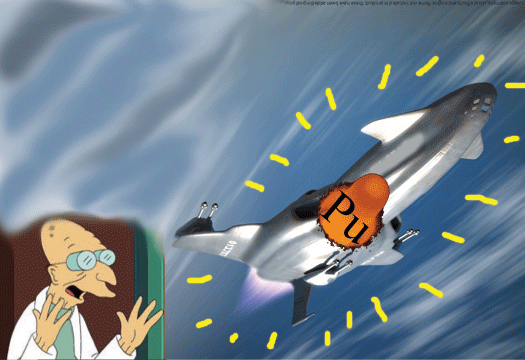 America’s New Strategy for Space Nuclear Power, By Zhanna Malekos Smith. Wednesday, February 3, 2021
Among the flurry of executive orders and proclamations signed during his final weeks in office, President Trump issued two directives that have received little fanfare—about space. One directive concerns enhancing the cybersecurity of GPS satellites. The other is perhaps more exciting: It focuses on exploring Mars and the moon.
Unsafe plan for abandoning nuclear reactors onsite, and developing Small Nuclear Reactors
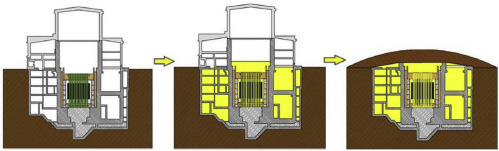
“IAEA guidance that entombment is not considered an acceptable strategy for planned decommissioning of existing [nuclear power plants] and future nuclear facilities.”
|
Groups oppose plans to abandon defunct nuclear reactors and radioactive waste, https://rabble.ca/columnists/2021/02/groups-oppose-plans-abandon-defunct-nuclear-reactors-and-radioactive-wasteThe Canadian Nuclear Safety Commission (CNSC) has just given a green light to the preferred industry solution for disposal of nuclear reactors — entomb and abandon them in place, also known as “in-situ decommissioning.” This paves the way for the introduction of a new generation of “small modular” nuclear reactors or SMRs. Over 100 Indigenous and civil society groups have signed a public statement opposing SMR funding, noting that the federal government currently has no detailed policy or strategy for what to do with radioactive waste. Many of these groups are also participating in a federal radioactive waste policy review launched in November 2020. The Assembly of First Nations passed resolution 62/2018 demanding that the nuclear industry abandon plans for SMRs and that the federal government cease funding them. It calls for free, prior and informed consent “to ensure that no storage or disposal of hazardous materials shall take place in First Nations lands and territories.”
An SMR emits no radiation before start-up (other than from uranium fuel) and could easily be transported at that stage. But during reactor operation, metal and concrete components absorb neutrons from the splitting of uranium atoms — and in the process, transform into radioactive waste. Removing an SMR after shut-down would be difficult and costly, and comes with the need to shield workers and the public from its radioactivity. Abandoning nuclear reactors on site has been in the works for some time. CNSC helped draft a 2014 nuclear industry standard with in-situ decommissioning as an option and then included it in a July 2019 draft regulatory document. However, when the International Atomic Energy Agency (IAEA) released a peer-reviewed report on Canada’s nuclear safety framework last February, it said in-situ decommissioning is “not consistent” with IAEA safety standards. The IAEA suggested that CNSC “consider revising its current and planned requirements in the area of decommissioning to align with the IAEA guidance that entombment is not considered an acceptable strategy for planned decommissioning of existing [nuclear power plants] and future nuclear facilities.” It also noted that CNSC is reviewing license applications for in-situ decommissioning of shut-down federal reactors in Ontario and Manitoba, and encouraged Canada “to request an international peer review of the proposed strategy” for legacy reactors. But CNSC continued to pursue this strategy. Clever language in a June 2020 document appeared to rule out on-site reactor disposal, but left the door open where removal is not “practicable”:
At public meeting last June, CNSC Commissioner Sandor Demeter asked: “why are future facilities in this sentence when in fact we should be designing them so that in-situ decommissioning is not the option?” Former CNSC staff member Karine Glenn replied that “leaving some small parts of a structure behind…especially if you are in a very, very remote area, may be something that could be considered.” Glenn is now with the industry-run Nuclear Waste Management Organization, tasked with leading the development of a radioactive waste management strategy for Canada. Commissioners decided to approve the regulatory document, but with added text to clarify where in-situ decommissioning would be acceptable. They asked for additional text on “legacy sites” and “research reactors,” stating that “[t]he Commission need not see this added text if it aligns with the oral submissions staff made in the public meeting.” But no new clarifying text was added to the final version of the document published on January 29, 2021. It enables abandonment of SMRs — by retaining the reference to future nuclear facilities — and of “research and demonstration facilities, locations or sites dating back to the birth of nuclear technologies in Canada for which decommissioning was not planned as part of the design.” The CNSC seems willing to ignore international safety standards — and a decision of its own commission — to accommodate nuclear industry proponents of SMRs and allow radioactive waste to be abandoned in place. Meanwhile, the federal government has assigned the nuclear industry itself — via the Nuclear Waste Management Organization — the task of developing a radioactive waste strategy for Canada. Barring public outcry, that strategy will be abandonment. Ole Hendrickson is a retired forest ecologist and a founding member of the Ottawa River Institute, a non-profit charitable organization based in the Ottawa Valley. |
|
USA preparing for war in space

SPACECOM’s New Vision Targets ‘Space Superiority’
“We must have fully integrated offensive and defensive operations across all of our services, as well as our partners,” says Army Gen. James Dickinson, SPACECOM commander.
Breaking Defense, By THERESAHITCHENSon January 28, 2021 “……… “The intended audience is both internal and external,” Army Gen. James Dickinson told me in an interview yesterday. “Internally, the objective is to set the stage for SPACECOM personnel to develop and sustain a warfighting mindset necessary for our mission challenges in this new warfighting domain.”………
Dickinson’s eight-page manifesto, “Never A Day Without Space: Commander’s Vision” — provided to Breaking D — was briefed to SPACECOM today. It will be the “baseline” for future development of subordinate SPACECOM planning guidance, campaign plans, operational plans and other organizational documents required to running the 18-month-old Combatant Command, Dickinson explained.
The general’s stress on the need for both ‘offensive and defensive’ operations to achieve space superiority is not new, even if it makes some US security experts — including some Democrats in Congress — a bit queasy. It is one of the first things his predecessor, Air Force Gen. Jay Raymond who now heads the Space Force, made clear when SPACECOM was stood up in August 2019……..
Unified Command Plan and Missions
As Breaking D readers were first to learn, the revised UCP sent by Chairman of the Joint Chiefs of Staff Gen. Mark Milley to President Trump included a number of changes designed to delineate the role of SPACECOM — designated as a new geographic command with an area of responsibility (AOR) from 100 kilometers above the Earth to, well, infinity and beyond in theory — vice the 10 other Combatant Commands. These include giving SPACECOM the lead in deciding who gets priority use of communications satellites during combat, and what targets missile warning and space surveillance sensors are tasked to monitor. Trump signed the revised 2020 UCP Jan. 13, a spokesperson for the Joint Staff confirmed……..
Dickison elaborated during his conversation with Mitchell Institute Dean Dave Deptula that SPACECOM now has three primary missions: “One, our enduring, no-fail mission to enable warfighting operations in other domains. Two, our future mission as global SATCOM manager and global sensor manager. And three, our current new mission set compelling us to fight and win in the space domain in order to protect and defend our interests there.
“Additionally, this warfighting domain is growing, and this AOR is by far the biggest and is getting bigger, each day,” he added………
The ‘protect and defend’ mission, which would include any offensive action in a conflict, is carried out by the Joint Task Force Space Defense, commanded by Brig. Gen. Tom James. ………
Despite the new UCP, however, Dickinson was coy with me about how exactly the decisions about who supports whom when are actually made, and at what level of the US military hierarchy. “Command decisions reside with the Combatant Commander,” he said, although “many of those decisions may be made well above us depending on the situation.”
Some of this, he said, is because such details remain classified. However, a number of sources intimately familiar with these issues tell me that a big problem is that there simply hasn’t yet been any agreements codified on how those decisions will be made. The hope is that the impending Joint Warfighting Concept, in which space plays a central role, will go some ways toward clarifying those questions………… https://breakingdefense.com/2021/01/spacecoms-new-vision-targets-space-superiority/
The aerospace industry – the goal is weaponry and global dominance
|
Keep Space for Peace! Save the Heavens fro!m Hegemony https://www.womenagainstmilitarymadness.org/articles/2020/12/22/keep-space-for-peace-save-the-heavens-from-hegemony Bruce K. Gagnon
Recently we learned that the aerospace industry is pushing to turn a former naval air station in Brunswick, Maine, into a spaceport. Promising lots of “high tech” jobs, a bill is being pushed in Augusta, our capital, by some of the most “progressive” legislators in the state. Similarly, we are hearing from many other states where launch complexes are being promoted – from Hawaii to New Mexico to Alaska – that the industry wants some of the most pristine places on Earth to become spaceports. Why? A spaceport in Kodiak Island, Alaska (locals call it “Spacepork”), was built some years ago in spite of overwhelming opposition by local residents. They were promised that it would be used only for civilian launches. So far, all the launches at Kodiak have actually been for Pentagon (and Israeli) space-weapons technology tests. We’ve been hearing for several years now that new companies formed by tech-industry billionaires Elon Musk (whose projects include Tesla and SpaceX) and Jeff Bezos (Amazon, Blue Orbit) plan to launch as many as 35,000 mini-sats (satellites) into orbit. Imagine the enormous hole these polluting launches will punch into the ozone layer. The plan is to have a satellite orbiting over the head of every person on Earth 24 hours a day, making it possible for the new 5G wireless technology system to be profitable. Many questions are being raised about the military (dual-use) applications of these satellites as well. Space Force Earlier this year, Trump was able to “stand up” his new high-tech legacy branch of the military, called the Space Force. Congress was overwhelmingly in favor – that means both parties supported it; the only thing the Democrats (who could have stopped it cold in the House of Representatives) wanted to change was the name ¾ to “Space Corps.” They surrendered on that as well. When the new leaders of the Space Force speak about it, they keep using the word “lean” to describe the new service branch. They want to make it sound as though it won’t be a “fiscal burden” to the nation, especially at a time when we have more unemployment than during the Great Depression. But facts are facts, and I can testify that the aerospace-industry publications have been bragging about since the 1980s when Ronald Reagan first proposed Star Wars, that this would be the largest industrial project in the history of the planet. So $15 billion is just the foot in the door. Where will the funds come from to pay for this? Our entitlement programs ¾ Social Security, Medicare, Medicaid, and what little is left of the social safety net –– are on the chopping block to be sacrificed to the aerospace industry. During his presidency, Trump announced that the U.S. rejects the United Nations Outer Space and Moon Treaties that declare the planetary bodies are the “province of all humankind” – meaning that no nation, corporation, or individual can claim ownership of them. Thus the way is open for a new gold rush to grab the planets for resource extraction. And, if Biden were to continue Obama’s legacy, the way will be paved. The Real Missions of Space Force In 2015, Obama signed the U.S. Commercial Space Launch Competitiveness Act into law. The act grants companies the rights to whatever they manage to pluck out of these extraterrestrial bodies. Effectively an extension of capitalism into space, the bill is one of the few during Obama’s presidency that received widespread support from the GOP as well as from the Democrats, because apparently nothing screams bipartisanship louder than asteroid mining. (Asteroids are rocky and metallic objects that orbit the sun but are smaller than planets.)[1] “This is the single greatest recognition of property rights in history,” said Eric Anderson, a founder of Planetary Resources, Inc., a company whose mission it is to mine asteroids. “This legislation establishes the same supportive framework that created the great economies of history, and will encourage the sustained development of space.” I’ve long believed that the Space Force (and before that the Space Command) will have two primary missions: first, to give the U.S. and its Western capitalist allies “control and domination” of Earth; and secondly, the Space Force will be given the task to create the technologies to “control and dominate” the pathway on and off our sacred Mother Earth. In 1989, the U.S. Congress published an internal study called “Military Space Forces: The Next 50 Years.” In this study, the congressional staffer who wrote it explained the need to control the pathway between the Earth and the Moon. He suggested that armed space stations on either side of the Moon would allow the Pentagon to seize the “Earth-Moon gravity well.” He wrote: “Armed forces might lie in wait at that location to hijack rival shipments on return.” So this plan has been in the works for many years – in fact, since a former Nazis first briefed Congress back in 1958. From Nazi Rocket Science to the U.S. Militarizing Space Program Walter Dornberger was Hitler’s head man in charge of his World War II era V-1 and V-2 rocket program. He was the staff link between rocket scientist Wernher von Braun and Hitler. Dornberger, like von Braun and 1,600 other Germans, was smuggled into the U.S. after the war in the secret military program called Operation Paperclip. Speaking at a congressional hearing in 1958, Dornberger insisted that America’s first space priority ought to be to “conquer, occupy, keep and utilize space between the Earth and the Moon.” There has been unanimity in the halls of Congress since Dornberger’s testimony – both parties have faithfully kept the funding for the militarized space program alive and growing. Dornberger would be happy today to see that his Nazi prophecy has largely come to fruition. International Treaties and an Achilles Heel The U.S. has been leading the way to militarize and weaponize space since the beginning of WW II. For a while the former Soviet Union was in the game – until its collapse in 1991. Neither Russia nor China could keep up with the U.S. in the ensuing years, and they continually begged the U.S. to join them in negotiating a treaty to ban all weapons in space – in other words, close the door to the barn before the horse gets out. During Republican and Democrat administrations since Bill Clinton, the response to Moscow and Beijing was the same from Washington – NO. So Russia and China slowly but steadily have moved forward since the early 1990s and have begun to close the space gap – always continuing to urge the creation of a space-weapons ban treaty. But Washington still refuses to even consider it. In fact, the U.S. has gone in the opposite direction of international treaties under Trump – pulling out of the Anti-Ballistic Missile Treaty (ABM), Intermediate-Range Nuclear Forces Treaty (INF), and the Iran Nuclear Deal. Will the U.S. under Biden renew the Strategic Arms Reduction Talks (START), which run out in 2021? It’s all really quite simple – the U.S. has not wanted to be bound by any treaties that limit its goal for “control and domination.” One could say the U.S. has become a renegade or pirate nation controlled by the soulless corporate agenda, which is all about power and greed. This all makes the job of the Global Network[2] terribly difficult. Since our founding in 1992 we’ve been working hard to build an international constituency to keep space for peace. The corporate agenda is determined to block any progress toward that goal. But I’ve always maintained that like everything else, the aerospace industry and its Star Wars project has an Achilles heel. It’s money. The current global virus pandemic is only bringing this reality to bear as never before. We Must Stop an Arms Race in Space! If we hope to beat this insane and provocative plan, then we must starve the beast. We can do that by bringing our national priorities down to earth and fighting for social progress – for programs like Medicare for All and funding to deal with our real problem today: climate crisis. Please help us beat the expensive and dangerous Space Force by demanding our government provide programs that honor life on this lovely planet. Best wishes to all of you. Keep your spirit strong! ~ Bruce K. Gagnon is coordinator of the Global Network Against Weapons & Nuclear Power in Space (keepspace4peace.org) and lives in Bath, Maine. He began working on space issues in 1982. Endnotes [1] Definition from solarviews.com [2] Global Network Against Weapons & Nuclear Power in Space |
|
|
Dangers of plutonium fuelled, sodium cooled “Versatile Nuclear Reactor”

|
Experimental Nuclear Reactor Design Could Come to ID https://www.publicnewsservice.org/2021-01-25/nuclear-waste/experimental-nuclear-reactor-design-could-come-to-id/a72914-1January 25, 2021
BOISE, Idaho — The public can weigh in this week on an experimental nuclear reactor which could be coming to the Idaho National Laboratory. The U.S. Department of Energy (DOE) has released a draft Environmental Impact Statement (EIS) for a new design known as a “versatile nuclear reactor.” The DOE said it will be used to test nuclear-energy innovations, helping to push the sector forward. Edwin Lyman, director of nuclear power safety for the Union of Concerned Scientists, believes its construction would pose risks for eastern Idaho. “People should ask questions about whether the DOE has really done the accident analysis that it needs to, and is being honest with the people about the potential consequences of accidents at that reactor,” Lyman contended. The versatile nuclear reactor is cooled by liquid sodium, which Lyman noted is highly potent. Reactors currently in operation in the U.S. are cooled by water. The public hearings on the EIS will be held online Wednesday and Thursday. Lyman added there is another concern with the fuel the reactor would use. “Unlike the fuels that are used for light-water reactors, which is called low-enriched uranium fuel, that fuel is not directly usable in a nuclear weapon,” Lyman explained. “But plutonium is directly usable.” Lyman argued it raises questions about the potential for nuclear proliferation. The DOE estimated the project will cost between $2.6 and $5.8 billion dollars. Lyman cautioned that’s a lot of money for an experimental project. “The DOE needs to reconsider this whole project, and whether they can spend that money more wisely in helping to improve the safety of existing technologies,” Lyman concluded. |
|
First a comment on military smrs – then the enthusiastic article about them
 spikedpsycho169, 18 Jan 21, Small reactors on a battlefield where the enemy now has suicide drones, rpg’s and homemade rockets. What could possibly go wrong.? Other than electricity, reactors have little use on a field of combat. Some advocate the production of liquid fuels using in situ resources like ammonia, methanol, etc made using ambient materials like air/water. That requires temperatures above 600-800 degrees celsius, Which no reactor currently operates.
White House Accelerates Development Of Mini Nuclear Reactors For Space And The Battlefield
The order looks to accelerate and integrate the development of highly mobile nuclear reactors for space and the terrestrial battlefield. BY BRETT TINGLEY JANUARY 16, 2021
President Trump issued an Executive Order on January 12 that aims to promote small, modular nuclear reactors for defense and space exploration applications. According to a press statement issued by the White House, the order will “further revitalize the United States nuclear energy sector, reinvigorate America’s space exploration program, and produce diverse energy options for national defense needs.”
The order instructs NASA’s administrator to prepare a report within 180 days that will define NASA’s requirements and foreseeable issues for developing a nuclear energy system for human and robotic exploratory missions through 2040. The order also calls for a “Common Technology Roadmap” between NASA and the Departments of Energy, Defense, Commerce, and State for implementing new reactor technologies. The full text of the Executive Order can be read at WhiteHouse.gov ………
Section 4 of the Executive Order goes into further detail about the DoD’s energy needs, and outlines the role the Department of Defense will play in this new initiative to develop mobile nuclear reactors …….
The Executive Order also outlines a Common Technology Roadmap that “describes potential development programs and that coordinates, to the extent practicable, terrestrial-based advanced nuclear reactor and space-based nuclear power and propulsion efforts” between the Departments of Energy, Defense, Commerce, State, and NASA. This roadmap will also require “assessments of foreign nations’ space nuclear power and propulsion technological capabilities.” Naturally, one of the most pressing concerns with any nuclear technology is national security, and thus the order also instructs the DoD to work together with NASA and other agencies to identify security issues associated with any potential space-based nuclear systems.
With this new Executive Order, the White House seeks to propel the United States to the forefront of all of the work being conducted in compact reactor research. While the wording in the statement focuses more on space exploration, the Department of Defense’s involvement is highly important. Since space environments are similar in that resupply is a tricky, if not impossible, endeavor, NASA could help jump-start the DoD’s mobile nuclear program even further if both are really working on it collaboratively, although the requirements will be somewhat different. “There’s sometimes a risk of forcing too much commonality,” a White House official told SpaceNews.com. “What this executive order does is ensure that there is a deliberate look at what those opportunities may be.”
If realized, the Executive Order’s accompanying statement reads, this initiative could lead to a “transportable small modular reactor for a mission other than naval propulsion for the first time in half a century.”
Contact the author: Brett@TheDrive.com https://www.thedrive.com/the-war-zone/38687/white-house-accelerates-development-of-mini-nuclear-reactors-for-space-and-the-battlefield
”Small Modular Reactors”’- governments are being sucked in by the ”billionaires’ nuclear club”

SNC-Lavalin Scandal-ridden SNC-Lavalin is playing a major role in the push for SMRs.
Terrestrial Energy….. Terrestrial Energy’s advisory board includes Dr. Ernest Moniz, the former US Secretary of the Dept. of Energy (2013-2017) who provided more than $12 billion in loan guarantees to the nuclear industry. Moniz has been a key advisor to the Biden-Harris transition team, which has come out in favour of SMRs.
The “billionaires’ nuclear club” …“As long as Bill Gates is wasting his own money or that of other billionaires, it is not so much of an issue. The problem is that he is lobbying hard for government investment.”
Going after the public purse
Bill Gates was apparently very busy during the 2015 Paris climate talks. He also went on stage during the talks to announce a collaboration among 24 countries and the EU on something called Mission Innovation – an attempt to “accelerate global clean energy innovation” and “increase government support” for the technologies.
Gates’ PR tactic is effective: provide a bit of capital to create an SMR “bandwagon,” with governments fearing their economies would be left behind unless they massively fund such innovations.
governments “are being suckers. Because if Wall Street and the banks will not finance this, why should it be the role of the government to engage in venture capitalism of this kind?”
It will take a Herculean effort from the public to defeat this NICE Future, but along with the Assembly of First Nations, three political parties – the NDP, the Bloc Quebecois, and the Green Party – have now come out against SMRs.
|
Mini-Nukes, Big Bucks: The Interests Behind the SMR Push https://watershedsentinel.ca/articles/mini-nukes-big-bucks-the-money-behind-small-modular-reactors/
It’s remarkable that only five years ago, the National Energy Board predicted: “No new nuclear units are anticipated to be built in any province” by 2040.So what happened? The answer involves looking at some of the key influencers at work behind the scenes, lobbying for government funding for SMRs. |

Big doubts on small nuclear reactors – on economics, on waste problems
 Former U.S. regulator questions small nuclear reactor technology, Business case for small reactors ‘doesn’t fly,’ says expert on nuclear waste, Jacques Poitras · CBC News Jan 15, 2021 A former head of the United States’ nuclear regulator is raising questions about the molten-salt technology that would be used in one model of proposed New Brunswick-made nuclear reactors.
The technology pitched by Saint John’s Moltex Energy is key to its business case because, the company argues, it would reuse some of the nuclear waste from Point Lepreau and lower the long-term cost and radioactivity of storing the remainder.
But Allison Macfarlane, the former chairperson of the U.S. Nuclear Regulatory Commission and a specialist in the storage of nuclear waste, said no one has yet proven that it’s possible or viable to reprocess nuclear waste and lower the cost and risks of storage.
“Nobody knows what the numbers are, and anybody who gives you numbers is selling you a bridge to nowhere because they don’t know,” said Macfarlane, now the director of the School of Public Policy and Global Affairs at the University of British Columbia.
“Nobody’s really doing this right now. … Nobody has ever set up a molten salt reactor and used it to produce electricity.”
Macfarlane said she couldn’t comment specifically on Moltex, calling information about the company’s technology “very vague.”
But she said the general selling point for molten-salt technology is dubious.
“Nobody’s been able to answer my questions yet on what all these wastes are and how much of them there are, and how heat-producing they are and what their compositions are,” she said.
“My sense is that all of these reactor folks have not really paid a lot of attention to the back end of these fuel cycles,” she said, referring to the long-term risks and costs of securely storing nuclear waste.
Moltex is one of two Saint John-based companies pitching small nuclear reactors as the next step for nuclear power in the province and as a non-carbon-dioxide emitting alternative to fossil fuel electricity generation.
Moltex North America CEO Rory O’Sullivan said the company’s technology will allow it to affordably extract the most radioactive parts of the existing nuclear waste from the Point Lepreau Generating Station.
The waste is now stored in pellet form in silos near the plant and is inspected regularly.
The process would remove less than one per cent of the material to fuel the Moltex reactor and O’Sullivan said that would make the remainder less radioactive for a much shorter amount of time.
Existing plans for nuclear waste in Canada are to store it in an eventual permanent repository deep underground, where it would be secure for the hundreds of thousands of years it remained radioactive………..
Shorter-term radioactivity complicates storage
Macfarlane said a shorter-term radioactivity life for waste would actually complicate its storage underground because it might lead to a facility that has to be funded and secured rather than sealed up and abandoned.
“That means that you believe that the institutions that exist to keep monitoring that … will exist for hundreds of years, and I think that is a ridiculous assumption,” she said.
“I’m looking at the United States, I’m seeing institutions crumbling in a matter of a few years. I have no faith that institutions can last that long and that there will be streams of money to maintain the safety and security of these facilities. That’s why you will need a deep geologic repository for this material.”
And she said that’s assuming the technology will successfully extract all of the most radioactive material.
“They are assuming that they remove one hundred per cent of the difficult, radionuclides, the difficult isotopes, that complicate the waste,” she said.
“My response is: prove it. Because if you leave five per cent, you have high-level waste that you’re going to be dealing with. If you leave one per cent, you’re going to have high-level waste that you’re going to be dealing with. So sorry, that one doesn’t fly with me.”
Macfarlane, a geologist by training, raised doubts about molten-salt technology and waste issues in a 2018 paper she co-authored for the Bulletin of the Atomic Scientists………. https://www.cbc.ca/news/canada/new-brunswick/nuclear-waste-reactors-new-brunswick-allison-macfarlane-moltex-arc-1.5873542
Small modular reactor plan bolsters nuclear industry’s future, but renewables could address energy issues now,
Small modular reactor plan bolsters nuclear industry’s future, but renewables could address energy issues now, https://www.cbc.ca/news/opinion/opinion-small-modular-reactor-strategy-1.5869623
While SMRs are hailed as start of a nuclear renaissance, there are big questions about costs and timeframe, Eva Schacherl · CBC News Jan 15 In late December, as many Canadians were easing into a low-key holiday break, Minister of Natural Resources Seamus O’Regan pulled out a bag of goodies for the nuclear industry. It was the much-hyped Small Modular Reactor Action Plan for Canada.
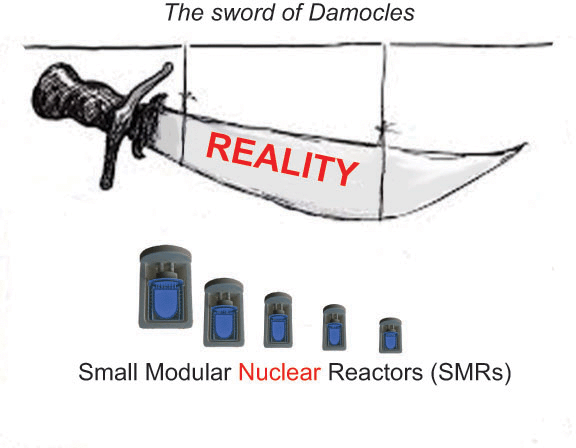
Small modular reactors (SMRs) are experimental nuclear technologies that are still on the drawing board. They are the nuclear power industry’s hope for overcoming the problems that have plagued it: high costs, radioactive waste, and risks of accidents.
Public interest groups across the country, however, argue that SMRs won’t solve these issues.
The dozen SMR vendors backing the technology include GE-Hitachi, Westinghouse, and SNC-Lavalin (which, along with two U.S. corporations, already holds a multibillion-dollar contract with the federal government to run Canadian Nuclear Laboratories at Chalk River, Ont.). O’Regan’s plan did nothing to clarify the price tag of a nuclear renaissance, but it says the federal government expects to share the cost and risks of SMR projects with the private sector.
Proponents say that SMRs will cost less than conventional nuclear and be flexible enough to serve remote communities reliant on costly and polluting diesel. O’Regan has also said that SMRs are necessary to fight climate change: in short, a utopia of “clean, affordable, safe and reliable power,” as he told a nuclear conference last year.
But is this any more than a dream? The enthusiasm for SMRs sometimes sounds like a New Age cult — let’s examine the claims.
First, must we have a new generation of nuclear reactors to get to the promised land of net-zero emissions?
Many studies show a path to net-zero without nuclear energy. Energy scientists who modelled a 100 per cent renewable energy system for North America, for example, concluded that nuclear energy “cannot play an important role in the future” because of its high cost and safety issues. Closer to home, it has been shown how Ontario can meet its electricity demand without nuclear, using renewables, hydro and storage.
Meanwhile, a new study in Nature Energy uses data from 123 nations to show that countries focused on renewables do much better at reducing emissions.
Can SMRs one day be cost-competitive with renewable energy?
Right now, the cost difference between nuclear power and other low-carbon alternatives is growing because renewables and energy storage keep getting cheaper.
Meanwhile, the estimated cost of the most advanced SMR project, in Idaho, has increased from $4.2 billion to $6.1 billion before shovels are even in the ground. That’s nearly $12,000 per kilowatt of generation capacity.
an small reactors wean off-grid communities and mines from diesel fuel?
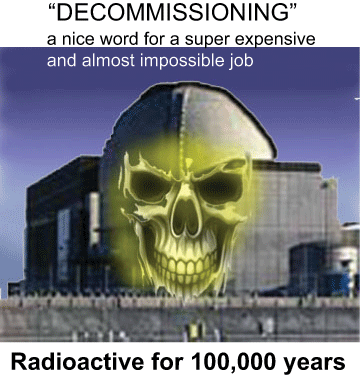
Finally, nuclear energy is neither green nor clean. All reactors produce radioactive waste that will need to be kept out of the biosphere for hundreds of thousands of years.
The proposal that some SMR models would reuse highly radioactive CANDU fuel and plutonium will only create worse problems in the form of radioactive wastes that are even more dangerous to manage.
For a livable future, Canada has pledged to get to net-zero emissions by 2050. Will we get a bigger bang for our buck from reactors that are still just design concepts? Or by retrofitting buildings, improving energy efficiency, and building solar, wind, geothermal and tidal power with existing technology?
Clearly, the latter. And it needs to be done now.
Nuclear Icebreakers Are Not An Option for U.S. Coast Guard
The call from the Trump administration to look at the potential for building nuclear-powered icebreakers coincided with the Pentagon’s ongoing shift to a National Defense Strategy that emphasizes high-end conflict with nations like Russia and China. ………… https://news.usni.org/2021/01/13/schultz-nuclear-icebreakers-are-not-an-option-for-coast-guard
As pandemic cripples America, Donald Trump orders funding for military Small Nuclear Reactors in space

|
Trump orders DoD to explore use of nuclear power for space, Defense News,
By: Aaron Mehta 14 Jan 21, WASHINGTON — In the waning days of his administration, U.S. President Donald Trump has signed an executive order aimed at pushing the Department of Defense toward quickly developing and producing small nuclear reactors for military use — and to see if they could be used by military space vehicles.
The order, signed Jan. 5 and posted publicly Jan. 12, is not the first time the value of nuclear power for military operations has been studied. There is a long history of the Pentagon considering the issue, which proponents believe could alleviate the department’s massive logistics challenge of keeping fuel moving around the world……… In terms of terrestrial efforts, the executive order requires the defense secretary to, within 180 days, “establish and implement a plan to demonstrate” a micro-reactor at a domestic military installation — in other words, setting up an actual test of a nuclear reactor at a U.S. military location. However, that doesn’t mean the first test will be on a military base. One location to keep an eye on is the Nevada National Security Site, a Department of Energy location roughly 65 miles from Las Vegas……. Noted Hans Kristensen of the Federation of American Scientists, “the signing of this at the very last minute of the Trump administration suggests someone is concerned [President-elect Joe Biden] might not support the program.” Specific to space, the order calls for the defense secretary, in consultation with the secretaries of state, commerce and energy as well as the NASA administrator, to “determine whether advanced nuclear reactors can be made to benefit Department of Defense future space power needs” and to “pilot a transportable micro-reactor prototype.” In addition, the order directs an analysis of alternatives for “personnel, regulatory, and technical requirements to inform future decisions with respect to nuclear power usage” as well as “an analysis of United States military uses for space nuclear power and propulsion technologies and an analysis of foreign adversaries’ space power and propulsion programs.” ……… While the order speeds up the timetable for a test of a nuclear reactor at a military installation, the idea of using nuclear power is hardly a new one for the DoD. In fact, the Pentagon currently has two different development tracts for small nuclear reactors. The first is “Project Pele,” an effort to create a small mobile nuclear reactor in the 1-5 MWe power range, being run out of the Strategic Capabilities Office. In March 2020, the department awarded three companies a combined $39.7 million to start design work for Project Pele, with plans to select one firm in 2022 to build and demonstrate a prototype. The second effort is run through the office of the undersecretary of acquisition and sustainment. That effort, ordered in the 2019 National Defense Authorization Act, involves a pilot program aiming to demonstrate the efficacy of a small nuclear reactor, in the 2-10 MWe range, with initial testing at a Department of Energy site around 2023. If all goes well, the goal is to have a permanent small nuclear reactor on a military base around 2027. Even if all those timelines are hit, it is unlikely microreactors could proliferate quickly throughout the military………. https://www.defensenews.com/smr/nuclear-arsenal/2021/01/13/trump-orders-dod-to-explore-use-of-nuclear-power-for-space-systems/ |
|
1 This Month
Watch the 2026 Doomsday Clock unveiling live here on January 27 at 10 a.m. EST

To see nuclear-related stories in greater depth and intensity – go to https://nuclearinformation.wordpress.com/

29 Jan. Thursday 7-8 p.m. Webinar – World’s Largest Nuclear Station in Port Hope, ON?


31st January – Challenging the War Machine – a DECLASSIFIED UK SUMMIT


Website of the Week
Now until to February 10, 2026 Radioactive waste storage in France: the debate is finally open! How to participate?
-
Archives
- January 2026 (277)
- December 2025 (358)
- November 2025 (359)
- October 2025 (376)
- September 2025 (258)
- August 2025 (319)
- July 2025 (230)
- June 2025 (348)
- May 2025 (261)
- April 2025 (305)
- March 2025 (319)
- February 2025 (234)
-
Categories
- 1
- 1 NUCLEAR ISSUES
- business and costs
- climate change
- culture and arts
- ENERGY
- environment
- health
- history
- indigenous issues
- Legal
- marketing of nuclear
- media
- opposition to nuclear
- PERSONAL STORIES
- politics
- politics international
- Religion and ethics
- safety
- secrets,lies and civil liberties
- spinbuster
- technology
- Uranium
- wastes
- weapons and war
- Women
- 2 WORLD
- ACTION
- AFRICA
- Atrocities
- AUSTRALIA
- Christina's notes
- Christina's themes
- culture and arts
- Events
- Fuk 2022
- Fuk 2023
- Fukushima 2017
- Fukushima 2018
- fukushima 2019
- Fukushima 2020
- Fukushima 2021
- general
- global warming
- Humour (God we need it)
- Nuclear
- RARE EARTHS
- Reference
- resources – print
- Resources -audiovicual
- Weekly Newsletter
- World
- World Nuclear
- YouTube
-
RSS
Entries RSS
Comments RSS
 nuclear-news