Small reactors: cash flow alert for Newcleo, Europe’s largest nuclear start-up.
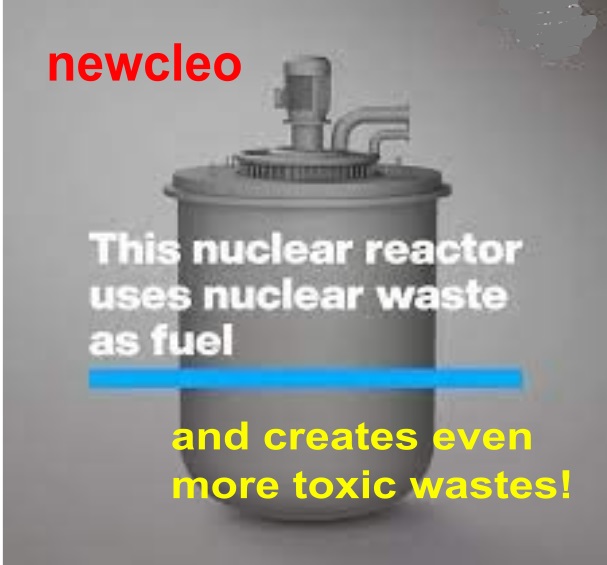
The company, which employs a thousand people, is burning through
too much cash. Its continued existence could be threatened without a new
round of financing.
But both private and public stakeholders remain
cautious. While waiting for fresh money, Newcleo is scaling back. Without a
new capital increase in the next twelve months, the company’s continued
existence is threatened, the Italian press reported in early August. The
articles, notably published in the business daily Il Sole 24 Ore , are
based on the findings of an audit of Newcleo’s 2024 accounts conducted by
KPMG, which La Tribune has seen.
The startup has notably abandoned its
ambitions in the United Kingdom, leading to the elimination of 150
positions. It also intends to reduce its engineering contracts with
external service providers.
La Tribune 29th Aug 2025, https://www.latribune.fr/climat/energie-environnement/petits-reacteurs-alerte-sur-la-tresorerie-de-newcleo-plus-grosse-start-up-europeenne-du-nucleaire-1031500.html
Golden Dome is already a turning point for American space policy.
As the space community awaits the upcoming deadline for a Golden Dome architecture, perhaps the biggest story on Golden Dome is how the program is resonating through the industry.
Last month, a new report by the Aerospace Corporation’s Center for Space Policy and Strategy identified Golden Dome (and its prominence within the Trump administration’s fiscal year 2026 defense budget request) as a significant turning point for American space policy, Pentagon spending priorities and the role of the Space Force.
The report said that “the introduction of Golden Dome is arguably the most important development affecting the defense space budget since the inception of the Space Force.”
As SpaceNews’ Sandra Erwin wrote:
For the relatively young Space Force, established in 2019, Golden Dome represents a significant expansion of resources and responsibilities. Sam Wilson, budget analyst at the Center for Space Policy & Strategy and author of the report, views the initiative as creating “a major opportunity for the Space Force as it brings extra resources for some of Space Force’s priorities such as missile warning satellites that the service already was planning to develop.”
“This is an opportunity to get those funded at higher levels,” Wilson told SpaceNews.
The article describes how Golden Dome’s prominence – and the level of attention paid to it – is elevating space issues within broader defense planning. It’s also a program that could benefit new and old space firms alike while calling broader public attention to the military’s role in and influence over space.
Investors feel the same. A note from Capital Alpha Partners this week highlighted that “Golden Dome gave something new for U.S. contractors to talk about and position for,” but so far details are scarce. At last month’s industry summit in Huntsville, Alabama, defense firms got little more than high-level overviews.
“Even if it’s classified, clarity on the architecture may provide something more meaningful for companies to discuss in the October-November earnings season,” the Capital Alpha note read….(Read more at link –
https://spacenews.bluelena.io/index.php?action=social&chash=980ecd059122ce2e50136bda65c25e07.830&s=d7cea81a8b3dc478fa14dbee41fab337)
Why NuScale Power Stock Slid 31% Last Month

By Brett Schafer – Sep 3, 2025 ,
https://www.fool.com/investing/2025/09/03/why-nuscale-power-stock-slid-31-last-month/
Key Points
- NuScale Power’s stock has pulled back after a huge gain coming from a recent executive order signing.
- The company has a small modular nuclear reactor approved, but has not won a customer contract.
- The stock trades at an expensive price, even though it generates barely any sales and has no customer wins.
The nuclear energy stock doesn’t generate much in revenue and is losing a lot of money.
Shares of NuScale Power (SMR 8.15%) fell 31% in August, according to data from S&P Global Market Intelligence. The nuclear energy upstart and designer of small modular reactors (SMRs) is experiencing wild gyrations with its stock price. The stock is up 432% in the last year and trades at a market cap of $11.5 billion, even though it generates minimal revenue and is burning a lot of cash.
It’s been a roller-coaster ride for nuclear start-ups
Nuclear energy stocks soared at the beginning of this summer, with the current presidential administration’s push to accelerate the development of nuclear energy to keep up with data center demand around artificial intelligence (AI). President Trump signed an executive order for advanced nuclear reactor technologies, of which NuScale Power is one.
In fact, NuScale Power is the only SMR company to have its design approved by the Nuclear Regulatory Commission (NRC), which could give it a head start in winning customer contracts. However, it has failed so far to win any customer contracts outside prospective contracting from a Romanian power company that’s exploring whether to use SMRs for its upcoming energy needs.
With close to zero revenue and a history of burning cash, NuScale Power is a stock that trades with a ton of volatility. As the air comes out of the post-executive order excitement, it is no surprise to see NuScale Power stock hit a bit of a rough patch. The company has no fundamental basis to anchor its $11.5 billion market cap, which makes it a risky stock to invest in.
NuScale Power’s uncertain future
NuScale Power has a few energy projects in the works that it could potentially win deals on, including a recent proposal from the Tennessee Valley Authority. Bringing these to fruition could help it actually develop an SMR to be deployed in the real world instead of talking about it, which has been all the company has done since its inception.
Even if these projects get approved, NuScale Power won’t generate much in revenue to warrant its $11.5 billion market cap, with revenue not showing up for years due to the long project life for nuclear energy developments. It is foolish to buy a stock valued at over $10 billion that’s generating zero revenue. Therefore, investors should avoid putting NuScale Power in their portfolios, given its uncertain future.
A new arms race in space must be stopped in its tracks .
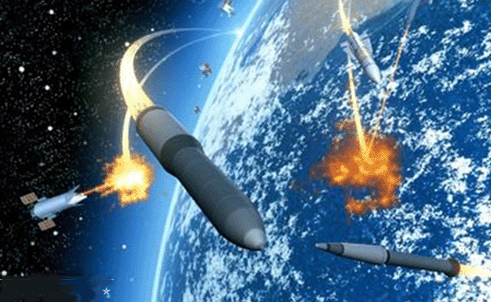
A new treaty banning all weapons in space is the only way to prevent a future calamity.
August 31, Bruce K. Gagnon, https://www.pressherald.com/2025/08/31/a-new-arms-race-in-space-must-be-stopped-in-its-tracks-opinion/
Bruce K. Gagnon is the coordinator of the Global Network Against Weapons & Nuclear Power in Space.
I read with great interest the recent Associated Press article titled “Hijacked satellites and orbiting space weapons: In the 21st century, space is the new battlefield.” It was full of half-truths and manipulations that we’ve come to expect from the Pentagon and the military industrial complex.
While in the Air Force during the Vietnam War, I read the infamous Pentagon Papers that revealed how our government lied to the public, the Congress and the media to create the support for the war. We witnessed a similar story repeated in 2003 with “shock and awe” in Iraq and supposed weapons of mass destruction.
I’ve been coordinating the Global Network since its founding in 1992 while then living in Florida. In 1997, we obtained a copy of the Space Command’s internal document “Vision for 2020” that declared the U.S. would “control space, dominate space and deny other nations access to space.” Since that time the Pentagon and the aerospace industry have done everything possible to create a new arms race in space that they long ago stated would be “the largest industrial project in human history.”
For more than 30 years, China and Russia have gone to the United Nations proposing a new space treaty called PAROS (Prevention of an Arms Race in Space). At the general assembly, in a vote on the nonbinding resolution, it overwhelmingly passes despite the U.S. and Israel voting “No.” The treaty proposal is then sent to Geneva’s Conference on Disarmament for negotiation. There the U.S. and Israel block the treaty.
The official position of the U.S. (through Democrat and Republican administrations) has been “There are no weapons in space, we don’t need a new treaty.” The Global Network’s position has always been “Close the door to the barn before the horse gets out.” But the U.S. has always intended to be the dominant power in space. That is how wars are created.
China and Russia have steadily responded, telling the U.S. that they will not allow Washington to be the “Master of Space” — a slogan over the doorway at the Space Command HQ in Colorado.
NASA has long predicted that war in space will create the Kessler Syndrome — a cascading field of space debris as satellites are destroyed. The outcome would be that much of the Earth would go dark as so many things in our high-tech civilization are linked to space satellites.
A new arms race in space must be stopped in its tracks | Opinion
A new treaty banning all weapons in space is the only way to prevent a future calamity.
Posted August 31
Bruce K. Gagnon
3 min readFont size +Gift Article
Bruce K. Gagnon is the coordinator of the Global Network Against Weapons & Nuclear Power in Space. He lives in Brunswick.
I read with great interest the recent Associated Press article titled “Hijacked satellites and orbiting space weapons: In the 21st century, space is the new battlefield.” It was full of half-truths and manipulations that we’ve come to expect from the Pentagon and the military industrial complex.
While in the Air Force during the Vietnam War, I read the infamous Pentagon Papers that revealed how our government lied to the public, the Congress and the media to create the support for the war. We witnessed a similar story repeated in 2003 with “shock and awe” in Iraq
and supposed weapons of mass destruction.
I’ve been coordinating the Global Network since its founding in 1992 while then living in Florida. In 1997, we obtained a copy of the Space Command’s internal document “Vision for 2020” that declared the U.S. would “control space, dominate space and deny other nations access to space.” Since that time the Pentagon and the aerospace industry have done everything possible to create a new arms race in space that they long ago stated would be “the largest industrial project in human history.”
For more than 30 years, China and Russia have gone to the United Nations proposing a new space treaty called PAROS (Prevention of an Arms Race in Space). At the general assembly, in a vote on the nonbinding resolution, it overwhelmingly passes despite the U.S. and Israel voting “No.” The treaty proposal is then sent to Geneva’s Conference on Disarmament for negotiation. There the U.S. and Israel block the treaty.
The official position of the U.S. (through Democrat and Republican administrations) has been “There are no weapons in space, we don’t need a new treaty.” The Global Network’s position has always been “Close the door to the barn before the horse gets out.” But the U.S. has always intended to be the dominant power in space. That is how wars are created.
Advertisement
China and Russia have steadily responded, telling the U.S. that they will not allow Washington to be the “Master of Space” — a slogan over the doorway at the Space Command HQ in Colorado.
NASA has long predicted that war in space will create the Kessler Syndrome — a cascading field of space debris as satellites are destroyed. The outcome would be that much of the Earth would go dark as so many things in our high-tech civilization are linked to space satellites.
The Pentagon has a plan, though. Its strategy is to fund a slew of launch providers around the world to, in a short time during a war in space, put into orbit new military mini-satellites to replace those that were destroyed. One such potential launch provider is bluShift Aerospace in Brunswick.
The CEO of bluShift, in answering a question from me, admitted that his corporation was being funded by NASA and the U.S. Space Force to launch mini-satellites in a time of crisis in order to keep China and Russia from filling up the already overly congested Lower Earth Orbit (LEO).
The only way to peace and security in space is via a new treaty to ban all weapons in space. We delay such a move at our own peril.
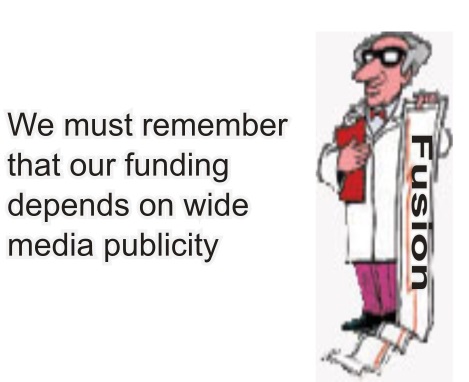
On fusion liability, Energy Minister completely sidelines the issue.
NFLA 27th Aug 2025
NFLA Secretary Richard Outram is disappointed that the new Energy Minister has completely missed the point that taxpayers should not be on the hook for unlimited liabilities to the nuclear fusion industry ‘resulting from incidents involving nuclear matter or emissions of ionising radiation arising from fusion activities relating to the STEP programme’.
On July 21, Climate Minister Kerry McCarthy issued a Departmental Minute to Parliament indicating that the Government will assume these liabilities for STEP (the Spherical Tokamak for Energy Production) project, the fusion experimental plant being built on a former power station site in West Burton with taxpayer money.
Richard wrote to his MP, Debbie Abrahams protesting that ‘As a citizen, I do not want my future taxes in hoc to a private company whose insurance risk for its nuclear activities would reside 100% with the future taxpayer. The procedure is certainly experimental; it may also be risky’. He asked that a request be placed with the Minister ‘with a full published risk analysis for STEP’ prior to a Parliamentary debate and vote.
In response, Ms Abrahams advised Richard that she had written to ‘the Department for Energy Security and Net Zero to make further enquiries about the STEP programme and make representations about your concerns’.
Ms McCarthy has now written back with a standard response in which she waxes lyrical about the supposed benefits that will be delivered through nuclear fusion, yet this is a technology described in the minister’s response as ‘nascent’, a euphemism for currently non-functioning.
The Minister makes a summary assessment that the risk presented by fusion is low, yet concedes ‘there is no private insurance market to provide cover to UKIFS (UK Industrial Fusion Limited) or their industry partners for liabilities in the unlikely event that radiological material or radiation is released from STEP outside of permit conditions‘.
This could suggest that the private sector might not want to insure any emerging nuclear fusion market because of the risk it presents, and if this is the case His Majesty’s Government might ultimately also have to indemnify nuclear fusion operators other than STEP in the future.
The Ministerial Direction effectively saddles the British taxpayer with responsibility to indemnify UKIFS ‘for an unlimited amount of money, for an unlimited time’.
And there is ambiguity in the timescale as some sources suggest STEP will be operational by 2040, whilst the Minister’s statement of 21 July says ‘by the 2040s’. This could mean 2049.
Finally, Richard was gratified to hear that the Minister’s letter was made in response to ‘a number of constituents’ suggesting some level of public disquiet with the Government’s decision………………………………………………………………………………………………………………………. https://www.nuclearpolicy.info/news/on-fusion-liability-energy-minister-completely-sidelines-the-issue/
The nuclear fusion delusion -Government proposals re Nuclear Fusion Siting Policy

Twelve months after a consultation on a proposed new siting policy for
nuclear fusion concluded in July 2024, the Department for Energy Security
and Net Zero finally published the government’s response to the
submissions received. This new policy (EN-8) mirrors that under development
for nuclear fission (EN-7). Consequently, the NFLAs submitted a response to
both consultations which shared many similarities.
It is clear from the
flavour of the government response that the new Climate Minister Kerry
McCarthy MP has like her predecessors been drinking from the fusion ‘Kool
Aid’, continuing to believe that fusion technology will be deployable on
time and at scale to provide a remedy to climate change.
NFLA 26th Aug 2025, https://www.nuclearpolicy.info/wp/wp-content/uploads/2025/08/A438-NB324-Govt-proposals-over-nuclear-fusion-siting-policy-Aug-2025.pdf
How AI and surveillance capitalism are undermining democracy

Bulletin, By Suresh Venkatasubramanian | August 21, 2025
On March 6, 2025, Axios reported that the State Department had launched a new social media surveillance program called “Catch and Revoke.” The intended goal of this program was to use artificial intelligence to assist in reviewing “tens of thousands of student visa holders’ social media footprints” to find “evidence of alleged terrorist sympathies expressed after Hamas’ attack on Israel.”
Whether you find this a horrifying development, an exciting application of AI, a flagrant violation of First Amendment rights, or even just a headscratcher, this incident captures the dynamics of how artificial intelligence, surveillance, and threats to democracy all come together. In a nutshell: AI’s promise of behavior prediction and control fuels a vicious cycle of surveillance which inevitably triggers abuses of power.
Throughout history, humans have always searched for ways to predict (and control) behavior, whether this constituted consulting an oracle, throwing bones, reading tea leaves, or even examining the shape of a person’s face and body to determine personality traits (which seems awfully contemporary if you start diving into the literature on “emotion AI”). As people became more adept at collecting data of various kinds, the field of statistics emerged to aid them in using data for prediction. (One of the amusing facts about AI research is that virtually every debate one encounters about the appropriate use of artificial intelligence in some social setting has parallels in history, often much earlier, which make it clear that efforts to predict and control behavior was never about AI at all.)
The problem with using data to make predictions is that the process can be used as a weapon against society, threatening democratic values. As the lines between private and public data are blurred in modern society, many won’t realize that their private lives are becoming data points used to make decisions about them. …………………………………………………………………………………………………… https://thebulletin.org/2025/08/how-ai-and-surveillance-capitalism-are-undermining-democracy/#post-heading
Angry Denver International Airport neighbors quash nuclear power idea in 48 hours flat.

Why waste money on an unproven, enormously expensive, extremely toxic nuclear power plant, with no place in the nation accepting the eventual radioactive waste, in a spot with hundreds of thousands of neighbors and 100 million visiting passengers a year?
Airport shelves $1.5 million study of “modular” nuclear power after local district uproar.
Michael Booth The ColoradoSun, Aug 20, 2025
If you have a snazzy new idea for miniature nuclear power plants in the middle of Denver International Airport that could be forced to store their spent nuclear waste onsite for centuries, maybe check with the neighbors first?
Denver’s mayor and airport chief touted a whiz-bang, $1.5 million exploratory study of small, “modular” nuclear power plants buried underground somewhere on DIA property to fuel decades of economic and passenger growth. The rah-rah news conference happened to be on a Wednesday that was also the 80th anniversary of the nuclear bombing of Hiroshima.
By that Friday, the study was back on the shelf, not to be revisited until city and airport officials completed some of the explaining they needed to do for local city council members and residents, who said they’d never been consulted on the (big) (radioactive) idea.
“I’m proud to say that community advocacy still works, but you really have to be within the community,” said City Council member Stacie Gilmore, whose northeast District 11 includes DIA. “People are paying attention, and they don’t trust the airport, and they don’t trust this administration, unfortunately.”
Gilmore said her constituents’ objections and questions were the same as those of reporters and environmental justice advocates who queried DIA chief Phil Washington and Mayor Mike Johnston at the Aug. 6 news conference launching the study: Why waste money on an unproven, enormously expensive, extremely toxic nuclear power plant, with no place in the nation accepting the eventual radioactive waste, in a spot with hundreds of thousands of neighbors and 100 million visiting passengers a year?
Especially at a time when Johnston is having to fire hundreds of current Denver city employees to make up for a major budget deficit? The airport can argue its funding for the study comes from airline and other fees, not city tax money, but still, opponents said … the optics?
“The optics are really crazy,” Gilmore said Tuesday. The date of the nuclear-curious news conference did not escape the notice of Gilmore, who has family members with parents who were in Japan when the first A-bomb dropped. “And it was just tone deaf to anything about the community, or the close proximity to Rocky Mountain Arsenal National Wildlife Refuge and its Superfund site,” Gilmore said. …………………………………………………………………………
Clean energy advocates said that none of the new generation of small modular reactors are actually plugged in and working yet, and that only a small handful of new nuclear power units have been approved nationwide since the 1970s. Cost overruns are the norm with nuclear, they add, and all existing nuclear power plants in the U.S. must store their highly radioactive spent nuclear fuel onsite because no federal repository has been opened. ………………………………… https://coloradosun.com/2025/08/20/dia-nuclear-power-study-shelved/
Reckon you can put a nuclear reactor on the Moon?
You have until Thursday August 21 to respond if you do
The Register, Richard Speed, Fri 15 Aug 2025
NASA’s plans to put a nuclear reactor on the Moon have moved on – the agency has now put out a Request For Information (RFI) to gauge industry interest in the project.
An RFI is not an invitation to bid for the work. Interested parties need to register their interest by 21 August, and only later, there’s a chance that they could be used to “finalize a potential opportunity later this year.” It comes after a directive from NASA Acting Administrator Sean Duffy that called for the US to be the first to put a nuclear reactor on the Moon.
Things will need to move fast if the agency is to meet the goal of being ready to launch by the first quarter of fiscal year 2030.
Dubbed the Fission Surface Power System, the reactor must have a mass of less than 15 metric tons, have a minimum power output of 100 kWe, and utilize a closed Brayton cycle power conversion system.
NASA is no stranger to nuclear power. It had rovers and spacecraft powered by the technology and has looked into Brayton cycle power conversion for nuclear electric propulsion on Mars missions [PDF].
The Apollo missions used Radioisotope Thermoelectric Generators (RTGs) to power experiments to be left on the lunar surface. These contained plutonium-238, and one returned to Earth on Apollo 13, remaining on the lunar module. The container for the plutonium is now at the bottom of the Pacific Ocean, and no release of radiation has been detected.
One hundred kilowatts of power is, however, an order of magnitude greater than the nuclear power sources launched by NASA to date. It would be enough to power the International Space Station (ISS), which currently charges its batteries using electricity generated by solar arrays attached to the outpost………………………https://www.theregister.com/2025/08/15/nuclear_moon/
Nuclear developers turn to Special Purpose Acquisition Companies.
Three nuclear energy developers are seeking to raise more than $500mn
through mergers with special purpose acquisition companies as investors
rush to tap into an atomic energy boom.
Terra Innovatum, Terrestrial Energy
and Eagle Energy Metals said the transactions, which they expected to be
completed by the end of the year, would accelerate the development of small
modular reactors.
Several other companies developing nuclear technologies
are considering listings via initial public offerings, including Holtec
International and Quantum Leap Energy, a division of ASP Isotopes.
“Investors now realise that nuclear energy is here to stay because it is
needed to power the artificial intelligence revolution and this is
turbocharging interest, particularly in the US,” said Nick Lawson, the
chief executive of Ocean Wall, an investment group advising ASP Isotopes on
the QLE spin off.
Shares in nuclear energy companies surged near record
highs last week as optimism about a nuclear renaissance gathered pace owing
to AI power demand and political support from the Trump administration.
Last month Westinghouse outlined plans to build 10 large nuclear reactors
in the US at a meeting in Pittsburgh attended by President Donald Trump,
who has set a target of quadrupling American nuclear power capacity in the
next 25 years.
FT 11th Aug 2025, https://www.ft.com/content/087f3fac-52ca-4ca7-8827-734125af4a2b
A Second CANDU Reactor for Point Lepreau? Let’s Ponder.
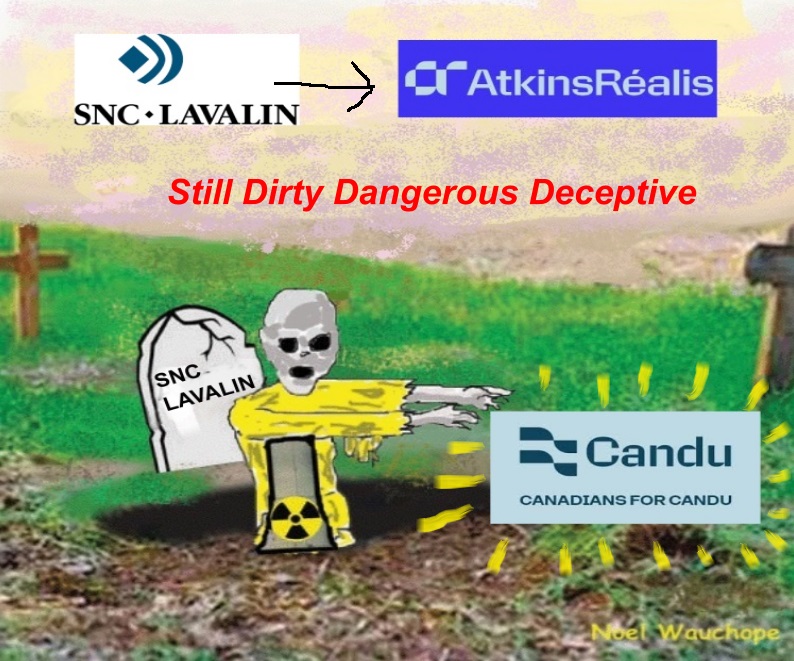
A new CANDU reactor does not exist. The current reactor at Point Lepreau is a CANDU 6, the same model as the one Hydro-Québec shut down permanently in 2012 and is now in the process of decommissioning. There are no plans to design a new CANDU 6.
August 6, 2025, Susan O’Donnell and Frank Greening, https://www.theenergymix.com/a-second-candu-reactor-for-point-lepreau-lets-ponder/
Over the summer, New Brunswick Premier Susan Holt mused to journalists about building a second CANDU reactor at the Point Lepreau nuclear site on the Bay of Fundy.
“A second CANDU is not far-fetched,” she told the Telegraph Journal. On the weekend, Holt enthused about the idea in a CBC story about the Eastern Energy Partnership pitch to Prime Minister Mark Carney.
A new CANDU reactor for New Brunswick? It’s a puzzling thought, worth pondering.
Let’s put aside for a moment that the current CANDU reactor at the Point Lepreau site is an economic nightmare, its poor performance the main reason NB Power loses money almost every year. Overspends on the original reactor and the rebuild together represent almost two-thirds of NB Power’s nearly $6-billion debt.
Let’s forget that more than 25 years ago in Ontario, the provincial utility Ontario Hydro was similarly effectively bankrupt before it was split up, leaving a $20-billion stranded debt, largely left over from its CANDU nuclear construction program. Ontario taxpayers and ratepayers were left holding the bag for that $20 billion, paying it back on their electricity bills. A recent investigation found that: “In 2050 Ontario will still be paying the debt of the nuclear program of the 1970s and 80s.”
Let’s also try to forget that the New Brunswick government gets its nuclear advice from NB Power (the utility that loses money almost every year), the same utility that in 2018 recommended the province invite two start-up companies from the United Kingdom and the United States that had never built a nuclear reactor to come to New Brunswick and, with their experimental reactor designs, start a new nuclear export industry.
It was a breathtakingly risky recommendation that can most kindly be described as “wishful thinking.” In the seven years since, despite more than $95 million to the companies from provincial and federal taxpayers, their two “advanced” designs for small modular nuclear reactors (SMRs) have failed to attract enough private sector financing and almost certainly will never be built in New Brunswick.
Finally, are we willing to ignore the fact that the Peskotomuhkati Nation never consented to the current CANDU reactor on its homeland at Point Lepreau, has made numerous interventions against plans to put the two SMRs on the site, and is highly unlikely to consent to a second CANDU?
For this ponder, let’s park all those troubling facts and focus on what we know about a potential second CANDU reactor for Point Lepreau.
A new CANDU reactor does not exist. The current reactor at Point Lepreau is a CANDU 6, the same model as the one Hydro-Québec shut down permanently in 2012 and is now in the process of decommissioning. There are no plans to design a new CANDU 6.
AtkinsRéalis (formerly SNC-Lavalin) owns the exclusive rights to design a new CANDU. The engineering firm announced in late 2023 that its new CANDU design is called Monark. So far, the CANDU Monark is a computer model, currently registered with the Canadian Nuclear Safety Commission as in a “familiarization and planning” stage with the start date for regulatory reviews “to be determined”.

Although AtkinsRéalis has released almost no technical details about its proposed design, the company did predict the CANDU Monark’s capacity factor, an important parameter for evaluating a nuclear reactor design. The capacity factor is a measure of efficiency, how often a nuclear reactor (or any other kind of power plant) operates at maximum power output over a specific period.
Predicted capacity factors require years of reactor operation to prove reliability. In 2023, the global average nuclear power plant capacity factor was 81.5%. Predicting a higher average capacity factor would mean AtkinsRéalis believes the CANDU Monark design can produce power more consistently and at a greater percentage of its potential than the average reactor.
This “new” CANDU Monark design has similar features (cooled and moderated with heavy water, similar core channels and heat transport system) to the design of the reactor at the Darlington nuclear site in Ontario, the last CANDU ordered in Canada more than 30 years ago. The lifetime average capacity factor for Darlington’s four CANDU units is 83%, in line with the global average.
Yet a paper sponsored by AtkinsRéalis at the June 2024 conference of the Canadian Nuclear Society claims the annual capacity of the CANDU Monark design is more than 95%, much higher than the global average or the actual number at Darlington.
How does AtkinsRéalis plan to boost this CANDU’s average capacity factor from 83% to 95%? The answer: more wishful thinking!
Now, back to the existing CANDU 6 reactor at Point Lepreau—which is currently, again, closed for repairs, this time for five months. After refurbishment, from the start of 2013 to the end of 2024, its capacity factor was 78%, below the global average. Last year, with a multi-month, unplanned shutdown for a generator repair, the reactor operated at 32% capacity. An investigation by CBC predicts that 2024 may be its worst operational year ever.
Earlier this year, the NB Power CEO said the root of the reactor’s problems can be traced to when the reactor was refurbished from 2008 to 2012. To save money, the plant’s supporting infrastructure was not upgraded, and now that infrastructure is breaking down.
Lack of money is a core constraint for New Brunswick’s nuclear plans. In 2024, another CBC investigation revealed a consultant report that linked the poor performance of NB Power’s nuclear reactor to the fact that since the refurbishment, the utility has not spent nearly enough to maintain it.
The basic problem is that New Brunswick lacks the capacity to operate a nuclear reactor. In addition to a financially stretched utility with a small grid, the province lacks nuclear management expertise.
When the plant reopened in 2012 after refurbishment, NB Power contracted a management team from Ontario Power Generation (OPG). Later, the utility hired a manager living outside the country. He billed the utility for travel expenses from his home to his work in New Brunswick in addition to his salary, a total that reached $1.3 million but delivered no improvement in the reactor’s performance. In 2023, NB Power said goodbye to the American and contracted OPG management again.
Across the globe [pdf], it is hard to find an electrical grid as small as NB Power’s with a nuclear reactor. The International Atomic Energy Agency recommends that: “A single power plant should represent no more than 10% of the total installed grid capacity.” NB Power’s Point Lepreau plant exceeds 15% of its grid capacity, including the energy available under power purchase agreements.
For decades, the utility has had oversized nuclear ambitions. As far back as 1972, a federal Department of Finance official warned [pdf] against subsidizing a power reactor for “a small, high-cost utility with barely enough cash flow to finance its present debt,” calling New Brunswick’s nuclear plans “the equivalent of a Volkswagen family acquiring a Cadillac as a second car.”
The nuclear industry depends on wishful thinking, plus its hubris and supreme confidence that have bamboozled generations of energy ministers and premiers into believing its overblown hype.
So, a second CANDU at Point Lepreau? The Premier would be wise to ignore the promotion and sales puff from NB Power and its nuclear industry friends and review the facts. Follow the money, or in this case, the billions the province has lost so far. A decision to build a second CANDU at Point Lepreau would be not only puzzling, but economically reckless.
Dr. Susan O’Donnell is a social scientist specializing in technology adoption and an Adjunct Research Professor and lead investigator of the CEDAR project at St. Thomas University. Dr. Frank Greening is nuclear research scientist with a PhD in Chemistry, retired from Ontario Power Generation (OPG). This story was first published by NB Media Co-op, and is republished by permission.
From boots to orbits: Army develops space skills amid growing battlefield reliance on satellites

The service is launching “40 Delta” military occupational specialty to build expertise in space domain operations
by Sandra Erwin, August 6, 2025, https://spacenews.com/from-boots-to-orbits-army-develops-space-skills-amid-growing-battlefield-reliance-on-satellites/?utm_source=ActiveCampaign&utm_medium=email&utm_content=Top stories%3A NASA s commercial space station pivot%2C China tests crewed lunar lander&utm_campaign=SNTW 8%2F8%2F2025
The U.S. Army will begin recruiting soldiers for its first dedicated enlisted specialty in space operations. This is part of a broader push by the service to build organic expertise as satellites become increasingly critical to modern ground warfare….
…The initiative comes as military leaders increasingly view space capabilities as essential to ground operations, driven in part by lessons from the conflict in Ukraine, where electronic jamming, cyber threats and satellite-denied environments have become routine challenges for forces.
HUNTSVILLE, Ala. — The U.S. Army will begin recruiting soldiers for its first dedicated enlisted specialty in space operations. This is part of a broader push by the service to build organic expertise as satellites become increasingly critical to modern ground warfare.
Army officials at the Space & Missile Defense Symposium this week said the 40 Delta (40D) Space Operations Specialist military occupational specialty is moving from planning to implementation, with full operations expected by October 2026.
Lt. Gen. Sean Gainey, head of the Army’s Space and Missile Defense Command, said the service is just weeks away from the official launch of the new specialty. The goal is to “build long-term, institutional knowledge and to retain noncommissioned officers (NCOs) with space expertise,” Gainey said.
The 40D program was approved in December and will begin accepting applications early next year, with selection boards starting in May, according to Command Sergeant Major John Foley, the Army’s senior enlisted leader for space operations. Selected soldiers will receive specialized training in Colorado Springs to become space operations specialists.
The initiative comes as military leaders increasingly view space capabilities as essential to ground operations, driven in part by lessons from the conflict in Ukraine, where electronic jamming, cyber threats and satellite-denied environments have become routine challenges for forces.
Organizational structure
Beyond the new enlisted specialty, the Army is developing what it calls a “space branch” – a professional category similar to existing branches like Infantry, Armor and Artillery. Foley said the space branch would initially encompass about 1,000 enlisted soldiers and officers and would allow space professionals to advocate for programs and resources. The branch is not officially in place yet but should be coming soon, he added.
These organizational changes build on the evolution of the 1st Space Brigade and expansion of “multidomain” task forces, which Gainey identified as significant developments in Army space capabilities. These units have integrated space operations with ground maneuver formations through exercises and collaboration with special operations and cyber elements, giving soldiers hands-on experience in spectrum awareness and techniques to deceive and disrupt adversaries’ satellite use.
The Army’s own labs also have produced weapons like BADGR, a portable system that combines surveillance sensors and jamming devices for electronic attack missions. Brig. Gen. Don Brooks, deputy commander for operations at the Army Space and Missile Defense Command, said five BADGR prototypes have been delivered to Army units based on feedback from ground forces requesting specialized equipment for “electronic attack.”
A joint endeavor, not a turf war
The Army’s push to develop internal space expertise has drawn criticism from some observers who view it as creating a “mini Space Force” that could duplicate the newer service’s mission. Army leaders have pushed back against such characterizations, emphasizing their goal is to cultivate organic space competencies rather than compete with the Space Force.
Army officials argue that having soldiers on the ground who understand space-based assets and can immediately translate satellite data, communication support and threat warnings into real-time action is essential for modern warfare. They contend that waiting for external support, even from an expert service like the Space Force, is often impractical when ground units need instant solutions integrated into their tactical operations.
The Army continues to rely on the Space Force for satellite launches, advanced systems and global networks, but maintains that a land component with skilled space professionals can make the entire joint force more capable and resilient.
Gen. Stephen Whiting, head of U.S. Space Command, offered support for the Army’s approach during remarks at the symposium. “I’m gratified to see that all of our military services are understanding the criticality of space,” Whiting said. “The Army recognizes that for maneuver elements to be successful, that there needs to be soldiers who understand space.”
Whiting emphasized that the Space Force maintains its “global space mission to provide space capabilities to the entire force and also to protect and defend capabilities in the domain,” while acknowledging that “all of our services have real institutional strengths.” Rather than viewing the Army’s efforts as competitive, Whiting said, “I don’t see it as being an overlapping and competitive set of responsibilities … but I do see them being complimentary.”
Who’s Protecting the Moon?
By Nina Beety, Global Research, May 12, 2020, https://www.globalresearch.ca/who-protecting-moon/5712564
“Thank God men cannot fly, and lay waste the sky as well as the earth,” – Henry David Thoreau
The moon is in trouble. And so are we.
Bruce Gagnon:
NASA is not really looking for the ‘origins of life,’ as it tells school children today. Instead, it is laying the groundwork for a new gold rush that will drain our national treasury and enrich the big corporations that now control our government. It is beyond time for the American people to wake up to the shell game underway.[1]
Americans haven’t awoken, despite the environmental damage these projects already inflict and the peril to Earth’s future and that of other planets. That damage will dramatically escalate with the U.S. Space Force and Artemis Accords.
The moon is key to the U.S. and other countries for commercial mining, military bases to control access to Earth and space, and for launching military and commercial conquest of space. On April 6, President Trump issued an executive order directing the Secretary of State to “take all appropriate actions to encourage international support for the public and private recovery and use of resources in outer space”.
“Americans should have the right to engage in commercial exploration, recovery, and use of resources in outer space, consistent with applicable law. Outer space is a legally and physically unique domain of human activity, and the United States does not view it as a global commons.” [2]
The Artemis Accords are being drafted to establish legal justification for commercial space resource extraction, exploitation, and ownership [3] (reminiscent of the Bush administration memos by Yoo, Bybee, and Bradbury on torture). They would be an international pact for “like-minded nations”, foregoing the United Nations treaty process.
Vice President Mike Pence:
“The United States has always been a nation of restless pioneers, from those Americans who crossed the western frontier to settle in California to those who first stepped onto the Moon. We are ever striving to explore uncharted lands, reach new horizons, and venture into the unknown.
Today, we are renewing the legacy of those courageous space pioneers and all they represent. As part of our re-engagement in human space exploration, the Trump administration’s policy is to return to the moon by 2024, ensuring that the next man and the first woman on the moon will both be American astronauts. From there, we plan to put men and women on Mars.
To accomplish this next big leap, we will develop the technologies to live on the moon for months and even years. We will learn how to make use of resources that the moon has to offer. That includes mining oxygen from the lunar surface and rocks to fuel reusable landers, extracting water from the permanently shadowed craters of the south pole, and developing a new generation of nuclear-powered spacecraft that will help us fly further and faster than ever before. [4]
Former Nazi Major General Walter Dornberger, head of Hitler’s V1 and V2 program, told Congress in 1958 that America’s top space priority ought to be to “conquer, occupy, keep, and utilize space between the Earth and the Moon.”[5] The Apollo missions were the first phase — on-site assessments to gather samples, run experiments, and test human interaction with the lunar environment.
Since 1959, lunar missions and crashes by the U.S., China, Russia, Japan, India, Israel, and European Union have left over 413,000 pounds of debris and toxic substances on the formerly pristine lunar surface,[6] including 96 bags of bacteria-laden human excrement dumped by the Apollo missions.[7] Apollo also left a nuclear generator on the moon.[8]
Governments have intentionally hit the moon 22 times as part of experiments and conducted 17 other post-mission crashes. The U.S. did the majority — 16 post-mission crashes and 14 intentional strikes, including the 2009 LCROSS hit, equivalent to 1.5 tons of TNT, to blast 350 tons of rock and dust and create a six-mile-high cloud for data gathering and public relations. That mission cost $49 million, and NASA’s Ames Research celebrated with an all-night party.[9] In the 1950s, the U.S. even planned to drop an atomic bomb on the moon — Project A119 – but cancelled it as too risky.[10]
Why should the moon be protected? There are many reasons.
The moon
stabilizes Earth’s rotation- has a major role in maintaining the Earth’s magnetic field
- regulates the climate
- creates the tides
- affects plant cycles and likely affects all biology and human cycles in profound ways
- regulates the procreation of some creatures, including coral [11]
The light of the moon is essential for life, and the moon may well be a stabilizing force for every living being on the planet,
The moon is also a sovereign body with its own rights, and it belongs to no one. It is revered by Earth–based indigenous peoples and has been considered a living, sentient being by people worldwide throughout human history. The moon and earth’s self-protective systems demonstrate far more intelligence, wisdom, and life than “civilized” society understands.[12]
None of this matters to NASA, the U.S. government, other countries, and related businesses. Laser-focused on their mission objectives, with virtually no checks or public oversight, they wield the ultimate in “big toys.” The United States alone budgets millions of tax dollars every year to develop space technology for future outposts and has spent billions on the Artemis Program. For their space program, the overarching priorities are American supremacy, empire, and profit — the unflinching mandate of manifest destiny projected into space.
The United States is by far the biggest threat to space and the moon.
When you don’t initiate the boys, they burn down the village. — African saying
The 1979 United Nations Moon Treaty prohibits military bases and national appropriation of territory but only minimally protects the moon environmentally. It enshrines depredation “on the basis of equality” — “The Moon and its natural resources are the common heritage of mankind.” [13] Former astronaut Harrison Schmidt, who formed his own company to mine the moon, complained the treaty would “complicate private commercial efforts.”[14] He was not alone. The U.S. did not sign, and only 18 nations have ratified it.
“…the United States does not consider the Moon Agreement to be an effective or necessary instrument to guide nation states regarding the promotion of commercial participation in the long-term exploration, scientific discovery, and use of the Moon, Mars, or other celestial bodies. Accordingly, the Secretary of State shall object to any attempt by any other state or international organization to treat the Moon Agreement as reflecting or otherwise expressing customary international law.” [15]
Companies such as Bechtel and Bigelow Aerospace [16] are securing contracts from the FAA and other agencies to own land on the moon and mine the moon. Helium-3, used for nuclear fusion, may be worth $3 billion per metric ton, and there are millions of tons of helium-3 in the moon’s upper layer. This is one cause of the new gold rush to the moon.[17] Lunar water deposits are being assessed to see if they can provide drinking water for military and commercial bases there. Moon tourism is being pursued internationally.[18] A Japanese startup even wants to put billboards on the moon.[19]
Trump Signs Executive Order to Support Moon Mining, Tap Asteroid Resources
There are direct and immediate impacts to Earth from these space programs. They accelerate climate change and will eventually torch the climate if allowed to continue. Each fossil-fuel-burning rocket launch not only uses toxic chemicals and causes toxic fallout. They also put particulate matter and exhaust into the atmosphere, and destroy part of the ozone layer.[20]
For example, before leaving Earth’s atmosphere, each shuttle spewed thousands of pounds of metals and other chemicals into the air, including lithium, nickel, mercury [21], bismuth, manganese, aluminum, iron, and zinc. “People think of a shuttle launch as a short-term, finite event, but each launch expels a huge amount of debris into the atmosphere with the potential for long-term effects on the surrounding ecosystem. The plume contains hydrogen chloride, a strong acid. After launches, the pH of the [nearby] lagoons may plummet for a short time, rendering the water nearly as caustic as battery acid.” — John Bowden, environmental chemist at Hollings Marine Laboratory in Charleston, S.C., 2014 [22]
The Earth and its atmosphere have never experienced the sheer volume of launches planned. Dramatically worsening this are the thousands of rockets to put Wi-Fi and 5G satellites into earth orbit that began last year by Elon Musk/SpaceX and others.[23]
This is sheer insanity.
Congress continues to divert more taxpayer dollars into these extremely costly space projects — the next moon visit could cost trillions. This resource extraction from taxpayers robs cities, counties, and states of critical financial resources to solve real problems right here, especially now, while ignoring the planetary environmental cost.
Where are the environmentalists, the biologists, the ocean scientists, and consumer advocates?
We must break out of the NASA trance. Everything that is done to the moon has repercussions to Earth. “National security” is protecting Earth and the moon.
Human history with empires and invaders that subjugate and plunder is being repeated again, with an addiction to “command and control” permeating these space programs. These values and policies are opposed to life, peace, and a future. The Global Network Against Weapons & Nuclear Power in Space just sponsored a webinar on these plans “War in Space — Weaponising the final frontier”.[24]
The film “Independence Day” got it wrong, and Pogo got it right – the enemy is human. Tell children the truth: astronauts are not heroes.
Humans must repair Earth and themselves first with all available creativity and resources, and the COVID19 shutdown has worsened everything. If humans are incapable of fixing the dire messes they’ve created on Earth, incapable of stopping wars, incapable of living cooperatively with their neighbors, then they cannot go off planet or contaminate anything else.
The future is at stake. The moon must be defended. Shut NASA and these space ventures down.
Nina Beety is an investigative writer and public speaker on governmental policy, the environment, and wireless radiation hazards. She has written two reports for officials on Smart Meter problems which are on her website www.smartmeterharm.org. She lives in California.
Notes
[1] 2006. Bruce Gagnon is co-founder of Global Network Against Weapons & Nuclear Power in Space.
The new space race: How the US, China, and Russia are all vying to be the first to build a nuclear reactor on the MOON.
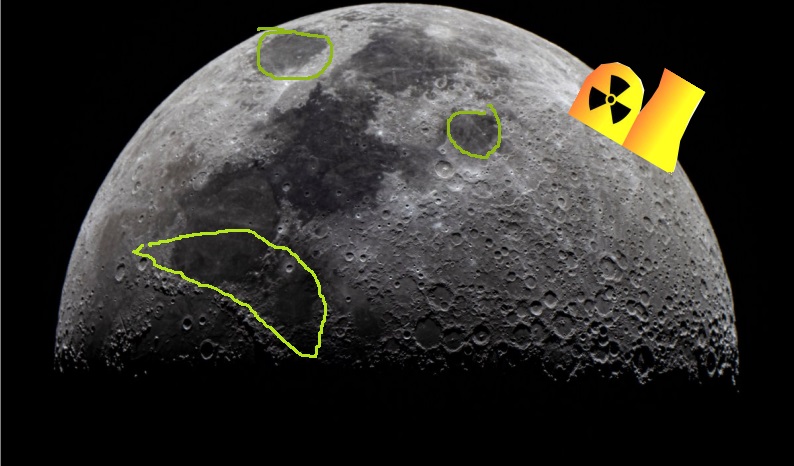
By WILIAM HUNTER, SCIENCE & TECHNOLOGY REPORTER, 5 August 2025, https://www.dailymail.co.uk/sciencetech/article-14971339/new-space-race-US-China-Russia.html
In the years of the Cold War, the US and the Soviet Union tussled to prove their superiority by rushing to become the first nation to put a man on the moon.
While America might have claimed that particular prize in 1969, a new and even more dramatic space race is only just beginning.
This week, it was revealed that Sean Duffy, the new head of NASA, is preparing to install an American nuclear reactor on the moon before 2030.
In a directive, first reported by Politico, Mr Duffy claims this would allow the US to declare a ‘keep-out zone’ on the lunar surface.
This is seen as a necessary step towards protecting the landing site for a future American moon base, planned as part of the Artemis Programme.
However, the US is far from being the only country to set its sights on our lunar satellite.
In May, China and Russia signed a memorandum of cooperation to build their own nuclear reactor on the moon.
But with Russia and China targeting 2036 as their completion date, the three superpowers are now locked in a head-to-head race to get there first.
This comes as the US makes a rapid and unexpected shift towards prioritising human exploration in space.
Despite slashing scientific missions and giving NASA the smallest budget since 1961, the agency has allocated more than $7 billion for lunar exploration.
The Artemis programme, once feared to be a target for Donald Trump’s cuts, is now scheduled to return a human presence to the moon by 2027.
In the directive, Mr Duffy called for NASA to ‘move quickly’ in establishing a nuclear reactor on the moon in order to ‘support a future lunar economy‘.
Mr Duffy, who is also US transport secretary, has asked NASA to place a reactor capable of producing at least 100 kilowatts on the moon by the end of the decade.
That is enough energy to power 80 average American households and could provide the energy backbone for a permanent lunar base.
NASA had previously planned to place a 40-kilowatt reactor on the moon in a similar timeframe, but it is not clear if they will be able to use the same designs.
Mr Duffy will give NASA 30 days to appoint an official to oversee the operation and 60 days to issue a request seeking proposals from commercial companies for the project.
Nuclear power is seen as key for establishing a lunar presence because it is plunged into complete, freezing darkness for two weeks every month.
At the South Pole, where NASA is planning to establish its operations, the sun never rises high above the horizon and some craters are shrouded in permanent darkness.
That makes it practically impossible for spacecraft or bases to survive on the moon using solar power and batteries alone.
However, this sudden swing back to lunar exploration may be a product of increasing competition from other superpowers.
Tellingly, Mr Duffy warned that ‘the first country to do so could potentially declare a keep-out zone which would significantly inhibit the United States from establishing a planned Artemis presence if not there first.’
This is almost certainly a reference to Russia and China’s recent plans to build a nuclear reactor on the moon, announced in May.
That reactor would be used to power the International Lunar Research Station (ILRS), which should be completed by 2036 according to the latest plans.
Roscosmos, the Russian space agency, wrote in a statement at the time: ‘The station will conduct fundamental space research and test technology for long-term uncrewed operations of the ILRS, with the prospect of a human being’s presence on the Moon.’
The groundwork will be laid by China’s upcoming Chang’e-8 mission, which will be the nation’s first attempted human moon landing.
This means that the moon, and especially the south pole, is now becoming the target of a new international space race.
Dr Mark Hilborne, a security studies expert from King’s College London, told Daily Mail: ‘The Moon is a place where nations will have competing interests. There will be parts of the moon that are more valuable than others and, therefore, could be particular points of competition.
‘The Moon is valuable as a low-gravity staging base where future space developments can be built. Lunar materials, mined in situ, would be valuable in building elements that would further lunar exploration.
‘If these could be built on the Moon, rather than sent from Earth, the cost would be far cheaper.’
The big concern for the US, and presumably Russia and China, is that whatever country starts building on the moon first could effectively claim it as its own territory
Countries’ dealings in space are governed by a set of rules called the Outer Space Treaty, which was first signed in 1967.
Signatories to the treaty agree that space is ‘not subject to national appropriation by claim of sovereignty, by means of use or occupation, or by any other means.’
This explicitly means that nations are not legally able to make territorial claims on celestial bodies like the moon.
However, in practice, America has recently doubled down on a far more assertive version of the law by signing a series of rules called the Artemis Accords in 2020.
Critically, the Artemis Accords also gives states the power to implement ‘safety zones’ – exclusive areas which members of other states will not be able to enter or use without permission from the owner.
While the US insists that these boundaries will end ‘when the relevant operation ceases’, for a permanent colony, this would function almost exactly like the borders of a sovereign territory.
These rules essentially create a principle that whoever gets to a part of the moon first gets to keep it for their own use.
Dr Jill Stuart, an expert on space law from the London School of Economics, told Daily Mail: ‘Countries could use a part of the lunar surface for a scientific base – without claiming long-term ownership of it – but must communicate to other users where that base is and be transparent about its purpose.
‘Although this seems like a potentially “fair” way to allow for future activity on the moon, it also creates a “first mover advantage” in that those who can set up bases first have the right to claim a safety zone around it.’
That idea may now be alarming to America as China shows rapid advancements in its spaceflight program that have put a human presence on the moon within reach.
While these safety zones might be essential for a nuclear reactor, experts say this may lead to an increasingly risky space race.
Dr Fabio Tronchetti, a space law expert from Northumbria University, told Daily Mail: ‘It is evident that we are heading towards a space rush.
‘The United States is attempting to act quickly and get to the Moon first, at least before China and Russia, so as to be able to unilaterally claim the right to set out the rules of the game.’
This has the serious potential to spark conflict between the nations since China and Russia, having not signed the Artemis Accords, have no legal requirement to respect the US ‘keep-out zones’.
Dr Tronchetti says that international law ‘does not recognise the possibility’ of the US’s claims, adding that the US is attempting to ‘force its [China’s] hand to set out rules favourable to its own interests’.
How this conflict might play out on the lunar surface remains to be seen, but in the future, we might see the conflicts here on Earth extend out into space.
A NASA Nuclear Reactor On The Moon? Bold Proposal Is Unfeasible By 2030– Here’s Why.
There are already many complications in this proposal,
which has not been officially released yet. The Trump administration
proposed a budget that would devastate NASA’s multiple science programs,
and while it asked for more funding for human spaceflight in the short
term, it would cancel the Space Launch System and Orion Spacecraft, making
NASA exclusively reliant on private companies to get to the Moon. As yet,
we don’t have one of those that won’t stop exploding.
IFL Science 5th Aug 2025, https://www.iflscience.com/a-nasa-nuclear-reactor-on-the-moon-bold-proposal-is-unfeasible-by-2030-heres-why-80289
1 This Month

of the week – Shut Down Drone Warfare!


Tell the Ukrainian Government to Drop Prosecution of Peace Activist Yurii Sheliazhenko

Petition to revoke the licensing of the Near Surface Nuclear Disposal Facility (NSDF) at Chalk River. https://www.ourcommons.ca/petitions/en/Petition/Details?Petition=e-7247
To see nuclear-related stories in greater depth and intensity – go to https://nuclearinformation.wordpress.com
-
Archives
- March 2026 (251)
- February 2026 (268)
- January 2026 (308)
- December 2025 (358)
- November 2025 (359)
- October 2025 (376)
- September 2025 (257)
- August 2025 (319)
- July 2025 (230)
- June 2025 (348)
- May 2025 (261)
- April 2025 (305)
-
Categories
- 1
- 1 NUCLEAR ISSUES
- business and costs
- climate change
- culture and arts
- ENERGY
- environment
- health
- history
- indigenous issues
- Legal
- marketing of nuclear
- media
- opposition to nuclear
- PERSONAL STORIES
- politics
- politics international
- Religion and ethics
- safety
- secrets,lies and civil liberties
- spinbuster
- technology
- Uranium
- wastes
- weapons and war
- Women
- 2 WORLD
- ACTION
- AFRICA
- Atrocities
- AUSTRALIA
- Christina's notes
- Christina's themes
- culture and arts
- Events
- Fuk 2022
- Fuk 2023
- Fukushima 2017
- Fukushima 2018
- fukushima 2019
- Fukushima 2020
- Fukushima 2021
- general
- global warming
- Humour (God we need it)
- Nuclear
- RARE EARTHS
- Reference
- resources – print
- Resources -audiovicual
- Weekly Newsletter
- World
- World Nuclear
- YouTube
-
RSS
Entries RSS
Comments RSS
 nuclear-news