The fiasco of nuclear preprocessing: UK, Japan, USA.

Part one | The slow violence of SA’s nuclear waste,
Part one of this four-part story considers the imminent danger involved in storing used radioactive materials, a dilemma growing at a rate of more than 32 tonnes a year. New Frame , By: Neil Overy, 8 Mar 21
”……………..This is a process by which fission products are chemically separated out of used fuel rods to extract any unused uranium. This alleged solution to the problem of high-level waste has been one of the illusionary solutions Eskom has regularly mooted and just as regularly abandoned because of the colossal costs and serious dangers involved in reprocessing.
In the United Kingdom, the Thermal Oxide Reprocessing Plant, opened at huge cost in 1994, closed in 2018 having reached none of its intended reprocessing targets. Its decommissioning is now set to cost taxpayers at least $5.5 billion and take up to 100 years to complete. In Japan, construction of the Rokkasho Reprocessing Plant began in 1993 and was supposed to be completed by 1997. Incredibly, the plant is still not complete – its completion date has been postponed 25 times – and it is now expected to be operational in 2023, 26 years late and tens of billions of dollars over budget.
Even when operational, large quantities of dangerously radioactive waste, which needs to be stored for thousands of years, remains. Some of this waste is separated plutonium, a fissile material used in nuclear bombs, which presents a very serious security risk. This is precisely why reprocessing has never been authorised in the United States. As the Union of Concerned Scientists conclude, reprocessing is “dangerous, dirty and expensive”. Quite clearly, reprocessing is not an option South Africa should consider. …… , https://www.newframe.com/part-1-the-slow-violence-of-sas-nuclear-waste/?fbclid=IwAR0TEdv3xITKJISxqQs_UwdO9JB4m5LkPABzUl9b6R_nYVZKdL2S2ikp-MA
The US Energy Department’s renewed promotion of plutonium-fueled reactors.

Plutonium programs in East Asia and Idaho will challenge the Biden administration, Bulletin of the Atomic Scientists, By Frank N. von Hippel | April 12, 2021 ”’…………. The US Energy Department’s renewed promotion of plutonium-fueled reactors. The US plutonium breeder reactor development program was ended by Congress in 1983. A decade later, the Clinton Administration shut down the Idaho National Laboratory’s Experimental Breeder Reactor II for lack of mission. At the time, I was working in the White House and supported that decision.

The nuclear-energy divisions at the Energy Department’s Argonne and Idaho National Laboratories refused to give up, however. They continued to produce articles promoting sodium-cooled reactors and laboratory studies on “pyroprocessing,” a small-scale technology used to separate plutonium from the fuel of the Experimental Breeder Reactor II .
During the Trump administration, this low-level effort broke out. With the Energy Department’s Office of Nuclear Energy headed by a former Idaho National Lab staffer and help from Idaho’s two Senators, the Energy Department and Congress were persuaded to approve the first steps toward construction at the Idaho National Laboratory of a larger version of the decommissioned Experimental Breeder Reactor II.
The new reactor, misleadingly labeled the “Versatile Test Reactor,” would be built by Bechtel with design support by GE-Hitachi and Bill Gates’ Terrapower. The Energy Department awarded contracts to the Battelle Energy Alliance and to university nuclear-engineering departments in Indiana, Massachusetts, Michigan, and Oregon to develop proposals for how to use the Versatile Test Reactor.

The current estimated cost of the Versatile Test Reactor is $2.6-5.8 billion, and it is to be fueled with plutonium. The Idaho National Laboratory’s hope is to convince Congress to commit to funding its construction in 2021.
The Energy Department also committed $80 million to co-fund the construction of a 345-megawatt-electric (MWe) “Natrium” (Latin for sodium) demonstration liquid-sodium-cooled power reactor proposed by GE-Hitachi and Terrapower which it hopes Congress would increase to $1.6 billion. It also committed $25 million each to Advanced Reactor Concepts and General Atomics to design small sodium-cooled reactors. And it has subsidized Oklo, a $25-million startup company financed by the Koch family, to construct a 1.5 MWe “microreactor” on the Idaho National Laboratory’s site to demonstrate an extravagantly costly power source for remote regions.
In all these reactors, the chain reaction would be sustained by fast neutrons unlike the slow neutrons that sustain the chain reactions in water-cooled reactors. The Energy Department’s Office of Nuclear Energy has justified the need for the Versatile Test Reactor by the fast-neutron reactors whose construction it is supporting. In this way, it has “bootstraping” the Versatile Test Reactor by creating a need for it that would not otherwise exist.
This program also is undermining US nonproliferation policy..………..https://thebulletin.org/2021/04/plutonium-programs-in-east-asia-and-idaho-will-challenge-the-biden-administration/?utm_source=Newsletter&utm_medium=Email&utm_campaign=MondayNewsletter04122021&utm_content=NuclearRisk_EastAsia_04122021
Japan’s hugely costly nuclear reprocessing program.

Plutonium programs in East Asia and Idaho will challenge the Biden administration, Bulletin of the Atomic Scientists, By Frank N. von Hippel | April 12, 2021, ”………………Japan’s hugely costly reprocessing program. The United States has been trying to persuade Japan to abandon reprocessing ever since 1977. At the time, then prime minister Takeo Fukuda described plutonium breeder reactors as a matter of “life and death” for Japan’s energy future and steamrolled the Carter administration into accepting the startup of Japan’s pilot reprocessing plant. Today, Japan is the only non-nuclear-armed state that separates plutonium. Despite the absence of any economic or environmental justification, the policy grinds ahead due to a combination of bureaucratic commitments and the dependence of a rural region on the jobs and tax income associated with the hugely costly program. The dynamics are similar to those that have kept the three huge US nuclear-weapon laboratories flourishing despite the end of the Cold War.
For three decades, Japan has been building, fixing mistakes, and making safety upgrades on a large plutonium recycle complex in Rokkasho Village in the poor prefecture of Aomori on the northern tip of the main island, Honshu. The capital cost of the complex has climbed to $30 billion. Operation of the reprocessing plant is currently planned for 2023.
A facility for fabricating the recovered plutonium into mixed-oxide plutonium-uranium fuel for water-cooled power reactors is under construction on the same site (Figure 3 on original). The cost of operating the complex is projected to average about $3 billion per year. Over the 40-year design life of the plant, it is expected to process about 300 tons of plutonium—enough to make 40,000 Nagasaki bombs. What could possibly go wrong?
Japan’s Atomic Energy Commission reports that, because of the failures and delays of its plutonium useage programs, as of the end of 2019, Japan owned a stock of 45.5 tons of separated plutonium: 9.9 tons in Japan with the remainder in France and the United Kingdom where Japan sent thousands of tons of spent fuel during the 1990s to be reprocessed.
Both the Obama and Trump administrations pressed Tokyo to revise its reprocessing policy, especially after Japan’s decision to decommission its failed prototype breeder reactor in 2016.
Perhaps in response to this pressure, in 2018, Japan’s cabinet declared:
“The Japanese government remains committed to the policy of not possessing plutonium without specific purposes on the premise of peaceful use of plutonium and work[s] to reduce of the size of [its] plutonium stockpile.”
A step toward reductions that is being discussed would be for Japan to pay the United Kingdom to take title to and dispose of the 22 tons of Japanese plutonium stranded there after the UK mixed-oxide fuel fabrication plant was found to be inoperable. Japan’s separated plutonium in France is slowly being returned to Japan in mixed-oxide fuel for use in reactors licensed to use such fuel.
If, as currently planned, Japan operates the Rokkasho Reprocessing Plant at its design capacity of more than seven tons of plutonium separated per year, however, its rate of plutonium separation will greatly exceed Japan’s rate of plutonium use. Four of Japan’s currently operating reactors are licensed to use mixed-oxide fuel but loaded only 40 percent as much mixed-oxide fuel as planned in 2018-19 and none in 2020. Two more reactors that can use mixed-oxide are expected to receive permission to restart in the next few years. In 2010, Japan’s Federation of Electric Power Companies projected that the six reactors would use 2.6 tons of plutonium per year. If the much-delayed Ohma reactor, which is under construction and designed to be able to use a full core of mixed-oxide fuel, comes into operation in 2028 as currently planned, and all these reactors use as much mixed-oxide fuel as possible, Japan’s plutonium usage rate would still ramp up to only 4.3 tons per year in 2033. (At the end of 2020 the Federation of Electric Power Companies announced its hope to increase the number of mixed-oxide-using reactors to 12 by 2030 but did not list the five additional reactors, saying only, “we will release it as soon as it is ready.”)
As of June 2020, construction at Rokkasho on the mixed-oxide fuel fabrication facility that will process the plutonium separated by the Rokkasho Reprocessing Plant was only 12 percent complete. It was still just a hole in the ground containing some concrete work with its likely completion years behind the currently planned 2023 operation date of the reprocessing plant.
Thus, as happened in Russia and the United Kingdom, the Rokkasho Reprocessing Plant could operate indefinitely separating plutonium without the mixed-oxide plant operating. The reprocessing plant includes storage for “working stocks” containing up to 30 tons of unirradiated plutonium. If and when it begins operating, the mixed-oxide fuel fabrication plant will itself have additional working stocks of at least several tons of plutonium. Therefore, even if Japan transfers title to the plutonium it has stranded in the United Kingdom and manages to work down its stock in France, the growth of its stock in Japan could offset those reductions.
The Biden administration should urge Japan’s government to “bite the bullet” and begin the painful but necessary process of unwinding its costly and dangerous plutonium program. A first step would be to change Japan’s radioactive waste law to allow its nuclear utilities to use the planned national deep repository for direct disposal of their spent fuel.
In the meantime, most of Japan’s spent fuel will have to be stored on site in dry casks, as has become standard practice in the United States and most other countries with nuclear power reactors. Because of its safety advantages relative to storage in dense-packed pools, the communities that host Japan’s nuclear power plant are moving toward acceptance of dry-cask storage. During the 2011 Fukushima accident, the water in a dense-packed pool became dangerously low. Had the spent fuel been uncovered and caught on fire, the population requiring relocation could have been ten to hundreds of times larger ………….https://thebulletin.org/2021/04/plutonium-programs-in-east-asia-and-idaho-will-challenge-the-biden-administration/?utm_source=Newsletter&utm_medium=Email&utm_campaign=MondayNewsletter04122021&utm_content=NuclearRisk_EastAsia_04122021
USA’s nuclear rocket plan, and the Nazi history behind it.
The US plans to put a nuclear-powered rocket in orbit by 2025, David Hambling.. (subscribers only)
: https://www.newscientist.com/article/2274199-the-us-plans-to-put-a-nuclear-powered-rocket-in-orbit-by-2025/#ixzz6rrl4rEGB
Nuclear space craft very clearly is part of nuclear weapons programme
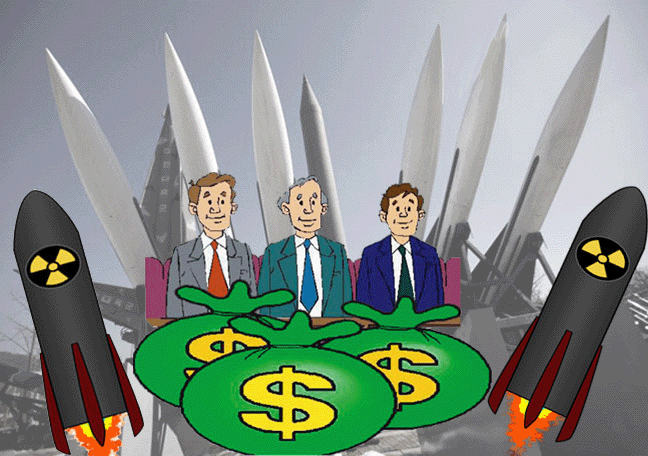
DARPA awards nuclear spacecraft contracts to Lockheed Martin, Bezos’ Blue Origin and General Atomics
PUBLISHED MON, APR 12 2021 HTTPS://WWW.CNBC.COM/2021/04/12/DARPA-NUCLEAR-SPACECRAFT-LOCKHEED-BEZOS-BLUE-ORIGIN-GENERAL-ATOMICS.HTML
The Pentagon’s DARPA awarded contracts to General Atomics, Lockheed Martin and Jeff Bezos’ space venture Blue Origin under the agency’s DRACO (Demonstration Rocket for Agile Cislunar Operations) program.
The Pentagon’s research and development arm on Monday awarded a trio of companies with contracts to build and demonstrate a nuclear-based propulsion system on a spacecraft in orbit by 2025.
General Atomics, Lockheed Martin and Jeff Bezos’ space venture Blue Origin won the Defense Advanced Research Projects Agency or DARPA awards, under the agency’s Demonstration Rocket for Agile Cislunar Operations program or DRACO.
The goal of the program is deceptively simple: Use a nuclear thermal propulsion system to power a spacecraft beyond low Earth orbit.
The problem of plutonium programs
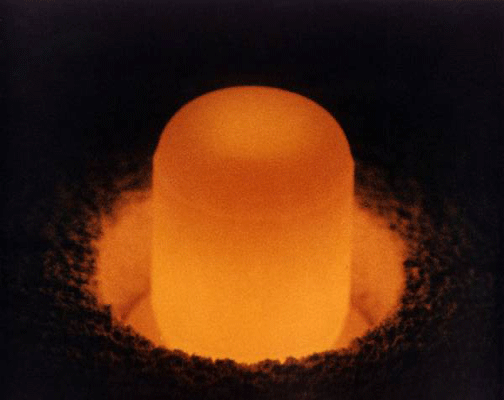
Plutonium programs in East Asia and Idaho will challenge the Biden administration, Bulletin of the Atomic Scientists, By Frank N. von Hippel | April 12, 2021 Among the Biden administration’s nuclear challenges are ongoing civilian plutonium programs in China and Japan. Also, South Korea’s nuclear-energy research and development establishment has been asserting that it should have the same “right” to have a plutonium program as Japan. These challenges have been compounded by a renewed push by the Energy Department’s Idaho National Laboratory to revive a plutonium program that was shut down in the 1980s. These foreign and domestic plutonium programs are all challenges because plutonium is a nuclear-weapon material.
Henry Kissinger’s State Department quickly discovered that the governments of Brazil, Pakistan, South Korea, and Taiwan—all under military control at the time—had contracted for French or German spent-fuel “reprocessing” plants. The United States intervened forcefully and none of these contracts were fully consummated…………………..
…………….A possible path forward. During the Trump administration, the Energy Department fell back into the never-never land of plutonium-fueled reactors from which the United States extracted itself in the 1980s. Fortunately, the big-dollar commitments to the Versatile Test Reactor and the Natrium Reactor have not yet been made, and the Biden administration could use the excuse of budget stringency not to make those commitments.
In South Korea, the Biden administration will have to deal with the completion of the Idaho National Lab–Korea Atomic Energy Research Institute Joint Fuel Cycle Study. Although there will no doubt be obfuscation in the report, the conclusions of the 10-year study should have been obvious from the beginning: reprocessing is hugely costly, creates proliferation risks, and complicates spent fuel disposal. Fortunately, the anti-nuclear-energy Moon administration is unlikely to push for reprocessing. It will be much more interested in the opportunities that the Biden administration can provide to advance the Korean Peninsula denuclearization agenda. It should therefore be politically relatively easy for the Biden Administration to terminate cooperation on pyroprocessing.
China’s reprocessing and fast-neutron reactor program may be driven in part by China’s interest in obtaining more weapon-grade plutonium to build up the size of its nuclear arsenal. If that is the case, China’s incentive to build up could be reduced through nuclear arms control. Specifically, if China is building up its nuclear arsenal out of concern about the adequacy of its nuclear deterrent in the face of an unconstrained US missile-defense buildup, then the United States could examine the possibility of an agreement to limit missile defenses as an alternative to an open-ended, offense-defense arms race. That was the path of wisdom that the United States and Soviet Union chose with their 1972 Anti-Ballistic Missile Treaty.
In Japan, the Biden administration will be faced with the continued unwillingness of the powerful Ministry of Economics, Trade, and Industry to wind down Japan’s dysfunctional plutonium program. But, if a linkage could be made between constraining China’s nuclear buildup and ending Japan’s hugely costly reprocessing program, that might help tip the balance in Japan’s internal debate over reprocessing. https://thebulletin.org/2021/04/plutonium-programs-in-east-asia-and-idaho-will-challenge-the-biden-administration/?utm_source=Newsletter&utm_medium=Email&utm_campaign=MondayNewsletter04122021&utm_content=NuclearRisk_EastAsia_04122021
The United States collaborates on nuclear pyroprocessing with South Korea.

Plutonium programs in East Asia and Idaho will challenge the Biden administration, Bulletin of the Atomic Scientists, By Frank N. von Hippel | April 12, 2021, ”…………………………………The United States collaborates on pyroprocessing with South Korea. The Idaho and Argonne National Laboratories also continue to promote the pyroprocessing of spent fuel. After the Clinton Administration shut down the Experimental Breeder Reactor II in 1994, the laboratory persuaded the Energy Department to continue to fund pyroprocessing as a way to process Experimental Breeder Reactor II spent fuel and blanket assemblies into stable waste forms for disposal in a deep underground repository. The proposal was to complete this effort in 2007. According to a review by Edwin Lyman of the Union of Concerned Scientists, however, as of the end of Fiscal Year 2016, only about 18 percent of the roughly 26 metric tons of assemblies had been processed at a cost of over $200 million into waste forms that are not stable. (Since then, an additional three percent has been processed.)
During the George W. Bush administration, Vice President Cheney accepted Argonne’s argument that pyroprocessing is “proliferation resistant” and the two US national laboratories were allowed to share the technology with the Korea Atomic Energy Research Institute.
At the beginning of the Obama administration, however, a group of safeguards experts from six Energy Department national laboratories, including Argonne and Idaho, concluded that pyroprocessing is not significantly more resistant to proliferation than PUREX, the standard reprocessing technology originally developed by the United States to extract plutonium for its weapons.

In 2014, the US-Republic of Korea Agreement for Cooperation on the Peaceful Uses of Atomic Energy was due to expire, but the negotiations on a successor agreement bogged down over Korea’s insistence that the new agreement include the same right to reprocess spent fuel as the 1988 US-Japan Agreement for Cooperation.
The compromise reached the following year was that the Korea Atomic Energy Research Institute and the Idaho National Laboratory would complete their Joint Fuel Cycle Study on “the technical, economic, and nonproliferation (including safeguards) aspects of spent fuel management and disposition technologies.” If the United States could be convinced that the proliferation risks of pyroprocessing were manageable, the secretary of energy would give consent for South Korea to use the technology on its territory. The final report from the joint study is due this year.
Meanwhile, in 2017, Moon Jae-in was elected president of the Republic of Korea on a platform that included not building any more nuclear power plants in South Korea. Fast-neutron reactors and pyroprocessing obviously do not fit with that policy. This gives the Biden administration an opportunity to end a cooperative nuclear-energy research and development program that is contrary to both US nuclear nonproliferation policy and South Korea’s energy policy. The United States could propose instead a joint collaborative program on safe spent fuel storage and deep underground disposal……………https://thebulletin.org/2021/04/plutonium-programs-in-east-asia-and-idaho-will-challenge-the-biden-administration/?utm_source=Newsletter&utm_medium=Email&utm_campaign=MondayNewsletter04122021&utm_content=NuclearRisk_EastAsia_04122021
China’s ambiguous plutonium policy.

Plutonium programs in East Asia and Idaho will challenge the Biden administration, Bulletin of the Atomic Scientists, By Frank N. von Hippel | April 12, 2021 ”…………………….China’s ambiguous plutonium policy. China is estimated to have produced between 2.3 and 3.5 tons of weapon-grade plutonium before it halted production in 1988. China is also estimated to have doubled the number of its nuclear warheads since the end of the Cold War to about 300, with a public call from one government-owned journal for a further increase to 1000.
That would require more weapon-grade plutonium.
China is, in fact, building a “demonstration” reprocessing plant and two plutonium breeder reactors. Breeder reactors produce weapon-grade plutonium in the uranium “blankets” surrounding their cores. This plutonium ordinarily would be mixed in with the non-weapon-grade plutonium recovered from the core and recycled into new fuel, but could be kept separate and used for weapons.
One troubling development that suggests that China may be reconsidering the civilian character of its plutonium program is that, since 2017, it has halted making the public annual declarations to the International Atomic Energy Agency of its civilian plutonium stocks required by the Guidelines for the Management of Plutonium. China was one of nine countries, including France and the United States, that committed to make those declarations starting in 1997. An International Atomic Energy Agency official has informed me that that the agency “does not request those member states to submit updates and has no role in connection with the implementation of these voluntary commitments.” One of the other states that are parties to the guidelines could, however, ask China why it has stopped submitting updates.
China’s National Nuclear Corporation has been negotiating since 2007 with France’s Orano to purchase technology for a large reprocessing plant like Japan’s that could separate up to eight tons of reactor-grade but weapon-usable plutonium per year. France’s finance minister said in 2018 that the sale could “save” France’s nuclear industry.
Unless the economic competitiveness of breeder reactors proves to be better in China than elsewhere, however, the rate of plutonium separation by the French plant would be vastly in excess of the amount that China could use to start a realistic number of breeder prototypes. Other countries, including France, Japan, Russia, and the United Kingdom, have been down this road before and ended up with huge stocks of reactor-grade plutonium (Figure 1 on original). One would hope that China would learn from rather than emulate their folly.
The Biden administration should engage France on the wisdom of Orano’s continued promotion of plutonium separation worldwide through offers of both reprocessing services and technology.
If China moves ahead with its own large-scale reprocessing program, it will make it more difficult to pressure Japan to end its plutonium program, which both countries clearly understand provides Japan with a nuclear-weapon option.
The Obama administration suggested to Beijing a bilateral multidisciplinary dialogue on pros and cons of civilian reprocessing. The Biden administration could press again for such a private discussion. Perhaps, backing away from reprocessing would become more attractive in both Beijing and Tokyo if they made their decisions in parallel…………..https://thebulletin.org/2021/04/plutonium-programs-in-east-asia-and-idaho-will-challenge-the-biden-administration/?utm_source=Newsletter&utm_medium=Email&utm_campaign=MondayNewsletter04122021&utm_content=NuclearRisk_EastAsia_04122021
No market for small nuclear reactors, so no justification for setting up factories to make them.
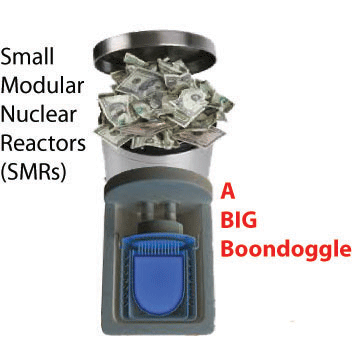
IEEE 9th March 2021, Small modular and advanced nuclear reactors have been proposed as potential ways of dealing with the problems—specifically economic competitiveness, risk of accidents, link to proliferation and production of waste—confronting nuclear power technology. This perspective article examines whether these new designs can indeed solve these problems, with a particular focus on the economic challenges.
It briefly discusses the technical challenges confronting advanced reactor designs and the many decades it might take for these to be commercialized, if ever. The article explains why the higher construction and operational costs per unit of electricity generation capacity will make electricity from small modular reactors more expensive than electricity from large nuclear power plants, which are themselves not competitive in today’s electricity markets.
Next, it examines the potential savings from learning and modular construction, and explains why the historical record suggests that these savings will be inadequate to compensate for the economic challenges resulting from the lower generation capacity. It then critically examines arguments offered by advocates of these technologies about job creation and other potential uses of energy generated from these plants to justify subsidizing and constructing these kinds of nuclear plants. It concludes with an assessment of the markets for these technologies, suggesting that
these are inadequate to justify constructing the necessary manufacturing facilities.
https://ieeexplore.ieee.org/document/9374057
New science report: advanced nuclear reactors no safer than conventional nuclear plants
Advanced nuclear reactors no safer than conventional nuclear plants, says science group https://www.reuters.com/article/us-usa-nuclearpower/advanced-nuclear-reactors-no-safer-than-conventional-nuclear-plants-says-science-group-idUSKBN2BA0CP, By Timothy Gardner-18 Mar 21,
President Joe Biden, a Democrat, has made curbing climate change a priority and has supported research and development for advanced nuclear technologies.
The reactors are also popular with many Republicans. Last October, the month before Biden was elected, the U.S. Department of Energy, awarded $80 million each to TerraPower LLC and X-energy to build reactors it said would be operational in seven years.
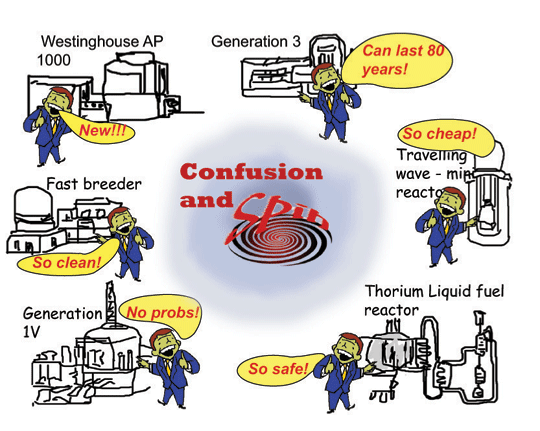
Advanced reactors are generally far smaller than conventional reactors and are cooled with materials such as molten salt instead of with water. Backers say they are safer and some can use nuclear waste as fuel.
“The technologies are certainly different from current reactors, but it is not at all clear they are better,” said Edwin Lyman, director of nuclear power safety at the Union of Concerned Scientists.
“In many cases, they are worse with regard to … safety, and the potential for severe accidents and potential nuclear proliferation,” said Lyman, author of the report UCS released Thursday called “‘Advanced’ Isn’t Always Better”.
Nuclear reactors generate virtually emissions-free power [ if you ignore their total fuel chain] which means conventional ones, at least, will play a role in efforts to decarbonize the economy by 2050, a goal of the Biden administration. But several of the 94 U.S. conventional nuclear plants are shutting due to high safety costs and competition from natural gas and wind and solar energy.
That has helped spark initial funding for a new generation of reactors.
Also, nuclear waste from today’s reactors would have to be reprocessed to make fuel. That technique has not been practiced in the United States for decades because of proliferation and cost concerns. Other advanced reactors emit large amounts of radioactive gases, a potentially problematic waste stream.
Lyman said advanced nuclear development funds would be better spent on bolstering conventional nuclear plants from the risks of earthquakes and climate change, such as flooding. The report recommended that the Department of Energy suspend its advanced reactor demonstration program until the Nuclear Regulatory Commission (NRC) requires prototype testing before reactors can be licensed for commercial use.
The DOE did not immediately respond to a request for comment.
Also, nuclear waste from today’s reactors would have to be reprocessed to make fuel. That technique has not been practiced in the United States for decades because of proliferation and cost concerns. Other advanced reactors emit large amounts of radioactive gases, a potentially problematic waste stream.
Lyman said advanced nuclear development funds would be better spent on bolstering conventional nuclear plants from the risks of earthquakes and climate change, such as flooding. The report recommended that the Department of Energy suspend its advanced reactor demonstration program until the Nuclear Regulatory Commission (NRC) requires prototype testing before reactors can be licensed for commercial use.
The DOE did not immediately respond to a request for comment.
Assessing types of Non-Light-Water Nuclear Reactors
|
Assessing the Safety, Security, and Environmental Impacts of Non-Light-Water Nuclear Reactors, Union of Concerned Scientists, Edwin Lyman, Mar 18, 2021 “Advanced” Isn’t Always Better”………………..Assessments of NLWR TypesUCS has reviewed hundreds of documents in the available literature to assess the comparative risks and benefits of the three major categories of NLWR with respect to the three evaluation criteria (Table 2).
|
|

Conclusions and recommendations of safety assessment of advanced nuclear reactors – non-light-water ones
Assessing the Safety, Security, and Environmental Impacts of Non-Light-Water Nuclear Reactors,Union of Concerned Scientists, Edwin Lyman Mar 18, 2021 “Advanced” Isn’t Always Better ”
”……….Conclusions of the Assessment
The non-light-water nuclear reactor landscape is vast and complex, and it is beyond the scope of this report to survey the entire field in depth. Nevertheless, enough is clear even at this stage to draw some general conclusions regarding the safety and security of NLWRs and their prospects for rapid deployment.
Based on the available evidence, the NLWR designs currently under consideration (except possibly once-through, breed-and-burn reactors) do not offer obvious improvements over LWRs significant enough to justify their many risks. Regulators and other policymakers would be wise to look more closely at the nuclear power programs under way to make sure they prioritize safety and security. Future appropriations for NLWR technology research, development, and deployment should be guided by realistic assessments of the likely societal benefits that would result from the investment of billions of taxpayer dollars.
Little evidence supports claims that NLWRs will be significantly safer than today’s LWRs. While some NLWR designs offer some safety advantages, all have novel characteristics that could render them less safe.
All NLWR designs introduce new safety issues that will require substantial analysis and testing to fully understand and address—and it may not be possible to resolve them fully. To determine whether any NLWR concept will be significantly safer than LWRs, the reactor must achieve an advanced stage of technical maturity, undergo complete comprehensive safety testing and analysis, and acquire significant operating experience under realistic conditions.
The claim that any nuclear reactor system can “burn” or “consume” nuclear waste is a misleading oversimplification. Reactors can actually use only a fraction of spent nuclear fuel as new fuel, and separating that fraction increases the risks of nuclear proliferation and terrorism.
No nuclear reactor can use spent nuclear fuel directly as fresh fuel. Instead, spent fuel has to be “reprocessed”—chemically treated to extract plutonium and other TRU elements, which must then be refabricated into new fuel. This introduces a grave danger: plutonium and other TRU elements can be used in nuclear weapons. Reprocessing and recycling render these materials vulnerable to diversion or theft and increases the risks of nuclear proliferation and terrorism—risks that are costly to address and that technical and institutional measures cannot fully mitigate. Any fuel cycle that requires reprocessing poses inherently greater proliferation and terrorism risks than the “once-through” cycle with direct disposal of spent fuel in a geologic repository.
Some NLWRs have the potential for greater sustainability than LWRs, but the improvements appear to be too small to justify their proliferation and safety risks.
Although some NLWR systems could use uranium more efficiently and generate smaller quantities of long-lived TRU isotopes in nuclear waste, for most designs these benefits could be achieved only by repeatedly reprocessing spent fuel to separate out these isotopes and recycle them in new fuel—and that presents unacceptable proliferation and security risks. In addition, reprocessing plants and other associated fuel cycle facilities are costly to build and operate, and they increase the environmental and safety impacts compared with the LWR once-through cycle. Moreover, the sustainability increases in practice would not be significant in a reasonably foreseeable time frame.
Once-through, breed-and-burn reactors have the potential to use uranium more efficiently without reprocessing, but many technical challenges remain.
One type of NLWR system that could in principle be more sustainable than the LWR without increasing proliferation and terrorism risks is the once-through, breed-and-burn reactor. Concepts such as TerraPower’s traveling-wave reactor could enable the use of depleted uranium waste stockpiles as fuel, which would increase the efficiency of uranium use. Although there is no economic motivation to develop more uranium-efficient reactors at a time when uranium is cheap and abundant, reducing uranium mining may be beneficial for other reasons, and such reactors may be useful for the future. However, many technical challenges would have to be overcome to achieve breed-and-burn operation, including the development of very-high-burnup fuels. The fact that TerraPower suspended its project after more than a decade of development to pursue a more conventional and far less uranium-efficient SFR, the Natrium, suggests that these challenges have proven too great.
High-assay low enriched uranium (HALEU) fuel, which is needed for many NLWR designs, poses higher nuclear proliferation and nuclear terrorism risks than the lower-assay LEU used by the operating LWR fleet.
Many NLWR designs require uranium enriched to higher levels than the 5 percent U-235 typical of LWR fuel. Although uranium enriched to between 10 and 20 percent U-235 (defined here as HALEU) is considered impractical for direct use in nuclear weapons, it is more attractive for weapons use—and requires more stringent security—than the lower-assay enriched uranium in current LWRs.
The significant time and resources needed to safely commercialize any NLWR design should not be underestimated.
It will likely take decades and many billions of dollars to develop and commercially deploy any NLWR design, together with its associated fuel cycle facilities and other support activities. Such development programs would come with a significant risk of delay or failure and require long-term stewardship and funding commitments. And even if a commercially workable design were demonstrated, it would take many more years after that to deploy a large number of units and operate them safely and reliably.
Vendors that claim their NLWRs could be commercialized much more quickly typically assume that their designs will not require full-scale performance demonstrations and extensive safety testing, which could add well over a decade to the development timeline. However, current designs for sodium-cooled fast reactors and high-temperature gas-cooled reactors differ enough from past reactor demonstrations that they cannot afford to bypass additional full-scale prototype testing before licensing and commercial deployment. Molten salt–fueled reactors have only had small-scale demonstrations and thus are even less mature. NLWRs deployed commercially at premature stages of development run a high risk of poor performance and unexpected safety problems.
Recommendations
The DOE should suspend the advanced reactor demonstration program pending a finding by the NRC whether it will require full-scale prototype testing before licensing the two chosen designs as commercial power reactors.
The DOE has selected two NLWR designs, the Natrium SFR and the Xe-100 pebble-bed HTGR, for demonstration of full-scale commercial operation by 2027. However, the NRC has yet to evaluate whether these designs are mature enough that it can license them without first obtaining data from full-scale prototype plants to demonstrate novel safety features, validate computer codes, and qualify new types of fuel in representative environments. Without such an evaluation, the NRC will likely lack the information necessary to ensure safe, secure operation of these reactors. The DOE should suspend the Advanced Reactor Demonstration Program until the NRC—in consultation with the agency’s Advisory Committee on Reactor Safeguards and external experts—has determined whether prototypes will be needed first.
Congress should require that an independent, transparent, peer-review panel direct all DOE R&D on new nuclear concepts, including the construction of additional test or demonstration reactors.
Given the long time and high cost required to commercialize NLWR designs, the DOE should provide funding for NLWR R&D judiciously and only for reactor concepts that offer a strong possibility of significantly increasing safety and security—and do not increase proliferation risks. Moreover, unlike the process for selecting the two reactor designs for the Advanced Reactor Demonstration Program, decision-making should be transparent.6 Congress should require that the DOE convene an independent, public commission to thoroughly review the technical merits of all NLWR designs proposed for development and demonstration, including those already selected for the ARDP. The commission, whose members should represent a broad range of expertise and perspectives, would recommend funding only for designs that are highly likely to be commercialized successfully while achieving clearly greater safety and security than current-generation LWRs.
The DOE and other agencies should thoroughly assess the implications for proliferation and nuclear terrorism of the greatly expanded production, processing, and transport of the high-assay low-enriched uranium (HALEU) required to support the widespread deployment of NLWRs.
Large-scale deployment of NLWRs that use HALEU fuel will require establishing a new industrial infrastructure for producing and transporting the material. The DOE is actively promoting the development of HALEU-fueled reactor designs for export. Given that HALEU is a material of higher security concern than lower-assay LEU, Congress should require that the DOE immediately assess the proliferation and nuclear terrorism implications of transitioning to the widespread use of HALEU worldwide. This assessment should also address the resource requirements for the security and safeguards measures needed to ensure that such a transition can occur without an unacceptable increase in risk.
The United States should make all new reactors and associated fuel facilities eligible for IAEA safeguards and provide that agency with the necessary resources for carrying out verification activities.
The IAEA, which is responsible for verifying that civilian nuclear facilities around the world are not being misused to produce materials for nuclear weapons, has limited or no experience in safeguarding many types of NLWRs and their associated fuel cycle facilities. NLWR projects being considered for deployment in the United States, such as the Natrium SFR and the Xe-100 pebble-bed HTGR, would provide ideal test beds for the IAEA to develop safeguards approaches. However, as a nuclear-weapon state, the United States is not obligated to give the IAEA access to its nuclear facilities. To set a good example and advance the cause of nonproliferation, the United States should immediately provide the IAEA with permission and funding to apply safeguards on all new US nuclear facilities, beginning at the design phase. This would help to identify safeguard challenges early and give the IAEA experience in verifying similar facilities if they are deployed in other countries.
The DOE and Congress should consider focusing nuclear energy R&D on improving the safety and security of LWRs, rather than on commercializing immature NLWR designs.
LWR technology benefits from a vast trove of information resulting from many decades of acquiring experimental data, analysis, and operating experience—far more than that available for any NLWR. This gives the LWR a significant advantage over other nuclear technologies. The DOE and Congress should do a more thorough evaluation of the benefits of focusing R&D funding on addressing the outstanding safety, security, and cost issues of LWRs rather than attempting to commercialize less mature reactor concepts. If the objective is to expand nuclear power to help deal with the climate crisis over the next few decades, improving LWRs could be a less risky bet.
Endnotes………
This is a condensed, online version of the executive summary. For all figures, references, and the full text, please download the PDF. https://ucsusa.org/resources/advanced-isnt-always-better#read-online-content
Nuclear reactors – “Advanced” Isn’t Always Better” – Non-Light-Water Nuclear Reactors
|
Assessing the Safety, Security, and Environmental Impacts of Non-Light-Water Nuclear Reactors,Union of Concerned Scientists, Edwin Lyman Mar 18, 2021 “Advanced” Isn’t Always Better ”……………………….Key Questions for Assessing NLWR Technologies It is critical that policymakers, regulators, and private investors fully vet the claims that the developers of NLWRs are making and accurately assess the prospects for both successful development_ and_ safe, secure, and cost-effective deployment. Given the urgency of the climate crisis, rigorous evaluation of these technologies will help our nation and others avoid wasting time or resources in the pursuit of high-risk concepts that would be only slightly better— or perhaps worse—than LWRs. Key questions to consider are the following:
To help inform policy decisions on these questions, the Union of Concerned Scientists (UCS) has evaluated certain claims about the principal types of NLWRs. In particular, this report compares several classes of NLWRs to LWRs with regard to safety and security, the risks of nuclear proliferation and nuclear terrorism, and “sustainability”—a term that in this context includes the often-claimed ability of some NLWRs to “recycle” nuclear waste and use mined uranium more efficiently. The report also considers the potential for certain NLWRs to operate in a once-through, “breed-and-burn” mode that would, in theory, make them more uranium-efficient without the need to recycle nuclear waste—a dangerous process that has significant nuclear proliferation and terrorism risks.
Non-Light-Water Reactor TechnologiesUCS considered these principal classes of NLWRs: Sodium-cooled fast reactors (SFRs): These reactors are known as “fast reactors” because, unlike LWRs or other reactors that use lower-energy (or “thermal”) neutrons, the liquid sodium coolant does not moderate (slow down) the high-energy (or “fast”) neutrons produced when nuclear fuel undergoes fission. The characteristics and design features of these reactors differ significantly from those of LWRs, stemming from the properties of fast neutrons and the chemical nature of liquid sodium. High-temperature gas–cooled reactors (HTGRs): These reactors are cooled by a pressurized gas such as helium and operate at temperatures up to 800ºC, compared with around 300ºC for LWRs. HTGR designers developed a special fuel called TRISO (tristructural isotropic) to withstand this high operating temperature. HTGRs typically contain graphite as a moderator to slow down neutrons. There are two main variants of HTGR. A prismatic-block HTGR uses conventional nuclear fuel elements that are stationary; in a pebble-bed HTGR, moving fuel elements circulate continuously through the reactor core. Molten salt–fueled reactors (MSRs): In contrast to conventional reactors that use fuel in a solid form, these use liquid fuel dissolved in a molten salt at a temperature of at least 650ºC. The fuel, which is pumped through the reactor, also serves as the coolant. MSRs can be either thermal reactors that use a moderator such as graphite or fast reactors without a moderator. All MSRs chemically treat the fuel to varying extents while the reactor operates to remove radio-active isotopes that affect reactor performance. Therefore, unlike other reactors, MSRs generally require on-site chemical plants to process their fuel. MSRs also need elaborate systems to capture and treat large volumes of highly radioactive gaseous byproducts. The Fuels for Non-Light-Water ReactorsToday’s LWRs use uranium-based nuclear fuel containing less than 5 percent of the isotope uranium-235. This fuel is produced from natural (mined) uranium, which has a uranium-235 content of less than 1 percent, in a complex industrial process called uranium enrichment. Fuel enriched to less than 20 percent U-235 is called “low-enriched uranium” (LEU). Experts consider it a far less attractive material for nuclear weapons development than “highly enriched uranium” (HEU), with a U-235 content of at least 20 percent. The fuel for most NLWRs differs from that of LWRs. . Some proposed NLWRs would use LEU enriched to between 10 and 20 percent uranium-235; this is known as “high-assay low enriched uranium” (HALEU).2 While HALEU is considered impractical for direct use in a nuclear weapon, it is more attractive for nuclear weapons development than the LEU used in LWRs. Other types of NLWRs would use plutonium separated from spent nuclear fuel through a chemical process called reprocessing. Still others would utilize the isotope uranium-233 obtained by irradiating the element thorium. Both plutonium and uranium-233 are highly attractive for use in nuclear weapons. Typically, the chemical forms of NLWR fuels also differ from those of conventional LWR fuel, which is a ceramic material composed of uranium oxide. Fast reactors can use oxides, but they can also use fuels made of metal alloys or chemical compounds such as nitrides. The TRISO fuel in HTGRs consists of tiny kernels of uranium oxide (or other uranium compounds) surrounded by several layers of carbon-based materials. MSR fuels are complex mixtures of fluoride or chloride salt compounds. The deployment of NLWRs also would require new industrial facilities and other infrastructure to produce and transport their different types of fuel, as well as to manage spent fuel and other nuclear wastes. These facilities may use new technologies that themselves would require significant R&D. They also may present different risks related to safety, security, and nuclear proliferation than do LWR fuel cycle facilities—important considerations for evaluating the whole system. Non-Light-Water Reactors: Past and PresentIn the mid-20th century, the Atomic Energy Commission (AEC)—the predecessor of today’s Department of Energy (DOE) and the NRC—devoted considerable time and resources to developing a variety of NLWR technologies, supporting demonstration plants at various scales at sites around the United States. Owners of several of these reactors abandoned them after the reactors experienced operational problems (for example, the Fort St. Vrain HTGR in Colorado) or even serious accidents (the Fermi-1 SFR in Michigan). Despite these negative experiences, the DOE continued R&D on various types of NLWR and their fuel cycles. In the 1990s, the DOE initiated the Generation IV program, with the goal of “developing and demonstrating advanced nuclear energy systems that meet future needs for safe, sustainable, environmentally responsible, economical, proliferation-resistant, and physically secure energy.” Although Generation IV identified six families of advanced reactor technology, the DOE has given most of its subsequent support to SFRs and HTGRs. Today, a number of NLWR projects at various stages of development are under way, funded by both public and private sources (Table 1). With support from Congress, the DOE is pursuing several new NLWR test and demonstration reactors. It is proceeding with the design and construction of the Versatile Test Reactor (VTR), an SFR that it hopes to begin operating in the 2026–2031 timeframe. The VTR would not generate electricity but would be used to test fuels and materials for developing other reactors. In October 2020, the DOE selected two NLWR designs for demonstrating commercial power generation by 2027: the Xe-100, a small pebble-bed HTGR that would generate about 76 megawatts of electricity (MWe), and the 345 MWe Natrium, an SFR that is essentially a larger version of the VTR with a power production unit. The DOE is also providing funding for two smaller-scale projects to demonstrate molten salt technologies. In addition, the DOE, the Department of Defense (DOD), and a private company, Oklo, Inc., are pursuing demonstrations of so-called micro-reactors—very small NLWRs with capacities from 1 MWe to 20 MWe—and project that these will begin operating in the next few years. A number of universities also have expressed interest in building small NLWRs for research. Congress would need to provide sufficient and sustained funding for any of these projects to come to fruition. This is far from assured—for example, funding for the VTR to date has fallen far short of what the DOE has requested, all but guaranteeing the project will be delayed. The Goals of New Reactor DevelopmentIf nuclear power is to play an expanded global role to help mitigate climate change, new reactor designs should be demonstrably safer and more secure—and more economical—than the existing reactor fleet. Today’s LWRs remain far too vulnerable to Fukushima-like accidents, and the uranium enrichment plants that provide their LEU fuel can be misused to produce HEU for nuclear weapons. However, developing new designs that are clearly superior to LWRs overall is a formidable challenge, as improvements in one respect can create or exacerbate problems in others. For example, increasing the physical size of a reactor core while keeping its power generation rate constant could make the reactor easier to cool in an accident, but it could also increase cost.
Moreover, the problems of nuclear power cannot be fixed through better reactor design alone. Also critical is the regulatory framework governing the licensing, construction, and operation of nuclear plants and their associated fuel cycle infrastructure. Inadequate licensing standards and oversight activities can compromise the safety of improved designs. A key consideration is the extent to which regulators require extra levels of safety—known as “defense-in-depth”—to compensate for uncertainties in new reactor designs for which there is little or no operating experience………
This is a condensed, online version of the executive summary. For all figures, references, and the full text, please download the PDF. https://ucsusa.org/resources/advanced-isnt-always-better#read-online-content |
|
Japan’s Nuclear Clean-Up Has No End in Sight
Climbing Without a Map: Japan’s Nuclear Clean-Up Has No End in Sight, U.S. News, By Reuters, Wire Service Content March 12, 2021, BY SAKURA MURAKAMI AND Aaron Sheldrick TOKYO (Reuters) – For one minute this week, workers at the Fukushima nuclear station fell silent to mark the 10-year anniversary of a natural disaster that triggered the worst nuclear accident since Chernobyl.
Then they went back to work tearing down the reactors melted down in the days after a tsunami on March 11, 2011.
The job ranks as the most expensive and dangerous nuclear clean-up ever attempted. A decade in, an army of engineers, scientists and 5,000 workers are still mapping out a project many expect will not be completed in their lifetime.
Naoaki Okuzumi, the head of research at Japan’s lead research institute on decommissioning, compares the work ahead to climbing a mountain range – without a map.
“The feeling we have is, you think the summit’s right there, but then you reach it and can see another summit, further beyond,” Okuzumi told Reuters.
Okuzumi and others need to find a way to remove and safely store 880 tonnes of highly radioactive uranium fuel along with a larger mass of concrete and metal into which fuel melted a decade ago during the accident.
The robotic tools to do the job don’t yet exist. There is no plan for where to put the radioactive material when it is removed.
Japan’s government says the job could run 40 years. Outside experts say it could take twice as long, pushing completion near the close of the century……..
It wasn’t until 2017 that engineers understood how complicated the clean-up would become. By that point, five specially designed robots had been dispatched through the dark, contaminated waters pumped in to cool the uranium. But radiation zapped their electronics.
One robot developed by Toshiba Corp, nicknamed the “little sunfish”, a device about the size of a loaf of bread, provided an early glimpse of the chaotic damage around the cores.
Kenji Matsuzaki, a robot technician at Toshiba who led development of the “sunfish”, had assumed that they would find melted fuel at the bottom of the reactors.
But the sunfish’s first video images showed a tumult of destruction, with overturned structures inside the reactor, clumps of unrecognizable brown debris and dangerously radioactive metal.
“I expected it to be broken, but I didn’t expect it would be this bad,” Matsuzaki said.
The delivery of a robotic arm to start removing fuel, developed in a $16 million programme with the UK’s Nuclear Decommissioning Authority, has been delayed until 2022. Tepco plans to use it to grab some debris from inside reactor 2 for testing and to help plan the main operation………….
But the cleanup has been delayed by the buildup of contaminated water in tanks that crowd the site. The melted cores are kept cool by pumping water into damaged reactor vessels.
But the cleanup has been delayed by the buildup of contaminated water in tanks that crowd the site. The melted cores are kept cool by pumping water into damaged reactor vessels. https://www.usnews.com/news/world/articles/2021-03-12/climbing-without-a-map-japans-nuclear-clean-up-has-no-end-in-sight
Space radiation – harmful to astronauts, not only with cancers, but also with heart and blood vessel effects
From Vitamin C to Spinach: Researching Ways to Protect Astronaut Cardiovascular Health From Space Radiation. Review explores ways that space radiation can damage cardiovascular health, and discusses how we can protect astronauts, from vitamin C to spinach. SciTech Daily 14 Mar 21, Space: the final frontier. What’s stopping us from exploring it? Well, lots of things, but one of the major issues is space radiation, and the effects it can have on astronaut health during long voyages. A new review in the open-access journal Frontiers in Cardiovascular Medicine explores what we know about the ways that space radiation can negatively affect cardiovascular health, and discusses methods to protect astronauts. These include radioprotective drugs, and antioxidant treatments, some of which are more common than you might think.
Space is incredibly inhospitable. Outside of low earth orbit, astronauts are bombarded with radiation, including galactic cosmic rays, and ‘proton storms’ released by the sun. This radiation is harmful for the human body, damaging proteins and DNA, and is one of the major reasons that we haven’t yet been able to send anyone to Mars, or beyond.
These issues inspired Dr Jesper Hjortnaes of the Leiden University Medical Center in the Netherlands to investigate what we know about the harmful effects of space radiation. “If we want to see human long distance space travel, we need to understand the impact of space-induced disease and how to protect our bodies from it,” said Hjortnaes. However, Hjortnaes has an interest in a specific aspect of space radiation: its cardiovascular effects.
You may be surprised to learn that aside from the illnesses we typically associate with radiation, such as cancer, it can also have serious effects on the cardiovascular system. Suffering from cardiovascular illness would be catastrophic for crew members on long-haul space missions, and so it’s important to identify what the risks are, and how to reduce them.
Hjortnaes and colleagues reviewed the evidence to establish what we know about the cardiovascular risks of space radiation. Much of what we know comes from studying people who have received radiation therapy for cancer, where cardiovascular disease is a common side-effect, or from mouse studies of radiation exposure.
So, what are the effects? Radiation can cause myocardial remodeling, where the structure of the heart begins to change, and tough, fibrous tissue grows to replace healthy muscle, potentially leading to heart failure. Other effects include atherosclerosis in blood vessels, which can cause stroke or heart attack. Radiation exerts its effects by causing inflammation, oxidative stress, cell death and DNA damage.
Researchers have also investigated potential ways to protect astronauts. These include drugs that an astronaut could take to protect themselves from space radiation, and antioxidants. Interestingly, an antioxidant diet, including dairy products, green vegetables such as spinach, and antioxidant supplements such as vitamin C, has potential in protecting astronauts from the damaging reactive oxygen molecules produced during radiation exposure.
Overall, the review revealed that so far, research has only scratched the surface of space radiation and the best methods to protect astronauts from it. There is little conclusive evidence of radiation-induced cardiovascular disease in astronauts themselves, as so few of them have ever gone further than low earth orbit, and mouse studies aren’t an exact match for humans……..https://scitechdaily.com/from-vitamin-c-to-spinach-researching-ways-to-protect-astronaut-cardiovascular-health-from-space-radiation/
1 This Month
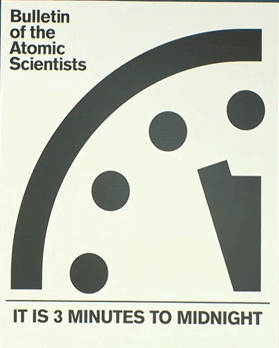
Watch the 2026 Doomsday Clock unveiling live here on January 27 at 10 a.m. EST
To see nuclear-related stories in greater depth and intensity – go to https://nuclearinformation.wordpress.com/

29 Jan. Thursday 7-8 p.m. Webinar – World’s Largest Nuclear Station in Port Hope, ON?


31st January – Challenging the War Machine – a DECLASSIFIED UK SUMMIT

Website of the Week
Now until to February 10, 2026 Radioactive waste storage in France: the debate is finally open! How to participate?
-
Archives
- January 2026 (277)
- December 2025 (358)
- November 2025 (359)
- October 2025 (376)
- September 2025 (258)
- August 2025 (319)
- July 2025 (230)
- June 2025 (348)
- May 2025 (261)
- April 2025 (305)
- March 2025 (319)
- February 2025 (234)
-
Categories
- 1
- 1 NUCLEAR ISSUES
- business and costs
- climate change
- culture and arts
- ENERGY
- environment
- health
- history
- indigenous issues
- Legal
- marketing of nuclear
- media
- opposition to nuclear
- PERSONAL STORIES
- politics
- politics international
- Religion and ethics
- safety
- secrets,lies and civil liberties
- spinbuster
- technology
- Uranium
- wastes
- weapons and war
- Women
- 2 WORLD
- ACTION
- AFRICA
- Atrocities
- AUSTRALIA
- Christina's notes
- Christina's themes
- culture and arts
- Events
- Fuk 2022
- Fuk 2023
- Fukushima 2017
- Fukushima 2018
- fukushima 2019
- Fukushima 2020
- Fukushima 2021
- general
- global warming
- Humour (God we need it)
- Nuclear
- RARE EARTHS
- Reference
- resources – print
- Resources -audiovicual
- Weekly Newsletter
- World
- World Nuclear
- YouTube
-
RSS
Entries RSS
Comments RSS
 nuclear-news