Fusion delusion – unsafe, too uncertain, too expensive, and too late – even if it worked
Fusion delusion no answer to climate emergency or cost-of-living crisis https://www.nuclearpolicy.info/news/fusion-delusion-no-answer-to-climate-emergency-or-cost-of-living-crisis/ 13 Feb 22,
Fusion is unsafe, too uncertain, too expensive and, if it is even possible, will still come far too late to address either climate change or Britain’s energy needs, says the UK’s Nuclear Free Local Authorities.
Slamming claims of a ‘major break-through’, Councillor David Blackburn, Chair of the NFLA, noted that scientists have made similar claims for decades when it has come to fusion. Commenting he said:
“Fusion has since the Second World War been heralded as the next big evolutionary development in our energy supply, and scientists have made similar claims for decades when it has come to fusion leading to countless billions being invested in this illusionary technology.”
Emeritus Professor of Energy Policy Stephen Thomas of the University of Greenwich suggested a motivation for the latest claims:
“It has always been said that fusion breakthroughs occur when there is a need for more public funding.”
Fusion is a complex technology to master, representing an attempt to reproduce on Earth the nuclear reactions that take place in the sun. As the Earth lacks the immense gravity of the Sun, the interior of the reactor must be superheated to 100 million degrees centrigrade (or six times the temperature of the Sun). Generating fusion reactions to date have used many times more energy than the energy produced, making fusion a technology that remains economically unviable. The reactor also requires intricate cooling and containment systems which ‘gobbles up’ much of the energy it produces; if these failed at any time reactor safety would be compromised.
Fusion is neither green nor safe. Neutrons produced by the reaction would bombard the walls of the reactor and its housing which over time would threaten the integrity of the structure. The radioactive tritium gas that is produced poses a real danger to public health even at very low levels if it enters the air or our water supply. And, like fission power, fusion would result in radioactive waste that will need to be safely stored and managed for countless years.
The UK Government is currently looking at five sites, one of which will soon be chosen to host a new experimental fusion reactor and has pledged £200 million towards its development.
Councillor Blackburn is sceptical there will be any result anytime soon:
“The earliest estimates that any fusion reactor could come on stream is in the late 2040’s, and that even assumes the technology will ever be mastered or economically viable. There is a need for humanity to address climate change and a need for Britons to address the energy crisis now. Fusion will come 30 years too late if at all. All of us are facing huge hikes in our energy bills, and we need power sources that are green, available now and affordable to keep our lights on and heat our homes.
“The UK Government has foolishly continued to pour billions of taxpayer money into the fusion delusion and other grandiose nuclear projects, whilst strangling financial support for renewables that work. We need a complete about-face in energy policy with the government instead investing massively in insulating Britain’s homes to reduce energy demand and energy bills and address fuel poverty, and also to finance the proven renewable technologies that can provide power now at an affordable price to Britain’s citizens, including solar generation, a renewable technology already available to us which harnesses the energy of the Sun.”
Hugely costly venture – nuclear fusion – now going private – but success is as elusive as ever

So far, while nuclear fusion has been successfully achieved in labs, ignition has remained elusive.
Europe’s Nuclear Fusion Race Is Going Private. The race is on to achieve commercial nuclear fusion. Believers in the “holy grail of clean energy” are hopeful that a breakthrough in nuclear fusion is imminent
enough that the clean energy source could power a green energy transition sweeping and swift enough to help the world achieve the emissions targets set by the Paris climate accord.
So far, relatively few large-scale nuclear fusion initiatives have gotten off the ground, due to huge barriers to entry. Because of the enormous expense associated with building a reactor capable of facilitating fusion, so far the field has been dominated by publicly funded projects such as Europe’s ITER and China’s EAST (Experimental Advanced Superconducting Tokamak). As scientists have gotten closer and closer to achieving ‘ignition’ – which refers to a nuclear fusion reaction that emits more energy than it consumes – the private sector has become increasingly interested in getting into the industry on the bottom floor and positioning itself at the forefront of what could be a world-changing innovation. So far, while nuclear fusion has been successfully achieved in labs, ignition has remained elusive.
Naked Capitalism 10th Feb 2022
Ahead of regulatory approval the US Dept of Energy wants Govt to grant $4 billion for Small Nuclear Reactors development

Bloomberg Business Week, 7 Feb 22, –………………………… Congress has ordered the Nuclear Regulatory Commission to replace a rules framework that dates to the 1950s. The new guidelines aren’t expected until at least 2025……… To prove the safety of designs, for instance, the commission demands data from similar plants, but none of the smaller installations have been built in the U.S., so there’s no performance history.
……….. the U.S. Department of Energy has gotten ahead of the NRC. The department is asking Congress for as much as $4 billion over seven years for advanced reactor development.
Beneficiaries include TerraPower, a startup founded by Bill Gates that’s working on a project in Wyoming; X-energy, which is planning a high-temperature, gas-cooled reactor in Washington state; and Kairos Power, which aims to build a 35-megawatt salt-cooled test reactor in Tennessee and applied for a construction license last September.
…………… these plants face staunch opposition. Environmental groups say that small reactors—some have a capacity of only 1.5MW, about 0.1% the size of a traditional plant—still produce enough radioactive material to present a contamination risk. And building more plants, even small ones, will add to the pile of toxic waste that no one can figure out what do with. “To the extent that there will be efforts to weaken the regulatory envelope, we will aggressively push back,” says Geoff Fettus, an attorney with the Natural Resources Defense Council.
Globally, more than 70 small modular reactors, with a total capacity of about 12 gigawatts, have been proposed or are under development in at least five countries, according to the International Atomic Energy Agency. The only one that’s been built is a floating reactor in the Russian town of Pevek, on the Arctic Sea, where it’s used to power mining operations. Gregory Jaczko, who served as NRC chair from 2009 to 2012, says the lack of movement on such plants around the world suggests we would be wrong to count on them as a way out of the climate crisis. “They’re just not ready,” he says. “And by the time they could be ready, they’re not going to be useful.”
A big pile of Plutonium – UK reprocessing ceases, leaving deadly waste and no plan

in the end, reprocessing became a commercial venture rather than producing anything useful. Nine countries sent spent fuel to Sellafield to have plutonium and uranium extracted for reuse and paid a great deal of money to do so. In reality, very little of either metal has ever been used because mixed oxide fuels were too expensive, and fast breeder reactors could never be scaled up sufficiently to be economic.
UK reprocessing ceases, leaving deadly waste and no plan
A big pile of PU — Beyond Nuclear International https://beyondnuclearinternational.org/2022/02/06/a-big-pile-of-pu/120 tons of plutonium is legacy of Britain’s dirty decades of reprocessing, By Paul Brown, The Energy Mix
Seventy years after the United Kingdom first began extracting plutonium from spent uranium fuel to make nuclear weapons, the industry is finally calling a halt to reprocessing, leaving the country with 120 tons of the metal, the biggest stockpile in the world. However, the government has no idea what to do with it.
Having spent hundreds of billions of pounds producing plutonium in a series of plants at Sellafield in the Lake District, the UK policy is to store it indefinitely—or until it can come up with a better idea. There is also 90,000 tons of less dangerous depleted uranium in warehouses in the UK, also without an end use.
Plans to use plutonium in fast breeder reactors and then mixed with uranium as a fuel for existing fission reactors have long ago been abandoned as too expensive, unworkable, or sometimes both. Even burning plutonium as a fuel, while technically possible, is very costly.
The closing of the last reprocessing plant, as with all nuclear endeavours, does not mean the end of the industry, in fact it will take at least another century to dismantle the many buildings and clean up the waste. In the meantime, it is costing £3 billion a year to keep the site safe.
Perhaps one of the strangest aspects of this story to outside observers is that, apart from a minority of anti-nuclear campaigners, this plutonium factory in one of prettiest parts of England hardly ever gets discussed or mentioned by the UK’s two main political parties. Neither has ever objected to what seems on paper to be a colossal waste of money.
Continue readingCan Space Tourism Co-exist with Space being turned into a War Zone?
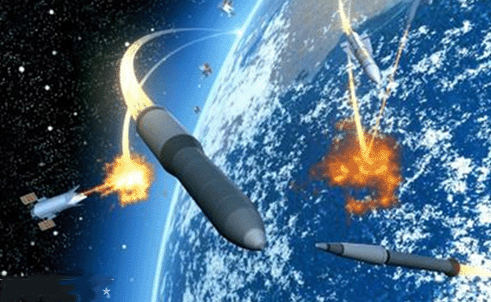
Can Space Tourism Co-exist with Space being turned into a War Zone?, By Karl Grossman, Space 4 Peace, Presented at the Space Tourism: Legal Dimensions Conference, 29 January 2022
The push to turn space into a war zone could spell goodbye to space tourism. The space tourism drive that is underway, led by billionaires Jeff Bezos with his Blue Origin company, Richard Branson and his Virgin Galactic, and Elon Musk and his SpaceX operation, is seen as only a start. As Dylan Taylor wrote in 2021 on www.space.com in an article headed “The Future of space tourism,” it’s a “a growing market expected to be worth at least $3 billion by 2030.” Space.com identified Taylor as an “entrepreneur, investor and philanthropist” and “cofounding patron of the Commercial Spaceflight Federation.” https://www.space.com/future-of-space-tourism-op-ed……………………………
Meanwhile, there’s the push, led by the United States, to turn space into a war zone—and this, despite the Outer Space Treaty of 1967 that sets space aside for peaceful purposes.
As then U.S. President Donald Trump declared in 2018 as he advocated for formation of a U.S. Space Force, “it is not enough to merely have an American presence in space. We must have American dominance in space.” https://www.space.com/40921-trump-space-traffic-policy-american-leadership.html
The following year, he signed the National Defense Authorization Act of 2020 establishing the Space Force as the sixth branch of U.S. armed forces and said: “Space is the world’s newest warfighting domain.” The Space Force, Trump said, would “help” the U.S. “control the ultimate high ground.” https://www.space.com/trump-creates-space-force-2020-defense-bill.html
Then, at the unveiling of a Space Force flag at the White House, Trump said: “Space is going to be…the future, both in terms of defense and offense.” https://www.nbcnews.com/news/us-news/trump-unveils-space-force-flag-ceremony-says-space-future-n1208021
Trump’s successor, U.S. President Joe Biden, has not rolled back the U.S. Space Force………………….
As to the impacts of war in space, Bruce Gagnon, coordinator of the Global Network Against Weapons and Nuclear Power in Space, in an interview in 2021 related the projection of the late Edgar Mitchell, in 1971 the sixth U.S. astronaut to walk on the moon. https://www.youtube.com/watch?v=ow8c7LbPvuI&feature=youtu.be
Gagnon said:
In 1989 during one of our campaigns against NASA plutonium launches [NASA’s launching of plutonium-powered space probes], we had a rally at the Kennedy Space Center in Florida, and our keynote speaker that day was Apollo astronaut Edgar Mitchell, one of the moonwalkers. And he came and said if there is one war in space, it’ll be the one and the only. He said because we will create so much space debris or space junk from all the destroyed satellites and things like that in space that there would literally be a minefield encircling the planet – he called it a piranha-laced river—and we would not be able to get through. A rocket would not be able to get off this Earth through that minefield. So, it’s insane to think about having a war in space.
Gagnon has also spoken of how space warfare would “mean activity on Earth below would immediately shut down—cell phones, ATM machines, cable TV, traffic lights, weather prediction and more—all hooked up to satellites, would be lost. Modern society would go dark.” https://www.counterpunch.org/2019/12/18/the-very-bad-space-force-deal/
Also pointing to the generation of space debris resulting from warfare in space was Alexander Chanock in section titled “Problems With Weaponizing Space” in an article published in 2013 in Journal of Air Law and Commerce titled “The Problems and Potential Solutions Related to the Emergence of Space Weapons in the 2lst Century.” https://scholar.smu.edu/cgi/viewcontent.cgi?article=1327&context=jalc
Chanock, then a candidate for a law degree, now a legislative counsel in the U.S. House of Representatives, wrote that a major problem “is the amount of space debris that space weapons would produce….The fear is that destroying in space could generate extremely dangerous debris with a long orbital life.”
Chanock quoted Dr. Joel Primack, professor of physics and astrophysics at the University of California, Santa Cruz, and “one of the premier experts on space debris, noted Chanock, as saying “the weaponization of space would make the debris problem much worse, and even one war in space could encase the entire planet in a shell of whizzing debris that would thereafter make space near the Earth highly hazardous for peaceful as well as military purposes.”……………………
U.S. interest in war in space has deep roots: back to the former Nazi rocket scientists and engineers brought to the U.S. from Germany after World War II under the U.S.’s Operation Paperclip. They ended up at the U.S. Army’s Redstone Arsenal in Huntsville, Alabama—to use “their technological expertise to help create the U.S. space and weapons program,” wrote Jack Manno, a professor of environmental studies at the State University of New York College of Environmental Science & Forestry, in his 1984 book Arming the Heavens: The Hidden Military Agenda for Space, 1945-1995. https://www.abebooks.com/9780396082118/Arming-heavens-hidden-military-agenda-0396082114/plp
“Many of the early space war schemes were dreamt up by scientists working for the German military, scientists who brought their rockets and their ideas to America after the war,” he wrote. Many of these scientists and engineers “later rose to positions of power in the U.S. military, NASA, and the aerospace industry.” Among them were “Wernher von Braun and his V-2 colleagues” who began “working on rockets for the U.S. Army,” and at the Army’s Redstone Arsenal “were given the task of producing an intermediate range ballistic range missile to carry battlefield atomic weapons up to 200 miles. The Germans produced a modified V-2 renamed the Redstone….Huntsville became a major center of U.S. space military activities.”
Manno told the story of former German Major General Walter Dornberger, who had been in charge of the entire Nazi rocket program, and how he “in 1947 as a consultant to the U.S Air Force and adviser to the Department of Defense…wrote a planning paper for his new employers. He proposed a system of hundreds of nuclear-armed satellites all orbiting at different altitudes and angles, each capable or reentering the atmosphere on command from Earth to proceed to its target. The Air Force began early work on Dornberger’s idea under the acronym NABS (Nuclear Armed Bombardment Satellites).”……………………………………..
This is pessimistic forecast need not be. The Outer Space Treaty of 1967 was—and is—a visionary documentary. “Let Us Beat Our Swords Into Plowshares” is the title of a statue by Evgeniy Vutetich in the sculpture garden of the UN in New York. It is based on the Book of Isaiah and its call that nations “shall beat their swords into plowshares and their spears into pruning hooks; nation shall not lift up sword against nation, neither shall they learn war any more.”
War on Earth is terrible enough. It must not be brought up to the heavens.
This will take continued take political will and international pressure—to preserve and extend the Outer Space Treaty of 1967 and its setting aside space for peaceful purposes. Especially in the United States, this will require action at the grassroots because the two major political parties in the U.S. have joined in a bellicose stance on space, supporting it becoming a war zone. Every year, the grassroots organization Global Network Against Weapons and Nuclear Power in Space, founded in Washington, D.C. in 1991 and the leading group internationally challenging the weaponization of space, holds a “Keep Space For Peace Week” with actions around the world. Meanwhile, there are nations around the globe that have, unlike the U.S., adopted a peaceful stance—as reflected in their support for the proposed PAROS treaty.
We must, indeed, keep space for peace.
Can space tourism co-exist with space being turned into a war zone? The answer is no.
And with a shooting war in space, it will not only space tourism that would be kissed goodbye. http://space4peace.org/can-space-tourism-co-exist-with-space-being-turned-into-a-war-zone/
How giving AI bots control over nuclear weapons could spark World War III

New York Post By Anthony Blair, The Sun, February 2, 2022
Giving artificial intelligence control over nuclear weapons could trigger an apocalyptic conflict, a leading expert has warned.
As AI takes a greater role in the control of devastating weaponry, so the chances of technology making a mistake and sparking World War III increase.
These include the USA’s B-21 nuclear bomber, China’s AI hypersonic missiles, and Russia’s Poseidon nuclear drone.
Writing for the Bulletin of the Atomic Scientists, expert Zachary Kellenborn, a Policy Fellow at the Schar School of Policy and Government, warned: “If artificial intelligences controlled nuclear weapons, all of us could be dead.”
He went on: “Militaries are increasingly incorporating autonomous functions into weapons systems,” adding that “there is no guarantee that some military won’t put AI in charge of nuclear launches.”
Kellenborn, who describes himself as a US Army “Mad Scientist”, explained that “error” is the biggest problem with autonomous nuclear weapons.
He said: “In the real world, data may be biased or incomplete in all sorts of ways.”
Kellenborn added: “In a nuclear weapons context, a government may have little data about adversary military platforms; existing data may be structurally biased, by, for example, relying on satellite imagery; or data may not account for obvious, expected variations such as imagery taken during foggy, rainy, or overcast weather.”
Training a nuclear weapons AI program also poses a major challenge, as nukes have, thankfully, only been used twice in history in Hiroshima and Nagasaki, meaning any system would struggle to learn.
Despite these concerns, a number of AI military systems, including nuclear weapons, are already in place around the world.
Dead Hand
In recent years, Russia has also upgraded its so-called “Doomsday device”, known as “Dead Hand”.
This final line of defense in a nuclear war would fire every Russian nuke at once, guaranteeing total destruction of the enemy.
First developed during the Cold War, it is believed to have been given an AI upgrade over the past few years.
In 2018, nuclear disarmament expert Dr. Bruce Blair told the Daily Star Online he believes the system, known as “Perimeter”, is “vulnerable to cyber attack” which could prove catastrophic.
Dead hand systems are meant to provide a backup in case a state’s nuclear command authority is killed or otherwise disrupted.
US military experts Adam Lowther and Curtis McGuffin claimed in a 2019 article that the US should consider “an automated strategic response system based on artificial intelligence”.
Poseidon Nuclear Drone
In May 2018, Vladimir Putin launched Russia’s underwater nuclear drone, which experts warned could trigger 300ft tsunamis.
The Poseidon nuclear drone, due to be finished by 2027, is designed to wipe out enemy naval bases with two megatons of nuclear power.
Described by US Navy documents as an “Intercontinental Nuclear-Powered Nuclear-Armed Autonomous Torpedo”, or an “autonomous undersea vehicle” by the Congressional Research Service, it is intended to be used as a second-strike weapon in the event of a nuclear conflict.
The big unanswered question over Poseidon is; what can it do autonomously…………………..
B21 Bomber
The US has launched a $550 million remotely-piloted bomber that can fire nukes and hide from enemy missiles.
In 2020, the US Air Force’s B-21 stealth plane was unveiled, the first new US bomber in more than 30 years.
Not only can it be piloted remotely, but it can also fly itself using artificial intelligence to pick out targets and avoid detection with no human output.
Although the military insists a human operator will always make the final call on whether or not to hit a target, information about the aircraft has been slow at getting out.
AI fighter pilots & hypersonic missiles
Last year, China bragged its AI fighter pilots were “better than humans” and shot down their non-AI counterparts in simulated dogfights……..
Last year, China claimed its AI-controlled hypersonic missiles can hit targets with 10 times as much accuracy as a human-controlled missile.,,,,,,,
Checkmate AI warplane
In 2021, Russia unveiled a new AI stealth fighter jet – while also making a dig at the Royal Navy.
The 1,500mph aircraft called Checkmate was launched at a Russian airshow by a delighted Vladimir Putin.
One ad for the autonomous plane – which can hide from its enemies – featured a picture of the Royal Navy’s HMS Defender in the jet’s sights with the caption: “See You”.
The world has already come close to devastating nuclear war which was only prevented by human involvement.
On September 27, 1983, Soviet soldier Stanislav Petrov was an on-duty officer at a secret command center south of Moscow when a chilling alarm went off.
It signaled that the United States had launched intercontinental ballistic missiles carrying nuclear warheads.
Faced with an impossible choice – report the alarm and potentially start WWIII or bank on it being a false alarm – Petrov chose the latter.
He later said: “I categorically refused to be guilty of starting World War III.”

Kellenberg said that Petrov made a human choice not to trust the automated launch detection system, explaining: “The computer was wrong; Petrov was right. The false signals came from the early warning system mistaking the sun’s reflection off the clouds for missiles.
“But if Petrov had been a machine, programmed to respond automatically when confidence was sufficiently high, that error would have started a nuclear war.”
He added: “There is no guarantee that some military won’t put AI in charge of nuclear launches; international law doesn’t specify that there should always be a ‘Petrov’ guarding the button. That’s something that should change, soon.” https://nypost.com/2022/02/02/how-giving-ai-bots-control-over-nuclear-weapons-could-spark-world-war-iii/
Japan to renew subsidies for plutonium nuclear recycling
Ministry to resume subsidies for stalled pluthermal plan https://www.asahi.com/ajw/articles/14526390
By JUNICHIRO NAGASAKI/ Staff Writer February 2, 2022 The economy ministry plans to bring back its subsidy program for areas that host pluthermal generation facilities in an attempt to break the logjam in the nuclear fuel recycling program.
The funds will be offered by the end of fiscal 2022.
The pluthermal program is part of the government’s nuclear fuel cycle policy, in which plutonium extracted from spent nuclear fuel produced at power plants in Japan is processed into plutonium-uranium mixed oxide (MOX) fuel and reused at reactors.
The Federation of Electric Power Companies of Japan plans to start pluthermal power production at 12 or more reactors by fiscal 2030.
But the technology has been in service at only four reactors: the No. 3 and No. 4 reactors in Kansai Electric Power Co.’s Takahama plant in Fukui Prefecture; the No. 3 reactor of Shikoku Electric Power Co.’s Ikata plant in Ehime Prefecture; and the No. 3 reactor of Kyushu Electric Power Co.’s Genkai plant in Saga Prefecture.
By distributing the local-revitalization subsidies, the ministry hopes to accelerate the formation of regional agreements on the fuel cycle project.
A reprocessing facility operated by Japan Nuclear Fuel Ltd. in Aomori Prefecture to recover plutonium is scheduled for completion in the first half of fiscal 2022, but the treatment plant cannot be put in full operation unless pluthermal generation spreads.
Unable to expand the use of MOX fuel, Japan now has 46 tons of plutonium stuck in storage, which has raised international concerns over its potential use in nuclear weapons.
Previously, prefectural governments that had agreed by fiscal 2008 to join the pluthermal circle could receive up to 6 billion yen ($52.4 million) in subsidies. Those that agreed by fiscal 2014 were eligible for a maximum of 3 billion yen in subsidies.
Eight prefectures, including Fukui, Ehime and Saga, have been receiving the subsidies. But currently there are no similar funding mechanisms for local governments under the pluthermal plan.
The economy ministry plans to incorporate a new system to finance prefectures with reactors that have not benefited from past subsidy programs.
Reactors at Japan Atomic Power Co.’s Tokai No. 2 nuclear power plant in Ibaraki Prefecture and elsewhere are expected to be eligible.
Although Chubu Electric Power Co.’s Hamaoka power plant in Shizuoka Prefecture and Chugoku Electric Power Co.’s Shimane plant in Shimane Prefecture are included on the list for past subsidies, it is unclear when they can restart operations because of difficulties in passing the Nuclear Regulation Authority’s screening and gaining consent from residents near the plants.
Bill to help build small nuclear reactors in Indiana passes Senate,
Bill to help build small nuclear reactors in Indiana passes Senate, WFYI Indianapolis,
REBECCA THIELE 2 Feb 22,
A bill that would make it easier for smaller, more advanced nuclear power plants to be built in Indiana passed in the state Senate on Tuesday…….
But opponents of SB 271 said small modular nuclear reactors are a risky investment for the state. None of the planned modular nuclear reactors have been built yet and many have gone over their proposed budgets — some by billions of dollars.
Sen. Shelli Yoder (D-Bloomington) said the fact that ratepayers would have to foot the bill for these projects is concerning.
“This is a question of who is going to pay and for quite some time and before any project has ever come to fruition,” she said.
The Union of Concerned Scientists has also questioned the safety of the plants. It said the nuclear industry has sometimes used the plant’s smaller size to justify cutting back on safety equipment and staff as well as shrink the area that would be told to evacuate in a disaster.
The bill now moves on to the House for consideration. https://www.wfyi.org/news/articles/bill-to-help-build-small-nuclear-reactors-in-indiana-passes-senate
UK preparing for ‘exo-atmospheric nuclear attack’ as greatest threat in space war, government report warns
UK preparing for ‘exo-atmospheric nuclear attack’ as greatest threat in space war, government report warns
Such an event would be a ‘permanent kill’ scenario worse than any electronic weapons or orbital anti-satellite weapons, a new report states, Adam Smith Independent 2 Feb 22,
The government says space will be a key future battlefield with the most dangerous threat being a “exo-atmospheric nuclear attack”.
In a report from the Ministry of Defence, the government body described such an event as a “permanent kill” scenario; this would be vastly more dangerous than either electronic warfare, laser dazzling, cyber attacks, or orbital ASATs (anti-satellite weapons)………… (registered readers only) https://www.independent.co.uk/space/atmospheric-nuclear-attack-space-war-government-b2005990.html
Swapping one dangerous fossil fuel technology for another dangerous nuclear technology is NOT progress
‘‘To make a relevant contribution to global power generation, up to more than ten thousand new reactors would be required, depending on reactor design.”
Caught between nostalgia and science fiction https://beyondnuclearinternational.org/2022/01/30/caught-between-nostalgia-and-science-fiction/
Swapping one dangerous technology for another isn’t progress. By Linda Pentz Gunter, 30 Jan 22,
It’s starting to sound a lot like a Christmas carol as a growing chorus of voices clamors to stop the European Union from including nuclear power in its “green taxonomy.”
Six countries, five former Japanese prime ministers, four former nuclear regulators, a bunch of French hens (at least 20 protesters), and two heads of Italy’s major energy behemoth, have all spoken out in recent weeks against rebranding dangerous, expensive nuclear power as “sustainable” energy or even a bridge to an all renewable future.
The youth climate movement, Fridays for the Future, have also condemned the potential inclusion of nuclear power in the EU Taxonomy as “greenwashing”, with spokesperson Luisa Neubauer telling Euractiv that Germany “can phase out both coal and nuclear power and enter the renewable age.” Why, she asked, would you “swap one high risk technology, coal, for another high risk technology? And maybe those risks aren’t quite the same, but the risks attached to nuclear energy, people have experienced that.” In addition, the costs for nuclear power, she said are “in a different galaxy” compared to renewables.
Francesco Starace, a nuclear engineer by training and the head of Enel, the Italian multinational energy company, said of nuclear power, “we can’t stay halfway between nostalgia for the past and hope in science fiction”. Enel Green Power head, Salvatore Bernabei, said “we don’t intend to invest in nuclear, obviously.”
Said Starace: “We must act now because the red alert for humanity has gone off and the next ten years will be crucial. There is only one road and it is already marked: electrification, renewables and batteries”.
The five former prime ministers of Japan spoke from direct experience, having lived through the devastation caused by the Fukushima Daiichi nuclear disaster, which began on March 11, 2011, but is still damaging human health and the environment today.
Promoting nuclear power can ruin a country,” wrote Junichiro Koizumi, Morihiro Hosokawa, Naoto Kan, Yukio Hatoyama and Tomiichi Murayama in a statement directed at the EU.
“We have witnessed in Fukushima over the last decade [ ] an indescribable tragedy and contamination on an unprecedented scale,” the prime ministers wrote. “Hundreds of thousands of people have been forced to flee their homes and vast areas of agricultural land have been contaminated. Radioactive water well beyond storage capacity continues to be generated, many children are suffering from thyroid cancer, and massive amounts of the country’s resources and wealth has been lost. We do not wish European countries to make the same mistake.”
The four former nuclear regulators — Dr. Greg Jaczko (US), Prof. Wolfgang Renneberg (Germany), Dr. Bernard Laponche (France) and Dr. Paul Dorfman (UK) — stated categorically that “The central message, repeated again and again, that a new generation of nuclear will be clean, safe, smart and cheap, is fiction.”
Given the urgency of the climate crisis, the four said, using nuclear power to address it was a completely unrealistic proposition. “The reality is nuclear is neither clean, safe or smart; but a very complex technology with the potential to cause significant harm,” they wrote.
They added: “Nuclear isn’t cheap, but extremely costly. Perhaps most importantly nuclear is just not part of any feasible strategy that could counter climate change. To make a relevant contribution to global power generation, up to more than ten thousand new reactors would be required, depending on reactor design.”
Although France is leading the charge — for obviously self-interested reasons — to include nuclear power in the EU Taxonomy, the country is not without its nuclear opponents. The nationwide Réseau sortir du nucléaire and scores of regional groups struggle to get attention, but have staged protests for years. France relies on nuclear power for 70% of its electricity and is also a member of the UN Security Council as a nuclear weapons country, giving it an illusory sense of prestige of which it is reluctant to let go.
Last December, protesters descended on France’s foreign ministry, roundly criticizing French president, Emmanuel Macron’s continued promotion of nuclear power. At the same time, the country was facing electricity shortages due to five French reactor outages.
Even scientists, sometimes the more cautious of species, have spoken out. According to the Financial Times, which viewed the documentation, scientific experts “hired by Brussels to help draw up the sustainable investment rules” have criticized the inclusion of nuclear power, while not going as far as to ask for its removal altogether. However, the experts wrote that “the inclusion of nuclear energy contravenes the principle of ‘do no significant harm’”, the Financial Times said.
Meanwhile, Austria is preparing to take the EU to court if it persists in labeling nuclear power as green. Austria has the support of Spain, Luxembourg and Denmark in calling the consideration of nuclear as a “sustainable” energy source “a step backwards.”
Germany, which is close to phasing out all of its nuclear power plants, has also rejected nuclear as part of the EU Taxonomy while so far failing to oppose the inclusion of gas, again for vested interests.
Linda Pentz Gunter is the international specialist at Beyond Nuclear and writes for and curates Beyond Nuclear International.
Japan needs a realistic debate instead of new push for fast nuclear reactors
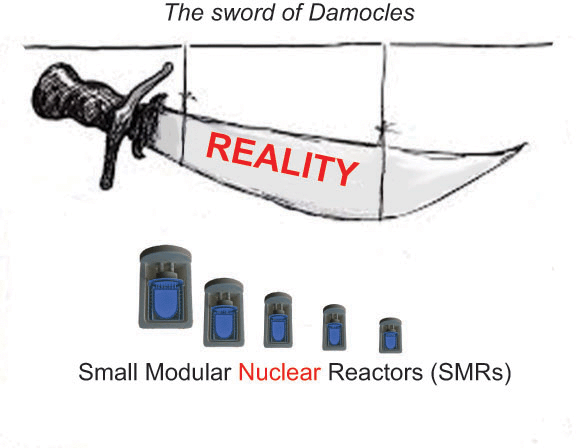
Realistic debate needed instead of new push for fast nuclear reactors https://www.asahi.com/ajw/articles/14534098
January 28, 2022 Japan has agreed to work with a U.S. company in technological cooperation to develop a sodium-cooled fast reactor.
People involved in the project stress that the new technology will contribute to the goal of a carbon-free society. But the government should not eschew reality-based debate on the future of existing nuclear power reactors.
The Japan Atomic Energy Agency, Mitsubishi Heavy Industries Ltd. and other Japanese entities will cooperate with TerraPower LLC’s project to build a fast reactor in the U.S. state of Wyoming.
Fast reactors are more resource efficient as they can burn types of nuclear fuel that cannot be used at conventional reactors.
TerraPower’s reactor will use liquid sodium as a cooling agent such as the Monju prototype fast-breeder reactor, which Japan decided to decommission after a series of accidents.
Japan can provide meaningful support to develop a new type of reactor and maintain related technology by offering what it has learned from its experiences including failures.
Japan has been promoting the concept of recycling separated plutonium back into fuel for nuclear power generation. Fast reactor technology to burn plutonium is at the core of this strategy.
But this program has suffered setbacks, including the decision to scrap Monju and a lack of progress in the government’s plan to burn so-called MOX (mixed oxide) fuel, which is usually plutonium blended with natural uranium, in conventional nuclear reactors.
The government also considered participating in France’s Advanced Sodium Technical Reactor for Industrial Demonstration (ASTRID) project to build a prototype sodium-cooled nuclear reactor.
But the idea was dropped after the French government decided to scale down the project.
The nuclear fuel recycling program, which has gone awry, should be abandoned. The participation in the TerraPower project should not allow the government to delay the decision on the program.
The technological cooperation with the United States has been touted as a way to “contribute to the achievement of carbon neutrality.”
However, it is unclear whether this will help Japan achieve its goal of net zero emissions of greenhouse gases by 2050.
TerraPower plans to start operating the new reactor in 2028. But this technology cannot be used immediately in Japan, which has been developing fast reactor technology for a different type of fuel.
The government’s road map for the development of fast reactor technology, determined in 2018, offers no clear time frame for practice use. It only said full-scale operation is expected “sometime in the late 21st century.”
The government has cited the development of next-generation reactor technology, such as small modular reactors and fast reactors, as an important factor for its clean energy and “zero carbon” policy efforts.
But it has failed to offer a clear vision for the future of existing nuclear reactors despite its massive reservoir of experience and expertise.
The government’s new Basic Energy Plan, unveiled last year, says nuclear power should account for 20 to 22 percent of the nation’s total electricity output in fiscal 2030. But the document did not refer to any specific measure to hit the target.
Neither Prime Minister Fumio Kishida nor members of his Cabinet have been eager to discuss this issue, apparently because of a reluctance to engage in debate on sticky issues concerning nuclear power.
Fast-breeder reactors, which can theoretically produce more fuel than they use, were once advertised as a source of “dream energy” for a resource-poor Japan.
Following the Monju debacle, the government started stressing that nuclear fuel recycling and fast reactor technology can help reduce high-level radioactive waste. Now, policymakers are singing the “carbon neutrality” theme.
The government should stop trying to obscure problems with its nuclear power policy by promoting a new technology without clear prospects for practical use under a new slogan.
Instead, it should launch a reality-based debate on existing nuclear reactors in line with its pledge to reduce the nation’s dependence on nuclear energy as much as possible.
NB Power and New Brunswick government gamble on untested, non existent ”small” nuclear reactors (SMRs)

While the world is turning overwhelmingly toward renewable sources of
energy, currently about four times cheaper than new nuclear plants and with
an established track record, NB Power and the New Brunswick government
insist on gambling on two new unproven nuclear plants, misleadingly termed
“small modular nuclear reactors” (SMNRs or SMRs).
SMRs do not exist at all in Canada except on paper or as computerized plans. There is no
guarantee these new untested reactors will ever succeed in producing
electricity in Canada in a safe and affordable manner.
But public utilities across the country are being pressured to generate power without emitting
greenhouse gases during operation. Instead of investing big bucks in
negawatts (energy efficiency) or renewables, four provinces are promoting
new nuclear plants – SMRs – as their best strategy for combatting
climate change. Since these plants are not likely to materialize for more
than a decade, if ever, the nuclear strategy is another way of “kicking
the can down the road.”
NB Media Co-op 27th Jan 2022
Russia’s nuclear powered container ship is sailing into thick ice.

Russia’s nuclear powered container ship is sailing into thick ice, Barents Observer By
Atle Staalesen, 26 Jan 22,
The “Sevmorput” joins a convoy of vessels that will break its way across the Northern Sea Route. The 260 meter long nuclear-powered vessel early this week sailed thought the Bering Strait and into the Chukchi Sea. A thick layer of sea-ice covers the remote waters that mark the eastern end of the Northern Sea Route.
It is a rough voyage, even for a ship that is designed for sailing in up to a meter thick ice. After this winter’s early freeze, there is now a solid layer of fast ice along Russia’s Arctic coasts, and the waters of the East Siberian, Laptev and Kara Seas have up to 2 meter thick sea-ice……….
The Sevmorput is escorted by nuclear-powered icebreaker Yamal. In the convoy is also heavy loads carrier Audax, as well as conventional icebreaker Kapitan Dranitsyn.
Both the Sevmorput and Audax have Murmansk as their destination.
Also nuclear-powered icebreaker Arktika might ultimately join the convoy. The new Russian icebreaker in late January completed its escort of cargo ship Lev Yashin, and will soon turn back to the Chukchi Sea.
Consequently, there might in only few days be three nuclear-powered vessels at the same time in the east Arctic waters……………..
Rockets Destroy Ozone and Cause Climate Change – Aerospace Programs’ Deadly Impacts to the Earth.
 | |||

Rockets Destroy Ozone and Cause Climate Change – Aerospace Programs’ Deadly Impacts to the Earth https://www.globalresearch.ca/rockets-destroy-ozone-and-cause-climate-change-aerospace-programs-deadly-impacts-to-the-earth/5767944By Nina BeetyGlobal Research, January 24, 2022 Since its beginnings, the space industry has used PR, Hollywood, and a parade of stars to carve itself into the public psyche, including targeting children. Aerospace costs have been largely ignored or hidden, but these costs are serious and accelerating.
The ozone layer in the sky continues to deteriorate despite international action such as the ban on CFCs. The Antarctic ozone hole is becoming permanent year-round, and the soothing green and blue on NASA’s maps actually signifies low ozone levels.1 The aerospace industry is a major factor in this problem. Dallas etal. (2020): [O]zone depletion is one of the largest environmental concerns surrounding rocket launches from Earth.”2 Why?
1. Rockets’ radical emissions cause immediate, almost total ozone destruction for hundreds of square miles and which lasts days.3
2. Rockets’ exhaust and pollutants introduced into the stratosphere persist there and react with and destroy ozone over the long term.4
3. The sun creates the ozone layer by changing oxygen into ozone in the stratosphere. But rockets put pollutants such as exhaust, water vapor, black carbon, and fuel components such as alumina into the stratosphere, blocking the sun’s rays. This reduces the sun’s creation of ozone, reducing ozone layer repair and replenishment. The long-lived rocket byproducts persist in the stratosphere for 3-5 years,5 and accumulate with every rocket launch, decreasing ozone regeneration with each launch.6
4. The shockwave of de-orbitting debris, satellites, and rockets creates nitric oxide which destroys ozone.7
There is no environmental oversight. Researchers including Martin Ross, Darin Toohey, and James Vedda have repeatedly warned the industry,8 but the industry and governments are escalating space funding and programs instead.
Prior to 2021, 2000 satellites were in orbit around the Earth. Then in 2021, 2800 satellites were launched — more than doubling the total in just one year.9 However, the FCC has approved 17,270 low-earth-orbit (LEO) satellites. 65,912 more LEO applications are pending. Governments and private companies plan an additional 30,947+. Rwanda has applied to the ITU for a staggering 327,320 satellites (Firstenberg, 2022). These numbers don’t include systems fewer than five satellites, geostationary, or medium earth orbit (MEO) satellites, or rockets into space.
These programs will acceleratingly destroy the ozone layer which is essential to protect the Earth and life.10 NASA discovered in 2007 that UV-C and UV-B were already reaching the Earth and failed to act.11 UV radiation is having lethal effects on species now.
LEO satellites are very short-lived, lasting 5-7 years; the U.S. military plans 3-year duration satellites. These LEOs need frequent replacement via rocket launch.
Aleksandr Dunayev of the Russian Space Agency said in 1991: “About 300 launches of the [space] shuttle each year would be a catastrophe, and the ozone layer would be completely destroyed.”12
Science author Arthur Firstenberg says: “In 2021, there were 146 orbital rocket launches to put 1,800 satellites into space. At that rate, to maintain and continually replace 100,000 low-earth-orbit satellites, which have a lifespan of five years, would require more than 1,600 rocket launches per year, or more than four every day, forever into the future.”13 That’s over five times the amount to totally destroy the ozone layer.
The long-lived rocket pollution in the stratosphere also traps Earth’s natural and human-made heat under a rapidly thickening blanket, preventing the heat from venting into space. This will increasingly raise Earth’s temperature.14 This has nothing to do with carbon or methane. However, the increased heat will release methane stored in permafrost and formerly ice-covered regions, and this methane will poison Earth.
These satellite systems are largely intended for 4G/5G global Wi-Fi, military warfighting, and the Internet of Things. They exponentially increase RF-EMF radiation levels in the atmosphere and on Earth. This radiation damages health and causes environmental damage. It damages neurology, DNA, cell membranes, the brain, cognition, learning, memory, immunity, reproduction and fertility, blood, and mitochondria, dysregulates hormones, the blood-brain barrier, and sleep cycles, and causes cancer, stroke, heart attacks, and oxidative stress.15
It disrupts wildlife’s ability to navigate and orient by Earth’s natural EMF fields. Bees, insects, and birds are particularly vulnerable.16 The U.S. Department of Interior warned in 2014 about the devastating impacts to birds from this radiation.17 In 2020, a 5G military/SpaceX “live fire” drill killed up to millions of birds in the Southwest.18 Western governments and the FCC ignore the substantial research showing devastating impacts.
What a disaster.

Another problem: dead spacecraft and debris are rapidly accumulating in the sky, creating collision hazards for other rockets, satellites, and the space stations.19 Every collision creates more debris, leading to more collisions. Unstoppable chain-reaction collisions – Kessler Syndrome — are inevitable. It is increasingly difficult to navigate through these debris fields.
High rates of satellite failure leave dead, unmaneuverable satellites in orbit. The new large constellations will dramatically worsen this problem.20
All of this debris, computers, electronic and chemical waste, radioactive elements, weapons, dead satellites, rocket parts, and dust come down. Aerospace officials and agencies, including the FCC,21 talk nonsense about “disposal” via “safe” de-orbitting and vaporization, as if the waste simply disappears.
The reality is that de-orbitting and vaporization create new problems — exploding burning debris, aerosolizing toxins, metals, paints, fuels, and other chemicals. They fall into the lower atmosphere to pollute the soil, ocean, waters, and air we breathe. “Vaporized” means it explodes into tiny particles and dust.
With these large constellations of short lifespan, increasing failures, and launch rocket debris, a barrage of debris and fall-out and increasing atmospheric dust are just beginning.
All of this debris burns at very hot temperatures as it re-enters the atmosphere, with big and little chunks landing everywhere.22 Exponential increases in fall-out increases the risk for fires, injuries, deaths, and property damage. A large chunk of space debris fell into a Michigan family’s yard and just missed hitting anyone.23 Hot debris fell in Chile last year causing fires.24 A Russian satellite that was supposed to stay in orbit for ten thousand years fell out of orbit this month and possibly landed in the Pacific Ocean.25
In 2020, the FCC proposed an “acceptable” casualty rate of 1 in 10,000 from falling satellites and rockets.26 The FCC also discussed liability and indemnity. However, any liability depends on debris being attributable to a company or government. Otherwise, injured parties would likely have limited or no recourse.
Direct land, air, and ocean pollution from dumping, rocket liftoffs, launch pad runoff and accidents, is another terrible problem.27
No one is discussing this.
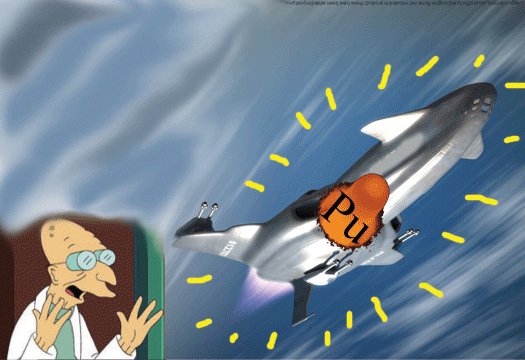
The US also wants to put nuclear power into space 28 — reactors in the sky — and awarded a major contract to a team that includes GE, the company which engineered the flawed Fukushima reactors.29 Rockets can explode at launch, malfunction after launch, or fail to reach orbit. This last happened with SNAP 9-A in 1964. As a result, 2.1 pounds of plutonium-238 “vaporized in the atmosphere and spread worldwide… Dr. John Goffman …concluded that the dispersed deadly plutonium-238 was a leading cause of the increase in cancers around the world today.”30 There have been other space nuclear accidents. Officials don’t seem to care.
The militarization of the atmosphere, space, and the moon risk World War III — another problem. 5G in space will control weapons systems on Earth and in the ocean, 31 including military sonar already responsible for killing hundreds of thousands of dolphins, whales, and other marine animals.32

The militarization of the atmosphere, space, and the moon risk World War III — another problem. 5G in space will control weapons systems on Earth and in the ocean, 31 including military sonar already responsible for killing hundreds of thousands of dolphins, whales, and other marine animals.32
Elon Musk/SpaceX in partnership with the US government has endangered Chinese astronauts by getting too close to their space station.33 Musk is the same man who advocates nuking Mars and saying the U.S. can coup whatever country it wants for rare earth minerals such as lithium.34 The military and its contractors are not guided by responsible, calm leaders. The worst is already happening.

Add to that accelerating plans to exploit, extract, militarize, and privatize the sovereign moon which stabilizes Earth’s rotation and climates, creates the tides, and is essential to all life, as I detailed in my previous article.35 Who’s protecting the moon and the Earth?
Military conquest, profiteering through extraction, mining, tourism, and exploitation are the main goals driving the expenditure of public monies and private investment, not pretty space pictures or neutral, scientific “exploration”. The plutonium ecocide of Saturn by the space industry via the Cassini probe should have been a wakeup call to pull the plug on NASA and the aerospace industry before more planets are destroyed including the Earth.
Subsidizing this industry has caused a brain drain into its high-paying jobs, neglecting and hampering work on Earth’s urgent problems. And the aerospace industry has siphoned off billions in public funds that could fund solutions, while causing expensive environmental problems to be dealt with “later”. The $10 billion dollar Webb telescope is one recent example. Decisionmakers are dashing headlong toward the mirage of a new Gold Rush.
It’s time to strip back the curtain and reveal the protected astronauts, aerospace moguls, and rocket scientists. They are not heroes. They are destroying the Earth. The joy rides of William Shatner and Jeff Bezos were sickening.
Those who want to stop climate change and protect the ozone layer must halt the space programs including space tourism and military programs.
Those who would protect the environment must stop these programs and do it now.
This is common sense. This is about Earth protection. This is about growing up.
Stop the rockets. Defund the space programs. Protect the Earth now.
Tight timetable for the Rolls Royce-led conglomeration to ever get their small nuclear reactors built

The reactors themselves will be installed at existing nuclear sites in
Britain. Rolls-Royce has not yet committed to any sites but Wylfa and
Trawsfynydd in north Wales are believed to be under consideration.
The company and its partners, which include Qatar’s sovereign wealth fund and
France’s wealthy Perrodo family, expect to decide on where to locate the
factory this year and to start construction soon after.
They face a tight timetable if they are to stay on track to meet their ambition to complete
the first 470MW plant by the early 2030s. Alongside the site selection, the
companies are putting their SMR design through the UK’s rigorous nuclear
regulatory regime, a process that is expected to take up to four years.
Irish Times 23rd Jan 2022
1 This Month



26 September – International Day for the Total Elimination of Nuclear Weapons


PLEASE OPPOSE HR 8255 AND S.3639 – bills would accelerate satellite deployment, with no environmental review or safeguards – https://ncstd5li.quorum.us/campaign/169331/
To see nuclear-related stories in greater depth and intensity – go to https://nuclearinformation.wordpress.com
-
Archives
- September 2026 (245)
- August 2026 (330)
- July 2026 (355)
- June 2026 (287)
- May 2026 (306)
- April 2026 (356)
- March 2026 (251)
- February 2026 (267)
- January 2026 (308)
- December 2025 (358)
- November 2025 (359)
- October 2025 (375)
-
Categories
- 1
- 1 NUCLEAR ISSUES
- business and costs
- climate change
- culture and arts
- ENERGY
- environment
- health
- history
- indigenous issues
- Legal
- marketing of nuclear
- media
- opposition to nuclear
- PERSONAL STORIES
- politics
- politics international
- Religion and ethics
- safety
- secrets,lies and civil liberties
- spinbuster
- technology
- Uranium
- wastes
- weapons and war
- Women
- 2 WORLD
- ACTION
- AFRICA
- Atrocities
- AUSTRALIA
- Christina's notes
- Christina's themes
- culture and arts
- Events
- Fuk 2022
- Fuk 2023
- Fukushima 2017
- Fukushima 2018
- fukushima 2019
- Fukushima 2020
- Fukushima 2021
- general
- global warming
- Humour (God we need it)
- Nuclear
- RARE EARTHS
- Reference
- resources – print
- Resources -audiovicual
- Weekly Newsletter
- World
- World Nuclear
- YouTube
-
RSS
Entries RSS
Comments RSS
 nuclear-news