A nuclear start-up company could undermine Canada’s global non-proliferation policy: experts
A nuclear start-up company could undermine Canada’s global non-proliferation policy: experts
the International Atomic Energy Agency (IAEA) has stated that “Nuclear weapons can be fabricated using plutonium containing virtually any combination of plutonium isotopes.” All plutonium is of equal “sensitivity” for purposes of IAEA safeguards in non-nuclear weapon states.
Similarly, a 2009 report by non-proliferation experts from six U.S. national laboratories concluded that pyroprocessing is about as susceptible to misuse for nuclear weapons as the original reprocessing technology used by the military, called PUREX.
By SUSAN O’DONNELL AND GORDON EDWARDS , THE HILL TIMES, JUNE 11, 2021www.ccnr.org/undermining_non-proliferation_2021.pdf
Important national and international issues are at stake, and conscientious Canadians should sit up and take notice. Parliamentarians of all parties owe it to their constituents to demand more accountability. To date however, there has been no democratic open debate or public consultation over the path Canada is charting with nuclear energy.
The recent effort to persuade Canada to sign the Treaty on the Prohibition of Nuclear Weapons has stimulated a lively debate in the public sphere. At the same time, out of the spotlight, the start-up company Moltex Energy received a federal grant to develop a nuclear project in New Brunswick that experts say will undermine Canada’s credibility as a non-proliferation partner.
Moltex wants to extract plutonium from the thousands of used nuclear fuel bundles currently stored as “high-level radioactive waste” at the Point Lepreau reactor site on the Bay of Fundy. The idea is to use the plutonium as fuel for a new nuclear reactor, still in the design stage. If the project is successful, the entire package could be replicated and sold to other countries if the Government of Canada approves the sale.On May 25, nine U.S. non-proliferation experts sent an open letter to Prime Minister Justin Trudeau expressing concern that by “backing spent-fuel reprocessing and plutonium extraction, the Government of Canada will undermine the global nuclear weapons non-proliferation regime that Canada has done so much to strengthen.”
The nine signatories to the letter include senior White House appointees and other U.S. government advisers who worked under six U.S. presidents: John F. Kennedy, Lyndon B. Johnson, Richard Nixon, George H.W. Bush, Bill Clinton, and Barack Obama; and who hold professorships at the Harvard Kennedy School, University of Maryland, Georgetown University, University of Texas at Austin, George Washington University, and Princeton University.
Plutonium is a human-made element created as a byproduct in every nuclear reactor. It’s a “Jekyll and Hyde” kind of material: on the one hand, it is the stuff that nuclear weapons are made from. On the other hand, it can be used as a nuclear fuel. The crucial question is, can you have one without the other?
India exploded its first nuclear weapon in 1974 using plutonium extracted from a “peaceful” Canadian nuclear reactor given as a gift many years earlier. In the months afterwards, it was discovered that South Korea, Pakistan, Taiwan and Argentina—all of them customers of Canadian nuclear technology—were well on the way to replicating India’s achievement. Swift action by the U.S. and its allies prevented these countries from acquiring the necessary plutonium extraction facilities (called “reprocessing plants”). To this day, South Korea is not allowed to extract plutonium from used nuclear fuel on its own territory—a long-lasting political legacy of the 1974 Indian explosion and its aftermath—due to proliferation concerns.
Several years after the Indian explosion, the U.S. Carter administration ended federal support for civil reprocessing of spent nuclear fuel in the U.S. out of concern that it would contribute to the proliferation of nuclear weapons by making plutonium more available. At that time, Canada’s policy on reprocessing also changed to accord with the U.S. policy—although no similar high-level announcement was made by the Canadian government.
Moltex is proposing to use a type of plutonium extraction technology called “pyroprocessing,” in which the solid used reactor fuel is converted to a liquid form, dissolved in a very hot bath of molten salt. What happens next is described by Moltex chairman and chief scientist Ian Scott in a recent article in Energy Intelligence. “We then—in a very, very simple process—extract the plutonium selectively from that molten metal. It’s literally a pot. You put the metal in, put salt in the top, mix them up, and the plutonium moves into the salt, and the salt’s our fuel. That’s it. … You tip the crucible and out pours the fuel for our reactor.”
The federal government recently supported the Moltex project with a $50.5-million grant, announced on March 18 by Intergovernmental Affairs Minister Dominic LeBlanc in Saint John. At the event, LeBlanc and New Brunswick Premier Blaine Higgs described the Moltex project as “recycling” nuclear waste, although in fact barely one-half of one per cent of the used nuclear fuel is potentially available for use as new reactor fuel. That leaves a lot of radioactive waste left over.
From an international perspective, the government grant to Moltex can be seen as Canada sending a signal—giving a green light to plutonium extraction and the reprocessing of used nuclear fuel.
The U.S. experts’ primary concern is that other countries could point to Canada’s support of the Moltex program to help justify its own plutonium acquisition programs. That could undo years of efforts to keep nuclear weapons out of the hands of countries that might want to join the ranks of unofficial nuclear weapons states such as Israel, India, Pakistan, and North Korea. The Moltex project is especially irksome since its proposed pyroprocessing technology is very similar to the one that South Korea has been trying to deploy for almost 10 years.
In their letter, the American experts point out that Japan is currently the only non-nuclear-armed state that reprocesses spent nuclear fuel, a fact that is provoking both domestic and international controversy.
In a follow-up exchange, signatory Prof. Frank von Hippel of Princeton University explained that the international controversy is threefold: (1) The United States sees both a nuclear weapons proliferation danger from Japan’s plutonium stockpile and also a nuclear terrorism threat from the possible theft of separated plutonium; (2) China and South Korea see Japan’s plutonium stocks as a basis for a rapid nuclear weaponization; and (3) South Korea’s nuclear-energy R&D community is demanding that the U.S. grant them the same right to separate plutonium as Japan enjoys.
Despite the alarm raised by the nine authors in their letter to Trudeau, they have received no reply from the government. The only response has come from the Moltex CEO Rory O’Sullivan. His reply to a Globe and Mail reporter is similar to his earlier rebuttal in The Hill Times published in his letter to the editor on April 5: the plutonium extracted in the Moltex facility would be “completely unsuitable for use in weapons.”
But the International Atomic Energy Agency (IAEA) has stated that “Nuclear weapons can be fabricated using plutonium containing virtually any combination of plutonium isotopes.” All plutonium is of equal “sensitivity” for purposes of IAEA safeguards in non-nuclear weapon states.
Similarly, a 2009 report by non-proliferation experts from six U.S. national laboratories concluded that pyroprocessing is about as susceptible to misuse for nuclear weapons as the original reprocessing technology used by the military, called PUREX.
In 2011, a U.S. State Department official responsible for U.S. nuclear cooperation agreements with other countries went further by stating that pyro-processing is just as dangerous from a proliferation point of view as any other kind of plutonium extraction technology, saying: “frankly and positively that pyro-processing is reprocessing. Period. Full stop.”
And, despite years of effort, the IAEA has not yet developed an approach to effectively safeguard pyroprocessing to prevent diversion of plutonium for illicit uses.
Given that history has shown the dangers of promoting the greater availability of plutonium, why is the federal government supporting pyroprocessing?
It is clear the nuclear lobby wants it. In the industry’s report, “Feasibility of Small Modular Reactor Development and Deployment in Canada,” released in March, the reprocessing (which they call “recycling”) of spent nuclear fuel is presented as a key element of the industry’s future plans.
Important national and international issues are at stake, and conscientious Canadians should sit up and take notice. Parliamentarians of all parties owe it to their constituents to demand more accountability. To date however, there has been no democratic open debate or public consultation over the path Canada is charting with nuclear energy.
Countless Canadians have urged Canada to sign the UN Treaty on the Prohibition of Nuclear Weapons that came into force at the end of January this year. Ironically, the government has rebuffed these efforts, claiming that it does not want to “undermine” Canada’s long-standing effort to achieve a Fissile Materials Cut-off Treaty. Such a treaty would, if it ever saw the light of day (which seems increasingly unlikely), stop the production of weapons usable materials such as Highly Enriched Uranium and (you guessed it) Plutonium.
So, the Emperor not only has no clothes, but his right hand doesn’t know what his left hand is doing.
Susan O’Donnell is a researcher specializing in technology adoption and environmental issues at the University of New Brunswick and is based in Fredericton.Gordon Edwards is a mathematician, physicist, nuclear consultant, and president of the Canadian Coalition for Nuclear Responsibility, and is based in Montreal.
Russia’s Approach to Nuclear Power in Outer Space
Russia’s Approach to Nuclear Power in Outer Space
Jamestown Foundation, Eurasia Daily Monitor Volume: 18 Issue: 92 By: Pavel Luzinune 9, 2021
Russia has been conducting research and development (R&D) on using nuclear power in outer space for years. On May 22, Alexander Bloshenko, executive director for advanced programs and science of Roscosmos, announced that the first mission of the nuclear-powered spacecraft, also known as the transport and energy module (TEM), is scheduled for 2030 (TASS, May 22). A week before this announcement, there was a deliberate leak from the Keldysh Center, a Roscosmos subsidiary entity, that this nuclear-powered spacecraft might be used for military purposes along with civil ones (RIA Novosti, May 13). These verbal interventions almost coincided with the hearings in the US Congress on the NASA budget request that proposes $585 million for nuclear thermal propulsion technology in FY2022 and ongoing American efforts in this field (SpaceNews, May 19; Physics Today, May 28). That means the Russian program on space nuclear power systems has not only technological but also geopolitical goals.
The current Russian program has a Soviet background. The USSR launched 33 military reconnaissance and targeting spacecraft with nuclear reactors into low-Earth orbit from 1969 to 1988. Most of them used thermoelectric nuclear power plants “Buk,” and the last two spacecraft used more advanced thermal electron emission NPPs “Topaz” with 4.5–5.5 kW of electric power. The Soviet Union also developed the prototypes of nuclear rocket engines, but the project was closed in 1986. In the early 1990s, a Russian-American project aimed to develop the “Topaz” reactors further, but was canceled by 1995. In 2000–2007, Russia tried to cooperate with China in this field (Kukharkin, 2012).
Despite long-term economic decline, Moscow has also tried to continue its independent efforts in space nuclear power systems since 1998, and during the presidency of Dmitry Medvedev, these efforts were proclaimed among the Kremlin’s key priorities (Pravo.gov.ru, February 2, 1998; RG.ru, November 13, 2009).
The program’s budget of 17 billion rubles for the period 2010–2018 was divided between Roscosmos (9.8 billion rubles) and Rosatom (7.2 billion rubles), totaling $560 million according to the exchange rates of 2010 (RG.ru, October 3, 2012). However, the actual spending was smaller. In 2010, only 500 million rubles ($16.5 million) were assigned for the purpose (Roscosmos, February 10, 2010). During the following decade, the total spending has reached almost 10 billion rubles or $213 million according to open data on federal budget funds and procurements released by Roscosmos and Rosatom (Vesti.ru, January 19, 2011; Interfax, October 12, 2020; Zakupki.gov.ru, 2013–2021). The current results of these efforts are less than initially planned………..
In comparison with NASA that tries to design a 10 kW space nuclear reactor with a Stirling engine intended to increase efficiency, the thermal electron emission remains the central paradigm of Russia’s R&Ds and the idea of using engines or turbines together with space nuclear reactors still remains theoretical (NASA, May 2, 2018; Issledovaniya Naukograda, July–September 2017). It is doubtful that Russia will develop the space nuclear power system with 1 MW of electric power and ion thrusters with more power in the foreseeable future. Still, Moscow definitely will try to convert existing results into some advance in outer space and foreign policy.
Along with a significant deficiency in other dimensions of Russia’s space activity and the country’s overall economic weakness, these problems prompt the Kremlin to look for an ace up its sleeve. While there is still a long way to go to develop nuclear reactors for space exploration missions, Russian industry and authorities are seeking to apply nuclear power for military satellites (KB Arsenal, September 1, 2020). Such spacecraft may be used for radar reconnaissance and electronic warfare (jamming) and be deployed to low, medium or geosynchronous orbits. However, there have not been any flight tests or technological demonstrations of such a satellite yet. This means Moscow will not be ready to deploy these satellites any time soon……… https://jamestown.org/program/russias-approach-to-nuclear-power-in-outer-space/
Bill Gates, Warren Buffett’s piddly little ”Natrium” nuclear reactor – greenwashing, while keeping fossil fuels going.

The key to understanding this story is found in Governor Gordon’s use of the words “all of the above.” That’s free market speak for “We’rehappy to have a piddly little 350 MW facility of over here, just so long as we can continue supporting coal- and gas-powered generating plants that churn out hundreds of gigawatts over there.”
In other words, it’s asmokescreen designed to allow fossil fuel interests to kick the can down the road a little further and add some greenwashing to their corporate portfolios at the same time. Being rich does not necessarily make a person all that smart. America needs more nuclear power like a fish needs a bicycle.
People in Wyoming may be fooled by this blather, but CleanTechnica readers aren’t taking the bait. Natrium was probably selected as the name of thus new nuclear technology because it sounds a little like “nature” or “natural.” That’s a great marketing ploy, but we’re not buying it. Frankly, the Bill and Warren show is more than a little disappointing.
Clean Technica 3rd June 2021
Bill Gates & Warren Buffett To Build A New Kind Of Nuclear Reactor — Is That Good News?
Billionaires’ advanced ”Natrium” nuclear reactors planned for Wyoming.
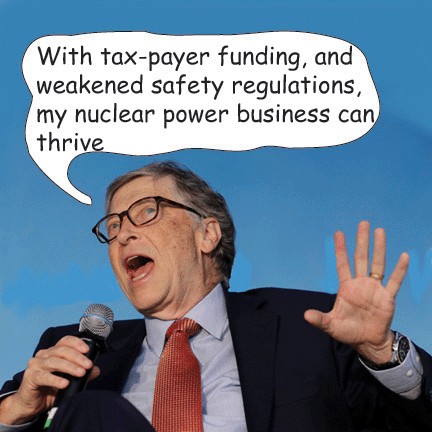
Power companies run by billionaire friends Bill Gates and Warren Buffett
have chosen Wyoming to launch the first Natrium nuclear reactor project on
the site of a retiring coal plant. TerraPower, founded by Gates about 15
years ago, and power company PacifiCorp, owned by Warren Buffett’s
Berkshire Hathaway, said on Wednesday that the exact site of the Natrium
reactor demonstration plant was expected to be announced by the end of the
year.
Nuclear power experts have warned that advanced reactors could have higher risks than
conventional ones. Fuel for many advanced reactors would have to be
enriched at a much higher rate than conventional fuel, meaning the fuel
supply chain could be an attractive target for militants looking to create
a crude nuclear weapon, a recent report said.
Guardian 3rd June 2021
Small nuclear reactors pushed for military use,despite their obvious dangers
There are concerns, of course, associated with deploying mobile nuclear reactors to bases or the battlefield. Meltdowns, waste products, and other malfunctions are always a concern with nuclear energy technologies, and if a reactor in a contested area is destroyed by adversary forces, for example, the risk of environmental contamination is high. That, in turn, could create a political disaster for the DOD and United States. Deploying any nuclear systems abroad also incurs the risk of proliferation if those technologies should fall into the wrong hands due to a forward-operating base or convoy being overrun by hostile forces.
Those concerns will no doubt be a major policy consideration when, or if, these mobile reactors ever reach a state of technological readiness to where they can be deployed. New nuclear technologies aren’t the only new energy production and storage systems the DOD is eyeing, however. Revolutionary concepts such as space-based solar power beaming, new forms of hydrogen fuel cells, or even more advanced applications of existing technologies like modular solar generators are all being developed which could revolutionize how the DOD powers its expeditionary forces without the risks associated with nuclear power.

The Military’s Mobile Nuclear Reactor Prototype Is Set To Begin Taking Shape, The Drive BY BRETT TINGLEY JUNE 3, 2021
Project Pele is one potentially revolutionary, albeit controversial, answer to the military’s growing battlefield energy requirements.
The Office of The Secretary of Defense (OSD) has requested $60 million dollars for Project Pele, which is aimed at developing a new, transportable nuclear microreactor to provide high-output, resilient power for a wide variety of Department of Defense (DOD) missions. The DOD hopes to begin working on a prototype reactor design, which will hopefully be able to eventually produce one to five megawatts of electricity and operate at peak power for at least three years, in the next fiscal year.
The request for funding for Project Pele is found in the Pentagon’s proposed budget for the 2022 Fiscal Year, which was released on May 28, 2021. This is the first year that the Office of the Secretary of Defense has asked for money for this program through the larger Advanced Innovative Technologies line item. Previous funding for Pele, also known as the Micro Nuclear Reactor Program, had come through a separate Operational Energy Capability Improvement account in OSD’s budget.
The budget documents say that the goals for Project Pele in the 2022 Fiscal Year are to “complete the design phase and prepare for construction of a 1-5 Megawatt electric transportable nuclear microreactor.” In addition, it notes that “due to the nature of this project, specific applications and detailed plans are available at a higher classification level.”
“The Pele project continues activities initiated under Congressional direction in FY 2020 and FY 2021,” according to the documents. “Congressional Adds [totaling $16 million in the 2021 Fiscal Year] directed for nuclear fuel core development to support the Pele reactor maturation and also funding to support power and thermal management maturation for directed energy weapons.”
………………the Fiscal Year 2022 budget requests says the desired design is as a 1-5 megawatt (MW) nuclear microreactor.
For comparison, the output of the smallest nuclear power plant in the United States, New York’s R.E. Ginna Nuclear Power Plant, is 581 MW. The desired power output is even smaller than most research reactors.
…… The funding for Pele also builds on several other developments, which show that the DOD, DOE, and the National Aeronautics and Space Administration (NASA) are investing heavily in new nuclear technologies to power a new American space age. “Production of a full-scale fourth-generation nuclear reactor will have significant geopolitical implications for the United States,” said Jay Dryer, director of the Strategic Capabilities Office.
……… Building on that document’s goals, a January 2021 Executive Order expanded on the National Space Council document by ordering NASA to deliver a report that defines requirements and foreseeable issues for developing a nuclear energy system to enable human and robotic space missions for the next two decades. The order also included plans for a “Common Technology Roadmap” made among NASA and the Departments of Energy, Defense, Commerce, and State for developing and deploying these new reactor technologies.
Energy security and dominance have become cornerstones of DOD strategy, given the unbelievable amounts of fuel and energy consumed by the power-hungry systems the modern military depends on. U.S. Army leadership has previously stated that it wants its brigades to be self-sufficient for a week without the need for resupply, and there have been previous calls for microreactors that could fit inside existing platforms such as the C-17 Globemaster. Meanwhile, Lockheed Martin and other laboratories continue work on the lofty goal of developing miniaturized fusion reactors…….
There are concerns, of course, associated with deploying mobile nuclear reactors to bases or the battlefield. Meltdowns, waste products, and other malfunctions are always a concern with nuclear energy technologies, and if a reactor in a contested area is destroyed by adversary forces, for example, the risk of environmental contamination is high. That, in turn, could create a political disaster for the DOD and United States. Deploying any nuclear systems abroad also incurs the risk of proliferation if those technologies should fall into the wrong hands due to a forward-operating base or convoy being overrun by hostile forces.
Those concerns will no doubt be a major policy consideration when, or if, these mobile reactors ever reach a state of technological readiness to where they can be deployed. New nuclear technologies aren’t the only new energy production and storage systems the DOD is eyeing, however. Revolutionary concepts such as space-based solar power beaming, new forms of hydrogen fuel cells, or even more advanced applications of existing technologies like modular solar generators are all being developed which could revolutionize how the DOD powers its expeditionary forces without the risks associated with nuclear power. https://www.thedrive.com/the-war-zone/40914/the-militarys-mobile-nuclear-reactor-prototype-is-set-to-begin-taking-shape
Ionising radiation the big danger to astronauts

NASA says that not only does space radiation potentially put astronauts at greater risk of radiation sickness, but an “increased lifetime risk for cancer, central nervous system effects, and degenerative diseases.”
Astronauts in space are exposed to the radiation equivalent of 150 to 6,000 chest x-rays https://www.revelstokereview.com/news/morning-start-astronauts-in-space-are-exposed-to-the-radiation-equivalent-of-150-to-6000-chest-x-rays/ May 28, 2021
As noted by NASA, radiation is a type of energy that is emitted in the form of rays, electromagnetic waves and/or particles. Radiation can be seen as visible light or felt as infrared radiation. However, some forms of radiation, like x-rays and gamma rays, are not visible.
Space radiation differs from the type of radiation experienced on Earth because intergalactic radiation “is comprised of atoms in which electrons have been stripped away as the atom accelerated in interstellar space to speeds approaching the speed of light – eventually, only the nucleus of the atom remains.”
So how much space radiation are astronauts exposed to? They’re exposed to “ionizing radiation with effective doses in the range from 50 to 2,000 mSv. 1 mSv of ionizing radiation is equivalent to about three chest x-rays. So that’s like if you were to have 150 to 6,000 chest x-rays.”
With that being said, NASA says that not only does space radiation potentially put astronauts at greater risk of radiation sickness, but an “increased lifetime risk for cancer, central nervous system effects, and degenerative diseases.”
Nuclear reactors in space, – enthusiasm by corporations and governments ignores the dangers.

You have to read through this article – about ”a major advance” – very carefully – to see that nothing much is really happening. You have to get to the end of the article =to learn how very dangerous is this plan. Of course there;’s no mention that (A) the whole thing is totally connected with militarism, and (B) only the tax-payer would be willing and able to pay for these space toys
Companies and government agencies propose nuclear reactors for space. The technologies could help the US Space Force monitor the region between Earth and the Moon Physics Today, Sarah Scoles 28 May 21, ,,……….
Someday, such a system could power and propel spacecraft or keep the lights on in lunar or Martian habitats. That sort of nuclear electricity source would be a major advance…..
Eric Felt, space vehicles director at the Air Force Research Laboratory (which supports both the air and space forces), spoke to Physics Today on behalf of the space force’s interests. The branch, he says, is monitoring developments in space-based nuclear reactors but not yet funding them. The recently established branch has no immediate plans to use off-Earth nuclear reactors and hasn’t determined if or how space fission fits into its portfolio. Felt says both the technological and policy barriers have shrunk; the obstacle that remains is to find a goal that needs nuclear fission.
One place where nuclear technology could fit is cislunar space—the expanse between Earth and the Moon.
……… McClure, Poston, and former Los Alamos associate director Andy Phelps have spun out their innovation into a company called Space Nuclear Power Corp, or SpaceNukes……..
SpaceNukes is not the only group working on nuclear reactors for cislunar “space domain awareness.” Among others, the Defense Advanced Research Projects Agency (DARPA) is pursuing a related project, the Demonstration Rocket for Agile Cislunar Operations, or DRACO. The craft would be propelled by a nuclear-thermal system and capable of surveilling a large area……….
Felt has met with the DRACO team and agreed to consider partnering with DARPA to transition the technology to the space force once it’s mature. The caveat—as with the Kilopower project—is that the space force must first find a “killer app” for it, says Felt. “Maybe ‘raison d’être’ would be more accurate,” he adds……. https://physicstoday.scitation.org/do/10.1063/PT.6.2.20210528a/full/
Sarah Scoles
……………..Nuclear reactors in space are not without hazards. Accidents involving nuclear reactors could put Earthlings at more risk than with conventional spacecraft. And any technology involving uranium could stir international objections, especially if it uses highly enriched uranium (HEU), as Kilopower does. “The problem with HEU is it’s weapons-grade material,” says McClure. “There’s always the concern that, if we lost it on launch, some bad person would recover it and do nefarious things.” Some policymakers and nonprofit groups worry that producing and using more HEU, which the US has worked to minimize for decades, poses proliferation risks.
The bomb-ready fuel isn’t banned completely, but its use would put the Kilopower design in the most stringent launch-approval category. The system can use a less-controversial fuel called high-assay low-enriched uranium, or HALEU, which does not carry the same proliferation risks, but it would add 700 kilograms to the reactor’s mass. “We prefer to use HEU because the system is lighter,” says Poston. But by using HALEU, DRACO’s launch approval would be greatly simplified. https://physicstoday.scitation.org/do/10.1063/PT.6.2.20210528a/full/
New technology comes nowhere close to solving the problem of nuclear waste

New technology comes nowhere close to solving the problem of nuclear waste, Toronto Star, By Thomas Walkom May 27, 2021 What is to be done with nuclear waste? It is a question that dominates the Atomic Age. It is also one that has never been satisfactorily answered…..
nuclear waste is a relentless certainty. A plant that produces nuclear power creates nuclear waste. It is that simple.But what to do with that waste? Up to now, the assumption was that such waste would be buried in deep geological caverns, or repositories. Two potential sites for such repositories have been identified — one in Northwestern Ontario and one near Lake Huron. The usual political battles are being waged over whether either or both sites are safe.
But over the last few years, more attention has been paid to a different solution — using radioactive waste as fuel to create more nuclear power from so-called small modular reactors (SMRs). The governments of Saskatchewan, Ontario and New Brunswick have been particularly interested in developing this new SMR technology.
One New Brunswick start-up, Moltex Energy of Saint John, has received $50.5 million in federal funds.
The new technology has its critics. In the first place, it can create new and even more dangerous radioactive waste. As the Globe and Mail reports, Moltex says it produces an impure form of plutonium as a waste byproduct from its SMRs. Pure plutonium is used in the manufacture of atomic bombs.
Indeed, some nuclear experts, including former senior U.S. officials, were so alarmed that seven of them took the unusual step of penning an open letter this week to Prime Minister Justin Trudeau.
In that letter, they warned that reprocessing waste in a manner that creates plutonium would undermine global efforts to limit nuclear proliferation.
They also noted that the new technology wouldn’t solve the waste problem. Rather, it would just produce different kinds of nuclear waste.
“Moltex, even in the R&D stage, would create a costly legacy of contaminated facilities and radioactive waste streams and require substantial additional government funding for cleanup,” the letter said.
All of this is true. But none of it is enough to derail the new interest in SMR technology. Governments like it because it promises to be cheaper to build than classic Pickering-style nuclear power plants. The nuclear industry sees it as a political lifeline at a time when atomic power is not particularly popular.
So regardless of what its critics say, don’t expect this new technology to fade away. It may not be the silver bullet that its adherents claim it to be. It comes nowhere close to solving the waste problem.
But it is supported by important political constituencies. History has shown how crucial this support has been to the nuclear industry. https://www.thestar.com/opinion/contributors/2021/05/27/new-technology-comes-nowhere-close-to-solving-the-problem-of-nuclear-waste.html
American experts warn Trudeau that Moltex small nuclear reactors are likely to prove a nightmare for Canada

The critics contend that SMRs are costly, unproven and creators of toxic waste of their own. From a practical point of view, it is hard to make the case that SMRs will be crucial in the battle against climate change, since they won’t come off the drawing board for years, if ever. Former Green Party leader Elizabeth May says that opting for experimental SMRs is just another way of delaying real action on global warming.
US Experts to Trudeau: Your Nuclear Dream May Turn Nightmare https://thetyee.ca/Analysis/2021/05/26/US-Experts-Trudeau-Your-Nuclear-Dream-May-Turn-Nightmare/?utm_source=daily&utm_medium=email&utm_campaign=260521
Rethink backing the Moltex reactor, urge nine non-proliferation heavyweights.
Michael Harris TheTyee.ca, 6 May 21, A blue-ribbon group of American nuclear non-proliferation experts warns that Canada’s investment in new nuclear technology could lead to the spread of nuclear weapons and new threats to the environment.
“We write as U.S. non-proliferation experts and former government officials and advisors with related responsibilities to express our concern about your government’s financial support of Moltex — a startup company that proposes to reprocess CANDU spent fuel to recover its contained plutonium for use in molten-salt-cooled reactors.”
The warning came in the form of an open letter to Prime Minister Justin Trudeau that was delivered on Tuesday and signed by the nine experts.
The group is spearheaded by Frank von Hippel, professor and senior research physicist at Princeton University; it includes Matthew Bunn, the Schlesinger professor of the practise of energy, national security, and foreign policy at the Harvard Kennedy School; and Thomas Countryman, former U.S. assistant secretary of state for non-proliferation.
“We understand your government’s motivation to support nuclear power and to reduce fossil fuel use but saving the world from climate disaster need not be in conflict with saving it from nuclear weapons. Also, like other reprocessing efforts, Moltex, even in the R&D stage, would create a costly legacy of contaminated facilities and radioactive waste streams, and require substantial additional government funding for cleanup and stabilization prior to disposal,” they wrote.
Rory O’Sullivan, CEO of Moltex North America painted a very different picture of his company’s experimental technology in an interview with World Nuclear News: “We are working to develop a technology that uses the fuel from the first generation of nuclear power to the next. This reduces the challenges associated with spent nuclear fuel, while expanding nuclear power to help Canada achieve its climate change objectives.”
The Trudeau government has invested $50.5 million in Moltex, and backs the company’s plan to build a 300 MW molten salt reactor in New Brunswick on the Bay of Fundy. Theoretically, it would then reprocess spent fuel from the Point Lepreau nuclear plant, which is set to be decommissioned in 2040.
The Moltex reactor belongs to a class of nuclear power plants termed small modular reactors or SMRs that generate small amounts of electricity in comparison with typical CANDU reactors.
Natural Resources Minister Seamus O’Regan has said that Canada can’t get to net-zero carbon emissions by 2050 without nuclear as part of the equation, along with renewables.
Despite marketing its roll of the dice on Moltex as part of its war on climate change, Ottawa isn’t getting much love from environmentalists, or many other people. Three federal political parties, the NDP, the Bloc and the Greens; the Green Budget Coalition; and the Canadian Environmental Law Association all oppose the federal investment in small modular reactors. University of British Columbia professor of public policy and global affairs M.V. Ramana has levelled criticisms in these pages as well.
The critics contend that SMRs are costly, unproven and creators of toxic waste of their own. From a practical point of view, it is hard to make the case that SMRs will be crucial in the battle against climate change, since they won’t come off the drawing board for years, if ever. Former Green Party leader Elizabeth May says that opting for experimental SMRs is just another way of delaying real action on global warming.
One who has closely followed and opposes the two experimental SMR reactors planned for New Brunswick, the ARC-100 and the Moltex SSR, is Dr. Susan O’Donnell, an adjunct professor of sociology at the University of New Brunswick. O’Donnell is also the primary investigator of Raven, a research team based at the university dedicated to highlighting rural environmental issues in the province.
O’Donnell points out that Moltex has never built a nuclear reactor before. In fact, only two molten salt reactors have ever been built — 50 years ago. Neither of them produced electricity. One of them lasted four years before shutting down, the other, just 100 hours.
On the environmental side, O’Donnell says that SMR pollution or a serious failure could lead to “disasters and no-go zones.”
On the non-proliferation front, she denounces the plan to broadly “export” the Moltex technology, assuming it ever gets up and running.
“What we have learned from Canada’s role in making India a nuclear power is that one of the dangers of the Moltex proposal is its plan to export the technology. We’re exporting bomb-making capacity,” she told The Tyee.
O’Donnell has pushed for public consultations to help develop a national radioactive waste policy. Last Aug. 13, she made an offer to the federal minister of natural resources to have the Raven project organize such a public consultation in New Brunswick. It would be online because of the pandemic, in both official languages, and would include Indigenous nations and rural communities. Minister O’Regan responded two months later, on Oct. 30, turning her down.
“Strangely, he cited the pandemic, even though our offer clearly stated the consultation would be virtual,” the professor said.
O’Donnell’s take on the Moltex project is backed up by Allison Macfarlane, former chair of the U.S. Nuclear Regulatory Commission. The specialist in the storage of nuclear waste told the CBC in January that the molten salt technology is totally unproven with respect to viability, costs and storage risks.
“Nobody knows what the numbers are, and anybody who gives you numbers is selling you a bridge to nowhere…. Nobody’s been able to answer my questions yet on what all those wastes are, and how much of them there are, and how heat-producing they are and what their compositions are,” Macfarlane said. She is now the director of the School of Public Policy and Global Affairs at UBC.
But the Trudeau government does have allies at the provincial level for its nuclear ambitions. The governments of New Brunswick, Ontario, Saskatchewan and Alberta have all signed a memorandum of understanding to develop SMRs, which means promoting them.
They are excited about the promises by Moltex that it will be able to produce clean energy at a low cost by recycling something that everyone wants to get rid of — the three million spent fuel bundles in Canada that the government still doesn’t know how to dispose of safely and permanently.
The U.S. experts made clear to the PM in their letter that they are not convinced by the company’s assertions. They want the Trudeau government to convene a high-level review of both the non-proliferation and environmental implications of Moltex’s reprocessing proposal. Key to that proposal is including “independent international experts,” before Ottawa makes any further investments in support of the Moltex proposal.
The earliest projects to reprocess nuclear waste extracted plutonium to make nuclear weapons. The letter signees worry Canada’s new generation of reactors will afford the same opportunity to anyone who buys them.
“Our main concern is that, by backing spent-fuel reprocessing and plutonium extraction, the government of Canada will undermine the global nuclear weapons non-proliferation regime that Canada has done so much to strengthen. Canada is a founding member of the Nuclear Suppliers Group, which was established in 1974 in response to India’s misuse of a Canada-supplied research reactor and U.S.-supplied reprocessing technology to acquire the plutonium needed for its first nuclear weapons.”
The reprocessing of nuclear waste was “indefinitely deferred” in the United States by president Jimmy Carter in 1977 after India tested its first nuclear weapon. At the time, the Americans discovered that several other countries including Brazil, Pakistan, South Korea and Taiwan were all surreptitiously headed down the same nuclear weapons path that India had taken. Of that group, only Pakistan managed to get the bomb.
The U.S. experts who signed the letter to Trudeau also rejected the claim by Moltex that by using spent fuel from older Canadian CANDU reactors, its reactor would reduce the long-term risk from a deep underground radioactive waste repository.
The Trudeau government promised it would base its major policies on science. It’s time for the public consultation, far from the greasy paws of lobbyists, and with the best minds that can be brought to the table.
This is a letter to take to heart.
Russia’s plans for nuclear-powered spacecraft to Jupiter
Russia Wants To Send A Nuclear-Powered Spacecraft To Jupiter This Decade, IFL Science 26 May 21,Russia is planning to send a nuclear-powered spacecraft to the grand gas giant of the Solar System, Jupiter, in 2030.
Roscosmos, Russia’s federal space agency, announced the plan for the mammoth 50-month journey last week. The journey will take it on a mini tour of the Solar System, taking pit stops around the Moon and Venus, dropping off spacecraft along its way, before heading on to Jupiter.
More specifically, a “space tug” with a nuclear-based transport and energy module dubbed Zeus will head towards the Moon where a spacecraft will separate from it. It will then pass by Venus to perform a gravity assist maneuver and drop off another spacecraft, before venturing towards Jupiter and one of its satellites.
“Together with the Russian Academy of Sciences, we’re are now making calculations about this flight’s ballistics and payload,” Roscosmos Executive Director for Long-Term Programs and Science Alexander Bloshenko told reporters, according to TASS news agency.
Most spacecraft use solar panels that convert the Sun’s energy into electricity. However, the deeper a spacecraft goes into the Solar System, the further it strays from the Sun and less solar energy is available. While batteries can be used for backup, some missions – such as Cassini and Voyager – have been powered from a radioisotope thermoelectric generator (RTG), which is a bit like a nuclear battery that uses heat from the radioactive decay of isotopes. RTGs are not nuclear reactors, however, as a chain reaction does not take place.
The new Zeus project, by comparison, is a whole nuclear reactor that will use fission reactions to drive the propulsion. In the words of Russian state media, it’s a “secrecy-laden project in development since 2010” that involves a 500-kilowatt nuclear reactor, weighing around 22 tons….
The Soviet Union launched a bunch of nuclear reactors into space during the Cold War as part of the RORSAT missions, a set of Soviet nuclear spy satellites launched between 1967 and 1988. On the other hand, the US has launched just one: SNAP-10A or SNAPSHOT, a nuclear-reactor power system launched in 1965.
The US has regained interest in nuclear-powered space travel over the past few decades. Just recently, the US Defense Advanced Research Projects Agency (DARPA) has commissioned three private companies – Blue Origin, Lockheed Martin, and General Atomics – to develop nuclear fission thermal rockets for use in lunar orbit, with the goal of demonstrating the technology above low Earth orbit in 2025. https://www.iflscience.com/space/russia-wants-to-send-a-nuclearpower-spacecraft-to-jupiter-this-decade/
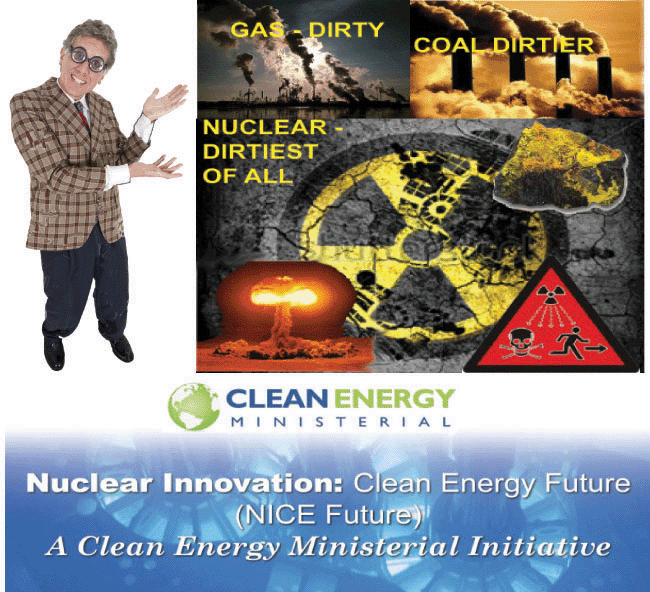
Canadian government in the grip of the nuclear lobby’s NICE dishonest spin about small nuclear reactors.
”…………….To date, not a single SMR has been built in Canada, but no matter, the technology is the current darling of nuclear power circles, and not just at home, either; other countries, from China to the United States, are pursuing the development of SMRs. Currently, 12 proposals for SMR development are winding their way through the Canadian Nuclear Safety Commission’s (CNSC) pre-licensing vendor review process, which enables CNSC staff to provide feedback on proposed designs at a company’s request. But not a single project has yet been approved.
For the time being, any vision of SMRs is largely aspirational. A Conference Board of Canada report in March on SMRs outlined that from concept to commercialization, the technology will require about a billion dollars of development expenditure. The same report noted that as an emerging technology, costs are still uncertain, and the “risky pre-commercial phase needs capital investment, but governments will be reluctant without major private capital commitment.”
It’s early days for financing the technology. For instance, one infusion of federal funds, the $50 million granted to New Brunswick’s Moltex Energy in mid-April, only supports research and development, employee recruitment and the expansion of academic, research and supply chain partnerships, not the physical construction of that firm’s SMR.
Beyond financial considerations, the Liberal government will have a tough time convincing environmentalists to embrace the merits of SMRs, or any nuclear power, as a clean energy source. More than 100 groups have signed a letter issued by the Canadian Environmental Law Association condemning the government’s push to pursue nuclear power and SMRs. Among their concerns are that SMRs are more expensive to develop than renewable energy and that the reactors are “dirty and dangerous,” creating new forms of radioactive waste that are especially dangerous to manage.
For now, however, nothing is slowing the momentum. In mid-April, the Canadian Nuclear Association triumphantly announced Alberta was joining Ontario, New Brunswick and Saskatchewan in the development of SMRs.
Those aren’t the only recent developments in the burgeoning SMR industry. Ontario Power Generation is teaming up with SMR developer Ultra Safe Nuclear Corporation to develop a micro modular reactor at Chalk River. Ontario Power Generation is also carrying out engineering and design work on SMRs with GE Hitachi, Terrestrial Energy, and X-energy…….
Europe is now shifting away from nuclear power. In 2019, solar installed capacity exceeded nuclear for the first time in the EU, with 130 gigawatts versus 116 gigawatts, according to the World Nuclear Industry Status annual report, which provides independent assessments of global nuclear developments. And a technical expert group convened in the EU chose not to recommend nuclear energy when asked to advise on screening criteria that would substantially contribute to climate change mitigation or adaptation while “avoiding significant harm” to other environmental objectives.,…..
the federal government has been lobbying hard on behalf of the industry since at least 2019. The Department of Natural Resources, for instance, is a member of the international initiative Nuclear Innovation: Clean Energy Future, or as it’s better known, NICE, Besides Canada, members include Japan, the United States, and a number of nuclear associations. The goal “is to ensure that nuclear energy receives appropriate representation in high-level discussions about clean energy.”
Freelance researcher Ken Rubin turned up a number of documents using freedom-of-information requests that showed the federal government is collaborating with NICE and others to promote nuclear power and SMRs. The federal government, for example, offered $150,000 for the development of a “Top 20 book of short stories” on “exciting near-term nuclear innovations” designed to showcase nuclear power as an environmental force for good. The book includes stories on the safe storage of nuclear waste as well as on the emerging SMR market.
According to the book, uses for the latter technology include “energy parks” providing heat for industrial processes, steam for heating and electricity for cooling homes, offices and shops, all without emissions. The story breathlessly declares: “This isn’t science fiction.”
No matter how hard the government lobbies the public for a NICE future, though, it’s going to remain a tough sell to Canadian environmentalists. While the environmentalists have nothing specific to fight yet, given that a viable SMR has yet to be built, they’ll be ready when the technology reaches development. Already, a who’s who of groups has signed a letter protesting the next thing in nuclear.
Theresa McClenaghan, CELA’s executive director and counsel, told Canada’s National Observer: “It’s not a climate answer for many reasons, including the fact it’s not realistic and it’s way too far down the road for us to meet any serious climate targets. We’ve characterized it as a dirty, dangerous distraction.”
Susan O’Donnell, a researcher and adjunct professor in the Department of Sociology at the University of New Brunswick and a nuclear activist, says SMRs are too slow and costly as a climate crisis solution. “It’s important to remember that these technologies basically don’t exist yet,” she said. “They’re at a very early stage in development. They are speculative technologies. It will take at least a decade to get them off the drawing board and then it will take much longer than that to find out if they work.” – from the Bulletin of the Atomic Scientists , 20 May 21
“Advanced” isn’t the answer — New reactors as an answer to climate change are an illusion

The study’s conclusion is that pursuing “advanced” nuclear reactors is too slow, too resource-intensive and too dangerous and won’t result in improvements over light-water reactors.
The costs of these “advanced” reactors are too high to justify their flimsy promises of improvement over traditional light-water reactors, especially given that the time needed urgently to address climate change is extremely short.
New reactors as an answer to climate change are an illusion
“Advanced” isn’t the answer — Beyond Nuclear International https://wordpress.com/read/feeds/72759838/posts/3354864782 23 May 21, Next in Talking Points series showcases USC takedown of non-light-water reactor delusions While we support efforts to guarantee better public safety protections for the public from the current fleet of light-water reactors, the position of Beyond Nuclear is that no further development of LWRs should happen, but rather that the country must expeditiously move to a 100% nuclear power phaseout.
Nevertheless, the specter of “advanced” reactors continues to loom, and many governments remain intent on squandering precious resources on attempts to develop these under the misleading guise of climate mitigation. Therefore, we believe that this comprehensive takedown of the futility of such endeavors is a valuable addition to our Talking Points series.
The full UCS report can be read here. And watch for new installments in our Talking Points series in the coming weeks.
Linda Pentz Gunter is the international specialist at Beyond Nuclear and writes for and edits Beyond Nuclear International.
By Linda Pentz Gunter
In the second in the Beyond Nuclear Talking Points series, we bring you Dr. Edwin Lyman’s definitive examination of so-called advanced reactors, or non-light-water reactors (NLWRs).
In a groundbreaking report, Lyman who is Director of Nuclear Power Safety at the Union of Concerned Scientists, debunks almost all of the industry claims for NLWRs, predominantly on the grounds of safety and security risks, but also touching on costs, time, regulations and waste.
The report — “Advanced” Isn’t Always Better. Assessing the Safety, Security, and Environmental Impacts of Non- Light-Water Nuclear Reactors — can be found in full here on the UCS website. We appreciated the opportunity to condense it into our second Talking Points, all of which are free to download, print and distribute widely.
As Lyman writes in the executive summary of the report, nuclear power in general is replete with flaws: “. . . the technology has fundamental safety and security disadvantages compared with other low-carbon sources. Nuclear reactors and their associated facilities for fuel production and waste handling are vulnerable to catastrophic accidents and sabotage, and they can be misused to produce materials for nuclear weapons.”
The study’s conclusion is that pursuing “advanced” nuclear reactors is too slow, too resource-intensive and too dangerous and won’t result in improvements over light-water reactors.
The report, and our Talking Points, lay out a number of the key arguments.
The current designs, still on paper, all present considerable safety risks. Sodium-cooled reactors could explode like a small nuclear bomb under severe accident conditions. High-temperature gas-cooled reactors use fuel that, contrary to claims, is not “meltdown proof”. Molten-salt-fueled reactors are also not meltdown-proof and, under some circumstances, the hot liquid fuel they use could heat up and destroy the reactor in minutes.
The costs of these “advanced” reactors are too high to justify their flimsy promises of improvement over traditional light-water reactors, especially given that the time needed urgently to address climate change is extremely short. Building the expensive new facilities and infrastructure NLWRs would need to manufacture, manage and eventually store their different kinds of fuels consumes resources better used elsewhere.
As with any new nuclear construction projects, the time and quantity needed to bring these to fruition in order to have any meaningful impact on carbon emissions reductions is unrealistic. At least 25,000 MWe of NLWR capacity would have to come on line globally each year between now and 2050 to reach such goals — five times the recent global rate of LWR construction — a target in which there is no basis to have any confidence whatsoever.
Given the risks and uncertainties of the NLWR designs, a strong regulator is essential. The US Nuclear Regulatory Commission is a weak one. Where extra levels of safety would be needed for NLWRs, for which there is little or no operating experience, the NRC is instead showing signs of leaning toward licensing designs chosen by the U.S. Department of Energy without requiring prototype testing first, running the risk of unanticipated reliability problems and serious accidents.
Promoters of NLWRs have made claims that these could “consume” or “burn” nuclear waste. Lyman’s paper calls this “misleading.” Such reactors, he writes, can only use a fraction of irradiated fuel as new fuel, and separating that fraction — through the necessary prior process of reprocessing — increases proliferation and terrorism risks.
Indeed, it is this necessity for reprocessing that is central to a major downside of NLWRs. Fast reactors such as the sodium-fueled reactor, typically require plutonium or highly enriched uranium-based fuels that are readily nuclear weapon-usable and therefore entail unacceptable proliferation and terrorism risks.
High-temperature gas-cooled reactors, using high-assay low enriched uranium fuel, are more proliferation-prone than light-water reactors due, in part, to the additional monitoring challenges presented by their fuel fabrication system.
Some molten salt reactor designs require on-site, continuously operating fuel reprocessing plants — pathways for diverting or stealing nuclear weapons-usable material.
The position of UCS, unlike that of Beyond Nuclear, is not openly to oppose nuclear power in principal but to ensure its safety. This is a tall order. Lyman concludes his report by saying: “. . . the bulk of nuclear energy-related research and development funding, both public and private, should be focused on improving the overall safety, security, efficiency, and cost-effectiveness of LWRs and the once-through fuel cycle.”
While we support efforts to guarantee better public safety protections for the public from the current fleet of light-water reactors, the position of Beyond Nuclear is that no further development of LWRs should happen, but rather that the country must expeditiously move to a 100% nuclear power phaseout.
Nevertheless, the specter of “advanced” reactors continues to loom, and many governments remain intent on squandering precious resources on attempts to develop these under the misleading guise of climate mitigation. Therefore, we believe that this comprehensive takedown of the futility of such endeavors is a valuable addition to our Talking Points series.
The full UCS report can be read here. And watch for new installments in our Talking Points series in the coming weeks.
Linda Pentz Gunter is the international specialist at Beyond Nuclear and writes for and edits Beyond Nuclear International.
Scientists turn a blind eye to the fraud that is the ITER nuclear fusion project

ITER Is a Suicidal Plan That Would Discredit Nuclear Fusion, Scientist Says, Again, New Energy Times, By Steven B. Krivit, Dec. 5, 2020 A retired plasma physicist has given New Energy Times permission to republish critical letters he wrote about the ITER fusion reactor project many years ago. He has done this despite risks associated with publicly criticizing the international project.
Ernesto Mazzucato spent his entire career — from 1965 to 2014 — working at the Princeton Plasma Physics Laboratory, a U.S. Department of Energy national laboratory. Mazzucato continues to work on his own fusion concepts.He told us about pressure from some of his peers from 1996 to 2006 when he openly criticized the ITER project, but he asked us to withhold those details for fear that it would interfere with his present access to resources and the ability to publish in peer-reviewed journals.
Mazzucato is the second retired fusion physicist from the Princeton laboratory with whom New Energy Times has spoken who is critical of ITER. The first was Mazzucato’s colleague, Daniel Jassby, who has been publishing critical articles about ITER on the Bulletin of Atomic Scientists Web site.Jassby was the first scientist to provide New Energy Times with clear values for the ITER reactor power requirements, following our attempts to obtain this information directly from the ITER organization.
Mazzucato told New Energy Times that he “suffered dearly” shortly after Science magazine published his first critical comments in 1996.
I knew that speaking out was risky, but I had to say what was on my mind,” Mazzucato said. “I thought that ITER would ruin fusion, and I had spent all my life working on fusion. ITER was the wrong track.”Mazzucato told New Energy Times that, decades earlier, at the beginning of the discussions about the ITER concept, the conversation was purely about physics. The conversation soon shifted to the bait-and-switch scheme, as Nobel laureate Masatoshi Koshiba called it.
“The scientists were not talking about power production,” Mazzucato said, “but then slowly, the bureaucrats were put in charge of this project, and they started talking about a power gain, that ITER would produce 10 times more power than it would use.“But none of the scientists said anything. We all knew that the power values only applied to the particles, not the overall reactor.”These are the three letters Mazzucato provided.
1996 Mazzucato Letter to Science
In his first letter, Mazzucato responded to an article published in Science magazine by Andrew Lawler about the ITER projec
For the United States to concentrate its efforts on the construction of ITER, which by my estimates would require at least twice the $8 billion cited by Lawler, [Andrew Lawler, “U.S. Power Outage Won’t Dim ITER,” Science, Jan. 19, 1996, p. 282] would halt significant progress in domestic thermonuclear research.It is tantamount to a suicidal plan that would discredit nuclear fusion as an economically viable form of energy production………….
The construction of ITER, by absorbing all the available funds, would inevitably prevent development in these critical areas. From Lawler’s article, it appears that ITER finds its strongest support in a “wealthy and influential association of major corporations…..” This sounds like an ominous repetition of history, as our problems today with nuclear fission power plants originated when the nuclear industry decided to bring to prominence the first fission reactor concept that appeared to work. Similarly, the adoption of this probably faulty device would have catastrophic consequences for the development of nuclear fusion energy……………..
Turning a Blind Eye
Mazzucato is the first fusion scientist I know who a) noticed the discrepancy between ITER’s planned power values and the publicized power values and b) openly objected to the false claims its promoters were making about the promised power gain of the reactor. Nobel Prize winner Masatoshi Koshiba had also sounded the alarm sometime between 2001 and 2004, calling the ITER project a bait-and-switch trick.
Mazzucato told me that all of his colleagues knew that the bureaucrats in charge of the project were tricking the public. Assuming he’s right, then there are thousands of fusion experts who saw what was going on and did and said nothing about it. It’s not the first time in history that something terrible was happening in a community and was known as an open secret within that community. But it is the first time in modern history that something like this, on this scale, has happened in science.
By 2003, the deception was firmly established, as evident by Robert Stern’s statement in the New York Times on Jan. 31, 2003: “ITER would provide a record 500 megawatts of fusion power for at least 500 seconds, a little more than eight minutes, during each experiment. That would meet the power needs of about 140,000 homes.”
In reality, a fusion reactor designed with the parameters of ITER, if configured to convert its thermal output to electricity, wouldn’t be able to power a single light bulb.
Public statements like Stern’s, published without the authors’ knowledge that they were false, were the norm for more than two decades. Either no fusion scientists except Mazzucato and Koshiba read news accounts about ITER and realized what was happening, or the majority of fusion scientists saw that the “mistakes” significantly favored their field, and they turned — and continue to turn — a blind eye to what has now developed into the largest science fraud in modern history.
By 2003, the deception was firmly established, as evident by Robert Stern’s statement in the New York Times on Jan. 31, 2003: “ITER would provide a record 500 megawatts of fusion power for at least 500 seconds, a little more than eight minutes, during each experiment. That would meet the power needs of about 140,000 homes.”
Public statements like Stern’s, published without the authors’ knowledge that they were false, were the norm for more than two decades. Either no fusion scientists except Mazzucato and Koshiba read news accounts about ITER and realized what was happening, or the majority of fusion scientists saw that the “mistakes” significantly favored their field, and they turned — and continue to turn — a blind eye to what has now developed into the largest science fraud in modern history. https://news.newenergytimes.net/2020/12/05/iter-is-a-suicidal-plan-that-would-discredit-nuclear-fusion/?fbclid=IwAR3p1jpgpyN7_un8Y7OrnCUTzC9p1lOIVFA5MyMKS67lUBEIlC2g4DeIY-0
Rolls Royce plans fleets of small nuclear reactors. At approx £2billion per reactor (that’s approx $2.8billion) how much will each fleet cost?

Rolls-Royce expects the first five reactors to cost £2.2bn each, falling to £1.8bn for subsequent units.
SMRs could not achieve economies of scale unless developers secured a large number of orders. “How are you going to get orders for 16 of an unproven reactor type and if you don’t have orders for 16 how are you going to build a factory?”

Rolls-Royce courts investors for mini nuclear plants, Consortium led by engine group seeks £300m in funding as it prepares application for small modular reactors, Nathalie Thomas in Edinburgh and Sylvia Pfeifer in London Ft.com, 17 May 21,
A consortium led by Rolls-Royce that is hoping to build a fleet of mini nuclear power stations across Britain is talking to investors to secure £300m in funding as it prepares to submit its design to regulators later this year. The consortium, which also includes Jacobs and Laing O’Rourke, hopes to be the first “small modular reactor” developer to put its design through the UK’s rigorous nuclear regulatory assessment. The process is expected to take up to four years but would keep the companies on track to complete their first 470MW plant by the early 2030s, which would be capable of generating enough low-carbon electricity for about 1m homes.
UK prime minister Boris Johnson backed SMRs as part of his 10-point plan for a “green industrial revolution” last year. The technology is viewed within the government as a good way to create manufacturing jobs as well as delivering on Johnson’s “levelling up” agenda. Rolls-Royce believes at least 16 SMRs could be installed at existing and former nuclear sites in Britain and more could potentially be built at locations such as former coal mines. It estimates the programme could create as many as 40,000 jobs in the UK regions by 2050.
Environmental groups say the technology is unproved and point out that nuclear energy leaves behind a legacy of waste, the most toxic of which takes at least 100,000 years to decay The prime minister has promised £215m in public funds, which the consortium hopes will help it secure the £300m in private match funding needed for the project to progress.
Rolls-Royce, which has been working on SMRs since 2015, expects the first five reactors to cost £2.2bn each, falling to £1.8bn for subsequent units.
It has argued that its design, which uses pressurised water reactors similar to existing nuclear power stations and boasts an increased generation capacity from 440MW previously, is more commercially viable and lower-risk than rival plans. The company has also claimed it could compete with renewable technologies such as offshore wind. Tom Samson, chief executive of the Rolls-Royce-led consortium, said “the way we manufacture and assemble our power station brings down its cost to be comparable with offshore wind at around £50/MWh”.
But Tom Burke, chair of climate change think-tank E3G, argued that SMRs could not achieve economies of scale unless developers secured a large number of orders. “How are you going to get orders for 16 of an unproven reactor type and if you don’t have orders for 16 how are you going to build a factory?” If sufficient private funding is secured, the consortium intends to set up a special purpose vehicle this summer in which Rolls-Royce is expected to retain a significant interest. The programme could give Rolls-Royce an important new revenue stream as it looks to reduce its exposure to the commercial aerospace sector, which has been severely dented by the coronavirus pandemic.https://www.ft.com/content/11ba5955-2f75-4eb5-b3e9-73f74684eb10
Small nuclear reactors – a way to get indigenous people to then accept nuclear waste?

Gordon Edwards is president of the Canadian Coalition for Nuclear Responsibility and notes the Moltex SMR design involves dissolving spent nuclear fuel in molten salt, and there lies an issue, he believes.
“What happens when you dissolve the solid fuel in a liquid, in this molten salt – then all of these radioactive materials are released into the liquid,” says Edwards, “and it becomes more dangerous to contain them because a solid material is much easier to contain than a liquid or gaseous material.”
Peskotomuhkati chief unhappy about nuclear reactor testing on his traditional territory https://www.aptnnews.ca/national-news/peskotomuhkati-nation-nuclear-reactor-testing-new-brunswick-small-modular-reactors/—
Christopher Read cread@aptn.caMay 16, 2021,
Feds say they won’t reach zero emissions by 2050 without small nuclear reactors.
It’s a new kind of nuclear reactor that the federal government is putting up $50.5 million in development money for, but some Indigenous leaders are already speaking out against it
.Moltex Energy Canada is getting the tax-dollar investment to develop what the nuclear industry calls a “small modular reactor” or SMR – which is generally considered to be a reactor with a power output of 300 megawatts or less.The Moltex SMR design is to be developed at New Brunswick Power’s Point LePreau Nuclear Generating Station, which is on the north shore of the Bay of Fundy and in Peskotomuhkati traditional territory.
ARC Clean Energy Canada is another operation also set to develop an SMR at the Point LePreau site. It was announced in February that ARC would get $20 million from the New Brunswick government if the company can raise $30 million of its own cash.
Hugh Akagi is Chief of Peskotomuhkati Nation and has concerns about more nuclear development in the aging facility.
“Well, I don’t feel very good about it, to be honest,” says Akagi. “You paid that money if you pay tax on anything in this country, you’ve just made a donation to Moltex. If you’re not concerned about $50 million being turned over to a corporation for a technology that does not exist – I hope you heard me correctly on that.”
The federal government has taken a shine to the idea of SMRs and Minister of Natural Resources Seamus O’Regan is on the record as saying “We have not seen a model where we can get to net-zero emissions by 2050 without nuclear.”
Under the Small Modular Reactor Action Plan, the federal government is pushing for SMRs to be developed and deployed to power remote industrial operations as well as northern communities.
Three streams of government-supported SMR developments are underway at two sites in Ontario as well as at Point LePreau.
As well, the governments of New Brunswick, Ontario, Saskatchewan and Alberta have all signed a memorandum of understanding pledging their support for SMR development.
Akagi says he hasn’t been formally consulted – but has been to a presentations put on by NB Power about the SMR project.
He says he is unlikely he’ll ever give it his support.
“Until I can have an assurance that the impact on the future is zero,” says Akagi, “I don’t want to 100 years, 200 years is still seven generations. I want zero impact.”
But Moltex Energy Canada CEO Rory O’Sullivan says his company’s technology will ultimately reduce environmental impact, by recycling spent nuclear fuel from full scale reactors.
“Instead of putting it in the ground where it’ll be radioactive for very long periods, we can reuse it as fuel to create more clean energy from what was waste,” says O’Sullivan. “We can’t get rid of the waste altogether. But the aim is to get rid, to get it down to about a thousandth of volume of the original long-lived radioactivity.
O’Sullivan admits to formerly seeing nuclear as too much of a problem to be a viable solution in the climate crisis.
“When I graduated as a mechanical engineer I saw that nuclear is potentially as too expensive, has the waste issue, has a potential safety issue,” says O’Sullivan. “Well, actually, with these innovative new designs, you can potentially have nuclear power that is lower cost, cheaper than fossil fuels – you can get much safer solution using innovation and you can potentially deal with the waste.”
Gordon Edwards, one of Canada’s most prominent nuclear critics, isn’t buying that argument.
Edwards is president of the Canadian Coalition for Nuclear Responsibility and notes the Moltex SMR design involves dissolving spent nuclear fuel in molten salt, and there lies an issue, he believes.
“What happens when you dissolve the solid fuel in a liquid, in this molten salt – then all of these radioactive materials are released into the liquid,” says Edwards, “and it becomes more dangerous to contain them because a solid material is much easier to contain than a liquid or gaseous material.”
Edwards also works on a radioactive task force with the Anishinabek Nation and the Iroquois Caucus.
And as he sees it, small modular reactors could make it harder for Indigenous communities to say no to the deep geological repositories [DGRs] being pitched to Indigenous communities as a supposedly safe way for Canada’s nuclear industry to entomb highly radioactive waste for hundreds of thousands of years.
“We don’t accept the small modular reactors because we know that it’s just a way of implicating us so that we can then have less of an argument against being radioactive waste dumps,” says Edwards. “If we accept small modular reactors into our communities, how can we then turn around and say we don’t want to keep the radioactive waste? It would just put us in an impossible position.”
Edwards and other nuclear critics such as Akagi recently participated in an online webinar focused on concerns around nuclear development at Point LePreau.
And those adding their voices to the critical side of the ledger on nuclear development at Point LePreau include Jenica Atwin – the Green Party’s MP for Fredricton, and Wolastoq Grand Council Chief Ron Tremblay – who issued a Resolution calling for nuclear development to be halted.
Atwin put out a release in April calling Canadian nuclear policies “profoundly misguided.”
“My basic premise is that the government needs to be more responsible in the information that they’re sharing just in general to talk about the risks that exist alongside whatever benefits they’re kind of toting,” says Atwin. “And right now, we’re only hearing that it’s the greatest option. This is how we fight climate change. It is clean, it’s cheap energy. And I have to disagree.”
If all goes to according to the Moltex plan, its SMR could be operable by about 2030.
1 This Month
Watch the 2026 Doomsday Clock unveiling live here on January 27 at 10 a.m. EST
To see nuclear-related stories in greater depth and intensity – go to https://nuclearinformation.wordpress.com/

29 Jan. Thursday 7-8 p.m. Webinar – World’s Largest Nuclear Station in Port Hope, ON?


31st January – Challenging the War Machine – a DECLASSIFIED UK SUMMIT


Website of the Week
Now until to February 10, 2026 Radioactive waste storage in France: the debate is finally open! How to participate?
-
Archives
- January 2026 (277)
- December 2025 (358)
- November 2025 (359)
- October 2025 (376)
- September 2025 (258)
- August 2025 (319)
- July 2025 (230)
- June 2025 (348)
- May 2025 (261)
- April 2025 (305)
- March 2025 (319)
- February 2025 (234)
-
Categories
- 1
- 1 NUCLEAR ISSUES
- business and costs
- climate change
- culture and arts
- ENERGY
- environment
- health
- history
- indigenous issues
- Legal
- marketing of nuclear
- media
- opposition to nuclear
- PERSONAL STORIES
- politics
- politics international
- Religion and ethics
- safety
- secrets,lies and civil liberties
- spinbuster
- technology
- Uranium
- wastes
- weapons and war
- Women
- 2 WORLD
- ACTION
- AFRICA
- Atrocities
- AUSTRALIA
- Christina's notes
- Christina's themes
- culture and arts
- Events
- Fuk 2022
- Fuk 2023
- Fukushima 2017
- Fukushima 2018
- fukushima 2019
- Fukushima 2020
- Fukushima 2021
- general
- global warming
- Humour (God we need it)
- Nuclear
- RARE EARTHS
- Reference
- resources – print
- Resources -audiovicual
- Weekly Newsletter
- World
- World Nuclear
- YouTube
-
RSS
Entries RSS
Comments RSS
 nuclear-news