Nuclear fusion – not as clean as they say: it produces considerable amounts of radioactive trash
NuClear News No 136 Dec 21, Fusion Waste The Committee on Radioactive Waste Management (CoRWM) has published a preliminary position on the implications for decommissioning, radioactive waste management, and radioactive waste disposal associated with fusion energy. (1) CoRWM member Claire Corkhill says: “Although nuclear fusion does not produce long lived fission products and actinides, neutron capture by the fusion reactor structural materials and components forms short, moderate and some long-lived activation products. In addition to tritium emissions and contaminated materials, it is clear that there will be a need to manage radioactive materials and wastes produced by neutron activation, within regulatory controls, over the whole life cycle of a fusion reactor.” (2)
The paper itself says: “The activation of components in a fusion reactor is low enough for the materials to be recycled or reused within 100 years.”
It continues:
“Minimising the generation of long lived activation products, and tritium inventory at source, is therefore of fundamental importance in achieving the primary objective in the waste hierarchy of waste prevention. However, it is to be recognised that future generations will be committed to managing wastes arising from decommissioning and waste management plans that are predicated on extended decay storage, such as those discussed herein.”
However, the paper goes on to says that “The primary components of the fusion reactor system are likely to require disposal, including the activated front wall, blanket, divertor and vacuum vessel materials … From a radiological perspective, it is reasonable to consider that, conceptually, wastes from a nuclear fusion power programme should be compatible with geological disposal, however, they may prove challenging for disposal in a near surface facility, given the long half-life and potential mobility of 14C and 94Nb.”
“…some key activation products of concern, such as 14C and 94Nb, which are long lived, should be limited in near surface disposal facilities, given the reliance on engineered barriers to assure containment.14C poses a particular challenge given its potential mobility in the near subsurface.
“Nuclear fusion technology is advocated as not being compromised by the burden of generating long lived nuclear wastes. It is evident that this claim is challenged by the expected generation of some significant volumes of LLW and likely ILW arisings. It may be noted that the recent call for expressions of interest to accommodate siting the STEP facility makes no mention of management of the arising radioactive waste. Future dialogue with local communities needs to ensure it is as open and transparent as possible on such matters.”
The Government is consulting on proposals for a regulatory framework for fusion. The consultation closes on 24th h December. See: https://assets.publishing.service.gov.uk/government/uploads/system/uploads/attachment_da ta/file/1032848/towards-fusion-energy-uk-government-proposals-regulatory-frameworkhttps://www.no2nuclearpower.org.uk/wp/wp-content/uploads/2021/12/nuClearNewsNo136.pdf
Nuclear weapons proliferation: the great danger in the USA exporting advanced fast nuclear reactors
Letter to the Secretary of Energy Regarding Advanced Reactors, Fast Reactors, Nuclear Proliferation https://npolicy.org/letter-to-the-secretary-of-energy-regarding-advanced-reactors-fast-reactors-nuclear-proliferation/ November 29, 2021
Earlier last month, Secretary of Energy Jennifer Granholm touted the Department’s commercialization of advanced fast reactors at the COPO26 Glasgow Climate Conference as a demonstration of America’s commitment to decarbonizing the planet. The State Department announced it’s organizing itself to support the export of such reactors. Yet, a day after Secretary Granholm’s COPO talk, the Pentagon determined that Beijing would acquire at least 1,000 nuclear weapons by 2030, in part, because of the super weapons-grade plutonium China could produce in its advanced fast reactors.
If the United States is serious about preventing the further spread of nuclear weapons, something has got to give. In June, I, Victor Gilinsky (NPEC’s Program Advisor), and 11 other of the nation’s leading nuclear nonproliferation experts wrote the Biden Administration and Secretary Granholm noting the nuclear weapons proliferation dangers posed by the Energy Department’s fast reactor commercialization efforts. The administration has yet to reply to that note, which called for a policy review.
Last week, I sent yet another note (below) to Secretary Granholm recalling the June 20th letter, the Pentagon’s latest China warhead findings, and fast reactor concerns.
It would be best if the United States dropped its plans to export fast reactors as these machines can be used to produce copious amounts of weapons plutonium. At a minimum, such reactors should not be exported unless and until our government can certify that it can technically assure timely warning of possible nuclear military diversions from such plants. This was the requirement that Presidents Ford and Carter demanded be met before the United States ever commercialized plutonium-based fuels. If we are still serious about preventing nuclear proliferation, our government should demand no less today.
It would be useful for the Secretary and the letter’s other addresses to clarify their position as the Department of State has already announced a $25 million-program to promote the export of U.S. advanced reactors and is presently in this business.
Letter to the Secretary of Energy Regarding Advanced Reactors, Fast Reactors, Nuclear Proliferation
November 29, 2021
The Honorable Jennifer M. Granholm
Secretary of Energy
US Department of Energy
1000 Independence Avenue, S.W.
Washington, DC 20585-1000
Re: Advanced reactors, fast reactors, nuclear proliferation
Madam Secretary:
Among the Energy Department’s “advanced reactors” that are being supported for commercialization and export are some — sodium-cooled fast reactors — that shouldn’t be for international security reasons. The natural fuel of such reactors is plutonium. In this mode they are called “breeder” reactors. If they are successful in becoming an export product—which the Department of Energy and the companies designing them advertise as a desirable goal—they will provide easy access around the world to nuclear weapons-grade plutonium. As far back as 1976, President Gerald Ford said we should not rely on plutonium fuel until the world can cope with the proliferation consequences. This determination was subsequently backed by President Jimmy Carter. Does anyone think we are anywhere near meeting this test and that we should now reverse that policy? The short answer is no.
Certainly, the Energy Department’s current enthusiasm to develop and export fast reactors is in direct conflict with the Pentagon’s trepidation about these reactors’ utility as nuclear weapons material production plants. In specific, Pentagon’s latest China military power report, released earlier this month, spotlighted two Chinese fast reactors and their associated reprocessing plants under construction and their role in helping to supply China with the weapons plutonium Beijing needs to acquire more than 1,000 nuclear weapons by 2030.
The head of the Strategic Command, Admiral Charles Richard, amplified this point earlier this year before the Senate Armed Services Committee. “With a fast breeder reactor,” he noted, “you now have a very large source of weapons grade plutonium available to you, that will change the upper bounds of what China could choose to do if they wanted to, in terms of further expansion of their nuclear capabilities.” In speaking of “a large source of weapons-grade plutonium,” Admiral Richard is referring not only to copious plutonium production, but to the “super weapons-grade” quality of about half of plutonium produced in fast reactors, a circumstance that simplifies weapon design and production. Imagine if such facilities spread globally, including to dangerous regions in Asia and the Middle East. We certainly cannot exclude the possibility that some future owners of such reactors may be interested in using these plants to make bombs.
With light water reactors, there is no need to extract plutonium. Also, as noted previously in letter to you with multiple signatures sent June 20th, there’s a major economic penalty for recycling plutonium in light water reactors versus using fresh uranium. As a result, international inspections to afford timely warning of military diversions are feasible. In contrast, with the copious quantities of “super-grade” plutonium that fast reactors produce, no such warning is yet practicable. Nor is there some technical modification of reprocessing technology that promises to make it substantially harder to access the plutonium to make bombs. Exporting “smaller” advanced nuclear plants also won’t help: Nuclear facilities, which are small in commercial terms, can, nonetheless pose very large military threats. A “small” 300 megawatt (electrical) fast reactor, for example, can produce upwards of 300 kilograms of plutonium annually, about half of which is “super-grade.” Contrast that with the requirement for a warhead, which can be as little three kilograms.
Unfortunately, nuclear enthusiasts intrigued with the breeding potential of fast reactors, especially the sodium-cooled category, have largely ignored these international security issues. Instead, they’ve lobbied for “advanced” fast reactors and reprocessing for decades. Yet, their “advanced” design dates back to the mid 1940s and so predates the light water reactor. In the 1970s, a fast reactor demonstration plant, the Clinch River Breeder Reactor, then the largest US energy project ever, was the Atomic Energy Commission’s main focus. Congress canceled it in the early 1980s because it made no economic sense. The Department of Energy, then, tried to revive the fast reactor concept during the George W. Bush administration on grounds that it would help in nuclear waste management, but that got nowhere.
The current Department of Energy flagship fast reactor commercialization demonstration project, TerraPower’s Natrium reactor, is based on an earlier General Electric-Hitachi design for a Prism reactor which is classified as a plutonium-fueled fast breeder reactor. TerraPower executives say they intend to fuel Natrium not with plutonium, but with uranium enriched to below 20 percent and that it would not require reprocessing of spent fuel. They also plan on exporting the reactor.
But fast reactors are very flexible regarding fuel use, and its customers, especially its foreign customers, will view the reactor as a potential “breeder” reactor, indeed it is the main attraction of such machines, and we expect the exporters will accommodate the customers. Consider that while TerraPower is taking advantage of the “small modular reactor” label’s cachet, TerraPower’s CEO expects customers to want the larger 1000 megawatt (electrical) size and expects to accommodate them. It is apparently still true—despite the enthusiasm over small modular reactors—that the larger sizes are more economic. I believe that once the design is established the fuel choice will revert the same way.
The Biden administration and Congress have decided to support nuclear energy as part of the effort to combat climate change. You have said that you are “very bullish on advanced nuclear reactors.” But our government’s support for advanced reactors should not be extended to fast reactors, much less their export, which would make it much easier for those so inclined to manufacture nuclear weapons. At a minimum, our government should not push their export unless and until it can certify that it can technically assure timely warning of possible nuclear military diversions. This was the requirement that Presidents Ford and Carter demanded be met before the United States ever commercialized plutonium-based fuels. If we are still serious about preventing nuclear proliferation, our government should demand no less today.
Sincerely, Henry Sokolski
Executive Director
The Nonproliferation Policy Education Center
CC: Secretary of State Antony Blinken
Administrator of the National Nuclear Security Administration Jill Hruby
Chairman, Nuclear Regulatory Commission Christopher Hansen
Analysis: Small Modular Reactors Are Decades Away. That Suits the Fossil Lobby Just Fine.

Perhaps it is no coincidence that the fossil fuel lobby in all three countries is keen to support nuclear power as “one of the answers to climate change.” Unlike renewables that can be deployed quickly, new nuclear power is decades away, providing breathing space for a dying industry to go on exploiting fossil fuels while nuclear power plants are built.
Analysis: Small Modular Reactors Are Decades Away. That Suits the Fossil Lobby Just Fine. https://www.theenergymix.com/2021/12/01/analysis-small-modular-reactors-are-decades-away-that-suits-the-fossil-lobby-just-fine/December 1, 2021
Primary Author: Paul Brown @pbrown4348 Media outlets and the energy journalists employed by them seem to have lost their critical faculties when it comes to writing about small modular nuclear reactors (SMRs), according to critics who think the industry has no hope of delivering on its promises to build a new generation of power stations.
In the build-up to the climate talks at COP 26 in Glasgow, through the negotiations and afterwards, small modular reactors were repeatedly discussed enthusiastically in newspaper articles, government announcements, and by the nuclear industry.
In every article or press release these reactors, which in the UK have yet to leave the drawing board, were touted as a vital part of Britain’s efforts to reach zero emissions by 2050. The same treatment has been given to similar plans in Canada, France, and the United States.
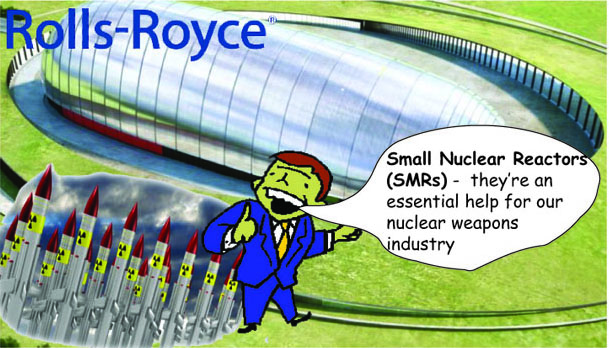
Oil Price reported Rolls Royce, the British engineering giant, was “breathing life back into the nuclear industry” by promising the first reactor in operation by the early 2030s and 10 by 2035.
After months of hype, having been given £210 million of British government money and raised £250 million from private investors, Rolls Royce has finally applied to the UK licencing authority to have its design approved so construction can begin.
Rolls-Royce SMR has been established to deliver a low-cost, deployable, scalable, and investable program of new nuclear power plants,” said CEO Tom Samson. “Our transformative approach to delivering nuclear power, based on predictable factory-built components, is unique, and the nuclear technology is proven. Investors see a tremendous opportunity to decarbonize the U.K. through stable baseload nuclear power, in addition to fulfilling a vital export need as countries identify nuclear as an opportunity to decarbonize.”
Meanwhile, campaigners and climate policy specialists at the Glasgow talks were looking for fast, deep cuts in carbon emissions before 2030, to enable the planet to have a chance of staying below 1.5°C. They cast Rolls-Royce’s plans, which have been re-announced repeatedly over several months, as another prime example of “greenwash” or “kicking the can down the road.”
Nor did campaigners at Glasgow miss the fact that Britain, Canada, and the United States, the three countries with most enthusiasm for small modular reactors, have something else in common: Their wish to go on extracting oil and gas that scientists say needs to be kept in the ground if the 1.5°C limit is not to be breached.
Perhaps it is no coincidence that the fossil fuel lobby in all three countries is keen to support nuclear power as “one of the answers to climate change.” Unlike renewables that can be deployed quickly, new nuclear power is decades away, providing breathing space for a dying industry to go on exploiting fossil fuels while nuclear power plants are built.
Jonathon Porritt, chair of the U.K.’s Sustainable Development Commission between 2000 and 2009 and founder member of Forum for the Future, is scathing about the plans of the U.K. government and Rolls Royce.
He says taking the SMR through the Generic Design Assessment process takes at least four years, more likely five, and even if it passes it will take years to build, given the need to find sites and seek planning permission amid likely public opposition.
To be generous, Porritt said, it would be 2035 before the first was commissioned, let alone the five to 16 reactors Rolls Royce wants to build.
“It is therefore of zero benefit in terms of meeting the (British) government’s own target of a 78% reduction in greenhouse gas emissions by 2035,” he said. “It doesn’t matter how many times ministers bang this particular drum, or how many times deplorably gullible journalists in the BBC, Financial Times, Times, and the Daily Telegraph suck it all up. Moonshine is still moonshine.”
“It’s all such a pathetic waste of time—and of taxpayers’ money,” he added. “Whatever the time scale, SMRs will never compete with renewables plus storage.”
Porritt went on to discuss tidal stream energy using undersea turbines rather like wind turbines, which two British companies are developing with some success, and the even greater potential of using the tidal range—the height difference between low and high tide—to generate electricity to generate electricity through traditional turbines. Since Britain has the second-highest tides in the world after Canada and is surrounded by the sea, it has huge potential—but is ignored by the U.K. government.
“If our government was genuinely serious about energy security (instead of finding ways of propping up Rolls-Royce to support our nuclear weapons program), tidal power would be top of its list,” Porritt concluded.
Not all publications, however, agree with the mainstream British press about nuclear power. Under the headline “Nuclear Power Won’t Save the World—It Won’t Even Help”, published in the Green Energy Times, climate writer and retired computer engineer George Harvey said the cost estimates and timetables for nuclear power were never realistic.
“All told, we might say that putting money into nuclear power goes beyond being a monumental waste,” he wrote. “It detracts from the overarching issue of dealing with climate change by making that money unavailable for dealing with the problem using less expensive, more reliable energy that can be built far more quickly.”
New Name- Same Scam. NuScale small nuclear reactors become ‘VOYGR”, universities co-opted.

NuScale SMR plants become VOYGR 03 December 2021,
NuScale Power’s small modular reactor (SMR) power plants are to be named VOYGR, the company has announced. The company is working towards commercialising the technology and aims to be ready to deliver the first VOYGR plant to public power consortium Utah Associated Municipal Power Systems’ Carbon Free Power Project by the end of the decade………
UAMPS earlier this year said it expects to submit a combined licence application for the Carbon Free Power Project – currently envisaged as a six-module plant – to the NRC in 2024. The plant is to be located on a site at the US Department of Energy’s (DOE’s) Idaho National Laboratory…….
Training centre

NuScale has now opened a third university-based centre to provide training and outreach opportunities through simulated, real-world nuclear power plant operation scenarios. The NuScale Energy Exploration (E2) Center, opened in collaboration with the Texas A&M Engineering Experiment Station, is at the Center for Advanced Small Modular and Micro Reactors located in College Station, Texas, and uses state-of-the-art computer modelling within a simulation of the control room of a 12-unit NuScale power plant control.
Previous E2 Centers were opened at Oregon State University, in November 2020, and at the University of Idaho, in August 2021. The centres are supported by a 2019 DOE grant to broaden the understanding of advanced nuclear technology in a control room setting. https://www.world-nuclear-news.org/Articles/NuScale-SMR-plants-become-VOYGR
France joins the Small Nuclear Reactor frenzy, bringing out its odd version ”NAAREA”

French engineering group Assystem has signed a cooperation agreement with
newly-created French micro-reactor developer Naarea to build its
ultra-compact eXtra Small Modular Reactor (XSMR). Dassault Systèmes is to
supply Naarea with a cloud-based platform on which to virtually design the
1 to 40 MW molten salt reactor. Naarea expects the first units of XSMR to
be produced by 2030.
The company says its ultra-compact molten salt reactor uses “the untapped potential of used radioactive materials, and thorium, unused mining waste.” Naarea noted, “The current stocks of these two wastes will supply the energy needs of humanity for thousands of years, and reconcile humanity with its future.”
World Nuclear News 3rd Dec 2021
https://www.world-nuclear-news.org/Articles/Assystem-to-cooperate-with-Naarea-on-micro-reactor
Canada to get its version of the mythical beast – the Small Nuclear Reactor – GE Hitachi Nuclear Energy (GEH) BWRX-300

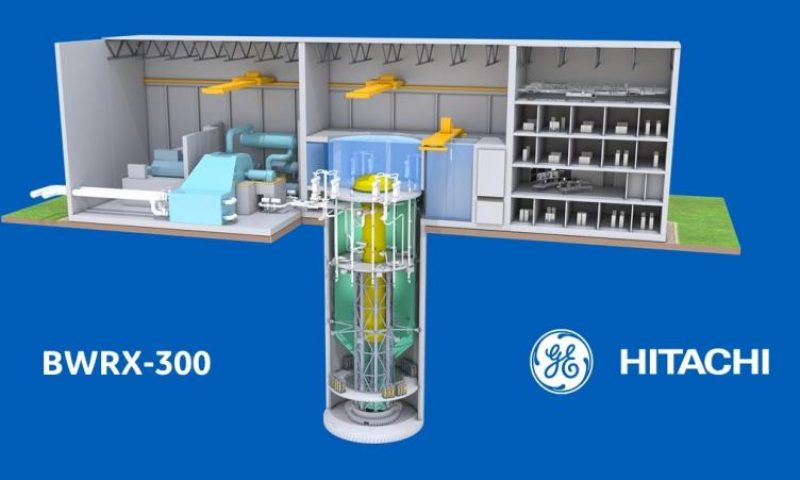
Ontario Power Generation (OPG) will build a GE Hitachi Nuclear Energy (GEH) BWRX-300 small modular reactor (SMR) at its Darlington Nuclear Station in Clarington, Ontario, marking a major triumph for the nuclear vendor in a stiff competition for the much-watched utility-scale project.
OPG announced the selection of the GE Hitachi BWRX-300 SMR over competitors X-energy and Terrestrial Energy in a live stream on Dec. 2. The utility said it will now work with GE Hitachi on the SMR engineering, design, planning, preparing the licensing and permitting materials, and performing site preparation activities. The companies are targeting a “mutual goal of constructing Canada’s first commercial, grid-scale SMR, projected to be completed as early as 2028.” Site preparation, which will include
“installation of the necessary construction services,” is slated to begin in the spring of 2022, pending appropriate approvals. OPG additionally said it will apply to the Canadian Nuclear Safety Commission
(CNSC) for a License to Construct the SMR by the end of 2022.
Power Mag 2nd Dec 2021
Gordon Edwards discusses a Canadian documentary on the ”Nuclear Revival” and small nuclear reactors.

Gordon Edwards, 1 December 21, On November 24, 2021, APTN broadcast a half-hour TV documentary about High Level Nuclear Waste in Canada, with some extra attention paid to the new, unorthodox irradiated fuels that would result from the proposed new reactors called SMRs. Here is a link to the program, entitled Nuclear Revival: https://youtu.be/uLhPwAWejzc
A couple of observations that crossed my mind while watching the report by Journalist Christopher Read –
(1) The fuel bundles should be thought of as CONTAINERS of the actual radioactive wastes, which are locked up inside those solid bundles. There are many different radioactive elements (all of them human-made, most of them not found in unspoiled nature) that can escape from the fuel bundles as gases, liquids or solids. They all have different chemical and biological properties but they are all cancer-causing elements and can damage genetic materials like DNA molecules.
Even though the fuel bundles may not move an inch from where they have been emplaced, these other materials can leak out or leach out and find their way to the environment of living things. Time is on their side!! Damaged fuel bundles are analogous to a broken bottle – the container is still there, but the contents (some at least) have escaped.
(2) Concerning SMRs, even if these new nuclear reactors all worked very well, which is doubtful, they will be terribly expensive and very slow to reach a level of commercial deployment (and profitability) – at least 10 to 20 years – so they are too costly and too slow to respond to the climate crisis TODAY.
Solar and wind are much cheaper than nuclear, they are proven and can be quickly deployed, while energy efficiency measures are even cheaper and even faster to implement. We do not yet know how much progress can be made using these alternatives but clearly they should have the first priority – with nuclear as a wait-and-see backup possibility which very likely will not be needed at all (as in the case of Germany, which has phased out nuclear – nearly finished – and now is focussed on phasing out coal, using renewables and efficiency.)
UK government secretive about its Net Zero strategy, especially on tax-payer funded projects like small nuclear power plants.
UK refuses to release document showing Net Zero Strategy CO2 savings, New Scientist, 1 December 2021, By Adam Vaughan
The UK government Department for Business, Energy and Industrial Strategy (BEIS) has turned down a freedom of information request that would allow independent scrutiny of its plan for net-zero greenhouse gas emissions.
The UK government has refused a freedom of information request to release a spreadsheet showing how much its landmark Net Zero Strategy will cut carbon emissions for individual measures, such as backing a new nuclear power station and fitting new electric car chargers.
Withholding the document smacks of “secrecy and subterfuge” and prevents the public from being able to interrogate the estimated impacts of the measures, says Ed Matthew at climate change think tank E3G.
The publication of the government’s Net Zero Strategy on 19 October was a key moment ahead of the COP26 climate summit, laying out in detail how the UK plans to reach its 2050 commitment to net-zero greenhouse gas emissions in the coming years.
Previous government blueprints for decarbonisation, such as the 2020 10-point green plan and 2017 clean growth strategy, have spelled out estimates of exactly how much individual policies will cut emissions. But the Net Zero Strategy failed to provide any such breakdown, which observers said showed a lack of transparency that hampered independent scrutiny.
Government officials conceded that there was a spreadsheet containing all the figures, but said they wouldn’t release it. Now, the Department for Business, Energy and Industrial Strategy (BEIS) has refused a freedom of information request by New Scientist to publish the document. It declined the request on the grounds that it involves the disclosure of internal communications…………….
The strategy does show top-level estimates of how much emissions will change for different sectors, such as power, buildings and farming, between now and 2050. But it doesn’t break down individual measures, including backing new hydrogen production or developing new small nuclear plants, both of which will be supported by hundreds of millions of pounds in public funding.
“Ministers are behaving like a shady dealer asking customers to buy a product without seeing it first,” says John Sauven at Greenpeace UK. He is calling on BEIS to publish the spreadsheet: “The best thing would be for the government to release the numbers behind the plan and allow experts to kick the tyres on it”.
The document is likely to include estimates of how extensively various technologies will be employed and their impacts on greenhouse gas emissions in the UK. There may be a mismatch between what the government has committed to publicly, such as a Conservative party manifesto pledge to quadruple offshore wind capacity by 2030, and the estimates that are being withheld, for example………..
New Scientist has appealed the decision not to publish the document. https://www.newscientist.com/article/2299318-uk-refuses-to-release-document-showing-net-zero-strategy-co2-savings/#ixzz7Drfyfmii
Global heating brings easier Arctic passage for Russia’s floating nuclear power plant to open up Arctic for more fossil fuel mining, more global heating.

World’s first floating nuclear power plant fuels Russia’s Arctic ambitions Ft.com Remote Siberian port lies at centre of plans to open up shipping and reach valuable resources © Nastassia Astrasheuskaya/FT | The Akademik Lomonosov nuclear power plant Share on twitter (opens new window) Share on facebook (opens new window) Share on linkedin (opens new window) Save Nastassia Astrasheuskaya in Pevek YESTERDAY
Moored off the small Arctic town of Pevek is the Akademik Lomonosov — the world’s first floating nuclear power plant and a sign of how President Vladimir Putin’s ambitions for Russia’s far east are taking shape. This port on the northern coast of Siberia was once notorious as a Soviet gulag. These days it is part of Moscow’s plan to open up a major shipping lane through the Arctic and bring natural resources within easier reach. Pevek’s harbour is only ice-free for four months a year but is intended to become a hub for commercial shipping on the so-called Northern Sea Route as climate change gradually eases the passage through the Arctic. And the power provided by the Akademik Lomonosov is intended to help Pevek become a gateway to Chukotka, a region close to Alaska and rich in gold, silver, copper, lithium and other metals…………
Few in Pevek seem concerned by the nuclear reactor in the harbour. “Fear? We have none. Perhaps Russians are not afraid of anything any more. We have seen and lived through everything. We have to be optimistic,” said Igor Ranav, a locally born businessman. “We were told the plant is made with the latest technology and it is safe, and I hope so.”
Development of the NSR is in the hands of Rosatom, the state nuclear corporation. As well as commissioning the Akademik Lomonosov, Rosatom is also in charge of nuclear-powered icebreakers that the company expects will help to open up year-round Arctic navigation by the middle of the decade. …………
Developing Chukotka along with the rest of the Arctic has long been a goal for Putin and Russia, which this week is hosting a plenary meeting of the Arctic Council, where the eight countries of the region are represented. “Russia should expand through the Arctic, as this is where it has its main mineral resources,” Putin said in 2017, when Russia first produced liquefied natural gas in the Arctic and exported it via the NSR. ……………
By mid-century, the Arctic and Antarctic Research Institut expects ice levels to lose another two-thirds in the summer, and to halve in winter. The warming ocean is expected to help cut shipment cost. Less ice means fewer icebreakers and faster journeys.
The warming ocean is expected to help cut shipment cost. Less ice means fewer icebreakers and faster journeys…………….. https://www.ft.com/content/f5d25126-94fc-41fc-bc35-341df0560f4d
The nuclear consequences of cyber vulnerabilities

The nuclear consequences of cyber vulnerabilities, https://www.europeanleadershipnetwork.org/commentary/the-nuclear-consequences-of-cyber-vulnerabilities/ Wilfred Wan |Researcher at the United Nations Institute for Disarmament Research (UNIDIR), 29 Nov 21,
A recent report about a massive cyber surveillance campaign allegedly conducted by Russian intelligence against US government agencies reflects disturbing trends in cyberspace. The number of reported data breaches in 2021 is on pace to set a record, with government entities constituting the most targeted sector, and global supply chains increasingly impacted. The planning and sophistication that characterizes some of these operations in recent years also suggest more frequent State-level involvement, underlining the fact that cyber—or information security—capabilities increasingly constitute part of national strategic toolkits.
Operations in cyberspace have also targeted elements of the nuclear weapons enterprise across states. Recent known cases include the discovery in December 2020 of “long duration activity” against the US National Nuclear Security Administration (responsible for the management of the US stockpile), and in April 2021 of operations against a firm linked to the design of Russian nuclear submarines. In neither instance was there any indication that functions related to nuclear weapons systems were impacted.
Yet these revelations should heighten concerns beyond the states targeted, as the existence of these operations could have implications for potential nuclear weapon use. Cyber operations of the kind cited are unlikely to cause detonation events directly. Yet operations that successfully interact with nuclear forces can undermine states’ confidence in their nuclear deterrence capability or credibility, which can trigger forceful military response and even prompt ‘use it or lose it’ nuclear dilemmas. The clearest path to this end involves intrusions into weapons systems themselves. This is not far-fetched. In limited testing with “relatively simple tools and techniques”, the US Department of Defense in 2018 “routinely found mission-critical cyber vulnerabilities” in their weapons systems under development. Other nuclear-armed states are likely to be similarly vulnerable.
Other infringements on deterrence include cyber operations that impact nuclear command, control, and communication. Increased digitalization is likely to create new vulnerabilities, exacerbated by reliance on the supply chain. Even systems isolated from the internet can be compromised. The militarization of cyberspace—and a legacy of Cold War electronic warfare — also raises the possibility that adversaries could now induce the kind of malfunctions (such as erroneous warnings in early warning systems) that in the past have fuelled several nuclear ‘close calls’. Additionally, cyber operations that amplify conventional capabilities to evade radar and air or missile defence may increase nuclear force vulnerability, real or perceived.
The reason why such intrusions may escalate to a scale even beyond the intentions of perpetrators centres on a lack of clarity around so-called cyber ‘red lines’. Several nuclear-armed states have acknowledged the possibility of escalation linked to the cyber domain, or in their nuclear doctrines open the door to use in response to cyber operations. Further precision on thresholds is generally absent, with deliberate ambiguity held in service of deterrence credibility. Yet notions of achievable strategic stability are undermined by the secretive nature of cyber operations, the many potential points of entry for cyber operations, and context-dependent concepts such as ‘critical infrastructure’. Cyber-nuclear interactions open the door for misperception, miscalculation, or misunderstanding.
Reducing cyber-nuclear risks requires preventing interactions between cyber operations and nuclear forces; it also requires mitigating the consequences of interactions when they do take place. Developments in cyber space suggest the potential development of voluntary ‘rules of the road’ that can support the former. Last month the US and Russia submitted a joint resolution to the UN General Assembly (co-sponsored by 104 States) on responsible behaviour in cyberspace. Cyberspace policy also features in ongoing US-Russia strategic stability talks; President Biden in June 2021 had provided President Putin a list of critical infrastructure sectors meant to be “off-limits” from cyber operations. Such negotiations of State behaviours would be significant but would only address part of the risk picture.
It is incumbent on nuclear-armed states to strengthen the cyber security of their weapons and related systems and to elaborate standards across the entirety of their supply chains. Dialogue among nuclear-armed and nuclear-allied states can inform common understandings of risk perceptions, and chip away at the ambiguity around red lines. States can also look to establish guard rails through the conflict-prevention toolkit. In fact, information exchange around cyber military exercises, memorandums of understanding on engagement with communications and radar systems, and political declarations that nuclear command and control lies outside cyber bounds can build a foundation for formal agreements down the line.
Cyber-nuclear interactions are likely to increase given trends in the militarisation of the cyber domain and the digitalisation of nuclear weapons systems. The secrecy across both domains presents significant challenges: not only in their regulation but also to underlining the urgency of the situation and creating the prerequisite momentum for such action. After all, the cyber equivalent of the Cuban Missile Crisis is unlikely to ever play out in public. Yet the very real risk of cyber-nuclear interactions driving inadvertent nuclear war should provide ready incentive for immediate action.
Wilfred Wan is the co-author of a new UNIDIR report on The Cyber-Nuclear Nexus: Interactions and Risks.
”Nuclear Revival” for Canada? Gordon Edwards discusses the latest propaganda.
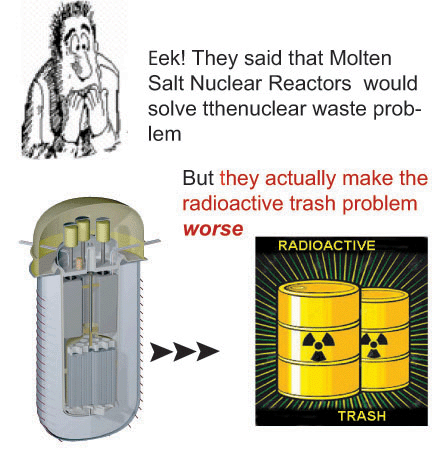
Gordon Edwards, 27 Nov 21, Christopher Read’s latest half-hour documentary on the Nuclear Waste Management Organization (NWMO) discusses its efforts to convince some small community in Ontario to receive all of Canada’s high level radioactive wastes for deep burial.
These are the most toxic materials ever produced by any industry. Of the hundreds of kinds of radioactive poisons contained in the used nuclear fuel, only a handful existed on Earth in significant amounts before 1939. They are created in large quantities inside nuclear reactors.
NWMO is owned by the same companies that make the radioactive poisons in the first place – and they have no intention of stopping. They want to keep right on mass-producing the highly dangerous byproducts indefinitely. Because they have to wait 30 years before moving these deadly wastes – they are literally and figuratively “too hot” to move sooner — there will always be a catastrophic amount left unburied at the surface no matter how fast they bury the older, somewhat cooler wastes.
Meanwhile they will be burdening communities with a permanent radioactive legacy, including contamination caused by unpacking and repackaging millions of embrittled fuel bundles right at the surface, beside the proposed waste dump. Any damage to any of these fuel bundles during handling, even small cracks, will allow radioactive materials to escape and some of it will inevitably enter the sir we breathe, the water we drink, the food we eat, or the soil we walk on.
New reactors are untested, exorbitantly expensive, and will take 10 to 20 years to become available, if ever. They are a DDD = Dirty, Dangerous Distraction from the real job of cutting greenhouse gases now, not 10 years from now. Energy efficiency and renewables can be implemented in a single building season. Wind and solar and efficiency measures are far cheaper and much faster to implement than new nuclear.
When your house is on fire, it is time to grab a bucket or a fire hose and pour water on it – out the fire out! This is no time to sit down and design a new, improved sprinkler system for future use.
Climate change is here now. Action is urgent.
Investing in new nuclear plants is just “kicking the can down the road”. Canada’s Environment Commissioner points out that Canada has the worst record for fighting climate change of any country in the G7, as our greenhouse gas emissions have increased steadily since Trudeau was first elected in 2915. Five of the G7 countries have reduced their GHG emissions, while the sixth has increased GHG emissions at a much slower rate than Canada has.
To invest in unproven and dangerous nuclear plants now will guarantee that no progress will be made for at least 10 to 20 years, minimum. And it will give us more radioactive waste, much of it even more dangerous than the waste we already have. Can we afford to encourage this kind of behaviour with lavish government subsidies?
Small modular reactors not the solution
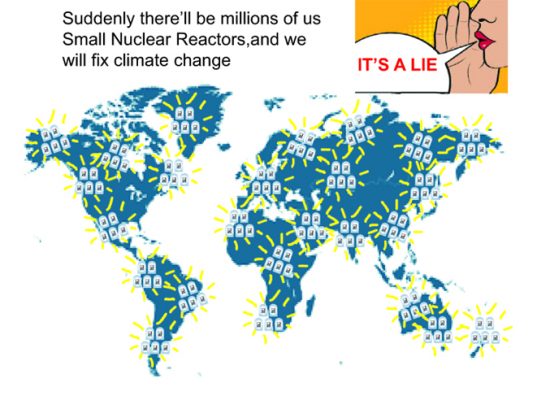
Small modular reactors not the solution – German nuclear authority assessments,
NEWS10 Mar 2021, Kerstine Appunn, Using a large fleet of small modular reactors (SMR) to secure climate neutral electricity supply in the future – as proposed by billionaire and philanthropist Bill Gates – poses many unsolved problems and security risks, two researcher assessments commissioned by the Federal Office for the Safety of Nuclear Waste Management (BASE) have found according to a report by Süddeutsche Zeitung (SZ). SMR proponents claim that, once produced in bulk, these small plants are cheaper and safer thanks to advanced reactor designs and can be operated with converted short-lived radioactive materials, solving the waste problem. But the two reports, seen by SZ, conclude that SMR “carry enormous risks with regard to the proliferation of weapons-grade materials and will probably never be as cheap as their advocates claim”, Michael Bauchmüller writes.
The paper by the Institute for Applied Ecology (Öko-Institut) found that in order to replace the 400 or so large reactors today, “many thousands to tens of thousands of SMR plants” would have to be built. But this raises questions for proliferation, the spread of dangerous nuclear material.
The second assessment by researchers from the Institute for Safety and Risk Sciences, at the Vienna University of Natural Resources and Applied Life Sciences, on nuclear waste aspects of SMR found in three scenarios that a repository for nuclear waste would remain necessary, and that the amount of low and medium level radioactive waste would increase “massively” during the dismantling of nuclear facilities.
Germany will shut down its last nuclear power plant by the end of 2022, according to the government’s phase-out legislation which is supported by a majority of the population. After the nuclear disaster in Fukushima ten years ago, Angela Merkel’s government decided to accelerate the phase-out of nuclear power in Germany where opposition to nuclear plants was one of the key causes leading to the founding of the country’s Green Party. Nuclear power is compensated for by expanding renewable sources wind, solar PV and biogas, as Germany strives for a climate neutral power supply by 2040 or 2050 at the latest.
Hurdles ahead for Rolls Royce small nuclear reactor development.

“SMR proponents argue that they can make up for the lost economies of scale by savings through mass manufacture in factories and resultant learning. But, to achieve such savings, these reactors have to be manufactured by the thousands, even under very optimistic assumptions about rates of learning.”
The Rolls Royce SMR design is not exactly small at 470 MWe.
SafeEnergy E Journal No.92. December 21 Rolls Royce’s Small Modular Reactors On 9th November the Government announced that it would back the Rolls-Royce Small Modular Reactor with £210m in funding. Matched by private sector funding of over £250 million, this investment will be used to further develop SMR design and start the Generic Design Assessment (GDA) process
The Government claims that SMRs have the potential to be less expensive to build than traditional nuclear power plants because of their smaller size, and because the modular nature of the components offers the potential for parts to be produced in dedicated factories and shipped by road to site – reducing construction time and cost.
But the reason why existing reactors are large is precisely to derive economies of scale: why smaller reactors should be more economic is problematic. Nuclear proponents allege that assembly-line technology will be used in reactor construction but this has yet to be shown in practice anywhere in the world.
Some say that SMRs are little more than wishful thinking. For example, Professor MV Ramana ‒ Simons Chair in Disarmament, Global and Human Security at the School of Public Policy and Global Affairs at the University of British Columbia – states:
“SMR proponents argue that they can make up for the lost economies of scale by savings through mass manufacture in factories and resultant learning. But, to achieve such savings, these reactors have to be manufactured by the thousands, even under very optimistic assumptions about rates of learning.” (1)
The Rolls Royce SMR design is not exactly small at 470 MWe. It is proposing to build 16 reactors at an expected cost around £1.8bn – £2.2bn and producing power at £40-60/MWh over 60 yrs. (2)

As well as the Government funding, Rolls-Royce has been backed by a consortium of private investors. The creation of the Rolls-Royce Small Modular Reactor (SMR) business was announced following a £195m cash injection from BNF Resources, and Exelon Generation to fund the plans over the next three years.(3)
Rolls Royce has submitted the SMR design to the GDA regulatory process, in a bid to secure clearance from the Department for Business, Energy and Industrial Strategy (BEIS) and the UK’s nuclear and environmental regulatory bodies. It expects the process to take around four to five years, during which time it plans to “engage in a range of parallel activities” including the SMR factory development, potential siting for future nuclear plants, and “commercial discussions”. (4)
Before the ONR approval process begins, the company must first get clearance from the government to submit its designs, which is expected by around March next year. (5)
As expected, Moorside, Wylfa and Trawsfynydd have all been mentioned as potential sites for an SMR. Tees Valley mayor Ben Houchen also wants Hartlepool to be on the list. (6) https://www.no2nuclearpower.org.uk/wp/wp-content/uploads/2021/11/SafeEnergy_No92.pdf
What might trip up the Rolls Royce plan for small nuclear reactors?

Fix the Planet newsletter: Can small nuclear power go big? Small modular reactors are being pitched as an affordable and fast way to decarbonise power grids but questions about the technology abound, New Scientist EARTH, 25 November 2021, By Adam Vaughan
”……… nuclear power did have a showing in Glasgow, at official events in the conference, deals on the sidelines and cropping up as a subject during press briefings.
One new technology popped up a few times: small modular reactors (SMRs), mini nuclear plants that would be built in a factory and transported to a site for assembly. A UK consortium led by Rolls-Royce wants to build a fleet in the country to export around the world as a low carbon complement to renewables. During COP26 the consortium received £210 million from the UK government. More private investment is expected soon.
Yet questions abound. Why should this technology succeed where large nuclear plants have failed to take off in recent years, beyond China? If they are small, will they make a sizeable enough dent in emissions? And will they arrive in time to make a difference to a rapidly warming world?……
What exactly is planned?
The reactors that Rolls-Royce SMR wants to build have been six years in development, with their roots in ones the company previously built for nuclear submarines. Despite being billed as small, the new reactor design is fairly large. Each would have 470 megawatts of capacity, a good deal bigger than the 300 MW usually seen as the ceiling for an SMR.
The consortium hopes to initially build four plants on existing nuclear sites around the UK. Ultimately it wants a fleet of 16 , enough to replace the amount of nuclear capacity expected to be lost in the UK this decade as ageing atomic plants retire. Later down the line, the SMRs could be exported around the world too.
Alastair Evans at Rolls-Royce SMR. says the first SMR would cost about £2.3 billion and could be operational by 2031. Later versions may fall to £1.8 billion, he claims. That may seem cheap compared to Hinkley, but an offshore wind farm with twice the capacity costs about £1 billion today, and that figure will be even lower in a decade’s time………….
What might trip them up?
SMRs have been in development for years but have made little inroads to date. The UK government has been talking about them for much of the past decade, with nothing to show. Progress elsewhere around the world has been slow, too. Outside of Russia there are no commercial SMRs connected to power grids. Even China, one of the few countries that has built new nuclear plants in recent years, only started construction of a demo SMR earlier this year, four years late. It wasn’t until last year that leading US firm NuScale had its design licensed by US authorities.
Paul Dorfman at the non-profit Nuclear Consulting Group, a body of academics critical of nuclear power, says the nuclear industry has always argued economies of scale will bring down costs so it is hard to see why going small will work. He says modularisation – making the reactors in factories – will only bring down costs if those factories have a full order book, which may not materialise. “It’s chicken and egg on the supply chain,” he says. He also notes the plants will still create radioactive waste (something another potential next gen nuclear technology, fusion, does not). And he fears nuclear sites near coasts and rivers will be increasingly vulnerable to the impacts of climate change, such as storm surges as seas rise.
What’s next? The Rolls-Royce SMR group this month submitted its reactor design for approval by the UK nuclear regulator, a process that could take around five years. It now needs to pick three locations for factories and start constructing them. The group also needs to win a Contract for Difference from the UK government, a guaranteed floor price for the electricity generated by the SMRs…….. https://www.newscientist.com/article/2299113-fix-the-planet-newsletter-can-small-nuclear-power-go-big/
Nuclear fusion for UK – to save the dying nuclear industry, and UK as a nuclear weapons state?
SafeEnergy E Journal No.92. December 21, Fusion Four sites in England and one in Scotland are on the final shortlist of sites to be the home of the UK’s prototype fusion energy plant. The government is backing plans for the Spherical Tokamak for Energy Production (Step) with a final decision on its location expected at the end of 2022. The UK Atomic Energy Authority (UKAEA) hope the plant will be operational by the early 2040s. The five shortlisted sites are: Ardeer, North Ayrshire; Goole, East Riding of Yorkshire; Moorside, Cumbria; Ratcliffe-on-Soar, Nottinghamshire; Severn Edge, Gloucestershire; They were whittled down from a longlist of 15 sites, which included Chapelcross near Annan and Dounreay. (1 …………
The Scottish Campaign for Nuclear Disarmament (CND) has said that this latest effort to extol the virtues of nuclear fusion as a “low carbon” source of energy is to keep the industry “alive” due to the UK being a “nuclear weapon state”. (5)………https://www.no2nuclearpower.org.uk/wp/wp-content/uploads/2021/11/SafeEnergy_No92.pdf
1 This Month
To see nuclear-related stories in greater depth and intensity – go to https://nuclearinformation.wordpress.com/

29 Jan. Thursday 7-8 p.m. Webinar – World’s Largest Nuclear Station in Port Hope, ON?


31st January – Challenging the War Machine – a DECLASSIFIED UK SUMMIT


Website of the Week
Now until to February 10, 2026 Radioactive waste storage in France: the debate is finally open! How to participate?
-
Archives
- January 2026 (271)
- December 2025 (358)
- November 2025 (359)
- October 2025 (376)
- September 2025 (258)
- August 2025 (319)
- July 2025 (230)
- June 2025 (348)
- May 2025 (261)
- April 2025 (305)
- March 2025 (319)
- February 2025 (234)
-
Categories
- 1
- 1 NUCLEAR ISSUES
- business and costs
- climate change
- culture and arts
- ENERGY
- environment
- health
- history
- indigenous issues
- Legal
- marketing of nuclear
- media
- opposition to nuclear
- PERSONAL STORIES
- politics
- politics international
- Religion and ethics
- safety
- secrets,lies and civil liberties
- spinbuster
- technology
- Uranium
- wastes
- weapons and war
- Women
- 2 WORLD
- ACTION
- AFRICA
- Atrocities
- AUSTRALIA
- Christina's notes
- Christina's themes
- culture and arts
- Events
- Fuk 2022
- Fuk 2023
- Fukushima 2017
- Fukushima 2018
- fukushima 2019
- Fukushima 2020
- Fukushima 2021
- general
- global warming
- Humour (God we need it)
- Nuclear
- RARE EARTHS
- Reference
- resources – print
- Resources -audiovicual
- Weekly Newsletter
- World
- World Nuclear
- YouTube
-
RSS
Entries RSS
Comments RSS
 nuclear-news