The environmental impact of emissions from space launches: a comprehensive review
The environmental impact of emissions from space launches: A comprehensive review https://www.sciencedirect.com/science/article/abs/pii/S0959652620302560Author links open overlay panelJ.A.DallasabS.RavalbcJ.P.Alvarez GaitandS.SaydamabA.G.Dempsterae
a Australian Centre for Space Engineering Research, UNSW, Sydney, Australia
bSchool of Minerals and Energy Resources Engineering, UNSW, Sydney, Australia
cAustralian Centre for Sustainable Mining Practices, UNSW, Sydney, Australia
d School of Civil and Environmental Engineering, UNSW, Sydney, AustraliaeSchool of Electrical Engineering and Telecommunications, UNSW, Sydney, Australia
28 January 2020.
Highlights
•The environmental impact of space launches is becoming increasingly significant.•
Stratospheric ozone depletion is a key environmental concern for space launches.•
Environmental trade-offs exist between propellant types.•
Further study is required into the cumulative impact of launches.
Abstract
With the increasing accessibility of commercial space flight, the environmental impacts of space launches will become increasingly significant in the coming years. Here, for the first time, a review is presented of the environmental impacts of space launches, specifically of emissions from commonly used solid and liquid rocket propellants. While there are a number of environmental impacts resulting from the launch of space vehicles, the depletion of stratospheric ozone is the most studied and most immediately concerning. Solid rocket motors are the subject of most of the environmental studies on rocket launches, while the now more commonly used liquid rocket propellants are underrepresented in the literature. The limited studies of emissions from rocket engines using liquid propellent reveal that while they do result in stratospheric ozone loss, solid rocket motors are responsible for orders of magnitude greater loss. The comparison of commonly used propellants highlights the environmental trade-offs that must be made when selecting a launch system. This review highlights the need for further study of the cumulative impacts that frequent space launches have on all areas of the environment, including global climate, ecosystem toxicity, and human toxicity, and with consideration given to all commonly used propellants, to ensure that the impacts are well characterised and well understood before the number of launches greatly increases.
You thought Rolls Royce’s Small Nuclear Reactors would be for electricity on Earth?

Rolls-Royce team moves into Space Park Leicester to work on nuclear powered space travel, BusinessLive, 13 Jan 22,
Rolls-Royce already signed contract with UK Space Agency to study future nuclear power options for space exploration.
Rolls-Royce has moved a team onto Space Park Leicester to push forward its work on nuclear power for space travel.
The engineering giant has taken space in the new £100 million facility which was launched as a breeding ground for out-of-this-world tech by bringing together industry and academia.
Rolls-Royce is reported to be the only UK company focussing on the line of work and staff with a pedigree in nuclear power will collaborate with new space park head Professor Richard Ambrosi, Professor of Space Instrumentation and Space Nuclear Power Systems at University of Leicester and other experts in space science.
Last January, Rolls-Royce signed a contract with the UK Space Agency to study future nuclear power options for space exploration………………… https://www.business-live.co.uk/technology/rolls-royce-team-moves-space-22728938
Claims of strange unidentified craft flying over top secret US Air Force base.
I guarded nuclear weapons and saw yellow orb-like UFOs flying over top-secret US Air Force base The Sun , Henry Holloway, Jan 12 2022 AN EX-NUCLEAR weapons tech has claimed he saw UFOs flying overhead while serving in the military at a top secret US Air Force base.
Adrian Reister, 37, decided to break his silence as the unknown phenomena has become a serious national security concern for US lawmakers and the Pentagon.
But he is speaking out as a variety of former US intelligence officials, nuclear launch officers, and fighter pilots have come forward about their UFO experiences in the last few years.
And it comes as former US Presidents Barack Obama and Bill Clinton even admitted there is something happening in the skies over the US that cannot be explained.
Adrian told The Sun Online he witnessed yellow orb UFOs flying over the base on two occasions while working as a “gun guard”.
Through his duties, he had a clear view and understanding of the bombers, fighter jets and other aircraft which would take off and leave the base.
So he is 100 per cent sure the objects he witnessed were not military or civilian aircraft – and the lights also did not move like any known vehicles……………………………………….
US lawmakers demanded reports of nuclear security as part of the purview of a new UFO office included in a mulit-billona defence bill signed off by Joe Biden.
It came after a number of former US servicemen came forward and revealed their own experiences with UFOs at nuclear weapons facilities.
The veterans even claimed the phenomena had “interfered” with weapons – including taking them offline – as they demanded transparency from the US.
UFOs have stepped from a fringe conspiracy theory to a serious national security debate in the US.
And a historic report by the Pentagon earlier in the year revealed 144 sightings by the military since 2004 remain unexplained.
Biden signed into law at the end of December a new UFO investigation unit that will run on the ground investigations and probe any “threat” posed by the phenomena.
The office will be set up jointly between the Department of Defense and the Office of the Director of National Intelligence (DNI) — a key marriage between the intelligence and military communities.
It will probe whether or not the strange craft that has been reportedly buzzing the US military are unknown technology from Russia and China or potentially something more alien.,,,, https://www.the-sun.com/news/4448824/nuclear-weapons-ufos-top-secret-base-whiteman/
What future for Small Nuclear Reactors (SMRs) ?

Small nuclear reactor? It’s a lemon!
Large taxpayer subsidies might get some projects, such as the NuScale project in the US or the Rolls-Royce mid-sized reactor project in the UK, to the construction stage. Or they may join the growing list of abandoned SMR projects
In 2022, nuclear power’s future looks grimmer than ever, Jim Green, 11 Jan 2022, RenewEconomy
”……………………………………….. Small modular reactors
Small modular reactors (SMRs) are heavily promoted but construction projects are few and far between and have exhibited disastrous cost overruns and multi-year delays.
It should be noted that none of the projects discussed below meet the ‘modular’ definition of serial factory production of reactor components, which could potentially drive down costs. Using that definition, no SMRs have ever been built and no country, company or utility is building the infrastructure for SMR construction.
In 2004, when the CAREM SMR in Argentina was in the planning stage, Argentina’s Bariloche Atomic Center estimated an overnight cost of A$1.4 billion / GW for an integrated 300 megawatt (MW) plant, while acknowledging that to achieve such a cost would be a “very difficult task”. Now, the cost estimate is more than 20 times greater at A$32.6 billion / GW. A little over A$1 billion for a reactor with a capacity of just 32 MW. The project is seven years behind schedule and costs will likely increase further.
Russia’s 70 MW floating nuclear power plant is said to be the only operating SMR anywhere in the world (although it doesn’t fit the ‘modular’ definition of serial factory production). The construction cost increased six-fold from 6 billion rubles to 37 billion rubles (A$688 million), equivalent to A$9.8 billion / GW. The construction project was nine years behind schedule.

According to the OECD’s Nuclear Energy Agency, electricity produced by the Russian floating plant costs an estimated A$279 / MWh, with the high cost due to large staffing requirements, high fuel costs, and resources required to maintain the barge and coastal infrastructure. The cost of electricity produced by the Russian plant exceeds costs from large reactors (A$182-284) even though SMRs are being promoted as the solution to the exorbitant costs of large nuclear plants.
SMRs are being promoted as important potential contributors to climate change abatement but the primary purpose of the Russian plant is to power fossil fuel mining operations in the Arctic.
A 2016 report said that the estimated construction cost of China’s demonstration 210 MW high-temperature gas-cooled reactor (HTGR) is about A$7.0 billion / GW and that cost increases have arisen from higher material and component costs, increases in labour costs, and project delays. The World Nuclear Association states that the cost is A$8.4 billion / GW. Those figures are 2-3 times higher than the A$2.8 billion / GW estimate in a 2009 paper by Tsinghua University researchers.
China’s HTGR was partially grid-connected in late-2021 and full connection will take place in early 2022.
China reportedly plans to upscale the HTGR design to 655 MW (three reactor modules feeding one turbine). China’s Institute of Nuclear and New Energy Technology at Tsinghua University expects the cost of a 655 MW HTGR will be 15-20 percent higher than the cost of a conventional 600 MW pressurised water reactor.
NucNet reported in 2020 that China’s State Nuclear Power Technology Corp dropped plans to manufacture 20 additional HTGR units after levelised cost of electricity estimates rose to levels higher than a conventional pressurised water reactor such as China’s indigenous Hualong One. Likewise, the World Nuclear Association states that plans for 18 additional HTGRs at the same site as the demonstration plant have been “dropped”.

The World Nuclear Association lists just two other SMR construction projects other than those listed above. In July 2021, China National Nuclear Corporation (CNNC) New Energy Corporation began construction of the 125 MW pressurised water reactor ACP100. According to CNNC, construction costs per kilowatt will be twice the cost of large reactors, and the levelised cost of electricity will be 50 percent higher than large reactors.

In June 2021, construction of the 300 MW demonstration lead-cooled BREST fast reactor began in Russia. In 2012, the estimated cost for the reactor and associated facilities was A$780 million, but the cost estimate has more than doubled and now stands at A$1.9 billion.
SMR hype
Much more could be said about the proliferation of SMRs in the ‘planning’ stage, and the accompanying hype. For example a recent review asserts that more than 30 demonstrations of ‘advanced’ reactor designs are in progress across the globe. In fact, few have progressed beyond the planning stage, and few will. Private-sector funding has been scant and taxpayer funding has generally been well short of that required for SMR construction projects to proceed.
Large taxpayer subsidies might get some projects, such as the NuScale project in the US or the Rolls-Royce mid-sized reactor project in the UK, to the construction stage. Or they may join the growing list of abandoned SMR projects.
A failed history of small reactor projects. A handful of recent construction projects, most subject to major cost overruns and multi-year delays. And the possibility of a small number of SMR construction projects over the next decade. Clearly the hype surrounding SMRs lacks justification.
Everything that is promising about SMRs belongs in the never-never; everything in the real-world is expensive and over-budget, slow and behind schedule. Moreover, there are disturbing, multifaceted connections between SMR projects and nuclear weapons proliferation, and between SMRs and fossil fuel mining.
SMRs for Australia
There is ongoing promotion of SMRs in Australia but a study by WSP / Parsons Brinckerhoff, commissioned by the South Australian Nuclear Fuel Cycle Royal Commission, estimated costs of A$225 / MWh for SMRs. The Minerals Council of Australia states that SMRs won’t find a market unless they can produce power at about one-third of that cost.
In its 2021 GenCost report, CSIRO provides these 2030 cost estimates:
* Nuclear (SMR): A$128-322 / MWh
* 90 percent wind and solar PV with integration costs (transmission, storage and synchronous condensers): A$55-80 / MWh
Enthusiasts hope that nuclear power’s cost competitiveness will improve, but in all likelihood it will continue to worsen. Alone among energy sources, nuclear power becomes more expensive over time, or in other words it has a negative learning curve.
Dr Jim Green is the national nuclear campaigner with Friends of the Earth Australia and the author of a recent report on nuclear power’s economic crisis. , https://reneweconomy.com.au/in-2022-nuclear-powers-future-is-grimmer-than-ever/
What motivates Canadian province Premiers to enthuse about costly, probably useless, Small Nuclear Reactors?
So why are Canadian provinces like Alberta so enthusiastic about the idea? Well, it provides a way for governments captured by the fossil fuel industry to show they’re doing something about climate change without actually doing anything about climate change. Of course, just because nuclear power generators might reduce the carbon footprint of oilsands extraction, that doesn’t mean the oil extracted would not be burned elsewhere, contributing to climate change.
Guess Who’s Leading the Charge for Nuclear Power in Canada?
Small reactors make no economic sense, despite the boost by Alberta Premier Jason Kenney and lobbyists. David Climenhaga The Tyee, Today | Alberta Politics 10 Jan 22,
”………………………………… Premier of Albeta Jason Kenney’s most recent tweet — which provides a link to a slick video touting nuclear power produced by the British newsmagazine the Economist, was posted on Jan. 6.
By coincidence, presumably, a communique issued the same day by the former heads of nuclear regulatory committees in the United Kingdom, United States, Germany and France concluded that “nuclear is not a practicable means to combat climate change.”
“The central message, repeated again and again, that a new generation of nuclear will be clean, safe, smart and cheap, is fiction,” the communique states.
Nuclear energy is neither cheap enough nor safe enough to provide an effective strategy against global climate change, the communique authors argued. “To make a relevant contribution to global power generation, up to more than 10,000 new reactors would be required, depending on reactor design.”
Among their key points:
- Nuclear power more expensive than renewable energy on a similar scale
- None of the problems of waste disposal have been solved
- It’s so expensive financial markets won’t invest in it, so it requires massive public subsidies
- No one is prepared to insure against the full potential cost of environmental and human impacts of accidental radiation releases
- Construction timelines are too long for it to make a contribution to stopping global warming.
- So why are Canadian provinces like Alberta so enthusiastic about the idea? Well, it provides a way for governments captured by the fossil fuel industry to show they’re doing something about climate change without actually doing anything about climate change.Of course, just because nuclear power generators might reduce the carbon footprint of oilsands extraction, that doesn’t mean the oil extracted would not be burned elsewhere, contributing to climate change.
- For a government like Kenney’s United Conservative Party, it’s also an opportunity to make positive-sounding announcements about new jobs in a new industry on days when news media would otherwise be concentrating on the latest scandal — nowadays pretty well every day.Moreover, the UCP Government is being actively lobbied by the Canadian Nuclear Association, “the voice of the Canadian nuclear industry since 1960,” which “promotes the industry nationally and internationally.

According to the Alberta Lobbyist Registry, Calgary-based New West Public Affairs, a firm with close ties to the Kenney government headed by former Harper government minister Monte Solberg, has been engaged to “facilitate introductions for the Canadian Nuclear Association and share information on small modular reactors” with various government departments.
New West was hired “specifically, to generate support for the technology and to identify if there is an opportunity in Alberta’s mining and oil and gas sectors for the deployment of new low carbon energy sources, including nuclear,” the registry entry says.
The CNA is also using Ottawa-based Earnscliffe Strategies, one of Canada’s best-known lobby firms, to seek “support for clean electricity — including nuclear electricity — as a foundation for emissions reduction in Canada.” In addition, Earnscliffe is lobbying for “support for the research and development of small modular reactors.” https://thetyee.ca/Analysis/2022/01/10/Nuclear-Power-Canada-Who-Leading-Charge/
Small nuclear reactors make no economic sense, despite the boost by Alberta Premier Jason Kenney and lobbyists.
Guess Who’s Leading the Charge for Nuclear Power in Canada?
Small reactors make no economic sense, despite the boost by Alberta Premier Jason Kenney and lobbyists. David Climenhaga The Tyee, Today | Alberta Politics 10 Jan 22,
David J. Climenhaga is an award-winning journalist, author, post-secondary teacher, poet and trade union communicator. He blogs at AlbertaPolitics.ca. Follow him on Twitter at @djclimenhaga.
Small nuclear reactors don’t make any more economic sense now than they did back in the summer of 2020 when Alberta Premier Jason Kenney took to the internet to tout the supposed benefits of the largely undeveloped technology being promoted by Canada’s nuclear industry.
Now that Kenney has taken to Twitter again to claim atomic energy is a “real solution that helps reduce emissions” and that so-called small modular reactors can “strengthen and diversify our energy sector,” it’s worth taking another look at why the economics of small nuclear reactors don’t add up.
As I pointed out in 2020, “as long as natural gas is cheap and plentiful, small nuclear reactors will never make economic sense.”
Natural gas is somewhat more expensive now than it was then, but not enough to make a difference to that calculation when the massive cost of any new nuclear-energy project is considered.
Even “small modular reactors,” so named to reassure a public skittish about the term nuclear and wary of the costs and risks of atomic reactors, are extremely expensive. It would be more accurate to call them “medium-sized nuclear reactors.”
For example, two such reactors built by Russia starting in 2006 were supposed to cost US$140 million. They ended up costing US$740 million by the time the project was completed in 2019.
Getting approvals for smaller reactors is time consuming, too. As environmentalist and author Chris Turner pointed out yesterday, the first small nuclear reactor approved in the United States “submitted its application in 2017, got approval late last year, could begin producing 700MW by 2029 if all goes perfectly. Solar will add double that to Alberta’s grid by 2023.” Indeed, the estimated completion date of the NuScale Power project may be even later.
The small reactors touted by many companies, often entirely speculative ventures, are nothing more than pretty drawings in fancy brochures. According to the International Atomic Energy Agency, there are about 50 concepts, but only a couple in the United States and Russia with massive amounts of government money behind them are anything more than pipedreams or stock touts’ pitches to investors.
And small nuclear reactors are less economical than big reactors, so power companies aren’t interested in building them; all but one proposed design requires enriched uranium, which Canada doesn’t produce, so they won’t do much for uranium mining in Alberta; and all the safety and waste-removal problems of big nukes continue to exist with small ones.
These points are documented in more detail my 2020 post, which also discussed why smaller reactors will never create very many jobs in Alberta, ……………………- https://thetyee.ca/Analysis/2022/01/10/Nuclear-Power-Canada-Who-Leading-Charge/
A warning against fetishizing nuclear power so it’s part of every solution

the enthusiasm overlooks some ugly truths about nuclear power.
Many alternative reactor designs are pitched as if they’re novel. They’re not. A good example is the Natrium reactor
The drawbacks of sodium technology should resonate especially loudly for Californians.
The 1959 explosion of a sodium-cooled test reactor at the government’s secretive Santa Susana Field Laboratory outside Simi Valley remains the worst nuclear accident in U.S. history
Today’s younger environmental activists may be more inclined to accept these promises today because their thinking wasn’t forged in the anti-nuclear protests of the 1960s and 1970s, as was that of their older colleagues.
The danger is that they, and society, may have to learn the harsh lessons of nuclear power’s past all over again.
Nuclear energy backers say it’s vital for the fight against global warming. Don’t be so sure, Los Angeles Times, BY MICHAEL HILTZIKBUSINESS COLUMNIST , JAN. 6, 2022
No one would have believed this possible only a few years ago, but nuclear energy has been creeping up in public estimation, despite its long record of unfulfilled promise and cataclysmic missteps.
The impetus has come from government and big business, among other sources.
Billions of dollars in incentives to keep existing nuclear plants operating and to get new nuclear technologies off the drawing board were enacted as part of the $1.2-trillion infrastructure bill signed late last year by President Biden.
You don’t compromise safety to keep a nuclear plant open so you can meet a carbon target—you need to have minimum, stringent safety standards. – EDWIN LYMAN, UNION OF CONCERNED SCIENTISTS……………

Some celebrity entrepreneurs have weighed in, without demonstrating that they have given the issue the thorough consideration it deserves. Elon Musk last month tweeted that “unless susceptible to extreme natural disasters, nuclear power plants should not be shut down.”Musk didn’t, however, define “extreme natural disasters” or mention the myriad other reasons that a plant might need to be shuttered, such as advanced age, upside-down economics or dangers in its own design or operation……………..
the enthusiasm overlooks some ugly truths about nuclear power.
The history of nuclear power in America is one of rushed and slipshod engineering, unwarranted assurances of public safety, political influence and financial chicanery, inept and duplicitous regulators, and mismanagement on a grand scale.
Many of the problems originated in the government’s decision to place the technology in the hands of the utility industry, which was ill-equipped to handle anything so complicated.
This record accounts for the technology’s deplorable public reputation, which has made it almost impossible to build a new nuclear plant in the U.S. for decades. Forgetting the history threatens to stage the same drama over again.
The debate over the nuclear power future is really two separate debates.
First, there are the optimistic expectations raised by alternatives to the design of the 93 reactors currently in operation in the U.S. — reactors in which a radioactive core heats water, producing steam to drive electricity-generating turbines.
Then there’s the question of what to do with the existing reactors, many of which have lasted well beyond their design lives. Only 28 of these have remained “competitive” — that is, economically viable — according to energy expert Amory Lovins.

That existing fleet includes Diablo Canyon, whose owner, PG&E, said the plant was facing an unprofitable future when it made the decision to abandon plans to seek a permit renewal from the Nuclear Regulatory Commission.
Many alternative reactor designs are pitched as if they’re novel. They’re not. A good example is the Natrium reactor, which is cooled not by water but liquid sodium and is being promoted by TerraPower, a firm founded by Microsoft billionaire Bill Gates.
Far from an advanced new technology, sodium-cooled reactors date from the very dawn of the nuclear power age. They were considered as an alternative to water-cooled reactors for submarine power plants, for example, by Adm. Hyman Rickover, the founder of America’s nuclear navy.
Rickover, whose rigorous standards for technology and crew training made the nuclear navy a success, ordered a prototype sodium reactor for the submarine Seawolf. Almost instantly, the technology demonstrated its flaws.
While the Seawolf was still at the dock, the reactor sprung a leak. “It took us three months, working 24 hours a day, to locate and correct” the leak, Rickover told a congressional committee in 1957.
Rickover abandoned any thought of using the reactors in his submarines, finding them “expensive to build, complex to operate, susceptible to prolonged shut down as a result of even minor malfunctions, and difficult and time-consuming to repair,” as he advised his Navy superiors and technical experts at the Atomic Energy Commission in late 1956 and early 1957.
The drawbacks of sodium technology should resonate especially loudly for Californians.
The 1959 explosion of a sodium-cooled test reactor at the government’s secretive Santa Susana Field Laboratory outside Simi Valley remains the worst nuclear accident in U.S. history, venting an immense amount of radioactivity into the air and creating what former California EPA Director Jared Blumenfeld called “one of the most toxic sites in the United States by any kind of definition.”

The three entities controlling portions of the site — Boeing Co., the U.S. Department of Energy and NASA — reached agreements with the state in 2007 and 2010 binding them to restore the site to “background” standards. Much of the work still hasn’t begun.
“There’s been a kind of cult that’s been trying to keep this technology alive for decades” despite persistent evidence of its inadequate reliability or sustainability, says Edwin Lyman, director of nuclear power safety at the Union of Concerned Scientists and the author of a report challenging safety and efficiency claims made for Natrium, among other alternative technologies.
“Pretty effective lobbyists” push the idea that “this is somehow a breakthrough technology that’s going to transform nuclear power,” Lyman said of sodium-cooled reactors.
“History tells us that it’s not a very reliable source of power and has a number of safety and security disadvantages that make one wonder why there’s such enthusiasm for it,” he said. None of the other alternatives, he adds, solve the most pressing problem of nuclear power: what to do with the radioactive waste produced by every plant.
………. TerraPower’s utility partner, PacifiCorp, a unit of Berkshire Hathaway (the conglomerate controlled by Warren Buffett), which is to take over the project once it’s operational, has no experience running a nuclear plant.
In any case, the Natrium reactor won’t become operational until 2028 at the earliest. That’s a deadline imposed by the government’s Advanced Reactor Demonstration Program, which is providing some of the funding…….
He cautions against “fetishizing nuclear power so it’s part of every solution.” His view is “you don’t compromise safety to keep a nuclear plant open so you can meet a carbon target — you need to have minimum, stringent safety standards.”
By that measure, there’s hardly any doubt that Diablo Canyon should be shut down, and the sooner the better.
The plant’s history makes that case…………………………………………….
The danger is that claims for the future of nuclear energy — that it will be a cheap and efficient path to a carbon-free future — will be as illusory as those of the past, when nuclear power was also promoted as safe and “too cheap to meter.”
Today’s younger environmental activists may be more inclined to accept these promises today because their thinking wasn’t forged in the anti-nuclear protests of the 1960s and 1970s, as was that of their older colleagues. The danger is that they, and society, may have to learn the harsh lessons of nuclear power’s past all over again. https://www.latimes.com/business/story/2022-01-06/column-nuclear-energy-backers-say-its-vital-for-the-fight-against-global-warming-dont-believe-them?fbclid=IwAR015ej03ZDoUA2kcNoc_mAqJS3D2N8T
Safety concerns: NRC was right to deny OKLO’s plan for small nuclear reactors

“The company asserted that its reactor was so small and so safe that it didn’t need to play by the same rules as those used to license larger reactors,” Lyman said. “But the fact remains that even a very small reactor contains enough highly radioactive material to cause significant radiological contamination in the event of an accident or a terrorist attack.”..
NRC denies Oklo Power’s plan to construct 1.5 MW advanced nuclear reactor in Idaho
Utility Dive Jan. 7, 2022 Robert Walton, Reporter
Dive Brief:
- The Nuclear Regulatory Commission on Thursday announced it denied without prejudice an application by Oklo Power to construct the United States’ first advanced nuclear reactor, in Idaho. The small design, dubbed “Aurora,” would be capable of producing 1.5 MW of electric power.
- The NRC cited “significant information gaps” in the company’s application, including details on potential accidents and its classification of safety systems and components. However, the company can resubmit its application and regulators said they are “prepared to re-engage” the company.
- Oklo is reviewing the decision, but in a statement said it was “eager to continue moving forward” on the Idaho reactor as well as others. Opponents of the project say a failure to provide safety information could put the public at significant risk in the event of an accident or attack.
………………………. according to the Union of Concerned Scientists, NRC was right to reject the application.
“Oklo simply refused to give the NRC the basic information that the agency needs to assess compliance with its regulations and its legal mandate to protect public health, safety, and the environment,” UCS Director of Nuclear Power Safety Edwin Lyman said in an email………
“The company asserted that its reactor was so small and so safe that it didn’t need to play by the same rules as those used to license larger reactors,” Lyman said. “But the fact remains that even a very small reactor contains enough highly radioactive material to cause significant radiological contamination in the event of an accident or a terrorist attack.”………. https://www.utilitydive.com/news/nrc-denies-oklo-powers-plan-to-construct-15-mw-advanced-nuclear-reactor-i/616807/
The world’s greatest garbage dump – space !

441,449 LOW EARTH ORBIT SATELLITES. Operating, Approved and Proposed …………………..
THE WORLD’S LARGEST GARBAGE PIT
And not only do thousands of whole satellites threaten the heavens, but a phenomenal amount of debris orbits the earth as a result of satellites colliding, or exploding, or otherwise being destroyed while in space. During the 64 years that humans have been launching rockets, the protective blankets of the ionosphere and magnetosphere have become the Earth’s largest garbage pit.
According to the European Space Agency there are, in orbit around the Earth today, 7,790 intact satellites, of which 4,800 are functioning. Since 1957, there have been more than 630 breakups, explosions, collisions, and other satellite-destroying events. This has resulted in the creation of more than 9,700 tons of space debris. There are, in orbit today:
- 30,430 debris objects presently being tracked
- 36,500 objects larger than 10 cm in size
- 1,000,000 objects from 1 cm to 10 cm in size
- 330,000,000 objects from 1 mm to 1 cm in size
EFFECTS ON OZONE, EARTHQUAKES, AND THUNDERSTORMSOzone In a 2020 paper titled “The environmental impact of emissions from space launches: A comprehensive review,” Jessica Dallas and her colleagues at the University of New South Wales wrote that “ozone depletion is one of the largest environmental concerns surrounding rocket launches from Earth.”
In 2021, there were 146 orbital rocket launches to put 1,800 satellites into space. At that rate, to maintain and continually replace 100,000 low-earth-orbit satellites, which have an average lifespan of five years, would require more than 1,600 rocket launches per year, or more than four every day, forever into the future.
2020 and 2021 witnessed two of the largest Antarctic ozone holes since measurements began in 1979. The 2020 hole was also the longest-lasting on record, and the 2021 hole was only a few days shorter; larger than the continent of Antarctica, it began in late July 2021 and ended on December 28, 2021. Everyone is still blaming chlorofluorocarbons (CFCs), which were banned by the Montreal Protocol in 1978. Nobody is looking at rocket launches, of which there were more in 2020 and 2021 than in any previous year. In addition to the 146 orbital launches in 2021, there were 143 sub-orbital launches of rockets to over 80 kilometers in altitude, for a total of 289 high-altitude launches for the year, or almost one every day.
Earthquakes and Thunderstorms
Earthquakes and Thunderstorms
In 2012, Anatoly Guglielmi and Oleg Zotov reviewed evidence that the global use of electricity has an effect on both seismic activity and thunderstorms…………………………………………… Everyone is so focused on a virus, and on antennas on the ground, that no one is paying attention to the holocaust descending from space. https://www.cellphonetaskforce.org/wp-content/uploads/2022/01/441449-Low-Earth-Orbit-Satellites.pdf
Hundreds of thousands of satellites brightening the night sky with negative effects on the ecosphere

441,449 LOW EARTH ORBIT SATELLITES
Operating, Approved and Proposed
While the attention of a terrified world has been riveted on a virus, and while concern about radiation has been focused on 5G on the ground, the assault on the heavens has reached astronomical proportions. During the past two years, the number of satellites circling the earth has increased from 2,000 to 4,800, and a flood of new projects has brought the number of operating, approved, and proposed satellites to at least 441,449. And that number only includes low-earth-orbit (LEO) satellites that will reside in the ionosphere.
The satellite projects include the ones listed below. The companies are based in the United States unless otherwise indicated.
17,270 satellites already approved by the U.S. Federal Communications Commission:
- Amazon (Kuiper) – 3,236 satellites
- Astro Digital – 30 satellites
- Black Sky Global – 36 satellites
- Boeing – 147 satellites
- Capella Space Corp. – 7 satellites
- Globalstar (operating since 2000) – 48 satellites
- Hawkeye 360 – 80 satellites
- ICEYE – 6 satellites (FINLAND)
- Iridium (operating since 1998) – 66 satellites
- Kepler Communications – 140 satellites (CANADA)
- Loft Orbital – 11 satellites
- OneWeb – 720 satellites (UNITED KINGDOM)
- Planet Labs (operating) – 200 satellites
- R2 Space, LLC – 8 satellites
- Spire Global – 175 satellites
- SpaceX – 11,943 satellites
- Swarm – 150 satellites
- Telesat – 117 satellites (CANADA)
- Theia Holdings – 120 satellites
- Umbra Lab – 6 satellites
- Viasat – 24 satellites
Applications for 65,912 satellites pending before the FCC:
- Amazon (Kuiper) – 4,538 additional satellites
- AST & Science – 243 satellites
- Astra Space – 13,620 satellites
- Boeing – 5,789 additional satellites
- Black Sky Global – 14 additional satellites
- Fleet Space Technologies – 40 satellites (AUSTRALIA)
- Hughes Network Systems – 1,440 satellites
- Inmarsat – 198 satellites (UNITED KINGDOM)
- Kepler Communications – two additional constellations of 360 satellites and 212 satellites (CANADA)
- Lynk Global – 10 satellites (HONG KONG)
- Maxar Technologies – 12 satellites
- New Spectrum – 30 satellites (CANADA)
- OneWeb – 6,368 additional satellites (UNITED KINGDOM)
- Orbital Sidekick – 6 satellites
- SN Space Systems – 1,190 satellites (UNITED KINGDOM)
- SpaceX – 30,000 additional satellites
- Telesat – 1,554 additional satellites (CANADA)
- Terra Bella – 24 satellites (15 already operating)
- Viasat – 264 additional satellites
Constellations totaling 14,872 satellites announced by governments:……………
Other LEO constellations planned by U.S. and foreign companies, totaling more than 16,055 satellites:…….
Rwanda, which wants to catapult Africa into world leadership in space, filed an application with the International Telecommunication Union (ITU) on September 21, 2021 for 327,320 satellites. Its proposal includes 937 orbital planes, distributed in 27 orbital shells (layers of satellites at different altitudes), with 360 satellites in each plane.
- Rwanda Space Agency – 327,320 satellites (RWANDA)
TOTAL: 441,449 SATELLITES OPERATING, APPROVED AND PROPOSED (+18 constellations whose numbers are not yet known) Most of the above list of satellites would orbit at altitudes between about 325 km (200 miles) and 1,100 km (680 miles), except that some of Rwanda’s proposed orbits go as low as 280 km (174 miles). The above list does not include applications for satellites in geostationary orbit (GEO), or for LEO constellations of fewer than 5 satellites, or constellations in medium earth orbit (MEO) such as:
- Intelsat (at 8600 km) – 216 satellites (LUXEMBOURG)
- Mangata Networks (at 6,400 km and 12,000 km) – 791 satellites
- O3b (at 8,062 km) – 112 satellites (LUXEMBOURG)
BRIGHTENING THE NIGHT SKY Scientists have already begun to publish papers analyzing the effect all these satellites will have, not only on astronomy, but on the appearance of the night sky and the visibility of the stars to everyone on earth. An article published online on March 29, 2021 in Monthly Notices of the Royal Astronomical Society by scientists in Slovakia, Spain and the United States is titled “The proliferation of space objects is a rapidly increasing source of artificial night sky brightness.” The scattering of sunlight from all of the objects in space, wrote the authors, is causing a “new skyglow” during the beginning and end of each night that has already brightened the natural night sky by about 10 percent. The authors are concerned that “the additional contribution of the new satellite mega-constellations” would ruin the night sky to a much greater extent.
A group of Canadian astronomers have an article in the January 2022 issue of The Astronomical Journal. “Megaconstellations of thousands to tens of thousands of artificial satellites (satcons) are rapidly being developed and launched,” they write. “These satcons will have negative consequences for observational astronomy research, and are poised to drastically interfere with naked-eye stargazing worldwide.” They analyzed what the effect on astronomy will be if 65,000 new low-orbit satellites are launched. At 40 degrees latitude (mid-United States; Mediterranean; mid-China; Japan; Buenos Aires; New Zealand), say these authors, more than 1,000 of these satellites will be sunlit and visible in the sky in the summer even at midnight. At higher latitudes (northern U.S.; Canada; most of Europe; Russia), thousands of these satellites will be visible all night long. Another paper, titled Report on Mega-Constellations to the Government of Canada and the Canadian Space Agency, was commissioned by the Canadian Astronomical Society and submitted to the Canadian government on March 31, 2021. It is a moving document. …………………………………… https://www.cellphonetaskforce.org/wp-content/uploads/2022/01/441449-Low-Earth-Orbit-Satellites.pdf
More fusion folly — Beyond Nuclear International

Fusion reactors present unsolved risks and still produce nuclear waste
More fusion folly — Beyond Nuclear International Nuclear fusion has been a long-held ambition of the nuclear industry and
governments who support nuclear power for decades. Since the end of the
Second World War, governments around the world, backed by elements of their
scientific communities, have always lauded fusion power as the ‘next
step’ above and beyond fission that is almost within reach, yet many
billions has so far been spent over the past seven decades on what has
often been called by its critics an ‘energy pipedream’.
Nuclear Free Local Authorities (NFLA) has rarely commented on nuclear fusion, given such
energy projects have yet to be commercially realised. All have foundered
around the complex challenges in developing such technology, many of which
in the third decade of the 21st century remain unsolved. In summary, to
date, none of the experimental reactors in operation have produced more
energy than was put into them.
Beyond Nuclear 2nd Jan 2022
https://beyondnuclearinternational.org/2022/01/02/more-fusion-folly/
Japan to help build Bill Gates’ high-tech Natrium nuclear reactor in Wyoming
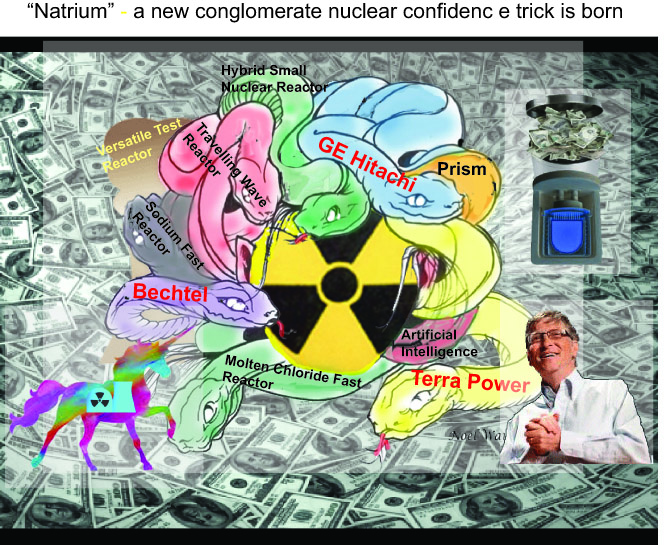
Japan to help build Bill Gates’ high-tech nuclear reactor in Wyoming -Yomiuri https://www.reuters.com/markets/commodities/japan-help-build-bill-gates-high-tech-nuclear-reactor-wyoming-yomiuri-2022-01-01/Reuters TOKYO. Reporting by Sakura Murakami; Editing by Kim Coghill- The Japan Atomic Energy Agency (JAEA) and Mitsubishi Heavy Industries Ltd (7011.T) are set to cooperate with the United States and Bill Gates’ venture company to build a high-tech nuclear reactor in Wyoming, the daily Yomiuri reported on Saturday.
The parties will sign an agreement as early as January for JAEA and Mitsubishi Heavy Industries to provide technical support and data from Japan’s own advanced reactors, the report said citing multiple unidentified sources.
TerraPower, an advanced nuclear power venture founded by Gates, is set to open its Natrium plant in Wyoming in 2028. The U.S. government will provide funding to cover half of the $4 billion project. read more
Terrapower had initially explored the prospect of building an experimental nuclear plant with state-owned China National Nuclear Corp, until it was forced to seek new partners after the administration of Donald Trump restricted nuclear deals with China.
The United States has been competing with China and Russia which also hope to build and export advanced reactors.
Japan, on the other hand, has a bitter history of decommissioning its Monju prototype advanced reactor in 2016, a project which cost $8.5 billion but provided little results and years of controversy.
The Monju facility saw accidents, regulatory breaches, and cover-ups since its conception, and was closed following public distrust of nuclear energy after the 2011 Fukushima nuclear disaster.
Both JAEA and Mitsubishi Heavy Industries could not be reached for comment, as their offices were closed for the New Year holidays.
Iran launches rocket into space as nuclear talks continue
Iran launches rocket into space as nuclear talks continue, Aljazeera, 31 Dec 21,
Iran uses satellite carrier rocket to send three research devices into space, state media reports, as talks to revive nuclear deal continue in Vienna.
Iran has launched a satellite carrier rocket bearing three research devices into space, according to state media, as difficult negotiations over its tattered nuclear deal with world powers continue in Vienna.The reports on Thursday did not say when the launch was conducted, nor what devices the carrier brought with it. It was unclear whether any of the objects entered orbit around the Earth…………………….. https://www.aljazeera.com/news/2021/12/30/iran-announces-new-space-launch-amid-nuclear-talks-in-vienna
The murky world of financing Small Nuclear Reactors (SMRs)

IKEA it ain’t: don’t go looking for friendly nuclear option, no matter the spin
MICHAEL WEST MEDIA, By Noel Wauchope|December 30, 2021
”……………..[Everyone] should be aware of the financial gymnastics going on in the USA, with NuScale, and in the UK, with Rolls-Royce. That’s just to single out the two most advanced of the many dubious SMR projects still at the starting gate.
The Murdoch media is enthusiastic about SMRs. Missing from the hype are a lot of unanswered questions. For a start — the ”M” stands for ”modular” — meaning that these reactors will be built in pieces, sort of, and transferred to a site, where they will be assembled, like a piece of IKEA furniture. But in fact there are at least 50 designs being promoted, and not all are modular.
The critical question comes down to – the money
The enthusiasm of the SMR lobby for the economic viability of SMRs is not matched by the facts.
For one thing to consider – there’s the price of the electricity to be eventually delivered by these small nuclear reactors. The Minerals Council of Australia estimates that by 2030 and beyond, SMRs could offer power to grids from $64-$77MWh, depending on size and type.
An analysis by WSP / Parsons Brinckerhoff, prepared for the 2015-16 South Australian Nuclear Fuel Cycle Royal Commission, estimated a cost of A$225 / MWh for a reactor based on the NuScale design, about three times higher than the MCA’s target range. CSIRO estimates SMR power costs at A$258-338 / MWh in 2020 and A$129-336 / MWh in 2030.
Then there are the costs of actually getting SMRs in the first place.
In Russia, China, France, and Argentina, the construction is done entirely or largely at taxpayers’ expense, and there is little or no transparency about the costs. But generally in the Western world, electricity production is supposed to be a commercially viable operation. In the context of promoting low -carbon technologies, SMRs are promoted as being cheaper than large ones. It is generally acceptable for the government to kick-start the process, with some funding, but with the understanding that the industry will become successful, profitable.
NuScale financing contortions
In the US, NuScale leads the pack. After its efforts to partner with Romania, UK, Canada and Jordan, NuScale has joined with a Utah-based utility consortium to develop what initially was proposed to be a power plant with 12 small reactors. The project, which is now forecast to cost $5.1 billion, has since been scaled back to six reactors, expected to start coming online in 2029. The Department of Energy (DOE) is to provide an annual supplement of about $130 million a year for a decade. However, that would be dependent upon annual renewals of the funding by Congress during that decade, which is a risk.
NuScale promises to deliver electricity at $55/MWh. UAMPS and NuScale have not explained the methodology used to develop this figure. Meanwhile PacifiCorp and Idaho Power have concluded that electricity from NuScale reactors would cost $94-$121/MWh.
Now NuScale is to go public by merging with what’s known as a special purpose acquisition company, or SPAC. The company, Spring Valley Acquisition Corporation, is already publicly traded. The new company named NuScale Power Corporation will list on the Nasdaq under the ticker symbol SMR. Their new SMR power plants will be called VOYGR, and NuScale will open centres at universities to promote technical training for them. The Department of Energy (DOE) will support these centres with funding, and NuScale will open centres at universities to promote technical training for them. DOE will support these centres with funding.
A SPAC is a type of shell company (shell companies being those not having actual business operations, just specific objectives, in this case, raising capital) The SPAC raises money from the public through initial public offerings, the sponsor getting 20% of the funds invested. Later private investments through public equity, or PIPES, can be added, often bought at a discount price by big institutions. The whole process is done relatively speedily, and with much less scrutiny than in usual mergers. US Securities and Exchange Commission Chair Gary Gensler wants to tighten regulations on SPACs:
Glitzy corporate presentation decks, hyped press releases and celebrity endorsements can balloon a SPAC’s equity well beyond a reasonable value long before proper disclosures are filed, Gensler said.
SPACs have had a chequered history — they enable the sponsors to avoid financial loss, even if the business fails, as many did, in the 1990s. Sixty-five per cent of deals completed in 2021 at a valuation above $1bn are trading below $10 — the price at which they were floated. All of the companies are trading below their stock market highs with some of them down by as much as 70%. Senator Elizabeth Warren and three other Democrats are investigating the imbalance between the financial results for the sponsors and banks versus the early investors.
Rolls-Royce still looking for money
The process of getting funding for the UK’s SMRs is equally tortuous. The government invested £18 million in November 2019, which delivered significant development of the initial design as part of Phase One of the project. At the beginning of November 2021, Rolls-Royce Holdings Plc raised 455 million pounds ($608 million) to fund the development of SMRs, with almost half of the financing coming from the U.K government Rolls-Royce Small Modular Reactor (SMR) business is a consortium, backed by BNF Resources and Exelon Generation. BNF Resources UK Limited is a subsidiary of BNF Capital Limited. Other members of the consortium are Assystem, Atkins, BAM Nuttall, Laing O’Rourke, National Nuclear Laboratory (NNL), Jacobs, The Welding Institute (TWI) and Nuclear AMRC, as well as Rolls-Royce. It’s not at all clear how much each group has put into the venture.
For the plan to have the planned £30 billion fleet of mini-nuclear power stations, the business will have to rely on UK taxpayers to help fund the construction of the first of the new designs. New government funding of £210 million announced on November 9 will take forward phase 2, over the next three years, of the so-called Low-Cost Nuclear project to further develop SMR design and take it through the regulatory processes to assess suitability of potential deployment in the UK. Exelon is contributing under an agreement from a year ago to find international markets. Rolls-Royce expects the first five SMR reactors to cost £2.2bn each, falling to £1.8bn for subsequent units.
Rolls-Royce will be seeking more investment for the project to help fund the building of actual SMRs.
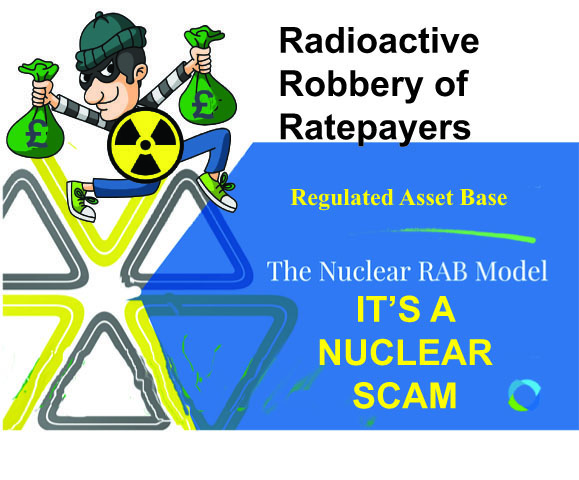
The government is currently passing legislation that will allow investors to back projects like SMRs using a regulated asset base (RAB) model, which allows them to recoup upfront costs from the consumers, over the construction period, long before those consumers actually get any electricity from the project.
Mythical beasts
So — what it all boils down to is an agreement to spend about £400 million over the next three years — to perhaps produce a design for a reactor, which might get approved by the regulators, and might find investors who might be willing to pay what will be at least £2 billion to build each one.
It’s not at all clear who is going to end up paying the most for small nuclear reactors, or indeed, if that fleet of SMRs will ever become a reality. It will probably be the taxpayers. I haven’t mentioned all those ancillary costs — of winning community approval, of security, waste disposal.
In the meantime, it’s worth being wary about the financial aspects, given the obscure manipulations going on in the US and UK, and remembering that not yet does one of these mythical beasts, Small Modular Nuclear Reactors actually exist.
Renewables remain the cheapest “new-build” source of energy generation. They exist. They work. https://www.michaelwest.com.au/ikea-it-aint-small-modular-nuclear-reactors/
.
NuScale’s Small Nuclear Reactors (SMRs) to go public with the dodgy Special Purpose Acquisition Company System
US nuclear reactor company NuScale to go public via SPAC, Capital.com, 30 Dec 21,
NuScale Power announced plans to go public in a merger with blank cheque company Spring Valley Acquisition earlier this month, highlighting the growing area of small nuclear power reactors……. So far, NuScale is the first and only company to design a SMR that received approval from the US Nuclear Regulatory Commission, according to the company’s presentation to investors…….
Going public
The deal values NuScale at $1.9bn, which implies a four-times multiple over its 2026 estimated EBITDA, CEO of Spring Valley Acquisition Chris Sorrells said in a call with investors.
The merger is expected to close in 2022 and will make NuScale a public company that trades on the Nasdaq under the ticker “SVIIU.”
The company has yet to produce revenue but estimates that once it’s incorporated, the company can begin producing around $16m in revenue next year and boost that to $13.1bn by 2030, according to the presentation.
NuScale was formed in 2007 when Oregon State University (OSU) granted exclusive rights to the core SMR technology patents. OSU maintains an interest in the company due to the technology transfer agreement.
Other companies that have invested in NuScale include Samsung’s construction subsidiary, Japanese engineering company JGC Holdings and Doosan Heavy Industries and Construction……
One of the first customers of NuScale’s technology will be Utah Associated Municipal Power Systems, which is expected to deploy a new plant in Idaho by 2029 for its Carbon Free Power Project.
Just last month, Romania’s state-owned electric utility service SN Nuclearelectrica signed an agreement to advance the deployment of NuScale’s technology in the country as early as 2027–2028.
1 This Month
To see nuclear-related stories in greater depth and intensity – go to https://nuclearinformation.wordpress.com/

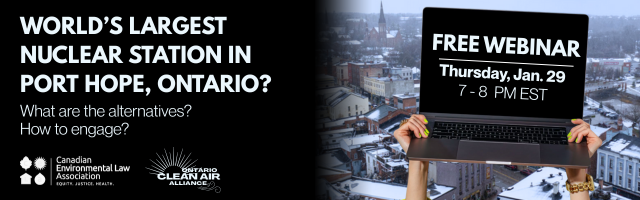
29 Jan. Thursday 7-8 p.m. Webinar – World’s Largest Nuclear Station in Port Hope, ON?

31st January – Challenging the War Machine – a DECLASSIFIED UK SUMMIT


Website of the Week
Now until to February 10, 2026 Radioactive waste storage in France: the debate is finally open! How to participate?
-
Archives
- January 2026 (271)
- December 2025 (358)
- November 2025 (359)
- October 2025 (376)
- September 2025 (258)
- August 2025 (319)
- July 2025 (230)
- June 2025 (348)
- May 2025 (261)
- April 2025 (305)
- March 2025 (319)
- February 2025 (234)
-
Categories
- 1
- 1 NUCLEAR ISSUES
- business and costs
- climate change
- culture and arts
- ENERGY
- environment
- health
- history
- indigenous issues
- Legal
- marketing of nuclear
- media
- opposition to nuclear
- PERSONAL STORIES
- politics
- politics international
- Religion and ethics
- safety
- secrets,lies and civil liberties
- spinbuster
- technology
- Uranium
- wastes
- weapons and war
- Women
- 2 WORLD
- ACTION
- AFRICA
- Atrocities
- AUSTRALIA
- Christina's notes
- Christina's themes
- culture and arts
- Events
- Fuk 2022
- Fuk 2023
- Fukushima 2017
- Fukushima 2018
- fukushima 2019
- Fukushima 2020
- Fukushima 2021
- general
- global warming
- Humour (God we need it)
- Nuclear
- RARE EARTHS
- Reference
- resources – print
- Resources -audiovicual
- Weekly Newsletter
- World
- World Nuclear
- YouTube
-
RSS
Entries RSS
Comments RSS
 nuclear-news