Will small modular reactors seed a nuclear renaissance?
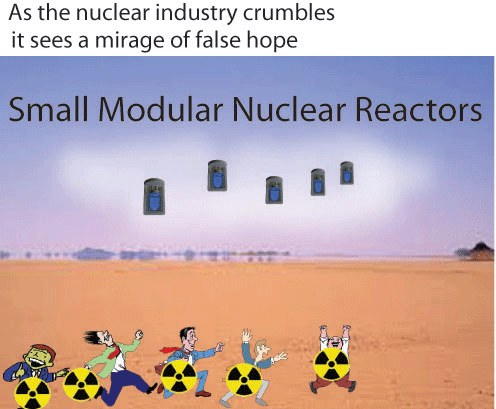
Corporate Knights does not consider new nuclear power projects to be “green” i
However, big questions remain about SMRs as the technology is largely untested. It’s unclear what the electricity from SMRs will cost and whether the technology can compete with cheap renewable sources like wind and solar backed up by storage. The prospect of micro reactors dotting remote Canadian landscapes also raises serious issues around safety and management of highly radioactive wastes.
Four Canadian provinces are banking on SMRs to help decarbonize their electricity grids, but critics argue the technology is unproven
Corporate Knights, BY SHAWN MCCARTHY, DECEMBER 8, 2022
It’s been more than a decade since Atomic Energy of Canada Ltd. (AECL) pulled the plug on its advanced CANDU reactor – a newly designed mega-reactor that industry said would usher in a “nuclear renaissance.”
Now Canada is seeing yet another promised resurgence for the nuclear industry. And this time, it comes in a size small. On December 1, Ontario Premier Doug Ford participated in a groundbreaking at Darlington nuclear facility, where provincially owned Ontario Power Generation (OPG) plans to build a small modular reactor (SMR).
If the Darlington project gets a green light on the final investment decision, the unit will be the first new reactor built in Canada in nearly 40 years, as other companies are pursuing plans to build SMRs across the country. (The nuclear sector has, however, been buoyed by massive reactor refurbishment projects at Darlington and Bruce Power’s eight-reactor site on Lake Huron.)
The industry’s latest hope, SMRs have a capacity of up to 300 megawatts and modular design features that are meant to keep construction costs under control (nuclear projects are notorious for their multibillion-dollar cost overruns). Micro reactors can be as small as five megawatts and are touted as an energy solution for remote communities and industrial sites like mines.
That’s in sharp contrast with the 1,000-megawatt behemoths that were marketed around the world in the first decade of the century by reactor manufacturers, including then federally owned AECL, Westinghouse Electric Co. and others.
The federal government and four provinces – Ontario, New Brunswick, Saskatchewan and Alberta – are lining up to support the commercial deployment of SMRs as low-carbon sources of electricity.
However, big questions remain about SMRs as the technology is largely untested. It’s unclear what the electricity from SMRs will cost and whether the technology can compete with cheap renewable sources like wind and solar backed up by storage. The prospect of micro reactors dotting remote Canadian landscapes also raises serious issues around safety and management of highly radioactive wastes.
Corporate Knights does not consider new nuclear power projects to be “green” in its Sustainable Economy Taxonomy. In July, the European Union overturned a draft proposal and included nuclear in its taxonomy for the purposes of green investing, though that controversial decision is being challenged in court by Austria, backed by several environmental groups.
In its fall fiscal update, the federal government introduced an investment tax credit of up to 30% for clean energy technologies, including SMRs. Ottawa has also committed $970 million in low-interest financing through the Canada Infrastructure Bank for the Darlington SMR project.
A bad day to go nuclear
Last decade was not kind to the nuclear industry, as Japan’s Fukushima meltdown after a tsunami in 2011 was the worst nuclear disaster since the Chernobyl accident of 1986 and led to the shutdown of all the country’s reactors. Those safety threats loom large today as Russia has attacked Ukraine’s nuclear energy site.
As well, the economic case for large new reactors has taken a beating over the years, as projects have been plagued by delays and cost overruns………………………….
At the National Energy Roundtable’s conference at the end of November, several speakers argued for the inclusion of nuclear in Canada’s strategy to electrify the economy. Energy ministers from Ontario and New Brunswick touted the benefits of SMRs, saying the technology can provide affordable, continuous, non-emitting power.
The two provinces – in addition to Alberta and uranium-rich Saskatchewan – have agreed to work together on the commercialization of SMRs……………………………….
At Darlington, OPG expects to receive a construction licence in 2024 and will release detailed cost estimates as design and regulatory work proceeds, OPG spokesman Neal Kelly said in an email.
Former mayor of Iqaluit Madeleine Redfern said at the roundtable discussion that SMRs can help northern communities and industry end their reliance on expensive, dirty and often unreliable diesel generators. Small reactors, she said, would be more reliable than intermittent electricity production from wind or solar projects. (Redfern is also chief operating officer of CanArctic Inuit Networks and an Indigenous advisor to nuclear energy developer USNC-Power, which is partnering with OPG on a demonstration reactor project, as it seeks approvals from the federal nuclear regulator.)…………………………………
Critics argue that SMRs pose the same problems of safety and waste disposal that have bedevilled the nuclear industry for decades. The future “lies in capturing the sun and wind, not in splitting atoms,” Greenpeace campaigner Keith Stewart said in an email. “SMRs have been a decade away from deployment for the last 30 years, while wind and solar are actually being deployed.”…………………….
Ontario Energy Minister Todd Smith
aid Ontario is committed to electrification but will need the federal government to be a reliable partner to help keep costs down. “If the price of electricity soars, we’re not going to see electrification unfold,” he said.
However, whether SMRs can be a timely source of cheap and low-carbon electricity for Ontario and beyond remains to be seen. https://www.corporateknights.com/category-climate/will-smrs-bring-nuclear-renaissance/
—
Another dodgy Special Purpose Acquisition Company (SPAC) set up to promote small nuclear reactors.
https://www.youtube.com/watch?v=AAJTkL99anI&t=22s
Nuclear SMR developer X-energy to merge with Ares Management-backed SPAC, creating $2B company, Utility Dive, Stephen Singer, Dec. 7, 2022
Dive Brief
- X Energy Reactor Co., a developer of small modular nuclear reactors and fuel technology, is merging with a special purpose acquisition company backed by private equity firm Ares Management Corp., X-energy announced Tuesday. The deal would establish a combined publicly traded company valued at $2 billion.
- The company will receive about $1 billion in cash in the trust account of Ares Acquisition Corp., the SPAC, assuming no redemptions by shareholders. Investments and financing commitments include $75 million from Ares Management and $45 million from Ontario Power Generation and Segra Capital Management.
……………………… X-energy, based in Rockville, Maryland, is advancing nuclear generation through a high-temperature gas-cooled small modular reactor, or SMR, the Xe-100, and its fuel, TRISO-X. The reactor is engineered to operate as a single 80-MW unit and optimized as a four-unit plant delivering 320 MW.
……………………. Edwin Lyman, director of Nuclear Power Safety at the Union of Concerned Scientists, questioned the “fundamental economic justification” for SMRs.
“A small reactor is going to produce more expensive electricity than large ones,” he said.
Backers defend SMRs as benefiting from economies of scale, but that’s not been demonstrated, Lyman said. “It would require a large order book and experience,” he said.
…………………………. At the closing of the deal, which is expected in the second quarter of 2023, the combined company will be named X-Energy Inc. and will be listed on the New York Stock Exchange. https://www.utilitydive.com/news/X-energy-ares-managment-spac-merger-small-modular-nuclear-smr/638097/
No legitimate reason to support the controversial nuclear technology planned for New Brunswick

Producing more plutonium will only exacerbate nuclear proliferation.
This is why a recent report published by the International Panel on Fissile Materials called for a global ban on separating plutonium.
The Canadian government is pushing in the opposite direction, increasing its research capacity to separate plutonium, and funding a company that seeks to export SMRs fuelled by this material.

The nuclear industry’s hope that reactors that can burn plutonium-based fuel will be less expensive has been illusory. Molten salt reactors like the Moltex SMR have a problematic history and investing in them is wasteful.
Separation of plutonium massively increases risk of proliferation, write M.V. Ramana and Susan O’Donnell
https://nbmediacoop.org/2022/11/26/commentary-no-legitimate-reason-to-support-the-controversial-nuclear-technology-planned-for-new-brunswick/ by M.V. Ramana and Susan O’Donnell, November 26, 2022
NB Power plans to develop new nuclear reactors at Point Lepreau that will use a controversial technology with implications for global security. Provincial and federal government support for this technology–called reprocessing–should end.
At an international conference on nuclear power in Washington, D.C. in October, federal Natural Resources Minister Jonathan Wilkinson proclaimed that Canada desires to play a leadership role in nuclear energy and promote its peaceful use around the world. Unfortunately, the leadership role the federal government has chosen involves separating plutonium, which enormously increases the risk of furthering nuclear proliferation.
Earlier in the year, Atomic Energy of Canada Limited (AECL), a federal Crown corporation, broke ground on a large nuclear research facility. The Advanced Nuclear Materials Research Centre, described as “the cornerstone” of the government’s $1.2-billion expansion of AECL’s Chalk River site, is to feature 12 “new shielded hot cells” and “glovebox facilities” for research on fuel associated with proposed small modular nuclear reactors (SMRs). The shielding and the glovebox are needed to develop some SMR designs that require plutonium as fuel to operate.
One of those SMR designs is being developed by Moltex, a company based in Saint John that received $50.5-million from Innovation, Science and Economic Development Canada. In his Washington address, Wilkinson took credit for investing in Moltex to develop its plutonium-extraction technology that can “recycle CANDU spent nuclear fuel into new fuel.” He said he would like Canada to export such “technology, goods and services” globally.
Another of these designs is the ARC-100, an SMR that will “breed” plutonium. NB Power is planning to apply for a licence to develop the Point Lepreau site for the ARC SMR in June 2023. Both the Moltex and ARC companies have signed agreements with Canadian Nuclear Laboratories to conduct nuclear fuel research at the Chalk River site.
Both companies have also received funding from the New Brunswick government and NB Power. In 2018, they gave $5M each to ARC and Moltex to bring them to the province and set up offices in Saint John. In 2021, the provincial government announced a further $20M grant to ARC.
Will expanding Canada’s plutonium interests support the peaceful use of nuclear energy?
Plutonium is intimately connected with nuclear power since it is created in all reactors when uranium absorbs neutrons. Using a chemical process called “reprocessing,” this plutonium can be separated from the remaining, highly radioactive, byproducts contained in irradiated nuclear fuel. Once removed, the plutonium could be used as fuel in some nuclear power plants.
But countries and individuals could make nuclear weapons with plutonium. Indeed, most people learned about this material first from news of the Fat Man bomb that flattened Nagasaki. The two uses of plutonium lie at the heart of India’s nuclear program. Set up ostensibly for peaceful purposes, India justified acquiring a reprocessing plant in the 1960s by announcing plans to develop reactors fuelled with plutonium. The source of the plutonium was CIRUS, a research reactor gifted by Canada. However, India’s first use of such plutonium was in the atomic bomb exploded in 1974, yet again demonstrating how plutonium separation and nuclear weapons are connected.
Since then, the United States, the country with the most nuclear reactors anywhere in the world, has stopped civilian reprocessing and the use of plutonium as fuel. Unfortunately, other countries didn’t follow suit—specifically, the United Kingdom, France, and Russia. The result: a stockpile of approximately 545 tonnes of plutonium. The Fat Man bomb exploded over Nagasaki used roughly six kilograms of plutonium. It is easy to do the math and calculate how many tens of thousands of nuclear weapons can be fabricated from this stockpile of separated plutonium.
Producing more plutonium will only exacerbate nuclear proliferation. This is why a recent report published by the International Panel on Fissile Materials called for a global ban on separating plutonium. The Canadian government is pushing in the opposite direction, increasing its research capacity to separate plutonium, and funding a company that seeks to export SMRs fuelled by this material.
In 2021, a group of U.S. non-proliferation experts and former government officials and advisers with related responsibilities penned an open letter to Prime Minister Justin Trudeau expressing concerns about the Moltex project. Moltex responded with the argument that the plutonium that would be produced in their proposed process is “impure” and cannot be used in nuclear weapons.
But the Moltex argument has long been refuted, for example in a 2009 report by safeguards experts from six US national laboratories. The reason is simple: any process that allows plutonium from spent fuel to be cleaned up adequately for use as nuclear fuel will make the material almost good enough for use in nuclear weapons; only relatively cheap and easy processing in a “hot cell” is necessary after that. This is why the International Atomic Energy Agency considers all plutonium (with one exception that does not apply to the process proposed by Moltex) as being “of equal sensitivity” when it comes to safeguards.
The open letter also suggested that the government carry out high-level reviews of the non-proliferation and environmental implications of the project. Instead of commissioning such reviews, the Canadian government has funded building an expensive laboratory to work on plutonium, that too at Chalk River, the site where reprocessing was carried out until 1954.
After India’s nuclear weapons test, separating plutonium b
ecame a political liability, and the nuclear establishment has only considered burying irradiated fuel in a deep geological repository. That changed under Trudeau’s leadership in March 2021, when Moltex received $50.5-million.
There is no legitimate reason to support reprocessing technology
The nuclear industry’s hope that reactors that can burn plutonium-based fuel will be less expensive has been illusory. Molten salt reactors like the Moltex SMR have a problematic history and investing in them is wasteful. Vast stores of separated plutonium sit in storage because nobody has built a reactor that can burn plutonium fuel successfully and economically. Concerns about running out of cheap uranium ore that were common in the early decades of the nuclear age have proven mistaken; there is plenty of uranium ore globally to fuel current and proposed nuclear reactors.
Further, a 2016 report from the Canadian Nuclear Laboratories found that there was no business case for reprocessing CANDU fuel, in part “due to its low fissile content,” and the associated costs and risks. The report also noted “significant upfront investment and numerous investments over a long timeframe,” and that reprocessing in other countries has not been commercially successful. Crucially, the report emphasized that reprocessing “would increase proliferation risk.”
Meanwhile, all Canada’s current and proposed plutonium activities have reduced regulatory oversight. In 2019, the Canadian Parliament approved Bill C-69, which allows some small modular reactors and associated nuclear projects below various thresholds, to move forward without being subject to a federal impact assessment.
This is why the Coalition for Responsible Energy Development in New Brunswick has petitioned Environment and Climate Change Minister Steven Guilbeault to require an impact assessment for NB Power’s ARC-100 SMR project. Unless Guilbeault requires it, there will be no federal impact assessment of this new plutonium project.
Over six decades of global experience with building nuclear power plants has clearly demonstrated that they are expensive and take years and years to start operating. Electricity from nuclear plants costs far more than from renewable energy sources. Nuclear power, then, cannot be a viable solution to climate change.
Nuclear reactors are also susceptible—albeit infrequently—to severe accidents that lead to long-lasting radioactive particles contaminating large tracts of land. The risk of accidents will increase as climate change worsens and extreme weather events become more common, or in the event of war—as evidenced by the ongoing situation at the Zaporizhzhia nuclear plant in Ukraine. There is also no demonstrated way to safely manage nuclear waste for the millennia the radioactive materials take to decay.
Small modular reactors are not going to solve these problems. On the contrary, adding plutonium separation to the Canadian nuclear industry’s repertoire will create a new global security risk and raise legitimate questions about Canada’s stated goal to be a leader in the peaceful use of nuclear energy. There is no legitimate reason to support technologies that create the potential for new countries to separate plutonium and develop nuclear weapons. The government should stop supporting this dangerous technology.
M.V. Ramana is the Simons Chair in Disarmament, Global and Human Security and professor at the School of Public Policy and Global Affairs, University of British Columbia, and the author of The Power of Promise: Examining Nuclear Energy in India.
Susan O’Donnell is the primary investigator of the RAVEN project at the University of New Brunswick, a member of the Coalition for Responsible Energy Development in New Brunswick, and an adjunct research professor in the Environment and Society program at St. Thomas University.
Talking football pitches but not in Qatar
thttps://www.nuclearpolicy.info/news/talking-football-pitches-but-not-in-qatar/ 5 Dec 22, Whilst the World Cup action on the pitch in Qatar is the current focus of many millions of fans of ‘the beautiful game’, the UK/Ireland Nuclear Free Local Authorities are seeking out the answer to a football-related question much nearer to home.
Rolls-Royce has been talking big about the prospects for its so-called Small Modular Reactors in recent days, but everyone remains confused as to how big the reactor is. Although the intended power output is clear, at 470 MW being roughly compatible with a first-phase Magnox nuclear reactor, various media articles have reported the SMR as occupying a surface area amounting to between ‘one and a half and ten football pitches’.
Football’s world governing body, FIFA, sets international standards for the dimensions of playing pitches based on metres, but even these are at variance. The length of a pitch can be between 90 metres and 120 metres from goal line to goal line and the width between 45 metres and 90 metres.
Quite a difference, so the NFLA decided they want to use Wembley Stadium with a playing pitch of 105 metres by 68 metres as a reference football pitch most people can relate to.
The Chair of the UK/Ireland Nuclear Free Local Authorities Councillor David Blackburn has just written to Tom Samson, Chief Executive Officer of Rolls-Royce SMR, seeking out the answer.
Councillor Blackburn said “If we do not know how big it is we do not know what we are dealing with, and it is way overdue for Rolls-Royce to provide clarity. With the FIFA standard size of a football pitch being variable, we have gone for Wembley Stadium as a reference most people, whether football fans or otherwise, can relate to. We have asked how many ‘Wembley’s’ will the SMR fill? It is now over to Mr Samson to respond. We shall of course bring you the final score when we have it.”
Australia a”pot of gold” for America’s military section to wage war in space

US Space Force eyes ‘prime’ Australian real estate for future warfare operations, ABC News, By defence correspondent Andrew Greene 3 Dec 22
Visiting senior US military officers believe Australia is a “pot of gold at the end of the rainbow”, as they eye off this continent’s “prime” geography for future space operations.
Key points:
- US military officials visiting Australia say conflict in space in the next few years is a very real prospect
- They believe the war in Ukraine is demonstrating the growing importance of space as a new war-fighting domain
- Australia’s southern location and potential launch sites near the equator make it an attractive prospect for future operations
Top-ranking members of the US Space Force are warning of China’s growing capability in the emerging military domain as they meet defence counterparts and local industry representatives.
“I’m visiting my allies and we’re talking about future partnerships that we can have,” US Space Force Lieutenant-General Nina Armagno told reporters in Canberra.
“This is prime country for space domain awareness,” the director of staff of the US Space Force added while speaking at the Australian Strategic Policy Institute.
The three-star general has travelled to Canberra along with Lieutenant-General John Shaw, the deputy commander of the US Space Command who is responsible for America’s combat capabilities above Earth……………………………..
Both of the visiting military officers believe the war in Ukraine is demonstrating the growing importance of space as a new war-fighting domain…………………………..
Australia’s own Defence Space Command was only formally stood up in March, but General Armagno says this country already has the natural advantage of its southern-hemisphere geography and potential launch sites close to the equator.
“It seems as [if] Australia is sitting on a pot of gold at the end of the rainbow, really, for our common national security interests,” she said. https://www.abc.net.au/news/2022-12-02/us-space-force-eyes-australian-real-estate-future-warfare/101724368
USA trying to use Philippines as a guinea pig for its unviable small nuclear reactors – and for military purposes.

“With recent plans by the US Department of Defense to build an advanced mobile nuclear microreactor prototype in Idaho, Manila should not allow Washington to use Philippine military bases as prototype areas for these reactors.
Save the country from the perils of nuclear reactors, NAKED THOUGHT
By Charlie V. Manalo, December 3, 2022
AS the United States government, invoking provisions of the Enhanced Defense Cooperation Agreement (EDCA), requests for additional military bases, five on the island of Luzon alone, the idea of the country playing host to mobile nuclear reactors is not far-fetched.
This is for the simple reason that whoever crafted the agreement made it so vague, it did not provide for any restrictions on the type of facilities and materials the US would be using in constructing its bases in the Philippines.
And this has been aggravated further by the enactment of the Public Service Law which opens the country’s airports to foreign ownership, giving the US all the resources needed to construct its own airports which it could use as military bases under the guise of a commercial airport.
Anyway, former congressman Terry Ridon, convenor of Infrawatch Philippines, sent me a copy of an article he wrote on the subject, explaining clearly its implications. It’s entitled, “Reject mobile nuclear reactors in PH bases-Infrawatch Philippines,” which I’m publishing in its entirety.
“With recent plans by the US Department of Defense to build an advanced mobile nuclear microreactor prototype in Idaho, Manila should not allow Washington to use Philippine military bases as prototype areas for these reactors.
According to an April report by The Associated Press, the US DoD ‘signed off on the Project Pele plan to build the reactor and reactor fuel outside of Idaho and then assemble and operate the reactor at the lab.’
As this is a project initiated by the US defense department, its military objectives had been disclosed by Jeff Waksman, project manager for Project Pele, saying, “Advanced nuclear power has the potential to be a strategic game-changer for the United States, both for the (Department of Defense) and for the commercial sector.”
The US DoD further said that the reactor designs are ‘high-temperature gas-cooled reactors using enriched uranium for fuel.’
PH microreactor deployment
Under the Enhanced Defense Cooperation Agreement between the Philippines and the United States, there are no restrictions to Washington on the type of facilities and materials it will construct and install in Philippine military bases, except a specific restriction against installing nuclear weapons.
However, Philippine authorities should be reminded that this restriction does not assuage fears that the country will not be involved in regional military conflicts because EDCA allows the installation of conventional military weapons which may approximate the breadth and fatal impact of nuclear weapons.
More importantly, in the event that nuclear microreactors are produced by the US DoD at scale, these small nuclear plants can, in fact, be installed in EDCA locations in different parts of the country.
This is alarming because the country has yet to decide and implement its national policy on nuclear development based on the policy direction of President Ferdinand Marcos Jr.
In fact, it needs to be made clear that nuclear microreactors in EDCA locations in the country will not be used for civilian purposes but for military objectives by the United States in the Indo-Pacific.
This distinction alone should give the current government pause on allowing nuclear microreactors to be deployed in EDCA locations in the future.
More importantly, military nuclear microreactors will allow Washington to deploy different kinds of weapons to influence the security arrangement in the South China Sea and the greater Indo-Pacific.
Military purposes
Further, as nuclear microreactors in EDCA areas will certainly be used for military purposes, this might prompt other regional actors to accuse Manila of violating the Bangkok Treaty, the treaty declaring Southeast Asia as a nuclear weapons-free zone and other weapons of mass destruction.
With a military nuclear microreactor in Philippine soil, Washington may be able to operate high-powered conventional military weapons which may be equivalent to weapons of mass destruction.
Certainly, Manila should follow its treaty obligations in the region, particularly as other strong powers are also looking at Manila to temper its pivot toward Washington.
Finally, allowing this kind of deployment in EDCA areas diminishes the current call of President Marcos to carefully proceed with nuclear research and development for civilian purposes.
The focus of the government should be considering whether nuclear energy should be part of the current energy mix and whether the Bataan Nuclear Power Plant should be revived.
It should also consider developing other aspects of nuclear technology, which can benefit health care and other critically important sectors.
As such, allowing nuclear microreactors in EDCA areas or anywhere in the Philippines should not be on the agenda.”
Small modular reactor plans to be blocked by the Scottish government
Plans to power a refinery in Scotland with a Rolls-Royce small modular
reactor (SMR) are likely to stall due to opposition from the Scottish
government. Government officials have said they will block any moves to
power the Grangemouth refinery on the Firth of Forth with a nuclear
reactor. According to the Sunday Telegraph, talks have taken place between
chemicals group Ineos and Rolls-Royce, and the two companies are understood
to have considered whether the plant could be powered by an SMR.
New Civil Engineer 30th Nov 2022 https://www.newcivilengineer.com/latest/scottish-small-modular-reactor-plans-to-be-blocked-by-government-30-11-2022/
Ukraine’s nuclear plants face uncertain future after Russian attacks
Attacks on Ukraine’s power grid took all 15 of the nation’s nuclear reactors offline for the first time ever. Russia also retains control of Zaporizhzhia Nuclear Power Plant, the largest nuclear power station in Europe
New Scientist, TECHNOLOGY | ANALYSIS 25 November 2022 By Matthew Sparkes
Ukraine’s nuclear power stations have been caught, both politically and literally, in the crossfire ever since the start of Russia’s invasion. But this week, for the first time in history, all 15 of its nuclear reactors were taken offline by fighting.
Zaporizhzhia Nuclear Power Plant (ZNPP), near the Ukrainian city of Enerhodar, is Europe’s largest nuclear power station and has been in Russian hands since in March. The final working reactor at ZNPP was shut down in September as a precautionary measure. Nuclear plants supply power to the grid when operating, but when shut down they actually draw power from it in order to run vital cooling and safety systems, which means disruption to electricity supply is a major concern.
On 23 November, shelling of power infrastructure in Ukraine by Russian troops led to blackouts that caused emergency diesel generators to start up at ZNPP, as well as at reactors across Ukraine’s three other nuclear plants that had previously made it through the war with relatively little disruption.
In a statement on its website, Ukrainian nuclear operator Energoatom said that for the first time in the 40-year history of the Ukrainian nuclear power industry, all of its nuclear power plants were not producing power, instead relying on diesel back-up generators. Access to the national grid resumed on 25 November………………………………………..
Olena Pareniuk, a scientist working at the Chernobyl site, says the process of restarting a nuclear power plant is long and difficult, but that the energy supply is sorely needed by Ukraine’s citizens, who are experiencing widespread blackouts across the country.
“It won’t [come in time to] help us through winter,” she says. Equipment will need to be checked, which is a job that cannot be rushed, she says. ………. https://www.newscientist.com/article/2348196-ukraines-nuclear-plants-face-uncertain-future-after-russian-attacks/
Ineos corporation to join Rolls Royce’s messy consortium, to push for Small Nuclear Reactors in the Great British Nuclear Swindle

Rolls-Royce is in talks with Ineos to build a mini nuclear reactor to power the chemicals group’s Grangemouth refinery.

Rolls is heading a government-backed consortium to develop between 20 and 30 small modular nuclear reactors but is in need of customers to help to reduce the risk of the venture.
Ministers are finalising plans to support SMRs through a body called Great British Nuclear, which will be responsible for getting
planning permission and undertaking the preparation work on the new sites. Rolls’ talks with Ineos, first reported by The Sunday Telegraph, are understood to be at an early stage. Ineos’s Grangemouth refinery in Scotland is a joint venture with PetroChina and refines crude oil and produces chemicals.
Times 28th Nov 2022
Small Modular Nuclear Reactor cost overruns: the same old problems haunt new nuclear in Utah
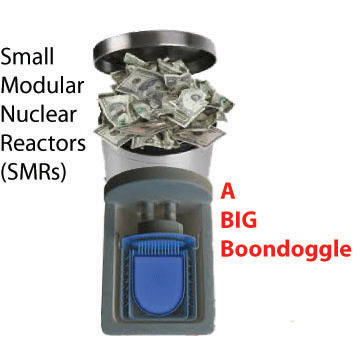
Much hope is being placed on Small Modular Reactors (SMR) making new
nuclear plants competitive. But David Schlissel at IEEFA summarises their
research into the publications, updates and statements coming from the
stakeholders involved with the SMR by UAMPS (Utah Associated Municipal
Power Systems) and NuScale Power Corporation that shows that costs are
going out of control, a persistent problem in the nuclear industry.
The original target power price of $55/MWh has risen to $100 (with subsidies)
and is likely to rise further by the time it’s switched on in 2030, says
Schlissel. Construction costs and delays are the main causes (as usual). So
concerned are potential customers that, since February 2022, only 101MW of
the plant’s total 462MW have been subscribed to.
It will be difficult to
secure financing for the plant without a fully subscribed project.
Meanwhile, IEEFA figures say renewable resources and battery storage will
provide reliable electricity at lower cost than the UAMPS plant, even if
the price for the power from the project is just $58 per MWh. And
renewables and battery costs are still declining.
Energy Post 25th Nov 2022 more https://energypost.eu/small-modular-reactor-cost-overruns-the-same-old-problems-haunt-new-nuclear-in-utah/
World’s Biggest Nuclear-Fusion Project Faces Delays as Component Cracks.

Cracks in a key silver-lined component are creating new delays and cost
overruns in the $23 billion project to prove whether nuclear fusion can
generate limitless clean energy.
The International Thermonuclear
Experimental Reactor, or ITER, under construction in southern France is
being funded by the European Union and countries including China, India,
Japan, Russia and South Korea. The world’s biggest experiment aims to show
that mimicking the power that makes stars shine can produce clean energy
that could help slow global warming on Earth.
But new ITER Director-General
Pietro Barabaschi warned members this week the project faces problems that
are potentially “extensive,” along with new requirements for time and
money that “will not be insignificant.”
Bloomberg 25th Nov 2022
Confusion over nuclear wastes from small modular reactors
Managing NuScale, other SMR waste will be ‘roughly comparable’ with conventional reactors, DOE labs find Utility Dive Stephen Singer, 23 Nov 22
Dive Brief:
- Two studies differ over how much nuclear waste would be a factor with small modular reactors, or SMRs, such as those planned by NuScale and TerraPower.
- The Argonne and Idaho national laboratories say managing waste from SMRs would have few challenges compared with traditional light water reactors. Spent fuel is thermally hot and highly radioactive, requiring remote handling and shielding.
- A study led by Stanford University and the University of British Columbia says SMRs will generate more radioactive waste than conventional nuclear power plants…………………………… more https://www.utilitydive.com/news/smr-modular-reactor-nuclear-waste-doe-stanford-0
Lawmaker says Filipinos will be ‘guinea pigs’ in nuclear pact with US

ABS-CBN News Nov 24 2022
MANILA — House Deputy Minority Leader France Castro is against negotiations for a civilian nuclear pact between the United States and the Philippines, saying it poses threat to the health and safety of Filipinos.
According to the ACT Teachers party-list representative, the Filipinos will become “guinea pigs” in this nuclear energy cooperation deal known as “123 agreement”.
The pact, among initiatives announced during US Vice President Kamala Harris’s recent trip to the Philippines, can lead to the future sale of US nuclear reactors to Manila.
“The US and the Philippines agreed to have a… testing of what we call the nuclear equipment here in the Philippines,” Castro told ANC’s “Headstart” Thursday.
“So, we are being made as guinea pigs in this experiment. This would affect our health, of course, our safety and the environment,” she added.
The Makabayan bloc, led by Castro, has filed House Resolution 582 to investigate the “123 agreement”.
The group said modular or microreactor nuclear power plants are still at an experimental stage and are only legally being made in US bases…………………… https://news.abs-cbn.com/video/news/11/24/22/filipinos-will-be-guinea-pigs-in-nuclear-pact-with-us-solon
USA Vice-President For the Nuclear Industry Kamala Harris on a marketing jaunt for NuScam’s Small Nuclear Reactors to Southeast Asia

Thailand, Philippines, Indonesia – nuclear reactors such a jolly idea in this earthquake ring of fire ?
US to supply Thailand, Philippines with modular nuclear reactors
BenarNews staff, 2022.11.23, Bangkok.
The United States says it will help Thailand and the Philippines with a new civilian nuclear technology to reduce climate-damaging emissions, but experts warn the final products are years away from being operational and other hurdles exist.
Plans by the U.S. to supply its longtime Southeast Asian allies with so-called small modular reactors (SMRs) were unveiled during Vice President Kamala Harris’ trip to both countries in recent days.
While attending the Asia-Pacific Economic Cooperation meetings in Bangkok last weekend, Harris launched a new clean energy partnership with Thailand.
From there, the vice president went to the Philippines where she announced that Washington and Manila were starting negotiations on the 123 Agreement, which would allow for civilian nuclear cooperation.
The U.S. nuclear technology plans for Thailand and the Philippines are firsts involving Southeast Asian nations.
The SMRs, which can be as small as a bucket and transportable, are to be constructed under “the highest standards of safety, security and nonproliferation,” officials said.
Another country in Southeast Asia that has shown interest in developing such reactors – Indonesia – appears to be looking at designs from several countries. [Never mind about the earthquakes?]
In a press release, the White House said the new partnership with Thailand would “build capacity for the secure and safe deployment of advanced nuclear reactor technologies.”
“This partnership will help Thailand take advantage of the unique benefits of SMRs that provide 24/7 reliable power, complement other clean energy sources, use a small land footprint and incorporate advanced safety features.”
The Thai government has set a goal of Net Zero Emissions by 2065, but no timeline for the SMR partnership. Washington praised the “unique benefits” of reactors which, besides providing reliable power, also fight climate change.
Small modular reactors generally are defined as advanced nuclear reactors with a capacity of less than 300 MW, according to the International Energy Agency.
A reactor could be as small as a five-gallon (18.9-liter) bucket. The traditional design has fuel and control rods, and energy is transported through boiling water, according to NuScale, a U.S. SMR manufacturer, which estimated initial costs at about U.S. $500 million.
The agreement with Manila calls for the U.S. and the Philippines to cooperate on advanced nuclear technologies to ensure energy security as that Southeast Asian country transitions to clean energy.
Once in force, the 123 agreement “will provide the legal basis for U.S. exports of nuclear equipment and material to the Philippines. The United States is committed to working with the Philippines to increase energy security and deploying advanced nuclear reactor technology as quickly as safety and security conditions permit to meet the Philippines’ dire baseload power needs,” the White House said in a statement.
Under President Ferdinand Marcos Jr.’s father, the late dictator Ferdinand E. Marcos, the Philippines began construction of the Bataan Nuclear Power Plant in 1976, in an area about 100 km (62 miles) west of Manila. The plant, constructed above a major fault line, was mothballed amid safety concerns after the 1986 Chernobyl disaster.
Today, the Philippines runs a couple of research reactors for training and education purposes while Thailand has no nuclear power.
……….. Tanagorn said Thais were concerned about safety in light of the 2011 Fukushima nuclear disaster caused by a tsunami in Japan. Other obstacles are the limited number of investors and the lack of domestic laws and regulation of nuclear activities.
John Timmer, science editor of Ars Technica, a web portal focusing on science and technology, said that with nuclear reactors, the principle is always “safety first.”
“The approval process for that reason tends to be long and includes a lot of documentation,” he said.
“The SMRs are designed to be much safer, but they haven’t been built (in the U.S.) in a final form yet, so it’s difficult to say whether the real-world experience will show that to be the case and also how useful they’ll be for addressing climate change,” Timmer told BenarNews.
“I’ve been hearing about SMRs for about a decade,” he said, adding that “until we build and get a sense what operating them is like and what costs are like, I’m going to be a bit skeptical.”
Cost is another obstacle.
“We’ve never built one of these, so this is going to be a learning experience and for the first few years. It’s going to be more expensive and more complicated to complete,” Timmer said.
‘Widespread misconceptions’
Economist John Quiggin, a professor at the University of Queensland in Australia, listed economic viability of nuclear power plants compared to coal, gas or solar and wind facilities as one of the “widespread misconceptions.”
“When pressed, nuclear fans will mostly shift the argument to the ill-defined notion of ‘small modular reactors,’ which don’t actually exist, and may never [exist],” Quiggin said, noting there are operating examples of small reactors, but “those are made on a one-off basis and are expensive because they forgo size economies.”
Once the reactors can be factory-produced “the ‘modular’ idea is to counter this loss with the economic gains of high-volume,” he said.
“There has been a lot of talk lately about a revival of nuclear power, partly in response to the need to replace the energy previously supplied by Russia, and partly as a longer-term response to climate change,” Quiggin said.
While in office U.S. President George W. Bush launched a nuclear power program, which led to talks of a “nuclear renaissance” but yielded only two projects despite no effective opposition “except from consumers objecting to the massive costs.”
Quiggin expects that the number of SMRs constructed will be also “tiny.”
“The work of decarbonizing energy supply will be done almost entirely by the sun and the wind,” he said.
Jason Gutierrez in Manila contributed to this report. https://www.benarnews.org/english/news/philippine/nuclear-reactors-11232022142149.html
NuScam’s Utah small nuclear reactor project in doubt – needs $billions of tax-payer support

Want to buy into a nuclear power project? This Utah group would like to talk.
UAMPS is still looking at small reactors in Idaho, but cost estimates are climbing and they need more partners.
After seven years, the Utah Associated Municipal Power Systems is still pursuing a series of small nuclear reactors at the Idaho National Laboratory as their clean-power solution.
And, after seven years, they still need more company.
UAMPS, which has 50 members that coordinate on buying and delivering electricity, will soon be updating the 27 entities that have opted into the “Carbon-Free Power Project,” and the price is going up.
The CFPP, a partnership between UAMPS and NuScale Power, an Oregon company developing small nuclear reactors, had given the members an earlier estimate of about $58 per megawatt-hour for power from the project, which was well above what they’re currently paying for power. And now it’s looking closer to be in the $80 to $100 per megawatt-hour by the time it would come online in 2029.
Meanwhile, the UAMPS members who have committed to the project would only take about a quarter of the CFPP’s planned 462-megawatt capacity. UAMPS’ incoming CEO Mason Baker acknowledges that isn’t enough…………..
Baker said they are looking for partners both inside and outside UAMPS. There were originally 36 interested members, but concerns over costs and risks were enough for Logan, Bountiful and others to withdraw in 2020…………………………………………
Is it a too-risky business?
Both Laurie Mangum, energy services director for St. George City. and Dennis Bott, mayor of Brigham City said they would like to see more financial participation from the federal government to lower the risk. The Department of Energy has committed $1.4 billion to the project. “I’d like to see them double or triple that,” Bott said.
UAMPS spokesman LaVarr Webb said completion of the latest cost estimates will trigger an “off-ramp” opportunity for the 27 participants. And if the price estimate exceeds a certain level, UAMPS will have the option to walk away with most of its costs recouped. If they do proceed, UAMPS will issue bonds to pay for the project, and power ratepayers in those cities will pay back the bonds through their monthly bills……………………….
The environmental watchdog group HEAL Utah has opposed the project since its inception, and Executive Director Lexi Tuddenham said CFPP can’t gain enough participants because of the open-ended financial risk of nuclear energy. She pointed to nuclear projects in South Carolina and Georgia that have seen large cost overruns.
“Baseload is important, but nuclear is certainly not the only way to meet that need — in addition to demand-side management, efficiency upgrades, and smart grids,” she said. “Battery storage technology of many types is at a stage where it can provide the reliable and dispatchable energy needed to pair with intermittent sources like wind and solar. In fact it is better and far more efficient at load-following than nuclear, which becomes even less cost effective when it is switched on and off.”………………………………
Still, what about nuclear waste?
From NuScale’s standpoint, the project is still full-speed ahead.
“We have issued the long-lead material specifications for the upper reactor pressure vessel, and the UAMPS project remains on track to start delivering safe and reliable carbon-free energy by the end of this decade,” said Diane Hughes, Vice President of NuScale’s Marketing and Communications. She said UAMPS’ license application is on schedule to be submitted to the Nuclear Regulatory Commission in 2024. The NRC review is expected to completed in 2026, and construction is planned for later that year. NuScale declined to comment on whether the project needed more participation to proceed.
For all of its safety refinements, the CFPP still relies on the fission of uranium, and with that process comes high level nuclear waste that takes up to 250,000 years to decay to a safe level. The U.S. government has never come up with a permanent solution for the waste, which is still stored near the plants that produced it. Like all nuclear power plants, the CFPP will be paying into a federal fund aimed at developing a solution………… https://www.sltrib.com/renewable-energy/2022/11/24/want-buy-into-nuclear-power/
1 This Month
To see nuclear-related stories in greater depth and intensity – go to https://nuclearinformation.wordpress.com/

29 Jan. Thursday 7-8 p.m. Webinar – World’s Largest Nuclear Station in Port Hope, ON?


31st January – Challenging the War Machine – a DECLASSIFIED UK SUMMIT


Website of the Week
Now until to February 10, 2026 Radioactive waste storage in France: the debate is finally open! How to participate?
-
Archives
- January 2026 (271)
- December 2025 (358)
- November 2025 (359)
- October 2025 (376)
- September 2025 (258)
- August 2025 (319)
- July 2025 (230)
- June 2025 (348)
- May 2025 (261)
- April 2025 (305)
- March 2025 (319)
- February 2025 (234)
-
Categories
- 1
- 1 NUCLEAR ISSUES
- business and costs
- climate change
- culture and arts
- ENERGY
- environment
- health
- history
- indigenous issues
- Legal
- marketing of nuclear
- media
- opposition to nuclear
- PERSONAL STORIES
- politics
- politics international
- Religion and ethics
- safety
- secrets,lies and civil liberties
- spinbuster
- technology
- Uranium
- wastes
- weapons and war
- Women
- 2 WORLD
- ACTION
- AFRICA
- Atrocities
- AUSTRALIA
- Christina's notes
- Christina's themes
- culture and arts
- Events
- Fuk 2022
- Fuk 2023
- Fukushima 2017
- Fukushima 2018
- fukushima 2019
- Fukushima 2020
- Fukushima 2021
- general
- global warming
- Humour (God we need it)
- Nuclear
- RARE EARTHS
- Reference
- resources – print
- Resources -audiovicual
- Weekly Newsletter
- World
- World Nuclear
- YouTube
-
RSS
Entries RSS
Comments RSS
 nuclear-news