Space dangers: Contested orbits and mounting space junk

The 1967 U.N. Outer Space Treaty prohibits ‘weapons of mass destruction’ in space or on ‘celestial bodies’ like the moon. But currently ‘weapons of selective destruction’ fall outside of the OST. Thus a new treaty is urgently needed.
By Bruce Gagnon , http://space4peace.blogspot.com/2023/02/space-dangers-contested-orbits-and.html
Space orbital parking lots are getting dangerously crowded risking cascading collisions ( Kessler Syndrome) which could become so severe that space flight would be impossible due to the orbiting field of debris. If this was to occur much of life on planet Earth would go dark as our daily activities are enabled by space satellites (GPS, Internet banking, weather prediction, cell phones, air traffic control, etc).
In addition, because of the massive escalation of satellite launches, astronomers are complaining that we are losing the night sky.
Elon Musk’s SpaceX makes rockets and satellites to build Starlink, a broadband Internet system that once completed will cover the entire world. SpaceX has so far put 2,500 satellites into orbit and plans for 42,000 satellites in low-Earth orbit (LEO) occupying 80% of this space.
The Pentagon funds and tests Starlink to use its military capabilities. Starlink satellites are being utilized by the Ukrainian military to guide drones, artillery shells, and missiles into Russian positions and at civilian targets.
Very recently Musk has begun to slightly restrict the use of Starlink by the Ukrainian military as he feared that Russia might take action against the constellation.
Anti-satellite weapons (ASAT) have been tested by India, US, Russia and China. ASAT’s need no explosives, at orbital speeds kinetic energy (one thing smashing into the other) does the job.
Virtually all warfare on the planet is now enabled by space technology. Thus filling up the increasingly limited parking spaces in various orbital regions will determine which nation has an advantage.
NATO in 2019 announced a new doctrine calling space a ‘fifth operational domain’. NATO maintains that the US-led bloc will use commercial satellites as a military booster.
The 1967 U.N. Outer Space Treaty prohibits ‘weapons of mass destruction’ in space or on ‘celestial bodies’ like the moon. But currently ‘weapons of selective destruction’ fall outside of the OST. Thus a new treaty is urgently needed.
Russia and China have been leading the effort at the UN to create a new treaty to ban all weapons in space for many years. But the US and Israel have been blocking such a step for peace in space. The official US line through Republican and Democratic administrations is ‘there is no problem in space, and no new treaty is needed’.
During recent years the numbers of satellites orbiting the Earth has grown dramatically. Thousands more satellite launches have been approved by the Federal Communications Commission despite legal action by a coalition of groups (including the Global Network Against Weapons & Nuclear Power in Space).
Each launch releases toxic agents which are destroying the Earth’s ozone layer. In addition, when satellites fall from lower earth orbit and burn-up on reentry they release a deadly stew of electronic particles into our atmosphere.
Russia has issued a warning to the US-NATO that they are ‘exposing civilian space assets to potential attack by utilizing them for military purposes’.
In early February Ukrainian troops fired rockets from a US-made HIMARS system which hit a hospital in Novoaydar, killing 14 Russian-ethnics and injuring 24. Russia claimed that Kiev used western satellites operated by NATO personnel to target the hospital.
In late February China announced that it was preparing to launch close to 13,000 satellites into LEO in a move to counter Musk’s SpaceX network. China stated that they intended to ‘ensure that our country has a place in low orbit and prevent the Starlink constellation from excessively preempting low-orbit resources.
~ Bruce Gagnon is coordinator of the Global Network Against Weapons & Nuclear Power in Space and lives in Brunswick, Maine.
The Dream of NuScale Small Nuclear Reactors Hangs in the Balance

Wired, 27 Feb 23
A cluster of reactors that are just 9 feet in diameter is supposed to start a nuclear energy resurgence. Mounting costs may doom the project.
JORDAN GARCIA, A deputy utilities manager in Los Alamos, New Mexico, is facing an energy crunch that is typical in the American West. For decades, the county-run utility relied on a cheap and steady mix of coal and hydroelectric power. But the region’s dams are aging and drought-parched, and its coal plants are slated to retire.
The county is aiming to fully decarbonize its grid by 2040, and the city has been tapping more solar lately, but batteries are arriving slowly, and Garcia worries about heat waves that strain the grid after the sun goes down. Wind power? He’d take more of it. But there aren’t enough wires stretching from the state’s windy eastern plains to the mesa-top community. “For us it’s pretty dire,” he says.
For the past few years, Garcia has been counting on a unique nuclear experiment to come to the rescue. In 2017, Los Alamos signed up to join a group of other local utilities as an anchor customer of the first small modular reactors, or SMRs, in the US, created by a company called NuScale. The design, which calls for reactors only 9 feet in diameter, had never been built before, but the initial cluster planned in Idaho Falls, Idaho, was promised to be much cheaper than a full-scale reactor and to offer affordable carbon-free energy 24/7.
To Garcia, this felt like a homecoming. Los Alamos, a town with the motto “Where discoveries are made,” is the birthplace of the atom bomb, and experimental reactors ran not far from downtown for much of the 20th century. But it had never actually used nuclear power to keep the lights on.
This month, Los Alamos and other local utilities across the West were facing a weighty decision: whether to pull the plug on their nuclear dream. NuScale had informed members of the group, Utah Associated Municipal Power Systems, or UAMPS, that the estimated costs of building the six 77-MW reactors had risen by more than 50 percent to $9.3 billion. For Garcia, that translated into a jump in the cost of energy from $58 to $89 per megawatt-hour.
…………… Without extra subsidies from the new Inflation Reduction Act—on top of $1.4 billion already committed to the project by the US Department of Energy—the price to energy users in places like Los Alamos would have doubled.
…………. The project’s power output is only 20 percent subscribed, and UAMPS says it will need to reach 80 percent for planning and construction to proceed next year.

Many a “nuclear renaissance” has fizzled.
…………….. Only two [large nuclear] reactors are being built in the US: a pair of 1100-MW units at the Vogtle plant in Georgia, now seven years delayed and $20 billion over their $14 billion budget.
NuScale hopes its smaller reactors can avoid that fate……… Last month, the company was the first of dozens of companies working on SMRs to have a design approved by US regulators. That makes NuScale first in the race to leap from a “paper napkin” reactor, as critics sometimes deride SMRs, to a real one, though the Idaho project involves a revised design that will need its own approval.
The project has hit roadblocks before. It began with 36 utilities signed on, but that number has fluctuated and dropped to 27 last year. In 2020, several municipal utilities dropped out in response to a construction delay and cost increases. Some later rejoined the project after the US Department of Energy upped its commitment to offset some of the costs.
Critics say those price revisions are a sign SMRs are heading down the same path as projects like Vogtle. For nearly a century, the nuclear power industry’s mantra was that building bigger plants would drive down costs. While existing plants aged and new construction withered, SMR companies began promoting a different philosophy, says David Schlissel, an analyst at the Institute for Energy Economics and Fiscal Analysis, claiming that constructing many small reactors would teach builders how to make them more cheaply.
But the evidence for progress is flimsy, says Schlissel, who notes that his 50-year career has spanned many a “nuclear renaissance” that fizzled. When that philosophy was applied in France, where dozens of reactors were built in the 1980s, costs still increased. Claims that “modularity” will help make construction construction more efficient are also suspect, he adds. The new Vogtle reactors involved nearly 1,500 “modular” components that were largely constructed offsite.
Schlissel also believes that NuScale’s current estimates are rosy because they rely on the approval of its newer design that uses less steel, one of the materials driving the cost increases. But regulators may not back that approach, he says. Towns should get out while they can, he advises, before costs climb higher still, and seek out alternatives like geothermal and battery storage. “Let the buyer beware,” he says.
……………….. officials in Morgan, Utah, a small town in the Wasatch Mountains north of Salt Lake City, decided to make a quick exit from the project…….
This year, the city realized it had new alternatives to the rising costs of nuclear power. While the Inflation Reduction Act is expected to help offset the costs of the Idaho plant, it also includes funds to help rural communities start their own energy projects. Bailey wants the city to become more self-reliant, installing its own solar panels and batteries that reserve power overnight.
In this round, Morgan was the only defector, though another Utah city, Parowan, reduced its commitment from 3 MW to 2 MW—just enough to cover the loss of its coal power. But the new agreement with utilities, negotiated during a two-day meeting with UAMPS members this winter, sets the project under a ticking clock. It includes requirements that the price hold steady at $89 per megawatt-hour, and—most worrying to utilities that want the project to succeed—that the project be at least 80 percent subscribed by next year. If it doesn’t hit that threshold, towns will get a refund on most of their expenses so far.
At this point, the utilities have sunk relatively little of their own money into the project, but that will change in 2024 as the project begins to seek site-specific building approvals followed by actual construction. To get the project fully subscribed, the group is talking with utilities elsewhere in the Northwest, where NuScale is competing with other SMR startups, including the Bill Gates–backed TerraPower, which recently signed a feasibility agreement with PacifiCorp, a private utility. Webb of UAMPS says he is optimistic about where the negotiations are headed.
…………………….. For now, the Los Alamos county council voted to formalize a long-planned increase of their share of the NuScale plant’s power, from 1.8 MW to 8.6 MW. Garcia hopes it will help encourage other utilities to take a chance on sparking a nuclear renaissance. https://www.wired.com/story/the-dream-of-mini-nuclear-plants-hangs-in-the-balance/—
Should Algorithms Control Nuclear Launch Codes?

A new State Department proposal asks other nations to agree to limits on the power of military AI.
LAST THURSDAY, THE US State Department outlined a new vision for developing, testing, and verifying military systems—including weapons—that make use of AI.
The Political Declaration on Responsible Military Use of Artificial Intelligence and Autonomy represents an attempt by the US to guide the development of military AI at a crucial time for the technology. The document does not legally bind the US military, but the hope is that allied nations will agree to its principles, creating a kind of global standard for building AI systems responsibly.
Among other things, the declaration states that military AI needs to be developed according to international laws, that nations should be transparent about the principles underlying their technology, and that high standards are implemented for verifying the performance of AI systems. It also says that humans alone should make decisions around the use of nuclear weapons.
When it comes to autonomous weapons systems, US military leaders have often reassured that a human will remain “in the loop” for decisions about use of deadly force. But the official policy, first issued by the DOD in 2012 and updated this year, does not require this to be the case.
Attempts to forge an international ban on autonomous weapons have so far come to naught. The International Red Cross and campaign groups like Stop Killer Robots have pushed for an agreement at the United Nations, but some major powers—the US, Russia, Israel, South Korea, and Australia—have proven unwilling to commit.
One reason is that many within the Pentagon see increased use of AI across the military, including outside of non-weapons systems, as vital—and inevitable. They argue that a ban would slow US progress and handicap its technology relative to adversaries such as China and Russia. The war in Ukraine has shown how rapidly autonomy in the form of cheap, disposable drones, which are becoming more capable thanks to machine learning algorithms that help them perceive and act, can help provide an edge in a conflict.
Earlier this month, I wrote about onetime Google CEO Eric Schmidt’s personal mission to amp up Pentagon AI to ensure the US does not fall behind China. It was just one story to emerge from months spent reporting on efforts to adopt AI in critical military systems, and how that is becoming central to US military strategy—even if many of the technologies involved remain nascent and untested in any crisis.
Lauren Kahn, a research fellow at the Council on Foreign Relations, welcomed the new US declaration as a potential building block for more responsible use of military AI around the world.
A few nations already have weapons that operate without direct human control in limited circumstances, such as missile defenses that need to respond at superhuman speed to be effective. Greater use of AI might mean more scenarios where systems act autonomously, for example when drones are operating out of communications range or in swarms too complex for any human to manage.
Some proclamations around the need for AI in weapons, especially from companies developing the technology, still seem a little farfetched. There have been reports of fully autonomous weapons being used in recent conflicts and of AI assisting in targeted military strikes, but these have not been verified, and in truth many soldiers may be wary of systems that rely on algorithms that are far from infallible.
And yet if autonomous weapons cannot be banned, then their development will continue. That will make it vital to ensure that the AI involved behave as expected—even if the engineering required to fully enact intentions like those in the new US declaration is yet to be perfected.
UK: big talk about small nuclear reactors, but not much is happening, really.

Over 3000GW of renewables are already in place globally, compared to only 394 GW of nuclear, with wind and solar now romping further ahead around the world. By 2050, the BNEF says the global power system will be dominated by wind and solar (75% of production), with nuclear at just 9%, down from 10% now. If it makes it to 24% nuclear by then, the UK will be a bit of an outlier.
“……………………………….Graham Stuart, now a Minister of State at the new Department for Energy Security and Net Zero…..- ‘what I can say is that we are absolutely committed to nuclear as a significant share of our electricity because we need that baseload and are committed to driving it forward.’
So that’s a positive ‘go’ signal, although funding is still a major problem, and, despite much talk, progress on the proposed ‘24 GW of nuclear by 2050’ programme seems to have slipped behind.
As NuClear News 141 reported, at the end of November last year, the Government was said to be about to announce proposals to set up a new body called Great British Nuclear (GBN), which would develop a network of small modular reactors (SMRs), as well as promote new large reactors. Grant Shapps, the Business Secretary, was due to make the announcement on 29th November. But it was delayed because of a row with the Treasury over funding.
And by January, The Times was reporting that a deal on SMR funding was unlikely to materialise for at least another 12 months. A senior government source said the Treasury would not sign off on any orders or significant funding for SMR work until the technology had approval from the Nuclear Regulators Generic Design Assessment, which was not expected, until 2024.
In addition to the proposed Rolls Royce SMRs, four of which are planned initially, several other SMRs are also now in the race for UK deployment, some from overseas. They include GE Hitachi’s 300MW boiling water reactor, and Holtec’s 160MWe pressurised water reactor, developed in collaboration with Mitsubishi and Hyundai. The USA’s NuScale, the most advanced project so far, has also expressed interest in UK sites for its mini PWR.
Potential UK sites for new SMRs include Trawsfynydd in Wales and Heysham and Oldbury in England, but, given the funding issues, it will evidently be a while before anything happens on SMRs, or indeed, in terms of new larger projects, after Sizewell C. Though some help with funding may yet be on hand. According to the Telegraph, nuclear projects may soon to be classed as ‘green’ or ’sustainable’ investments, clearing a way for more institutional investors and environment-focused funds to back them. The Telegraph says there are also hopes that use can be made of the Government’s green gilts green savings bonds.
Is nuclear really green? Not many greens think so, and given the risks, costs and delays associated with it, nuclear is often not popular with investors. There have been some delays with the only currently live new projects in the UK, the Hinkley Point C EPR being built by EdF, although nothing so far on the decade-long delays with the ongoing EPR projects in France and Finland. EDF now say the Hinkley EPR should start up in 2027. However, to be on the safe side, the deadline for starting up its major CfD payment (after which, under the contract rules, it would not be eligible for CfD payments) has been extended to 2036 from 2033.
…………………….. EDF has recently admitted that Hinkley Point C final cost is likely to be £31-32bn, up from the £18 bn estimated initially. Sizewell ought to benefit from construction lessons learned from Hinkley, but, although RAB pushes the financial risks onto consumers, there are still many investment uncertainties about the project.
Finance may be a key issue for EDF in the UK, but it is if anything even more of an issue for it in France, where it is facing major problems, with a huge repair bill and loss of income as plants are shut for safety checks and power has to be imported. As a result, with energy security being a key issue these days, nuclear no longer looks reliable. ………………………
With a handful of other nuclear projects being considered around the world, including some SMRs, and Russia and China also pressing ahead with larger plants, the UK isn’t the only country with ambitions for nuclear expansion. However, globally, the likely scale of nuclear expansion is relatively small in total, compared with the vast scale and rapid pace of renewables expansion.
Over 3000GW of renewables are already in place globally, compared to only 394 GW of nuclear, with wind and solar now romping further ahead around the world. By 2050, the BNEF says the global power system will be dominated by wind and solar (75% of production), with nuclear at just 9%, down from 10% now. If it makes it to 24% nuclear by then, the UK will be a bit of an outlier. https://renewextraweekly.blogspot.com/2023/02/uk-nuclear-news.html
Russia Sends Ship To Space Station To Rescue “Stranded Crew”
BY TYLER DURDEN, SATURDAY, FEB 25, 2023 https://www.zerohedge.com/technology/russia-sends-ship-space-station-rescue-stranded-crew
Russia launched an uncrewed Soyuz spacecraft on Friday for a NASA astronaut and two cosmonauts after their original ride back to Earth was damaged by a micrometeoroid impact while parked at the International Space Station in December.
The rescue plan was announced last month. The empty rescue capsule, Soyuz MS-23, blasted off from Baikonur Cosmodrome in Kazakhstan early Friday morning and is set to dock at the orbiting lab on Sunday.
WATCH: NASA launched a Roscomos Soyuz spacecraft from the Baikonur Cosmodrome in Kazakhstan to the International Space Station to bring back a stranded crew to Earth https://t.co/aUNd9r46fs pic.twitter.com/6brPI1vVzm— Reuters Asia (@ReutersAsia) February 24, 2023
The damaged Soyuz will return to Earth for further inspection at the end of March. There will be no crew on board.
The three men arrived at the ISS in September on what was expected to be a six-month mission, but that will be extended for another six months.
NASA is sending another crew of four to the ISS Monday via a SpaceX rocket from Florida’s Kennedy Space Center.
Belarus’ second nuclear reactor is far behind schedule, while Unit 1 reactor remains unstable.
The Unit 2 reactor at the Belarusian Nuclear Power Plant — built to
showcase Russian state nuclear corporation Rosatom’s AES-2006 reactor
design in a foreign setting — has not yet been put into operation and
work on it is far behind schedule. The Unit 1 reactor at the station is
unstable and has been idle for almost half the time since its grand opening
in November of 2020. Against this backdrop, President Alexander Lukashenko
and his Ministry of Energy have declared their intention to build a second
nuclear plant amid Western sanctions and the Belarusian regime’s support
for Russia’s aggression against Ukraine.
Bellona 23rd Feb 2023
Belarus hints at building a second nuclear power plant without resolving problems at its first
Rolls Royce’s financial problems, as it plans to make small nuclear reactors for the British government.

Rolls is complex: it can’t seem to decide whether it has three, four, or
five divisions. It has its fingers in too many pies.
Among its many projects: it makes engines for luxury yachts. It provides back-up power to
solar farms in the Atacama desert. It has built an enormous new jet engine
called the UltraFan at a cost of hundreds of millions of pounds, without
knowing which model of plane might actually use it (Rolls insists the tech
developed for Ultra Fan is already finding its way into existing engines).
Oh, and it has an arm that wants to build small modular nuclear reactors
(SMRs) for the British government — tech derived from the reactors it
makes for the Royal Navy.
So much for the diagnosis, but what can
Erginbilgic do to heal the patient? This week he is expected to announce
restructuring — though not job cuts, yet — and a strategic review. This
may stop short of selling off divisions, but could see Rolls seek out more
partners.
Times 19th Feb 2023
Small modular nuclear reactors: a good deal for Southwest Virginia?

FEBRUARY 16, 2023 By Rees Shearer, https://www.virginiamercury.com/2023/02/16/small-modular-nuclear-reactors-a-good-deal-for-southwest-virginia/
In announcing his 2022 Virginia Energy Plan, Gov. Glenn Youngkin said, “A growing Virginia must have reliable, affordable and clean energy for Virginia’s families and businesses.” The governor’s plan to promote and subsidize small modular nuclear reactors (SMRs) in Southwest Virginia fails all three of the governor’s own criteria:
- SMRs can’t be reliable, when they cannot reliably be built and brought on line in a predictable and timely fashion.
- SMRs can’t be affordable, because nuclear power is close to the costliest of all forms of electric power generation.
- SMRs can’t be clean, since they produce extremely toxic high- and low-level nuclear waste, which has no safe storage or disposal solution.
Appalachia has long served as a sacrifice zone for rapacious energy ambitions of other regions. Southwest Virginians have had reason to hope that would change as opportunities for low-cost solar development emerged in recent years. Instead, politicians like Youngkin are making too-good-to-be-true promises about SMRs, sidelining opportunities to promote solar, which can produce power in a matter of weeks, not decades.
Imposing SMRs on Southwest Virginia is disturbing. My father worked for the Atomic Energy Commission in the 1950s. The promise the nuclear industry and the government touted then, “electricity, too cheap to meter,” has never been realized. Tennessee Valley Authority and other utilities abandoned nuclear plants under construction, leaving costly monuments to that folly and sticking electricity customers with the bill.
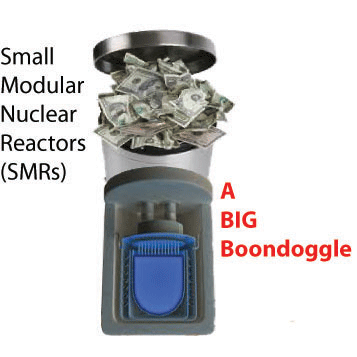
It’s not at all clear that SMR technology will succeed, or when. Levelized cost charts of electric power generation rate nuclear as among the very most expensive means to generate electric power at utility scale. If nuclear waste management, insurance and decommissioning costs are included, actual costs are far higher. (Some of these costs are already socialized for nuclear power, such as insurance in the Price-Anderson Act.)
The first commercial SMR is not expected to be completed until 2029, but already its developers have raised the target price of its power by 53%. This is not a surprise; nuclear power construction history documents an extremely strong correlation between new designs and cost increases and project delays. Indeed, the Lazard analysis shows that nuclear is the ONLY grid-wide generation source to increase in price between 2009 and 2021. The increase was 36%!

Nuclear waste and reprocessing are also serious concerns. Make no mistake, un-reprocessed nuclear waste, for all practicable purposes, is forever. The fact that we have become accustomed to risk does not, by any means, reduce risk. Nor will SMRs generate less waste than their larger forbears. Indeed, a recent Stanford University study concluded that “small modular reactors may produce a disproportionately larger amount of nuclear waste than bigger nuclear plants.”
Safeguarding this waste is already costing taxpayers and utility customers tens of billions of dollars. Since the United States has failed to designate a central storage facility, nuclear power plants are forced to continue to store the waste in pools on site.

Yet nuclear waste recycling, known as reprocessing, is no panacea. In November, the governor spoke in Bristol in support of recycling nuclear waste from SMRs: “I think the big steps out of the box are the technical capability to deploy in the next 10 years and on top of that to press forward to recycling opportunities for fuel.” He may have had in mind BWX Technologies of Lynchburg, which is beginning reprocessing of uranium at its Nuclear Fuel Services plant in Erwin, Tennessee, for nuclear weapons.

Transportation of SMR nuclear wastes along Virginia mountain roads or railroads across the border to Erwin presents further risk of accident and contamination. Longstanding concerns about transportation and security of nuclear wastes have never been adequately addressed.
Given these questions about cost, practicality and safety, the governor’s choice of SMRs as the cornerstone for future energy development in the coalfields of Southwest Virginia risks leaving residents here with nothing. This is especially worrisome as it pulls state support from proven, cheaper and more readily deployable solar and energy storage applications.
It also redirects government resources away from homegrown economic projects, like the New Economy Program, based on cleaning up and repurposing unrestored mine lands for a burgeoning utility solar energy industry, employing local residents and adding productive purpose to restored land and benefiting the tax base.
Counties across eastern and Piedmont Virginia are benefiting from a property tax bonanza flowing from utility-scale solar development. Coalfield counties are being told to ignore a sure solar bet and place their few economic development chips on a risky, unproven, costly, pie-in-the-sky energy prospect.
Why should SWVA be forced to endure the burden of risky and more costly electric energy, subsidized by the state to benefit powerful corporations, which seek to exploit our region and its people? Why indeed, while the rest of Virginia benefits economically from low-cost, safe solar energy?
This same shell game occurred when state mining regulation allowed mountaintops to be blown away and thousands of acres of forestland despoiled. Once again, government officials are choosing to make decisions that benefit the interests of corporations outside the region instead of the people who actually live here.
NASA Gets High on Its Nuclear Supply

Why can’t our species sit down, seek some peace and quiet, and sort out our priorities? Consider race, sex, and class injustices. Consider human trafficking, animal trafficking, and habitat loss. Wars and famines. The steady disintegration of the ice caps that keep the nuclear nations physically apart, and keep Earth itself balanced, and watered with the seasons. Shouldn’t these be our preoccupations? Instead, we’re keen to expand the outsized footprint of human commerce and conflict.
BY LEE HALL https://www.counterpunch.org/2023/02/16/nasa-gets-high-on-its-nuclear-supply/
NASA’s going nuclear. It was decreed before most of us were born. Back in 1955, the Air Force set out to design a nuclear-propelled stage for an intercontinental ballistic missile at the Los Alamos Scientific Laboratory. In 1958, a few months after the Soviets launched Sputnik, Congress held hearings on Outer Space Propulsion by Nuclear Energy. And the Air Force project was reassigned to the newly created National Aeronautics and Space Administration.
NASA was founded as “a defense agency of the United States for the purpose of chapter 17 of title 35 of the United States Code.” Its council—including the U.S. President and Secretaries of State and Defense, and the Chair of the Atomic Energy Commission—would forge “cooperative agreements” with the Army, Navy, Air Force, and Marines.
NASA’s military roots are deep.
Since 1961, NASA has deployed “more than 25 missions carrying a nuclear power system.” Today, the federal Defense Advanced Research Projects Agency (DARPA) is making a nuclear fission reactor and rocket for NASA to test in 2027. The Demonstration Rocket for Agile Cislunar Operations aims to replace chemical propellants with nuclear propulsion systems at least three times as efficient, enabling crewed flights to reach Mars.
Chemical propulsion isn’t totally passé. The demo rocket will be nuclear-powered in space, but chemically launched—to limit the potential for an accidental release of radioactive materials on the ground. NIMBY!
In 1961, John F. Kennedy found the perfect aerospace engineer for the U.S. space mission. In 1962, JFK publicly vowed that U.S. Americans would be first to set foot on the moon.
JFK’s pick, Wernher von Braun, had reached the rank of major in Nazi Germany’s Allgemeine SS paramilitary forces, invented the V-2 rockets. These monstrosities were linked to many thousands of deaths—of civilians, soldiers, and concentration camp prisoners who were forced to build Germany’s vengeance weapons./

Historian Michael J. Neufeld found that von Braun was not in charge of assignments or punishments of concentration camp prisoners, but had been in “direct contact with them and with decisions how to deploy them.” While von Braun wasn’t directly killing people, the ruin and loss of others’ lives in the course of the work didn’t seem to trouble the scientist.
In the United States, von Braun designed TV satellites and early intercontinental ballistic missiles. As part of Hermes, General Electric’s missile-making project for the U.S. Army, von Braun helped refurbish V-2s taken from Germany after the war. And von Braun led the Saturn V rocket project that launched Apollo 11, fulfilling JFK’s promise.
The Wrong Stuff
Such is the story of NASA’s formative years. Today, the agency touts its moon missions through “graphic novels and interactive experiences” for young people. Artemis 3, NASA’s first crewed mission since 1972, will feature female and Black astronauts. Take that, Gil Scott-Heron.
The European Space Administration has floated the concept of an international “village” on the moon. NASA’s Artemis Accords allow extraterrestrial mining. Israel has launched a rocket made by Elon Musk’s SpaceX. The governments of China, India, and Russia all have space stations in the works.
As the space domain becomes more contested and congested, the U.S. military Space Force is on display, maintaining Space Domain Awareness. This adolescent language might be laughable, but for the coiled aggression, obscene spending, and the natural resource depletion behind it. It might be laughable, but for the failure of humanity to ensure everyone is housed and fed on Earth. Let them eat interactive experiences?
But here we go, bringing nuclear rockets to Mars.
The Mars Project was written in 1948, and published in 1953. It contained the first technical specification for a crewed Mars flight. Its author was Wernher von Braun. (Per Twitter, the book prophesied that Elon Musk would be involved in a human Mars landing. If von Braun were looking for a 21st-century protégé, an oft-noted habit of prioritizing production over people could fortify Musk’s candidacy.)
By 1969, von Braun’s designs included nuclear thermal propulsion. Nixon sidelined von Braun’s career. And “nuclear power went out of fashion after the disasters of the 1980s,” says Joshua Frank, author of Atomic Days: The Untold Story of the Most Toxic Place in America.
“People had turned on atomic energy, so the industry was coming up with the most ridiculous ideas about what to do with all of its deadly stuff, and there was talk about dumping radioactive waste in space, or on the moon.”
Could the new boosters of nuclear technology resurrect these ridiculous plans, asks Frank, “in order to sidestep the valid concerns that radioactive waste is a poison that lasts millennia? Fortunately, at least for now, it’s simply not cost-effective to rocket nuclear waste to space. If it were, you can bet Elon Musk would be loading up his space fleet today.”
The resurgence of nuclear space projects raises these and many other questions.
To What End?
Jim Reuter of NASA’s Space Technology Mission Directorate says nuclear thermal propulsion will show our “transportation capability for an Earth-Moon economy.” The economy theme is a popular one. While Toyota develops Lunar Cruisers for NASA crews, Honda has an R&D contract with Japan’s space agency for lunar EVs. Hyundai, Kia, and Boston Robotics are all working on proprietary technologies for lunar robots and vehicles. And so on. A recent Bloomberg article titled Space Startups Are Trying to Make Money Going to the Moon sounds positively moonstruck:
“In the future, private companies could ferry people and cargo to and from the moon, creating a base to conduct science and, eventually, mine resources and even lunar ice as an ingredient to make rocket propellant. It’s a grand vision that could start to take shape this year and eventually lead to a marketplace in which companies could use the lunar environment to turn a profit…”
Anthony Calomino, a NASA research engineer, has said: “It’s important for the United States to remain a primary and dominant player in space. It is the next frontier.”
So, the main reasons for colonizing Space are: (a) because it’s there; (b) fear of missing out; (c) because there’s stuff to extract and profits to be made up there; and (d) because nobody puts a possessive nation of Homo sapiens in the corner.
Curb the Anthropocene
Why can’t our species sit down, seek some peace and quiet, and sort out our priorities? Consider race, sex, and class injustices. Consider human trafficking, animal trafficking, and habitat loss. Wars and famines. The steady disintegration of the ice caps that keep the nuclear nations physically apart, and keep Earth itself balanced, and watered with the seasons. Shouldn’t these be our preoccupations? Instead, we’re keen to expand the outsized footprint of human commerce and conflict.
If living organisms are out there, how will they withstand our acquisitive onslaughts? We lack the standing to colonize other planets. Our penchant for colonizing is, itself, a treacherous flaw. The sensitive among us are beginning to understand, and attempting to remediate, the vast and continuing harm done by the colonial mindset.
Meanwhile, humanity relentlessly drives other species and the climate itself past the brink of breakdown. If there were ever a time to “leave no trace” on nature, it’s now—on Earth and beyond.
Lee Hall holds an LL.M. in environmental law with a focus on climate change, and has taught law as an adjunct at Rutgers–Newark and at Widener–Delaware Law. Lee is an author, public speaker, and creator of the Studio for the Art of Animal Liberation on Patreon.
Coalition for Responsible Energy Development in New Brunswick (CRED-NB) informs Senate with analysis of “advanced” small nuclear reactors
On Feb. 14, our Coalition made our case against SMRs to the MLAs on the Climate Change and Environmental Stewardship committee of the Legislative Assembly of New Brunswick. Our presentation used the best scientific analysis to critique the “advanced” SMRs for development in New Brunswick. CRED-NB core member Susan O’Donnell presented on behalf of the Coalition. Our written presentation in English is HERE (and HERE in French). The video of the session is on YouTube, HERE. Check out the video to learn more about the SMR plans and what our elected representatives have to say about them.
There were 13 presentations over two days. Other presentations to watch for are, on Feb. 14: J.P. Sapinski, M.V. Ramana. On Feb. 15: Gordon Edwards, Chief Hugh Akagi + Chief Ron Tremblay + Kim Reeder, and Louise Comeau + Moe Quershi. Each has a one-hour time slot, with 20 minutes by presenters followed by 40 minutes of Q&A with the MLAs on the committee. The full schedule of presentations is HERE. The link to the video archive is HERE (scroll through or search to find the webcast archive from Feb. 14 and 15).
*on Thursday, the House of Commons Standing Committee on Science and Research released the report from the SMR study:
The link to the national report is here:
tiny pdf button top right of this page:
https://www.ourcommons.ca/DocumentViewer/en/44-1/SRSR/report-3/
The report recommends that the federal government pay half the development costs of SMRs
*Today the front page of the business section of New Brunswick’s Telegraph Journal has this story, attached:
Moltex wants $250 million in public funds (half its development costs)
Scotland’s Minister Matheson reassures the Nuclear Free Local Authorities (NFLA) that no small nuclear power station will be permitted near Grangemouth refinery.
The Scottish Nuclear Free Local Authorities have been reassured by a recent
reply from Scottish Government Net Zero Minister Michael Matheson that
Small Modular Reactors are not under consideration at the Grangemouth
refinery complex.
Following media speculation that INEOS was contemplating
co-locating an SMR next to its colossal refinery to power operations, the
Convenor of the Scottish NFLA, Councillor Paul Leinster, wrote to the
minister expressing grave concerns that the combination of a nuclear power
station next to the chemical refinery represents ‘a disaster
waiting-to-happen’.
Covering an area of 1,700 acres and with 2,000 staff,
INEOS’s own website describes Grangemouth as a ‘world-scale
petrochemicals plant’ which produces about 7 million tonnes of fuels, much
of which is used in Scotland, and 1.4 million tonnes of other products per
year. These products are synthetic ethanol, ethylene, propylene,
polyethylene and polypropylene used in the food packaging, construction,
automotive and pharmaceutical industries.
In his letter, Cllr Leinster
described an accident involving an SMR and the INEOS refinery as ‘a
monumental calumny for Scotland against which any Hollywood disaster movie
would pale by comparison’. To the NFLA, ‘it would be madness to partner a
nuclear power plant with Scotland’s biggest explosive chemical factory’.
In his response, dated 12 January, Michael Matheson was quick to reassure the
NFLA that Scottish Ministers ‘remain committed’ to their ‘long-standing
government policy to withhold support for any new nuclear power stations to
be built in Scotland’ and that officials have been advised by INEOS that
‘Small Modular Reactors do not currently form part of their net zero road
map for Grangemouth’.
NFLA 17th Feb 2023
Rolls Royce’s “small” nuclear reactor will occupy 5.3 acres.
The UK/Ireland Nuclear Free Local Authorities have today received a reply
from Rolls-Royce as to just how big their proposed ‘Small’ Modular
Reactor will be.
During last year’s World Cup, the NFLA’s then Chair,
Councillor David Blackburn, wrote to Tom Samson, Chief Executive Officer at
Rolls-Royce, to point out the general state of confusion amongst nuclear
activists, pro- and anti-, alike, with media reports claiming that an SMR
would occupy a surface area amounting to between ‘one and a half and ten
football pitches’ and asking for clarification.
Now Dan Gould, Head of Communications at Rolls-Royce SMR, has provided a final score – 5.3 acres –
an area ‘incorporating the entirety of the SMR unit’.
NFLA 16th Feb 2023
Some, but not all, First Nations support small nuclear reactors in New Brunswick

Moltex CEO says company has full support of all 15 First Nations in N.B. to develop SMRs
Jennifer Sweet · CBC News Feb 15, 2023
Companies trying to develop small modular nuclear reactors in New Brunswick are getting some support from an unlikely source.
An energy crisis is looming large, and SMRs have better potential than renewables in the short term, said Chief Terry Richardson of Pabineau First Nation, near Bathurst.
Richardson said he sees nuclear power as consistent with his cultural values.
“As First Nations, we are stewards of the land. Well, when we look at nuclear technology, it’s not a carbon emitter. So it’s not going to cause a problem. It’s going to actually solve the problem of carbon.
“If we don’t do something, we all know what’s happening with climate change.”
Pabineau has signed memoranda of understanding to work with two companies that have SMR projects under way at Point Lepreau — Moltex and ARC, said Richardson.
He describes the MOUs as “non-contractual, binding documents” that state a willingness to work together on development.
Details of exactly how his community and potentially other First Nations in the province may take part in SMR projects have yet to be negotiated, said Richardson.
“There’s going to be an opportunity to be involved on the equity side and that’s where we have to sit down and talk and discuss it and see where we’re going to go.”
After the initial development at Lepreau, ARC is talking about installing more SMRs in Belledune, Richardson noted, which could mean job opportunities in northern New Brunswick.
He also likes that Moltex is looking at reusing spent fuel rods, which it says would reduce the amount of toxic nuclear waste that already exists.
Study looks at SMR waste
A Canadian peer-reviewed study that came out last summer found the volume of waste from SMRs would be between double and 30 fold that from a typical reactor and that its chemical complexity would make it more difficult to manage.
Richardson said he is satisfied that plans are in place to deal with nuclear waste and added that maybe in the future there will be a way to recycle it…..
Moltex CEO Rory O’Sullivan told the legislative committee Wednesday that his company has the support of all 15 First Nations in the province to develop SMRs.
However, some other Indigenous leaders addressed the committee who have concerns about the SMR plans and the public investment in development.
Chief Hugh Akagi represents the Peskotomuhkati Nation at Skutik, which doesn’t have official recognition as a First Nation in Canada. https://www.cbc.ca/news/canada/new-brunswick/first-nations-small-modular-nuclear-reactors-1.6749808
U.S. military’s newest weapon against China and Russia: Hot air balloon

The Pentagon is quietly transitioning high-altitude balloon projects to the military services.
By LEE HUDSON, 07/05/2022 https://www.politico.com/news/2022/07/05/u-s-militarys-newest-weapon-against-china-and-russia-hot-air-00043860
The Pentagon is working on a new plan to rise above competition from China and Russia: balloons.
The high-altitude inflatables, flying at between 60,000 and 90,000 feet, would be added to the Pentagon’s extensive surveillance network and could eventually be used to track hypersonic weapons.
The idea may sound like science fiction, but Pentagon budget documents signal the technology is moving from DoD’s scientific community to the military services.
“High or very high-altitude platforms have a lot of benefit for their endurance on station, maneuverability and also flexibility for multiple payloads,” said Tom Karako, senior fellow for the International Security Program and Missile Defense Project director at the Center for Strategic and International Studies.
The Pentagon continues to invest in these projects because the military could use the balloons for various missions.
Over the past two years, the Pentagon has spent about $3.8 million on balloon projects, and plans to spend $27.1 million in fiscal year 2023 to continue work on multiple efforts, according to budget documents.
Meanwhile, the Pentagon is working on its own hypersonic weapons program, despite Wednesday’s failure of the latest test.
A bright spot for the U.S. is the balloons may help track and deter hypersonic weapons being developed by China and Russia.
Checking Back in on China’s Nuclear Icebreaker
Over four years after the project was announced, updates remain scarce on China’s first nuclear icebreaker.
The Diplomat, By Trym Eiterjord 13 Feb 23
In 2018, it became known that the state-owned China National Nuclear Corporation (CNNC) was embarking on a project to develop nuclear-powered icebreakers…………….
Over four years later, information about the project remains scarce, but a handful of patents recently filed by engineers at the CNNC Marine subsidiary would seem to indicate that development is moving forward. The content of these patents may give some insight into what is potentially China’s first nuclear-powered surface vessel.
The patents filed so far are concerned mainly with nuclear engineering. ……………………
Finally, the new subsidiary has filed a patent titled simply “A nuclear-powered icebreaker,”………………..
This is more or less the extent of new information to have come out since the project was first revealed in 2018……………………………….
The People’s Liberation Army Navy has also seemingly become interested in nuclear propulsion for polar-going icebreakers…………………….. more https://thediplomat.com/2023/02/checking-back-in-on-chinas-nuclear-icebreaker/
1 This Month
To see nuclear-related stories in greater depth and intensity – go to https://nuclearinformation.wordpress.com/

29 Jan. Thursday 7-8 p.m. Webinar – World’s Largest Nuclear Station in Port Hope, ON?


31st January – Challenging the War Machine – a DECLASSIFIED UK SUMMIT


Website of the Week
Now until to February 10, 2026 Radioactive waste storage in France: the debate is finally open! How to participate?
-
Archives
- January 2026 (259)
- December 2025 (358)
- November 2025 (359)
- October 2025 (376)
- September 2025 (258)
- August 2025 (319)
- July 2025 (230)
- June 2025 (348)
- May 2025 (261)
- April 2025 (305)
- March 2025 (319)
- February 2025 (234)
-
Categories
- 1
- 1 NUCLEAR ISSUES
- business and costs
- climate change
- culture and arts
- ENERGY
- environment
- health
- history
- indigenous issues
- Legal
- marketing of nuclear
- media
- opposition to nuclear
- PERSONAL STORIES
- politics
- politics international
- Religion and ethics
- safety
- secrets,lies and civil liberties
- spinbuster
- technology
- Uranium
- wastes
- weapons and war
- Women
- 2 WORLD
- ACTION
- AFRICA
- Atrocities
- AUSTRALIA
- Christina's notes
- Christina's themes
- culture and arts
- Events
- Fuk 2022
- Fuk 2023
- Fukushima 2017
- Fukushima 2018
- fukushima 2019
- Fukushima 2020
- Fukushima 2021
- general
- global warming
- Humour (God we need it)
- Nuclear
- RARE EARTHS
- Reference
- resources – print
- Resources -audiovicual
- Weekly Newsletter
- World
- World Nuclear
- YouTube
-
RSS
Entries RSS
Comments RSS
 nuclear-news