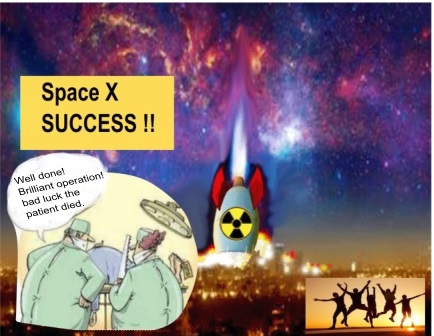
SpaceX launches most powerful rocket in history in explosive debut – like many first liftoffs, Starship’s test was a successful failure
The Conversation, Wendy Whitman Cobb 21 Apr 23
Professor of Strategy and Security Studies, Air University
Starship is almost 400 feet (120 meters) tall and weighs 11 million pounds (4.9 million kilograms). An out-of-control rocket full of highly flammable fuel is a very dangerous object, so to prevent any harm, SpaceX engineers triggered the self-destruct mechanism and blew up the entire rocket over the Gulf of Mexico.
On April 20, 2023, a new SpaceX rocket called Starship exploded over the Gulf of Mexico three minutes into its first flight ever. SpaceX is calling the test launch a success, despite the fiery end result. As a space policy expert, I agree that the “rapid unscheduled disassembly” – the term SpaceX uses when its rockets explode – was a very successful failure.
The most powerful rocket ever built
This launch was the first fully integrated test of SpaceX’s new Starship. Starship is the most powerful rocket ever developed and is designed to be fully reusable. It is made of two different stages, or sections. The first stage, called Super Heavy, is a collection of 33 individual engines and provides more than twice the thrust of a Saturn V, the rocket that sent astronauts to the Moon in the 1960s and 1970s.
The first stage is designed to get the rocket to about 40 miles (65 kilometers) above Earth. Once Super Heavy’s job is done, it is supposed to separate from the rest of the craft and land safely back on the surface to be used again. At that point the second stage, called the Starship spacecraft, is supposed to ignite its own engines to carry the payload – whether people, satellites or anything else – into orbit.
An explosive first flight
While parts of Starship have been tested previously, the launch on April 20, 2023, was the first fully integrated test with the Starship spacecraft stacked on top of the Super Heavy rocket. If it had been successful, once the first stage was spent, it would have separated from the upper stage and crashed into the Gulf of Mexico. Starship would then have continued on, eventually crashing 155 miles (250 kilometers) off of Hawaii.
During the SpaceX livestream, the team stated that the primary goal of this mission was to get the rocket off the launch pad. It accomplished that goal and more. Starship flew for more than three minutes, passing through what engineers call “max Q” – the moment at which a rocket experiences the most physical stress from acceleration and air resistance.
According to SpaceX, a few things went wrong with the launch. First, multiple engines went out sometime before the point at which the Starship spacecraft and the Super Heavy rocket were supposed to separate from each other. The two stages were also unable to separate at the predetermined moment, and with the two stages stuck together, the rocket began to tumble end over end. It is still unclear what specifically caused this failure.
Starship is almost 400 feet (120 meters) tall and weighs 11 million pounds (4.9 million kilograms). An out-of-control rocket full of highly flammable fuel is a very dangerous object, so to prevent any harm, SpaceX engineers triggered the self-destruct mechanism and blew up the entire rocket over the Gulf of Mexico…………………………………… https://theconversation.com/spacex-launches-most-powerful-rocket-in-history-in-explosive-debut-like-many-first-liftoffs-starships-test-was-a-successful-failure-204248
Terrestrial Energy’s molten-salt reactor gets over one hurdle – but many more to come. Will it be a lemon?

Terrestrial Energy’s molten-salt reactor clears prelicensing review, Globe and Mail, MATTHEW MCCLEARN, APRIL 19, 2023
Nuclear-reactor developer Terrestrial Energy has completed a prelicensing review by the Canadian Nuclear Safety Commission, an early milestone along the road to commercialization of its next-generation product.
The Integral Molten Salt Reactor (IMSR) is the first of its kind to finish the CNSC process known as a vendor design review. Whereas conventional reactors use solid fuel, this novel variety features liquid fuel dissolved in molten salt that’s heated to temperatures above 600 degrees.
The review, which began in 2016, is intended to provide feedback to reactor vendors in the early stages of development, but does not confer a licence to build one. CNSC staff found “no fundamental barriers to licensing,” signalling their willingness to entertain next-generation designs radically different from Canada’s aging fleet of Candu reactors………..
the CNSC’s high-level findings, published Tuesday, highlight the challenges ahead. It called on Terrestrial to provide more information to confirm that the IMSR meets safety requirements. Sensors, monitoring equipment, instrumentation and control systems all need to be further developed……………
” you see a lot of engineering questions that have to be followed up on.” -Akira Tokuhiro, a professor at Ontario Tech’s energy and nuclear engineering department.
Prof. Tokuhiro said answering those questions means Terrestrial (which currently employs about 100 people) will need to grow its engineering staff. NuScale Power, an early developer of small modular reactors (SMR) founded in 2007, stands alone in achieving certification from the U.S. Nuclear Regulatory Commission. It needed 500 staff and US$1-billion to accomplish that, said Prof. Tokuhiro, who previously served as an engineer at NuScale.
“There have been SMR startups – I won’t name names – where the company and investors quit when they got to the point of going from 50 engineers to 500 engineers on payroll,” he said.
Prof. Tokuhiro estimated that fewer than 20 people throughout North America possess deep experience with molten salt technologies, making it difficult to find qualified workers. Moreover, Terrestrial will likely need to build a demonstration unit – another expensive undertaking.
“It has to be a facility that’s quality assured and quality controlled,” he said. “And it has to be able to produce data that the regulator accepts.”……..
nitially developed in the 1950s and 60s, molten salt reactors never operated commercially but have lately enjoyed renewed interest. The U.S. Department of Energy funded two small demonstration projects, and the Canadian government provided tens of millions of dollars to each of Terrestrial and Moltex Energy, another startup, based in New Brunswick, that’s marketing a model known as the Stable Salt Reactor – Wasteburner (SSR-W).
According to a 2021 report about advanced nuclear reactors by the Union of Concerned Scientists, molten salt reactors are “even less mature” than other novel designs such as sodium-cooled and gas-cooled reactors.
That report – entitled Advanced Isn’t Always Better– concluded they were “significantly worse” than traditional light-water reactors in terms of safety and the risk of nuclear proliferation and terrorism, but acknowledged that some molten salt reactors would generate less hazardous waste than conventional models.
“MSR fuels pose unique safety issues,” the report concluded. “Not only is the hot liquid fuel highly corrosive, but it is also difficult to model its complex behaviour as its flows through a reactor system. If cooling is interrupted, the fuel can heat up and destroy an MSR in a matter of minutes.
“Perhaps the most serious safety flaw is that, in contrast to solid-fuelled reactors, MSRs routinely release large quantities of gaseous fission products, which must be trapped and stored.”
The nuclear industry has precious few small modular reactors available for sale today, but is under intense pressure to bring new ones to market quickly to capitalize on an anticipated surge in demand for low-carbon electricity. Yet recent reactors based on conventional technologies took longer than 30 years to develop, license and build, and some ran disastrously overbudget……………………………………. https://www.theglobeandmail.com/business/article-terrestrial-energys-molten-salt-reactor-clears-prelicensing-review/
Russia to set up a small nuclear reactor in the Arctic Republic of Sakha
Rosatom and the Corporation for the Development of the Far East and the
Arctic have signed a cooperation agreement relating to the construction of
a Russian small nuclear reactor power plant in the Republic of Sakha (also
known as Yakutia).
World Nuclear News 18th April 2023
https://www.world-nuclear-news.org/Articles/Fresh-cooperation-agreement-on-SMR-plan-for-Yakuti
‘It’s time to pump the brakes on reintroduction of nuclear energy to Trawsfynydd’
By Patrick O’Brien | Columnist |Sunday 16th April 2023
‘It’s time to pump the brakes on reintroduction of nuclear energy to
Trawsfynydd’. Giving SMRs a clean bill of health in advance of any
researched-based demonstration that such is justified is bad enough, but en
route there is a sweeping assertion about the utter desirability of all
nuclear power – past and present.
For any deniers of the proposition, this
is a meltdown moment. SMRs, which can generate up to 300 megawatts, or
about two-thirds less than traditional nuclear power reactors. They are
claimed to be safer because of increased use of smart innovative technology
and inherent safety features.
So how solid is the SMR safety case? The
jury’s out. In 2021, the intergovernmental Nuclear Energy Agency (NEA)
established an expert group on SMRs “to handle safety challenges and
develop a solid scientific basis which supports safety demonstration of the
advanced and innovative technologies used for SMRs”.
But the NEA is clear
that much research on safety remains to be done. The Welsh Government,
meanwhile, is brimming over with enthusiasm, insisting its proposed project
will become essential for the diagnosis and treatment of a number of
diseases, and that its north Wales facility would be a global centre of
excellence in nuclear medicine, making Wales the leading location for
medical radioisotope production in the UK, leading to the creation of
highly skilled jobs over several decades.
But it’s time to slow down. The
NEA’s reticence on safety means it’s necessary for the government – and
Patrick Loxdale – to take a deep breath and, no doubt with difficulty,
reserve judgment.
Cambrian News 15th April 2023
U.S. Senate Weighs Big Plans for Small Reactors

NRC reporting on alternative sources of nuclear fuel, in particular, would be especially noteworthy for SMR developers. Fueling most SMR designs is so-called high-assay low-enriched uranium (HALEU), which has a higher uranium-235 content than larger reactors’ fuel. Currently, the world’s only commercial HALEU provider is TENEX, a Russian state-owned company: a source that has become particularly problematic in the wake of Russia’s aggression in Ukraine. Licensing a more geopolitically tenable HALEU supply chain, then, is a priority for any U.S.-based SMR project.
The Price-Anderson Act’s present iteration expires in 2025, and time is ticking. Lawmakers can certainly renew it elsewhere.
But a failure to renew it would throw the entire nuclear industry into uncertainty—SMRs included—potentially delaying deployment,
The ADVANCE Act could give nuclear SMR developers more than a few advancements
RAHUL RAO, 15 Apr 23 IEEE Spectrum,
Small modular reactors (SMRs) power many of today’s nuclear enthusiasts’ clean-energy dreams. ………….
In the U.S., SMR designers, operators, and fuel suppliers must all pass the Nuclear Regulatory Commission (NRC), the U.S. government’s nuclear arbiter. Unfortunately, SMRs don’t fit neatly into the NRC’s aged regulatory scheme, one built for old and established large reactors. That’s at least part of the reason why, on 3 April, a bipartisan group of U.S. senators unveiled the ADVANCE Act, a bill containing a package of nuclear reforms.
Anyone hoping for total renovation of the NRC will be disappointed; the act retains the philosophy that NRC approval is necessary. But the act would order a platter of small, subtle changes to the NRC’s innards. At least some SMR proponents are optimistic that—if the act passes—those changes could smooth the ways for a growing number of SMR developers.
…………. For one, applicants today must pay around $300 for each hour of the NRC’s time. When a single review can take tens of thousands of hours, these fees pile up. Larger firms like Rolls-Royce might be able to afford them, but smaller SMR developers—more than a few of them nascent startups—may struggle. The act would offset some of those costs: around half, according to an NIA estimate.
The act would also establish prizes. “Those prizes involve the first [developers] going through the different regulatory frameworks that the NRC has,” says Erik Cothron, an analyst at the NIA. For instance, the bill would reward the first reactor designer to receive the stamp of Part 53, a new SMR-specific licensing process that Congress ordered the NRC to create in 2018.
Nuclear-themed prizes may make for a fun day at the fair, but their dividends are more than short-term. The prizes, the NIA analysts say, would also pay back developers who might have to bear with a sluggish NRC whose regulators are themselves still learning how to navigate new regulatory routes.
Additionally, the act would require reports on several NRC-related topics, such as: how to license nuclear reactors for applications beyond electricity (such as heating); how to speed up approvals for reactors at previously developed “brownfield” sites (such as depreciated fossil fuel power plants); and how effectively the NRC might license alternative sources of nuclear fuel.
Reports like these might seem like busywork for bureaucrats, but analysts say they serve an important risk-reducing role, giving SMR developers (and investors) a clearer picture of and more confidence in the path ahead.
NRC reporting on alternative sources of nuclear fuel, in particular, would be especially noteworthy for SMR developers. Fueling most SMR designs is so-called high-assay low-enriched uranium (HALEU), which has a higher uranium-235 content than larger reactors’ fuel. Currently, the world’s only commercial HALEU provider is TENEX, a Russian state-owned company: a source that has become particularly problematic in the wake of Russia’s aggression in Ukraine. Licensing a more geopolitically tenable HALEU supply chain, then, is a priority for any U.S.-based SMR project.
Of course, all speculation is moot unless the ADVANCE Act clears Congress.
The Act isn’t Congress’s first recent recent attempt at nuclear reforms. The ADVANCE Act shares multiple provisions and supporters with an earlier bill called the American Nuclear Infrastructure Act (ANIA), first introduced in 2020. However, ANIA never saw the light of legislative day.
The Act isn’t Congress’s first recent recent attempt at nuclear reforms. The ADVANCE Act shares multiple provisions and supporters with an earlier bill called the American Nuclear Infrastructure Act (ANIA), first introduced in 2020. However, ANIA never saw the light of legislative day.
If the ADVANCE Act followed ANIA’s fate, it wouldn’t deal a mortal wound to SMR developers. But one of the ADVANCE Act’s other provisions is crucial to U.S. nuclear energy as a whole: It would renew the Price-Anderson Act, which mandates civilian nuclear plants carry insurance that would compensate members of the public for severe accidents.
The Price-Anderson Act’s present iteration expires in 2025, and time is ticking. Lawmakers can certainly renew it elsewhere. But a failure to renew it would throw the entire nuclear industry into uncertainty—SMRs included—potentially delaying deployment, according to Adam Stein, an analyst at the Breakthrough Institute think tank, which helped give input on earlier drafts of the bill’s text. https://spectrum.ieee.org/small-modular-reactors-advance-act
An operational domain’: Fear UK nuclear power plan for moon may lead to militarisation of space
Rolls-Royce’s director of future programmes Abi Clayton tellingly said: ‘The technology will deliver the capability to support commercial and defence use cases.’
These activities are all completely contrary to the legal commitments the UK made a half century ago to preserve space for peace.
It may mirror the plot of classic ‘70s British sci-fi series, Space 1999, which also features a moon base and the threat posed by radioactive waste, but the UK/Ireland Nuclear Free Local Authorities also have real concerns that the development of a future British moon base powered by nuclear fission could represent a further unwanted development along the road to the militarisation of space.
Today is the UN International Day of Human Space Flight. On April 12, 2011, the UN General Assembly established the day on the 40th anniversary of Major Yuri Gagarin becoming the first human being to circle the Earth in his spacecraft ‘Vostok’. UN delegates reaffirmed ‘the important contribution of space science and technology in achieving sustainable development goals and increasing the well-being of States and peoples, as well as ensuring the realization of their aspiration to maintain outer space for peaceful purposes’.
Last week, the UK Space Agency announced a £2.9 million grant is to be awarded to Rolls-Royce SMR to collaborate with academic institutions to develop mini-reactors for deployment in space, with most media reports focusing on its potential to power a future moon base as part of the UK’s commitment to an international project to colonise the Earth’s near neighbour (Project Artemis). However, in welcoming the new funding, Rolls-Royce’s director of future programmes Abi Clayton tellingly said: ‘The technology will deliver the capability to support commercial and defence use cases.’
Whilst projects in outer space can be both benign and beneficial, the UK Space Strategy and UK Space Defence Strategy both identify that ‘NATO has made space one of five operational domains’,[1] and the UK Space Defence Strategy is subtitled ‘Operationalising the Space Domain’.[2] To make this a reality, the UK Government is intent upon investing £6.4 billion in a ‘Defence Space Portfolio’[3] for defence ‘in and through space’.[4]
For these purposes, the UK has joined the US and France in developing its own Space Command, and a nuclear moon base could in time become a part of the ‘portfolio’ from which UK Space Command operates,[5] in line with the government and military’s desire to ‘assure our access to, and operational independence in, space’.[6]
These activities are all completely contrary to the legal commitments the UK made a half century ago to preserve space for peace.
“Ironically the UK was in 1967 one of the first three co-signatories of the Outer Space Treaty which pledged the sponsors to ensure ‘that the Moon and other celestial bodies shall be used exclusively for peaceful purposes’”,[7] said Councillor Lawrence O’Neill, Chair of the NFLA Steering Committee.
“Our fear is that any future nuclear-powered moon-base could be ultimately crewed by military personnel from Space Command conducting operations that would be far from benign and beneficial, whether this be the permanent surveillance of perceived hostile states on Earth or more sinisterly as a platform for offensive weapons systems to project military power ‘through space’.
“And of course, once one major power establishes such a base, then the others, all not wishing to be outdone, will seek to do the same.”
The NFLA also has real practical concerns about the environmental impact of such a nuclear-powered base.
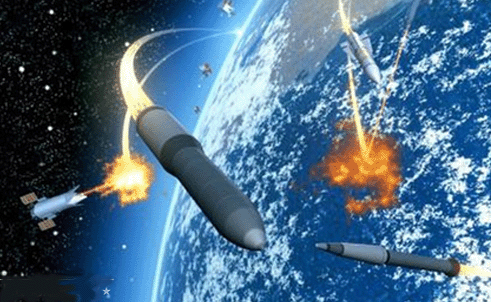
Councillor O’Neill added: “We have worries about the transfer of nuclear materials into space. It is not unknown for rockets to malfunction and explode on take-off or in early flight, indeed sadly this has led to the loss of human life, nor for radioactive material to be distributed across the surface of the Earth by exploding space vehicles, witness the accident involving Soviet satellite Kosmos 954.[8] And the UK Government’s own Committee on Radioactive Waste Management dismissed the idea of blasting radioactive waste into space on the grounds of both risk and cost.
“And in turn, a nuclear-powered moon base would generate radioactive waste. Where would this be put? If it came back to Earth, there would remain the risk of an accident on re-entry and states parties to the Outer Space Treaty also pledge to ‘avoid harmful contamination of space and celestial bodies’ so burial in situ below the lunar surface or blasting it into space would be unlawful”.
Lastly there is also a latent threat posed from outer space itself to the facility.
n 2016, NASA announced the findings of their Lunar Reconnaissance Orbiter (LRO) mission. Observing the lunar surface since launch in 2009, NASA scientists reported that ‘200 impact craters (had) formed during the LRO mission, ranging in size from about 10 to 140 feet (approximately 3 to 43 meters) in diameter’. Consequently, NASA recommended that ‘equipment placed on the moon for long durations – such as a lunar base – may have to be made sturdier. While a direct hit from a meteoroid is still unlikely, a more intense rain of secondary debris thrown out by nearby impacts may pose a risk to surface assets.’
In concluding Councillor O’Neill said: “We have all been concerned recently with the potential damage that could be caused on Earth to Ukrainian nuclear facilities from shelling and missile strikes so what happens if a meteoroid, or a fragment thereof, with massive kinetic energy hits a nuclear reactor based on the surface of the moon?[9]
Massive undersea works to commence for HinkleyPoint C nuclear project
Two huge vessels have arrived off the coast of Somerset as offshore work
continues on the UK’s newest nuclear power station, Hinkley Point C. Named
Neptune and Sea Challenger, they are ‘jack-up’ vessels, used to create six
vertical shafts into the seabed.
The shafts will be used to install
components for the power station’s cooling water system. The plant will
eventually be cooled by water flowing through six miles (10km) of tunnels.
Hinkley Point C has been under construction by EDF Energy for five years.
Once the shafts, which will go 20m (70ft) into the seabed, are installed,
miners will dig a horizontal connection between them and the cooling
tunnels.
BBC 11th April 2023
The Pros And Cons of Modular Nuclear Reactors
By Leonard Hyman & William Tilles – Apr 10, 2023 https://oilprice.com/Alternative-Energy/Nuclear-Power/The-Pros-And-Cons-of-Modular-Nuclear-Reactors.html
- Customization in nuclear power led to isolated and non-transferable experiences and limited the industry’s growth.
- Small modular reactors are a new approach that allows for standardization and assembly line efficiency, but also offer logistical and funding challenges.
- The future of nuclear energy could rely, in part, on the development and implementation of small modular reactors.
Did you ever get the feeling that you’ve seen this movie before, except with another name? The remake, maybe in color this time or with a younger cast? Well, nothing wrong with recycling but not when you get the uncomfortable notion that the actors don’t know that somebody did it before them.
Take nuclear power What went wrong last time around? We suggest that a principal culprit was customization. Almost every utility wanted a nuke tailored to its needs, site by site. Thus, each site had its own problems, and solving them produced little experience that helped anywhere else.
France, of course, was the main exception. The French state, which owned the utility, settled on one design and repeated it again and again. Of course, the French utility had the scale that U.S. and British’s utilities lacked. And the French never shied from dirigisme, state control of the economy. If the government planned to finance, subsidize and insure the industry, it might as well specify what it wanted. Not so in the USA, where we didn’t want the government to tell utilities what to buy, although we had no problem subsidizing and insuring whatever they built.
Today, we applaud the efforts to design nuclear power stations of smaller size, which will achieve economies of scale by constructing identical equipment in a manufacturing setting and shipping the modules to the construction site where they will be assembled. We have yet to establish whether the modular units will be substantially cheaper, and we have a good idea that most of the designs will not solve the nuclear waste problem. We are still determining whether the public will accept the new nukes more warmly than the old ones, too. But we are confident that builders will have less money at risk in any one piece of machinery, which is good.
Here’s our worry. There are at least 21 announced small modular reactor technologies ( as we wrote in a previous report), some with big-name tech backers. It is almost as if some tech entrepreneurs that can no longer find app start-ups to fund have plunged into nuclear energy.
Now, let’s do some rough numbers. There are 439 nuclear power plants in the world (92 in the USA, 56 in France, 54 in China and 37 in Russia, 33 in Japan, and 24 in South Korea). Over the coming 20 years, we believe most of these reactors will have to be retired, some in extreme old age. Figure that the new units might average one-tenth to one-quarter the size of the old ones.
So maybe a requirement for 4000 units over 20 years. Or 200 units per year. Divide that by 20 different designs. If each producer got an equal share, that would mean ten units per year. We don’t know but have to ask whether that number would yield financing for a factory that could achieve economies of scale.
Now add on the nationalism and security issues. Should we expect the USA, France, Russia and China to buy from foreign sources? If they require in-country sourcing, it is more difficult for any manufacturer to achieve real scale. The contestable market for manufacturers might be closer to 100 units per year, maybe less. That might not give room for manufacturing economies of scale.
We do not expect to see reliable analyses of the manufacturing costs of SMRs for some time, if ever, because the information would be a competitive secret. We are not even sure that current cost estimates are reliable, as opposed to come-ons to bring in generator companies to sign memoranda of interest, which are not contracts but might convince backers to put up money to build a factory.
However, let’s assume that manufacturing a reactor in a factory is not much different than manufacturing an airplane or automobile. Each facility ( or firm) has a U-shaped or saucer shaped cost curve. That is, cost per unit is high when volume is low, hits a low point at a a given volume, and then, eventually rises as the firm hits diseconomies of scale. [graph on original]
Average cost per unit at given production volumes
Let’s say that the total market per year for the product is 200 units. With the optimal, low-cost-per-unit production point at 50-60 units, the market couldn’t support more than four manufacturers. Whether the nuclear market can support 21 or four manufacturers depends on presently unknown manufacturing cost curves. As good capitalists, you might ask why consumers should care if a bunch of manufacturers put up plants and don’t get enough business to support them and then go under.
Well, there are several reasons. For one, we don’t want manufacturers hard up for orders and profits to skimp on the production process. The nuclear plant had better operate safely. Second, owners of nukes will need decades of service. Would they buy plants from manufacturers that look like they might not be around when needed?
Third, considering the financial consequences of outages, would they want to take a chance on a cheaper unit or rather pay up for perceived quality? Fourth, and most importantly, would government watchdogs encourage a proliferation of designs, making their jobs harder?
We don’t expect many of these SMR providers to get off the ground, especially if the government, the real backer of the industry, decides to opt for uniformity in order to get economies of scale in manufacturing and in regulation. In short, we’d put our money on the big names with long years of servicing their products.
Finally, SMRs, while welcome, neither substantially reduce nuclear costs nor cure the waste disposal problem, although they should reduce the financial burden inherent in big nuclear projects. In other words, they seem like a better way to pursue nuclear energy, which remains the most expensive, environmentally controversial, non-carbon producer. Is there a better way?
$16-million-a-second and no electricity — Beyond Nuclear International

ITER fusion reactor has countries cooperating for the wrong cause
$16-million-a-second and no electricity — Beyond Nuclear International
Exorbitant fusion project is obsolete and might even be inoperable
By Linda Pentz Gunter, 10 Apr 23,
As defined by World Nuclear News, the international fusion project known as ITER, exists “to prove the feasibility of fusion as a large-scale and carbon-free source of energy. The goal of ITER is to operate at 500 MW (for at least 400 seconds continuously) with 50 MW of plasma heating power input. It appears that an additional 300 MWe of electricity input may be required in operation. No electricity will be generated at ITER.”
Four hundred seconds. No electricity.
ITER, which stands for International Thermonuclear Experimental Reactor, is a collaboration between 35 countries that was first conceived in 1985 and formally agreed to on November 21, 2006. Construction began in 2010 at the Cadarache nuclear complex in southern France.
The official seven group founding members of ITER are China, the European Union (then including the UK, which remains in the project), India, Japan, Korea, Russia and the United States.
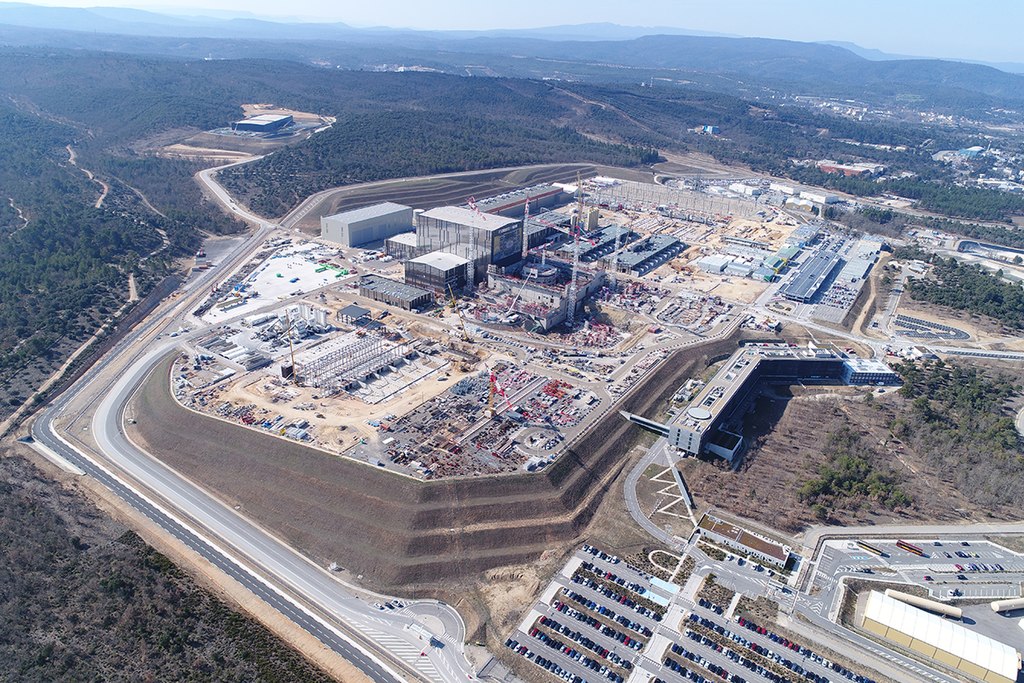
By the time ITER is actually operational — if it ever is — it will have gobbled up billions of dollars. Currently, those cost estimates range wildly between the official ITER figure of $19-23 billion (likely a gross under-estimate) and the U.S. Department of Energy’s (DOE) current estimate of $65 billion.
The starting price when the project began was around $6.3 billion.
If the DOE numbers are right, then those 400 seconds will cost $16.25 million a second. Just to prove that fusion power is possible. Without actually delivering anything practical at all to anyone.
Whatever the costs, they are too high to be remotely justifiable, given the end product and the far more compelling and essential competing needs of the world right now.
Worse still, ITER may not actually work. “ITER is of the tokamak based design using strong magnetic fields to confine the very hot plasma needed to induce the fusion reaction,” explained two scientists in a January 2021 paper published in Nature — Potential design problems for ITER fusion device. “Building a successful magnetic fusion device for energy production is of great challenge.”
The paper’s authors, Hassanein and Sizyuk, who modeled the ITER design “in full and exact 3D geometry,” contend that, “The current ITER divertor design will not work properly during transient plasma events and needs to be modified or a new design should be developed to ensure successful operation and maintain the confidence in the tokamak concept as a viable magnetic fusion energy production system.”
So far, the ITER project has already experienced some technical failures. ………………………………………………………
There is now considerable competition in the fusion field, with US laboratories, especially, eager to demonstrate ITER as obsolete before it is even completed — current predictions make that date some time in 2035. But, as we pointed out last December, during the false fanfare about a breakthrough at the National Ignition Facility (NIF), fusion is already obsolete. Given the confluence of the climate crisis and emerging energy needs in much of the less developed world, fusion has no practical applicability.
International collaboration is desperately needed in today’s conflict-riven world. It just needs to focus on something that’s mutually beneficial to our collective survival. Let’s start spending $16 million a second on that. https://beyondnuclearinternational.org/2023/04/10/16-million-a-second-and-no-electricity/
Absolutely disingenuous – DARC – the Deep-Space Advanced Radar Capability – Australia to join USA’s plan for Space as a War-fighting Domain.
“So, what worries me most is China’s use of space to complete the kill chain necessary to generate long-range precision strikes against the maritime and air components scheme of maneuver. That’s what concerns me the most,” Brig. Gen. Anthony Mastalir, commander of Space Forces Indo-Pacific, said.
By COLIN CLARKon April 07, 2023
SYDNEY — The vast landmass of Australia, possessed of clear skies free of city lights or pollution, is the perfect spot to place the most acute space situational awareness systems. Which is why Brig. Gen. Anthony Mastalir, the head of Space Forces Indo-Pacific says it’s “absolutely critical” to get a new radar system there as quickly as can be.
“When you look at a place like Australia as a landmass, you have a lot of opportunity to contribute to that space picture,” Mastalir told Breaking Defense during an interview during the Sydney Dialogue, put on by the Australian Strategic Policy Institute. “The Australians, the defense Space Command folks and the acquisition arms, they absolutely understand that, so they’re moving aggressively to embrace some of these opportunities and bring systems like DARC — deep space radar capability — here on the continent.”
DARC, officially the Deep-Space Advanced Radar Capability, was designed by Johns Hopkins Applied Physics Laboratory to provide global monitoring of geosynchronous orbits in all kinds of weather and during daylight. According to the APL, it relies heavily on commercial technology. The Space Force received DARC technology from APL last year, with demonstrations taking place at White Sands Missile Range in New Mexico.
Ultimately, the operational DARC program calls for three transmit/receive sites, spaced at mid-latitudes around the world, to detect and track satellites. Northrop Grumman won a $341 million contract from US Space Force’s Space Systems Command last February to begin building the global system, with the first location in Australia targeted for calendar year 2025. That will be followed by one in Europe and a third in the US, with those locations yet to be announced.
FY24 budget justification documents show $174M requested for DARC in the next fiscal year. It further states that “The total cost of the DARC Rapid Prototype Middle Tier of Acquisition (MTA) effort is 844.6M. DARC Site 1 is not fully funded across the Future Years Defense Program.” $40 million is set aside for early work on sites 2 and 3.
“The DARC program will field a resilient ground-based radar providing our nation with significantly enhanced space domain awareness for geostationary orbit,” Pablo Pezzimenti, vice president for integrated national systems at Northrop Grumman said in a statement announcing the first contract award. “While current ground-based systems operate at night and can be impacted by weather conditions, DARC will provide an all-weather, 24/7 capability to monitor the highly dynamic and rapidly evolving geosynchronous orbital environment critical to national and global security.”
Discussions are underway about where to locate the system in Australia once it’s ready. Before anything can be released officially, negotiations must conclude on a treaty level document known as the Technology Safeguards Agreement. Negotiations began in mid-2021. Mastalir declined to discuss the talks, noting they are led by the Department of Commerce.
Russia And China Remain Top Concerns
During the panel Mastalir appeared on at the Sydney Dialogue, the general said that Russia had clearly possessed space superiority at the beginning of the invasion of Ukraine but had lost it. After the panel, Breaking Defense asked him to explain his remarks.
“Russia clearly is a dominant space power, relative to Ukraine. So they entered that conflict in that position,” he said. “Now you see no less than seven or eight different commercial entities, everything from GPS jammer detection, communications to tactical ISR that are bringing products to bear to support the Ukrainians. And has Russia been able to deny the adversary, in this case, Ukraine, from benefiting from space? And the answer, I think, is no — not really.”
His assessment is that the two countries have reached perhaps the most dangerous state for two militaries slugging it out on the battlefield: parity.
“Now parity, parity is dangerous, right? Because when you have parity — and I think this is what we’re kind of seeing play out — you have these prolonged conflicts, and a lot of destruction and death. And that’s not a situation that we ever want to be in as the United States.”
Asked if there are lessons for the United States military and intelligence community in light of what he called “a potential paradigm shift.” the general said it raises many difficult policy and operational questions.
That includes the question of how commercial operators are protected, or not, by the government if they are being used for military operations.
“Number one, who’s going to defend those assets? Is there a responsibility for the United States to protect and defend commercial on-orbit capability that’s assisting the US military?” The related issue is, “to what extent should we integrate commercial across all of our space capabilities?”
Given these complexities, what keeps the general up at night in this region?
So, what worries me most is China’s use of space to complete the kill chain necessary to generate long-range precision strikes against the maritime and air components scheme of maneuver. That’s what concerns me the most,” Mastalir said. “I have to have the ability to deny China in this situation, as a potential adversary, the ability to do that. And so those are the kinds of things that that you know, worry me the most now.”
He stressed that the simple possession of such capabilities “doesn’t mean it’s wrong. But if you look at our efforts to maintain a free and open Indo-Pacific, you quickly run into a situation where our ends, and what we see in terms of behavior coming from China, their ends don’t necessarily align.”
Theresa Hitchens in Washington contributed to this report.
Current State of Post-Accident Operations at Fukushima Daiichi Nuclear Power Station (Jun. to Dec. 2022)

State of the Plant Fukushima Now – Part 2, BY CITIZENS’ NUCLEAR INFORMATION CENTER APRIL 5, 2023 · By Matsukubo Hajime (CNIC)
The water temperature in the containment vessels and the spent fuel pools (SFPs) shows no great variation despite seasonal temperature changes. The state of releases of Xenon-135 (half-life roughly nine hours), released when uranium fuel undergoes fission, is also unchanged and it can therefore be estimated that the state of the reactors is stable. Further, according to an assessment by TEPCO in December 2022, around 10,000 becquerels per hour (Bq/h) of radioactive materials were being released to the atmosphere from the buildings (Fig.1 on original).
At the same time, decay heat has fallen greatly with the passage of time, and thus the volume of cooling water injected into the reactors has been reduced (falling from 7-10m3 per hour in May 2011 to 1.6-4m3 per hour as of December 2022).
The state of removal of spent nuclear fuel from the SFPs is summarized in Table 1 [0n original]. Spent nuclear fuel removal from Units 3 and 4 has been completed. However, as it has not been possible to remove control rods and other high-dose equipment stored in the SFPs, preparatory work has been underway for removal of this equipment from Unit 3 in the second half of FY2022 and removal from Unit 4 will commence in the second half of FY2024. Further, the removal of this equipment from Unit 3 was due to start from late October 2022, but this has now been rescheduled for early March 2023.
Preparations for the removal of fuel debris are also under way…………………………………..
The Unit 2 reactor core isolation cooling (RCIC) system was operating after the accident and for a further three days, including the time when the tsunami arrived at the plant. Uncovering the reason why it ceased functioning has been an issue, but it is inaccessible even now, after approximately 12 years underground………………………………………..
The changes in the average number of workers onsite per day is shown in Fig. 2 [on original] . As of December 2022, the number of workers was 4,410, about half the number it was at its peak. …………………………………
Contaminated water countermeasures at Fukushima Daiichi Nuclear Power Station (FDNPS) can be broadly divided into three areas: 1) Reduction of groundwater flowing into buildings, 2) Reduction of contaminated water flowing into the sea, and 3) Reduction of the toxicity of contaminated water. The main countermeasures to reduce water inflow into the buildings are, from higher elevations downward, ………………………………………………………
In the reduction of the toxicity of contaminated water, cesium and strontium are removed, and after the removal of impurities using a reverse osmosis (RO) membrane, radionuclides other than tritium are removed by the multi-radionuclide removal equipment…………………………………………
The frozen earth barrier consists of about 1600 30-meter freeze pipes buried in the ground, through which coolant at -30°C is circulated to freeze the surrounding soil. The effectiveness of the frozen earth barrier has been questioned since it was first installed, but since 2019 there have been several coolant leakage incidents.
Concerning the issue of releasing contaminated water into the ocean after ALPS treatment, TEPCO’s policy to release the water was authorized at the 25th Meeting of the Nuclear Regulatory Authority on July 22, and the construction was approved by the governor or Fukushima Prefecture and the mayors of both Okuma Town and Futaba Town in August. At present, construction of the release tunnel is ongoing, and the plan is to complete the construction during the first quarter of 2023. ………………………….. A fund of 30 billion yen has already been established as a measure against “adverse publicity.” Additionally, TV commercials, etc. are also being employed as “actions to foster understanding.” On the same day Chairman Masanobu Sakamoto of the National Federation of Fisheries Cooperative Associations released a statement saying, “We have not altered one little bit our opposition to the oceanic release.”
Meanwhile, Secretary General Henry Puna of the Pacific Islands Forum (PIF), an inter-governmental organization that aims to enhance cooperation among 15 countries and two regions of Oceania, announced in a statement on January 18 that PIF will demand a postponement of releases until it has become possible to confirm the safety of all involved [timetable of events shown on original] more https://cnic.jp/english/?p=6553
Nuclear fusion is a never-ending dream

. “The development of the toroidal [magnetic confinement] nuclear fusion reactor is totally blocked by three challenges:
One, abysmally high cost (trillions of yen more in the future?) and a mind-boggling long time (more than 50 years); two, gigantic and complicated systems (a mega-sized system cannot be handled unless simple); and three, the heat-resistant material and radiation-proof material for the reactor walls are not available on earth.”
BY CITIZENS’ NUCLEAR INFORMATION CENTER · APRIL 5, 2023, By Nishio Baku (CNIC Co-Director)
Green Transformation (GX) Basic Policy proposed by the Japanese government mentions nuclear fusion as one of the next-generation innovative nuclear technologies in its reference information. I doubted my ears when I learned that the Nuclear Energy Subcommittee of the ministerial Advisory Committee for Natural Resources and Energy, which drafted the policy, brought up nuclear fusion as one of the “innovative technologies” to be pursued.
It was a big surprise. That is the very nuclear fusion that, at the Second International Conference for the Peaceful Uses of Atomic Energy of September 1 through 13, 1958 in Geneva, Dr. H. J. Bhabha from India, who chaired the conference, flamboyantly predicted would take shape in 20 years. It has been 64 years since then. The government refers to this vintage technology as “innovative”.
During the decade of the 1980s, various Japanese universities received more budget than previously from the government for nuclear fusion research. The website of professor Takabe Hideaki, Institute of Laser Fusion, Osaka University, notes on September 10, 2014 that, during the days of the Second Oil Crisis, when Gekko XII [the experimental laser fusion apparatus at Osaka University] was completed, the government’s top-down initiative provided the university with a budget of 30 billion yen (in the value of the yen at the time), to build the laser system and a robust building for it.
I find this maybe a special case (another document I have with me says, of the fiscal 1984 national budget, 35 billion yen was given to the then Power Reactor and Nuclear Fuel Development Corporation and a total of 7 billion yen to universities). Uramoto Joshin, a former associate professor at the National Institute for Fusion Science, wrote in his retirement memoir “My Final Words as a NIFS Staff” (NIFS News, May 1998), that he was in a festive mood around the time when he joined the former Plasma Research Institute of Nagoya University, which was one of the founding bodies of the NIFS.
The boom faded, and in 1989, the Plasma Research Institute was reorganized as the National Institute for Fusion Science, an inter-university research institute, into which a part of the Heliotron Plasma Physics Laboratory at Kyoto University and a part of the Institute for Fusion Theory at Hiroshima University were incorporated. The technology that the government refers to is the same nuclear fusion.
In what respect can the nuclear fusion reactor be a “next-generation innovative reactor”? While there is no full-size nuclear fusion reactor, what would a “compact nuclear fusion reactor” look like?
Today, “private-sector nuclear fusion” by venture companies seems to be enjoying a global boom………………………………………………. the project did not seem very practical.
……………………………………………………………. Whatever the case, the ignition lasts only one instant.
How far will the muddy road continue?
This nuclear fusion was mentioned by Prime Minister Kishida in his administrative policy speech on January 17, 2022 with the cryptic reasoning that it would help achieve the 2050 goal of carbon neutrality. Using this as the basis, the government set up the Nuclear Fusion Strategy Expert Panel under the Integrated Innovation Strategy Promotion Council of the Cabinet Office.
The panel had its first meeting on September 30, where Takaichi Sanae, Minister of State for Science and Technology Policy, said: “I have a strong will to accelerate the efforts to commercialize nuclear fusion technology as far as possible.” However, the Innovative Reactor Working Group placed under the Nuclear Energy Subcommittee, states in its “Roadmap for Introduction” (August 9, 2022) that whether the construction of a prototype nuclear fusion reactor should start or not will be determined in the mid-2030s. What would “commercializing nuclear fusion” mean at this point?
I wonder how much longer this fusion boom will continue. “As I am leaving this institute, I breathe a sigh,” Associate Professor Uramoto said in his NIFS retirement memoir. “The development of the toroidal [magnetic confinement] nuclear fusion reactor is totally blocked by three challenges: One, abysmally high cost (trillions of yen more in the future?) and a mind-boggling long time (more than 50 years); two, gigantic and complicated systems (a mega-sized system cannot be handled unless simple); and three, the heat-resistant material and radiation-proof material for the reactor walls are not available on earth.”
For the cost, the Special Committee on the ITER Project of the Japan Atomic Energy Commission bragged about ITER in its report, “International Thermonuclear Experimental Reactor (ITER) Project Forecast” (May 18, 2001): “It is difficult to correctly estimate the cost required to realize a nuclear fusion reactor, …………………………………………………
Of the challenges Uramoto pointed out, the second one, “gigantic and complicated systems (a mega-sized system cannot be handled unless simple)” and the third one, “the heat-resistant material and radiation-proof material for the reactor walls are not available on earth” remain unsolved, despite the passage of so many years.
The pot is calling the kettle black
It is meaningless to compare nuclear fusion with nuclear power generation, but some say: “Nuclear fusion is clean.” In terms of the radioactivity released when a large accident occurs, nuclear fusion technology would emit less radioactivity than a conventional nuclear plant.
However, the daily releases of radioactive materials from nuclear fusion would be greater than those from a conventional nuclear power plant. Nuclear fusion is also more likely to leak tritium and radioactive gas. It will produce four times as much energy as nuclear fission while producing seven times as many neutrons. Workers in the fusion plant would be exposed to radiation, and people in the neighborhood would also be exposed due to sky shine. Plant equipment would be strongly radiated and easily embrittled, requiring frequent replacement, producing a huge amount of highly contaminated wastes……………………………………………. more https://cnic.jp/english/?p=6549
Nuclear life extension plans tested by obsolete components

“Under current license basis 92% of operating reactors would shut down by 2050 and 74 percent would shut down by 2050 with anticipated license renewals. However, if 54 reactors extended operation to 80 years, only 20% of operating reactors would shut down by 2050,”
In fact, with construction times for some plants approaching ten years, many of the parts can be obsolete before the plant has even started generating power
Reuters By Paul Day April 5
- An increasing number of aging nuclear plants are being cleared for long-term operations and suppliers say solving obsolescence will be key to keeping the fleet operating.
– Nuclear operators must be able to swap out old parts for new to keep a reactor running, but when like-for-like is unavailable, original equipment manufacturers (OEMs) are faced with the challenge of finding an alternative while avoiding making any major changes.
“There’s a rule of thumb that if a plant has to do a design change, it’ll cost anywhere from $300,000-$500,000 just in engineering, licensing changes, drawing changes, and that doesn’t include the cost of the required equipment … so we try, wherever possible, to keep our clients from doing a design change,” says Vice President of Westinghouse Parts Business in its Operating Plant Services unit Craig Irish.
However, design changes and other innovative solutions such as additive manufacturing will be needed as an increasing number of nuclear power plant operators extend their plants’ lives from the original 40 years to 60 years or further.
Many of the world’s nuclear power plants were built several decades ago and applications for long-term operations (LTOs) beyond initial lifespans are becoming increasingly common.
At the end of 2020, over 100 nuclear reactors worldwide were operating beyond their initial 40-year licensed periods, with more than 30% of the nuclear fleet operating under LTO conditions, the OECD-NEA says.
In the United States, where nuclear power has supplied 20% of electricity and is currently running 93 reactors with two new units under construction, the average age of the fleet is 41 years including three reactors that started operation 52 years ago, according to the Department of Energy (DOE).
Nine U.S. reactors have active applications with the Nuclear Regulatory Commission (NRC) to extend their lives and 10 reactors have publicly announced plans to extend their licenses to 80 years.
“Under current license basis 92% of operating reactors would shut down by 2050 and 74 percent would shut down by 2050 with anticipated license renewals. However, if 54 reactors extended operation to 80 years, only 20% of operating reactors would shut down by 2050,” the DOE said in its 2022 report on nuclear energy supply chains.
Obsolescence challenge
The challenge, say OEMs, is keeping a supply chain running and up to date for complex, always-on machines that were built with Reagan-era (or earlier) technology.
According to Westinghouse, a leading global parts manufacturer for power stations, approximately 35% of installed equipment in the nuclear industry is obsolete.
In fact, with construction times for some plants approaching ten years, many of the parts can be obsolete before the plant has even started generating power, according to Westinghouse’s Irish.
The high cost of design changes means that many operators, working with a plant that went online in the 1970’s, would work hard to keep it looking the same by the time it is set for decommissioning in 2030, he says.
This was especially challenging when dealing with instrumentation and control (I&C) parts which may have worked with dials and levers when the plant was built but now in many cases can be digitalized.
“They try like hell to keep plants exactly the same, with the same technology, the same parts, though obviously that’s not realistic, so operators have to introduce digital products where it makes sense,” he says.
Internationally, part of the challenge is many of the parts produced for the nuclear industry face varying specifications depending on the regulator they are working under, restricting an already tight market to national boundaries.
Such differences will become even more pronounced with the introduction of a new generation of reactors expected to begin commercial operations within the next decade, with more than 70 SMR designs under development in 18 countries…………………………………………………………..
“The biggest problem is a lot of these discrete components, resistors, diodes, transistors, capacitors, etc are either substantially changed from the 70s and 80s when we built these instruments or they’re not available or they got bought and sold by another company,” …………………………………… https://www.reuters.com/business/energy/nuclear-life-extension-plans-tested-by-obsolete-components-2023-04-05/

No, Nuclear Energy Won’t Save Us
If you have pinned your hopes on nuclear, I have very bad news to serve: Uranium production will peak (if it hasn’t already). Since exploration has already hit diminishing returns in 2011 this was only a question of when, not if. No wonder: we live on a planet constrained by geology and physics, not money.
Then new reactor designs will surely save us! Well, breeding and 4th generation reactors are still in development phase and nowhere near commercialization. It will take decades to have them approved and to sort out all kinds of technical and safety issues. Even the Chinese, who are the forerunners of this technology, do not plan to build their first experimental reactors till the 2030’s… We don’t have that much time left.
Medium, 3 Apr 23, [good diagrams/charts]
Ever since the first commercial reactors have started to produce electricity for the grid in the 1950’s (um, about 70 years ago now…) we keep hearing how nuclear is the clean, green power of the future. No emissions, no limits, just the infinite power of the atom.……..
………………….. let’s examine the proposed alternative to fossil fuels: nuclear energy.
I’ve mentioned in the introduction to this article how Hubbert has presented a glaring contradiction between the reality of peak oil and his expectations towards nuclear power supposedly providing us all the energy we need for countless millennia to come. I say glaring, because as a geologist it should have been obvious to him that nuclear power is coming from Uranium, a mineral found in finite quantities, in finite reserves on this finite planet. In other words: the same rise and fall in its extraction is all but guaranteed.
Production starts at the best locations, where the most dense and easy to get forms of Uranium ore can be found. Like the ones in Canada, with 20% U content (a fantastically high concentration for any metal by the way). The issue is: such high grade ores are rare. They are like the golden tip of Khafre’s pyramid. Shiny, easy to work with, but not too much compared to the rest of the reserves.
Imagine that all the Uranium ores ever mined (and yet to be mined) were brought into one location by the Gods. There they would pile it up into a shape of a gigantic pyramid, putting the highest quality ores from Canada, like a cherry, on the top. The next, more voluminous layer in this imaginary pyramid of Uranium resources then would consist of ores with 2% Uranium content (where the rest is mining waste containing less valuable metals in various quantities). As you can see we have much more of these, but still not enough to power the entire planet with. Moving down another layer we would find much much more Uranium albeit locked up in ever lower grade ores containing a mere kilogram of pure Uranium in every ton hauled to the surface (or 0.1%).
Notice how we jump orders of magnitude in density as we move up and down this pyramid: 20% on the top is ten times as dense as a 2% ore, which is twenty times as dense as a 0.1% ore in a row below. At the bottom layers we would find common granite and sedimentary rock containing mere grams of Uranium per ton of ore mined: 3–5 ppm that is (or 0.0003%). Good luck mining, hauling then crashing tons of the hardest of rocks this planet has to offer, only to try and extract a few grams of Uranium out of it.
Long story short: we have only a very little amount of high grade, easy to mine Uranium and billions of tons of low grade, hard to find, hard to extract metal dispersed around the surface of the planet. Just like with every single other material we’ve ever mined.
Preposterous as it may sound, our Uranium resources refuse to grow in line with the money we pour on exploration. We are simply unable to grow our good old high quality low cost reserves. What we have found instead is of an ever lower quality type, containing less and less U per ton and costing more and more to extract. Despite a virtual explosion in exploration expenditure (doubling the total amount spent in 12 years between 2005 and 2017) our reserves grew by 60% only — then flat-lined — indicating a peak in exploration.
Let’s face it: Uranium exploration has hit diminishing returns with current reserves are now estimated to be enough for 90 years — not 5000 as suggested by Hubbert. Spending more on exploration will not give us large quantities of high grade resources in return. What we are left with is of ever lower quality and costlier to get ores. It doesn’t matter if the oceans or Earth’s crust contains millions of tons of Uranium in theory. In practice it’s in such a diluted form that it would take more energy to scrub and collect the radioactive metal than the energy we could get out of reactors in the end.
What matters is net energy: if there is nothing to gain, then why do it…?
This is how, Dear Reader, a natural limit to growth look like. (Not unlike the situation we experience with oil.) Perpetuating the myth of “high prices bring about more supply” will not help here. Expecting that higher prices will make the extraction of low grade reserves economic (basically all the new discoveries) in an energy constrained world, is nothing but magical thinking…………………………….
We already face a supply gap, which will only keep growing as cheap resources keep depleting. Expanding the fleet of reactors will further increase this gap, weighing even more on an already stretched supply and national stockpiles.
Needless to say, this is unsustainable. If Uranium prices don’t rise significantly then suppliers will have to stop mining. We are at around 110 USD/kg and most reserves need 130 USD/kg to become economic — not to mention newer reserves needing 260 USD/kg to be tapped. If prices do rise to this level then this would force poorer nations to retire their fleets and cancel projects in droves, causing prices to fall again. Needless to say, this zig-zagging of prices would make any incentive for discovery and ideas of utilizing lower grades vanish. (Just like with oil).
If you have pinned your hopes on nuclear, I have very bad news to serve: Uranium production will peak (if it hasn’t already). Since exploration has already hit diminishing returns in 2011 this was only a question of when, not if. No wonder: we live on a planet constrained by geology and physics, not money.
Then new reactor designs will surely save us! Well, breeding and 4th generation reactors are still in development phase and nowhere near commercialization. It will take decades to have them approved and to sort out all kinds of technical and safety issues. Even the Chinese, who are the forerunners of this technology, do not plan to build their first experimental reactors till the 2030’s… We don’t have that much time left. Oil is about to start its long decline this decade — first slowly and tentatively, then ever faster — causing all sorts of problems preventing us from investing in these untested technologies. Besides, all these new reactors would use is a finite fuel source still (U-235), already peaking then declining.
As diesel gets ever scarcer and harder to get by, servicing older reactors will become ever more problematic. We need long term thinking here: reactors will still need active care and cooling decades after their decommissioning, and if we lose grid stability (which is very much a near term concern), then a longer blackout could cause unwanted problems (again, we will not be able to rely on diesel generators helping us out for long either).
Based on the above, it is neither sustainable, nor safe to expand nuclear reactor fleets. ………….. https://thehonestsorcerer.medium.com/no-nuclear-energy-wont-save-us-41c516a9dae
North Korea May Be Close to Completing New Nuclear Reactor: 38 North
Satellite images indicate North Korea may be close to completing a new
reactor in its major nuclear complex in Yongbyon, according to 38 North, a
Washington-based website that tracks events in the country. Construction
crews are working on a support building at the site’s Experimental Light
Water Reactor (ELWR) development and water discharges have been spotted
near the ELWR’s pump house that could be associated with testing of the
reactor’s cooling system, the website said.
North Korean leader Kim Jong Un
visited a facility producing nuclear bombs earlier this week and reiterated
his order to massively expand the North’s nuclear arsenal. Kim said North
Korea is ready to use nuclear weapons “anytime and anywhere,” the
official Korean Central News Agency reported. His visit to the facility
came as the nation carried out series of weapon tests including ballistic
missiles designed to deliver a nuclear warhead. The Yongbyon site’s
existing 5 MWe reactor has been running since July 2021 and commercial
satellite images from March show there’s new construction for the reactor’s
spent fuel storage building, according to 38 North.
Bloomberg 2nd April 2023
1 This Month
To see nuclear-related stories in greater depth and intensity – go to https://nuclearinformation.wordpress.com/

29 Jan. Thursday 7-8 p.m. Webinar – World’s Largest Nuclear Station in Port Hope, ON?


31st January – Challenging the War Machine – a DECLASSIFIED UK SUMMIT

Website of the Week
Now until to February 10, 2026 Radioactive waste storage in France: the debate is finally open! How to participate?
-
Archives
- January 2026 (259)
- December 2025 (358)
- November 2025 (359)
- October 2025 (376)
- September 2025 (258)
- August 2025 (319)
- July 2025 (230)
- June 2025 (348)
- May 2025 (261)
- April 2025 (305)
- March 2025 (319)
- February 2025 (234)
-
Categories
- 1
- 1 NUCLEAR ISSUES
- business and costs
- climate change
- culture and arts
- ENERGY
- environment
- health
- history
- indigenous issues
- Legal
- marketing of nuclear
- media
- opposition to nuclear
- PERSONAL STORIES
- politics
- politics international
- Religion and ethics
- safety
- secrets,lies and civil liberties
- spinbuster
- technology
- Uranium
- wastes
- weapons and war
- Women
- 2 WORLD
- ACTION
- AFRICA
- Atrocities
- AUSTRALIA
- Christina's notes
- Christina's themes
- culture and arts
- Events
- Fuk 2022
- Fuk 2023
- Fukushima 2017
- Fukushima 2018
- fukushima 2019
- Fukushima 2020
- Fukushima 2021
- general
- global warming
- Humour (God we need it)
- Nuclear
- RARE EARTHS
- Reference
- resources – print
- Resources -audiovicual
- Weekly Newsletter
- World
- World Nuclear
- YouTube
-
RSS
Entries RSS
Comments RSS
 nuclear-news