USSR Sprinkled More Than 2,500 Nuclear Generators Across The Countryside
Hundreds of these tiny atomic terrors are still unaccounted for in the rugged landscape of the former Soviet Union.
By Erin Marquis, 16 June 23, https://jalopnik.com/ussr-sprinkled-more-than-2-500-nuclear-generators-acros-1850501190
Ah, the USSR. It was a strange place with strange ideas. Ideas such as planting unprotected mini nuclear power sources into inhospitable and hard-to-reach areas. I mean, nothing should go wrong as long as the government always exists to maintain them, right?
Welcome to the world of Radioisotope Thermoelectric Generators or RTGs. It’s a piece of nuclear history I only recently learned about and thought I should bring this whole new horror to your attention as well. These things are just kind of rolling around famously stable Russia, and it seems like it should be a cause for concern.
RTGs are not nuclear reactors, nor are they “nuclear batteries.” Rather they work by converting the heat caused by radioactive decay into electricity. Due to the dangerous nature of the materials used however, countries like America only use RTGs in applications such as space exploration. Voyager, Cassini and New Horizons uses RTGs for power, as do the Mars rovers Perseverance and Curiosity. These probes however, use expensive plutonium-238 as their power sources and we launch them far the hell away from us.
The USSR though? Nah. It’s going to use super cheap, super radioactive Strontium-90 instead, though later, smaller RTGs used equally cheap Caesium-137 or Cerium-144. These three isotopes all have one thing in common; they’re all the products of spent nuclear fission. In other words, waste. The terrestrial Beta-M RTG is about 1.5 meters wide and 1.5 meters tall and weight about one metric ton, according to the International Atomic Energy Agency. The entire unit put out about between 1 and 1000 watts (quite the spread) and had a working life of 10 to 20 years.
Originally built by the USSR’s Navy to power lighthouses and radio navigation beacons along Russia’s expansive arctic coastline, the RTGs provided power hundreds or even thousands of miles from civilization, occasionally completely unprotected and always unsupervised. They were occasionally secured by metal frames or sheds, but sometimes these lighthouses and radio beacons were set up on little more than rough structures hastily constructed out of nearby timber with the RTG stuck outside to face the harsh arctic elements. While the USSR provided regular rolling patrols to maintain the RTGs, that came to a screeching halt in 1991 when the Soviet Union fell. After that, there was no money to maintain the hard-to-reach RTGs, and they became victims of neglect and metal thieves.
After it proved useful for the Navy, the Soviets put the RTGs into service in other rough terrains. That’s how several ended up in the mountains of the former Soviet state of Georgia. Three residents from the village of Lia, Georgia, found a canister high up in the mountains. Since this strange material gave off heat, the three used it to stay warm overnight, but they woke up vomiting and dizzy. A week later, a military hospital diagnosed the three with radiation sickness. Two of the men would make it out with the help of dozens of skin grafts and months in the hospital. But the man who slept closest to the radioisotope source and handled it the most could not be saved.
Their arrival at the hospital launched a mad scramble from the international atomic community to find the orphan source of radiation. Footage of the clean-up crew both training for retrieval and actually snaring the Strontium-90 core shows just how dangerous RTGs are:
That wasn’t the only incident involving RTGs however. In 2001, scrappers broke into a lighthouse on Kandalashka Bay and stole three radioisotope sources (all three were recovered and sent to Moscow). Three men in the mountains of Georgia were also exposed in 2002 after stumbling upon cores left out in the woods. In 2003, scrappers hurled a core into the Baltic Sea, where a team of experts retrieved it.
A.I. or Nuclear Weapons: Can You Tell These Quotes Apart?
Many experts on artificial intelligence are warning of its potential dangers and calling for regulation, just as others once did with the atomic bomb.
NYT.By Ian Prasad Philbrick and Tom Wright-Piersanti. June 10, 2023
The comparison seems to be everywhere these days. “It’s like nuclear weapons,” a pioneering artificial intelligence researcher has said. Top A.I. executives have likened their product to nuclear energy. And a group of industry leaders warned last week that A.I. technology could pose an existential threat to humanity, on par with nuclear war.
People have been analogizing A.I. advances to splitting the atom for years. But the comparison has become more stark amid the release of A.I. chatbots and A.I. creators’ calls for national and international regulation — much as scientists called for guardrails governing nuclear arms in the 1950s. Some experts worry that A.I. will eliminate jobs or spread disinformation in the short term; others fear hyper-intelligent systems could eventually learn to write their own computer code, slip the bonds of human control and, perhaps, decide to wipe us out. “The creators of this technology are telling us they are worried,” said Rachel Bronson, the president of the Bulletin of the Atomic Scientists, which tracks man-made threats to civilization. “The creators of this technology are asking for governance and regulation. The creators of this technology are telling us we need to pay attention.”…………………………………more https://www.nytimes.com/2023/06/10/upshot/artificial-intelligence-nuclear-weapons-quiz.html
Nuclear-Powered Cargo Ships Are Trying to Stage a Comeback
Faced with the difficult task of decarbonizing, some shipping companies are taking another look at a polarizing solution—nuclear fission.
Wired, CHRIS BARANIUK, JUN 9, 2023
“………………………………………..Eisenhower agreed to authorize a nuclear-powered merchant ship that would carry both cargo and passengers. As well as goodwill, naturally.
The nuclear ship Savannah, capable of hauling 14,000 tons of cargo, entered service in 1962. Its reactor was encased behind 4 feet of concrete, as well as thick layers of steel and lead. In the glitzy passenger lounge stood an 8-foot-long table topped with white marble—and an early CCTV system so passengers could keep an eye on the reactor while sipping martinis.
…………….. heed this cautionary tale of nuclear hubris. The NS Savannah was a failure. During its first year at sea, the ship dumped 115,000 gallons of radioactive waste into the ocean. It had inadequate cranes and poorly designed cargo hatches. Egregiously expensive to run, the vessel carried passengers for a mere three years, and cargo alone for another five, before retiring.
Other countries also tried—and struggled—to make nuclear merchant ships work during the 20th century. West Germany’s demonstration nuclear cargo ship, the Otto Hahn, was refused entry to some ports and the Suez Canal on safety grounds. The Mutsu, a Japanese vessel, suffered a minor failure in its reactor’s radiation shielding in 1974, causing outcry. Indignant fishers blocked the ship’s return to port for several weeks.
As of 2023, there is only one active nuclear-powered merchant ship in the world, the Russian-built container-carrying NS Sevmorput. It is tiny compared to most fossil-fuel-powered container ships and has been plagued by breakdowns.
…………………………In February, a gaggle of organizations based in South Korea, including those behind multiple shipping lines, signed a memorandum of understanding. The group aims to develop nuclear-powered merchant ships equipped with small modular reactors. But they won’t say much else about the project.
“We believe it is too early to mention details on the tangible results of this partnership,” Hojoon Lee, a spokesperson for HMM, one of the shipping lines involved, tells WIRED. “We still have a long way to go to achieve the commercial viability of nuclear energy sources.”
There is another project afoot, in Norway, called NuProShip (Nuclear Propulsion of Merchant Ships). The team behind it has come up with a short list of six possible reactor designs that could work in a demonstrator vessel, says project manager Jan Emblemsvåg of the Norwegian University of Science and Technology. “The progress is quite OK,” he adds, via email. He and colleagues plan to convert a liquefied natural gas tanker called the Cadiz Knutsen to run on nuclear power.
Both the South Korean and Norwegian efforts are considering molten salt reactors. Instead of solid fuel rods, the nuclear fuel in these devices is dissolved into, for example, molten fluoride salts. Such reactors first operated in the 1960s and are nothing new, but technical issues, including corrosion occurring inside the reactors, have hampered their widespread rollout. Despite concerns from some over the viability of this technology, multiple countries are pursuing it.
………………………………………. while there are lots of nuclear reactors operating at sea right now, they tend to be on vessels with some of the highest security in the world. Commercial ships are occasionally subject to piracy and accidents, including large fires and explosions—the thought of adding nuclear fuel to such scenarios is unlikely to be met with enthusiasm.
The task of switching to a world in which nuclear-powered vessels are commonly welcomed at commercial ports is “not trivial,” says Stephen Turnock, professor of maritime fluid dynamics at the University of Southampton. “You have to have protocols in place to say what would happen in the event of an emergency associated with a nuclear-powered vessel,” he explains.
Simon Bullock, a shipping researcher at the University of Manchester, says that there is not enough of a regulatory framework to define how nuclear ships would operate globally in the commercial sector, including detail on who would bear responsibility for any mishaps. Would it be the ship owner, the ship operator, the manufacturer of the nuclear reactor, or the country where the ship is registered, known as the flag state? There are six “decade-long problems” of this kind regarding nuclear vessels that the International Maritime Organization (IMO) and other agencies would have to sort out if nuclear-powered commercial ships were ever to become widespread, he says……………………….
The crews on nuclear ships would also require special training and expertise, which raises the cost of running such vessels. Is it worth dealing with all these challenges, given the need to decarbonize right now? Probably not, says Bullock. “The critical thing here is the next 10 years,” he says, referring to the urgency of tackling emissions and climate change right now. “Nuclear can do nothing about that.”
Even the Norwegian NuProShip project won’t convert its first demonstrator ship until at least 2035. Meanwhile, there are other low- or zero-emissions fuels already being deployed in vessels—from methanol to ammonia, electric batteries, and hydrogen. None of these is perfect, and all will jostle for supremacy in the coming years. Nuclear, with its many complications, is “possibly a dangerous distraction” from the main horse race, says Bullock……………….. https://www.wired.com/story/nuclear-cargo-ships/
Is nuclear fusion energy salvation?
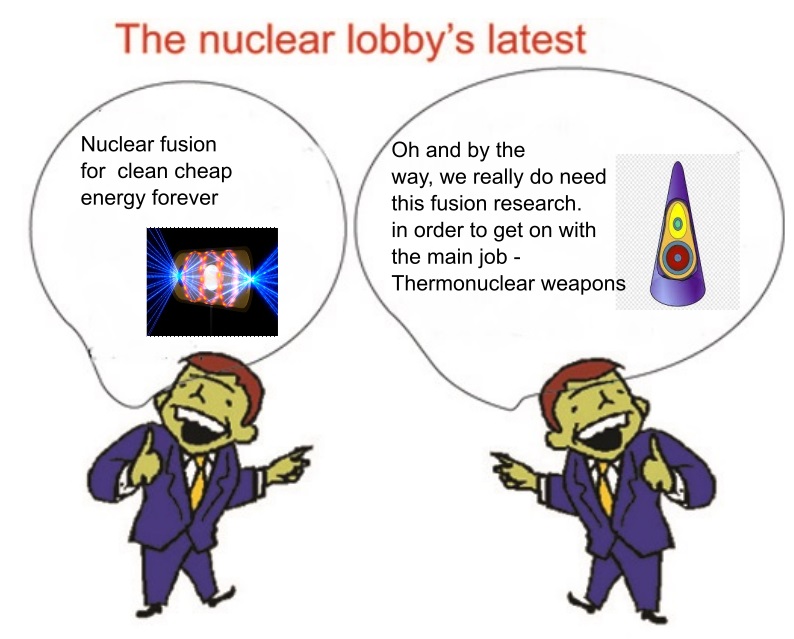
the real reason for the race to fusion is actually to allow the stockpiling of nuclear weapons that are even more dreadful than present ones. Currently, a major difficulty in manufacturing nuclear bombs is “the need for highly enriched uranium or plutonium” to initiate the reaction. Research with nuclear fusion could provide an alternative path to accomplish the ignition.

Few know that “100 significant accidents happened in world’s nuclear power plants from mid-1950s to 2010.” The world’s press has given scant attention to how people were used as guinea pigs in testing sites such as the Marshall Islands.
mronline, By Don Fitz, Stan Cox ( Jun 07, 2023) Originally published: Dissident Voice on June 3, 2023
Like a third rate zombie movie on Netflix, delusions of nuclear fusion repeatedly rise from the dead. The cover story in the June 2023 issue of Scientific American by Philip Ball, “Star Power: Does Fusion Have a Future After All?” recycles the corporate line which was broadcast on December 13, 2022. The U.S. Department of Energy (DOE) announced that the National Ignition Facility (NIF) at the Lawrence Livermore National Laboratory had reached a “breakthrough” in developing an alternative to fission.
As Joshua Frank described the hype over nuclear fusion …
“there’s no toxic mining involved, nor do thousands of gallons of cold water have to be pumped in to cool overheated reactors, nor will there be radioactive waste byproducts lasting hundreds of thousands of years. And not a risk of a nuclear meltdown in sight! Fusion, so the cheery news went, is safe, effective, and efficient!“
After six months of the announcement’s being debunked, the Scientific American article admitted some of the inherent faults with fusion, repeated some of the original misstatements, and went on with detailed descriptions of technical tweaks necessary to make the technology viable in the second half of the century. Unfortunately, most of those who criticized fusion missed one of its most serious dangers—that discovering a source of limitless cheap energy would doom humanity’s future rather than enhance it.
The Terror
In order to interpret the spin of the military-industrial-pseudo-scientific (MIPS) complex, we need to appreciate the primary obstacle to expanding nuclear power. MIPS must overcome the intense terror of nukes.
The terror began with images of Hiroshima and Nagasaki in August 1945. Photos of burnt bodies are burned into the minds of their viewers. MIPS seeks to discount the images with the myth that Japan had to be nuked, even though it was ready to surrender. The mythology continued with the “Atoms for Peace” false pretense that there could be a disconnect between nuclear power and nuclear bombs.
A few decades went by and on March 28, 1979 Three-Mile Island melted down. A good part of its infamy stemmed from repeated government lies that the event was not so serious and would have few long-lasting effects. Americans would never be convinced that nukes would only be dangerous if the Soviets or Japanese built them.
Then there was Chernobyl on April 26, 1986. In 2009 the New York Academy of Science published a detailed analysis estimating the total death count to be around 900,000 and the MIPS spewed forth venomous claims that it was not actually so bad, but was merely the worst human-caused catastrophe in history.
This was followed on March 11, 2011 with the Fukushima Daiichi apocalypse when 3 of 6 nuclear reactors melted down, spreading radioactivity into the neighboring Pacific Ocean and poisoning unknown quantities of aquatic life. So, each generation from World War II through today, has memories of horrendous nuclear events which MIPS has been totally unsuccessful at erasing.
But credit should be given where it is due, and there is an area where MIPS has done quite well in its plugola efforts. Those efforts have been to keep everyday leakage of nuclear material and “smaller” catastrophes either out of or reduced to short paragraphs in the corporate press. Few know that “100 significant accidents happened in world’s nuclear power plants from mid-1950s to 2010.” The world’s press has given scant attention to how people were used as guinea pigs in testing sites such as the Marshall Islands. Souma Dutta notes such events:
… in the Soviet nuclear test sites of Semipalatinsk in Kazakhstan, Novaya Zemlya and others, the French nuclear test sites of Reggane & Akker in Algeria and the Mururoa Atoll in the Pacific, the British test sites in the Australian territories of Monte Bello, Maralinga, Emu Field, and the Chinese test site of Lop Nur.
Denial Non-Stop
The Scientific American article lets us know which dangers of nuclear fusion that MIPS continues to deny six months after the NIF “breakthrough.” Despite a good amount of evidence to contrary, the article claims that nuclear fusion would (a) produce “near zero carbon emissions” but (b) “without creating the dangerous radioactive waste.”
……………………………Please remember that the goal of corporations is profit. That requires expanding production by increasing the amount of energy used to the maximum. If fusion were added to the energy mix, there would continue be little to no decrease in fossil fuel use.
Equally fallacious is the claim that nuclear fusion would not result in deadly waste. Essential for the fusion process is tritium, a radioactive form of hydrogen. Its isotopes can permeate metals and pass through the tiniest spaces in enclosures. Since tritium can enter virtually any part of the human body, it can lead to a variety of cancers.
Nuclear fusion would be even more inefficient at water use than would fission reactors. Though not exactly a “waste product,” this wastage would seriously drain water supplies at a time when they are increasingly being exhausted.
Dirty Little Secrets Creep into the Open
Philip Ball’s article slyly admits the accuracy of several of the most frequent criticisms of the December 2022 “breakthrough” announcement. They appear as a hint to the MIPS complex that, in order to manufacture consent on the grandeur of nuclear fusion, its acolytes should modify some of their more outlandish claims if they are to be taken seriously.
First, nuclear fusion is far, far too expensive to provide energy “too cheap to meter” during upcoming decades. Not only is tritium (costing $30,000 per gram) necessary to start the initial reaction, reactors must be lined with expensive lithium. Equipment to make the tiny event happen is enormous, requiring space equal to three football fields. The complexity of the system requires twice as many employees—1000 for fusion vs. 500 for a fission reactor. This helps explain why original cost projections of $6.3 billion mushroomed to DOE’s current estimate of $65 billion.
Second, closely linked to cost is the contrast between the minuscule amount of electricity squeezed out with the use of 192 lasers in December 2022 and the gargantuan amount that would be needed to feed the grid. According to Brian Tokar, the Livermore blast lasted for one ten-billionth of a second. Nowhere close to powering a major city for a year, or a month or even an hour.
Third, the cost for such a frivolous amount of energy means that no one seriously suggests that fusion reactors will power homes in the foreseeable future. Many proponents now openly admit that claiming that the technology will be used to improve people’s lives is a hoax. Ball quotes an industry spokesperson bluntly stating that “There is not today a single project underway to build a fusion power plant that will produce energy.”
Fourth, the real reason for the race to fusion is actually to allow the stockpiling of nuclear weapons that are even more dreadful than present ones. Currently, a major difficulty in manufacturing nuclear bombs is “the need for highly enriched uranium or plutonium” to initiate the reaction. Research with nuclear fusion could provide an alternative path to accomplish the ignition.
Dr. M.V Ramana explains the search for “neutrons with the very short pulse widths characteristic of low-yield nuclear intercepts that can be used to establish lethal criteria for chemical/biological agents and nuclear warhead targets.” Thus, if experimentation with nuclear fusion were to be successful, it could further shorten the Doomsday Clock, increasing the probability of human annihilation.
To Dream the Impossible Dream
………………………………………….. quest for limitless energy is a journey into oblivion. To dream the impossible energy dream is to hallucinate the most hideous nightmare. Richard Heinberg warns of the dangers of ignoring limits, noting that if nuke fusion were to remove limits on energy production, corporations would expand production to endlessly deplete soil and destroy species habitat.
Searching for infinite energy other than fossil fuels would present dangers as ominous as nuclear war.
Christopher Ketcham summarizes:
mainstream environmentalists have siloed climate change as a phenomenon apart from the broad human ecological footprint, separate from deforestation, overgrazing of livestock, megafauna kill-off, collapsing fisheries, desertification, depleted freshwater, soil degradation, oceanic garbage gyres, toxification of rainfall with microplastics, and on and on–the myriad biospheric effects of breakneck growth.
The attitude that “nothing is as threatening as climate change” has lured many into the abyss of ignoring (or minimizing) the humongous dangers of “alternative” energy (AltE). Stan explains how AltE contributes to ongoing threats, writing that the total quantity of “human-made mass”—which is everything made by people—has now exceeded the “the total weight of all living plant, animal, and microbial biomass on Earth.” This material mass is doubling every 20 years, it contributing to the “breakdown of of entire ecosystems” as well as climate change………………………….
The good news is that it does not have to be like this. We now have the knowledge and ability to provide good lives for people throughout the world if we have the sense to distinguish what humanity needs vs. what corporations are greedy for.
Do we really need to build rocket ships to Mars? Is the quality of our lives improved by having products that fall apart sooner and sooner? Must there be a car for every adult on Earth instead of having communities where people get 80% of what they use by walking or cycling?
Are Americans really safer by having over 700 military bases and the ability to exterminate every human many times over. Don’s book on Cuban Health Care documents how that country’s medical system produces less infant mortality and a longer life expectancy than the U.S. while spending less than 10% of what the U.S. spends per person annually.
Contrary to widespread propaganda, humanity does not desperately need more energy. We desperately need to live better with less energy. https://mronline.org/2023/06/07/is-nuclear-fusion-energy-salvation/
OpenAI’s Sam Altman calls for an international agency like the UN’s nuclear watchdog to oversee AI
By Associated Press • Updated: 07/06/2023 – 15:06
The creator of ChatGPT has suggested an international agency like the UN’s nuclear watchdog could police and regulate the technology.
Artificial intelligence (AI) poses an “existential risk” to humanity, a key innovator warned during a visit to the United Arab Emirates on Tuesday, suggesting an international agency like the International Atomic Energy Agency (IAEA) be created to oversee the ground-breaking technology.
Sam Altman, CEO of OpenAI, the creator of wildly popular chatbot ChatGPT, is on a global tour to discuss the significance of AI.
“We face serious risk. We face existential risk,” said Altman.
……………………. Hundreds of industry leaders, including Altman, have signed a letter in May that warns “mitigating the risk of extinction from AI should be a global priority alongside other societal-scale risks such as pandemics and nuclear war”…………………………………….. more https://www.euronews.com/next/2023/06/07/openais-sam-altman-calls-for-an-international-agency-like-the-uns-nuclear-watchdog-to-over
Robotic “dogs” to help clean up Dounreay nuclear site
A ‘pack’ of robotic ‘dogs’ have been harnessed to help Dounreay with
monitoring work on site. Spot, a robotic quadruped (‘dog’) from Boston
Dynamics, has the ability to climb stairs, avoid obstacles, and move over
rough ground, allowing it to monitor and collect data in hazardous areas.
Dounreay and Createc, the systems integrator for Spot, are working together
on a series of 7 use cases for the ROV, that will be carried out over the
next 12 months. A dedicated Createc employee will be based on site to
initially lead the projects, and will train Dounreay staff to use the
robot. Heather Fairweather is the innovation team’s project manager for
the work. She says that the use cases will demonstrate the multi-tasking
value of the ROV, and its ability to carry out practical work.
Dounreay 6th June 2023
https://www.gov.uk/government/news/robotic-dogs-arrive-on-site
Small nuclear reactors for the moon
Westinghouse Electric and Astrobotic are to develop nuclear reactors and
power grids for use in space exploration for NASA and the Department of
Defense. The US-nuclear firm and space land and rover company have agreed
to collaborate on the development of space nuclear technology and delivery
systems.
Last year, Westinghouse was awarded a NASA/DOE contract to provide
an initial design concept for a fission lunar surface power system.
Westinghouse is developing a scaled-down version of the 5-MWe eVinci
microreactor to power spacecraft in orbit or for deployment on the surface
of planetary bodies such as the Moon or Mars.
Aerospace Testing 6th June 2023
Amidst all the enthusiastic promotion of Small Nuclear Reactors, there’s still the admission that SMRs are simply unaffordable

The future of energy: small modular reactors (SMRs) and nuclear power, small caps, By Colin Hay June 5, 2023
‘………………………………………………………………………………………… A recent report from international energy analysts Wood Mackenzie, suggested that lower costs technological developments such as small modular reactors (SMRs) may help speed up the introduction of new nuclear power plants……………………
However, the company added that for nuclear power to flourish, governments, developers and investors must work together to establish a new nuclear ecosystem, one that makes nuclear affordable………………
According to one Wood Mackenzie report, ‘The nuclear option: Making new nuclear power viable in the energy transition’, despite policy support and market growth, cost is the biggest economic hurdle to the uptake of more nuclear power and the much-vaunted small modular reactors systems…………………..
“The nuclear industry will have to address the cost challenge with urgency if it is to participate in the huge growth opportunity that low-carbon power presents. At current levels, the cost gap is just too great for nuclear to grow rapidly,” said David Brown, a Director, Energy Transition Service at Wood Mackenzie, and lead author of the report.
Mr Brown said scaling up the SMR market will depend on how fast costs fall to a level that is competitive against other forms of low-carbon power generation.
According to Wood Mackenzie estimates, conventional nuclear power currently has a levelised cost of electricity (LCOE) of at least four times that of wind and solar……………..
CSIRO plays down SMR’s Australian potential
Australia’s leading science agency, the CSIRO, has also recently raised the cost issue with regard to the local introduction of new nuclear technology.
In a recent report, “The question of nuclear in Australia’s energy sector”, the CSIRO noted that there has been increased debate around the use of nuclear power in Australia.
………. the report suggested that at present, the numbers don’t stack up.
“… a review of the available evidence makes it clear that nuclear power does not currently provide an economically competitive solution in Australia – or that we have the relevant frameworks in place for its consideration and operation within the timeframe required,” the CSIRO report said.
……. The report noted that only two SMRs are currently in operation, located in Russia and China, and both have experienced cost blowouts and delays.
Paul Graham, a CSIRO energy economist and lead author of the Australian Energy Market Operator’s (AEMO) GenCost report, says more data needs to be provided to support the push for nuclear power in Australia.
He said that with the use of standard formula for levelised costs, plus the additional calculations specific to storage and transmission, wind and solar come in at a maximum of $83 per megawatt hour in 2030.
“In contrast, SMRs come in at $130 to $311 per megawatt hour.”…………………………………………….. m https://smallcaps.com.au/future-energy-small-modular-reactors-smrs-nuclear-power/
Scientists heat nuclear reactor heated to 100 MILLION degree Celsius – hotter than the SUN (what could possibly go wrong?)

- British company achieved the milestone using a ‘spherical tokamak’ called ST40
- Nuclear fusion reactors copy the energy-producing process of stars like our sun
By JONATHAN CHADWICK FOR MAILONLINE , 2 June 2023
Described as the ‘holy grail’, the milestone was achieved using the ST40 ‘spherical tokamak’ – a ‘cored-apple’ shaped nuclear device in Oxfordshire – and the team is now working on a fusion reactor that can connect to the national grid in the 2030s.
The milestone is short of the record set by Chinese scientists in 2021, who ran their reactor at 120 million degrees Celsius. ……………………………………………………………………………….
Funded by the UK government, STEP will be located at the existing West Burton power station in Nottinghamshire, it was announced last October……………………………………………………………………………………………………… https://www.dailymail.co.uk/sciencetech/article-12147389/Nuclear-fusion-breakthrough-Holy-grail-power-production-closer-reality.html
Panellists discuss nuclear documentary ‘Atomic Bamboozle’ and warn against return of nuclear power .
Activists show, discuss nuclear documentary ‘Atomic Bamboozle’ at Kiggins in Vancouver, Film, panelists warn against return of nuclear power,
By Scott Hewitt, Columbian staff writer, June 2, 2023, https://www.columbian.com/news/2023/jun/02/activists-show-discuss-nuclear-documentary-atomic-bamboozle-at-kiggins-in-vancouver/
Get used to the phrase “small modular nuclear reactor” and its abbreviation, SMR. A global debate about this old-made-new energy idea is already heating up, with big implications for the people and environs of the Pacific Northwest.
SMRs are either the cleaner, safer, cheaper future of nuclear power or the return of the same old bundle of hazards, dressed up in newly attractive camouflage.
“They’re going to make nuclear energy cool again,” said former Trump administration energy secretary Rick Perry (consistently mispronouncing the word “nuclear”) in a news clip featured in the new documentary film “Atomic Bamboozle.”
“Atomic Bamboozle” is the latest in a series of timely, social-issue documentaries directed by Jan Haaken, a retired Portland State University psychology professor. Last year, Haaken produced a film about the courtroom victories of local oil-train protesters called “Necessity: Climate Justice and the Thin Green Line,” which screened, along with a panel discussion, at Vancouver’s Kiggins Theatre.
The same will happen at a Wednesday screening of “Atomic Bamboozle” at Kiggins. Environmental activists featured in the film will discuss the potential resurgence of nuclear power in the Pacific Northwest through supposedly safe, small, factory-built nuclear plants.
Panelists are Cathryn Chudy and Lloyd Marbet of the Oregon Conservancy Foundation; Desiree Hellegers, English professor and director of the Collective for Social and Environmental Justice at Washington State University Vancouver; public interest attorney Dan Meek; Dr. Patricia Kullberg, former medical director of the Multnomah County Health Department; “Atomic Days” author Joshua Frank; and film director Haaken.
(Frank’s book about the decommissioned Hanford nuclear site in Eastern Washington, “Atomic Days: The Most Toxic Place in America,” is the Fort Vancouver Regional Library system’s “Revolutionary Reads” book for this year. Free copies of the book are available to all at library branches.)
Climate wedge
Although small modular nuclear reactors are still more blueprint than reality, they’ve become a wedge issue among some environmentalists who are desperate to beat climate change, said Chudy, who lives in Vancouver.
“SMRs sound pretty cool but there are very big problems that they don’t want to talk about,” Chudy said during a phone interview with The Columbian.
“Atomic Bamboozle” reviews the troubled history of Oregon’s only commercial nuclear power plant, Trojan, which operated from 1976 through 1992 near Rainier, just across the Columbia River from Kalama. Trojan’s cooling tower dominated the skyline until it was demolished in 2006, but problems plagued the plant throughout its short life, including construction flaws, unexpected cracks, steam leaks and discovery of previously unknown earthquake fault lines nearby.
“We had assurances the plant was safe. The public relations around Trojan were amazing,” said Chudy, a pediatric mental health therapist at Legacy Emanuel Medical Center in Portland.
Chudy said today’s youth are struggling as never before with existential worry about a world that grown-ups have failed to steward. Proposed SMRs represent an opportunity to choose wisely and safely now rather than punting complicated problems into an unknown future, she said.
“Kids don’t trust adults to make good decisions,” Chudy said. “We are all putting our lives in the hands of people we elect … but I don’t think we can rely on them to steer the ship in the right direction without all of us being involved.”
Unsolved problems
Both Oregon and Washington have adopted clean energy policies for the future, Chudy said, but both include a loophole for nuclear power because nuclear plants do not emit carbon pollution.
She argues that nuclear power is actually a big cause of carbon pollution and a driver of global warming from many sources other than operating the plants themselves, including uranium mining as well as construction, decommissioning and materials transportation.
Necessary economies of scale are another serious question about nuclear power, Chudy added.
SMR boosters like them because they’re small. But what they contain is standard, old-school nuclear technology that’s simply operating on a tiny scale, M.V. Ramana, professor of physics, public policy and global affairs at the University of British Columbia, said in the film.
Early experiments with nuclear power started small too, Ramana said, but grew huge in pursuit of financial efficiency. Nothing has changed about that, he argues in the film, and new forecasts show the productions costs of nuclear power climbing.
“All nuclear reactors used to be small. The only way the nuclear industry could figure out to reduce cost was to go to larger reactors,” Ramana said. “There’s no way small modular reactors are going to be economically competitive.”
Soaring projected costs have led some members to drop out of a consortium of Western cities now pursuing an SMR on the Snake River in Idaho, according to Reuters.
The risk of nuclear accidents always remains, Ramana said in the movie. But siting decisions are made by politicians and investors in state and national capitals, far removed from the action.
US announces $46 million in funds to eight nuclear fusion companies
By Timothy Gardner, WASHINGTON, May 31 (Reuters) – Eight U.S. companies developing nuclear fusion energy will receive $46 million in taxpayer funding to pursue pilot plants attempting to generate power from the process that fuels the sun and stars, the Department of Energy said on Wednesday.
Generating more energy from a fusion reaction than goes into the fusion plant to heat fuel to temperatures of more than 100 million Celsius has eluded scientists for decades.
…………..”The Biden-Harris Administration is committed to partnering with innovative researchers and companies across the country to take fusion energy past the lab and toward the grid,” Energy Secretary Jennifer Granholm said in a release.
The awardees are:
-Commonwealth Fusion Systems (CFS)
-Focused Energy Inc
-Princeton Stellarators Inc
-Realta Fusion Inc
-Tokamak Energy Inc
-Type One Energy Group
-Xcimer Energy Inc
-Zap Energy Inc
The funding, which comes from the Energy Act of 2020, is for the first 18 months. Projects may last up to five years, with future funding totaling $415 million contingent on congressional approval and engineering and scientific milestones.
“Participating companies only get paid if they deliver results and the public program verifies the science is sound,” said Bob Mumgaard, the CEO and founder of CFS.
Looking to develop fusion plants that use lasers or magnets, private companies and government labs spent $500 million on their supply chains last year, according to a Fusion Industry Association (FIA) survey.
They plan to spend about $7 billion by the time their first plants come online, and potentially trillions of dollars mainly on high-grade steel, concrete and superconducting wire in a mature industry, estimated to be sometime between 2035 and 2050.
Reporting by Timothy Gardner in Washington Editing by Matthew Lewis and Diane Craft https://www.reuters.com/business/energy/us-announces-46-million-funds-eight-nuclear-fusion-companies-2023-05-31/
France’s triple dependence on nuclear fuel .
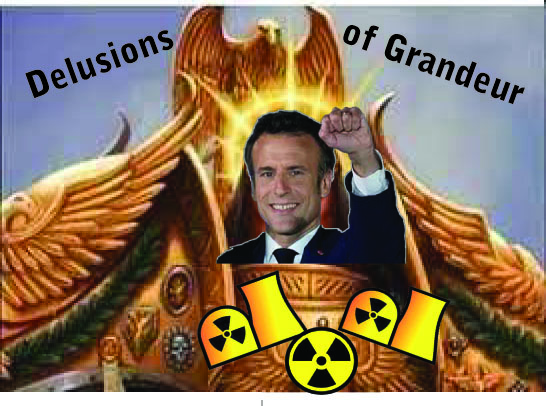
the main argument of this policy is “national energy independence”, moreover making a misleading shortcut from energy to electricity and from it nuclear power, an imaginary symbol of supposed independence.
Tuesday, May 30, 2023, by Bernard Laponche , Jean-Claude Zerbib, m https://www.global-chance.org/IMG/pdf/gc_la_triple_de_pendance_mai_2023_v2.pdf
Introduction
With 56 reactors spread over 18 EDF nuclear power plants, approximately 70% of electricity production in France is ensured by the use of nuclear energy, thanks to the production of heat by the combination of fission and chain reaction in reactors.
This situation makes France the most “nuclearized” country in the world in proportion to its population and the third in level of production after the United States and China, which are much more populous.
The program of reactors currently in operation (including the two Fessenheim reactors being dismantled) was launched in the early 1970s and reinforced by the “Messmer Program” of 1974, on the occasion of the first “oil shock”, inaugurating the “all-electric-all-nuclear” policy which continued until the construction of the Flamanville EPR in 2007, which has still not started.
The current government places itself in this line by advocating the extension of the duration of operation of the current reactors and the construction of a certain number of reactors of the EPR2 sector, heir to the EPR.
As at the time, and although times have changed, the main argument of this policy is “national energy independence”, moreover making a misleading shortcut from energy to electricity and from it nuclear power, an imaginary symbol of supposed independence. Let us admit, however, that the design and construction of the reactors are “national”, although much equipment is imported, the fact remains that the design is essentially that of the enriched uranium and pressurized water reactors of Westinghouse origin, and that the “francization” carried out at the beginning of the 1980s now raises a lot of questions, in particular with the discovery of cracks caused by corrosion under stress or thermal fatigue, which plague a certain number of reactors, including the most recent ones.
On the other hand, independence is far from being acquired on the side of the “nuclear fuel” which “boils the pot”. Indeed, natural uranium, the raw material for fission, has been completely imported for several decades. The suppliers are numerous but, among the main ones, Kazakhstan, Niger, Uzbekistan, Australia, Canada, three present geopolitical risks. But, we are told, since France has an enrichment plant, a reprocessing plant and fuel fabrication plants, we could rest easy.
The reality is much more complex.
On the other hand, independence is far from being acquired on the side of the “nuclear fuel” which “boils the pot”. Indeed, natural uranium, the raw material for fission, has been completely imported for several decades. The suppliers are numerous but, among the main ones, Kazakhstan, Niger, Uzbekistan, Australia, Canada, three present geopolitical risks. But, we are told, since France has an enrichment plant, a reprocessing plant and fuel fabrication plants, we could rest easy.
The reality is much more complex.
The purpose of this article is to assess:
- The tonnages of uranium which are delivered directly to France by the producing country, in the form of yellow cake and then undergo all the transformations, up to being put into the form of assemblies;
- The tonnages of natural uranium transiting through a third country, to arrive in France in the form of enriched uranium, gaseous or solid, or even fuel assemblies produced abroad;
- EDF’s depleted uranium enrichment operations in Russia;
- EDF and Orano’s reprocessing uranium enrichment operations in Russia.
- Manufacture of fuel assemblies, partly carried out abroad.
Thus will be established the triple dependence, total or partial, in the supply of natural uranium, in the enrichment of natural uranium, depleted uranium and reprocessed uranium and, in the manufacture of fuel assemblies.
This article is dedicated to the memory of André Guillemette, member of Global Chance and ACRO, expert in issues related to the reprocessing of irradiated fuels and the plutonium industry, author of several articles on these subjects, in particular in collaboration with Jean-Claude Zerbib, published on the Global Chance website ( www.global-chance.org ).
To read the full text https://www.global-chance.org/IMG/pdf/gc_la_triple_de_pendance_mai_2023_v2.pdf—
Call on ratepayers to fund a study for small nuclear reactors in Clark County
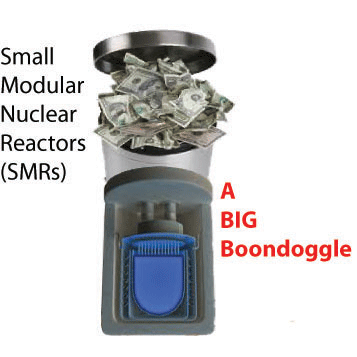
Nuclear power may again be on horizon for Clark County , By Lauren Ellenbecker, Columbian staff writer, June 2, 2023
Clark Public Utilities delays decision on helping fund study
“…………………..Energy Northwest invited Clark Public Utilities to participate in a feasibility study on its proposed small nuclear reactor development in Richland. The agency is considering creating four to 12 modular reactors, projected to generate 320 to 960 megawatts of power — less than its existing Columbia Generating Station, which has a capacity of 1,200 megawatts.
During a Clark Public Utilities Board of Commissioners meeting in May, Energy Northwest representatives sought $200,000 of ratepayer funds for the study, which is projected to cost $4 million. The body did not approve the request, as its three-member vote was split.
Commissioners Nancy Barnes and Jane Van Dyke both requested more time to consider Energy Northwest’s request and speak with other utilities, saying further clarity was needed.
Commissioner Jim Malinowski, who sits on Energy Northwest’s board of directors, advocated for Clark Public Utilities’ involvement. By providing funding, the utility would be “keeping the effort live” and showing there’s regional support for nuclear energy, he said.
Following the May meeting, skeptics said that discussions surrounding Energy Northwest’s project haven’t been substantive or transparent to the public, given the agency’s initial request for ratepayer funds.
“It seems this proposed financial investment is on a fast track with no obvious reason for the rush and shortchanges the public’s opportunity to ask questions and weigh meaningfully,” Cathryn Chudy of Vancouver wrote to the Clark Public Utilities commission.
Commissioners are expected to revisit Energy Northwest’s small modular reactor developments at their June 6 meeting.
Energy Northwest is meeting with Washington’s 28 public utility districts and municipalities for investments to its feasibility study, as well as reaching out to utilities in Oregon and Idaho. Eight utilities in Washington have contributed to date. https://www.columbian.com/news/2023/jun/02/nuclear-power-may-again-be-on-horizon-for-clark-county/
Canadian reactors that “recycle” plutonium would create more problems than they solve

Bulletin, By Jungmin Kang, M.V. Ramana | May 25, 2023
In 2021, nine US nonproliferation experts sent an open letter to Canada’s Prime Minister Justin Trudeau. In their letter, the experts expressed their concern that the Canadian government was actually increasing the risk of nuclear weapons proliferation by funding reactors that are fueled with plutonium. Earlier that year, the Federal Government had provided 50.5 million Canadian dollars to Moltex Energy, a company exploring a nuclear reactor design fueled with plutonium. The linkage to nuclear weapons proliferation has also led several civil society groups to urge the Canadian government to ban plutonium reprocessing.
Much of the concern so far has been on Canada setting a poor example by sending a “dangerous signal to other countries that it is OK to for them to extract plutonium for commercial use.” But Moltex plans to export its reactors to other countries raise a different concern. Even if a country importing such a reactor does not start a commercial program to extract plutonium, it would still have a relatively easy access to plutonium in the fuel that the reactor relies on to operate. Below we provide a rough estimate of the quantities of plutonium involved—and their potential impact on nuclear weapons proliferation—to help explain the magnitude of the problem. But there is more. By separating multiple radionuclides from the solid spent fuel and channeling it into waste streams, Moltex reactors will only make the nuclear waste problem worse.
Moltex’s technological claims. Moltex established its Canadian headquarters in the province of New Brunswick after it received an infusion of 5 million Canadian dollars from the provincial government. The company offers two products: a molten salt reactor and a proprietary chemical process that Moltex terms “waste to stable salts” technology. Moltex claims that, by using its chemical process, it can “convert” spent fuel from Canada’s deuterium uranium nuclear reactors (CANDUs) into new fuel that can be used in its reactor design. Moltex essentially claims it can “reduce waste.” In light of the problematic history associated with molten salt reactors, Moltex’s proposed reactors, and especially the chemical process needed to produce fuel, deserve more scrutiny. These will have serious implications for nuclear policy.
In its response to the open letter from the US nonproliferation experts, Moltex dismissed the ability of outsiders to comment, arguing that experts “are not aware of [its proprietary] process as only high-level details are made public.” Moltex has been indeed sparse in what it shared publicly about its technologies. Still, there is much one can surmise from earlier experiences with the processing of spent fuel and from basic science. With some simple calculations based on these high-level details provided by Moltex so far—and taking those at face value, i.e., without evaluating the feasibility of the design or their plans—we show that there is reason to be concerned about the amounts of plutonium that will be used in the reactor.
[Technical explanation here about chemical processes]…………………………………………………………………………….
Moltex’s proposed technology has not yet been evaluated by the International Atomic Energy Agency for how well it can be safeguarded; nor is it possible to evaluate how well the technology can be safeguarded in advance of a final design. But there is good reason to think that a determined country—one that might not play by the rules set by the IAEA—might find a way to divert some plutonium from Moltex’s chemical process to use it in nuclear weapons.
Diversion has been a long-standing concern with pyroprocessing, which is closely related to what Moltex is proposing. …………………………………………………………more https://thebulletin.org/2023/05/canadian-reactors-that-recycle-plutonium-would-create-more-problems-than-they-solve/
No, There Won’t Be Nuclear-Powered Commercial Shipping This Time Either
Clean Technica 25 May 23
Nuclear for commercial ships is so obviously flawed from a business perspective that I didn’t even bother to include it in my quadrant chart of sexy vs impractical maritime decarbonization technologies.
A while ago, I published my sexy-practical quadrant chart for maritime shipping decarbonization. Sharp-eyed readers noted an omission from it: nuclear power for commercial ships. While I make no claims to be encyclopedic, I do try to be relatively thorough, and it honestly didn’t occur to me to include it. Imagine my surprise that a private nuclear commercial shipping representative, CTO Giulio Gennaro of Core Power Energy, was on the panel with me at Stena Sphere’s technical summit in Glasgow.
My take is that all inland shipping and two-thirds of short sea shipping will just go to battery-electric eventually. There will be hybrid solutions where when the batteries are replaced, the pure battery range will increase and less fuel will be consumed. And biofuels will take care of the rest……………………………………………………………..
As an indicator of that niche going away, while there are over 900 ultra large crude carriers in service, only one — yes, that’s not a typo, only a single ship of that class — was on order earlier this year. No one is buying them because everyone knows that they have a good chance of being stranded assets. As I found out this week, smaller carriers are being ordered, but the ones most suitable for nuclear aren’t.
He made it clear that they were arguing for small molten salt nuclear reactors (which I guess would be MSR SMRs?), but no one pressed him on commercial demonstration of that technology. For context, there are two prototype, non-grid connected, tiny MSRs in operation in China the last time I checked. This technology has been around since the 1960s and was never commercialized. And as the product doesn’t exist today, it won’t exist in any volumes for a decade at least. They have a preferred technology, but I see no evidence of a specific design. They appear to be doing more promotion of the idea rather than development of a product. https://cleantechnica.com/2023/05/26/no-there-wont-be-nuclear-powered-commercial-shipping-this-time-either/
1 This Month
To see nuclear-related stories in greater depth and intensity – go to https://nuclearinformation.wordpress.com/

29 Jan. Thursday 7-8 p.m. Webinar – World’s Largest Nuclear Station in Port Hope, ON?


31st January – Challenging the War Machine – a DECLASSIFIED UK SUMMIT


Website of the Week
Now until to February 10, 2026 Radioactive waste storage in France: the debate is finally open! How to participate?
-
Archives
- January 2026 (259)
- December 2025 (358)
- November 2025 (359)
- October 2025 (376)
- September 2025 (258)
- August 2025 (319)
- July 2025 (230)
- June 2025 (348)
- May 2025 (261)
- April 2025 (305)
- March 2025 (319)
- February 2025 (234)
-
Categories
- 1
- 1 NUCLEAR ISSUES
- business and costs
- climate change
- culture and arts
- ENERGY
- environment
- health
- history
- indigenous issues
- Legal
- marketing of nuclear
- media
- opposition to nuclear
- PERSONAL STORIES
- politics
- politics international
- Religion and ethics
- safety
- secrets,lies and civil liberties
- spinbuster
- technology
- Uranium
- wastes
- weapons and war
- Women
- 2 WORLD
- ACTION
- AFRICA
- Atrocities
- AUSTRALIA
- Christina's notes
- Christina's themes
- culture and arts
- Events
- Fuk 2022
- Fuk 2023
- Fukushima 2017
- Fukushima 2018
- fukushima 2019
- Fukushima 2020
- Fukushima 2021
- general
- global warming
- Humour (God we need it)
- Nuclear
- RARE EARTHS
- Reference
- resources – print
- Resources -audiovicual
- Weekly Newsletter
- World
- World Nuclear
- YouTube
-
RSS
Entries RSS
Comments RSS
 nuclear-news