Nuclear lobby and NASA propagandising to schoolkids

NASA Seeks Students to Imagine Nuclear Powered Space Missions
NASA 8 Nov 23
The third Power to Explore Student Challenge from NASA is underway. The writing challenge invites K-12th grade students in the United States to learn about radioisotope power systems, a type of nuclear battery integral to many of NASA’s far-reaching space missions, and then write an essay about a new powered mission for the agency.
For more than 60 years, radioisotope power systems have helped NASA explore the harshest, darkest, and dustiest parts of our solar system and has enabled many spacecrafts to conduct otherwise impossible missions in total darkness. Ahead of the next total solar eclipse in the United States in April 2024, which is a momentary glimpse without sunlight and brings attention to the challenge of space exploration without solar power, NASA wants students to submit essays about these systems.
Entries should detail where students would go, what they would explore, and how they would use the power of radioisotope power systems to achieve mission success in a dusty, dark, or far away space destination with limited or obstructed access to light. Submissions are due Jan. 26, 2024.
“The Power to Explore Student Challenge is part of NASA’s ongoing efforts to engage students in space exploration and inspire interest in science, technology, engineering, and mathematics,” said Nicola Fox, associate administrator of NASA’s Science Mission Directorate in Washington. “This technology has been a gamechanger in our exploration capabilities and we can’t wait to see what students – our future explorers – dream up; the sky isn’t the limit, it’s just the beginning.”……………………………..
The Power to Explore Student Challenge is funded by the NASA Science Mission Directorate’s Radioisotope Power Systems Program Office and managed and administered by Future Engineers under the direction of the NASA Tournament Lab, a part of the Prizes, Challenges, and Crowdsourcing Program in NASA’s Space Technology Mission Directorate. https://www.nasa.gov/news-release/nasa-seeks-students-to-imagine-nuclear-powered-space-missions/ #nuclear #antinuclear #nuclearfree #NoNukes #radioactive
Preventing AI Nuclear Armageddon.

Nov 8, 2023,MELISSA PARKE https://www.project-syndicate.org/commentary/dangers-of-artificial-intelligence-ai-applications-nuclear-weapons-by-melissa-parke-2023-11
Nuclear history is rife with near-misses, with disaster averted by a human who chose to trust their own judgment, rather than blindly follow the information provided by machines. Applying artificial intelligence to nuclear weapons increases the chances that, next time, nobody will stop the launch.
GENEVA – It is no longer science fiction: the race to apply artificial intelligence to nuclear-weapons systems is underway – a development that could make nuclear war more likely. With governments worldwide acting to ensure the safe development and application of AI, there is an opportunity to mitigate this danger. But if world leaders are to seize it, they must first recognize just how serious the threat is.
In recent weeks, the G7 agreed on the Hiroshima Process International Code of Conduct for Organizations Developing Advanced AI Systems, in order to “to promote safe, secure, and trustworthy AI worldwide,” and US President Joe Biden issued an executive order establishing new standards for AI “safety and security.” The United Kingdom also hosted the first global AI Safety Summit, with the goal of ensuring that the technology is developed in a “safe and responsible” manner.
But none of these initiatives adequately addresses the risks posed by the application of AI to nuclear weapons.
Both the G7 code of conduct and Biden’s executive order refer only in passing to the need to protect populations from AI-generated chemical, biological, and nuclear threats. And UK Prime Minister Rishi Sunak did not mention the acute threat posed by nuclear-weapons-related AI applications at all, even as he declared that a shared understanding of the risks posed by AI had been reached at the AI Safety Summit.
No one doubts the existential risks posed by the use of nuclear weapons, which would wreak untold devastation on humanity and the planet. Even a regional nuclear war would kill hundreds of thousands of people directly, while leading to significant indirect suffering and death. The resulting climatic changes alone would threaten billions with starvation.
Nuclear history is rife with near-misses. All too often, Armageddon was averted by a human who chose to trust their own judgment, rather than blindly follow the information provided by machines. In 1983, the Soviet officer Stanislav Petrov received an alarm from the early-warning satellite system he was monitoring: American nuclear missiles had been detected heading toward the Soviet Union. But rather than immediately alert his superiors, surely triggering nuclear “retaliation,” Petrov rightly determined that it was a false alarm.
Would Petrov have made the same call – or even had the opportunity to do so – if AI had been involved? In fact, applying machine learning to nuclear weapons will reduce human control over decisions to deploy them.
Of course, a growing number of command, control, and communications tasks have been automated since nuclear weapons were invented. But, as machine learning advances, the process whereby advanced machines make decisions is becoming increasingly opaque – what is known as AI’s “black box problem.” This makes it difficult for humans to monitor a machine’s functioning, let alone determine whether it has been compromised, is malfunctioning, or has been programmed in such a way that could lead to illegal or unintentional outcomes.
Simply ensuring that a human makes the final launch decision would not be enough to mitigate these risks. As psychologist John Hawley concluded in a 2017 study, “Humans are very poor at meeting the monitoring and intervention demands imposed by supervisory control.”
Moreover, as Princeton University’s Program on Science and Global Security showed in 2020, leaders’ decision-making processes in a nuclear crisis are already very rushed. Even if AI is merely used in sensors and targeting, rather than to make launch decisions – it will shorten the already tight timescale for deciding whether to strike. The added pressure on leaders will increase the risk of miscalculation or irrational choices.
Yet another risk arises from the use of AI in satellite and other intelligence-detection systems: this will make it more difficult to hide nuclear weapons, such as ballistic-missile submarines, that have historically been concealed. This could spur nuclear-armed countries to deploy all their nuclear weapons earlier in a conflict – before their adversaries get a chance to immobilize known nuclear systems.
So far, no initiative – from Biden’s executive order to the G7’s code of conduct – has gone beyond a voluntary commitment to ensure that humans retain control of nuclear-weapons decision-making. But, as United Nations Secretary-General António Guterres has noted, a legally binding treaty banning “lethal autonomous weapons systems” is crucial.
While such a treaty is a necessary first step, however, much more needs to be done. When it comes to nuclear weapons, trying to anticipate, mitigate, or regulate the new risks created by emerging technologies will never be enough. We must remove these weapons from the equation entirely.
This means that all governments must commit to stigmatize, prohibit, and eliminate nuclear weapons by joining the Treaty on the Prohibition of Nuclear Weapons, which offers a clear path toward a world without such arms. It also means that nuclear-armed states must immediately stop investing in modernizing and expanding their nuclear arsenals, including in the name of making them “safe” or “secure” from cyberattacks. Given the insurmountable risks posed by the mere existence of nuclear weapons, such efforts are fundamentally futile.
We know that autonomous systems may lower the threshold to engage in armed conflict. When applied to nuclear weapons, AI is adding another layer of risk to an already unacceptable level of danger. It is critical that policymakers and the public recognize this, and fight not only to avoid applying AI to nuclear weapons, but to eliminate such weapons entirely. #nuclear #antinuclear #nuclearfree #NoNukes
Business complications for SMR companies X-energy and NuScale – 6 November last day of trading in public shares

NEI Magazine, 3 November 2023
US-based X-Energy Reactor Company and publicly-traded special purpose acquisition company Ares Acquisition Corporation (AAC), have mutually agreed to terminate their previously announced business combination agreement with immediate effect. ……. X-energy and AAC agreed not to proceed with the transaction citing “challenging market conditions, peer-company trading performance and a balancing of the benefits and drawbacks”.
……………………………………….Neither party is required to pay the other a termination fee as a result of the mutual decision to terminate the agreement. AAC determined that it will not be able to consummate an initial business combination within the time period required by its amended and restated memorandum and articles of association and intends to dissolve and liquidate. AAC anticipates that the last day of trading in the public shares will be 6 November…………………….
NuScale is also facing difficulties after a lengthy report by Iceberg Research entitled “Nuscale Power ($SMR): A fake customer and a major contract in peril cast doubt on NuScale’s viability”. Iceberg alleged that NuScale had sold 24 reactors to a “fake customer”. This referenced a deal NuScale announced in October to supply Standard Power with 1,848 MWe of power provided by 24 SMRs to power two US data centre sites. Iceberg predicts Standard Power will be unable to support the contract.
……………………………….. The Standard Power deal is bigger than NuScale’s other contract, with the government-backed Carbon Free Power Project (CFPP) to provide Utah Associated Municipal Power Systems (UAMPS) with 462 MWe. Iceberg said NuScale has “around 15 months before its cash runs out” and that the UAMPS contract is reaching a crucial stage. Overall shares in NuScale have fallen around 75% since their peak in late 2022, from around $14 to around $3.5……………………………………………………………………………… https://www.neimagazine.com/news/newsbusiness-complications-for-smr-companies-x-energy-and-nuscale-11268599. #nuclear #antinuclear #nuclearfree #NoNukes #smr
Bad guys and bombs: The nuclear risks of small modular reactors

National Observer, By John Woodside November 3rd 2023
Nuclear proliferation experts are warning that 50 years of policy designed to limit the spread of nuclear weapons is unravelling as governments invest in certain small modular reactors that could be misused to build bombs.
The concerns are aimed at Moltex, a Saint John, N.B., nuclear startup building small modular reactors (SMRs) that will be powered with spent fuel from CANDU reactors. To make the fuel, Moltex plans to separate plutonium from uranium in CANDU waste and use the extracted plutonium to power new SMRs.
It is this separation process that led a dozen nuclear scientists to write to Prime Minister Justin Trudeau in September, warning him that Moltex is a nuclear weapon proliferation risk and calling for a formal risk assessment of emerging nuclear technologies.
Edwin Lyman, Union of Concerned Scientists nuclear power safety director, was one of the signatories of the letter. Lyman — who has testified multiple times before the U.S. Congress and the Nuclear Regulatory Commission on the topics of nuclear power safety, security and proliferation — said that by separating and concentrating plutonium, Moltex is completing one of the most difficult steps on the path to making a bomb.
“The very process of extracting plutonium from the spent nuclear fuel and concentrating it is itself a very serious proliferation and security threat because you’re simply doing the work of the bad guys for them by concentrating and extracting plutonium,” he said.
Extracting plutonium from nuclear waste, converting it into a fuel and then transporting the fuel to a reactor increase the nuclear weapon proliferation threat “immensely,” Lyman said. The alternative is leaving the plutonium in the waste, where it is more difficult to extract, he said.
Currently, nuclear waste created by existing reactors is stored in facilities designed for interim storage. But because the waste stays radioactive for thousands of years, long-term storage solutions are a pressing concern. Canada is exploring plans to deal with the waste by burying it deep underground. Moltex, which has received at least $50.5 million worth of federal government subsidies, $10 million from New Brunswick, and $1 million from Ontario Power Generation (and is eyeing roughly $200 million more), said its SMRs, which will use plutonium extracted from the waste and use it as new energy to power a reactor, is another viable solution because the waste becomes less radioactive in the process.
Both recycling and burying spent nuclear fuel come with risks. Burying the waste deep underground could hypothetically mean the site could be exploited as a plutonium mine for future nuclear weapon production while reprocessing it could open the door for clandestine repurposing.
The reactor technology is still being developed, but in the view of nuclear weapon proliferation experts interviewed by Canada’s National Observer, the Moltex design is similar enough to previously studied nuclear technologies that are called “proliferation-prone” rather than “proliferation-resistant.” For that reason, the company should be stopped in its tracks, they say…………………………………………….
Kuperman said it’s “misleading” to say the proliferation risk is only for a short period of time because Moltex not only would need to reprocess spent fuel at the start of its process to obtain the plutonium it needs but would also reprocess the fuel over the life of the reactor to “remove undesired products of reactor operation.” In other words, the proliferation risks last the life of each reactor, which is estimated at 60 years.
He said safeguards are also difficult, if not impossible, to implement when the risk is that plutonium could be diverted from the reactor to make bombs because discovering misuse after the fact is too late. A 2009 study from six U.S. national laboratories analyzing various types of nuclear-reprocessing technologies, some of which Kuperman described as similar to Moltex’s design, emphasized this risk.
“While an attempt by the state to separate pure plutonium in facilities using these technologies might be readily detected, once the state has withdrawn or broken out from its non-proliferation obligations, estimates of the time to convert the facility to separate pure plutonium ranges from a few days to a few weeks,” the study found.
That 2009 study is “objective and authoritative,” Kuperman said. “By contrast, the Moltex CEO is a businessman trying to make money by downplaying the nuclear weapons proliferation risks of his technology.”
In Kuperman’s view, the big picture is that there is a documented history of nuclear energy with peaceful purposes in mind having been misused to create bombs — and there is no reason to risk it again………………………………. more https://www.nationalobserver.com/2023/11/03/news/bad-guys-bombs-nuclear-risks-small-modular-reactors #nuclear #antinuclear #nuclearfree #NoNukes
Number of planned low-orbit satellites NOW EXCEEDS ONE MILLION

ARTHUR FIRSTENBERG, NOV 1, 2023
https://arthurfirstenberg.substack.com/p/number-of-planned-low-orbit-satellites?utm_source=profile&utm_medium=reader2
On Sunday, SpaceX launched 23 satellites from Cape Canaveral in the morning, and 22 more from Vandenberg Air Force Base in the evening. This brought the total number of operating satellites irradiating the Earth to about 8,800.
SpaceX has been sending up satellite-laden rockets every few days this year, in its haste to satisfy an insatiable demand for bandwidth by the billions of human beings who use cell phones. But SpaceX is not the only one. Hundreds of companies are competing for a share of the global market to supply Internet from the sky to the world’s population.
On January 5, 2022, I sent out a newsletter listing 147 companies and government agencies from 34 countries that were operating, launching, or planning fleets of satellites that, if they were all launched, would total about half a million in our skies, far outnumbering the visible stars. On October 17, 2023, the journal Science, reviewing filings with the International Telecommunication Union, informed the world that the number of filings and the number of planned satellites have again more than doubled. There are more than 90 filings for constellations of over 1,000 satellites each. Twenty-three have over 5,000 satellites, and eight have over 10,000 satellites. As of December 31, 2022, the number of satellites being planned by 300 companies and governments exceeded one million. And in June, 2023, E-Space, a company based in France and founded by Greg Wyler in 2022, filed a plan for a single megaconstellation containing 116,640 satellites. E-Space had previously filed a plan, via the government of Rwanda, for an even larger constellation containing 327,320 satellites. Two days after his new filing with the ITU, Wyler clarified that “Our filing in France is in addition to our filings in Rwanda.”
Our new network, People Without Cell Phones, is more important than ever. The only way to diminish the demand for bandwidth that is turning the Earth into a giant computer, with all living beings electrocuted inside of it, is to stop using cell phones. Not to use them less frequently, but to throw them away. The ability to use them, no matter how infrequently, requires the entire planet to be irradiated. Please join our network by forming a local chapter where you live. You can set your own rules, but it is important to have meetings in person. Please contact me if you need help and let me know that you are doing it. Our goal is to establish an expanding global presence of communities that do not use cell phones. It is up to us. #nuclear #antinuclear #nuclearfree #NoNukes
Arthur Firstenberg
President, Cellular Phone Task Force
Author, The Invisible Rainbow: A History of Electricity and Life
P.O. Box 6216
Santa Fe, NM 87502 USA
phone: +1 505-471-0129
arthur@cellphonetaskforce.org
Lawyers circle nuclear startup NuScale over claims a 24-reactor deal will fail
Short seller brands blockchain firm Standard Power a “fake customer”
October 27, 2023 By Peter Judge https://www.datacenterdynamics.com/en/news/lawyers-circle-nuclear-startup-nuscale-over-claims-a-24-reactor-deal-will-fail/
Nuclear power startup NuScale is facing investigation by lawyers after a short-seller’s report alleged that it has sold 24 reactors to a “fake customer.”
NuScale announced a deal earlier this month to supply blockchain firm Standard Power with 1,848MW of power provided by 24 of NuScale’s small modular reactors (SMRs), to power two US data center sites.
Last week its share price dropped around 10 percent after a scathing report from short seller Iceberg Research claimed that the deal, estimated at $37 billion, had “zero chance of being executed.” The shares bounced back around six percent earlier this week, when NuScale responded, saying the Iceberg claims were “riddled with speculative statements with no basis in fact.”
NuScale has contracted to provide Standard Power with 1,848MW of power, but Iceberg predicts Standard Power will be unable to support the contract. Among other things, Iceberg points out that Standard Power’s CEO Maxim Serezhin has an outstanding $54k tax warrant in New York, rendering his assets vulnerable to seizure, adding that a former Standard Power leader, Adam Swickle, was found guilty of securities fraud in 2003.
The Standard Power deal is massively bigger than NuScale’s only other contract, with the government-backed Carbon Free Power Project (“CFPP”) to provide Utah Associated Municipal Power Systems (“UAMPS”) with 462MW, and is also bigger than Standard Power’s other major deal, a 200MW contract for nuclear power at Shippingport Pennsylvania.
Iceberg says NuScale has “around 15 months before its cash runs out,” and says the UAMPS contract is reaching a crucial stage, claiming: “NuScale has been given till around January 2024 to raise project commitments to 80 percent or 370 MWe.”
Iceberg also cast doubt on NuScale’s commercial partner Entra1, saying it was set up in 2021 to finance NuScale reactors, has only one employee, and was “very unlikely to be able to finance even a portion of this contract.”
NuScale said it “will not engage in a point-by-point rebuttal of every falsehood,” but issued statements on several points, saying that NuScale has a “solid balance sheet,” and that US Department of Energy (DOE) support for the CFPP “has advanced our SMR technology to the point of commercialization.”
DOE support has been a key factor in NuScale’s development, helping it bring nuclear power down to a commercial price point, however, the price of nuclear electricity from its projected plans has been creeping up, from an initial estimate of $55 per MWh to around $90 per MWh, making it less competitive.
NuScale said it “will not engage in a point-by-point rebuttal of every falsehood,” but issued statements on several points, saying that NuScale has a “solid balance sheet,” and that US Department of Energy (DOE) support for the CFPP “has advanced our SMR technology to the point of commercialization.”
Iceberg suggests that it may not be able to fully deliver without further support from the US government, which it says will “dilute” shareholder value. NuScale went public with a SPAC in May 2022.
Lawyers investigated NuScale on behalf of investors over “possible violations of federal securities laws,” include Howard G. Smith, which issued a press release this week, and Rosen Law Firm, which is planning a class action lawsuit. These releases are classed as “attorney advertising.”
Overall shares in NuScale have fallen around 75 percent since their peak in late 2022, from around $14 to around $3.5.
Space debris

https://interconnectedrisks.org/tipping-points/space-debris 25 Oct 23
Thousands of satellites orbit the Earth, gathering and distributing vital information for weather monitoring, disaster early warning systems and communications. Recent technological advancements have made it easier and more affordable for countries, companies and even individuals to put satellites into space. Satellites make our lives safer, more convenient and connected, and represent critical infrastructure that is now essential for a functioning society. However, as the number of satellites increases, so does the problem of space debris, which poses a threat to both functioning satellites and the future of our orbit.
Space debris consists of various objects, from minuscule flecks of paint to massive chunks of metal. Out of 34,260 objects tracked in orbit, only around 25 per cent are working satellites while the rest are junk, such as broken satellites or discarded rocket stages. Additionally, there are likely around 130 million pieces of debris too small to be tracked, measuring between 1 mm and 1 cm. Given that these objects travel over 25,000 kilometres per hour, even the smallest debris can cause significant damage. Each piece of debris becomes an obstacle in the orbital “highway”, making it increasingly difficult for functional satellites to avoid collisions.
Key Numbers
8,300 functioning satellites in orbit
34,260 tracked objects in orbit
25,000 kilometres per hour travel speed
The danger is more than just theoretical. In 2009, a collision between a defunct satellite and an active communications satellite created thousands of debris pieces that still orbit Earth today. This debris can impact other objects, such as the International Space Station, which conducts manoeuvres around once per year to avoid such debris. Satellites can be warned of impending collisions; in fact, the European Sentinel-2 satellite registered more than 8,000 alerts between 2015 and 2017. Collision avoidance even between active satellites can also be difficult since agencies often need to communicate and quickly come to agreements. For example, in 2019, a European Space Agency satellite had to perform an emergency manoeuvre to avoid colliding with a communications satellite after an agreement with the operator could not be reached.
More than 100,000 new spacecraft could be launched into orbit by 2030, compared to the approximately 8,000 we have now. As more satellites are launched, the orbit becomes more crowded, increasing the risk of collisions. Each collision creates millions more pieces of debris, which can then collide with other debris or satellites, creating even more shrapnel. Eventually, this will reach a point where one crash sets off a chain reaction, causing our orbit to become so dense with shrapnel that it becomes unusable. The existing space infrastructure would eventually be destroyed and future activities in space could become impossible.
Space is the final frontier, and with countries and companies racing to stake their claim, we must consider what kind of future we want to create. If we continue on the current trajectory, we risk sacrificing Earth’s orbits and the opportunities they offer to society now and in the future. Importantly, we must regulate space launches more strictly and ensure that satellites and other spacecraft are disposed of responsibly, while also investing in technologies for tracking and removing orbital debris. By coming together as a global community to treat Earth’s orbits as a precious common good, we can safeguard our future in space before it is too late. #nuclear #antinuclear #nuclearfree #NoNukes
NUSCALE POWER ($SMR): A FAKE CUSTOMER AND A MAJOR CONTRACT IN PERIL CAST DOUBT ON NUSCALE’S VIABILITY
As of now, there are only two operational SMR plants in the world — located in Russia and China — and both have experienced cost blowouts and delays. NuScale claims approximately 680 issued and pending global patents. But the company does not have an operational SMR and the only revenue it generates comes from the reimbursement of specific R&D activities.
Considering Fluor’s plan to divest its NuScale stake and the apparent lack of substantial activity at Entra1, one could speculate that Standard Power and Entra1 were brought in primarily to pump NuScale’s stock, just like many other SPACs.
October 19, 2023 · by Iceberg Research
Main Findings
- NuScale, a developer of small modular nuclear reactors (SMR), recently disclosed a huge contract with blockchain datacenter service provider Standard Power. The deal aims for a projected capacity of 1,848 MWe that we estimate is worth ~$37bn. This contract has zero chance of being executed as Standard Power clearly does not have the means to support contracts of this size. Its managing director Adam Swickle was found guilty of securities fraud in the past. Entra1 — NuScale’s commercial partner — is expected to help with the funding. The company was created in 2021 and it is very unlikely to be able to finance even a portion of this contract.
- NuScale has a more credible contract with the Carbon Free Power Project (“CFPP”) for the Utah Associated Municipal Power Systems (“UAMPS”). CFPP participants have been supportive of the project despite contracted energy prices that never seem to stop rising, from $55/MWh in 2016, to $89/MWh at the start of this year. What many have missed is that NuScale has been given till around January 2024 to raise project commitments to 80% or 370 MWe, from the existing 26% or 120 MWe, or risk termination. Crucially, when the participants agreed to this timeline, they were assured refunds for project costs if it were terminated, which creates an incentive for them to drop out. We are three months to the deadline and subscriptions have not moved an inch.
- NuScale has around 15 months before its cash runs out. We fully expect further shareholder dilution, as completion of the CFPP remains an iffy prospect with its constant cost overruns. On 13 October 2023, former CFO Chris Colbert sold the last of his NuScale stake.
- We believe these commercial and financial struggles present hurdles NuScale won’t cross without continued support from the Department of Energy (“DOE”). This presents a double-edged sword. Even if that support continues, the DOE’s usual policy is that costs have to be shared with the private sector, meaning that existing shareholders will be diluted.
Presentation of NuScale
NuScale Power Corporation, based in Portland, Oregon, has been developing small modular nuclear reactors (“SMRs”) since 2007. In May 2022, the company went public through a merger with SPAC Spring Valley Acquisition Corp. NuScale’s market cap stands at ~$1.2bn. This valuation combines both Class A and Class B shares, which can’t be traded unless converted to Class A. Fluor Enterprises Inc, NuScale’s parent company, holds 126 million Class B shares that represent 55.8% of NuScale’s voting power.
SMRs have power capacities of up to 300 MWe per unit while conventional nuclear reactors generate around 1,000 MWe. For example, NuScale’s design is 77 MWe. These SMRs come with lower upfront costs because of their smaller size. But this benefit is offset by lower economies of scale compared to conventional reactors.
Over the last 16 years, NuScale has spent ~$1.6bn to develop its SMR tech, funded by a mix of SPAC money, government grants, and private investments. The Department of Energy (“DOE”) has contributed over $650m of grants to NuScale’s endeavors.
The company is going toe-to-toe with industry goliaths like Westinghouse, Rolls-Royce, EDF, etc. But it managed to snag the first-ever Standard Design Approval from the Nuclear Regulatory Commission in 2020 – a 12-module plant at 50 MWe each. However, in August 2023, the company decided to switch the blueprint – a six-plant design featuring an uprated 77 MWe. NuScale is now waiting for the new design’s approval, which would take ~24 months according to the company.
As of now, there are only two operational SMR plants in the world — located in Russia and China — and both have experienced cost blowouts and delays. NuScale claims approximately 680 issued and pending global patents. But the company does not have an operational SMR and the only revenue it generates comes from the reimbursement of specific R&D activities.
As for customers, NuScale has two significant contracts. The first is a 462 MWe agreement with the Utah Associated Municipal Power Systems (“UAMPS”), a consortium that supplies wholesale electricity to around 50 municipalities, priced at $9.3bn. The second is a 1,848 MWe deal that was recently signed with blockchain datacenter service provider Standard Power, with an estimated value of ~$37bn.
New client Standard Power: Crypto mixed with nuclear energy – What could possibly go wrong?
On 6 October 2023, NuScale’s stock popped over 20%, after the company announced its largest-ever contract, to deliver 24 units of 77 MWe modules in 2029. As part of this agreement, NuScale’s commercial partner Entra1 would develop, manage, own, and operate these SMRs, while blockchain datacenter service provider Standard Power would be the end-user.
The deal’s total projected output is 1,848 MWe, four times the size of NuScale’s existing agreement with its other major client UAMPS, and translates to a staggering $37bn financial commitment. Considering there are only two operational SMR plants globally, one in China and the other in Russia, this agreement not only marks a significant achievement for NuScale but also holds the distinction of being the largest SMR contract ever.
Unsurprisingly, the sell-side cheerleaders have applauded this deal…………………………….
Both Standard Power and Entra1 present obvious credit and performance risks.
1) Standard Power
Standard Power was formed in 2018 to provide data centre services for blockchain mining and high performance computing applications.
According to its LinkedIn page, the company operates with just 30 employees.
Searching the internet suggests that Standard Power’s most significant partnership to date was with Cipher Mining. In 2021, the company signed a hosting agreement with Cipher ‘to provide a total mining capacity of at least 200 MW’. This deal ultimately fell apart as the contract was terminated in February this year (see below on original).
In addition, Standard Power’s management team raises some serious red flags, especially when it comes to their managing director, Adam Swickle.
Swickle has a track record that screams “investor beware”. He cut his teeth at notorious Wall Street firms like Stratton Oakmont and Meyers Pollock & Robbins — both infamous for pump-and-dump schemes and ultimately shuttered due to regulatory crackdowns.
In 2003, the SEC went after Swickle for setting up a fake foreign exchange trading house and making off with investors’ cash. As the CEO of United Currency Group, from May 2001 to December 2002, he conducted a fraudulent offering of securities based on misleading info. This included the company’s plans for an IPO, Swickle’s own background, and how corporate funds would be used. …………………………………………………………………………..
Taking these factors into consideration, it appears that Standard Power does not have the balance sheet to support this contract, both in the present and in the future.
2) ENTRA1
NuScale portrays Entra1 as having a “strong global pipeline of energy production projects” and a ““one-stop-shop” for the financing, investment, development, execution, and management of NuScale-powered projects and opportunities”, suggesting that Entra1 will finance the Standard Power contract.
Entra1 was incorporated in Delaware in December 2021. But the firm has only one employee referenced on LinkedIn, its online presence is almost non-existent, its Twitter account is essentially a NuScale bulletin board, and its only announced deal is unsurprisingly, with NuScale.
At a recent Analyst/Investor Day event, it was disclosed that Wadie Habboush, the founder of Entra1, has a longstanding personal relationship with NuScale’s CEO, John Hopkins. Around 10 years ago, Habboush formed a joint venture with Fluor — NuScale’s controlling shareholder — for projects in the Middle East e.g., Iraq. We can’t see how experience working on Middle Eastern projects would be directly transferable to managing a $37bn mega-SMR project in the US.
Fluor, NuScale’s controlling shareholder, has been open about its intention to reduce its stake (55.8%) in the company. Its long-term plan is to own only 20%-25% of NuScale as per EVP Joseph Brennan on Fluor’s 3Q22 call. He further elaborated in 4Q22 that Fluor had “kicked off the strategic exercise” and the company would be in a better position to discuss that at the end of 1Q23. There were no updates on Fluor’s 2Q23 call.
Considering Fluor’s plan to divest its NuScale stake and the apparent lack of substantial activity at Entra1, one could speculate that Standard Power and Entra1 were brought in primarily to pump NuScale’s stock, just like many other SPACs.
We believe that the contract with Standard Power has zero chance of being executed. Announcing a deal with such counterparties damages the credibility of a company in an industry where public trust is paramount. We doubt established players like Westinghouse would deal with a questionable client like Standard Power.
The situation at the Carbon Free Power Project is much worse than what NuScale lets on
Unlike Standard Power, the Carbon Free Power Project (“CFPP”) started off as a sound counterparty. The project was launched in 2015 by the Utah Associated Municipal Power Systems (UAMPS), as part of its long-term strategy to reduce carbon emissions and replace outdated coal-fired plants. If completed, the Idaho Falls plant will begin generating power in 2029, and will deploy six, 77-MWe modules to generate 462 MW of electricity by 2030. Its development and construction is funded under a cost-share agreement between the DOE and UAMPS.
Originally, between 2016 and 2020, NuScale priced the power at $55/MWh. Then, the price was raised to $58/MWh when the project was downsized from 12 reactor modules to just six (924 MWe to 462 MWe). By December 2019, 35 UAMPS members had signed on for 200 MW of power. But escalating costs have caused these numbers to shrink. As of March this year, there were 26 participants, and subscriptions dropped to ~120 MW (see appendix for table), representing 26% of the project’s total capacity.
The shocker came in January this year when new cost estimates pushed that figure up by 53%, setting it at $89/MWh. NuScale attributed the significant increase to a 75% rise in estimated construction costs, from $5.3bn to $9.3bn, caused by factors such as commodity price inflation and higher interest rates. The actual cost would be much higher, if not for more than $4bn in subsidies the project expects to get from US taxpayers, according to the Institute for Energy Economics and Financial Analysis.
The good news for NuScale is that the participants extended their commitment and accepted the revised cost. On NuScale’s 1Q23 earnings call, CEO Hopkins stated, “Right now, we feel very comfortable with that $89 megawatt hour.”
What was generally overlooked in the press is that the agreement includes conditions that essentially kick the can down the road, and endanger the project. The extension (Pg 4) states that NuScale must raise subscription levels from its current 120 MWe (26% of total capacity) to 370 MWe (80% of total capacity), on the earlier of the combined license application (“COLA”) submission, or 1 February 2024. ……………………………………………..
UAMPS member Idaho Falls laid out the stakes at its council meeting (Pg 4) in February. If NuScale fails to meet the subscription target, and costs continue to go up, so does the risk of project termination………………………………….
Key to the extension is this condition: participants will be refunded their costs if the 80% threshold is not reached. Now, with this new clause, they have a strong financial incentive to withdraw if NuScale fails to meet the subscription target.
NuScale has around three months to the deadline but is nowhere near the 80%. In August 2023, the company told news outlet Power that “no changes have occurred since March”. At a September meeting of the Washington City power board, when asked about subscription progress, director Rick Hansen said (1:01:10-1:04:00) that “Not anybody that’s able to or willing to sign at this point.” He added. “We have lots of cheerleaders but not a lot of people that want to jump in the game at this point.” Interested parties want additional mechanisms to de-risk it, according to him. This suggests no one has signed on since March.
The contract that has lent NuScale credibility is hitting a wall. The company seems to echo this sentiment, based on recent language in its 10-Q, which now adds: “While it is reasonably possible we will be required to pay these amounts, no accrual has been recorded in our financial statements.”…………………
Specifically, NuScale had a capped financial obligation’ of $83.5m to UAMPS. As of the end of June, this looming liability was around $37m.
Even if the project continues, NuScale’s $89/MWh commitment adds further financial risk. The nuclear reactor industry has a notorious history of cost overruns and delays during the construction stage. NuScale has not built a SMR yet so there’s no reason to believe the company will defy industry norms. For equity holders, this is uncomfortable, as they will bear the brunt of these performance shortfalls and costs.
NuScale’s heavy cash burn will lead to shareholder dilution
NuScale’s financial position appears increasingly shaky under the uncertainty hanging over the CFPP. The company has around 15 months of cash, based on its end-June cash balance of ~$215m, and LTM operating cash flow of negative $167m. That runway could stretch to ~26 months if the company maxes out its $150m at-the-market equity line, announced on 9 August 2023. But this does not account for potential CFPP cost repayments………………
We fully expect further shareholder dilution. Completion of the CFPP remains an iffy prospect, and given NuScale’s track record with cost overruns, that seems almost inevitable.
Against this backdrop, we noted that former CFO Chris Colbert has been selling his shares since May 2023, fully unloading his stake on 13 October 2023 – reaping total gross proceeds of ~$1.7m over this period. This could be a leading indicator of NuScale’s unspoken issues. …………
Conclusion
NuScale’s delusional contract with Standard Power seems more like an act of desperation to shore up investor confidence, rather than a strategic move. The company is struggling and we believe its equity has little to no value without government support. Even if that support continues, the DOE’s usual policy is that costs have to be shared with the private sector, meaning that existing shareholders will be diluted.
Importantly, the DOE holds a non-exclusive worldwide license to NuScale’s intellectual property, according to financing agreements. This creates the possibility that the DOE could simply transfer this intellectual property to a more established player, if NuScale is unable to meet performance obligations. ……………………..
We are short NuScale……………………………
Appendix………….. https://iceberg-research.com/2023/10/19/nuscale-power-smr-a-fake-customer-and-a-major-contract-in-peril-cast-doubt-on-nuscales-viability/ #nuclear #antinuclear #nuclearfree #NoNukes
Nuclear companies sign up for space technology missions
WNN, 20 October 2023
With nuclear technology set to underpin new developments in space travel, NASA has awarded Ultra Safe Nuclear Corporation a contract to manufacture and test fuel and develop the design of a nuclear thermal propulsion engine for near-term missions. Separately, Space Nuclear Power Corporation has partnered with Lockheed Martin Corporation and BWX Technologies for the US Space Force/Air Force’s JETSON nuclear electric propulsion demonstration project, while Framatome has announced the creation of a new brand, Framatome Space.
……………………………………………………………………..The JETSON – Joint Emergent Technology Supplying On-orbit Nuclear Power – nuclear electric propulsion demonstration project was launched in January when the US Air Force Research Laboratory (AFRL)/Space Vehicle Directorate issued solicitations to industry for high and low-power spacecraft concepts and designs using nuclear fission, rather than solar panels, for propulsion. On 3 October, the AFRL awarded Lockheed Martin, Westinghouse Government Services and Intuitive Machines LLC separate contracts totalling over USD53 million to develop the technologies and spacecraft concepts.
………………………………………………………………………………The JETSON – Joint Emergent Technology Supplying On-orbit Nuclear Power – nuclear electric propulsion demonstration project was launched in January when the US Air Force Research Laboratory (AFRL)/Space Vehicle Directorate issued solicitations to industry for high and low-power spacecraft concepts and designs using nuclear fission, rather than solar panels, for propulsion. On 3 October, the AFRL awarded Lockheed Martin, Westinghouse Government Services and Intuitive Machines LLC separate contracts totalling over USD53 million to develop the technologies and spacecraft concepts.
………………………….Framatome joins space race
Framatome has announced the creation of Framatome Space, which it said is putting the French company’s 65 years of nuclear and industrial expertise at the service of the space industry. The company is already supporting the French Alternative Energies & Atomic Energy Commission (CEA) and Ariane Group with a feasibility study on an nuclear thermal propulsion engine and earlier this year announced plans with USNC to form a joint venture to manufacture TRISO particles on a commercial scale………………………………………………………… https://www.world-nuclear-news.org/Articles/Nuclear-companies-sign-up-for-space-technology-mis #nuclear #antinuclear #nuclearfree #NoNukes
Many years before floating nuclear power plants could become viable.
King’s College leads workshops on floating nuclear power plant challenges
in Southeast Asia. King’s staff joined nuclear leaders in Indonesia, the
Philippines and Thailand to explore why it will be many years before these
technologies will be viable.
Kings College London 19th Oct 2023
https://www.kcl.ac.uk/news/kings-leads-workshops-on-floating-nuclear-power-plant-challenges-in-southeast-asia #nuclear #antinuclear #nuclearfree #NoNukes
Burned-up space junk pollutes Earth’s upper atmosphere, NASA planes find
Space.com, By Tereza Pultarova, 19 Oct 23
Chemicals created by fiery satellite re-entries could affect Earth’s climate.
Scientists have long thought that the burning up of space junk in Earth’s atmosphere creates air pollution that can affect the planet’s climate. Now, for the first time, they’ve managed to detect the presence of these pollutants in the air high above our planet.
A team of researchers flew high-altitude NASA aircraft over Alaska and the U.S. mainland to sample the chemical composition of the thin air in the stratosphere, the second-lowest layer of Earth’s atmosphere, which extends from about 6 miles to 30 miles (10 to 50 kilometers) above the planet’s surface.
The planes, NASA’s WB-57 and ER-2 aircraft, allowed the researchers to reach altitudes of up to 11.8 miles (19 km), which is about five miles (9 km) above the cruising altitude of commercial airliners.
Sensitive sensors in the nosecones of the planes analyzed the chemical compounds diluted in the thin, pristine stratospheric air, which is out of reach of Earth-based air pollution sources. The researchers found traces of lithium, aluminum, copper and lead in the sampled air. The detected concentrations of these compounds were much higher than what could be caused by natural sources, such as the evaporation of cosmic dust and meteorites upon their encounter with the atmosphere. In fact, the concentrations of these pollutants reflected the ratio of chemical compounds present in alloys used in satellite manufacturing, the researchers said in a statement.
“We are finding this human-made material in what we consider a pristine area of the atmosphere,” Dan Cziczo, a professor of Earth, atmospheric, and planetary sciences at Purdue University in Indiana and one of the authors of the study, said in the statement. “And if something is changing in the stratosphere — this stable region of the atmosphere — that deserves a closer look.”
In recent years, scientists have been sounding alarm bells about the possible effects of the rising number of rocket launches and satellite re-entries on the upper layers of Earth’s atmosphere. …………………………………………………………………………………………………………………………………………………
The study was published in the journal Proceedings of the National Academy of Sciences on Monday (Oct. 16). https://www.space.com/air-pollution-reentering-space-junk-detected #nuclear #antinuclear #nuclearfree #NoNukes
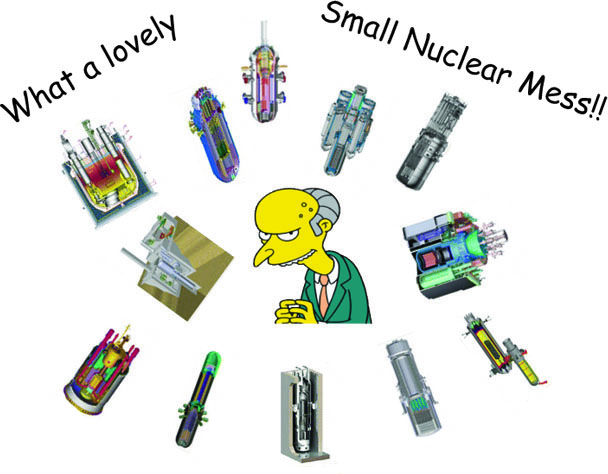
Why are Small Modular Nuclear Reactors a Dog’s Breakfast of Designs?
SMRs Information Task Force, 18 Oct 23 https://preview.mailerlite.com/i0i8d4u0o3/2327788063679321961/y8d5/
As of 2023 roughly 50 small modular reactor (SMR) designs are under development, with electrical generating capacity varying between 5 and 300 megawatts.
Compared to the current generation of larger nuclear reactors, SMRs would require smaller capital investments and provide options for deployment at remote locations with smaller power demands. But as reactor size goes down, unit cost goes up, as does the amount of radioactive waste per unit of electricity generated.
Different technology options attempt to address the concerns that plague the nuclear industry: safety, cost, radioactive waste, and weapons proliferation. However, designing for “passive safety”, opting for “waste recycling”, or providing “proliferation resistance” all involve trade-offs. With no clear “best” design, and no sizeable market, there is no justification for building a factory to mass-produce “modular” components to bring down costs.
SMR promoters have steered the debate away from these issues, arguing that all options for addressing climate change must be on the table. More SMR designs mean more opportunities to secure public subsidies.
The Government of Canada appears to have accepted the “all options” argument, and by funding multiple SMR designs is contributing to the illusion of profitability. Canada’s nuclear regulator, despite its limited capacity for technical assessment of SMR designs, has opted to boost them through largely inconsequential “vendor design reviews.”
| More than 80 years have passed since the first controlled, self-sustaining nuclear chain reaction. All proposed SMRs are essentially variations on older reactor designs that were tested decades ago and eventually abandoned. The World Nuclear Industry Status Report concludes that SMRs “will likely face major economic challenges and not be competitive on the electricity market.” #nuclear #antinuclear #nuclearfree #NoNukes |
Small modular nuclear reactors: Unlikely, unaffordable, dirty and dangerous
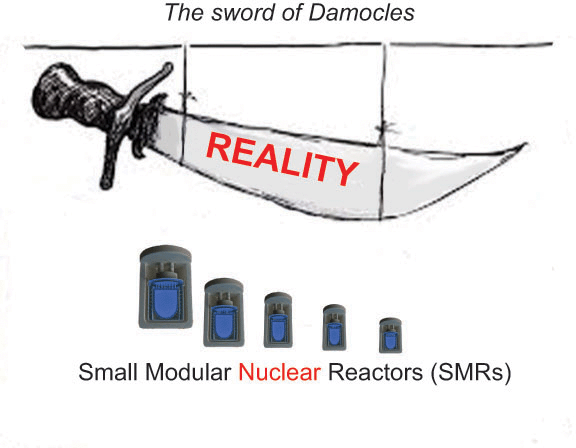
So local jobs may only amount to security, cutting the grass, and periodic reactor maintenance with possible radiation exposure.
The Appalachia Peace Education Center in Abingdon considers the small reactors a bad idea. Here’s why.
by Rees Shearer, October 16, 2023 https://cardinalnews.org/2023/10/16/small-modular-nuclear-reactors-unlikely-unaffordable-dirty-and-dangerous/
A year ago, Gov. Glenn Youngkin came to Bristol to announce proposals from his new Virginia Energy Plan. He declared, “A growing Virginia must have reliable, affordable and clean energy for Virginia’s families and businesses.”
As a requisite to achieving those goals, the Governor proposed four small modular nuclear reactors for the Southwest Virginia Coalfields. But SM[n]Rs fail to meet the governor’s three laudable goals.
SM[n]Rs cannot be reliably licensed and constructed for a decade or more. No commercial SM[n]R has been successfully licensed. There are competing designs and even the Governor said the project would take 10 years. Nuclear power has a notorious history of construction and licensing delays. That means no new nuclear energy generation for at least a decade. There can be no reliable generation when the plant is not up and running. Solar energy and energy storage on restored mine lands can be brought online in a fraction of that time.

SM[n]Rs are unaffordable. At utility scale, the electricity energy standard, Lazards Levelized Cost of Energy, rates nuclear as the most expensive means to generate electric power. It’s not clear whether nuclear waste management, insurance, and decommissioning are included among the costs. The Nu-Scale reactor, under construction in Idaho, is the only SM[n]R even close to licensing. Between 2016 and 2023, NuScale’s estimated power cost increased 60%. That’s in addition to $4 billion in subsidies from U.S. taxpayers. The latest nuclear project to come online (seven years late), Georgia Power’s Vogtle Units 3 and 4, exceeded cost projections by 120%. It’s unclear how much of the cost overruns customers will be forced to shell out. Nuclear power construction history shows an unfailing correlation between new designs and cost increases and project delays. Youngkin is opting for new technology designs. SM[n]Rs will not be affordable and Apco and Dominion Energy try to make sure customers bear the costs, even if the SM[n]R project is canceled before generating one Watt. The LCOE shows solar and on-shore wind, even adding battery storage, are the lowest cost sources of new power generation.
SM[n]Rs are dirty and dangerous. SM[n]Rs produce plutonium 239, the most lethal element in high-level nuclear waste. A Stanford University study concluded that “small modular reactors may produce a disproportionately larger amount of nuclear waste than bigger nuclear plants.” That element is deadly for a quarter million years, a horrifying legacy. There is no permanent storage solution. Just to maintain this waste is already costing taxpayers and utility customers tens of billions of dollars. Additionally, plutonium 239 is the key element in proliferation of nuclear weapons and nuclear terrorism. There is risk of radiation leaks or a catastrophic accident. This becomes all the more concerning, given the proximity of sites already evaluated as potential SM[n]R locations to Southwest Virginia schools, neighborhoods, and downtowns. The governor proposes reprocessing the waste, which adds transportation and terrorism risks.
But what about jobs, you may ask? Modular design means that the reactors would be manufactured in one central location. Modules would be transported by truck to reactor sites. Then a specialized crew, moving from site to site, would assemble the reactor. At most, ground preparation will be the work for local contractors. What about high skill nuclear technology jobs the Governor is touting? A spokesperson at NuScale Power, eagerly anticipated, “NuScale developed the information needed to obtain NRC approval that allows up to 12 NuScale Power Modules to be operated remotely from a single control room.” So local jobs may only amount to security, cutting the grass, and periodic reactor maintenance with possible radiation exposure.
The Clinch Coalition is a leading regional voice for transparency and opposition to SM[n]Rs. The Coalition developed satellite videos (available at their website), demonstrating the risky proximity of homes, a school and businesses of three of seven SM[n]R sites proposed in a study by LENOWISCO Planning District Commission.
Gov. Youngkin could have proposed solar farms on restored mine lands. When combined with current technology battery storage, solar generates reliable, affordable and clean power — 24/7, installed and maintained by a local workforce — today. Just what the governor said he wanted.
Rees Shearer is a 40-year member of the Appalachian Peace Education Center in Abingdon. He writes this on the center’s behalf in response to the Sept. 9 opinion piece: “Virginia’s clean energy revolution begins in Southwest.” #nuclear #antinuclear #nuclearfree #NoNukes
Ten reasons why nuclear power has no future.

by Sam Arnold and Ann McAllister, https://nbmediacoop.org/2023/10/11/commentary-ten-reasons-why-nuclear-power-has-no-future/October 11, 2023
Nuclear power is dirty and dangerous now, and for many generations to come. The following ten reasons state why nuclear has no future.
- Nuclear power is too slow to help mitigate the climate crisis. A 2022 report by the National Academies of Science found that most advanced reactors, including small modular nuclear reactors (SMNRs), “will confront significant challenges in meeting commercial deployment by 2050.” In contrast, the Burchill Wind Farm near Saint John took three and a half years from partnership to full deployment. Canada’s target to reduce carbon emissions by 40 to 45 per cent below 2005 levels by 2030 is looming. Renewables with storage, energy efficiency and conservation, demand-side management, and interties such as the Atlantic Loop can provide reliable baseload electricity. To wait for the SMNR silver bullet, which may never come, is to court climate catastrophe.
- Nuclear power is too expensive compared to alternatives. Wind and solar both undercut nuclear power rates. The authoritative Lazard energy analysis for 2023 costed storage-backed onshore wind and solar at US $42 to $114 per megawatt-hour, compared to nuclear power at US $141 to $221. Power from SMNRs will probably be more expensive than electricity from large nuclear plants with their history of cost increases. Crucially, SMNRs can’t take advantage of the economies of scale which large reactors do. There are orders for only single SMNRs, making it unlikely that multiple units will ever be built.
Chronic exposure to radioactive pollutants emitted from nuclear power plants can damage human health. The thyroid absorbs radioactive iodine as readily as non-radioactive iodine, putting children at particular risk of thyroid disease and cancer. Chronic exposure to radioactive materials, even at low doses, increases the incidence of cancer, leukemia, anemia, genetic damage, immune system damage, strokes, heart attacks, and low intelligence.- Liquid sodium and molten salt reactors pre-dating the ARC and Moltex SMR designs were unreliable and dangerous. Internationally, sodium reactors have not performed reliably; one in Russia experienced repeated fires. In the 1960s, the US Molten Salt Reactor Experiment (1965-1969) operated at only 40 per cent capacity compared to 90 per cent for the average US commercial nuclear power plant.
- Nuclear power does not work effectively with renewable energy. A University of Sussex study of 123 countries over 25 years found that countries that invested in renewable energy reduced more carbon emissions than countries with large percentages of nuclear power. Contrary to the claim that nuclear energy and renewables work well together, the study found that they “crowd each other out.”
- Radioactive waste remains an unsolved conundrum and will be an ongoing cost to taxpayers far into the future. Deep geological repositories (DGRs) for the disposal of high-level nuclear waste fuel are not operational anywhere in the world, including Finland and Sweden. The two locations Ignace and Saugeen Ojibway Nation under consideration in Ontario are opposed by many, including Indigenous peoples. A little-known fact is that while the waste fuel is the responsibility of the federal government, the provinces are responsible for the steel and concrete building materials which will ultimately become radioactive rubble. Would Canadians accept having a nuclear waste dump in or near their community?
- Many Indigenous leaders and First Nations are skeptical of nuclear reactors, nuclear waste, environmental risks, and groundwater contamination posed by the long-term storage of such wastes. First Nations in Ontario and Quebec do not want radioactive waste from New Brunswick in their territories. Federal and provincial governments have a history of not consulting First Nations and ignoring their concerns about nuclear installations. The Peskotomukhati Nation at Skutik and the Wolastoq Grand Council are firmly opposed to nuclear development. Nuclear does not align with their sacred principle of caring for the next seven generations.
- Transporting radioactive waste long distances to a proposed geological repository would come with higher costs and increased risk of accidents. The transport distance from Point Lepreau to a DGR proposed for northern Ontario could exceed 2,000 km. Considering the frequency of accidents involving transport trucks and freight trains, how would you feel about radioactive loads passing your home several times weekly for the next 40-plus years? To prevent such catastrophes, decommissioned nuclear reactors and their accumulated wastes must be stored safely in their present location.
- Nuclear weapons are dependent on energy from the plutonium produced at nuclear power plants, making them partners in all nuclear weapons produced. Moltex Energy’s technology for separating plutonium, the explosive in atomic bombs, from nuclear waste fuel increases the risk of nuclear weapons proliferation. Moltex’s claim that the plutonium would be too impure for use in nuclear weapons has been discredited in a 2022 report from the US National Academy of Sciences and Medicine. The experts stated that the method might delay the plutonium’s use in weapons, but would not prevent it. Nine US non-proliferation experts who advised six US presidents warned the Trudeau government that plutonium separation “will undermine the global nuclear weapons non-proliferation regime that Canada has done much to strengthen.”
- The cost of decommissioning nuclear reactors must be added to all expenses incurred at every link in the nuclear chain, from mining and fuel fabrication to perpetual waste storage, from domestic safety and security to international proliferation prevention, from policy to regulation, from design to final disposition. Taxpayers are paying for these cumulative costs, so the tally must be made public.
- Knowing the environmental dangers and financial and social liabilities nuclear power will impose on us and our descendants should galvanize us to demand that government regulations act in the public’s best interest.
- Sam Arnold and Ann McAllister are with the Coalition for Responsible Energy Development in New Brunswick (CRED-NB). #nuclear #antinuclear #NuclearFree #NoNukes #NuclearPlants
New Brunswick small nuclear tech could be used for nuclear war: physicist.
John Chilibeck, Local Journalism Initiative reporter|, Brunswick News, 11 Oct 23
A physicist from British Columbia is warning that New Brunswick is heading down a dangerous path, increasing the likelihood of a nuclear war by supporting the development of small reactors for export.
M. V. Ramana, a professor and Simons Chair in Disarmament, Global and Human Security at the University of British Columbia, says the two companies that are trying to develop small modular reactors at Point Lepreau near Saint John – Moltex and ARC – use technology that could one day be used to make nuclear weapons.
If those reactors fell in the wrong hands, he says, humankind could be put at risk.
“All reactors use plutonium and many of them use enriched uranium. Both of these processes can also be used to produce weapons material,” the academic said from the Vancouver airport on Wednesday, a day ahead of his lecture at St. Thomas University in Fredericton at 7 p.m. at the Kinsella Auditorium, McCain Hall. “The other issue is personnel. People working with reactors can learn to make nuclear weapons. And lastly, in many countries, it’s the same institutions that are involved in developing nuclear energy as developing nuclear weapons.”
Ramana cited the country of his birth, India, which ostensibly developed reactors for peaceful purposes through its Department of Nuclear Energy but after a couple of decades started making weapons out of the material to counter the influence of Pakistan, which it has fought four wars against since independence in 1947.
He also mentioned Iran, which first acquired the technology for nuclear energy in the 1970s when the Shah was in power and the country was friendly to the West. Following the revolution of 1979, religious extremists took over who now sponsor terrorist attacks around the world – such as the Hamas raid last weekend that left 1,000 Israeli citizens and soldiers dead – and also want to develop their own nuclear arsenal.
New Brunswick, he said, could unwittingly undo years of international efforts to stop nuclear proliferation once the ARC and Moltex technologies are ready, expected sometime around 2030 or a few years after.
Despite a long history of producing nuclear energy, Canada has never made nuclear weapons. Ramana said that could change if the wrong politicians came to power.
“Look at what happened on January 6, 2021 at the Capitol Building,” he said of the attempted insurrection in the United States. “I don’t think anyone thought that would ever happen. And we don’t know who will be in power in Canada in 30 years.”
Moltex and ARC have made no secret of their desire to create prototype reactors in New Brunswick that could one day be made and sold to other places, both within Canada and to other countries. It’s part of their business model.
Rory O’Sullivan, the CEO of Moltex, recently wrote a letter to Prime Minister Justin Trudeau rebutting the criticisms of a group of anti-nuclear non-proliferation academics from the United States.
Ottawa has already provided Moltex $50 million to develop its technology, and New Brunswick $5 million. It will likely need more public investment to keep developing its technology…………………………..
“Imagine one day they export reactors to South Korea, or Saudi Arabia, or Nigeria, whatever country you want to think about it. When they send the reactors abroad, they’ll have to send the fuel for those reactors, and they have a very large amount of plutonium. A country could get the reactor and the plutonium and say, ‘we’re going to use the plutonium to make nuclear weapons,’ there’s very little we can do to sanction that country.”– said Ramana #nuclear #antinuclear #NuclearFree #NoNukes #NuclearPlants
1 This Month

29 Jan. Thursday 7-8 p.m. Webinar – World’s Largest Nuclear Station in Port Hope, ON?


31st January – Challenging the War Machine – a DECLASSIFIED UK SUMMIT



Website of the Week
Now until to February 10, 2026 Radioactive waste storage in France: the debate is finally open! How to participate?
-
Archives
- January 2026 (259)
- December 2025 (358)
- November 2025 (359)
- October 2025 (376)
- September 2025 (258)
- August 2025 (319)
- July 2025 (230)
- June 2025 (348)
- May 2025 (261)
- April 2025 (305)
- March 2025 (319)
- February 2025 (234)
-
Categories
- 1
- 1 NUCLEAR ISSUES
- business and costs
- climate change
- culture and arts
- ENERGY
- environment
- health
- history
- indigenous issues
- Legal
- marketing of nuclear
- media
- opposition to nuclear
- PERSONAL STORIES
- politics
- politics international
- Religion and ethics
- safety
- secrets,lies and civil liberties
- spinbuster
- technology
- Uranium
- wastes
- weapons and war
- Women
- 2 WORLD
- ACTION
- AFRICA
- Atrocities
- AUSTRALIA
- Christina's notes
- Christina's themes
- culture and arts
- Events
- Fuk 2022
- Fuk 2023
- Fukushima 2017
- Fukushima 2018
- fukushima 2019
- Fukushima 2020
- Fukushima 2021
- general
- global warming
- Humour (God we need it)
- Nuclear
- RARE EARTHS
- Reference
- resources – print
- Resources -audiovicual
- Weekly Newsletter
- World
- World Nuclear
- YouTube
-
RSS
Entries RSS
Comments RSS
 nuclear-news