Why SMRs Are Taking Longer Than Expected to Deploy
Oil Price, By Felicity Bradstock – Sep 14, 2024
“…………………………………………..Several energy companies and startups, such as Terrapower – founded by Bill Gates, are developing SMR technology. The founders of Terrapower decided the private sector needed to take action in developing advanced nuclear energy to meet growing electricity needs, [?] mitigate climate change and lift [?] billions out of poverty.
Several SMR projects are also being backed by government financing. For example, in the U.S., the Department of Energy announced $900 million in funding to accelerate the deployment of Next-Generation Light-Water SMRs. In addition, many companies, such as Microsoft, have signed purchase agreements with energy companies to use SMRs, or are developing their own SMR strategies, to power operations with [?]clean energy.
While there is huge optimism around the deployment of SMR technology, many of the companies developing the equipment have faced a plethora of challenges, which has led to delays and massive financial burdens. At present, only three SMRs are operational in the world, in China and Russia, as well as a test reactor in Japan. Most nuclear energy experts believe SMRs won’t reach the commercial stage in the U.S. until the 2030s.
NuScale cancelled plans to launch an SMR site in Idaho in 2023 after the cost of the project rose from $5 billion to $9 billion owing to inflation and high interest rates. This is a common issue, as companies must predict the costs of a first-of-a-kind project. Once one SMR site is launched and companies can establish tried-and-tested methods of deployment, a second site is expected to be cheaper and faster to develop. A trend that will continue as companies gain more experience. Eric Carr, the president of nuclear operations at Dominion Energy, explained, “Nobody exactly wants to be first, but somebody has to be.” Carr added, “Once it gets going, it’s going to be a great, reliable source of energy for the entire nation’s grid.”
Another issue is access to uranium. Russia is currently the only commercial source of high-assay low- enriched uranium (HALEU), which companies require to power their reactors. In late 2022, Terrapower announced it would be delaying the launch of its first SMR site in Wyoming due to a lack of fuel availability. However, the U.S. is developing its domestic production capabilities. The Biden administration is expected to award over $2 billion in the coming months to uranium enrichment companies to help jumpstart the supply chain. Meanwhile, Terrapower announced this summer that it is finally commencing construction on its Wyoming SMR site and is working with other companies to develop alternate supplies of HALEU. https://oilprice.com/Energy/Energy-General/Why-SMRs-Are-Taking-Longer-Than-Expected-to-Deploy.html
The future of new nuclear

With new nuclear stagnating and renewables soaring – the sober reality is that nuclear power is just too costly and too late amid crisis
by Dr Paul Dorfman, 10-09-2024 ,
https://bylines.scot/environment/the-future-of-new-nuclear/
Editor’s note: This article has been written by Dr Dorfman and others:
- Prof Steve Thomas (Coordinating Editor, Energy Policy; Emeritus Professor of Energy Policy, University of Greenwich, UK).
- Dr Bernard Laponche (Polytechnicien, Docteur ès Sciences en Physique des Réacteurs Nucléaires, Docteur en Economie de l’Energie, France).
- Prof MV Ramana (Professor and Simons Chair in Disarmament, Global and Human Security at the School of Public Policy and Global ANairs, University of British Columbia, Canada).
- Tetsunari Iida (Chairperson, Institute for Sustainable Energy Policies, Japan).
- Prof Amory Lovins (Civil Engineering, Stanford University, USA).
Many governments around the world are under enormous pressure to expand funding for nuclear power, usually accompanied by claims that nuclear must or will play a key role in achieving climate change targets. However, the fact is that nuclear technology is in decline, and for good reason. Nuclear energy’s share of global electricity production has decreased from 17.5% (1996) to 9.2% (2023), largely due to the high costs of, and delays to, building and operating nuclear reactors.

Governments must resist pressures from the nuclear industry to fund this declining technology. These resources should be used to fund renewables and energy storage or management options – these can and will deliver climate change objectives more abundantly, reliably, quickly, and cost-effectively.

New nuclear promotional pressure can be seen in three areas: funding for the development of Small Modular Reactors (SMRs), financing new large reactors, and paying for life extension of existing reactors as they reach the end of their design life. These pressures on governments can be seen in five of the major nuclear-generating countries: the USA, France, Canada, Japan, and the UK.
Small Modular Reactors (SMRs)
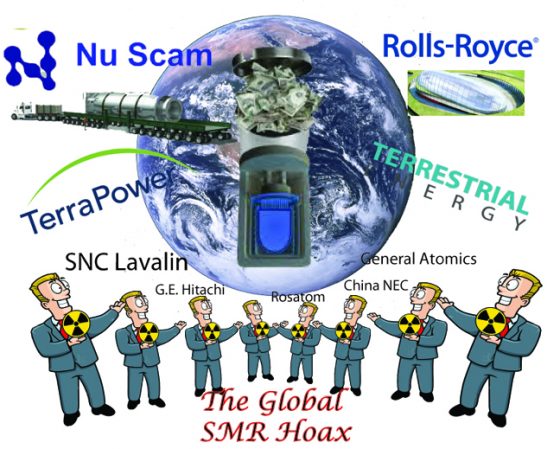
When times get tough, the nuclear industry always redirects attention to new technologies it claims will solve the problems of existing designs. The latest magic bullet is SMRs. Even though no commercial order is even close to being placed, SMRs are presented in the press as quick, cheap, safe, and under construction. Yet, in reality, SMRs are years away from commercial operation, are as expensive as large reactors, and share the same safety, security, and waste problems.

Indeed, the motivation behind SMRs appears to be financial. In recent years the nuclear industry has quietly changed its business model from making and selling products to harvesting subsidies for SMR ‘development’. In Canada, various publicly owned bodies are trying to develop new SMRs using public money, while here, the UK government is running an SMR design competition with a budget of £20bn from the public purse. Ultimately, the underlying problems become obvious – as demonstrated by last year’s collapse of NuScale USA’s SMR design and EDF France’s recent abandonment of its own SMR effort.
Large nuclear reactors
Far from improving, the record of large nuclear reactor construction is in decline with the latest designs being the worst-ever record of delays and cost escalation. The nuclear industry’s recipe is always the same; claim they are learning, claim bulk orders will reduce cost, and try to ‘streamline’ planning, safety and security regulation. These have never worked in the past and won’t work now.
Meanwhile, despite the usual cost and time overruns, the UK government is struggling to build two more reactors using the frail European Pressurised Reactor (EPR) reactor design. In France, EDF (the nationalised French nuclear utility), has plans to develop new large reactors using a modified version of the EPR design – limiting a number of safety and security features – while signalling that it will need even more public financial support.

Ageing nuclear
The world’s reactor stock is ageing. In the USA, about half the operating reactors are beyond their 40-year design life, providing expensive power even though their construction costs have been paid off. There, nuclear can survive in competitive electricity markets only thanks to large new public subsidies. In Japan, 23 reactors remain closed since the Fukushima disaster – their utilities are still trying to reopen them despite these reactors being out of service for 13 years and more. In France, EDF is facing a bill of up to €100bn for mandatory safety upgrades to its ageing nuclear fleet. Globally, these old reactors fall far short of the safety and security standards required for new reactors and should therefore be replaced as soon as possible with non-nuclear options.
Transition to renewables
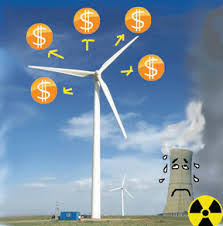
Nuclear power has never been economic, and its real costs have continued to rise throughout its history. In the past, nuclear survived because electricity was a monopoly, and electric utilities could pass on the cost, no matter how high. The introduction of competitive electricity meant this option was lost, causing the finance market to turn away from new nuclear.
After more than 60 years of commercial history, nuclear is getting further from, not nearer to, being able to survive without massive public subsidies. This is a clear indication that this quintessentially mid-20th century technology is in terminal decline and should be abandoned. Doing so would help protect the climate, not least because an hour of nuclear energy production costs several times more than renewables. In other words, nuclear delivers far less power per pound sterling than renewables.
Nuclear displaces far less fossil fuel than renewables, in terms of cost and delivery time. According to the UK Government’s Regulated Asset Base Model Impact Assessment, new nuclear takes up to 17 years for the planning, regulation and construction of just one station. The more concerned you are about climate change, the more vital it is to buy cost-effective, fast, sure, renewable options rather than expensive, slow, speculative nuclear.
The International Panel on Climate Change has reported that renewables are now ten times more efficient than nuclear at CO2 mitigation. New renewable electricity provided 507 Gigawatts (GW) in 2023, accounting for 86% of global additions of generation capacity, (reaching a total renewable capacity of 3870 GW). The renewable share of total power capacity rose to 43.2%. This extraordinary surge shows that renewables are the only technology available for a rapid transition from fossil fuels. At best, new nuclear adds only as much electricity in a year as renewables add every few days. For example, China is now installing wind and solar capacity equivalent to five new nuclear reactors every week.
New nuclear has no business case
With new nuclear stagnating and renewables soaring, the sober reality is that nuclear power is just too costly and too late for the climate and energy crises.
Far from being needed to back up variable solar and wind power, nuclear plants require even more and costlier support because their failures are larger, longer, more abrupt, and far less predictable. In 2022, half of all French reactors were online with safety faults. Not only is nuclear slow and expensive, but it is also far too inflexible to keep going up and down with the swings of electricity demand. In contrast, the variability of wind and solar technologies can be more easily integrated into evolving, flexible electricity grids capable of adjusting output to fluctuating demand and providing stable power at all times.
New nuclear has no operational need and no business case. The fact is, it’s entirely possible to sustain a reliable power system by using electricity far more efficiently and expanding diverse renewable energy supply in all sectors. This can be achieved together with the rapid growth and modernisation of the electricity grid, fuller and faster interconnection, smart energy management, and swift deployment of today’s cost-effective storage technology.
We need to secure affordable, sustainable, low-carbon energy to power our industry, transport, homes, and businesses. Since all key energy international organisations and institutes agree that renewables will do the heavy lifting to achieve net-zero, the future backbone of the world’s power supply will be clean, green, safe, and cost-effective. Nuclear is none of those.
Flamanville EPR shutdown prompts fresh questions over reactor design

The first attempt to start up the process of nuclear reaction in the European Pressurized Reactor (EPR) at the Flamanville nuclear power plant, situated on France’s Channel Coast close to Jersey and Guernsey, was aborted by an automatic shutdown last week. The process was finally successfully re-engaged four days later, but the failure was just the latest in a catalogue of incidents and delays at the site, now 12 years overdue. For one specialist, the flaws in the design of the reactor, which is the same design as that planned for Hinkley Point in England, are such that it ‘will never function properly’. Jade Lindgaard reports.
Jade Lindgaard, 9 September 2024, Mediapart
French utility giant EDF was an official sponsor of the Summer Olympic and Paralympic Games in Paris, and it’s management knows only too well how embarrassing a false start can be. For that was the case with its initial announcement last week about the starting up of the European Pressurized Reactor (EPR) at Flamanville, northern France – the most awaited event in the French nuclear energy industry in recent history……………………………………..(Subscribers only) https://www.mediapart.fr/en/journal/france/090924/flamanville-epr-shutdown-prompts-fresh-questions-over-reactor-design
Nuclear Fusion’s public-relations drive is obscuring the challenges that lie ahead

EUROfusion’s Research Roadmap, which the UK co-authored when it was still part of ITER, sees fusion as only making a significant contribution to global energy production in the course of the 22nd century. This may be politically unpalatable, but it is a realistic conclusion.
EUROfusion’s Research Roadmap, which the UK co-authored when it was still part of ITER, sees fusion as only making a significant contribution to global energy production in the course of the 22nd century. This may be politically unpalatable, but it is a realistic conclusion.
https://physicsworld.com/a/fusions-public-relations-drive-is-obscuring-the-challenges-that-lie-ahead/, 09 Sep 2024
Guy Matthews says that the focus on public relations is masking the challenges of commercializing nuclear fusion.
“For a successful technology, reality must take precedence over public relations, for nature cannot be fooled.” So stated the Nobel laureate Richard Feynman during a commission hearing into NASA’s Challenger space shuttle disaster in 1986, which killed all seven astronauts onboard.
Those famous words have since been applied to many technologies, but they are becoming especially apt to nuclear fusion where public relations currently appears to have the upper hand. Fusion has recently been successful in attracting public and private investment and, with help from the private sector, it is claimed that fusion power can be delivered in time to tackle climate change in the coming decades.
Yet this rosy picture hides the complexity of the novel nuclear technology and plasma physics involved. As John Evans – a physicist who has worked at the Atomic Energy Research Establishment in Harwell, UK – recently highlighted in Physics World, there is a lack of proven solutions for the fusion fuel cycle, which involves breeding and reprocessing unprecedented quantities of radioactive tritium with extremely low emissions.
Unfortunately, this is just the tip of the iceberg. Another stubborn roadblock lies in instabilities in the plasma itself – for example, so-called Edge Localised Modes (ELMs), which originate in the outer regions of tokamak plasmas and are akin to solar flares. If not strongly suppressed they could vaporize areas of the tokamak wall, causing fusion reactions to fizzle out. ELMs can also trigger larger plasma instabilities, known as disruptions, that can rapidly dump the entire plasma energy and apply huge electromagnetic forces that could be catastrophic for the walls of a fusion power plant.
In a fusion power plant, the total thermal energy stored in the plasma needs to be about 50 times greater than that achieved in the world’s largest machine, the Joint European Torus (JET). JET operated at the Culham Centre for Fusion Energy in Oxfordshire, UK, until it was shut down in late 2023. I was responsible for upgrading JET’s wall to tungsten/beryllium and subsequently chaired the wall protection expert group.
JET was an extremely impressive device, and just before it ceased operation it set a new world record for controlled fusion energy production of 69 MJ. While this was a scientific and technical tour de force, in absolute terms the fusion energy created and plasma duration achieved at JET were minuscule. A power plant with a sustained fusion power of 1 GW would produce 86 million MJ of fusion energy every day. Furthermore, large ELMs and disruptions were a routine feature of JET’s operation and occasionally caused local melting. Such behaviour would render a power plant inoperable, yet these instabilities remain to be reliably tamed.
Complex issues
Fusion is complex – solutions to one problem often exacerbate other problems. Furthermore, many of the physics and technology features that are essential for fusion power plants and require substantial development and testing in a fusion environment were not present in JET. One example being the technology to drive the plasma current sustainably using microwaves. The purpose of the international ITER project, which is currently being built in Cadarache, France, is to address such issues.
ITER, which is modelled on JET, is a “low duty cycle” physics and engineering experiment. Delays and cost increases are the norm for large nuclear projects and ITER is no exception. It is now expected to start scientific operation in 2034, but the first experiments using “burning” fusion fuel – a mixture of deuterium and tritium (D–T) – is only set to begin in 2039. ITER, which is equipped with many plasma diagnostics that would not be feasible in a power plant, will carry out an extensive research programme that includes testing tritium-breeding technologies on a small scale, ELM suppression using resonant magnetic perturbation coils and plasma-disruption mitigation systems.
The challenges ahead cannot be understated. For fusion to become commercially viable with an acceptably low output of nuclear waste, several generations of power-plant-sized devices could be needed
Yet the challenges ahead cannot be understated. For fusion to become commercially viable with an acceptably low output of nuclear waste, several generations of power-plant-sized devices could be needed following any successful first demonstration of substantial fusion-energy production. Indeed, EUROfusion’s Research Roadmap, which the UK co-authored when it was still part of ITER, sees fusion as only making a significant contribution to global energy production in the course of the 22nd century. This may be politically unpalatable, but it is a realistic conclusion.
The current UK strategy is to construct a fusion power plant – the Spherical Tokamak for Energy Production (STEP) – at West Burton, Nottinghamshire, by 2040 without awaiting results from intermediate experiments such as ITER. This strategy would appear to be a consequence of post-Brexit politics. However, it looks unrealistic scientifically, technically and economically. The total thermal energy of the STEP plasma needs to be about 5000 times greater than has so far been achieved in the UK’s MAST-U spherical tokamak experiment. This will entail an extreme, and unprecedented, extrapolation in physics and technology. Furthermore, the compact STEP geometry means that during plasma disruptions its walls would be exposed to far higher energy loads than ITER, where the wall protection systems are already approaching physical limits.
I expect that the complexity inherent in fusion will continue to provide its advocates, both in the public and private sphere, with ample means to obscure both the severity of the many issues that lie ahead and the timescales required. Returning to Feynman’s remarks, sooner or later reality will catch up with the public relations narrative that currently surrounds fusion. Nature cannot be fooled.
Whoopsie, SpaceX Blew Up Two Rockets and Punched a Massive Hole in One of Earth’s Layers
We learned something, though. By Darren Orf Sep 05, 2024
- In mid-November 2023, a disastrous SpaceX launch, which saw the explosion of not one but two rockets, offered a rare opportunity to study the effects of such phenomena on the ionosphere.
- A study by Russian scientists revealed how this explosion temporarily blew open a hole in the ionosphere stretching from the Yucatan to the southeastern U.S.
- Although far from the first rocket-induced disturbance in the ionosphere, this is one of the first explosive events in the ionosphere to be extensively studied.
November 18, 2023, wasn’t a great day for the commercial spaceflight company SpaceX. While testing its stainless steel-clad Starship, designed to be the company’s chariot to Mars, the spacecraft exploded four minutes after liftoff over the skies of Boca Chica, Texas.
Filling a metal candle with more than a thousand tons of propellant and flinging it into outer space has always run its fair share of risks (and explosions), but this particular event—occurring around 93 miles above the Earth’s surface—allowed scientists to closely study one poorly understood aspect of human spaceflight: What damage do rockets inflict on the Earth’s all-too-important ionosphere?
Lying at the edge of the planet’s atmosphere and outer space some 50 to 400 miles above the surface, the ionosphere is a sea of electrically charged particles vital to global radio and GPS technologies as well as protecting us from harmful solar rays. Because of its important role in the everyday function of modern society, scientists are eager to understand how disturbances in the ionosphere can impact life on Earth, and that’s why team of researchers from institutes and universities in Russia and France analyzed the explosion of the tallest and most powerful rocket ever built. The results were published in the journal Geophysical Research Letters.
Although bad news for SpaceX, the explosion oddly presented a rare opportunity to study aspects of the ionosphere that would, under normal conditions, be too weak to detect……………………………………………………………………………………………..https://www.popularmechanics.com/space/rockets/a62047078/starship-explosion-ionosphere/
Delays, debts and false promises — inside France’s nuclear nightmare.
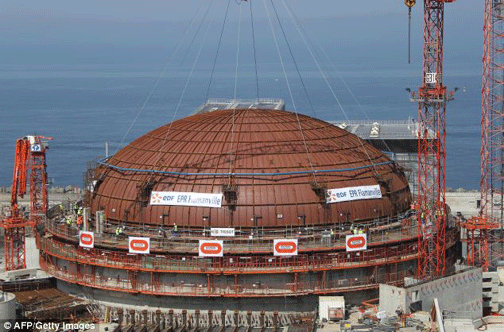
The energy giant EDF pledged to rebuild Britain’s atomic power sector,
starting with Hinkley Point. But setbacks to a similar project in Normandy
throw the UK’s nuclear future into doubt.
This week, the one and only EPR
that France has itself tried to build was finally switched on — 12 years
behind schedule. When work got under way on the reactor in Flamanville,
Normandy, in 2007, engineers had promised that it would be up and running
by 2012, at a cost of €3.3 billion (£2.8 billion).
The final bill is estimated to be €19.1 billion and it is not even plugged into the grid
yet. EDF says that will happen “by the end of the autumn”, signalling
yet another delay.
The project has been beset by problems. Safety
inspectors discovered “deviations” in eight welds in the reactor’s
main steam transfer pipe, for instance. It instructed EDF’s welders to do
the job again. Then the Nuclear Safety Authority, the French watchdog, came
across what it called a “manufacturing anomaly in the lower dome and the
vessel closure head”, which are also key components.
It has ordered the replacement of the head, although it agreed to allow the reactor to start
up with the existing one still in place. It will be removed after about 18
months of operation, to coincide with the first fuelling outage. The delays
and cost overruns at Flamanville have been viewed as a national
humiliation. Critics have asked how the project could have gone so wrong,
given France’s proud nuclear tradition — its reactors supplying about
two thirds of the country’s electricity.
Times 4th Sept 2024
Small Modular Nuclear Reactors (SMRs) in Canada

While civil society opposition to SMRs is broad and substantial in Canada, ultimately the exorbitant cost of SMRs will be their undoing. Conclusive analysis shows that SMRs cannot compete economically with wind, solar and storage systems.
SMRs will last as long as governments are willing to pour public funds into them, and SMRs will start to disappear after the money tap is turned off. Already the nuclear hype in Canada is turning back to big reactors.
WISE/NIRS Nuclear Monitor, August 29, 2024 | Issue #918, By Brennain Lloyd and Susan O’Donnell
Introduction: CANDUs versus SMRs
Canada developed the CANDU reactor, fueled with natural uranium mined in Canada and cooled and moderated with heavy water. All 19 operating power reactors in Canada – 18 in Ontario on the Great Lakes and one in New Brunswick on the Bay of Fundy – are CANDU designs with outputs ranging from about 500 to 900 MWe.
It’s been more than 30 years since the last CANDU was completed and connected to the grid in Canada. Attempts to build new ones were halted over high projected costs, and CANDU exports have dried up. To keep itself alive, in 2018 the nuclear industry launched a “roadmap” to develop smaller reactors and kick-start new nuclear export opportunities.
From 2020 to 2023, the Canadian government funded six so-called “Small Modular Nuclear Reactor” (SMR) designs. Only one – Terrestrial Energy’s Integral Molten Salt Reactor (IMSR) design – is Canadian.
The six designs are not only unlike the CANDU but also different from each other. The fuels range from low-enriched uranium, TRISO particles and HALEU (High-Assay, Low-Enriched Uranium) to plutonium-based fuel, and the different cooling systems include high-temperature gas, molten salt, liquid sodium metal and heat pipes. One design – Moltex – requires a separate reprocessing unit to extract plutonium from used CANDU fuel to make fuel for its proposed SMR.
Only one of the grid-scale SMR designs seems plausible to be built – the GE Hitachi 300 MWe boiling water reactor (BWRX-300) being developed at the Darlington nuclear site on Lake Ontario. This design uses low-enriched uranium fuel and is cooled by ordinary water. The Darlington site owner, the public utility Ontario Power Generation (OPG), is planning to build four of them.
Canada gave OPG a $970 million “low-interest” loan to help develop the BWRX-300 design. The other five SMR designs received considerably less federal funding, from $7 million to $50.5 million each, and most SMR proponents have been struggling to source matching funds. One design, Westinghouse’s off-grid eVinci micro-reactor, had early development costs funded by the U.S. military and now seems to have independent funding.
The Canadian Nuclear Laboratories (CNL) at Chalk River received more than $1.2 billion in 2023. CNL is operated by a private-sector consortium with two U.S. companies involved in the nuclear weapons industry and the Canadian firm Atkins-Réalis (formerly SNC Lavalin) which is also involved in almost every SMR project in Canada. CNL and Atomic Energy of Canada Limited are building an “Advanced Nuclear Materials Research Centre” at Chalk River, one of the largest nuclear facilities ever built in Canada, that will conduct research on SMRs.
Canada recently released a report suggesting that SMRs will be in almost all provinces by 2035, although most provincial electrical utilities have expressed no interest, and only Ontario, New Brunswick, Saskatchewan and Alberta are promoting SMRs. Alberta says it wants SMRs to reduce the GHG emissions generated in tar sands extraction.
SMR “project creep”
Proponents of most of the SMR designs keep changing the description of their projects. This is not unique to Canada, but is certainly apparent in Canada, and the regulator, the Canadian Nuclear Safety Commission (CNSC), aids and abets that practise for those SMRs in the review stream.
In the case of the BWRX-300 proposed for the Darlington site, the CNSC not only accepted a 2009 environmental assessment for very different reactors as a stand-in for the BWRX-300 but also is carrying out the current review as if for a single reactor. The nuclear regulator made this decision despite Ontario Power Generation very publicly stating its intent to construct four reactors in rapid succession at the Darlington site.
The proposed “Micro Modular Reactor” (MMR) for the Chalk River site in Ontario is another example of “project creep” and demonstrates just how flexible “scope of project” is in the domain of the CNSC.
Earlier this year, CNSC staff released a document outlining communications from the MMR proponent, Global First Power, describing significant project changes. The proponent wants to triple power output, and to operate with fuel enrichment levels from 9.75% (LEU+) up to 19.75%.
Global First Power also wants a shift from no need to refuel in a 20-year operating life to provision for on-site refueling and defueling with periods varying from three to 13.5 years. They also want to double their facility design life from 20 years to 40 years.
Despite all these significant changes to key elements of the design, the CNSC staff concluded that the Global First Power MMR project remained within scope of its initial (very different) description.
Another example of SMR project creep is in New Brunswick. In June 2023, the provincial utility NB Power applied to the CNSC for a licence to clear a site for the ARC-100 design at the Point Lepreau nuclear site on the Bay of Fundy. The design for the sodium-cooled reactor requires HALEU fuel, which is scarce because of sanctions imposed on Russia, the sole supplier.
News reports have suggested the ARC-100 design might need to change because changing the fuel means changing the design. Meanwhile the ARC company CEO left suddenly, and staff received layoff notices. Despite these obvious problems, the application under CNSC review and a provincial environmental assessment underway with the CNSC are continuing with the original design.
SMRs complicate radioactive waste management

One of the (many) false promises floated about SMRs is that they will alleviate the significant challenges of managing radioactive wastes. This is patently false. Some of this misleading rhetoric stems from the notion of “recycling” and claims by some SMR promoters that their particular design of reactor will use high-level radioactive wastes as “fuel” for their reactor.
But the reality is that the introduction of so-called “next generation” designs of reactors in Canada will only complicate the already complex set of problems related to the caretaking of these extremely hazardous materials.
……………………………………………..The shift from natural uranium to enriched uranium in commercial power reactors in Canada will fundamentally change the nature and characteristics of the spent fuel waste and will take away one of the nuclear industry’s favourite pitch points for the CANDU design: that there is no potential for criticality after the fuel is removed from the reactor.
The new potential for the irradiated enriched fuel wastes to “go critical” is only one of the many problems being overlooked by both government and industry.
Another very obvious shift is in the dimensions of the fuel, from the relatively uniform dimensions of CANDU fuel to the widely divergent shapes and sizes of fuel being depicted for the various small modular reactor designs.
The CANDU fuel bundles are approximately 50 cm long and 10 cm in diameter. In contrast, the fuel waste dimensions are significantly different for SMRs. For example, the BWRX-300 fuel bundles are much larger, the casks much heavier, and the reactor will generate higher level activity wastes. These differences will require different approaches and designs for interim and long-term dry storage of used fuel.
SMR wastes not considered in Canada’s repository design
As a fleet, small modular reactors will generate more waste per energy unit than the larger conventional reactors that preceded them. But in Canada they will also require redesign of the “concept” plan currently being promoted for the long-term dispositioning of the used fuel to a deep geological repository (DGR).
Since 2002 an association of the nuclear power companies, operating as the Nuclear Waste Management Organization (NWMO), have been pursuing a single site to bury and then abandon all of Canada’s high-level nuclear waste.
Their siting process, launched in 2010, caught the interest of 22 municipalities that allowed themselves to be studied for the “$16-24 billion national infrastructure project.” Hundreds of millions of dollars later – with tens of millions going directly into the coffers of the participating municipalities – the NWMO is now down to two candidate sites in Ontario.
The NWMO say they will make their final selection by the end of 2024. But even at this late date they have produced only “conceptual” descriptions of their repository project, including for key components such as the packaging plant where the fuel waste would be transferred into that final container, and the DGR itself. But all of the conceptual work is premised on the characteristics and dimensions of the CANDU fuel bundle.
The process lines of the used fuel packaging plant, the final container, and the spacing requirements for the repository will all need to be redone for different SMR wastes with their very different dimensions and characteristics.
While it could be said that the NWMO design progress has been surprisingly slow given their target of selecting a site this year and beginning the regulatory and licensing process next year, it will be back to square one if their proposed DGR is to accommodate SMR wastes.
There is, however, a strong possibility that the regulator, the CNSC, will allow the NWMO to skate through at least the first license phase with large information gaps, as the CNSC is doing with the plan to construct four BWRX-300s at the Darlington site.
As mentioned in the example of “project creep,” earlier this year the CNSC announced it would accept an environmental assessment approval of a generic 2009 reactor proposal instead of requiring that the BWRX-300 be subject to an impact assessment. This was despite the marked differences between the technologies assessed in 2009 and the BWRX-300 technology.
These differences will impact the management of the project’s radioactive waste. For example, the BWRX-300 public dose rates are estimated to be 10 x higher for one accident scenario (pool fire) and 54% higher in a dry storage container accident, the waste contains different proportions of radionuclides than the waste that was assessed in 2009, radio-iodine and carbon-14 emissions will be higher, alpha and beta-gamma activity per cubic metre of waste will be higher and the BWRX-300 will generate higher activity spent fuel.
Despite the NWMO having successfully wooed two small municipalities, there is broad opposition to the transportation, burial and abandonment of all of Canada’s high-level radioactive wastes in a single location, either in the headwaters of two major watersheds in northern Ontario or the rich farm lands of southwestern Ontario.
This opposition is amplified by concerns about SMR wastes and the NWMO’s open ticket to add other operations to their DGR site. Of particular concern are the potential for the NWMO to add an SMR to power their repository site or even to add a reprocessing plant at the site to extract plutonium from the used fuel. The Canadian government’s refusal to include an explicit ban on commercial reprocessing in the 2022 review of the national radioactive waste policy heightened the latter concern.
Who/what is behind the SMR push in Canada?
Although proponents claim that SMRs will contribute to climate action, critics are sceptical. It is doubtful that any SMR will be built in time to contribute to Canada’s target to decarbonize the electricity grid by 2035, and independent research found that SMRs will cost substantially more than alternative sources of grid energy.
The high cost and lengthy development timelines of SMRs, the questionable claims of climate action, as well as the significant challenges related to SMR wastes, raises an obvious question: who is pushing SMRs and why?
A central reason is a political imperative to keep the Canadian nuclear industry alive. The industry is small in Canada, but nuclear power looms large in the political imagination. Canada sees itself as a global leader in the peaceful use of nuclear energy.
Without a nuclear weapons industry, Canada needs nuclear exports to keep its domestic industry alive and ensure Canada’s membership in the international nuclear club. Earlier this year, Canada released an action plan to get nuclear projects built faster and ensure that “’nuclear energy remains a strategic asset to Canada now and into the future.”
Since the start of the nuclear age, Canada has spent a disproportionate amount of research funding on nuclear reactor development. Politicians see the CANDU design as a success, despite its costly legacy and lackluster exports. The CANDU reactors in Canada have all required significant public subsidies, and the CANDUs sold for export have been heavily subsidized by Canada as well.
Selling more CANDUs outside Canada is unlikely in the foreseeable future. But Canada wants a nuclear industry, and that requires choosing and aggressively marketing at least one nuclear reactor design. Despite being a U.S. design, the G.E. Hitachi BWRX-300 is the chosen favourite in Canada. The reactor, in early development at the Darlington site, is being promoted globally by Ontario Power Generation as part of an international collaboration with GE Hitachi Nuclear Energy, the Tennessee Valley Authority, and Synthos Green Energy.
What’s the future for SMRs in Canada?
Since the nuclear industry and its government partner Natural Resources Canada (NRCan) launched their SMR roadmap in 2018, the political and business hype for SMRs has been intense. The SMR buzz is meant to attract private sector investment, but so far that strategy is failing.
Almost everyone understands now that SMRs, like the CANDUs, are expensive projects that will need continuous massive public subsidies. To date, taxpayers have provided just over $1.2 billion in direct subsidies to SMR proponents in Canada, not nearly as much as the industry will need to develop an SMR fleet in the country.
A broad coalition of groups – from climate activists to Indigenous organizations and other groups protecting lands and waters from radioactive waste – have been pushing back against public funding for SMRs. A 2020 statement signed by 130 groups called SMRs “dirty, dangerous distractions” from real climate action. In March this year, 130 groups in Canada also signed the international declaration against new nuclear energy development launched in Brussels at the Nuclear Summit organized by the International Atomic Energy Agency.
While civil society opposition to SMRs is broad and substantial in Canada, ultimately the exorbitant cost of SMRs will be their undoing. Conclusive analysis shows that SMRs cannot compete economically with wind, solar and storage systems.
SMRs will last as long as governments are willing to pour public funds into them, and SMRs will start to disappear after the money tap is turned off. Already the nuclear hype in Canada is turning back to big reactors.
The Bruce Nuclear Generating Station on Lake Huron in Ontario, with eight CANDU reactors, is already the largest operating nuclear plant in the world. Bruce Power recently began the formal process to develop four new big reactors at the site, to generate another 4,800 megawatts of electricity. It remains to be seen if the sticker shock for the proposed big nuclear reactors will, like it has for SMRs, scare off investors.
Although more than six years of SMR promotion in Canada has produced almost no private investor interest, the SMR buzz remains strong. The SMR star may be fading but the SMR story is far from over.
Brennain Lloyd is the coordinator of Northwatch in Ontario. Susan O’Donnell is the lead researcher for the CEDAR project at St. Thomas University in New Brunswick and a spokesperson for CRED-NB. https://crednb.ca/small-modular-nuclear-reactors-smrs-in-canada/
Recent Events Prove Western Nations Are Highly Vulnerable To Cyber Calamity
Alt-Market.US, August 27, 2024

COMMENT. The original of this article contains a conspiratorial view of Covid-19 and its causes.
I can’t really agree to that opinion on Covid.
BUT – the dangers of cyber calamity seem all too real to me, and this article sets it out well
As most people are aware, this month there was a sweeping internet outage across the US which led to a failure in roughly 8.5 million Microsoft Windows devices. Disruptions included banks, airline networks, emergency call centers, online retailers and numerous corporate networks. The outage is estimated to have caused at least $5.4 billion in profit losses and it only lasted about a day.
The alleged cause of the breakdown was Crowdstrike, a cyber-security company that uses large scale data updates to Microsoft Windows networks to counter cyber threats. Instead, the company uploaded bugged code and caused a cascading outage. Mac and Linux machines were not affected.
The scale of the shutdown was immense – Over 25% of Fortune 500 companies were frozen. Travel essentially stopped. Business transactions for many companies ceased. Some banks including Bank of America, Capital One, Chase, TD Bank and Wells Fargo could not function and customers could not access their accounts.
The event reminded me of the panic surrounding the Y2K scare 25 years ago. Of course, that was all nonsense; US systems were definitely not digitized to an extent great enough to cause a disaster should there be an internet crash or a software crash. But today things are very different. Nearly every sector of the American (and European) economy and many utilities are directly dependent on a functioning internet.
The fear that prevailed during Y2K was unrealistic in 1999. Now, it makes perfect sense.
………………First and foremost, there is the potential for random error like the Crowdstrike incident. Then there’s the potential for a foreign attack on US and European digital infrastructure. Then, there’s the potential for a false flag event BLAMED on random error or a foreign government in order to foment war or economic collapse.
……………………..In June of 2021 there was an internet outage that led to large swaths of the web going completely dark, including a number of mainstream news sites, Amazon, eBay, Twitch, Reddit, etc. A host of government websites also went down. All this happened when content delivery network (CDN) company Fastly experienced a “bug.” Although Amazon had its website back online within 20 minutes, the brief outage cost the company over $5.5 million in sales.
A content delivery network is a geographically distributed network of proxy servers and their data centers. They make up what is known as the “backbone” of the internet. Only a handful of these company’s support a vast majority of internet activity. All it would take is for a few to go down, and the internet goes down, taking our economy with it.
The recent Crowdstrike situation is perhaps the worst web disruption of all time, and that was just a bug in a software update. Imagine if someone wanted to deliberately damage internet functions for an extended period of time? The results would be catastrophic.
With supply chains completely dependent on “just-in-time” freight deliveries and those deliveries dependent on efficient digital communications and payments between retailers and manufacturers, a web-down scenario for more than a few days would cause an immediate loss of consumer goods. Stores would empty within hours should the public realize that new shipments might not arrive for a long time.
Keep in mind, I’m not even accounting for payment processing between customers and retailers. If that shuts down, then ALL sales shut down. Then, whatever food you have left in your pantry or in storage is what you will have to live on until the problem is fixed. If it is ever fixed…
Network attacks are difficult to independently trace, which means anyone can initiate them and anyone can be blamed afterwards. With the increasing tensions between western and eastern nations the chances of an attack are high. And corrupt government officials could also trigger an internet crisis and blame it on foreign enemies – Either to convince the public to go to war, or to convince the public to accept greater authoritarianism.
…………….Figuring out who triggered the breakdown would be nearly impossible. We could suspect, but proving who did it is another matter. In the meantime, western officials controlled by globalist interests could lock down internet traffic and eliminate alterna
What are the most practical solutions to this? As always we can store necessities to protect our families and friends. To protect data, I recommend shutting OFF Windows Updates to prevent something like a Crowdstrike error from affecting your devices. You can also set up a Linux-based device with all your important data storage secured.
You can purchase an exterior hard drive and clone your computer data, then throw it in a closet or a waterproof case. Then there is the option of building a completely offline device (a computer that has never and will never connect to the internet).tive media platforms they don’t like, giving the public access to corporate news sources only.
These options protect you and your valuable files, but there’s not much that can be done to prevent a national scale cyber attack and the damage that one could cause. Organizing for inevitable chaos and violence is all you can do.
With a cyber-event there is the distinct danger of communications disruptions – No cell phones, no email, no social media, nothing. So, having knowledge in ham radio and radio communications is a must. I’m a general class ham and I’m still finding there’s more to learn, but a basic knowledge of radios, frequency bands and repeaters will help you to at least listen in on chatter and get important information outside of controlled news networks.
The people who used to claim it’s “doom mongering” to examine the threat of cyber attacks have been proven utterly wrong this past month. We just witnessed one of the worst internet implosions of all time and more are on the way. Prepare accordingly and remember that technological dependency is a double-edged sword. Use your tech wisely and don’t let it run your life. https://alt-market.us/recent-events-prove-western-nations-are-highly-vulnerable-to-cyber-calamity/
The UK nuclear fusion start-up helping the US develop stealth submarines
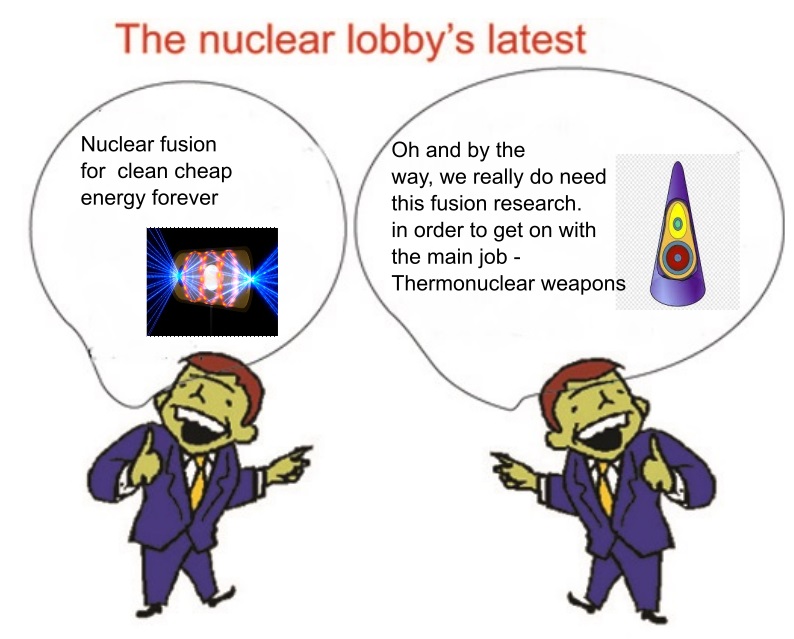
Tokamak
Energy’s collaboration with Darpa among ways UK company is seeking to
monetise its magnet breakthroughs. UK start-up Tokamak Energy is supporting
a US Defense Advanced Research Projects Agency programme to make silent
submarines.
FT 30th Aug 2024
https://www.ft.com/content/570267a4-657e-4c6b-805d-7b29a637e546
Molten salt reactors were trouble in the 1960s—and they remain trouble today

Many molten salt reactor developers and proponents seem to have decided that the Molten Salt Reactor Experiment experience was so successful that all that remains is for it to be scaled up and deployed across the world. But is this really the case? A careful look suggests otherwise.
A few years after the Molten Salt Reactor Experiment was shut down, the Atomic Energy Commission terminated the entire molten salt reactor program, although it continued to fund the molten salt breeder reactor program until the end of fiscal year 1976.
Bulletin, By M.V. Ramana | June 20, 2022
Molten salt nuclear reactors are all the rage among some nuclear power enthusiasts. They promise designs that will soon lower emissions from shipping, be cheaper to run and consume nuclear waste, and be transportable in shipping containers. The Canadian government has provided two companies, Terrestrial Energy and Moltex, with tens of millions of dollars in funding. Indonesia’s Ministry of Defense has sponsored a study of thorium-based molten salt reactors. The International Atomic Energy Agency organized a webinar calling molten salt reactors “A game changer in the nuclear industry.” Unsurprisingly, China has plans to build one.
Unlike other nuclear reactor designs that can claim multiple roots, the technology underlying molten salt reactors has a fairly clear origin: the Oak Ridge National Laboratory in Tennessee. All molten salt reactors are based, in one way or another, on the Molten Salt Reactor Experiment that operated at Oak Ridge from 1965 to 1969. That experimental reactor, in turn, was based on another experimental reactor, the Aircraft Reactor Experiment, that had operated a decade earlier at the same facility.
Among developers, the Molten Salt Reactor Experiment has a legendary status. For example, in 2015, an official from Terrapower, the nuclear venture funded in part by Bill Gates, noted that his company was “excited to celebrate and build upon” the experiment by designing a molten chloride fast reactor. His accompanying slide show reinforced the message with pictures of the Molten Salt Reactor Experiment assembly, the red hot heat exchanger, and Alvin Weinberg, the leader of Oak Ridge at that time, noting that the experiment had operated for 6,000 hours. Also in 2015, Terrestrial Energy’s David LeBlanc made “a kind of pilgrimage to Oak Ridge” to celebrate the 50th anniversary of the Molten Salt Reactor Experiment becoming critical.
Many molten salt reactor developers and proponents seem to have decided that the Molten Salt Reactor Experiment experience was so successful that all that remains is for it to be scaled up and deployed across the world. But is this really the case? A careful look suggests otherwise.
Molten salt reactors’ early history. Molten salt reactors go back to the US Air Force’s failed effort to build a nuclear-powered, long-range bomber aircraft. The Air Force spent more than $1 billion (over $7 billion in today’s dollars) between 1946 and 1961 on its Aircraft Nuclear Propulsion program. President John F. Kennedy, seeing how little had been achieved, told Congress on March 28, 1961 that the possibility of success in the foreseeable future was “still very remote” and recommended terminating the program.
As part of this effort, the Air Force made Oak Ridge National Laboratory responsible for building the Aircraft Reactor Experiment as part of its effort to fly a bomber on nuclear power. The 2.5 megawatt reactor operated for a mere nine days in November 1954. Some Oak Ridge officials considered running the reactor longer, but others grew concerned about overheating of one of the reactor components. That concern was legitimate; five days later, this component failed and “released radioactive gas into the reactor compartment.” But Oak Ridge National Lab officials were undeterred. For them, the experience showed “the feasibility of molten-salt fuel” and they “persuaded the Atomic Energy Commission to fund a study of molten-salt power reactors.” In 1958, the commission did just that, and thus began the Molten Salt Reactor Experiment.
To understand the interest in molten salt reactors, start by adopting a 1950s mindset. At the time, nuclear power was expected to expand rapidly, and some energy planners were worried that there would be insufficient uranium to fuel all the reactors to be built over upcoming decades. Alvin Weinberg, the head of Oak Ridge, expressed this eloquently when he prophesized that humanity would need to “burn the rocks” in what are called breeder reactors in order to live a “passably abundant life.” While the dominant types of reactors around the world (light water reactors and heavy water reactors) use only a small fraction of the uranium and thorium found in the Earth’s crust, breeder reactors can exploit a much larger fraction of these minerals.
The concern among nuclear power advocates about running out of uranium was also at the heart of another major nuclear development during this period: the liquid metal (sodium) cooled fast breeder reactor. These reactors were an effort to tap the energy present in the uranium-238 isotope that is not used in standard light and heavy water reactors by converting it into plutonium. Glenn Seaborg, who discovered the element and rose to become Chairman of the US Atomic Energy Commission from 1961 to 1971, predicted in 1970 that, by the year 2000, plutonium “can be expected to be a predominant energy source in our lives.” By contrast, the molten salt reactors were mostly intended as a pathway to use thorium, which was more plentiful than uranium, by converting it into uranium-233.
In retrospect, these expectations proved mistaken in three ways. First, energy demand has risen much more slowly, both in the United States and globally, than predicted. For example, in 1959, Weinberg assumed that the global population would stabilize at 7 billion and that it would need at least 1.9 billion, billion BTU per year. In comparison, in 2020, the world used a little over a quarter of this level of energy for nearly 8 billion people.
Second, nuclear energy proved much more expensive than envisioned in the heady “too cheap to meter” era. As nuclear power’s poor economics became apparent, reactor construction declined dramatically and has never achieved anywhere near the levels seen in the 1970s and 1980s………………………………………………………
Third, uranium proved to be more ubiquitous than anticipated, and global uranium resource estimates have continuously increased. ………………………………………..
…..the Molten Salt Reactor Experiment, Oak Ridge’s proposal for the next step in the molten salt reactor research process, was designed and constructed. As one of the Oak Ridge team leaders described it, “Design of the [Molten Salt Reactor Experiment] started in the summer of 1960, and construction started 18 months later, at the beginning of 1962. The reactor went critical in June 1965.”
In 1965, when the reactor started operating, it was fueled by a mixture of 150 kilograms of depleted uranium and 90 kilograms of weapons-grade, highly-enriched uranium (93 percent of uranium-235). After March 1968, the fuel was changed to one involving another weapons-usable material, uranium-233, which was derived from thorium. After this switch, the Molten Salt Reactor Experiment went critical in October 1968 and reached full power in January 1969. But at the end of that year, the experiment shut down. No more molten salt reactors have been built since.
The Molten Salt Reactor Experiment operation. Proponents of molten salt reactors have claimed for decades that the Molten Salt Reactor Experiment operated successfully. Indeed, they started making this claim even when it had barely started operating. In May 1966, for example, Paul Haubenreich, Oak Ridge National Laboratory associate director, cockily announced that the experiment “will live up to the name which we think goes with the initials M.S.R.E.—Mighty Smooth Running Experiment.” This, after listing many problems, including a basic one that was never resolved.
That basic problem was the reactor’s power level. The Molten Salt Reactor Experiment was designed to produce 10 megawatts (MW) of heat. The power level is given only in terms of heat production because its designers did not even try to generate electricity from the power produced in the reactor. Instead, the experiment just dissipated the heat produced to the surrounding air.
But this design power level was never reached. As Haubenreich described while pronouncing that the experiment was running “mighty smooth,” the operators “ran into some difficulties” and could only operate “at powers up to 5 MW.” …………………It turned out that the designers of the reactor had “miscalculated the heat transfer characteristics” of the system used for dissipating the heat produced into the atmosphere, and the reactor could not operate at its intended power level.
……………the reactor operated for just 13,172 hours over those four years, or only around 40 percent of the time……………….
During its operational lifetime, the Molten Salt Reactor Experiment was shut down 225 times. Of these 225 interruptions, only 58 were planned………………….
One persistent problem was with the electrical system, which experienced “eleven important failures.”…………………………………….. unexpected failures and shutdowns ended only in December 1969, when the Molten Salt Reactor Experiment was shut down.
The patchy experience of the experiment was by no means unique. Many other reactor designs have been plagued by unreliable operations and frequent shutdowns, that in many cases only became worse when scaled up. Consider, for example, sodium cooled fast breeder reactors. France, the country most reliant on nuclear power, tried to commercialize this technology after operating pilot-scale and demonstration reactors. This “commercial” version was the Superphénix, which started operating in 1986, experienced a series of accidents, and was shut down in 1997. During this period, it generated less than 8 percent of the electrical energy of what it would have generated running at full power round-the-clock. In the United States, the first and only commercial sodium cooled breeder reactor, Fermi-1, suffered a disastrous meltdown in 1966 as a result of a series of failures that had been dismissed as not credible by reactor engineers. Likewise, high-temperature, gas-cooled reactors have historically performed poorly.
The Molten Salt Reactor Experiment aftermath. For Oak Ridge officials and other molten salt reactor proponents, these problems with the Molten Salt Reactor Experiment were not worthy of significant concern. They moved forward with plans to build a larger molten salt breeder reactor. (Remember that the ultimate goal was to use thorium to breed nuclear fuel.) But the experiment did identify major hurdles in the path of building reliable molten salt reactors.
Here’s a key concern: Materials used to manufacture molten-salt-reactor components must maintain their integrity in highly radioactive and corrosive environments at elevated temperatures. The corrosion is a result of the reactor’s nature, which involves the use of a fuel consisting of uranium mixed with the hot salts for which the reactor is named. As anyone living near a seashore knows, chemically corrosive salt water eats most metallic objects.
To deal with this problem, Oak Ridge developed a new alloy known as IN0R-8 or Hastelloy-N in the late 1950s. While Hastelloy-N did not get significantly corroded—at least during the four years of intermittent operations—it had two significant problems. First, the material had trouble managing stresses. It became brittle, for example. Second the material developed cracks on surfaces exposed to the fuel salt. Both of these could lead to the component failing.
These problems remain relevant. Even today, no material can perform satisfactorily in the high-radiation, high-temperature, and corrosive environment inside a molten salt reactor. In 2018, scientists at the Idaho National Laboratory conducted an extensive review of different materials and, in the end, could only recommend that “a systematic development program be initiated.” In other words, fifty years after the molten salt reactor was shut down, technical experts still have questions about materials development for a new molten salt reactor design.
A few years after the Molten Salt Reactor Experiment was shut down, the Atomic Energy Commission terminated the entire molten salt reactor program, although it continued to fund the molten salt breeder reactor program until the end of fiscal year 1976…………………………………………………………………………………………………………………………
The Atomic Energy Commission, for its part, justified its decision in a devastating report that listed a number of problems with the large molten salt reactor that Oak Ridge scientists had conceptualized. The list included problems with materials, some of which have been earlier described; the challenge of controlling the radioactive tritium gas that is produced in molten salt reactors; the many large components, such as steam generators, that woud have to be developed from scratch (as researchers had no experience with such components for a molten salt reactor); the difficulties associated with molten-salt-reactor maintenance because radioactive fission products would be dispersed throughout the reactor; some safety disadvantages (though these are balanced by pointing out some of the safety advantages); and problems with graphite, which is used in molten-salt-reactor designs to slow down neutrons, because it swells when subjected to the nuclear reactor’s high radiation doses.
Other institutions too questioned the idea. A 1975 Office of Technology Assessment report listed the pros and cons of maintaining support for the molten salt breeder reactor program. An important set of arguments listed there proved prescient: “the [molten salt breeder reactor] may never work, its economics would be doubtful even if it did, and the chances of needing it are small.” As a result, in the years after the Molten Salt Reactor Experiment was shut down, many arguments were advanced to abandon the molten salt route, including not throwing good money after bad.
The Molten Salt Reactor Experiment’s long difficult tail.………………………………………………………. The distribution of the numbers of papers indicates the challenge of dealing with the waste resulting from a small molten salt reactor.
Dealing with radioactive salt wastes involves at least two separate concerns. The first, ongoing problem is that managing the radioactive salts that contain the uranium isotopes and the fission products is difficult. In the 1990s, researchers discovered that uranium had migrated and settled in other parts of the facility, leading to the possibility of an accidental criticality.
The second challenge is that of securely storing the uranium-233 from the Molten Salt Reactor Experiment. Although the uranium-233 used in the Molten Salt Reactor Experiment is but a small part of the larger US stockpile of the substance, it occurs in chemical forms that are difficult to manage. Further, urarnium-233 is usable in nuclear weapons, and any loss of this material might lead to security concerns.
In all, the costs incurred so far have run into the hundreds of millions of dollars—dozens of times the cost of constructing the reactor itself. …………………………………………………………………………………
Molten salt reactors are a bad idea. The Molten Salt Reactor Experiment’s history is riddled with extensive problems, both during its operational lifetime and the half century thereafter. These problems were not accidental but a result of the many material challenges faced by the reactor itself………………………………………………………………..
Should molten salt reactors ever be constructed, they are unlikely to operate reliably. And if they are deployed, they would likely result in various safety and security risks. And they would produce several different waste streams, all of which would require extensive processing and would face disposal related challenges. Investing in molten salt reactors is not worth the cost or the effort.
This article has benefited from research support from Maggie Chong, a materials engineering student at the University of British Columbia. une 2022
https://thebulletin.org/2022/06/molten-salt-reactors-were-trouble-in-the-1960s-and-they-remain-trouble-today/
A robot’s attempt to get a sample of the melted nuclear fuel at Japan’s damaged reactor is suspended
An attempt to use an extendable robot to remove a fragment of melted fuel from a wrecked reactor at Japan’s tsunami-hit nuclear plant has been suspended due to a technical issue
abc news, By MARI YAMAGUCHI Associated Press, August 22, 2024,
TOKYO — An attempt to use an extendable robot to remove a fragment of melted fuel from a wrecked reactor at Japan’s tsunami-hit Fukushima Daiichi nuclear power plant was suspended Thursday due to a technical issue.
The collection of a tiny sample of the debris inside the Unit 2 reactor’s primary containment vessel would start the fuel debris removal phase, the most challenging part of the decadeslong decommissioning of the plant where three reactors were destroyed in the March 11, 2011, magnitude 9.0 earthquake and tsunami disaster.
The work was stopped when workers noticed that five 1.5-meter (5-foot) pipes used to maneuver the robot were placed in the wrong order and could not be corrected within the time limit for their radiation exposure, the plant operator Tokyo Electric Power Company Holdings said.
The pipes were to be used to push the robot inside and pull it back out when it finished. Once inside the vessel, the robot is operated remotely from a safer location.
The robot can extend up to about 22 meters (72 feet) to reach its target area to collect a fragment from the surface of the melted fuel mound using a device equipped with tongs that hang from the tip of the robot.
The mission to obtain the fragment and return with it is to last two weeks. TEPCO said a new start date is undecided…………………………………………………………….
The government and TEPCO are sticking to a 30-40-year cleanup target set soon after the meltdown, despite criticism it is unrealistic. No specific plans for the full removal of the melted fuel debris or its storage have been decided. https://abcnews.go.com/Technology/wireStory/robots-attempt-sample-melted-nuclear-fuel-japans-damaged-113049701
Nuclear power on the prairies is a green smokescreen.

By M. V. Ramana & Quinn Goranson, August 19th 2024, Canada’s National Observer https://www.nationalobserver.com/2024/08/19/opinion/nuclear-power-prairies-green-smokescree
On April 2, Alberta Premier Danielle Smith declared on X (formerly Twitter) “we are encouraged and optimistic about the role small modular reactors (SMRs) can play” in the province’s plans to “achieve carbon neutrality by 2050.”
SMRs, for those who haven’t heard this buzzword, are theoretical nuclear reactor designs that aim to produce smaller amounts of electricity compared to the current reactor fleet in Canada. The dream of using small reactors to produce nuclear power dates back to the 1950s — and so has their record of failing commercially.
That optimism about SMRs will be costing taxpayers at least $600,000, which will fund the company, X-Energy’s research “into the possibility of integrating small modular reactors (SMRs) into Alberta’s electric grid.” This is on top of the $7 million offered by Alberta’s government in September 2023 to oil and gas producer Cenovus Energy to study how SMRs could be used in the oil sands.
Last August, Saskatchewan’s Crown Investments Corporation provided $479,000 to prepare local companies to take part in developing SMRs. Alberta and Saskatchewan also have a Memorandum of Understanding to “advance the development of nuclear power generation in support of both provinces’ need for affordable, reliable and sustainable electricity grids by 2050”.
What is odd about Alberta and Saskatchewan’s talk about carbon neutrality and sustainability is that, after Nunavut, these two provinces are most reliant on fossil fuels for their electricity; as of 2022, Alberta derived 81 per cent of its power from these sources; Saskatchewan was at 79 percent. In both provinces, emissions have increased more than 50 per cent above 1990 levels.
It would appear neither province is particularly interested in addressing climate change, but that is not surprising given their commitment to the fossil fuel industry. Globally, that industry has long obstructed transitioning to low-carbon energy sources, so as to continue profiting from their polluting activities.
Canadian companies have played their part too. Cenovus Energy, the beneficiary of the $7 million from Alberta, is among the four largest Canadian oil and gas companies that “demonstrate negative climate policy engagement,” and advocate for provincial government investment in offshore oil and gas development. It is also a part of the Pathways Alliance that academic scholars charge with greenwashing, in part because of its plans to use a problematic technology, carbon capture and storage, to achieve “net-zero emissions from oilsands operations by 2050.”
Carbon capture and storage is just one of the unproven technologies that the fossil fuel industry and its supporters use as part of their “climate pledges and green advertising.” Nuclear energy is another — especially when it involves new designs such as SMRs that have never been deployed in North America, or have failed commercially.
X-energy, the company that is to receive $600,000, is using a technology that has been tried out in Germany and the United States with no success. The last high-temperature, gas-cooled reactor built in the United States was shut down within a decade, producing, on average, only 15 per cent of what it could theoretically produce.
Even if one were to ignore these past failures, building nuclear reactors is slow and usually delayed. In Finland, construction of the Olkiluoto-3 reactor started in 2005, but it was first connected to the grid in 2022, a thirteen-year delay from the anticipated 2009.
Construction of Argentina’s CAREM small modular reactor started in February 2014 but it is not expected to start operating till at least the “end of 2027,” and most likely later. Both Finland and Argentina have established nuclear industries. Neither Alberta nor Saskatchewan possess any legislative capacity to regulate a nuclear industry.
What Alberta and Saskatchewan are indulging in through all these announcements and funding for small modular nuclear reactors is an obstructionist tactic to slow down the transition away from fossil fuels. Discussing nuclear technology shifts attention from present and projected GHG emissions, while enabling a ramp-up of fossil fuel reliance in the medium-term and delaying climate action into the long-term.
Floating the idea of adding futuristic SMR technology into the energy mix is one way to publicly appear to be committed to climate action, without doing anything tangible. Even if SMRs were to be deployed to supply energy in the tar sands, that does not address downstream emissions from burning the extracted fossil fuels.
Relying on new nuclear for emission reductions prevents phasing out fossil fuels at a pace necessary for the scientific consensus in favour of rapid and immediate decarbonization. An obstructionist focus on unproven technologies will not help.
Quinn Goranson is a recent graduate from the University of British Columbia’s School of Public Policy and Global Affairs with a specialization in environment, resources and energy. Goranson has experience working in research for multiple renewable energy organizations, including the CEDAR project, in environmental policy in the public sector, and as an environmental policy consultant internationally.
M.V. Ramana is the Simons Chair in Disarmament, Global and Human Security and Professor at the School of Public Policy and Global Affairs, at the University of British Columbia in Vancouver. He is the author of The Power of Promise: Examining Nuclear Energy in India (Penguin Books, 2012) and “Nuclear is not the Solution: The Folly of Atomic Power in the Age of Climate Change” (Verso Books, 2024).
The Risk of Bringing AI Discussions Into High-Level Nuclear Dialogues
Overly generalized discussions on the emerging technology may be unproductive or even undermine consensus to reduce nuclear risks at a time when such consensus is desperately needed.
by Lindsay Rand, August 19, 2024, https://carnegieendowment.org/posts/2024/08/ai-nuclear-dialogue-risks-npt?lang=en
Last month, nuclear policymakers and experts convened in Geneva to prepare for a major conference to review the implementation of the Treaty on the Non-Proliferation of Nuclear Weapons (NPT). At the meeting, calls for greater focus on the implications of artificial intelligence (AI) for nuclear policy pervaded diverse discussions. This echoes many recent pushes from within the nuclear policy community to consider emerging technologies in nuclear security–focused dialogues. However, diplomats should hesitate before trying to tackle the AI-nuclear convergence. Doing so in official, multilateral nuclear security dialogues risks being unproductive or even undermining consensus to reduce nuclear risks at a time when such consensus is desperately needed.
Last month, nuclear policymakers and experts convened in Geneva to prepare for a major conference to review the implementation of the Treaty on the Non-Proliferation of Nuclear Weapons (NPT). At the meeting, calls for greater focus on the implications of artificial intelligence (AI) for nuclear policy pervaded diverse discussions. This echoes many recent pushes from within the nuclear policy community to consider emerging technologies in nuclear security–focused dialogues. However, diplomats should hesitate before trying to tackle the AI-nuclear convergence. Doing so in official, multilateral nuclear security dialogues risks being unproductive or even undermining consensus to reduce nuclear risks at a time when such consensus is desperately needed.
The level of interest in AI at the preparatory committee meeting isn’t surprising, given how much attention is being paid to the implications of AI for nuclear security and international security more broadly. Concerns range from increased speed of engagement, which could reduce human decisionmaking time, to automated target detection that could increase apprehension over second-strike survivability, or even increase propensity for escalation. In the United States, the State Department’s International Security Advisory Board recently published a report that examines AI’s potential impacts on arms control, nonproliferation, and verification, highlighting the lack of consensus around definitions and regulations to govern Lethal Autonomous Weapons Systems (LAWS). Internationally, there have also been calls for the five nuclear weapon states (P5) to discuss AI in nuclear command and control at the P5 Process, a forum where the P5 discuss how to make progress toward meeting their obligations under the NPT. Observers have called for the P5 to issue a joint statement on the importance of preserving human responsibility in nuclear decisionmaking processes.
However, injecting AI into nuclear policy discussions at the diplomatic level presents potential pitfalls. The P5 process and NPT forums, such as preparatory committee meetings and the NPT Review Conference, are already fraught with challenges. Introducing the complexities of AI may divert attention from other critical nuclear policy issues, or even become linked to outstanding areas of disagreement in a way that further entrenches diplomatic roadblocks.
Before introducing discussions about AI into official nuclear security dialogues, policymakers should address the following questions:
- In which forums could discussions about AI be productive?
- What specific topics could realistically foster more productive dialogue?
- Who should facilitate and participate in these discussions?
Forum Selection………………………………………………………………
Topic Selection………………………………..
Participants………………………………
Tech Companies Are Racing to Harness Nuclear Power
Oil Price, By Felicity Bradstock – Aug 18, 2024
- Tech companies are investing heavily in nuclear energy to power their AI operations.
- Regulatory challenges and utility opposition are hindering the development of new nuclear projects.
With the demand for power increasing rapidly, tech companies are looking for innovative solutions to meet the demand created by artificial intelligence (AI) and other new technologies. In addition to solar and wind power, several tech companies are investing in nuclear energy projects to power operations. The clear shift in the public perception of nuclear power has once again put the abundant clean [!] energy source on the table as an option, with the U.S. nuclear energy capacity expected to rise significantly over the coming decades. ……………………………
Tech companies have invested heavily in wind and solar energy to power their data centers and are now looking for alternative clean power supplies. In 2021, Sam Altman, the CEO of OpenAI, invested $375 in the nuclear fusion startup Helion Energy. Last year, Microsoft signed a deal to purchase power from Helion beginning in 2028. Altman also chairs the nuclear fission company Oklo. Oklo is planning to build a massive network of small-scale nuclear reactors in rural southeastern Idaho to provide power to data centers as the electricity demand grows. It is also planning to build two commercial plants in southern Ohio.
However, getting some of these nuclear projects off the ground is no easy feat. Oklo has found it difficult to get the backing of nuclear regulators. In 2022, the Federal Nuclear Regulatory Commission (FERC), which oversees commercial nuclear power plants, rejected the firm’s application for the design of its Idaho “Aurora” project, for not providing enough safety information. …………………………………………
In addition to the red tape from regulators, many utilities are opposing new nuclear projects due to their anticipated impact on the grid. Some data centers require 1 GW or more of power, which is around the total capacity of a nuclear reactor in the U.S. PJM Interconnection, the biggest grid operator in the U.S., recently warned that power supply and demand is tightening as the development of new generation is falling behind demand. However, some tech companies are proposing to connect data centers directly to nuclear plants, also known as co-location, to reduce the burden on the grid.
However, several U.S. utilities oppose co-location plans……………………………………………………… more https://oilprice.com/Alternative-Energy/Nuclear-Power/Tech-Companies-Are-Racing-to-Harness-Nuclear-Power.html
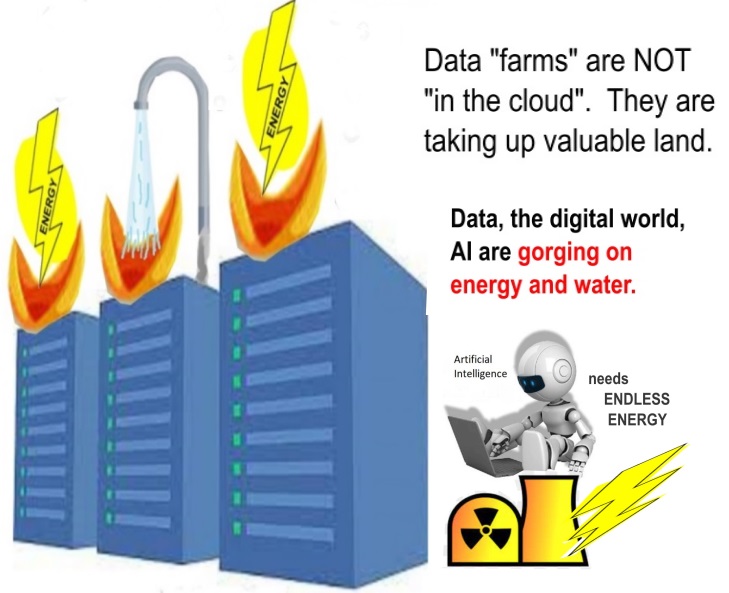
Amazon Vies for Nuclear-Powered Data Center
The deal has become a flash point over energy fairness
1EEE Spectrum, Andrew Moseman, 12 Aug 2024
When Amazon Web Services paid US $650 million in March for another data center to add to its armada, the tech giant thought it was buying a steady supply of nuclear energy to power it, too. The Susquehanna Steam Electric Station outside of Berick, Pennsylvania, which generates 2.5 gigawatts of nuclear power, sits adjacent to the humming data center and had been directly powering it since the center opened in 2023.
After striking the deal, Amazon wanted to change the terms of its original agreement to buy 180 megawatts of additional power directly from the nuclear plant. Susquehanna agreed to sell it. But third parties weren’t happy about that, and their deal has become bogged down in a regulatory battle that will likely set a precedent for data centers, cryptocurrency mining operations, and other computing facilities with voracious appetites for clean electricity.
Putting a data center right next to a power plant so that it can draw electricity from it directly, rather than from the grid, is becoming more common as data centers seek out cheap, steady, carbon-free power. Proposals for co-locating data centers next to nuclear power have popped up in New Jersey, Texas, Ohio, and elsewhere. Sweden is considering using small modular reactors to power future data centers.
However, co-location raises questions about equity and energy security, because directly-connected data centers can avoid paying fees that would otherwise help maintain grids. They also hog hundreds of megawatts that could be going elsewhere.
When Amazon Web Services paid US $650 million in March for another data center to add to its armada, the tech giant thought it was buying a steady supply of nuclear energy to power it, too. The Susquehanna Steam Electric Station outside of Berick, Pennsylvania, which generates 2.5 gigawatts of nuclear power, sits adjacent to the humming data center and had been directly powering it since the center opened in 2023.
After striking the deal, Amazon wanted to change the terms of its original agreement to buy 180 megawatts of additional power directly from the nuclear plant. Susquehanna agreed to sell it. But third parties weren’t happy about that, and their deal has become bogged down in a regulatory battle that will likely set a precedent for data centers, cryptocurrency mining operations, and other computing facilities with voracious appetites for clean electricity.
Putting a data center right next to a power plant so that it can draw electricity from it directly, rather than from the grid, is becoming more common as data centers seek out cheap, steady, carbon-free power. Proposals for co-locating data centers next to nuclear power have popped up in New Jersey, Texas, Ohio, and elsewhere. Sweden is considering using small modular reactors to power future data centers.
However, co-location raises questions about equity and energy security, because directly-connected data centers can avoid paying fees that would otherwise help maintain grids. They also hog hundreds of megawatts that could be going elsewhere.
“They’re effectively going behind the meter and taking that capacity off of the grid that would otherwise serve all customers,” says Tony Clark, a senior advisor at the law firm Wilkinson Barker Knauer and a former commissioner at the Federal Energy Regulatory Commission (FERC), who has testified to a U.S. House subcommittee on the subject.
Amazon’s nuclear power deal meets hurdles
The dust-up over the Amazon-Susquehanna agreement started in June, after Amazon subsidiary Amazon Web Services filed a notice to change its interconnection service agreement (ISA) in order to buy more nuclear power from Susquehanna’s parent company, Talen Energy. Amazon wanted to increase the amount of behind-the-meter power it buys from the plant from 300 MW to 480 MW. Shortly after it requested the change, utility giants Exelon and American Electric Power (AEP), filed a protest against the agreement and asked FERC to hold a hearing on the matter…………………………………………………………………………………………………………….
Costs of data centers seeking nuclear energy
Yet such arrangements could have major consequences for other energy customers, Clark argues. For one, directing all the energy from a nuclear plant to a data center is, fundamentally, no different than retiring that plant and taking it offline. “It’s just a huge chunk of capacity leaving the system,” he says, resulting in higher prices and less energy supply for everyone else.
Another issue is the “behind-the-meter” aspect of these kinds of deals. A data center could just connect to the grid and draw from the same supply as everyone else, Clark says. But by connecting directly to the power plant, the center’s owner avoids paying the administrative fees that are used to maintain the grid and grow its infrastructure. Those costs could then get passed on to businesses and residents who have to buy power from the grid. “There’s just a whole list of charges that get assessed through the network service that if you don’t connect through the network, you don’t have to pay,” Clark says. “And those charges are the part of the bill that will go up” for everyone else.
Even the “carbon-free” public relations talking points that come with co-location may be suspect in some cases. In Washington State, where Schneider works, new data centers are being planted next to the region’s abundant hydropower stations, and they’re using so much of that energy that parts of the state are considering adding more fossil fuel capacity to make ends meet. This results in a “zero-emissions shell game,” Clark wrote in a white paper on the subject.
These early cases are likely only the beginning. A report posted in May from the Electric Power Research Institute predicts energy demand from data centers will double by 2030, a leap driven by the fact that AI queries need ten times more energy than traditional internet searches. The International Energy Agency puts the timeline for doubling sooner–in 2026. Data centers, AI, and the cryptocurrency sector consumed an estimated 460 terawatt-hours (TWh) in 2022, and could reach more than 1000 TWh in 2026, the agency predicts.
Data centers face energy supply challenges
New data centers can be built in a matter of months, but it takes years to build utility-scale power projects, says Poorvi Patel, manager of strategic insights at Electric Power Research Institute and contributor to the report. The potential for unsustainable growth in electricity needs has put grid operators on alert, and in some cases has sent them sounding the alarm. Eirgrid, a state-owned transmission operator in Ireland, last week warned of a “mass exodus” of data centers in Ireland if it can’t connect new sources of energy. ……………………………………………………………………………………..more https://spectrum.ieee.org/amazon-data-center-nuclear-power—
1 This Month


PLEASE OPPOSE HR 8255 AND S.3639 – bills would accelerate satellite deployment, with no environmental review or safeguards – https://ncstd5li.quorum.us/campaign/169331/
To see nuclear-related stories in greater depth and intensity – go to https://nuclearinformation.wordpress.com
-
Archives
- September 2026 (194)
- August 2026 (330)
- July 2026 (355)
- June 2026 (287)
- May 2026 (306)
- April 2026 (356)
- March 2026 (251)
- February 2026 (267)
- January 2026 (308)
- December 2025 (358)
- November 2025 (359)
- October 2025 (375)
-
Categories
- 1
- 1 NUCLEAR ISSUES
- business and costs
- climate change
- culture and arts
- ENERGY
- environment
- health
- history
- indigenous issues
- Legal
- marketing of nuclear
- media
- opposition to nuclear
- PERSONAL STORIES
- politics
- politics international
- Religion and ethics
- safety
- secrets,lies and civil liberties
- spinbuster
- technology
- Uranium
- wastes
- weapons and war
- Women
- 2 WORLD
- ACTION
- AFRICA
- Atrocities
- AUSTRALIA
- Christina's notes
- Christina's themes
- culture and arts
- Events
- Fuk 2022
- Fuk 2023
- Fukushima 2017
- Fukushima 2018
- fukushima 2019
- Fukushima 2020
- Fukushima 2021
- general
- global warming
- Humour (God we need it)
- Nuclear
- RARE EARTHS
- Reference
- resources – print
- Resources -audiovicual
- Weekly Newsletter
- World
- World Nuclear
- YouTube
-
RSS
Entries RSS
Comments RSS
 nuclear-news