Nuclear secret: India’s space program uses plutonium pellets to power missions
Rt.com 5 Feb 24
New Delhi is experimenting with radioisotopes to charge its robotic missions to the Moon, Mars and beyond.
Indians are ecstatic over their space program’s string of successes in recent months. The Indian Space Research Organization (ISRO) has a couple of well-kept tech secrets – one of them nuclear – that will drive future voyages to the cosmos.
In the Hollywood sci-fi movie ‘The Martian’, astronaut Mark Watney, played by Matt Damon, is presumed dead and finds ways to stay alive on the red planet, mainly thanks to a big box of Plutonium known as a Radioisotope Thermoelectric Generator (RTG).
In the film, Watney uses it to travel in his rover to the ‘Pathfinder’, a robotic spacecraft which launched decades ago, to use its antenna to communicate with his NASA colleagues and tell them he’s still alive. Additionally, the astronaut dips this box into a container of water to thaw it.
In real life, the RTG generates electricity from the heat of a decaying radioactive substance, in this case, Plutonium-238. This unique material emits steady heat due to its natural radioactive decay. Its continuous radiation of heat, often lasting decades, made it the material of choice for producing electrical power onboard several deep-space missions of the erstwhile USSR and the US.
For short-duration voyages, Soviet missions used other isotopes, such as a Polonium-210 heat source in the Lunokhod lunar rovers, two of which landed on the Moon, in 1970 and 1973.
NASA has employed Plutonium-238 to produce electricity for a wide variety of spacecraft and hardware, from the science experiments deployed on the Moon by the Apollo astronauts to durable robotic explorers, such as the Curiosity Mars rover and the Voyager 1 and 2 spacecraft, which are now at the edge of the solar system.
The ISRO first used nuclear fuel to keep the instruments and sensors going amid frigid conditions during a successful lunar mission, Chandrayaan-3. A pellet or two of Plutonium-238 inside a scaled-down version of the RTG known as the radioisotope heating unit (RHU) made its way to space aboard the rocket. It was provided by India’s atomic energy experts.
RHUs are similar to RTGs but smaller. They weigh 40 grams and provide about one watt of heat each. Their ability to do so is derived from the decay of a few grams of Plutonium-238. However, other radioactive isotopes could be used by today’s space explorers……………………………………………………………………………………..
Meanwhile, the Indian space agency has also kept under wraps two critical technologies developed for future missions by a Bengaluru-based space tech startup, Bellatrix Aerospace.
These unique propulsion systems – engines that utilize electricity instead of conventional chemical propellants onboard satellites – were tested in space aboard POEM-3 (PSLV Orbital Experimental Module-3), which was launched by PSLV on January 1, 2024. The crew also tried replacing hazardous Hydrazine with a non-toxic and environment-friendly, high-performing proprietary propellant.
Hydrazine, an inorganic compound that is used as a long-term storable propellant has been used in the past by various space agencies; even for thrusters on board NASA’s space shuttles. However, it poses a host of health hazards; engineers wear space suits to protect themselves while loading it before the launch of a satellite or a deep-space probe.
In 2017, the European Union recommended banning its use as a satellite fuel, prompting the European Space Agency (ESA) to research alternatives to Hydrazine. The US administration has proposed a ban on the use of Hydrazine to propel satellites in outer space by 2025……… https://www.rt.com/india/591138-india-space-program-plutonium-pellets/
The new space race Is Causing New Pollution Problems.

NY Times, Ed Friedman Tue, 30 Jan 2024
The high-altitude chase started over Cape Canaveral on Feb. 17, 2023, when a SpaceX Falcon 9 rocket launched. Thomas Parent, a NASA research pilot, was flying a WB-57 jet when the rocket ascended past the right wing — leaving him mesmerized before he hit the throttle to accelerate.
For roughly an hour, Mr. Parent dove in and out of the plume in the rocket’s wake while Tony Casey, the sensor equipment operator aboard the jet, monitored its 17 scientific instruments. Researchers hoped to use the data to prove they could catch a rocket’s plume and eventually characterize the environmental effects of a space launch.
In the past few years, the number of rocket launches has spiked as commercial companies — especially SpaceX, founded by Elon Musk — and government agencies have lofted thousands of satellites into low-Earth orbit. And it is only the beginning. Satellites could eventually total one million, requiring an even greater number of space launches that could yield escalating levels of emissions.
SpaceX declined to comment about pollution from rockets and satellites. Representatives for Amazon and Eutelsat OneWeb, two other companies working toward satellite mega-constellations, said they are committed to sustainable operations. But scientists worry that more launches will scatter more pollutants in pristine layers of Earth’s atmosphere. And regulators across the globe, who assess some risks of space launches, do not set rules related to pollution.
Image
The exhaust plume from a SpaceX Falcon 9 rocket taking off from Vandenberg Air Force Base in California in 2018,Credit…Matt Hartman/Associated Press
Experts say they do not want to limit the booming space economy. But they fear that the steady march of science will move slower than the new space race — meaning we may understand the consequences of pollution from rockets and spacecraft only when it is too late. Already, studies show that the higher reaches of the atmosphere are laced with metals from spacecraft that disintegrate as they fall back to Earth.
“We are changing the system faster than we can understand those changes,” said Aaron Boley, an astronomer at the University of British Columbia and co-director of the Outer Space Institute. “We never really appreciate our ability to affect the environment. And we do this time and time again.”
……………………………… By the time a rocket curves into orbit, it will have dumped in the middle and upper layers of the atmosphere as much as two-thirds of its exhaust, which scientists predict will rain down and collect in the lower layer of the middle atmosphere, the stratosphere.
The stratosphere is home to the ozone layer, which shields us from the sun’s harmful radiation. But it is extremely sensitive: Even the smallest of changes can have enormous effects on it — and the world below.
………………………….Just how rockets will affect that relatively clear top, the stratosphere, remains uncertain. But scientists are concerned that black carbon, or soot, that is released from current rockets will act like a continuous volcanic eruption, a change that could deplete the ozone layer and affect the Earth below.
……………………………………………… A Race Against the Space Race
As space companies set records for launches and satellites deployed, scientists are starting to quantify the potential effects.
In a paper published in 2022, soot from rockets was shown to be nearly 500 times as efficient at heating the atmosphere as soot released from sources like airplanes closer to the surface. It’s the muddy-barrel effect.
“That means that as we start to grow the space industry and launch more rockets, we’re going to start to see that effect magnify very quickly,” said Eloise Marais, an associate professor in physical geography at University College London and an author of the study.
That said, Dr. Maloney’s team did not quantify how much more radiation exposure could occur.
The exact amounts of soot emitted by different rocket engines used around the globe are also poorly understood. Most launched rockets currently use kerosene fuel, which some experts call “dirty” because it emits carbon dioxide, water vapor and soot directly into the atmosphere. But it might not be the predominant fuel of the future. SpaceX’s future rocket Starship, for example, uses a mix of liquid methane and liquid oxygen propellants.
Still, any hydrocarbon fuel produces some amount of soot. And even “green rockets,” propelled by liquid hydrogen, produce water vapor, which is a greenhouse gas at these dry high altitudes.
“You can’t take what’s green in the troposphere and necessarily think of it being green in the upper atmosphere,” Dr. Boley said. “There is no such thing as a totally neutral propellant. They all have different impacts.”
Smithereens of Satellites
What goes up must come down. Once satellites in low-Earth orbit reach the end of their operational lifetimes, they plunge through the atmosphere and disintegrate, leaving a stream of pollutants in their wake. Although scientists do not yet know how this will influence Earth’s environment, Dr. Ross thinks that it will be the most significant impact from spaceflight.
A study published in October found that the stratosphere is already littered with metals from re-entering spacecraft. It used the same NASA WB-57 jet that chased the SpaceX rocket plume last year, studying the stratosphere over Alaska and much of the continental U.S.
When the researchers began analyzing the data, they saw particles that didn’t belong. Niobium and hafnium, for example, do not occur naturally but are used in rocket boosters. Yet these metals, along with other distinct elements from spacecraft, were embedded within roughly 10 percent of the most common particles in the stratosphere.
The findings validate earlier theoretical work, and Dr. Boley, who was not involved in the study, argues that the percentage will only increase given that humanity is at the beginning of the new satellite race.
Of course, researchers cannot yet say how these metals will affect the stratosphere.
“That’s a big question that we have to answer moving forward, but we can’t presume that it won’t matter,” Dr. Boley said.
…………………………………..scientists argue, satellite operators and rocket companies need regulations. Few are currently in place.
“Space launch falls into a gray area,” said Gavin Schmidt, director of the NASA Goddard Institute for Space Studies, who has been involved in a working group on this research. “It falls between the cracks of all the regulatory authorities.”
The Montreal Protocol, for instance, is a treaty that successfully set limits on chemicals known to harm the ozone layer. But it does not address rocket emissions or satellites.
In the United States, the Environmental Protection Agency is not responsible for analyzing rocket launches. The Federal Communications Commission licenses large constellations of satellites but does not consider their potential harm to the environment. (The Government Accountability Office called for changes to that F.C.C. policy in 2022, but they have yet to occur.) And the Federal Aviation Administration assesses environmental impacts of rocket launches on the ground, but not in the atmosphere or space.
That could put the stratosphere’s future in the hands of Elon Musk, Jeff Bezos and other private space company executives — which is particularly worrying to Dr. Boley, who says the space industry does not want to slow down.
“Unless it immediately affects their bottom line, they’re simply not interested,” he said. “The environmental impact is an inconvenience.”……… https://www.nytimes.com/2024/01/09/science/astronomy-telescopes-satellites-spacex-starlink.html?action=click&module=RelatedLinks&pgtype=Article—
Nuclear power on the moon: NASA wraps up 1st phase of ambitious reactor project
By Andrew Jones. Space, 3 Feb 24
1The project aims to get a reactor up and running on the moon in the early 2030s. NASA is wrapping up the design phase of a project to develop concepts for a small, electricity-generating nuclear fission reactor for use on the moon…..
NASA and the U.S. Department of Energy announced contracts to three companies — Lockheed Martin, Westinghouse and IX (a joint venture of Intuitive Machines and X-Energy) — for the initial phase back in 2022. ……….. https://www.space.com/nasa-moon-nuclear-reactor-project-first-phase-complete
The reactor plan is one of a number of new nuclear plans for space, including launching a nuclear-powered spacecraft, named DRACO, by early 2026.
Will AI Warfare Usher in a Massive Expansion of the Surveillance State? (w/ Stavroula Pabst)
By Diego Ramos and Max Jones / ScheerPost Staff Writers1 31 Jan 24, https://scheerpost.com/2024/01/31/will-ai-warfare-usher-in-a-massive-expansion-of-the-surveillance-state-w-stavroula-pabst/
he use of AI weaponry has become increasingly common and normalized, with its use in conflicts such as Gaza and Ukraine, without almost any public debate. This has allowed its implementation into military practice to be ushered in under the noses of most people, without any consideration for the domestic implications the technology brings, nor the capacities it creates for surveillance.
In this week’s episode of Journalists for Sale, co-hosts Max Jones and Diego Ramos speak with Stavroula Pabst about these developments, and what they might mean for the future of war and everyday life. Pabst is not optimistic about the future of AI, and warns that the industry will be dominated by dangerous tech controlled by a small group of billionaires.
Will AI weaponry dehumanize its victims even further than traditional warfare? Who will be left responsible for the inevitable mistakes of AI technology? If AI fundamentally changes who we are, then who do we become?
Nuclear industry takes control of NASA
Global Network Against Weapons & Nuclear Power in Space 31 Jan 24
globalnet@mindspring.com
here has long been an attempt by the nuclear industry to move their deadly toxic project into space. The industry drools when it considers the profits by linking the atomic age with the space race.
Early on the Pentagon developed nuclear devices to power military satellites. Accidents happened during those days.
Then in the 1980-1990’s NASA put deadly plutonium-238 on interplanetary space missions to provide on-board power sources. The Galileo, Ulysses and Cassini missions were loaded with pu-238. The Florida Coalition for Peace & Justice and the Global Network Against Weapons & Nuclear Power in Space organized international campaigns and lawsuits in federal courts to challenge those missions.
Before the Cassini launch from the space center in Florida in 1997 more than 1,000 people joined a protest there to oppose the launch. Even CBS’s ’60 Minutes’ news show covered our resistance to the launch.
The NASA rovers currently driving around Mars taking soil samples for future mining operations are powered by plutonium-238.
In addition the mission is about developing space nuclear power for weapons.
A 1989 Congressional study (endorsed by the likes of former Sen. John Glenn and current NASA administrator Bill Nelson) entitled Military Space Forces: The Next 50 Years concluded that “Nuclear reactors thus remain the only known long-lived, compact source able to supply military space forces with electric power….Larger versions could meet multi-megawatt needs of space-based lasers, neutral particle beams, mass drivers, and railguns. Nuclear reactors must support major bases on the moon until better options, yet identified, become available.”
“Safety factors, rather than technological feasibility, will remain the principal impediment to nuclear power in space, unless officials convince influential critics that risks are acceptably low.”
UK govt awards Hitachi £33.6 m to design small nuclear reactors

GE Hitachi awarded nuclear design funding, 30 January 2024
GE Vernova’s nuclear business, GE Hitachi Nuclear Energy, was on 25
January awarded a £33.6 m Future Nuclear Enabling Fund grant from the
UK’s Department for Energy Security & Net Zero. The UK government has
ambitions for 24 GW of nuclear generation by 2050 to help in providing
energy security for the UK and for meeting net zero. The grant will help GE
Hitachi develop its small nuclear reactor design.
Modern Power Systems 30th Jan 2024
https://www.modernpowersystems.com/news/newsge-hitachi-awarded-nuclear-design-funding-11474778
Advanced nuclear power is costly and tech is still developing. Is a Pueblo plant realistic?
James Bartolo, Pueblo Chieftain, 29 Jan 24
While a committee of 11 local leaders championed advanced nuclear as the best replacement for the Comanche 3 coal plant earlier this month, others question the feasibility of nuclear in Pueblo…………….
Is advanced nuclear too expensive? Can it be built on time?
Xcel Energy is the primary owner of Comanche 3 through its subsidiary, Public Service Company of Colorado. On July 20, 2023, Xcel Energy leadership team members presented a hypothetical timeline to PIESAC for replacement of Comanche 3 with advanced nuclear.
Regulatory processes, licensing processes, construction and development of small modular nuclear reactor technology could push the start date of an advanced nuclear plant to 2037 or later, according to the timeline.
“Right now what is known of the solutions that we have, if you stack it up, we are much closer to 2040 before a solution like this would be serving our customers,” said Kathryn Valdez, carbon-free technology policy director at Xcel Energy, on July 20.
Matthew Gerhart, senior attorney of the Sierra Club Environmental Law Program, told the Chieftain that the lengthy timeline associated with advanced nuclear should rule it out as a potential replacement for Comanche 3.
Gerhart said advanced nuclear is ultimately a “distraction” from considering more feasible and cost-effective energy replacements.
“Not only have a handful of people settled on option, which is not even feasible to be built by 2031, but they’ve settled on the most expensive option by far.”
A draft study by the Colorado Energy Office models scenarios for reaching zero greenhouse gas emissions in the state’s electric power sector before 2040. A “cost-optimized” scenario for reaching zero emissions in the study did not select nuclear “due to high costs,” according to the study.
The scenario in the Colorado Energy Office’s draft study did, however, select several other fuel sources including batteries, biomass, clean hydrogen, demand response, geothermal, solar and wind.
“What they found was that you could reduce emissions and get really close to zero emissions in the utility sector without nuclear,” Gerhart said………………………………………………………………………………. https://www.chieftain.com/story/news/2024/01/29/is-advanced-nuclear-a-realistic-replacement-for-comanche-3-in-pueblo/72339785007/
Microsoft Looks to Nuclear to Fuel AI Plans, (with help from nuclear front group Terra Praxis)

Microsoft goes nuclear to deal with energy influx due to the meteoritic rise of its AI platforms.
tech.co by Abby Ward, January 25, 2024,
Microsoft is looking to fuel its future AI plans with nuclear, according to a recent moves by the company.
AI notoriously requires huge amounts of energy on a daily basis, and with more and more of us using it, and companies investing heavily in the technology, the scramble for power is ramping up.
With Microsoft throwing its weight (and money) behind AI, including huge investments in OpenAI, it seems nuclear power could be the key to its success………………………………
Due to the explosive arrival of AI, consuming a whopping four times more power than cloud servers, Microsoft appears to be preparing for this increased demand to power their data centers as they continue to accelerate their growth plans in the AI arena.
Among other signs that Microsoft will be looking to nuclear power to plan for the shortfall in energy is the appointment of a Director of Nuclear Development Acceleration last week.
Data Center Energy Shortfall
Data centers, the things that physically store and share applications and data, require an enormous amount of energy to run……………………
To put the size of the problem into perspective, McKinsey wrote that a hyperscaler’s data center can use as much power as 80,000 households do.
In the same article, McKinsey forecasted that the power needed to facilitate US data centers are set to jump from 17 gigawatts (GW) in 2022 to 35 GW by 2030………………………………………
A recent collaboration between Microsoft and Terra Praxis, a non-profit advocating for repurposing old coal plants into SMR facilities, further underlines the company’s nuclear ambitions. According to reports from Data Center Dynamics, together, they developed a generative AI model to streamline the lengthy and costly nuclear regulatory process, showcasing Microsoft’s commitment to making nuclear power a viable option for its data centers…………………………………..
Microsoft’s foray into nuclear power is bound to raise eyebrows and concerns about safety and waste disposal will need to be addressed in due course………………………………
https://tech.co/news/microsoft-nuclear-fuel-a
Nuclear start-up Newcleo drops plans for British factory in favour of France
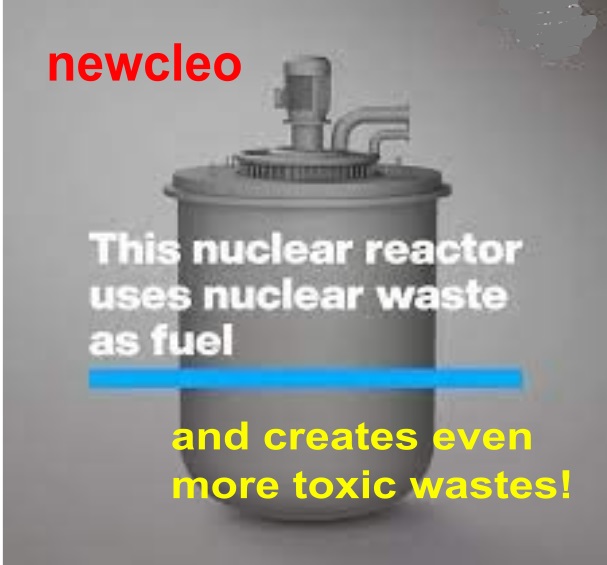
COMMENT. This is a very interesting article. For one thing, it shows that these “advanced” nuclear reactors require plutonium to get the fission process happening. It also claims that these advanced nuclear reactors can solve the problem of plutonium wastes. That is not true. The wastes resulting from this process are smaller in volume, but more highly toxic. That means that they require the same area/voume of space for disposal as the original plutonium. On another angle, it does indicate the confusion that the British government is in about the way ahead in their highly suspect “Civil Nuclear Roadmap”. And on another angle again, it shows how Macron’s France is putting all its eggs into the one nuclear basket. When we look at the extreme costs, and the extreme climate effects, Macron’s French nuclear obsession is likely to result in political suicide.
Matt Oliver, Sun, 21 January 2024, https://finance.yahoo.com/news/nuclear-start-drops-plans-british-131702123.html#:~:text=A%20British%20nuclear%20startup%20has,lobbied%20personally%20by%20Emmanuel%20Macron.
A British nuclear startup has dropped plans to build a pioneering power plant in Cumbria and will invest £4bn in France instead, after it was lobbied personally by Emmanuel Macron.
Newcleo, which is headquartered in London, is developing a type of mini nuclear power plant, known as an advanced modular reactor (AMR), that will use nuclear waste for fuel.
The company had hoped to tap into the UK’s vast stockpile of waste at Sellafield, where it wanted to invest £2bn in a waste reprocessing factory and AMR that would have created around 500 jobs.
It was also planning a similarly-sized facility in France.
But Stefano Buono, Newcleo’s chief executive and founder, said the company has now dropped the UK plans after the Government ruled out giving private companies access to the Sellafield stockpile in a nuclear industry “roadmap” published this month.
Instead, Newcleo is planning an enlarged development at an undisclosed location in the south of France, where it now plans to spend £4bn and create around 1,000 jobs, he said.
As part of that scheme, it will buy nuclear waste from French state energy giant EDF.
The company is also currently in the middle of a €1bn (£860m) fundraising.
The decision comes after the company was blocked from participating in the UK’s design competition for mini nuclear reactors.
By comparison, France has eagerly supported Newcleo and Mr Buono was lobbied repeatedly for investment by President Macron in face-to-face meetings.
Newcleo, which was also invited to last year’s “Choose France” business summit at the Palace of Versailles, has never been offered an in-person meeting with a British prime minister.
Mr Buono told The Telegraph: “Our plan initially was to use one factory in France and one in the UK.
“Now, we will double the capacity of France and we are not investing in the UK.”
He added that the company had hoped to pioneer its technology in Britain but added: “In two years, we were not able to even locate the site, so we have decided to accept the offer from France.
“We can proceed with our business model there.”
Newcleo’s decision to build its first plant abroad comes amid growing frustration within the British nuclear industry over the slow progress the Government has made towards identifying sites for new power plants.
The loss of significant investment to France will also be seen as the latest sign that Downing Street’s efforts to attract business investment are being outshone by President Macron, who has launched a charm offensive to lure companies across the Channel since Brexit.
He was the only G7 leader to attend the World Economic Forum in Davos, Switzerland, this week, while he has rolled out the red carpet for business leaders including Tesla boss Elon Musk and JP Morgan banker Jamie Dimon at his annual Choose France event.
Last year’s summit resulted in major deals, with Taiwanese car battery maker ProLogium unveiling plans for a €5.2bn plant at the port of Dunkirk and Verkor, a French company, pledging a €1.6bn battery factory there too.
In the UK, six SMR developers including Rolls-Royce have been shortlisted for support under a competition run by Great British Nuclear.
Newcleo was not considered because of the AMR’s lead cooling system and unusual fuel, Mr Buono has claimed.
The company’s novel design would run on processed plutonium, helping countries such as the UK dispose of the dangerous waste, which is expensive to manage. [Ed. This ignores the fact that this process results in a smaller volume of more highly toxic waste]
At Sellafield, the UK has amassed 140 tonnes of plutonium – the world’s biggest stockpile – as a result of historic nuclear weapons programmes and abandoned efforts to develop so-called fast breeding reactors that would have used it as fuel.
A massive effort is currently under way at the Cumbrian site to safely store the waste, but Mr Buono and his colleagues have argued it could be put to better use as reactor fuel.
The entrepreneur made his fortune selling cancer treatment developer AAA to Novartis for $3.9bn (£3.2bn) in 2017, reportedly earning him $420m.
His company has the backing of the Agnelli industrialist family, which made its money from Fiat and Ferrari.
The French government is expected to confirm a deal with Newcleo later this year.
The UK Government did not respond to requests for comment.
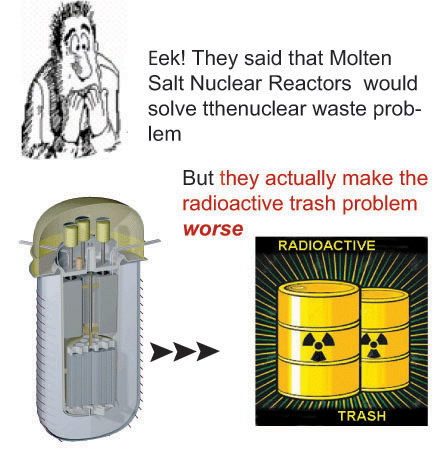
Nuclear power: molten salt reactors and sodium-cooled fast reactors make the radioactive waste problem WORSE

 reactors https://www.tandfonline.com/doi/full/10.1080/00963402.2018.1507791, Lindsay Krall &Allison Macfarlane, 31 Aug 18
ABSTRACT
Nuclear energy-producing nations are almost universally experiencing delays in the commissioning of the geologic repositories needed for the long-term isolation of spent fuel and other high-level wastes from the human environment. Despite these problems, expert panels have repeatedly determined that geologic disposal is necessary, regardless of whether advanced reactors to support a “closed” nuclear fuel cycle become available. Still, advanced reactor developers are receiving substantial funding on the pretense that extraordinary waste management benefits can be reaped through adoption of these technologies.
Here, the authors describe why molten salt reactors and sodium-cooled fast reactors – due to the unusual chemical compositions of their fuels – will actually exacerbate spent fuel storage and disposal issues. Before these reactors are licensed, policymakers must determine the implications of metal- and salt-based fuels vis a vis the Nuclear Waste Policy Act and the Continued Storage Rule.
Big costs sink flagship nuclear project and they’ll sink future small modular reactor projects too.

By Susan O’Donnell and M.V. Ramana, 024, https://beyondnuclearinternational.org/2024/01/21/big-costs-sink-flagship-nuclear-project/
The major news in the world of nuclear energy last November was the collapse of the Carbon Free Power Project in the United States. The project was to build six NuScale small modular nuclear reactors (SMRs). Given NuScale’s status as the flagship SMR design not just in the U.S. but even globally, the project’s cancellation should ring alarm bells in Canada. Yet SMRs are touted as a climate action strategy although it is becoming clearer by the day that they will delay a possible transition to net-zero energy and render it more expensive.
The NuScale project failed because there were not enough customers for its expensive electricity. Construction cost estimates for the project had been steadily rising—from USD 4.2 billion for 600 megawatts in 2018 to a staggering USD 9.3 billion (CAD 12.8 billion) for 462 megawatts. Using a combination of government subsidies, potentially up to USD 4.2 billion, and an opaque calculation method, NuScale claimed that it would produce electricity at USD 89 per megawatt-hour. When standard U.S. government subsidies are included, electricity from wind and solar energy projects, including battery storage, could be as cheap as USD 12 to USD 31 per megawatt-hour.
A precursor to the failed NuScale project was mPower, which also received massive funding from the U.S. Department of Energy. Described by The New York Times as the leader in the SMR race, mPower could not find investors or customers. By 2017, the project was essentially dead. Likewise, a small reactor in South Korea proved to be “not practical or economic”.
Ignoring this dire economic reality, provincial governments planning for SMRs – Ontario, New Brunswick, Saskatchewan and Alberta – published a “strategic plan” seemingly designed to convince the federal government to open its funding floodgates. Offering no evidence about the costs of these technologies, the report asserts: “The power companies assessed that SMRs have the potential to be an economically competitive source of energy.”
For its part, the federal government has coughed up grants totalling more than $175 million to five different SMR projects in Ontario, New Brunswick, and Saskatchewan. The Canada Infrastructure Bank loaned $970 million to Ontario Power Generation to develop its Darlington New Nuclear project. And the Canada Energy Regulator’s 2023 Canada’s Energy Future report envisioned a big expansion of nuclear energy based on wishful thinking and unrealistic assumptions about SMRs.
Canada’s support is puzzling when considering other official statements about nuclear energy. In 2021, Environment Minister Steven Guilbeault said that nuclear power must compete with renewable energy in the market. The previous year, then Environment Minister and current Energy and Natural Resources Minister Jonathan Wilkinson also emphasized competition with other sources of energy, concluding “the winner will be the one that can provide electrical energy at the lowest cost.” Given the evidence about high costs, nuclear power cannot compete with renewable energy, let alone provide electricity at the lowest cost.
Investing huge amounts of taxpayer money in technologies that are uncompetitive is bad enough, but an equally serious problem is wasting time. The primary justification for this government largesse is dealing with climate change. But the urgency of that crisis requires action now, not in two decades.
All the SMR designs planned in Canada’s provinces are still on the drawing board. The design furthest along in the regulatory process – the BWRX-300 slated for Ontario’s Darlington site – does not yet have a licence to begin construction. New Brunswick’s choices – a sodium cooled fast reactor and a molten salt reactor – are demonstrably problematic and will take longer to build.
Recently built nuclear plants have taken, on average, 9.8 years from start of construction to producing electricity. The requisite planning, regulatory evaluations of new designs, raising the necessary finances, and finding customers who want to pay higher electricity bills might add another decade.
SMR vendors have to raise not only the billions needed to build the reactor but also the funding to complete their designs. NuScale spent around USD 1.8 billion (CAD 2.5 billion), and the reactor was still left with many unresolved safety problems. ARC-100 and Moltex proponents in New Brunswick have each asked for at least $500 million to further develop their designs. Moltex has been unable to obtain the required funding to match the $50.5 million federal grant it received in 2021.
Adverse economics killed the flagship NuScale SMR project. There is no reason to believe the costs of SMR designs proposed in Canada will be any lower. Are government officials attentive enough to hear the clanging alarm bells?
Susan O’Donnell is adjunct research professor and primary investigator of the CEDAR project at St. Thomas University in Fredericton. M.V. Ramana is the Simons Chair in Disarmament, Global and Human Security and professor at the School of Public Policy and Global Affairs, University of British Columbia.
US Offers Up To $500MM for Advanced Nuclear Fuel Production

by Jov Onsat, Rigzone Staff, Monday, January 15, 2024
The United States Department of Energy (DOE) is offering contracts worth up to $500 million in total for the production of a uranium fuel for smaller nuclear reactors, as it announced a breakthrough in an enrichment project
The request for proposals is for the enrichment of high-assay low-enriched uranium (HALEU). Currently this fuel is produced only in Russia and the US but only the former makes it at a commercial scale, according to the International Atomic Energy Agency (IAEA). The United Kingdom government earlier this month announced funding to enable domestic HALEU production.
“Currently, HALEU is not commercially available from U.S.-based suppliers, and boosting domestic supply could spur the development and deployment of advanced reactors in the United States”, the DOE noted in a press release announcing the funding offer……………………………………………………
Each contractor is assured of a minimum order value of $2 million. They must conduct enrichment and storage activities in the continental US and comply with the National Environmental Policy Act, the DOE said. Proposals are until March 8.
The $500 million offer includes a DOE request announced November for services to deconvert the uranium enriched through this funding into metal, oxide and other forms to be used as fuel for advanced reactor https://www.rigzone.com/news/us_offers_up_to_500mm_for_advanced_nuclear_fuel_production-15-jan-2024-175378-article/
Dissension in the nuclear lobby – it had to happen – Small Nuclear versus Big Nuclear.

Comment. As the UK fumbles its way through its “Civil Nuclear Roadmap” folly, the Rolls Royce lobby paints Hinkley and Sizewell projects as obsolete trash, and touts Rolls Royce’s non existent small reactors as Britain’s energy salvation .
Jeremy Warner: Outsourcing Britain’s nuclear renewal is insanity.
Rolls-Royce’s modular reactors are an obvious way to break free of EDF’s
grip.
Here we go again. Einstein’s definition of insanity is to keep doing
the same thing and expecting different outcomes. You would think that the
Government had learned its lesson on nuclear renewal after the debacle of
Hinkley Point C. Clearly not.
Having already made the same mistake once, by
pledging a replica of the ruinously costly Hinkley at Sizewell on the
Suffolk coast, ministers are doubling down and promising a third such
monstrosity somewhere else.
According to the Government’s “Nuclear
Roadmap”, published last week, another of these leviathans in an as yet
unspecified location is to be given the go-ahead later this year. On the
most recent estimates, Hinkley Point C is expected to cost at least 80pc
more than its original budget and is years behind schedule. Some fear that
it won’t be until the early 2030s before the reactors are fully
operational, such have been the technical and safety complications
encountered in the construction phase.
Ministers have also had to agree to
punishingly expensive output prices to persuade the main developer,
France’s state-controlled EDF, to build in the first place, committing
consumers to high electricity costs for decades to come. So much for the
promise once made by the ever courteous Vincent de Rivaz, the one-time boss
of EDF in Britain, that Hinkley Point would be cooking our Christmas
lunches by 2017.
Even allowing for the learning process – theoretically,
later projects to the same design should cost less, with past mistakes
taken on board – it beggars belief that the Government should attempt to
repeat such a tried and demonstrably poor value for money technology.
Given the experience of Hinkley Point C, why are we still pursuing the hugely
costly, largely obsolete technology of EDF’s gigawatt stations when there
are perfectly viable, but smaller, homegrown alternatives just waiting for
the opportunity to fill the gap? If we are to spend £28bn a year of
taxpayers’ money on going green, as promised by Labour, we should at
least be confident that a large part of the wider economic benefit is
reserved for UK supply chains, and is not instead squandered on supporting
jobs abroad in France, China, Denmark and the US.
Telegraph 13th Jan 2024
https://www.telegraph.co.uk/business/2024/01/13/uk-go-full-nuclear-ensure-solutions-british/
Killer Robots: UN Vote Should Spur Action on Treaty

technological advances are spurring the development of autonomous weapons systems that operate without meaningful human control, delegating life-and-death decisions to machines. The machine rather than the human operator would determine where, when, or against what force is applied.
January 3, 2024, https://www.hrw.org/news/2024/01/03/killer-robots-un-vote-should-spur-action-treaty
Guterres Should Seek to Tackle Autonomous Weapons Systems
(New York, January 3, 2023) – Countries that approved the first-ever United Nations General Assembly resolution on “killer robots” should promote negotiations on a new international treaty to ban and regulate these weapons, Human Rights Watch said today. Autonomous weapons systems select and apply force to targets based on sensor processing rather than human inputs.
On December 22, 2023, 152 countries voted in favor of the General Assembly resolution on the dangers of lethal autonomous weapons systems, while four voted no, and 11 abstained. General Assembly Resolution 78/241 acknowledges the “serious challenges and concerns” raised by “new technological applications in the military domain, including those related to artificial intelligence and autonomy in weapons systems.”
“The General Assembly resolution on autonomous weapons systems stresses the urgent need for the international community to deal with the dangers raised by removing human control from the use of force,” said Mary Wareham, arms advocacy director at Human Rights Watch. “The resolution’s wide support shows that governments are prepared to take action, and they should move forward on a new international treaty without delay.”
Some autonomous weapons systems have existed for years, but the types, duration of operation, geographical scope, and environment in which such systems operate have been limited. However, technological advances are spurring the development of autonomous weapons systems that operate without meaningful human control, delegating life-and-death decisions to machines. The machine rather than the human operator would determine where, when, or against what force is applied.
The resolution asks UN Secretary-General António Guterres to seek the views of countries and other stakeholders on ways to address the challenges and concerns raised by autonomous weapons systems “from humanitarian, legal, security, technological and ethical perspectives,” and reflect those views in a report to the General Assembly by September 2024.
The resolution adds an agenda item on “lethal autonomous weapons systems” to the provisional agenda of the UN General Assembly in 2024, providing a platform for states to pursue action to address this issue. The General Assembly provides an inclusive and accessible forum in which any UN member state can contribute. Tackling the killer robots challenge under its auspices would allow greater consideration of concerns that have been overlooked in discussions held to date, including ethical perspectives, international human rights law, proliferation, and impacts on global security and regional and international stability, including the risk of an arms race and lowering the threshold for conflict, Human Rights Watch said.
The countries voting against the resolution were: Belarus, India, Mali, and Russia. Those abstaining were: China, Iran, Israel, Madagascar, North Korea, Niger, Saudi Arabia, South Sudan, Syria, Türkiye, and the United Arab Emirates. Of these states, China, India, Iran, Israel, and Türkiye have been investing heavily in military applications of artificial intelligence and related technologies to develop air, land, and sea-based autonomous weapons systems.
Austria put forward the resolution with 42 co-sponsoring states at the UN General Assembly’s First Committee on Disarmament and International Security, where it passed an initial vote on November 1, by 164 votes in favor, five against, and eight abstentions.
More than 100 countries regard a new treaty on autonomous weapons systems with prohibitions and restrictions as necessary, urgent, and achievable, and during 2023, many states and international organizations have reiterated their support for this objective.
In February, more than 30 countries from Latin America and the Caribbean endorsed the Belén Communiqué, acknowledging the need “to promote the urgent negotiation of an international legally binding instrument, with prohibitions and regulations with regard to autonomy in weapons systems.” In September, 15 Caribbean states endorsed a CARICOM declaration on the human impacts of autonomous weapons at a meeting in Trinidad and Tobago.
On October 5, Secretary-General Guterres and International Committee of the Red Cross President Mirjana Spoljaric issued a joint appeal for UN member states to negotiate a new international treaty by 2026 to ban and regulate autonomous weapons systems.
Most treaty proponents have called for prohibitions on autonomous systems that by their nature operate without meaningful human control or that target people, as well as regulations that ensure all other autonomous weapons systems cannot be used without meaningful human control.
Talks on lethal autonomous weapons systems have been held at the Convention on Conventional Weapons (CCW) in Geneva since May 2014, but have failed to deliver a substantive outcome. The main reason for the lack of progress under the CCW is that its member countries rely on a consensus approach to decision-making, which means a single country can reject a proposal, even if every other country agrees to it. A handful of major military powers have exploited this to repeatedly block proposals to negotiate a legally binding instrument.
On November 17, states at the CCW agreed to meet for up to 20 days across 2024 and 2025 to “consider and formulate, by consensus, a set of elements of an instrument, without prejudging its nature.” The agreement does not mandate states to negotiate and adopt a new CCW protocol.
“Technological change is rapidly advancing a future of automated killing that needs to be stopped,” Wareham said. “To safeguard humanity, all governments should support the urgent negotiation of a new international treaty to prohibit and restrict autonomous weapons systems.”
Cancelled NuScale contract weighs heavy on new nuclear
Paul Day, 11 Jan 24, https://www.reuters.com/business/energy/cancelled-nuscale-contract-weighs-heavy-new-nuclear-2024-01-10/
- Summary
- The failure of a high profile small modular reactor (SMR) contract in the United States has prompted concerns that Gen IV nuclear may be further off than expected.
NuScale, the first new nuclear company to receive a design certificate from the Nuclear Regulatory Commission (NRC) for its 77 MW Power Module SMR, said in November it was terminating its Carbon Free Power Project (CFPP) with the Utah Associated Municipal Power Systems (UAMPS).
UAMPS serves 50 community-owned power utilities in the Western United States and the CFPP, for which the Department of Energy approved $1.35 billion over 10 years subject to appropriations, was abandoned after the project failed to attract enough subscriptions.
NuScale shares tumbled 37% to less than $2 on the day of the news, November 8, and have remained largely between $2.5 and $3.5 since then. The shares hit highs of nearly $15 in August 2022 just three months after going public.
The CFPP had aimed to build NuScale SMR units at a site near Idaho Falls to be operable by 2029 though concerns arose that some at UAMPS members may be unwilling to pay for power from the project after NuScale raised the target price to $89/MWh in January, up from a previous estimate of $58/MWh.
The cancellation came shortly after another advanced reactor developer, X-Energy and special purpose acquisition company Ares Acquisition Corporation, called off a $1.8-billion deal to go public citing “challenging market conditions (and) peer company trading performance.”
The work with UAMPS had helped advance NuScale’s technology to the stage of commercial deployment, President and CEO John Hopkins said.
However, the failure of the much-anticipated proof case for advanced nuclear alongside the X-Energy market retreat left many questioning whether next generation nuclear could live up to its promises.
“Almost all these kinds of MoUs and contracts, as we saw with the NuScale contract, are just not worth the paper they’re written on. There are so many off ramps and outs for both sides and no one’s willing to expose themselves to the downside risk of projects that go way over budget cost and take too long,” says Ted Nordhaus, Founder and Executive Director of The Breakthrough Institute.
Nordhaus co-wrote a piece for The Breakthrough Institute, ‘Advanced Nuclear Energy is in Trouble’, a scathing criticism of policy efforts to commercialize advanced nuclear which, it says, to date have been entirely insufficient.
The nuclear industry was keen to ‘whistle past the graveyard’ of recent developments and efforts to commercialize the new generation of reactors ‘are simply not on track’, the Breakthrough piece said.
Mounting challenges
There are five areas that pose mounting challenges for the industry, according to Breakthrough; high interest rates and commodity prices, constrained supply chains, a regulatory regime that penalizes innovation, project costs versus system costs, and fuel production.
High interest rate and commodity costs in the last couple of years have hit the industry especially hard due to long project lead times. Nuclear supply chains are struggling to rebuild as tight regulation forces many materials to be tracked from certified mine to certified manufacturer.
The regulatory regime, meanwhile, continues to cut and paste large nuclear reactor regulations on to the small reactor designs, whether it makes sense to do so or not, Nordhaus wrote.
Delivery costs for small nuclear are relatively low due to the relatively small volumes of steel and mortar needed, but system costs must factor in safety regulation which is stricter than other types of energy projects. Proponents argue this makes it harder to compete with fossil fuels and renewables, which pay little to no cost for polluting or intermittency, the Institute says.
Advanced nuclear fuel production, meanwhile, had been outsourced to Russia for decades and is only now being hastily reassembled in the United States for the new reactors, with developers such as Terrapower forced to push delay their commercialization timelines due to a lack of fuel.
“Taken together, these developments suggest that current efforts are unlikely to be sufficient to deliver on the promise of advanced nuclear energy,” The Breakthrough Institute said.
Investor case
e
Over recent years, nuclear power has been recognized as an environmental, social, and governance (ESG) investible asset, taking its place alongside renewables in the European taxonomy and successfully raising cash through green bonds in Canada.
Such classifications allow nuclear companies to attract funds from investors looking to build increasingly popular clean energy portfolios.
Nuclear will also benefit from government schemes such as the U.S. Inflation Reduction Act (IRA), which is expected to subsidize new nuclear through Production Tax Credits (PTC) and Investment Tax Credits (ITC) on first-of-a-kind (FOAK) and nth-of-a-kind (NOAK) builds.
With billions of dollars earmarked for clean technologies and mounting concerns over missing emission targets, certain aspects of the nuclear industry have attracted new investors; Uranium spot prices have nearly doubled in the last year as bets are made on rising demand.
However, with all this tailwind, new nuclear has not been attracting the cash it needs. That’s partly due to developers’ lack of focus on development activities, according to Fiona Reilly, CEO of energy consultancy FiRe Energy.
“They’re so focused on the technology that they’re often not focusing on the commercial aspect. How to be more efficient, how to be more effective. What’s your risk register look like; corporate risks as well as technical risks? What’s your legal structure? Where is the money coming from?” says Reilly.
“They seem to think that if they have this great technology, then the market will finance the projects. How the project will reach financial close and make a return for investors does not always appear to be a key feature.”
The NuScale failure with UAMPS and X-Energy’s cancelled offering are just further bad signs for the market, and came just as the international nuclear community said they need to triple capacity by 2050 at the COP28 summit in Dubai.
“We’ve got to start building a mix of large and small reactors for different applications and, once we can start proving projects can be built in a commercial and efficient way, then you can start talking about targets,” says Reilly.
“You can’t set targets like these when we’re not even building the first reactors in many countries.”
1 This Month

29 Jan. Thursday 7-8 p.m. Webinar – World’s Largest Nuclear Station in Port Hope, ON?


31st January – Challenging the War Machine – a DECLASSIFIED UK SUMMIT



Website of the Week
Now until to February 10, 2026 Radioactive waste storage in France: the debate is finally open! How to participate?
-
Archives
- January 2026 (246)
- December 2025 (358)
- November 2025 (359)
- October 2025 (376)
- September 2025 (258)
- August 2025 (319)
- July 2025 (230)
- June 2025 (348)
- May 2025 (261)
- April 2025 (305)
- March 2025 (319)
- February 2025 (234)
-
Categories
- 1
- 1 NUCLEAR ISSUES
- business and costs
- climate change
- culture and arts
- ENERGY
- environment
- health
- history
- indigenous issues
- Legal
- marketing of nuclear
- media
- opposition to nuclear
- PERSONAL STORIES
- politics
- politics international
- Religion and ethics
- safety
- secrets,lies and civil liberties
- spinbuster
- technology
- Uranium
- wastes
- weapons and war
- Women
- 2 WORLD
- ACTION
- AFRICA
- Atrocities
- AUSTRALIA
- Christina's notes
- Christina's themes
- culture and arts
- Events
- Fuk 2022
- Fuk 2023
- Fukushima 2017
- Fukushima 2018
- fukushima 2019
- Fukushima 2020
- Fukushima 2021
- general
- global warming
- Humour (God we need it)
- Nuclear
- RARE EARTHS
- Reference
- resources – print
- Resources -audiovicual
- Weekly Newsletter
- World
- World Nuclear
- YouTube
-
RSS
Entries RSS
Comments RSS
 nuclear-news