Satellites burning up in our atmosphere may not be as harmless as first thought

Business Insider, Marianne Guenot , Mar 2, 2024
- Spacecraft burning up in the atmosphere are leaving behind metal particles.
- Scientists are racing to understand if that affects the climate.
- One risk is that these particles may spark rainbow-colored clouds that damage the ozone layer.
Satellites and spacecraft burning up in our atmosphere are leaving metal particles in the stratosphere — and scientists are worried it could harm our planet.
About 10% of the particles floating around the stratosphere now come from the aerospace industry, and we don’t know if this could impact the climate.
One risk is that these new particles could seed polar stratospheric clouds, which are spectacular rainbow-colored clouds that can damage the ozone layer, experts told Business Insider.
“This is a good demonstration of how important it is to have the basic research on the stratosphere,” Daniel Murphy, a research scientist at the National Oceanic and Atmospheric Administration Chemical Science Lab, who led a survey of the particles, told BI.
“There is a whole phenomenon here that we didn’t expect out and we don’t fully understand the implications,” he said.
Stratospheric particles can shape the ozone layer
…..This crucial layer of the atmosphere, mostly contained in the stratosphere, protects us from ultraviolet radiation from the sun. It was frequently splashed across the headlines about 40 years ago when scientists raised the alarm about gaping holes growing over the poles made by chlorofluorocarbons (CFCs) rising up uncontrolled to the atmosphere…………………………………………………
Metal from satellites and spacecraft is vaporizing into the atmosphere
Murphy and his colleagues recently conducted a survey of the state of stratospheric particles over Alaska using a sensitive detector aboard NASA’s WB-57 high-altitude research plane.
The findings, published in the peer-reviewed journal PNAS in October 2023, revealed that about 10% of the stratospheric sulfuric acid particles they picked up could not be explained by natural causes………………………………………………………………………………………………………………………….
We’re realizing how little we know

With launch costs going down, the number of satellites orbiting the planet is only expected to grow to over 50,000 by 2030, up from about 8,000 now. Many of these satellites are expected to have a short lifetime.
“If you multiply those numbers out, a satellite will be reentering the atmosphere on average about once an hour,” said Murphy.
Within the next few decades, Murphy and his co-authors estimate aerospace debris could make up 50% of the particles in the stratosphere, which makes the need to understand what they do even more pressing.
Spacecraft decommissioning is only part of the equation, said Chipperfield.
“There’s an increasing number of rocket launches for small satellites and tourism, which burn kerosene or other fuels that emissions in the atmosphere. Then some satellites and orbit have fuel like iodine that can come back to the atmosphere. And then the demise,” he said………………………………………………………………………………. more https://www.businessinsider.com/satellites-burn-atmosphere-particles-stratosphere-climate-ozone-2024-2
—
Finland’s Olkiluoto nuclear power station to be disconnected for 37 days
The Olkiluoto-3 nuclear power plant in Finland – the first of its type
in Europe – will be disconnected from electricity production on 2 March
for its first annual outage, owner and operator Teollisuuden Voima Oyj
said. Regular electricity production began at the 1,600 MW EPR unit one
year ago with full commercial operation on 1 May.
TVO said the planned
outage is expected to last 37 days. The lengthy duration is due to the
technical characteristics of the plant type and the large number of
periodic tests and maintenance activities to be carried out during the
outage, TVO said. “As OL3 is the largest nuclear power plant unit in
Europe, there is a considerable number of components and equipment that
need to be serviced.” The plan for the Olkiluoto-3 outage includes some
1,900 different activities with almost 6,500 work phases.
Nucnet 1st March 2024
So They’re Experimenting With Military Robots In Gaza Now

CAITLIN JOHNSTONE, MAR 4, 2024, https://www.caitlinjohnst.one/p/so-theyre-experimenting-with-military?utm_source=post-email-title&publication_id=82124&post_id=142282788&utm_campaign=email-post-title&isFreemail=true&r=1ise1&triedRedirect=true&utm_medium=email
One of the most horrifying facts about this dystopia we live in is that large-scale military operations are routinely used as testing grounds for new war machinery, using human bodies as guinea pigs for experimentation in what amount to giant blood-soaked field laboratories — all to benefit the strategic objectives of empire managers and the profit margins of the military-industrial complex.
Haaretz has a new article out titled “Gaza Becomes Israel’s Testing Ground for Military Robots”, which reports that “In an effort to avoid harming soldiers and dogs, the IDF has been experimenting with the use of robots and remote-controlled dogs in the Gaza War.”
(Yeah because my gosh, can you imagine how terrible it would be if Israeli soldiers and dogs got harmed while carrying out a genocide?)
The article’s author Sagi Cohen reports that drone-mounted robot dogs and remotely controlled bulldozers are two of the new apocalyptic horrors currently being battle-tested in Gaza, saying “defense establishment officials confirm that there has been a leap in the use and sophistication of robots on the battlefield.” Which is a pretty disconcerting sentence to read.
This news comes out at the same time as a new Public Citizen report warning of the likely imminent arrival of autonomous weapons systems which will kill people with minimal instruction from human pilots, saying “The most serious worry involving autonomous weapons is that they inherently dehumanize the people targeted and make it easier to tolerate widespread killing, including in violation of international human rights law.”
The more normalized robots become within the world’s militaries the closer we come to this point, and steps are already being taken in that direction. As Common Dreams’ Thor Benson notes in an article about the Public Citizen report, “Israel has purchased and at times deployed self-piloting, lethal drones.”
Back in January I wrote that “Gaza is a live laboratory for the military industrial complex,” saying “Data is with absolute certainty being collected on all the newer weapons being field-tested on human bodies in Gaza (just like has been happening in Ukraine) to be used to benefit the war machine and arms industry.”
What sparked this comment at the time was reports and first-hand witness accounts we’d seen coming out about the prolific use of IDF “sniper drones” in Gaza since October, with Israeli forces frequently shooting Palestinians with quad drones armed with rifles. Copious records are most assuredly being compiled on the effectiveness of these newer weapons and tactics in ending human lives, which will then be used to help market those weapons to other states and to improve their efficiency in killing.
When I say this is most assuredly happening, I am not being hyperbolic for effect. Author and journalist Antony Loewenstein gave a lengthy interview on The Chris Hedges Report back in December about Israel’s long and extensively documented history of using Gaza as a testing ground for new weapons, spyware, surveillance and security systems, AI, drones, and tactics, which has profited scores of corporations and enabled Israel to become a player of outsized success in the global weapons industry.
“Israel’s drones, surveillance technology including spyware, facial recognition software, and biometric gathering infrastructure, along with smart fences, experimental bombs, and AI-controlled machine guns are all tried out on the captive population in Gaza, often with lethal results,” says Hedges in introduction. “These weapons and technologies are then certified as ‘battle-tested’ and sold around the world.”
This doesn’t only happen in Gaza. This past September The Wall Street Journal published an article titled “The War in Ukraine Is Also a Giant Arms Fair,” subtitled “Arms makers are getting orders for weapons being put to the test on the battlefield.” In January of last year CNN published a report titled “How Ukraine became a testbed for Western weapons and battlefield innovation,” with one source saying that Ukraine is “absolutely a weapons lab in every sense because none of this equipment has ever actually been used in a war between two industrially developed nations.”
And of course we are also seeing this same phenomenon in Africa. In 2021 Mintpress News published a report by Scott Timcke titled “West Africa is the Latest Testing Ground for US Military Artificial Intelligence” about this very same trend. In 2020 Libya saw what is believed to have been the first time a human being has ever been killed by a fully automated drone attack — that is, killed without the machine having been told to do so by a human.
The other day we discussed how the empire’s great weakness is that it depends on normal human beings to carry out its orders and turn the gears of the machine. If you look at the facts and think about them for a moment, it’s not hard to see how the empire managers are hoping to overcome this weakness in the future.
Get These Rich People Off the Moon.

Other than allowing billionaires and private companies to benefit from taxpayer-funded pipe dreams and advertising, the value of going to the moon for all mankind is not at all clear.
The US military has also expressed an interest in renting Starships for their Space Force cargo and troops — delivering war to poor countries anywhere in the world within one hour.
Despite the mess it makes on Earth, NewSpace investments are growing in popularity among everyman-for-himself superrich techies
BY PETER HOWSON,on behalf of Koohan Paik-Mander
Texas start-up Intuitive Machines has achieved the first moon landing by a private firm. It’s dumping rich people’s detritus on the lunar surface — a grim sign of how the superrich plan to plant their flag beyond our own planet.
Amid tears of joy at their Houston control room, the Texas start-up Intuitive Machines successfully landed on the moon. Their uncrewed lander, known as Odysseus, hitched a ride on a SpaceX rocket last week, touching down near the moon’s south pole on Thursday. After many failed attempts by various private outfits, Intuitive Machines is the first private company to plant a free-market flag on the moon
In January, a different US private venture crashed back to Earth. Astrobotic’s Peregrine lander had been supposed to dispose of at least seventy dead rich people (and one rich dog) on the lunar surface.
Spending billions of dollars dumping odd things in space has become a tradition among the lunar classes. Elon Musk famously sent a Tesla Roadster as the dummy payload for the 2018 Falcon Heavy test flight. Driven by a mannequin in a spacesuit dubbed “Starman,” the car is now an enduring satellite of the sun. You can track him, if you like.
The Japanese isotonic drinks company Pocari Sweat has been trying to leave a can of pop on the moon since 2014. It finally crashed with Astrobotic’s failed $100 million lander. The Japanese still plan to send a hydrogen-powered Toyota “Lunar Cruiser” up there, despite a few explosive setbacks.
Toxic Effects
Other than allowing billionaires and private companies to benefit from taxpayer-funded pipe dreams and advertising, the value of going to the moon for all mankind is not at all clear. British astronaut Tim Peake suggests the microgravity up there might one day enable exotic treatments for all sorts of diseases, albeit expensive treatments for those who can afford them. Aside from body parts, fizzy pop, and “art,” the squillion-dollar landers are packed full of instruments designed for exploring the unknown, before anyone else gets their mitts on it.
So called “NewSpace” companies are on the prowl for profitable rare earth metals, helium-3, and water. Just like the spice of Arrakis, helium-3 is being pitched as “the most precious resource in the universe.” At least it might be if someone invents a use for it. Getting large quantities of water to space is pricey. A stable reservoir will keep plebs alive while they mine for spice. And both hydrogen and oxygen can make the rocket fuel needed to search for shiny things further afield.
It all sounds very exciting. But realizing these fantasies has costs for the rest of us. According to Atrium, a big insurer for rocket-makers, early space-faring outfits should typically expect 30 percent of their launches to end in catastrophic failure. When two separate SpaceX Starship launches in Texas went south last year, toxic particulates rained down on people’s homes. Debris broke windows and caused fires that burned across Boca Chica Park, home to endangered birds and ocelot cats.
“We never gave our consent,” said one indigenous Carrizo-Comecrudo representative at a SpaceX protest in South Texas. “Yet they [SpaceX] are moving forward. It’s colonial genocide of native people and native lands.” Bekah Hinojosa of the Texas environmental group Another Gulf Is Possible claims environmental deregulation, tax breaks, and subsidies have been used by the Texas state government to lure SpaceX in. Meanwhile local indigenous communities who rely on Boca Chica’s fish to feed their families feel their customary land is being sacrificed.
For the Navajo people, the costly blunders are no bad thing. The Navajo hold the moon to be sacred, and consider fly-tipping and mining there an act of profound desecration. According to the Navajo Nation’s president Dr Buu Nygren, “The sacredness of the Moon is deeply embedded in the spirituality and heritage of many Indigenous cultures, including our own.”
Wars on Our Home Planet
Yet, despite the mess they’re making, SpaceX plans on going bigger and bigger.
SpaceX will soon be moving its monster Starship boosters from Boca Chica to the much larger Kennedy Space Center in Florida. Like the Falcon 9, SpaceX’s Starship is designed as a workhorse for frequent, repeated flights. Instead of only a couple of launches per year, Kennedy will start to resemble an airport. The same powerful and destructive super heavy-lift rockets that devastated Boca Chica will be lifting off on a near daily basis from the Florida coast.
The US military has also expressed an interest in renting Starships for their Space Force cargo and troops — delivering war to poor countries anywhere in the world within one hour.
NewSpace is scaling up US geopolitical influence behind a facade of free-market competition. In Indonesia, SpaceX has edged out Beijing to become the country’s satellite launch partner of choice. The partnership was achieved through the personal relationship Musk nurtured with outgoing Indonesian president Joko Widodo. The deal marks a rare instance of a US company making inroads in Indonesia, whose telecommunications sector is dominated by Chinese outfits offering low costs and easy financing. Some see the SpaceX deal as just a sweetener for Musk to build a new Tesla factory somewhere in Indonesia. The electric vehicle-maker has so far signed contracts worth billions for Indonesia’s nickel and other essential materials for the company’s car batteries.
As well as ripping up Indonesia’s pristine forests for luxury car bits, plans to furnish Musk with a new spaceport on the island of Biak, Papua, is fermenting anger among indigenous Warbon peoples. Clearances for the spaceport are reigniting ethnic tensions and military violence. Somewhere between 40 and 150 Papuans protesting the spaceport have been killed by the Indonesian military since the plans were originally unveiled.
Real People Are Gross
Despite the mess it makes on Earth, NewSpace investments are growing in popularity among everyman-for-himself superrich techies.
For them, dealing with today’s real social and environmental problems tends to involve paying icky taxes and/or remunerating their workers fairly. Meanwhile, finding solutions for potential future problems is far more profitable. For billionaires, “longtermism” packages up this predicament beautifully.
Factoring future populations into decision-making models is just a nice, sustainable thing to do. Longtermism on the other hand, is too much of a good thing. It’s an extreme utilitarian, accelerationist ideology asking us to drastically increase rates of economic growth and technological advancement to ensure humanities’ long-term survivability as a multiplanetary species.
Meanwhile, taxes and government interventions are framed as an impediment to growth and innovation. For these longtermists, someone potentially not being born on Mars in the far distant future is in many ways far worse than someone actually dying of a preventable disease or poverty today. Mars guy is super smart and loaded. Unlike the stinky real person, Mars guy is likely to live a long happy life free of dysentery. He’s white because rich people tend to be that way.
If this all sounds a bit fascist, that’s because it is. According to Oxford philosopher Nick Bostrom, widely considered the founding father of longtermism, “blacks are more stupid than whites,” as he once said on an extropian community message board. “I like that sentence and think it is true.” Bostrom then used an offensive slur beginning with “N.” “It seems that there is a negative correlation in some places between intellectual achievement and fertility,” he argued. “If such selection were to operate over a long period of time, we might evolve into a less brainy but more fertile species.” He later apologized for coming across as “racist.”
Thanks in part to Musk, the cost of space travel has dropped considerably. A seat on a Falcon 9 rocket and an eight-day stay on the International Space Station (ISS) now only costs $82 million. Musk predicts his one-way tickets to Mars will cost somewhere between $500,000 to $1 million, a price at which he thinks “it’s highly likely that there will be a self-sustaining Martian colony.” For the poors, Musk has an indentured labor package where workers take out a loan to pay for their tickets, paying them off later by mining for spice or something.
Life on Earth will end one day (we have somewhere between one and five billion years). But the universe will also end. What then? We could just keep on running through the vacuum of a dying universe. Or, instead of living as slaves obsessing over spice and birth quotas for some odious space baron, we could take a leaf from the Navajo’s book, taking the moon for sacred, and mountains, lakes, and rivers, too. If we treat our planet right, we might just live longer and better.
I’ll admit: I wrote two versions of this article, depending on the fate of the Intuitive Machines lander. In 1969, President Richard Nixon did something similar, just in case everyone died onboard Apollo 11. But when it comes to NewSpace, there’s no need for tears or alternative endings.
Private space missions will only ever serve the billionaires, not us.If we make no effort to change direction, we will end up where we are heading.”
UK spurns European invitation to join ITER nuclear fusion project
Since Brexit, the UK no longer has access to ITER, the world’s largest nuclear fusion experiment, through the European Union. After an invitation to rejoin this week, the UK government has confirmed it prefers to go it alone
New Scientist, By Matthew Sparkes, 1 March 2024
The UK government has declined an invitation to become an official member of the ITER nuclear fusion experiment, having lost access to the project following Brexit. Instead, it plans to focus on UK-based fusion efforts, both public and private.
ITER, the world’s largest fusion experiment, is under construction in France and is expected to be completed in 2025 after many delays. The project is being funded by a huge international collaboration including China, India, Japan, Russia, South Korea, the US and the European Union……………………………………………………………………. more https://www.newscientist.com/article/2419671-uk-spurns-european-invitation-to-join-iter-nuclear-fusion-project/
Nuclear space-based ASAT weapons – A brief international legal perspective

Charlie JP Bennett, 27 Feb 24, https://www.ejiltalk.org/nuclear-space-based-asat-weapons-a-brief-international-legal-perspective/
On 14th February 2024, US and UK media reported the emergence of serious national security concerns by senior American officials and lawmakers that the Russian state was pursuing the deployment of a nuclear-based weapon designed to eliminate (enemy) satellites. It was added that such a weapon had not yet been deployed, but had reached some stage of development.
The exact severity of the development remains hotly contested (also here) and presently unknown, but was described as a ‘destabilising foreign military capability’ to the US and its allies. There is speculation that it may be a political ploy to further pressure the US house to authorise further aid to Ukraine in its conflict against Russia. There has also been speculation regarding a critically-important ambiguity in the information released – is it a nuclear weapon, or merely a nuclear-powered weapon? The latter is far less destructive.
Yet, the White House NSC strategic communications coordinator, John Kerby, stated on February 15th, without any hesitation whatsoever, that the weapon, if deployed, would be ‘space based, and a violation of the Outer Space Treaty’. Assuming this is true, and though not definitive evidence, the fact that no other weapons are prohibited by the Outer Space Treaty except for nuclear weapons/WMDs (see below) means that we have to consider the nuclear weapon scenario. The scenario for a weapon to be so definitively contrary to the treaty, and not nuclear, is small. Even if true in part, it would mark a frightening turning point in the decades-long consensus regarding nuclear-based weapons in space; and yet another compounding issue for an international legal order stretched to its limits.
How such weapons may work
It seems highly likely that the intent of such a space-based nuclear explosion would be to knock out satellites through the emission of a powerful Electromagnetic Pulse (EMP) as a consequence of the explosion: rendering all electronics caught in the (potentially enormous) area – and thus also any satellites – damaged or outright inoperable. These effects can linger for years, forming an artificial radiation belt around earth.
One of the last nuclear tests in outer space, the American ‘starfish prime’, produced an EMP so (unexpectedly) powerful that it damaged all electronics within a ~900 mile / ~1450 kilometre radius – including on the ground in Hawaii. That explosion had a large yield of approximately 1.4 megatons. Its resulting electromagnetic effects carried by the planet’s magnetic field, flattening them into a radioactive belt, almost immediately rendered three satellites in Low Earth Orbit (LEO) inoperable, and ultimately destroyed eight in the months that followed due to lingering radiation in orbit. Not many in absolute terms – but roughly a third of those deployed in 1962; at time of writing, there are approximately 8,300. This was not even a weapon designed to produce as large an EMP as possible, or to target specific orbits – both things a new weapon might do. There is little doubt that deployment of such an EMP through a nuclear medium would be a highly destructive weapon.
Some observers have pointed out that use of such a weapon would damage Russia’s (or any nuclear-ASAT deploying nation’s) own interests; its own space-based infrastructure – with the implication being that they would thus never actually use it. Given the events of the past several years, however, can we really rely on the assumption that a state will not – even severely – damage itself to prevent another state from achieving/acquiring/joining something? No. Absolutely not.
Tearing up the nuclear-space consensus
It is pertinent to distinguish between the use/deployment of a nuclear weapon in space, and the mere placing of such a weapon into outer space. Both are prohibited through different instruments.
Use of such a weapon in space is, flatly, prohibited. The most obvious legal violation would be against the “1963 Treaty Banning Nuclear Weapon Tests in the Atmosphere, in Outer Space and Under Water” (otherwise known as the ‘Partial test-ban treaty’), to which Russia is (and for now remains) a founding party. It is a short treaty with one operable article, created immediately after the Cuban Missile Crisis of 1962. It simply states the following:
Article 1
1. Each of the Parties to this Treaty undertakes to prohibit, to prevent, and not to carry out any nuclear weapon test explosion, or any other nuclear explosion, at any place under its jurisdiction or control:
a. in the atmosphere; beyond its limits, including outer space […]
The provision includes no further qualification. For now Russia remains a party to this treaty, though has pulled out of similar cold-war era treaties in recent years given the restrictions they place on military operations.
Further, the mere placement of such a weapon into space is clearly prohibited by international space law. The Outer Space Treaty is sometimes known as the ‘Space Constitution’, and is the most fundamental treaty governing outer space activities. All major space powers, including the US, Russia, China, Japan, and leading European states, are party to it. It plainly states:
Article IV
States Parties to the Treaty undertake not to place in orbit around the earth any objects carrying nuclear weapons or any other kinds of weapons of mass destruction, install such weapons on celestial bodies, or station such weapons in outer space in any other manner.
[…]
These provisions are rather simple as international legal provisions go. They reflect an agreement between the Soviet Union and the US established after repeated nuclear crises in the 1960s that the use of nuclear weapons must be limited as far as possible – including in outer space.
Desecration of the space environment
In addition to the above, there is also (as is so common when talking about space-based issues) the issue of the debris it will cause. Dead, inoperable satellites-turned-debris cannot manoeuvre to avoid orbital collisions with debris. They will remain in orbit, as debris, for potentially indefinitely depending on their altitude. While there is no binding international law or custom (yet) that prohibits the production of space debris, it could certainly be argued that the desecration of the space environment in this manner violates the Outer Space Treaty, Article IX of which prohibits the ‘contamination’ of the space environment and its celestial bodies.
We also know from the long-lasting consequences of Starfish Prime that, depending on the size and calibration of the weapon, entire regions of Low Earth Orbit could be rendered (near-)uninhabitable zones for satellites – or indeed any electronic systems – for potentially several years. This is strikingly similar, in terms of severity and also duration, with a Kessler Syndrome/Cascade; the worst case scenario following the continuous build-up of conventional space debris multiple decades from now. Entire regions of LEO could be rendered inoperable for satellites post-deployment of such a weapon, without considering the more immediate damage it would cause.
The Legality of the Threat or Use of Nuclear Weapons Advisory Opinion, though inconclusive in its final determination of the legality of a nuclear weapon’s use, does make clear that the long-term, and widespread nature of nuclear effects may well be in violation of international humanitarian law. The Court did not apply its reasoning to the realm of space specifically. However, it is worth noting that the effects of rendering regions of space uninhabitable is notably far more widespread than the effects of a typical nuclear weapon detonated on the ground (actually a little above) – whereas the latter may affect an area of hundreds of square kilometres, the former may affect an area of hundreds of thousands of cubic kilometres. Whether this changes the proportionality equation (preserved by the Court in relation to an extreme circumstance of self-defence) is perhaps worth further thought.
Further consequences
There has not been a known nuclear deployment in space since the 60s. Since then, the Partial Nuclear Test Ban and Outer Space Treaties have held firm, albeit with a couple of allegations of relatively minor primarily procedural breaches by various parties, from which no consequence followed. The mere deployment of such weapons may therefore tear up over 55 years of legal and geopolitical consensus, and throw astropolitics into a new era of threat – one where, as is increasingly common in many areas, international rules give way to military and strategic interests.
It is far from clear whether or not the US or its allies have capabilities to stop such a weapon from being deployed should it reach space. In theory, conventional ASAT weapons (also heavily restricted) might be able to take them out before deployment, but this would of course amount to direct military engagement at a time where military intervention could have explosive consequences. Thus, once there, such a weapon would hang in orbit like a Sword of Damocles ready to swing – potentially crippling parts of civil (or even military) infrastructure at least for a time if used – and causing significant military, economic and societal damage. Given that a nation could send a nuclear weapon into space atop a ballistic missile if it wanted to, the insecurity and fear of having a nuclear weapon orbiting above a country at any point might even be its primary destructive power. They could also be extremely difficult to detect/verify as there – unlike a ballistic launch.
Concluding remarks
If Russia, or any nation, were to do this, there is no doubt that the placement, or detonation, of nuclear-based weapons in outer space would amount to a flagrant violation of several enduring international treaties. A great deal remains unknown, and seemingly contradictory. It is nonetheless important (also for international lawyers) to prepare for all scenarios – including purportedly stupid, self-harming ones. Russia has already harmed its (and all of our) space environment via conventional ASAT testing.
This further raises the question about whether Russia may withdraw from further nuclear-restricting treaties to do this, as has been hypothesised. It already has with several. The departure of one of the most prominent space-faring nations from the Outer Space Treaty would be legally monumental at a critical juncture in the development of international space law. It would further reflect yet more dismantling of the most basic rules of the ‘rules-based international order’.
Finally, this threat – the ambiguity of its imminence and its true existence aside – highlights the importance of the defence of space-based infrastructure upon which so much of the modern world – and modern military – relies. The vulnerability of these systems is now plain for all to see, and may perhaps induce concrete action to mitigate their risks. The threat of an outer-space arms race remains firmly on the table as a result of these developments, to the detriment of global safety, and especially to outer-space activities.
The Cost of Nuclear War in Space

Putting a weapon into orbit is not just a military threat. It’s also a risk to the billions of dollars pouring into the space economy.
https://www.nytimes.com/2024/02/24/business/dealbook/the-cost-of-nuclear-war-in-space.html By Ephrat Livni and Vivienne Walt
Just before the Russian-Ukrainian war reached its two-year milestone today, U.S. intelligence agencies warned that Russia might aim a nuclear weapon at an unusual target: not any place on Earth, but satellites orbiting in space.
Putting a weapon into orbit is not just a military threat. It’s also a risk to the space economy — and the one on the ground. There is a little-known but fast-growing industry that insures satellites, but it doesn’t provide insurance against nuclear arms.
What’s at stake: hundreds of billions (and probably trillions) of dollars when including the services that rely on satellites, according to David Wade, an underwriter at the Atrium Space Insurance Consortium, which insures satellites for Lloyd’s.
Of more than 8,000 satellites in orbit, thousands belong to private companies, according to Orbiting Now, a site that compiles real-time satellite tracking data from NASA and other sources. The Russian weapon is said to be designed to target satellites in low Earth orbit, where most commercial satellites operate.
SpaceX’s Starlink dominates the space-based internet services industry, and Amazon also has big aspirations in space. But the sharp drop in launch costs in recent years — driven largely by SpaceX — has made entry possible for many smaller players, leading to a satellite-business frenzy that prompted the Federal Communications Commission to open a Space Bureau last year.
Wade estimated the total value of all insured satellites in orbit at $25 billion. That doesn’t include the revenue they generate. The Satellite Industry Association estimated revenues for nongovernmental satellite services at $113 billion in 2022.
Investment in the space economy is increasing quickly. Space activity could total $620 billion this year, according to the most recently available estimate. That’s up from $545 billion in 2022, according to an estimate from the Space Foundation, a nonprofit that promotes space education and enterprise.
Aspirations for the space economy include mining for rare minerals and water, tourism, communications, and data transfer infrastructure. On Thursday, a lunar lander from Intuitive Machines, traveling on a SpaceX rocket, became the first private craft to land on the moon, which some are hopeful leads to mining for water that could be used to make fuel for more distant industrial missions.
A space weapon would cast a pall across other businesses, too. Industries from agriculture to tech depend on satellites, and sectors like shipping, transport, banking and supply chain management rely on GPS, which uses satellites. The threat would also have “a depressive effect” on space company valuations broadly, said Donald Moore, C.E.O. of the Space Finance Corporation and a space policy lecturer at the University of Michigan Law School.
The new threat could also put a dent in the U.S. government’s plans to rely on private players just as the Department of Defense is expected to release details of a new strategy to integrate commercial satellites in national security, noted Brian Weeden, the chief program officer for the Secure World Foundation, a nonprofit that works on space policy.
Some are skeptical of the risk. The precise effects would depend on unknowns about the weapon, company contingency planning and other factors. “We could still communicate,” said Henry Hertzfeld, a space policy professor at George Washington University and former chief economist at NASA. “We still have some landlines,” he added, speaking from his office phone. And he doubts that Russia will introduce this menace, as it would also endanger its space activities. Notably, it would also violate an international space treaty.
But the risk is not covered by insurance. “Exclusions for acts of war, antisatellite devices and nuclear reaction, nuclear radiation or radioactive contamination (except for radiation naturally occurring in the space environment) are typically listed in a space insurance policy,” Wade said in an email.
The U.S. space model depends heavily on commercialization, noted Russell Sawyer, a space insurance broker at Lockton in London. The government has pushed risk out onto private companies, he said, and this trend could shift if this nuclear threat really is serious: “The government would be needed.” — Ephrat Livni
Shock Horror! Serious risk TO INVESTORS of nuclear war in space!

Are investors prepared for *checks notes* nuclear war in space? Space boom, meet actual boom
F.com Sinead O’Sullivan FEBRUARY 24 2024 Sinéad O’Sullivan is a former Senior Researcher at Harvard Business School’s Institute for Strategy and Competitiveness.
Imagine if a country launched a 1.4-megaton nuclear warhead into space and detonated it 400 kilometres above the Pacific Ocean, generating such a huge burst of electromagnetic energy that it resulted in an artificial aurora while disrupting electrical systems over land masses up to 1,500km away and destroying several satellites…………………………………..
This actually happened in 1962. And the actor, naturally, was the United States of America. In the early 1960’s, the United States conducted a series of nuclear tests in space, which were primarily aimed at studying the effects and potential military applications of deploying nuclear weapons in space. The explosion test, called Starfish Prime, was a high-altitude nuclear test conducted as a joint effort of the Atomic Energy Commission and the Defense Atomic Support Agency.
One of the test’s consequences was to catalyse Russian enthusiasm for some ground rules: the Outer Space Treaty was adopted by the United Nations General Assembly a few years later, in 1967……
Today, most people — including investors who have bet billions of dollars on SpaceX’s Starlink constellation — have probably not heard of Starfish Prime, and don’t worry much about the impact of mega-radiation war in space………………….
Regardless, what we do know is that any nuclear weapon in space would — along with a great number of other consequences — pose a huge risk to the $300bn of private capital invested into the space sector in the last decade………………..
It is unideal that there are currently no globally binding rules that protect investor interests and assets in space. Consider the $180bn valuation of SpaceX, which is largely credited to its Starlink satellite communications constellation. This constellation could disappear in the space of minutes with the use of a single nuclear anti-satellite weapon in space — Russian or otherwise. It is possible many investors have not considered that a single adversarial event could destroy value so quickly. …………………………………..
The Outer Space Treaty says that nations cannot militarise space, place weapons in space, or take ownership of any celestial space bodies. This makes it an established investor’s friend, not foe — especially if that investor is American.
It is overseen by the United Nations Committee on the Peaceful Uses of Outer Space (UN COPUOUS), but this body cannot legally mandate any nation to follow it. After all, in the jurisdiction of space, adherence is done via the complex mechanisms of diplomacy, something capital markets grossly lack……………….. https://www.ft.com/content/5a9c4477-6db9-4ea5-8ba2-7065f2370b02
Tax-payer to take bigger financial risks under new payment plan for nuclear command satellites
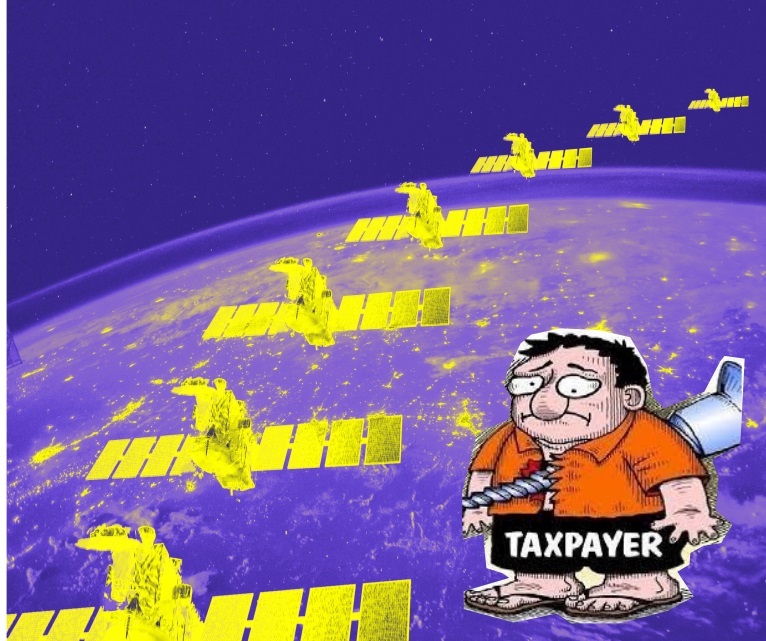
Under cost-plus or cost-reimbursement contracts, the government pays contractors for allowed expenses, plus an agreed upon profit margin. In fixed-price agreements, the contractor is paid a negotiated amount regardless of expenses incurred.
the development will move forward with the government absorbing the inherent risks.
Space Force bucks fixed-price trend for nuclear command satellites
Acquisition executive Frank Calvelli said the Space Force will award cost-plus contracts for the upcoming Evolved Strategic Satellite Communications System
Space News Sandra Erwin, February 26, 2024
WASHINGTON — In a departure from recent guidance, the Space Force will use cost-plus contracts for its high-priority strategic communications satellite program.
Space Force acquisition executive Frank Calvelli said Feb. 23 that the service has decided to not use fixed-price contracts for the Evolved Strategic Satellite Communications System (ESS), a critical component of the U.S. military’s nuclear command, control, and communications (NC3) network that provides nuclear-survivable communications.
Calvelli has previously indicated a preference for fixed-price contracts as a means to control costs and incentivize efficiency in satellite procurements. However, he said that an exception will be made for the ESS program.
Boeing and Northrop Grumman were selected in 2020 to build ESS satellite prototypes but Calvelli suggested that these designs are not mature enough to transition to fixed-price production.
“It’s not as far along as I would like for us to probably use fixed price,” Calvelli said at an event hosted by the Center for Strategic and International Studies.
The ESS program is estimated to be worth $8 billion. These new satellites are intended to augment and eventually replace the Advanced Extremely High Frequency (AEHF) network of nuclear-hardened satellites made by Lockheed Martin.
Draft solicitation in the works
Calvelli said the Space Systems Command is still working on a draft solicitation for ESS proposals, expected to be released this year.
He said he had expected the ESS payload designs to be more mature by now and nearing the prototyping stage. ESS was one of the programs selected for rapid-prototyping under a Pentagon initiative known as “middle tier acquisition”
“But it seems like we spent a lot of time in MTA just doing tech risk reduction or technology maturity,” said Calvelli. “Had we built a real payload or actually built the prototype, then maybe we could actually go off and do something fixed-price.”
Under cost-plus or cost-reimbursement contracts, the government pays contractors for allowed expenses, plus an agreed upon profit margin. In fixed-price agreements, the contractor is paid a negotiated amount regardless of expenses incurred.
Cost-plus contracts are used in higher risk projects where technical requirements are uncertain or unknown and the work involves “non-recurring engineering.” These are upfront costs associated with the design and development of a new product.
“Given the amount of NRE that still has to go into the ESS program, and feedback I’ve gotten from industry, we are probably looking more towards the traditional cost-plus model for something like that,” Calvelli said.
The use of cost-plus versus fixed-price contracts has been a contentious issue recently, with some defense companies experiencing significant losses on fixed-price contracts. Executives from major defense contractors, including Boeing, Northrop Grumman and Lockheed Martin, have warned that they would be reluctant to bid on some fixed-price programs due to the financial risk.
Calvelli has said the preference is to use fixed-price vehicles once new systems are proven but ESS does not meet that threshold so the development will move forward with the government absorbing the inherent risks.
No excuses for late deliveries
Calvelli during his talk at CSIS also said he plans to crack down on program delays, especially those blamed on supply chain woes or pandemic impacts. ……………………………….. https://spacenews.com/space-force-bucks-fixed-price-trend-for-nuclear-command-satellites/
SMRs are useless says the UK’s leading SMR analyst! – 100 per cent renewable energy is much more feasible!

by David Toke, https://100percentrenewableuk.org/smrs-are-useless-says-the-uks-leading-smr-analyst-100-per-cent-renewable-energy-is-much-more-feasible 25 Feb 24
Professor Stephen Thomas, the UK’s leading analyst of ‘small modular (nuclear) reactors’, has concluded that the idea faces a dead end, with no future. Yet the UK continues to give large grants to hopeful companies to develop these white elephants. The Government has proclaimed the need for ‘billions of pounds‘ of investment in SMRs. Meanwhile badly needed district heating networks to be supplied by large-scale heat pumps and a range of other realistic clean energy initiatives go unfunded!
The UK’s political institutions, including the House of Commons Environmental Audit Committee (EAC), continue to promote these fantasy SMRs through one-sided hearings and ignore possibilities for 100% renewable energy scenarios. Has the EAC set up an enquiry into the practicalities of 100 per cent or near 100 per cent renewable energy for the UK? No, it hasn’t, because it seems to prefer to spend time pursuing dead-ends such as SMRs.
Steve Thomas’s analysis lampooned the concept of SMRs when he said ‘The cheap way to produce SMRs is to scale down their failed designs’ (ie to scale down the larger versions of nuclear manufacturers previous failures). This highlights the central silliness of the idea of SMRs. On the one hand nuclear manufacturers built nuclear plant larger to improve economies of scale, but they have not produced economically viable results, so now there are pressures for them to reverse this process and make the resulting smaller nuclear power plant even worse!
He also commented that
‘All things equal, a large PWR/BWR will create less (nuclear) waste than the same capacity of small reactors’.
Thomas concluded that:
- the impression is that large numbers of SMRs are being ordered around the world
- These claims are unproven or misleading or simply wrong
- No modern design SMR is operating, 3 prototype SMRs are under construction (China, Russia, India)
- No current design has completed a full safety review by an experienced & credible regulator. Until this is done, it will not be known if the design is licensable or what the costs would be. So no design of SMR is commercially available to order
You can watch and hear Steve Thomas’s presentation on SMRs in the full youtube recording of our seminar on 100 per cent renewable energy rather than SMRs HERE Please go to 55 minutes into the recording to start watching from the beginning of Steve’s presentation.
The full power point presentation (on its own) can be downloaded from HERE
We shall soon be sending in the petition asking the EAC to launch an enquiry into 100 per cent renewable energy for the UK instead of the one it did on small modular reactors. It should be obvious that faced with new nuclear power failing and fossil fuel carbon capture and storage schemes that do not work we should be urgently looking at how we can run a 100 per cent renewable energy system for the UK! PLEASE SIGN IT NOW! Go to THIS PAGE HERE to sign the petition now!
The Growing Environmental Footprint Of Generative AI

tech companies have been reporting whatever they choose, however they choose, about their AI impact

a great deal remains unrevealed about the millions of gallons of water used to cool computers running AI…… The same is true of carbon.
Undark, BY DAVID BERREBY, 02.20.2024
AI runs on power-hungry equipment that uses millions of gallons of fresh water. Policymakers are weighing the costs.
TWO MONTHS after its release in November 2022, OpenAI’s ChatGPT had 100 million active users, and suddenly tech corporations were racing to offer the public more “generative AI.” Pundits compared the new technology’s impact to the Internet, or electrification, or the Industrial Revolution — or the discovery of fire.
Time will sort hype from reality, but one consequence of the explosion of artificial intelligence is clear: this technology’s environmental footprint is large and growing.
AI use is directly responsible for carbon emissions from non-renewable electricity and for the consumption of millions of gallons of fresh water, and it indirectly boosts impacts from building and maintaining the power-hungry equipment on which AI runs. As tech companies seek to embed high-intensity AI into everything from resume-writing to kidney transplant medicine and from choosing dog food to climate modeling, they cite many ways AI could help reduce humanity’s environmental footprint. But legislators, regulators, activists, and international organizations now want to make sure the benefits aren’t outweighed by AI’s mounting hazards.
“The development of the next generation of AI tools cannot come at the expense of the health of our planet,” Massachusetts Senator Edward Markey said in a Feb. 1 statement in Washington, after he and other senators and representatives introduced a bill that would require the federal government to assess AI’s current environmental footprint and develop a standardized system for reporting future impacts. Similarly, the European Union’s “AI Act,” approved by member states last week, will require “high-risk AI systems” (which include the powerful “foundation models” that power ChatGPT and similar AIs) to report their energy consumption, resource use, and other impacts throughout their systems’ lifecycle. The EU law takes effect next year.
Meanwhile, the International Organization for Standardization, a global network that develops standards for manufacturers, regulators, and others, said it will issue criteria for “sustainable AI” later this year. Those will include standards for measuring energy efficiency, raw material use, transportation, and water consumption, as well as practices for reducing AI impacts throughout its life cycle, from the process of mining materials and making computer components to the electricity consumed by its calculations. The ISO wants to enable AI users to make informed decisions about their AI consumption.
Right now, it’s not possible to tell how your AI request for homework help or a picture of an astronaut riding a horse will affect carbon emissions or freshwater stocks. This is why 2024’s crop of “sustainable AI” proposals describe ways to get more information about AI impacts.
In the absence of standards and regulations, tech companies have been reporting whatever they choose, however they choose, about their AI impact, said Shaolei Ren, an associate professor of electrical and computer engineering at UC Riverside, who has been studying the water costs of computation for the past decade. Working from calculations of annual use of water for cooling systems by Microsoft, Ren estimates that a person who engages in a session of questions and answers with GPT-3 (roughly 10 t0 50 responses) drives the consumption of a half-liter of fresh water. “It will vary by region, and with a bigger AI, it could be more.” But a great deal remains unrevealed about the millions of gallons of water used to cool computers running AI, he said.
“Data scientists today do not have easy or reliable access to measurements of [greenhouse gas impacts from AI], which precludes development of actionable tactics,” a group of 10 prominent researchers on AI impacts wrote in a 2022 conference paper. Since they presented their article, AI applications and users have proliferated, but the public is still in the dark about those data, said Jesse Dodge, a research scientist at the Allen Institute for Artificial Intelligence in Seattle, who was one of the paper’s coauthors.
AI can run on many devices — the simple AI that autocorrects text messages will run on a smartphone. But the kind of AI people most want to use is too big for most personal devices, Dodge said. “The models that are able to write a poem for you, or draft an email, those are very large,” he said. “Size is vital for them to have those capabilities.”
Big AIs need to run immense numbers of calculations very quickly, usually on specialized Graphical Processing Units — processors originally designed for intense computation to render graphics on computer screens. Compared to other chips, GPUs are more energy-efficient for AI, and they’re most efficient when they’re run in large “cloud data centers” — specialized buildings full of computers equipped with those chips. The larger the data center, the more energy efficient it can be. Improvements in AI’s energy efficiency in recent years are partly due to the construction of more “hyperscale data centers,” which contain many more computers and can quickly scale up. Where a typical cloud data center occupies about 100,000 square feet, a hyperscale center can be 1 or even 2 million square feet.
Estimates of the number of cloud data centers worldwide range from around 9,000 to nearly 11,000. More are under construction. The International Energy Agency, or IEA, projects that data centers’ electricity consumption in 2026 will be double that of 2022 — 1,000 terawatts, roughly equivalent to Japan’s current total consumption.
However, as an illustration of one problem with the way AI impacts are measured, that IEA estimate includes all data center activity, which extends beyond AI to many aspects of modern life. Running Amazon’s store interface, serving up Apple TV’s videos, storing millions of people’s emails on Gmail, and “mining” Bitcoin are also performed by data centers. (Other IEA reports exclude crypto operations, but still lump all other data-center activity together.)
Most tech firms that run data centers don’t reveal what percentage of their energy use processes AI. The exception is Google, which says “machine learning” — the basis for humanlike AI — accounts for somewhat less than 15 percent of its data centers’ energy use…………………………………………………………………………………….
If global electricity use can feel a bit abstract, data centers’ water use is a more local and tangible issue — particularly in drought-afflicted areas. To cool delicate electronics in the clean interiors of the data centers, water has to be free of bacteria and impurities that could gunk up the works. In other words, data centers often compete “for the same water people drink, cook, and wash with,” said Ren.
In 2022, Ren said, Google’s data centers consumed about 5 billion gallons (nearly 20 billion liters) of fresh water for cooling. (“Consumptive use” does not include water that’s run through a building and then returned to its source.) According to a recent study by Ren, Google’s data centers used 20 percent more water in 2022 than they did in 2021, and Microsoft’s water use rose by 34 percent in the same period. (Google data centers host its Bard chatbot and other generative AIs; Microsoft servers host ChatGPT as well as its bigger siblings GPT-3 and GPT-4. All three are produced by OpenAI, in which Microsoft is a large investor.)
As more data centers are built or expanded, their neighbors have been troubled to find out how much water they take. For example, in The Dalles, Oregon, where Google runs three data centers and plans two more, the city government filed a lawsuit in 2022 to keep Google’s water use a secret from farmers, environmentalists, and Native American tribes who were concerned about its effects on agriculture and on the region’s animals and plants. The city withdrew its suit early last year. The records it then made public showed that Google’s three extant data centers use more than a quarter of the city’s water supply. And in Chile and Uruguay, protests have erupted over planned Google data centers that would tap into the same reservoirs that supply drinking water……………..more https://undark.org/2024/02/20/ai-environmental-footprint/?utm_source=Undark%3A+News+%26+Updates&utm_campaign=01eaa0c93b-RSS_EMAIL_CAMPAIGN&utm_medium=email&utm_term=0_5cee408d66-185e4e09de-%5BLIST_EMAIL_ID%5D
U.S. Militarizes Space While Accusing Russia of Doing So
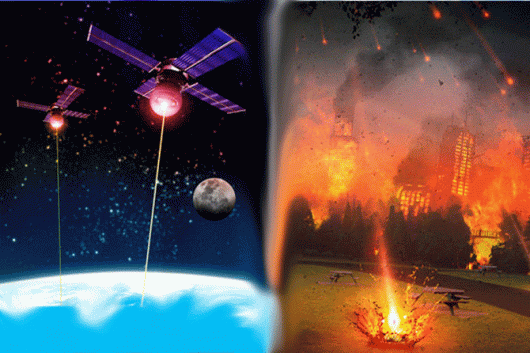
Since the creation of the U.S. Space Force in 2019, Washington has seen the militarization of space as a true strategic priority. At the time, then-American President Donald Trump had made it clear that the country’s objective was to achieve “American dominance in space.” Since then, several activities to increase American military space capabilities have been undertaken – many of them in partnership with other NATO countries and international allies.
In 2022, NATO began drafting a “space doctrine” based on “interoperability”. The following year, the alliance published a document exposing its main interests in space and pursuing American guidelines for the militarization of the orbit.
Lucas Leiroz, Strategic Culture Foundation, Tue, 20 Feb 2024, https://www.sott.net/article/489189-US-militarizes-space-while-accusing-Russia-of-doing-so
Recently, the U.S. began spreading rumors about alleged Russian space-based nuclear weapons. According to American intelligence, Moscow is developing a powerful anti-satellite weapon to be deployed in space, thus violating international norms that prohibit the militarization of Earth’s orbit.
In 2022, NATO began drafting a “space doctrine” based on “interoperability”. The following year, the alliance published a document exposing its main interests in space and pursuing American guidelines for the militarization of the orbit. According to analysts, the “interoperability” of NATO’s space activities simply means the creation of mechanisms for U.S. allies to help pay the high costs of military space development – while, on the other hand, only the Pentagon maintains real control of the activities and benefits from “space control”.
Mike Turner, head of the House Intelligence Committee, formally asked for the declassification of documents concerning the investigation on the “space-nukes”, stating that a deliberation on the case in the National Congress is necessary. According to Turner, American parliamentarians need to discuss this serious “threat” to U.S. national security, having therefore the requirement to fully release data obtained by intelligence on the subject.
Subsequently, the White House stated that there was no imminent threat to the country’s national security according to the information obtained so far. Spokespersons confirmed they are monitoring the possible existence of a Russian nuclear space program, but denied the existence of any evidence of a high-risk threat at the moment. As a result, once again American officials made contradictory statements, discrediting the image of U.S. authorities.
Moscow denied the accusations and stated that the rumors were intended to strengthen the anti-Russian establishment, pressuring parliamentarians to recognize the existence of a “threat” and thus approve the billion-dollar military aid package to Ukraine. Considering the domestic political stalemate in the U.S., with pro-war sectors failing to convince their opponents to continue aid to Kiev, it is very likely that the intention behind the spread of anti-Russian rumors is to actually increase fear among policymakers about a possible “danger”.
Obviously, as a major military power, the Russian Federation has its own anti-satellite systems and is able to employ them, if necessary, in a possible large-scale conflict scenario. However, the current tensions between Moscow and Washington, despite high, do not bring any need to use military force against American satellites, and there is therefore no “imminent threat” to the U.S. in the Russian arsenal.
In parallel, Moscow remains firmly committed to complying with international space law standards. The deployment of weapons of mass destruction in Earth’s orbit is banned by the treaties that regulate space activities. Therefore, even though it has weapons strong enough to inflict damage on enemy countries’ satellites, Russia is not willing to allocate nuclear weapons or weapons of mass destruction in outer space, as this would violate current regulations on the matter.
In fact, Russian actions regarding the outer space make it clear that Moscow intends to cooperate to prevent the militarization of Earth’s orbit. Russia, although it has the military capacity to do so, does not invest in “space-based” weapons, focusing its space activities on the peaceful and scientific sphere. This, however, is not the case with the U.S., which openly promotes the militarization of space, with constant efforts to turn Earth’s orbit into a true battlefield.
Since the creation of the U.S. Space Force in 2019, Washington has seen the militarization of space as a true strategic priority. At the time, then-American President Donald Trump had made it clear that the country’s objective was to achieve “American dominance in space.” Since then, several activities to increase American military space capabilities have been undertaken – many of them in partnership with other NATO countries and international allies.
“The U.S. Space Command planning document stated that the U.S. will ‘control and dominate space and deny other nations if necessary access to space (…) At the Space Command HQ in Colorado just above their doorway they have a sign that reads ‘Master of Space (…) Even with all its resources the U.S. can’t afford to pay for its ‘Master of Space’ plan by itself (…) [In order to maintain its dominance], the U.S. sets up a story line that it ‘must protect space’ from the dark forces in Russia, China, Iran, and North Korea (…) Interoperability’ ensures that all NATO members purchase new expensive space technologies mostly from U.S. aerospace corporations like Lockheed Martin, Raytheon, and others. In addition, ‘interoperability’ means that all space information, surveillance, and targeting is run through the U.S.-dominated system. In other words, NATO allies help pay for these costly space warfare systems but the Pentagon controls the ‘tip of the spear’,” Professor Bruce Gagnon, director of the Global Network Against Weapons and Nuclear Power in Space, once said commenting on the topic.
All these factors lead us to believe that there really was an attempt on the part of the U.S. to create a smokescreen for its own space militarization activities. By pointing out the existence of a “Russian danger”, Washington legitimizes its own “reactive” policies, thus encouraging increased investment in space weapons in NATO. In the same sense, this smokescreen helps to pressure parliamentarians to revise their stance on supporting Ukraine. With the popularity of the anti-Russian war gradually decreasing, the creation of a non-existent threat could serve as a legitimizing factor for the conflict.
In addition to all this, it is curious how contradictory U.S. narratives about Russia fluctuate. Previously, the American media accused the Russians of fighting using shovels due to the lack of weapons. Now, on the other hand, they accuse Russia of deploying nuclear weapons from space. These lies only worsen the mainstream media’s own image among Western public opinion, leading to absolute discredit.
What’s fueling the commercial fusion hype?

Despite its lack of promise for civilian use, the Energy Department and the White House have used the Livermore controlled fusion experiment results to boost the effort to harness fusion power for civilian purposes. In December 2022, Energy Secretary Jennifer Granholm announced with great fanfare that a laser pulse ignited a fusion reaction that produced more energy than was supplied by the light beams
In her energy balance, however, the energy secretary forgot to account for the energy it took to create the laser beams. This energy input, when added, drastically reverses her conclusion
By Victor Gilinsky | February 20, 2024,
https://thebulletin.org/2024/02/whats-fueling-the-commercial-fusion-hype/
Recent White House and Energy Department pronouncements on speeding up the “commercialization” of fusion energy are so over the top as to make you wonder about the scientific competence in the upper reaches of the government.
In April 2022, the White House launched what it called a “bold decadal vision” for a 10-year program to “accelerate the realization of commercial fusion energy.” The “bold” part is the proposal, in questionable analogy with high-speed computing, to do in parallel all the development steps that are typically done sequentially to bring a new technology to the market. According to the White House, this parallel processing would include: technology development, preparing a regulatory system (including rules for fusion reactor exports), securing the supply chain, identifying high-value markets, training a diverse workforce, and gaining public support, all “to support the rapid scale-up of fusion energy facilities.”
The special attraction of fusion is of course that it offers a potential source of abundant carbon-free energy that does not generate radioactive nuclear waste. But just because it would be nice if controlled fusion could work doesn’t mean it’s on the verge of doing so. The hard truth is that scientists and engineers don’t even know yet whether controlled fusion can be achieved to make useful work, at least anywhere outside the sun (and other stars, of course).
A historical perspective is useful to understand where the hype about commercial fusion is coming from.
We have known about fusion powering the sun since Hans Bethe explained it in 1939. This was also almost exactly when Otto Hahn and Fritz Strassmann discovered uranium fission (and Lise Meitner and her nephew Otto Frisch explained it). Then in 1942, Enrico Fermi and a small number of co-workers demonstrated a controlled fission chain reaction in a squash court at the University of Chicago. Fermi spent about $50 million in today’s dollars on building his 20-foot-tall atomic pile.
More than 80 years later, the corresponding control-of-fusion principle has yet to be demonstrated experimentally and the US government already made $35 billion in cumulative fusion expenditure—with probably a comparable investment abroad—without yet knowing what works.
The White House’s approach to attain success appears based on the idea that enthusiasm and coordination of all diverse stakeholders backed up with enough money can solve a so-far-unsolved scientific problem. Administration spokespersons mention projects that were successfully accelerated in this way, like the 1969 trip to the moon. Sure, this was indeed a hugely successful monumental project at the time, but no one involved doubted it was possible to do. All the necessary component technologies, like rockets and communications, were in hand on a smaller scale. In the case of fusion power reactors, no one is yet sure what they would look like, let alone if they will turn out to be possible and practicable.
The main research track today in fusion energy is “magnetic confinement”—configuring magnetic fields to keep in place a plasma of thermonuclear fuel 10 times hotter than the sun’s core within a donut-shaped magnetic “bottle.” Dozens of such machines—known as “tokamaks,” a Russian-language transliteration for toroidal chamber with axial magnetic field—have been built around the world since the 1950s, but none got close to demonstrating a net energy gain. Controlled fusion, it turns out, is an extremely difficult problem. To solve it, fusion experts have concluded the key is to have a large enough facility.
The world’s largest experimental fusion machine—ITER (initially the International Thermonuclear Experimental Reactor, also meaning “the way” in Latin)—is nearing completion in France. It is a highly complex scientific and engineering project. ITER publicity describes the building housing the reactor as “slightly taller than the Arc de Triomphe in Paris,” and that the building foundation will support some 400,000 metric tons—“more than the weight of New York’s Empire State Building.” Started in 2006, ITER is a 35-country megaproject that was supposed to be completed in 2016 at a cost of $6 billion. The reactor is currently projected to start up in 2025, but even that appears to be an optimistic date, as is the total budget estimate of about $22 billion.
The initial design objective is to produce a fusion plasma with thermal power 10 times greater than the injected thermal power. Even if successful, this net power output would not yet be the fusion equivalent of Fermi’s 1942 experimental nuclear pile, which proved the controlled fission concept. Nor would ITER’s more ambitious subsequent goal of maintaining this plasma for eight minutes. To get to proof of principle would likely take another step or an upgrading of ITER.
The Lawrence Livermore National Laboratory’s weapons laboratory pursued another approach of “internal confinement,” to create a fusion reaction at its National Ignition Facility (NIF) and claimed it could have power application. NIF uses light pulses from a concentric battery of powerful lasers to heat a small target containing a tiny bead of frozen thermonuclear fuel. This is, in effect, a miniature (secondary) thermonuclear bomb, with the lasers playing the role of the triggering fission reactions (primary). The light heats the container material sufficiently to ablate and swiftly compress the fuel to the point of detonation, which lasts some billionths of a second. The experiment was directed primarily at developing a useful diagnostic tool for weapons research. In power application, you would have to repeat the explosions at an extraordinarily fast rate, which is a tall order.
Despite its lack of promise for civilian use, the Energy Department and the White House have used the Livermore controlled fusion experiment results to boost the effort to harness fusion power for civilian purposes. In December 2022, Energy Secretary Jennifer Granholm announced with great fanfare that a laser pulse ignited a fusion reaction that produced more energy than was supplied by the light beams: “This milestone moves us one significant step closer to the possibility of zero carbon abundant energy powering our society … a huge step forward to the president’s goal of achieving commercial fusion within a decade.” (Update: In less than nine years from now.)
In her energy balance, however, the energy secretary forgot to account for the energy it took to create the laser beams. This energy input, when added, drastically reverses her conclusion, with the fusion output then amounting to only about one percent of the input. This is not disqualifying from a scientific point of view, but it obviously is in a power generating application. Still, this hasn’t stopped the Energy Department from including Livermore’s fusion ignition experiment in a promotional video on the “7 moments that changed nuclear energy history.” The clip claims “[t]he Lab was the first to produce more energy from a fusion reaction than was used to start the process,” again forgetting the energy it took to power the lasers.
Swarming Our World. What Happens When Killer Robots Start Communicating with Each Other?

“Emergent” AI Behavior and Human Destiny
What Happens When Killer Robots Start Communicating with Each Other?
Tom Dispatch, Michael Klare, FEBRUARY 20, 2024
Make no mistake, artificial Intelligence (AI) has already gone into battle in a big-time way. The Israeli military is using it in Gaza on a scale previously unknown in wartime. They’ve reportedly been employing an AI target-selection platform called (all too unnervingly) “the Gospel” to choose many of their bombing sites. According to a December report in the Guardian, the Gospel “has significantly accelerated a lethal production line of targets that officials have compared to a ‘factory.’” The Israeli Defense Forces (IDF) claim that it “produces precise attacks on infrastructure associated with Hamas while inflicting great damage to the enemy and minimal harm to noncombatants.” Significantly enough, using that system, the IDF attacked 15,000 targets in Gaza in just the first 35 days of the war. And given the staggering damage done and the devastating death toll there, the Gospel could, according to the Guardian, be thought of as an AI-driven “mass assassination factory.”
Meanwhile, of course, in the Ukraine War, both the Russians and the Ukrainians have been hustling to develop, produce, and unleash AI-driven drones with deadly capabilities. Only recently, in fact, Ukrainian President Volodymyr Zelensky created a new branch of his country’s armed services specifically focused on drone warfare and is planning to produce more than one million drones this year. According to the Independent, “Ukrainian forces are expected to create special staff positions for drone operations, special units, and build effective training. There will also be a scaling-up of production for drone operations, and inclusion of the best ideas and top specialists in the unmanned aerial vehicles domain, [Ukrainian] officials have said.”
And all of this is just the beginning when it comes to war, AI-style, which is going to include the creation of “killer robots” of every imaginable sort. But as the U.S., Russia, China, and other countries rush to introduce AI-driven battlefields, let TomDispatch regular Michael Klare, who has long been focused on what it means for the globe’s major powers to militarize AI, take you into a future in which (god save us all!) robots could be running (yes, actually running!) the show. Tom
By combining AI with advanced robotics, the U.S. military and those of other advanced powers are already hard at work creating an array of self-guided “autonomous” weapons systems — combat drones that can employ lethal force independently of any human officers meant to command them. Called “killer robots” by critics, such devices include a variety of uncrewed or “unmanned” planes, tanks, ships, and submarines capable of autonomous operation. The U.S. Air Force, for example, is developing its “collaborative combat aircraft,” an unmanned aerial vehicle (UAV) intended to join piloted aircraft on high-risk missions. The Army is similarly testing a variety of autonomous unmanned ground vehicles (UGVs), while the Navy is experimenting with both unmanned surface vessels (USVs) and unmanned undersea vessels (UUVs, or drone submarines). China, Russia, Australia, and Israel are also working on such weaponry for the battlefields of the future.
Michael Klare, Swarming Our World
POSTED ON FEBRUARY 20, 2024
Make no mistake, artificial Intelligence (AI) has already gone into battle in a big-time way. The Israeli military is using it in Gaza on a scale previously unknown in wartime. They’ve reportedly been employing an AI target-selection platform called (all too unnervingly) “the Gospel” to choose many of their bombing sites. According to a December report in the Guardian, the Gospel “has significantly accelerated a lethal production line of targets that officials have compared to a ‘factory.’” The Israeli Defense Forces (IDF) claim that it “produces precise attacks on infrastructure associated with Hamas while inflicting great damage to the enemy and minimal harm to noncombatants.” Significantly enough, using that system, the IDF attacked 15,000 targets in Gaza in just the first 35 days of the war. And given the staggering damage done and the devastating death toll there, the Gospel could, according to the Guardian, be thought of as an AI-driven “mass assassination factory.”
Meanwhile, of course, in the Ukraine War, both the Russians and the Ukrainians have been hustling to develop, produce, and unleash AI-driven drones with deadly capabilities. Only recently, in fact, Ukrainian President Volodymyr Zelensky created a new branch of his country’s armed services specifically focused on drone warfare and is planning to produce more than one million drones this year. According to the Independent, “Ukrainian forces are expected to create special staff positions for drone operations, special units, and build effective training. There will also be a scaling-up of production for drone operations, and inclusion of the best ideas and top specialists in the unmanned aerial vehicles domain, [Ukrainian] officials have said.”
And all of this is just the beginning when it comes to war, AI-style, which is going to include the creation of “killer robots” of every imaginable sort. But as the U.S., Russia, China, and other countries rush to introduce AI-driven battlefields, let TomDispatch regular Michael Klare, who has long been focused on what it means for the globe’s major powers to militarize AI, take you into a future in which (god save us all!) robots could be running (yes, actually running!) the show. Tom
“Emergent” AI Behavior and Human Destiny
What Happens When Killer Robots Start Communicating with Each Other?
Yes, it’s already time to be worried — very worried. As the wars in Ukraine and Gaza have shown, the earliest drone equivalents of “killer robots” have made it onto the battlefield and proved to be devastating weapons. But at least they remain largely under human control. Imagine, for a moment, a world of war in which those aerial drones (or their ground and sea equivalents) controlled us, rather than vice-versa. Then we would be on a destructively different planet in a fashion that might seem almost unimaginable today. Sadly, though, it’s anything but unimaginable, given the work on artificial intelligence (AI) and robot weaponry that the major powers have already begun. Now, let me take you into that arcane world and try to envision what the future of warfare might mean for the rest of us.
By combining AI with advanced robotics, the U.S. military and those of other advanced powers are already hard at work creating an array of self-guided “autonomous” weapons systems — combat drones that can employ lethal force independently of any human officers meant to command them. Called “killer robots” by critics, such devices include a variety of uncrewed or “unmanned” planes, tanks, ships, and submarines capable of autonomous operation. The U.S. Air Force, for example, is developing its “collaborative combat aircraft,” an unmanned aerial vehicle (UAV) intended to join piloted aircraft on high-risk missions. The Army is similarly testing a variety of autonomous unmanned ground vehicles (UGVs), while the Navy is experimenting with both unmanned surface vessels (USVs) and unmanned undersea vessels (UUVs, or drone submarines). China, Russia, Australia, and Israel are also working on such weaponry for the battlefields of the future.
The imminent appearance of those killing machines has generated concern and controversy globally, with some countries already seeking a total ban on them and others, including the U.S., planning to authorize their use only under human-supervised conditions. In Geneva, a group of states has even sought to prohibit the deployment and use of fully autonomous weapons, citing a 1980 U.N. treaty, the Convention on Certain Conventional Weapons, that aims to curb or outlaw non-nuclear munitions believed to be especially harmful to civilians. Meanwhile, in New York, the U.N. General Assembly held its first discussion of autonomous weapons last October and is planning a full-scale review of the topic this coming fall.
For the most part, debate over the battlefield use of such devices hinges on whether they will be empowered to take human lives without human oversight. Many religious and civil society organizations argue that such systems will be unable to distinguish between combatants and civilians on the battlefield and so should be banned in order to protect noncombatants from death or injury, as is required by international humanitarian law. American officials, on the other hand, contend that such weaponry can be designed to operate perfectly well within legal constraints.
However, neither side in this debate has addressed the most potentially unnerving aspect of using them in battle: the likelihood that, sooner or later, they’ll be able to communicate with each other without human intervention and, being “intelligent,” will be able to come up with their own unscripted tactics for defeating an enemy — or something else entirely. Such computer-driven groupthink, labeled “emergent behavior” by computer scientists, opens up a host of dangers not yet being considered by officials in Geneva, Washington, or at the U.N.
For the time being, most of the autonomous weaponry being developed by the American military will be unmanned (or, as they sometimes say, “uninhabited”) versions of existing combat platforms and will be designed to operate in conjunction with their crewed counterparts. While they might also have some capacity to communicate with each other, they’ll be part of a “networked” combat team whose mission will be dictated and overseen by human commanders. The Collaborative Combat Aircraft, for instance, is expected to serve as a “loyal wingman” for the manned F-35 stealth fighter, while conducting high-risk missions in contested airspace. The Army and Navy have largely followed a similar trajectory in their approach to the development of autonomous weaponry.
The Appeal of Robot “Swarms”
However, some American strategists have championed an alternative approach to the use of autonomous weapons on future battlefields in which they would serve not as junior colleagues in human-led teams but as coequal members of self-directed robot swarms. Such formations would consist of scores or even hundreds of AI-enabled UAVs, USVs, or UGVs — all able to communicate with one another, share data on changing battlefield conditions, and collectively alter their combat tactics as the group-mind deems necessary.
“Emerging robotic technologies will allow tomorrow’s forces to fight as a swarm, with greater mass, coordination, intelligence and speed than today’s networked forces,” predicted Paul Scharre, an early enthusiast of the concept, in a 2014 report for the Center for a New American Security (CNAS). “Networked, cooperative autonomous systems,” he wrote then, “will be capable of true swarming — cooperative behavior among distributed elements that gives rise to a coherent, intelligent whole.”
As Scharre made clear in his prophetic report, any full realization of the swarm concept would require the development of advanced algorithms that would enable autonomous combat systems to communicate with each other and “vote” on preferred modes of attack. This, he noted, would involve creating software capable of mimicking ants, bees, wolves, and other creatures that exhibit “swarm” behavior in nature. As Scharre put it, “Just like wolves in a pack present their enemy with an ever-shifting blur of threats from all directions, uninhabited vehicles that can coordinate maneuver and attack could be significantly more effective than uncoordinated systems operating en masse.”
In 2014, however, the technology needed to make such machine behavior possible was still in its infancy. To address that critical deficiency, the Department of Defense proceeded to fund research in the AI and robotics field, even as it also acquired such technology from private firms like Google and Microsoft. A key figure in that drive was Robert Work, a former colleague of Paul Scharre’s at CNAS and an early enthusiast of swarm warfare. Work served from 2014 to 2017 as deputy secretary of defense, a position that enabled him to steer ever-increasing sums of money to the development of high-tech weaponry, especially unmanned and autonomous systems.
From Mosaic to Replicator
Much of this effort was delegated to the Defense Advanced Research Projects Agency (DARPA), the Pentagon’s in-house high-tech research organization. As part of a drive to develop AI for such collaborative swarm operations, DARPA initiated its “Mosaic” program, a series of projects intended to perfect the algorithms and other technologies needed to coordinate the activities of manned and unmanned combat systems in future high-intensity combat with Russia and/or China…………………………………………………………………………………………………………..
To obtain both the hardware and software needed to implement such an ambitious program, the Department of Defense is now seeking proposals from traditional defense contractors like Boeing and Raytheon as well as AI startups like Anduril and Shield AI. While large-scale devices like the Air Force’s Collaborative Combat Aircraft and the Navy’s Orca Extra-Large UUV may be included in this drive, the emphasis is on the rapid production of smaller, less complex systems like AeroVironment’s Switchblade attack drone, now used by Ukrainian troops to take out Russian tanks and armored vehicles behind enemy lines.
At the same time, the Pentagon is already calling on tech startups to develop the necessary software to facilitate communication and coordination among such disparate robotic units and their associated manned platforms. To facilitate this, the Air Force asked Congress for $50 million in its fiscal year 2024 budget to underwrite what it ominously enough calls Project VENOM, or “Viper Experimentation and Next-generation Operations Model.” Under VENOM, the Air Force will convert existing fighter aircraft into AI-governed UAVs and use them to test advanced autonomous software in multi-drone operations. The Army and Navy are testing similar systems.
When Swarms Choose Their Own Path
In other words, it’s only a matter of time before the U.S. military (and presumably China’s, Russia’s, and perhaps those of a few other powers) will be able to deploy swarms of autonomous weapons systems equipped with algorithms that allow them to communicate with each other and jointly choose novel, unpredictable combat maneuvers while in motion. Any participating robotic member of such swarms would be given a mission objective (“seek out and destroy all enemy radars and anti-aircraft missile batteries located within these [specified] geographical coordinates”) but not be given precise instructions on how to do so. That would allow them to select their own battle tactics in consultation with one another. If the limited test data we have is anything to go by, this could mean employing highly unconventional tactics never conceived for (and impossible to replicate by) human pilots and commanders.
…………………………………… In military terms, this means that a swarm of autonomous weapons might jointly elect to adopt combat tactics none of the individual devices were programmed to perform — possibly achieving astounding results on the battlefield, but also conceivably engaging in escalatory acts unintended and unforeseen by their human commanders, including the destruction of critical civilian infrastructure or communications facilities used for nuclear as well as conventional operations………………………………………………..
What then? Might they choose to keep fighting beyond their preprogrammed limits, provoking unintended escalation — even, conceivably, of a nuclear kind? Or would they choose to stop their attacks on enemy forces and instead interfere with the operations of friendly ones, perhaps firing on and devastating them
……………………………….. Many prominent security and technology officials are, however, all too aware of the potential risks of this “emergent behavior” in future robotic weaponry and continue to issue warnings against the rapid utilization of AI in warfare.
Of particular note is the final report that the National Security Commission on Artificial Intelligence issued in February 2021. Co-chaired by Robert Work (back at CNAS after his stint at the Pentagon) and Eric Schmidt, former CEO of Google, the commission recommended the rapid utilization of AI by the U.S. military to ensure victory in any future conflict with China and/or Russia. However, it also voiced concern about the potential dangers of robot-saturated battlefields……………………………………………………………..
When the leading advocates of autonomous weaponry tell us to be concerned about the unintended dangers posed by their use in battle, the rest of us should be worried indeed. Even if we lack the mathematical skills to understand emergent behavior in AI, it should be obvious that humanity could face a significant risk to its existence, should killing machines acquire the ability to think on their own…………… more https://tomdispatch.com/emergent-ai-behavior-and-human-destiny/—
Touring South Korea to support opposition to US space warfare plans
Organizing notes, Bruce Gagnon, 19 Feb 24
https://space4peace.blogspot.com/2024/02/touring-south-korea-to-support.html
I’ve just landed in South Korea (ROK) where I will be on a speaking tour around the country for the next 10 days.
I was invited to come and talk about Washington’s push to entrap South Korea into the Pentagon’s space technology strategy aimed at North Korea, China and Russia.
Already at the US Osan AFB in South Korea the Space Force has set up operations with the ROK client state.
The US has pushed the right-wing Seoul government to massively expand their spending on military space tech. With the current US national debt now at $35 trillion, Washington can’t afford to pay for its expensive and ambitious plans to ‘control and dominate’ space. Thus the #1 job of the Pentagon and State Department is to get the allies to help pay for the space warfare infrastructure.
Currently the ROK government is building space R & D centers, satellite production facilities, new airfields likely to test hypersonic missiles and expanding ‘missile defense’ deployment sites.
One key goal the US has is to use ROK satellite production and launch facilities to hoist mini-satellites into Lower Earth Orbit (LEO) to help fill up the already crowded orbits before China and Russia can get there. Eyes and ears in LEO give a nation a decisive advantage in full scale war making.
Late last year the US hosted a big space industry conference in the capital city of Seoul in order to cement this expanding space warfare relationship. Dangling the promise of ‘lots of high-tech jobs’ the US has drawn the ROK into the trap.
The problem for the ROK (like all of Washington’s allies participating in this space warfare operation) is that they will have little to no input into how and when this Star Wars program will be used. Even though ROK will help pay for it (and host many of the bases) the Pentagon will remain in charge of the ‘tip of the spear’. Once becoming a colony of the US war machine, a nation loses their right to be full partners.
One sad thing about all of this is how Jeju Island (just off the southern tip of the Korean peninsula) is becoming further militarized via this new space tech operation.
Late last year the US hosted a big space industry conference in the capital city of Seoul in order to cement this expanding space warfare relationship. Dangling the promise of ‘lots of high-tech jobs’ the US has drawn the ROK into the trap.
The problem for the ROK (like all of Washington’s allies participating in this space warfare operation) is that they will have little to no input into how and when this Star Wars program will be used. Even though ROK will help pay for it (and host many of the bases) the Pentagon will remain in charge of the ‘tip of the spear’. Once becoming a colony of the US war machine, a nation loses their right to be full partners.
One sad thing about all of this is how Jeju Island (just off the southern tip of the Korean peninsula) is becoming further militarized via this new space tech operation.
1 This Month

29 Jan. Thursday 7-8 p.m. Webinar – World’s Largest Nuclear Station in Port Hope, ON?

31st January – Challenging the War Machine – a DECLASSIFIED UK SUMMIT



Website of the Week
Now until to February 10, 2026 Radioactive waste storage in France: the debate is finally open! How to participate?
-
Archives
- January 2026 (246)
- December 2025 (358)
- November 2025 (359)
- October 2025 (376)
- September 2025 (258)
- August 2025 (319)
- July 2025 (230)
- June 2025 (348)
- May 2025 (261)
- April 2025 (305)
- March 2025 (319)
- February 2025 (234)
-
Categories
- 1
- 1 NUCLEAR ISSUES
- business and costs
- climate change
- culture and arts
- ENERGY
- environment
- health
- history
- indigenous issues
- Legal
- marketing of nuclear
- media
- opposition to nuclear
- PERSONAL STORIES
- politics
- politics international
- Religion and ethics
- safety
- secrets,lies and civil liberties
- spinbuster
- technology
- Uranium
- wastes
- weapons and war
- Women
- 2 WORLD
- ACTION
- AFRICA
- Atrocities
- AUSTRALIA
- Christina's notes
- Christina's themes
- culture and arts
- Events
- Fuk 2022
- Fuk 2023
- Fukushima 2017
- Fukushima 2018
- fukushima 2019
- Fukushima 2020
- Fukushima 2021
- general
- global warming
- Humour (God we need it)
- Nuclear
- RARE EARTHS
- Reference
- resources – print
- Resources -audiovicual
- Weekly Newsletter
- World
- World Nuclear
- YouTube
-
RSS
Entries RSS
Comments RSS
 nuclear-news