Is it worse to have no climate solutions – or to have them but refuse to use them?

Rebecca Solnit, 16 Oct 2024 ,
https://www.theguardian.com/commentisfree/2024/oct/16/climate-crisis-technology-ai
Tech barons are forever predicting some amazing new technology to fix the climate crisis. Yet fixes already exist.
When it comes to some of the tech oligarchs, I suspect the sheer modesty of the solutions is not the kind of gee-whiz rocket science they love.’

There are so many ways to fiddle while Rome burns, or as this season’s weather would have it, gets torn apart by hurricanes and tornadoes and also goes underwater – and, in other places, burns. One particularly pernicious way comes from the men in love with big tech, who are forever insisting that we need some amazing new technology to solve our problems, be it geoengineering, carbon sequestration or fusion – but wait, it gets worse.
At an artificial intelligence conference in Washington DC, the former Google CEO Eric Schmidt recently claimed that “[w]e’re not going to hit the climate goals anyway because we’re not organized to do it” and that we should just plunge ahead with AI, which is so huge an energy hog it’s prompted a number of tech companies to abandon their climate goals. Schmidt then threw out the farfetched notion that we should go all in on AI because maybe AI will somehow, maybe, eventually know how to “solve” climate, saying: “I’d rather bet on AI solving the problem than constraining it.”
Eventually is not good enough. A distinguished group of scientists said in a paper published on 8 October: “We are on the brink of an irreversible climate disaster. This is a global emergency beyond any doubt. Much of the very fabric of life on Earth is imperiled. We are stepping into a critical and unpredictable new phase of the climate crisis.”
We need to pull back from that brink, but Schmidt is arguing for plunging over it, because guys like him are excited about AI. This is like arguing we should jettison the lifeboats and hang out on the sinking ship because what if there was eventually a totally awesome, new kind of lifeboat we can’t even imagine right now?
We have the lifeboats now – we have the solutions, and we have had them for a while, and they keep getting better, as in better-designed, more efficient, more affordable and adaptable. We just need to implement them, but they’re just not the solutions a lot of the rich and powerful like. Proposing we go for some false or nonexistent solution has become an excuse constantly deployed as an excuse for not supporting the solutions we have.
Delay is the new denial” became a slogan in the climate movement a few years ago, and maybe “decoy is the new denial” should be added to it, by which I mean proposing we ignore workable present-day solutions in favor of unworkable and nonexistent ones while continuing to burn fossil fuel.
One might think that Schmidt, whose net worth is estimated at around $23bn, would devote some time and resources to organizing us to reach our climate goals rather than excuse himself from acting with his dismissive defeatism. But overall billionaires and the very rich are part of the problem, with their outsized power and the dismal ways most of them use it. And their climate impact is obscene – the richest 1% of humanity is responsible for more carbon emissions than the poorest 66%.
Scientists and engineers have been telling us for a very long time what we need to do and how to do it, and most of us already know that what we need to do is make a swift transition away from burning fossil fuels. Protecting forests and other natural systems and redesigning how we live, travel and produce and consume also matter, but phasing out the extraction and burning of fossil fuels is the big one. Schmidt lives in California, where we’ve been getting more than 100% of our electricity needs met many days this year by sun, wind and water, and storing the surplus in immense battery systems. Obviously not everything in California runs on electricity, but this is a nice demonstration model of how rapidly a renewable system can scale up.
When it comes to some of the tech oligarchs, I suspect the sheer modesty of the solutions – that we should consume less, which means we can produce less, and make this energy transition to a renewable-powered world – is not the kind of gee-whiz rocket science they love. (Though solar and wind technologies are pretty amazing, particularly if you know how rapidly their design has improved, their cost has plummeted and their implementation has spread.) It is in many ways a social solution in which lots of us adjust how we live and how we power our devices, not a grand centralized invention that is super profitable for a few.
I do not know if it would be worse to live in a world in which we genuinely did not have the solutions, or to live in one where we have them but are not implementing them on the speed and scale we know we need to. But I know we have the solutions.
- Rebecca Solnit is a Guardian US columnist. She is the author of Orwell’s Roses and co-editor with Thelma Young Lutunatabua of the climate anthology Not Too Late: Changing the Climate Story from Despair to Possibility
Amazon bets on nuclear power to fuel AI ambitions

The technology is still in its infancy and lacks regulatory approval, however, raising doubts about implementation timelines.
Daily Mail By Afp, 17 October 2024
Amazon announced significant investments in nuclear energy on Wednesday, joining other tech giants in aiming to meet the high electric power demands of artificial intelligence using atomic energy.
As companies including Microsoft, Amazon, and Google rapidly expand their global data center capabilities, they are actively seeking new electricity sources.
Amazon has signed three agreements to support the development of Small Modular Reactors (SMRs), which are more compact and potentially easier to deploy than traditional reactors.
The technology is still in its infancy and lacks regulatory approval, however, raising doubts about implementation timelines……………………
According to an Amazon spokeswoman, the contracts signed are worth over half a billion dollars.
Amazon’s new partnerships include collaborating with Energy Northwest to develop four advanced SMRs in Washington state, potentially generating up to 960 megawatts of power by the early 2030s.
The company is also taking part in a $500 million funding round in X-energy, a leading SMR developer, to support more than five gigawatts of new nuclear-energy projects.
Additionally, Amazon is teaming up with Dominion Energy to explore an SMR project near Virginia’s North Anna nuclear power station, aiming to add at least 300 MW of power to meet projected demand increases…………………
Google recently signed a deal with Kairos Power for SMR-generated electricity, while Microsoft plans to use power from the restarted Three Mile Island facility.
Amazon has also announced plans to locate a major data center next to a 40-year-old nuclear facility in Pennsylvania.
According to Goldman Sachs, data center power demand is estimated to grow 160 percent by 2030, with AI representing about 19 percent of data center power demand by 2028.
https://www.dailymail.co.uk/wires/afp/article-13967077/Amazon-bets-nuclear-power-fuel-AI-ambitions.html
To make nuclear fusion a reliable energy source one day, scientists will first need to design heat- and radiation-resilient materials
Fusion energy has the potential to be an effective clean energy source, as its reactions
generate incredibly large amounts of energy. Fusion reactors aim to
reproduce on Earth what happens in the core of the Sun, where very light
elements merge and release energy in the process. Engineers can harness
this energy to heat water and generate electricity through a steam turbine,
but the path to fusion isn’t completely straightforward.
Controlled nuclear fusion has several advantages over other power sources for
generating electricity. For one, the fusion reaction itself doesn’t
produce any carbon dioxide. There is no risk of meltdown, and the reaction
doesn’t generate any long-lived radioactive waste. I’m a nuclear
engineer who studies materials that scientists could use in fusion
reactors.
Fusion takes place at incredibly high temperatures. So to one day
make fusion a feasible energy source, reactors will need to be built with
materials that can survive the heat and irradiation generated by fusion
reactions.
The Conversation 18th Oct 2024 https://theconversation.com/to-make-nuclear-fusion-a-reliable-energy-source-one-day-scientists-will-first-need-to-design-heat-and-radiation-resilient-materials-238489
Small nuclear reactors won’t be ready in time for the needs of energy-guzzling needs of Artificial Intelligence.
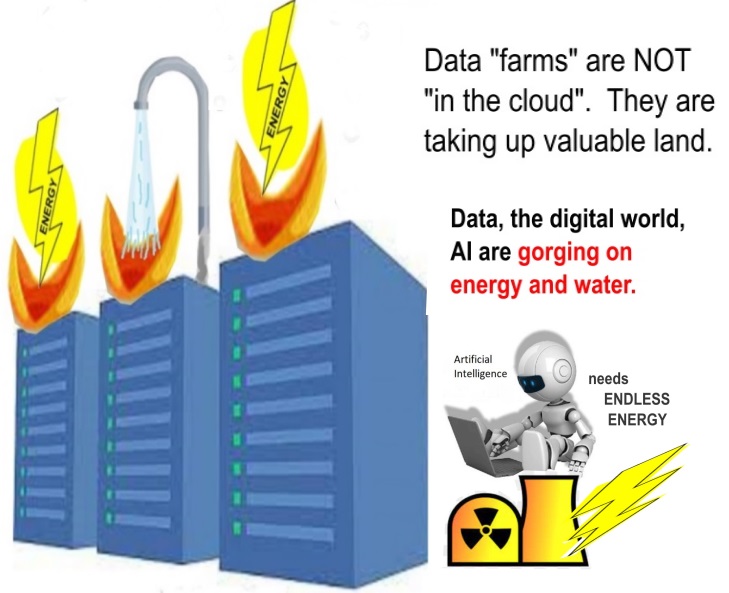
As of last month, when [data centres] were classed as critical national
infrastructure, data centres are on a par with utilities, meaning the
government would step in were there a risk to connectivity. Nonetheless, as
Rohan Kelkar, the executive vice-president of power products at Schneider
Electric, puts it, the “lack of grid capacity puts UK’s AI and data
centre ambitions and energy transition goals at risk”.
So much so that we have seen the boroughs of Hillingdon, Ealing and Hounslow all rejecting
data centre projects in order to retain supply for housing. This is far
from a UK-specific issue. In Ireland, the pressure on the national grid
from computing needs is so acute they have had to pause some data centre
approvals over concerns that excessive demand from data centres could lead
to blackouts.
On the other side of the Atlantic, Big Tech companies are
also grappling with the energy conundrum: how to find low-carbon, reliable
sources of power for their power-hungry warehouses without jeopardising
customer needs or their net zero goals. Along with renewable energy and
improving battery storage, right now they all seem to be turning in one
direction: towards nuclear power. Microsoft signed a deal last month to
help resurrect a unit of the Three Mile Island plant in Pennsylvania.
Amazon bought a nuclear-powered data centre earlier in the year. On Monday,
Google became the latest to announce a nuclear energy deal to meet the
needs of its data centres, looking at mini reactors developed by a
Californian company.
A cocktail of technological innovation means this
could happen in the UK, too. Rolls-Royce, the engineer, is at the forefront
of developing mini reactors and is already having conversations with
operators in the UK about their use. While mini nukes would not have been
commercially viable in the past, now that demand for data centres has
jumped exponentially, their potential use has become more feasible. Another
key component in the future marriage of computing and nuclear power is that
data centres are becoming less location driven because of improvements in
latency, the time it takes for data to travel from one point to another.
The immediate problem with the introduction of small nuclear reactors?
Rolls-Royce estimates that they remain a decade or more away, with none
currently operating and generating electricity in the UK. In the meantime,
connection to the “constrained” grid, remains all-important headache
for those looking to build data centres.
Times 16th Oct 2024
TODAY. Media enthusiasm for dodgy “cutting edge Lego-like micro-nuclear power plants” , (but doubts creep in).

modules assembled “like a LEGO kit” and designed to be fabricated, transported, and assembled within 24 months”
BUT -“the tech is still in the early stages and faces a myriad of hurdles.”
“has yet to obtain licensing and planning approvals“
“How the new fleet of SMRs will be funded has yet to be established. The technology is not yet generating power anywhere in the world”
I am fascinated with the way that the media continues to obediently trot out the official dogma that small nuclear reactors are the new great white hope – for everything – jobs, reduce carbon emissions, revitalise the economy, cheap, clean, plentiful energy, – blah blah. The interesting thing is that, in the midst of their enthusiasm, some respectable news outlets occasionally now slip in a little bit of doubt.
A couple of examples of doubt from the UK.:
Guy Taylor, Transport and Infrastructure Correspondent at City A.M. enthuses over a “hotly anticipated tender“ surrounding the development of Small Modular Reactors (SMR)’s in the UK. A micro reactor project in Wales will bring energy for 244,000 UK homes – “will pump around £30m into the local economy”.
But he also mentions that “the tech is still in the early stages and faces a myriad of hurdles.”
Ian Weinfass, in Construction News gives a positive, optimistic, story on this micro nuclear reactor development, but clearly states that the company (Last Energy) “has yet to obtain licensing and planning approvals for its technology.“ He tellingly concludes “How the new fleet of SMRs will be funded has yet to be established. The technology is not yet generating power anywhere in the world”
However, don’t fret, little nuclear rent-seekers! Most of the media is still obedient, and they know which side their bread is buttered on . Sion Barry, writing in Wales Online, describes the same “24/7 clean energy” project as “of national significance“. There’s a reassuring note about wastes, and the barest mention of “planning and licensing approvals“. Business Green discusses the Last Energy plan as “clean energy” – modules assembled “like a LEGO kit” and designed to be fabricated, transported, and assembled within 24 months”
News media, on the whole, are happy to uncritically trot out a nuclear company’s line – as we find this same project touted in Reuters, in Power, Sustainable Times, in New Civil Engineer. On Google News today, there are 15 similar articles, with only Yahoo! News including a tad of doubt about local public reaction.
And by the way, Tom Pashby in New Civil Engineer also adds to the joy by telling us that the company involved, Last Energy is working with Nato on military applications of micro-reactors.
What does Google’s move into nuclear power mean for AI – and the world?
” tech companies operate: as supranational organisations that manage to bend countries’ regulation to their will,”

In today’s newsletter: Google will soon use nuclear reactors to run its AI datacentres. What are the economic, ethical and environmental implications?
Archie Bland, Wed 16 Oct 2024
Good morning. If you were looking for an inkblot test for your view of big tech’s investment in artificial intelligence, you could hardly do better than the news that Google is ordering the construction of at least six small nuclear reactors to power the growth of the technology.
Here, in one view, is an enlightened business leveraging its size to invest in infrastructure that could change the world for the better. Here, in another, is a poorly regulated corporation ignoring democratic objections in the brutal race for control of an innovation with great potential to do harm – and leaving the rest of us with little say in its development.
Google is making this eye-catching move because the datacentres that power the explosive growth of generative AI consume huge amounts of electricity – more than the existing grid in the US or other western nations can readily supply. For today’s newsletter, I spoke to technology journalist Chris Stokel-Walker, author of How AI Ate the World, about why the demand for power is growing so quickly – and whether we can trust big tech to handle the consequences. Here are the headlines.
In depth: Why AI needs so much power – and what big tech will do to get it
They might be called “small nuclear reactors”, but don’t be fooled: the 500MW Google is buying from Kairos Power is enough to power a midsize city. To begin to understand the scale of the demand AI puts on the electricity grid, keep in mind that this is only enough to cover one datacentre campus equipped to handle the growing demands of AI. One company alone, OpenAI, is trying to get the White House to sign off on building at least five datacentres, needing 5GW each of power – 10 times as big.
The reason for this nuclear power rush: the vast energy consumption of the computer chips (called graphics processing units or GPUs) that power the training of the large language models crucial to the development of AI. Meanwhile, a ChatGPT query needs nearly 10 times as much electricity to process as a Google search.
“GPUs are more advanced and more powerful than the CPUs [central processing units] of the previous generation of datacentres,” Chris Stokel-Walker said. “So there’s more demand there immediately. But we are also starting to see massive ‘megaclusters’ of GPUs. It’s not just the individual chips getting bigger and needing more power: it’s the race to get as many together to amplify their power as possible.”
How much impact will AI’s demand for power have?
“The challenge in estimating this is that the companies are pretty coy about telling us their power usage,” said Chris. “But there is a settled understanding that the energy used by datacentres is going to increase hugely as AI becomes layered into everything we do.”
The increase in demand already is significant: where the average datacentre drew 10MW of power a decade ago, they need 100MW today. And the biggest can already demand more than 600MW each.
The New York-based Uptime Institute, which has created a benchmarking system that is now industry standard, predicts that whereas AI only accounts for 2% of global datacentres’ power use today, that will reach 10% by next year. “The growth in power consumption is not linear,” Chris said. “In the same way that we used to have whacking great transistors behind our TVs and now we have flatscreens with eco-friendly modes, they are getting more efficient. But that doesn’t mean it’s not going upwards – just that it’s going up more slowly.”
How are tech companies trying to get the power to meet their needs?
By building it or paying others to do so. And because most governments expect that control of AI will be crucial to their ability to compete globally in the future, tech firms have a very strong hand when negotiating what to build and where.
“The argument tech companies are making, and that they’re trying to cement in the minds of decision-makers around the world, is: you either buy into this and sign up, or you run the risk of falling behind,” Chris said.
This New York Times piece lays out a case study of how that plays out in practice. It reports that as part of a recent fundraising effort, OpenAI’s CEO, Sam Altman, told executives at a Taiwanese semiconductor company that it would cost about $7tn (£5.6tn) to fulfil his vision of 36 semiconductor plants and additional datacentres. That’s about a quarter of the total US annual economic output. OpenAI denies that claim, and says that its plans run to the hundreds of billions of dollars.
Meanwhile, Altman has also been considering building these centres in other countries, including the United Arab Emirates. But there are fears in Washington that placing the centres there could give China a back door to American AI advances, because of the links between Chinese and Emirati universities. And at the same time, Altman is exploring plans for centres within the US.
“The warning is being used as a stick alongside the carrot,” Chris said. “They’re saying: if you don’t do this, we will go elsewhere, and you will not just lose the investment, but face a national security risk.”
What is the potential impact on the climate?
Big tech companies insist they are leaning into renewable sources of power as much as possible – and argue that AI could ultimately be a crucial tool to limit the damage caused by the climate crisis.
It is true that tech firms’ investment in renewable sources of energy has played an important part in their growth. But claiming that AI will help defeat the climate crisis is a theoretical benefit that won’t be seen until some point in the fairly distant future. And there are claims that emissions caused by current energy usage from datacentres owned by the likes of Google, Microsoft and Meta are much higher than they admit publicly.
In this piece published last month, Isabel O’Brien reported that big tech firms are using renewable energy credits – which may not actually be used to power the datacentres themselves and which may not even reduce emissions – to artificially deflate their reported emissions. That means the actual figures could be more than seven times higher than the numbers they report.
What about the use of nuclear power?
Google says its experiment makes it the first company in the world to buy nuclear energy from small nuclear reactors. But Amazon and Microsoft have already struck deals with conventional, larger nuclear power plants in the US this year. Don’t panic, but Microsoft’s deal will for the first time in five years activate a nuclear reactor at Three Mile Island in Pennsylvania – the site of the worst nuclear meltdown in US history. Sensibly, they’re emphasising its history of safe operation since the 1979 disaster at another reactor there – and renaming it.
With datacentres estimated to be on track to produce about 2.5bn tonnes of carbon-dioxide equivalent emissions by 2030, there is an environmental argument for the use of nuclear power. But that is a highly controversial case, which, because of the associated risks, has been the subject of charged democratic debate for many years. Wherever you stand on that question, it is remarkable that these companies appear to be able to simply decide on their own.
“One of the things that’s really striking here is what it says about how tech companies operate: as supranational organisations that manage to bend countries’ regulation to their will,” Chris said.
On the other hand, Google argues its investment in small nuclear reactors could be a necessary boost to a technology that has struggled to get off the ground. “In the end, some of this does trickle down,” said Chris. “They tend to commercialise technologies in a safe way. But it takes a long time, and the benefits are unequally distributed.”
Can governments bring these changes under control?
There are well-documented issues with regulating tech firms: without globally enforced agreements, there will always be another country ready to offer a better deal. See, for example, Ireland’s status as the European home of many big techfirms because of its favourable tax regime.
Regulation does not necessarily need to be globally agreed to be effective, however: in California, for example, new legislation intended to combat greenwashing will soon require all private companies with global revenue above $1bn to publish details of their carbon footprint. Since any big tech firm is bound to want to maintain operations in California, that could have much wider ramifications.
The impact of attempts at regulation and better data collection on the growth of AI may also depend on whether tech firms willingly cooperate – and if not, whether there is an appetite to force them to. The controversy over renewable energy credits is an example of how vexed even apparently positive steps can be.
And big tech firms have a valuable card in their hand: the desperate desire among governments around the world to win the AI race. “These companies point to astronomical figures of expected improvements in GDP and they say, this is the wave that is coming,” Chris said. “You can either ride it, or drown.”
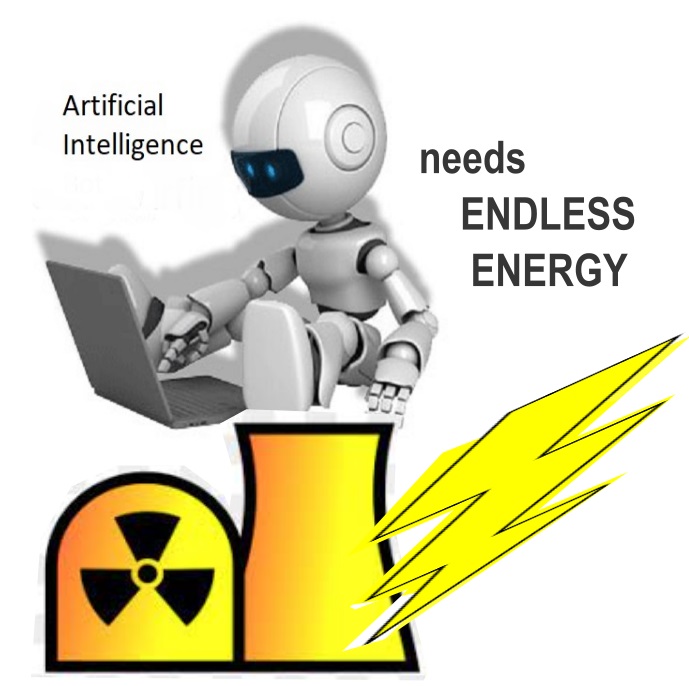
Open AI Wants to Build Data Centres That Would Consume More Electricity Per Year Than the Whole of the U.K.
The Daily Sceptic, by David Turver, 14 October 2024
Over the past few months, the newswires have been hot with stories about the large-scale data centres that will be required to meet the needs of the forthcoming revolution in Artificial Intelligence (AI). How much electricity will these new data centres consume and what does that mean for the electricity demand forecasts underpinning the plans for Net Zero?
Recent Date Centre Announcements.
To give a flavour of the scale of data centre developments that are coming, it is helpful to look at recent announcements from large tech companies. Back in March, it was announced that Amazon had bought a 960MW data centre that is powered by an adjacent nuclear power station. In April, Mark Zuckerberg CEO of Meta that owns Facebook and Instagram said energy requirements may hold back the build out of AI data centres. He also talked about building data centres that would consume 1GW of power.
Last month, Oracle chairman Larry Ellison announced that Oracle was designing a data centre that would consume more than 1GW that would be powered by three small modular nuclear reactors (SMRs). Then Microsoft also got in on the act when it announced it had done a deal with U.S. utility Constellation to restart the 835MW Three Mile Island (TMI) Unit 1 nuclear power plant to power its data centres. Anxious not to be left out, Sundar Pichai, CEO of Google said they too were working on 1GW data centres and saw money being invested in SMRs.
Finally, Sam Altman of OpenAI, the creator of ChatGPT has trumped them all by pitching the idea of 5GW data centres to the White House. Altman has been heard talking of building five to seven of these leviathans…………………….
Scale of AI Energy Demand
When companies bandy about such large numbers it is sometimes difficult to visualise just how big they are. For context, consider that a 1GW data centre would consume 8.76TWh of electricity each year. Seven of Altman’s enormous 5GW data centres would consume 306.6TWh. According to DUKES data (Table 5.6) the UK generated 292.6TWh in 2023. The plans for ChatGPT alone would consume more electricity in a year than the U.K., the sixth largest economy in the world, managed to generate. Now consider what the total demand is going to be when you add in the requirements the likes of Amazon, Oracle, Microsoft, Meta, Google and X…………………………………………..
Google Pivots to Nuclear Reactors to Power Its Artificial Intelligence
Science Alert, 15 October 2024, Glenn Chapman,
Google on Monday signed a deal to get electricity from small nuclear reactors to help power artificial intelligence.
The agreement to buy energy from reactors built by Kairos Power came just weeks after word that Three Mile Island, the site of America’s worst nuclear accident, will restart operations to provide energy to Microsoft………………………………………..
Insatiable AI
Tech giants like Microsoft, Amazon, and Google are rapidly expanding their data center capabilities to meet the AI revolution’s computing needs while also scouring the globe for sources of electricity………………………………….
However, the technology is still in its infancy and lacks regulatory approval, leading companies to seek out existing nuclear power options……………………………..
Is it safe?
………………………………… This area faces severe strain from data centers’ massive energy consumption, raising concerns about grid stability as AI demands increase.
Amazon’s AWS agreed in March to invest $650 million in a data center campus powered by another Pennsylvania nuclear plant.
Nuclear energy has staunch opponents due to concerns about radioactive waste disposal, the potential for catastrophic accidents, and the high costs associated with plant construction and decommissioning……….. https://www.sciencealert.com/google-pivots-to-nuclear-reactors-to-power-its-artificial-intelligence
A new military-industrial complex: How tech bros are hyping AI’s role in war
The current debate on military AI is largely driven by “tech bros” and other entrepreneurs who stand to profit immensely from militaries’ uptake of AI-enabled capabilities.
the new military-industrial complex wherein business leaders are framing the future direction of war, despite their lack of military experience.
Bulletin, By Paul Lushenko, Keith Carter | October 7, 2024
Since the emergence of generative artificial intelligence, scholars have speculated about the technology’s implications for the character, if not nature, of war. The promise of AI on battlefields and in war rooms has beguiled scholars. They characterize AI as “game-changing,” “revolutionary,” and “perilous,” especially given the potential of great power war involving the United States and China or Russia.
In the context of great power war, where adversaries have parity of military capabilities, scholars claim that AI is the sine qua non, absolutely required for victory. This assessment is predicated on the presumed implications of AI for the “sensor-to-shooter” timeline, which refers to the interval of time between acquiring and prosecuting a target. By adopting AI, or so the argument goes, militaries can reduce the sensor-to-shooter timeline and maintain lethal overmatch against peer adversaries…………………..
It encourages policymakers and defense officials to follow what can be called a “primrose path of AI-enabled warfare,” which is codified in the US military’s “third offset” strategy……………………
The current debate on military AI is largely driven by “tech bros” and other entrepreneurs who stand to profit immensely from militaries’ uptake of AI-enabled capabilities. Despite their influence on the conversation, these tech industry figures have little to no operational experience, meaning they cannot draw from first-hand accounts of combat to further justify arguments that AI is changing the character, if not nature, of war. Rather, they capitalize on their impressive business successes to influence a new model of capability development through opinion pieces in high-profile journals, public addresses at acclaimed security conferences, and presentations at top-tier universities.
To the extent analysts do explore the implications of AI for warfighting, such as during the conflicts in Gaza, Libya, and Ukraine, they highlight limited—and debatable—examples of its use, embellish its impacts, conflate technology with organizational improvements provided by AI, and draw generalizations about future warfare.
It is possible that AI-enabled technologies, such as lethal autonomous weapon systems or “killer robots,” will someday dramatically alter war. Yet the current debate for the implications of AI on warfighting discounts critical political, operational, and normative considerations that imply AI may not have the revolutionary impacts that its proponents claim, at least not now.
………………………………………………….. Our research suggests that three related considerations have combined to shape the hype surrounding military AI, informing the primrose path of AI-enabled warfare. First, that primrose path is paved by the emergence of a new military industrial complex that is dependent on commercial service providers. Second, this new defense acquisition process is the cause and effect of a narrative suggesting a global AI arms race, which has encouraged scholars to discount the normative implications of AI-enabled warfare. Finally, while analysts assume that soldiers will trust AI, which is integral to human-machine teaming that facilitates AI-enabled warfare, trust is not guaranteed.
………………………………………………………………….The primrose path of AI-enabled warfare is paved by a new military-industrial complex. Countries typically acquire military technologies, such as drones, for reasons that relate to supply, demand, and status considerations………………………………………………………………………
The political economy of the primrose path of AI-enabled warfare is different. It flips these defense acquisition processes on their heads such that industry drives, rather than responds to, militaries’ requirements for new capabilities. This approach reflects the United States’ historical preference for technology standards that are based on a “bottom-up, laissez-faire corporate-led strategy,” which emphasizes the anticipated economic advantages of leading-sector innovation.
These industry drivers consist of businesses that are funded by venture capitalists, including Anduril, Black Cape, Inc., Clarifai, CrowdAI, and ScaleAI; established defense contractors such as AWS, ECS Federal, IBM, Maxar, Microsoft, Palantir, Raytheon, and the Sierra Nevada Corporation; and business magnates like Elon Musk, Palmer Luckey, and Eric Schmidt. ………………………………………….. Luckey, founder of Anduril, promises to “save western civilization…as we make tens and tens of billions of dollars a year.”
Similarly, Musk’s Starlink uses low-earth orbit satellites to provide militaries’ assured communication in expeditionary and contested environments. Earlier in its war with Russia, Musk decided if Ukraine could use the Starlink satellite network, thus shaping the country’s military operations against Russia on the basis of his fears of crisis escalation. Schmidt’s new start-up, White Stork (previously Swift Beat), is designed to develop fully-autonomous drones. Schmidt, capitalizing on his previous roles as Chairman of the National Security Commission on AI and Director of the Defense Innovation Board, also instantiates the new military-industrial complex wherein business leaders are framing the future direction of war, despite their lack of military experience.
……………………………………………………………………………..the primrose path of AI-enabled warfare is also shaped by a military-industrial complex that provides technical warfighting solutions as a service, meaning they often do not respond to validated military requirements. Thus, companies’ have hedged their bets, investing billions of dollars into end-to-end AI-enabled technologies that they assume militaries will need to purchase to maintain lethal overmatch of adversaries during future conflict. This also means that businesses, especially their software engineers referred to as field engineers, are embedded within military organizations to an unprecedented degree that may muddle the legitimate use of force, at least for some critics.
………………………………………….. an assumption that a monopoly over these technologies will result in economic gains that undergird military power and shape the global balance of power. Russian president Vladimir Putin argued that whoever leads the development of AI will dominate the world; President Xi Jinping intends for China to surpass the United States as the world’s leader of AI development by 2030; and the United States is outspending other countries for AI development……………………………….survey research in the United States shows that support for AI-enabled warfare among both the public and military is strongly shaped by a perceived AI arms race globally.
This perspective has implications for the legal, moral, and ethical considerations that shape countries’ use of force, which scholars emphasize to greater or lesser degrees when characterizing future war. Skeptics caution that AI-enabled warfare will deskill humans and supplant their agency, leading to unintended consequences including crisis escalation, civilian casualties, and accountability and responsibility gaps for these outcomes.
………………………………………………………….Soldiers do not trust AI. The military-industrial complex, and the narratives of an AI arms race that encourages it, assumes that soldiers will trust human-machine teaming. In a recent opinion piece with Schmidt, Mark Milley, formerly chairman of the US Joint Chiefs of Staff, pontificated that “soldiers could sip coffee in their offices, monitoring screens far from the battlefield, as an AI system manages all kinds of robotic war machines.” Despite this sanguine prediction, it is unclear what shapes soldiers’ trust in AI, thus encouraging them to overcome inherent skepticism of machines.
…………………………………………………………………. Our findings suggest that soldiers’ trust in AI is not a foregone conclusion. Further, we found that trust is complex and multidimensional. Importantly, these findings are consistent across the military ranks.
First, senior officers do not trust AI-enhanced capabilities. …………………………………………………………………………………
Visualizing the future of war. Still, it is not only likely, but probable, that AI will shape future warfare in unique ways. As discussed above, the development of AI for commercial applications is re-ordering the defense acquisitions process…………………………………………………………………….
The use of AI to create novel text, images, and video will likely exacerbate the challenge of cognitive warfare. This form of non-lethal warfare explains the social engineering of adversaries’ beliefs, with the overall intent to affect their defense priorities, military readiness, and operations. In this way, countries will attempt to harness AI to produce misinformation and disinformation, which are designed to mislead and deceive opponents, and across the competition continuum ranging from peace to war.
During competition, countries will likely use AI to stoke social, political, and economic grievances among their opponents, such that their defense planning and military readiness are embroiled by increasing levels of partisanship, social unrest, and even political violence…………………………………………………………………………………….
During armed conflict, the confusion created by AI-generated psychological operations will threaten situational awareness required for timely decision-making. In the worst case scenarios, this could cause misidentification of friendly forces, leading to fratricide…………………………………………………………….
In the more distant future, as AI matures, further delegation of military operations would likely go to autonomous systems. This is often referred to as minotaur warfare, such that machines control humans during combat and across domains, which can range from patrols of soldiers on the ground to constellations of warships on the ocean to formations of fighter jets in the air….. https://thebulletin.org/2024/10/a-new-military-industrial-complex-how-tech-bros-are-hyping-ais-role-in-war/
At last – one corporate newsmedia admits there is no “cloud” – only dirty great steel structures
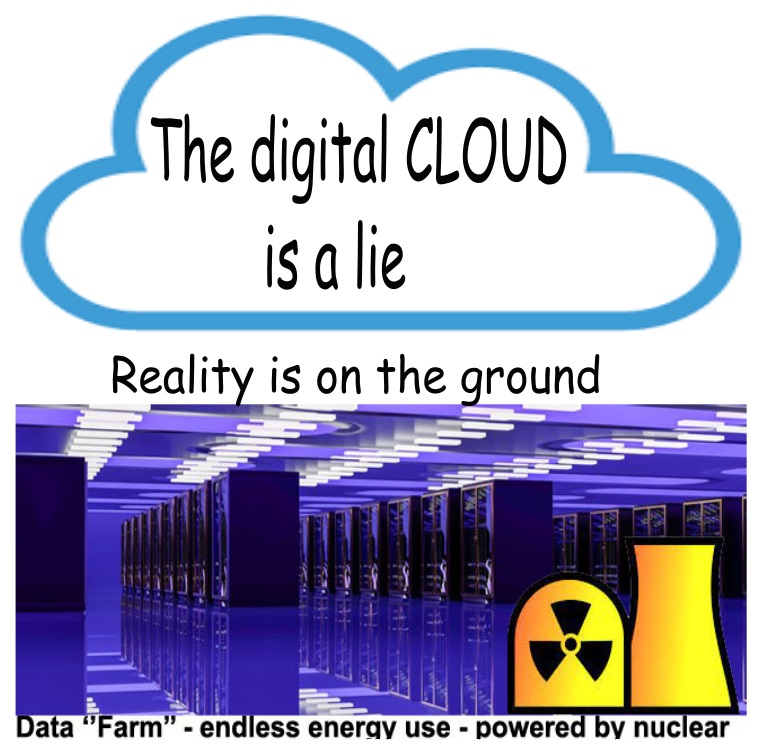
Stopping the great AI energy squeeze will need more than data centres
Amazon Web Services is currently rolling out €30bn of investments in
Europe amid a boom in artificial intelligence, according to Neil Morris,
its Irish head. But none of that bonanza is going to Ireland, because
Amazon officials worry about future energy constraints.
Indeed, there are reports that the company has already been rerouting some cloud activity
because of this. And while the Irish government has pledged to expand the
grid, mostly via wind farms, this is not happening fast enough to meet
demand. The water infrastructure is creaking too. Yes, you read that right:
an (in)famously wet and windy country is struggling to sustain tech with
water and wind power. There are at least four sobering lessons here. First,
this saga shows that our popular discourse around tech innovation is, at
best, limited and, at worst, delusional.
More specifically, in modern
culture we tend to talk about the internet and AI as if it they were a
purely disembodied thing (like a “cloud”). As a consequence,
politicians and voters often overlook the unglamorous physical
infrastructure that makes this “thing” work, such as data centres,
power lines and undersea cables.
But this oft-ignored hardware is essential
to the operation of our modern digital economy, and we urgently need to pay
it more respect and attention. Second, we need to realise this
infrastructure is also increasingly under strain. In recent years the
energy consumption of data centres has been fairly stable, because rising
levels of internet usage were offset by rising energy efficiency.
However, this is now changing fast: AI queries use around 10 times more energy than
existing search engines. Thus the electricity consumption of data centres
will at least double by 2026, according to the International Energy Agency
— and in the US they are expected to consume nine per cent of all
electricity by 2030. In Ireland the usage has already exploded to over a
fifth of the grid — more than households.
FT 4th Oct 2024,
https://www-ft-com.ezphost.dur.ac.uk/content/4fd66b27-f51b-4029-af3a-f5521368046f
On Army bases, nuclear energy can’t add resilience, just costs and risks
In this op-ed, Alan J. Kuperman argues that the risks of adding nuclear reactors to military bases outweigh any benefits.
By Alan J. Kupermanon October 07, 2024, https://breakingdefense.com/2024/10/on-army-bases-nuclear-energy-cant-add-resilience-just-costs-and-risks/?fbclid=IwY2xjawFxlwlleHRuA2FlbQIxMQABHZAdc8iogUaPZy6lBkxZanmlnIB3-Rh3nkB6DDMNuGH1snaqLwuI5-PJWA_aem_NL8jwrpce6F1ZUFkVDIG9A
Every now and then, the US government offers a huge subsidy to an industry on grounds that make no sense to anyone with even basic knowledge of the subject. The latest example, announced in June, is the Army’s Advanced Nuclear Power for Installations (ANPI) program to install small reactors on military bases, ostensibly to increase “energy resilience.”
This is perplexing for several reasons. First, such resilience can be provided much more effectively, safely, and cheaply with non-nuclear options. Second, nuclear reactors themselves cannot provide “resilience,” because their safe operation always has required input of electricity to the reactors from other power sources. Third, the Army’s planned reactors would lack a robust containment building, so an attack or accident could disperse radioactive waste, endangering base personnel and neighboring civilians.
Both the Army and taxpayers should cry foul on this indefensible waste of national security dollars.
Of course, energy resilience is a reasonable concern for Army bases, which now get their electricity from the commercial grid that is potentially subject to blackouts from bad weather or even cyberattacks. The simple and inexpensive solution, already utilized by military bases and other essential services including hospitals, is to maintain backup diesel fuel and generators for emergency use. It costs only about $2 million to $4 million for a set of diesel generators to produce 5 megawatts of electricity — the amount the Army seeks — and the diesel fuel would be cheap since the generators would operate only during rare emergencies.
By contrast, the price of a single nuclear reactor to produce the same five megawatts of electricity would be several hundred million dollars — roughly 100 times as expensive — according to government estimates and my previously published research. Even if, as the Army hopes, the reactor could replace the commercial grid as the primary source of power for the base, the electricity produced by the reactor would cost several times more than what the Army now pays for commercial electricity. So, regardless of whether the reactor was used for primary or backup power, Army costs would spike substantially.
What about resilience, which is the supposed justification for buying these expensive reactors? Well, even though reactors can produce electricity, they have always required an external source of electricity to keep them running safely — most crucially to cool the fuel to avoid a nuclear meltdown and radioactive release. The Army’s recent request for proposals seems to acknowledge this reality by saying that in addition to an external electricity source, the reactor must have an “alternative credited independent power source as a backup.”
Therefore, an Army base reactor would almost surely depend on drawing electricity from the commercial grid. But this means the reactor would be no more resilient than the existing power source it is supposed to replace to increase resilience. In the event of a blackout of the commercial grid, what would the reactor do to get essential electricity? Of course, it would turn on its backup diesel generators. However, if the base requires backup generators anyway, it has no need for the super-expensive reactor.
It gets even worse. To prevent costs from rising even higher, the nuclear industry has decided that its small reactors — the kind the Army is seeking — will be built without a containment building that could prevent radiation from escaping in the event of an accident. This also means the reactors would be more vulnerable to attack by aircraft, missiles, rockets, and drones.
A successful kinetic attack could spread radioactivity in at least two ways. First, like a “dirty bomb,” it could disperse the reactor’s solid irradiated fuel over a wide area into a few or many radioactive chunks that would be very hazardous if approached. Even worse, if the attack interrupted the reactor’s active or passive cooling, the fuel could overheat and breach its cladding, thereby allowing gaseous radioactivity to spread more widely.
Ironically, it is not clear if the Army even wants these nuclear reactors, which originally were proposed in 2018 by Congressional advocates of nuclear energy, who also have promoted nuclear reactors for Air Force bases and forward operating bases — including in war zones where they would be even more vulnerable.
Comments from Pentagon officials about these programs indicate that at least part of the motivation is to help America’s struggling nuclear reactor companies, which have yet to find a single private-sector customer for their small but pricey powerplants. The Defense Secretary’s manager for the Army’s mobile reactor project touts it as “a pathfinder to advanced nuclear reactors in the commercial sector.” A Deputy Assistant Secretary in the Air Force says, “We’re trying to … create a playbook of how other villages or communities and cities” can pursue “energy through a microreactor.”
But even if the civilian nuclear industry deserved additional subsidies, which is questionable, that would not justify wasting defense dollars on unnecessary reactors that could endanger our troops.
Truthfully, energy resilience for military bases is a real concern that deserves safe, effective, and economical solutions — but nuclear reactors satisfy none of those criteria.
Fortunately, we live in a democracy, so there is still a chance to stop these dangerous boondoggles. Service members and their dependents, communities near military bases, and taxpayers in general can and should call on Congress to suspend the ANPI program — and instead explore how its funding could be reprogrammed more productively.
Alan J. Kuperman is associate professor and coordinator of the Nuclear Proliferation Prevention Project (www.NPPP.org) at the LBJ School of Public Affairs, University of Texas at Austin.
Sorry, AI won’t “fix” climate change.
OpenAI’s Sam Altman claims AI will deliver an “Intelligence Age,” but tech breakthroughs alone can’t solve global warming.
James Temple, September 28, 2024,
https://www.technologyreview.com/2024/09/28/1104588/sorry-ai-wont-fix-climate-change/
In an essay last week, Sam Altman, the CEO of OpenAI, argued that the accelerating capabilities of AI will usher in an idyllic “Intelligence Age,” unleashing “unimaginable” prosperity and “astounding triumphs” like “fixing the climate.”
It’s a promise that no one is in a position to make—and one that, when it comes to the topic of climate change, fundamentally misunderstands the nature of the problem.
More maddening, the argument suggests that the technology’s massive consumption of electricity today doesn’t much matter, since it will allow us to generate abundant clean power in the future. That casually waves away growing concerns about a technology that’s already accelerating proposals for natural-gas plants and diverting major tech companies from their corporate climate targets.
By all accounts, AI’s energy demands will only continue to increase, even as the world scrambles to build larger, cleaner power systems to meet the increasing needs of EV charging, green hydrogen production, heat pumps, and other low-carbon technologies. Altman himself reportedly just met with White House officials to make the case for building absolutely massive AI data centers, which could require the equivalent of five dedicated nuclear reactors to run.
It’s a bedrock perspective of MIT Technology Review that technological advances can deliver real benefits and accelerate societal progress in meaningful ways. But for decades researchers and companies have oversold the potential of AI to deliver blockbuster medicines, achieve super intelligence, and free humanity from the need to work. To be fair, there have been significant advances, but nothing on the order of what’s been hyped.
Given that track record, I’d argue you need to develop a tool that does more than plagiarize journalism and help students cheat on homework before you can credibly assert that it will solve humanity’s thorniest problems, whether the target is rampant poverty or global warming.
To be sure, AI may help the world address the rising dangers of climate change. We have begun to see research groups and startups harness the technology to try to manage power grids more effectively, put out wildfires faster, and discover materials that could create cheaper, better batteries or solar panels.
All those advances are still relatively incremental. But let’s say AI does bring about an energy miracle. Perhaps its pattern-recognition prowess will deliver the key insight that finally cracks fusion—a technology that Altman is betting on heavily as an investor.
That would be fantastic. But technological advances are just the start—necessary but far from sufficient to eliminate the world’s climate emissions.
How do I know?
Because between nuclear fission plants, solar farms, wind turbines, and batteries, we already have every technology we need to clean up the power sector. This should be the low-hanging fruit of the energy transition. Yet in the largest economy on Earth, fossil fuels still generate 60% of the electricity. The fact that so much of our power still comes from coal, petroleum, and natural gas is a regulatory failure as much as a technological one.
“As long as we effectively subsidize fossil fuels by allowing them to use the atmosphere as a waste dump, we are not allowing clean energy to compete on a level playing field,” Zeke Hausfather, a climate scientist at the independent research organization Berkeley Earth, wrote on X in a response to Altman’s post. “We need policy changes, not just tech breakthroughs, to meet our climate goals.”
That’s not to say there aren’t big technical problems we still need to solve. Just look at the continuing struggles to develop clean, cost-competitive ways of fertilizing crops or flying planes. But the fundamental challenges of climate change are sunk costs, development obstacles, and inertia.
We’ve built and paid for a global economy that spews out planet-warming gases, investing trillions of dollars in power plants, steel mills, factories, jets, boilers, water heaters, stoves, and SUVs that run on fossil fuels. And few people or companies will happily write off those investments so long as those products and plants still work. AI can’t remedy all that just by generating better ideas.
To raze and replace the machinery of every industry around the world at the speed now required, we will need increasingly aggressive climate policies that incentivize or force everyone to switch to cleaner plants, products, and practices.
But with every proposal for a stricter law or some big new wind or solar farm, forces will push back, because the plan will hit someone’s wallet, block someone’s views, or threaten the areas or traditions someone cherishes. Climate change is an infrastructure problem, and building infrastructure is a messy human endeavor.
Tech advances can ease some of these issues. Cheaper, better alternatives to legacy industries make hard choices more politically palatable. But there are no improvements to AI algorithms or underlying data sets that solve the challenge of NIMBYism, the conflict between human interests, or the desire to breathe the fresh air in an unsullied wilderness.
To assert that a single technology—that just happens to be the one your company develops—can miraculously untangle these intractable conflicts of human society is at best self-serving, if not a little naïve. And it’s a troubling idea to proclaim at a point when the growth of that very technology is threatening to undermine the meager progress the world has begun to make on climate change.
As it is, the one thing we can state confidently about generative AI is that it’s making the hardest problem we’ve ever had to solve that much harder to solve.
In the Woomera Manual, International Law Meets Military Space Activities

by David A. Koplow, September 12, 2024, https://www.justsecurity.org/100043/woomera-manual-international-law-military-space/
The law of outer space, like so much else about the exoatmospheric realm, is under stress. The prodigious growth in private-sector space activities (exemplified by SpaceX’s proliferating Starlink constellation, and other corporations following only shortly behind) is matched by an ominous surge in military space activities – most vividly, the creation of the U.S. Space Force and counterpart combat entities in rival States, the threat of Russia placing a nuclear weapon in orbit, and China and others continuing to experiment with anti-satellite weapons and potential techniques. The world is on the precipice of several new types of space races, as countries and companies bid for first-mover advantages in the highest of high ground.
The law of outer space, in contrast, is old, incomplete, and untested. A family of foundational treaties dating to the 1960s and 1970s retains vitality, but provides only partial guidance. Space is decidedly not a “law-free zone,” but many of the necessary guard rails are obscure, and few analysts or operators have ventured into this sector.
A new treatise, the Woomera Manual on the International Law of Military Space Activities and Operations, has just been published by Oxford University Press to provide the first comprehensive, detailed analysis of the existing legal regime of space. As one of the editors of the Manual, I can testify to the long, winding, and arduous – but fascinating – journey to produce it, and the hope that it will provide much-needed clarity and precision about this fast-moving legal domain.
Military Manuals
This Manual follows a grand tradition of prior efforts to articulate the applicable international military law in contested realms, including the 1994 San Remo Manual on Naval Warfare, Harvard’s 2013 Humanitarian Policy and Conflict Research Manual on Air and Missile Warfare, and the 2013 and 2017 Tallinn Manuals on Cyber Operations. The Woomera Manual was produced by a diverse team of legal and technical experts drawn from academia, practice, government, and other sectors in several countries (all acting in their personal capacities, not as representatives of their home governments or organizations). The process consumed six years (slowed considerably by the Covid-19 pandemic, which arrested the sequence of face-to-face drafting sessions).
The Manual is co-sponsored by four universities, among other participants: the University of Nebraska College of Law (home of Professor Jack Beard, the editor-in-chief), the University of Adelaide (with Professor Dale Stephens on the editorial board), the University of New South Wales—Canberra, and the University of Exeter (U.K.) The name “Woomera” was chosen in recognition of the small town of Woomera, South Australia, which was the site of the country’s first space missions, and in acknowledgement of the Aboriginal word for a remarkable spear-throwing device that enables greater accuracy and distance.
Comprehensive Coverage of a Broad Field
Three features of the Woomera Manual stand out. The first is the comprehensive nature of the undertaking. The Manual presents 48 rules, spanning the three critical time frames: ordinary peace time, periods of tension and crisis, and during an armed conflict. There may be a natural tendency to focus on that last frame, given the high stakes and the inherent drama of warfare, but the editors were keen to address the full spectrum, devoting due attention and analysis to the background rules that apply both to quotidian military space activities and to everyone else in space.
Complicating the legal analysis is the fragmentation of the international legal regime. In addition to “general” international law – which article III of the Outer Space Treaty declares is fully applicable in space – two “special” areas of law are implicated here. One, the law of armed conflict (also known as international humanitarian law) provides particularized jus in bello rules applicable between States engaged in war, including wars that begin in, or extend to, space. But the law of outer space is also recognized as another lex specialis, and it accordingly provides unique rules that supersede at least some aspects of the general international law regime. What should be done when two “special” areas of international law overlap and provide incompatible rules? The Woomera Manual is the first comprehensive effort to unravel that riddle.
The Law as It Is
A second defining characteristic of this Manual is the persistent, rigid focus on lex lata, the law as it currently is, rather than lex ferenda, the law as it may (or should) become. The authors, of course, each have their own policy preferences, and in their other works they freely opine about how the international space law regime should evolve (or be abruptly changed) to accommodate modern dangers and opportunities. But in this Manual, they have focused exclusively on describing the current legal structure, concentrating on treaties, customary international law, and other indicia of State practice. This is not the sort of manual in which the assembled experts “vote” on their competing concepts of the legal regime; instead, Woomera addresses what States (the sources and subjects of international law) say, do, and write. The authors have assembled a monumental library of State behaviors (including words as well as deeds, and silences as well as public pronouncements), while recognizing that diplomacy (and national security classification restrictions) often impede States explaining exactly why they did, or did not, act in a particular way in response to some other State’s provocations.
One feature that enormously facilitated the work on the Manual was a phase of “State engagement.” In early 2022, the Ministries of Foreign Affairs and Defense of the government of the Netherlands circulated a preliminary draft of the Woomera Manual to interested national governments and invited them to a June 2022 conference in The Hague to discuss it. Remarkably, two dozen of the States most active in space attended, providing two days of sustained, thoughtful, constructive commentary. The States were not asked to “approve” the document, but their input was enormously valuable (and resulted in an additional several months of painstaking work in finalizing the manuscript, as the editors scrambled to take into account the States’ voluminous comments and the new information they provided).
Space as a Dynamic Domain
Third, a manual on space law must acknowledge the rapidly-changing nature and scope of human activities in this environment, and the great likelihood that even more dramatic alterations are likely in the future. Existing patterns of behavior may alter abruptly, as new technologies and new economic opportunities emerge. The Manual attempts to peer into the future, addressing plausible scenarios that might foreseeably arise, but it resists the temptation to play with far-distant “Star Wars” fantasies.
The unfortunate reality here is that although the early years of the Space Age were remarkably productive for space law, the process stultified shortly thereafter. Within only a decade after Sputnik’s first orbit, the world had negotiated and put into place the 1967 Outer Space Treaty, which still provides the cardinal principles guiding space operations today. And within only another decade, three additional widely-accepted treaties were crafted: the 1968 astronaut Rescue Agreement, the 1971 Liability Convention, and the 1975 Registration Convention, as well as the 1979 Moon Convention (which has not attracted nearly the same level of global support and participation). But the articulation of additional necessary increments of international space law has been constipated since then – no new multilateral space-specific treaties have been implemented in the past four decades, and none is on the horizon today.
Sources and Shortcomings of International Space Law
The corpus of international space law is not obsolete, but it is under-developed. We have the essential principles and some of the specific corollaries, but we are lacking the detailed infrastructure that would completely flesh out all those general principles. Some important guidance may, however, be found in State practice, including the understudied negotiating history of the framework treaties for space law, particularly the Outer Space Treaty. The Manual provides important insights in this area, notably with respect to several ambiguous terms embedded in the treaties.
The authors of the Woomera Manual, therefore, were able to start their legal analysis with the framework treaties – unlike, for example, the authors of the Tallinn Manuals, covering international law applicable to cyber warfare, who had to begin without such a structured starting point. Still, the Woomera analysis confronted numerous lacunae, where the existing law and practice leave puzzling gaps. The persistent failure of the usual law-making institutions to craft additional increments of space arms control is all the more alarming as the United States, NATO, and others have declared space to be an operational or war-fighting domain.
Conclusion
It is hoped that the process of articulating the existing rules – and identifying the interstices between them – can provide useful day-to-day guidance for space law practitioners in government, academia, non-governmental organizations, the private sector, and elsewhere. The prospect of arms races and armed conflict in space unfortunately appears to be growing, and clarity about the prevailing rules has never been more important. It is a fascinating, dynamic, and fraught field.
NASA’s uncrewed Artemis mission highlights radiation risk to astronauts
ABC, By science reporter Jacinta Bowler, Thu 19 Sep, 24
In short:
Scientists analysed the radiation experienced by two ‘radiation phantom’ dummies on NASA’s November 2022 uncrewed Artemis I mission.
The results suggest radiation may not be an issue for short Moon missions, but could be on longer Moon layovers or missions to Mars.
What’s next?
Scientists are trying to design ways to minimise radiation on longer space missions, including radio-protective drugs and spacecraft magnetic fields.
In September next year, astronauts will be strapped into the Orion spacecraft and rocketed around the Moon in the first human moon visit in more than 50 years.
And thanks to two space-travelling test dummies we now know those astronauts will likely be protected against dangerously high radiation exposure on their short trip.
Known as “radiation phantoms”, the specially designed dummies Helga and Zohar were included on last year’s Artemis 1 uncrewed mission.
Helga and Zohar are recreations of female humans, complete with fake organs that allowed researchers to record radiation exposure throughout the journey, and analyse results from skin, lungs, stomach, uterus and the spine to understand how radiation moves throughout the body.
The results are published today in Nature.
Stuart George, lead author and a member of the NASA Space Radiation Analysis Group, says the results suggest that radiation exposure won’t be dangerously high for short Moon missions, but problems may arise on longer Moon missions such as the “Gateway” lunar space station, and eventual trips to Mars.
“These measurements comprehensively showed we have a well-developed system for protecting the crew from radiation during Artemis I, but challenges still remain for longer duration missions such as Mars,” Dr George said.
Why is radiation an issue?
………………………………………………Items in low-Earth orbit are under the protection of Earth’s magnetic field, which shields Earth from the vast majority of radiation produced by our Sun (or from background cosmic radiation).
But outside of this field, in open space, it’s a different story.
“In general, radiation levels are higher outside of the protection of low-Earth orbit and the protection of Earth’s magnetic field,” Dr George said.
“In addition, the exposure of crew to space weather, specifically ‘energetic solar particle events’ can be much higher as the Earth’s magnetic field is very effective at shielding these.”
……………………………………………...What did the research find?
The Artemis 1 mission, which lasted for 25 days, flew 450,000 km to the Moon, looped around it and then almost 65,000 kms out into deep space before flying back to Earth.
The team used Helga and Zohar as well as radiation sensors called HERA (Hybrid Electronic Radiation Assessor) placed throughout the cabin of the Orion spacecraft to assess how radiation levels changed throughout the mission.
………………………………………………………………..it wasn’t all good news.
“The inside of the cabin was full of X-rays during the transit of the outer Van Allen belt which was something we did not expect,” Dr George said.
“The overall biological impact was minor, but this was still a fascinating observation.”
The health risk of ionising radiation is measured in millisieverts (mSv).
The research team suggested that a quick trip around the Moon, like in the Artemis I mission might set you back about 26.7 – 35.4 millisieverts (mSv), which is well below the amount that might cause damage to an astronaut.
……………………………………………………………………………. According to Dr George, travelling to, and then staying on Gateway would expose astronauts to much higher levels of radiation than what they would receive on the ISS.
Then there’s Mars, a trip which may take around nine months each way, plus any radiation you might receive on the surface.
When the team extrapolated out the Artemis results to a Mars mission, and combined it with measurements from Mars’ Curiosity rover, they found astronauts might scrape by under the NASA lifetime limit of radiation, which is 600 mSv, but not by much.
“A really big solar particle event (with appropriate sheltering) might also push you up by a few hundred mSv,” Dr George said. …………………………………………………………………..
……………………………………..further into the future, radiation protection might become significantly more high tech.
According to Anatoly Rozenfeld, a medical physicist at the University of Wollongong who specialises in space radiation, one line of research is trying to build a magnetic field for the spacecraft itself, but he warns that this is still very much in it’s infancy.
“There’s a lot of different kinds of projects and some of them are realistic, some of them are less realistic,” Professor Rozenfeld said.
“People are also developing radio-protective drugs. So when you take these pills, your cells will recover very quickly after radiation.” https://www.abc.net.au/news/science/2024-09-19/nasa-radiation-artemis-mission-helga-zolar/104365924
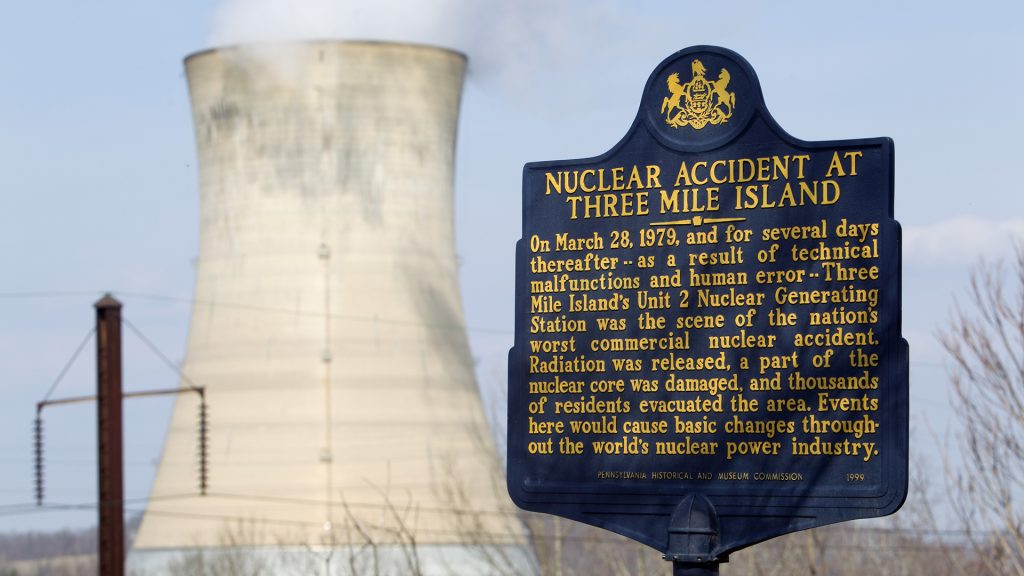
Microsoft deal propels Three Mile Island restart, with key permits still needed
By Reuters, September 21, 2024
Sept 20 (Reuters) – Constellation Energy (CEG.O), opens new tab and Microsoft (MSFT.O), opens new tab have signed a power deal to help resurrect a unit of the Three Mile Island nuclear plant in Pennsylvania in what would be the first-ever restart of its kind, the companies said on Friday.
Key regulatory permits for the plant’s new life, however, haven’t been filed, regulators say.
Big tech has led to a sudden surge in U.S. electricity demand for data centers needed to expand technologies like artificial intelligence and cloud computing. ……………………………………..
Power from the plant would be used to offset Microsoft’s data center electricity use, the companies said.
A relaunch of Three Mile Island, which had a separate unit suffer a partial-meltdown in 1979 in one of the biggest industrial accidents in the country’s history, still requires federal, state and local approvals.
Constellation has yet to file an application with federal nuclear regulators to restart the plant.
“It’s up to Constellation to lay out its rationale for justifying restart, so we’re prepared to engage with the company on next steps,” said Nuclear Regulatory Commission (NRC) spokesperson Scott Burnell.
Constellation said it expected the NRC review process to be completed in 2027.
BILLION DOLLAR BET
The deal would help enable a revival of Unit 1 of the five-decades-old facility in Pennsylvania that was retired in 2019 due to economic reasons. Unit 2, which had the meltdown, will not be restarted. https://www.reuters.com/markets/deals/constellation-inks-power-supply-deal-with-microsoft-2024-09-20/
1 This Month

of the week – Shut Down Drone Warfare!


Tell the Ukrainian Government to Drop Prosecution of Peace Activist Yurii Sheliazhenko

Petition to revoke the licensing of the Near Surface Nuclear Disposal Facility (NSDF) at Chalk River. https://www.ourcommons.ca/petitions/en/Petition/Details?Petition=e-7247
To see nuclear-related stories in greater depth and intensity – go to https://nuclearinformation.wordpress.com
-
Archives
- April 2026 (7)
- March 2026 (251)
- February 2026 (268)
- January 2026 (308)
- December 2025 (358)
- November 2025 (359)
- October 2025 (376)
- September 2025 (257)
- August 2025 (319)
- July 2025 (230)
- June 2025 (348)
- May 2025 (261)
-
Categories
- 1
- 1 NUCLEAR ISSUES
- business and costs
- climate change
- culture and arts
- ENERGY
- environment
- health
- history
- indigenous issues
- Legal
- marketing of nuclear
- media
- opposition to nuclear
- PERSONAL STORIES
- politics
- politics international
- Religion and ethics
- safety
- secrets,lies and civil liberties
- spinbuster
- technology
- Uranium
- wastes
- weapons and war
- Women
- 2 WORLD
- ACTION
- AFRICA
- Atrocities
- AUSTRALIA
- Christina's notes
- Christina's themes
- culture and arts
- Events
- Fuk 2022
- Fuk 2023
- Fukushima 2017
- Fukushima 2018
- fukushima 2019
- Fukushima 2020
- Fukushima 2021
- general
- global warming
- Humour (God we need it)
- Nuclear
- RARE EARTHS
- Reference
- resources – print
- Resources -audiovicual
- Weekly Newsletter
- World
- World Nuclear
- YouTube
-
RSS
Entries RSS
Comments RSS
 nuclear-news