Small nuclear reactors are at risk from military attacks, so should be built underground

Small modular reactors (SMRs) should be built underground, including in
city centres, to protect them from military attacks, seismic activity and
other natural hazards, according to a new academic study.
Nucnet 27th Nov 2024
https://www.nucnet.org/news/underground-plants-could-be-built-in-city-centres-11-3-2024
Iran deploys advanced centrifuges in defiance of IAEA resolution
Iran has begun deploying advanced centrifuges which enrich uranium for the
country’s nuclear program in response to a resolution by the
International Atomic Energy Agency (IAEA) calling for greater transparency
into Iran’s nuclear activities.
Speaking during an open session of
parliament on Sunday, Mohammad Bagher Ghalibaf criticized the resolution,
accusing the United States and European nations of using Iran’s nuclear
program as a pretext for unjustified actions. He said, “The Islamic
Republic of Iran’s reciprocal response to this political misuse of the
Board of Governors was immediately put into action, and the deployment of a
set of new and advanced centrifuges has begun”.
Iran International 24th Nov 2024,
https://www.iranintl.com/en/202411240306
Nuclear fusion: neither imminent nor relevant to climate change

Billions of dollars have been raised on promises of limitless power from nuclear fusion. However, the technology will not deliver affordable power within our lifetimes.
By Ross McCracken, 22/11/2024,
https://www.energyvoice.com/renewables-energy-transition/563251/nuclear-fusion-neither-imminent-nor-relevant-to-climate-change/
As a child, my father, a senior experimental plasma physicist at the UK’s Culham Laboratory, would tell me that an electricity-generating fusion reactor was just 30 years away. His opinion had not changed by the time he retired, and I believe it would be the same now, if he were alive. But then, he always was an optimist.
With the exception of those on which their business is based, such as France’s EdF, electric utilities in the western world have largely given up on building new nuclear fission reactors. They are expensive; the capital outlay and commercial risks are too high, and they take too long to build.
Market forces and climate policies are now driving the construction of wind and solar farms, which generate cleaner electricity more cheaply, even when energy storage is included. As nuclear power has largely failed as a commercial market proposition, nearly all nuclear newbuild in the world today is heavily state sponsored in one form or another, rather than market driven.
But the nuclear industry is far from out. It has ‘new’ propositions, one of which is still nuclear fusion.
Dubious claims
Private companies have entered the sector, claiming that they can solve the problems encountered by decades of international research with new reactor designs and fusion processes.
Investors hope that innovation from an agile private sector will rejuvenate and overtake the slow process of publicly funded science, represented by the ITER project currently under construction at Cadarache, in France. Fusion will generate limitless clean energy and, in the process, become a key tool for addressing climate change – according to its proponents.
US company Helion, which in 2015 promised a “a useful reactor in the next three years”, now promises a fusion plant by 2028, for example. Microsoft has even agreed to purchase electricity from the facility.
However, the claims of clean, unlimited energy do not stand up to scrutiny. Or as nuclear fusion scientist SJ Zweben put it more bluntly in an article for Physics and Society in January, they are:
“At best wildly optimistic but more often mistaken, delusional, deceitful or fraudulent.”
The scientific and engineering challenges facing nuclear fusion reactors are legion, and as Zweben points out they all need to be resolved at the same time. This is extremely challenging because the solutions proposed for one problem often exacerbate others or create new ones.
The many challenges include energy confinement, impurity contamination, plasma disruptions, wall erosion, the tritium fuel cycle, availability in terms of operational uptime, excessive power consumption by the plant itself, cost and – yes, contrary to industry marketing – radioactive waste.
Spherical Tokamak for Energy Production (STEP)
The UK is basing its fusion hopes on STEP, having left the international ITER project with Brexit. A site has been chosen for the project, but it is not yet clear whether the experiment will garner the same support from the current government as it did from the previous one.
In a recent article for Physics World, fusion scientist Guy Matthews noted that the energy stored in STEP’s plasma would need to be about 5,000 times larger than that produced in the UK’s MAST-U spherical tokamak experiment. He describes the single giant leap to a power plant as “an extreme, and unprecedented, extrapolation of physics and technology”.
It may even be dangerous. There is no way yet of reliably avoiding or mitigating plasma instabilities, known as ‘disruptions’. Without a robust solution, the consequent damage “would render a power plant inoperable”.
Other experienced fusion scientists share these and other concerns.
John Evans, who worked at the Atomic Energy Research Establishment in Harwell, recently highlighted the lack of a proven solution for the fusion fuel cycle.
This involves breeding and reprocessing unprecedented quantities of radioactive tritium – a hydrogen isotope that does not occur naturally and needs to be generated from a massive ‘breeding blanket’ containing lithium. A solution must be in place before any fusion power plant can operate and each fusion plant would consume, annually, more tritium than is currently available globally.
Put simply, the technical and scientific challenges posed by any approach to fusion, whether using spherical, ‘toroidal’ tokamaks or lasers, are huge.
Will fusion be clean?
According to the International Atomic Energy Agency (IAEA), “Fusion does not create any long-lived radioactive waste”. This is true only in theory.
A fusion reactor produces helium, an inert gas, as a result of a fusion reaction between the hydrogen isotopes tritium and deuterium. Tritium is very radioactive with a half-life of 12.3 years. The tritium is both produced and consumed by the fusion reactor so, in a perfect world, there is no nuclear waste.However, 80% of the power from the fusion reaction is delivered as fast neutrons that generate the tritium from the surrounding breeding blanket, which is likely to require periodic replacement.Nuclear reactions between the neutrons, and impurities or primary elements in the blanket, make it radioactive and degrade the materials – i.e. increasing the need for replacement.Materials in a more compact fusion reactor, like STEP, would accumulate neutron damage more rapidly and would therefore need more frequent replacement.
As a result, Matthews provides a somewhat different message to the IAEA: “If conventional engineering materials are used, fusion reactors have the potential to generate far larger volumes of long-lived radioactive waste than fission reactors.”
The extent to which suitable low-activation fusion materials can be developed to mitigate this challenge at an acceptable cost is one of the many unsolved problems facing fusion power.
A neutron-free fusion reaction is possible using hydrogen and boron, but for this to work the plasma temperature needs to be around 7,000 million degrees – which makes the deuterium-tritium reaction (JET, ITER), at a mere 100 million degrees, seem like a walk in the park.
Fusion’s costs are misunderstood or ignored
Fusion advocates use the term ‘limitless’ energy to imply cheap energy. But will fusion provide either?
It could be limitless in the sense that the base fuel sources – lithium and deuterium – are abundant and only relatively small amounts are required to produce huge amounts of power. Unfortunately, the idea that a limitless or near-limitless energy source means cheap energy is plain wrong because, however energy is generated, it has a cost.
A nuclear fusion power plant will have a capital cost, an operational cost and a maximum generating capacity like any other power plant. The price of a first-of-a-kind reactor will be huge and an ‘nth of a kind’ reactor will not be cheap. ITER’s costs are currently estimated at €18-22 billion, but will likely prove much higher and it is an experiment – not a power plant.
STEP’s cost is estimated to run to several billion pounds before construction has even started and it is a far more challenging project. Moreover, the role of STEP (if successful) is only to provide a “pathway to commercialisation” according to Howard Wilson, fusion pilot plant lead at the US’ Oak Ridge National Laboratory.
Cost trajectory
For wide-scale deployment, fusion must be economically viable. The general ‘rule’ used in forecasting future costs is that they halve as production of a commodity doubles. However, this is a popularisation and over-optimistic simplification of Wright’s Law, which states that for every cumulative doubling of units produced, costs will fall by a constant percentage.
The extent of that percentage is usually governed by the complexity of the technology concerned and the degree to which it can be modularised and subject to the cost gains of mass manufacturing. Technical complexity and safety concerns, when major, mean that the cost reduction of higher production volumes can be small or non-existent.
Just as nuclear fission has struggled to follow Wright’s Law, there is no reason to believe that fusion, which is much more complex, will be any more successful.
Relevance to climate change
Nuclear fusion is still decades away from working (i.e. producing sustainable net energy gains), and then decades more from economic viability. Even then, it would be more decades still from deployment on a scale large enough to have any impact on climate change.
It is almost 2025, and to remain on track to limit global warming to 1.5°C above pre-industrial levels, the world, not just individual countries, needs to achieve net-zero carbon by 2050. It is a goal that is already slipping away. Fusion is simply too far off to be of any use.
Ross McCracken is a freelance energy analyst with more than 25 years experience, ranging from oil price assessment with S&P Global to coverage of the LNG market and the emergence of disruptive energy transition technologies.
The entanglement of fusion energy research and bombs
By Arjun Makhijani | November 12, 2024
The recent achievement of fusion ignition—meaning more
energy came out of a self-sustaining fusion reaction than was put in—at
Lawrence Livermore National Laboratory’s National Ignition Facility (NIF)
has brought to the fore long-simmering questions about whether certain
experiments violate the Comprehensive Test Ban Treaty on nuclear
explosions.
Fusion research for peaceful use and military use are highly
intertwined, despite attempts to cloak nuclear weapons with the aura of the
so-called “peaceful atom.” Ignition has been achieved, but there is
still a remarkable silence around whether pure fusion weapons—weapons
that could kill large numbers of humans with neutron radiation but have
blast effects much smaller than current thermonuclear weapons—are an
objective of the overall program.
Even if not an explicit objective, would they be built if fusion technology makes them feasible? Research and experiments into weapons-related nuclear fusion and commercial energy fusion are highly entangled, and have been notably so since the 1950s,
after the Soviets conducted their “layer cake” nuclear test with a
fusion component in 1953, and the US did its 15-megaton Bravo test in
1954—a test of a thermonuclear weapon.
To improve the terrible public
relations image that those tests cast over the world, the Eisenhower
administration came up with a carefully orchestrated propaganda campaign
for nuclear power, with the tag line “atoms for peace.” That is
happening again after the recent achievement of ignition at the National
Ignition Facility at Lawrence Livermore National Laboratory, with the
difference that the world does not even know whether pure fusion weapons
are on the agenda.
Bulletin of Atomic Scientists 11th Nov 2024,
https://thebulletin.org/premium/2024-11/the-entanglement-of-fusion-energy-research-and-bombs/
Will New Brunswick choose a “small, modular” nuclear reactor – that’s not small at all (among other problems)?

There is nothing modular about this reactor. The idea that such an elaborate structure can just be trucked in, off-loaded, and ready to go, is a fantasy cultivated by the nuclear industry as a public relations gimmick.
by Gordon Edwards, November 23, 2024, https://nbmediacoop.org/2024/11/23/will-new-brunswick-choose-a-small-modular-nuclear-reactor-thats-not-small-at-all-among-other-problems/
NB Power seems determined to build at least two experimental reactors at the Point Lepreau nuclear site, but their chosen designs are running into big problems.
One possible alternative is the reactor design Ontario Power Generation (OPG) hopes to build at the Darlington nuclear site on Lake Ontario. OPG is promoting it as a “small, modular” nuclear reactor.
Consider a building that soars 35 metres upwards and extends 38 metres below ground. That’s 10 stories up, 11 stories down. At 73 metres, that’s almost as tall as Brunswick Square in Saint John, or Assumption Place in Moncton, the tallest buildings in New Brunswick. Would you call such a structure small?
That’s the size of the new reactor design, the first so-called “Small Modular Nuclear Reactor” (SMNR) to be built in Canada, if the Canadian Nuclear Safety Commission gives OPG the go-ahead in January. It’s an American design by GE Hitachi that requires enriched uranium fuel – something Canada does not produce. If the reactor works, it will be the first time Canada will have to buy its uranium fuel from non-Canadian sources.
The new project, called the BWRX-300, is a “Boiling Water Reactor” (BWR), completely different from any reactor that has successfully operated in Canada before. Quebec tried a boiling water CANDU reactor several decades ago, but it flopped, running for only 180 days before it was shut down in 1986.
The Darlington BWR design is not yet complete. Its immediate predecessor was a BWR four times more powerful and ten times larger in volume, called the ESBWR. It was licensed for construction in the U.S. in 2011, the same year as the triple meltdown at Fukushima in Japan. The ESBWR design was withdrawn by the vendor and never built.
The BWRX-300 is a stripped-down version of ESBWR, which in turn was a simplified version of the first reactor that melted down in Japan in 2011. To shrink the size and cut the cost, the BWRX-300 eliminates several safety systems that were considered essential in its predecessors.
For example, BWRX-300 has no overpressure relief valves, no emergency core cooling system, no “core catcher” to prevent a molten core from melting through the floor of the building. Instead, it depends on a closed-loop “isolation condenser” system (ICS) to substitute for those missing features.
But is the ICS up to the job? During a 1970 nuclear accident, the ICS failed in a BWR at Humboldt Bay in California. At Fukushima, the ICS system failed after a few hours of on-and-off functioning.
Because CNSC, the Canadian nuclear regulator, has no experience with Boiling Water Reactors, it has partnered with the US Nuclear Regulatory Commission (NRC). They both met with the vendor GE-Hitachi several times.
The regulatory approach of the two countries has been very different: in February 2024, the U.S. NRC staff told GE-Hitachi that a complete design is needed before safety can be certified or any licence can be considered. But In Canada, the lack of a complete design seems no obstacle.
CNSC public hearings in November 2024 and January 2025 are aimed at giving OPG a “licence to construct” the BWRX-300 – before the design is even complete, and before the detailed questions from U.S. NRC staff have been addressed.
Building the BWRX-300 will require a work force of 1,000 or more. The entire reactor core, containing the reactor fuel and control mechanisms, will be in a subterranean cylindrical building immersed in water, not far from the shore of Lake Ontario.
There is nothing modular about this reactor. The idea that such an elaborate structure can just be trucked in, off-loaded, and ready to go, is a fantasy cultivated by the nuclear industry as a public relations gimmick.
The BWRX-300 will not be small. It will not be modular. And so far, its design is incomplete. An initial analysis of the design has identified unanswered safety questions.
If CNSC is prudent, it will not grant OPG a licence to construct the reactor next year. There are too many unanswered safety-related questions.
And if OPG is prudent, It will count on a doubling or tripling of the estimated cost. Already we have seen SMR projects in Idaho and Chalk River in Ontario run into crippling financial roadblocks.
The financial problems of the current SMNR designs in New Brunswick are the latest examples of private capital shunning nuclear investments. If New Brunswick is prudent, it will think very hard before diving into another nuclear boondoggle. The potential fallout will not be small at all.
Dr. Gordon Edwards is the president of the Canadian Coalition for Nuclear Responsibility based in Montreal.
Shares in nuclear reactor company OKLO bite the dust

Sam Altman-Backed Oklo Slumps After Kerrisdale Says It’s Shorting Stock
By Carmen Reinicke and Will Wade, November 20, 2024 , https://www.bnnbloomberg.ca/investing/2024/11/20/sam-altman-backed-oklo-slumps-after-kerrisdale-says-its-shorting-stock/
Shares of Oklo Inc., the nuclear fission reactor company backed by OpenAI Inc’s Sam Altman, tumbled Wednesday after Kerrisdale Capital said it is shorting the stock.
The report alleges that “virtually every aspect of Oklo’s investment case warrants skepticism,” sending the stock down as much as 10%. Shares pared much of the decline and were down about 6% in midday trading in New York.
Oklo shares have whip-sawed recently, rallying more than 20% this week through Tuesday’s close after falling 25% on Friday following its earnings release and the expiration of a lockup period that allows key investors like Peter Thiel’s venture capital firm to start selling shares.
Oklo declined to comment.
Since the company went public via a special purpose acquisition merger in May, its shares have soared more than 150%.
“In classic SPAC fashion, Oklo has sold the market on inflated unit economics while grossly underestimating the time and capital it will take to commercialize its product,” the Kerrisdale report said.
The company is among a wave of firms developing so-called small modular reactors that are expected to be built in factories and assembled on site. Advocates say the approach will make it faster and cheaper to build nuclear power plants, but the technology is unproven. Only a handful have been developed, and only in Russia and China.
Oklo has said it expects its first system to go into service in 2027, but the Kerrisdale report highlights numerous technical and regulatory hurdles that may delay that schedule. Oklo is pursuing a new technology that it said will make its design safer and cheaper than conventional reactors in use today. The company’s design doesn’t have approval from the US Nuclear Regulatory Commission, a process that typically takes years.
Wall Street is split on the company thus far. Of the four analysts covering Oklo, two have buy-equivalent ratings and two are neutral. The average price target implies about 5% return from where shares are trading.
Besides Altman and Thiel, the company has another potentially high-profile connection. Board member Chris Wright was nominated by President-elect Donald Trump to lead the Energy Department last week.
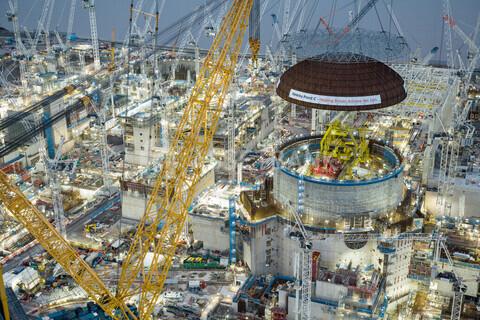
Why EDF’s Hinkley C nuclear power plant will probably not be running before 2035
David Toke. Nov 20, 2024, https://davidtoke.substack.com/p/why-edfs-hinkley-c-nuclear-power
There is a broad relationship between the time it takes to build nuclear power stations and their cost. That is apparent from looking at what has happened in the past, with nuclear costs escalating as construction times have increased. A study of this relationship leads to the conclusion that the commercial operation of Hinkley Point C (HPC) will almost certainly not happen before 2035.
The model being built at Hinkley C is the European Pressurised Reactor (EPR). The only two EPRs to have been (more or less) completed in the West have involved major cost overruns. They have taken much longer to build than expected. In Finland, the plant at Olkiluoto took nearly 17 years to come into commercial operation from its construction start in 2005. The EPR at Flamanville in France has so far taken 17 years to (not quite as yet) come into commercial operation since the concrete for the reactor was first poured in 2007.
When I was writing a book about nuclear power, safety, and costs I did an (anonymised) interview with a British-based nuclear industry consultant who commented:
‘the point at which you do the first concrete pour, the organisation starts hemorrhaging money. That is when you have to build as rapidly as possible with minimum delays and commission as quickly as you can’. (anonymous interview with nuclear consultant, 01/06/2018) (page 133 see book link HERE ). It’s a simple relationship really. The longer the construction period is, then the longer you have to employ staff to do the job. Hence costs increase almost as night follows day.
You can see the relationship between costs and construction time in Figure 1 below [on original]. Please note these are so-called ‘overnight’ costs and do not include interest payments to debtors or equity holders. This, in reality, pushes up costs greatly, which is why these ‘overnight’ costs greatly understate nuclear costs. However, I use the overnight costs for comparison purposes, and also because their interpretation is much more transparent and unarguable compared to making assumptions about the cost of capital.
In a post earlier this year I explained how Flamanville 3’s construction time had been part of a trend towards increasing nuclear construction times in France. This is shown in Figure 2 below [on original]. The bar on the right represents Flamanville 3 whose construction began in 2007.
Both the power plant compared in Figure 1 (Flamanville 3 and Olkiluoto 3) cost much more than expected. However the alarming thing about the British nuclear programme is that they are still only about half as expensive as the projected costs of Hinkley C. Whereas Olkiluoto 3 and Flamanville 3 have overnight costs of around 8.7 to 8.1 billion euros per GW, Hinkley C has projected costs, according to EDF, of around double this amount (ie over 16 billion euros per GW) when EDF’s median projected costs are translated into 2024 euro prices. (See HERE for costs in 2015 £s, as reported by ‘World Nuclear News’).
This does imply that Hinkley C is going to take even longer to come online than these power plants in Finland and France did. Hinkley C’s reactor construction began at the end of 2018, and the cost estimates made then were broadly in line with the sort of costs we have seen in the cases of Fimamanville and Olkiluoto. However, projections of cost overruns for HPC have escalated since then.
Even if EDF ‘only’ took as long to build as Flamanaville and Olkiluoto, HPC will not be online until 2035. But the costs of HPC are much higher, around double, compared to either of these other EPRs. Of course, we cannot say, for definite, now how long for sure completion of HPC will take. But we can do an estimate by working backward from the cost. That is if there is a simple linear relationship between construction time and cost then we could say that if HPC is going to cost twice as much as Flamanville 3 or Olkiluoto 3 then HPC will take twice as long as these plants – that is well over 30 years. On that basis, HPC would not be finished until around 2050. You can see this calculation in Figure 3. [on original] HPC is in the third set of columns.
Maybe it will not take quite as long as 2050 to finish HPC – I cannot say – but what these simple calculations do suggest that EDF’s (most recently) projected completion dates of 2029-2031 look hopelessly optimistic. Even if HPC ‘only’ takes as long as Flamanville 3, we shall still be looking at a start no earlier than 2035. The CEO of EDF is famously quoted as saying that people would be cooking their turkeys by the xmas of 2017. We could be lucky to be cooking our turkeys using HPC power by 2037!
The prospect of HPC not being online in 2029 automatically triggers penalty clauses in the contract that was agreed between the UK Government and EDF in 2013. If EDF does not meet this deadline then it loses a year of its premium price guarantee for every year that it fails to start generating. The premium price of £92.50 per MWh in 2012 prices which equates to £129 per MWh in 2024 prices. No doubt pressure will grow on the UK Government to relax the penalty clause.
All of this does not bode well for Sizewell C. This is a carbon copy of the design of HPC, we are told. Except that it is not, It is on a different site with its own, different, challenges. There can be no confidence that the costs will be much less than HPC – as Amory Lovins puts it, nuclear power seems to have an ‘unlearning curve’ – ie it gets more expensive over time in a given country. It is unlikely that EDF will have much capacity to do much on Sizewell C until HPC is more or less completed, and as Sizewell C is likely to take at least 15 years to build (based on experience with EPRs) it seems unlikely that Sizewell C will be generating this side of 2050. I have one good reason to hope to see the day when Sizewell C is generating. It means that I shall live a very long time and be very old indeed!
Otherwise, it would not be wise to persevere with Sizewell C. Sizewell C is likely to come online when it is even more technologically uncompetitive than it is now with other green energy sources and techniques. Indeed the approach of the Government has altered dramatically since the Hinkley Point C contract was signed. Then there were penalty clauses imposed on EDF to encourage good performance. Now, with Sizewell C, EDF will be able to rely on the consumer to pay the tens of billions of pounds of cost overruns that will inevitably occur. A sort of reverse logic has been applied. It has been realized that nuclear power is too uneconomic to be built by offering a long-term contract to buy electricity. But instead of walking away from the technology, we will now take on a massive uncapped financial obligation for the next project.
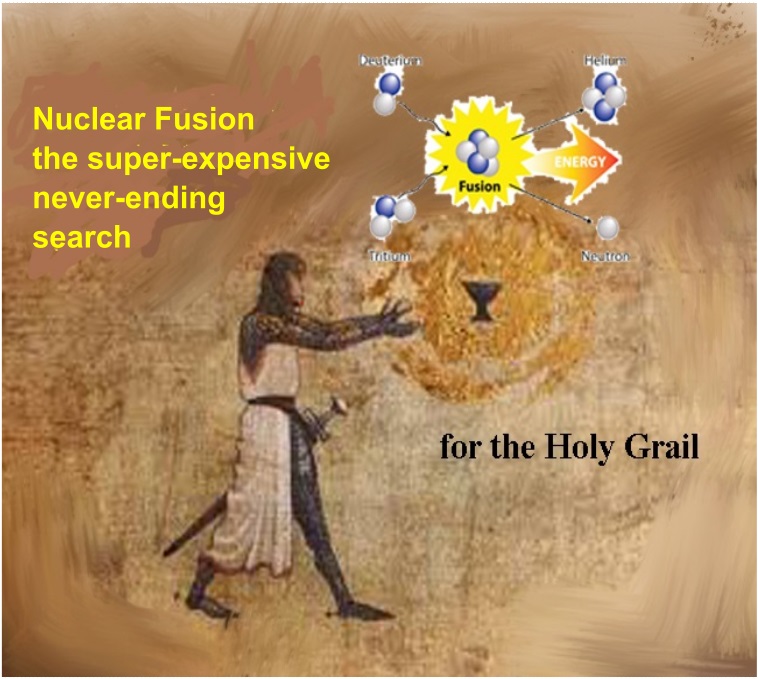
Nuclear Fusion, forever the energy of tomorrow?
Bulletin, By Dan Drollette Jr | November 12, 2024
Nuclear fusion as a source of electricity always seems to be just around the corner. As the old joke goes, “Thirty years ago, fusion was 30 years away from becoming a viable commercial reality”—a comment borne out in the Bulletin’s own pages, if not precisely on a 30-year timescale.
In 1971, physicist Richard Post of what was then the Lawrence Radiation Laboratory published a Bulletin of the Atomic Scientists’ article featuring a chart that showed how fusion—that is, the fusing of hydrogen atoms to release energy, a process that powers all stars, including the Earth’s sun—would be widely available on a commercial scale, routinely pumping electrons to the electrical grid, by the year 1990 (although he hedged his bets by labeling it “An Optimist’s Fusion Power Timetable” [emphasis added]).
That optimism was widely shared, judging from the literature in the science and technology press of the time. But it proved to be misplaced; although militaries have thousands of nuclear warheads based on the fusion process, everything about commercial fusion as an energy has proven harder and taken longer than expected. For example, more than 60 years passed since the development of the first fusion “tokamak” reactor in the old Soviet Union to the first sustained fusion “burn,” or ignition, at the National Ignition Facility in the United States in 2022.
The difficulties involved in creating a commercial power plant are relatively simple to enumerate, as plasma physicist Bob Rosner—himself the former director of a national laboratory (and former chair of the Bulletin’s Science and Security Board)—explains in his interview, “Ferreting out the truth about fusion.” In a nutshell, the fusion process releases neutrons that are 10 times more energetic than what a commercial plant powered by the splitting of atoms, or nuclear fission, ordinarily emits. These high-powered neutrons are difficult to contain and rapidly degrade the containers proposed for controlling the extremely hot plasma required for a fusion reaction. At the same time, plasmas are just plain difficult to keep stable while producing that all-important steady (or quasi-steady) fusion “burn.”
In fact, Rosner notes, it’s likely that if a disruptive instability ever happens at ITER—the giant international research and engineering effort, based in France, that seeks to demonstrate how fusion could be produced in a magnetic fusion device—the multibillion-dollar experimental facility likely would not recover. For these reasons and more, Rosner asserts that commercial-scale, tokamak-style fusion will not be a reality in his lifetime—“and I think not in my children’s lifetime, or my grandchildren’s lifetime.” In addition, he warns about the hype and public relations fluff surrounding overly rosy projections for fusion, or what Rosner terms “a complex mixture of fact, half-truths and outright misinformation.”
It turns out that getting a reliable, steady source of tritium fuel for a fusion reactor would be an extremely difficult problem to crack, as physicist Daniel K. Jassby—formerly of the Princeton Plasma Physics Laboratory—points out. In his article, “The fuel supply quandary of fusion power reactors,” Jassby argues that the fusion reactors now envisioned would not be able to “breed” enough tritium to supply the reactor’s continued operation, and that even a few such reactors (if they ever became reality) would shortly exhaust the world’s supply of that hydrogen isotope, which is not naturally occurring.
So, why would anyone or any institution even go near fusion research? The same reasons keep popping up, in various forms, among the various experts in this issue of the magazine: There’s the desire to know and understand the basic mechanisms of our universe, and the likelihood that fundamental research and development in fusion could lead to big results in other scientific and technological arenas (“self-healing metals” being one of them). And then there’s what fusion research could do for nuclear weapons research in the immediate near-term. As Arjun Makhijani, president of the Institute for Energy and Environmental Research, writes:
“Fusion research for peaceful use and military use are highly intertwined, despite attempts to cloak nuclear weapons with the aura of the so-called ‘peaceful atom.’ ”
Given these considerations, it’s understandable that governments continue to back fusion research, despite the small likelihood that a commercial fusion power plant will come on-line soon. After all, funding basic research and providing for national defense are core goals for any state.
It is harder to understand why prominent players in the private marketplace—including the founders of Microsoft, OpenAI, Paypal, and Amazon—would invest vast sums on an infant field like commercial fusion. More than $1.8 billion was raised to fund just one startup, Commonwealth Fusion Systems, whose website indicates that it seeks to commercialize fusion energy in some form in just 10 years—decades ahead of government-funded efforts. To help explain their thinking, Silicon Valley venture capitalist and University of California Berkeley professor Mark Coopersmith delves into the world of high-finance. In his interview, “Fusion is not a typical bet,” Coopersmith explains the psychology behind putting down large sums despite long odds—assuming one has the money burning a hole in one’s pocket. The prospect of a “super return” of 1,000 or even 10,000 percent makes “deep-tech” research and development attractive, he says, even if the potential payoff could be decades away………………………………………………………. https://thebulletin.org/premium/2024-11/introduction-fusion-the-next-big-thing-again/?utm_source=Newsletter&utm_medium=Email&utm_campaign=ThursdayNewsletter11142024&utm_content=NuclearRisk_FusionNextBigThingAgain_11122024
Micro-reactor developer optimistic about connecting South Wales project by 2027
08 Nov, 2024 By Tom Pashby
The CEO of a micro nuclear reactor developer aiming to build in Wales this
decade has told NCE he is confident that grid connection reforms will help
keep his company’s ambitious plans on schedule.
Last Energy is a developer of micro-reactors, which fall within the overall category of
small modular reactors (SMRs). The firm is hoping to build and commission
four 20MW reactors in South Wales by 2027.
Details of its Prosiect Egni Glan Llynfi project in Bridgend County were released last month and raised eyebrows. Last Energy calls it, in English, the Llynfi Clean Energy Project
and is proposed on the site of the former coal-fired Llynfi Power Station
which was in operation from 1951 to 1977.
The SMR designs in Great British
Nuclear’s competition are subject to a generic design assessment (GDA) by
regulators of the UK nuclear sector. This allows the regulators to assess
the safety, security, safeguards and environmental aspects of new reactor
designs before site-specific proposals are brought forward.
Jenner said Last Energy is not going through the generic design assessment approach. He
said the ONR “stated that that’s not absolutely essential”. “It’s
one route you can take. We are going straight to the site licensing
route,” he said. “We are linking our project and our design straight to
our project in this case, is Llynfi in South Wales, so you go through the
same rigor, but it’s linked to a site.
” Even with all the benefits for
rapid deployment, the 2027 commission date seems ambitious. Jenner said
Last Energy had not commenced any works at the site yet. “When we expect
to is something that we are still working through the timeline on in our
discussions with the ONR (Office for Nuclear Regulation),” he said.
New Civil Engineer 8th Nov 2024,
https://www.newcivilengineer.com/latest/interview-micro-reactor-developer-optimistic-about-connecting-south-wales-project-by-2027-08-11-2024/
Japanese nuclear reactor that restarted 13 years after Fukushima disaster is shut down again
A Japanese nuclear reactor that restarted last week for the first time in more than 13 years after it survived a massive earthquake and tsunami that badly damaged the nearby Fukushima nuclear plant has been shut down again due to an equipment problem
Mari Yamaguchi, 4 Nov 24, https://www.independent.co.uk/news/ap-japanese-tokyo-fukushima-b2640761.html
A Japanese nuclear reactor that restarted last week for the first time in more than 13 years after it had survived a massive 2011 earthquake and tsunami that badly damaged the nearby Fukushima nuclear plant was shut down again Monday due to an equipment problem, its operator said.
The No. 2 reactor at the Onagawa nuclear power plant on Japan’s northern coast was put back online on Oct. 29 and had been expected to start generating power in early November.
But it had to be shut down again five days after its restart due to a glitch that occurred Sunday in a device related to neutron data inside the reactor, plant operator Tohoku Electric Power Co. said.
The reactor was operating normally and there was no release of radiation into the environment, Tohoku Electric said. The utility said it decided to shut it down to re-examine equipment to address residents’ safety concerns. No new date for a restart was given.
The reactor is one of three at the Onagawa plant, which is 100 kilometers (62 miles) north of the Fukushima Daiichi plant where three reactors melted following a magnitude 9.0 earthquake and tsunami in March 2011, releasing large amounts of radiation.
ExoAnalytic observes 500 pieces of debris from Intelsat 33e breakup
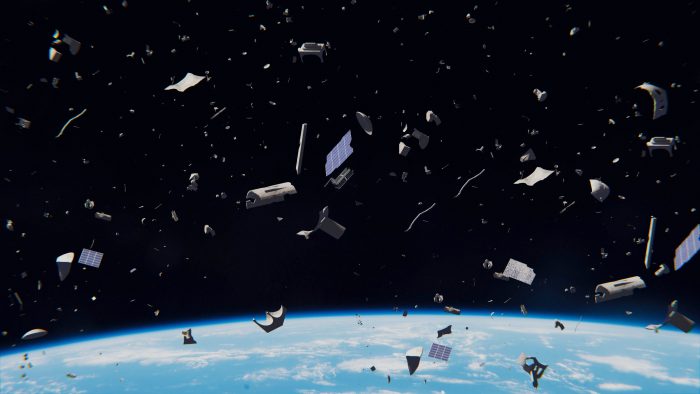
It is too early to say whether parts of Intelsat 33e could hit another object in orbit after the satellite broke up Oct. 19, which could create more potentially hazardous debris.
Jason Rainbow, October 28, 202
TAMPA, Fla. — U.S.-based space-tracking company ExoAnalytic Solutions has identified about 500 pieces of debris from Intelsat 33e’s recent breakup in geostationary orbit (GEO).
“The size of the debris we are tracking ranges from small fragments roughly the size of a softball to larger pieces up to the size of a car door,” ExoAnalytic chief technology officer Bill Therien told SpaceNews in an Oct. 28 email.
“The majority of the tracked objects are on the smaller end of that spectrum, which contributes to the difficulty of consistently observing all the debris pieces.”
ExoAnalytic has observed 108 of these pieces in the last 24 hours, Therien said, adding that the company does not expect to observe every piece of debris each night because size, velocity, and position relative to ground sensors can influence whether the debris is visible during a particular observation window.
In addition, it is possible some of them are no longer present, such as solid fuel fragments that are evaporating.
“The debris field from an incident like this can be complex, and new pieces can be more reliably tracked over time,” Therien said………
It is too early to say whether parts of Intelsat 33e could hit another object in orbit after the satellite broke up Oct. 19, which could create more potentially hazardous debris……………………………………………………………………. https://spacenews.com/exoanalytic-observes-500-pieces-of-debris-from-intelsat-33e-breakup/?utm_source=ActiveCampaign&utm_medium=email&utm_content=%F0%9F%A4%9DLockheed%20Martin%20buys%20Terran%20Orbital%20-%20SpaceNews%20This%20Week&utm_campaign=SNTW%20Nov%201%202024
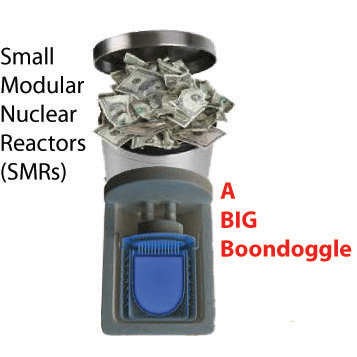
NextEra No Longer Bullish on Nuclear SMRs
By Alex Kimani – Oil Price , Oct 31, 2024,
NextEra Energy is exploring the reopening of the Duane Arnold nuclear plant amid rising data center interest but remains cautious on the viability of small modular reactors.
SMRs, though promising in terms of smaller size, lower fuel needs, and modular design, face significant challenges.
High production costs for HALEU, estimated to reach up to $25,725/kg, pose a substantial financial hurdle.
……………………..CEO John Ketchum said he was “not bullish” on small modular reactors (SMRs), adding that the company’s in-house SMR research unit has so far not drawn favorable conclusions about the technology.
“A lot of [SMR equipment manufacturers] are very strained financially,” he said. “There are only a handful that really have capitalization that could actually carry them through the next several years.”
Ketchum might have a valid point. …………………………………………….
The U.S. Department of Energy has so far spent $1.2B on SMR R&D and is projected to spend nearly $6B over the next decade. Last year, the U.S. Nuclear Regulatory Commission (NRC) certified NuScale Power Corp.(NYSE:SMR) VOYGR 77 MW SMR in Poland, the first ever SMR to be approved in the country.
But there’s a big problem here because the fuel required to power these novel nuclear plants might be really expensive.
Three years ago, U.S. Nuclear Regulatory Commission (NRC) approved Centrus Energy Corp.’s (NYSE:LEU) request to make High Assay Low-Enriched Uranium (HALEU) at its enrichment facility in Piketon, Ohio, becoming the first company in the western world outside Russia to do so. A year later, the U.S. Department of Energy (DoE) announced a ~$150 million cost-shared award to American Centrifuge Operating, LLC, a subsidiary of Centrus Energy. HALEU is a nuclear fuel material enriched to a higher degree (between 5% and 20%) in the fissile isotope U-235. According to the World Nuclear Association, applications for HALEU are currently limited to research reactors and medical isotope production; however, HALEU will be needed for more than half of the SMRs currently in development. HALEU is only currently available from TENEX, a Rosatom subsidiary.
………..A 2023 survey by the Nuclear Energy Institute on U.S. advanced reactor developers estimated that the total market for HALEU could reach $1.6 billion by 2030 and $5.3 billion by 2035.
Last year, the Nuclear Innovation Alliance (NIA) published a report wherein they discussed production costs for HALEU. Here’s an excerpt from the report:
‘‘Calculated HALEU production cost for uranium enriched to 19.75% is $23,725/kgU for HALEU in an oxide form and $25,725 for HALEU in a metallic form under baseline economic assumptions but could be higher.’’
The report claims that a SWU (Separative Work Unit) is going to cost a lot more in a HALEU enrichment cascade compared to a standard LEU (Low-Enriched Uranium) enrichment cascade.
……………….NIA reckons it might cost ~$2000/kgU to make HALEUF6 into HALEUO2, and as much as $4000/kgU to make HALEUF6 into HALEU-metal. At the end of the day, you’d end up with HALEU with 28 times the fissile content of natural uranium at over 100 times the price.
https://oilprice.com/Alternative-Energy/Nuclear-Power/NextEra-No-Longer-Bullish-on-Nuclear-SMRs.html
BAE Systems fire: blaze at shipyard ‘could delay Aukus’
Building schedule of new fleet could be set back, experts warn, as two taken to
hospital after blaze breaks out at facility in Cumbria. Investigators are
still trying to determine the cause of a massive fire at a nuclear
submarine shipyard in Cumbria that analysts warned could delay the delivery
schedule of new boats for Australia as part of the Aukus pact.
Times 30th Oct 2024
The Rise and Fall of NuScale: a nuclear cautionary tale

Kelly Campbell, October 29, 2024 ,
https://oregoncapitalchronicle.com/2024/10/29/the-rise-and-fall-of-nuscale-a-nuclear-cautionary-tale/
A decade ago, NuScale, the Oregon-based small modular nuclear company born at Oregon State University, was on a roll. Promising a new era of nuclear reactors that were cheaper, easier to build and safer, their Star Wars-inspired artist renditions of a yet to be built reactor gleamed like a magic bullet.

As of last year, NuScale was the furthest along of any reactor design in obtaining Nuclear Regulatory Commission licensing and was planning to build the first small modular nuclear reactor in the United States. Its plan was to build it in Idaho to serve energy to a consortium of small public utility districts in Utah and elsewhere, known as UAMPS.
This home-grown Oregon company was lauded in local and national media. According to project backers, a high-tech solution to climate change was on the horizon, and an Oregon company was leading the way. It seemed almost too good to be true.
And it was.
image

Turns out, NuScale was a house of cards. The UAMPS project’s price tag more than doubled and the timeline was pushed back repeatedly until it was seven years behind schedule. Finally, UAMPS saw the writing on the wall and wisely backed out in November, 2023.
After losing their customer, NuScale’s stock plunged, it laid off nearly a third of its workforce, and it was sued by its investors and investigated for investor fraud. Then its CEO sold off most of his stock shares.
NuScale’s project is the latest in a long line of failed nuclear fantasies.

Why should you care? A different nuclear company, X-Energy, now in partnership with Amazon, wants to build and operate small modular nuclear reactors near the Columbia River, 250 miles upriver from Portland.
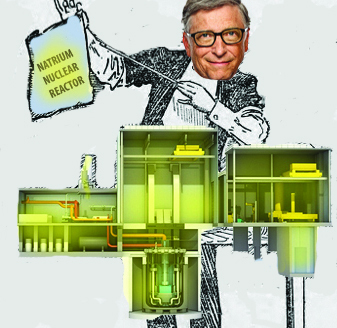
Bill Gates’s darling, the Natrium reactor in Wyoming is also plowing ahead. Both proposals are raking in the Inflation Reduction Act and other taxpayer funded subsidies. The danger: Money and time wasted on these false solutions to the climate crisis divert public resources from renewables, energy efficiency and other faster, more cost-efficient and safer ways to address the climate crisis.
A recent study from the Institute for Energy Economics and Financial Analysis concluded that small modular nuclear reactors are still too expensive, too slow to build and too risky to respond to the climate crisis.
While the nuclear industry tries to pass itself off as “clean,” it is an extremely dirty technology, beginning with uranium mining and milling which decimates Indigenous lands. Small modular nuclear reactors produce two to thirty times the radioactive waste of older nuclear designs, waste for which we have no safe, long-term disposal site. Any community that hosts a nuclear reactor will likely be saddled with its radioactive waste – forever. This harm falls disproportionately on Indigenous and low-income communities.

For those of us downriver, X-Energy’s plans to build at the Hanford Nuclear Site on the Columbia flies in the face of reason, as it would add more nuclear waste to the country’s largest nuclear cleanup site.
In Oregon, we have a state moratorium on building nuclear reactors until there is a vote of the people and a national waste repository. Every few years, the nuclear industry attempts to overturn this law at the Oregon Legislature, but so far it has been unsuccessful. This August, Umatilla County Commissioners announced they’ll attempt another legislative effort to overturn the moratorium. Keeping this moratorium is wise, given the dangerous distraction posed by the false solution of small modular nuclear reactors. Let’s learn from the NuScale debacle and keep our focus on a just transition to a clean energy future–one in which nuclear power clearly has no place.
Will AI’s huge energy demands spur a nuclear renaissance?
Contracts with Google and Amazon could help, but bringing new types of reactor online will take larger investments — and time.
Davide Castelvecchi, Nature , 25vOct 24
Last week, technology giants Google and Amazon both unveiled deals supporting ‘advanced’ nuclear energy, as part of their efforts to become carbon-neutral.
Google announced that it will buy electricity made with reactors developed by Kairos Power, based in Alameda, California. Meanwhile, Amazon is investing approximately US$500 million in the X-Energy Reactor Company, based in Rockville, Maryland, and has agreed to buy power produced by X-energy-designed reactors due to be built in Washington State.
Both moves are part of a larger [??] green trend that has arisen as tech companies deal with the escalating energy requirements of the data centres and number-crunching farms that support artificial intelligence (AI). Last month, Microsoft said it would buy power from a utility company that is planning to restart a decommissioned 835-megawatt reactor in Pennsylvania.
The partnerships agreed by Google and Amazon involve start-up companies that are pioneering the design of ‘small modular reactors’, which are intended to be assembled from prefabricated pieces………….they still have a way to go before they become a reality.
Nature talked to nuclear-energy researchers to explore the significance and possible implications of these big-tech investments.
Could these deals spur innovation in the nuclear industry?
Building nuclear power stations — a process often plagued by complex permit procedures, construction delays and cost overruns — is financially risky, and betting on unproven technologies is riskier still…………..
the details of the deals are murky, and the level of support provided by Amazon and Google is likely to be “a drop in the bucket” compared with the billions these start-ups will ultimately need, says physicist Edwin Lyman, director of nuclear power safety at the Union of Concerned Scientists in Washington DC. “The PR machine is just going into overdrive,” says Lyman, but “private capital just doesn’t seem ready yet to take that risk”.
Allison Macfarlane, director of the School of Public Policy and Global Affairs at the University of British Columbia in Vancouver, Canada, and former chair of the US Nuclear Regulatory Commission (NRC), says that the speed of progress in computer science raises another question. “If we’re talking 15 years from now, will AI need that much power?”
Are there safety advantages to the small modular designs?
“The smallest reactors, in theory, could have a high degree of passive safety,” says Lyman. When shut down, the core of a small reactor would contain less residual heat and radioactivity than does a core of the type that melted down in the Fukushima Daiichi disaster that followed the cataclysmic 2011 tsunami in Japan.
The companies also say that the proposed pebble-bed reactors are inherently safer because they are not pressurized, and because they are designed to circulate cooling fluids without the help of pumps (it was the loss of power to water pumps that caused three of the Fukushima plant’s reactors to fail).
But Lyman thinks it is risky to rely on potentially unpredictable passive cooling without the backup of an active cooling option. And as reactors become get smaller, they become less efficient. Another start-up company, NuScale Power, based in Portland, Oregon, originally designed its small modular reactor — which was certified by the NRC — to produce 50 MW of electricity, but later switched to a larger, 77-MW design. The need to make the economics work “makes passive safety less credible”, Lyman says.
Do small modular reactors carry extra risks?
In some cases, small modular reactors “could actually push nuclear power in a more dangerous direction”, says Lyman. “Advanced isn’t always better.”
In particular, Lyman points out that the pebble-bed designs drawn up by X-energy and Kairos would rely on high-assay low-enriched uranium (HALEU), which comprises 10–20% uranium-235 — compared with the 5% enrichment level required by most existing reactors (and by NuScale’s reactor). HALEU is still classified as low-enrichment fuel (as opposed to the highly enriched uranium used to make nuclear bombs), but that distinction is misleading, Lyman says. In June, he and his collaborators — including physicist Richard Garwin, who led the design of the first hydrogen bomb — warned in a Science article that a bomb could be built with a few hundred kilograms of HALEU, with no need for further enrichment1.
Smaller reactors are also likely to produce more nuclear waste and to use fuel less efficiently, according to work reported in 2022 by Macfarlane and her collaborators2. In a full-size reactor, most of the neutrons produced by the splitting of uranium travel through a large volume of fuel, meaning that they have a high probability of hitting another nucleus, rather than colliding with the walls of the reactor vessel or escaping into the surrounding building. “When you shrink the reactor, there’s less material in there, so you will have more neutron leakage,” Macfarlane says. These rogue neutrons can be absorbed by other atomic nuclei — which would then themselves become radioactive.
Will small reactors be cheaper to build?
The capacity to build components in an assembly line could drastically cut reactors’ construction costs. But there are also intrinsic economies of scale in building larger reactors, says Buongiorno. “Don’t believe people blindly” when they say smaller reactors will produce cheaper energy, he says: nuclear energy has a lot going for it, but “it ain’t cheap” — and that is unlikely to change significantly.
Will all of these efforts help to combat climate change?
…………….. whether building new reactors is the best way to rapidly cut emissions is debated. Macfarlane points out that solar panels and wind turbines can be deployed at a much faster rate.
https://www.nature.com/articles/d41586-024-03490-3
-
Archives
- February 2026 (199)
- January 2026 (308)
- December 2025 (358)
- November 2025 (359)
- October 2025 (376)
- September 2025 (258)
- August 2025 (319)
- July 2025 (230)
- June 2025 (348)
- May 2025 (261)
- April 2025 (305)
- March 2025 (319)
-
Categories
- 1
- 1 NUCLEAR ISSUES
- business and costs
- climate change
- culture and arts
- ENERGY
- environment
- health
- history
- indigenous issues
- Legal
- marketing of nuclear
- media
- opposition to nuclear
- PERSONAL STORIES
- politics
- politics international
- Religion and ethics
- safety
- secrets,lies and civil liberties
- spinbuster
- technology
- Uranium
- wastes
- weapons and war
- Women
- 2 WORLD
- ACTION
- AFRICA
- Atrocities
- AUSTRALIA
- Christina's notes
- Christina's themes
- culture and arts
- Events
- Fuk 2022
- Fuk 2023
- Fukushima 2017
- Fukushima 2018
- fukushima 2019
- Fukushima 2020
- Fukushima 2021
- general
- global warming
- Humour (God we need it)
- Nuclear
- RARE EARTHS
- Reference
- resources – print
- Resources -audiovicual
- Weekly Newsletter
- World
- World Nuclear
- YouTube
-
RSS
Entries RSS
Comments RSS
 nuclear-news