The dodgy economics and doubtful future for Small Nuclear Reactors (SMRs)
 FOR GENERAL ATOMICS, SMALLER NUCLEAR PLANTS ARE BEAUTIFUL, San Diego Union Tribune But can its technology work? And is it even needed? BY ROB NIKOLEWSKI July 15, 2016 The scientists and engineers at General Atomics think the future of nuclear energy is coming on the back of a flatbed truck.
And the leadership at the San Diego-based company, which has been developing nuclear technologies for more than 60 years, has already spent millions in the expectation that its ambitious plans for the next generation of reactors will actually work.
“We have technology that we think is going to qualitatively change the game,” saidChristina Back, vice president of nuclear technologies and materials at General Atomics……..it’s designed to produce a reactor that’s so compact that the company’s handout material shows it being transported by tractor-trailer.
But EM² is still a long way from becoming a day-to-day reality in a fast-changing energy landscape.
Just building a prototype, Back said, is at least 10 years away and, “we’re looking at 2030-ish” before a commercial reactor could be up and running using EM² technology……And there are no guarantees the design will work……
Here in the United States, natural gas may pose an even greater challenge. Techniques such as hydraulic fracturing and horizontal drilling have unlocked vast amounts of natural gas in North America and the increased supply has lowered prices. Utilities are increasingly turning to natural gas-fired power plants to generate electricity, at least in large part, because gas burns much cleaner than coal.
Where does that leave nuclear?…….. nuclear has long faced intense opposition from those who consider it an inherently dangerous source of power and the EM² technology is being developed at a time when nuclear plants are getting shut down in places such as Illinois, Vermontand New York.
The environment for nuclear power in California is even more daunting……Critics of nuclear power point to the falling costs and rising production numbers for renewable energy, as well as a mandate from the California Public Utilities Commission ordering the state’s big three investor-owned utilities to add 1.3 gigawatts of energy storage to their grids by the end of the decade.
Solar powered spacecraft to arrive on Jupiter on July 4
| Juno spacecraft demonstrates viability of solar power in deep space, Enformable, Karl Grossman 27 Jun 2016 What NASA insisted for decades could not be a spacecraft using solar energy rather than nuclear power going beyond the orbit of Marswill be proven false next Monday, July 4th, Independence Day, when the solar-energized Juno space probe arrives at Jupiter.NASA had maintained that to provide on-board power and heat on spacecraft in deep space, plutonium-powered systems were requireddespite the disaster if there were an accident on launch or in a fall back to Earth and the plutonium was released. I broke the story 30 years ago about how the next mission of NASA’s ill-fated Challenger shuttle was to involve lofting a plutonium-powered space probe and I have been reporting in articles, books and on television on the nuclear-in-space issue ever since. If the Challenger accident did not happen in January 1986 but the shuttle exploded on its next scheduled mission, in May 1986, with the plutonium-powered space probe in its cargo bay, the impacts could have been enormous. Plutonium is the most lethal of all radioactive substances. Still, when NASA re-scheduled the two plutonium-powered missions it had planned for 1986one the Galileo mission to Jupiterit not only publicly declared that plutonium systems to provide on-board power for space probes in deep space were necessary but swore to that in court. Opponents of the Galileo mission brought suit in U.S. District Court in Washington, D.C. in 1989 seeking to stop the nuclear-energized Galileo shot because of its public health danger in the event of an accident, and they pressed NASA and the U.S. Department of Energy (DOE) on the availability of a safe energy alternative. NASA and DOE officials swore that only nuclear power would do that far out in space, that solar energy could not be harvested beyond the orbit of Mars. And now comes NASA’s own Juno spacecraft energized by solar energy functioning in deep space. Indeed, NASA acknowledges, “This is the first time in history a spacecraft is using solar power so far out in space.”…… “Just like here on Earth there is a tug-of-war going on between those who wish to promote life-giving solar power and those who want nukes. That same battle for nuclear domination is being taken into the heavens by an industry that wants more profitno matter the consequences. The Global Network will continue to organize around the space nuclear power issue by building a global constituency opposed to the risky and unnecessary nukes in space program.” – Gagnon, coordinator of The Global Network —Against Weapons and Nuclear Power in Space With solar-energized Juno’s arrival at Jupiter, this Independence Day should mark a blow for independence from dangerous nuclear power above our heads in space. http://enformable.com/2016/06/juno-spacecraft-demonstrates-viability-solar-power-deep-space/ |
Nuclear weapons risk could spread if laser uranium enrichment technology is adopted
Laser uranium enrichment technology may create new proliferation risks, Science Daily, June 27, 2016
- Source:
- Princeton University, Woodrow Wilson School of Public and International Affairs
- Summary:
- A new laser-based uranium enrichment technology may provide a hard-to-detect pathway to nuclear weapons production, according to a forthcoming paper.
- A new laser-based uranium enrichment technology may provide a hard-to-detect pathway to nuclear weapons production, according to a forthcoming paper in the journalScience & Global Security by Ryan Snyder, a physicist with Princeton University’s Program on Science and Global Security.
- One example of this new third-generation laser enrichment technique may be the separation of isotopes by laser excitation (SILEX) process which was originally developed in Australia and licensed in 2012 for commercial-scale deployment in the United States to the Global Laser Enrichment consortium led by General Electric-Hitachi. Research on the relevant laser systems is also currently ongoing in Russia, India and China.
The paper explains the basic physics of the new uranium separation concept, which relies on the selective laser excitation and condensation repression of uranium-235 in a gas. It also estimates the key laser performance requirements and possible operating parameters for a single enrichment unit and how a cascade of such units could be arranged into an enrichment plant able to produce weapon-grade highly enriched uranium.
Using plausible assumptions, the paper shows how a covert laser enrichment plant sized to make one bomb’s worth of weapon-grade material a year could use less space and energy than a similar scale plant based on almost all current centrifuge designs, the most efficient enrichment technology in use today. The results suggest a direct impact on detection methods that use size or energy use as plant footprints……..https://www.sciencedaily.com/releases/2016/06/160627160941.htm
Russia’s massive nuclear-powered icebreaker to seek oil reserves in Arctic
Arktika is just one icebreaker in a class known as Project 22220. The other two — Sibir, which was laid down in May 2015, and Ural — are also planned. If completed, Sibir will reportedly have the propulsion power of 110 MW, almost twice as powerful as Arktika. Both ships are part of a $1.2 billion contract that Baltic Shipyards signed in 2014 with Rosatom State Nuclear Energy Corp.
Why would Russia need nuclear-powered icebreakers in the first place? Obviously, for defense. Icebreakers can clear a path for military ships, allowing for increased mobility and range for the Russian naval fleet.
Russia’s powerful new nuclear icebreaker
Russia unveils ‘world’s biggest’ nuclear icebreaker, Yahoo News June 17, 2016, Moscow (AFP) – Russia on Thursday floated out a new nuclear-powered icebreaker, said to be the world’s biggest and most powerful, to be used for hauling liquefied natural gas from its Arctic terminal.
Arktika, ordered by Russia’s Rosatom state nuclear agency, was built at the Baltic Shipyard in Saint Petersburg, and will be ready to use by the end of next year.
“There are no icebreakers like it in the world,” said Rosatom chief Sergei Kiriyenko at the ceremony, according to a company statement. “The Arktika icebreaker presents truly new opportunities for our country.”…….It can cut through ice of up to 2.8 metres (nine feet) thick. https://au.news.yahoo.com/world/a/31854163/russia-unveils-worlds-biggest-nuclear-icebreaker/#page1
Fleet of little nuclear reactors for Britain. Rolls Royce to build them?

Rolls Royce Shortlisted to build fleet of baby nuclear-reactors, CITY AM Jessica Morris, 5 June 16 , FTSE 100-listed engineering company Rolls-Royce has been shortlisted to build a fleet of mini nuclear reactors, City A.M. understands.It’s part of the government’s £250m nuclear research programme unveiled in last year’s Autumn Statement, which includes a competition to identify the best value small modular reactor (SMR) design for the UK.
An industry source said that the SMR scheme won’t be a “short process”. This comes despite the UK energy policy crisis, with an increasingly strained power supply. Almost 6,000 MW could be lost this year.
Of the 38 companies which submitted expressions of interest in the competition, 33 were eligible to compete in the next round, according to the Sunday Timeswhich first reported the news.
These also include US engineering giant Bechtel, NuScale Power which is backed by US engineer Fluor, and Canada’s Terrestrial Energy……The company declined to comment, while the Department for Energy and Climate Change hasn’t yet responded to a request for comment. http://www.cityam.com/242623/rolls-royce-shortlisted-to-build-fleet-of-baby-nuclear-reactors
Monju: the failing nuclear reprocessing dream
Nuclear Holy Grail Slips Away From Japan With Operator Elusive http://www.bloomberg.com/news/articles/2016-05-31/nuclear-holy-grail-slips-away-from-japan-with-operator-elusive Stephen Stapczynski sstapczynski Emi Urabe
-
Japan to pick a new operator for Monju fast-breeder reactor
-
The prototype plant has cost more than $9 billion amid delays
Japan is missing its own deadline to find a new operator for a prototype nuclear power program that’s failed to succeed in the two decades since it was built, threatening the resource-poor country’s support of a technology other nations have abandoned.
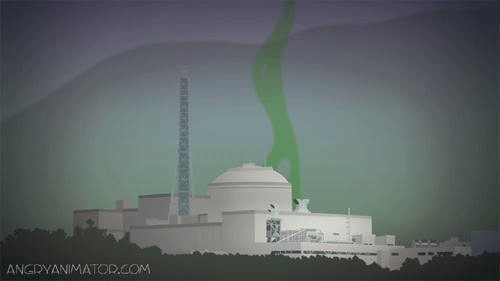
The country’s nuclear regulator demanded in November a replacement for the government-backed Japan Atomic Energy Agency be found within six months for the Monju fast-breeder reactor. Monju, which has functioned for less than a year since its completion more than 20 years ago, now faces the possibility of being scrapped.
The so-called fast-breeder reactor — a cornerstone of its atomic energy strategy dating back to the 1950s — uses spent nuclear fuel from other plants and is designed to produce more atomic fuel that it consumes. The reactor, named after the Buddhist deity of wisdom, has cost the nation more than 1 trillion yen ($9 billion) and has barely operated since it first generated electricity in 1995.
1950s Strategy
Monju is currently operated by the JAEA, a quasi-government organization that is under the Ministry of Education, Culture, Sports, Science and Technology. JAEA declined to comment. The nation’s nuclear watchdog, the Nuclear Regulation Authority, didn’t respond to e-mailed questions regarding the status of Monju.
“We don’t have plans to decommission the reactor,” said Hiroki Takaya, director of the ministry’s International Nuclear and Fusion Energy Affairs Division, which oversees Monju. “We are exploring many different options for who will operate the reactor — either a new entity or an existing company.”
The NRA said in November the science ministry must find a new operator or consider closure. The ministry drafted a set of criteria for a new operator, but have yet to name a replacement, it said on May 27. The ministry hopes to find an operator as soon as possible, but hasn’t set a concrete deadline.
America’s NRC changing nuclear fee structure to help Small Nuclear reactors: Shillenberger delighted
 NuScale Power LLC is expected to be the first company in the U.S. to submit a small modular reactor design application to the NRC by the end of the year, with project commercialization by 2024. NuScale’s reactor modules would each generate 50 megawatts (95 ECR, 5/17/16).
The NRC is implementing a variable annual fee schedule for these reactors including a minimum fee, a variable fee and a maximum fee based on the reactor’s cumulative licensed thermal power rating, which is the total heat output for all modules at a nuclear power plant. …..
Safety Concerns from Environmentalists
The Union of Concerned Scientists, a nonprofit organization focused on scientific research of environmental issues, opposes different fees for small modular reactors because the safety risk of these reactors is still unclear, it said.
“It’s not clear that the relative risk of SMRs and the effort needed to license and regulate them is proportional to the power rating,” Ed Lyman, a senior scientist at the Union of Concerned Scientists, told Bloomberg BNA May 23. He said this is especially true “since SMR applicants are requesting exemptions that require significant technical analysis, such as reducing emergency planning zone size and weakening security requirements.”
Also, Lyman disagreed with the statement that the SMRs would require less regulatory oversight. “NRC inspections of a multi-module SMR bundled unit may be more complex and entail more labor than inspections of a single large reactor with the same power rating,” he said.
Similarly, Tim Judson, executive director of the Nuclear Information Resources Service, said he thinks that reduced fees for SMRs would ultimately impact NRC safety inspections.
“Smaller reactors means there would be several times more reactors requiring inspections and oversight for the same amount of power. Basing the fees on the generation capacity seems like it’s likely to starve the agency of resources to do its job,” he told Bloomberg BNA May 23.
TVA Submits Early Site Permit for SMR
The Tennessee Valley Authority submitted an early site permit application for the potential to construct and operate multiple small modular reactor units at its Clinch River site near Oak Ridge, Tenn. TVA is the first in the nuclear industry to submit any such application related to SMR technology to the NRC, TVA said in a May 13statement.
The utility, which currently operates three nuclear plants in the South, has not decided what company it would purchase the SMR technology from, a TVA spokeswman told Bloomberg BNA May 23.
To contact the reporter on this story: Rebecca Kern in Washington atrkern@bna.com
To contact the editor responsible for this story: Larry Pearl atlpearl@bna.com
Small Modular Nuclear Reactors not economically viable, but being promoted anyway
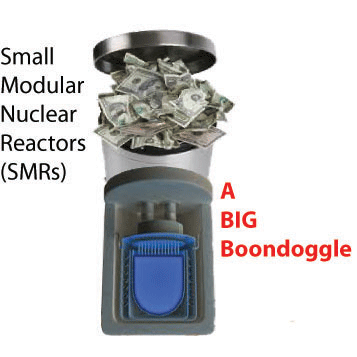 Small Modular Reactors Get Their First Chance In The US, MIT Technology Review, Richard Martin Editor 12 May 16 Small, modular reactors have long been viewed by many in the nuclear power industry as the most promising technology—indeed, as the only realistic path forward—for nuclear power in the United States. In a possible step forward for next-generation nuclear power, the Tennessee Valley Authority is applying for a permit to build one such reactor. Although the specific reactor technology has yet to be determined, the utility could have it running by the mid-2020s……..
The site chosen for the project, on the Clinch River, is notable in the checkered history of nuclear power in this country: it was to be the site of the Clinch River Breeder Reactor, on which more than $1 billion was spent in the 1970s and early 1980s. The project was finally killed by Congress in 1983, and many date the decline of the U.S. nuclear industry to its demise.
Nuclear fusion – International Thermonuclear Experimental Reactor not likely to succeed
What’s Wrong with The Bill Gates Nuclear Vision? Well, a lot, actually
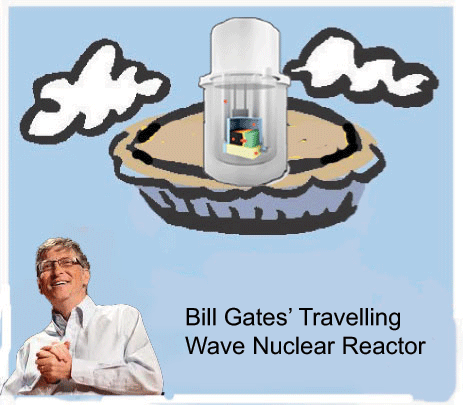 Bill Gates Still Trying To Corral The “Wild” Nuclear Unicorn, Clean Technica May 3rd, 2016 by Tina Casey Legendary tech billionaire Bill Gates has been pitching the idea that nuclear energy is the only technology that can be deployed quickly enough to ward off catastrophic global warming. However, Gate’s favored nuclear technology is not nearly ready to come off the drawing board. Meanwhile, solar, wind, and other clean technologies are already sweeping into the real world.
Nevertheless, Gates continues to soldier on. In the latest development, he made the case for a nuclear energy “miracle” to the readers of MIT Technology Review.
The Bill Gates Nuclear Vision
One should expect an ultra-savvy marketer like Bill Gates to come up with a far-reaching strategy for his nuclear vision, and he has. In 2006 he formed a nuclear company called TerraPower with the aim of providing the world with “a more affordable, secure and environmentally friendly form of nuclear energy.”
Gates bumped his strategy up to the next level in December 2015. In a splashy media event coordinated with the COP21 Paris climate talks, he launched a new investment group called the Breakthrough Energy Coalition.
BEC was designed as private sector companion to Mission Innovation, which also launched at COP21. Mission Innovation is a coalition of energy-producing governments that have pledged to increase public sector investment in clean energy.
Given Gate’s interest in TerraPower’s success, we’re thinking that BEC is also designed to deflect investment toward nuclear. Although Gates has positioned BEC as source-neutral, in a blog post during COP21 he laid down a pretty big hint that nuclear was the way to go:
The renewable technologies we have today, like wind and solar, have made a lot of progress and could be one path to a zero-carbon energy future. But given the scale of the challenge, we need to be exploring many different paths—and that means we also need to invent new approaches.
What’s Wrong With A Little Nuclear Energy?
Joe Romm of Think Progress has picked apart Gates’s most recent pro-nuclear pitch, concluding that:
…Gates is just wrong about everything here. He is wrong that energy miracles are needed by the industrialized countries to achieve CO2 levels in 2050 consistent with beating the 2°C target. He is wrong that achieving that target requires focusing on R&D rather than deployment. He is wrong that there is some sort of consensus to that effect. He is wrong that a carbon price isn’t important in achieving the rapid reduction the rich countries need. He is wrong to make it seem like boosting energy efficiency is not as vital a strategy as reducing carbon intensity.
Ouch!
Romm’s basic point is that clean energy solutions are already here and now, just not in the form that Gates would prefer to invest in.
The solar industry, of course, is one place where you’ll find a lot of agreement with Romm. One example is the graphic above, which represents the winnowing-out process used by the company Siva Power to settle on its market-ready thin film solar technology.
Last December, Siva CTO Markus E. Beck, a recognized leader in thin film technology, shared some thoughts with CleanTechnica about Gates’s nuclear solution. He emphasized that solar insiders are not the only skeptics:
The Breakthrough Energy Coalition’s premise is flawed. The BEC argues that at present there are no workable solutions to tackle the world’s increasing need for energy while reducing carbon emissions at an affordable level. Studies by Goldman Sachs, MIT, McKinsey, the IEA, Shell and others provide data supporting a counter argument — i.e. the solutions exist: namely solar (PV) and wind.
Tough Row To Hoe For Nuclear Energy
We’ll give the last word on TerraPower to the Senior Editor of MIT Technology Review, Richard Martin.
In a brief but eyebrow-raising article last fall, Martin raised some questions aboutTerraPower’s choice of nuclear technology, the traveling wave reactor. Apparently, after spending a considerable amount of time and money on traveling wave R&D, the company has modified its course and is now experimenting with a molten chloride design:
Many nuclear industry observers have been skeptical about the concept from the outset. The traveling wave is a subspecies of a sodium-cooled fast reactor, and the track record of those reactors is not encouraging.
Martin also cites M.V. Ramana, a Princeton nuclear physicist:
“The problem with sodium is that it has been pretty much impossible to prevent leaks… Fast reactors in general have never been commercially viable, and I haven’t seen anything from TerraPower that suggests that their design will fare any better………..http://cleantechnica.com/2016/05/03/bill-gates-still-trying-corral-wild-nuclear-unicorn/
Documents reveal poor performance of Mixed Oxide Fuel Fabrication Facility (MOX)
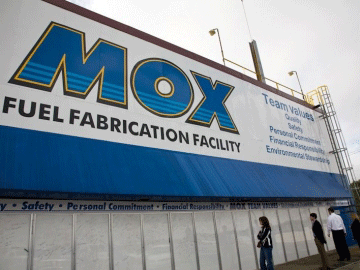 MOX Contractor Slammed for Poor Performance http://www.pogo.org/blog/2016/05/mox-contractor-slammed-for-poor-performance.html?referrer=http://paper.li/artmackay/1324257026?edition_id=94aab260-1141-11e6-9ab7-002590a5ba2d By: Lydia Dennett, 2 May 16 Investigator, POGO Documents obtained by Savannah River Site Watch are providing even more evidence than is already out there that it is time for Congress to follow the Department of Energy’s recommendation and cancel the Mixed Oxide Fuel Fabrication Facility (MOX) for good.
“Overall performance is below the level needed for successful project completion, as culminated in cost overruns and schedule delays,” the National Nuclear Security Administration (NNSA) wrote in its analysis of the contractor in charge of constructing MOX.
According to the NNSA documents obtained via the Freedom of Information Act and released by Savannah River Site Watch, the MOX contractor, CB&I AREVA MOX Services (CB&I), received only 49 percent of the possible award fee. This dock in award fee was due to concerning findings regarding DB&I’s management of the project, including the fact that the contractor failed to adequately perform random drug testing of its employees. However, CB&I still received $4.33 million of the possible $8.86 million in award fees.
CB&I has now been the MOX contractor for over nine years. The project’s estimated total life-cycle cost (which includes construction and operating the plant for 20 years) has gone from $4 billion to a whopping $25 billion. But even $25 billion may not be enough.Independent cost estimates have found that unless annual appropriations more than double over the next few years, the whole MOX project could cost as much as $110 billion and won’t be complete until 2100. Government officials have further noted that the contractor is running at a 25 percent rework rate, meaning approximately one quarter of the work done on the MOX facility will have to be re-done.
The MOX project is a multi-billion dollar boondoggle that, even if completed, will not be able to complete its mission. Just this year the Administration announced they believe it would be in the best interest of taxpayers to pursue an alternative plan, but it’s up to Congress to make the final cut. With the contractor performing so poorly, and the cost mounting with every delay and mistake, it’s time to make the fiscally responsible decision and end MOX.
China planning Floating Nuclear Power Plants
 China to Develop Floating Nuclear Power Plants, NYT, By MICHAEL FORSYTHE APRIL 22, 2016 HONG KONG — All the radar systems, lighthouses, barracks, ports and airfields that China has set up on its newly built island chain in the South China Sea require tremendous amounts of electricity, which is hard to come by in a place hundreds of miles from the country’s power grid.
Beijing may have come up with a solution: floating nuclear power plants.
A state-owned company, China Shipbuilding Industry Corporation, is planning to build a fleet of the vessels to provide electricity to remote locations including offshore oil platforms and the contentious man-made islands, the state-run newspaper Global Times reported on Friday.
The paper quoted an executive at the company, Liu Zhengguo, as saying that “demand is pretty strong” for the floating power stations, which would be built by one of its subsidiaries.
In January, Xu Dazhe, the director of the China Atomic Energy Authority,told reporters in Beijing that China was planning to develop offshore floating nuclear energy plants, saying they “must undergo a rigorous, scientific evaluation,” but also linking these to China’s desire to become a “maritime power.”……
Typhoons regularly cross the South China Sea, and ships and submarines that run on nuclear power generally have the means to quickly sail away from a storm. It is unclear how mobile or seaworthy these reactor ships will be. Safety regulations for the seaborne reactors are being drawn up and reviewed, Global Times said, quoting Tang Bo, an official at China’s National Nuclear Safety Administration.
David Lochbaum, a nuclear engineer and the director of the Nuclear Safety Project for the Union of Concerned Scientists, said that in the event of a major nuclear accident at a floating barge, like a meltdown of the reactor core, winds could carry radioactivity to large population centers.
“The floating nuke accident scenario also carries with it the potential for molten parts of the reactor core burning through the bottom of the barge to reach the water below,” Mr. Lochbaum wrote in an email. “The water is good for cooling, but not good for containment.”……..
Gregory B. Poling, director of the Asia Maritime Transparency Initiative at C.S.I.S. said it was too soon to tell how a possible deployment of the floating nuclear power stations would play out in the complicated politics of the South China Sea, though he said it was “potentially worrisome.”
“But it appears that the idea hasn’t gotten any farther than conceptualization yet, so we seem to have years to wait before we find out,” Mr. Poling wrote in an email.
A rendering of a possible Chinese floating nuclear power station was published on the English-language website of Global Times’s parent company, the Communist Party’s flagship newspaper, People’s Daily. The image showed the small ship or barge next to a pier, surrounded by what looked like floating ice. http://www.nytimes.com/2016/04/23/world/asia/china-nuclear-power-south-china-sea.html?_r=0
Nuclear industry up to their old tricks, spruiking “new nuclear”
But thorium can’t fuel a reactor by itself: rather, a uranium- or plutonium-fueled reactor can convert thorium-232 into fissionable (and plutonium-like, highly bomb-usable) uranium-233. Thorium’s proliferation [8], waste, safety, and cost problems differ only in detail from uranium’s: e.g., thorium ore makes less mill waste, but highly radioactive U-232 makes fabricating or reprocessing U-233 fuel hard and costly.

‘New’ nuclear reactors? Same old story, Ecologist, Amory Lovins 12th April 2016 The nuclear industry is forever reinventing itself with one brilliant ‘new’ idea after another, Amory Lovins wrote in this classic 2009 essay. But whether it’s touting the wonders of future SMRs, IFRs or LFTRs, the reality never changes: the reactors they are building right now are over time, over budget and beset by serious, entirely unforeseen technical problems….. Continue reading
The folly of wasting time and money on EPR nuclear reactor
 Nuclear power and climate change Too little, too late
The EPR nuclear reactor A dangerous waste of time and money NIRS Briefing January 2012 The French EPR* is a nuclear reactor design that is aggressively marketed by the French companies Areva and EDF. Despite the companies’ marketing spin, not only is the reactor hazardous, it is also more costly and takes longer to build than renewable-energy alternatives. While no EPR is currently operating anywhere in the world, four reactors are under construction in Finland (Olkiluoto 3, construction started in 2005), France (Flamanville 3, 2007) and China (Taishan 1 and 2, 2009-10). The projects have failed to meet nuclear safety standards in design and construction, with recurring construction defects and subsequent cover-ups, as well as ballooning costs and timelines that have already slipped significantly.
1 This Month
26 September – International Day for the Total Elimination of Nuclear Weapons





PLEASE OPPOSE HR 8255 AND S.3639 – bills would accelerate satellite deployment, with no environmental review or safeguards – https://ncstd5li.quorum.us/campaign/169331/
To see nuclear-related stories in greater depth and intensity – go to https://nuclearinformation.wordpress.com
-
Archives
- September 2026 (291)
- August 2026 (330)
- July 2026 (355)
- June 2026 (287)
- May 2026 (306)
- April 2026 (356)
- March 2026 (251)
- February 2026 (267)
- January 2026 (308)
- December 2025 (358)
- November 2025 (359)
- October 2025 (375)
-
Categories
- 1
- 1 NUCLEAR ISSUES
- business and costs
- climate change
- culture and arts
- ENERGY
- environment
- health
- history
- indigenous issues
- Legal
- marketing of nuclear
- media
- opposition to nuclear
- PERSONAL STORIES
- politics
- politics international
- Religion and ethics
- safety
- secrets,lies and civil liberties
- spinbuster
- technology
- Uranium
- wastes
- weapons and war
- Women
- 2 WORLD
- ACTION
- AFRICA
- Atrocities
- AUSTRALIA
- Christina's notes
- Christina's themes
- culture and arts
- Events
- Fuk 2022
- Fuk 2023
- Fukushima 2017
- Fukushima 2018
- fukushima 2019
- Fukushima 2020
- Fukushima 2021
- general
- global warming
- Humour (God we need it)
- Nuclear
- RARE EARTHS
- Reference
- resources – print
- Resources -audiovicual
- Weekly Newsletter
- World
- World Nuclear
- YouTube
-
RSS
Entries RSS
Comments RSS

