I’ve got a rocket for these space cadets and their pantomime of feminism

They do not operate the spaceship. They dress sexy for the spaceship flight.
pseudo-feminism.. which wrinkles its nose if you look grey, ugly or old
The Age, Jacqueline Maley, April 20, 2025
“……………………………………………………………….. We didn’t want to look but we found we couldn’t look away when, on Wednesday, Jeff Bezos’ Blue Origin – a space technology company – launched an all-female, B- and C-list celebrity crew of six into space, wearing skintight designer spacesuits and heavy make-up. It was the first fully-lady-mission since Russian astronaut Valentina Tereshkova’s solo space flight in 1963.
The team consisted of the billionaire Bezos’ fiancée, the television journalist and children’s book author Lauren Sanchez; pop star Katy Perry; television host and Oprah-bestie Gayle King; former NASA rocket scientist Aisha Bowe; activist, sexual assault survivor and scientist Amanda Nguyen; and film producer Kerianne Flynn.
“I was like, ‘What am I going to wear?’” Perry told Elle of her initial reaction to the invitation. “But seriously, I have wanted to go to space for almost 20 years.”
In terms of publicity for space tourism for the rich and (dubiously) famous, it was a bonanza. But the heavily girlified nature of the rhetoric around the mission (if we can call it that – the trip lasted for 11 minutes), and its explicit branding as an exercise in empowering girls to aspire to careers in space exploration, well, that made it a very dark day for feminism.
The whole exercise was emblazoned with such drippy femininity and lame girlboss-ery that all womankind was implicated. It was a test of the implicit feminist pact to Support Women. I suspect I failed it.
It’s not something that Virginia Woolf or Betty Friedan ever prepared us for – an all-woman space crew which served quotes like: “I think it’s so important for people to see … this dichotomy of engineer and scientist, and then beauty and fashion. We contain multitudes. Women are multitudes. I’m going to be wearing lipstick.”
Despite not having any direct link to the Trump administration, it all felt so very Trumpy – a symbol of the dark end-days of American democracy; the great American project of aspiration and exploration reduced to a commercialised stunt, obscenely wasteful and vulgar beyond words. …………..
… the moral emptiness of the mission was underscored by leaked documents showing the Trump administration plans to gut key science programs funded by the federal government.
Under the leaked plans, NASA’s science budget for the fiscal year 2026 would be nearly halved. As Nature reported: “At risk is research that would develop next-generation climate models, track the planet’s changing oceans and explore the Solar System.”
Separately, NASA’s Diversity, Equity and Inclusion chief Neela Rajendra was sacked, in compliance with Trump’s executive order to “terminate” all people employed under “DEI” programs.
Business Standard reported Rajendra “played a key role in national initiatives like the Space Workforce 2030 pledge, aimed at increasing representation of women and minorities in STEM fields”.
Sure, but did she put the glam into space? The girlstronauts represent a pantomime of feminism found everywhere across Trump-land.
It’s in the robotically doll-like women who sit behind the men of the administration, nodding and smiling as they announce powerful new assaults on the rule of law.
It’s in the milquetoast “Be Best” initiatives of first lady Melania Trump.
It’s in the administration’s persecution of trans people in the name of “women’s rights”, and in its rollback of abortion rights…………
But at least the women are on stage, right? Women can be treated as a special category as long as they uplift and adorn – that seems to be the message the girl crew have absorbed and then promoted. But there is little point in them being on view if they are not looking “glam”.
Such women equate a certain kind of physical presentation with self-respect, and they defend it as their “right”. They fail to realise, or are too rich to care, that the companies which sell them their version of beauty are exploiting them. They do not operate the spaceship. They dress sexy for the spaceship flight.
It is a nihilistic form of pseudo-feminism that insists on women’s right to “take up space” (as the astronaut women chanted when they reached the zero-gravity part of their adventure), but which wrinkles its nose if you look grey, ugly or old while doing so.
It is a way of reducing women to the status of a pretty distraction, while insisting, straight-faced, that at least that means we are being “seen”. https://www.theage.com.au/politics/federal/i-ve-got-a-rocket-for-these-space-cadets-and-their-pantomime-of-feminism-20250417-p5lslv.html
Aerial photos show state of Sizewell C preparatory works

Aerial photos of the proposed Sizewell C nuclear power station in Suffolk
have revealed the state of preparatory works ahead of its final investment
decision (FID). Despite the nuclear power plant having received development
consent in 2022, its FID is still yet to be achieved and the mood of
potential investors has been the subject of intense speculation.
Centrica chief executive Chris O’Shea said his company’s stake in Sizewell C
could be “between 1% or 2% and 50%”, meanwhile, the French spending
regulator Cour des comptes said EDF should scale back its involvement in
the project.
Nevertheless, preparatory work is underway such on road
upgrades and ground freezing, with over £2.5bn worth of contracts having
been awarded already. Four photos taken from an aerial platform, which
could be a drone, aircraft or hot air balloon, were published by Stop
Sizewell C on 8 April. The images were republished by Nuclear Free Local
Authorities (NFLA), which said the photos had been taken by an “anonymous
source” who “kindly made them free of license for open use”.
New Civil Engineer 16th April 2025, https://www.newcivilengineer.com/latest/aerial-photos-show-state-of-sizewell-c-preparatory-works-16-04-2025/
Bill Gates enters race to build mini-nuclear reactors in Britain

Competition from billionaire’s company TerraPower threatens blow for Rolls-Royce
A company founded by Bill Gates has submitted a bid to build
mini-nuclear reactors in Britain, dealing a potential blow to
Rolls-Royce’s hopes of dominating the domestic market.
Seattle-based TerraPower has written to the Government outlining its intention to submit
its reactor design for regulatory approval. The move kickstarts efforts by
the US company to enter an increasingly competitive market to build small
modular reactors (SMR), which are expected to play a key role in the UK’s
shift to cleaner energy.
The Microsoft billionaire’s company has
developed a reactor, called Natrium, that uses a molten sodium heat storage
system that allows it to rapidly ramp up its power output at peak times.
Natrium is the Latin word for sodium which has the chemical symbol Na.
Chris Levesque, TerraPower chief executive, said: “I am incredibly
excited to begin the process of licensing the Natrium technology in the UK.
Rolls-Royce had hoped to corner UK market with its small modular reactors.
While TerraPower is not involved in the competition for the UK’s SMR
contract, the potential entrant of a new deep-pocketed rival into the
market will pose a fresh challenge to Rolls-Royce’s plans.
Telegraph 16th April 2025, https://www.telegraph.co.uk/business/2025/04/16/bill-gates-bids-to-build-mini-nuclear-reactors-in-britain/
UPENN REPORT: TARIFFS LIKELY NAIL IN COFFIN OF U.S. SMALL NUCLEAR REACTORS.

Small Modular Reactors (SMRs) are a “false promise” for powering
proposed artificial intelligence (AI) data centers nationwide, according to
a new report published today by the University of Pennsylvania’s (UPenn), Dr. Joseph Romm, a former Acting Assistant Secretary of Energy.
The research report, “Smaller nuclear reactors (SMRs) are a costly dead end,
especially for AI, and Trump’s tariffs and other policies make them even
more of a losing bet,” is an expanded version of a chapter in Dr.
Romm’s new book, “The Hype About Hydrogen: False Promises and Real
Solutions in the Race to Save the Climate” (Island Press, April 22).
The report examines recent economic developments, including the over-budget $35
billion completion of Georgia’s Vogtle plant, current and canceled SMR
proposals, and how Trump’s tariffs (and other policies) threaten the
nuclear industry. The study concludes that these factors will ultimately
doom the likelihood of new American commercial nuclear reactors playing
much of a role in meeting U.S. electricity demand needs for the foreseeable
future.
“It would be unprecedented in the history of energy for smaller
nuclear reactors to overcome not only the high cost per megawatt of large
nuclear plants but also the diseconomies of shrinking them down—and then
to somehow keep dropping in price so sharply that SMRs become such clear
marketplace winners as to make a major contribution to cutting greenhouse
gas emissions by 2050. This is especially true since SMRs show every sign
of the kind of cost escalation that has plagued larger nuclear reactors for
decades,” according to the report.
Hastings Group 15th April 2025,
https://hastingsgroupmedia.com/SMF/041525-Romm-SMR-Dead-End-Report-news-release.pdf
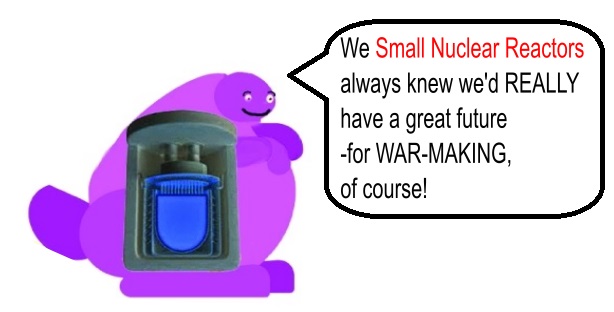
U.S. advances microreactor program for military sites
Nuclear Newswire, Apr 15, 2025,
The Defense Innovation Unit announced April 10 next steps in the Advanced Nuclear Power for Installations (ANPI) program, launched in 2024 to deploy microreactor nuclear systems for increased power reliability at select military locations.
The ANPI program is a collaboration between DIU, which is under the Department of Defense, and the Departments of the Army and the Air Force, with the goals of working to design, license, build, and operate one or more microreactor nuclear power plants for the armed forces………………..
The DIU released the names of eight companies eligible to receive Other Transaction awards to provide commercially available dual use microreactor technology at various DOD installations:
- Antares Nuclear
- BWXT Advanced Technologies
- General Atomics Electromagnetic Systems
- Kairos Power
- Oklo
- Radiant Industries Incorporated
- Westinghouse Government Services
- X-energy
“Projecting power abroad demands ensuring power at home and this program aims to deliver that, ensuring that our defense leaders can remain focused on lethality,” ………………………………………………………………… https://www.ans.org/news/2025-04-14/article-6931/us-advances-microreactor-program-for-military-sites/
Gender Stunts in Space: Blue Origin’s Female Celebrity Envoys
April 15, 2025 Dr Binoy Kampmark, https://theaimn.net/gender-stunts-in-space-blue-origins-female-celebrity-envoys/
Indulgent, vain and profligate, the all-female venture into space on the self-piloted New Shepard (NS-31) operated by Jeff Bezos’ Blue Origin was space capitalism and celebrity shallowness on full show, masquerading as profound, moving and useful.
The crew consisted of bioastronautics research scientist and civil rights activist Amanda Nguyen, CBS Mornings co-host Gayle King, pop entertainer Katy Perry, film producer Kerianne Flynn, former NASA scientist and entrepreneur Aisha Bowe and Lauren Sánchez, fiancée of Jeff Bezos. The journey took 11 minutes and reached the Kármán line at approximately 96 kilometres above the earth.
Blue Origin had advertised the enterprise as an incentive to draw girls to pursue careers in science, technology, engineering and mathematics (STEM). It also shamelessly played on the background of some of the crew, with Nguyen promoted as “the first Vietnamese and south-east Asian female astronaut” whose presence would “highlight science as a tool for peace” and also project a potent “symbol of reconciliation between the US and Vietnam.”
Phil Joyce, Senior Vice President of New Shepard, thought it a “privilege to witness this crew of trailblazers depart the capsule today.” Each woman was “a storyteller” who would “use their voices – individually and together – to channel their life-changing experience today into creating lasting impact that will inspire people across our planet for generations.”
What was more accurately on show were celebrity space marketers on an expensive jaunt, showing us all that women can play the space capitalism game as well, albeit as the suborbital version of a catwalk or fashion show. Far from pushing some variant of feminism in the frontier of space, with scientific rewards for girls the world over, we got the eclipsing, if not a wholesale junking, of female astronauts and their monumental expertise.
It hardly compared, at any stretch or by any quantum of measure, with the achievement of Russian cosmonaut, Valentina Tereshkova, who piloted a Vostok 6 into earth’s orbit lasting 70 hours over six decades prior. To have Sánchez claiming to be “so proud of this crew”, tears cued for effect, gave the impression that they had shown technical expertise and skill when neither was required. It was far better to have deep pockets fronting the appropriate deposit, along with the necessary safe return, over which they had virtually no control over.
Dr Kai-Uwe Schrogl, special advisor for political affairs at the European Space Agency, offered a necessarily cold corrective. “A celebrity isn’t an envoy of humankind – they go into space for their own reasons,” he told BBC News. “These flights are significant and exciting, but I think maybe they can also be a source of frustration for space scientists.” How silly of those scientists, who regard space flight as an extension of “science, knowledge and the interests of humanity.”
The Guardian was also awake to the motivations of the Bezos project. “The pseudo progressiveness of this celebrity space mission, coupled with Bezos’s conduct in his other businesses, should mean we are under no illusion what purpose these flights serve.” With Richard Branson’s Virgin Galactic and Elon Musk’s SpaceX, the space tourism market, marked by its bratty oligarchs, is becoming competitive. In an effort to corner the market, attractive gimmicks are in high demand.
The cringingly superficial nature of the exercise was evident in various comments on the fashion aspect of the suits worn by the crew. Here was branding, and the sort that could be taken to space. As Sánchez stated: “Usually, you know, these suits are made for a man. Then they get tailored to fit a woman. I think the suits are elegant, but they also bring a little spice to space.” Blue Origin had capitalised on NASA’s own failings in 2019, which saw the abandoning of an all-female spacewalk for lacking appropriately fitting spacesuits.
On their return, the female cast performed their contractual undertakings to bore the press with deadly clichés and meaningless observations, reducing space travel to an exercise for the trivial. “Earth looked so quiet,” remarked Sánchez. “It was quiet, but really alive.” King, after getting on her knees to kiss the earth, merely wanted “to have a moment with the ground, just appreciate the ground for just a second.” (Surely she has had longer than that.) Perry, on her return after singing What a Wonderful World during the trip, overflowed with inanities. She felt “super connected to life”, as well as being “so connected to love.”
On the ground were other celebrities, delighted to offer their cliché-clotted thoughts. “I didn’t realise how emotional it would be, it’s hard to explain,” reflected Khloé Kardashian. “I have all this adrenaline and I’m just standing here.” From a family of celebrities that merely exist as celebrities and nothing else, she had some advice: “Dream big, wish for the stars – and one day, you could maybe be amongst them.”
Amanda Hess, reflecting on the mission in The New York Times, tried to put her finger on what it all meant. “The message is that a little girl can grow up to be whatever she wishes: a rocket scientist or a pop star, a television journalist or a billionaire’s fiancée who is empowered to pursue her various ambitions and whims in the face of tremendous costs.” Just not an astronaut.
California Nuclear Plant Integrates AI for Efficiency

Oil Price By Haley Zaremba – Apr 13, 2025,
- The Diablo Canyon nuclear power plant in California is utilizing AI technology to improve the efficiency of its document retrieval processes, aiming to reduce the time and resources spent on managing technical documentation.
- While the initial use of AI is limited to document retrieval, there are concerns among lawmakers and watchdogs regarding the potential for broader automation and the safety implications within a nuclear setting.
- The convergence of nuclear energy and AI is being driven by the increasing energy demands of data centers, with tech leaders and the federal government exploring the symbiotic relationship between these technologies for future energy solutions.
……………………………………………………………………………………………………………………lawmakers are very concerned about what the introduction of artificial intelligence into nuclear power production could mean for the future, and are pushing for more concrete guardrails. However, under the Trump administration, such parameters may not be forthcoming. Trump has already walked back a Biden-era ??executive order outlining goals for AI regulation, which the current administration sees as anti-innovation.
While there is little risk in the use of AI for document retrieval, there is concern about what comes next.
“The idea that you could just use generative AI for one specific kind of task at the nuclear power plant and then call it a day, I don’t really trust that it would stop there,” Tamara Kneese, the director of tech policy nonprofit Data & Society’s Climate, Technology, and Justice program, was recently quoted by Cal Matters. “And trusting PG&E to safely use generative AI in a nuclear setting is something that is deserving of more scrutiny.”
Nuclear energy and AI have become increasingly entangled as the runaway energy demand growth of data centers has threatened domestic energy security as well as Silicon Valley’s decarbonization goals. Tech bigwigs like Bill Gates and Sam Altman have increasingly touted nuclear energy as a carbon-free solution to meeting AI’s fast-growing energy demand, and have even envisioned a symbiotic relationship between nuclear and AI, wherein machine learning can help plan and design more efficient and cost-effective next-gen power plants.
The federal government has also pushed this angle. The U.S. Department of Energy recently identified 16 federal sites that ??are “uniquely positioned for rapid data center construction, including in-place energy infrastructure with the ability to fast-track permitting for new energy generation such as nuclear.” https://oilprice.com/Alternative-Energy/Nuclear-Power/California-Nuclear-Plant-Integrates-AI-for-Efficiency.html
UK Government convenes AI Energy Council, but could be ignoring hidden climate impacts in supply chains
Edie 10th April 2025, Sidhi Mittal
The UK Government has officially launched its AI Energy Council, with its first meeting outlining five key priorities for aligning the country’s clean energy ambitions with the rapid growth of artificial intelligence (AI).
However, while the Council focuses on integrating AI intro the UK’s energy system, Ministers are being warned that they are overlooking the strain which AI supply chains are putting on energy systems overseas.
The Council is led by Science, Innovation and Technology Secretary Peter Kyle and Energy Secretary Ed Miliband. Representatives from companies including Microsoft, Google, Amazon, ARM, EDF and ScottishPower sit on the Council, alongside energy regulator Ofgem and the National Energy System Operator (NESO).
The Council this week met for the first time, and agreed on focus points for the year ahead. These include preparing the UK’s energy grid for the electricity demands of AI and computer infrastructure, accelerating renewable energy adoption, and ensuring AI’s role in the energy sector contributes to the transition to net-zero.
Emphasis was also placed on using AI to improve grid flexibility and ensuring its safe, secure deployment in the energy system.
This move comes amid growing pressure for the UK’s AI ecosystem to deliver more public benefit. A recent report from the Institute for Public Policy Research (IPPR) found that only 15% of AI firms in the UK are developing solutions aimed at social challenges such as public health or environmental sustainability, despite 20% having received public funding.
IPPR’s head of AI Carsten Jung said: “Too many companies are focussed on generic process improvements rather than coming up with new, better products. And too few innovations are aimed at solving big societal problems, such as public health and climate change.
“This quantity over quality, profit over purpose, speed over substance, approach is a hugely missed opportunity.”
But as the UK attempts to shape a greener AI-powered future through initiatives like the AI Energy Council, the global supply chain it relies on presents an emissions challenge far beyond its borders.
AI chip boom in East Asia drives fossil fuel surge
New research from Greenpeace East Asia has found that electricity demand for manufacturing AI chips has risen more than 350% between 2023 and 2024. East Asia—home to the bulk of global AI chip production—is seeing this growth largely powered by fossil fuels………………………..
Greenpeace East Asia’s supply chain project lead Katrin Wu said: “While fabless hardware companies like Nvidia and AMD are reaping billions from the AI boom, they are neglecting the climate impact of their supply chains in East Asia.
“Across East Asia, there are many opportunities for companies to invest directly in wind and solar energy, yet chipmakers have failed to do so on a meaningful scale.
“Hardware companies can overcome renewable energy bottlenecks by investing directly in wind and solar capacity, signing power purchase agreements, and leveraging their influence to advocate for a higher ratio of renewable energy in the grid.”……………………………………………………………. https://www.edie.net/uk-government-convenes-ai-energy-council-but-could-be-ignoring-hidden-climate-impacts-in-supply-chains/
The Flamanville EPR nuclear reactor will not be able to deliver its full power without major works.

According to our information, EDF has still not been able to identify the cause of the malfunction of the turbine in the Normandy reactor.
La Tribune Juliette Raynal, 04/07/25
After a doomed construction site, the Normandy reactor of the Flamanville EPR started up on December 21, twelve years behind schedule. Its entry into service does not signal the end of the problems, far from it. According to our information, the difficulties encountered with the turbo-alternator unit, the centerpiece of a nuclear power plant, will prevent the first French EPR from delivering its full electrical power without major intervention requiring the assembly of scaffolding inside a room that is difficult to access.
Contacted by La Tribune , EDF did not wish to comment on this information and indicated that it was maintaining its provisional schedule with the transition to 100% of its nominal power in the summer of 2025. “While technically the reactor could well reach its full thermal power in the coming months, the electrical power will be reduced by 10 to 20% due to the partial vacuum,” qualifies a well-informed source.
As we reported on March 13, EDF teams had to deal with abnormal heating in the turbo-generator unit. Located in the heart of the engine room, the 70-meter-long Arabelle turbine, manufactured by General Electric, but now owned by Arabelle Solutions, a subsidiary of EDF,
transforms the thermal energy contained in the steam into mechanical energy to drive the alternator that produces electricity.
The Arabelle turbine, the centerpiece of the power plant
In a technical document published following a general meeting, organized on February 25th within the framework of the Local Information Commission (CLI), the electrician revealed a malfunction: “The temperature increases beyond the authorized limit on stages 7 and 8 of the turbo alternator group when trying to reach the expected condenser vacuum . “
…………………………………….. the 57th reactor in the French fleet is still shut down due to a maintenance operation on equipment located in the nuclear part of the plant.
After several postponements, its start-up is expected on April 11. “While these adjustments allow the reactor to be restarted without exceeding the authorized heating levels, they will not allow it to operate at full power,” a well-informed source cautions. “The reactor will only be able to continue its tests at a partial vacuum,” the same source specifies.
……………………………..With the vacuum reduced, the turbine’s efficiency will be mechanically reduced and could therefore be between 10 and 20% below its nominal operating temperature.
The cause of the malfunction has not yet been identified.
“The work that has been carried out on the bearings is corrective work. It helps to reduce the fault that is causing excessive heating, but the teams involved do not expect this to completely resolve the problem. In short, it helps to treat the symptoms, but not the cause, which remains unidentified ,” reports this source.
According to our information, to attempt a diagnosis, EDF teams will have to install scaffolding inside the condenser itself. A room that is difficult to access since it is located just below the turbine. “It is an intrusive operation that requires a complete shutdown of the reactor for at least several weeks ,” according to this well-informed source.
“A nightmare to cope with”
Unlike a conventional shutdown for refueling, which lasts on average 30 to 40 days, this first break should last “at least 250 days ,” said Régis Clément, deputy director of EDF’s nuclear fleet division, during a press briefing on December 20. In other words, more than eight months. EDF also intends to take advantage of this interruption to replace the defective tank cover, required by the nuclear regulator.
While waiting for this operation, the various components of the turbine, due to its abnormal operation, could well be damaged. And for good reason, even if by lowering the vacuum level the defect becomes acceptable, it does not disappear. As a result, the bearings wear unevenly and mistreat the turbine. “This machine risks being a nightmare to operate ,” fears a person close to the case.
Radiation Monitoring – Scottish university in ‘world-first’ for nuclear technology
A “cutting-edge” radiation detector module for nuclear experiments has
been developed by staff and students at the University of the West of
Scotland (UWS) that will be deployed at the world’s top laboratories. The
detection module, which can be used for nuclear experiments, will have
“far-reaching impact” on the areas where radiation detection is required.
Herald 7th April 2025,
https://www.heraldscotland.com/news/25068881.scottish-university-world-first-nuclear-technology/
ESA’s new documentary paints worrying picture of Earth’s orbital junk problem

By Monisha Ravisetti , April 3, 2025, https://www.space.com/the-universe/earth/esas-new-documentary-paints-worrying-picture-of-earths-orbital-junk-problem
There are a lot of satellites, and a lot of trash, around our planet — and the quantities are only going to get higher.
A new documentary short released by the European Space Agency presents an ominous statement within its first 20 seconds: “Around 70% of the 20,000 satellites ever launched remain in space today, orbiting alongside hundreds of millions of fragments left behind by collisions, explosions and intentional destruction.”
The approximately eight-minute-long film “Space Debris: Is it a Crisis?” attempts to answer its conjecture with supportive statistics and orbital projections.
For instance, it discusses how the rise of satellite constellations (think, SpaceX Starlink internet satellites) is bound to further increase the amount of stuff that orbits our planet — yet simultaneously, the amount of space junk will likely go up, too, due to shards of rockets tearing off during launch and out-of-commission spacecraft that can’t be returned to the ground in a timely manner.
Considering how quickly things in Earth orbit tend to zip around, a fragment of a spacecraft crashing into a satellite could greatly hinder that satellite; two satellites colliding could be catastrophic for both. Sometimes, debris even falls uncontrolled back to our planet.
The film also mentions that the kind of Earth orbit matters when discussing whether we’re in a space junk “crisis” — though unfortunately, orbits at risk appear to be those with satellites that help with communication and navigation, as well as our fight against another primarily human-driven crisis: global warming.
Still, the film emphasizes that solutions ought to be thought of carefully: “True sustainability is complex, and rushed solutions risk creating the problem of burden-shifting.”
You can watch the film on ESA’s website, linked just here.
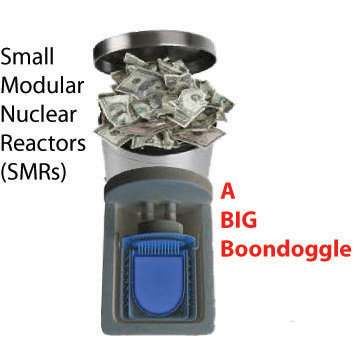
SMRs most expensive of all electricity technologies per kW generation
31 Mar, 2025 By Tom Pashby
Small modular reactors (SMRs) are projected to be the most expensive source per kW of electricity generated when compared with natural gas, traditional nuclear and renewables.
(behind a paywall)
Mini nuclear reactor rush has a short half-life.

By Rob Cyran,
The rush to produce mini nuclear reactors on the cheap might have a short
half-life. In search of vast quantities of power for the data centers
fueling artificial intelligence, Meta Platforms, Alphabet and Amazon have
backed a goal, to triple the world’s nuclear power capacity by 2050.
The prospects for nuclear are indeed brightening, but it is still more
expensive and far slower to build than renewables. The upstart approach of
making smaller, identikit reactors will struggle even harder to close that
gap. Theoretically, SMRs can reduce costs by simplifying the underlying
design into a set of mass-produced, standard parts made off-site. About 95
companies are actively chasing this dream, according to John Ketchum, chief
executive of NextEra, the nation’s largest power developer.
Big names are in the fray, like OpenAI chief Sam Altman and his side project Oklo, or
Google and Amazon, which have invested in Kairos and X-energy,
respectively. UK-based engineering giant Rolls-Royce is urging the British
government to begin moving ahead with new projects.
This idea isn’t entirely new. The U.S. built some small commercial reactors in the 1960s.
But bigger reactors benefit from economies of scale, requiring
proportionately less material and fewer operating staff, resulting in a
one-third advantage versus smaller plants in costs per kilowatt of power,
Reuters 31st March 2025
https://www.reuters.com/breakingviews/mini-nuclear-reactor-rush-has-short-half-life-2025-03-31/
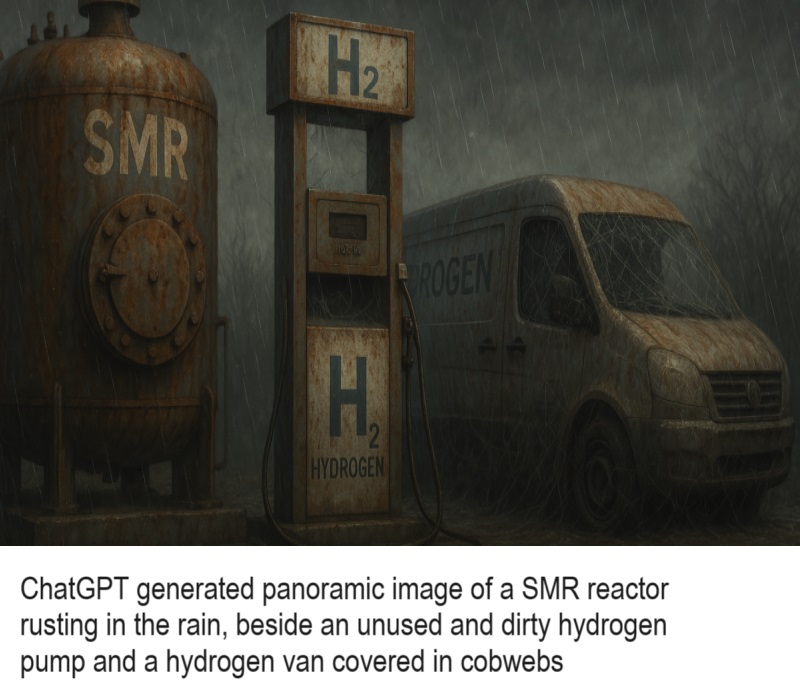
Bavarian SMRs & Hydrogen Vans: What Could Possibly Go Wrong?
Michael Barnard https://cleantechnica.com/2025/04/01/bavarian-smrs-hydrogen-vans-what-could-possibly-go-wrong/
First Hydrogen Corp, a Canadian firm with more ambition than balance sheet, has now turned its sights on Germany — arguably the worst possible place to mix hydrogen hype with small modular nuclear reactors. The company, known mostly for a hydrogen van prototype and a team structure with more CEOs than engineers, is proposing a new strategy: use SMRs to produce hydrogen in Europe. Specifically, Germany.
The same Germany that just shut down its last nuclear plant, has strong anti-nuclear public
sentiment, and boasts some of the world’s most rigorous licensing hurdles for anything
remotely radioactive. As ideas go, this one isn’t just premature — it’s completely divorced from geopolitical, technological, and economic reality.
First Hydrogen’s European push is being channeled through its subsidiary, First Hydrogen
GmbH, an entity that appears to have been created to give the illusion of boots on the ground.
Back home, they’ve created First Nuclear Corp to drive this atomic angle, despite having no
nuclear licenses, no reactor designs, no partnerships with reactor vendors, and no market for
their product. The goal, supposedly, is to deploy SMRs to generate electricity that will then be
used to produce green hydrogen. This hydrogen would then presumably be used to fuel their
not-yet-commercial light commercial vehicles. Vehicles which, in independent UK trials,
consumed about 3.3 kilograms of hydrogen per 100 kilometers, making them far less efficient
than any battery-electric alternative, and certainly more expensive.
Let’s set aside for a moment the inconvenient truth that SMRs don’t exist yet in commercial
form. There are prototypes on paper, pilots under development, and timelines that stretch
comfortably into the late 2030s, assuming nothing goes wrong. But what’s really being
proposed here is to power a struggling hydrogen vehicle strategy with a non-existent nuclear
technology in a jurisdiction where nuclear projects are politically toxic and legally tangled. This is not a roadmap. It’s a Mad Libs of energy buzzwords.
Germany has made its stance on nuclear abundantly clear. After Fukushima, the country
committed to a complete nuclear phaseout, closing its last reactors in 2023. Public support for nuclear energy remains extremely low, and regulatory pathways for new nuclear builds are effectively blocked. That’s before we even get into the practicalities of siting, permitting,
insuring, and securing nuclear facilities in urban or semi-urban zones where hydrogen refueling infrastructure would plausibly be located. It’s like proposing to build a coal plant in the middle of Amsterdam to power electric scooters — technically possible, but politically suicidal and economically nonsensical.
But to understand why Germany is so allergic to nuclear, you have to understand the deeper
story of the Energiewende, Germany’s energy transition. It didn’t start in 2011 with Fukushima.
It started decades earlier, born out of a uniquely German mix of post-war anti-militarism,
environmental consciousness, and civic engagement. The anti-nuclear protests of the 1970s
weren’t fringe movements, they were formative. They helped shape political parties, most
notably the Greens, and built the cultural foundation for the country’s long-standing skepticism of nuclear energy. When Fukushima happened, it wasn’t a wake-up call for Germany, it was a confirmation of everything they already believed.
And here’s the thing: despite their nuclear exit, Germany has made enormous progress on
decarbonization. Their electricity mix now includes more than 50% from renewables,
dominated by wind and solar. They built the world’s largest solar industry (before China
undercut it), deployed tens of gigawatts of onshore and offshore wind, and invested heavily in grid infrastructure and storage. Per capita and against GDP, they emit far less CO₂ than most industrialized nations. Their carbon intensity of electricity has plummeted since the early 2000s, while industrial output remained robust. In short, Germany has done more of the hard work of decarbonization than most of its nuclear-hugging critics.
That doesn’t mean shutting down their nuclear plants was their best move. It wasn’t. Keeping
them online until their natural retirement age would have eased short-term energy price
spikes, especially during the Russian gas crunch. But the decision wasn’t made in a vacuum, and it wasn’t made by a government asleep at the wheel. It was the culmination of decades of cultural, environmental, and political alignment. If any country has earned the right to make that call, it’s the one that actually built a renewable-heavy grid and stuck with it through market ups and downs.
So for First Hydrogen to march into this context with a plan to pair nuclear technology Germany doesn’t want with hydrogen use cases it doesn’t need is more than tone-deaf, it’s
fundamentally incoherent. It misunderstands the culture, the policy, the economics, and the
actual energy system Germany has spent a generation building.
Then there’s the hydrogen problem itself. Hydrogen, for all its green branding, is an expensive
and inefficient energy carrier. Producing it via electrolysis requires vast amounts of electricity.
Storing it requires compression, liquefaction, or chemical conversion, all of which add cost and complexity. Transporting it is a logistical headache. Using it in vehicles loses 70 to 80% of the original energy. Add a nuclear reactor to the chain, and you’ve just stapled a megabucks solution to a kilobuck problem. It’s like powering your toaster with a jet engine. Sure, it works in
theory, but you’ll be out of money before the bread even gets warm.
And yet, if there’s one country where this kind of layered energy absurdity might get polite
applause instead of the deadpan stares it deserves, it’s Germany. Because while Germany has done many things right in its energy transition, it has also demonstrated a persistent, baffling irrationality when it comes to hydrogen.
This isn’t new. Michael Liebreich has been calling out the hydrogen hype for years. I’ve written
extensively about the groupthink — gruppendenken — that has gripped German energy policy circles, particularly in their obsession with hydrogen for end-use energy. Not for steelmaking or fertilizer — reasonable uses — but for heating buildings and driving cars and, now apparently, running vans on SMR-generated hydrogen. The evidence for this folly isn’t anecdotal, it’s in their modeling.
The dena-led Leitstudie Aufbruch Klimaneutralität (the German Energy Agency’s major
decarbonization pathway study) baked in hydrogen use at the end of every possible pipe. It
projected hydrogen-based heating, hydrogen transport, even hydrogen-based electricity
storage, despite the energy system losses stacking up like a Jenga tower made of burned
money. Similarly, the Prognos/PKI modeling , used in federal advisory processes, leaned heavily on magical hydrogen imports and vast, unexplained electrolysis buildouts, seemingly
unbothered by grid realities or cost curves.
These weren’t fringe speculations, they were foundational documents. Germany’s hydrogen
enthusiasm has created a policy environment where ideas that should be non-starters get
traction simply because they have the word wasserstoff in them. In that context, First
Hydrogen’s pitch to bring SMR-powered hydrogen production to Germany starts to make a
twisted kind of sense — not in physics, not in finance, but in the cultural logic of a country that,
for all its engineering rigor, still sometimes falls hard for the techno-utopianism of
overcomplicated solutions. It’s a country that earned its way to energy credibility with wind,
solar, and storage, and then occasionally turns around and tries to put a hydrogen jetpack on it for no good reason. So yes, the plan is absurd, but absurdity has a strange way of finding an audience where the right buzzwords meet the right policymaking blind spots.
And yet, First Hydrogen keeps raising small sums of money and announcing ever more
grandiose plans. In 2024, it closed tranches of convertible debentures amounting to a few
hundred thousand Canadian dollars, not enough to buy a single electrolyzer system, let alone fund a nuclear project. That’s on top of the roughly $9 million it has raised since 2020 which is supposed to fund a 35 MW electrolysis plant and a hydrogen delivery van manufacturing facility in Quebec as well.
The same company that hasn’t brought a product to market is now pitching itself as a future
builder of Europe’s nuclear-hydrogen infrastructure. The gap between vision and resources is
so wide you could drive their hydrogen prototype van through it and still have room for a
busload of skeptical engineers.
Balraj Mann, the founder, chair and CEO of First Hydrogen, had 20 firms he had founded,
owned, and was CEO of many of them when I looked at them a year ago. Now he’s added some more, and possibly has increased his $480,000 per year salary — just from First Hydrogen — based on this new international expansion. It’s convenient that these hydrogen plays appear to be a long way from his investors, reducing the likelihood of due diligence types actually looking at the lack of evidence of any there there.
What makes this spectacle more concerning is not that it exists — there are always hype-
chasers in clean tech — but that it continues to attract press coverage, grants, and in many
cases, government support. It raises a deeper question: why are we so willing to entertain the
layering of unproven technologies under the banner of innovation?
Hydrogen for energy plays keep failing and the countries into the first and biggest,
like Norway and Australia, are abandoning the space because it doesn’t make economic sense.
SMRs are decades away from commercial competitiveness, if they ever get there (unlikely),
more a form of intentional delay by right wing parties that can no longer just deny climate
change than an energy alternative. Stacking one onto the other doesn’t multiply opportunity, it multiplies uncertainty. Hydrogen with SMRs is such a classic case of multiplying hype that I
called it out specifically in my article from a couple of years ago, Two Wrongs Don’t Make A
Right: Adventures In Multiplying Hype.
In the end, First Hydrogen’s German SMR plan isn’t a moonshot, it’s a distraction. The world needs scalable, affordable, low-carbon solutions now. We have them: solar, wind, batteries,
grid interconnection, efficiency. Instead of doubling down on fairy dust, maybe it’s time we
started demanding fewer buzzwords and more kilowatt-hours. Until then, we’ll keep getting
pitches like this — powerpoint fantasies fueled by venture fumes and public confusion.
Swarms of satellites are harming astronomy. Here’s how researchers are fighting back

SpaceX and other companies plan to launch tens of thousands of satellites, which could mar astronomical observations and pollute the atmosphere.
Nature, By Alexandra Witze, 18 Mar 25
In the next few months, from its perch atop a mountain in Chile, the Vera C. Rubin Observatory will begin surveying the cosmos with the largest camera ever built. Every three nights, it will produce a map of the entire southern sky filled with stars, galaxies, asteroids and supernovae — and swarms of bright satellites ruining some of the view.
Astronomers didn’t worry much about satellites photobombing Rubin’s images when they started drawing up plans for the observatory more than two decades ago. But as the space around Earth becomes increasingly congested, researchers are having to find fresh ways to cope — or else lose precious data from Rubin and hundreds of other observatories.
The number of working satellites has soared in the past five years to around 11,000, mostly because of constellations of orbiters that provide Internet connectivity around the globe (see ‘Satellite surge’). Just one company, SpaceX in Hawthorne, California, has more than 7,000 operational Starlink satellites, all launched since 2019; OneWeb, a space communications company in London, has more than 630 satellites in its constellation. On paper, tens to hundreds of thousands more are planned from a variety of companies and nations, although probably not all of these will be launched1.
Satellites play a crucial part in connecting people, including bringing Internet to remote communities and emergency responders. But the rising number can be a problem for scientists because the satellites interfere with ground-based astronomical observations, by creating bright streaks on images and electromagnetic interference with radio telescopes. The satellite boom also poses other threats, including adding pollution to the atmosphere.
When the first Starlinks launched, some astronomers warned of existential threats to their discipline. Now, researchers in astronomy and other fields are working with satellite companies to help quantify and mitigate the impacts on science — and society. “There is growing interest in collaborating and finding solutions together,” says Giuliana Rotola, a space-policy researcher at the Sant’Anna School of Advanced Studies in Pisa, Italy.
Timing things right………………………………………..https://www.nature.com/articles/d41586-025-00792-y?fbclid=IwY2xjawJYMe9leHRuA2FlbQIxMAABHZglIwLgXdf2zs39ZTJIEmAP2QcvsWbVMRrzGsBT3jO8rtlyneCYBjefSA_aem_YRQybLlF5vTcwKEIIuQ0ZA
1 This Month

of the week – Shut Down Drone Warfare!


Tell the Ukrainian Government to Drop Prosecution of Peace Activist Yurii Sheliazhenko

Petition to revoke the licensing of the Near Surface Nuclear Disposal Facility (NSDF) at Chalk River. https://www.ourcommons.ca/petitions/en/Petition/Details?Petition=e-7247
To see nuclear-related stories in greater depth and intensity – go to https://nuclearinformation.wordpress.com
-
Archives
- March 2026 (251)
- February 2026 (268)
- January 2026 (308)
- December 2025 (358)
- November 2025 (359)
- October 2025 (376)
- September 2025 (257)
- August 2025 (319)
- July 2025 (230)
- June 2025 (348)
- May 2025 (261)
- April 2025 (305)
-
Categories
- 1
- 1 NUCLEAR ISSUES
- business and costs
- climate change
- culture and arts
- ENERGY
- environment
- health
- history
- indigenous issues
- Legal
- marketing of nuclear
- media
- opposition to nuclear
- PERSONAL STORIES
- politics
- politics international
- Religion and ethics
- safety
- secrets,lies and civil liberties
- spinbuster
- technology
- Uranium
- wastes
- weapons and war
- Women
- 2 WORLD
- ACTION
- AFRICA
- Atrocities
- AUSTRALIA
- Christina's notes
- Christina's themes
- culture and arts
- Events
- Fuk 2022
- Fuk 2023
- Fukushima 2017
- Fukushima 2018
- fukushima 2019
- Fukushima 2020
- Fukushima 2021
- general
- global warming
- Humour (God we need it)
- Nuclear
- RARE EARTHS
- Reference
- resources – print
- Resources -audiovicual
- Weekly Newsletter
- World
- World Nuclear
- YouTube
-
RSS
Entries RSS
Comments RSS
 nuclear-news