Germany’s successful development towards nuclear fusion
achieved a world record for plasma production, according to its creators.
Researchers were able to keep the device, technically known as Wendelstein
7-X, running for longer and at higher energy, than ever before. Its
performance is the best recorded for a stellarator type reactor and brings
the goal of producing limitless energy a step closer to reality,
researchers say. The new success was thanks to modifications made to the
walls of the reactor, which increase the temperature and efficiency of the
reaction.http://www.dailymail.co.uk/sciencetech/article-5886603/Germanys-star-jar-fusion-reactor-comes-step-closer-producing-LIMITLESS-energy.html
Small Modular Nuclear Reactors are NOT going to save the nuclear industry
 The future of nuclear power in the US is bleak http://thehill.com/opinion/energy-environment/393717-the-future-of-nuclear-power-in-the-us-is-bleak, BY M. V. RAMANA, 06/23/18 Presumably as a way to fulfill election promises, President Trump has ordered the use of emergency federal powers designed for war-time crises to financially prop up coal and nuclear power plants.
Nuclear power that was once advertised as being “too cheap to meter” has evidently become too costly for electric utilities to buy. Apart from two 1,000 megawatt reactors being constructed in Georgia at enormous expense to ratepayers (even after subsidies from tax payers), there are no immediate prospects for new nuclear power plants in the United States. What of the longer-term future?
Why SMRs? According to promoters of these scaled-down reactors, they could solve the multiple challenges faced by nuclear power. SMR developers promise lowered costs, decreased production of radioactive waste, reduction or even elimination of the risk of severe accidents, and no contribution to nuclear proliferation. Dozens of companies claim to be developing their own SMR designs, and many have received funding from wealthy private investors and the U.S. Department of Energy.
However, there is little to suggest SMRs will somehow magically remedy all that ails the nuclear industry. SMRs, as the name suggests, produce relatively small amounts of electricity in comparison with currently operational reactors. This puts them at a disadvantage.
One known way to reduce the cost of nuclear electricity has been to build larger reactors because the expenses associated with constructing and operating a reactor do not increase in direct proportion to the power generated. SMRs will, therefore, cost more than large reactors for each unit of generation capacity. Most of the small reactors built in the United States shut down early because they couldn’t compete economically.
SMR proponents argue that they can compensate by savings through mass manufacture in factories and learning how to hold down costs from the experience of constructing lots of reactors. This is a dubious assumption: In both the United States and France, the two countries with the highest numbers of nuclear plants, costs went up, not down, with construction experience.
Even if one were to assume that such “learning” actually occurs, SMRs have to be manufactured by the thousands to achieve meaningful savings. There is simply no market for so many reactors.
Even Westinghouse, the company that has directly or indirectly designed the majority of the world’s nuclear reactors, has realized that there is no market. For a decade or more, Westinghouse pursued a SMR design. But, in 2014, the company abandoned that effort. Its CEO explained: “The problem I have with SMRs is not the technology, it’s not the deployment — it’s that there’s no customers.” Few or no customers means no one would, or should, want to build a factory to construct the modules constituting these SMRs.
What of the claims about safety and nuclear waste? The problem is that the technical demands posed by these different goals conflict with one another, forcing reactor designers to make impossible choices.
For example, safety can be improved by making reactors smaller. But, a smaller reactor, at least the water-cooled reactors that are most likely to be built earliest, will produce more, not less, nuclear waste per unit of electricity they generate because of lower efficiencies. With no long-term solution in sight for nuclear waste, accumulating more radioactive spent fuel aggravates the storage problem.
The poor economic outlook for SMRs also affects safety. Companies that market SMRs propose placing multiple reactors in close proximity to save on costs of associated infrastructure. But this would increase the risk of accidents or the impact of potential accidents on the surrounding population.
At Japan’s Fukushima nuclear complex, explosions at one reactor damaged the spent fuel pool in a co-located reactor. Radiation leaks from one unit made it difficult for emergency workers to approach the other units.
The future of nuclear power in the United States, and indeed in much of the world, is bleak. Small modular reactors will not change that prognosis. There is no point in wasting public money on promoting them.
M. V. Ramana is the Simons chairman in Disarmament, Global and Human Security at the School of Public Policy and Global Affairs, University of British Columbia and the author of “The Power of Promise: Examining Nuclear Energy in India.”
Why Japan should disconnect from fast-breeder reactor project – The Asahi Shimbun
EDITORIAL: Japan should disconnect from fast-breeder reactor project http://www.asahi.com/ajw/articles/AJ201806180025.html, June 18, 2018
France has decided to sharply scale down its ASTRID fast-reactor project, which is supported by Japan.
France’s decision underscores afresh the dismal outlook of Japan’s plan to continue the development of fast-reactor technology by relying on an overseas project.
Now that it has become unclear whether participation in the ASTRID project will pay off in future benefits that justify the huge investment required, Japan should pull out of the French undertaking.
Fast reactors are a special type of nuclear reactors that burn plutonium as fuel. The ASTRID is a demonstration reactor, the stage in reactor technology development just before practical use.
The French government has said the Advanced Sodium Technological Reactor for Industrial Demonstration, if it comes on stream, will generate 100 to 200 megawatts of electricity instead of 600 megawatts as originally planned. Paris will decide in 2024 whether the reactor will actually be built.
Japan has been seeking to establish a nuclear fuel recycling system, in which spent nuclear fuel from reactors will be reprocessed to extract plutonium, which will then be burned mainly in fast reactors.
When the Japanese government in 2016 pulled the plug on the troubled Monju prototype fast-breeder reactor, which was at the technology stage prior to that of a demonstration reactor, it decided to make the joint development of the ASTRID the centerpiece of its plan to continue the nuclear fuel recycling program.
The government will provide some 5 billion yen ($45.2 million) annually for the French project through the next fiscal year, which starts in April, and decide, by the end of this year, whether and how it will be involved in the project after that.
Because of significant differences in the roles of prototype and demonstration reactors, a simple comparison between the Monju and the ASTRID can be misleading.
But it is clearly doubtful whether the ASTRID, which will be smaller than the Monju, will offer sufficient benefits for Japan’s fuel recycling program.
If it fully commits itself to the joint development of the ASTRID in response to France’s request, Japan will have to shoulder half the construction cost, estimated to be hundreds of billions to 1 trillion yen, and assign many engineers to the project. But these resources could end up being wasted.
Over the years, the government spent more than 1.1 trillion yen of taxpayer money on the Monju, designed to be a small-scale example of the potential of the fast-breeder reactor technology. But the prototype reactor remained out of operation for most of the two decades after it became operational. It actually accomplished only a small fraction of what it was designed to achieve.
The government should make an early decision to end its involvement in the ASTRID to avoid repeating the mistake it made with the Monju project, which was kept alive at massive cost for far too long as the decision to terminate it was delayed for years without good reason.
The government has only itself to blame for the current situation. Despite deciding to decommission the Monju, it stuck to the old fuel cycle policy without conducting an effective postmortem on the Monju debacle. Instead, the government too readily embraced the ASTRID project as a stopgap to keep its fast-reactor dream alive.
The government needs to rigorously assess whether it is wise to continue developing fast-reactor technology.
Producing electricity with a fast reactor is costlier than power generation with a conventional reactor that uses uranium as fuel. The United States, Britain and Germany phased out their own fast-reactor projects long ago.
France has continued developing the technology, but feels no urgent need to achieve the goal. The country predicts that the technology will be put to practical use around 2080 if it ever is.
Even if Japan wants to continue developing fast-reactor technology, it would be extremely difficult to build a demonstration reactor for the project within the country given that even finding a site to build an ordinary reactor is now virtually impossible.
The government would be utterly irresponsible if it aimlessly keeps pouring huge amounts of money into the project when there is no realistic possibility of the technology reaching the stage of practical application.
If it abandons the plan to develop fast-reactor technology, the government will have to rethink the entire nuclear fuel recycling program.
Any such fundamental change of the nuclear power policy would have serious implications. But there is no justification for postponing the decision any further.
Why does Japan persist with dangerous, unnecessary nuclear Rokkasho reprocessing? Is it to enable nuclear weapons?
 The Rokkasho reprocessing plant could ruin everything, Beyond Nuclear, By Kiyohiko Yamada, with additional contributions by Kurumi Sugita and Jon Gomon, 17 June 18
There is a nuclear fuel cycle center in Rokkasho village, located at the tip of Shimokita Peninsula in Aomori Prefecture, in the northernmost part of the main island of Japan.
On April 9, 1985, the governor of Aomori Prefecture gave the green light for the Rokkasho center to proceed. At first, it comprised three facilities:
•a uranium enrichment plant
•a fuel reprocessing plant
•a low-level radioactive waste repository
Later, two more facilities were added:
•a temporary storage facility of high-level radioactive waste returned from overseas after reprocessing,
•a MOX fabrication plant.
The nuclear fuel cycle center of Rokkasho village is operated by Japan Nuclear Fuel Limited (JNFL), notorious for its incompetent management. In October 2017, the Japanese Nuclear Regulation Autority (NRA) reported that JNFL violated safety measures. As the Mainichi Shimbun reported in an October 11, 2017 article, safety records were faked at the unfinished reprocessing plant.
“The NRA concluded on Oct. 11 that Japan Nuclear Fuel Ltd. (JNFL) has violated safety measures after it was learned that the firm failed to carry out the required checks and nevertheless continued to write down “no abnormalities” in safety check records. There has been a spate of incidents such as the flow of rainwater into facility buildings at the plant in the Aomori Prefecture village of Rokkasho.
“The plant, which is scheduled to reprocess spent nuclear fuel, was on the verge of hosting a final-stage NRA safety inspection, but the checkup is likely to be postponed considerably as JNFL now has to prioritize in-house inspections of all facilities at the plant.”The Japanese nuclear fuel cycle collapsed with the fast breeder reactor “Monju”
The Japanese government obstinately pursued a fast breeder reactor program, even though other similar projects had been abandoned elsewhere in the world. An estimated $9 billion was spent on Japan’s Monju prototype breeder reactor, which was so troubled it operated only 250 days during its 22-year existence. It was finally abandoned permanently in December 2016 and the decision was taken to decommission it.
And yet the Japanese government persists in trying to start operation of the Rokkasho reprocessing plant in the first half of 2021, even though the prospect of the fast breeder reactor’s commercialization has become improbable.
There is a contradiction here. Why start a reprocessing plant when there is no usage plan for the end product? One possible reason is that for quite some time, former Liberal Democratic Party (LDP) ministers have been hinting at the possibility of having nuclear weapons. Reprocessing extracts plutonium from irradiated reactor fuel. Perhaps the real intent is to have such a plutonium extraction plant which can produce eight tons of plutonium annually.
Surplus plutonium problem.……..
If the Rokkasho reprocessing plant is put into operation, it will create a surplus of eight tons of plutonium annually. The possession of such an amount of plutonium will most certainly increase tensions in Asia.
Risks involved in the Rokkasho plant
① The reprocessing plant is on a fault line
Japan is riddled with geological faults, and there is no stable stratum including at the Rokkasho reprocessing plant site. A large, active fault about 100 km in length lies on the Pacific Ocean side. Scientists warn that in the case of a big earthquake, a magnitude 8 tremor could seriously damage the reprocessing plant.
The operating company insists that a big earthquake will not occur in Rokkasho, but their seismograph is installed on bedrock, and is set so that it does not indicate more than a seismic intensity of 3. Why? It is because when seismic intensity higher than 3 is detected, it is necessary to make a total inspection of the reprocessing plant.
② Hakkoda and Towada volcanoes are nearby ….
③ Fighter jets fly near Rokkasho …..
Possibility of a serious accident …….
If the plant goes into operation, even without an accident, radiation exposure of the entire Aomori Prefecture, and of the Pacific Ocean, will be far too high
After the Fukushima Daiichi nuclear accident, many tanks were created on the site of the Fukushima nuclear power plant to store the tritium contaminated water after processing the radioactive water by the multi-nuclide removal facility (Advanced Liquid Processing System). In Fukushima prefecture, tritium contaminated water is not discharged into the ocean due to opposition from fishermen. In contrast, the same tritiated water was released in large amounts in Rokkasho during the active testing. Fishermen in Iwate once demanded that the reprocessing plant drainage be discharged into Mutsu Bay and not into the Pacific Ocean. The person in charge in Aomori Prefecture refused, saying, “Mutsu Bay would die”.
An upcoming mayoral election in Rokkasho Village could have important repercussions for the reprocessing plant. One candidate— Junk Endo — is resolutely opposed to opening it. The election takes place on June 24, 2018.
We are calling on our friends and colleagues all around the world to send Ms. Endo messages of support. It is important that Japanese authorities understand that the world is watching these elections. The people of Rokkasho do not need the leukemia clusters or the proliferation risks of a reprocessing plant. The world does not need more carcinogenic radioactive releases from yet another reprocessing plant when those at La Hague, France, and Sellafield, England, have already poisoned the air and seas far from their own lands. https://beyondnuclearinternational.org/2018/06/17/all-that-would-be-destroyed-reprocessing-japan/
Robots the hope for cleaning up the world’s riskiest and massive nuclear waste storage pool, at Sellafield, UK.

Above – Sellafield’s massive Magnox nuclear waste storage pool
Only Cthulhu can solve Sellafield’s sludgy nuclear waste problem, Wired, , 14 June 18
Cleaning up Sellafield’s nuclear waste costs £1.9 billion a year. To help with the toxic task, robots are evolving fast. Sellafield has been called the most dangerous place in the UK, the most hazardous place in Europe and the world’s riskiest nuclear waste site. At its heart is a giant pond full of radioactive sludge, strewn with broken metal, dead animals and deadly nuclear rods. The solution to clearing up Sellafield’s nuclear waste and retrieving the missing nuclear fuel? Robots, of course. And to tackle this mammoth task, the robots are being forced to evolve.
Sellafield’s First-Generation Magnox Storage Pond is a giant outdoor body of water that’s the same size as two Olympic swimming pools. It was built in the 1960s to store used fuel rods from the early Magnox reactors – which had magnesium alloy cladding on the fuel rods – as part of Britain’s booming nuclear program. In 1974, there was a delay in reprocessing; fuel rods started corroding and the pond became murky. The pool was active for 26 years until 1992 and is now finally being decommissioned as part of the £1.9 billion spent each year on Sellafield’s mammoth cleanup operation.
The pond contains about six metres of radioactive water and half a metre of sludge, composed of wind-blown dirt, bird droppings and algae – the usual debris that builds up in any open body of water. Unlike other mud, it conceals everything from dropped tools and bird carcasses to corroded Magnox cladding and the remains of uranium fuel rods.
A number of robotic creations have bee used to get to the bottom of the pool’s sludge but struggle to break through the hostile environment. Tethered swimming robots do not have the sensors to find objects in the fine mud, and lack the leverage to lift chunks of metal. Experience at Fukushima has shown robots that are not well adapted to the environment are a waste of time.
Enter Cthulhu, a tracked robot that can drive along the pond bed, feeling its way with tactile sensors and sonar. The robot, which is currently in development, is approaching Sellafield’s problem differently. The robot will be able to identify nuclear rods and then pick them up. “Rather than trying to mimic a human, we’re building a robot that can do things humans can’t do with senses that humans don’t have,” says Bob Hicks of QinetiQ, which is leading the project.
The name stands for ‘Collaborative Technology Hardened for Underwater and Littoral Hazardous Environment,’ but it’s also a nod to Cthulhu, the godlike alien created by HP Lovecraft: both are amphibious, dwell in strange surroundings, and have sensory feelers. “Much like a walrus detecting molluscs, we hope to be able to detect and identify objects in the sludge with the whiskers,” says Plamen Angelov of Lancaster University’s School of Computing and Communications.
QinetiQ is supplying the tracked body, originally from a bomb disposal robot, and Bristol Maritime Robotics is developing the tactile sensors, while Angelov’s team is providing the neural network AI. It is planned the robot will use deep learning to fuse tactile and sonar data into a single picture of the world. Existing neural networks can handle video data, and ‘image classifiers’ to distinguish objects are well-established. But nobody has tried to fuse data from different types of sensor before.
Cthulhu’s classifier will learn to divide objects into ‘fuel rods’ and ‘everything else’………
The work at Sellafield is due to take several decades to complete fully. Nuclear waste is spread through several buildings in a variety of silos and pools. Each has its own challenges for cleaning-up. For the First Generation Magnox Pond, documents from the government show all the bulk fuel should be removed by the early 2030s. http://www.wired.co.uk/article/sellafield-nuclear-robots-cleanup-waste
The nuclear power industry is dying under its own weight.New small nuclear reactors too costly, too late
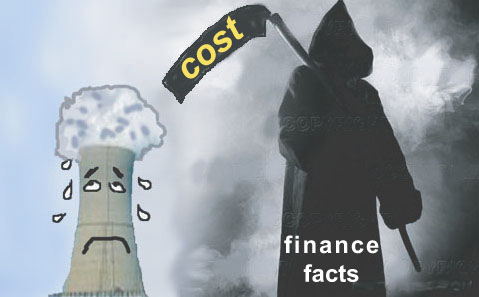 Nuclear Power Won’t Survive Without A Government Handout, Five Thirty Eight, By Maggie Koerth-Baker 14 June 18, Once upon a time, if you were an American who didn’t like nuclear energy, you had to stage sit-ins and marches and chain yourself to various inanimate objects in hopes of closing the nation’s nuclear power plants. Today … all you have to do is sit back and wait.
There are 99 nuclear reactors producing electricity in the United States today. Collectively, they’re responsible for producing about 20 percent of the electricity we use each year. But those reactors are, to put it delicately, of a certain age. The average age of a nuclear power plant in this country is 38 years old (compared with 24 years old for a natural gas power plant). Some are shutting down. New ones aren’t being built. And the ones still operational can’t compete with other sources of power on price. Just last week, several outlets reported on a leaked memo detailing a proposed Trump administration plan directing electric utilities to buy more from nuclear generators and coal plants in an effort to prop up the two struggling industries. The proposal is likely to butt up against political and legal opposition, even from within the electrical industry, in part because it would involve invoking Cold War-era emergency powers that constitute an unprecedented level of federal intervention in electricity markets. But without some type of public assistance, the nuclear industry is likely headed toward oblivion.
“Is [nuclear power] dying under its own weight? Yeah, probably,” said Granger Morgan, professor of engineering and public policy at Carnegie Mellon University.
……… it’s the cost of upkeep that’s prohibitive. Things do fall apart — especially things exposed to radiation on a daily basis. Maintenance and repair, upgrades and rejuvenation all take a lot of capital investment. And right now, that means spending lots of money on power plants that aren’t especially profitable…….
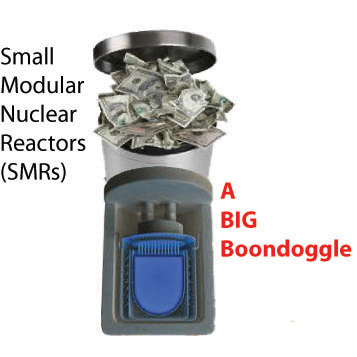 Morgan and other researchers are studying the economic feasibility of investment in newer kinds of nuclear power plants — including different ways of designing the mechanical systems of a reactor and building reactors that are smaller and could be put together on an assembly line. Currently, reactors must be custom-built to each site. Their research showed that new designs are unlikely to be commercially viable in time to seriously address climate change. And in a new study that has not yet been published, they found that the domestic U.S. market for nuclear power isn’t robust enough to justify the investments necessary to build a modular reactor industry. …….https://fivethirtyeight.com/features/nuclear-power-wont-survive-without-a-government-handout/
Japan approves 70-year plan to scrap nuclear reprocessing plant
https://mainichi.jp/english/articles/20180613/p2g/00m/0dm/072000c
(Mainichi Japan) TOKYO (Kyodo) — Japan’s nuclear watchdog on Wednesday approved a plan to scrap a nuclear fuel reprocessing plant northeast of Tokyo over a 70-year period with the cost projected at 1 trillion yen ($9 billion).
The facility in Tokaimura, Ibaraki Prefecture went into operation in 1977. It was Japan’s first spent-fuel reprocessing plant built under the nation’s nuclear fuel cycle policy, which aims to reprocess all spent nuclear fuel in order to reuse the extracted plutonium and uranium as reactor fuel in the resource-scarce country.
But the policy has run into a dead end as the completion of a separate fuel reprocessing plant in Aomori Prefecture, built on the technological expertise of the Tokaimura plant, has been delayed by more than 20 years.
The decommissioning cost will be shouldered by taxpayers as the Japan Atomic Energy Agency operating the Tokaimura plant, is backed by the state. Where to store the waste accumulated at the plant is undecided.
In 2014, the agency decided to decommission the plant due to its aging and the huge cost to run it under stricter safety rules introduced after the 2011 Fukushima nuclear crisis.
According to the plan approved by the Nuclear Regulation Authority, around 310 canisters of highly radioactive vitrified waste and some 360 cubic meters of radioactive waste are currently stored at the facility.
About 770 billion yen is estimated for the disposal of such waste and decommissioning of the facility and roughly 217 billion yen for the 10-year preparation work.
Old, unproven, unreliable nuclear technology planned for Britain’s Wylfa nuclear power station
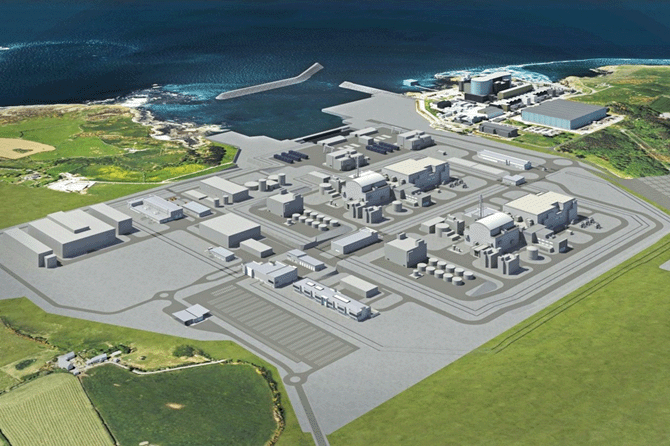 Unearthed 5th June 2018 Hitachi is seeking billions of pounds from the British government to help build a new nuclear power plant at Anglesey in Wales – but experts say the technology being used is far from proven.
Last week Hitachi-rival Toshiba confirmed that they are pulling out of a major nuclear power project in the USA which planned to use a similar reactor type to the one planned for Wylfa. Toshiba said in a press release that the South Texas
Project had “ceased to be financially viable” due to prevailing economic conditions.
The announcement leaves the UK as one of the last countries looking to build this technology, called the Advanced Boiling
Water Reactor (ABWR). Steve Thomas, Professor of Energy Policy at the University of Greenwich, said that while there are some small differences between the European reactor led by Hitachi and the abandoned US reactor
from Toshiba, the “perception that this is proven technology is not supported by the facts”.
Although there are four similar reactors that have been built in Japan, plans for construction elsewhere have seen a
series of failures. And because of the long lead-in times for developing and building nuclear reactors, power plants built today may have been designed decades ago, Thomas said
“The technology that has been built already is actually 30 year old technology, which has been updated twice
over. So the plants that are operating do not really represent what we would build, and also the performance of the plants in terms of their reliability has actually been very poor.”
https://unearthed.greenpeace.org/2018/06/05/wylfa-hitachi-nuclear-reactor-type-awbr/
MOX nuclear fuel project in deep trouble, but judge rules against suspending its construction

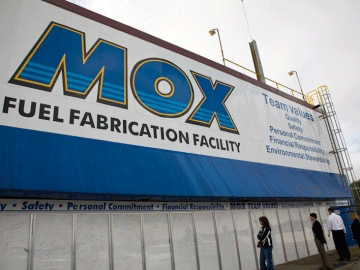 Judge’s ruling keeps over-budget nuclear project from being shut down, BY SAMMY FRETWELL sfretwell@thestate.com June 07, 2018
A judge on Thursday stopped the federal government from suspending construction of a nuclear fuel factory at the Savannah River Site atomic weapons complex near Aiken.
The ruling by U.S. District Judge Michelle Childs damages federal efforts to walk away from the over-budget and behind-schedule mixed oxide fuel project, which has been on the drawing boards for more than two decades and is currently under construction. The mixed oxide fuel plant would turn excess weapons grade plutonium into fuel for commercial nuclear reactors.
The U.S. Department of Energy has been trying in recent years to suspend the project, saying it is expensive and no longer necessary to dispose of the plutonium. The latest federal plan is to ship excess plutonium, a key ingredient in nuclear bombs, to a New Mexico site for disposal.
Childs’ order temporarily halts the federal shutdown process until arguments can be heard in court over whether to keep the effort going. ……..
Savannah River Site Watch’s Tom Clements, an opponent of the MOX project, said he was disappointed in the judge’s ruling Thursday. Clements says the project isn’t necessary.
“The judge doesn’t understand what deep trouble the project is in,’’ he said, noting that building the MOX project doesn’t necessarily mean South Carolina will get rid of all surplus plutonium at SRS.
The project is about $12 billion over budget and years behind schedule, but employs hundreds of people who would be out of work if the project shuts down, boosters say. It has been touted as a way to provide new missions for SRS.
Federal officials say they won’t forget SRS in shutting down the MOX plant. They have proposed converting it to a factory to make plutonium pits for nuclear weapons. http://www.thestate.com/latest-news/article212778069.html
Terra Power’s Traveling Wave Nuclear Reactor sounds great – BUT!
TerraPower’s Nuclear Reactor Could Power the 21st Century. The traveling-wave reactor and other advanced reactor designs could solve our fossil fuel dependency IEEE Spectrum, By In a world defined by climate change, many experts hope that the electricity grid of the future will be powered entirely by solar, wind, and hydropower. Yet few expect that clean energy grid to manifest soon enough to bring about significant cuts in greenhouse gases within the next few decades. Solar- and wind-generated electricity are growing faster than any other category; nevertheless, together they accounted for less than 2 percent of the world’s primary energy consumption in 2015, according to the Renewable Energy Policy Network for the 21st Century.
To build a bridge to that clean green grid of the future, many experts say we must depend on fission power. ………several U.S. startups are pushing new reactor designs they say will address nuclear’s major shortcomings. In Cambridge, Mass., a startup called Transatomic Power is developing a reactor that runs on a liquid uranium fluoride–lithium fluoride mixture. In Denver, Gen4 Energy is designing a smaller, modular reactor that could be deployed quickly in remote sites.
 In this cluster of nuclear startups, TerraPower, based in Bellevue, Wash., stands out because it has deep pockets and a connection to nuclear-hungry China. Development of the reactor is being funded in part by Bill Gates, who serves as the company’s chairman. And to prove that its design is viable, TerraPower is poised to break ground on a test reactor next year in cooperation with the China National Nuclear Corp. …….
It also releases plenty of energy; after all, Pu-239 is the primary isotope used in modern nuclear weapons. But Levesque says the creation of Pu-239 doesn’t make the reactor a nuclear-proliferation danger—just the opposite. Pu-239 won’t accumulate in the TWR; instead, stray neutrons will split the Pu-239 into a cascade of fission products almost immediately.
In other words, the reactor breeds the highly fissile plutonium fuel it needs right before it burns it, just as Feinberg imagined so many decades ago. Yet the “traveling wave” label refers to something slightly different from the slowly burning, cigar-style reactor. In the TWR, an overhead crane system will maintain a reaction within a ringed portion of the core by moving pins into and out of that zone from elsewhere in the core, like a very large, precise arcade claw machine.
To generate electricity, the TWR uses a more complicated system than today’s reactors, which use the core’s immense heat to boil water and drive a steam turbine to generate usable electricity. In the TWR, the heat will be absorbed by a looping stream of liquid sodium, which leaves the reactor core and then boils water to drive the steam turbine.
 But therein lies a major problem, says Makhijani. Molten sodium can move more heat out of the core than water, and it’s actually less corrosive to metal pipes than hot water is. But it’s a highly toxic metal, and it’s violently flammable when it encounters oxygen. “The problem around the sodium cooling, it’s proved the Achilles’ heel,” he says.
Artificial intelligence could increase nuclear war threat
How artificial intelligence could increase nuclear war threat, according to RAND by Joe Douglass, KATU News 1 June 18 “…..KATU talked with Andrew Lohn, an engineer for the RAND corporation recently bout a new study he co-authored.
“This study is: How might artificial intelligence affect the risk of nuclear war?” said Lohn. “We’re trying to look at it not from the way that pop fiction has looked at it over the decades where artificial intelligence gets control of the nuclear weapons and can launch them at will. But more about how, how could technologies that are a little bit more feasible in the near-ish term affect the way that humans perceive the risks or balances and cause them to make dangerous or improper decisions.”
For input, Lohn said RAND talked with top experts in the nuclear weapons and AI industries on the condition of anonymity.
…….Lohn said over the next couple of decades experts could see a path where AI might also be competitive in war gaming scenarios.
“And in that case generals or presidents would have to think, ‘Well, what do our main advisers say, what does the secretary of defense say?'” he said. “And then ask, ‘What does the computer say?’ And they might be influenced to making decisions that the computer suggests even without the computer being directly connected to any of the launchers.”
The other risk factor: Information overload from technology that may be able to take in and analyze a huge amount of data about an enemy’s arsenal.
“It can potentially be destabilizing if you know where all of your enemy’s launchers are,” Lohn said. “Or even if you don’t know where they are but they think that you know where all of their launchers are they might be pressured into a scenario where they think they’re in a use-it-or-lose-it situation.”
Or, Lohn said, if they think there’s an imminent attack, they could be pressured to “fire now” instead of waiting for confirmation…….http://katu.com/news/nation-world/how-artificial-intelligence-could-increase-nuclear-war-threat-according-to-rand
France scaling back nuclear reprocessing – fears of financial disaster as with Japan’s Monju project
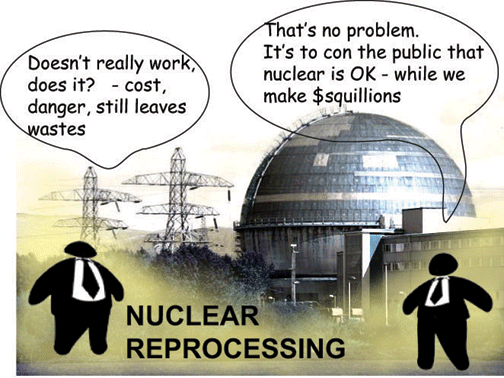 Scaling back of French reactor a blow for nuke fuel reprocessing THE ASAHI SHIMBUN May 31, 2018
Japan’s hopes of keeping its nuclear fuel recycling program alive faces another major obstacle with signs from France that a reactor project there will be scaled back because of swelling construction costs.
After the nuclear fuel recycling program suffered a heavy blow with the decision in late 2016 to decommission the Monju prototype fast-breeder reactor, government officials turned to France’s ASTRID program as an alternative information source for the fuel recycling plan.
But French government officials said the Advanced Sodium Technological Reactor for Industrial Demonstration will have its planned power generation scaled back from the initial plan of 600 megawatts of electricity to between 100 and 200 megawatts.
The major aim of the nuclear fuel recycling program is to reprocess spent nuclear fuel to extract plutonium, which would be used to create mixed-oxide fuel that could be burned in nuclear reactors.
Government officials had hoped to use various technologies emerging from the ASTRID program to eventually construct a demonstration fast reactor in Japan. But a scaled-back ASTRID would mean knowledge needed for the demonstration reactor would not be available.
According to several government sources, French government officials informed their Japanese counterparts of the planned reduction in the ASTRID power generation plan due mainly to the high construction costs.
French officials also inquired about the possibility of Japan shouldering half the ASTRID construction burden, which could run anywhere between several hundreds of billions of yen to about 1 trillion yen ($9.2 billion).
Plans call for constructing the ASTRID in France with construction to start sometime after 2023………
Even some officials of the Ministry of Economy, Trade and Industry, which has been promoting the nuclear fuel recycling program, have raised doubts about participating in the ASTRID program.
Concerns are also being raised among lawmakers in the ruling Liberal Democratic Party, with one executive wondering if cooperating with the ASTRID program could end up much like the Monju project, which wasted more than 1 trillion yen following a spate of accidents and other problems.
(This article was written by Tsuneo Sasai, Shinichi Sekine and Rintaro Sakurai.) http://www.asahi.com/ajw/articles/AJ201805310040.html
Logan city in Idaho ponders joining in costly and risky Small Modular Nuclear Reactor (SMR) development
 Logan has 10 months to consider modular nuclear reactor program, HJ News.com, By Sean Dolan staff writer, 31 May 18, “……..Right now, Logan is the largest city participating in a plan to build a small modular nuclear reactor just north of Idaho Falls.
The project is still in the development phases, and Logan has several opportunities to pull out of the project, including a coming deadline in March 2019. At that point, UAMPS Chief Legal Officer Mason Baker said, UAMPS will gauge how many cities are participating and decide whether it makes good business sense to keep going. Baker said UAMPS hopes Logan will sign power contracts before the March deadline.
……“There’s all kinds of risks,” said Logan Light and Power Director Mark Montgomery. “There’s first-of-its-kind risk, there’s construction risk, there’s design risk, there’s a regulatory risk and probably other risks that I’m forgetting.”
The very real and very serious danger of nuclear reactor accidents in space
 NASA looks to send a small nuclear reactor to the moon and Mars SanDiego Union-Tribune, 23 May 18 ………. some aren’t exactly over the moon with the prospect of nuclear power in space.
“I think it’s too dangerous,” said Bruce Gagnon, the coordinator of the Global Network Against Weapons and Nuclear Power in Space, based in Brunswick, Maine.
Among other incidents, the group points to a Russian nuclear-powered satellite that crashed into the Indian Ocean in 1982 and chunks of another that fell into a remote area of the Northwest Territories of Canada in 1978.
Gagnon also worries about launch accidents, contamination and whether projects like Kilopower may “serve as a Trojan horse” that could lead to using nuclear to power weapon systems in space.
“It’s not the kind of thing we can play games with,” Gagnon said. “One thing we know is technology is not invincible — the Titantic, the Challenger, Fukushima, there are a whole host of examples in the modern age. And when you start mixing nuclear power into the equation, it’s a very dangerous thing.”
Cosmic radiation will damage the brains of space travellers
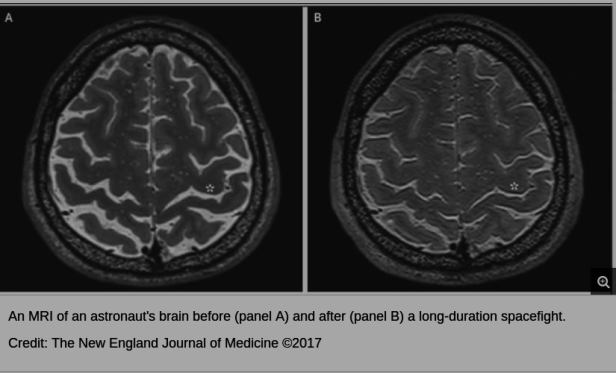
Can we protect the brain from cosmic radiation? Medical News Today , As we prepare to enter a new era of space travel, we must find ways of averting health risks posed by the cosmic environment. Deep space radiation, in particular, is known to impair cognitive function………. One main threat comes from cosmic radiation, which can harm the central nervous system, altering cognitive function and leading to symptoms similar to those found in Alzheimer’s disease.
……. ‘Cosmic radiation may affect brain long-term’Previous research conducted by Rosi and team found that, after mice were exposed to a level of radiation roughly equivalent to what human astronauts might encounter during an outer space mission, their capacity to differentiate between familiar and unfamiliar objects was impaired.
Usually, when mice are faced with two objects — one that is new and unknown to them and one that they formerly explored — they will spend more time familiarizing themselves with the new object.
However, the animals that had been exposed to radiation tended to spend an equal amount of time exploring both objects, which suggested to the researchers that the mice had forgotten they had already been exposed to one of the two.
Other symptoms that the mice presented included problems with social interactions and a sense of elevated anxiety. Rosi and team note that this was likely because of the effect the strong radiation had on the microglia, or nerve cells found in the brain and spinal chord that are part of the central nervous system’s immune mechanism.
When microglia are activated, they can cause symptoms — such as impaired memory recall — that are consistent with those of neurodegenerative disorders.
This is partly due to the fact that they are driven to destroy synapses, or the connections formed between brain cells that allow them to convey information.
“We are starting to have evidence that exposure to deep space radiation might affect brain function over the long-term, but as far as I know, no one had explored any possible countermeasures that might protect astronauts’ brains against this level of radiation exposure.” Susanna Rosi………https://www.medicalnewstoday.com/articles/321898.php
1 This Month
26 September – International Day for the Total Elimination of Nuclear Weapons





PLEASE OPPOSE HR 8255 AND S.3639 – bills would accelerate satellite deployment, with no environmental review or safeguards – https://ncstd5li.quorum.us/campaign/169331/
To see nuclear-related stories in greater depth and intensity – go to https://nuclearinformation.wordpress.com
-
Archives
- September 2026 (281)
- August 2026 (330)
- July 2026 (355)
- June 2026 (287)
- May 2026 (306)
- April 2026 (356)
- March 2026 (251)
- February 2026 (267)
- January 2026 (308)
- December 2025 (358)
- November 2025 (359)
- October 2025 (375)
-
Categories
- 1
- 1 NUCLEAR ISSUES
- business and costs
- climate change
- culture and arts
- ENERGY
- environment
- health
- history
- indigenous issues
- Legal
- marketing of nuclear
- media
- opposition to nuclear
- PERSONAL STORIES
- politics
- politics international
- Religion and ethics
- safety
- secrets,lies and civil liberties
- spinbuster
- technology
- Uranium
- wastes
- weapons and war
- Women
- 2 WORLD
- ACTION
- AFRICA
- Atrocities
- AUSTRALIA
- Christina's notes
- Christina's themes
- culture and arts
- Events
- Fuk 2022
- Fuk 2023
- Fukushima 2017
- Fukushima 2018
- fukushima 2019
- Fukushima 2020
- Fukushima 2021
- general
- global warming
- Humour (God we need it)
- Nuclear
- RARE EARTHS
- Reference
- resources – print
- Resources -audiovicual
- Weekly Newsletter
- World
- World Nuclear
- YouTube
-
RSS
Entries RSS
Comments RSS

