 Russia building first ‘floating’ nuclear power plant, Economic Times, BY IANS | MAY 30, 2017,NEW DELHI: Russia is in advanced stages of building the world’s first “floating” nuclear power plant (FNPP) for installation in remote areas and hopes FNPP technology will also interest South Asian countries like India.
Pavel Ipatov, Deputy CEO (Special Projects) in Russia’s state atomic energy corporation Rosatom, told IANS in an e-mail interview from Moscow that an FNPP is basically a mobile, low-capacity reactor unit operable in remote areas isolated from the main power distributor. .. …
According to Ipatov, the vessel’s “construction is at its closing stage. The plant has already been floated out, fitting-out is under way”. It has been undergoing “mooring trials” since last July to test the FNPP’s performance efficiency, which are scheduled to be completed by October.
After the tests, the FNPP, called ‘Academician Lomonosov’, will be transported by Russia’s Northern Sea route to the  operation site, where it will be integrated into the coastal network being constructed .. …..
According to Ipatov, with Russia’s expertise, its FNPPs will be in great demand in the global small nuclear power market.
“We see significant potential in Southeast Asia and other regions of the world. Memorandums of cooperation on floating nuclear power plants projects have been signed with China and Indonesia,” he said.
“We hope that FNPP technology will also gain interest in South Asia, including India, ot only in terms of new opportunities to provide power supply to remote areas, but in terms of building extra seawater desalination facilities, too,” he added.
May 31, 2017
Posted by Christina Macpherson |
Russia, technology |
Leave a comment
China installs heavy containment dome on nuclear plant, Financial Express China today successfully installed the heavy containment dome for its first domestically developed third-generation reactor design which may also be used at the Karachi nuclear plant where Beijing is building two 1100 mw reactors. By: PTI | Beijing: May 26, 2017 The hemispherical dome, weighing 340 tonnes and measuring 46.8 metres in diametre, was installed by crane on the No 5 unit of China National Nuclear Corporation (CNNC) in Fuqing City, state-run Xinhua news agency reported. The installation marks the completion of construction work on the pilot project and the beginning of the assembly stage, said Yu Peigen, deputy general manager of CNNC at the site of installation.

The dome will be used for protection against nuclear accidents under extreme conditions, and both its design and installation are very demanding processes, the report said. The design may be replicated in Karachi plant in Pakistan where China is building two 1100 mw reactors at a cost of USD 6.5 billion. “The installation is much more difficult than that of traditional nuclear reactors because the whole weight of the dome and the ropes is more than 500 tonnes,” said Yang Jianguo, the lifting commander at the site. http://www.financialexpress.com/world-news/china-installs-heavy-containment-dome-on-nuclear-plant/687878/
May 27, 2017
Posted by Christina Macpherson |
China, technology |
Leave a comment
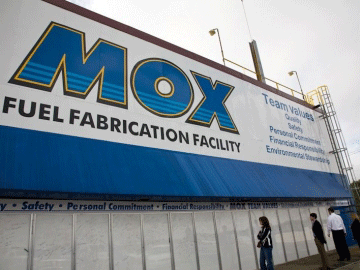
 Platts 23rd May 2017 The Trump administration is proposing to end construction of a facility deigned to convert 34 mt of plutonium from surplus nuclear weapons to nuclear reactor fuel, concluding it would “be irresponsible to pursue this approach when a more cost-effective alternative exists.”
The administration, which Tuesday unveiled its proposed fiscal 2018 budget, said it will direct CB&I Areva MOX Services to develop a plan “as soon as practical,” to halt construction of the Mixed Oxide Fuel Fabrication Facility at the Savannah River Site in South Carolina and securely shut the facility by late 2018.
The 2018 fiscal year starts October 1. Congress must authorize and appropriate fiscal 2018 spending and the president must sign the budget bill. The $340 million that Congress appropriated in an omnibus budget resolution for fiscal 2017 was earmarked primarily for the installation of ductwork and to seal openings in the facility used during
construction.
The fiscal 2018 proposal states appropriations for the MOX project after this fiscal year are “to be determined,” with no dollar amount specified. A justification for terminating the MOX project that the US Department of Energy provided Tuesday noted that the facility’s $4.8 billion cost projected in 2007, with a startup date of 2015, had ballooned
to $17.2 billion by 2016, with 2048 the earliest date, by which mix-oxide fuel could be produced. DOE now estimates the completion cost at up to $26 billion.
DOE noted that analysis it and “external independent analyses” have conducted “have consistently concluded that the MOX approach to plutonium disposition is significantly costlier and would require a much higher annual budget than an alternate disposition method, ‘Dilute and Dispose.'” https://www.platts.com/latest-news
May 26, 2017
Posted by Christina Macpherson |
- plutonium, reprocessing, USA |
1 Comment
 Nuclear Australia

Submission to: Inquiry: The Generation IV Nuclear Energy – Accession.by Noel Wauchope, 24 April 2017
First of all, I find it very strange that this agreement has been signed up to in advance, not by any elected representative of the Australian Parliament, but by Dr Adi Patterson CEO of the Australia Nuclear Science and Technology Organisation, apparently pre-empting the results of this Inquiry!
I find it disturbing that this Inquiry is being held without any public information or discussion. Are we to assume that the decision to join this “Charter” is being taken without prior public knowledge?
It is a pretty momentous decision. According to the World Nuclear Association the 2005 Framework agreement “formally commits them (signatories) to participate in the development of one or more Generation IV systems selected by GIF for further R&D.”
The Environment Protection and Biodiversity Conservation Act 1999 currently prohibits the development of nuclear power in…
View original post 1,083 more words
May 19, 2017
Posted by Christina Macpherson |
AUSTRALIA, secrets,lies and civil liberties, technology |
Leave a comment
 Today, I am taking the unusual step of publishing an entire submission. That’s because it is so good. The nuclear lobby pulled a swifty on Australians, by having government and media very quietly do what is sure to be a “rubber stamp” job on Australia joining up to the Framework Agreement for Generation IV Nuclear Energy Systems.
They very quietly allowed a very short time for submissions to the Parliamentary Inquiry. The nuke lobby must have been in the know, as they put in 11, whereas there were only 3, (one mine) critical of the plan.
Fortunately the critical ones contain compelling information. So, here, in full, is the:
 Submission from Friends of the Earth
  Australia and the Australian Conservation Foundation .
Contacts:
• Jim Green (Friends of the Earth, Australia) jim.green@foe.org.au, 0417 318 368
• Dave Sweeney (Australian Conservation Foundation) dave.sweeney@acf.org.au, 0408 317 812
Contents
1. Introduction and Response to National Interest Analysis
2. Generation IV Reactor Concepts ‒ Introduction
3. Decades Away
4. Purported Benefits
5. French Government’s IRSN Report
6. US Government Accountability Office Report
7. The Slow Death of Fast Reactors
8. Integral Fast Reactors
9. Thorium 10. Small Modular Reactors 11. Fusion Scientist Debunks Fusion
- INTRODUCTION AND RESPONSE TO NATIONAL INTEREST ANALYSIS Friends of the Earth Australia and the Australian Conservation Foundation welcome the opportunity to make a submission to this inquiry and would welcome the opportunity to appear before a hearing of the Committee.
The Committee will likely receive submissions promoting the construction of Generation IV reactors in Australia and it is therefore worth noting comments by the SA Nuclear Fuel Cycle Royal Commission in its May 2016 Final Report: “[A]dvanced fast reactors and other innovative reactor designs are unlikely to be feasible or viable in the foreseeable future. The development of such a first-of-a-kind project in South Australia would have high commercial and technical risk. Although prototype and demonstration reactors are operating, there is no licensed, commercially proven design. Development to that point would require substantial capital investment. Moreover, electricity generated from such reactors has not been demonstrated to be cost competitive with current light water reactor designs.”1
Here we provide brief responses to a number of comments in the National Interest Analysis (NIA).2
The NIA asserts that participation in the Generation IV International Forum (GIF) will further Australia’s non-proliferation and nuclear safety objectives. No evidence is supplied to justify the tenuous assertion. There is much else that Australia could do ‒ but is not doing ‒ that would demonstrably further non-proliferation objectives, e.g. a ban on reprocessing Australian Obligated Nuclear Materials (AONM); a reversal of the decision to permit uranium sales to countries that have not signed or ratified the NPT; or refusing uranium sales to countries that refuse to sign or ratify the Comprehensive Test Ban Treaty. There is much else that Australia could do ‒ but is not doing ‒ that would demonstrably further safety objectives, e.g. revisiting the decision to sell uranium to Ukraine in light of the ongoing conflict in that country, refusing to supply uranium to nuclear weapon states that are not fulfilling their NPT obligations, insisting that uranium customer countries establish a strong, independent regulatory regime (as opposed to the inadequate regulation in a number of customer countries, e.g. China, India, Russia, Ukraine and others).
Nuclear non-proliferation would also be far better realised by active Australian engagement in the current UN process around the development of a nuclear weapons ban treaty. Instead Australia has spurned this pivotally important initiative and is refusing to participate. If Australia is serious about its international standing, our representatives would be at the table in New York.
The NIA states that ongoing participation in GIF will help Australia maintain its permanent position on the IAEA’s 35-member Board of Governors. ANSTO routinely makes such arguments ‒ in support of the construction of the OPAL reactor, in support of the development of nuclear power in Australia, and now in support of Australian participation in GIF. Australia has held a permanent position on the IAEA’s Board of Governors for decades and there is no reason to believe that participation or non-participation in GIF will change that situation.
The NIA asserts that accession to the Agreement and participation in GIF will have important economic benefits. No evidence is supplied to justify that tenuous assertion. There are no demonstrated economic benefits from participation in GIF ‒ however there are clear costs.
The NIA states that the “costs of participation in the System Arrangements will be borne by ANSTO from existing funds.” ANSTO should be required to provide a detailed account of past expenditure relating to this Agreement and anticipated future expenditure.
The NIA states that ongoing participation in GIF “will improve the Australian Government’s awareness and understanding of nuclear energy developments throughout the region and around the world, and contribute to the ability of the Australian Nuclear Science and Technology Organisation (ANSTO) to continue to provide timely and comprehensive advice on nuclear issues.” Those arguments are tenuous, especially given that little about GIF is secret.
The NIA states that “Generation IV designs will use fuel more efficiently, reduce waste production, be economically competitive, and meet stringent standards of safety and proliferation resistance.” Those false claims are rebuked in later sections of this submission.
The NIA states that the success of Australia’s bid for membership of GIF was based in part on ANSTO’s “world-class capabilities and expertise” in the “development of nuclear safety cases.” ANSTO should be asked to justify that assertion. ANSTO could also be asked whether, based on its “world-class” expertise in nuclear safety, whether it considers it is appropriate for Australia to sell uranium to countries with demonstrably inadequate nuclear regulatory regimes, e.g. China, India, Russia, Ukraine and others.
The NIA asserts that “a significant expansion in nuclear power production is underway or under consideration by a number of countries, including several in the Asia Pacific region.” In fact:
- Globally, nuclear power has been stagnant for the past 20 years.
- For the foreseeable future, there is zero likelihood of a “significant” nuclear expansion of nuclear power and there will be an overall decline unless growth in China matches the decline elsewhere. Declines can be predicted with great confidence in North America, across all EU countries combined, in Japan, and in numerous other countries and regions ‒ and a very large majority of the world’s countries (about five out of six) are nuclear-free and plan to stay that way.
- No country in the Asia Pacific or South East Asia is seriously planning to introduce nuclear power. The only country that was seriously planning to introduce nuclear power in the region ‒ Vietnam ‒ abandoned those plans last year.
The NIA states that Australia’s participation in GIF falls within the existing functions of ANSTO under Section 5 of the Australian Nuclear Science and Technology Organisation Act 1987. The Joint Standing Committee on Treaties should assess whether Australia’s participation in GIF is consistent with legislation banning nuclear power in Australia (the EPBC and ARPANS Acts). 2.
2. GENERATION IV REACTOR CONCEPTS ‒ INTRODUCTION Continue reading →
May 13, 2017
Posted by Christina Macpherson |
AUSTRALIA, technology |
1 Comment
However, nuclear critics point out that the small modular reactors remain unproven. Because none has been built, questions remain about whether they would be safer or more economical than full-size reactors

 Newhouse asks Trump for small modular reactor money, Tri City Herald, BY ANNETTE CARY acary@tricityherald.com, 6 May 17 Federal money to establish the United States as a leader in small modular nuclear reactors would pay off with economic and security benefits, Rep. Dan Newhouse, R-Wash., has told President Donald Trump.
Newhouse and Rep. Chris Collins, R-N.Y., led an effort to get 17 Republican representatives to send a letter to Trump last week asking that he include money for the Department of Energy’s small modular reactors in his fiscal 2018 budget request to Congress.
The president’s budget proposal is expected to be released later this month……..
Money would be used for continued cost sharing among DOE and small modular reactor developers to help reduce the risk associated with significant cost and uncertainty related to Nuclear Regulatory Commission design certification, NRC site permitting and design finalization work before construction may begin.
NuScale Power, which has ties to the Tri-Cities, submitted the first design certification application in the United States to the NRC Dec. 31. The NRC accepted it for review in March, confirming the 12,000-page application contained the technical information needed to conduct the review.
The NRC has said the application review will take about three years and four months.
Areva was awarded the contract to manufacture the initial fuel for NuScale’s small modular reactor. It also provided licensing, testing and fuel expertise for the NRC application, with much of the work done in Richland.
NuScale plans to place its first small modular reactor in Idaho, possibly at the Idaho National Laboratory, to produce power for the Utah Associated Municipal Power Systems.
Energy Northwest, of Richland, would operate the reactor. It would gain operational experience to eventually bring small modular reactors to Washington state, preferably to the Tri-Cities, according to Energy Northwest…….
However, nuclear critics point out that the small modular reactors remain unproven. Because none has been built, questions remain about whether they would be safer or more economical than full-size reactors….http://www.tri-cityherald.com/news/local/hanford/article149108814.html
May 8, 2017
Posted by Christina Macpherson |
politics, technology, USA |
Leave a comment
Breaking the cycle of indecision: nuclear report by the House of Lords, The Weinberg Foundation, May 3rd, 2017, Suzanna Hinson
This week the House of Lord’s Science and Technology Committee published its report “ Nuclear research and technology: Breaking the cycle of indecision”. Weinberg Next Nuclear welcomes the report and agrees with many of its conclusions.
Nuclear has undoubted potential in the UK, but indecision for many years, through successive governments, has impaired progress. Continual delays have damaged both short and long term opportunities, as well as tarnishing the reputation for nuclear in the UK and limiting investor confidence.
Instead, the report argues that the Government “must act now to provide underpinning strategic support to the nuclear industry”. This action can and should be chosen strategically, and the Government can decide to either be a designer, manufacturer and operator of nuclear power itself, or be a destination to operate nuclear reactors designed and potentially manufactured overseas…….
Small modular reactors (SMRs) are one of the areas that have particular potential, with the report recognising they are likely to be “globally important for the future of nuclear energy”. The UK’s experience in this sector, through defence application expertise, gives it the potential to be a world leader……
Weinberg Next Nuclear hope the Government heed this report, and its recommendations. Following the General Election in June, nuclear power policy should come off of hold and onto fast track. http://www.the-
weinberg-foundation.org/2017/05/03/breaking-the-cycle-of-indecision-nuclear-report-by-the-house-of-lords/
May 5, 2017
Posted by Christina Macpherson |
technology, UK |
Leave a comment
 How two cutting edge U.S. nuclear projects bankrupted Westinghouse, Reuters, By Tom Hals and Emily Flitter | WILMINGTON, DEL./NEW YORK, 2 May 17
In 2012, construction of a Georgia nuclear power plant stalled for eight months as engineers waited for the right signatures and paperwork needed to ship a section of the plant from a factory hundreds of miles away.
The delay, which a nuclear specialist monitoring the construction said was longer than the time required to make the section, was emblematic of the problems that plagued Westinghouse Electric Co as it tried an ambitious new approach to building nuclear power plants.
The approach – building pre-fabricated sections of the plants before sending them to the construction sites for assembly – was supposed to revolutionize the industry by making it cheaper and safer to build nuclear plants.
But Westinghouse miscalculated the time it would take, and the possible pitfalls involved, in rolling out its innovative AP1000 nuclear plants, according to a close examination by Reuters of the projects.
Those problems have led to an estimated $13 billion in cost overruns and left in doubt the future of the two plants, the one in Georgia and another in South Carolina.
Overwhelmed by the costs of construction, Westinghouse filed for bankruptcy on March 29, while its corporate parent, Japan’s Toshiba Corp, is close to financial ruin [L3N1HI4SD]. It has said that controls at Westinghouse were “insufficient.”
The miscalculations underscore the difficulties facing a global industry that aims to build about 160 reactors and is expected to generate around $740 billion in sales of equipment in services in the coming decade, according to nuclear industry trade groups.
The sector’s problems extend well beyond Westinghouse. France’s Areva is being restructured, in part due to delays and huge cost overruns at a nuclear plant the company is building in Finland………
the source of the biggest delays can be traced to the AP1000’s innovative design and the challenges created by the untested approach to manufacturing and building reactors, according to more than a dozen interviews with former and current Westinghouse employees, nuclear experts and regulators.
Unlike previous nuclear reactors, the AP1000 would be built from prefabricated parts; specialized workers at a factory would churn out sections of the reactor that would be shipped to the construction site for assembly. Westinghouse said in marketing materials this method would standardize nuclear plant construction..…..
By 2016 Westinghouse began to grasp the scope of its dilemma, according to a document filed in its bankruptcy: Finishing the two projects would require Westinghouse to spend billions of dollars on labor, abandoning them would mean billions in penalties.
Westinghouse determined it could not afford either option. http://www.reuters.com/article/us-toshiba-accounting-westinghouse-nucle-idUSKBN17Y0CQ
May 3, 2017
Posted by Christina Macpherson |
business and costs, technology, USA |
Leave a comment
 UK nuclear’s future in government hands, say reports, World Nuclear News, 2 May 17, Two UK parliamentary committees have published separate reports – one related to research and development, the other concerning Brexit – that both call on the government to take action to ensure the future competitiveness of the country’s nuclear industry.
According to the House of Lords Science and Technology Committee, “We have reached a critical moment for the future of the United Kingdom as a serious nuclear nation.” It continues, “The undoubted potential of the civil nuclear sector has been blighted by the indecision of successive governments.”…..
 SMR competition
The government’s failure to make a decision on its strategy for small modular reactors (SMRs) “is a prime example of its inaction in the civil nuclear arena”, the report says. “Not keeping to the stated timetable for the SMR competition has had a negative effect on the nuclear sector in the UK and if the government does not act soon the necessary high level of industrial interest will not be maintained.”
Nuclear Industry Association (NIA) chief executive Tom Greatrex said the industry shares the committee’s “frustration” with the SMR competition. “With a potential global market for SMRs valued at £250-£400 billion ($323-$517 billion), the government must provide clarity as soon as possible after the general election if the energy, industrial and export opportunities of a UK SMR are to be realised.”
Tom Mundy, NuScale Power’s chief commercial officer and managing director for the company in the UK and Europe, also said a “clear direction” on SMRs from the government is needed. “We therefore welcome the committee’s call for the government’s SMR strategy to be published, setting out what the next steps will be to make SMRs a reality for the UK.”
Committee chairman, John Roundell Palmer, said: “We also found that the amount of UK funding for nuclear research, development and innovation is much lower than public funding levels in other leading nuclear nations, including the US, France and Japan. If the government’s aim is for the UK to be active across the main areas of nuclear R&D it needs to make significant investments in new technologies or we risk falling behind the rest of the world.”
Brexit
The committee also said the nuclear industry faces risks if the UK’s membership of European Atomic Energy Community (Euratom) expires at the end of the two-year negotiating period without a replacement. It warned, “The UK risks losing its lead in fusion research as well as losing access to the markets and skills it needs to construct new nuclear power plants and existing power plants could be unable to acquire fuel.”…….http://www.world-nuclear-news.org/NP-UK-nuclear-industrys-future-in-government-hands-say-reports-0205174.html
May 3, 2017
Posted by Christina Macpherson |
technology, UK |
Leave a comment
Alarm sounded over delays to develop UK mini nuclear reactors Lords scold government for lack of progress on small modular reactors plan, warning UK nuclear sector will suffer if firms walk away, Guardian, Adam Vaughan, 2 May 17, The government’s failure to deliver on a multimillion-pound competition to develop mini atomic power stations has hurt the nuclear sector and risks international companies walking away from the UK, a Lords committee has warned.
In 2015 the then chancellor George Osborne promised £250m over five years for a nuclear research and development programme, an undisclosed sum of which was for a competition to pave the way for small modular reactors.
These reactors are much smaller than conventional nuclear plants with a capacity of less than 300MW – or a 10th of what Hinkley Point C should provide.
But the government has failed to even publish results of the first phase of the competition, expected last autumn, which the Lords science and technology committee said was “particularly alarming”.
“This has had a negative effect on the nuclear sector in the UK and if the government does not act soon the necessary high level of industrial interest will not be maintained,” they said in a report on Tuesday.
The peers urged ministers to publish their plans for small modular reactors (SMRs) without delay, and scolded the government for not showing any urgency to make a decision…….
Newcastle-based Penultimate Power UK, which hopes to capitalise on the market, told the committee that a lack of clarity from government had paralysed development of nuclear power generation technology…….
Government officials said earlier this year that one of the attractions of mini nuclear power stations was they fitted with the industrial strategy launched by Theresa May. But Tom Wintle, deputy director at the business department, said they had to provide affordable power.
“SMRs will need to deliver energy cost-competitively if they are to play a part in the UK’s future energy mix. As well as securing low-carbon energy, government is also committed to keeping down the cost of that energy for consumers, so there is a key challenge there for the nuclear industry as a whole and for SMRs,” he told an industry conference. https://www.theguardian.com/business/2017/may/02/alarm-sounded-over-delays-to-develop-uk-mini-nuclear-reactors
May 3, 2017
Posted by Christina Macpherson |
technology, UK |
Leave a comment
 TVA’s plan for small nuclear reactor on Clinch River running into barriers, Knoxville News Sentinel Tyler Whetstone , USA TODAY NETWORK – Tennessee, 2 May 17, TVA’s plan to put a small modular nuclear reactor on its Clinch River site near Oak Ridge, which has been on the priority list for the energy giant, has experienced setbacks in the last year and is still a long way from getting started, members of TVA’s Regional Energy Resource Council learned Tuesday.
Joe Hoagland, TVA’s vice president of stakeholder relations, said the project still has three significant barriers that must be crossed before the project can begin.
TVA officials said in May they had filed an Early Site Permit application with the Nuclear Regulatory Commission for evaluating that site for the development of the reactor. TVA had announced in April it would take this step, as it considered the possibility of building and operating one of the modular reactors at the 1,200-acre Clinch River site. The NRC uses the application to look at the site in terms of safety, environmental issues and emergency preparedness requirements for construction of a reactor.
Hoagland, at the Energy Council workshop Tuesday morning, said one of the first issues is that TVA doesn’t need the extra energy and the marketplace isn’t clamoring for it in today’s environment. Eventually, TVA will have to decommission its current nuclear plants and the hope is that the Clinch River site will be ready by then, he said.
Secondly, the dollars and cents for such a project do not yet add up, he said. Operational costs would be too high.
“We’ve talked here in the past that for the SMRs (small modular reactors) to be really viable they’ve got to be cost-competitive with other technologies for the size and dollars per megawatt and they are not there yet,” Hoagland said.
Lastly, the technology for the small nuclear reactor is not yet there. Companies have submitted designs for the facility, but Hoagland said the process to review the designs can take up to five years.
May 3, 2017
Posted by Christina Macpherson |
technology, USA |
Leave a comment
Potential Challenges The ‘first of a kind’ build cost for any commercial SMR would be comparable to that of a conventional large reactor and would therefore need Government support. Cost savings for manufacture will typically only be realised after 10 or more reactors have been built, which is likely to be bigger that the UK market for SMRs. SMRs have the potential to both increase and decrease the proliferation risk depending upon the type of SMR produced.
We are disappointed that the Government launched a competition for SMRs and has not kept to its stated timetable. This has had a negative effect on the nuclear sector in the UK and if the Government does not act soon the necessary high level of industrial interest will not be maintained. It is particularly alarming that the results of Phase One of the competition, which does not involve the selection of an SMR design, have yet to be announced by the Government.
May 3, 2017
Posted by Christina Macpherson |
politics, technology, UK |
Leave a comment
Nuclear Power and Small Modular Reactors in Indonesia: Potential and Challenges, The  Nautilus Institute, Bernadette K. Cogswell, Nataliawati Siahaan, Friga Siera R, M. V. Ramana, and Richard Tanter Indonesian Institute for Energy Economics Nautilus Institute for Security and Sustainability April 2017
“………CONCLUSION This report has also outlined many challenges that would have to be overcome before any SMRs are constructed in Indonesia, including a lack of support for nuclear power at the highest (and lower) political levels, public opposition to nuclear power, the absence of tested SMR designs, and the higher electricity generation costs associated with SMR technology. There are also legislative regulations that could become obstacles for specific technologies, such as floating power plants, and the model of SMR construction that involve fabrication of the bulk of the reactor in factories
The first factor, the absence of widespread and sustained political support, has been the major roadblock for the establishment of nuclear power in general. The Indonesian nuclear establishment has been trying to set up nuclear power plants since the 1970s but has so far not managed to persuade government leaders. Indeed, in December 2015, then Energy and Mineral Resources Minister Sudirman Said announced publicly that the government had concluded that “this is not the time to build up nuclear power capacity. We still have many alternatives and we do not need to raise any controversies”.155 Although this decision might be revised in the future, it testifies to lack of broad-based political support. Given this context, those advocating constructing SMRs in a country like Indonesia that has no nuclear power capacity face the basic conundrum: building untested nuclear technologies that might lead to higher electricity generation costs is going to be more of a political challenge than constructing nuclear reactor designs that have been operated in other countries.
The higher electricity generation cost associated with SMRs should be seen not just in comparison with the cost of generating electricity with a large NPP but also with a range of alternatives that are available in Indonesia. Of these, the declining cost of solar photovoltaic technology is particularly relevant. Studies testify to the large potential of solar energy in Indonesia and the government has been adopting policies that promise to accelerate the construction of significant amounts of solar capacity.
The smaller power level of SMRs also implies that producing the same amount of electricity using these as opposed to large reactors would require dealing with public resistance at many more sites. Because public opposition has played a major role in stopping construction of nuclear power plants so far, constructing SMRs might be even more of a challenge than large reactors; for SMRs, the potential benefits accruing from electricity generation comes at a higher economic and social cost. As a result, it would seem that the construction of SMRs is unlikely, especially in large enough numbers to make a sizeable contribution to Indonesia’s electricity generation. http://liu.arts.ubc.ca/wp-content/uploads/2015/12/IIEE-Nautilus-SMR-Report-Final-For-Publication-April2017.pdf
May 1, 2017
Posted by Christina Macpherson |
Indonesia, technology |
Leave a comment
 The final mission for Cassini, Enformable, 26 Apr 17, Karl Grossman Despite protests around the world, the Cassini space probe—containing more deadly plutonium than had ever been used on a space device—was launched 20 years ago. And this past weekend—on Earth Day—the probe and its plutonium were sent crashing into Saturn.
The $3.27 billion mission constituted a huge risk. Cassini with its 72.3 pounds of Plutonium-238 fuel was launched on a Titan IV rocket on October 17, 1997 despite several Titan IV rockets having earlier blown up on launch.
At a demonstration two weeks before in front of the fence surrounding the pad at Cape Canaveral from which Cassini was to be launched, Dr. Michio Kaku, professor of theoretical physics at the City University of New York, warned of widespread regional damage if this Titan IV lofting Cassini exploded on launch. Winds could carry the plutonium “into Disney World, University City, into the citrus industry and destroy the economy of central Florida,” he declared………
on an Earth “flyby” by Cassini , done on August 18, 1999, it wouldn’t have been a regional disaster but a global catastrophe if an accident happened.
Cassini didn’t have the propulsion power to get directly from Earth to its final destination of Saturn, so NASA figured on having it hurtle back to Earth in a “sling shot maneuver” or “flyby”—to use Earth’s gravity to increase its velocity so it could reach Saturn. The plutonium was only used to generate electricity—745 watts—to run the probe’s instruments. It had nothing to do with propulsion.
So NASA had Cassini come hurtling back at Earth at 42,300 miles per hour and skim over the Earth’s atmosphere at 727 miles high. If there were a rocket misfire or miscalculation and the probe made what NASA in its “Final Environmental Impact Statement for the Cassini Mission” called an “inadvertent reentry,” it could have fallen into Earth’s atmosphere, disintegrating, and releasing plutonium. Then, said NASA in its statement, “Approximately 7 to 8 billion world population at a time … could receive 99 percent or more of the radiation exposure.”
The worst accident involving space nuclear power occurred in 1964 when a satellite powered by a SNAP-9A plutonium system failed to achieve orbit and fell to Earth, breaking apart and releasing its 2.1 pounds of Plutonium-238 fuel, which dispersed all over the planet. According to the late Dr. John Gofman, professor of medical physics at the University of California at Berkeley, that accident contributed substantially to global lung cancer rates……….
the U.S. Department of Energy working with NASA has started up a new production facility at its Oak Ridge National Laboratory in Tennessee to produce Plutonium-238 for space use. Other DOE labs are also to participate.
Says Gagnon of the Maine-based Global Network: “Various DOE labs are rushing back into the plutonium processing business likely to make it possible for the nuclear industry to move their deadly product off-planet in order to ensure that the mining operations envisioned on asteroids, Mars, and the Moon will be fully nuclear-powered. Not only do the DOE labs have a long history of contaminating us on Earth but imagine a series of rocket launches with toxic plutonium on board that blow up from time to time at the Kennedy Space Center. They are playing with fire and the lives of us Earthlings. The space and the nuke guys are in bed together and that is a bad combination—surely terrible news for all of us.”
“The Global Network,” said Gagnon, “remains adamantly opposed to the use of nuclear power in space.” http://enformable.com/2017/04/the-final-mission-for-cassini/?utm_source=feedburner&utm_medium=email&utm_campaign=Feed%3A+Enformable+%28Enformable%29
April 28, 2017
Posted by Christina Macpherson |
- plutonium, safety, technology, USA |
Leave a comment
The three-tier disposal scheme for the waste generated by the Tokai Reprocessing Plant is based on radiation level.
Waste with the highest radiation level, which will fill some 30,000 drums, will be buried more than 300 meters underground.
Mid-level waste, which will fill about 24,000 containers, is expected to be buried several dozens of meters underground.
Low-level waste, involving another 81,000 drums, will be buried close to the surface, the JAEA said. In the meantime, the plant’s tainted equipment and facilities will need to be decontaminated and scrapped before being filled with cement and mortar and put in drums for transport to a final disposal site.
The big problem is, there has been little progress in deciding where to bury the drums because they can’t find anyone willing to accept them.
 Closure of Tokai Reprocessing Plant to cost an estimated ¥800 billion: JAEA source http://www.japantimes.co.jp/news/2017/04/23/national/closure-tokai-reprocessing-plant-cost-estimated-%C2%A5800-billion-jaea-source/#.WP_gPUWGPGg The Japan Atomic Energy Agency has revealed that the scrapping of the Tokai Reprocessing Plant, the nation’s first facility for reusing spent nuclear fuel, will cost an estimated ¥800 billion, an official said.
The state-backed JAEA did not reveal the cost to taxpayers in 2014, when it made the decision to shut down the plant in the village of Tokai, Ibaraki Prefecture, over a 70-year period.
The facility started operation in 1977 as part of Japan’s desire to establish a nuclear fuel cycle, in which all spent fuel is reprocessed to extract its plutonium and uranium to make more fuel. The policy is designed to ensure resource-dependent Japan uses its nuclear fuel as efficiently as possible.
The JAEA decided to scrap the sprawling plant after it became too costly to run under the more stringent safety rules introduced following the 2011 Fukushima nuclear crisis. The facility comprises around 30 buildings and has large areas rife with contamination caused by its task of disassembling spent nuclear fuel.
According to the official, the startling decommissioning estimate is based on an estimate the agency made in 2003. The JAEA is finalizing the assessment and on course to submit it for approval by the Nuclear Regulation Authority as early as June.
The three-tier disposal scheme for the waste generated by the Tokai Reprocessing Plant is based on radiation level.
Waste with the highest radiation level, which will fill some 30,000 drums, will be buried more than 300 meters underground.
Mid-level waste, which will fill about 24,000 containers, is expected to be buried several dozens of meters underground.
Low-level waste, involving another 81,000 drums, will be buried close to the surface, the JAEA said. In the meantime, the plant’s tainted equipment and facilities will need to be decontaminated and scrapped before being filled with cement and mortar and put in drums for transport to a final disposal site.
The big problem is, there has been little progress in deciding where to bury the drums because they can’t find anyone willing to accept them.
Despite the Fukushima nuclear disaster, the government is trying to resume nuclear power generation and continue its pursuit of a nuclear fuel cycle.
This policy, however, has experienced setbacks from the recent decision to decommission the Monju fast-breeder reactor, an experimental facility in Fukui Prefecture that was considered key to the nuclear fuel cycle plan.
And the completion of a new fuel reprocessing plant in the village of Rokkasho, Aomori Prefecture, has also been largely behind schedule for years.
In the meantime, public concerns about the safety of atomic power remain strong at a time when the government is aiming to make it account for 20 to 22 percent of Japan’s electricity supply by 2030.
The new estimate for decommissioning the Tokai Reprocessing Plant includes ¥330 billion for storing waste underground, ¥166 billion for decontaminating and dismantling the facility, and ¥87 billion for transportation costs.
The JAEA facility is not to be confused with the private uranium-processing facility in Tokai where a fatal criticality accident occurred in 1999.
April 26, 2017
Posted by Christina Macpherson |
Japan, reprocessing, wastes |
Leave a comment












 nuclear-news