AWS says Britain needs more nuclear power to feed AI data center surge
CEO warns energy demands will overwhelm grid without extra generation capacity
The UK needs more nuclear energy generation just to power all the AI
datacenters that are going to be built, according to the head of Amazon Web
Services (AWS). In an interview with the BBC, AWS chief executive Matt
Garman said the world is going to have to build new technologies to cope
with the projected energy demands of all the bit barns that are planned to
support AI. “I believe nuclear is a big part of that, particularly as we
look ten years out,” he said. AWS has already confirmed plans to invest £8
billion ($10.6 billion) on building out its digital and AI infrastructure
in Britain between now and the end of 2028 to meet “the growing needs of
our customers and partners.”
The Register 16th May 2025 https://www.theregister.com/2025/05/16/amazon_nuclear_power_britain/
Status and Trends of the Global Nuclear Industry: A Cruel Reality Check
May 13, 2025, By: Mycle Schneider, https://nationalinterest.org/blog/energy-world/status-and-trends-of-the-global-nuclear-industry-a-cruel-reality-check
Trends in the global nuclear industry indicate a high probability that its ferocious rivals have digested its lunch before it has demonstrated that it can actually keep its promises on the ground. That’s the cruel reality.
The excitement is palpable. Enthusiasm in the nuclear community is overwhelming. Red tape is being cut. The nuclear revival is on its way. The New York Times reported that the Administration “formally specified the steps it will take to revive commercial nuclear power, an industry whose current problems the Administration regards as largely due to overregulation by the Government.” The President ordered the Secretary of Energy “to give high priority to recommending ways to speed the regulatory and licensing process for new plants.”
That was in 1981, and the president was Ronald Reagan. Ever since, at least once every decade, a global nuclear renaissance has been proclaimed by industry representatives and policymakers.
What happened in the real world? For the past eighteen years, the annual World Nuclear Industry Status Report, researched by an international team of interdisciplinary experts from universities and think tanks around the world that I coordinate, attempts just that: a periodical reality check on the status and trends of the industry.
Trends in the Global Nuclear Industry
Most of the industry indicators peaked a long time ago. The largest number of units, 438, operated in 2002. With regards to commercial power, nuclear’s slice of the energy pie reached its zenith in 1996 at 17.5 percent. Startups of new reactors peaked in 1984-1985 at thirty-three per year, with only three closed in each of those years. The most units, 234, were under construction in 1979, and the number of construction starts saw its historic maximum at forty-four in 1976.
In comparison, in 2024, seven new reactors started up in the world, while four were closed. That is a net addition of three units, one-tenth of the level seen in the mid 1980s. The share of nuclear declined to around nine percent, about half of the level that existed three decades ago. As of the beginning of 2025, there were 411 reactors operating, and sixty under construction, of which twenty-nine are in China, but not a single one is on the entire American continent from Alaska to Cape Horn. The only indicator in 2024 that marginally exceeded a previous record set in 2006 is operating nuclear capacity – by four gigawatts (GW) or a one percent increase in eighteen years. Total global nuclear electricity generation also has likely exceeded the previous 2006-peak by two percent or so, but official numbers are not yet available.
In the United States, over the past forty years since Reagan’s nuclear revival efforts, Westinghouse started construction on just four AP1000 reactors, all in 2013 – two in South Carolina and two in Georgia. The builder claimed that “by using modular construction methods, Westinghouse and its project partners will be able to build the AP1000 in 36 months.” Four years later, after an investment of nearly $10 billion and nine rate increases for local electricity customers, Westinghouse went bankrupt and abandoned the construction at the V.C. Summer site in South Carolina.
The economic disaster had a serious legal aftermath, and four former utility and industry executives were sentenced to prison or home detention. The last one was Jeffrey Alan Benjamin, former senior vice president for new plants and major projects at the Westinghouse Electric Company who “directly supervised all new nuclear projects worldwide during the V.C. Summer project” and who, in November 2024, was sentenced to federal prison for causing the builder-utility SCANA “to keep false records in connection with the failed V.C. Summer nuclear construction project.”
Historically, on a global average, one in nine reactors listed as under construction at some point in time have been given up at various stages of advancement.
In the United States, the other two AP1000s at the Vogtle site in Georgia made it to the grid after, respectively, ten and eleven years of construction at an all-in cost of around $35 billion. Georgia Public Services Commission staff calculated that “the cost increases and schedule delays have completely eliminated any benefit [of Vogtle-3 and -4] on a life-cycle cost basis.”
In 2025, ninety-three percent of the capacity added to the U.S. grid is expected to come from solar (fifty-two percent), wind (twelve percent), and battery storage (twenty-nine percent). For 2025, the U.S. Energy Information Administration predicts a twenty-six-percent growth of solar capacity to exceed 150 GW in total. Texas alone is on track to host, by the end of the year, forty GW of solar, over forty GW of wind, and twenty GW of grid-connected battery storage.
Over the past two decades, 2005-2024, we have seen 104 reactor startups and 101 closures in the world. However, fifty-one of the new grid connections were in China, where no closures have occurred. In other words, the world outside China saw only fifty-three startups but 101 closures, a significant net decline of forty-eight units.
Changes in Nuclear Power
Were there any fundamental changes towards the end of the twenty-year period? Yes, Russia became the dominant international vendor. Over the past five years, 2020–2024, forty construction starts took place, of which twenty-six were in China, one was in Pakistan (by Chinese companies) and the remaining thirteen were implemented by Russian companies in Egypt, India, Türkiye, and at home. Basically, recent nuclear construction efforts can be summed up by saying China builds at home and Russia abroad.
Even China’s nuclear expansion is dwarfed by its renewables buildout. Three new reactors totaling 3.5 GW were connected to the Chinese grid in 2024 – just 0.8 percent of total capacity additions – while 357 GW of solar (278 GW) and wind (seventy-nine GW) capacity – together eighty-three percent of the total – was added at the same time, according to National Energy Administration data. Even if nuclear plants in China generate on average seven times more power per GW than solar and close to four times more than wind, solar and wind each generated two times more electricity than nuclear in 2024. Consequently, the share of nuclear power in the national electricity mix shrunk slightly to around 4.5 percent.
There are countless announcements of nuclear projects around the world, policy decisions, budget allocations, and design developments – especially on SMRs, which seem to be more appropriately called small miraculous reactors – but in the end, the question is what happens on the ground. For the time being, nuclear power remains irrelevant in the world market for electricity generating machines. And potential builders, other than the Chinese and Russians, have yet to prove that they are able to design, build, and commission within tight time-frames and budget constraints. Competitors on the renewable and storage side are accelerating implementation now. The probability is high that these ferocious rivals have digested nuclear’s lunch before the atomic industry has demonstrated that it can actually keep its promises on the ground. That’s the cruel reality.
Mycle Schneider is an international energy and nuclear policy analyst based in Paris, France. He is the initiator, editor, and publisher of the annual World Nuclear Industry Status Report and has worked on these issues for over four decades.
Why small modular reactors do not exist – history gives the answer.
David Toke, Jan 15, 2025, https://davidtoke.substack.com/p/why-small-modular-reactors-do-not
In recent years we have seen many stories with an upbeat message about small modular reactors (SMRs) and ‘races’ to develop them. But in fact, the concept of SMR is a bogus term that tries to give the impression that something new in nuclear power is afoot. It most certainly is not. In fact what are called SMRs cannot easily be distinguished from nuclear power plants that were built in the 1940s to 1960s, long before the SMR notion was invented. The term SMR does not exist as a useful definable concept.
Even examples of new so-called SMRs are practically non-existent around the world when it comes to operating projects. But there has been a tremendous amount of hype. Indeed the hype seems to grow in inverse proportion to the lack of any projects being completed. First, a definition:
According to the International Atomic Energy Agency:
‘Small modular reactors (SMRs) are advanced nuclear reactors that have a power capacity of up to 300 MW(e) per unit, which is about one-third of the generating capacity of traditional nuclear power reactors. SMRs, which can produce a large amount of low-carbon electricity, are:
- Small – physically a fraction of the size of a conventional nuclear power reactor.
- Modular – making it possible for systems and components to be factory-assembled and transported as a unit to a location for installation.
- Reactors – harnessing nuclear fission to generate heat to produce energy.’ (Ref: see HERE
Yet the problem with this definition is that none of this represents anything new i.e. something that has not been done long ago. The term ‘advanced’ is vague and does not seem to exclude approaches that have been tried before. The notion of modular is even more misleading in practice. That is because having smaller reactors reduces the scope for factory production of components.
There are fewer economies of scale for small reactors compared to making parts for larger-scale reactors (which require more parts of a particular type). The word ‘reactor’ is not new. So what’s new? Certainly nothing, in my view, to warrant the ascription of ‘fourth generation’ nuclear designs that these so-called SMR proposals have often been given.
In practice, even projects that are called SMRs are very, very few in operation around the world. There are very few even under construction, and the ones that are seem to be taking a long time to build. That is, according to the International Atomic Energy Agency. So how can we explain this apparent contrast between, as the media stories put it ‘races’ to develop SMRs, and reality?
The problems with the concept of SMRs can be explained by reference to the historical development of nuclear power. In the 1950s and 1960s, the nuclear industry found that the (then) existing designs of small(er) reactors, what is now called SMRs, were uneconomic compared to larger reactors. As a result, the industry developed larger reactor types. The larger reactors, of course, have had very big construction problems and costs. However, this should not obscure the fact that in comparison the smaller reactors were even worse. Let us look at some of the reactor history in terms of size.
Originally, after WW2, the first electricity-generating nuclear reactors were designed for nuclear submarines. These pressurised water reactors (PWRs) range from a few MWe to over 100MWe for the largest submarines today. I would say that they are the original small nuclear reactors. Indeed here it gets a bit confusing. Why aren’t these submarine reactors called small modular reactors? Essentially, I think, because they do not fit into the current narrative which tries to give the impression that there is a new type of advanced reactor called an SMR.
Small reactors were then designed, starting in the 1950s, for land-based operations to supply mainstream electricity grids. Then design sizes increased and PWRs became the dominant technology throughout the world. Chart 1 shows how nuclear reactor sizes have increased over the decades in the case of the UK. You can see how the average design size for reactors increased from around 100 MW in the 1950s, to 400 MW in the 1960s, over 500 MW in the 1970s, and then to over 1000MW since the 1980s.
There is a very good reason that design sizes increased from the 1950s onwards. Indeed this reason seems to have been mostly overlooked in the blizzard of press releases about small modular reactors. It is all to do with the economies of scale.
There was a (at the time, well-regarded) book published in 1978 by Bupp and Derian (see later reference). This summed up the reason why the rush of ordering nuclear reactors in the USA came to an end in the 1970s. It has great relevance to the issue of small reactors today. It is all to do with the size and cost and also the safety requirements of reactors. They said:
‘In 1955 a 180 MW light water reactor design called for more than 30 tons of structural steel and about one-third of a cubic yard of concrete per MW. By 1965 a much larger plant of about 550MW required less than half as much of these materials per megawatt of capacity. These efficiencies reflect classic ‘economies of scale’. Then, in the late 1960s, the trend reversed. Larger light water plants began to require more, not less, structural materials per unit of capacity; by 1975, the steel and concrete needed per megawatt for 1,200 MW plant approximately equaled the 1960 requirement for a 200-300 MW design. This reversal was a direct consequence of stricter safety and environmental protection requirements laid down during this period. More stringent safety requirements meant thicker concrete walls.’1
So, essentially, nuclear power plants became bigger because of the drive for economies of scale. A big reason why nuclear power did not continue to become cheaper was because, by the 1970s, demands for stricter safety precautions were being translated into regulations. This meant that the progress in reduced costs had been reversed. More recent (so-called Generation 3) nuclear designs have been based on the hope that ever-bigger reactors with better safety designs would once again pave the way to cheaper nuclear reactors. It has not, of course, happened.
In other words, small modular reactors will not produce cheaper outcomes. Arguing for such a proposition flies in the face of history, not to mention basic engineering economic theory. That is, of course, if we assume that small reactors have to deliver the same safety levels as big reactors. Yet it is difficult to see the regulators scrapping the main safety requirements accumulated since the 1960s just for small nuclear reactors. Why would they? Having a much larger number of smaller reactors would increase the risk of there being a serious accident at one of them.
Progress in constructing new small reactors
This is extremely thin. Only two operating so-called SMRs were identified by the International Atomic Energy Agency in 2024, and there are very few others (three in fact) listed as under construction (see HERE page 13). So far as I can see all are very well supported by direct state or research demonstration funds. That is they are nowhere near becoming commercial propositions able to survive on the promise of privately funded bank loans and equity investment.
Of the two so-called SMR plants in operation, one is a 200 MWe reactor built in China (See HERE) – which as you can see in Chart 1 is actually rather bigger than the average reactor size in the UK designed in the 1950s. Not only that, but it took a total of 12 years to construct (see HERE). The other operational project is based on a ship in Russia. This could be described as a variation on a submarine reactor built to support a very niche market, with financing details not available.
One of the three of the three so-called SMRs under construction is being built in Argentina (and whose funding stream is threatened by Government cutbacks). This has a 32MWe reactor and is a variant of a PWR. Construction began in 2014. This is oriented mainly not to electricity production but to an extremely limited market in radioactive products.
The second is a 300 MWe ‘fast’ reactor being built in Russia. Fast reactors are certainly not new. They have been tried in various countries before (including the UK) and have not been commercially successful.
A third, much publicised, development is the 150 MWe Kairos reactor in the USA. This power plant is sited at East Tennessee Technology Park. The US Government’s Department of Energy is supporting the construction of the project. It is a ‘pebble’ bed high temperature, gas cooled reactor. Although called ‘Advanced’ pebble bed reactors were first mooted in the 1940s and have been tried and discontinued before.
Indeed, as Steve Thomas has said about the notion of ‘Advanced’ reactors (see HERE) ‘The advanced designs are not new. For example, sodium cooled fast reactors and high temperature reactors were built as prototypes in the 1950s and 1960s but successive attempts to build demonstration plants have been short-lived failures. It is hard to see why these technologies should now succeed given their poor record. Other designs have been talked about for decades but have not even been built as prototype power reactors – so again it is hard to see why the problems that prevented their deployment to date will be overcome.’
Other variants, including thorium-based plants are proposed (most recently in China). On the one hand, all of these ideas have been tried before, but are being presented as ‘new’ developments. They have failed before. These warmed-up versions of previously tried technical nuclear fission variants do not solve nuclear power’s basic cost problems. These problems involve too much steel, and concrete and the need for unique, very expensive, types of parts and techniques that are too specialist to be sourced from standard industrial supply chains.
This (Kairos) project was made famous by an announcement from Google to buy power from it. However, beyond that, I have no information about how much money Google has actually spent on the project or indeed how much it has agreed to pay for the power the reactor will produce.
Indeed the Autumn of 2024 saw a flurry of announcements of support for so-called SMRs from ‘Tech Giants’. However, the terms of the financial support were generally vague. The announcements were made just prior to the General Election and seemed to respond to the rising hype about powerful AI. In a different blog post I analyse this AI over-hype, (see HERE).
Of course, we can all agree to buy power from people for a specified price by agreeing to PPAs. No commitment to part with money is necessarily required. Whether banks and equity investors are willing to lend money to the energy project in question on the basis of such PPAs is an entirely separate matter.
SMRs in the UK
There are no projects called SMRs operating in the UK. None are under construction and none are in the process of getting anywhere near construction starts. The UK Government for its part, amongst a fanfare of publicity about support for SMRs, promises an aim of ‘deploying a First-of-a-Kind SMR by the early 2030s’ (See HERE). Of course, as Chart 1 above implies, there used to be reactors that are small enough to fit the definition of ‘SMR’. They just weren’t called SMRs at the time.
Indeed, Rolls Royce, has, for several years been promoting their so-called small modular reactor (SMR) design. This is rather larger than a lot of past British nuclear power plants, albeit none still in operation. Their proposed (so-called) SMR design has gone up to 470MWe (See HERE). It uses PWR technology.
This proposed project is rather larger, for example than the 235 MW units which comprised Hinkley A nuclear power station. This power plant began construction in 1957, started generation in 1966, and stopped generating electricity to the grid in 1999. When construction of this project began such a nuclear power plant would have been called large, not small!
I do not understand the claims made by Rolls Royce for their ‘SMR’ to be called modular. The power plant has to be constructed on-site. As I have already stated I do not understand why there is more, or even as much, scope for mass production of parts compared to a conventional reactor such as that being built at Hinkley C.
I could say much the same about Holtec, a US nuclear services company who are promoting a 300 MW reactor – again not really that small. Like Rolls Royce, it has been exciting local people in places in Yorkshire with talk of building factories. This seems unlikely to happen without, essentially the UK Government paying for all or at least much of the project.
My prize for the most ingenious piece of SMR promotion are the claims made by ‘Last Energy’, who are promoting what they describe as a 20 MW PWR reactor. A headline appeared on the Data Centre Dynamics website saying ‘Last Energy claims to have sold 24 nuclear reactors in the UK for £2.4 billion’ (see HERE). Associated with this was another story in Power Magazine saying (see HERE) that the company had secured PPAs for 34 power plants in the UK and Poland, something that was described as ‘extraordinary progress’.
I cannot see any evidence that these power plants are being constructed, ie ‘concrete poured’ at any site. However, it is claimed that the first project will be finished by 2027. There are reports that the company has been conducting site surveys in Wales (see HERE).
What I find especially puzzling about the Last Energy promotion is the lack of a mention on a specific page on the website of the Office of Nuclear Regulation (ONR). In order for a new design of a nuclear power plant to be licensed to generate in the UK, it has to be approved for what is a very lengthy (several years) and very expensive (many £millions) Generic Design Assessment (GDA). However, there is no mention of Last Energy on the ONR information page giving the current and completed GDAs (see HERE).
Why is all this so-called ‘SMR’ activity happening now?
There are two interrelated factors in operation here; material rewards and political-psychological pressures. Material factors include the designation of governmental programmes to fund demonstrations of so-called SMRs. The second is the possibility of raising share capital to fund projects labeled as ‘SMR’.
Of course this in itself does not explain why this has happened in recent years. An excerpt from an opinion piece published in the Guardian in September 2015 can give us an important clue to the political psychology involved. In an article entitled ‘We are pro-nuclear, but Hinkley C must be scrapped’, written by George Monbiot, Mark Lynas and Chris Goodall, there was a subtitle: ‘Overpriced, overcomplicated and overdue, the Hinkley project needs to be killed off and the money invested into other low-carbon technologies’. The authors’ recommendations for alternative funding went on to say: ‘We would like to see the government produce a comparative study of nuclear technologies, including the many proposed designs for small modular reactor, and make decisions according to viability and price’ (See HERE)
What this looks like to me is a face-saving device. It tries to deal with the (recently re-discovered) fact that new nuclear power stations are much too expensive. I interpret this as a piece of cognitive dissonance to deal with the very apparent limitations of environmentalists trying to promote nuclear power as a response to climate change.
This is a form of cognitive denial of the obvious; that nuclear power is extremely expensive and difficult and very longwinded to deliver. SMRs have been at least partly invented to serve the purpose of shifting mental attention from this fact, a form of denial. The denial is sugar-coated with the notion that we can escape reality by embracing so-called SMRs.
This cognitive dissonance allows people to carry on believing in and promoting nuclear power in spite of reality. A new SMR alternative reality is created. This fills the void created by dull reality.
This, in practice, diverts attention from the central cost problems of nuclear power. These are the quantities of steel and concrete needed to build nuclear power stations, the need for unique types of very expensive parts, and the need for exacting, highly specialised processes of building the reactors. Making smaller nuclear plants will not solve these problems. Indeed it makes them worse insofar as this reduces the possibilities for economies of scale.
Now I am not trying to heap the blame for the SMR fantasies on Monbiot, Lynas, and Goodall – at least not entirely! There is a large well of public wishful thinking attached to things with the word ‘nuclear’ in them and this well can be tapped by concerted, if flimsily-based efforts. The promoters of the so-called SMR technologies are the ones who have ignored history to produce what is, in essence, a warmed-up version of a long-discarded set of nuclear technological ideas and practices. Indeed I would class this stream of historical re-interpretation as an example of the use of postmodernism in the nuclear industry.
SMRs as nuclear postmodernism
Postmodernism emerged originally in architecture. It was, put simply, about reviving ancient, or at least old, building designs and using them in contemporary building design (See HERE). The old is presented therefore as the new. For buildings, that’s a pretty harmless, indeed often pleasing, pathway to adopt. However, to present old (smaller) sizes of nuclear power stations (often mixed in with long discarded design ideas) as new and call them ‘Advanced’ nuclear technologies is, in my view, doing a great disservice to us all. It skews public debate relatively against real green energy options by presenting an option (so-called SMRs) that does not exist.
Social scientists are often derided for talking about postmodernism. Yet here we see the apparent apotheosis of natural science, the nuclear sector, engaging in precisely this sort of approach. They are presenting the technologies of the 1940s to 1960s as ‘new’. We should not have to take it seriously. Many people in the nuclear industry are either living in their own alternative postmodern reality or at least are tolerating this non-existent vision.
There may be a small number of demonstration projects constructed that are called SMRs. They are, and will be, expensive and take a long to build. But they are really just warmed-up old-style versions of the 1950s-1960s-sized reactors, mixed in sometimes with tried and failed techniques. They certainly do not represent an ‘advanced’ path for a nuclear-powered future. As a concept, Small Modular Reactors have no existence outside of a postmodernist nuclear industry fantasy.
I invite people to listen to Bonzo Dog’s old hit ‘Urban Spaceman’ (see HERE). The general spirit and especially the last couple of lines of the song seem especially apposite to a discussion of so-called SMRs.
After I wrote this post came the news that the Ontario Government has given the go-ahead to the so-called SMR project at Darlington. Acclaimed as a breakthrough, it may only be a breakthrough as being the most expensive nuclear power scheme in history. Its starting price, as around $21 billion (Canadian dollars, see HERE) for 1.2 GW is almost exactly the same as the final price of the Flamanville EPR reactor in France built by EDF. This came in at €13 billion, roughly 4 times its original price tag (see HERE). Yet Flamanville has a generating capacity of 1.63 GW, that is around a third larger than the sum of the capacities of the four new Ontario reactors! So the Darlington scheme is already a third more expensive than Flamanville!

The crucial difference between the new Ontario scheme and the French power plant at Flamanville is that construction is only about to start at the Canadian scheme. So, let's repeat this. The (spuriously) acclaimed Ontario SMR scheme is already around a third more expensive than the widely panned super-expensive French Flamanville EPR even before the inevitable construction cost increases start piling up!

Given that all nuclear power plant built in the West this century have all come in a great deal more expensive than projected before construction, the cost will spiral even farther upwards. It is likely that the Ontario SMR project will win the prize of the most expensive nuclear project (per GW) this century! Even at its projected price the Ontario SMR scheme is calculated by the Ontario Clean Air Alliance to be up to 8xs more expensive than wind power (See HERE) This puts my arguments in this post in perspective, SMRs are going to be a lot more expensive than conventional nuclear power!
pages 156-157, Bupp, I, and Derian, J-C. 1978. Light Water: How the Nuclear Dream Dissolved. New York: Basic Books
Ontario’s Costly Nuclear Folly

May 12, 2025 • David Robertson, https://socialistproject.ca/2025/05/ontarios-costly-nuclear-folly/#more
The last time the nuclear industry got its way in the province, Ontario Hydro spent over two decades building 20 nuclear reactors. It was a mash-up of missed deadlines, cost overruns, and a troubling pattern of declining nuclear performance.
Even more troubling, the last generation of nuclear reactors forced Ontario Hydro to the edge of bankruptcy. And it saddled us with a mountain of nuclear debt that we are still paying off.
The Conservative government of Doug Ford is now repeating those costly mistakes in the largest expansion of the nuclear industry in Canada’s history. A nuclear blunder on steroids.
Part 1: Past Debt Due
In 1999, Ontario Hydro collapsed under the staggering weight of its nuclear debt. When the account books were opened, the reality hit home. At the time, Hydro’s assets were valued at $17.2-billion but its debt amounted to $38.1-billion. The government was faced with a stranded debt of $20.9-billion.
In response, the government of the day split Ontario Hydro into five separate organizations. Ontario Power Generation took over the generating facilities (hydro, coal, gas, nuclear) and Hydro One, later privatized, inherited the transmission grid. Neither of these organizations would survive if they had to carry the debt. The government was aware that any future hopes of privatizing the successors of Ontario Hydro would be scuttled if investors had to absorb the debt. The debt was transferred to Ontario families through special charges on electricity bills (until 2018), regular electricity bills, and the tax system. It was the world’s largest nuclear bailout, one we are still paying.
The Ontario Electrical Financial Corporation is one of the five Ontario Hydro successor entities. It was set up to manage and service the long-term debt of the former Ontario Hydro. According to its 2024 Annual Report, the total debt, twenty-five years later, is still $12.1-billion. In 2024, OEFC paid $626-million in interest charges alone, an amount that is recouped from taxpayers and ratepayers. In its financial statements the organization notes that its longest-term debt issue matures on December 2, 2050. In 2050, Ontario will still be paying the debt of the failed nuclear program of the 1970s and 80s.
Part 2: Repeating Past Mistakes
Ontario Power Generation (OPG) is owned by the government of Ontario. OPG is leading Ontario’s nuclear resurrection. It is aided and abetted by the IESO (Independent Electricity System Operator) another surviving offshoot of the collapse of Ontario Hydro. And it is directed by a series of government policy announcements and legislative initiatives. These directives put nuclear on the fast track while shouldering aside clean, cost-effective, and safe renewables.
It is an astonishing nuclear industry coup. Without putting up their own money, without bearing the financial risks, the nuclear industry has captured Ontario’s energy policy and turned crown agencies into nuclear cheerleaders.
Even a few years ago this would have seemed impossible. The nuclear industry was on the ropes. Catastrophic nuclear accidents at Three Mile Isle in the US, Chernobyl in Ukraine, and Fukushima in Japan had severely tarnished the nuclear safety image. All around the world, the cost overruns and lengthy build times of nuclear plants had chilled utility and government interest in more nuclear plants. In Europe, only one nuclear plant has been built and come on line since 2000.
In Ontario, the last nuclear reactor went into operation in 1993. Nuclear plants that had been forecast to operate for 40 years showed major signs of early ageing after about ten years. Most of the existing nuclear fleet was rapidly reaching its best before dates. Safety and operational issues plagued the industry. The four units at Pickering had been shutdown because of safety reasons. And shut down again. By 1993, Bruce A’s performance, as a result of ‘fretting’ pressure tubes, had drastically declined. In 1997, Ontario Hydro announced that it would temporarily shut down its oldest seven reactors. By that time, the escalating costs of the newest reactors at the Darlington site were already a cautionary tale. Originally billed in 1978 at $3.9-billion, the final cost in 1993 had more than tripled to $14.4-billion (1993 dollars).
The first generation of nuclear plants had clearly demonstrated the failure of the nuclear industry to deliver electricity on time and on budget. It also demonstrated that nuclear reactors couldn’t provide affordable electricity. In fact, Ontario Hydro’s last public cost comparison (1999) revealed the cost of nuclear energy to be more than six times the cost of hydro electricity. (7.72 c/kWh vs $1.09)
Part 3: The Nuclear Resurrection

It seems that all those ‘hard lessons’ learned have been willfully forgotten. The Ford government has now launched a multipoint nuclear power offensive. It has passed legislation to ensure that nuclear is Ontario’s energy priority. It has made commitments to build untested and costly small modular reactors (SMRs). It has decided to refurbish antiquated nuclear plants (Pickering) when there is no business case to do so. It has announced as the centrepiece of its energy policy the irrational goal of becoming a nuclear energy superpower. And it has opened the public purse to the appetite of the nuclear industry.
It is a power play with some revealing features.
3a. A Propaganda Push

In 2023, OPG launched a series of propaganda ads. The ads, in bus shelters and transit, print, and television, were designed to overcome public skepticism and convince us that a new generation of nuclear was safe, reliable, and clean. The company behind the pubic relations campaign made the following claim: “For years, popular culture has distorted perceptions about nuclear power with false narratives that served to stoke fear.” They go on: “The campaign is intended to recast nuclear power as a “true hero” of the province’s clean energy mix.”
Some of the ads focused on Gen Z and Tik Tok with the cartoon character “Pelly the uranium pellet.” Others were tailored to older generations who were well aware of the problems with the nuclear industry and there were ads which simply made outrageous claims. For example, the ad for Small Modular Reactors declared that “SMRs are clean and reliable.” Quite the claim since none have been built.
The ad campaign effectively echoed the industry’s talking points, talking points that have become the mantra of the Ford government. Nuclear energy is now described by Ontario’s energy minister as “clean,” “non-emitting,” “reliable,” and “fundamental to our future.”
3b. A revolving door between the government and the industry
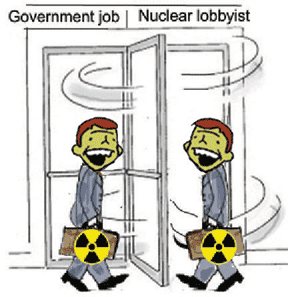
Back in June 2024, former Energy Minister Todd Smith left the government, after spending billions on the nuclear industry and promising billions more. Upon his departure, Todd Smith landed a job as a VP of CANDU Energy Inc. CANDU Energy Inc was created when SNC-Lavalin purchased the commercial reactor division of Atomic Energy of Canada Limited from the federal government in 2011. In an effort to distance itself from its scandal ridden past, SNC-Lavalin has since changed its name to AtkinsRealis. The company is heavily involved in the refurbishment of Ontario nuclear plants and the plans for new builds.
3c. The technological hype of SMRs
Small Modular Reactors (SMRs) are not small and they are not that modular. And they are not that new. The designs, of which there are about 54, have been kicking around for a long time. It’s just that no one wanted to build them, and investors were loathe to put up their own money. The fate of SMRs changed when the nuclear industry convinced governments in Canada to develop what it called the “SMR Roadmap.” The “Roadmap,” largely produced by the industry, was all hype and little substance, but it was enough to convince the Ford government to join the parade.
The World Nuclear Industry Status Review is an annual independent assessment of the global nuclear industry. In its 2022 review, it concluded:
“Small modular (nuclear) reactors or SMRs continue to hog the headlines in many countries, even though all the evidence so far shows that they will likely face major economic challenges and not be competitive on the electricity market. Despite this evidence, nuclear advocates argue that these untested reactor designs are the solution to the nuclear industry’s woes.”
In the 2024 edition of the review, the analysts note: “The gap between hype about Small Modular Reactors (SMRs) and reality continues to grow. The nuclear industry and multiple governments are doubling down on their investments into SMRs, both in monetary and political terms.”
3d. Over-the-top visioning and ideological straw men
Stephen Lecce became the Minister of Energy in June 2024. Shortly afterwards, he travelled to the US where he made a pitch to western leaders and industry movers and shakers. He told them that Ontario is building a blueprint for a nuclear energy future.
A CP wire story put it this way: “Ontario is selling itself as the nuclear North Star to guide the direction of American power.”
Speaking to a largely American audience, he said it’s time to “rid our economies of any dependence on these foreign states that … do not share our democratic embrace,” (Oops).
The minister’s early charm offensive turned more aggressive back home when he criticized those who support renewable energy as” ideologues” who want to “romanticize certain resources.” As he told the National Post, “We are seeing forces on the left, the illiberal left, who cannot come to terms with the fact that in order to decarbonize we’re going to need nuclear.”
The commitment to nuclear was further baked into Ontario’s future when the Ford government released its energy vision in October 2024. The document ironically entitled “Ontario’s Affordable Energy Future” sets the stage for a massive build out of nuclear power.
It also makes it clear that Ontario has set its sights on becoming a nuclear energy superpower in the hopes of selling expensive nuclear electricity to the US and costly nuclear technology to the world.
Reflecting the grandiose aspirations of a would-be energy superpower the Minister declared that “this was Ontario’s moment.”
3e. The legislative lock-in
In December 2024, the government passed the misnamed “Affordable Energy Act” (Bill 214) The legislation has many troubling aspects. Various sections of the act restrict public consultation, further erode the independence of regulatory tribunals, and shifts more decision making to the government. But most alarming is how the government has used the Act to give preference and priority to nuclear power. Section 25.29 (2) of the Act refers to, “the prioritization of nuclear power generation to meet future increases in the demand for electricity …”
3f. The commitment to underwrite the costs of nuclear
The government is bankrolling the nuclear expansion with public money because investors don’t want their own money at risk. The costs of nuclear power have driven private investors away. Even with massive subsidies from governments, investors are reluctant to ante up.
A spokesperson for the government-owned Ontario Power Generation made the point very clear when commenting on small modular reactors.
Kim Lauritsen is a senior OPG vice-president. She told a Global Business conference audience that the crown corporation was willing to take the “first-mover risk.”
As she put it: “Because they (small modular reactors) take too long and the industry needs to see that these things can be built successfully, to give investors the confidence and really get the ball rolling for other jurisdictions.”
Because investors are nervous and because Ontario wants to show the way for other jurisdictions, the Ford government is prepared to saddle Ontario families and future generations with the exorbitant costs of nuclear power.
Part 4: The nuclear three-prong plug: Refurbishments, SMRs and New Large Scale Reactors
Refurbishments
The Ontario government is spending billions to refurbish old nuclear plants. Fourteen reactors are scheduled to be rejuvenated – 6 at Bruce, 4 at Darlington, and 4 at Pickering. The repair schedule for existing nuclear plants stretches out for decades. While these reactors are off line, the government plans to make up the electricity shortfall with more climate wrecking, fossil-gas generating plants.
The cost of the refurbishments will be in excess of $40-billion. That forty billion and the millions more in interest charges will find its way onto our electricity bills.
As our electricity bills go up, so does political pressure and when that pressure reaches a tipping point, the government steps in with subsidies to help reduce electricity bills. It is a repeated pattern in Ontario.
A recent report from the Government’s Financial Accountability Office (FAO) projected the cost of current electricity subsidies to be $118-billion over the next 20 years. These are not all nuclear electricity subsidies. But as we spend more on nuclear and nuclear increases the cost of electricity and governments are pressured to reduce the cost of electricity, there will be even more subsidies to shift the costs from our electricity bills to our taxes.
Small Modular Reactors (SMRs)
In addition to the massive refurbishment program the Ford government has announced a series of nuclear new builds.
There will be four new small modular reactors (SMRs) built at the Darlington nuclear location. Site preparation work is already underway on the first one. OPG has convinced the Canadian Nuclear Safety Commission to forego an environmental impact assessment, relying instead on an assessment that had been done years ago on the site for a different project.
The government has selected the GE-Hitachi BWRX-300 design. This is based on a design that has been kicking around for about 20 years and has had to be redesigned about ten times. It still has never been built. The engineering designs for Darlington have again been changed, making the small modular reactor less small and even less modular.

OPG has not released a cost estimate for the reactors. But there are some indications of the probable magnitude. In the US, the only SMR project that had been approved by the US federal government was NuScale in the mid-west. The project was cancelled because of escalating costs. Originally estimated at $3-billion (US), it was terminated in 2024 when the projected costs reached $9.3-billion (US).
The Tennessee Valley Authority, a large power utility in the US, has partnered with the OPG to promote the GE-Hitachi SMR. The TVA recently provided some estimates of the costs of building the SMR in the US. It indicated that the cost of the first reactor could be about $5.4-billion (US). It hoped the costs could be reduced to about $3.7-billion (US) if more were built. These costs do not include any interest charges, cost overruns, or missed deadlines.
If we assume the lower cost and convert to Canadian dollars, the price tag for the four SMRs at Darlington would be about $20-billion before things go wrong. In 2019, the company’s indicated the costs would have to be below $1-billion (US).
New Large Scale Nuclear Reactors
In July 2023, the Ontario government announced its support to expand the capacity of the Bruce nuclear power plant near Kincardine. The Bruce nuclear generating station is owned by OPG but operated by Bruce Power, a private consortium. Bruce Power is planning a major expansion of the site’s generating capacity. At present, six of the eight reactors are being refurbished. This new development, if it goes ahead, will add an additional 4800 MW, which would require building four or five new reactors. Admittedly, it is early days, and no costs have been provided.
Port Hope
In January 2025, the Ontario government announced that it was in the preliminary stages of a massive new nuclear plant that could be built at the OPG site in Wesleyville, near Port Hope. Officials have suggested the plant could have a capacity of 8,000 to 10,000 megawatts and be in operation by the 2040s. Achieving that generating capacity would require building eight or more nuclear reactors.
Part 5: Calculating the Costs
Continue readingCritics Slam Cost of Ontario SMR Plan, Question Dependence on U.S. Uranium
May 12, 2025, Mitchell Beer, https://www.theenergymix.com/critics-slam-cost-of-ontario-smr-plan-question-dependence-on-u-s-uranium/
Critics are taking a hard line on Ontario’s announcement that it will build four 300-megawatt small modular nuclear reactors (SMRs) at the existing Darlington nuclear plant near Bowmanville, with most concerns focused on the cost of the project and the geopolitical risk in sourcing enriched uranium from a U.S. supplier.
Ontario Power Generation announced provincial approval for the first of the four units May 8, describing it as “the first new nuclear build in Ontario in more than three decades.”
“This is truly a historic moment,” said OPG President and CEO Nicolle Butcher. “This made-in-Ontario project will support provincial companies, create jobs for Ontarians, and spur growth for our economy.”
Energy and Mines Minister Stephen Lecce declared the 1,200-megawatt installation, the first of its kind in the G7, a “nation-building project being built right here in Ontario.” Durham MPP Todd McCarthy called it “the next step to strengthening Ontario and Canada’s energy security.”
The published cost of the project is $7.7 billion for the first reactor, including $1.6 billion for infrastructure and administrative buildings, and $20.9 billion to complete the series of four. Citing Conference Board of Canada figures, OPG said the four SMRs will contribute $38.5 billion to Canada’s GDP over 65 years and sustain an average of about 3,700 jobs per year, including 18,000 per year during construction.
First Mover Advantage or Boutique Pricing?
In the OPG announcement, Butcher suggested an advantage in being the first G7 jurisdiction to bring an SMR to market. “As a first mover on SMRs, Ontario will also be able to market our capabilities and nuclear expertise to the world to further grow our domestic industry,” she said.
The Globe and Mail says the Darlington New Nuclear Project “is being watched closely by utilities around the world,,”, and OPG’s BWRX-300 design “is a candidate for construction in the United States, Britain, Poland, Estonia, and elsewhere.” But “the costs published Thursday are higher than what independent observers argue are necessary to attract many more orders. For comparison, a recently completed 377-megawatt natural gas-fired power station in Saskatchewan cost $825-million.”
Ed Lyman, director of nuclear power safety at the Cambridge, MA-based Union of Concerned Scientists, called the Ontario estimate “an eye-popping figure, but not unexpected given what we know about the poor economics of small nuclear reactors.” That would make the Darlington SMR facility “a boutique unit that’s going to produce electricity for a very expensive price.”
An independent study released last week by the Ontario Clean Air Alliance found that the Darlington SMRs will cost up to eight times as much as onshore wind, almost six times as much as utility-scale solar, and 2.7 times as much offshore wind in the Great Lakes after factoring in the federal tax credit. The analysis by Hinesburg, Vermont-based Energy Futures Group “used data from Ontario’s Independent Electricity System Operator (IESO) but used realistic real-world capital costs and performance measures to develop a more accurate comparison of the cost of nuclear and renewable power options,” OCAA writes.
The report calculates the levelized cost of electricity (LCOE) from different sources in 2030 and 2040, with and without the federal government’s 30% clean energy investment tax credit (ITC). It places the unsubsidized costs per megawatt-hour in 2030 at:
• $33 to $51 for onshore wind;
• $54 for utility-scale solar;
• $105 to $113 for offshore wind;
• $214 to $319 for different SMR designs;
• $279 to $307 for conventional nuclear plants.
By 2040, the prices range from $30 for onshore wind and $41 for utility-scale solar to up to $269 for SMRs and $307 for conventional nuclear. SMR pricing falls as low as $137 per MWh with a 30% ITC.
“It remains unclear how this, and the province’s larger nuclear expansion program, will actually be paid for,” Mark Winfield, co-chair of York University’s Sustainable Energy Initiative, told The Energy Mix in an email. “Putting this on the rate base means higher rates for Ontario electricity consumers, even if the costs are as claimed.”
He added that “the potential role of the federal ITC and [Canada] Infrastructure Bank Investment raises serious questions about what should be defined as ‘clean’ energy given the risks involved in this case, in terms of economic and technological viability, safety risks, and unanswered questions regarding waste streams.”
Critics were already questioning whether field experience with four individual SMRs will be enough to drive down production costs from $6.1 billion plus surrounding infrastructure for the first unit to a range of $4.1 to $4.9 billion for the next three, after the estimated price of the project has already ballooned. Now, with New Brunswick scaling back its SMR development plans, “Ontario is taking something of a technological and economic flyer on this, on behalf of everyone else, underwritten by the electricity ratepayers and, ultimately, taxpayers of Ontario,” Winfield wrote. “This is a project that demands serious economic, technological, and environmental scrutiny, and has been subject to virtually none.”
Uranium Sourced from the United States
OPG is also running into concerns with its plan to power the BWRX-300 with enriched uranium supplied by a firm in the U.S. state of New Mexico. When Donald Trump launched his tariff war earlier this year and began muttering about making Canada a 51st state, Premier Doug Ford applied a short-lived tariff to Ontario power sales and referred publicly to cutting exports as a retaliatory measure. Now, the province is proposing to make 1,200 MW of electricity supply dependent on a vendor that could see its price driven up by tariffs, or be compelled to cut off the supply entirely.
“Developing a dependence on another country for our nuclear fuel has always been a concern, and recent events have proven those concerns are justified,” Bob Walker, national director of the Canadian Nuclear Workers’ Council, told the Globe and Mail in February. “The arrangements are probably as robust as they could be under normal circumstances, but the circumstances are no longer normal.”
In an email to the Globe at the time, OPG spokesperson Neal Kelly described the situation as “very fluid”, adding that “we are proactively evaluating potential impacts and will act as the situation arises.”
Kelly did not respond to an email Monday morning asking whether OPG has any concerns about sourcing enriched uranium from the U.S., and whether it has or needs a Plan B.
US loosens some rules for offensive counterspace ops, wargaming
Some decision-making authorities, previously closely held by the president or secretary of defense, have been delegated to US SPACECOM, according to sources, but military space leaders want more freedom to act.
Breaking DEfense, By Theresa Hitchens, on May 12, 2025
WASHINGTON — When the Space Force recently put out a forward-leaning “warfighting” framework, it included an unusually blunt warning for military commanders: ensure the rules of engagement for space operations aren’t too restrictive, or the US will be at a severe disadvantage in the heavens.
That warning was public, but Breaking Defense has learned it comes amid a parallel push by the Space Force and US Space Command (SPACECOM) over the last several years to gain more military decision-making control over the use of anti-satellite (ASAT) weapons — decision-making authority that has historically been closely held by the president and/or the secretary of defense.
While delegation of presidential authority with regard to space weapons is obscured by deep secrecy and classification, discussions by Breaking Defense with more than a dozen sources — including former Pentagon and US government civilian officials, retired and current military officials and outside space experts — have revealed that gradual but ground-breaking shifts in military freedom to prosecute war in the heavens have begun to take place in response to growing threats from Russia and, in particular China.
“We have made some changes that delegated some authorities down to Space Command commander under certain circumstances,” a former senior Space Force official said. “But in my view, not enough.”
For example, over the last decade there has been a gradual loosening of the reins on case-by-case determinations about the use of some types of temporary or reversible counterspace actions, such as jamming or lazing, according to a handful of sources. However, these sources did not indicate that there has been any relaxation of the requirement for approval by the president and/or the secretary of defense for a kinetic attack to destroy an enemy satellite……………………….
Changes in delegation of authority sped up following the standup of SPACECOM in 2019, the former senior Space Force official said. And according to three sources close to the debate, there were intense discussions as late as last summer within the Biden administration about delegating authority for the use of offensive satellite attack weapons to SPACECOM.
“OSD [Office of the Secretary of Defense] Space Policy was engaged in the strongest push I’m aware of to get authorization to use offensive counterspace capabilities delegated down from the [White House] to the [Secretary of Defense] and eventually to” the head of SPACECOM, said another former Pentagon official.
John Plumb, the head of OSD Space Policy under President Joe Biden, did reveal to Breaking Defense one significant move by that administration: allowing joint force planners to include space warfighting in their routine contingency plans and wargames for future conflict. (He would not, however, address the key question of whether destructive, kinetic strikes can be included in those plans.)………………………………………………………………………………………………………………………………. https://breakingdefense.com/2025/05/exclusive-us-loosens-some-rules-for-offensive-counterspace-ops-wargaming/
Resuscitation at Zaporizhzhia?
by beyondnuclearinternational, https://beyondnuclearinternational.org/2025/05/11/resuscitation-at-zaporizhzhia/
Why would the US, Ukraine and Russia contemplate this when renewables could answer energy needs faster and more safely, writes Linda Pentz Gunter
The Trump administration has been dangling all sorts of offers before the embattled (literally) Ukrainian government lately. These include a US grab for Ukraine’s minerals in exchange for continued support of its war with Russia, and asking Ukraine to serve as an overseas prison for those residents of the US deemed “illegals” and “criminals” by Trump’s (in)justice department.
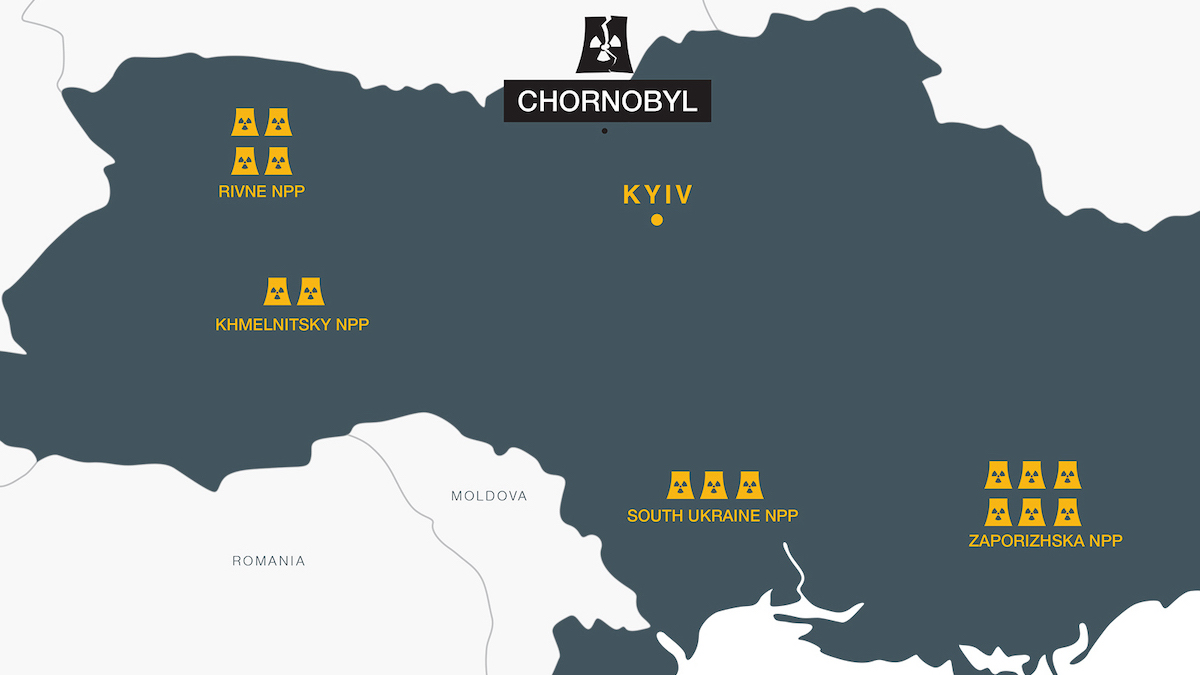
Now, the White House is apparently suggesting that the US should first rebuild and then operate the damaged six-reactor Zaporizhzhia nuclear plant in the southeast of Ukraine, the area of some of the most intense fighting between Ukrainian and Russian forces.
This bizarre proposal is detailed in a new column by the director of the Nonproliferation Policy Education Center, Henry Sokolski, in the May 6, 2025 edition of The Bulletin of the Atomic Scientists. Along with the question of whose nuclear plant Zaporizhzhia actually is, or who damaged it, Sokolski also asks just how complex and expensive restoring the plant would be and whether it is even needed?
In reading through the list of challenges to a restart that Sokolski outlines, the answer to that last question becomes increasingly more obvious: No. It is glaringly evident that nuclear power is the wrong choice for Ukraine at this point (and, we would argue, always has been).
Renewable energy can take a couple of years — and in some cases just a few months — to build and bring into operation. Given Ukraine’s previous reliance on nuclear energy for around 55% of the country’s electricity (before the war interrupted the flow), developing an energy supplier that can come on fast and doesn’t present a safety risk (under war conditions or at any other time) is, as they say here, a “no brainer”.
And yet all three countries are vying to be the one responsible for a Zaporizhzhia restart. All three are also married to the idea of a nuclear-powered future and therefore cannot be relied upon to take the more sensible renewable energy route. Even in the midst of a war, Ukraine has signaled its intention to build as many as nine new Westinghouse AP1000 reactors at all four of its existing nuclear sites —yes, even at Zaporizhzhia! Both Russia and the US are expanding their nuclear power capacity, at home as well as abroad, including through the export of reactor technology.
Why then are any of these countries even contemplating an attempt to surmount the likely insurmountable challenges of resurrecting the existing Russian built VVER Zaporizhzhia reactors, which comprise the largest nuclear power plant in Europe at 5,700 MW?
As Sokolski asks in a preamble to his Bulletin article:
“Russia destroyed the Kakhovka Dam upstream of the plant. What would be required to assure a steady clean supply of cooling water for the reactors? The Russians laid mines around the plant; the area is also laced with unexploded ordnance. How will these be neutralized? Who will do this? The Russians looted and damaged much of the plant’s control equipment. How will it be repaired and replaced? Who will certify that the work has been done properly? The U.S. Nuclear Regulatory Commission? The Ukrainian State Nuclear Regulatory Inspectorate? Rosatom?”
Then there’s the issue of cost.
“Will seized Russian assets foot the bill?” Sokolski asks. “Or will it be European Reconstruction Bank funds? What of US investment, taxpayer funds, and any private entity potentially interested in chipping in? Once funds are allocated, who would receive the profits, if any, or be responsible for the losses? Who would assume responsibility for possible accidents and damage to property beyond the plant’s site? And, finally, who will bear the costs of ensuring the plant’s security so that its reactors do not become again the targets of future attacks?”
It’s not just a question of repairing the reactors of course. It’s also an issue of repairing the damaged — and in parts destroyed — electrical grid. Even assuming Zaporizhzhia gets restared, how will the electricity it generates even reach its customers? And do they even have homes left where the lights can be switched on? Let’s remind ourselves one more time that there is a war going on in Ukraine, a bloody and protracted one that began on February 24, 2022 when Russia invaded its neighbor. (The arguments about why and what the precursors were have raged on, especially on the left, but are not the subject of this present discussion.)
There seem to be altogether too many questions surrounding a Zaporizhzhia restart to make any such prospect an even vaguely rational proposition. And there would be no need to ask any of these questions, if the obvious alternative — renewable energy — was mooted instead. These days you can ask AI — a not entirely unbiased source to be sure — which responds that Ukraine hasn’t turned to renewable energy because it “requires significant investment and infrastructure development.” Yes, but not nearly as much as trying to re-establish broken nuclear power plants and reconnect them to a destroyed electricity grid.
None of this will cross the radar at peace talks between the warring parties and the US in its self-appointed role as peacemaker. That’s because solar panels and wind turbines don’t come with the radioactive inventory that has somehow earned nuclear power a position of international — and aspirational — prestige. What it should trigger instead is an array of red warning flags, and not the kind any of us would want to “keep flying here”.
Linda Pentz Gunter is the international specialist at Beyond Nuclear and writes for and edits Beyond Nuclear International. Opinions are her own.
.
Westinghouse drops out of UK SMR competition
Nuclear Engineering International 30th April 2025, https://www.neimagazine.com/news/westinghouse-drops-out-of-uk-smr-competition/
S Westinghouse has pulled out of the UK’s small modular reactor (SMR) design competition, according to the UK The Telegraph.
Earlier in April, three of the four competition finalists in Great British Nuclear’s (GBN’s) small modular reactor (SMR) competition submitted their final tenders. The four finalists received an Invitation to Submit Final Tender (ISFT) in February – GE-Hitachi Nuclear Energy International, Holtec Britain, Rolls-Royce SMR, and Westinghouse Electric Company.
GEH (part of GE Vernova) proposed its BWRX-300 boiling water reactor; Holtec proposed its SMR-300 – a 300 MWe pressurised water reactor (PWR); the Rolls-Royce SMR is a 470 MWe PWR; and the Westinghouse AP300 is a 300 MWe/900 MWt PWR. Westinghouse, however, failed to submit its final tender.
GBN was expected to announce two winners this summer with bidders told to prepare to build three to four mini reactors each. The winners will be awarded contracts to co-fund further design development as well as the necessary regulatory, environmental and site-approvals before a final investment decision is taken in 2029. The contracts are expected to total £20bn ($26.7bn) – £10bn each if two companies are selected.
However, The Telegraph reported in February that the Government was considering awarding only one contract as Rachel Reeves, the Chancellor “is struggling to balance the books as weak economic growth makes it harder to meet her self-imposed ‘fiscal rules’ for borrowing.
According to The Telegraph, Westinghouse did not deny it had withdrawn but declined to give its reasons. “One industry source suggested the company had baulked at the commercial offer made by the Government.”
A spokesman from the UK Energy Department said: “Great British Nuclear is driving forward its SMR competition for UK deployment. It has now received final tenders, which it will evaluate ahead of taking final decisions this spring.”
There is growing concern that the economics of SMRs could prove even hard to justify at the high costs for the initial four units. None of the bidders has built their designs which are still in development. All SMRs in the GBN competition will be first-of-a-kind units (FOAK), which will push up costs.
Commenting on the issue, Neutron Bytes noted: “Most estimates are that economies of scale based on factory production of SMRs, promised by all four vendors, only kick in when order books come in “fleet mode,” e.g. by the dozen or more. It follows that even £10bn could be insufficient to cover the costs of four units any of the three 300 MWe offerings based on their status as FOAK projects.”
It added: “Splitting the difference for the GBN competition, e.g. awarding one winner £10bn, keeps the SMR initiative alive, but does nothing to promote long-term “fleet mode” production of SMRs which the UK nuclear industry points out is the only way to achieve economies of scale with factory production of SMRs.”
US nuclear giant Westinghouse pulls out of race to build Britain’s first mini-nukes

There are growing fears that the economics of SMRs could prove even harder to justify – because they have many of the same problems as large reactors – meaning security and waste disposal – but produce far less electricity and so make less money.
There are growing fears that the economics of SMRs could prove even harder to justify – because they have many of the same problems as large reactors – meaning security and waste disposal – but produce far less electricity and so make less money.
Westinghouse has not submitted its final bid for the UK’s SMR design competition
Matt Oliver, Industry Editor, https://www.telegraph.co.uk/business/2025/04/26/us-company-pulls-out-race-build-britains-first-mini-nuke/
US nuclear giant Westinghouse has pulled out of the UK’s small modular reactor (SMR) design competition.
The four companies remaining in the contest were given a deadline of mid-April to make their final bids, but The Telegraph understands that Westinghouse did not submit one following a negotiation process.
It means only three finalists – Rolls-Royce, GE-Hitachi and Holtec – remain in the running.
Great British Nuclear (GBN), the quango responsible for the SMR programme, was expected to announce two winners this summer with bidders told to prepare to build three to four mini reactors each.
Westinghouse did not deny it had withdrawn on Friday but declined to give its reasons.
One industry source suggested the company had baulked at the commercial offer made by the Government.
GBN previously advertised contracts worth £20bn in total for SMR “technology partners”, a figure that is understood to be based on the assumption two winners would be chosen.
However, The Telegraph revealed in February that the Government was considering awarding a contract to only one company as Rachel Reeves, the Chancellor, looks to make savings in her cross-departmental spending review.
The Chancellor is struggling to balance the books as weak economic growth makes it harder to meet her self-imposed “fiscal rules” for borrowing.
SMR supporters claim they could be a breakthrough in nuclear power because they would be made predominantly in factories and then assembled on site, cutting building times from around a decade to a few years. In theory this could cut costs – as would-be builders of SMRS have repeatedly promised..
Many politicians have snapped up that bait. When he opened the latest stage of the SMR competition, Mr Miliband said: “Small modular reactors will support our mission to become a clean energy superpower.”
However, the nuclear industry has a mixed record on bringing in key projects on time and on budget.
The biggest current example is the UK’s Hinkley Point C power station in Somerset which EDF originally said would cost under £20bn and be operating by now. Current costs estimates are for a final price approaching £50bn and a start-up after 2030.
There are growing fears that the economics of SMRs could prove even harder to justify – because they have many of the same problems as large reactors – meaning security and waste disposal – but produce far less electricity and so make less money.
A spokesman from the UK Energy Department said: “Great British Nuclear is driving forward its SMR competition for UK deployment. It has now received final tenders, which it will evaluate ahead of taking final decisions this spring.”
On Friday, a GBN spokesman declined to comment on Westinghouse’s position as did Westinghouse itself.
China, Russia may build nuclear plant on moon to power lunar station, official says

By Eduardo Baptista, April 24, 2025,
https://www.reuters.com/business/energy/china-led-lunar-base-include-nuclear-power-plant-moons-surface-space-official-2025-04-23/
- Summary
- China and Russia plan nuclear reactor for lunar base by 2035
- China and Russia-led ILRS aims to rival NASA’s Artemis program
- China-Russia cooperation strengthened by tensions with West
SHANGHAI, April 23 (Reuters) – China is considering building a nuclear plant on the moon to power the International Lunar Research Station (ILRS) it is planning with Russia, a presentation by a senior official showed on Wednesday.
China aims to become a major space power and land astronauts on the moon by 2030, and its planned Chang’e-8 mission for 2028 would lay the groundwork for constructing a permanent, manned lunar base.
In a presentation in Shanghai, the 2028 mission’s Chief Engineer Pei Zhaoyu showed that the lunar base’s energy supply could also depend on large-scale solar arrays, and pipelines and cables for heating and electricity built on the moon’s surface.
Russia’s space agency Roscosmos said last year it planned to build a nuclear reactor on the moon’s surface with the China National Space Administration (CNSA) by 2035 to power the ILRS.
The inclusion of the nuclear power unit in a Chinese space official’s presentation at a conference for officials from the 17 countries and international organisations that make up the ILRS suggests Beijing supports the idea, although it has never formally announced it.
“An important question for the ILRS is power supply, and in this Russia has a natural advantage, when it comes to nuclear power plants, especially sending them into space, it leads the world, it is ahead of the United States,” Wu Weiren, chief designer of China’s lunar exploration program, told Reuters on the sidelines of the conference.
After little progress on talks over a space-based reactor in the past, “I hope this time both countries can send a nuclear reactor to the moon,” Wu said.
China’s timeline to build an outpost on the moon’s south pole coincides with NASA’s more ambitious and advanced Artemis programme, which aims to put U.S. astronauts back on the lunar surface in December 2025.
Wu said last year that a “basic model” of the ILRS, with the Moon’s south pole as its core, would be built by 2035.
In the future, China will create the “555 Project,” inviting 50 countries, 500 international scientific research institutions, and 5,000 overseas researchers to join the ILRS.
Researchers from Roscosmos also presented at the conference in Shanghai, sharing details about plans to look for mineral and water resources, including possibly using lunar material as fuel.
‘I guarded Britain’s nuclear sites – our security can’t cope with new mini reactors’

mini reactors do not pose miniature hazards. “On security, size doesn’t matter. When it comes to the fuel and the byproducts, they are equally dangerous.”
“You get less energy, but you’re still going to have exactly the same security concerns,” says Okuhara. “How enthusiastic is a site operator going to be paying for security when that’s eating into their bottom line?”
INTERVIEW . Matthew Okuhara, a former armed officer with the Civil Nuclear Constabulary, fears that current security plans will be inadequate to protect the UK’s next generation of nuclear power plants..
Rob Hastings, Special Projects Editor , April 22, 2025
Sometimes he would patrol rural lanes on foot, carrying his assault rifle, looking out for any terrorists hiding in the countryside. On other assignments he would man machine guns mounted on armoured ships, watching for any sign of hostile vessels coming his way. Or he would drive in weapons-laden road convoys, monitoring potential threats from vehicles.
While serving as an armed officer with the Civil Nuclear Constabulary (CNC), Matt Okuhara saw every aspect of how the UK’s nuclear power stations and their radioactive fuel are protected from terrorists.
He spent years escorting the transport of uranium fuel to and from plants, which would be planned for months in advance. “Nuclear material is at its most vulnerable when it’s in transit,” he explains. “You’ve got to move it as secretly as possible.”
Working for the specialist force, Okuhara always felt confident the country’s civil nuclear programme was in safe hands. “Any threat has been detected long before it’s been able to cause any problems,” he says.
However, he believes the situation is “definitely more dangerous now” than when he was serving. Terrorism has become more advanced and there are new fears about so-called hybrid warfare from geopolitical adversaries including Russia.
“You don’t have to be a James Bond super-villain to realise where the vulnerable parts of a site are. You can just look on Google Maps and say, ‘We’ll attack that bit,’ especially now we’ve got drones. The threat has really shot up.”
With new technology also on the horizon, he believes the nuclear industry must face up to big security questions.
The CNC currently guards just a handful of sites, all in relatively remote locations. But experts believe the Government’s planned array of cutting-edge mini nuclear power stations could lead to a “proliferation” of reactors around the country, potentially much closer to towns and cities. This may also lead to their fuel being transported more often.
Small modular reactors (SMRs) are seen as an essential source of green energy for the UK in decades to come. Proponents say they will be quicker and cheaper to build than conventional plants, because they will be largely prefabricated.
But security experts are worried about the complex implications for how SMRs will be policed and protected, as The i Paper revealed this week. Analysts say that thousands more armed officers would have to be recruited, co-ordination with local police would have to be strengthened, and a new national infrastructure force may even have to be created.
Okuhara shares these concerns. “I don’t think the CNC’s current policing model would be able to cope with any more sites,” he says. “The generating sites, they’re kept well away from the public for good reasons.
“One, they’re easier to protect. And two, if something goes wrong, the contingency engineers have got some space to work with.”
What is the Civil Nuclear Constabulary?
- The CNC is a specialist armed force with about 1,600 officers and staff. It was created in 2005 to guard civil nuclear sites and material.
- “The CNC will deter any attacker whose intent is the theft, sabotage or destruction of nuclear material, whether static or in transit, or the sabotage of high consequence facilities,” its web page explains.
- It adds: “If an attack occurs, CNC will defend that material and those facilities and deny access to them. If material is seized or high consequence facilities are compromised, the CNC will recover control of those facilities and regain custody of the material.”
New small reactors, same big risks
After fighting in the Iraq War with British infantry, Okuhara joined the CNC in 2006 and served for six years. He describes how he helped to protect Gloucestershire’s Oldbury Power Station – which is now undergoing decommissioning – in his new book, Nuclear Copper. “Based within the high metal fences and fortress-like security measures of the power station, there was a heavily armed police presence on duty at any given time,” he writes.
To deter and prevent terrorism, the team patrolled surrounding roads and villages, wearing body armour and carrying G36C assault rifles. They benefited from the rural location by building relationships with local farmers and villagers, who “could recognise an unfamiliar car or person instantly” and knew to inform officers.
Rules currently state that nuclear power stations can only be placed in “semi-urban” settings. A spokesperson for the Department for Energy Security & Net Zero insists: “All new nuclear projects, including SMRs, are prevented from being built in densely populated areas.” The Government is loosening restrictions on them being built in the countryside.
But a majority of industry figures believe that “new nuclear technologies could be safely located closer to densely populated areas,” according to an official consultation paper.
The Whitehall document says that the semi-urban restriction will be reviewed every five years “to ensure it remains relevant and effective,” and the Government is “open to revising” this rule in future……………………….
The nuclear industry argues that SMRs will be small enough to build in urban settings, but Okuhara argues this would rob officers of a key advantage. “An intervention zone around a site gives you plenty of space where you can detect things,” he explains.
And he underlines that mini reactors do not pose miniature hazards. “On security, size doesn’t matter. When it comes to the fuel and the byproducts, they are equally dangerous.”
At the moment, energy companies cover much of the CNC’s costs. But having many smaller sites is likely to make security operations proportionately more expensive.
He continues: “If you think about the largest sites in the UK, places like Sellafield or Dounreay, they’ve got hundreds of officers. There are plenty of people out on patrol. Are these SMRs going to be given sufficient resources? Or are the companies going to be saying: ‘It’s a small reactor, we don’t need as many bodies on the ground’?”
The Government offers reassurance that any SMR will “need to have the highest levels of security in place.” A spokesperson said: “All operators are answerable to a robust and independent regulator – the Office for Nuclear Regulation – which must approve their security plan covering physical, personnel and cyber security.” The CNC declined to comment.
Vetting failures
If potentially thousands more armed officers must be recruited to guard SMRs, the CNC must improve its vetting procedures. That much is clear because of one man: Wayne Couzens.
Couzens’ name became infamous after he raped and murdered Sarah Everard in Surrey in 2021, having used his Metropolitan Police ID to falsely arrest her.
Couzens had previously been an authorised firearms officer with the CNC, serving at Sellafield and Dungeness. He had passed the CNC’s vetting procedures in 2011 despite previously being accused of numerous sexual offences, including harassment, assault and indecent exposure. He transferred to the Met in 2018.
The CNC’s Chief Constable, Simon Chesterman, apologised “unreservedly” on behalf of the force in 2024, “for the part CNC played in his entry as a full-time police officer.”………………………………………………
No matter whether they’re protecting groundbreaking SMRs, or conventional nuclear sites, or convoys of radioactive fuel, “every officer in the CNC should have the top level of vetting,” he says. “They’ve got access to firearms. They can access some of the most toxic material that has ever existed.”
It’s a reminder that when it comes to nuclear security, sometimes the biggest threats can come from insiders.
‘Nuclear Copper: The Secret World of Nuclear Policing’ by Matt Okuhara is out now (£22.99, Amberley Publishing) @robhastings.bsky.social https://inews.co.uk/news/crime/i-guarded-britains-nuclear-sites-security-mini-reactors-3649782
China, Russia may build nuclear plant on moon to power lunar station, official says
China is considering building a nuclear plant on the moon to power the
International Lunar Research Station (ILRS) it is planning with Russia, a
presentation by a senior official showed on Wednesday. China aims to become
a major space power and land astronauts on the moon by 2030, and its
planned Chang’e-8 mission for 2028 would lay the groundwork for
constructing a permanent, manned lunar base.
Reuters 23rd April 2025, https://www.reuters.com/business/energy/china-led-lunar-base-include-nuclear-power-plant-moons-surface-space-official-2025-04-23/
As more countries enter space, the boundary between civilian and military enterprise is blurring. Dangerously.
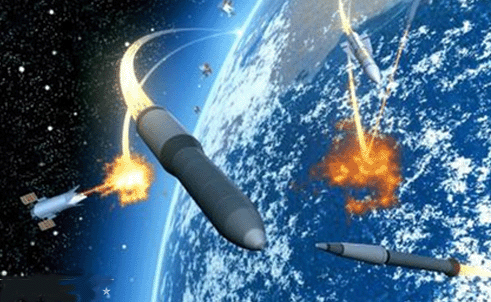
By Zohaib Altaf | April 9, 2025, https://thebulletin.org/2025/04/as-more-countries-enter-space-the-boundary-between-civilian-and-military-enterprise-is-blurring-dangerously/#post-heading
Outer space is no longer just for global superpowers and large multinational corporations. Developing countries, start-ups, universities, and even high schools can now gain access to space. The democratization of space has led to significant technological advancements, economic growth, and international collaboration.
In 2024, a record 2,849 objects were launched into space. The commercial satellite industry saw global revenue rise to $285 billion in 2023, driven largely by the growth of SpaceX’s Starlink constellation. Private space companies such as SpaceX have played crucial roles in making space more accessible globally.
Developing countries have also made strides. Since 2018, nations like Bangladesh, Ghana, Nepal, Rwanda, and Sri Lanka have launched their first satellites. The African space scene has grown, with 43 satellites launched since 2016, totaling 63 in 2025. Ethiopia, despite being one of the world’s poorest countries, has made significant progress in space activities. Similarly, Rwanda, with a substantial portion of its population living in poverty, has embarked on its space journey. These advances show that barriers to space entry are declining.
While the democratization of space is a positive development, it has introduced complex challenges, particularly an ethical quandary that I call the “double dual-use dilemma.” The double dual-use dilemma refers to how private space companies themselves—not just their technologies—can become militarized and integrated into national security while operating commercially
Unlike the traditional military-industrial complex, space companies fluidly shift between civilian and military roles. Their expertise in launch systems, satellites, and surveillance infrastructure allows them to serve both markets, often without clear regulatory oversight. Companies like Walchandnagar Industries in India, SpaceX in the United States, and the private Chinese firms that operate under a national strategy of the Chinese Communist Party called Military-Civil Fusion exemplify this trend, maintaining commercial identities while actively supporting defense programs. This blurring of roles, including the possibility that private space companies may develop their own weapons, raises concerns over unchecked militarization and calls for stronger oversight to preserve space as a neutral domain.
Dual use of space companies. Countries like the United States and China have already shown a willingness to use commercial space entities for military purposes. China encourages private entities to participate in space activities as part of its Military-Civilian Integration Strategy. Similarly, the 2021 United States Space Priorities Framework outlines how new commercial space capabilities and services can be leveraged to meet national security needs. In a 2021 interview, the then-head of the US Space Force discussed the importance of using the space industry for national security.
Researchers and security analysts are increasingly concerned that the dual use of private space companies is not limited to their space technologies, such as the satellites they launch. In some cases, a company may appear to be a civilian space entity while actually maintaining close links with defense sectors.
For instance, take the example of India, which has seen phenomenal growth in its space sector in recent years. The leading companies of the Indian Space Association have worked closely with the Indian Ministry of Defence on various contracts.
Furthermore, the association’s leadership maintains a close connection with the Indian army and defense organizations. For example, the first chairman, Jayant Patil, was also the senior vice president for defense business at Larsen and Toubro, an Indian company involved in the space industry. The company has collaborated with India’s Defence Research and Development Organisation since the mid-1980s.
The usefulness of space companies goes beyond their existing technologies. Military organizations can use expertise gained through civilian cooperation programs to develop other critical technologies. India’s intercontinental ballistic missile program, based on the SLV-3 vehicle, was initially developed under civilian space cooperation with NASA. India’s Agni-V ICBM, which is capable of carrying multiple warheads and has a range exceeding 5,000 kilometers, has also benefited from technological cooperation with NASA.
Indian private space companies such as Walchandnagar Industries are also defense contractors producing aerospace, defense, missile, and nuclear power technologies. These companies collaborate with India’s Defence Ministry and the Defence Research and Development Organisation to produce strategic articles, tactical missiles, and critical platform-based equipment. The expertise gained from private space launches and technological developments can be leveraged to improve missile technology.
There is a serious risk that civilian companies in India and elsewhere, having gained expertise through cooperation with the military, might start developing their own weapons. The table below shows how specific types of space expertise can be used to develop missiles, drones, precision missiles, hypersonic missiles, and other loitering munitions.
Dual use of space technology. India’s rapidly growing space sector and expanding military-commercial partnerships make it a key case study of the double dual-use dilemma. Unlike the United States and China, which have structured policies—the US Space Force and National Space Policy formally integrate private firms into defense, while China’s Military-Civil Fusion strategy mandates commercial space support for China’s army—India’s private space sector is expanding, but its dual-use regulatory framework is still developing. India’s Space Policy 2023, while not explicitly mentioning the military, hints at defense applications by emphasizing space capabilities for “national security.”
This lack of clear regulatory boundaries allows technologies initially developed for civilian use to be repurposed for defense applications, as seen in the case of Synthetic Aperture Radar. Originally acquired through civilian cooperation with NASA, this radar imaging technique is now being adapted for military reconnaissance and targeting. Although not a weapon, the technique’s dual-use nature enables high-resolution surveillance, missile guidance, and intelligence operations.
The commercialization of space by private companies poses significant security challenges. For instance, ostensibly civilian satellites can be repurposed for military uses such as surveillance and espionage. Commercial satellites with high-resolution imaging capabilities, like those from companies such as Planet Labs, can be used for intelligence gathering, providing detailed information on adversaries’ activities and installations. The dual-use dilemma affects governments as well as private companies, but poses greater risks with private entities due to weaker oversight and profit-driven priorities. Governments operate under strict security frameworks and treaties like the Outer Space Treaty, ensuring accountability in the use of dual-use technologies. In contrast, private companies may prioritize commercial interests, potentially selling technologies to less accountable actors, increasing proliferation risks. While satellite launches are regulated, post-launch activities—like selling high-resolution imagery or repurposing technology—are harder to monitor.
Furthermore, companies like the American company Capella Space have developed synthetic aperture radar satellites for civilian purposes such as disaster management and environmental monitoring. However, the high-resolution images provided by these satellites can also be used for military applications, including counterforce strikes and espionage. These satellites can monitor adversaries and plan strategic military operations.
Moreover, American companies like SpaceX and Blue Origin, which focus on developing rockets and spacecraft for civilian space missions, also have the potential to contribute to military logistics and defense operations. For instance, SpaceX’s Starlink constellation, designed for global internet coverage, could be used in military scenarios to support drone operations by enabling real-time communication and coordination, as seen during the Russia-Ukraine conflict.
Repurposing commercial technologies for military use introduces potential risks. Civilian systems could become high-value targets, vulnerable to cyberattacks and physical strikes, potentially disrupting operations and escalating conflicts into space. The reliance on privately owned infrastructure also poses challenges, as it reduces government oversight and increases the risk of misuse or proliferation. For example, reusable rockets developed for commercial launches could be adapted for missile programs, enabling military advancements to be concealed within civilian initiatives. These dual-use capabilities have the potential to blur the boundaries between civilian and military applications, increasing the risks of conflict escalation and complicating efforts to maintain global stability in a democratized space domain.
Need for robust regulatory framework. The challenges posed by the double dual-use dilemma necessitate robust regulatory frameworks and international cooperation to ensure that the commercialization of space does not compromise global security. For example, commercial satellite launch services could be used to deploy space-based weapons or reconnaissance systems under the guise of civilian activities, making it harder to enforce arms control agreements. Effective space governance must address the potential for commercial space entities to be co-opted for military purposes. One practical step is the establishment of international agreements that mandate transparency in satellite launches and operations.
The Outer Space Treaty, which forms the basis of international space law, should be expanded to include specific provisions for the dual use of space technologies. For example, countries could be required to declare the intended uses of their satellites, with periodic inspections to ensure compliance. International space governance must ensure that expertise gained through civil cooperation does not translate into new weapons programs.
Furthermore, partnerships between governments and private corporations should be regulated to prevent the misuse of commercial space capabilities. The European Union’s Space Surveillance and Tracking network is an example of regional cooperation to monitor space activities and ensure that space assets are used for their declared purposes. This type of cooperation should be extended globally to include major space-faring nations and emerging space players.
In the United States, the Space Force has already begun leveraging commercial space capabilities for national security purposes. For instance, the National Reconnaissance Office has contracted with commercial satellite companies to provide imagery for intelligence purposes. Such partnerships highlight the need for clear guidelines to differentiate civilian and military applications and to ensure that commercial space activities do not escalate geopolitical tensions.
The international community must develop comprehensive strategies to manage the complexities introduced by the double dual-use dilemma. It is no longer a distant challenge—it is actively reshaping the balance of power in space. As private space firms blur the lines between commercial innovation and military assets, the risk of an unregulated arms race beyond Earth’s atmosphere grows.
Without clear governance, space could follow the path of cyberspace—a once-neutral domain now deeply entrenched in geopolitical rivalry. The question is no longer if commercial space activities will fuel strategic competition, but how soon nations will act to prevent the militarization of the final frontier.
INSIDER THREAT SECURITY CONSIDERATIONSFOR ADVANCED AND SMALL MODULAR REACTORS.
The wide range of nuclear power plant technologies currently in design
globally have an assortment of unique characteristics that create novel
security considerations compared to large conventional nuclear power
plants.
Some of these characteristics create “insider threat”
considerations for nuclear security, where insiders are defined as
individuals with legitimate access to nuclear facilities and materials who
use this access to carry out sabotage or theft of nuclear material.
These include a lack of mature security culture in developer organisations,
serial plant manufacturing in a production line environment, plant siting
in remote and isolated areas, minimised staff numbers, teleoperation of
plants by offsite staff, the increased reliance on digital instrumentation
and control systems, and the potential for greater involvement of foreign
experts and third-party suppliers, especially on short-term bases for, e.g,
refuelling and maintenance.
The paper takes a technology agnostic approach
to examine what these factors may mean for insider threat risks and
suggests that plant designers should be identifying and minimising the
opportunities of insiders to act throughout the engineering design process.
Doing so is anticipated to strengthen effective insider threat mitigation
in deployed small and advanced reactors.
Kings College 21st April 2025 – https://kclpure.kcl.ac.uk/ws/portalfiles/portal/311074601/Paper_381_Insider_Threat_for_SMR.pdf
Small nuclear reactors are no fix for California’s energy needs
I know all too well that the hype is built on quicksand …….. many of those “building support for small modular reactors” are putting forward “rhetorical visions imbued with elements of fantasy.”
SMRs are just one of several wildly overhyped false promises on which the world is poised to spend hundreds of billions of dollars by 2040
Joseph Romm, April 18, 2025 , https://www.latimes.com/opinion/story/2025-04-18/small-modular-reactors-cost-california
It might seem like everyone from venture capitalists to the news media to the U.S. secretary of Energy has been hyping small modular reactors as the key to unlocking a nuclear renaissance and solving both climate change and modern data centers’ ravenous need for power.
On Monday, the Natural Resources Committee of the California Assembly will consider a bill to repeal a longstanding moratorium on nuclear plants in the state, which was meant to be in place until there is a sustainable plan for what to do with radioactive waste. Defeated multiple times in the past, this bill would carve out an exception for small modular reactors, or SMRs, the current pipe dream of nuclear advocates.
SMRs are typically under 300 megawatts, compared with the combined 2.2 gigawatts from Diablo Canyon’s two operating reactors near San Luis Obispo. These smaller nukes have received so much attention in recent years mainly because modern reactors are so costly that the U.S. and Europe have all but stopped building any.
The sad truth is that small reactors make even less sense than big ones. And Trump’s tariffs only make the math more discouraging.
I’ve been analyzing nuclear power since 1993, when I started a five-year stint at the Department of Energy as a special assistant to the deputy secretary. I helped him oversee both the nuclear energy program and the energy efficiency and renewable energy program, which I ran in 1997.
So I know all too well that the hype is built on quicksand — specifically, a seven-decade history of failure. As a 2015 analysis put it, “Economics killed small nuclear power plants in the past — and probably will keep doing so.” A 2014 journal article concluded many of those “building support for small modular reactors” are putting forward “rhetorical visions imbued with elements of fantasy.”
But isn’t there a nuclear renaissance going on? Nope. Georgia’s Vogtle plant is the only new nuclear plant the U.S. has successfully built and started in recent decades. The total cost was $35 billion, or about $16 million per megawatt of generating capacity — far more than methane (natural gas) or solar and wind with battery storage.
As such, Vogtle is “the most expensive power plant ever built on Earth,” with an “astoundingly high” estimated electricity cost, noted Power magazine. Georgia ratepayers each paid $1,000 to support this plant before they even got any power, and now their bills are rising more than $200 annually.
The high cost of construction and the resulting high energy bills explain why nuclear’s share of global power peaked at 17% in the mid-1990s but was down to 9.1% in 2024.
For decades, economies of scale drove reactors to grow beyond 1,000 megawatts. The idea that abandoning this logic would lead to a lower cost per megawatt is magical thinking, defying technical plausibility, historical reality and common sense.
Even a September report from the federal Department of Energy — which funds SMR development — modeled a cost per megawatt more than 50% higher than for large reactors. That’s why there are only three operating SMRs: one in China, with a 300% cost overrun, and two in Russia, with a 400% overrun. In March, a Financial Times analysis labeled such small reactors “the most expensive energy source.”

Indeed, the first SMR the U.S. tried to build — by NuScale — was canceled in 2023 after its cost soared past $20 million per megawatt, higher than Vogtle. In 2024, Bill Gates told CBS the full cost of his 375-megawatt Natrium reactor would be “close to $10 billion,” making its cost nearly $30 million per megawatt — almost twice Vogtle’s.
All of this has played out against a backdrop of historically cheap natural gas and a rapid expansion of renewable energy sources for electricity generation. All that competition against nuclear power matters: A 2023 Columbia University report concluded that “if the costs of new nuclear end up being much higher” than $6.2 million per megawatt, “new nuclear appears unlikely to play much of a role, if any, in the U.S. power sector.” R.I.P.
SMRs are just one of several wildly overhyped false promises on which the world is poised to spend hundreds of billions of dollars by 2040, including hydrogen energy and direct air carbon capture.
But nuclear power is the original overhyped energy technology. When he was chairman of the Atomic Energy Commission, Lewis Strauss — the Robert Downey Jr. character in “Oppenheimer” — predicted in 1954 that our children would enjoy nuclear power “too cheap to meter.”
Yet by the time I joined the Department of Energy in 1993, nuclear power costs had grown steadily for decades. Since then, prices for new reactors have kept rising, and they are now the most expensive power source. But solar, wind and battery prices have kept dropping, becoming the cheapest. Indeed, those three technologies constitute a remarkable 93% of planned U.S. utility-scale electric-generating capacity additions in 2025. The rest is natural gas.
China is the only country building many new nuclear plants over the next five years — about 35 gigawatts. Less than 1% of this projected capacity would be from small reactors — while more than 95% will be from reactors over 1,100 megawatts. Now compare all that to the 350 gigawatts of solar and wind China built — just in 2024.
For the U.S., President Trump’s erratic tariffs make small modular reactors an even riskier bet. If the U.S. economy shrinks, so does demand for new electric power plants. And the twin threats of inflation and higher interest rates increase the risk of even worse construction cost overruns.
Also, China, Canada and other trading partners provide critical supply chain elements needed to mass-produce SMRs — and mass production is key to the sales pitch claiming this technology could become affordable. That logic would apply only if virtually all of the current SMR ventures fail and only one or two end up pursuing mass production.
So, can we please stop talking about small modular reactors as a solution to our power needs and get back to building the real solutions — wind, solar and batteries? They’re cheaper and cleaner — and actually modular.
Joseph Romm is a former acting assistant secretary of Energy and the author of “The Hype About Hydrogen: False Promises and Real Solutions in the Race to Save the Climate.”
1 This Month

of the week – Shut Down Drone Warfare!


Tell the Ukrainian Government to Drop Prosecution of Peace Activist Yurii Sheliazhenko

Petition to revoke the licensing of the Near Surface Nuclear Disposal Facility (NSDF) at Chalk River. https://www.ourcommons.ca/petitions/en/Petition/Details?Petition=e-7247
To see nuclear-related stories in greater depth and intensity – go to https://nuclearinformation.wordpress.com
-
Archives
- March 2026 (251)
- February 2026 (268)
- January 2026 (308)
- December 2025 (358)
- November 2025 (359)
- October 2025 (376)
- September 2025 (257)
- August 2025 (319)
- July 2025 (230)
- June 2025 (348)
- May 2025 (261)
- April 2025 (305)
-
Categories
- 1
- 1 NUCLEAR ISSUES
- business and costs
- climate change
- culture and arts
- ENERGY
- environment
- health
- history
- indigenous issues
- Legal
- marketing of nuclear
- media
- opposition to nuclear
- PERSONAL STORIES
- politics
- politics international
- Religion and ethics
- safety
- secrets,lies and civil liberties
- spinbuster
- technology
- Uranium
- wastes
- weapons and war
- Women
- 2 WORLD
- ACTION
- AFRICA
- Atrocities
- AUSTRALIA
- Christina's notes
- Christina's themes
- culture and arts
- Events
- Fuk 2022
- Fuk 2023
- Fukushima 2017
- Fukushima 2018
- fukushima 2019
- Fukushima 2020
- Fukushima 2021
- general
- global warming
- Humour (God we need it)
- Nuclear
- RARE EARTHS
- Reference
- resources – print
- Resources -audiovicual
- Weekly Newsletter
- World
- World Nuclear
- YouTube
-
RSS
Entries RSS
Comments RSS
 nuclear-news