Is Fukushima Worse Than Chernobyl?
Radiation from Fukushima, Food Consumer, 5 Sept 12,
Radiation from Fukushima ukushima nuclear disaster is not the only thing Americans need to be worried about. As many as 14 states have been polluted by the nuclear tests conducted in the U.S. in 50’s, according to some reports. The clean states are only those in the West like Oregon, California, and maybe Washington as well. By Dr. Mercola
“……When the Chernobyl reactor melted down in 1986, approximately 134 plant workers and firefighters were exposed to high doses of radiation – 800 to 16,000 mSv – and developed acute radiation sickness. Of those 134 workers, 28 died within 3 months of exposure.
In total, more than 160,000 children and 146,000 cleanup workers became victims of radiation poisoning as a result of living and working in that radiotoxic environment, raising the incidence of birth defects, leukemia, anemia, cancers, thyroid disease, liver and bonemarrow degeneration, and overall severely compromised immune systems.
These, however, are only estimates, and according to some data, Chernobyl deaths may actually top 1 million.6 Fukushima is the largest nuclear disaster since, but there are many similarities popping up. For one, as the Institute of Science in Society (ISIS) points out:7
“From the beginning, the official nuclear safety experts were at pains to minimize the projected health impacts, as they are doing now for the Fukushima accident.”
According to ISIS, with Chernobyl, they underestimated related deaths by:
- Underestimating the level of radiation by averaging exposure over a large region, such as an entire country, so high exposure doses and health statistics of the most contaminated areas are lumped together with the less and least exposed
- Ignoring internal sources of radiation due to inhalation and ingestion of radioactive material from fallout
- Using an obsolete and erroneous model of linear energy transfer due to external sources of ionizing radiation
- Not counting diseases and conditions other than cancers
- Overestimating the natural background radiation; today’s “background” has been greatly increased by discharges from nuclear activities including tests of nuclear weapons, use of depleted uranium, and uranium mining
- Suppressing and withholding information from the public……. http://www.foodconsumer.org/newsite/Non-food/Environment/radiation_from_fukushima_0904120707.html
Touching faith of Steve Kidd that our grandchildren will solve the nuclear waste problem
 “SOMEHOW the waste issue will UNDOUBTEDLY be taken care of”
In Today’s issue of Nuclear Engineering I found a fascinating article by Steve Kidd, deputy director-general of the World Nuclear Association. I was fascinated because of the insight this article gives into the thinking of the nuclear lobby.
It’s all about South Korea, and Mr Kidd is full of praise for the culture there. You see, they’re not only hard-working, – but Mr Kidd seems to be rejoicing that the South Koreans have none of that pesky individualism, that slows things up in other countries. In South Korea, he says, there’s ” a feeling of national unity, initially fostered by strong state control and somewhat repressive policies, which it carries through to today. Critics would argue that there is a lack of individualism, and it is certainly true that South Koreans all seem to think and speak with one voice…. every Korean is part of ‘Korea Inc’ and the economy drives forward with only the odd bump on the way”
This is awfully handy for the nuclear industry, – South Korea sounds like one place where the populace will believe their government. Mr Kidd seems agrees with all the economists, that nuclear energy needs government backing to survive “A strong national consensus that a nuclear programme is both necessary and do-able is also important, as is the guarantee that support won’t suddenly be withdrawn by political change.”
But my favourite part is that wonderfully religious bit, in which the nuclear advocate shows complacent faith that somehow, in the future, somebody’s grandchild will fix the problems that the nuclear industry has created – no doubt long after Mr Kidd and the rest of them have made their money, retired, and died.
“The major difficulty may turn out to be obtaining sites for the additional reactors in the 2020s, as the current four sites will run out of space for extra units by then. But somehow this will undoubtedly be taken care of, as will the waste issue, which is rising in significance as the volume of stored used fuel grows rapidly.”
Touching faith, isn’t it? – Christina Macpherson
Don’t believe the nuclear lobby’s lies about bananas and radiation
 Nukers promoting contaminated food – the falsehoods of
 the Potassium excuse http://nuclearhistory.wordpress.com/2012/08/30/nukers-promoting-contaminated-food-the-falsehoods-of-the-potassium-excuse/http://nuclearhistory.wordpress.com/2012/08/30/nukers-promoting-contaminated-food-the-falsehoods-of-the-potassium-excuse/ I have blogged about this before. Attempts at selling contaminated food in the market of people’s lives by nuclear advocates has to stop in Japan and everywhere.
It will take me the weekend to finish this post as I gather the historic and current sources which show the Potassium equivalent dose (which the industry calls the banana equivalent dose) is a false, incorrect, wrong and deceptive fallacy.
In the interim, this wiki article explains the fallacy in brief:http://en.wikipedia.org/wiki/Banana_equivalent_dose
In brief: radio potassium (K40) is much a very small proportion of all potassium. It is far less radioactive per unit weight (amount, physical dose) than any biologically active fission product.
Potassium in any form is dangerous to the heart in excess, but potassium is a needed nutrient.
The body maintains a potassium balance therefore. This danger to the heart is a bio-chemical effect. The radiological nature of radio cesium (a potassium analogue) poses an additional threat to the heart and other soft tissue. Continue reading
Murdoch news paints nuclear disasters as “not too bad, really”
 Murdoch’s Journal pushes tragic Fukushima flim-flam http://www.freepress.org/columns/display/7/2012/1941#.UD6F7tkjq2c.twitter August 29, 2012 With every atomic reactor disaster comes the inevitable whitewash.
And Rupert Murdoch’s Wall Street Journal has just painted a tragic new coat over the radioactive wasteland of atomic flim-flam. Its “Panic at Fukushima” speaks volumes to a nuclear power industry now crumbling at the core. It fits an historic pattern:
When yet another radioactive leak emits from the local nuke—no matter how serious—the official response is hard-wired to include the phrase “no danger to the public.”
When serious structural cracks surface at reactors like Ohio’s Davis-Besse or Crystal River, Florida, safety concerns are invariably dismissed with well-funded contempt.
As with fatally flawed steam generators at California’s San Onofre, if it can make an extra buck, the industry will run these reactors into the ground, safety-be-damned. Protected by federal taxpayer insurance and the bankruptcy laws, they know even a catastrophic disaster need not trouble their bottom line. Continue reading
What is wrong with thorium nuclear reactors? Well, a lot, really
Thorium: Why We Don’t Want It http://nowarnow.wordpress.com/2012/08/03/thorium-why-we-dont-want-it/ By No War Now / 3 August, 2012
“….. Thorium is just another nuclear industry way of persevering their jobs in an energy production method that does not make sense for our planet. Thorium requires mining rare earth elements. Thorium requires the changing of laws to process monazite, currently categorized as “‘prescribed substance’ and the sole domain of the government” per the Atomic Energy Act (Canada and China work in thorium, http://nextbigfuture.com/2012/08/canada-and-china-work-on-thorium-candu.html).
Thorium continues the predatory practice of extracting public money to support its development and operations. Of course, you won’t learn this from the schills and trolls who want to convince you that thorium is the answer to our energy needs and ought be part of our “clean energy” package. Mining is not, and has never been, a clean energy production practice. Especially when it involves uranium. Continue reading
Don’t be sucked in by ‘spin’ promoting thorium nuclear reactors
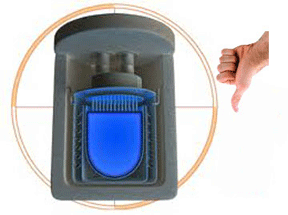 thorium is merely a way of deflecting attention and criticism from the dangers of the uranium fuel cycle and excusing the pumping of more money into the industry….. the nuclear industry itself is also sceptical
‘ these arereally U-233 reactors,’ This isotope is more hazardous than the U-235 used in conventional reactors, he adds, because it produces U-232 as a side effect (half life: 160,000 years), on top of familiar fission by-products
Don’t believe the spin on thorium being a ‘greener’ nuclear option Ecologist, Eifion Rees 23rd June, 2011 It produces less radioactive waste and more power than uranium but the UK would be making a mistake in looking to it as a ’greener’ fuel. The Ecologist reports….. nuclear radiologist Peter Karamoskos, of the International Campaign to Abolish Nuclear Weapons (ICAN), says the world shouldn’t hold its breath.
‘Without exception, [thorium reactors] have never been commercially viable, nor do any of the intended new designs even remotely seem to be viable. Like all nuclear power production they rely on extensive taxpayer subsidies; the only difference is that with thorium and other breeder reactors these are of an order of magnitude greater, which is why no government has ever continued their funding.’ Continue reading
In Japan, (as in other countries) nuclear lobby cons children

At left is an example of AREVA’s spin to children in Australia
‘Alice in Wonderland’ was used to convince children in Japan nuclear power is safe (PHOTO & VIDEO) http://enenews.com/alice-wonderland-convince-children-japan-nuclear-power-safe-photo-video (VIDEO) August 8th, 2012 By ENENews
Speaker: Charles Ferguson, President, Federation of American Scientists Stories have come out that the government was promoting nuclear power so much that they were using cartoon characters, they were using Alice in Wonderland to convince school children nuclear power is incredibly safe. They weren’t showing the other side of the story adequately enough. It was an unbalanced presentation.
The New York Times’ Norimitsu Onishi on the ‘Alice in Wonderland’ theme: The New York Times’ Norimitsu Onishi on the ‘Alice in Wonderland’ theme:
Source: Ko Sasaki for The New York Times
Near a nuclear power plant facing the Sea of Japan, a series of exhibitions in a large public relations building here extols the virtues of the energy source with some help from “Alice in Wonderland.”
“It’s terrible, just terrible,” the White Rabbit says in the first exhibit. “We’re running out of energy, Alice.”
A Dodo robot figure, swiveling to address Alice and the visitors to the building, declares that there is an “ace” form of energy called nuclear power. It is clean, safe and renewable if you reprocess uranium and plutonium, the Dodo says.
“Wow, you can even do that!” Alice says of nuclear power. “You could say that it’s optimal for resource-poor Japan!”
Nuclear Regulatory Commission to woo indigenous peoples with education money
This funding opportunity is open to institutions of higher education; Alaska Native and Native Hawaiian Serving Institutions; Hispanic-serving Institutions; Historically Black Colleges and Universities; and Tribally-Controlled Colleges and Universities; non-profits.

 $4.7 Million Funding Available for Nuclear Education Curricula Development Power Industry News, WASHINGTON, Aug. 5 — The U.S. Nuclear Regulatory Commission has announced that it expects to award discretionary grant for the development of nuclear education curricula promoting common defense and security; and protecting the environment. Continue reading
Nuclear and fossil fuel lobbies wage expensive war against renewable energy
Renewable Energy Under Siege In The USA http://www.energymatters.com.au/index.php?main_page=news_article&article_id=3326 by Energy Matters, 7 Aug 12, Renewable energy faces opposition from cashed-up fossil fuel supporters in Australia; but it’s nothing compared to what is going on in the USA at the moment. While solar energy, wind power and other clean energy sources have always hit opposition in the USA, the smearing has hit new levels as the nation prepares to vote and crucial renewable energy support mechanisms are under review.

The Sierra Club has released a report revealing how the fossil fuel industry is using tactics such as financial contributions to political campaigns, fake think tanks and faux intellectuals to attack renewable energy in order to alter public opinion and the views of lawmakers. ”From California to Pennsylvania, clean energy jobs are under attack by fossil fuel interest groups – yet many in Congress are sitting on their hands while tens of thousands of American jobs hang in the balance,” said Michael Brune, executive director of the Sierra Club.
The Sierra Club’s report claims the oil and gas industry spent more than $146 million on lobbying alone in 2011 and organizations such as the Manhattan Institute and the Heartland Institute that defend oil subsidies while attacking renewable energy have received in excess of $600,000 each since 1998 from the oil company Exxon. The report states the oil and gas industry contributed to 88 percent of all members of the U.S. House of Representatives and 89% of Senators in the 2010 election cycle.
Quoting data from Open Secrets; ConocoPhillips spent $20.5 million on lobbying last year and Royal Dutch Shell, $14.79 million. Add to those figures spending by ExxonMobil, Chevron, the American Petroleum Institute, and Koch Industries and the grand total comes to more than $74 million in 2011.
The report comes at a crucial time as a crucial element of support for wind energy – the Production Tax Credit (PTC) – may be lost at the end of this year. The PTC helps support the more than 75,000 jobs in the wind industry and many as half those jobs could be lost if it is not renewed.
The report, titled “Clean Energy Under Siege – Following the Money Trail Behind the Attack on Renewable Energy”, can be viewed in full here (PDF).
Big oil companies fight renewable energy through “think tanks”
 rather than providing the public with education for the greater good, faux “think tanks” like Manhattan Institute and the Heartland Institute masquerade as “pro-free market” organizations yet they defend oil subsidies and attack renewable energy support. The organizations are funded by fossil fuel companies like Exxon,
New report outlines coordinated attacks by big oil on renewable energy Examiner, AUGUST 2, 2012 BY: ALICIA BAYER A new report released today by the Sierra Clubshows that over the past decade the fossil fuel industry and its well-funded backers have mounted a coordinated campaign to discredit renewable energy and hinder its growth. Continue reading
That magic phrase again – Fukushima – “just a SPEED HUMP”
Report: Fukushima a “Speed Bump” on the Road to Massive Nuclear Power Expansion IEEE Spectrum BY: DAVE LEVITAN, JULY 26, 2012 “….. According to the UN’s Nuclear Energy Agency and the International Atomic Energy Agency nuclear power will expand between 44 and 99 percent by 2035, with a total added capacity between 165 and 371 gigawatts.

To be sure, some countries, notably Germany, which has pledged to shut down all of its 17 reactors by 2022, are headed in the opposite direction. Even if they follow through, however, this might not make a dent in the industry overall growth. The report, known informally as
the Red Book, predicts nuclear will expand between 125 and 185 percent in East Asia, with heavy construction in China, South Korea, India, and Russia. (Notably though, the low end of that prediction does not include the possibility that Japan will fully disavow the use of
nuclear in Fukushima’s wake.)
It seems striking that a disaster that captured the world’s full attention might have so little lingering effect. Gary Dyck, the head of nuclear fuel cycle and materials at IAEA, told Reuters that “we see [Fukushima] as a speed bump. We still expect huge growth in China.” That’s a hell of a speed bump; after Chernobyl in 1986, global nuclear capacity growth did slowfairly dramatically, though this could be attributed to a number of factors.
Climate Science Denial – Australia’s Institute of Public Affairs (IPA)

Science denial tourism, sponsored by the IPA Want to a free trip around Australia, all expenses paid? It’s easy, just publish a book denying climate change (scientific credentials not required) then
contact the Institute of Public Affairs — they’ll take care
everything. Graham Readfearn from DeSmogBlog.com reports on the IPA —
Australia’s home of anti-science……
http://www.independentaustralia.net/2012/environment/science-denial-tourism-sponsored-by-the-ipa/
Nuclear and fossil fuel lobbies have conned Australia about wind energy
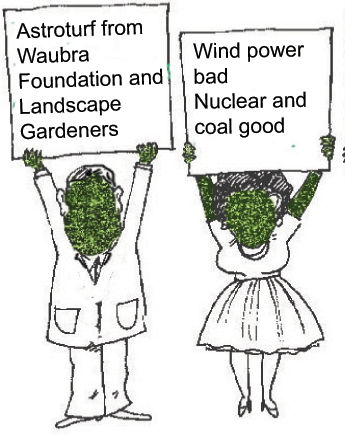 There are two main anti-wind farm groups in Australia busily fomenting anxiety and opposition. One is the Waubra Foundation, a group of mainly wealthy individuals, none of whom live in or near the town of Waubra, near Ballarat. Several of them, NIMBY style, have opposed turbines near their own properties elsewhere. They are led by an unregistered doctor, Sarah Laurie, and a wealthy mining investor, Peter Mitchell who also has connections to the Landscape Guardians. Despite their name, the Guardians have never attempted to guard our landscape from over-zealous residential developers, open cut coal or coal seam gas mining. They only target wind farm developments. All three – Waubra, the Guardians and Mitchell’s mining investment company share a South Melbourne post office box.
Wind turbine syndrome: a classic ‘communicated’ disease https://theconversation.edu.au/wind-turbine-syndrome-a-classic-communicated-disease-8318?utm_medium=email&utm_campaign=Latest+from+The+Conversation+for+20+July+2012&utm_content=Latest+from+The+Conversation+for+20+July+2012+CID_be7f8aff1000afd17cabaf558b629431&utm_source=campaign_monitor&utm_term=Simon+Chapman+investigates At the beginning of this year I started collecting examples of health problems some people were attributing to wind turbine exposure. I had noticed a growing number of such claims on the internet and was curious about how many I could find. Within an hour or two I had found nearly 50 and today the number has grown to an astonishing 155. Continue reading
Japan Atomic Energy board “sanitises” education about nuclear radiation
The editing of the supplementary reader was commissioned to the Japan Atomic Energy Relations Organization, where senior officials of power utilities serve as board members.
Both the supplementary reader and the teacher’s guide tout the benefits of radiation, but neither of them mentions last year’s nuclear disaster and the public’s alarm about high levels of radiation exposure
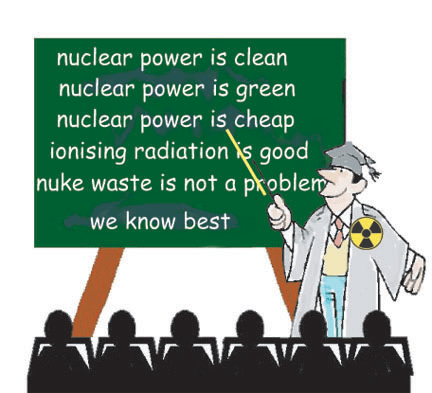
No well-trodden path for radiation literacy classes in Fukushima schools July 12, 2012 THE ASAHI SHIMBUN, by Yasuhito Watanabe and Midori Iki. Schools in Fukushima Prefecture, still reeling from last year’s nuclear disaster, find themselves in uncharted territory with a new addition to their curriculums: radiation literacy classes.
Fukushima’s prefectural board of education ordained that between one and three hours of homeroom activity, or “integrated studies,” be set aside every year for the topic from this academic year through all grades. Continue reading
Integral Fast Reactors – let the public beware of these!
 In dispraise of Integral Fast Nuclear Reactors Independent Australia, 5 July 12, Can only nuclear technocrats discuss nuclear issues — leaving the great unwashed out of the debate? Noel Wauchope considers the latest – but not necessarily the greatest – nuclear gizmo — Integral Fast Reactors. “….. It must be reassuring to the nuclear lobby to know that the great unwashed, the hoi polloi, the peasantry, have no idea about the differences between the various types of nuclear reactors now in operation — the Generation 2 and Generation 3 reactors. Let alone the new developing blueprints of Generation IV: Integral Fast Reactors, Lead Cooled Fast Reactors, Molten Salt Reactors, Sodium Cooled Fast reactors, Thorium Liquid Fuel reactors; the peasant mind boggles! And wait, like those old TV commercials – there’s more! – Generation V is now in the minds and on some bits of paper of the nuclear boffins.
Well, the nuclear priesthood is pretty safe in all this. They keep the argument narrowly technical, with pages and pages on the various technicalities of cooling systems, reprocessing of fuel systems, passive safety systems and so on; in other words, they induce in the public a kind of mindless torpor as they dazzle us with science.
At the same time, the nuclear priesthood, like some gifted but autistic child with specialist knowledge in just one area, seems to have little grasp of other issues concerning nuclear power — blinkered as they are in their apparent view that the technicalities are the whole story. This is the case with their latest propaganda for the ‘Integral Fast Reactor’ or IFR.
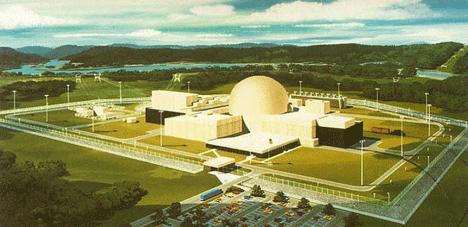
For instance, they ignore the fact that IFRs needs plutonium or enriched uranium as fuel. So, to have fast reactors, Australia would need to import these, or set up nuclear reprocessing or uranium enrichment here. This would also involve issues such as cost, politics, public opinion, issues concerning our growing renewable energy systems, radioactive waste storage — just to mention some of the more obvious of the considerable obstacles to Australia ever getting fast reactors. Nuclear lobbyists seem naively oblivious to the importance of these factors in the minds of the general public……
The Integral Fast Reactor is, after all, just another type of nuclear reactor — it runs on radioactive fuel, provides heat to make electricity and produces radioactive waste. It also uses reprocessed nuclear wastes for its fuel, therefore nuclear reprocessing plants would be needed. So far, all existing nuclear reprocessing has proved to be an expensive failure. For instance, the USA’s MOX reprocessing fuel plant is still under construction — it has cost billions of dollars, is over budget and also behind schedule. In Japan, the super expensive Monju prototype fast breeder reactor is costing 1,000 times more than conventional reactors to run………
As these fast reactors need to get the weapons grade plutonium and/or enriched uranium, these materials have to be procured from somewhere. The nuclear lobby portrays this as a benefit to the world, by using up the existing plutonium and so on. Now, I don’t know whether they say this out of naiveté or hypocrisy, but the obvious reality is that the old-fashioned Generation 3 and 4 reactors will have to be kept going – or uranium enrichment and reprocessing will have to keep going – to turn out more plutonium, which must then travel to the new IFRs. Of course, all this flies in the face of President Obama’s move to limit nuclear weapons proliferation, the New START treaty with Russia, which depends on confining the spread of uranium enrichment and weapons grade plutonium…….
there’s that final problem of the wastes.
David Biello from the Scientific American comments:
‘Ultimately, however, the core problem may be that such new reactors don’t eliminate the nuclear waste that has piled up, so much as transmute it. Even with a fleet of such fast reactors, nations would nonetheless require an ultimate home for radioactive waste, one reason that a 2010 M.I.T. report on spent nuclear fuel dismissed such fast reactors.’…..
http://www.independentaustralia.net/2012/environment/in-dispraise-of-integral-fast-nuclear-reactors/
1 This Month



26 September – International Day for the Total Elimination of Nuclear Weapons


PLEASE OPPOSE HR 8255 AND S.3639 – bills would accelerate satellite deployment, with no environmental review or safeguards – https://ncstd5li.quorum.us/campaign/169331/
To see nuclear-related stories in greater depth and intensity – go to https://nuclearinformation.wordpress.com
-
Archives
- September 2026 (245)
- August 2026 (330)
- July 2026 (355)
- June 2026 (287)
- May 2026 (306)
- April 2026 (356)
- March 2026 (251)
- February 2026 (267)
- January 2026 (308)
- December 2025 (358)
- November 2025 (359)
- October 2025 (375)
-
Categories
- 1
- 1 NUCLEAR ISSUES
- business and costs
- climate change
- culture and arts
- ENERGY
- environment
- health
- history
- indigenous issues
- Legal
- marketing of nuclear
- media
- opposition to nuclear
- PERSONAL STORIES
- politics
- politics international
- Religion and ethics
- safety
- secrets,lies and civil liberties
- spinbuster
- technology
- Uranium
- wastes
- weapons and war
- Women
- 2 WORLD
- ACTION
- AFRICA
- Atrocities
- AUSTRALIA
- Christina's notes
- Christina's themes
- culture and arts
- Events
- Fuk 2022
- Fuk 2023
- Fukushima 2017
- Fukushima 2018
- fukushima 2019
- Fukushima 2020
- Fukushima 2021
- general
- global warming
- Humour (God we need it)
- Nuclear
- RARE EARTHS
- Reference
- resources – print
- Resources -audiovicual
- Weekly Newsletter
- World
- World Nuclear
- YouTube
-
RSS
Entries RSS
Comments RSS
 nuclear-news