Global nuclear lobby has found a sucker in one State in Australia
Clearly this whole disastrous process is financially beyond the reach of little South Australia. However
Premier Jay Weatherill has been persuaded to establish a flawed royal commission to assess the viability of incorporating the entire nuclear fuel chain in the state.
South Australia has vast amounts of geothermal energy available in its northern reaches and it is perfectly suited for solar and wind power, which get cheaper by the day. With a little initiative and wise political leadership, the state could become a world leader in clean, green and sustainable energy, installing solar panels on every building and parking area, building electric solar-powered cars, constructing thousands of turbines and upgrading the grid, which would enormously increase the GDP and welfare of South Australia.
South Australia’s short-sighted view of uranium and nuclear options https://www.thesaturdaypaper.com.au/opinion/topic/2015/05/30/sas-short-sighted-view-uranium-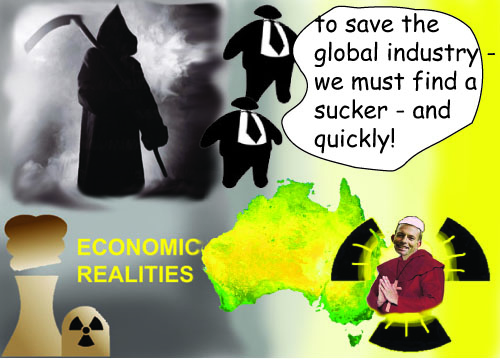 and-nuclear-options/14329080001942#.VWjSBtKqpHw Something quite extraordinary is happening in South Australia, the state that initiated the national movement against French atmospheric nuclear tests in 1971-72, and where the movement against uranium mining began in 1975, which ultimately led to a five-year ban by the ACTU on the mining, transport and export of uranium. Forty years later, it is the ultimate irony that the French nuclear industry is interested in becoming involved in South Australian uranium enrichment and nuclear reactors.
In 2010, the University College London (UCL) established its School of Energy and Resources, Australia, in Adelaide. The  school partnered with pro-nuclear and pro-shale gas corporations, including BHP Billiton and Santos. On the surface this may seem harmless enough, but the school and its well-connected backers has had a profound impact on the nuclear debate in South Australia, particularly as the state begins a royal commission into “opportunities and risks” in the “nuclear fuel cycle”.
Professor Stefaan Simons, who is the director of the International Energy Policy Institute and UCL’s BHP Billiton chairman of energy policy, has been strongly promoting construction of nuclear powered submarines in South Australia, as well as a repository in the state for radioactive “waste streams”. Dr Tim Stone, a businessman and visiting professor to the UCL’s Adelaide campus, was expert chair of the British Office for Nuclear Development and sits on the board of British energy company Horizon Nuclear Power. James Voss, the former managing director of Pangea Resources, the company that originally proposed a nuclear waste dump in Australia in the late 1990s, is also part of the UCL fold, as honorary reader at the International Energy Policy Institute.
Outside of UCL, support has come from the likes of Professor Barry Brook, former professor of climate change at the University of Adelaide, and now professor and chair of environmental sustainability at the University of Tasmania. Brook has vigorously promoted the whole nuclear fuel chain, from uranium mining and enrichment to reactors and storage of radioactive waste in the desert of South Australia. He and Tim Stone have been appointed to the Nuclear Fuel Cycle Royal Commission’s Expert Advisory Committee.
The arguments put for nuclear power are many and specious. As South Australia continues to be seduced by them, it is worth pointing out the flaws that too often go uncorrected.
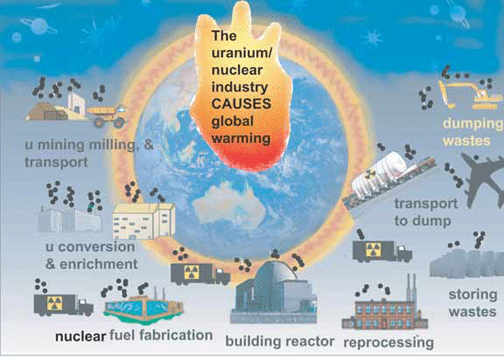 The first argument is environmental: that nuclear power is the best way to reduce greenhouse gas emissions and as such combat climate change. But this ignores the huge expulsion of greenhouse gas that goes into producing nuclear power.
The massive industrial process supporting a nuclear power plant is complex and energy intensive. It involves mining millions of tonnes of soil and ore. The uranium must then be separated, milled, enriched and converted into ceramic particles to be packed into zirconium fuel rods. Construction of the huge reactor complex adds substantially to global warming as it is largely made of concrete – a CO2-intensive product. One hundred tonnes of enriched uranium fuel rods are packed into the reactor core and submerged in water. The fission reaction boils the water, steam turns a turbine and generates electricity. Each 1000-megawatt reactor requires one million gallons of water a minute, for cooling.
 In operation, the uranium becomes one billion times more radioactive, and more than 200 new man-made radioactive elements are created. Thirty tonnes of radioactive spent fuel rods – nuclear waste – removed from the reactor core annually must be continually cooled for decades. Decommissioning of the intensely radioactive reactor occurs decades hence and long-term storage of radioactive waste for one million years must follow.
This complex process produces massive amounts of global warming gases, including CO2 and chlorofluorocarbons. Enriching uranium also requires the enormous expense of energy, as in Paducah, Kentucky, where two huge coal-fired plants provided the requisite electricity for uranium enrichment for atomic power and weapons.
As far as mitigation of global warming is concerned, the Institute for Energy and Environmental Research estimates that 2000 to 3000 reactors of 1000 megawatts each would need to be built over the next 50 years to have any impact – one a week – in order to replace half of our present oil and coal capacity as well as meeting globally escalating electricity needs.
Nonetheless, the South Australian Liberal senator Sean Edwards, a real estate agent and winemaker, has parroted the fallacious arguments about climate change mitigation in a recent interview for the Murdoch press. But he also went further.
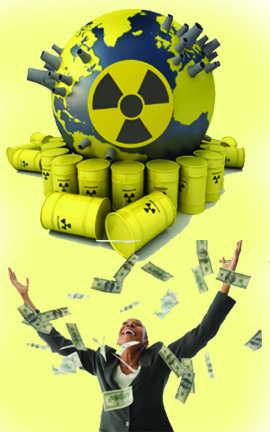 He said that South Australia could create a special economic zone, thus eliminating $4.4 billion in taxes, including payroll tax, motor vehicle taxes and the emergency services levy, if it became the world’s radioactive waste dump. He said that because international partners would pay handsomely for this service, “free power could then be provided to SA households”.
Ben Heard, an occupational therapist and PhD candidate studying nuclear power, agreed with Edwards and said this proposal was “entirely credible” and that the global market for storing radioactive waste was worth hundreds of billions of dollars. Heard argued that “the used fuel rods … can be converted into a metal form and that can go into a fast reactor that recycles the metal over and over again until all of that material has produced energy, and in that process it converts into a much shorter lived waste form”.
Heard is advocating the reprocessing of radioactive fuel. This involves dissolving intensely radioactive fuel rods in nitric acid and chemically precipitating out plutonium, which would then fuel small, modular, fast-breeder reactors.
Here, another specious argument. Reprocessing is an extremely dangerous process, exposing workers to high levels of radiation and leaving a toxic corrosive brew of more than 100 deadly radioactive elements that must then be isolated from the ecosphere for one million years, according to the US Environmental Protection Agency. It’s a scientific impossibility. The proponents argue that fissioning plutonium (the process of nuclear reaction) in a fast reactor converts it to shorter-lived radioactive elements, which reduces the amount of very long-lived waste. Plutonium’s radioactive life is 250,000 years, while that of converted elements such as cesium-137 and strontium-90 is 300 years. But they are wrong. Only 9 per cent of the plutonium successfully fissions, leaving 91 per cent of it with its extensive life, as well as producing deadly fission byproducts.
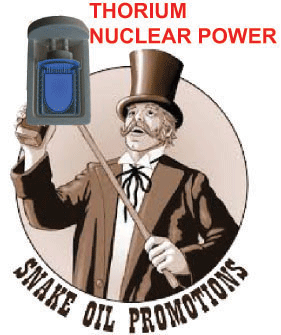 It is also argued that South Australia’s reserves of thorium could be used for electricity production, but this would require the use of enriched uranium or plutonium to make thorium fissionable. This is another vastly expensive and dangerous operation.
Next, there is the question of militarisation. Proliferation of nuclear power and weapons is intrinsically linked. Fast reactors make access to plutonium readily available to use as fuel for nuclear weapons for the next 250,000 years. Fast reactors also use liquid sodium as a coolant, which explodes or burns if exposed to air, should a cooling pipe crack or leak. Five kilograms of plutonium is critical mass – the amount necessary for a sustained chain reaction – and with tonnes of plutonium in the reactor core, a loss of coolant could induce a huge nuclear explosion scattering deadly plutonium. Moreover, fast reactors are hugely expensive and have never been produced on a commercial scale.
There are, as mentioned, supporters of the South Australian waste dump proposal. No doubt, countries with some of the 350,000 tonnes of spent fuel in the world would be thrilled with such a scheme. The dump would be constructed on Aboriginal land, near and likely above the Great Artesian Basin. The extremely dangerous elements in this waste include plutonium-239, existing for 250,000 years and so toxic that one-millionth of a gram is carcinogenic. There would also be americium-241, even more deadly than plutonium, as well as strontium-90 and cesium-137, lasting 300 years. Radioactive elements that concentrate in the food chain are odourless, invisible and tasteless. They induce varieties of cancer, including lung, liver, bone, testicular, breast, muscle and brain. They can cause severe congenital deformities and their presence increases the incidence of inherited genetic diseases, including cystic fibrosis, diabetes, haemochromatosis and dwarfism.
The South Australian population would be likely to experience epidemics of cancer, leukaemia, congenital anomalies and genetic diseases through future generations as the waste inevitably leaked.
 The entire nuclear fuel chain in all countries with nuclear power, including its accident insurance, is heavily subsidised by government. Wall Street will not invest in nuclear power, so in essence it is a socialised industry paid for by the taxpayers. Construction of 1000-megawatt nuclear reactors in the US now costs upwards of $US12 billion. Many of the nuclear power plants in Britain, Europe, Japan, Canada and the US are reaching the end of their productive lives. But because the private utility companies that run the reactors make over 1 million dollars a day selling electricity, they are persuading governments to allow these dilapidated and dangerous reactors to operate for another 20 years. Continue reading
Exploding the nuclear lobby’s hype about all those “planned projects”
All the time that a nuclear plant is getting built someone is footing the bill on the materials that are not generating revenue, it’s usually the state that is building the project. It also inevitably becomes an open cheque book, whereas in solar the project is totally underwritten by the supplier (in the terms of small domestic and medium to large commercial rooftop) and the technology is generating, earning a return (as a feed-in tariff and/or self consumption) before it is even paid for.
What if we all adopted the nuclear industry’s interpretation of a ‘planned’ project?MATTHEW WRIGHT , HTTP://WWW.BUSINESSSPECTATOR.COM.AU/ARTICLE/2015/5/27/RENEWABLE-ENERGY/WHAT-IF-WE-ALL-ADOPTED-NUCLEAR-INDUSTRYS-INTERPRETATION-PLANNED
 If you search the definitive list of reactors on Wikipedia, you’ll find that reactors are being decommissioned globally at a rate of knots, and many more are set to be decommissioned in the not too distant future. This includes the entire fleet in Germany and a significant portion but unspecified number of reactors in Japan.
If you looked further, you’d find that you could count the total number of reactors built in 2014 and 2015 on just one hand. In that period there was activity predominately in China — with its centralised state control avoiding the scrutiny the technology gets everywhere, outside a lone reactor in Argentina being the exception — but you could hardly get excited as that project was started when first of the Generation Ys were still in nappies in 1981.
So you’ve got a few plants getting built at a much slower pace than planned in China, and a bunch of plants ‘planned’ all over the place. But as is the case with almost all nuclear plans in the last 25 years, they’ve gone nowhere. They are plans (if a dream is a plan), but are not likely to be plants.
So why do we hear about these so called plans over and over?
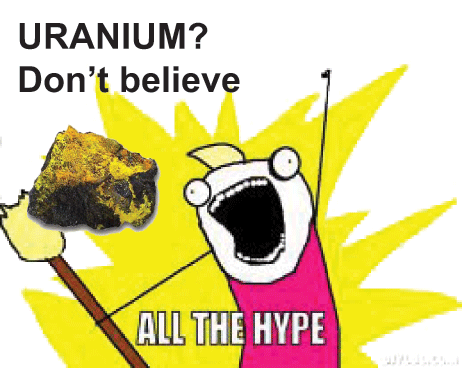 The answer is the stockmarket: the uranium juniors and the speculative stocks. Get rich quick by backing a speculative exploration license holder, or someone who’s got as far as doing a desktop of some geology somewhere on earth.
It’s these guys who really need the uranium story to continue. Without it they don’t exist; all those pieces of paper that were going to create multi-millionaires are worth nothing. The trick here for them is to keep everyone believing that nuclear and hence the appetite for uranium is rocketing on.
That’s why there are so may projects being ‘planned’ or ‘under construction’ but nothing substantial ever getting built and delivered.
Let’s compare that to renewables.
If we had a list of renewable projects that were planned and under construction, it would look like the renewable sector was 1000 per cent of what it actually is. That’s because there are a lot of planned wind farms and even more solar farms. Continue reading
Paris Climate Talks will be the focus of the global nuclear lobby’s strategy

Christina Macpherson’s websites & blogs
The global nuclear lobby is getting a bit desperate, especially with nuclear’s ever-escalating costs and delays, and renewable energy’s rapidly declining costs, and speed of set-up.
This extract from an investment advisor shows us just what strategy the nuclear lobby is now adopting – a hypocritical story about nuclear power being “renewable” “clean” and the “answer to climate change”
Uranium’s Glow Still Smothered by Safety Concerns Wall Street Daily, Fri, May 15, 2015 | Shelley Goldberg, Commodity Strategist
“……..If you’re in the uranium market, it’s best to be short and nimble.
 The first thing to do is stay focused on the United Nations Climate talks later this year in Paris.While France will likely insist that nuclear reactors are the preferred, low-carbon source, the more important issue is whether or not they can demonstrate that modern nuclear power plants can be built on time, on budget, and convincingly address the issue of radioactive waste. As it stands now, the deck is stacked against them….
This is a tug-of-war between fossil fuels and clean energy. If clean proves to be a winner, it’ll then be a battle between the more traditional solar and wind power and nuclear……“http://www.wallstreetdaily.com/2015/05/15/uranium-commodity-concerns/
MY COMMENT on that strategy
All very well – except that nuclear energy is NOT clean.
For one thing – the total nuclear chain from uranium mining to the burial of dead reactors – emits large amounts of CO2 – and that’s without mentioning all the transport involved.
For another thing – while coal and other mining do emit radioactive isotopes, no industry other than nuclear produces virtually eternal highly carcinogenic radioactive wastes.
No other industry runs the risk, however small, of catastrophic accidents that make large areas of land unlivable for decades.
It’s not merely a joke to call nuclear energy “clean’. It’s a lie
Massive governmental and media effort to cover up the truth about Fukushima
 Study: Conspiracy of Fukushima Cover up Between Government and Media Proven, Your News Wire, 14 Apr 15 by Royce Christyn A groundbreaking study by American University sociology Prof. Celine Marie Pascale has proven there is a continuing and massive effort by varying world governments and major mainstream media outlets to cover up the horrifying truth of Fukushima.
According to the press release made public by the University and Pascale, the media and government (regarding the Fukushima cover up) “largely minimized health risks to the general population”.
Natural News reports: Just how bad was the radiation fallout from the near-complete destruction of three nuclear reactors at the Fukushima power station following a massive earthquake-generated tsunami in March 2011? The answer is, most people simply don’t know – because the media coverage of the damage and fallout, at the time of the accident and in the four years since, has been grossly inadequate, according to a new study –
As noted by American University sociology Prof. Celine Marie Pascale, there has especially been a dearth of U.S. media coverage, the disaster long disappearing from the headlines of domestic newspapers and cable news networks, despite the fact that the crippled plant dumps three hundred tons of radioactive water into the ocean daily, and the region surrounding the plant remains uninhabitable – probably forever.
Further, her new analysis found that U.S. news media coverage of Fukushima “largely minimized health risks to the general population,” says a press release from the university.
The release further states:
Pascale analyzed more than 2,000 news articles from four major U.S. outlets following the disaster’s occurrence March 11, 2011 through the second anniversary on March 11, 2013. Only 6 percent of the coverage – 129 articles – focused on health risks to the public in Japan or elsewhere. Human risks were framed, instead, in terms of workers in the disabled nuclear plant.
‘Articles discuss instead how dangerous cosmic radiation is’
“It’s shocking to see how few articles discussed risk to the general population, and when they did, they typically characterized risk as low,” said Pascale, who studies the social construction of risk and meanings of risk in the current century.
“We see articles in prestigious news outlets claiming that radioactivity from cosmic rays and rocks is more dangerous than the radiation emanating from the collapsing Fukushima Daiichi nuclear plant,” she added.
The sociology prof examined news articles, editorials and letters from two major U.S. papers – The New York Times and The Washington Post – and two additional, prominent online news sites – Politico and The Huffington Post. The four outlets are not only among the largest, most influential in the U.S., they are also the most-cited by television news and talk shows, as well as other newspapers and blogs. Also, they are talked up in social media often, says Pascale. So, in that sense, she says, seeing how risk is presented in national prominent media can provide data on how the issue is framed nationally, in public conversations.
The press release further discussed Pascale’s analytical method and variables: – See more at: http://yournewswire.com/study-conspiracy-of-fukushima-cover-up-between-government-and-media-proven/#sthash.08pZB0ka.dpuf
Agressive pro nuclear propaganda in Turkey (a taste of what’s to come, globally?)
 Nuclear energy: An unpopular product on sale http://www.todayszaman.com/columnist/joost-lagendijk/nuclear-energy-an-unpopular-product-on-sale_377657.html JOOST LAGENDIJK J.lagendijk@todayszaman.com szaman.co
I first noticed the advertisements on a tram I boarded in İstanbul last week. Later I saw huge billboards along major roads and a TV commercial trying to promote the same product: nuclear energy. For one moment I hesitated: Did I miss something and was Turkey already able to provide electricity from nuclear reactors? A quick check taught me it wasn’t at all far: Turkey’s first nuclear power plant, at Akkuyu, near Mersin, is still in the first phase of construction and will most probably only start producing electricity in 2023. So why then spend so much money on marketing a product that is not for sale in the foreseeable future?
For decades Turkey has tried to acquire its own nuclear power plants. For all kind of political and financial reasons, Ankara never managed to strike a deal with a foreign company to build one until in 2010 the Russian state-owned nuclear energy company Rosatom came up with an offer that Turkey could not refuse. The Russians will build, own and operate the $20-billion Akkuyu nuclear power plant while the Turkish state will guarantee the purchase of most of the electricity produced there against a fixed price. Three years later, in 2013, Turkey signed a second deal with a Japanese/French consortium that will build and operate another nuclear plant in Sinop but that will only start delivering after 2023. For the moment, all attention is focused on Akkuyu.
You can be sure last week’s publicity offensive is only the first phase of a long campaign to convince the Turkish population of the benefits of nuclear energy. The Turkish government knows very well that for now, most Turks are either opposed to nuclear energy or at the very least very skeptical about the presumptive advantages. Nuclear energy is an unpopular product that will need massive marketing to get it accepted by the time it becomes available.
In the months and years to come we will witness a very professional public relations campaign with only one aim: To try to take away the doubts about nuclear energy and highlight the positives. The arguments in favor will be a combination of the general ones always promoted by the nuclear industry and some specific Turkish ones. Belonging to the first category are the following catchwords: Improved safety, low costs, cleaner than coal, major contribution to fighting climate change. On top of that will come several presumed national bonuses: It will decrease Turkey’s energy dependency and current account deficit and will increase the country’s status and prestige.
All these justifications will be challenged by a motley collection of environmentalists, academics and local activists from Akkuyu and Sinop who don’t want their towns to be the places where this controversial experiment is located.
All these justifications will be challenged by a motley collection of environmentalists, academics and local activists from Akkuyu and Sinop who don’t want their towns to be the places where this controversial experiment is located.
The arguments against nuclear power are well-known as well: The unresolved waste issue, the lethal impact of possible accidents, the brighter future of renewable alternatives such as sun and wind power, and, in the case of Turkey, the danger of earthquakes and the growing dependency on Russia.
In a timely, recently published book on Turkey’s nuclear future, edited by George Perkovich and Sinan Ülgen, another potential risk is stressed and that is the need for an independent regulatory nuclear agency that will give Turks and the international community confidence that safety will be an overriding imperative. Whether or not such an agency can be effective and, if need be, go against the government, depends according to the authors on the evolution of the Turkish state. Will independent institutions still be allowed to operate freely in a country where power is increasingly concentrated in a de facto presidential system with few checks and balances left intact?
These and all the classical questions on nuclear energy will hopefully be part of the debate we should have in Turkey in the upcoming years. My advice: Be critical of the slick and polished pro-nuclear advertising campaigns that will be launched to prepare the ground. Take your time to listen to the arguments of the opponents who, I admit, convinced me some time ago that going nuclear is an old-fashioned, 20th-century solution at a time when better, safer and cheaper alternatives are available.
Muzzling scientists: UK follows Canada’s lead

 Following Canada’s Bad Example, Now UK Wants To Muzzle Scientists And Their Inconvenient Truths https://www.techdirt.com/articles/20150331/06512830496/following-canadas-
bad-example-now-uk-wants-to-muzzle-scientists-their-inconvenient-truths.shtml from the non-appliance-of-science dept Free Speech by Glyn MoodyWed, Apr 1st 2015
Under the new code, scientists and engineers employed at government expense must get ministerial approval before they can talk to the media about any of their research, whether it involves GM crops, flu vaccines, the impact of pesticides on bees, or the famously obscure Higgs boson.
The fear — quite naturally — is that ministers could take days before replying to requests, by which time news outlets will probably have lost interest. As a result of this change, science organizations have sent a letter to the UK government, expressing their “deep concern” about the code. A well-known British neurobiologist, Sir Colin Blakemore, told the Guardian:
“The real losers here are the public and the government. The public lose access to what they consider to be an important source of scientific evidence, and the government loses the trust of the public,” Blakemore said.
Not only that, by following Canada’s example, the British government also makes it more likely that other countries will do the same, which will weaken science’s ability to participate in policy discussions around the world — just when we need to hear its voice most.
Follow me @glynmoody on Twitter or identi.ca, and +glynmoody on Google+
USA’s Nuclear Regulatory Commission gambles with safety, using legalistic jargon
 US NRC Playing Brazen Legalese Games with Safety (Reactor Pressure Vessel Embrittlement) at Palisades Nuclear Power Station and Elsewhere, Mining Awareness, 9 Apr 15 In the April 18, 2013 US NRC “Summary of the March 19, 2013 Public Meeting Webinar Regarding Palisades Nuclear Plant” one finds brazen legalese statements by the US NRC in order to defend one of Entergy’s aging reactors, Palisades (Note that the NRC also had lawyer(s) working on the corporate side pushing the judge to ignore current concerns at Davis Besse Nuclear Power Station too. Davis Besse and Palisades endanger the largest surface fresh water system on earth.) The NRC inadvertently points out that, most likely, no US nuclear reactor has the more resistant materials required for safety starting in 1977.
Someone asked the NRC:
“Which are the other most embrittled plants in the U.S.? How many PWRs will reach their screening criteria in the next 10 years?”
The NRC responded:
“The NRC currently estimates that the following plants will exceed the PTS screening criteria of 10 CFR 50.61 during their 20-year period of operation beyond their original 40 year licenses. Updated fluence calculations, capacity factors changes, power uprate, new surveillance data, and improved material property information (i.e., the use of direct rather than correlative measurements of the vessel material’s resistance to fracture) can change these estimates…
1. Point Beach 2 (2017)
2. Palisades (2017)
3. Diablo Canyon 1 (2033)
4. Indian Point 3 (2025)
5. Beaver Valley 1 (2033)”
http://pbadupws.nrc.gov/docs/ML1310/ML13108A336.pdf
(It’s not clear if these years are the license expiration dates, or when they are estimated as in most danger of reactor pressure vessel fractures, minus uprates etc, which increase stress and put them at risk more quickly. PTS is Pressurized Thermal Shock. Point Beach is also on the Great Lakes (Lake Michigan, as is Palisades)
According to the NRC, Entergy-Palisades didn’t violate standards because there weren’t any! “Palisades did not violate the NRC’s PTS safety standards in 1981 since the NRC did not have any regulations pertaining to PTS until June 26, 1984.”
The NRC inadvertently explains that US Reactors are not up to even 1977 standards:
“For new plants, the reactor vessel beltline materials should have the content of residual elements such as copper, phosphorus, sulfur, and vanadium controlled to low levels. The levels should be such that the predicted adjusted reference temperature at the ¼ T position in the vessel wall at end of life is less than 200 °F. [These] recommendations … will be issued in evaluating construction permits docketed on or after June 1, 1977.”http://pbadupws.nrc.gov/docs/ML1310/ML13108A336.pdf
“There has been no ground-breaking on new nuclear plants in the United States since 1974. Up until 2013, there had also been no ground-breaking on new nuclear reactors at existing power plants since 1977.”http://en.wikipedia.org/wiki/Nuclear_power_in_the_United_States
Since permitting would normally come before ground-breaking this appears to mean that no nuclear reactors currently in operation are up to the 1977 standards for prevention of embrittlement. 1977 was 37-38 years ago. Jimmy Carter was President and the Cold War was far from over. Apple home computers weighed 11.5 pounds excluding the screen, which probably weighed almost as much. Apple Ipad air weighs less than one pound.
The NRC further states:
“In conclusion, there was no violation of NRC requirements concerning PTS at Palisades. Had Palisades ever violated PTS requirements the NRC would have shut down the plant.
Regulatory Guides do not contain requirements, only recommendations.”http://pbadupws.nrc.gov/docs/ML1310/ML13108A336.pdf
So, since the “Regulatory Guides only contain recommendations”, anything goes? What’s the NRC for then? Making the US tax-payer pay for lawyers and staff to protect the interests of the nuclear power industry? Safety doesn’t matter? Regulations are supposed to be laws. Aren’t they?
Where did concern about the US budget go anyway? A good place to start cuts is the US NRC, which has long been called an instance of regulatory capture. ……..https://miningawareness.wordpress.com/2015/04/09/us-nrc-playing-brazen-legalese-games-with-safety-reactor-pressure-vessel-embrittlement-at-palisades-nuclear-power-station-and-elsewhere/
The Nuclear Power Agenda to block climate action, stop renewable energy, and subsidize old reactors.
Nuclear Economics Nuclear Information and Resource Service….…….September 11, 2014. Killing the Competition. The Nuclear Power Agenda to block climate action, stop renewable energy, and subsidize old reactors. Major new report by NIRS’ Executive Director Tim Judson details how major utilities and nuclear power companies have begun a campaign to rig energy markets, climate regulations, and clean energy programs to prevent the advance of renewable energy.
 Using a deceptive public relations campaign and heavily-funded front groups like Nuclear Matters, Third Way, and C2ES, corporations including Exelon and Entergy have tried to drum up fears of a national energy crisis stemming from the closure of several aging, uncompetitive nuclear plants and the advance of renewable energy. While touting the need to “preserve” nuclear power, nuclear interests have covered up the actual reforms they are seeking and their implications for the U.S.’s energy future.
Audio recording (mp3 file) of press conference release of the report featuring Tim Judson, Dr. Mark Cooper, Vermont Law School, Institute for Energy and the Environment; Tyson Slocum, energy program director, Public Citizen; Deb Katz, executive director, Citizens Awareness Network (New England); David Kraft, executive director, Nuclear Energy Information Service (Illinois); Jessica Azulay, program director, Alliance for a Green Economy (New York).”…..http://www.nirs.org/neconomics/neconomicshome.htm
Nuclear lobby claims to be clean and green , wants government money
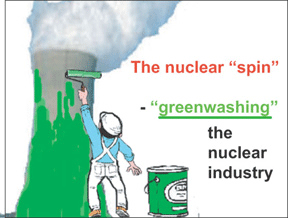 Nation’s biggest nuclear firm makes a play for green money, Herald News By RAY HENRY –Saturday, March 28, 2015 1 The Associated Press The biggest player in the beleaguered nuclear power industry wants a place alongside solar, wind and hydroelectric power collecting extra money for producing carbon-free electricity.
Chicago-based Exelon essentially wants to change the rules of the state’s power market as the nuclear industry competes with historically low prices for natural gas. Dominion Resources Inc. recently closed the Kewaunee Power Station in Wisconsin for financial reasons, and Entergy Corp. likewise shuttered its Vermont Yankee plant.
Plans for a new wave of U.S. nuclear plants have been delayed or canceled, aside from three projects deep into construction at Plant Vogtle south of Augusta, Georgia; V.C. Summer Nuclear Station north of Columbia, South Carolina; and Watts Bar Nuclear Plant in eastern Tennessee. Electric utilities in those states do not face competition…….
Though it wants financial assistance, Exelon will not release detailed information about the cost of running the three Illinois plants in Quad Cities, Byron and Clinton that company officials say are most at-risk. An analysis by state agencies estimated the cost of producing power at those plants may exceed the payments they get, though they could not be certain.
Exelon and other around-the-clock plants sometimes take losses when wind turbines produce too much electricity for the system.
Exelon remained profitable overall, making $1.6 billion last year.
“If the question is, ‘Are they under economic threat?’ I don’t think there’s any question they are,” said Paul Patterson, a utility analyst for Glenrock Associates LLC, who referred to nuclear plant closures elsewhere as evidence. “Will they shut down? I think it depends at what plant you’re looking at.”
The Illinois proposal would reward nuclear plants. Under the system, electric suppliers would have to buy credits from carbon-free energy producers. Exelon says the plan would benefit nuclear plants, hydroelectric dams, and other solar and wind projects. http://www.theherald-news.com/2015/03/29/nations-biggest-nuclear-firm-makes-a-play-for-green-money/axrimv5/
Pattern of denial by nuclear industry set off after the Three Mile Island accident
 Three Mile Island: Writing the Nuclear Meltdown Playbook, Fairewinds By Arnie Gundersen,March 25th, 2015
People today who are familiar with social media think that TMI means “Too Much Information”. But to me, and anyone listening to the news in 1979, TMI will always represent the disaster at Three Mile Island, when the public received too little information, not too much.
At the time of the nuclear disaster at TMI, there were plans to build more than 200 nuclear plants in the US, with some projections topping 1,000. Today, less than 100 nuclear plants are operating in the US. During the 1970’s, the total amount invested in those early plants easily exceeded one trillion dollars. If the public became fearful of nuclear power, then the nuclear industry, investors, and banks that had loaned money would face huge losses, so the nuclear industry and nuclear regulators tried desperately to minimize the significance of what was happening at the crippled reactor.
The pattern of denial created by the nuclear industry during the TMI meltdown had at least five steps in its playbook:
- Make it appear that “authorities” have the situation under control.
- Delay any evacuation orders for as long as possible.
- Claim radiation releases are much lower than they actually are.
- Claim radiation exposures are acceptable and that no one will die.
- And lastly, minimize conflicting information given to the press through paid off experts.
The formula for damage control at TMI was designed by the nuclear industry composed a one size fits all “playbook” the industry has followed for all nuclear catastrophes since TMI. Comments made during the triple meltdown at Fukushima Daiichi by utility owner Tokyo Electric could easily mimic those made at Chernobyl and TMI! When Maggie and I saw these old tricks being played again at Fukushima Daiichi, we dedicated ourselves to ensuring that the public has an accessible resource on which to rely that provides accurate information, and thus the Fairewinds videos were born.
In this video posted to commemorate the TMI disaster, I discuss the pattern of denial regarding nuclear power plant failures and meltdowns, not just for TMI but also for Chernobyl and Fukushima Daiichi as well. We at Fairewinds Energy Education hope you will watch it and think about sharing the true facts with others. http://www.fairewinds.org/three-mile-island/#sthash.InUCa9Be.dpuf
Nuclear Regulatory Commission trickery on radiation rules favours the nuclear industry, not the public interest
The NRC needs to recall that its name is the Nuclear Regulatory Agency and so its job is to regulate the industry, rather than to work for the nuclear industry. Its job is to help the EPA keep a high safety standard for water, air, soil. They both appear to have forgotten or be oblivious to their purpose, which is to protect the people and environment from radionuclides from the nuclear industry.
Nuclear Facilities also are allowed to emit so many radionuclides, that it takes 50 pages to list them, including plutonium 239 to the air, along with the water. But, like the water, to talk about concentrations in the air – as opposed to amounts – is really meaningless for anything but the shortest-lived radionuclides.
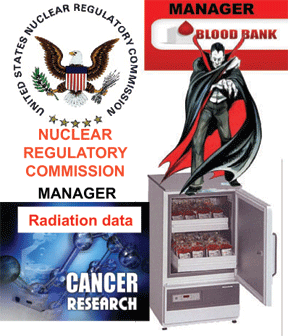
US NRC Radioactive Dilute and Deceive Scam – Comment Deadline June 22nd (Extended) Mining Awareness Plus, 18 Mar 15 US NRC Comment Deadline extended to 22 June 2015:https://www.federalregister.gov/articles/2014/11/20/2014-27519/radiation-protection http://www.regulations.gov/#!documentDetail;D=NRC-2009-0279-0098 “………..The disgusting truth is that research on ionizing radiation has been ongoing since 1895. At the beginning of the nuclear age, focus was on how dangerous radiation was. Many animal and even human experiments have been done. The human experiments were both official experiments and unofficial making the population at large act as guinea pigs. They have known from the beginning the dangers. Somewhere along the way they seem to have switched from doing experiments to see how dangerous it was to doing endless experiments in an attempt at proving that it is safe. Despite their efforts to prove the contrary, they have only succeeded in proving that ionizing radiation is even more dangerous than their early results showed. As the National Academy of Science has stated endlessly in their BEIR reports, there is no safe dose of ionizing radiation. Increased dose is increased risk. This is even more true for high-LET internal alpha radiation and high LET neutrons.
The US EPA has a “clean water” water “standard” for drinking water, though it has none for water emissions from nuclear facilities – which makes no sense. Who, if anyone, pays to clean up the difference between radionuclides emitted by nuclear facilities and that allowed in drinking water?
Furthermore, the “Clean Water” drinking water standard appears to be inadequately protective, as well. It allows 740 Bq/liter of tritium in drinking water. The Canadian nuclear lobby was reportedly satisfied with a 20 Bq/liter standard for tritium in drinking water, recommended by the Ontario Water Advisory Commission (OWAC), even though Canadian CANDU reactors produce more tritium than other reactors. OWAC started with the idea that “the target derived risk level should be 1 in a million or 10-6 (meaning 1 new excess cancer occurrence over existing background cancer rates in 1,000,000 people); the target derived risk level should be over a lifetime of exposure of 70 years, and based on cancer incidences above background (occurrences) rather than mortality (deaths);” This led to models ranging from 7 Bq/L to 109 Bq/L.http://www.odwac.gov.on.ca/reports/052109_ODWAC_Tritium_Report.pdfhttp://www.odwac.gov.on.ca/reports/052109_Tritium_Report_Cover_Letter.pdf
Notice the number was chosen based on cancer morbidity (illness), not just mortality (death). (Unfortunately, if there are cooling towers they could send the balance of tritium out into the air.) Contrary to what TEPCO, AREVA, and EnergySolutions want everyone to believe, there are several ways to filter tritium………
Yes, they need water standards but they need real standards and strict standards, which account for all radionuclides emitted in air and water and per facility. The actual quantities of the radionuclides must be measured and not the concentration! Continue reading
The industry of “doubt” promoted against climate science
 Doubt over climate science is a product with an industry behind it With its roots in the tobacco industry, climate science denial talking points can be seen as manufactured doubt Guardian, Graham Readfearn 5 Mar 15 It’s a product that you can find in newspaper columns and TV talk shows and in conversations over drinks, at barbecues, in taxi rides and in political speeches.
You can find this product in bookstores, on sponsored speaking tours, in the letters pages of local newspapers and even at United Nations climate change talks.
This product is doubt – doubt about the causes and impacts of climate change, the impartiality of climate scientists, the world’s temperature records, the height of the oceans and basic atmospheric physics. Continue reading
Examining 3 shaky arguments for nuclear energy
 Nuclear Energy Is Dirty, Unsafe And Uneconomic: Environmental Scientist https://newmatilda.com/2015/02/21/nuclear-energy-dirty-unsafe-and-uneconomic-environmental-scientist by Dr Dr Mark Diesendorf , Associate Professor and Deputy Director within the Institute of Environmental Studies at the University of NSW………there seem to be three shaky legs upon which proponents attempt to stand their campaign to expand nuclear energy:
1. Nuclear energy has allegedly no or low greenhouse gas emissions.
2. New nuclear reactor technologies are allegedly safer than the present generation of reactors.
3. New and existing reactors are allegedly cheaper than other low-carbon technologies, notably renewable energy.
Let’s examine these claims.
1. Green House Gas emissions
Neither nuclear energy nor most renewable technologies emit carbon dioxide during operation. However, to do a meaningful comparison, we must compare the whole life-cycles from mining the raw materials to managing the wastes. In a peer-reviewed journal paper published in 2008, nuclear physicist and nuclear energy supporter Manfred Lenzen compared life-cycle emissions from nuclear, wind and natural gas power stations.
For nuclear energy based on mining high-grade uranium ore, he found average emissions of 60 grams of carbon dioxide per kilowatt-hour (g/kWh) of electricity generation, for wind 10–20 g/kWh and for gas 500–600 g/kWh. Now comes the part that most nuclear proponents try to ignore or misrepresent.
The world has only a few decades of high-grade uranium ore reserves left. As the ore-grade inevitably declines, the fossil fuel used to mine and mill uranium increases and so do the resulting greenhouse gas emissions.
Lenzen calculates the life-cycle greenhouse gas emissions when low-grade uranium ore is used to be 131 g/kWh. This is unacceptable in terms of climate science, especially taking into account that Lenzen’s analysis favoured nuclear energy by assuming that mountains of radioactive uranium mine waste are left to blow in the wind for thousands of years.
2. New reactor technologies Continue reading
Vulture Capitalist Paul Singer funds climate denialism
Bjorn Lomborg Think Tank Funder Revealed As Billionaire Republican ‘Vulture Capitalist’ Paul Singer DESMOGBLOG, GRAHAM READFEARN, 9 FEB 15, A billionaire “vulture capitalist” and major backer of the US Republican Party is a major funder of the think tank of Danish climate science contrarian and fossil fuels advocateBjørn Lomborg, DeSmogBlog has found.
New York-based hedge fund manager Paul Singer’s charitable foundation gave $200,000 to Lomborg’s Copenhagen Consensus Center (CCC) in 2013, latest US tax disclosures reveal.
The grant to Lomborg’s think tank is revealed in the tax form of the Paul E. Singer Foundation covering that foundation’s activities between December 2012 and November 2013.
Singer, described as a “passionate defender of the 1%”, has emerged as a major force in the Republican party in recent years and was a key backer and influencer during Mitt Romney’s failed tilt at the Presidency.
The $200,000 grant represented almost one third of the $621,057 in donations declared by the Copenhagen Consensus Center in 2013……..
Lomborg, a Danish political scientist, is often cited on lists of the world’s most influential people.
He writes extensively on climate change and energy issues with his columns appearing in many of the world’s biggest news outlets.
The CCC think tank produces reports that consistently argue that cutting greenhouse gas emissions and increasing the roll-out of current renewable energy technologies should be low priorities for policy makers.
Most recently, Lomborg wrote a column for the Wall Street Journal arguing climate change was not the urgent problem that many thought.
He wrote that “the narrative that the world’s climate is changing from bad to worse is unhelpful alarmism”.
Lomborg argues the poorest countries need fossil fuels to lift themselves out of poverty – a position that gained support from the world’s richest man, Bill Gates.
At a G20 side event in Brisbane last year, Lomborg appeared at an event sponsored by the world’s largest private coal company, Peabody Energy, where he again argued that the world’s poor needed fossil fuels.
The CCC’s keystone project is the Post 2015 Consensus that is trying to influence the formulation of the next set of global development goals being discussed by the United Nations. Those goals will replace the millennium development goals.
Lomborg’s CCC think tank was registered as a not-for-profit in the US in 2008 and has attracted almost $5 million in donations since then. In 2013, the CCCpaid Lomborg, its founder and president, $200,484 for his work. The previous year Lomborg was paid $775,000……
he discovery of support from Paul Singer comes after a DeSmogBlog investigation last year found that CCC’s early funders included conservative think tanks with links to the network of organisations funded by the Koch brothers, who have pushed millions into organisations denying climate science and blocking action to cut fossil fuel emissions.
In the 2014 US political spending cycle, data presented by OpenSecrets shows Singer spent $9.4 million influencing Republicans – the biggest disclosed individual spender on the conservative side of US politics.
Singer, whose Elliott Management hedge fund manages about $25 billion in assets, has been branded a “vulture capitalist” enterprise due to investment strategies employed by his firm that targets foreign economies in trouble……
As well as the generosity shown to Bjorn Lomborg’s think tank, Singer’s foundation gave $500,000 to the Manhattan Institute for Policy Research, where Singer is chairman of the board of trustees.
The Manhattan Institute is also known for downplaying the impacts of climate change while promoting fossil fuels.
In October 2014, Manhattan senior fellow Robert Bryce wrote a report Not Beyond Coal arguing that the future for the coal industry was bright and the fossil fuel was “essential” for addressing poverty in developing countries — a position identical to that pushed by Lomborg.
Bryce also attacks the wind industry claiming it cannot cut emissions, describing wind turbines as “climate change scarecrows”. In testimony to theUS Senate Environment and Public Works Committee in February 2014, Bryce said wind turbines were “slaughtering wildlife” ………http://www.desmogblog.com/2015/02/09/exclusive-bjorn-lomborg-think-tank-funder-revealed-billionaire-republican-vulture-capitalist-paul-singer
Climate Crocks exposes paid climate denialist “Big Green Radicals’
— Climate Denial Crock of the Week, Climate Crocks, with Peter Sinclair Thanks Dr. Evil! Fossil Fuel Propaganda Misfire Goes Viral
February 12, 2015 Every once in a while we can pull back the curtain and get a good look at the evil elves and Madison Avenue Orcs deployed by the fossil fuel barons. Look hard, climate deniers. This is the man pulling your strings.
Posted by a front group called the “Environmental Policy Alliance”, this corporate forged “viral” video popped up a couple days ago. Had to check and make sure this wasn’t a joke, but it’s real. …..
Big Green Radicals is a front group operated by the PR firm Berman & Co. Berman & Co. operates a network of dozens of front groups, attack-dog web sites, and alleged think tanks that work to counteract minimum wage campaigns, keep wages low for restaurant workers, and to block legislation on food safety, secondhand cigarette smoke, drunk driving, and more.
Big Green Radicals describes itself as “a project of the Environmental Policy Alliance (EPA), which exists to educate the public about the real agenda of well-funded environmental activist groups” according its website. “The EPA receives support from individuals, businesses, and foundations.”
Richard Berman is the type of corporate hit man that Aaron Eckhart played in “Thank You For Smoking” – amoral, vicious, and dishonest. PR guys like him usually don’t make the headlines, preferring to remain the man behind the curtain – but a few months ago he showed up in the New York Times, because recommendations he made in a presentation were so vile and offensive that even members of the oil industry audience were disgusted.
If the oil and gas industry wants to prevent its opponents from slowing its efforts to drill in more places, it must be prepared to employ tactics like digging up embarrassing tidbits about environmentalists and liberal celebrities, a veteran Washington political consultant told a room full of industry executives in a speech that was secretly recorded.
The blunt advice from the consultant, Richard Berman, the founder and chief executive of the Washington-based Berman & Company consulting firm, came as Mr. Berman solicited up to $3 million from oil and gas industry executives to finance an advertising and public relations campaign called Big Green Radicals.
The company executives, Mr. Berman said in his speech, must be willing to exploit emotions like fear, greed and anger and turn them against the environmental groups. And major corporations secretly financing such a campaign should not worry about offending the general public because “you can either win ugly or lose pretty,” he said.
“Think of this as an endless war,” Mr. Berman told the crowd at the June event in Colorado Springs, sponsored by the Western Energy Alliance, a group whose members include Devon Energy, Halliburton and Anadarko Petroleum, which specialize in extracting oil and gas through hydraulic fracturing, also known as fracking. “And you have to budget for it.”
What Mr. Berman did not know — and what could now complicate his task of marginalizing environmental groups that want to impose limits on fracking — is that one of the energy industry executives recorded his remarks and was offended by them.
“That you have to play dirty to win,” said the executive, who provided a copy of the recording and the meeting agenda to The New York Times under the condition that his identity not be revealed. “It just left a bad taste in my mouth.”
Pdf of Berman’s presentation here.
Speaking of bad taste, “60 Minutes” profiled Berman as an attack dog for the purveyors of poisonous junk food, and he was proud enough of that to post it on his own Youtube channel,
Berman was paid well by Philip Morris (PM)…. has worked for companies that privatize the profits and socialize the costs. He attacked fine scientists like Steve Schneider (Stanford) and Stan Glantz (UCSF)……….
http://climatecrocks.com/2015/02/12/thanks-dr-evil-fossil-fuel-propaganda-misfire-goes-viral/
1 This Month



26 September – International Day for the Total Elimination of Nuclear Weapons


PLEASE OPPOSE HR 8255 AND S.3639 – bills would accelerate satellite deployment, with no environmental review or safeguards – https://ncstd5li.quorum.us/campaign/169331/
To see nuclear-related stories in greater depth and intensity – go to https://nuclearinformation.wordpress.com
-
Archives
- September 2026 (233)
- August 2026 (330)
- July 2026 (355)
- June 2026 (287)
- May 2026 (306)
- April 2026 (356)
- March 2026 (251)
- February 2026 (267)
- January 2026 (308)
- December 2025 (358)
- November 2025 (359)
- October 2025 (375)
-
Categories
- 1
- 1 NUCLEAR ISSUES
- business and costs
- climate change
- culture and arts
- ENERGY
- environment
- health
- history
- indigenous issues
- Legal
- marketing of nuclear
- media
- opposition to nuclear
- PERSONAL STORIES
- politics
- politics international
- Religion and ethics
- safety
- secrets,lies and civil liberties
- spinbuster
- technology
- Uranium
- wastes
- weapons and war
- Women
- 2 WORLD
- ACTION
- AFRICA
- Atrocities
- AUSTRALIA
- Christina's notes
- Christina's themes
- culture and arts
- Events
- Fuk 2022
- Fuk 2023
- Fukushima 2017
- Fukushima 2018
- fukushima 2019
- Fukushima 2020
- Fukushima 2021
- general
- global warming
- Humour (God we need it)
- Nuclear
- RARE EARTHS
- Reference
- resources – print
- Resources -audiovicual
- Weekly Newsletter
- World
- World Nuclear
- YouTube
-
RSS
Entries RSS
Comments RSS
 nuclear-news