Pro Nuclear Environmentalists trivialise Chernobyl with lies about psychological trauma
Radiation harm deniers? Pro-nuclear environmentalists and the Chernobyl death toll, Ecologist, Dr Jim Green 7th April 2016“……..Psychological trauma
 Finally, PNEs [Pro Nuclear Environmentalists] also trivialise Chernobyl by peddling the furphy that the psychological trauma was greater than the biological effects from radiation exposure. There’s no dispute that, as the WHO states, the relocation of more than 350,000 people in the aftermath of the Chernobyl disaster “proved a deeply traumatic experience because of disruption to social networks and having no possibility to return to their homes.”
How to compare that psychological trauma to estimates of the death toll, such as the UN/WHO estimate of 9,000 cancer deaths in ex-Soviet states? Your guess is as good as mine.
Perhaps the biological damage and psychological trauma can be compared and ranked if we consider the second of the two defensible positions regarding the long-term death toll – UNSCEAR’s position that the death toll is uncertain. Does the psychological trauma outweigh the 50 or so known deaths, around 6,000 non-fatal thyroid cancers (withanother 16,000 to come), and an uncertain long-term death toll?
The argument only begins to make sense if you accept the third of the two defensible positions regarding the death toll – the view that there were no deaths other than emergency workers and a small number of deaths from thyroid cancers. Thus Mark Lynasasserts that “as Chernobyl showed, fear of radiation is a far greater risk than radiation itself in the low doses experienced by the affected populations” and he goes on to blame anti-nuclear campaigners for contributing to the fear.
But the trauma isn’t simply a result of a fear of radiation – it arises from a myriad of factors, particularly for the 350,000 displaced people. Nor is the fear of radiation necessarily misplaced given that the mainstream scientific view is that there is no threshold below which radiation exposure is risk-free.
Most importantly, why on earth would anyone want to rank the biological damage and the psychological trauma from the Chernobyl disaster? Chernobyl resulted in both biological damage and psychological trauma, in spades.
Psychological insult has been added to biological injury. One doesn’t negate the other.
Dr Jim Green is the national nuclear campaigner with Friends of the Earth Australia and editor of the Nuclear Monitor newsletter, where a version of this article was originally published. Nuclear Monitor, published 20 times a year, has been publishing deeply researched, often critical articles on all aspects of the nuclear cycle since 1978. A must-read for all those who work on this issue! http://www.theecologist.org/News/news_analysis/2987515/radiation_harm_deniers_pronuclear_environmentalists_and_the_chernobyl_death_toll.html
Cheaper, faster renewable energy will obliterate the prospects for “new nuclear”
The nuclear industry: a small revolution, BBC News By Roger Harrabin BBC Environment analyst 23 March 2016“………..investors scanning the world for money-making opportunities tend to turn away when they see a nuclear reactor taking years to build, fraught with technical and political risk. Solar and wind energy offer much more predictable returns in a fraction of the pay-back time.
But SMR fans say mini-nukes as small as 50 megawatts (MW) could change that. They suggest it’s as simple as placing your order and waiting for a reactor to turn up. Then plug and play – and wait to get your money back.
If you want large-scale power, just line up a dozen SMRs side by side……
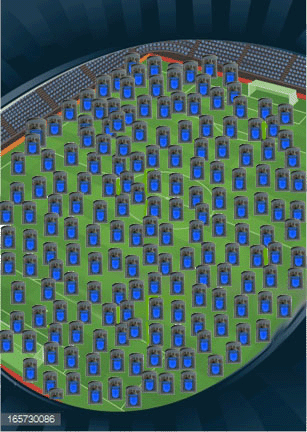
In his most recent Budget, the Chancellor George Osborne announced a competition for the design of small modular reactors for use in the UK.
‘Evolutionary technology’
There are two catches.
First, there’s still no solution (in the UK at least) to what to do with the nuclear waste. The government appears willing to go ahead with new nukes without knowing what happens to spent fuel and contaminated equipment.
Second, no-one has actually built an SMR yet, and it’s likely to take until the 2030s or 2040s before SMRs are widespread and making a real contribution to hitting carbon emission targets.
The firm claiming to be leading the global SMR race is the US government-funded NuScale. It expects to have its first American SMR in operation by 2025, and hopes to be ready to generate in the UK in 2026 at the earliest…
‘Jam tomorrow’
However, there are cautionary voices. Experts warn that to make it worthwhile building it, a reactor factory would need 40-70 orders. And the time scale is a big stumbling point for many.
According to John Sauven of Greenpeace there’s a high risk it will take longer than predicted to bring small scale nuclear on-stream. “Remember the nuclear industry promised in the 1950s that it would deliver energy too cheap to meter,” he says. “Since then it’s been completely overtaken by wind and solar energy which are much safer, reliable and cheaper.
“With nuclear it’s always jam tomorrow. We’ve got to decarbonise the energy industry now.”
Other critics warn that renewables and energy storage are progressing so fast that the energy industry won’t need the sort of round the clock “baseload” power produced by nuclear in the medium term future.
The energy commentator Kees van der Leun tweeted: “By the time [of the 2030s and 2040s] the growth of cheap solar and wind will have obliterated the chance of making any money with ‘baseload’.” http://www.bbc.com/news/business-35863846
Bill Gates enjoys spruiking his plutonium dream
Bill Gates’ Nuclear Pipe Dream: Convert Depleted Uranium to Plutonium to Power Earth for Centuries, Truth Out Tuesday, 15 March 2016 By Josh Cunnings and Emerson Urry, EnviroNews | Video Report Voice of Bill Gates –-“……… Excerpt #1: There was a concept a long time ago that you would do a different type of reactor called a “fast reactor,” that would make a bunch of another element called plutonium, and then you would pull that out, and then you would burn that. That’s called “breeding” in a fast reactor. That is bad because plutonium is nuclear weapons material. It’s messy. The processing you have to get through is not only environmentally difficultly, it’s extremely expensive.
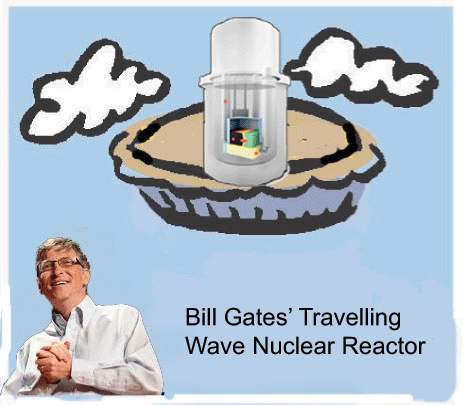 Cunnings: The man considered by many to be supposedly a humanitarian trailblazer when it comes to combatting disease, has a plan to fast-breed the mountainous heaps of depleted uranium at Paducah into plutonium — one of the most dangerous and disease-causing substance on the face of the planet. Then in turn, this plutonium would be used to power what would be the so-called new fourth-generation nuclear power plants. Let’s listen to Gates articulate his plutonium scheme.
Voice of Bill Gates — Excerpt #2: The concept of this so-called “TerraPower reactor” is that you, in the same reactor, you both burn and breed. So, instead of making plutonium and then extracting it, we take uranium — the 99.3 percent that you normally don’t do anything with — we convert that, and we burn it.
[Editor’s Note: Bill Gates is the current Chairman of the Board of TerraPower — a Washington-based nuclear power technology company.]
Cunnings: Now get this, only 60 seconds after Gates acknowledges the tremendous problem of bringing more plutonium into this world, he turns around and makes a joke about it to a crowd filled with university students from nuclear programs — all this, only a few months after the catastrophic triple melt-through at Fukushima Daiichi.
Bill Gates — Excerpt #3: Our flame is taking the normal depleted uranium — the 99.3 percent that’s cheap as heck, and there’s a pile of it sitting in Paducah, Kentucky that’s enough to power the United States for hundreds and hundreds of years. You’re taking that and you are converting it to plutonium (humorously under his breath) — and then you’re burning that.
Cunnings: Oh yes, Mr. Gates seems to have a little love affair going on with plutonium — and the notion is that we need nuclear power to save ourselves from climate change.
Bill Gates — Excerpt #4: You could go nuts!
Wall Street Journal Interviewer Alan Murray: If everything goes perfectly?
Gates: Absolutely.
Murray: How often does everything go perfectly?
Gates: In nuclear? Ah, well, ya’ know… If you ignore… (laughter) No, no. Come on. If you ignore 1979 [Three Mile Island], and 1986 [Chernobyl], and 2011 [Fukushima], come on — we’ve had a good century (laughter). No seriously. I mean, in terms of raw figures, you know, coal mining, natural gas … More people die, I mean … It wasn’t far from here a natural gas pipe blew up and incinerated people.
Bill Gates Excerpt #5: So we can simulate Richter-10 earthquakes. We simulate 70-foot waves coming into these things. Very cool. We basically say no human should ever be required to do anything, because if you judge by Chernobyl and Fukushima, the human element is not on your side.
Bill Gates Excerpt #6: We have, you know, total fail-safe … Any reactor that a human has to do something … that’s a little scary.
Bill Gates Excerpt #7: So, you’ve got to design something that humans just don’t have to be involved in.
Bill Gates Excerpt #8: I love nuclear. It does this radiation thing that’s tricky (laughter). But they’re good solutions. You know, it was interesting; recently, in Connecticut this natural gas plant blew up 11 guys. It just blew them up.
Murray: But you are personally investing in nuclear?
Gates: Right………” http://www.truth-out.org/news/item/35229-bill-gates-nuclear-pipe-dream-convert-mountains-of-depleted-uranium-to-plutonium-to-power-earth-for-centuries
Nuclear propagandist Prof Geraldine Thomas: comfortable , but incorrect, spin on Fukushima
Is this a problem for human health? You bet it is. The question no-one asked is what is causing the excess dose? The answer is easy: radioactive contamination, principally of Caesium-137. On the basis of well-known physics relationships we can say that 3Sv/h at 1m above ground represents a surface contamination of about 900,000Bq per square metre of Cs-137. That is, 900,000 disintegrations per second in one square metre of surface: and note that they were standing on a tarmac road which appeared to be clean. And this is 5 years after the explosions. The material is everywhere, and it is in the form of dust particles which can be inhaled; invisible sparkling fairy-dust that kills hang in the air above such measurements.
The particles are not just of Caesium-137. They contain other long lived radioactivity, Strontium-90, Plutonium 239, Uranium-235, Uranium 238, Radium-226, Polonium-210, Lead-210, Tritium, isotopes of Rhodium, Ruthenium, Iodine, Cerium, Cobalt 60. The list is long.
the Japanese government wants to send the people back there. It is bribing them with money and housing assistance. It is saying, like Gerry Thomas, there is no danger. And the BBC is giving this misdirection a credible platform.
They keep the lid on the truth using ill-informed individuals like Geraldine Thomas.
Fukushima is far from being over, and the deaths have only just begun.
Is Fukushima’s nuclear nightmare over? Don’t count on it https://www.rt.com/op-edge/335362-fukushima-nuclear-japan-bbc/ Chris Busby 12 Mar 16
 On the 5th Anniversary of the catastrophe, Prof Geraldine Thomas, the nuclear industry’s new public relations star, walked through the abandoned town of Ohkuma inside the Fukushima exclusion zone with BBC reporter Rupert Wingfield-Hayes.
Thomas was described as “one of Britain’s leading experts on the health effects of radiation”. She is of the opinion that there is no danger and the Japanese refugees can come back and live there in the “zone”. Her main concern seemed to be how untidy it all was: “Left to rack and ruin,” she complained, sadly.
At one point, Rupert pulled out his Geiger counter and read the dose: 3 microSieverts per hour. “How much radiation would it give in a year to people who came back here,” he asked. Thomas replied: “About an extra milliSievert a year, which is not much considering you get 2mSv a year from natural background”.
“The long term impact on your health would be absolutely nothing.”
Now anyone with a calculator can easily multiply 3 microSieverts (3 x 10⁻⁶ Sv) by 24 hours and 365 days. The answer comes out to be 26 mSv (0.026Sv), not “about 1mSv” as the “leading expert on the health effects of radiation” reported.
I must personally ask if Gerry Thomas is a reliable expert; her CV shows she has published almost nothing in the way of original research, so we must ask how it is the BBC has taken her seriously. Continue reading
How EDF taught Britons to love nuclear power, especially targeting women
Targeting women In 2012 EDF began a publicity campaign in the UK to soften up the public, which was predominantly anti-nuclear, including paying for editorial in women’s magazines because its market research found that women were more like to oppose nuclear power than men.
A complaint I made to the Advertising Standards Authority was upheld, regarding the use of advertising from EDF that was not labelled as advertising and looked like editorial, in Marie Claire – the “magazine for women who want to think smart and look amazing”. The articles were provided by EDF, under the headline “Nuclear power: the facts”, but contained inaccuracies.
Even after the ASA ruled in my favour, EDF still continued making dubious claims in the pages of the magazine, such as that in the 2030s “nuclear reactors in Somerset and Suffolk could supply around 40 per cent of the country’s energy needs”.
In its dreams, maybe. because even while this was going on the French National Audit Office had recommended abandonment of the EPR as too complex and expensive.
“The problem is, politicians like big projects. By contrast, energy efficiency, although much more beneficial, is almost invisible, and is certainly lots of small projects.”
And energy projects don’t come much bigger than nuclear power. As Jimmy Cliff might have put it: “the bigger they come, the harder they fall.”
 The mystery of Britain’s love affair with new nuclear, The Fifth Estate, David Thorpe | 8 March 2016
Electricite de France’s chief financial officer Thomas Piquemal has resigned after opposing the announcement next month of a final investment decision on building a new nuclear reactor at Hinkley Point C in the UK.
EDF shares immediately dropped in value and further questions are being asked over the wisdom of proceeding with the plant, which would be the first new nuclear power station to be built in the UK in two decades. It was originally planned for completion in 2017 and is now unlikely to be built until at least 2025 – if ever. Continue reading
Australian Senator’s Impossible Nuclear Dream – analysis by Australia Institute
The impossible dream Free electricity sounds too good to be true. It is. A plan to produce free electricity for South Australia by embracing nuclear waste sounds like a wonderful idea. But it won’t work. The Australia Institute Briefing paper Dan Gilchrist February 2016

Nuclear lobby’s “makeover” of the industry’s bad reputation
The Not-So-Peaceful Atom Bob Rowen accidentally took on corporate nuclear power in the 1970s. Four decades later he remembers what it was like to be Humboldt County’s most infamous whistleblower. North Coast Journal, BY JAPHET WEEKS, 20 MARCH 2008 “……….The makeover is industry-wide. Proponents of nuclear power are touting it as our natural next step, a clean, endless supply of energy. And they’ve latched onto fears of global warming and concerns over the skyrocketing price of oil to usher energy consumers into a new nuclear century. They also argue that today’s reactors are far cleaner and more economic than the dirty, atavistic behemoths of yore.
In their promotional materials, the Nuclear Energy Institute, the leading lobby group for the U.S. nuclear industry, points out that America’s nuclear reactors already produce 20 percent of the electricity we use, and according to the Department of Energy, electricity demand will rise 45 percent by 2030.
In another brochure aimed at debunking myths about radiation, one section header reads, “Radiation: Helping All of Us.” The brochure, which features a nuclear family of four watching the sunset at the beach cites the 1991 National Cancer Institute report, which indicates no increased rate of mortality in communities with nuclear power plants.
But Manetas and Welch don’t buy the hype. They argue that a lack of economic viability has and always will be one of nuclear power’s biggest drawbacks. A nuclear power plant is very expensive to build, Manetas said, and even more expensive to decommission. The Humboldt facility is a case in point. It cost $33 million to construct and he estimates the price tag for decommissioning to be around $380 million. Every nuclear facility across the country has a lifespan of about 30 years. Manetas argues that without significant subsidies from the U.S. government, nuclear power plants wouldn’t be able to break even.
There are also hidden costs to nuclear energy like dealing with the waste it produces as well as extracting and processing the uranium required to run the plants in the first place. “Eventually power plants would be cannibalizing themselves,” Manetas said, “producing just enough energy to produce more power plants.”
As open as PG&E has become over the years to the local community, Manetas is still concerned that “floating over that is cooperate PG&E.” The company owns and operates one of California’s two remaining nuclear power plants, the Diablo Canyon facility in San Luis Obispo.
How would someone like Bob Rowen expect to be treated at a nuclear power plant today? Manetas speculates that “his ability to whistle-blow and make that information public … is more viable in today’s environment.”
Still, Manetas warns that there is a nation-wide nuclear renaissance underway, and the zeitgeist could quickly change back to what it was when Rowen first started working at the Humboldt Bay nuclear power plant. That was a time when the nuclear industry was anxious to prove that their energy prices could compete with those of fossil fuel plants, and they had few qualms about silencing their naysayers. http://www.northcoastjournal.com/humboldt/the-not-so-peaceful-atom/Content?oid=2126811
UK may be getting Beautiful Nuclear Cathedrals! (Amber Rudd will be pleased)
Moorside: Developers launch competition to design visually beautiful nuclear power station
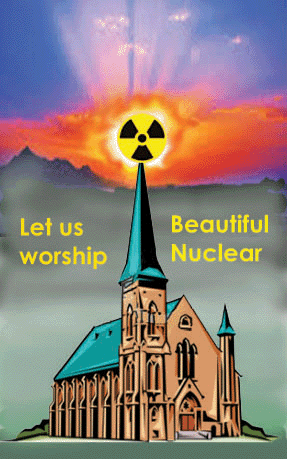
The shortlisted designs will be selected by an independent panel of architects, landscape designers and ecologists including Sir Terry Farrell, who created the MI6 building in London. Their challenge will be to come up with something striking and beautiful which can work around the sensitive construction of the site’s nuclear reactors.
Sebastien Ricard, a director at WilkinsonEyre architects who is currently involved with the multibillion-pound redevelopment of Battersea Power Station in London, said industrial buildings were increasingly regarded by architects as  the “cathedrals of the modern era” as they offered the chance to work with innovative technologies on a grand scale….
it is hoped that the winning plans will succeed in blending the site into its surroundings and perhaps even turn Moorside into a destination in its own right……http://www.independent.co.uk/news/uk/home-news/moorside-developers-launch-competition-to-design-visually-beautiful-nuclear-power-station-a6859311.html
The philosophy of science denial within the nuclear lobby
the cancers near the nuclear sites are caused by internal exposures, to Plutonium, Uranium, Tritium, 
Strontium-90, Caesium-137, Iodine-131, Carbon-14, particles and huge amounts of radioactive noble gases Krypton-85 and Argon-41. There are more nasty isotopes but that will do.And internal exposures can deliver doses to the cell and to the DNA which are far above the small doses that the hormesis people are citing. They are talking about low external doses around external natural background, up to 10 mSv.
 Nuclear radiation, Kierkegaard, and the philosophy of denial, The Ecologist, Chris Busby 8th January 2016 As the evidence of the extreme harm to health inflicted by nuclear radiation mounts, the denialists are resorting to ever greater extremes, writes Chris Busby. On the one hand, advancing the absurd claim that ionising radition is not merely harmless, but health-enhancing. On the other, closing down the experiment that would have provided the strongest evidence yet………
Kierkegaard said of belief that it becomes stronger the more impossible and threatened it is. And this seems to be rapidly coming true in the case of nuclear energy. The torture imposed on logic, reason and observational data by the advocates of nuclear power has now reached the level of clinical psychosis.
A psychosis is a thought disorder in which reality testing is grossly impaired. There is so much evidence that nuclear power kills, causes cancer, mutates populations, reduces fertility and kills babies that only a mad person would continue with the belief that it is a good thing and should be pursued no matter what the cost in money and death.
And as they move to even greater levels of psychotic delusion they present two new survival strategies which make it brilliantly clear that the proponents of nuclear are off their heads.
First the recent move to petition the US nuclear regulators to accept the idea that small amounts of radiation are actually good for you (Yes!); we should all be forced to be irradiated like food, maybe at birth in the equivalent of a mass vaccination. In you go, Jimmy: BZZZZZ, there you are, that didn’t hurt did it?
And the second, as I wrote about recently, is to cancel the US nation-wide study of cancer near nuclear plants.
Are these two moves related? You bet! If the National Academy of Sciences Cancer Study found that people are dying because of the ‘low doses’ received from the emissions, then obviously low doses of radiation can’t be good for you. We are back to the Dark Ages. Continue reading
Pro Nuclear Spin: denial of radiation effects, of Fukushima harm
Denial in the face of evidence has certainly been an effective tool to frustrate worldwide efforts to address Climate Change. Why not attempt the same public relations makeover on radiation?
This new, bold initiative appears to be coming in a two-pronged attack: the first is reviving an already disproved theory that radiation may be ‘good for you’: hormesis.
The second is changing the world’s perception of the Fukushima Daiichi triple meltdown that released and deposited massive amounts of radioactivity in many areas of Japan.
The potential ramifications for public health are huge.
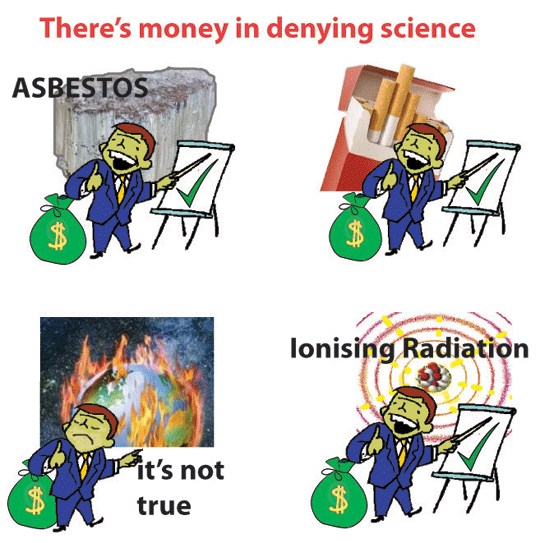
Demystifying Nuclear Power: Problem: In a post-Fukushima-triple-meltdown world, do the numbers work for atomic power? Fairewinds,November 17, 2015 by Sue Prent
With a giant blot still reading over the page of its public safety record, the multi-national, multi-billion dollar atomic power industry faces the stark economic reality that without even more of the regulatory and financial support that it has long enjoyed, it cannot successfully compete financially with sustainable methods electrical generation.
Moreover, these preferential government regulations and incredible financial subsidies from countries around the world are more concerned with maintaining a nuclear energy fleet that in the US has long been tied-up with Defense Department interests, and throughout the world has also been an assured method of access to nuclear weapons.
During the early days of atomic reactors, decommissioning, clean-up and long-term radioactive waste storage were not even acknowledged or planned for, and now they crowd onto center stage as aged and leaking plants line up to speedily shutdown and abandon their overflowing nuclear waste cesspools. In the US, people living near the plants and state governments without regulatory authority over this federal process are stunned to discover the financial burden of underfunded decommissioning funds and inadequate decommissioning procedures that will leave the public facing corporate waste abandonment.
That’s right, here’s the hook: if it weren’t for the scientific consensus view that radiation is harmful, and more radiation is even more harmful, nuclear plants might be a whole lot cheaper to operate.
Talk about your “inconvenient truth!”
Recent developments suggest that the atomic power industry, with cooperation from the US Nuclear Regulatory Commission (NRC), may have come up with a crafty way to make the financial numbers work once again: rehabilitate radiation. Continue reading
“An Ecomodernist Manifesto” the ‘cool’ new nuclear front group
The Technofix Is In: A critique of “An Ecomodernist Manifesto”, Clive Hamiliton 28 APRIL 2015 For some years the California-based Breakthrough Institute has been vigorously promoting what it claims to be a new “post-environmentalism,” one highly critical of the mainstream environment movement ……..
The institute maintains a determinedly optimistic view of the world, although the bright facade frequently veils a rancor directed against other environmentalists. This rancor perhaps explains some of its baffling policy stances.
The institute frequently attacks renewable energy and energy efficiency, at times with a highly tendentious use of data. For an organization concerned about spiraling greenhouse gas emissions, it’s hard to work out why the group is so dismissive, except as a way of differentiating itself from mainstream environmentalism. Conversely, it vigorously promotes nuclear power, also deploying data and arguments in a misleading way.
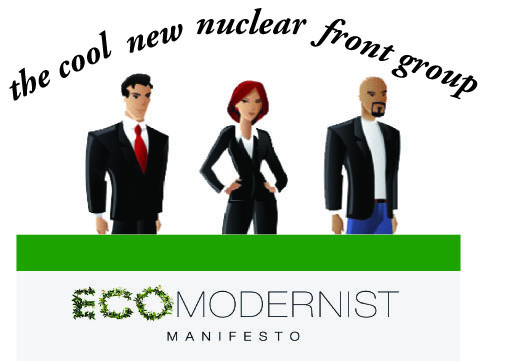
Nuclear power has become an obsession for the institute, a kind of signifier by which players in the environmental debate are allocated to the “good guys” box or the “bad guys” box. In a perfect example of mimesis, the dogmatic stance of some anti-nuclear campaigners is reflected back by these pro-nuclear campaigners……….
An Ecomodernist Manifesto, signed by 18 “scholars, scientists, campaigners, and citizens” associated with the institute, is not satisfied with proclaiming that we can look forward to a good Anthropocene. The manifesto declares that we are entering a great Anthropocene.
What force can turn a gloomy prognosis into a golden future? The answer, of course, is technology. The manifesto’s authors are convinced that “knowledge and technology, applied with wisdom, might allow for a good, or even great, Anthropocene.”
For those who believe we must embrace low-emissions technology (i.e. all of us who recognize the reality of anthropogenic climate change) the manifesto is oddly selective, dismissing many large-scale renewable energy technologies (especially wind power and biomass), and taking a skeptical view of solar energy’s potential.
And so the manifesto returns to the ecomoderns’ peculiar obsession: only nuclear power can give us climate stabilization.But, the authors concede, the nuclear industry is flat on its face in most places, so we must wait for the next generation of nuclear fission (or even fusion!) plants, before which opposition will surely melt away. In the meantime, we will need to build more hydroelectric dams and construct “fossil fuel plants with carbon capture and storage” technology.
Here the ability to set aside science is on full display. The manifesto does not say how long we will need to wait for the next generation of nuclear plants, or how much of the global carbon budget will be used up while we cool our heels. Perhaps it might take 20 years for the first plants to be built, and 40 before they are making a large dent in global emissions. By then the planet will be, in Christine Lagard’s arresting phrase, “roasted, toasted, fried and grilled,” and there will be no way to rescue the situation……..
The technofix is in
An Ecomodernist Manifesto does not offer a new way out of the climate morass, but only a warmed-over version of the old-fashioned American technofix. Politics has gone AWOL in it. The only place politics intrudes is where the manifesto bewails social and institutional obstacles to the further spread of nuclear power. So it is the greens who bring politics to the climate debate! This is not an accidental slip, for The Breakthrough Institute gives the impression of being motivated less by the vision of a great future on a human-regulated Earth than by animosity towards other environmentalists.
Predictably, the manifesto has been greeted with enthusiasm by various purveyors of climate science denial….
The Breakthrough Institute has allied itself with some unsavory characters, like the American Enterprise Institute which has been active in promoting climate science denial and has been partly funded by Exxon and the Koch Brothers. Is this the “post-partisan politics” foreshadowed by “The Death of Environmentalism”? If so, it’s a tarnished vision and reflects The Breakthrough Institute’s self-defeating policy of cozying up to environmentalism’s natural enemies and alienating its most stalwart friends. – …….. http://clivehamilton.com/the-technofix-is-in-a-critique-of-an-ecomodernist-manifesto/
Nuclear Orwellian Doublespeak
New Protection Action Guidelines Will Leave You Chilled to the Bone, Nuclear World, Marti LeRoux 26 Dec 15, In Dr. Bertell’s 1986 speech, she candidly describes the two tactics that she used to report radiological incidents and the release of radionuclides into the environment.
“It’s become even worse of late because in order to impress the public with how insignificant the exposures are, there seem to be two tactics. One tactic is to make the numbers small. So if you’ve been in the business of reporting radiation exposure or accidents for awhile, you’ll remember that it used to be in terms of maybe eighty millirem at Three Mile Island, or a hundred millirem as background radiation, or 5,000 millirem permitted to workers per year. It’s now changed so that instead of eighty millirem it would be eight-tenths of a millisievert. Eight-tenths is a littler number. Instead of workers getting 5,000 millirems per year they now get fifty millisieverts. So they changed the unit to make it a hundred times bigger which makes the numbers a hundred times smaller. So that’s one tactic.
The other tactic is to give everything in percent so that you’re told `well, there’s a little bit of iodine 131 in your milk, but it’s O.K., it’s only a small percentage of the permissible level.’ Now you’re not really told where that permissible level came from, or who said you could have radioactive material in your milk and it was O.K. But to even express it as a small percentage of a permissible level is very deceptive because those permissible levels are extraordinarily high.”
Since this speech was given, there have been many more radiation disasters in the US and abroad, most notably, Fukushima. Recently, the White House dramatically raised “permissible” levels of radiation in our drinking water and soil. This was done without any input or discussion from you or me. By raising permissible levels the administration seeks to create a “new normal” for our radiation exposure.
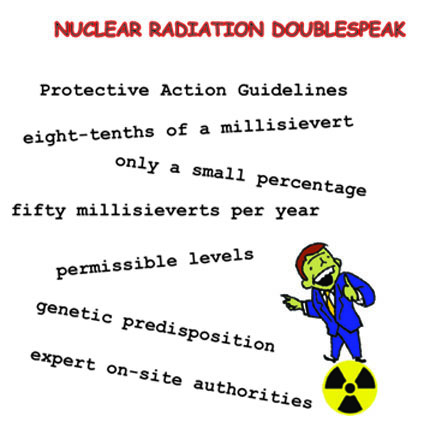
It’s a huge win for the nuclear industry because it allows them to legally say that everything is within “permissible levels.” However, the permissible levels “allowed” by the White House is equivalent to Orwellian doublespeak.
 Doublespeak deliberately cloaks words in order to distort, disguise or reverse the true meaning of words. It’s a very insidious form of manipulation and a subtle form of brainwashing that is unrelentingly used on the American public in many different ways, but especially so by mass media. Doublespeak is employed in order to make nuclear’s version of the “truth” sound palatable. It’s intentionally designed to create ambiguity and confusion.
What politicians and nuclear lobbyists have determined to be “permissible” is in fact unacceptable, but has the US mainstream media bothered to report it? Of course not.
It turns out that major mainstream media outlets in the US are owned by the very same corporations that own nuclear power plants. Talk about conflict of interest!
The Environmental Protection Agency (EPA) has established new radiation guidelines called Protective Action Guides or PAGs. Tragically, these newly established PAGs are extremely negligent and that’s putting it mildly. PAGs have provisions that cover evacuation, shelter, food restrictions and a host of other actions that governmental agencies are permitted to use following a wide range of “radiological emergencies.”
New Protective Guidelines Only Protect the Nuclear Industry
Orwellian doublespeak abounds when dealing with the nuclear agenda. Take the name Protective Action Guidelines (PAG) for example, these new PAGS have very little to do with actually protecting us. They have more to do with protecting the established nuclear industry. Additionally, very little action is involved, if any. I believe it is safe to say that next to no action is involved when it comes to cleaning up nuclear contamination.
Cancer rates, infertility and genetic mutations will be the order of the day, as very little action will be required for governmental agencies to step in and clean up nuclear contamination because these “protective” guidelines are so lax as to be almost useless. I would even go so far as to say they are laughable, but that would not be showing respect to the generations that will suffer as a direct result of the White House’s refusal to take their responsibility seriously.
Is it any wonder that we hear nary a word spoken against nuclear in the US mainstream media? That’s no coincidence because GE, the company that brought you Fukushima also owns, NBC, CNBS, USA Network, A&E, The History Channel, Bravo, SYFY, Lifetime, and The Biography Channel (just to name a few). ……….http://www.nuclearworld.net/pag/
The nuclear charlatans’ last refuge – their myth about climate change
Praise the Lord and pass the ammunition: Nuclear power and climate progress in the 21st century http://thebulletin.org/commentary/praise-lord-and-pass-ammunition-nuclear-power-and-climate-progress-21st-century 17 DECEMBER 2015 Peter A. Bradford adjunct professor, Vermont Law School and former Nuclear Regulatory Commission member
In the 15th year of the era formerly known as “the nuclear renaissance,” not a single molecule of carbon dioxide emission has been avoided by a renaissance reactor built in the United States or in Europe. Unless the 40-year-old Watts Bar 2 reactor scheduled to operate in Tennessee early in 2016 is called “renaissance,” this situation will not change for several more years.
Climate change, so urgent and so seemingly intractable, has become the last refuge of nuclear charlatans throughout the Western world. From well-meaning ideologues and editorial writers claiming that the unknowable is theirs to state with certainty, to paid advocates more skilled in pleasing and persuading government officials than furthering consumer and environmental well-being, prophetic arguments have swollen from a stream to a river and now merge with the Seine in Paris, threatening to submerge the world under a layer of nonsense rising as inexorably as the seas themselves.
We are told that:
- Energy efficiency and renewables cannot save us because they are too costly, too small and too variable, despite their falling costs, rapidly rising deployment, and particular success in the world’s fourth largest economy in Germany.
- The power markets that that have functioned reliably and efficiently for 20 years and that repeatedly reject nuclear as too expensive are “flawed” because they don’t reward nuclear for its benefits as to fuel diversity and reliability, and—in a valid criticism not fixable by uniquely nuclear subsidies—do not reflect the lack of carbon pricing in most of the United States.
- Nuclear power’s problems of cost, delay, and inflexibility will soon be solved by new designs, if only misguided regulators and environmentalists will get out of the way, never mind that regulators and environmentalists have had no hand in the cancellation of some 25 renaissance reactors.
James Hansen, perhaps the most visible of the climate scientists who advocate heavy reliance on breeder or other innovative reactor designs without paying any attention to their track record of long and costly failure, has become ever more reminiscent of Groucho Marx leaping from a paramour’s bed to confront a disbelieving husband with: “Who are you going to believe, me or your eyes?”
Our eyes tell us that the breeder reactor technology has been abandoned in the United States, in France, in Germany, and in Britain. In Japan, the Monju breeder has operated one year out of the last 20. (See von Hippel et al, “Fast Breeder Reactor Programs: History and Status”). Of course success in technology often builds from many failures, but there are no signs of success on this horizon, and delay—as Hansen among others often tells us—allows ever more CO2 to concentrate in the skies to accelerate warming for decades regardless of the technologies deployed 20 years from now.
The op-ed that Hansen and three other scientists signed from Paris says that by building 115 reactors per year from now until 2050, we could eliminate fossil fuels from the electric sector. What these four nuclear horsemen don’t mention is that, using the cost of Britain’s proposed Hinkley station as a proxy (even though breeders and their attendant reprocessing facilities would surely cost more), this commitment would cost some $2 trillion per year, or $70 trillion altogether.
Making assumptions about renewables and efficiency plus electrical storage capacity that are more plausible than Hansen’s assumptions about an immediate reversal in the fortunes of breeder reactors, equivalent carbon reductions can be achieved at much lower cost and in less time, leaving money over for continuing research and development, even nuclear R&D.
Another group of scientists (including one of Hansen’s cosigners), also writing from Paris, said, “Our nation’s gross domestic product (GDP) has grown since 2007 without increases in energy consumption due in large part to major advances in fuel economy in vehicles and energy efficiency in buildings. Solar power comprised 32 percent of all new electric generating capacity in the U.S. last year—a twelvefold increase in the amount of solar photovoltaic installations since just five years ago. Wind power now generates about five percent of our nation’s electricity, and in some regions already costs less than natural gas and coal-fired generation. Texas alone nearly doubled its wind energy generation between 2009 and 2014. Propelled by remarkable gains such as these, states and cities across our nation are setting ambitious targets for reducing carbon emissions.”
Our real challenge is to develop market rules and regulatory processes that allow low-carbon technologies to reap the rewards of their relative cleanliness while competing vigorously with each other to meet the needs of developing and developed nations. The economists who succeed in this urgent task are a much better bet than scientists who claim the gift of prophesy.
The Hansen letter contains these remarkably unself-aware sentences:
“To solve the climate problem, policy must be based on facts and not on prejudice.”
“The climate issue is too important for us to delude ourselves with wishful thinking.”
“The future of our planet and our descendants depends on basing decisions on facts, and letting go of long held biases when it comes to nuclear power.”
Amen, brother.
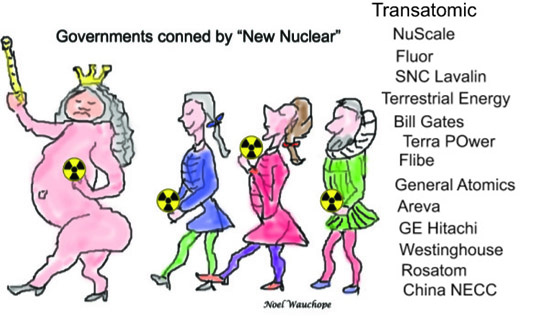
The nuclear snake oil salesmen now pitching Small Reactors as “green”

The Sierra Club says it has all the makings of a snake-oil sale. The organization would prefer the Obama administration abandon the extremely costly pursuit of advanced nuclear power in favor of greater investment in renewable energy such as solar and wind power.
Small-scale nuclear plants being pitched as new green, Albuquerque Journal, December 20th, 2015“……….State leaders aren’t necessarily rushing to embrace the vision in a place where all but one nuclear plant have been mothballed and where old-guard nuclear safety advocates warn that so-called advanced nuclear technologies are an attempt to put shiny earrings on the same old pig.
But the investors and nuclear scientists opening startup labs in the office parks of California’s technology hubs and within the research centers of universities see a more influential ally in the White House.
‘All of the above’ strategy Nuclear power is at the nub of the Obama administration’s “all of the above” strategy for reinventing the energy industry in an era of climate change, and its faith in the fraught power source has captured the imagination of some notable and deep-pocketed West Coast thinkers.
Investors, including Microsoft founder Bill Gates and PayPal co-founder Peter Thiel, have poured about $2 billion into a few dozen small outfits, many of which are concentrated in the West. …….
Nuclear déjà vu That may all be possible someday, say the nuclear experts at the Union of Concerned Scientists, but that day is probably several decades and many tens of billions of dollars away. The sudden excitement around nuclear makes them nervous. They say they have seen this before. Continue reading
The new climate denialism – that renewable energy “doesn’t work”
 There is a new form of climate denialism to look out for – so don’t celebrate yet, Guardian, Naomi Oreskes, 17 Dec 15 At the exact moment in which we need to reduce our reliance on fossil fuel, we’re being told that renewable sources can’t meet our energy needs.
fter the signing of a historic climate pact in Paris, we might now hope that the merchants of doubt – who for two decades have denied the science and dismissed the threat – are officially irrelevant.
But not so fast. There is also a new, strange form of denial that has appeared on the landscape of late, one that says that renewable sources can’t meet our energy needs.
Oddly, some of these voices include climate scientists, who insist that we must now turn to wholesale expansion of nuclear power. Just this past week, as negotiators were closing in on the Paris agreement, four climate scientists held an off-site session insisting that the only way we can solve the coupled climate/energy problem is with a massive and immediate expansion of nuclear power. More than that, they are blaming environmentalists, suggesting that the opposition to nuclear power stands between all of us and a two-degree world.
That would have troubling consequences for climate change if it were true, but it is not. Numerous high quality studies, including one recently published by Mark Jacobson of Stanford University, show that this isn’t so. We can transition to a decarbonized economy without expanded nuclear power, by focusing on wind, water and solar, coupled with grid integration, energy efficiency and demand management. In fact, our best studies show that we can do it faster, and more cheaply.
The reason is simple: experience shows that nuclear power is slow to build, expensive to run and carries the spectre of catastrophic risk. It requires technical expertise and organization that is lacking in many parts of the developing world (and in some part of the developed world as well). As one of my scientific colleagues once put it, nuclear power is an extraordinarily elaborate and expensive way to boil water.
The only country in the world that has ever produced the lion’s share of its electricity from nuclear is France, and they’ve done it in a fully nationalized industry – a model that is unlikely to be transferable to the US, particularly in our current political climate.
Even in the US, where nuclear power is generated in the private sector, it has been hugely subsidized by the federal government, which invested billions in its development in order to prove that the destructive power unleashed at Hiroshima and Nagasaki could be put to good use. The government also indemnified the industry from accidents, and took on the task of waste disposal – a task it has yet to complete.
We also have to pay attention to the problem of continued fossil fuel development. Climate activists have focused attention on divestment as a means to remind the world that continued investment in new fossil fuel infrastructure is inconsistent with the decarbonized economy that we need…….
we probably won’t get very far if the alternatives to fossil fuel – such as renewable energy – are disparaged by a new generation of myths. If we want to see real solutions implemented, we need to be on the lookout for this new form of denial……The key to decarbonizing our economy is to build a new energy system that does not rely on carbon-based fuels. Scientific studies show that that can be done, it can be done soon and it does not require nuclear power. http://www.theguardian.com/commentisfree/2015/dec/16/new-form-climate-denialism-dont-celebrate-yet-cop-21
1 This Month
19 February – VIRTUAL EVENT-Decision Time: AI and Our Nuclear Arsenal
12:45 p.m. Central / 1:45 p.m. Eastern
To see nuclear-related stories in greater depth and intensity – go to https://nuclearinformation.wordpress.com
-
Archives
- February 2026 (170)
- January 2026 (308)
- December 2025 (358)
- November 2025 (359)
- October 2025 (376)
- September 2025 (258)
- August 2025 (319)
- July 2025 (230)
- June 2025 (348)
- May 2025 (261)
- April 2025 (305)
- March 2025 (319)
-
Categories
- 1
- 1 NUCLEAR ISSUES
- business and costs
- climate change
- culture and arts
- ENERGY
- environment
- health
- history
- indigenous issues
- Legal
- marketing of nuclear
- media
- opposition to nuclear
- PERSONAL STORIES
- politics
- politics international
- Religion and ethics
- safety
- secrets,lies and civil liberties
- spinbuster
- technology
- Uranium
- wastes
- weapons and war
- Women
- 2 WORLD
- ACTION
- AFRICA
- Atrocities
- AUSTRALIA
- Christina's notes
- Christina's themes
- culture and arts
- Events
- Fuk 2022
- Fuk 2023
- Fukushima 2017
- Fukushima 2018
- fukushima 2019
- Fukushima 2020
- Fukushima 2021
- general
- global warming
- Humour (God we need it)
- Nuclear
- RARE EARTHS
- Reference
- resources – print
- Resources -audiovicual
- Weekly Newsletter
- World
- World Nuclear
- YouTube
-
RSS
Entries RSS
Comments RSS
 nuclear-news
