The “new nuclear” lobby is working hard, to get the tax and other advantages that the industry could get, if it could get nuclear power formally accepted as a clean method of reducing global warming. In the past, the nuclear industry used to deny global warming. But now they see it as a lifeline for their otherwise doomed industry.
Now the modern gurus of “New Nuclear” have written an open letter to the UN, in Trump-like manner, bewailing “UN discrimination” against them.
Their letter does us all a bit of a favour, clearly listing the current most prominent nuclear lobbyists and “environmental” front groups
The letter, to Erik Solheim Executive Director of the United Nations Environment Programming, accuses United Nations Environment Program ( UNEP) of “an act of discrimination” against the nuclear industry .
It goes on to the importance of climate change, – claiming that action against it will fail without nuclear power. They quote “Environmental Progress:” – “intense investment in renewable technology has resulted in virtually no decarbonisation of global energy” They claim that nuclear power is essential to reduce carbon emissions. They claim that “evidence is undeniable “that nuclear power can achieve rapid decarbonisation. They attack UNEP as“discarding the scientific process in favour of ideology”. Colourful condemnation of this United Nations body goes on – we must “unshackle from the suspicions and hostility of an obsolete era of environmentalism”.
The letter is signed by:
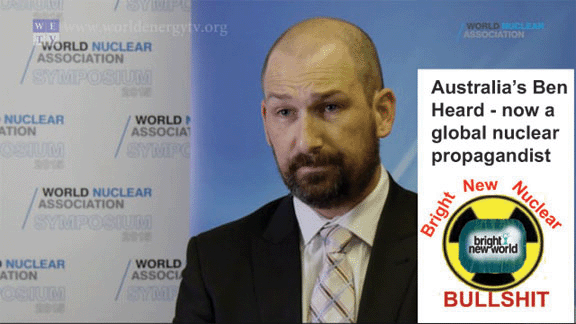
Ben Heard, – Executive Director, Bright New World
Eric Meyer- Co-Founder and Director Generation Atomic
Heather Matteson – Co-Founder, Mothers for Nuclear
Kirsty Gogan, – Co-Founder and Director, Energy for Humanity
Kristin Zaitz – Co-Founder, Mothers for Nuclear
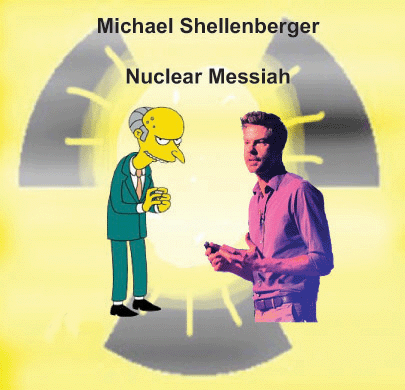
Michael Shellenberger – Founder, Environmental ProgressPhil Ord,- President, Americans for Nuclear Energy
Phumzile J. Oliphant,Chairperson -Thyspunt Nuclear Development Forum, South Africa
Rauli Partanen- Independent Author and Founder,Finnish Ecomodernist Society
Taylor Stevenson- Co-Founder and Director, Generation Atomic
Followerd by endorsement from a whole heap of nuclear industry supporters
The Japanese government wants to show the fake side of Fukushima,”
Large swaths of Fukushima remain uninhabitable, with cleanup at the plant estimated to take up to 40 years and cost almost $200 billion
Would You Play Ball at Fukushima?, NYT, By SETH BERKMANFUKUSHIMA, Japan — A sea of brightly colored banners and advertisements decorated Fukushima train station in early November to celebrate coming road races and Fukushima United, the local soccer club.
Exposing the misinformation of Michael Shellenberger and ‘Environmental Progress’, Nuclear Monitor Issue: #853 4689 30/10/2017, Jim Green ‒ Nuclear Monitor editor, and national nuclear campaigner with Friends of the Earth Australia
Michael Shellenberger’s pro-nuclear lobby group ‘Environmental Progress’ (EP) is celebrating the decision to proceed with two partially-built reactors in South Korea. A citizens jury appointed by the government voted almost 60% in favor of completing the reactors. President Moon Jae-in said the government would allow construction of the reactors to proceed but “we will completely stop all plans for the construction of new nuclear reactors.”1
It’s doubtful that Shellenberger’s California-based organization could have significantly swayed the citizens jury in South Korea, but EP was very active in the debate and presumably had some effect in shifting opinions. Here is a summary of the work EP carried out in South Korea this year:2
EP published a 62-page pro-nuclear report ‒ ‘The High Cost of Fear: Understanding the Costs and Causes of South Korea’s Proposed Nuclear Energy Phase-Out’.3
Shellenberger visited South Korea four times between April and October 2017, giving speeches, holding press conferences on collaborating with nuclear advocates. He claims that dozens of media outlets reported on EP’s visits, that a press conference in Seoul was “packed”4, and that he enjoyed “a crush of media attention”.5
EP sent a sign-on letter to South Korean President Moon Jae-in in July 2017 and another in August 2017.
In October, EP wrote to the citizens jury tasked with deciding the fate of the two partially-built reactors (Shin Kori 5 and 6).6
EP produced a video promoting nuclear power in South Korea.
Shellenberger has been talking and writing about his bizarre plan to bring peace to the Korean Peninsula by supporting the development of nuclear power in North Korea.
And, according to Shellenberger, EP countered the “lies” of Friends of the Earth (FOE) and Greenpeace in “two investigative pieces and three separate open letters to President Moon and the citizens jury that were signed by climate scientists and environmentalists from around the world.”6
EP’s campaign has involved a blizzard of misinformation and relentless, dishonest attacks against environment groups, particularly Friends of the Earth (FOE) and Greenpeace. Shellenberger claims4 that the “greatest coup” of the two groups was the “Hollywood-style anti-nuclear disaster movie” called Pandora7 which was released last year and has been watched by millions, mostly on Netflix. But FOE and Greenpeace had nothing to do with the production of the Pandora film!……..
The funding of the Pandora film isn’t an important issue but it neatly illustrates Shellenberger’s M.O. of relentless repetition of falsehoods in the hope that some mud sticks…..
Shellenberger himself featured in the dishonest and wildly inaccurate ‘Pandora’s Promise’ film a few years ago………
Nuclear power and weapons proliferation
Shellenberger states: “One of FOE-Greenpeace’s biggest lies about nuclear energy is that it leads to weapons. Korea demonstrates that the opposite is true: North Korea has a nuclear bomb and no nuclear energy, while South Korea has nuclear energy and no bomb.”4
In fact, the connections between nuclear power (and associated industries such as enrichment and reprocessing) and weapons proliferation are well understood and there are countless real-world examples demonstrating the risks.26
Prominent nuclear lobbyists are now openly talking about the connections between nuclear power (and related industries) and weapons production in order to boost the case for further subsidies to support the ‘civil’ nuclear industry, particularly in the US.27 It seems Shellenberger didn’t get the memo.
As for Shellenberger’s claims about proliferation on the Korean peninsula, he ignores the fact that North Korea uses what is calls an ‘experimental power reactor’ (based on the UK Magnox power reactor design) to produce plutonium for weapons.28 He ignores the fact that North Korea acquired enrichment technology from Pakistan’s A.Q. Khan network, who stole the blueprints from URENCO, the consortium that provides enrichment services for the nuclear power industry.28 He ignores the fact that North Korea’s reprocessing plant is based on the design of the Eurochemic plant in Belgium, which provided reprocessing services for the nuclear power industry.28
Exposing the misinformation of Michael Shellenberger and ‘Environmental Progress’ Jim Green,Nuclear Monitor Issue: #853 4689 30/10/2017 “………….Fake scientists and radiation quackery
Environmental Progress’s UK director John Lindberg is described as an “expert on radiation” on the EP website.38 In fact, he has no scientific qualifications whatsoever let alone specialist qualifications regarding the health effects of ionizing radiation. Likewise, a South Korean article39 reposted on the EP website (without correction) falsely claims that Shellenberger is a scientist; in fact, he has a degree in cultural anthropology.
Lindberg is an ‘Associate Member’ of Scientists for Accurate Radiation Information (SARI)40, a group comprised mostly of quacks, cranks, non-scientists and conspiracy theorists whose views are directly at odds with those of scientific associations such as UNSCEAR.
SARI is at war with the linear, no-threshold (LNT) model ‒ the group’s short ‘Charter & Mission’ insists three times that LNT is “misinformation”.41 Yet LNT enjoys heavy-hitting scientific support. For example the 2006 report of the US National Academy of Sciences’ Committee on the Biological Effects of Ionizing Radiation states that “the risk of cancer proceeds in a linear fashion at lower doses without a threshold and … the smallest dose has the potential to cause a small increase in risk to humans.”34 Likewise, a report in the Proceedings of the National Academy of Sciences states: “Given that it is supported by experimentally grounded, quantifiable, biophysical arguments, a linear extrapolation of cancer risks from intermediate to very low doses currently appears to be the most appropriate methodology.”42
A 2010 UNSCEAR report isn’t sold on the linear part of LNT but it is at odds with SARI (and EP) on the question of a threshold. The UNSCEAR report states that “the current balance of available evidence tends to favour a non-threshold response for the mutational component of radiation-associated cancer induction at low doses and low dose rates.”43By contrast, SARI promotes hormesis ‒ the discredited view that low-dose radiation exposure is beneficial to human health.44 https://wiseinternational.org/nuclear-monitor/853/exposing-misinformation-michael-shellenberger-and-environmental-progress
Exposing the misinformation of Michael Shellenberger and ‘Environmental Progress’ Jim Green,
Nuclear Monitor Issue: #853 4689 30/10/2017 “…..Chernobyl and Fukushima
Shellenberger says that at a recent talk in Berlin: “Many Germans simply could not believe how few people died and will die from the Chernobyl accident (under 200) and that nobody died or will die from the meltdowns at Fukushima. How could it be that everything we were told is not only wrong, but often the opposite of the truth?”4
There’s a simple reason that Germans didn’t believe Shellenberger’s claims about Chernobyl and Fukushima ‒ they are false.
Shellenberger claims that “under 200” people have died and will die from the Chernobyl disaster. In fact, the lowest of the estimates of the Chernobyl cancer death toll is the World Health Organization’s estimate of “up to 9,000 excess cancer deaths” in the most contaminated parts of the former Soviet Union.29 And of course there are higher estimates for the death toll across Europe.30,31
Shellenberger claims that the Fukushima meltdowns “killed precisely no one” and that “nobody died or will die from the meltdowns at Fukushima”.4 An EP report has this to say about Fukushima: “[T]he science is unequivocal: nobody has gotten sick much less died from the radiation that escaped from three meltdowns followed by three hydrogen gas explosions. And there will be no increase in cancer rates.”3
In support of those assertions, EP cites a World Health Organization report that directly contradicts EP’s claims. The WHO report concluded that for people in the most contaminated areas in Fukushima Prefecture, the estimated increased risk for all solid cancers will be around 4% in females exposed as infants; a 6% increased risk of breast cancer for females exposed as infants; a 7% increased risk of leukaemia for males exposed as infants; and for thyroid cancer among females exposed as infants, an increased risk of up to 70% (from a 0.75% lifetime risk up to 1.25%).32
Applying a linear-no threshold (LNT) risk factor to the estimated collective radiation dose from Fukushima fallout gives an estimated long-term cancer death toll of around 5,000 people.33 Nuclear lobbyists are quick to point out that LNT may overestimate risks from low dose and low dose-rate exposure. But LNT may also underestimate the risks. The 2006 report of the US National Academy of Sciences’ Committee on the Biological Effects of Ionizing Radiation (BEIR) states: “The committee recognizes that its risk estimates become more uncertain when applied to very low doses. Departures from a linear model at low doses, however, could either increase or decrease the risk per unit dose.”34 And the BEIR report states that “combined analyses are compatible with a range of possibilities, from a reduction of risk at low doses to risks twice those upon which current radiation protection recommendations are based.”34
Fukushima evacuation
Shellenberger claims that the Fukushima evacuation was “entirely unnecessary and indeed counterproductive” and it was the “outcome of the kind of fear-mongering engaged in by Moon, FOE, and Greenpeace.”4 But of course Moon Jae-in, FOE and Greenpeace had nothing to do with the evacuation of 160,000 people in the aftermath of the Fukushima disaster. Evacuations were ordered not on the basis of fear-mongering by nuclear critics; they were ordered on the basis of multiple fires, hydrogen explosions and presumed meltdowns.
EP states: “In 2013, the United Nations Scientific Committee on the Effects of Atomic Radiation (UNSCEAR) concluded that the vast majority of the Fukushima evacuation zone is safe and nearly all residents could have returned long ago ‒ indeed, most should never have left.”3 But the UNSCEAR report didn’t conclude that the vast majority of the Fukushima evacuation zone is safe or that nearly all residents could have returned long ago, and it didn’t state that most evacuees should never have left.35 The UNSCEAR report states: “The actions taken to protect the public significantly reduced the radiation exposures that could have been received. This was particularly the case for settlements within the 20-km evacuation zone and the deliberate evacuation zones, where the protective measures reduced the potential exposures in the first year by up to a factor of 10.”35
An EP report berates the Japanese government for failing to follow “normal protocols” by ordering Fukushima residents to evacuate instead of sheltering in place.3 EP cites a 2015 IAEA report36 in support of that argument, but nowhere in the IAEA report (or any IAEA report) is there a proscription against evacuation in response to nuclear accidents. No IAEA report states that sheltering in place should be the “normal protocol” in the event of a nuclear accident ‒ the appropriate response depends entirely on the circumstances. A 2011 IAEA report points to the impracticality of sheltering in place as a long-term response to elevated radiation levels following nuclear accidents: “Lesson 12: The use of long term sheltering is not an effective approach and has been abandoned and concepts of ‘deliberate evacuation’ and ‘evacuation-prepared area’ were introduced for effective long term countermeasures using guidelines of the ICRP [International Commission on Radiological Protection] and IAEA.”37
The 2015 IAEA report notes that radiation levels were astronomical in some areas in the days after the Fukushima disaster ‒ even in some locations beyond the 20 km exclusion zone, dose rates of the order of a few hundred microsieverts per hour were measured from 15 March 2011 onward.36 Thus the annual public limit of 1 millisievert from anthropogenic sources would be reached in just a few hours, and the Japanese government’s new limit of 20 millisieverts in Fukushima-contaminated regions would be reached in just a few days.https://wiseinternational.org/nuclear-monitor/853/exposing-misinformation-michael-shellenberger-and-environmental-progress
Exposing the misinformation of Michael Shellenberger and ‘Environmental Progress’ Jim Green,Nuclear Monitor Issue: #853 4689 30/10/2017
“…….Attacking environment groups
Shellenberger reduces the complexities of environmental opposition to nuclear power to the claim that in the 1960s, an “influential group of conservationists within Sierra Club feared that cheap, abundant electricity from nuclear would result in overpopulation and resource depletion” and therefore decided to campaign against nuclear power.4
If such views had any currency in the 1960s, they certainly don’t now. Yet EP asserts that Greenpeace and FOE “oppose cheap and abundant energy”3 and Shellenberger asserts that “the FOE-Greenpeace agenda has never been to protect humankind but rather to punish us for our supposed transgressions.”4 And Shellenberger suggests that such views are still current by asserting that the anti-nuclear movement has a “long history of Malthusian anti-humanism aimed at preventing “overpopulation” and “overconsumption” by keeping poor countries poor.”8 Again we see Shellenberger’s M.O. of relentless repetition of falsehoods in the hope that mud will stick.
In an ‘investigative piece’ ‒ titled ‘Enemies of the Earth: Unmasking the Dirty War Against Clean Energy in South Korea by Friends of the Earth (FOE) and Greenpeace’ ‒ Shellenberger lists three groups which he claims have accepted donations “from fossil fuel and renewable energy investors, as well as others who stand to benefit from killing nuclear plants”.4 FOE and Greenpeace don’t feature among the three groups even though the ‘investigative piece’ is aimed squarely at them.
Undeterred by his failure to present any evidence of FOE and Greenpeace accepting fossil fuel funding (they don’t), Shellenberger asserts that the donors and board members of FOE and Greenpeace “are the ones who win the government contracts to build solar and wind farms, burn dirty “renewable” biomass, and import natural gas from the United States and Russia.”4 Really? Where’s the evidence? There’s none in Shellenberger’s ‘investigative piece’.
In an article for a South Korean newspaper, Shellenberger states: “Should we be surprised that natural gas companies fund many of the anti-nuclear groups that spread misinformation about nuclear? The anti-nuclear group Friends of the Earth ‒ which has representatives in South Korea ‒ received its initial funding from a wealthy oil man …”45He fails to note that the donation was in 1969! And he fails to substantiate his false insinuation that FOE accepts funding from natural gas companies, or his false claim that natural gas companies fund “many of the anti-nuclear groups”.
Shellenberger’s ‘investigative piece’ falsely claims4 that FOE keeps its donors secret, and in support of that falsehood he cites an article8 (written by Shellenberger) that doesn’t even mention FOE. EP falsely claims that FOE has hundreds of millions of dollars in its bank and stock accounts.3
EP has an annual budget of US$1.5 million, Shellenberger claims, and he asks how EP “can possibly succeed against the anti-nuclear Goliath with 500 times the resources.”8
An anti-nuclear Goliath with 500 times EP’s budget of US$1.5 million, or US$750 million in annual expenditure on anti-nuclear campaigns? Shellenberger claims that Greenpeace has annual income of US$400 million to finance its work in 55 nations8 ‒ but he doesn’t note that only a small fraction of that funding is directed to anti-nuclear campaigns. FOE’s worldwide budget is US$12 million according to EP3 ‒ but only a small fraction is directed to anti-nuclear campaigns.
“The more the nuclear industry claims eating plutonium, strontium, cesium, iodine and other fuel and fission products is OK because bananas exist and because the potassium is a needed nutrient, the more I consider them to be blatant liars.”
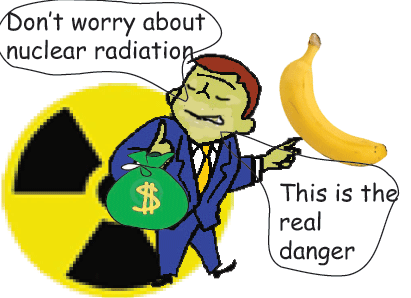
The ‘Nuclear for Climate’ lobby group recently attended the United Nations’ COP23 climate conference armed with bananas, in order to make specious comparisons between radiation exposures from eating bananas and routine emissions from nuclear power plants.
One of the reasons the comparison is specious is that some exposures are voluntary, others aren’t. Australian academic Prof. Barry Brook said in the aftermath of the Fukushima disaster: “People don’t understand that they live in an environment that is awash with radiation and they make decisions every day which affect their radiation dose ‒ they hop on an airplane or eat a banana or sit close to the TV.” True ‒ but people choose to hop on an airplane or eat a banana or sit close to the TV, whereas radiation doses from nuclear plants and nuclear accidents are usually involuntary.
Another reason why the comparison made by ‘Nuclear for Climate’ is specious is that it ignores spikes in radioactive emissions during reactor refueling. Radiation biologist Dr Ian Fairlie notes that when nuclear reactors are refueled, a 12-hour spike in radioactive emissions exposes local people to levels of radioactivity up to 500 times greater than during normal operation. The spikes may explain infant leukemia increases near nuclear plants − but operators provide no warnings and take no measures to reduce exposures.
The comparison between bananas and nuclear power plants also ignores the spike in emissions and radiation doses following catastrophic accidents. So, what’s the Banana Equivalent Dose (yes, that’s a thing) of the Chernobyl and Fukushima disasters?
According to the International Atomic Energy Agency (IAEA), the collective effective dose from Chernobyl was 600,000 person-Sieverts. The UN Scientific Committee on the Effects of Atomic Radiation estimates radiation exposure from the Fukushima disaster at 48,000person-Sieverts.
Combined, exposure from Chernobyl and Fukushima is estimated at 648,000 person-Sieverts. Exposure from eating a banana is estimated at between 0.09-2.3 microSieverts. Let’s use a figure of 0.1 microSievert per banana. Thus, exposure from Chernobyl and Fukushima equates to 6,480,000,000,000 Banana Equivalent Doses ‒ that’s 6.48 trillion bananas or, if you prefer, 6.48 terabananas or 6,480 gigabananas.
End-to-end, that many 15-cm (6-inch) bananas would stretch 972 million kilometres ‒ far enough to reach the sun 6.5 times over, or the moon 2,529 times over.
Potassium cycle
Another reason the comparison made by ‘Nuclear for Climate’ is specious is explained by Dr Gordon Edwards from the Canadian Coalition for Nuclear Responsibility:
“[T]he body already has a lot of “natural” potassium including K-40 [which is unavoidable], and any new “natural” potassium ingested is balanced by eliminating a comparable amount of “natural” potassium to maintain the “homeostasis” of the body. In other words the body’s own mechanisms will not allow for a net increase in potassium levels – and therefore will not allow for an increase in K-40 content in the body.
“Here’s what the Oak Ridge Associated Universities has to say; (ORAU was founded in 1946 as the Oak Ridge Institute of Nuclear Studies.): ‘The human body maintains relatively tight homeostatic control over potassium levels. This means that the consumption of foods containing large amounts of potassium will not increase the body’s potassium content. As such, eating foods like bananas does not increase your annual radiation dose. If someone ingested potassium that had been enriched in K-40, that would be another story.’
“The same argument does not work for radioactive caesium, or for any of the radioactive pollutants given off by a nuclear power plant, because most of these materials do not exist in nature at all – and those that do exist in nature are not subject to the same homeostatic mechanism that the body uses to control potassium levels. Consequently any foodstuffs or beverages containing radioactive caesium or other man-made radioactive pollutants will cause an additional annual dose of ionizing radiation to the person so exposed.”
Likewise, Linda Gunter explained in a 16 November 2017 article:
“At the COP23 Climate Talks currently underway in Bonn, a group calling itself Nuclear for Climate, wants you to slip on their false banana propaganda and fall for their nonsensically unscientific notion that bananas are actually more dangerous than nuclear power plants! I am not making this up. Here is the picture.
“The oxymoronic Nuclear for Climate people are handing out bananas complete with a sticker that reads: “This normal, every-day banana is more radioactive than living near a nuclear power plant for one year.” …
“If you smell something rotten in this banana business, you are right. So let’s peel off the propaganda right now. In short, when you eat a banana, your body’s level of potassium-40 doesn’t increase. You just get rid of some excess potassium-40. The net dose of a banana is zero.
“To explain in more detail, the tiny radiation exposure due to eating a banana lasts only for a few hours after ingestion, namely the time it takes for the normal potassium content of the body to be regulated by the kidneys. Since our bodies are under homeostatic control, the body’s level of potassium-40 doesn’t increase after eating a banana. The body just gets rid of some excess potassium-40.
“The banana bashers don’t want you to know this and instead try to pretend that the potassium in bananas is the same as the genuinely dangerous man-made radionuclides ‒ such as cesium-137 and strontium-90 ‒ that are released into our environment from nuclear power facilities, from atomic bomb tests and from accidents like Fukushima and Chernobyl.
“These radioactive elements, unlike the potassium-40 in bananas, are mistaken by the human body for more familiar elements. For example, ingested radioactive strontium-90 replaces stable calcium, and ingested radioactive cesium-137 replaces stable potassium. These nuclides can lodge in bones and muscles and irradiate people from within. This is internal radiation and can lead to very serious, long-lasting and trans-generational health impacts.”
An unfortunate incident in Goiania, Brazil in September 1987 illustrates the hazards of cesium-137, a fission product. Two people stole a radiotherapy source from a disused medical clinic. A security guard did not show up to work that day; he went instead to the cinema to see ‘Herbie Goes Bananas‘. The radiotherapy source contained 93 grams of cesium-137. It was sold to a junkyard dealer. Many people were exposed to the radioactive cesium and they spread the contamination to other sites within and beyond the town. At least four people died from exposure to the radiation source and, according to the IAEA, “many others” suffered radiation injuries. Those injured included eight patients who required surgical debridments, amputation of the digital extremities and plastic skin grafts. The incident was rated Level 5 (‘Accident with Off Site Risk’) on the 7-point International Nuclear Event Scale.
Terrorists don’t arm themselves with bananas
There is a long history of nuclear power plants being used directly and indirectly in support of nuclear weapons programs. Bananas are of no interest to nuclear weapons proliferators. There’s no Treaty on the Non-Proliferation of Bananas, no Comprehensive Test Banana Treaty, no Anti-Banana Missile Treaty. Kim Jong-un and Donald Trump aren’t threatening each other with bananas; not yet, at least.
Nuclear historian Paul Langley notes that terrorists don’t arm themselves with bananas:
“The potassium cycle in humans is no excuse for nuclear authorities anywhere on the planet to claim any benefit or natural precedent for the marketing of nuclear industry emissions contaminated food.
“The fission products are not nutrients. Do not eat them. The nuclear industry promises to keep its radioactive sources sealed. When the industry invariably fails in this undertaking, it turns around and claims that the residue of its pollution is like a banana. Crap. The residue is like the residue of a rad weapon. Fact. It’s the same stuff. Terrorists do not attempt to arm themselves with bananas. They are not dangerous.
“Radio Strontium, Radio Iodine, Radio cesium have NO PLACE in food. Nuke is not clean, it is not green and it relies on lies it has concocted over decades. … The more the nuclear industry claims eating plutonium, strontium, cesium, iodine and other fuel and fission products is OK because bananas exist and because the potassium is a needed nutrient, the more I consider them to be blatant liars.”
The Sway of the Nuclear Arms Industry Over Donald Trump and Congress Is Terrifying “The devastation is very important to me.” Mother Jones WILLIAM HARTUNGNOV. 18, 2017 This story originally appeared on TomDispatch.com. “……..Another way the nuclear weapons industry (and the rest of the military-industrial complex) tries to control and focus public debate is by funding hawkish think tanks. The advantage to weapons makers is that those institutions and their “experts” can serve as front groups while posing as objective policy analysts. Think of it as intellectual money laundering.
One of the most effective industry-funded think tanks in terms of promoting costly, ill-advised policies has undoubtedly been Frank Gaffney’s Center for Security Policy. In 1983, when President Ronald Reagan first announced his Strategic Defense Initiative (a.k.a. “Star Wars”), the high-tech space weapons system that was either meant to defend the country against a future Soviet first strike or—depending on how you looked at it—free the country to use its nuclear weapons without fear of retaliation, Gaffney was its biggest booster. More recently, he has become a prominent purveyor of Islamophobia, but the impact of his promotional work for Star Wars continues to be felt in weapons contracts to this day.
Just as George W. Bush was entering the White House, another industry-backed think tank, the National Institute for Public Policy, released a report on nuclear weapons policy that would be adopted almost wholesale for the new administration’s first key nuclear posture review. It advocated such things as increasing the number of countries targeted by US nukes and building a new, more “usable” bunker-busting nuclear weapon. At that time, NIPP had an executive from Boeing on its board. Its director was Keith Payne, who would become infamous in the annals of nuclear policy for co-authoring a 1980 article at Foreign Policy entitled “Victory Is Possible,” suggesting that the United States could actually win a nuclear war, losing “only” 30 million to 40 million people. This is the kind of expert the nuclear weapons complex funded to promulgate its views.
Then there’s the Lexington Institute, a think tank that never met a weapons system it didn’t like. Lexington front man Loren Thompson is frequently quoted in news stories on defense issues, but it is rarely disclosed that he is funded by Lockheed Martin, Northrop Grumman, and other nuclear weapons contractors.
Just as George W. Bush was entering the White House, another industry-backed think tank, the National Institute for Public Policy, released a report on nuclear weapons policy that would be adopted almost wholesale for the new administration’s first key nuclear posture review. It advocated such things as increasing the number of countries targeted by US nukes and building a new, more “usable” bunker-busting nuclear weapon. At that time, NIPP had an executive from Boeing on its board. Its director was Keith Payne, who would become infamous in the annals of nuclear policy for co-authoring a 1980 article at Foreign Policy entitled “Victory Is Possible,” suggesting that the United States could actually win a nuclear war, losing “only” 30 million to 40 million people. This is the kind of expert the nuclear weapons complex funded to promulgate its views.
Then there’s the Lexington Institute, a think tank that never met a weapons system it didn’t like. Lexington front man Loren Thompson is frequently quoted in news stories on defense issues, but it is rarely disclosed that he is funded by Lockheed Martin, Northrop Grumman, and other nuclear weapons contractors.
Examples include Secretary of Defense James Mattis, a former board member at General Dynamics; White House Chief of Staff John Kelly, who worked for a number of defense firms and was an adviser to DynCorp, a private security firm that has done everything from (poorly) training the Iraqi police to contracting with the Department of Homeland Security; former Boeing executive and now Deputy Secretary of Defense Patrick Shanahan; former Lockheed Martin executive John Rood, nominated as undersecretary of defense for policy; former Raytheon Vice President Mark Esper, newly confirmed as secretary of the Army; Heather Wilson, a former consultant to Lockheed Martin, who is now secretary of the Air Force; Ellen Lord, a former CEO for the aerospace company Textron, who is undersecretary of defense for acquisition; and National Security Council Chief of Staff Keith Kellogg, a former employee of the major defense and intelligence contractor CACI, where he dealt with “ground combat systems” among other things.
Keep in mind that these high-profile industry figures are just the tip of the iceberg when it comes to the corporate revolving door that has been installed in the Pentagon for decades, as journalist Lee Fang has documented in the Intercept.
Given the composition of his national security team and Trump’s love of all things nuclear, what can we expect from his administration on this front? In addition to the $1.7 trillion nuclear build-up, Trump’s impending nuclear posture review seems to include proposals for dangerous new weapons like a “low-yield,” purportedly more usable nuclear warhead. He’s spoken privately with his team about expanding the arsenal in a staggering fashion—the equivalent of a 10-fold increase. He’s wholeheartedly embraced missile defense spending, pledging to put billions of dollars more into that overfunded, under-producing set of programs. And of course, he is assiduously trying to undermine the Iran nuclear deal, one of the most effective arms control agreements of recent times, and so threatening to open the door to a new nuclear arms race in the Middle East.
Unless the nuclear spending spree being pushed by President Trump as the best thing since the invention of golf is stopped thanks to public opposition, the rise of an antinuclear movement, or congressional action, we’re in trouble. The nuclear weapons lobby will again have won the day—just as it did almost 60 years ago, despite the opposition of a popular president and decorated war hero.
And Donald Trump, “bone spurs” and all, is no Dwight D. Eisenhower.
DeSmog Blog, By Graham Readfearn • Wednesday, November 8, 2017 We’re at that time of year when delegations from countries around the world gather for the latest round of United Nations climate negotiations — this time in Bonn, Germany.
For climate science deniers, this is also the time of year to polish up their dodgy climate science talking points and those mythical conspiracy theories about the UN, new world orders, secretive global government plans, and other such illuminati activities.
One recurring feature of these efforts is what’s known as quote mining, where lines are taken out of context to try and discredit people associated with climate science or the UN. If that doesn’t work, then just make up words that people never said.
Here’s how it usually works. The “source” for a particular quote will invariably lead you down a rabbit hole, echoing with the sounds of other climate science deniers quoting the same material. If a misrepresentation occurs in two different places, this does not suddenly make it real.
Rarely, if ever, will the quote be linked to a primary source that might give you some idea of the context, relevance, or the actual date when the quote was supposedly delivered.
At other times, the claimed “quote” turns out not to have been a quote at all, but a piece of reported speech or a headline that someone stuck quote marks around to turn it into a quote. This is not how quoting people works.
Public Outreach Is Needed to Gain Support for the Nuclear Power Industry Power Magazine, 11/06/2017 Gary J. Duarte “……….Nuclear proponents must spread the message of the energy source’s value: rebrand, redirect, recycle, and renew……
the benefits of nuclear power far outweigh the perceived problems. Engagement with the public is necessary in order to offset political obstruction. Educated grassroots constituents can raise their voices against political correctness, and point out the sound science and engineering behind nuclear technology…….
Media distribution of information must provide equal time and print to inform both sides of complex issues……..
Aside from the country’s need for a nuclear waste storage garage, new technologies are on the horizon too. Tomorrow’s nuclear players should be utilizing grassroots education to advance their causes. The public needs to be made more aware of small modular reactors (SMRs), lead-cooled fast reactors, and molten salt reactors. The best way to improve public knowledge of these new technologies is through outreach.
In recent years, the U.S. Nuclear Energy Foundation (USNEF) has been one of the loudest nuclear advocacy voices. The group is working to become the go-to source for nuclear technology information. A paradigm shift is necessary, and USNEF is involved in multiple programs to address this through grassroots education.
USNEF provides local presentations, industry presentations, American Nuclear Society workshops, Advanced Reactor Technical Summits, Yucca Educational Symposiums (YES), open invitation tours to the Idaho National Laboratory, print collaterals, and TV and YouTube videos available via website download. The foundation is promoting the same advanced reactor designs and SMRs that the industry is currently pitching to government legislatures, agencies, and others.
The bottom line is that rebranding, redirecting, recycling, and renewing “Atoms for Peace” involves understanding the value and importance of grassroots education, and engaging with the general public to promote the nuclear industry’s benefits.
—Gary J. Duarte is director of the U.S. Nuclear Energy Foundation
Mainstream media in various places continues to regurgitate pro nuclear propaganda without any attempt to examine it critically
In the example below – of course – they didn’t say that the reasons for Bill Gates’ doing this in China:
1. Because China does not have the strict safety regulations that USA has – so Gates can’t do this in USA
2. Because China’s nukes are tax-payer funded – so no worries about getting funding – (in USA there’s quite an outcry about the govt funding nukes)
3. The article made a virtue out of the reactor using ‘waste fuel’ from conventional reactors – ignoring all the transport safety problems etc.
4 The article brushed over the fact that even this new reactor leaves long-lasting radioactive trash – smaller in volume, yes, but so toxic that it need equal space to safely store
The article glosses over the fuel “waste uranium” “depleted uranium” as if that’s fine.
There’s an area that I find ambiguous:
“This joint venture aims to design and construct multiple nuclear power plants generating around 1150 megawatts over the next two decades which utilise this fourth generation nuclear technology. ….” “the reactor would only need eight tonnes of this material to power 2.5 million homes for a year.”
Do they mean that ONE reactor would provide all this power? They might. But as I understand it, the Travelling Wave Reactor is a small model, that would need to be set up as a bunch of multiples – (further making it difficult to market, as a country would have to order them en masse. I say a country, because apart from Gates and a few mates, private enterprise is unwilling to take this huge financial risk)
Bill Gates and China partner on world-first nuclear technology ,Cole Latimer, SMH, The Age, and global media outlets, 8 November 17
Bill Gates’ nuclear firm TerraPower and the China National Nuclear Corporation have signed an agreement to develop a world-first nuclear reactor, using other nuclear reactors’ waste
I missed that interview, but apparently the ABC interviewer asked some hard questions.
Shellenberger commented: “fighting to survive a brutal interview by a tough young reporter in Oz On ABC (the Aussie BBC)”
Australia’s own nuclear propagandist, Ben Heard, commented: “Shabby interview. Host evidently unfamiliar with topic”
However, those pro nuclear spinners were happy with shock jock Alan Jones on 2GB Alan Jones Breakfast Show. Jones said:
“Michael has turned on wind and solar with a passion: he’s now advocating for an all-atomic energy future, simply because the latter provides reliable power, whereas the former are a childish nonsense…..
the Finkel review totally ignored nuclear power as an option and pushed harder for more and more renewable energy. So Victoria’s looking at 25% renewables by 2025, South Australia 50%, the ACT 100%, Queensland 50%……
one of the world’s leading new-generation environmental thinkers has said the renewable energy experiment with wind and solar has failed. Michael Shellenberger is a former renewables advocate and adviser to Barack Obama when he was President. [ed. not true. Shellenberger sent an unsolicited submission to President Obama] He is now global champion for nuclear energy, which he said was the only option to replace coal and gas on a global scale. ……”
Shellenberger said:
every major study for the last 40 years finds that nuclear power is the safest way to make reliable electricity. You don’t have the risks that come with coal and fossil fuels, both in terms of mine collapses and air pollution, and the accidents themselves that everyone worries so much about hardly have any impact on people’s lives…
Wind and solar – They’re the worst. Really, all renewables are. The reason is easy to understand, in the sense that the fuels are very dilute, they’re very diffuse, and so you have to cover a huge amount of land with wind and solar……. solar produces huge quantities of toxic waste…… They produce two to three hundred times more toxic waste than nuclear plants, which are the only way of producing electricity that contain all of their potentially harmful waste. Of course it’s been contained so well that nobody has ever been harmed by the radiation from nuclear power waste, ever……
The other problem is that you just end up getting too much wind energy when you don’t need it, like the middle of the night. Solar and wind, it’s like they’re almost set up to destroy cheap, clean, reliable energy.
What happened was that there was a smaller group of anti-human so-called environmentalists that opposed nuclear precisely because it allowed for so much cheap and abundant power, and they thought, “Well, if we’re going to stop the human cancer, we have to cut off its energy supplies.” …..
You’ve got some really crazy anti-nuclear people down there…..
Alan Jones: I’ll tell you something, when you arrive in this country, Michael we’ll have you on again. We can’t hear enough of you. It’s time we had a good healthy dose of common sense,
Michael Shellenberger is visiting Australia this week. He has been a prominent environmentalist (of sorts) since he co-authored the 2004 essay, The Death of Environmentalism. These days, as the President of the California-based ‘Environmental Progress’ lobby group, he is stridently pro-nuclear, hostile towards renewable energy and hostile towards the environment movement.
Shellenberger is visiting to speak at the International Mining and Resources Conference in Melbourne. His visit was promoted by Graham Lloyd in The Australian in September. Shellenberger is “one of the world’s leading new-generation environmental thinkers” according to The Australian, and if the newspaper is any guide he is here to promote his message that wind and solar have failed, that they are doubling the cost of electricity, and that “all existing renewable technologies do is make the electricity system chaotic and provide greenwash for fossil fuels.”
Trawling through Environmental Progress literature, one of their recurring themes is the falsehood that “every time nuclear plants close they are replaced almost entirely by fossil fuels”. South Korea, for example, plans to reduce reliance on coal and nuclear under recently-elected President Moon Jae-in, and to boost reliance on gas and renewables. But Shellenberger and Environmental Progress ignore those plans and concoct their own scare-story in which coal and gas replace nuclear power, electricity prices soar, thousands die from increased air pollution, and greenhouse emissions increase.
Fake scientists and radiation quackery
Environmental Progress’ UK director John Lindberg is described as an “expert on radiation” on the lobby group’s website. In fact, he has no scientific qualifications. Likewise, a South Korean article falsely claims that Shellenberger is a scientist and that article is reposted, without correction, on the Environmental Progress website.
Shellenberger says that at a recent talk in Berlin: “Many Germans simply could not believe how few people died and will die from the Chernobyl accident (under 200) and that nobody died or will die from the meltdowns at Fukushima. How could it be that everything we were told is not only wrong, but often the opposite of the truth?”
There’s a simple reason that Germans didn’t believe Shellenberger’s claims about Chernobyl and Fukushima ‒ they are false. Shellenberger claims that “under 200” people have died and will die from the Chernobyl disaster, but in fact the lowest of the estimates of the Chernobyl cancer death toll is the World Health Organization’s estimate of “up to 9,000 excess cancer deaths” in the most contaminated parts of the former Soviet Union. And of course there are higherestimates for the death toll across Europe.
Shellenberger claims that the Fukushima meltdowns “killed precisely no one” and that “nobody died or will die from the meltdowns at Fukushima”. An Environmental Progress report has this to say about Fukushima: “[T]he science is unequivocal: nobody has gotten sick much less died from the radiation that escaped from three meltdowns followed by three hydrogen gas explosions. And there will be no increase in cancer rates.”
In support of those assertions, Environmental Progress cites a World Health Organization report that directly contradicts the lobby group’s claims. The WHO report concluded that for people in the most contaminated areas in Fukushima Prefecture, the estimated increased risk for all solid cancers will be around 4% in females exposed as infants; a 6% increased risk of breast cancer for females exposed as infants; a 7% increased risk of leukaemia for males exposed as infants; and for thyroid cancer among females exposed as infants, an increased risk of up to 70% (from a 0.75% lifetime risk up to 1.25%).
Applying a linear-no threshold (LNT) risk factor to the estimated collective radiation dose from Fukushima fallout gives an estimated long-term cancer death toll of around 5,000 people. Nuclear lobbyists are quick to point out that LNT may overestimate risks from low dose and low dose-rate exposure ‒ but LNT may also underestimate the risks according to expert bodies such as the US National Academy of Sciences’ Committee on the Biological Effects of Ionizing Radiation.
“The omission of the word ‘any’ implies there could be a case of nuclear weapon use that would not cause inhumane consequences and therefore this type of use might be permitted”
“The Japanese draft resolution looks like one proposed by the United States or any other nuclear weapon states”
A draft resolution recently proposed by the Abe government to the United Nations General Assembly was dramatically watered down under diplomatic pressure from the United States, government sources have revealed.
Japan, the only nation to have been attacked with atomic weapons, saw the U.S. destroy Hiroshima and Nagasaki with two atomic bombs 72 years ago. it has proposed a series of draft resolutions on nuclear disarmament to the General Assembly since 1994.
Last year, its proposed resolution was adopted at the assembly’s plenary session with support from 167 nations, including the United States, while China, North Korea, Russia and Syria opposed and 16 other nations abstained.
In the middle of October, Japan submitted a resolution titled “United action with renewed determination toward the total elimination of nuclear weapons.”
Close examination of the text has found a few major changes from past resolutions.
Since 2010, Japan has drafted annual resolutions that include the same common sentence, which emphasizes “deep concern at the catastrophic humanitarian consequences of any use of nuclear weapons.”
The phrase, “the catastrophic humanitarian consequences of any use of nuclear weapons,” has been a keyword used by international movements pursuing a denuclearized world in recent years.
In July, this anti-nuclear campaign culminated in the adoption of the Treaty on the Prohibition of Nuclear Weapons at the United Nations — the first international law that prohibits state parties from developing, testing, possessing and using nuclear weapons in any manner, including “threat of use.”
In the most recently proposed resolution, the government deleted the word “any” from the frequently used phrase, rendering it as “deep concern at the catastrophic humanitarian consequences of nuclear weapons use.”
It seems a minor rhetorical change, but the deletion of “any” has raised concerns and sparked severe criticism from nuclear disarmament specialists in Japan.
“The omission of the word ‘any’ implies there could be a case of nuclear weapon use that would not cause inhumane consequences and therefore this type of use might be permitted,” professor Tatsujiro Suzuki, director of the Research Center for Nuclear Weapons Abolition at Nagasaki University, pointed out.
“It can’t be helped if Japan will be regarded (by the international community) as an unfit advocate for the abolition of nuclear weapons,” Suzuki said.
“The Japanese draft resolution looks like one proposed by the United States or any other nuclear weapon states,” said Akira Kawasaki, an International Steering Group member of ICAN, or the International Campaign to Abolish Nuclear Weapons.
ICAN will receive the Nobel Peace Prize at the end of this year in Oslo for its worldwide grass-roots campaign for the adoption of the Treaty on the Prohibition of Nuclear Weapons.
During a recent interview, Kawasaki said “the deletion of ‘any’ is so problematic” that several nations which have supported Japan’s annual resolutions in the past may not become a cosponsor of the resolution this year.
That wold pose a serious setback for Japan, which has taken a leading position in the international disarmament based on its strong credentials.
Governmental sources suggested that the administration of U.S. President Donald Trump opposes including the word “any” in the draft resolution, and that Japan made the concession to get Washington’s support for the document.
Trump has indicated a desire to accelerate the modernization of the U.S. nuclear arsenal in light of North Korea’s nuclear and missile provocations. Prime Minister Shinzo Abe has been deepening security cooperation with the United States and repeatedly requested more U.S. security assurances for Japan, including the “nuclear umbrella.”
Another conspicuous change in the latest Japanese resolution is that it urges only North Korea to sign and ratify the Comprehensive Nuclear Test Ban Treaty without delay, rather than the eight nations it named for the previous resolutions.
Japan is a key advocate of accelerating the CTBT, which requires ratification by eight nations including North Korea, China and the United States. The U.S. Republican Party is widely known as a strong opponent of CTBT.
“Our new draft resolution is the result of policy considerations for creating a common ground between nuclear weapon states and nonnuclear weapons states for furthering a practical approach (toward nuclear abolition),” said one official of the Ministry of Foreign Affairs without specifically explaining why they decided to make the notable changes in the draft resolution.
Why NRC Nuclear Safety Inspections are Necessary: Columbia Generating Station, UCS, DAVE LOCHBAUM, DIRECTOR, NUCLEAR SAFETY PROJECT | OCTOBER 17, 2017The Nuclear Regulatory Commission (NRC) adopted its Reactor Oversight Process (ROP) in 2000. The ROP is far superior to the oversight processes previously employed by the NRC. Among its many virtues, the NRC treats the ROP as a work in progress, meaning that agency routinely re-assesses the ROP and makes necessary adjustments.
Earlier this year, the NRC initiated a formal review of its engineering inspections with the goal of making them more efficient and more effective. During a public meeting on October 11, 2017, the NRC working group conducting the review outlined some changes to the engineering inspections that would essentially cover the same ground but with an estimated 8 to 15 percent reduction in person-hours (the engineering inspections and suggested revisions are listed on slide 7 of the NRC’s presentation). Basically, the NRC working group suggested repackaging the inspections so as to be able to examine the same number of items, but in fewer inspection trips.
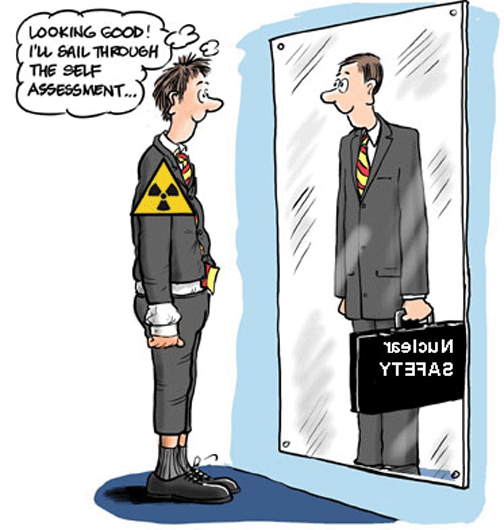
The nuclear industry sees a different way to accomplish the efficiency and effectiveness gains sought by the NRC’s review effort—they propose to eliminate the NRC’s engineering inspections and replace them with self-assessments. The industry would mail the results from the self-assessments to the NRC for their reading pleasure.
UCS is wary of self-assessments by industry in lieu of NRC inspections. On one hand, statistics might show that self-assessments increase safety just as a community firing all its law enforcement officers would see a statistical decrease in arrests, suggesting a lower crime rate. I have been researching the records publicly available in ADAMS to compare the industry’s track record for finding latent safety problems with the NRC’s track record to see whether replacing NRC’s inspections with industry self-assessments could cause nuclear safety to go off-track.
This commentary is the first in a series that convinces us that the NRC’s engineering inspections are necessary for nuclear safety and that public health and safety will be compromised by replacing them with self-assessments by industry.
Columbia Generating Station: Not so Cool Safety Moves………
UCS Perspective
Under the Atomic Energy Act as amended, the NRC is tasked with establishing and enforcing regulations to protect workers and the public from the inherent hazards from nuclear power reactor operation.
Owners are responsible for conforming with applicable regulatory requirements. In this case, the owner made a series of changes that resulted in the plant not conforming with applicable regulatory requirements for the air temperature within the control room. But there’s no evidence suggesting that the owner knew that the changes were illegal yet made them anyway hoping not to get caught. Nevertheless, ignorance of the law is still not a valid excuse. The public is not adequately protected when safety regulations are not met, regardless of whether the violations are intentional or inadvertent.
This case study illustrates the vital role that NRC’s enforcement efforts plays in nuclear safety. The soundest safety regulation in the world serves little use unless owners abide by it. The NRCs inspection efforts either verify that owners are abiding by safety regulations or identify shortfalls. Self-assessments by owners are more likely to sustain mis-interpretations and misunderstandings than to flush out safety problems.
The NRC’s ROP is the public’s best protection against hazards caused by aging nuclear power reactors, shrinking maintenance budgets, and emerging sabotage threats. Replacing the NRC’s engineering inspections with self-assessments by the owners would lessen the effectiveness of that protective shield.













 nuclear-news