Would closing old and uncompetitive nuclear power plants really harm the United States?
The ‘Threat’ of Nuclear Power Plant Closures, Would closing old and uncompetitive nuclear power plants really harm the United States? https://nationalinterest.org/feature/threat-nuclear-power-plant-closures-28262by Victor Gilinsky Henry Sokolski
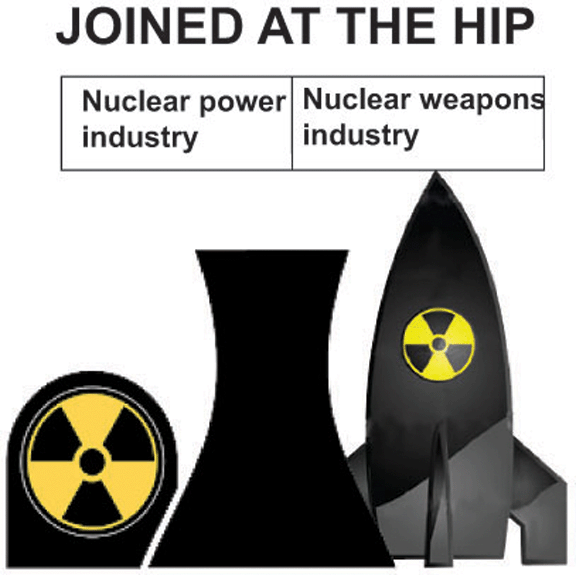 For years, the nuclear industry insisted that civilian nuclear power had nothing to do with weapons programs. That was then. Now, in a desperate attempt to keep no-longer-competitive nuclear plants from being shuttered, the industry claims there really has been a connection all along, and electricity customers should pay a premium to keep it going. It is one claim too many.
In its latest public effort, the nuclear industry got several dozen retired generals and admirals, former State, Defense and Energy Department officials, three former chairmen of the Nuclear Regulatory Commission, and a sprinkling of former senators, governors, industrialists and other worthies to sign a June 26, 2018, letter to Energy Secretary Rick Perry attesting to the connection between U.S. nuclear power plants and national security. The letter urged him to weigh in with federal and state rate-setting bodies to raise customers’ electricity bills to keep U.S. nuclear plants from shutting down, however much that will cost.
The letter didn’t, of course, put it in such crass terms. It talks about taking “concrete steps” to ensure electricity markets valued the nuclear plants’ “national security attributes”— a vague enough formulation to ease getting signatories. Most of them, as one of the signers (former Virginia Senator John Warner) himself put it , “are not intimately familiar with the ins and outs of the financial side of the power grid.” They do, however, apparently believe that they see the big picture—”the national security attributes of nuclear power”—more clearly than the parochial federal and state officials who set electric rates.
But are they any clearer on nuclear power’s national-security attributes than they are on the financial side of the industry?
The letter talks about “robust” nuclear power plants offering “a level of protection against natural and adversarial threats.” Leaving aside that “a level of protection” doesn’t mean much, the implied claim is dubious. It’s not well known but nuclear plant safety is critically dependent on the reliability of the electrical grid to which it is connected. In severe natural situations (ice storms, hurricanes, tornadoes, earthquakes), and even more so in adversarial ones, the transmission lines connecting nuclear plants to the electrical grid may fail or be destroyed. The earthquake that triggered the Fukushima accident first destroyed transmission towers and broke the link with the electrical grid. In these circumstances a nuclear plant must be shut down, as would any other electric generating plant. The difference, however, is that the nuclear plant becomes a serious liability because its safety cooling systems would have to operate indefinitely on its emergency diesel reserves—a highly undesirable state of affairs. There have been grid failures in the United States that have put several nuclear plants into emergency mode. In this context, it’s fair to ask whether nuclear plants increase the resilience of our electrical grid or burden it.
Another claim is that the Navy “benefits from a strong civil nuclear sector.” Maybe so. But in that event, as John Cochrane, an economist with the Hoover Institution, pointed out in connection with a similar appeal to subsidies, “If national security is at risk, let Defense ask for money.” The writers and signatories of the Perry letter know that nuclear power subsidies wouldn’t stand a chance set against the priorities of the Department of Defense. They know it would be an easier touch to stick the country’s ratepayers with the added bill. There is an element of insensitivity in this, as most of the ratepayers are in rather more difficult financial circumstances than the comfortably pensioned signatories. It has not occurred to them to ask that industry should earn less out of patriotism. But, of course, they didn’t write the letter.
“The nuclear industry is an important career destination for military veterans.” True, and retired Navy officers and seamen have had a useful effect on making plants run better and more safely. But should customers pay more on their bills to provide second careers to retired military and naval personnel at plants that are not needed?
The claim in the letter that deserves the most attention is the insidious argument that the United States needs to be a major exporter of nuclear technology in order to retain “influence over nonproliferation.” The worldwide spread of nuclear technology is, of course, what makes proliferation an urgent problem. The whole point of the body of the Perry letter is that there is a close connection between U.S. nuclear power and our nuclear weapons programs. Why should we think that this connection is not present in other countries? Wouldn’t that suggest sharing less, rather than more, of this technology?
Nuclear power has not succeeded in escaping its origin. It was born in the federal government, was suckled by the government, and has always relied on government support and protection. The industry preferred a system of federal regulation that gave the public essentially no say in the deployment of nuclear plants. It was an easy path for the industry to get its way, but only for a time. The crutch that seemed to make it unnecessary to react to public and market feedback also held back improvements. Now that nuclear plants are threatened with shutdowns, the industry can only think of more federal and state subsidies. In this latest effort, the industry wraps itself in the flag to urge Washington to find a way to stick ratepayers with the tab. It should be ignored.
Victor Gilinsky served on the U.S. Nuclear Regulatory Commission under Presidents Gerald Ford, Jimmy Carter, and Ronald Reagan. He is program adviser for the Nonproliferation Policy Education Center. Henry Sokolski is executive director of the Nonproliferation Policy Education Center and the author of Underestimated: Our Not So Peaceful Nuclear Future. He served as deputy for nonproliferation policy in the office of the U.S. secretary of defense from 1989 to 1993.
Canada’s Nuclear Waste Management Organization is educating youth

NWMO introducing nuclear waste plan education to youth Kincardine News, 9 Aug 18, With summer winding down, the Nuclear Waste Management Organization is concluding a busy few months of activities engaging with area youth……. “We want to foster and support opportunities for young people in South Bruce and Huron-Kinloss. Our local youth have a lot to offer, and as we engage with them as part of Canada’s plan we hope to strengthen the impact they will have on their communities.”…….
Elementary and high schools in South Bruce and Huron-Kinloss were treated to an energy and nuclear power discussion with University of Calgary Professor Dr. Jason Donev, and the Canadian Nuclear Safety Commission (CNSC) also made stops to talk about radiation and their role as Canada’s independent nuclear regulator.
Local youth have highlighted their desire to seek out information on social media, specifically on Instagram.
Already established on Facebook since October 2017, the NWMO recently launched on Instagram (follow @nwmocanada) with content highlighting its activities, and is working toward digital products that will help introduce Canada’s plan to the next generation.https://www.kincardinenews.com/news/local-news/nwmo-introducing-nuclear-waste-plan-education-to-youth
Ahead of Olympic Games, Fukushima nuclear power plant gets an extreme makeover
 Extreme makeover: Fukushima nuclear plant tries image overhaul,
  Channel News Asia, 3 August 18,
FUKUSHIMA: Call it an extreme makeover: In Japan’s Fukushima, officials are attempting what might seem impossible, an image overhaul at the site of the worst nuclear meltdown in decades.
At the Fukushima Daiichi nuclear plant, there’s a flashy new administrative building, debris has been moved and covered, and officials tout the “light” radioactive security measures now possible.
“You see people moving around on foot, just in their uniforms. Before that was banned,” an official from the plant’s operator TEPCO says.
“These cherry blossoms bloom in the spring,” he adds, gesturing to nearby foliage.
If it sounds like a hard sell, that might be because the task of rehabilitating the plant’s reputation is justifiably Herculean.
………TEPCO officials have been gradually trying to rebrand the plant, bringing in school groups, diplomats and other visitors, and touting a plan to attract 20,000 people a year by 2020, when Tokyo hosts the Summer Olympics.
Officials point out that protective gear is no longer needed in most of the plant, except for a small area, where some 3,000 to 4,000 workers are still decontaminating the facility.
Since May, visitors have been able to move around near the reactors on foot, rather than only in vehicles, and they can wear “very light equipment,” insists TEPCO spokesman Kenji Abe.
That ensemble includes trousers, long sleeves, a disposable face mask, glasses, gloves, special shoes and two pairs of socks, with the top pair pulled up over the trouser hem to seal the legs underneath.
And of course there’s a geiger counter.
The charm offensive extends beyond the plant, with TEPCO in July resuming television and billboard adverts for the first time since 2011, featuring a rabbit mascot with electrical bolt whiskers called “Tepcon”.
But the upbeat messaging belies the enormity of the task TEPCO faces to decommission the plant.
It has installed an “icewall” that extends deep into the ground around the plant in a bid to prevent groundwater seeping in and becoming decontaminated, or radioactive water from inside flowing out to the sea.
But about 100,000 litres of water still seeps into the plant each day, some of which is used for cooling. It requires extensive treatment to reduce its radioactivity.
Once treated, the water is stored in tanks, which have multiplied around the plant as officials wrangle over what to do with the contaminated liquid.
There are already nearly 900 tanks containing a million cubic metres of water – equal to about 400 Olympic swimming pools.
And the last stage of decommissioning involves the unprecedented task of extracting molten nuclear fuel from the reactors…….https://www.channelnewsasia.com/news/asia/extreme-makeover–fukushima-nuclear-plant-tries-image-overhaul-10586540
Australia’s nuclear testing before the 1956 Olympics in Melbourne should be a red flag for Fukushima in 2020
Part time tutor in Medical Education, University of Dundee
The scheduling of Tokyo 2020 Olympic events at Fukushima is being seen as a public relations exercise to dampen fears over continuing radioactivity from the reactor explosion that followed the massive earthquake six years ago.
It brings to mind the British atomic bomb tests in Australia that continued until a month before the opening of the 1956 Olympic Games in Melbourne – despite the known dangers of fallout travelling from the testing site at Maralinga to cities in the east. And it reminds us of the collusion between scientists and politicians – British and Australian – to cover up the flawed decision-making that led to continued testing until the eve of the Games.
Australia’s prime minister Robert Menzies agreed to atomic testing in December 1949. Ten months earlier, Melbourne had secured the 1956 Olympics even though the equestrian events would have to be held in Stockholm because of Australia’s strict horse quarantine regimes.
The equestrians were well out of it. Large areas of grazing land – and therefore the food supplies of major cities such as Melbourne – were covered with a light layer of radiation fallout from the six atomic bombs detonated by Britain during the six months prior to the November 1956 opening of the Games. Four of these were conducted in the eight weeks running up to the big event, 1,000 miles due west of Melbourne at Maralinga.
Bombs and games
In the 25 years I have been researching the British atomic tests in Australia, I have found only two mentions of the proximity of the Games to the atomic tests. Not even the Royal Commission into the tests in 1985 addressed the known hazards of radioactive fallout for the athletes and spectators or those who lived in the wide corridor of the radioactive plumes travelling east.
At the time, the approaching Olympics were referred to only once in the Melbourne press in relation to the atomic tests, in August 1956. It is known that D-notices from the government “requesting” editors to refrain from publishing information about certain defence and security matters were issued.
The official history of the tests by British nuclear historian Lorna Arnold, published by the UK government in 1987 and no longer in print, reports tests director William Penney signalling concern only once, in late September 1956:
Am studying arrangements firings but not easy. Have Olympic Games in mind but still believe weather will not continue bad.
This official history doesn’t comment on the implications. And nowhere in the 1985 Royal Commission report is there any reference to the opening of the Olympics, just one month and a day after the fourth test took place 1,000 miles away.
The 1984 report of the Expert Committee on the review of Data on Atmospheric Fallout Arising from British Nuclear Tests in Australia found that the methodology used to estimate the numbers of people who might have been harmed by this fallout at fewer than 10 was inappropriate. And it concluded that if the dose calculations were confined to the communities in the path of the fallout and not merged with the total Australian population “such an exercise would generate results several orders of magnitude higher than those based on conventional philosophy”. There was no mention of the Olympic Games.
Neither Prime Minister Menzies nor his cabinet ever referred publicly to what had been known from the outset – that the British atomic tests in Australia would almost coincide with the Melbourne Olympics. The tests and the Games were planned simultaneously through the first half of the 1950s.
In May 1955, 18 months before the Olympics were due to start, Howard Beale, the Australian minister for supply, announced the building of “the Los Alamos of the British Commonwealth” (a nuclear test site in New Mexico) at Maralinga, promising that “tests would only take place in meteorological conditions which would carry radioactive clouds harmlessly away into the desert”.
An Atomic Weapons Tests Safety Committee was formed by the Australians but was closely controlled by physicist Professor Ernest Titterton, the only Englishman on the panel. The 1985 Royal Commission stated explicitly that the AWTSC was complicit in the firing of atomic detonations in weather conditions that they knew could carry radioactive fallout a thousand miles from Maralinga to eastern cities such as Melbourne.
Hazards of radioactivity
Professor Titterton, who had recently been appointed to a chair in nuclear physics at the Australian National University after working on the Manhattan Project at Los Alamos, and at Aldermaston in England, explained why the atomic devices were being tested in Australia:
Because of the hazards from the radioactivity which follows atomic weapons explosions, the tests are best carried out in isolated regions – usually a desert area … Most of the radioactivity produced in the explosion is carried up in the mushroom cloud and drifts downward under atmospheric airstreams. But particular material in this cloud slowly settles to the ground and may render an area dangerously radioactive out to distances ranging between 50 and several hundred miles … It would therefore be hazardous to explode even the smallest weapons in the UK, and it was natural for the mother country to seek test sites elsewhere in the Commonwealth.
The AWTSC published two scientific papers in 1957 and 1958 which flat out denied that any dangerous levels of radioactivity reached the eastern states. But their measurements relied on a very sparse scattering of sticky paper monitors – rolls of gummed film set out to catch particles of fallout – even though these could be washed off by rain.
Despite their clear denials in these papers, meteorological records show that prior to the Games there was rain in Melbourne which could have deposited radioactivity on the ground.
The AWTSC papers included maps purporting to show the plumes of radioactive fallout travelling north and west from Maralinga in the South Australian desert. The Royal Commission published expanded maps (see page 292) based on the AWTSC’s own data and found the fallout pattern to be much wider and more complex. The Australian scientist Hedley Marston’s study of radioactivity uptake in animals showed a far more significant covering of fallout on a wide swathe of Australian grazing land than indicated by the sticky paper samples of the AWTSC.
The 1985 Royal Commission report into British Nuclear Tests in Australia discussed many of these issues, but never in relation to the proximity and timing of the 1956 Olympic Games. Sixty years later, are we seeing the same denial of known hazards six years after the reactor explosion at Fukushima?
China and UK to work together on promoting the nuclear industry to universities etc
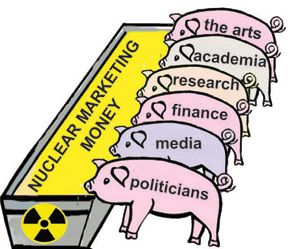
Energy Live News 29th June 2018 , China’s largest nuclear power producer has signed a Memorandum of
Understanding (MOU) with the UK Nuclear Advanced Manufacturing Research
Centre (Nuclear AMRC) to help deepen its links with Britain’s supply
chain.
CGN, the developer of the Bradwell B project, hopes to develop its
expertise and knowledge, as well as improve commercial and academic
connections. The wide-ranging deal includes working out how UK businesses
and universities can prepare themselves to participate in the project and
how these organisations can add value to CGN’s nuclear operations in
China and elsewhere.
https://www.energylivenews.com/2018/06/29/cgn-signs-mou-to-deepen-links-with-uks-nuclear-supply-chain/
James Hansen – a prophet on climate change, but a crank on nuclear power
James Hansen and the whale, a tragi-comedy in four chapters, The Reality Based Community, By
“………..[James Hansen] he said :
Nuclear, especially next-generation nuclear, has tremendous potential to be part of the solution to climate change. The dangers of fossil fuels are staring us in the face. So for us to say we won’t use all the tools [such as nuclear energy] to solve the problem is crazy.
These crucial policy and technical developments were the fruit of a fairly small number of enterprising, determined and lucky individuals. They included:
- Researchers on solar: Becquerel, Willoughby Smith, Fritts, Einstein, Czochralski, the Bell Labs team of Chapin, Fuller, and Pearson. On wind: Poul La Cour and Johannes Juul in Denmark. On batteries: John Goodenough, who coming up to his 96th birthday still unprized in Stockholm, has just announced a research breakthrough on a high-density solid-state lithium battery.
- Politicians and bureaucrats: NASA in the 1960s, MITI in the 1970s; Hans-Josef Fell and Hermann Scheer, leaders of the Energiewende in Germany and instigators of the 2000 Renewable Energy Act (EEG); Jerry Brown of California; Barack Obama (through targeted ARRA funding and the bilateral deal with China that made Paris possible).
- Businessmen: Tokuji Hayakawa of Sharp in Japan; Elon Musk of Tesla; Wang Chuanfu of BYD.
This is an incomplete list, and no doubt unfair from my lack of knowledge. But it is near-certain that without these 18, and the then leaders of MITI and NASA, renewable energy and electric transport would not be where they are today.
The challenge also induced a lot of effort on enhanced geothermal, wave energy, OTEC, power kites, fuel cell cars, and other ideas that have not so far panned out. Nobody knows in advance which ideas will work out, and the failures also deserve their share of praise….. http://www.samefacts.com/2018/07/everything-else/james-hansen-and-the-whale-a-tragi-comedy-in-four-chapters/

UK govt launches pro nuclear campaign, pushes for women in the nuclear industry
 UK government unveils £200m nuclear sector deal, The Engineer, Business secretary Greg Clark launches deal including commitment to new technology development and increased role for women in the nuclear industry ……. Details of the deal include up to £44m funding to develop advanced modular reactors, a commitment to reduce the cost of nuclear new build by 30 per cent by 2030, and to cut the cost of decommissioning old sites by 20 per cen% in the same period. There will be a new review into ways of accelerating the cleanup of old sites. Clark also signalled an increased commitment to fusion energy research, with the establishment of a national fusion technology centre at Culham in Oxfordshire, the site of the Joint European Torus (JET) fusion experiment and the home of Tokomak Technologies, which is developing fusion reactors based on the spherical tokomak principle. This fusion centre will be supported by £86m funding from the government.
“The UK is the home of civil nuclear technology and with this investment in innovation and our commitment to increasing diversity in an already highly-skilled workforce, I want to ensure we remain the world leader,” Clark said.
The NSD was announced at Trawsfynydd in Snowdonia, the site of a decommissioned nuclear reactor (the only one in the UK not on the coast) and a mooted site for the first small modular reactor project. “This site reflects both the past of our nuclear industry and an exciting future as the potential site for the new generation of small reactors, placing Wales at the centre of a UK arc of the nuclear industry,” said Alan Cairns, secretary of state for Wales.
The advanced modular reactor project will see eight designs go forward to detailed commercial and technical visibility studies. This phase 1, £4m has been allocated, and three or four of the designs will then go forward to a second phase for further development, with a possible £40m of further funding subject to a value for money approval from the Treasury. Up to £5m will be made available to regulators to support this, and up to £7m will fund capability and capacity to assess and licence small and novel reactor designs…..https://www.theengineer.co.uk/nuclear-industry-sector-deal/
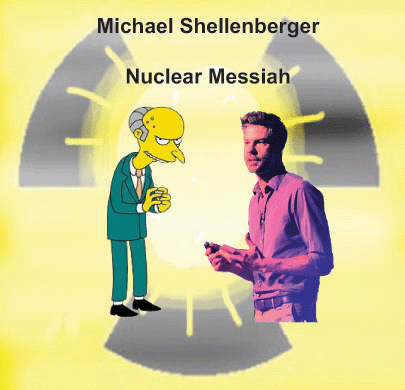
Pro nuclear spruik of Michael Shellenberger is getting weirder and weirder
Steve Dale Nuclear Fuel Cycle Watch South Australia, 21 June 18
Shellenberger’s latest article is pretty strange and contradicts a lot of things I’ve heard from his local supporters.
Most unusual is that he calls nuclear waste a “blessing” – “But achieving that future will first require that we abandon our ridiculous fears and start seeing nuclear waste as the environmental blessing that it is.”
He also doesn’t want nuclear waste moved – not even from the reactor, let alone the USA. He says “Don’t Move The Waste” and “transporting cans of used nuclear waste would increase the threat to the continued operation of our life-saving nuclear plants.” This sort of contradicts the whole push of the NFCRC.
Shellenberger proposes that money set aside for storing nuclear waste for millennia should be diverted to nuclear plants, he says “It should be used to subsidize the continued operation of economically distressed nuclear plants, and subsidize the building of new ones.”
When a nuclear accident occurs we are usually told it’s because it is an old or aging plant? Well Shellenberger claims “Nuclear plants are functionally immortal. Existing plants can operate for 60, 80, 100 years or longer because everything inside the plant from the control panels to the steam generators and even the reactor vessel itself can be replaced, if needed.”
And I’ve heard local nuclear lobbyists claim new “waste eating” reactors are just around the corner, less than 10 years away, but Shellenberger says – “Sometime between 2050 and 2100, new nuclear plants — like the kind being developed by Bill Gates — will likely be able to use the so-called “waste” as fuel.”
I wonder what Shellenberger’s local supporters would think of this article? If Shellenberger gets his way, millennia lasting nuclear waste will be stored in half-inch thin, welded casks (see picture below) for centuries – by which time it would be too fragile to move.
The Forbes article is “Stop Letting Your Ridiculous Fears Of Nuclear Waste Kill The Planet” https://www.facebook.com/groups/1021186047913052/
The nuclear industry has co-opted academia in Cumbria
In Cumbria 21st June 2018, More needs to be done to ensure communities not only see but feel the benefits of investment in Cumbria’s nuclear sector, industry figures have been told. Rick Wylie, the Samuel Lindow Academic Director for the University of Central Lancashire (UCLan) based at Westlakes Science and Technology Park, laid down the challenge at the third warm-up arm-up event to September’s Cumbria Nuclear Conference, hosted by Carlisle MP John Stevenson.
Mr Wylie stressed the important work the nuclear industry had already done to support communities and the aspirations of young people and adults, by supporting projects such as the new Whitehaven Academy and Well Whitehaven. But, in a speech at Castle Green Hotel in Kendal on Thursday night, he said: “Nuclear investment needs to have wider public value. It is not just about money, it is about ensuring people not just see but feel the benefits of it.
Japan High School Peace Envoys Keen to Deliver Voices of Hibakusha

https://jen.jiji.com/jc/eng?g=eco&k=2018060701223
Tokyo, (Jiji Press), 7 June 18, –Japanese “high school peace ambassadors” on Thursday expressed their hopes to convey the voices of hibakusha, or atomic bomb survivors, for nuclear abolition to the world, and spread peace across the globe.
The high school students, who took part in a campaign to collect signatures with the aim of abolishing nuclear weapons, have been selected as a candidate for the Nobel Peace Prize for 2018.
At an event in Tokyo on Thursday to report the peace ambassador activities, Konami Funai, 17, a high school third-grader from Fukuyama, Hiroshima Prefecture, western Japan, spoke about her visit to the secretariat of the Norwegian Nobel Committee in March.
“It made me even prouder of our activities,” she said, referring to the nomination as a Nobel prize candidate. But Funai added that even if they win the prize, it would not be their goal. “I’ll patiently continue to call for nuclear abolition.”
The high school peace ambassadors were nominated a Nobel Peace Prize candidate by the Norwegian committee, after Japanese lawmakers recommended them for the award with the campaign marking its 20th anniversary this year.
Chinese firm Ocean Nuclear, links to former UK Prime Minister, on a fund-raising roadshow in London


 City AM 1st June 2018 Energy investment firm Ocean Nuclear today announced the launch of a $5bn (£3.8bn) nuclear energy industry fundraising roadshow in London. The Chinese company has negotiated nuclear infrastructure projects in more than
20 countries and will use 144 meetings at the roadshow to raise money for the programmes.
Ocean Nuclear has backing from firms including Silk Road Energy, which aims to raise $80m, and has been backed by the Belt and Road initiative, which has links to former Prime Minister David Cameron.
http://www.cityam.com/286792/chinese-firm-launches-5bn-london-nuclear-energy-industry
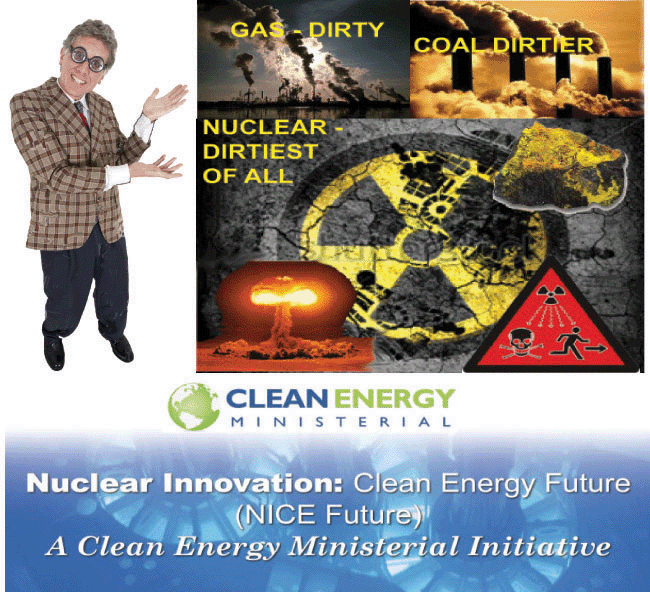
“Nuclear is N.I.C.E” – the latest spin from the desperate nuclear industry
America Joins With Canada And Japan To Promote Nuclear Power, Forbes, , 29 May 18, “…… at a summit in Copenhagen, Denmark last week, it was clear the US is now trying a different tact.
A ‘Clean Energy Summit’ was organized bringing together energy ministers from across the world. At the event, the US launched new partnerships to promote nuclear power and coal with carbon capture and storage technology as alternatives to traditional fossil fuels……
The new nuclear partnership with Japan and Canada, was launched on Thursday. At the summit, the US was able to convince two new partners who are member states of the European Union – Poland and Romania – to join the alliance.
The partnership is called Nuclear Innovation: Clean Energy Future (NICE Future).
“Countries will need to use nuclear energy alongside other forms of clean energy to deliver a sustainable energy mix that is affordable to all and that supports economic development,” Agneta Rising, director general of the World Nuclear Association, said at the launch.
The aim of the initiative is to promote nuclear as a solution to climate change….
Separately, the US also promoted a new platform on Carbon Capture and Storage (CCS) called the Carbon Capture, Utilization and Storage Initiative that will focus on obtaining more financing for CCS demonstration projects. Such financing has been hard to come by in Europe, because investors are still sceptical about whether the technology, which stores the carbon underground rather than releasing it into the air, is viable.
The efforts may represent a new phase in America’s climate diplomacy……
Environmental campaigners, however, are having none of it. Hundreds of activists disrupted an event organized by the US government in November to promote nuclear and clean coal. They say the recent US moves are greenwashing a pro-coal agenda that is not actually interested in stopping climate change.
Whether these new US initiatives attract more members remains to be seen. https://www.forbes.com/sites/davekeating/2018/05/28/america-joins-with-canada-and-japan-to-promote-nuclear-power/#4c8293d4da53
UK is not correctly testing Hinkley Point dumped mud for radioactivity
Barry GEM 28th May 2018 ,Richard Bramhall. Referring to The GEM’s recent article on the dumping of
mud from Hinkley Point in the Bristol Channel, campaigners oppose the
dumping not because of ‘passion’ but because of science.
EDF’s references to bananas, radon and cosmic rays are unscientific. Potassium 40
(in the bananas), radon and cosmic rays are evenly distributed in body
tissue and the radiation effects are well understood.
The radioactive particles which EdF refuses to look for in the mud are quite different. The
UN has published data showing enormous amounts of particulates from Hinkley
Point. These are microscopic fragments of uranium oxide and probably
plutonium which are small enough to inhale. From the lung they can travel
anywhere in the body — to the lymph nodes, for example. Such particles
emit very short-range radiations all the time, continually hitting the
cells within a few microns. To treat this as an average all-body dose is
like thinking you can safely keep your baby warm by tucking a soldering
iron into her babygro. The Government laboratory that tested mud samples
did not use techniques capable of detecting uranium or plutonium. This is
why campaigners demand thorough testing.
http://www.barry-today.co.uk/article.cfm?id=119988&headline=%E2%80%98Hinkley%20Point%20mud%20needs%20more%20testing%E2%80%99%20%E2%80%93%20a%20GEM%20reader%27s%20letter§ionIs=news&searchyear=2018
USA and others start a new desperate push to promote nuclear power
 U.S. and partners form international alliance to push nuclear power https://www.reuters.com/article/us-usa-nuclear/u-s-and-partners-form-international-alliance-to-push-nuclear-power-idUSKCN1IP1PO, Reuters Staff, 24 May 18, COPENHAGEN (Reuters) – The United States is leading an initiative with several other governments to promote nuclear power and encourage investment in new nuclear technologies.
The initiative, launched on Thursday by U.S. Deputy Secretary of Energy Dan Brouillette with international partners, aims to “highlight the value of nuclear energy as a clean reliable energy source”.
The partners are Japan, Canada, Russia, South Africa, the United Arab Emirates, Poland, Argentina and Romania.
The U.S. nuclear industry is battling competition particularly from natural gas, while many national governments want to reduce their dependency on the energy source after the nuclear accident at Japan’s Fukushima plant in 2011.
The group of nations aims to promote areas such as improved power system integration and the development of technologies like hybrid nuclear-renewable systems.
“Nuclear-renewable systems could link emission-free nuclear power plants with variable renewables like solar or wind farms and could allow nuclear power to backstop intermittent generation,” Brouillette said during the launch at the Clean Energy Ministerial (CEM) in Copenhagen.
CEM is a global forum of 24 countries and the European Union which together account for 75 percent of global greenhouse gas emissions.
Brouillette said the initiative would also focus on the development of small modular reactors (SMR), which use existing or new nuclear technology scaled down to a fraction of the size of larger plants and would be able to produce around a tenth of the electricity created by large-scale projects.
Critics say SMR economies of scale will be limited because each reactor will need its own control and safety systems. They also point to the danger of spreading radioactive material more widely, increasing radiation and security risks.
The administration of President Donald Trump also launched an alliance with Norway and Saudi Arabia to boost public and private partnerships on carbon capture, utilization and storage (CCUS).
Earlier this month, Japan released a draft of an updated basic energy policy, leaving its ideal mix of power sources for 2030 in line with targets set three years ago, despite criticism that it placed too much emphasis on unpopular nuclear power.
To view a graphic on Nuclear power plants in the world , click: tmsnrt.rs/2sKlV1X
Reporting by Stine Jacobsen and Jacob Gronholt-Pedersen; Editing by Edmund Blair and David Stamp
Desperate nuclear lobby goes bananas over bananas

The pro-nuclear lobby goes bananas https://beyondnuclearinternational.org/2018/05/20/the-pro-nuclear-lobby-goes-bananas/
1 This Month
Chernobyl: The Lost Tapes – A good documentary on Chernobyl on SBS available On Demand for the next 3 weeks– https://www.sbs.com.au/ondemand/tv-program/chernobyl-the-lost-tapes/2352741955560

of the week–London Campaign for Nuclear Disarmament

Tell the Ukrainian Government to Drop Prosecution of Peace Activist Yurii Sheliazhenko
To see nuclear-related stories in greater depth and intensity – go to https://nuclearinformation.wordpress.com
-
Archives
- April 2026 (152)
- March 2026 (251)
- February 2026 (268)
- January 2026 (308)
- December 2025 (358)
- November 2025 (359)
- October 2025 (376)
- September 2025 (257)
- August 2025 (319)
- July 2025 (230)
- June 2025 (348)
- May 2025 (261)
-
Categories
- 1
- 1 NUCLEAR ISSUES
- business and costs
- climate change
- culture and arts
- ENERGY
- environment
- health
- history
- indigenous issues
- Legal
- marketing of nuclear
- media
- opposition to nuclear
- PERSONAL STORIES
- politics
- politics international
- Religion and ethics
- safety
- secrets,lies and civil liberties
- spinbuster
- technology
- Uranium
- wastes
- weapons and war
- Women
- 2 WORLD
- ACTION
- AFRICA
- Atrocities
- AUSTRALIA
- Christina's notes
- Christina's themes
- culture and arts
- Events
- Fuk 2022
- Fuk 2023
- Fukushima 2017
- Fukushima 2018
- fukushima 2019
- Fukushima 2020
- Fukushima 2021
- general
- global warming
- Humour (God we need it)
- Nuclear
- RARE EARTHS
- Reference
- resources – print
- Resources -audiovicual
- Weekly Newsletter
- World
- World Nuclear
- YouTube
-
RSS
Entries RSS
Comments RSS
 nuclear-news